June 11, 2017marketing.scienceconsulting group, inc.
linkedin.com/in/augustinefou
Q2 2017 Ad Blocking Update
Marketing Science analyzed 1 billion pageviews from 20 top mainstream publishers
in the U.S. and Canada. The data was directly measured with an on-site embed code
during the month of May 2017. Mobile is mobile web; ads in-app cannot be blocked
by other apps on the mobile device, because app-store policies prevent any app
from interfering with the operation of another app, which includes calling for ads.
(NOTE: specifically configured proxy apps can block ads from other apps; but their use is not widespread.)
The methodology includes the following:
• Could not be measured - on average 10% of the pageviews could not be measured for ad
blocking (e.g. browser did not run javascript, measurement script blocked by ad blocker).
• Bots must be scrubbed - on average, good publishers had 1 - 4% bots (NHT, IVT), which were
scrubbed from the data. Bots do not block ads and therefore should not be counted.
• Confirmed by direct measurement - of the remaining pageviews, ad blocking was measured
by calling an ad – ad.gif, with standard dimensions – 300x250. The results were confirmed as
“ad loaded” or “ad blocked.” Desktop and laptops were grouped together, and separated from
Mobile (which includes smartphones and tablets).
KEY FINDINGS
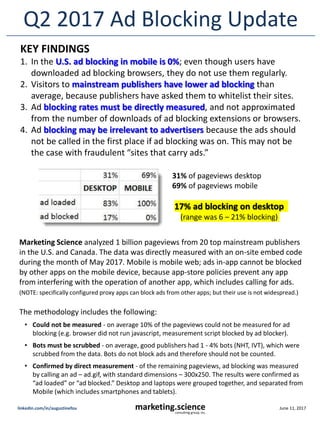
1. In the U.S. ad blocking in mobile is 0%; even though users have
downloaded ad blocking browsers, they do not use them regularly.
2. Visitors to mainstream publishers have lower ad blocking than
average, because publishers have asked them to whitelist their sites.
3. Ad blocking rates must be directly measured, and not approximated
from the number of downloads of ad blocking extensions or browsers.
4. Ad blocking may be irrelevant to advertisers because the ads should
not be called in the first place if ad blocking was on. This may not be
the case with fraudulent “sites that carry ads.”
31% of pageviews desktop
69% of pageviews mobile
17% ad blocking on desktop
(range was 6 – 21% blocking)

Q2 2017 Ad Blocking Update

  • 1.
    June 11, 2017marketing.scienceconsultinggroup, inc. linkedin.com/in/augustinefou Q2 2017 Ad Blocking Update Marketing Science analyzed 1 billion pageviews from 20 top mainstream publishers in the U.S. and Canada. The data was directly measured with an on-site embed code during the month of May 2017. Mobile is mobile web; ads in-app cannot be blocked by other apps on the mobile device, because app-store policies prevent any app from interfering with the operation of another app, which includes calling for ads. (NOTE: specifically configured proxy apps can block ads from other apps; but their use is not widespread.) The methodology includes the following: • Could not be measured - on average 10% of the pageviews could not be measured for ad blocking (e.g. browser did not run javascript, measurement script blocked by ad blocker). • Bots must be scrubbed - on average, good publishers had 1 - 4% bots (NHT, IVT), which were scrubbed from the data. Bots do not block ads and therefore should not be counted. • Confirmed by direct measurement - of the remaining pageviews, ad blocking was measured by calling an ad – ad.gif, with standard dimensions – 300x250. The results were confirmed as “ad loaded” or “ad blocked.” Desktop and laptops were grouped together, and separated from Mobile (which includes smartphones and tablets). KEY FINDINGS 1. In the U.S. ad blocking in mobile is 0%; even though users have downloaded ad blocking browsers, they do not use them regularly. 2. Visitors to mainstream publishers have lower ad blocking than average, because publishers have asked them to whitelist their sites. 3. Ad blocking rates must be directly measured, and not approximated from the number of downloads of ad blocking extensions or browsers. 4. Ad blocking may be irrelevant to advertisers because the ads should not be called in the first place if ad blocking was on. This may not be the case with fraudulent “sites that carry ads.” 31% of pageviews desktop 69% of pageviews mobile 17% ad blocking on desktop (range was 6 – 21% blocking)