Judaism and Greek Culture“Art, like morality, means drawing a line somewhere.” – Oscar Wilde
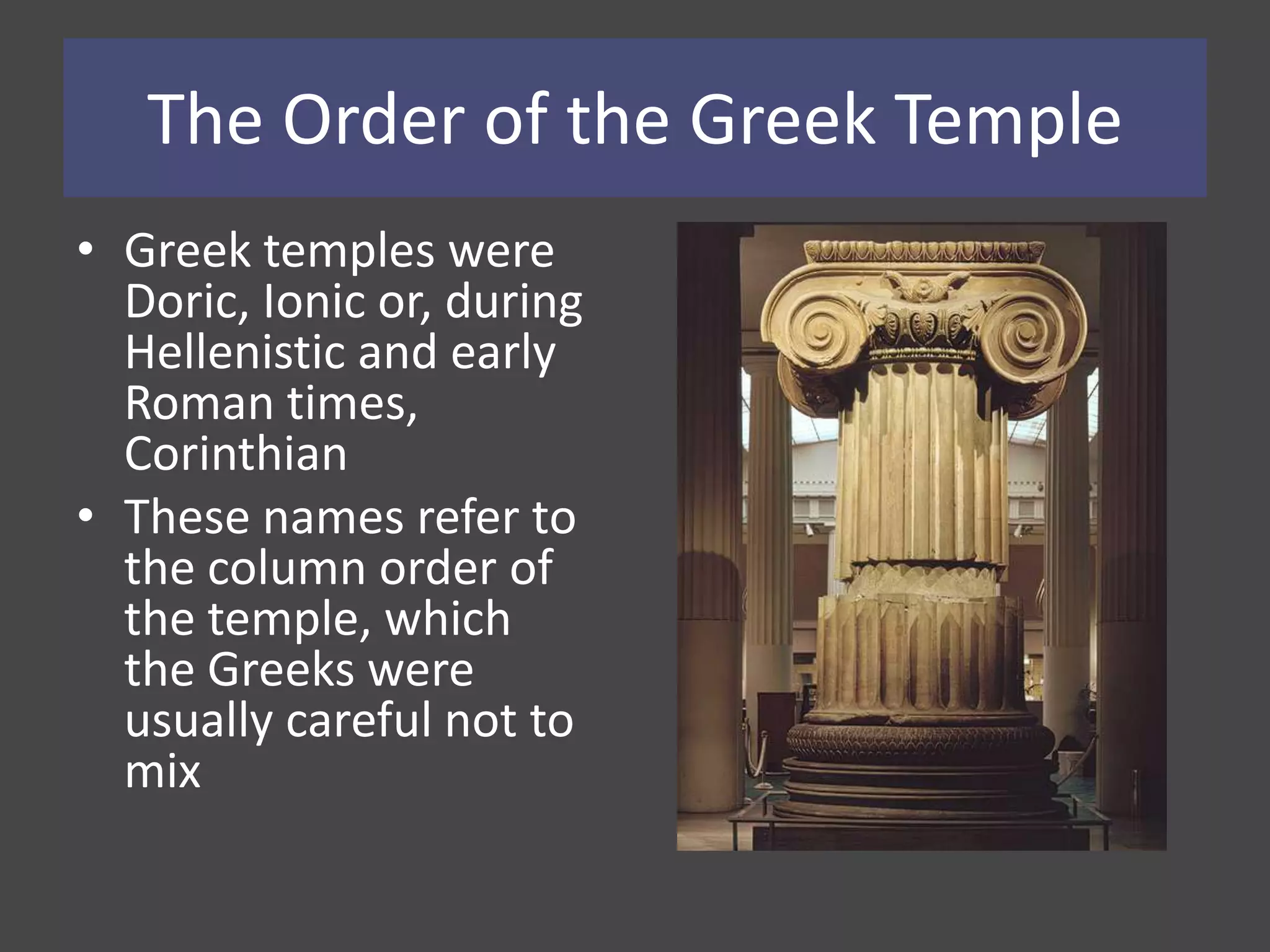
The Order of the Greek TempleGreek temples were Doric, Ionic or, during Hellenistic and early Roman times, CorinthianThese names refer to the column order of the temple, which the Greeks were usually careful not to mix
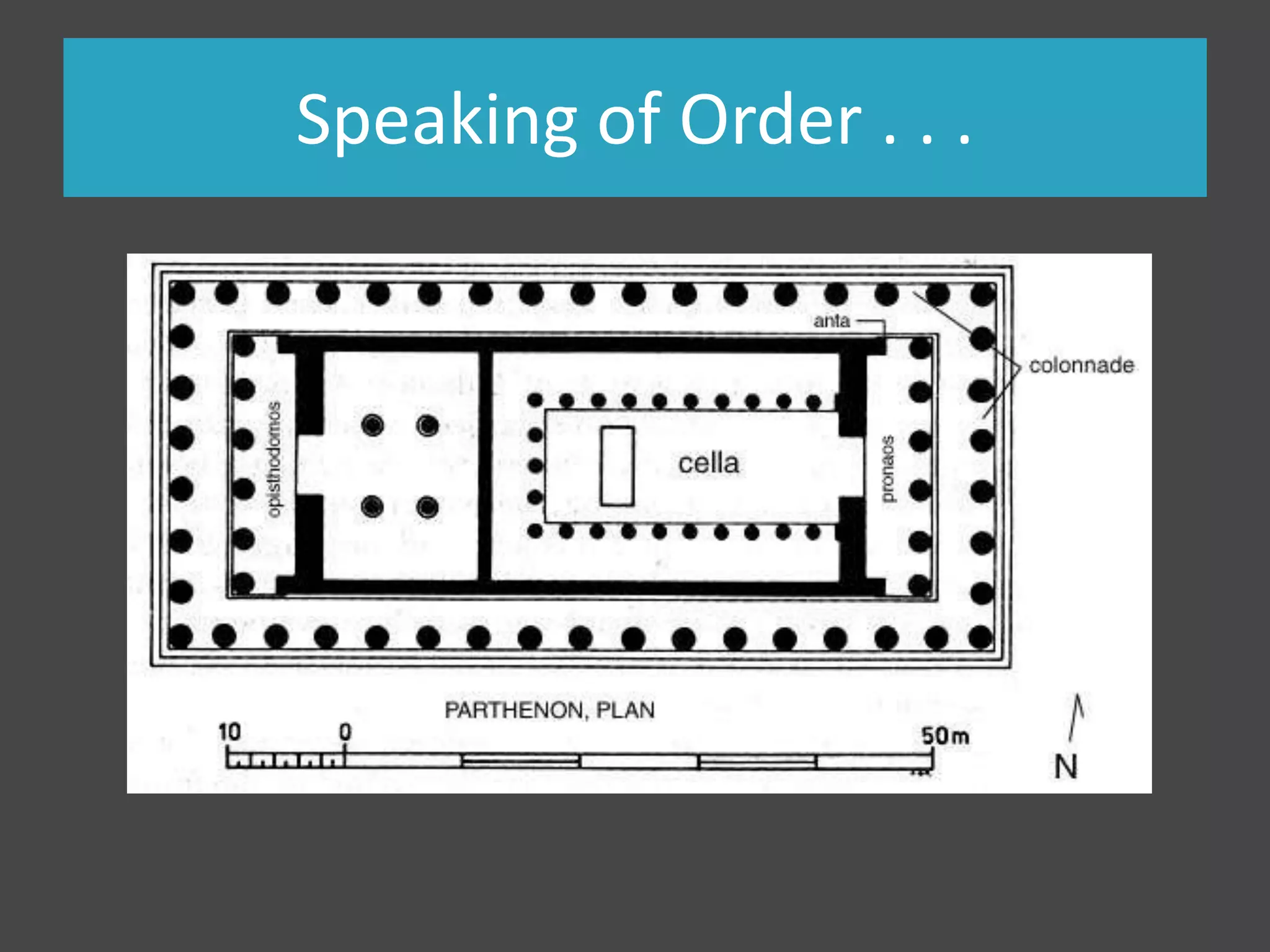
Speaking of Order . . .
The Exactness of the Greeks
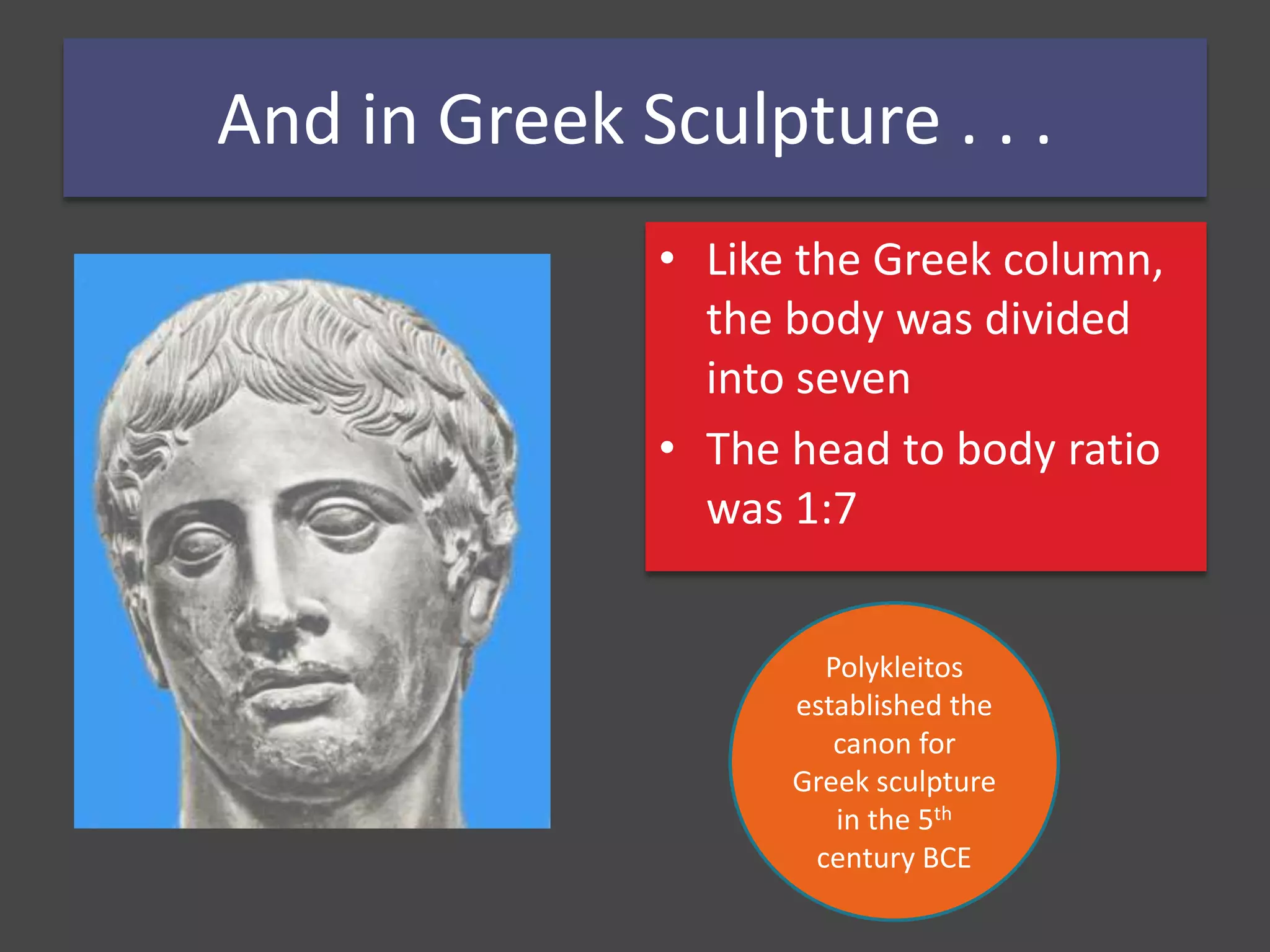
And in Greek Sculpture . . . Like the Greek column, the body was divided into sevenThe head to body ratio was 1:7Polykleitos established the canon for Greek sculpture in the 5th century BCE
Optical Corrections
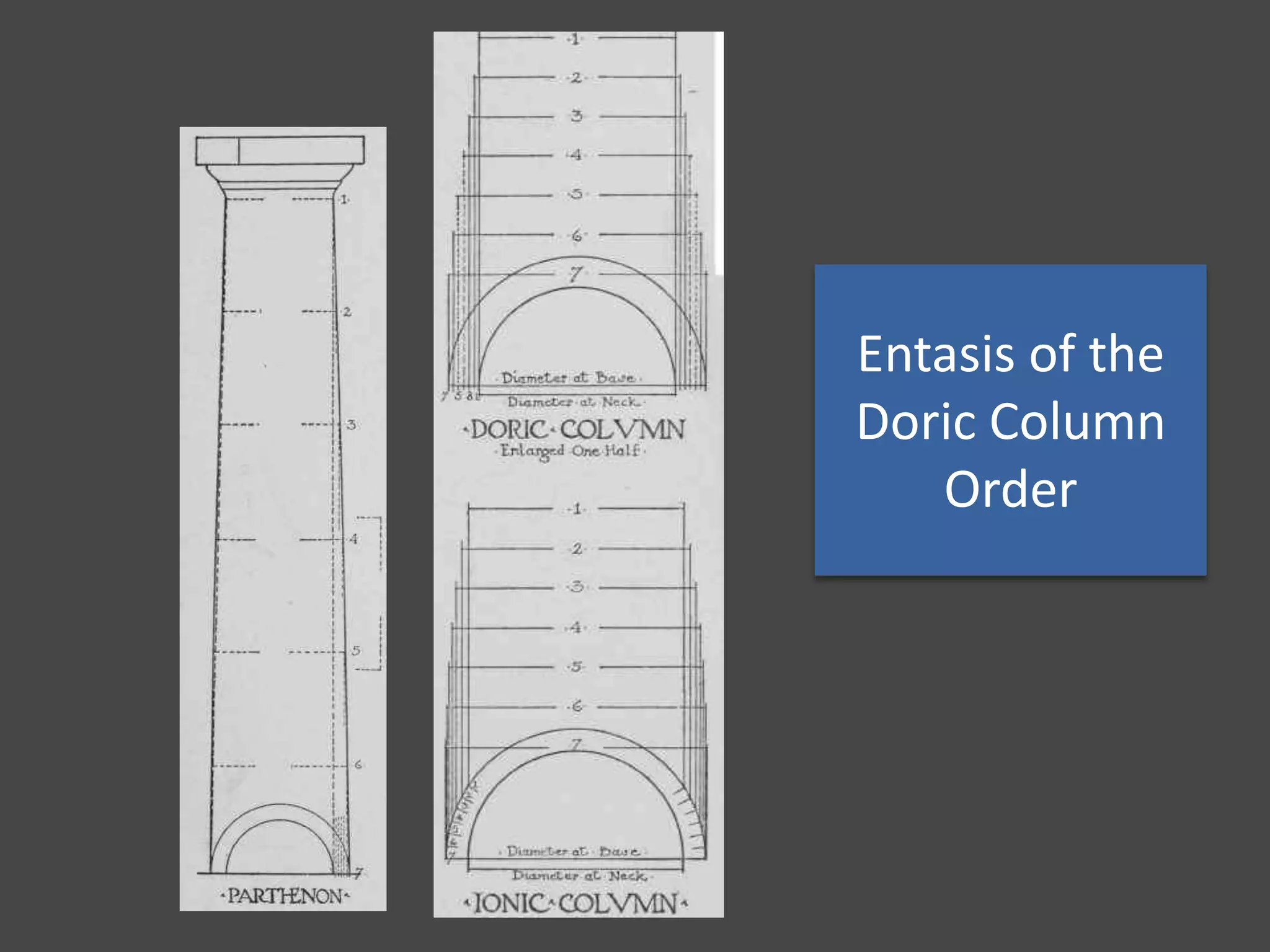
Entasis of the Doric Column Order
The Final Product
Greek Mathematical Principles and Notions of Beauty are Still With Us Today
So What Was the Problem?
Wisdom of Solomon, 13, late 2nd or early 1st century BCE workFor all men who were ignorant of God were foolish by nature; . ". . but they supposed that either fire or wind or swift air or "the circle of the stars, or turbulent water, or the "luminaries of heaven were the gods that rule the "world. . . . Yet these men are little to be blamed, for "perhaps they go astray while seeking God and desiring to find "him.
HammathTiberias B
Roman Floor Mosaic, depicting Helios, the sun god, who represented Sunday
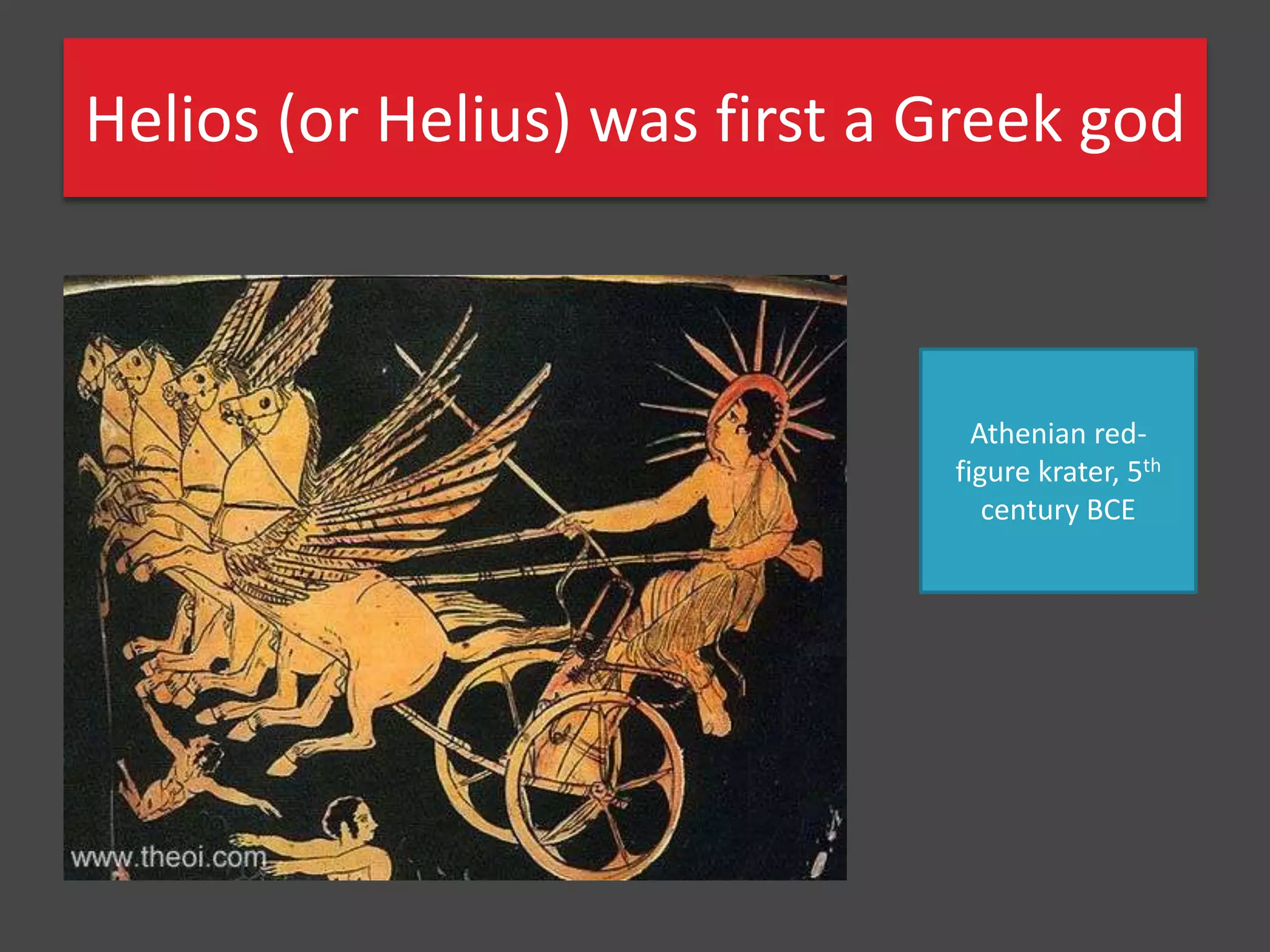
Helios (or Helius) was first a Greek godAthenian red-figure krater, 5th century BCE
ProhibitionsMishnahAvodah Zara 3:1The Rabbis forbid any image “that has in its hand a staff or a bird or a globe (kadur)”Circumcision is the oldest identifying feature of the Jews and was a ritual that was threatened during Hellenistic times, when nudity was so popular.
Greco-Roman Elements vs. Jewish Elements
“Art, like morality, means drawing a line somewhere” – Oscar Wilde“Art, like Modern Orthodoxy, means drawing a line somewhere” – Today’s Presentation

Judaism And Greek Culture

  • 1.
    Judaism and GreekCulture“Art, like morality, means drawing a line somewhere.” – Oscar Wilde
  • 2.
    The Order ofthe Greek TempleGreek temples were Doric, Ionic or, during Hellenistic and early Roman times, CorinthianThese names refer to the column order of the temple, which the Greeks were usually careful not to mix
  • 3.
  • 4.
  • 5.
    And in GreekSculpture . . . Like the Greek column, the body was divided into sevenThe head to body ratio was 1:7Polykleitos established the canon for Greek sculpture in the 5th century BCE
  • 6.
  • 7.
    Entasis of theDoric Column Order
  • 8.
  • 9.
    Greek Mathematical Principlesand Notions of Beauty are Still With Us Today
  • 10.
    So What Wasthe Problem?
  • 11.
    Wisdom of Solomon,13, late 2nd or early 1st century BCE workFor all men who were ignorant of God were foolish by nature; . ". . but they supposed that either fire or wind or swift air or "the circle of the stars, or turbulent water, or the "luminaries of heaven were the gods that rule the "world. . . . Yet these men are little to be blamed, for "perhaps they go astray while seeking God and desiring to find "him.
  • 12.
  • 13.
    Roman Floor Mosaic,depicting Helios, the sun god, who represented Sunday
  • 14.
    Helios (or Helius)was first a Greek godAthenian red-figure krater, 5th century BCE
  • 15.
    ProhibitionsMishnahAvodah Zara 3:1TheRabbis forbid any image “that has in its hand a staff or a bird or a globe (kadur)”Circumcision is the oldest identifying feature of the Jews and was a ritual that was threatened during Hellenistic times, when nudity was so popular.
  • 16.
  • 17.
    “Art, like morality,means drawing a line somewhere” – Oscar Wilde“Art, like Modern Orthodoxy, means drawing a line somewhere” – Today’s Presentation

Editor's Notes

  • #3 Image and information from: http://www.metmuseum.org/toah/ho/04/eusb/ho_26.59.1.htmIonic capital, torus (foliated base), and parts of a fluted column shaft from the Temple of Artemis at Sardis, 4th century b.c.Greek, LydianMarble H. 142 1/8 in. (361 cm)Gift of The American Society for the Excavation of Sardis, 1926 (26.59.1)Parts of this column were found during excavations conducted from 1911 through 1914 at Sardis, the ancient capital of Lydia, in southern Turkey. The fluted column, with most of the shaft omitted, was reconstituted from one or more similar columns and would have stood over fifty-six feet high in its original location. Of particularly fine workmanship is the carving of the foliate ornaments on the Ionic capital, as well as the scale pattern on the torus (foliated base).This column was once part of the Temple of Artemis at Sardis, one of the cities of western Asia Minor in which Greek influence was continually interwoven with local tradition. After the conquest of Alexander the Great, Sardis became part of the Seleucid empire, which spanned Asia Minor, the Levant, Persia, and as far east as India. Consistent with the predilection for enormous scale already manifest in Archaic temples in western Asia Minor, for instance at Ephesus and Didyma, the one at Sardis ranks among the seven largest of all Greek temples.A Doric column has no ornamental volute, as the Ionic one does here, and a Doric column is less slender than an Ionic one. A Corinthian capital has a volute as well as acanthus leaves. The Corinthian column was invented in Hellenistic times and reflects the more ornamental style preferred during the era. A well known example of a Greek temple that does mix column orders is the Parthenon. Pericles, the ruler of Athens who commissioned the Parthenon, wanted to show the unity of all parts of Greece or wanted to show Athens’ Ionian roots.
  • #4 Image from: http://www.columbia.edu/courses/corecurriculum/huma-c1121/syllabus95-96/diagrams/plan.jpegColumn order was important in identifying a Greek temple, but the Greeks were obsessed with another type of order: balance and harmony in proportion. A Greek temple was a building that was constructed using strict mathematical principles.Column number, for example, was derived using a mathematical equation, as were other parts of the temple. For columns, the Greeks used the following equation: frontal columns:side columns = n (2n + 1). There were usually 6 X 13 columns or 5 X 11 intercolumnitions. The Parthenon, one of the most famous Greek temples, built during the height of Classical Greece, Greece’s Golden age, 5th century BCE, has 8 X 17 columns which are also reduced in areas to 4:9. Other mathematical equations govern intercolumniations, the stylobate, and the width-height proportion of the entire building.Vitruvius, the Roman architect of the 1st century BCE, learned from the Greeks and on his work on architectural theory, discussed the importance of proportion of column width to the space between columns, or intercolumnium.