MONEY   MATTERS
AgendaCalculating cost of attendanceFinancial AidScheduleDeadlinesProcessesBilling and Payment ProcessesOverview of ProcessTutorialDeadlines and RemindersWe are here to help you start the semester smoothly
Calculating Cost of AttendanceCost of attendance is based on: Residency or Program StatusNumber of Credits EnrolledRoom and BoardFeesBooksThese costs will vary for you based on your course enrollment
Financial Aid To Do ListFAFSA
State Grant Application
Accept your Financial Aid Award
Submit any Documents Requested
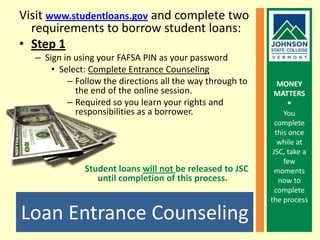
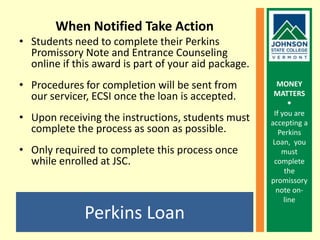
Federal Direct Student Loans
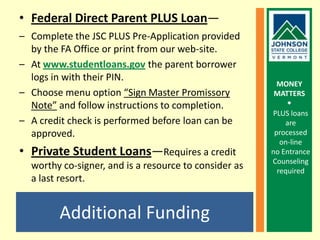
Federal Direct Parent PLUS Loan
Private Student LoansStudents must check their JSC email accounts  regularly
What should already be done?FAFSA- The Free Application for Federal Student Aid
 This is JSC’s only application for aid
State Grant Applications
 Check with your state agency In college, students are responsible for these tasks with assistance from parents
Once you’ve been awarded!Communication is Key!Students and Parents need to know what is going on!  Have a checklist  to stay on track!What should you be doing now?Many financial  aid tasks have deadlines students and parents must share information regularly
 Aid and DocumentsAccept Your Aid Package
Return letter by mail
Accept aid on Web Services
Submit Requested Documents
Verification Worksheet
Federal Tax Returns

JSC Money Matters

Editor's Notes

  • #4 The cost of attendance varies based on the enrollment status of the student; this means that the tuition rate will be different for students based on whether they are considered in-state, out-of-state or NEBHE. Out-of-state students enrolled in a NEBHE-eligible program receive discounted tuition. Eligible programs vary by state and are subject to annual review by the New England Board of Higher Education. If a student enrolls for fewer than 12 credits, the student is considered part-time. Part-time students are charged tuition based on a per-credit basis. Please note, that part-time status does effect financial aid eligibility. If your students is receiving financial aid it is important that they be in contact with the Financial Aid Office if they expect to reduce their number of credits below the full-time threshold.. Students enrolled in 12 to 18 credits are considered full-time. These students pay a single tuition rate regardless of the number of credits. A student enrolling in more than 18 credits is charged an additional per credit rate for all credits greater than 18. Enrollment as of the end of the add/drop period (approximately 2 weeks after the start of school) is considered the final enrollment for the student and all subsequent billing will be based on this enrollment. Students living on campus are charged for room and board. Room charges are based on the living arrangements for the student and will vary depending on whether the student is living in a double, triple or single room. Board charges are based on the selected board plan. Information regarding these plans will be available when you meet with the Business Office. All undergraduate students are charged a Campus Initiative Fee and a Student Activity Fee. The Campus Initiative Fee is used to offset the capital construction costs for on-campus construction. The Student Activity Fee is used to support student clubs and activities on campus. Course fees are charged to offset extraordinary costs for individual courses. They may be travel fees, materials fees or lab fees. Course fees are listed with the course bulletin and are available to the student before registering for the class. Books are an expensive proposition! You may purchase your textbooks through the college’s bookstore either when you return to campus for orientation, or online. To help students with paying for their books, the college allows students who have finalized their payment arrangements to charge their books and supplies to their account. This minimizes your initial cash outlay and allows you to delay payment for this expense for a few weeks.
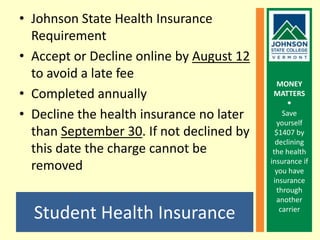
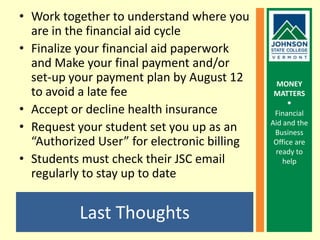
  • #14 All Full time students in the Vermont State College system are required to have health insurance. If students have an injury or accident, they don’t have to drop-out of college to pay their medical bills. The coverage runs Aug 15, 2011 to August 14, 2012.Johnson State College passes along the cost of this insurance with no markup.
  • #16 In addition to cash, check and credit card, Johnson State College offers electronic payments through on-line ACH deposits using your checking account. Additionally, the college offers you the choice of a deferred payment plan that allows you to extend your payments through the semester.
  • #17 The college is pleased to offer payment plans that allow you to spread your payments over several months. There is a $30 set-up fee, and the first installment is due at signing. To sign up for a payment plan, go to the students billing account, which parents will have access to, once your students have set you up as an authorized user.. Once you’ve logged in with your user id and password, you can set up your payment plan from the Make a Payment option.
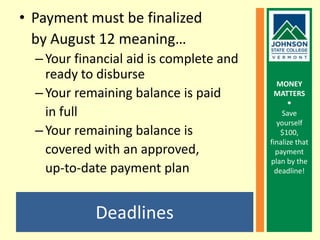
  • #18 Payment must be finalized by August 12. In order to consider your payment finalized, you must meet all of the following conditions: Your financial aid file is complete and ready to disburse. This means that you have completed all of the required paperwork for your lender (if needed) and your verification is complete (if necessary). If you have a remaining balance, after your aid, you have paid the balance in full with cash or credit card; orYou have an approved payment plan on file that is up to date with all payments.
  • #19 Let’s put this in the positive. NO ONE wants to talk about the consequences for not finalizing payment by the deadline, but we feel that it is important to let you know fully what to expect if we are not able to make final arrangements for payment as the due date. For students who have not arranged for payment by the due date, the following actions will occur: Move-in day is scheduled for August 19. In order to minimize your time in lines you will want to arrange for payment before this day. You and your student will be much happier spending the day moving into her room than waiting in line at the Business Office. The College allows students who have finalized their payment to charge their books to their student account. This is a very convenient service for many students and families as books can be quite expensive and this minimizes the initial cash outlay. If payment is finalized by August 12, your student will be able to charge her books. Students who have not finalized payment are not eligible to use their work study award until payment is finalized. Delaying payment may result in a loss of this benefit if too much time passes. NCAA regulations require that students traveling or playing with a Varsity team must be current with their student account. Until payment is finalized, your student will be ineligible to travel or play with a varsity team. Accounts that have not been finalized by the due date will be charged a $100 late fee. Last but not least, we do need to mention that if payment has not been finalized by September 30, we may be forced to administratively dismiss your student for non-payment. When this happens, your student will be withdrawn from all classes, and the bill and any financial aid will be pro-rated.
  • #20 Don’t forget to waive your health insurance
  • #21 Don’t forget to waive your health insurance