http://www.youtube.com/watch?v=-p-I19Prqzs
WHAT IS CYBER
     BULLYING?
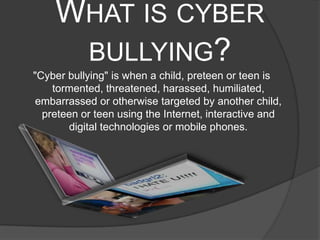
"Cyber bullying" is when a child, preteen or teen is
    tormented, threatened, harassed, humiliated,
 embarrassed or otherwise targeted by another child,
  preteen or teen using the Internet, interactive and
       digital technologies or mobile phones.
Situational Analysis
It is only called cyber bullying when instigated by a minor. Once done by
an adult it turns into cyber stalking or cyber harassment.

Methods are limited only by the child's imagination and access to
technology.

A cyber bully one moment may become the victim the next.
Students often go from victim to bully and back again.

    • Sexual harassment, verbal abuse, public humiliation, rape and
    death are all examples of what can be followed afterwards.

            (http://www.stopcyber bullying.org/what_is_cyber bullying_exactly.html)
Statistics
   In a random sampling of 10-18 year olds in a large school
    district in 2010, nearly 20% reported having been cyber
    bullied at some point in their life and 7.5% responded they
    had been bullied within the previous thirty days.

   A 2008 study of children in grades 4-8 found that 42% had
    been bullied while online and that one in four had it happen
    more than once.

   A recent study showed that 81% of cyber bullies think that it’s
    funny. Other responses indicated that nearly all cyber bullies
    think it’s no big deal.
Primary Audience
   Teens They must know the definition and effects of cyber bullying
    to then know which steps to take should they find themselves in
    this situation.

   Parents With children as key targets, they too should be
    knowledgeable of cyber bullying and monitor their children’s
    usage of the internet.

   Teachers Avoid ignoring the obvious tell-tale signs; be vigilant of
    odd behavior exhibited by their students, and provide guidance
    and support to them.

   Social Networking Sites Educational purposes as children use
    them to build names for themselves/reputation.
Case
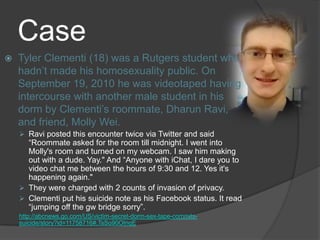
   Tyler Clementi (18) was a Rutgers student who
    hadn’t made his homosexuality public. On
    September 19, 2010 he was videotaped having
    intercourse with another male student in his
    dorm by Clementi’s roommate, Dharun Ravi,
    and friend, Molly Wei.
     Ravi posted this encounter twice via Twitter and said
      “Roommate asked for the room till midnight. I went into
      Molly's room and turned on my webcam. I saw him making
      out with a dude. Yay." And “Anyone with iChat, I dare you to
      video chat me between the hours of 9:30 and 12. Yes it's
      happening again."
     They were charged with 2 counts of invasion of privacy.
     Clementi put his suicide note as his Facebook status. It read
      “jumping off the gw bridge sorry”.
    http://abcnews.go.com/US/victim-secret-dorm-sex-tape-commits-
    suicide/story?id=11758716#.TsSo90OInqE
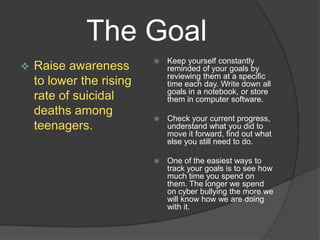
The Goal
                             Keep yourself constantly
   Raise awareness           reminded of your goals by
                              reviewing them at a specific
    to lower the rising       time each day. Write down all
                              goals in a notebook, or store
    rate of suicidal          them in computer software.
    deaths among
                             Check your current progress,
    teenagers.                understand what you did to
                              move it forward, find out what
                              else you still need to do.

                             One of the easiest ways to
                              track your goals is to see how
                              much time you spend on
                              them. The longer we spend
                              on cyber bullying the more we
                              will know how we are doing
                              with it.
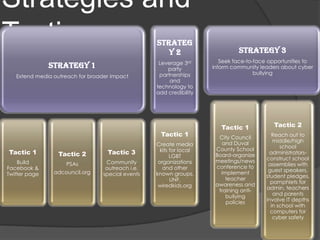
Strategies and
Tactics                                            Strateg
                                                      y2                       Strategy 3
                                                    Leverage 3rd         Seek face-to-face opportunities to
               Strategy 1                              party          inform community leaders about cyber
                                                    partnerships                      bullying
   Extend media outreach for broader impact
                                                        and
                                                   technology to
                                                   add credibility


                                                                         Tactic 1           Tactic 2
                                                     Tactic 1           City Council        Reach out to
                                                                          and Duval         middle/high
                                                   Create media                                school
                                                     kits for local    County School
Tactic 1          Tactic 2         Tactic 3                            Board-organize      administrators-
                                                          LGBT                           construct school
    Build                          Community        organizations      meetings/news
                    PSAs                                                                  assemblies with
Facebook &                         outreach i.e.      and other        conference to
                adcouncil.org                                            implement        guest speakers,
Twitter page                      special events   known groups.                         student pledges,
                                                          UNF,             teacher
                                                                       awareness and       pamphlets for
                                                    wiredkids.org                        admin, teachers
                                                                        training anti-
                                                                           bullying         and parents
                                                                           policies      involve IT depths
                                                                                           in school with
                                                                                           computers for
                                                                                            cyber safety
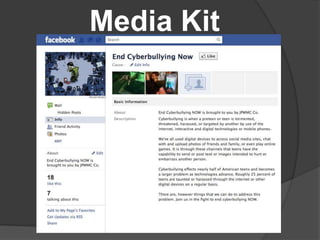
Media Kit
http://www.youtube.com/watch?v=WFQq8X79H9g
http://www.youtube.com/watch?v=D
3KsGTIeO7A&feature=related
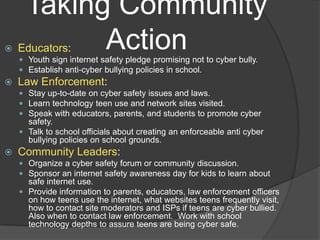
Taking Community
          Action
    Educators:
     Youth sign internet safety pledge promising not to cyber bully.
     Establish anti-cyber bullying policies in school.
   Law Enforcement:
     Stay up-to-date on cyber safety issues and laws.
     Learn technology teen use and network sites visited.
     Speak with educators, parents, and students to promote cyber
      safety.
     Talk to school officials about creating an enforceable anti cyber
      bullying policies on school grounds.
   Community Leaders:
     Organize a cyber safety forum or community discussion.
     Sponsor an internet safety awareness day for kids to learn about
      safe internet use.
     Provide information to parents, educators, law enforcement officers
      on how teens use the internet, what websites teens frequently visit,
      how to contact site moderators and ISPs if teens are cyber bullied.
      Also when to contact law enforcement. Work with school
      technology depths to assure teens are being cyber safe.
Solutions
When schools try to get involved by disciplining a student for cyber bullying
actions that took place off-campus and outside of school hours, they are often
sued for exceeding their authority and violating the student's free speech right.
They also often lose.

    However, schools can still be helpful in preventing cyber bullying:
    • Educate those at an early age against bullying.
    • Teach the law and right from wrong.
    • Schools end at 3, but the internet is available 24/7.

There are only three states without an anti-bullying law
    •South Dakota, Michigan and Montana
    (http://www.bullypolice.org/)

It all starts in the home. Teaching children early on that bullying is wrong will
decrease the chance of them being a bully.
    •Leading by example and watching what is said around kids and the message parent’s
    show.
Community
                 Outreach
Set up 2-3 focus groups in order to evaluate general knowledge of the
population in the area
     - How do you feel about cyber bullying?
     -What could be some ways to help kids who have been cyber bullied?
     -What could be some ways to stop kids from doing cyber bullying?


Arrange presentations at local middle and high schools to inform students
     -Create interaction, getting students involved


Form partnerships with both local and national organizations


Utilize social media outlets available—such as facebook
JPWMC Vision
Ultimately, the agency hopes to create awareness
that can lead to an end of cyber bullying. Not
every human is being monitored and not every
child will be able to speak up under fear of
repercussions. However, those who can speak
up, those who are aware, with our friends and our
families together, cyber bullying can be reduced
to a minimum.


                                      “Do not let circumstance
                                      control you, you change
                                      your circumstances.”
For further research JPWMC Co. suggests the following informational
and support sites:


Don’t Stand By – Stand Up! Campaign
Stopcyber bullying.org
This website is created by Parry Aftab, one of the leading experts, worldwide, on
cybercrime, internet privacy and cyber-abuse issues. There is information for students,
separated into three age-groups, as well as for parents. The campaign also includes
informational material, such as how to report abuse on a variety of technologies.

National Crime Prevention Council’s Cyber Bullying Campaign
NCPC.org/cyberbullying
This national campaign includes information on ways teens are cyber-bullied, reactions
of victims and how to help, as well as links to external secondary sites.


There are also moderated support forums for those who have been both the
victim—and the bully, to share their stories freely, and get information on
cyberbullying in a safe, interactive environment:

Bullying, Be Gone!
Bullying-begone.Livejournal.com
If you or someone you know, is in suicidal crisis or
   emotional distress please call 1-800-273-TALK
    (8255) or visit suicidepreventionlifeline.com
JPWMC Co.
   Caitlin Rulien
  Janet Haubein
  Whitney Walters
  Preston Brown
  Michelle Arena

      PUR3000
     Chunsik Lee
    MWF 10-10:50


                   “I believe the world is
                   one big family and
                   we need to help each
                   other.”

JPWMC Co.- Cyber Bullying

  • 2.
  • 3.
    WHAT IS CYBER BULLYING? "Cyber bullying" is when a child, preteen or teen is tormented, threatened, harassed, humiliated, embarrassed or otherwise targeted by another child, preteen or teen using the Internet, interactive and digital technologies or mobile phones.
  • 4.
    Situational Analysis It isonly called cyber bullying when instigated by a minor. Once done by an adult it turns into cyber stalking or cyber harassment. Methods are limited only by the child's imagination and access to technology. A cyber bully one moment may become the victim the next. Students often go from victim to bully and back again. • Sexual harassment, verbal abuse, public humiliation, rape and death are all examples of what can be followed afterwards. (http://www.stopcyber bullying.org/what_is_cyber bullying_exactly.html)
  • 5.
    Statistics  In a random sampling of 10-18 year olds in a large school district in 2010, nearly 20% reported having been cyber bullied at some point in their life and 7.5% responded they had been bullied within the previous thirty days.  A 2008 study of children in grades 4-8 found that 42% had been bullied while online and that one in four had it happen more than once.  A recent study showed that 81% of cyber bullies think that it’s funny. Other responses indicated that nearly all cyber bullies think it’s no big deal.
  • 6.
    Primary Audience  Teens They must know the definition and effects of cyber bullying to then know which steps to take should they find themselves in this situation.  Parents With children as key targets, they too should be knowledgeable of cyber bullying and monitor their children’s usage of the internet.  Teachers Avoid ignoring the obvious tell-tale signs; be vigilant of odd behavior exhibited by their students, and provide guidance and support to them.  Social Networking Sites Educational purposes as children use them to build names for themselves/reputation.
  • 7.
    Case  Tyler Clementi (18) was a Rutgers student who hadn’t made his homosexuality public. On September 19, 2010 he was videotaped having intercourse with another male student in his dorm by Clementi’s roommate, Dharun Ravi, and friend, Molly Wei.  Ravi posted this encounter twice via Twitter and said “Roommate asked for the room till midnight. I went into Molly's room and turned on my webcam. I saw him making out with a dude. Yay." And “Anyone with iChat, I dare you to video chat me between the hours of 9:30 and 12. Yes it's happening again."  They were charged with 2 counts of invasion of privacy.  Clementi put his suicide note as his Facebook status. It read “jumping off the gw bridge sorry”. http://abcnews.go.com/US/victim-secret-dorm-sex-tape-commits- suicide/story?id=11758716#.TsSo90OInqE
  • 8.
    The Goal  Keep yourself constantly  Raise awareness reminded of your goals by reviewing them at a specific to lower the rising time each day. Write down all goals in a notebook, or store rate of suicidal them in computer software. deaths among  Check your current progress, teenagers. understand what you did to move it forward, find out what else you still need to do.  One of the easiest ways to track your goals is to see how much time you spend on them. The longer we spend on cyber bullying the more we will know how we are doing with it.
  • 9.
    Strategies and Tactics Strateg y2 Strategy 3 Leverage 3rd Seek face-to-face opportunities to Strategy 1 party inform community leaders about cyber partnerships bullying Extend media outreach for broader impact and technology to add credibility Tactic 1 Tactic 2 Tactic 1 City Council Reach out to and Duval middle/high Create media school kits for local County School Tactic 1 Tactic 2 Tactic 3 Board-organize administrators- LGBT construct school Build Community organizations meetings/news PSAs assemblies with Facebook & outreach i.e. and other conference to adcouncil.org implement guest speakers, Twitter page special events known groups. student pledges, UNF, teacher awareness and pamphlets for wiredkids.org admin, teachers training anti- bullying and parents policies involve IT depths in school with computers for cyber safety
  • 10.
  • 11.
  • 12.
  • 13.
    Taking Community  Action Educators:  Youth sign internet safety pledge promising not to cyber bully.  Establish anti-cyber bullying policies in school.  Law Enforcement:  Stay up-to-date on cyber safety issues and laws.  Learn technology teen use and network sites visited.  Speak with educators, parents, and students to promote cyber safety.  Talk to school officials about creating an enforceable anti cyber bullying policies on school grounds.  Community Leaders:  Organize a cyber safety forum or community discussion.  Sponsor an internet safety awareness day for kids to learn about safe internet use.  Provide information to parents, educators, law enforcement officers on how teens use the internet, what websites teens frequently visit, how to contact site moderators and ISPs if teens are cyber bullied. Also when to contact law enforcement. Work with school technology depths to assure teens are being cyber safe.
  • 14.
    Solutions When schools tryto get involved by disciplining a student for cyber bullying actions that took place off-campus and outside of school hours, they are often sued for exceeding their authority and violating the student's free speech right. They also often lose. However, schools can still be helpful in preventing cyber bullying: • Educate those at an early age against bullying. • Teach the law and right from wrong. • Schools end at 3, but the internet is available 24/7. There are only three states without an anti-bullying law •South Dakota, Michigan and Montana (http://www.bullypolice.org/) It all starts in the home. Teaching children early on that bullying is wrong will decrease the chance of them being a bully. •Leading by example and watching what is said around kids and the message parent’s show.
  • 15.
    Community Outreach Set up 2-3 focus groups in order to evaluate general knowledge of the population in the area - How do you feel about cyber bullying? -What could be some ways to help kids who have been cyber bullied? -What could be some ways to stop kids from doing cyber bullying? Arrange presentations at local middle and high schools to inform students -Create interaction, getting students involved Form partnerships with both local and national organizations Utilize social media outlets available—such as facebook
  • 16.
    JPWMC Vision Ultimately, theagency hopes to create awareness that can lead to an end of cyber bullying. Not every human is being monitored and not every child will be able to speak up under fear of repercussions. However, those who can speak up, those who are aware, with our friends and our families together, cyber bullying can be reduced to a minimum. “Do not let circumstance control you, you change your circumstances.”
  • 17.
    For further researchJPWMC Co. suggests the following informational and support sites: Don’t Stand By – Stand Up! Campaign Stopcyber bullying.org This website is created by Parry Aftab, one of the leading experts, worldwide, on cybercrime, internet privacy and cyber-abuse issues. There is information for students, separated into three age-groups, as well as for parents. The campaign also includes informational material, such as how to report abuse on a variety of technologies. National Crime Prevention Council’s Cyber Bullying Campaign NCPC.org/cyberbullying This national campaign includes information on ways teens are cyber-bullied, reactions of victims and how to help, as well as links to external secondary sites. There are also moderated support forums for those who have been both the victim—and the bully, to share their stories freely, and get information on cyberbullying in a safe, interactive environment: Bullying, Be Gone! Bullying-begone.Livejournal.com
  • 18.
    If you orsomeone you know, is in suicidal crisis or emotional distress please call 1-800-273-TALK (8255) or visit suicidepreventionlifeline.com
  • 19.
    JPWMC Co. Caitlin Rulien Janet Haubein Whitney Walters Preston Brown Michelle Arena PUR3000 Chunsik Lee MWF 10-10:50 “I believe the world is one big family and we need to help each other.”