* Corresponding author : E-mail : hs.mdanial@gmail.com
OPTIMISATION OF VEHICLE KINEMATICS CHARACTERISTICS USING
DESIGN OF EXPERIMENT METHOD
Mohd Danial bin Harun*
Faculty of Mechanical Engineering,
University Teknologi Malaysia,
81200 Skudai, Johor Bahru.
ABSTRACT
The kinematics characteristic of double wishbone suspension system analysis is about to
define the parameters or hardpoints needed thus the behaviour of kinematics characteristic
which is toe and camber angle of the system behave as it would be to achieve an excellent
vehicle ride performance. In order to achieve that, many criteria or constraints needed to
study carefully. As so to achieve these, optimum design needed and in order to formulate the
optimum design, design of experiments method (DOE) approach will be used in determining
the best design. This thesis will shows how to construct or formulation of this problem
solution.
Keywords: double wishbone suspension, kinematics characteristics, Design of Experiments
(DOE), optimisation formulation, optimisation.
1.0 INTRODUCTION
People always think of automobile performance, but they just do think about the horsepower,
torque and zero to sixty acceleration of the vehicle. But, all of the power generated is useless
when the driver cannot control it. That is why engineers have turned their attention on the
suspension system of the vehicle. The demand of the excellent performance of suspension
system is kind of high and despite the controllability become an issue, the 'comfort' of vehicle
ride also play an issue in designing the suspension system.
Front double wishbone suspension system is a complex, flexible and stable system.
Most of the car nowadays used this system and so for McPherson system as its near
competitors. The only disadvantage of the double wishbone or double A-arm system is its
price and the complexity of the design. However, it is worth system than offer by McPherson
system since its offer more stable and flexible design to apply most notice in sport cars
vehicle system and formula 1 car.
* Corresponding author : E-mail : hs.mdanial@gmail.com
2.0 MODEL OF SUSPENSION SYSTEM
2.1 Model of Double Wishbone Suspension
As the suspension system is already build in the Adams/Car as the template and ready to use
by the user, all the needs is just to define the certain parameters that will be affect the
suspension system performance. The parameters need to clarify is important as this is the
main criteria as what double wishbone suspension system is. The Figure 3.1 shows the design
of the double wishbone suspension system
2.2 Baseline Parallel Wheel Travel Analysis
Baseline parallel wheel travel analysis is the experiment to analyze the behavior of the
suspension system of the kinematics parameters on toe and camber angle value when the
wheels of the suspension moving upwards and downwards depends on the setting of the
experiment The experiments are taking place of 20 step simulations and the bump travel and
rebound travel are set at 50mm and -50mm respectively.
3.0 OPTIMISATION FORMULATION AND DESIGN OF EXPERIMENT (DOE)
3.1 OPTIMISATION FORMULATION
Optimisation formulation have a process to be followed and conducted properly as stated
above a good optimum design come with a good formulation process. Mostly, this
formulation involves translating words of statement into well defined mathematical statement
[9].
1. Project/problem description
2. Data and information collection
3. Definition of design variables
4. Optimisation criteria/objectives
5. Formulation of constraints
* Corresponding author : E-mail : hs.mdanial@gmail.com
3.2 Design of Experiments
After all requirement of optimisation formulation been gathered, the next step is to apply the
formulation to solve the optimisation problems. The first step is to identify what factors affect
response of the experiment mostly. To achieve this objective, DOE must be generated and the
tool used is MSC Adams/Insight as been decided in problem formulation process. The
experiment specification of the DOE is as stated below;
Table 3.1 : Design specification
Design Specification
Investigation strategy : DOE screening (2 levels)
Model : Linear
DOE Design Type : Fractional Factorial
Number of Runs : 64
Fractional factorial DOE design type is chosen as this type of experiments screening
important variables thus enable the experiment to estimate the effects on the system. Hence,
fewer trials than full factorial required to run the experiment which is 64 trials or runs.
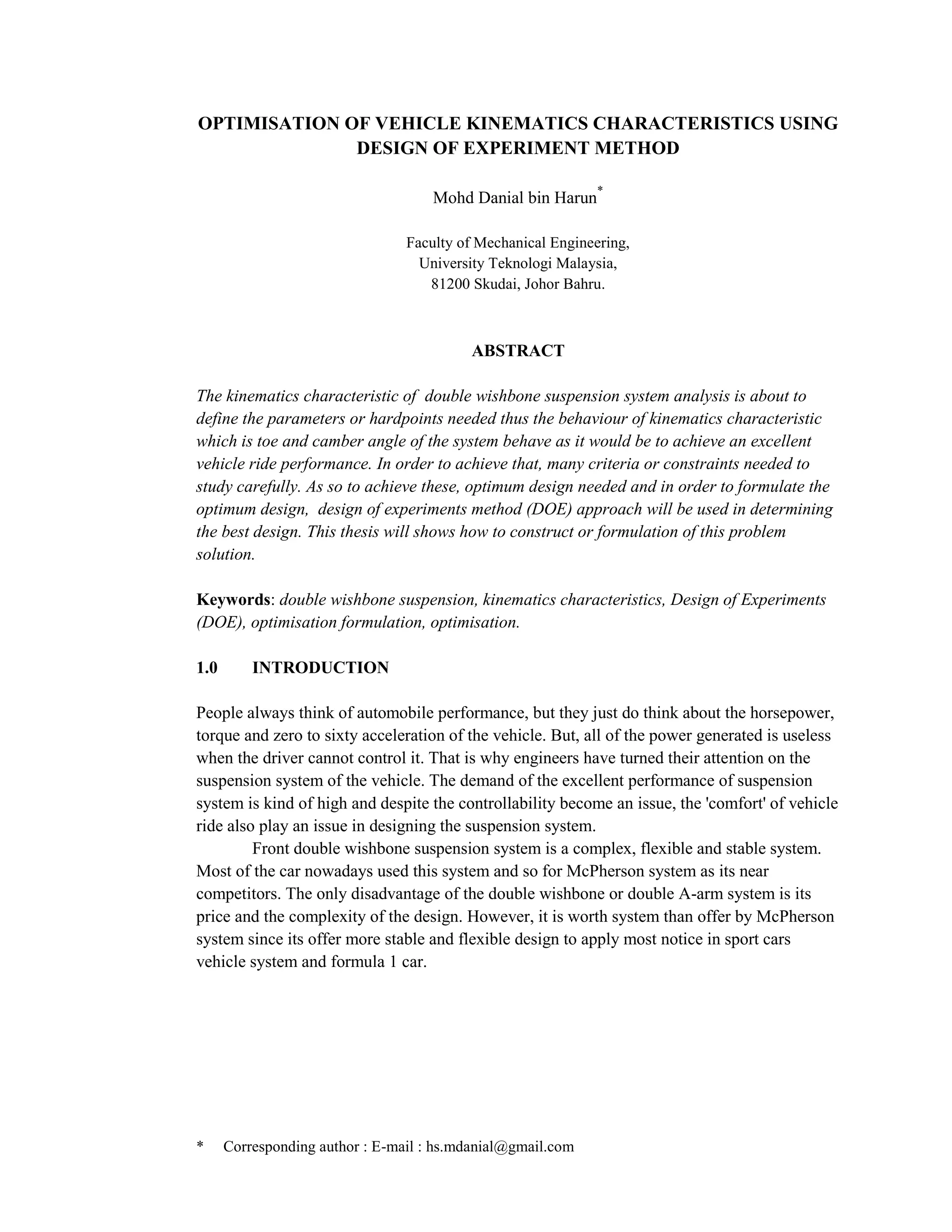
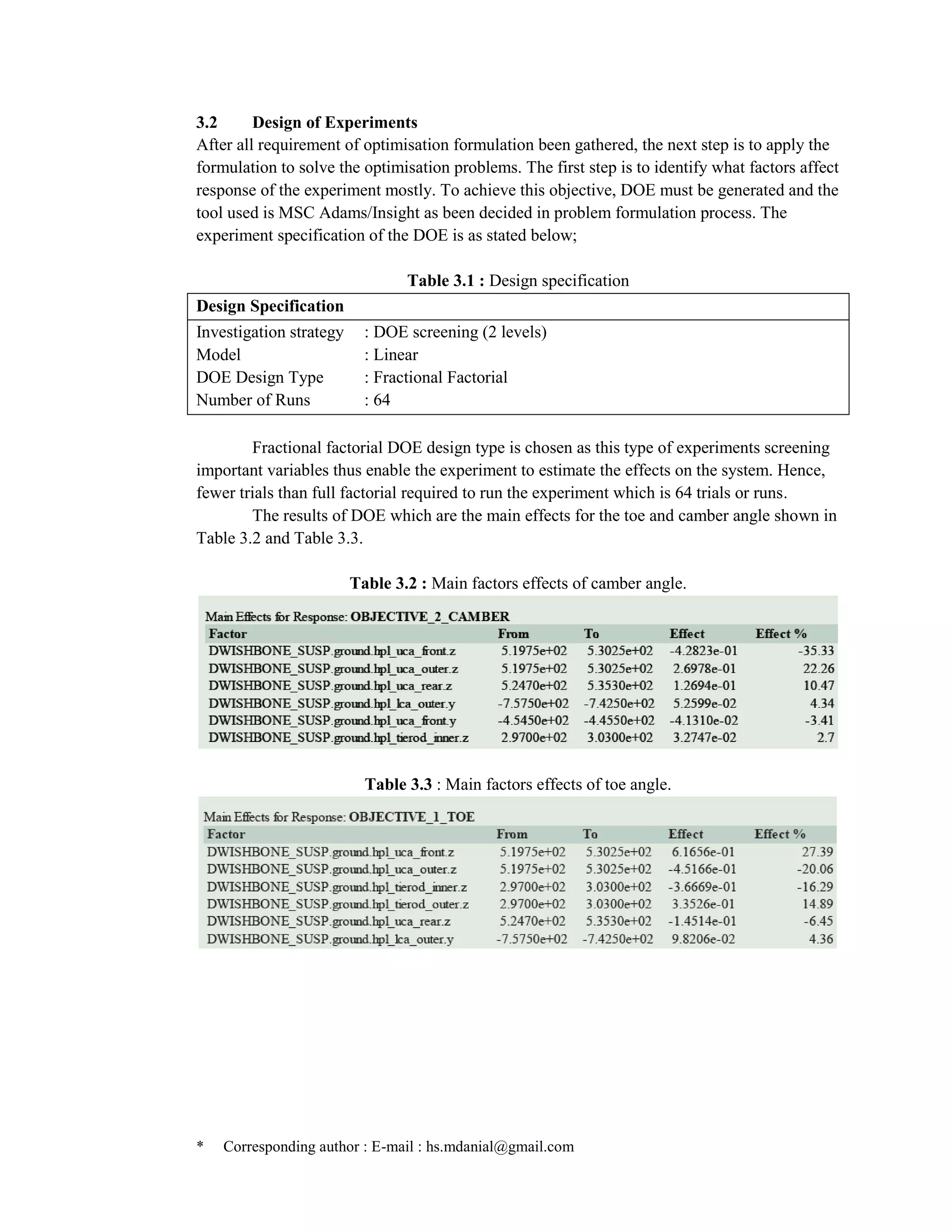
The results of DOE which are the main effects for the toe and camber angle shown in
Table 3.2 and Table 3.3.
Table 3.2 : Main factors effects of camber angle.
Table 3.3 : Main factors effects of toe angle.
* Corresponding author : E-mail : hs.mdanial@gmail.com
4.0 OPTIMISATION RESULTS AND ANALYSIS
4.1 Experiment1 : Main Effects Variables
The main factors that mostly affect response of the system set as the design variables. The
main factors decided is the factors that have more than 5 percentage effects on both responses
and the hardpoints factors shown in Table 4.6 and Table 4.7 for camber and toe angle
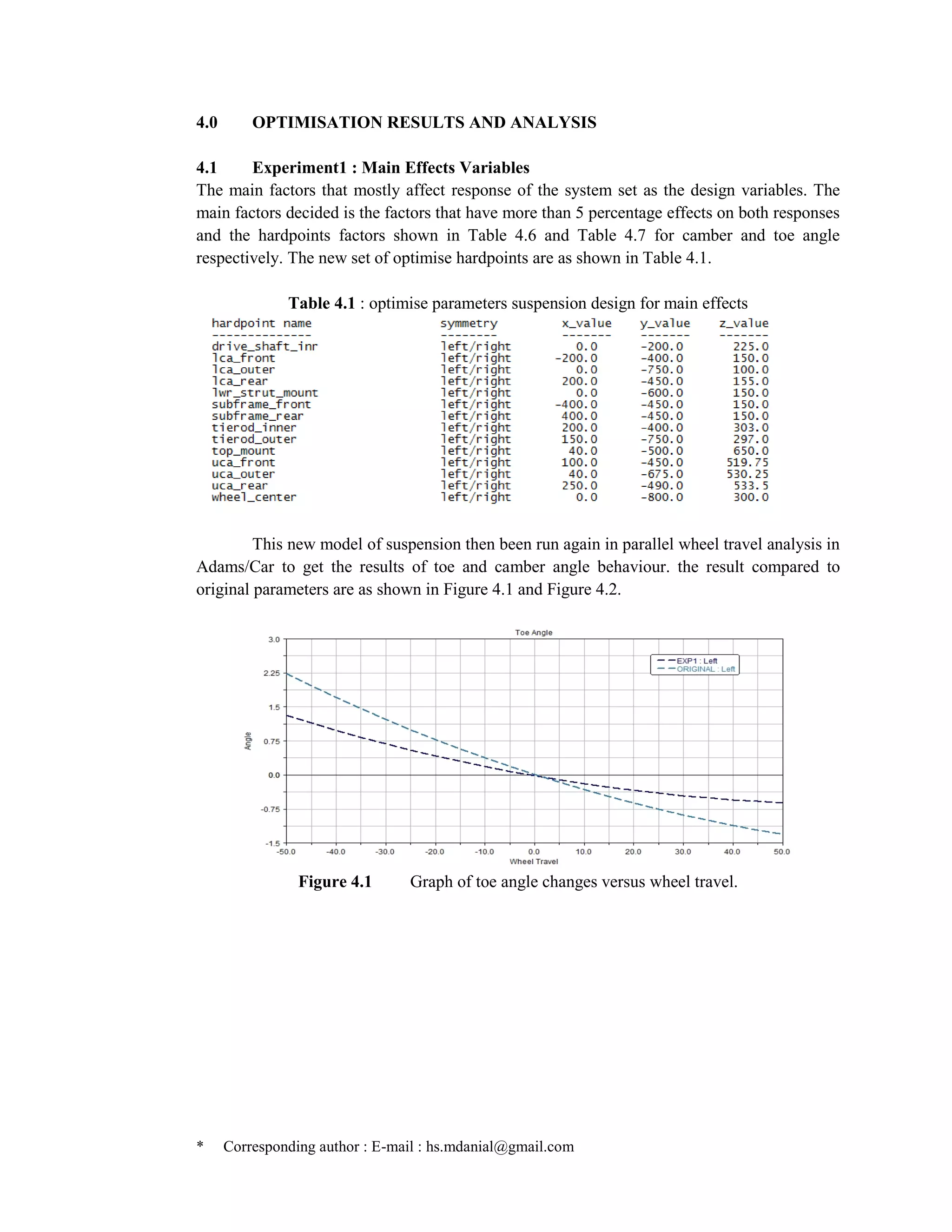
respectively. The new set of optimise hardpoints are as shown in Table 4.1.
Table 4.1 : optimise parameters suspension design for main effects
This new model of suspension then been run again in parallel wheel travel analysis in
Adams/Car to get the results of toe and camber angle behaviour. the result compared to
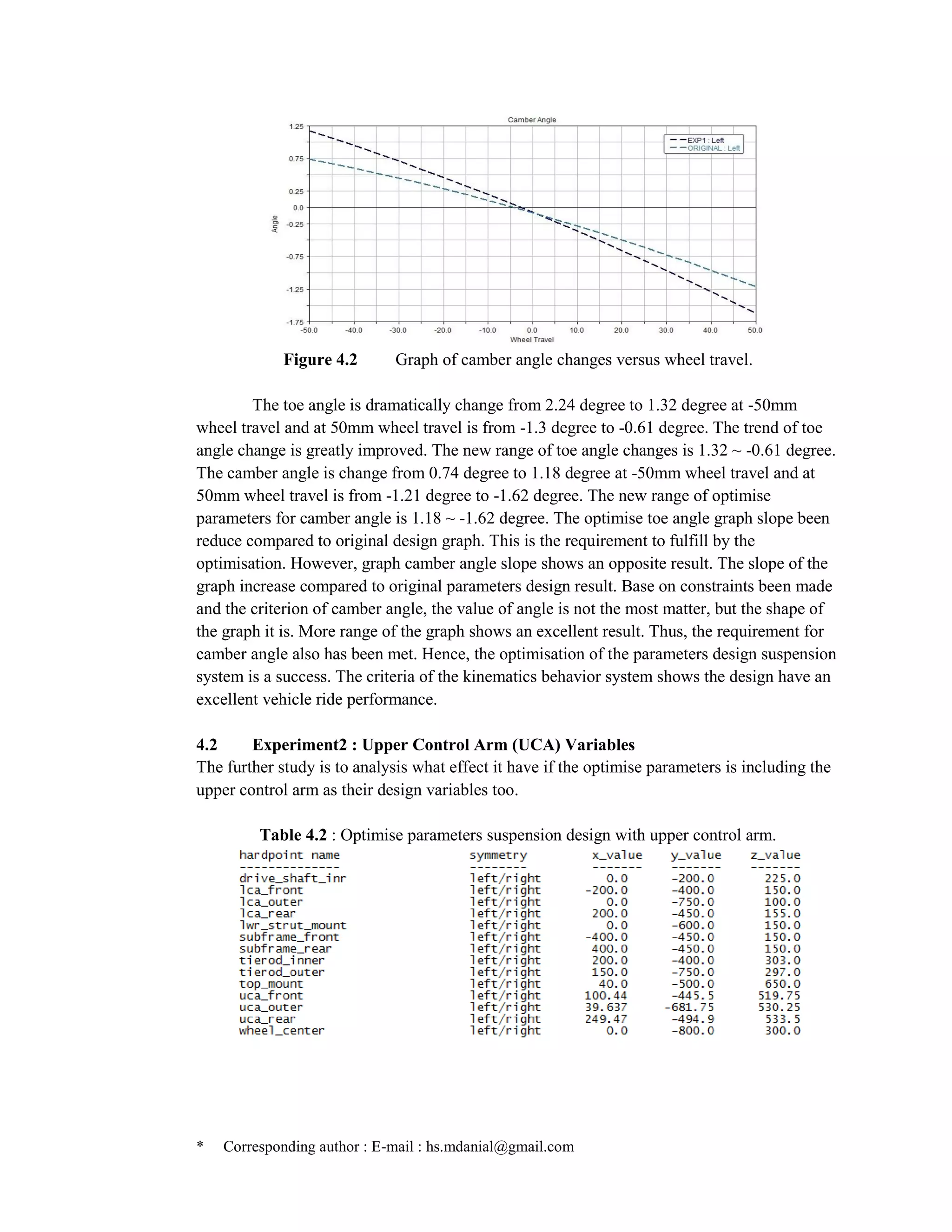
original parameters are as shown in Figure 4.1 and Figure 4.2.
Figure 4.1 Graph of toe angle changes versus wheel travel.
* Corresponding author : E-mail : hs.mdanial@gmail.com
Figure 4.2 Graph of camber angle changes versus wheel travel.
The toe angle is dramatically change from 2.24 degree to 1.32 degree at -50mm
wheel travel and at 50mm wheel travel is from -1.3 degree to -0.61 degree. The trend of toe
angle change is greatly improved. The new range of toe angle changes is 1.32 ~ -0.61 degree.
The camber angle is change from 0.74 degree to 1.18 degree at -50mm wheel travel and at
50mm wheel travel is from -1.21 degree to -1.62 degree. The new range of optimise
parameters for camber angle is 1.18 ~ -1.62 degree. The optimise toe angle graph slope been
reduce compared to original design graph. This is the requirement to fulfill by the
optimisation. However, graph camber angle slope shows an opposite result. The slope of the
graph increase compared to original parameters design result. Base on constraints been made
and the criterion of camber angle, the value of angle is not the most matter, but the shape of
the graph it is. More range of the graph shows an excellent result. Thus, the requirement for
camber angle also has been met. Hence, the optimisation of the parameters design suspension
system is a success. The criteria of the kinematics behavior system shows the design have an
excellent vehicle ride performance.
4.2 Experiment2 : Upper Control Arm (UCA) Variables
The further study is to analysis what effect it have if the optimise parameters is including the
upper control arm as their design variables too.
Table 4.2 : Optimise parameters suspension design with upper control arm.
* Corresponding author : E-mail : hs.mdanial@gmail.com
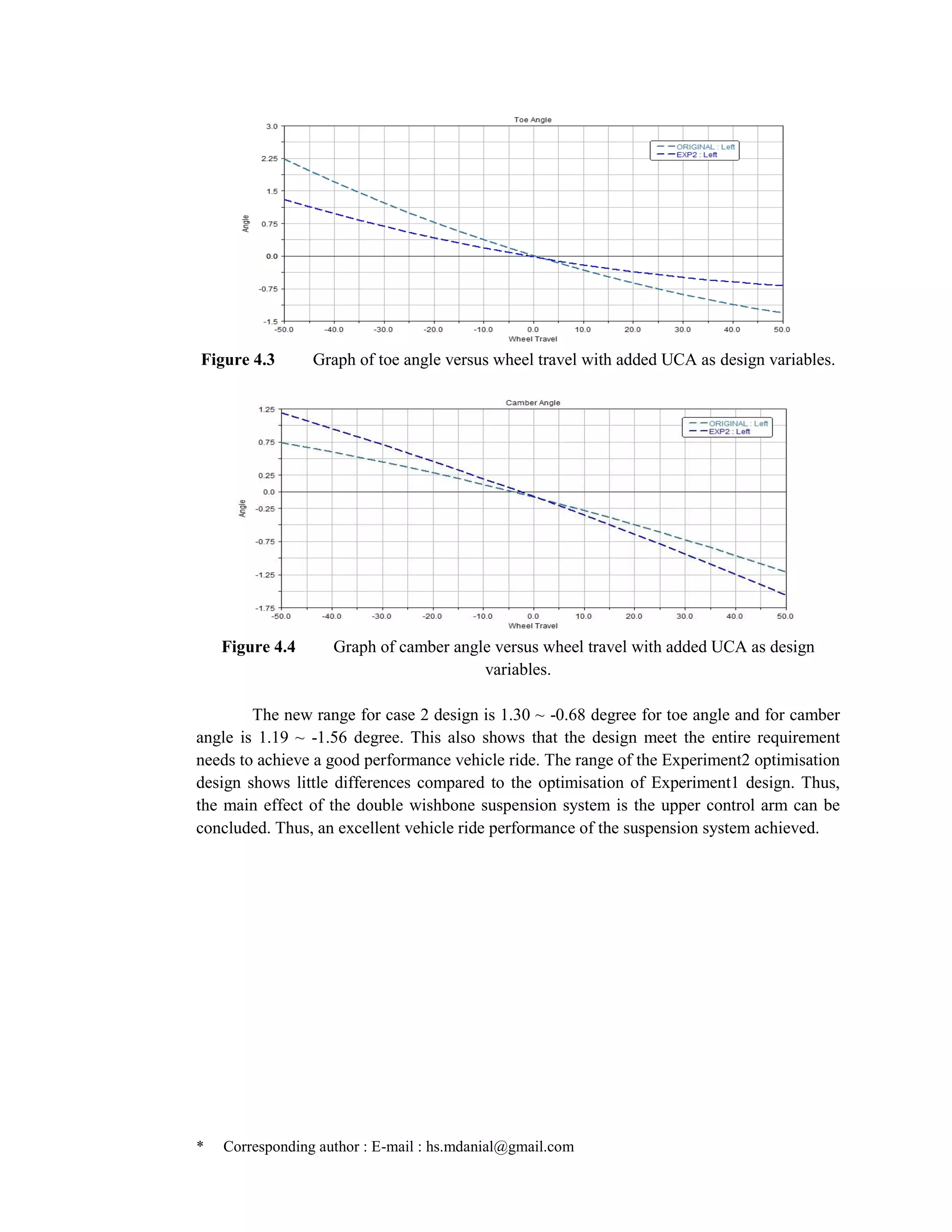
Figure 4.3 Graph of toe angle versus wheel travel with added UCA as design variables.
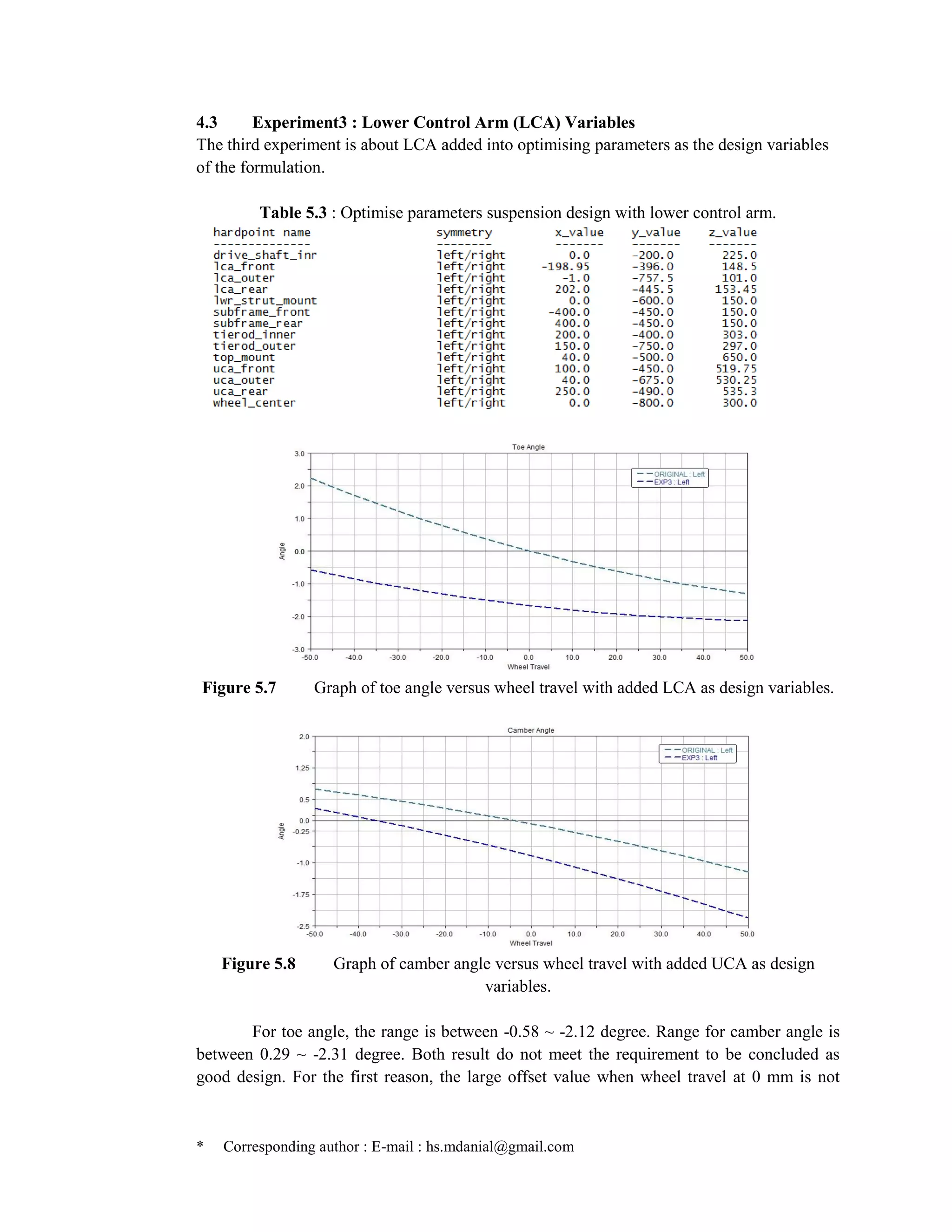
Figure 4.4 Graph of camber angle versus wheel travel with added UCA as design
variables.
The new range for case 2 design is 1.30 ~ -0.68 degree for toe angle and for camber
angle is 1.19 ~ -1.56 degree. This also shows that the design meet the entire requirement
needs to achieve a good performance vehicle ride. The range of the Experiment2 optimisation
design shows little differences compared to the optimisation of Experiment1 design. Thus,
the main effect of the double wishbone suspension system is the upper control arm can be
concluded. Thus, an excellent vehicle ride performance of the suspension system achieved.
* Corresponding author : E-mail : hs.mdanial@gmail.com
4.3 Experiment3 : Lower Control Arm (LCA) Variables
The third experiment is about LCA added into optimising parameters as the design variables
of the formulation.
Table 5.3 : Optimise parameters suspension design with lower control arm.
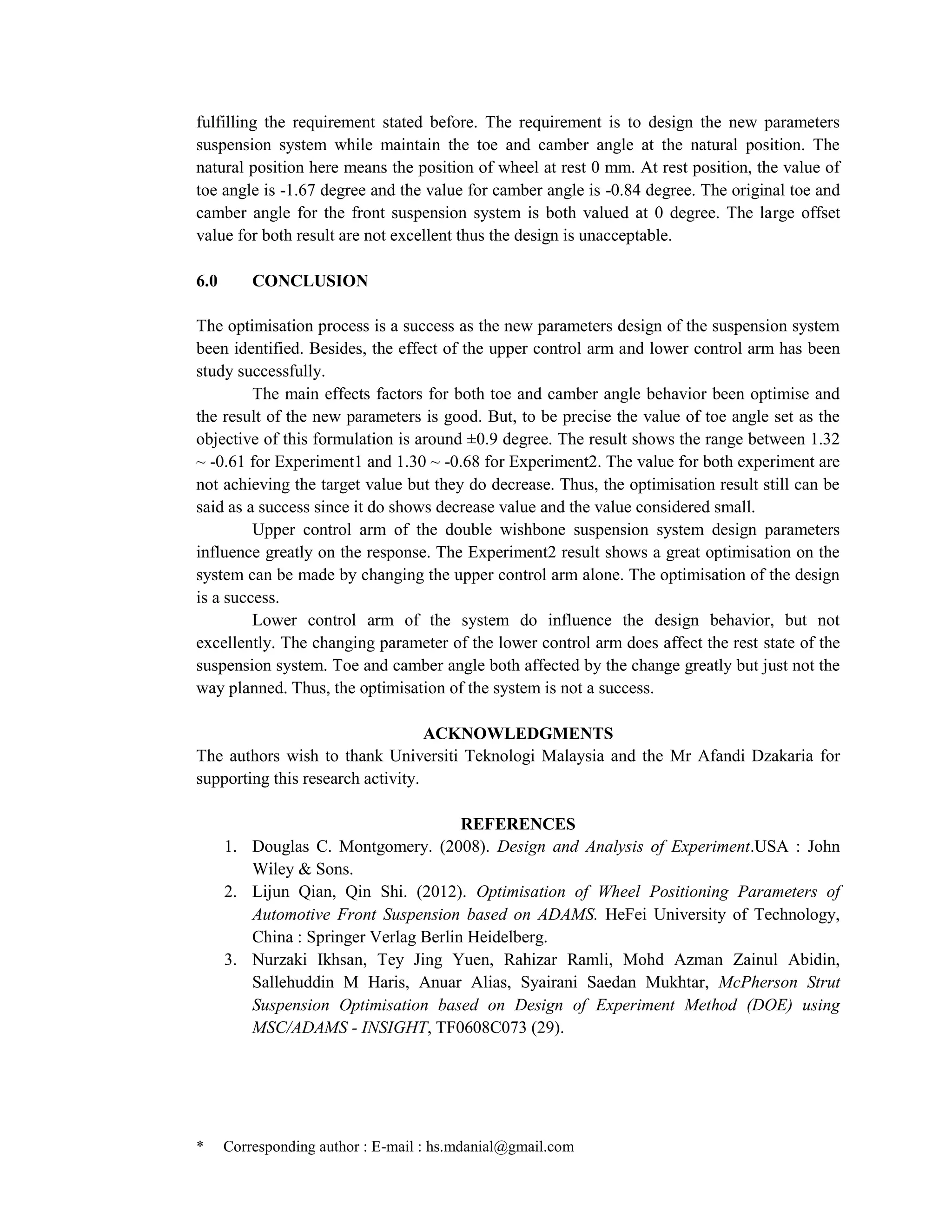
Figure 5.7 Graph of toe angle versus wheel travel with added LCA as design variables.
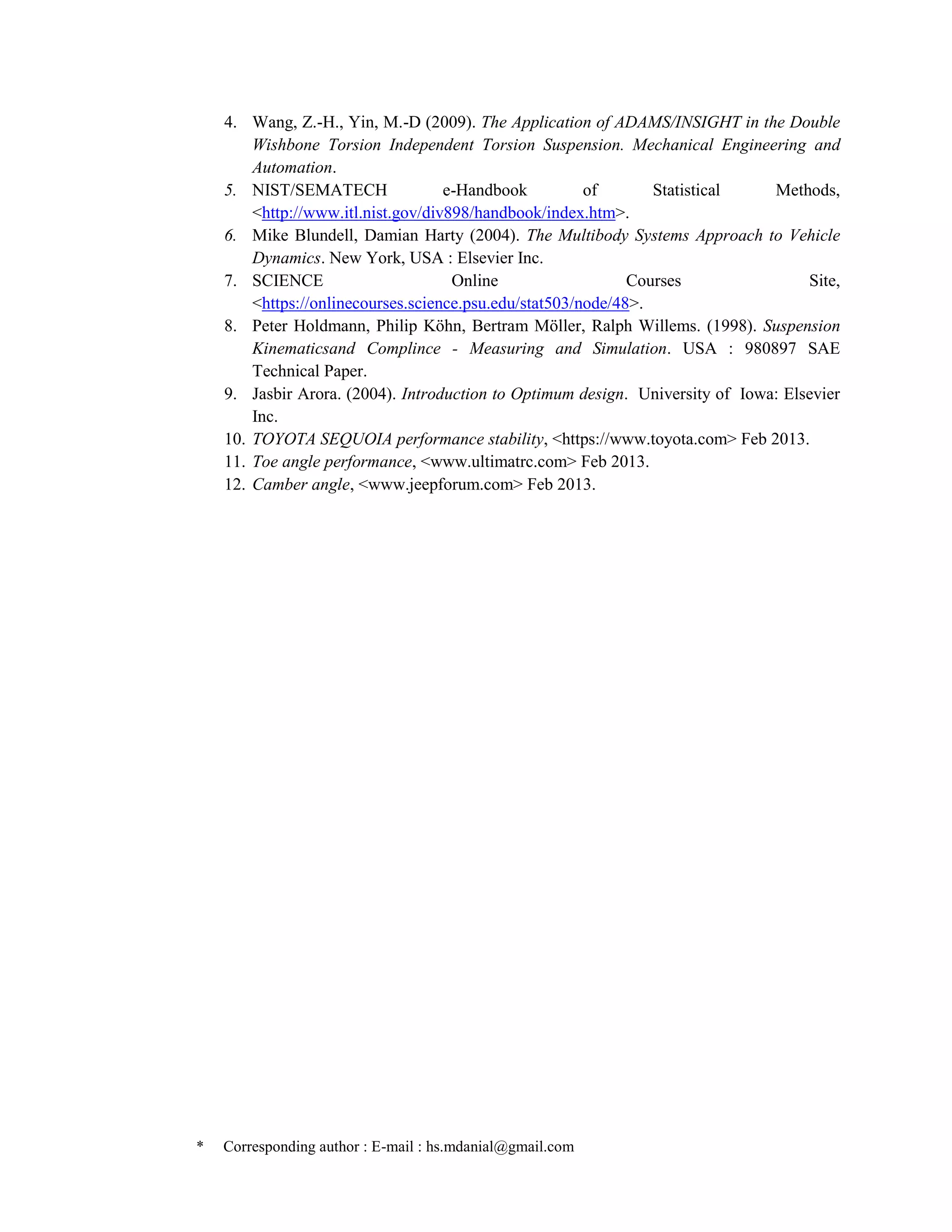
Figure 5.8 Graph of camber angle versus wheel travel with added UCA as design
variables.
For toe angle, the range is between -0.58 ~ -2.12 degree. Range for camber angle is
between 0.29 ~ -2.31 degree. Both result do not meet the requirement to be concluded as
good design. For the first reason, the large offset value when wheel travel at 0 mm is not
* Corresponding author : E-mail : hs.mdanial@gmail.com
fulfilling the requirement stated before. The requirement is to design the new parameters
suspension system while maintain the toe and camber angle at the natural position. The
natural position here means the position of wheel at rest 0 mm. At rest position, the value of
toe angle is -1.67 degree and the value for camber angle is -0.84 degree. The original toe and
camber angle for the front suspension system is both valued at 0 degree. The large offset
value for both result are not excellent thus the design is unacceptable.
6.0 CONCLUSION
The optimisation process is a success as the new parameters design of the suspension system
been identified. Besides, the effect of the upper control arm and lower control arm has been
study successfully.
The main effects factors for both toe and camber angle behavior been optimise and
the result of the new parameters is good. But, to be precise the value of toe angle set as the
objective of this formulation is around ±0.9 degree. The result shows the range between 1.32
~ -0.61 for Experiment1 and 1.30 ~ -0.68 for Experiment2. The value for both experiment are
not achieving the target value but they do decrease. Thus, the optimisation result still can be
said as a success since it do shows decrease value and the value considered small.
Upper control arm of the double wishbone suspension system design parameters
influence greatly on the response. The Experiment2 result shows a great optimisation on the
system can be made by changing the upper control arm alone. The optimisation of the design
is a success.
Lower control arm of the system do influence the design behavior, but not
excellently. The changing parameter of the lower control arm does affect the rest state of the
suspension system. Toe and camber angle both affected by the change greatly but just not the
way planned. Thus, the optimisation of the system is not a success.
ACKNOWLEDGMENTS
The authors wish to thank Universiti Teknologi Malaysia and the Mr Afandi Dzakaria for
supporting this research activity.
REFERENCES
1. Douglas C. Montgomery. (2008). Design and Analysis of Experiment.USA : John
Wiley & Sons.
2. Lijun Qian, Qin Shi. (2012). Optimisation of Wheel Positioning Parameters of
Automotive Front Suspension based on ADAMS. HeFei University of Technology,
China : Springer Verlag Berlin Heidelberg.
3. Nurzaki Ikhsan, Tey Jing Yuen, Rahizar Ramli, Mohd Azman Zainul Abidin,
Sallehuddin M Haris, Anuar Alias, Syairani Saedan Mukhtar, McPherson Strut
Suspension Optimisation based on Design of Experiment Method (DOE) using
MSC/ADAMS - INSIGHT, TF0608C073 (29).
* Corresponding author : E-mail : hs.mdanial@gmail.com
4. Wang, Z.-H., Yin, M.-D (2009). The Application of ADAMS/INSIGHT in the Double
Wishbone Torsion Independent Torsion Suspension. Mechanical Engineering and
Automation.
5. NIST/SEMATECH e-Handbook of Statistical Methods,
<http://www.itl.nist.gov/div898/handbook/index.htm>.
6. Mike Blundell, Damian Harty (2004). The Multibody Systems Approach to Vehicle
Dynamics. New York, USA : Elsevier Inc.
7. SCIENCE Online Courses Site,
<https://onlinecourses.science.psu.edu/stat503/node/48>.
8. Peter Holdmann, Philip Köhn, Bertram Möller, Ralph Willems. (1998). Suspension
Kinematicsand Complince - Measuring and Simulation. USA : 980897 SAE
Technical Paper.
9. Jasbir Arora. (2004). Introduction to Optimum design. University of Iowa: Elsevier
Inc.
10. TOYOTA SEQUOIA performance stability, <https://www.toyota.com> Feb 2013.
11. Toe angle performance, <www.ultimatrc.com> Feb 2013.
12. Camber angle, <www.jeepforum.com> Feb 2013.

JOURNAL_OPTIMISATION OF VEHICLE KINEMATICS CHARACTERISTICS USING DESIGN OF EXPERIMENT METHOD

  • 1.
    * Corresponding author: E-mail : hs.mdanial@gmail.com OPTIMISATION OF VEHICLE KINEMATICS CHARACTERISTICS USING DESIGN OF EXPERIMENT METHOD Mohd Danial bin Harun* Faculty of Mechanical Engineering, University Teknologi Malaysia, 81200 Skudai, Johor Bahru. ABSTRACT The kinematics characteristic of double wishbone suspension system analysis is about to define the parameters or hardpoints needed thus the behaviour of kinematics characteristic which is toe and camber angle of the system behave as it would be to achieve an excellent vehicle ride performance. In order to achieve that, many criteria or constraints needed to study carefully. As so to achieve these, optimum design needed and in order to formulate the optimum design, design of experiments method (DOE) approach will be used in determining the best design. This thesis will shows how to construct or formulation of this problem solution. Keywords: double wishbone suspension, kinematics characteristics, Design of Experiments (DOE), optimisation formulation, optimisation. 1.0 INTRODUCTION People always think of automobile performance, but they just do think about the horsepower, torque and zero to sixty acceleration of the vehicle. But, all of the power generated is useless when the driver cannot control it. That is why engineers have turned their attention on the suspension system of the vehicle. The demand of the excellent performance of suspension system is kind of high and despite the controllability become an issue, the 'comfort' of vehicle ride also play an issue in designing the suspension system. Front double wishbone suspension system is a complex, flexible and stable system. Most of the car nowadays used this system and so for McPherson system as its near competitors. The only disadvantage of the double wishbone or double A-arm system is its price and the complexity of the design. However, it is worth system than offer by McPherson system since its offer more stable and flexible design to apply most notice in sport cars vehicle system and formula 1 car.
  • 2.
    * Corresponding author: E-mail : hs.mdanial@gmail.com 2.0 MODEL OF SUSPENSION SYSTEM 2.1 Model of Double Wishbone Suspension As the suspension system is already build in the Adams/Car as the template and ready to use by the user, all the needs is just to define the certain parameters that will be affect the suspension system performance. The parameters need to clarify is important as this is the main criteria as what double wishbone suspension system is. The Figure 3.1 shows the design of the double wishbone suspension system 2.2 Baseline Parallel Wheel Travel Analysis Baseline parallel wheel travel analysis is the experiment to analyze the behavior of the suspension system of the kinematics parameters on toe and camber angle value when the wheels of the suspension moving upwards and downwards depends on the setting of the experiment The experiments are taking place of 20 step simulations and the bump travel and rebound travel are set at 50mm and -50mm respectively. 3.0 OPTIMISATION FORMULATION AND DESIGN OF EXPERIMENT (DOE) 3.1 OPTIMISATION FORMULATION Optimisation formulation have a process to be followed and conducted properly as stated above a good optimum design come with a good formulation process. Mostly, this formulation involves translating words of statement into well defined mathematical statement [9]. 1. Project/problem description 2. Data and information collection 3. Definition of design variables 4. Optimisation criteria/objectives 5. Formulation of constraints
  • 3.
    * Corresponding author: E-mail : hs.mdanial@gmail.com 3.2 Design of Experiments After all requirement of optimisation formulation been gathered, the next step is to apply the formulation to solve the optimisation problems. The first step is to identify what factors affect response of the experiment mostly. To achieve this objective, DOE must be generated and the tool used is MSC Adams/Insight as been decided in problem formulation process. The experiment specification of the DOE is as stated below; Table 3.1 : Design specification Design Specification Investigation strategy : DOE screening (2 levels) Model : Linear DOE Design Type : Fractional Factorial Number of Runs : 64 Fractional factorial DOE design type is chosen as this type of experiments screening important variables thus enable the experiment to estimate the effects on the system. Hence, fewer trials than full factorial required to run the experiment which is 64 trials or runs. The results of DOE which are the main effects for the toe and camber angle shown in Table 3.2 and Table 3.3. Table 3.2 : Main factors effects of camber angle. Table 3.3 : Main factors effects of toe angle.
  • 4.
    * Corresponding author: E-mail : hs.mdanial@gmail.com 4.0 OPTIMISATION RESULTS AND ANALYSIS 4.1 Experiment1 : Main Effects Variables The main factors that mostly affect response of the system set as the design variables. The main factors decided is the factors that have more than 5 percentage effects on both responses and the hardpoints factors shown in Table 4.6 and Table 4.7 for camber and toe angle respectively. The new set of optimise hardpoints are as shown in Table 4.1. Table 4.1 : optimise parameters suspension design for main effects This new model of suspension then been run again in parallel wheel travel analysis in Adams/Car to get the results of toe and camber angle behaviour. the result compared to original parameters are as shown in Figure 4.1 and Figure 4.2. Figure 4.1 Graph of toe angle changes versus wheel travel.
  • 5.
    * Corresponding author: E-mail : hs.mdanial@gmail.com Figure 4.2 Graph of camber angle changes versus wheel travel. The toe angle is dramatically change from 2.24 degree to 1.32 degree at -50mm wheel travel and at 50mm wheel travel is from -1.3 degree to -0.61 degree. The trend of toe angle change is greatly improved. The new range of toe angle changes is 1.32 ~ -0.61 degree. The camber angle is change from 0.74 degree to 1.18 degree at -50mm wheel travel and at 50mm wheel travel is from -1.21 degree to -1.62 degree. The new range of optimise parameters for camber angle is 1.18 ~ -1.62 degree. The optimise toe angle graph slope been reduce compared to original design graph. This is the requirement to fulfill by the optimisation. However, graph camber angle slope shows an opposite result. The slope of the graph increase compared to original parameters design result. Base on constraints been made and the criterion of camber angle, the value of angle is not the most matter, but the shape of the graph it is. More range of the graph shows an excellent result. Thus, the requirement for camber angle also has been met. Hence, the optimisation of the parameters design suspension system is a success. The criteria of the kinematics behavior system shows the design have an excellent vehicle ride performance. 4.2 Experiment2 : Upper Control Arm (UCA) Variables The further study is to analysis what effect it have if the optimise parameters is including the upper control arm as their design variables too. Table 4.2 : Optimise parameters suspension design with upper control arm.
  • 6.
    * Corresponding author: E-mail : hs.mdanial@gmail.com Figure 4.3 Graph of toe angle versus wheel travel with added UCA as design variables. Figure 4.4 Graph of camber angle versus wheel travel with added UCA as design variables. The new range for case 2 design is 1.30 ~ -0.68 degree for toe angle and for camber angle is 1.19 ~ -1.56 degree. This also shows that the design meet the entire requirement needs to achieve a good performance vehicle ride. The range of the Experiment2 optimisation design shows little differences compared to the optimisation of Experiment1 design. Thus, the main effect of the double wishbone suspension system is the upper control arm can be concluded. Thus, an excellent vehicle ride performance of the suspension system achieved.
  • 7.
    * Corresponding author: E-mail : hs.mdanial@gmail.com 4.3 Experiment3 : Lower Control Arm (LCA) Variables The third experiment is about LCA added into optimising parameters as the design variables of the formulation. Table 5.3 : Optimise parameters suspension design with lower control arm. Figure 5.7 Graph of toe angle versus wheel travel with added LCA as design variables. Figure 5.8 Graph of camber angle versus wheel travel with added UCA as design variables. For toe angle, the range is between -0.58 ~ -2.12 degree. Range for camber angle is between 0.29 ~ -2.31 degree. Both result do not meet the requirement to be concluded as good design. For the first reason, the large offset value when wheel travel at 0 mm is not
  • 8.
    * Corresponding author: E-mail : hs.mdanial@gmail.com fulfilling the requirement stated before. The requirement is to design the new parameters suspension system while maintain the toe and camber angle at the natural position. The natural position here means the position of wheel at rest 0 mm. At rest position, the value of toe angle is -1.67 degree and the value for camber angle is -0.84 degree. The original toe and camber angle for the front suspension system is both valued at 0 degree. The large offset value for both result are not excellent thus the design is unacceptable. 6.0 CONCLUSION The optimisation process is a success as the new parameters design of the suspension system been identified. Besides, the effect of the upper control arm and lower control arm has been study successfully. The main effects factors for both toe and camber angle behavior been optimise and the result of the new parameters is good. But, to be precise the value of toe angle set as the objective of this formulation is around ±0.9 degree. The result shows the range between 1.32 ~ -0.61 for Experiment1 and 1.30 ~ -0.68 for Experiment2. The value for both experiment are not achieving the target value but they do decrease. Thus, the optimisation result still can be said as a success since it do shows decrease value and the value considered small. Upper control arm of the double wishbone suspension system design parameters influence greatly on the response. The Experiment2 result shows a great optimisation on the system can be made by changing the upper control arm alone. The optimisation of the design is a success. Lower control arm of the system do influence the design behavior, but not excellently. The changing parameter of the lower control arm does affect the rest state of the suspension system. Toe and camber angle both affected by the change greatly but just not the way planned. Thus, the optimisation of the system is not a success. ACKNOWLEDGMENTS The authors wish to thank Universiti Teknologi Malaysia and the Mr Afandi Dzakaria for supporting this research activity. REFERENCES 1. Douglas C. Montgomery. (2008). Design and Analysis of Experiment.USA : John Wiley & Sons. 2. Lijun Qian, Qin Shi. (2012). Optimisation of Wheel Positioning Parameters of Automotive Front Suspension based on ADAMS. HeFei University of Technology, China : Springer Verlag Berlin Heidelberg. 3. Nurzaki Ikhsan, Tey Jing Yuen, Rahizar Ramli, Mohd Azman Zainul Abidin, Sallehuddin M Haris, Anuar Alias, Syairani Saedan Mukhtar, McPherson Strut Suspension Optimisation based on Design of Experiment Method (DOE) using MSC/ADAMS - INSIGHT, TF0608C073 (29).
  • 9.
    * Corresponding author: E-mail : hs.mdanial@gmail.com 4. Wang, Z.-H., Yin, M.-D (2009). The Application of ADAMS/INSIGHT in the Double Wishbone Torsion Independent Torsion Suspension. Mechanical Engineering and Automation. 5. NIST/SEMATECH e-Handbook of Statistical Methods, <http://www.itl.nist.gov/div898/handbook/index.htm>. 6. Mike Blundell, Damian Harty (2004). The Multibody Systems Approach to Vehicle Dynamics. New York, USA : Elsevier Inc. 7. SCIENCE Online Courses Site, <https://onlinecourses.science.psu.edu/stat503/node/48>. 8. Peter Holdmann, Philip Köhn, Bertram Möller, Ralph Willems. (1998). Suspension Kinematicsand Complince - Measuring and Simulation. USA : 980897 SAE Technical Paper. 9. Jasbir Arora. (2004). Introduction to Optimum design. University of Iowa: Elsevier Inc. 10. TOYOTA SEQUOIA performance stability, <https://www.toyota.com> Feb 2013. 11. Toe angle performance, <www.ultimatrc.com> Feb 2013. 12. Camber angle, <www.jeepforum.com> Feb 2013.