conducted
Ch Instrumentation/ /
/
Energy Science/ /
22
STMJournals invitesthepapers
from the National Conferences,
International Conferences, Seminars
conducted by Colleges, Universities,
Research Organizations etc. for
Conference Proceedings and Special
Issue.
xSpecial Issues come in Online and
Printversions.
xSTM Journals offers schemes to
publish such issues on payment and
gratis(online)basisas well.
To g e t m o r e i n f o r m a t i o n :
stmconferences.com
Over 500 Indian and International
Subscribers.
30,000 Top Researchers, Scientists,
Authors and Editors All Over the
WorldAssociated.
Editorial/ Reviewer Board Members :
.
1000
+
1,00,000 Visitors to STM Website
+
From 140 CountriesQuarterly.
+
10,000 Downloads from STM
+
Website.
GLOBAL READERSHIP STATISTICS
STM Journals
Empowering knowledge
Free Online Registration
ISO: 9001Certified
Journal of
Structural Engineering
& Management
(JoSEM)
September–December 2016
ISSN 2393-8773 (Online)
www.stmjournals.com
STM JOURNALS
Scientific Technical Medical
STM Journals, a strong initiative by Consortium E-Learning Network Private Ltd. (established 2006), was
launched in the year 2010 under the support and guidance by our esteemed Editorial and Advisory Board
Membersfromrenownedinstitutes.
Objectives:
 Promotion of Scientific, Technical and Medical research.
 Publication of Original Research/Review, Short Articles and Case Studies through
Peer Review process.
 Publishing Special Issues on Conferences.
 Preparing online platform for print journals.
 Empowering the libraries with online and print Journals in Scientific, Technical
and Medical domains.
 Publishing and distribution of books on various subjects in the category of Nanotechnology,
Scientific and Technical Writing, and Environment, Health and Safety.
SalientFeatures:
 A bouquet of 100+ Journals that fall under Science, Technical and Medical domains.
 Employs Open Journals System (OJS)—a journal management and publishing system.
 The first and one of the fastest growing publication website in India as well as in abroad
for its quality and coverage.
 Rapid online submission and publication of papers, soon after their formal
acceptance/finalization.
 Facilitates linking with the other authors or professionals.
 Worldwide circulation and visibility.
Journal of Structural Engineering and Management
ISSN: 2393-8773(online)
Focus and Scope Covers
 VibrationImpact,StucturalDynamics
 ExperimentalMechanics
 StructuralEngineeringandStructuralMechanics
 AnalyticalanddesignMethods
 Bridge,Damconstructionandanalysis
 Repairs,Strengthening,Maintenance
 InnovativeStructures
Journal of Structural Engineering and Management is published (frequency: three times a year) in India by STM
Journals (division of Consortium e-Learning Network Private Ltd. Pvt.) The views expressed in the articles do not
necessarily reflect of the Publisher. The publisher does not endorse the quality or value of the advertised/sponsored
products described therein. Please consult full prescribing information before issuing a prescription for any products
mentionedinthispublication.
No part of this publication may be reproduced, stored in retrieval system or transmitted in any from without written
permissionof thepublisher.
To cite any of the material contained in this Journal, in English or translation, please use the full English reference at the
beginningof eacharticle.Toreuseanyofthematerial,pleasecontactSTM Journals (info@stmjournals.com)
STM Journals
STM Journals (division of Consortium e-Learning Network Private Ltd. ) having its Marketing office located at Office
No. 4, First Floor, CSC pocket E Market, Mayur Vihar Phase II, New Delhi-110091, India is the Publisher of Journal.
Statements and opinions expressed in the Journal reflect the views of the author(s) and are not the opinion of STM
Journals unless so stated.
Subscription Information and Order:
 NationalSubscription:
Print-Rs 3750/-perJournal( includes3printissues), SingleIssue copypurchase:Rs 1500.
Online - Rs 3750/- per Journal inclusive Service Tax ( includes 3 online issues), Single Issue purchase: Rs 1500
inclusiveServiceTax
Print+Online-Rs 5000/-perJournalinclusiveServiceTax( includes3print&onlineissues).
 International Subscription:
 Online Only- $199, Print Only-$299 (includes 3 print issues)
 Online + Print-$399 (includes 3 print issues + online access of published back volumes )
To purchase print compilation of back issues please send your query at info@stmjournals.com
Subscription must be prepaid. Rates outside of India includes delivery. Prices subject to change without notice.
Mode of Payment: At par cheque, Demand draft, and RTGS (payment to be made in favor of
Consortium E-Learning Network. Pvt. ltd., payable at Delhi/New Delhi.
Online Access Policy
A). For Authors:
In order to provide maximum citation and wide publicity to the authors work, STM Journals also have Open Access
Policy, authors who would like to get their work open access can opt for Optional Open Access publication at
nominal cost as follows
India, SARC and African Countries: INR 2500 or 100 USD including single hard copy of Author's Journal.
Other Countries: USD 200 including single hard copy of Author's Journal.
B). For Subscribers:
 Online access will be activated within 72 hours of receipt of the payment (working days), subject to receipt of
correct information on user details/Static IP address of the subscriber.
 The access will be blocked:
 If the user requests for the same and furnishes valid reasons for blocking.
 Due to technical issue.
 Misuse of the access rights as per the access policy.
Advertising and Commercial Reprint Inquiries: STM Journals with wide circulation and visibility offer an excellent
media for showcasing/promotion of your products/services and the events-namely, Conferences, Symposia/Seminars
etc. These journals have very high potential to deliver the message across the targeted audience regularly with each
published issue. The advertisements on bulk subscriptions, gift subscriptions or reprint purchases for distribution etc. are
alsoverywelcome.
Lost Issue Claims: Please note the following when applying for lost or missing issues:
 Claims for print copies lost will be honored only after 45 days of the dispatch date and before publication of the
next issue as per the frequency.
 Tracking id for the speed post will be provided to all our subscribers and the claims for the missing Journals will
be entertained only with the proofs which will be verified at both the ends.
 Claims filed due to insufficient (or no notice) of change of address will not be honored.
 Change of Address of Dispatch should be intimated to STM Journals at least 2 months prior to the dispatch
schedule as per the frequency by mentioning subscriber id and the subscription id.
 Refund requests will not be entertained.
Legal Disputes
All the legal disputes are subjected to Delhi Jurisdiction only. If you have any questions, please contact the Publication
Management Team: info@stmjournals.com; Tel : +91 0120-4781211.
Gargi Asha Jha
Manager (Publications)
PUBLICATION MANAGEMENT TEAM
Internal Members
External Members
Bimlesh Lochab
Assistant Professor
Department of Chemistry
School of Natural Sciences, Shiv Nadar University
Gautam Buddha Nagar, Uttar Pradesh, India
Dr. Rajiv Prakash
Professor and Coordinator
School of Materials Science and Technology
Indian Institute of Technology (BHU), Varanasi
Uttar Pradesh, India
Dr. Rakesh Kumar
Assistant Professor
Department of Applied Chemistry
BIT Mesra, Patna,
Bihar, India
Prof. S. Ramaprabhu
Alternative Energy and Nanotechnology Technology
Laboratory, Department of Physics
Indian Institute of Technology, Chennai
Tamil Nadu, India
Himani Pandey
Isha Chandra
Senior Associate Editors
Dr. Yog Raj Sood
Dean (Planning and Development)
Professor, Department of Electrical Engineering
National Institute of Technology, Hamirpur
Himachal Pradesh, India
Prof. Chris Cannings
Professor, School of Mathematics and Statistics
University of Sheffield,
Sheffield
United Kingdom
Dr. D. K. Vijaykumar
MS, MCh (Surgical Oncology), Professor and
Head Department of Surgical Oncology
Amrita Institute of Medical Sciences and Research Centre
Ponekkara, Cochin, Kerala, India
Dr. Durgadas Naik
Associate Professor (Microbiology)
Management and Science University,
University Drive, Seksyen13
Selangor, Malaysia
Prof. José María Luna Ariza
Department of Computer Sciences and
Numerical Analysis
Campus of Rabanales
University of Córdoba, Spain
Dr. Khaiser Nikam
Professor, Library and Information Science
Department of Library and Information Science
University of Mysore
Mysore, India
Quaisher J Hossain
Senior Editor
Group Managing Editor
Dr. Archana Mehrotra
Managing Director
CELNET, Delhi, India
Meenakshi Tripathi
Shivani Sharma
Chairman
Mr. Puneet Mehrotra
Director
Shambhavi Mishra
Associate Editors
Sugandha Mishra
Prof. Priyavrat Thareja
Director Principal
Rayat Institute of Engineering and
Information Technology
Punjab, India
Dr. Baldev Raj
Director, National Institute of Advanced Studies
Indian Institute of Science campus Bangalore
Karnataka, India
Former Director
Indira Gandhi Centre for Atomic Research,
Kalpakkam, Tamil Nadu, India
Dr. Pankaj Poddar
Senior Scientist
Physical and Materials Chemistry Division,
National Chemical Laboratory
Pune, Maharastra India
Prof. D. N. Rao
Professor and Head
Department of Biochemistry
All India Institute of Medical Sciences
New Delhi, India
Dr. Nandini Chatterjee Singh
Additional Professor
National Brain Research Centre
Manesar, Gurgaon
Haryana, India
Dr. Ashish Runthala
Lecturer, Biological Sciences Group
Birla Institute of Technology and Science
Pilani, Rajasthan,
India
Dr. Bankim Chandra Ray
Professor and Ex-Head of the Department
Department of Metallurgical and
Materials Engineering
National Institute of Technology, Rourkela
Odisha, India
Prof. Yuwaraj Marotrao Ghugal
Professor and Head
Department of Applied Mechanics
Government College of Engineering
Vidyanagar, Karad
Maharashtra, India
Dr. Hardev Singh Virk
Visiting Professor, Department of Physics
University of SGGS World University
Fatehgarh Sahib, Punjab,
India
Former Director Research
DAV Institute of Engineering and Technology
Jallandhar, India
Dr. Shrikant Balkisan Dhoot
Senior Research Scientist, Reliance
Industries Limited, Mumbai, India
Former Head (Research and Development)
Nurture Earth R&D Pvt Ltd., MIT Campus
Beed Bypass Road, Aurangabad
Maharashtra, India
STM JOURNALS
ADVISORY BOARD
Dr. Rakesh Kumar
Assistant Professor
Department of Applied Chemistry
Birla Institute of Technology
Patna, Bihar, India
Prof. Subash Chandra Mishra
Professor
Department of Metallurgical and
Materials Engineering
National Institute of Technology, Rourkela
Odisha, India
Dr. Shankargouda Patil
Assistant Professor
Department of Oral Pathology
KLE Society's Institute of Dental Sciences
Bangalore, Karnataka, India
Prof. Sundara Ramaprabhu
Professor
Department of Physics
Indian Institute of Technology Madras
Chennai, Tamil Nadu
India
Dr. Baskar Kaliyamoorthy
Associate Professor
Department of Civil Engineering
National Institute of Technology, Trichy
Tiruchirappalli, Tamil Nadu, India
STM JOURNALS
ADVISORY BOARD
Editorial Board
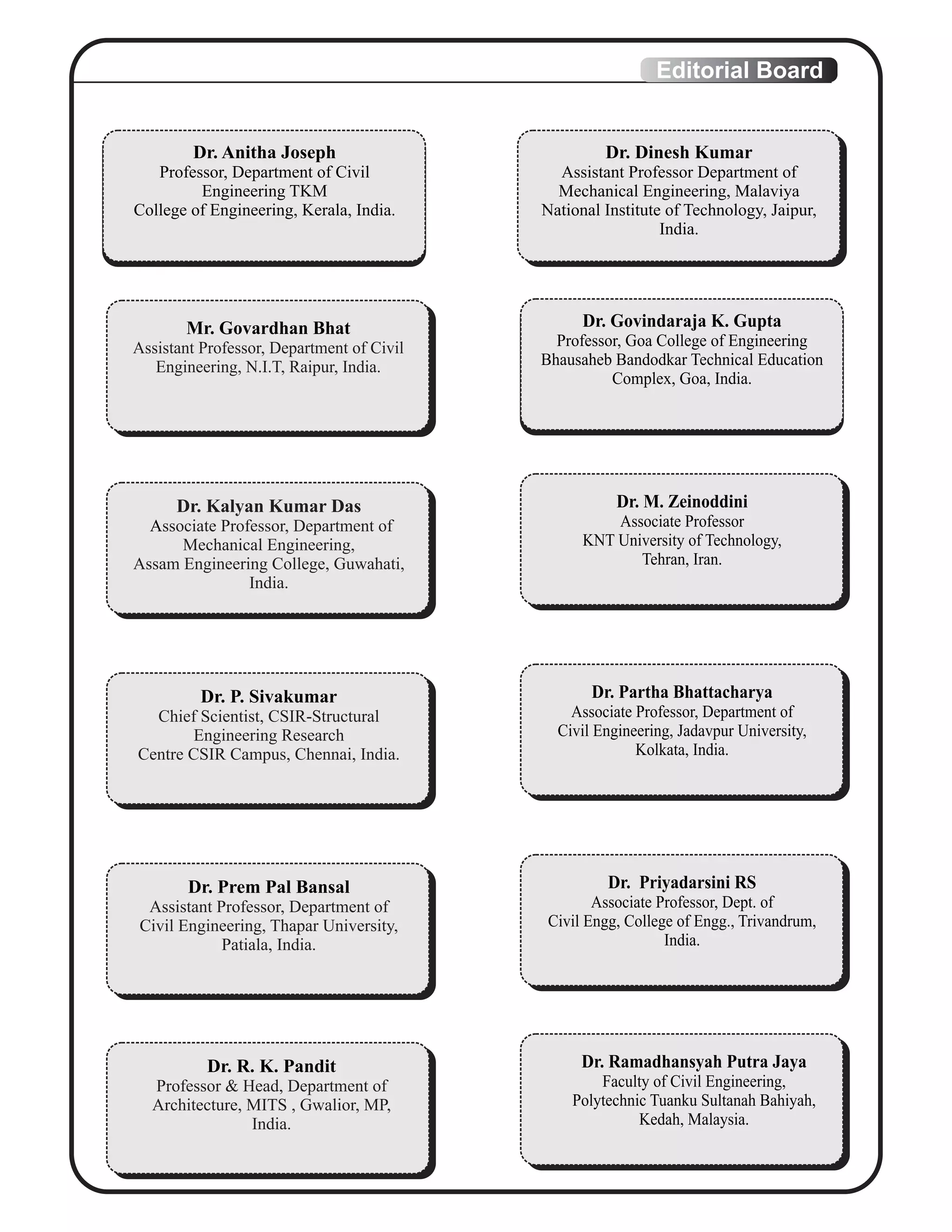
Dr. Anitha Joseph
Professor, Department of Civil
Engineering TKM
College of Engineering, Kerala, India.
Mr. Govardhan Bhat
Assistant Professor, Department of Civil
Engineering, N.I.T, Raipur, India.
Dr. Kalyan Kumar Das
ssociate Professor, Department ofA
Mechanical Engineering,
Assam Engineering College, Guwahati,
India.
Dr. M. Zeinoddini
Associate Professor
KNT University of Technology,
Tehran, Iran.
Dr. Govindaraja K. Gupta
Professor, Goa College of Engineering
Bhausaheb Bandodkar Technical Education
Complex, Goa, India.
Dr. Dinesh Kumar
Assistant Professor Department of
Mechanical Engineering, Malaviya
National Institute of Technology, Jaipur,
India.
Dr. P. Sivakumar
Chief Scientist, CSIR-Structural
Engineering Research
Centre CSIR Campus, Chennai, India.
Dr. Partha Bhattacharya
Associate Professor, Department of
Civil Engineering, Jadavpur University,
Kolkata, India.
Dr. Prem Pal Bansal
Assistant Professor, Department of
Civil Engineering, Thapar University,
Patiala, India.
Dr. Priyadarsini RS
Associate Professor, Dept. of
Civil Engg, College of Engg., Trivandrum,
India.
Dr. R. K. Pandit
Professor & Head, Department of
Architecture, MITS , Gwalior, MP,
India.
Dr. Ramadhansyah Putra Jaya
Faculty of Civil Engineering,
Polytechnic Tuanku Sultanah Bahiyah,
Kedah, Malaysia.
Editorial Board
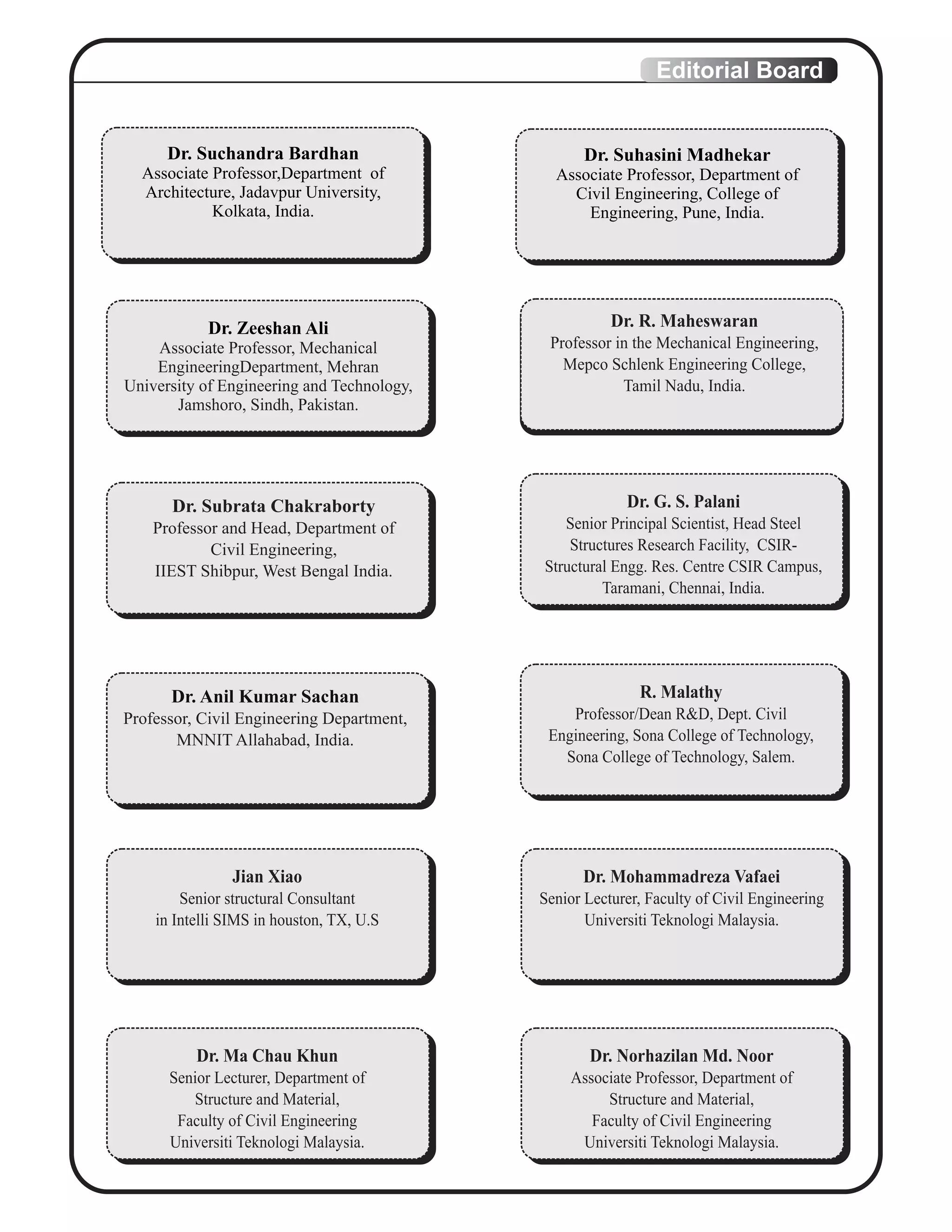
Dr. Zeeshan Ali
Associate Professor, Mechanical
EngineeringDepartment, Mehran
University of Engineering and Technology,
Jamshoro, Sindh, Pakistan.
Dr. Subrata Chakraborty
Professor and Head, Department of
Civil Engineering,
IIEST Shibpur, West Bengal India.
Dr. G. S. Palani
Senior Principal Scientist, Head Steel
Structures Research Facility, CSIR-
Structural Engg. Res. Centre CSIR Campus,
Taramani, Chennai, India.
Dr. R. Maheswaran
Professor in the Mechanical Engineering,
Mepco Schlenk Engineering College,
Tamil Nadu, India.
Dr. Anil Kumar Sachan
Professor, Civil Engineering Department,
MNNIT Allahabad, India.
R. Malathy
Professor/Dean R&D, Dept. Civil
Engineering, Sona College of Technology,
Sona College of Technology, Salem.
Dr. Suchandra Bardhan
Associate Professor,Department of
Architecture, Jadavpur University,
Kolkata, India.
Dr. Suhasini Madhekar
Associate Professor, Department of
Civil Engineering, College of
Engineering, Pune, India.
Jian Xiao
Senior structural Consultant
in Intelli SIMS in houston, TX, U.S
Dr. Mohammadreza Vafaei
Senior Lecturer, Faculty of Civil Engineering
Universiti Teknologi Malaysia.
Dr. Ma Chau Khun
Senior Lecturer, Department of
Structure and Material,
Faculty of Civil Engineering
Universiti Teknologi Malaysia.
Dr. Norhazilan Md. Noor
Associate Professor, Department of
Structure and Material,
Faculty of Civil Engineering
Universiti Teknologi Malaysia.
It is my privilege to present the print version of the [Volume 3 Issue 3] of our Journal of Structural
Engineering and Management, 2016. The intension of JoSEM is to create an atmosphere that
stimulatesvision,researchandgrowth intheareaofStructuralEngineeringandManagement.
Timely publication, honest communication, comprehensive editing and trust with authors and
readers have been the hallmark of our journals. STM Journals provide a platform for scholarly
research articles to be published in journals of international standards. STM journals strive to publish
qualitypaperinrecordtime,makingitaleaderinserviceandbusiness offerings.
The aim and scope of STM Journals is to provide an academic medium and an important reference
for the advancement and dissemination of research results that support high level learning, teaching
andresearchinalltheScience,TechnologyandMedicaldomains.
Finally, I express my sincere gratitude to our Editorial/ Reviewer board, Authors and publication
team for their continued support and invaluable contributions and suggestions in the form of
authoring writeups/reviewing and providing constructive comments for the advancement of the
journals.With regards to their due continuous support and co-operation, we have been able to publish
qualityResearch/Reviewsfindingsfor our customersbase.
Ihopeyouwillenjoyreadingthisissue andwewelcomeyourfeedbackonanyaspectof theJournal.
Dr.ArchanaMehrotra
ManagingDirector
STM Journals
Director's Desk
STM JOURNALS
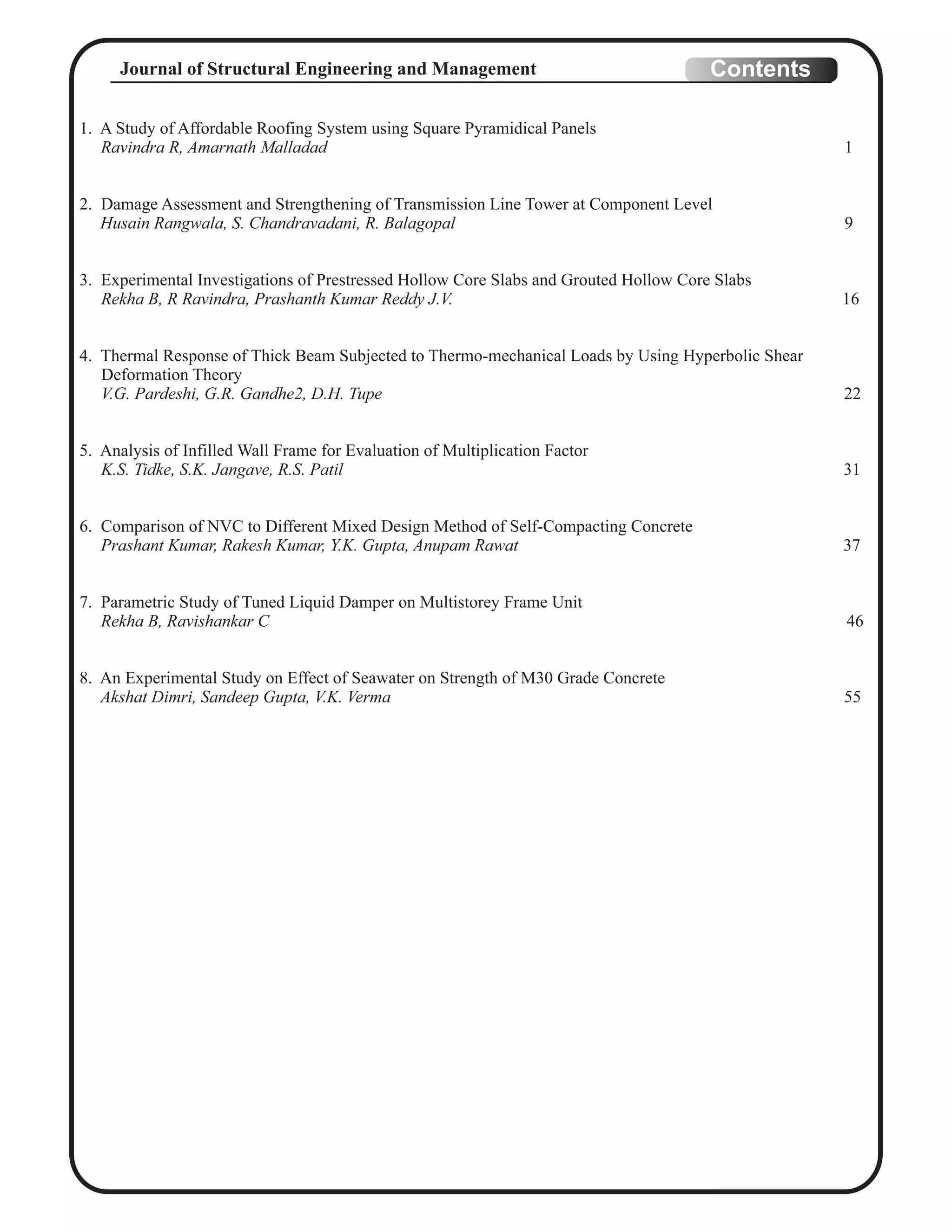
1. A Study of Affordable Roofing System using Square Pyramidical Panels
Ravindra R, Amarnath Malladad 1
2. Damage Assessment and Strengthening of Transmission Line Tower at Component Level
Husain Rangwala, S. Chandravadani, R. Balagopal 9
3. Experimental Investigations of Prestressed Hollow Core Slabs and Grouted Hollow Core Slabs
Rekha B, R Ravindra, Prashanth Kumar Reddy J.V. 16
4. Thermal Response of Thick Beam Subjected to Thermo-mechanical Loads by Using Hyperbolic Shear
Deformation Theory
V.G. Pardeshi, G.R. Gandhe2, D.H. Tupe 22
5. Analysis of Infilled Wall Frame for Evaluation of Multiplication Factor
K.S. Tidke, S.K. Jangave, R.S. Patil 31
6. Comparison of NVC to Different Mixed Design Method of Self-Compacting Concrete
Prashant Kumar, Rakesh Kumar, Y.K. Gupta, Anupam Rawat 37
7. Parametric Study of Tuned Liquid Damper on Multistorey Frame Unit
Rekha B, Ravishankar C 46
8. An Experimental Study on Effect of Seawater on Strength of M30 Grade Concrete
Akshat Dimri, Sandeep Gupta, V.K. Verma 55
ContentsJournal of Structural Engineering and Management
JoSEM (2016) 1-8 © STM Journals 2016. All Rights Reserved Page 1
Journal of Structural Engineering and Management
ISSN: 2393-8773(online)
Volume 3, Issue 3
www.stmjournals.com
A Study of Affordable Roofing System using
Square Pyramidical Panels
Ravindra R*, Amarnath Malladad
Department of Civil Engineering, R.V. College of Engineering,
Visvesvaraya Technological University, Bengaluru, Karnataka, India
Abstract
Affordability of housing unit is a worldwide concern. The term affordable roofing is used to
describe the low cost dwelling units, which are inexpensive and reasonably priced and can
easily serve to certain group of people within specified income range. Structural roofing
system contributes substantially to cost of construction of housing unit in normal situation;
hence, any savings attained in roofing system will reduce the cost of construction of housing
unit. In a search of new roofing system, the present study is carried out to check whether the
prefabricated roofing would replace the normal roofing process. In the study undertaken, pre-
cast RCC roof infill elements are supported on precast RCC joist system. The square
pyramidical panels have size of 0.5 m  0.5 m and 0.75 m  0.75 m considered with a rise of
60 mm, 75 mm and 90 mm at the centre. The analysis of the roof system is made by using
STAADPRO software and further validated with the software Etabs. The panels are designed
using M20 grade concrete and steel corresponding to 415 N/mm2
. The cost analysis made for
the roofing system proposed indicates a cost reduction 19.2% and 39.12% for slab size of 2 m
 2.5 m and 3 m  3.75 m respectively, when compared to the conventional slab of same size.
The weight of the joist systems and the infill panels are found to be relatively less and can
handled easily by two to four masons thus reducing the labour cost. The joist systems and
panels are prefabricated and can be easily placed thus eliminating need of shuttering and in
situ construction, leading to faster construction of slab. The proposed roofing system is cost
effective with a greater speed of construction compared to conventional roofing system.
Keywords: Affordable roofing, precast concrete, cost economics of roofing system, square
pyramidical panel
INTRODUCTION
Affordability of housing units is a worldwide
concern. The term affordable roofing is used
to describe the low cost dwelling units which
are inexpensive and reasonably priced and
which can easily serve to certain group of
people within specified income range. Roofs
contribute to 8–11% of the total cost of
construction. Structural roofing system
contributes substantially to the cost of
construction of housing unit in normal
situation; hence, any savings attained in
roofing system will reduce the cost of
construction of housing unit [1].
According to World Bank 2013 report on
poverty in India, 23.6% are living in lower
income range. Government of India launched
Pradhan Mantri Awas Yojana (PMAY) in
2015, According to PMAY report, the slum
dwelling is growing at the rate of 34% for a
decade; henceforth, there is a need of
affordable units. The estimated housing units
required by 2022 are 20 million units [2].
In a search of new roofing system, the present
study is carried out which is described briefly
as follows. Pre-cast Square pyramidical panel
elements are placed on pre-cast RCC joist
system, which contains primary components
joined together with secondary beam and with
an overlay of in situ concrete. The two main
components are (i) Roof infill element, which
consists of square pyramidical panels, (ii)
Primary and secondary RCC precast beams
grid system.
The necessity in the reduction of the cost in
construction led to the development of
alternative roofing technologies. Filler slab is
JoSEM (2016) 9-15 © STM Journals 2016. All Rights Reserved Page 9
Journal of Structural Engineering and Management
ISSN: 2393-8773(online)
Volume 3, Issue 3
www.stmjournals.com
Damage Assessment and Strengthening of Transmission
Line Tower at Component Level
Husain Rangwala1,
*, S. Chandravadani2
, R. Balagopal3
1
Department of Civil Engineering, Institute of Technology, Nirma University, Ahmedabad, India
2
Department of Civil Engineering Vellore Institute of Technology, Vellore, Tamil Nadu, India
3
Tower Testing Research Station, CSIR-Structural Engineering Research Centre, Chennai,
Tamil Nadu, India
Abstract
The damage assessment and strengthening of transmission tower is an important factor to be
considered for life enhancement. The transmission tower deteriorate due to corrosion and
ageing. In this paper, analytical and experimental investigation is carried out at component
level on cantilever beam made of square hollow and angle section. The damage is inflicted by
reducing the stiffness of the beam. The damage is assessed based on frequency response
measurements. The damaged beam is strengthened through GFRP (Glass Fibre Reinforced
Polymer) wrapping using araldite bonding. The analytical investigation is carried out using
ANSYS software. The enhanced strength of the beam due to GFRP wrapping is analyzed and
the results of experimental and analytical investigations are compared.
Keywords: Damage assessment, strengthening, steel beam, cantilever beam, frequency
response
INTRODUCTION
In the field of structural engineering, structural
health monitoring is term increasingly used in
the last decade to describe a range of systems
implemented on full-scale civil infrastructure.
Structural health monitoring is referred as the
process of implementing damage detection
methodologies and characterizing the current
state of health of engineering structure.
Structural health monitoring involves
observation of system over time using
periodically sampled dynamic response
measurements from an array of sensors, the
extraction of damage sensitive features from
these measurements and statistical analysis of
these features so as to determine current state
of system health [1].
This process involves the observation of a
structure or mechanical system over time
using periodically spaced measurements, the
extraction of damage sensitive features from
these measurements and the statistical analysis
of these features to determine the current state
of system health. Under an extreme event,
such as an earthquake or unanticipated blast
loading, SHM is used for rapid condition
screening. This screening is intended to
provide, in near real-time, reliable information
about system performance during such
extreme events and the subsequent integrity of
the system.
In most general term, damage is defined as
changes introduced into a system that
adversely affects the current or future
performance of that system. Damage in the
structure can be identified in terms of dynamic
properties of the structure such as natural
frequency, damping, and mode shape etc.
Vibration based damage method growing
interest during the past 20 years. Several
vibration based damaged methods has been
presented in this period which review are
given in Rytter 1993) [2].
Pandey et al. [3] and Kahl et al. [4] used
special information such as curvature mode
and strain data. Some researchers have
attempted to detect and localize damage using
damage in natural frequencies [5–8]. The most
appealing feature associated while using
frequencies is that natural frequencies are
relatively simple to measure. The feasibility of
JoSEM (2016) 16-21 © STM Journals 2016. All Rights Reserved Page 16
Journal of Structural Engineering and Management
ISSN: 2393-8773(online)
Volume 3, Issue 3
www.stmjournals.com
Experimental Investigations of Prestressed Hollow Core
Slabs and Grouted Hollow Core Slabs
Rekha B1,
*, R Ravindra2
, Prashanth Kumar Reddy J.V.3
1,3
School of Civil Engineering, Reva University, Bangaluru, Karnataka, India
2
Department of Civil Engineering, RV College of Engineering, Bangaluru, Karnataka, India
Abstract
With the advent and rapid inclusion of prefabricated concrete system to the construction
industry, it poses interesting research challenges to the academic world. The acceptance of
hollow-core slab as an alternative to the normal reinforced concrete solid slabs is getting
delayed due to the delusion among public. The usage of grouted hollow core slabs by filling
the core with grout is one of the increasing demands observed by the hollow core slab
manufacturers. This research paper is intended to compare the behaviour of the hollow core
slabs and the grouted hollow core slabs under different loading cases. Deflections at critical
section, lateral displacement and failure pattern is experimentally measured and compared as
part of the study. The study reveals that for uniformly distributed loading and two point
loading, the hollow core behaved elegantly compared to the grouted specimen. In case of
single point loading the behaviour of both specimens are in a similar fashion.
Keywords: Hollow core structures, grouted hollow core structures, loading capacity, lateral
displacement, crack pattern
INTRODUCTION
The study on the behaviour of hollow core
slab is one of the thrust areas among research
fraternity. However, there is a definite gap on
research of hollow core behaviour in
comparison with grouted core slabs. John F.
Stanton tried to determine the distribution of
response in hollow-core slab floors subjected
to concentrated point and line loads [1]. This
paper concluded that the distribution width for
the precast is less than the conventional type
slab, hence leads to the fact that the entire load
should be carried in the longitudinal bending.
Vidya Jose, P. Rajeev Kumar gave give
insights on the design concepts, manufacture
and the erection techniques of hollow core
slabs [2].
Tan et al. carried out study using design charts
and concluded that the designing for
continuity leads to an increase in span capacity
of hollow-core slabs with reduced deflections
[3]. Edward Fallon discussed the five
important stages in the design which includes
Stress distribution and deflection checks for
Serviceability limit state, Moment capacity
and Vertical shear capacity for the Ultimate
limit state and Shear checks at the slab/topping
interface [4]. Rahman et al. carried out
experimental studies and the results showed
that the existing ACI code equations
underestimated the flexure-shear strength of
these hollow-core slabs [5].
Present Work
The dearth of study on grouted hollow cores
was visible from the literature study. This
paper aims to investigate the gap by
conducting the experimental study of hollow
cores in comparison with grouted hollow
cores; thus, convey the right impression to the
public on the load bearing capacity of hollow
core slabs. The experiment was conducted at
two phases.
Phase 1: Preparation of specimens
Phase 2: Evaluation of load capacity testing in
Loading Frame.
Phase 1: Preparation of specimens
Being a comparative study, the preparation of
specimen is cast using same equipment under
similar conditions. Six similar prestressed
precast hollow core slabs are prepared of same
dimensions. The dimension of those hollow-
JoSEM (2016) 22-30 © STM Journals 2016. All Rights Reserved Page 22
Journal of Structural Engineering and Management
ISSN: 2393-8773(online)
Volume 3, Issue 3
www.stmjournals.com
Thermal Response of Thick Beam Subjected to
Thermo-mechanical Loads by Using Hyperbolic Shear
Deformation Theory
V.G. Pardeshi1,
*, G.R. Gandhe2
, D.H. Tupe2
Department of Civil Engineering, Deogiri Institute of Engineering and Management Studies,
Aurangabad, Maharashtra, India
Abstract
In this paper, a hyperbolic shear deformation theory (HPSDT) taking into account transverse
shear deformation effect is presented for thermo-mechanical stress analysis of thick isotropic
beam subjected to thermo-mechanical. The displacement field contains two variables. The
hyperbolic sine and cosine function is used in the displacement field in terms of thickness Co-
ordinate to represent the effect of shear deformation. The most important feature of the theory
is that, the transverse shear stresses can be obtained directly from the use of equilibrium
equation, satisfying the stress-free boundary conditions at top and bottom surfaces of the
beam. The present theory obviates the need of shear correction factor. Governing differential
equations and boundary conditions of the theory are obtained using the principle of virtual
work. Navier solution technique is employed for the simply supported beams. The results
obtained for bending analysis of isotropic beam subjected to thermo-mechanical load are
compared with those obtained by other theories like the elementary theory of beam (ETB),
first-order shear deformation theory (FSDT), to validate the accuracy of the presented theory.
Keywords: Hyperbolic shear deformation, isotropic thick beam, principle of virtual work,
thermo-mechanical loads
INTRODUCTION
The isotropic and anisotropic structural
elements are used in aerospace vehicles,
construction of rockets, high-speed vehicle and
nuclear reactors. The temperature variation
often represents a significant factor and
sometimes the predominant causes of failure
of structure. The deflection and stress analysis
of beam subjected to linear thermal load has
beam subject of research interest in recent
years. B. A. Boley et al. [1] explained the
effect of uniform thermal load on thick beam
for its analysis of thermal stresses. Wan-Lee
Yin [2] have used a variational method
involving stress functions is used to determine
the interlaminar stresses and the free-edge
effects in a laminated beam under a
temperature loading. S. Kapuria et al. [3] has
presented a new efficient higher order zigzag
theory for composite and sandwich beams
subjected to thermal loading. Reddy J. N. et al.
[4] are presented Thermal deformations in
symmetric and antisymmetric cross-ply beams
are investigated. Yepeng Xu et al. [5] are
presented Two-dimensional thermoelastic
analysis for simply supported beams with
variable thickness and subjected to thermo-
mechanical loads. Gandhe G. R. et al. [6] are
presented thermo-elastic stress analysis
perfectly clamped metallic rod using integral
transform technique.
THEORETICAL FORMULATION
The variationally correct forms of differential
equations and boundary conditions, based on
the assumed displacement field are obtained
using the principle of virtual work. The beam
under consideration occupies the following
region:
0 ; /2 /2; /2 /2x L b y b h z h       
Consider a thick isotropic simply supported
beam of dimensions L, b and h in x, y, z
direction respectively. Where x, y and z are
Cartesian coordinates. The beam is subjected
to thermo-mechanical load of intensity T(x) +
qo on whole length of beam (Figure 1).
JoSEM (2016) 31-36 © STM Journals 2016. All Rights Reserved Page 31
Journal of Structural Engineering and Management
ISSN: 2393-8773(online)
Volume 3, Issue 3
www.stmjournals.com
Analysis of Infilled Wall Frame for Evaluation of
Multiplication Factor
K.S. Tidke1,
*, S.K. Jangave2
, R.S. Patil2
Department of Civil Engineering, Deogiri Institute of Engineering and Management Studies,
Maharashtra, India
Abstract
Masonry infilled reinforced concrete (RC) frames are the most common type of structures
which is used for multi-storeyed constructions in the developing countries like India, even
those these are located in seismically active regions. Masonry infill walls are frequently used
as interior and exterior wall in reinforced concrete (RC) buildings. Infill wall protects the
internal of the buildings from the environment hazards. Masonry infills are normally
considered as non-structural elements and their stiffness contributions are generally ignored
in practice, such approach can lead to an unsafe design. This paper includes seismic analysis
of multi-storey structure with and without infill wall by using response spectrum and time
history analysis method. Both the structure analysed and compared in different terms such as
base shear, maximum storey drift and multiplication factor of soft storey column using finite
element method (FEM) based software SAP2000. The result shows that presence of infill wall
increases the stiffness and strength of structure. IS code 1893(Part I):2002 provision does not
satisfy the multiplication factor of soft storey column.
Keywords: Bare frame, equivalent diagonal strut, infill wall, response spectrum, time history
INTRODUCTION
Nowadays, a human aspiration is to create
taller and taller structures. In a country like
India, use of reinforced concrete framed
structure in multi-storey building construction
is very common. Development of metro cities
in India is increasing resulting to demand of
high-rise building. The reinforced cement
concrete moment resisting frames infilled with
unreinforced brick masonry walls are very
common in India and also in other developing
countries. Masonry is a commonly used
construction material in the world that includes
accessibility, functionality, and cost.
The primary function of masonry is either to
protect inside of the structure from the
environment or to divide inside spaces.
Normally it is considered as architectural
elements. Engineer’s often neglect their
presence. Because of complexity of the
problem, their interaction with the bounding
frame is often neglected in the analysis of
building structures [1]. Nevertheless, the
presence of masonry infill walls has a
significant impact on the seismic response of a
reinforced concrete frame building, increasing
structural strength and stiffness (relative to a
bare frame) has been reported [2]. Properly
designed infills can increase the overall
strength, lateral resistance, and energy
dissipation of the structure. An infill wall
reduces the lateral deflections and bending
moments in the frame, thereby decreasing the
probability of collapse [3].
V.K.R. Kodur, M.A. Erki and J.H.P.
Quenneville considered a three storey RC
frame building models for the analysis [4].
These RC frames were analysed for three
cases:
1. Bare frame
2. Infilled frame
3. Infilled frame with openings respectively.
Based on the analysis results they found that
base shear of infilled frame is more than
infilled frame with openings and bare frame.
Time period of infilled frame is less as
compared to infilled frame with openings and
bare frame. The natural frequency of infilled
frame is more as compared to infilled frame
with openings and bare frame.
JoSEM (2016) 37-45 © STM Journals 2016. All Rights Reserved Page 37
Journal of Structural Engineering and Management
ISSN: 2393-8773(online)
Volume 3, Issue 3
www.stmjournals.com
Comparison of NVC to Different Mixed Design Method of
Self-Compacting Concrete
Prashant Kumar, Rakesh Kumar, Y.K. Gupta, Anupam Rawat*
Department of Civil Engineering, Motilal Nehru National Institute of Technology, Allahabad,
Uttar Pradesh, India
Abstract
In comparison to normally solid vibrated (NVC), Self-compacting concrete (SCC) Elimination
of extended properties and compaction due to improving productivity and working conditions.
SCC usually NVC is more than powder material and thus to achieve an affordable and
durable solid additions to change some of the cement by. As the flow of such recession-self
acceptance of compressed concrete characteristics test results; J-ring, funnel and L box are
presented. In addition, at the age of 7 and 28 days compressive strength was determined and
the results are included here.
Keywords: self-compacting concrete, NVC concrete, Okamura Method, CBI Method, UCL
Method, Aggregate Packing Factor
INTRODUCTION
Self-compacting concrete (SCC), requiring no
alliance work at site or concrete plants, has
been developed in Japan to recover the
durability and uniformity of concrete in 1988
[1]. The mix composition is chosen to satisfy
all performance standards for the concrete in
both the fresh and hardened states. There is no
standard technique for SCC mix design, and
many academic institutions as well as
admixture, ready-mixed, precast and
contracting companies have advanced their
own mix proportioning methods. As per
EFNARC Guidelines for SCC mix design, one
of the most important differences between
SCC and normal concrete is the incorporation
of a mineral admixture. Thus, many studies on
the properties of mineral admixtures on the
properties of SCC have been conducted. These
studies show the benefit of mineral admixture
usage in SCC, such as developed workability
with reduced cement content [2].
The results show that the ability to consistently
fill of SCC, fly ash concrete (SCC) cemented
Compact with development actors in order to
overcome the problems associated with in-
place concrete for the construction industry to
have a desirable achievement. Self-contained
compressed solid its high fluidity and isolation
for long range (Bartos, 2000) can be the cause
of resistance workers [3], pump size and
arrangement of bars or the amount of a
structure to consolidate is not affected by the
skills of and. The concept of concrete self-
compact 1986 Professor Hajime Okamura
(1997) was proposed, but in 1988 the first
prototype was developed in Japan, Tokyo
University Professor Ozawa [4]. Self-
contained compressed solid durability of
concrete structures developed at that time was
to improve. Since then, there have been
various investigations and practical structures,
primarily in the SCC Japan large construction
has been used by companies.
Combine a rational design method and check
for the installation of compatibility test
methods this is a standard concrete forming
has been out of sight. Self-contained
compressed solid cast so that no additional
internal or external vibration compaction is
necessary. It flows like "honey" and after a
very smooth surface level. With regard to its
composition, the cement, aggregates concrete
self-compact, and water, chemical and mineral
admixtures in different proportions with the
addition of the same components as
conventional concrete is vibrated [5]. Usually,
the chemical admixtures used high range water
reducers (Super plasticizers) and rheological
properties of concrete viscosity modifying
JoSEM (2016) 46-54 © STM Journals 2016. All Rights Reserved Page 46
Journal of Structural Engineering and Management
ISSN: 2393-8773(online)
Volume 3, Issue 3
www.stmjournals.com
Parametric Study of Tuned Liquid Damper on
Multistorey Frame Unit
Rekha B1,
*, Ravishankar C2
1
School of Civil Engineering, REVA University, Bangalore, Karnataka, India
2
Department of Civil Engineering, Reva Institute of Technology and Management, Bangalore,
Karnataka, India
Abstract
Swimming pools in a skyscraper are not only an entertainment facility but also a boon of a
structural design engineer to curb the impact of lateral forces such as wind, earthquake, etc.
The usage of swimming pools as liquid tuned damper is a cost effective alternative without
having any additional component within the structure. Much of the research to damp the
vibration of the structure like base isolation, bracing, in-fills and dampers is available the
literature. In this experimental study, it is intended to perform a parameter study of tuned
liquid damper by changing aspect ratio**, i.e., the depth of water to the length of the
container and by changing the mass ratio, i.e., mass of the tuned liquid to the total mass of the
frame unit. This study revealed the aspect ratio of 0.25 has better efficiency and the increase
in mass ratio provides the improved efficiency and consistency.
Keywords: Tuned liquid damper (TLD), sloshing, sinusoidal excitation, dampers
INTRODUCTION
There are multiple papers available on the
performance study of tuned liquid dampers in
literature. Bhattacharjee et al. concluded that
the maximum damping is achieved at the
resonance period from the attachment of tuned
liquid damper [1].
J.S. Love and M. J. Tait deployed nonlinear
model and observed that the multiple tuned
liquid damper is robust than single liquid
damper [2]. Fujino et al. carried out a semi
analytical studied of a two-dimensional liquid
motion subjected to harmonic excitation on the
basis of “shallow wave theory” [3]. Reed et al.
found out that the tuned liquid damper
efficiency increases as the amplitude increase
[4]. M.J. Tait, N. Isyumov, A. A. Ei Damatty
compared tuned and un-tuned liquid dampers
and verified the performance on unidirectional
and bidirectional [5]. Y. Fujino, and L. M. Sun
compared the efficiency of multiple tuned
liquid dampers to single tuned liquid damper
and found that multiple tuned liquid being more
efficient in small amplitude but comparable in
large amplitudes [6]. M.J. Tait, N. Isyumov,
A.A. Ei Damatty derived a model to design the
tuned liquid damper [7]. E. Sonmez, S.
Nagarajaiah, C. Sun, B. Basu conducted the
experiment on semi active tuned liquid damper
and results in a more robust liquid damper than
the conventional [8]. J.S. Love and M.J. Tait
figured out a fluid model [9].
Thus, the literature survey indicates that plenty
of study were happened in this field of tuned
liquid dampers and tuned active liquid
dampers. However, most of the experimental
study was conducted on single storeyed units.
In this study, we conducted the experimental
study on multistoreyed frame units.
PRESENT WORK
This paper aims to investigate the performance
of tuned liquid damper systems on
multistoreyed frame unit. The experiment was
conducted at two phases.
JoSEM (2016) 55-59 © STM Journals 2016. All Rights Reserved Page 55
Journal of Structural Engineering and Management
ISSN: 2393-8773(online)
Volume 3, Issue 3
www.stmjournals.com
An Experimental Study on Effect of Seawater on Strength
of M30 Grade Concrete
Akshat Dimri1,
*, Sandeep Gupta2
, V.K. Verma2
1
Department of Civil Engineering, National Institute of Technology, Kurukshetra, Haryana, India
2
Department of Civil Engineering, G.B. Pant University of Agriculture and Technology, Pantnagar,
Uttarakhand, India
Abstract
The concrete structures constructed near the coastal areas may deteriorate due to the action
of sea salts present in seawater on hardened concrete surface with passage of time. The
strength decreases due to the formation of complex ions when chloride and sulphate ions,
react with cement hydration products. In this study, experiments were carried out to get the
effect of seawater on the strength of M30 grade concrete in laboratory to measure
compressive, split tensile and flexural strength. 15 sets of cube of size 150×150×150 mm, 15
sets of cylinder of diameter 100 mm and height 200 mm and 15 sets of beam of size
100×100×500 mm were cast. Out of these 15 sets of each specimen, five sets were kept in
plain water, five sets in artificial seawater of 1N concentration and five sets in artificial
seawater of 8N concentration. 1N seawater means normal seawater made by mixing tap water
with exact amount and proportion of principal salts found in natural seawater. Each specimen
was tested after an interval of 30, 60, 90, 120 and 180 days. A comparison was made between
the strength variation of concrete in 1N and 8N concentration of seawater and plain water.
Keywords: Seawater, concrete, compressive strength, split tensile strength, flexural strength
INTRODUCTION
Seawater is a complex solution of different
salts containing suspended silt, dissolved gases
and decaying organic matter. The average salt
concentration of seawater is about 3.5%
although it varies from sea to sea depending
upon the geological location [1]. The seawater
contains chlorides, sulphates, carbonates and
bromides of sodium, magnesium, calcium and
potassium [2]. To relieve land from pressure
of urban congestion and pollution, floating
offshore platforms made of concrete are being
considered for location of new airports, power
plants, and waste disposal facilities. The use of
concrete offshore drilling platforms and oil
storage tanks is already increasing.
Several studies were carried out on the
strength properties of hardened concrete
specimens cast or cured with natural as well as
artificial seawater to see the effect of salts of
seawater on concrete specimens and it was
found that attack by sea salts on concrete is a
very slow process [3, 4]. The most damaging
effect of seawater on concrete structures arises
by the attack of chlorides on the steel
reinforcement [5]. The increase in the risk of
corrosion of steel limit the use of seawater in
steel reinforced structures, if prior preventive
measures are not taken. Preventive measures
include the coating of reinforcement steel with
cement slurry mixed with fresh water,
decreasing the w/c ratio in concrete, using
different additives to increase the strength of
concrete [6].
The main objective of this research was to
prepare the M30 grades concrete by using
Glenium as a superplasticizer and to study the
variation in compressive, split tensile and
flexural strength of this grade of concrete
when they are kept in plain water and artificial
seawater of 1N concentration. 1N seawater
means normal seawater made by mixing tap
water with exact amount and proportion of
principal salts found in natural seawater. The
study was also carried out to check the
variation in strength of concrete when
concentration of salts in artificial seawater was
increased by eight times of natural seawater.
conducted
Ch Instrumentation/ /
/
Energy Science/ /
22
STMJournals invitesthepapers
from the National Conferences,
International Conferences, Seminars
conducted by Colleges, Universities,
Research Organizations etc. for
Conference Proceedings and Special
Issue.
xSpecial Issues come in Online and
Printversions.
xSTM Journals offers schemes to
publish such issues on payment and
gratis(online)basisas well.
To g e t m o r e i n f o r m a t i o n :
stmconferences.com
Over 500 Indian and International
Subscribers.
30,000 Top Researchers, Scientists,
Authors and Editors All Over the
WorldAssociated.
Editorial/ Reviewer Board Members :
.
1000
+
1,00,000 Visitors to STM Website
+
From 140 CountriesQuarterly.
+
10,000 Downloads from STM
+
Website.
GLOBAL READERSHIP STATISTICS
STM Journals
Empowering knowledge
Free Online Registration
ISO: 9001Certified
Journal of
Structural Engineering
& Management
(JoSEM)
September–December 2016
ISSN 2393-8773 (Online)
www.stmjournals.com
STM JOURNALS
Scientific Technical Medical

Journal of Structural Engineering and Management vol 3 issue 3

  • 1.
    conducted Ch Instrumentation/ / / EnergyScience/ / 22 STMJournals invitesthepapers from the National Conferences, International Conferences, Seminars conducted by Colleges, Universities, Research Organizations etc. for Conference Proceedings and Special Issue. xSpecial Issues come in Online and Printversions. xSTM Journals offers schemes to publish such issues on payment and gratis(online)basisas well. To g e t m o r e i n f o r m a t i o n : stmconferences.com Over 500 Indian and International Subscribers. 30,000 Top Researchers, Scientists, Authors and Editors All Over the WorldAssociated. Editorial/ Reviewer Board Members : . 1000 + 1,00,000 Visitors to STM Website + From 140 CountriesQuarterly. + 10,000 Downloads from STM + Website. GLOBAL READERSHIP STATISTICS STM Journals Empowering knowledge Free Online Registration ISO: 9001Certified Journal of Structural Engineering & Management (JoSEM) September–December 2016 ISSN 2393-8773 (Online) www.stmjournals.com STM JOURNALS Scientific Technical Medical
  • 2.
    STM Journals, astrong initiative by Consortium E-Learning Network Private Ltd. (established 2006), was launched in the year 2010 under the support and guidance by our esteemed Editorial and Advisory Board Membersfromrenownedinstitutes. Objectives:  Promotion of Scientific, Technical and Medical research.  Publication of Original Research/Review, Short Articles and Case Studies through Peer Review process.  Publishing Special Issues on Conferences.  Preparing online platform for print journals.  Empowering the libraries with online and print Journals in Scientific, Technical and Medical domains.  Publishing and distribution of books on various subjects in the category of Nanotechnology, Scientific and Technical Writing, and Environment, Health and Safety. SalientFeatures:  A bouquet of 100+ Journals that fall under Science, Technical and Medical domains.  Employs Open Journals System (OJS)—a journal management and publishing system.  The first and one of the fastest growing publication website in India as well as in abroad for its quality and coverage.  Rapid online submission and publication of papers, soon after their formal acceptance/finalization.  Facilitates linking with the other authors or professionals.  Worldwide circulation and visibility. Journal of Structural Engineering and Management ISSN: 2393-8773(online) Focus and Scope Covers  VibrationImpact,StucturalDynamics  ExperimentalMechanics  StructuralEngineeringandStructuralMechanics  AnalyticalanddesignMethods  Bridge,Damconstructionandanalysis  Repairs,Strengthening,Maintenance  InnovativeStructures Journal of Structural Engineering and Management is published (frequency: three times a year) in India by STM Journals (division of Consortium e-Learning Network Private Ltd. Pvt.) The views expressed in the articles do not necessarily reflect of the Publisher. The publisher does not endorse the quality or value of the advertised/sponsored products described therein. Please consult full prescribing information before issuing a prescription for any products mentionedinthispublication. No part of this publication may be reproduced, stored in retrieval system or transmitted in any from without written permissionof thepublisher. To cite any of the material contained in this Journal, in English or translation, please use the full English reference at the beginningof eacharticle.Toreuseanyofthematerial,pleasecontactSTM Journals (info@stmjournals.com) STM Journals
  • 3.
    STM Journals (divisionof Consortium e-Learning Network Private Ltd. ) having its Marketing office located at Office No. 4, First Floor, CSC pocket E Market, Mayur Vihar Phase II, New Delhi-110091, India is the Publisher of Journal. Statements and opinions expressed in the Journal reflect the views of the author(s) and are not the opinion of STM Journals unless so stated. Subscription Information and Order:  NationalSubscription: Print-Rs 3750/-perJournal( includes3printissues), SingleIssue copypurchase:Rs 1500. Online - Rs 3750/- per Journal inclusive Service Tax ( includes 3 online issues), Single Issue purchase: Rs 1500 inclusiveServiceTax Print+Online-Rs 5000/-perJournalinclusiveServiceTax( includes3print&onlineissues).  International Subscription:  Online Only- $199, Print Only-$299 (includes 3 print issues)  Online + Print-$399 (includes 3 print issues + online access of published back volumes ) To purchase print compilation of back issues please send your query at info@stmjournals.com Subscription must be prepaid. Rates outside of India includes delivery. Prices subject to change without notice. Mode of Payment: At par cheque, Demand draft, and RTGS (payment to be made in favor of Consortium E-Learning Network. Pvt. ltd., payable at Delhi/New Delhi. Online Access Policy A). For Authors: In order to provide maximum citation and wide publicity to the authors work, STM Journals also have Open Access Policy, authors who would like to get their work open access can opt for Optional Open Access publication at nominal cost as follows India, SARC and African Countries: INR 2500 or 100 USD including single hard copy of Author's Journal. Other Countries: USD 200 including single hard copy of Author's Journal. B). For Subscribers:  Online access will be activated within 72 hours of receipt of the payment (working days), subject to receipt of correct information on user details/Static IP address of the subscriber.  The access will be blocked:  If the user requests for the same and furnishes valid reasons for blocking.  Due to technical issue.  Misuse of the access rights as per the access policy. Advertising and Commercial Reprint Inquiries: STM Journals with wide circulation and visibility offer an excellent media for showcasing/promotion of your products/services and the events-namely, Conferences, Symposia/Seminars etc. These journals have very high potential to deliver the message across the targeted audience regularly with each published issue. The advertisements on bulk subscriptions, gift subscriptions or reprint purchases for distribution etc. are alsoverywelcome. Lost Issue Claims: Please note the following when applying for lost or missing issues:  Claims for print copies lost will be honored only after 45 days of the dispatch date and before publication of the next issue as per the frequency.  Tracking id for the speed post will be provided to all our subscribers and the claims for the missing Journals will be entertained only with the proofs which will be verified at both the ends.  Claims filed due to insufficient (or no notice) of change of address will not be honored.  Change of Address of Dispatch should be intimated to STM Journals at least 2 months prior to the dispatch schedule as per the frequency by mentioning subscriber id and the subscription id.  Refund requests will not be entertained. Legal Disputes All the legal disputes are subjected to Delhi Jurisdiction only. If you have any questions, please contact the Publication Management Team: info@stmjournals.com; Tel : +91 0120-4781211.
  • 4.
    Gargi Asha Jha Manager(Publications) PUBLICATION MANAGEMENT TEAM Internal Members External Members Bimlesh Lochab Assistant Professor Department of Chemistry School of Natural Sciences, Shiv Nadar University Gautam Buddha Nagar, Uttar Pradesh, India Dr. Rajiv Prakash Professor and Coordinator School of Materials Science and Technology Indian Institute of Technology (BHU), Varanasi Uttar Pradesh, India Dr. Rakesh Kumar Assistant Professor Department of Applied Chemistry BIT Mesra, Patna, Bihar, India Prof. S. Ramaprabhu Alternative Energy and Nanotechnology Technology Laboratory, Department of Physics Indian Institute of Technology, Chennai Tamil Nadu, India Himani Pandey Isha Chandra Senior Associate Editors Dr. Yog Raj Sood Dean (Planning and Development) Professor, Department of Electrical Engineering National Institute of Technology, Hamirpur Himachal Pradesh, India Prof. Chris Cannings Professor, School of Mathematics and Statistics University of Sheffield, Sheffield United Kingdom Dr. D. K. Vijaykumar MS, MCh (Surgical Oncology), Professor and Head Department of Surgical Oncology Amrita Institute of Medical Sciences and Research Centre Ponekkara, Cochin, Kerala, India Dr. Durgadas Naik Associate Professor (Microbiology) Management and Science University, University Drive, Seksyen13 Selangor, Malaysia Prof. José María Luna Ariza Department of Computer Sciences and Numerical Analysis Campus of Rabanales University of Córdoba, Spain Dr. Khaiser Nikam Professor, Library and Information Science Department of Library and Information Science University of Mysore Mysore, India Quaisher J Hossain Senior Editor Group Managing Editor Dr. Archana Mehrotra Managing Director CELNET, Delhi, India Meenakshi Tripathi Shivani Sharma Chairman Mr. Puneet Mehrotra Director Shambhavi Mishra Associate Editors Sugandha Mishra
  • 5.
    Prof. Priyavrat Thareja DirectorPrincipal Rayat Institute of Engineering and Information Technology Punjab, India Dr. Baldev Raj Director, National Institute of Advanced Studies Indian Institute of Science campus Bangalore Karnataka, India Former Director Indira Gandhi Centre for Atomic Research, Kalpakkam, Tamil Nadu, India Dr. Pankaj Poddar Senior Scientist Physical and Materials Chemistry Division, National Chemical Laboratory Pune, Maharastra India Prof. D. N. Rao Professor and Head Department of Biochemistry All India Institute of Medical Sciences New Delhi, India Dr. Nandini Chatterjee Singh Additional Professor National Brain Research Centre Manesar, Gurgaon Haryana, India Dr. Ashish Runthala Lecturer, Biological Sciences Group Birla Institute of Technology and Science Pilani, Rajasthan, India Dr. Bankim Chandra Ray Professor and Ex-Head of the Department Department of Metallurgical and Materials Engineering National Institute of Technology, Rourkela Odisha, India Prof. Yuwaraj Marotrao Ghugal Professor and Head Department of Applied Mechanics Government College of Engineering Vidyanagar, Karad Maharashtra, India Dr. Hardev Singh Virk Visiting Professor, Department of Physics University of SGGS World University Fatehgarh Sahib, Punjab, India Former Director Research DAV Institute of Engineering and Technology Jallandhar, India Dr. Shrikant Balkisan Dhoot Senior Research Scientist, Reliance Industries Limited, Mumbai, India Former Head (Research and Development) Nurture Earth R&D Pvt Ltd., MIT Campus Beed Bypass Road, Aurangabad Maharashtra, India STM JOURNALS ADVISORY BOARD
  • 6.
    Dr. Rakesh Kumar AssistantProfessor Department of Applied Chemistry Birla Institute of Technology Patna, Bihar, India Prof. Subash Chandra Mishra Professor Department of Metallurgical and Materials Engineering National Institute of Technology, Rourkela Odisha, India Dr. Shankargouda Patil Assistant Professor Department of Oral Pathology KLE Society's Institute of Dental Sciences Bangalore, Karnataka, India Prof. Sundara Ramaprabhu Professor Department of Physics Indian Institute of Technology Madras Chennai, Tamil Nadu India Dr. Baskar Kaliyamoorthy Associate Professor Department of Civil Engineering National Institute of Technology, Trichy Tiruchirappalli, Tamil Nadu, India STM JOURNALS ADVISORY BOARD
  • 7.
    Editorial Board Dr. AnithaJoseph Professor, Department of Civil Engineering TKM College of Engineering, Kerala, India. Mr. Govardhan Bhat Assistant Professor, Department of Civil Engineering, N.I.T, Raipur, India. Dr. Kalyan Kumar Das ssociate Professor, Department ofA Mechanical Engineering, Assam Engineering College, Guwahati, India. Dr. M. Zeinoddini Associate Professor KNT University of Technology, Tehran, Iran. Dr. Govindaraja K. Gupta Professor, Goa College of Engineering Bhausaheb Bandodkar Technical Education Complex, Goa, India. Dr. Dinesh Kumar Assistant Professor Department of Mechanical Engineering, Malaviya National Institute of Technology, Jaipur, India. Dr. P. Sivakumar Chief Scientist, CSIR-Structural Engineering Research Centre CSIR Campus, Chennai, India. Dr. Partha Bhattacharya Associate Professor, Department of Civil Engineering, Jadavpur University, Kolkata, India. Dr. Prem Pal Bansal Assistant Professor, Department of Civil Engineering, Thapar University, Patiala, India. Dr. Priyadarsini RS Associate Professor, Dept. of Civil Engg, College of Engg., Trivandrum, India. Dr. R. K. Pandit Professor & Head, Department of Architecture, MITS , Gwalior, MP, India. Dr. Ramadhansyah Putra Jaya Faculty of Civil Engineering, Polytechnic Tuanku Sultanah Bahiyah, Kedah, Malaysia.
  • 8.
    Editorial Board Dr. ZeeshanAli Associate Professor, Mechanical EngineeringDepartment, Mehran University of Engineering and Technology, Jamshoro, Sindh, Pakistan. Dr. Subrata Chakraborty Professor and Head, Department of Civil Engineering, IIEST Shibpur, West Bengal India. Dr. G. S. Palani Senior Principal Scientist, Head Steel Structures Research Facility, CSIR- Structural Engg. Res. Centre CSIR Campus, Taramani, Chennai, India. Dr. R. Maheswaran Professor in the Mechanical Engineering, Mepco Schlenk Engineering College, Tamil Nadu, India. Dr. Anil Kumar Sachan Professor, Civil Engineering Department, MNNIT Allahabad, India. R. Malathy Professor/Dean R&D, Dept. Civil Engineering, Sona College of Technology, Sona College of Technology, Salem. Dr. Suchandra Bardhan Associate Professor,Department of Architecture, Jadavpur University, Kolkata, India. Dr. Suhasini Madhekar Associate Professor, Department of Civil Engineering, College of Engineering, Pune, India. Jian Xiao Senior structural Consultant in Intelli SIMS in houston, TX, U.S Dr. Mohammadreza Vafaei Senior Lecturer, Faculty of Civil Engineering Universiti Teknologi Malaysia. Dr. Ma Chau Khun Senior Lecturer, Department of Structure and Material, Faculty of Civil Engineering Universiti Teknologi Malaysia. Dr. Norhazilan Md. Noor Associate Professor, Department of Structure and Material, Faculty of Civil Engineering Universiti Teknologi Malaysia.
  • 9.
    It is myprivilege to present the print version of the [Volume 3 Issue 3] of our Journal of Structural Engineering and Management, 2016. The intension of JoSEM is to create an atmosphere that stimulatesvision,researchandgrowth intheareaofStructuralEngineeringandManagement. Timely publication, honest communication, comprehensive editing and trust with authors and readers have been the hallmark of our journals. STM Journals provide a platform for scholarly research articles to be published in journals of international standards. STM journals strive to publish qualitypaperinrecordtime,makingitaleaderinserviceandbusiness offerings. The aim and scope of STM Journals is to provide an academic medium and an important reference for the advancement and dissemination of research results that support high level learning, teaching andresearchinalltheScience,TechnologyandMedicaldomains. Finally, I express my sincere gratitude to our Editorial/ Reviewer board, Authors and publication team for their continued support and invaluable contributions and suggestions in the form of authoring writeups/reviewing and providing constructive comments for the advancement of the journals.With regards to their due continuous support and co-operation, we have been able to publish qualityResearch/Reviewsfindingsfor our customersbase. Ihopeyouwillenjoyreadingthisissue andwewelcomeyourfeedbackonanyaspectof theJournal. Dr.ArchanaMehrotra ManagingDirector STM Journals Director's Desk STM JOURNALS
  • 10.
    1. A Studyof Affordable Roofing System using Square Pyramidical Panels Ravindra R, Amarnath Malladad 1 2. Damage Assessment and Strengthening of Transmission Line Tower at Component Level Husain Rangwala, S. Chandravadani, R. Balagopal 9 3. Experimental Investigations of Prestressed Hollow Core Slabs and Grouted Hollow Core Slabs Rekha B, R Ravindra, Prashanth Kumar Reddy J.V. 16 4. Thermal Response of Thick Beam Subjected to Thermo-mechanical Loads by Using Hyperbolic Shear Deformation Theory V.G. Pardeshi, G.R. Gandhe2, D.H. Tupe 22 5. Analysis of Infilled Wall Frame for Evaluation of Multiplication Factor K.S. Tidke, S.K. Jangave, R.S. Patil 31 6. Comparison of NVC to Different Mixed Design Method of Self-Compacting Concrete Prashant Kumar, Rakesh Kumar, Y.K. Gupta, Anupam Rawat 37 7. Parametric Study of Tuned Liquid Damper on Multistorey Frame Unit Rekha B, Ravishankar C 46 8. An Experimental Study on Effect of Seawater on Strength of M30 Grade Concrete Akshat Dimri, Sandeep Gupta, V.K. Verma 55 ContentsJournal of Structural Engineering and Management
  • 11.
    JoSEM (2016) 1-8© STM Journals 2016. All Rights Reserved Page 1 Journal of Structural Engineering and Management ISSN: 2393-8773(online) Volume 3, Issue 3 www.stmjournals.com A Study of Affordable Roofing System using Square Pyramidical Panels Ravindra R*, Amarnath Malladad Department of Civil Engineering, R.V. College of Engineering, Visvesvaraya Technological University, Bengaluru, Karnataka, India Abstract Affordability of housing unit is a worldwide concern. The term affordable roofing is used to describe the low cost dwelling units, which are inexpensive and reasonably priced and can easily serve to certain group of people within specified income range. Structural roofing system contributes substantially to cost of construction of housing unit in normal situation; hence, any savings attained in roofing system will reduce the cost of construction of housing unit. In a search of new roofing system, the present study is carried out to check whether the prefabricated roofing would replace the normal roofing process. In the study undertaken, pre- cast RCC roof infill elements are supported on precast RCC joist system. The square pyramidical panels have size of 0.5 m  0.5 m and 0.75 m  0.75 m considered with a rise of 60 mm, 75 mm and 90 mm at the centre. The analysis of the roof system is made by using STAADPRO software and further validated with the software Etabs. The panels are designed using M20 grade concrete and steel corresponding to 415 N/mm2 . The cost analysis made for the roofing system proposed indicates a cost reduction 19.2% and 39.12% for slab size of 2 m  2.5 m and 3 m  3.75 m respectively, when compared to the conventional slab of same size. The weight of the joist systems and the infill panels are found to be relatively less and can handled easily by two to four masons thus reducing the labour cost. The joist systems and panels are prefabricated and can be easily placed thus eliminating need of shuttering and in situ construction, leading to faster construction of slab. The proposed roofing system is cost effective with a greater speed of construction compared to conventional roofing system. Keywords: Affordable roofing, precast concrete, cost economics of roofing system, square pyramidical panel INTRODUCTION Affordability of housing units is a worldwide concern. The term affordable roofing is used to describe the low cost dwelling units which are inexpensive and reasonably priced and which can easily serve to certain group of people within specified income range. Roofs contribute to 8–11% of the total cost of construction. Structural roofing system contributes substantially to the cost of construction of housing unit in normal situation; hence, any savings attained in roofing system will reduce the cost of construction of housing unit [1]. According to World Bank 2013 report on poverty in India, 23.6% are living in lower income range. Government of India launched Pradhan Mantri Awas Yojana (PMAY) in 2015, According to PMAY report, the slum dwelling is growing at the rate of 34% for a decade; henceforth, there is a need of affordable units. The estimated housing units required by 2022 are 20 million units [2]. In a search of new roofing system, the present study is carried out which is described briefly as follows. Pre-cast Square pyramidical panel elements are placed on pre-cast RCC joist system, which contains primary components joined together with secondary beam and with an overlay of in situ concrete. The two main components are (i) Roof infill element, which consists of square pyramidical panels, (ii) Primary and secondary RCC precast beams grid system. The necessity in the reduction of the cost in construction led to the development of alternative roofing technologies. Filler slab is
  • 12.
    JoSEM (2016) 9-15© STM Journals 2016. All Rights Reserved Page 9 Journal of Structural Engineering and Management ISSN: 2393-8773(online) Volume 3, Issue 3 www.stmjournals.com Damage Assessment and Strengthening of Transmission Line Tower at Component Level Husain Rangwala1, *, S. Chandravadani2 , R. Balagopal3 1 Department of Civil Engineering, Institute of Technology, Nirma University, Ahmedabad, India 2 Department of Civil Engineering Vellore Institute of Technology, Vellore, Tamil Nadu, India 3 Tower Testing Research Station, CSIR-Structural Engineering Research Centre, Chennai, Tamil Nadu, India Abstract The damage assessment and strengthening of transmission tower is an important factor to be considered for life enhancement. The transmission tower deteriorate due to corrosion and ageing. In this paper, analytical and experimental investigation is carried out at component level on cantilever beam made of square hollow and angle section. The damage is inflicted by reducing the stiffness of the beam. The damage is assessed based on frequency response measurements. The damaged beam is strengthened through GFRP (Glass Fibre Reinforced Polymer) wrapping using araldite bonding. The analytical investigation is carried out using ANSYS software. The enhanced strength of the beam due to GFRP wrapping is analyzed and the results of experimental and analytical investigations are compared. Keywords: Damage assessment, strengthening, steel beam, cantilever beam, frequency response INTRODUCTION In the field of structural engineering, structural health monitoring is term increasingly used in the last decade to describe a range of systems implemented on full-scale civil infrastructure. Structural health monitoring is referred as the process of implementing damage detection methodologies and characterizing the current state of health of engineering structure. Structural health monitoring involves observation of system over time using periodically sampled dynamic response measurements from an array of sensors, the extraction of damage sensitive features from these measurements and statistical analysis of these features so as to determine current state of system health [1]. This process involves the observation of a structure or mechanical system over time using periodically spaced measurements, the extraction of damage sensitive features from these measurements and the statistical analysis of these features to determine the current state of system health. Under an extreme event, such as an earthquake or unanticipated blast loading, SHM is used for rapid condition screening. This screening is intended to provide, in near real-time, reliable information about system performance during such extreme events and the subsequent integrity of the system. In most general term, damage is defined as changes introduced into a system that adversely affects the current or future performance of that system. Damage in the structure can be identified in terms of dynamic properties of the structure such as natural frequency, damping, and mode shape etc. Vibration based damage method growing interest during the past 20 years. Several vibration based damaged methods has been presented in this period which review are given in Rytter 1993) [2]. Pandey et al. [3] and Kahl et al. [4] used special information such as curvature mode and strain data. Some researchers have attempted to detect and localize damage using damage in natural frequencies [5–8]. The most appealing feature associated while using frequencies is that natural frequencies are relatively simple to measure. The feasibility of
  • 13.
    JoSEM (2016) 16-21© STM Journals 2016. All Rights Reserved Page 16 Journal of Structural Engineering and Management ISSN: 2393-8773(online) Volume 3, Issue 3 www.stmjournals.com Experimental Investigations of Prestressed Hollow Core Slabs and Grouted Hollow Core Slabs Rekha B1, *, R Ravindra2 , Prashanth Kumar Reddy J.V.3 1,3 School of Civil Engineering, Reva University, Bangaluru, Karnataka, India 2 Department of Civil Engineering, RV College of Engineering, Bangaluru, Karnataka, India Abstract With the advent and rapid inclusion of prefabricated concrete system to the construction industry, it poses interesting research challenges to the academic world. The acceptance of hollow-core slab as an alternative to the normal reinforced concrete solid slabs is getting delayed due to the delusion among public. The usage of grouted hollow core slabs by filling the core with grout is one of the increasing demands observed by the hollow core slab manufacturers. This research paper is intended to compare the behaviour of the hollow core slabs and the grouted hollow core slabs under different loading cases. Deflections at critical section, lateral displacement and failure pattern is experimentally measured and compared as part of the study. The study reveals that for uniformly distributed loading and two point loading, the hollow core behaved elegantly compared to the grouted specimen. In case of single point loading the behaviour of both specimens are in a similar fashion. Keywords: Hollow core structures, grouted hollow core structures, loading capacity, lateral displacement, crack pattern INTRODUCTION The study on the behaviour of hollow core slab is one of the thrust areas among research fraternity. However, there is a definite gap on research of hollow core behaviour in comparison with grouted core slabs. John F. Stanton tried to determine the distribution of response in hollow-core slab floors subjected to concentrated point and line loads [1]. This paper concluded that the distribution width for the precast is less than the conventional type slab, hence leads to the fact that the entire load should be carried in the longitudinal bending. Vidya Jose, P. Rajeev Kumar gave give insights on the design concepts, manufacture and the erection techniques of hollow core slabs [2]. Tan et al. carried out study using design charts and concluded that the designing for continuity leads to an increase in span capacity of hollow-core slabs with reduced deflections [3]. Edward Fallon discussed the five important stages in the design which includes Stress distribution and deflection checks for Serviceability limit state, Moment capacity and Vertical shear capacity for the Ultimate limit state and Shear checks at the slab/topping interface [4]. Rahman et al. carried out experimental studies and the results showed that the existing ACI code equations underestimated the flexure-shear strength of these hollow-core slabs [5]. Present Work The dearth of study on grouted hollow cores was visible from the literature study. This paper aims to investigate the gap by conducting the experimental study of hollow cores in comparison with grouted hollow cores; thus, convey the right impression to the public on the load bearing capacity of hollow core slabs. The experiment was conducted at two phases. Phase 1: Preparation of specimens Phase 2: Evaluation of load capacity testing in Loading Frame. Phase 1: Preparation of specimens Being a comparative study, the preparation of specimen is cast using same equipment under similar conditions. Six similar prestressed precast hollow core slabs are prepared of same dimensions. The dimension of those hollow-
  • 14.
    JoSEM (2016) 22-30© STM Journals 2016. All Rights Reserved Page 22 Journal of Structural Engineering and Management ISSN: 2393-8773(online) Volume 3, Issue 3 www.stmjournals.com Thermal Response of Thick Beam Subjected to Thermo-mechanical Loads by Using Hyperbolic Shear Deformation Theory V.G. Pardeshi1, *, G.R. Gandhe2 , D.H. Tupe2 Department of Civil Engineering, Deogiri Institute of Engineering and Management Studies, Aurangabad, Maharashtra, India Abstract In this paper, a hyperbolic shear deformation theory (HPSDT) taking into account transverse shear deformation effect is presented for thermo-mechanical stress analysis of thick isotropic beam subjected to thermo-mechanical. The displacement field contains two variables. The hyperbolic sine and cosine function is used in the displacement field in terms of thickness Co- ordinate to represent the effect of shear deformation. The most important feature of the theory is that, the transverse shear stresses can be obtained directly from the use of equilibrium equation, satisfying the stress-free boundary conditions at top and bottom surfaces of the beam. The present theory obviates the need of shear correction factor. Governing differential equations and boundary conditions of the theory are obtained using the principle of virtual work. Navier solution technique is employed for the simply supported beams. The results obtained for bending analysis of isotropic beam subjected to thermo-mechanical load are compared with those obtained by other theories like the elementary theory of beam (ETB), first-order shear deformation theory (FSDT), to validate the accuracy of the presented theory. Keywords: Hyperbolic shear deformation, isotropic thick beam, principle of virtual work, thermo-mechanical loads INTRODUCTION The isotropic and anisotropic structural elements are used in aerospace vehicles, construction of rockets, high-speed vehicle and nuclear reactors. The temperature variation often represents a significant factor and sometimes the predominant causes of failure of structure. The deflection and stress analysis of beam subjected to linear thermal load has beam subject of research interest in recent years. B. A. Boley et al. [1] explained the effect of uniform thermal load on thick beam for its analysis of thermal stresses. Wan-Lee Yin [2] have used a variational method involving stress functions is used to determine the interlaminar stresses and the free-edge effects in a laminated beam under a temperature loading. S. Kapuria et al. [3] has presented a new efficient higher order zigzag theory for composite and sandwich beams subjected to thermal loading. Reddy J. N. et al. [4] are presented Thermal deformations in symmetric and antisymmetric cross-ply beams are investigated. Yepeng Xu et al. [5] are presented Two-dimensional thermoelastic analysis for simply supported beams with variable thickness and subjected to thermo- mechanical loads. Gandhe G. R. et al. [6] are presented thermo-elastic stress analysis perfectly clamped metallic rod using integral transform technique. THEORETICAL FORMULATION The variationally correct forms of differential equations and boundary conditions, based on the assumed displacement field are obtained using the principle of virtual work. The beam under consideration occupies the following region: 0 ; /2 /2; /2 /2x L b y b h z h        Consider a thick isotropic simply supported beam of dimensions L, b and h in x, y, z direction respectively. Where x, y and z are Cartesian coordinates. The beam is subjected to thermo-mechanical load of intensity T(x) + qo on whole length of beam (Figure 1).
  • 15.
    JoSEM (2016) 31-36© STM Journals 2016. All Rights Reserved Page 31 Journal of Structural Engineering and Management ISSN: 2393-8773(online) Volume 3, Issue 3 www.stmjournals.com Analysis of Infilled Wall Frame for Evaluation of Multiplication Factor K.S. Tidke1, *, S.K. Jangave2 , R.S. Patil2 Department of Civil Engineering, Deogiri Institute of Engineering and Management Studies, Maharashtra, India Abstract Masonry infilled reinforced concrete (RC) frames are the most common type of structures which is used for multi-storeyed constructions in the developing countries like India, even those these are located in seismically active regions. Masonry infill walls are frequently used as interior and exterior wall in reinforced concrete (RC) buildings. Infill wall protects the internal of the buildings from the environment hazards. Masonry infills are normally considered as non-structural elements and their stiffness contributions are generally ignored in practice, such approach can lead to an unsafe design. This paper includes seismic analysis of multi-storey structure with and without infill wall by using response spectrum and time history analysis method. Both the structure analysed and compared in different terms such as base shear, maximum storey drift and multiplication factor of soft storey column using finite element method (FEM) based software SAP2000. The result shows that presence of infill wall increases the stiffness and strength of structure. IS code 1893(Part I):2002 provision does not satisfy the multiplication factor of soft storey column. Keywords: Bare frame, equivalent diagonal strut, infill wall, response spectrum, time history INTRODUCTION Nowadays, a human aspiration is to create taller and taller structures. In a country like India, use of reinforced concrete framed structure in multi-storey building construction is very common. Development of metro cities in India is increasing resulting to demand of high-rise building. The reinforced cement concrete moment resisting frames infilled with unreinforced brick masonry walls are very common in India and also in other developing countries. Masonry is a commonly used construction material in the world that includes accessibility, functionality, and cost. The primary function of masonry is either to protect inside of the structure from the environment or to divide inside spaces. Normally it is considered as architectural elements. Engineer’s often neglect their presence. Because of complexity of the problem, their interaction with the bounding frame is often neglected in the analysis of building structures [1]. Nevertheless, the presence of masonry infill walls has a significant impact on the seismic response of a reinforced concrete frame building, increasing structural strength and stiffness (relative to a bare frame) has been reported [2]. Properly designed infills can increase the overall strength, lateral resistance, and energy dissipation of the structure. An infill wall reduces the lateral deflections and bending moments in the frame, thereby decreasing the probability of collapse [3]. V.K.R. Kodur, M.A. Erki and J.H.P. Quenneville considered a three storey RC frame building models for the analysis [4]. These RC frames were analysed for three cases: 1. Bare frame 2. Infilled frame 3. Infilled frame with openings respectively. Based on the analysis results they found that base shear of infilled frame is more than infilled frame with openings and bare frame. Time period of infilled frame is less as compared to infilled frame with openings and bare frame. The natural frequency of infilled frame is more as compared to infilled frame with openings and bare frame.
  • 16.
    JoSEM (2016) 37-45© STM Journals 2016. All Rights Reserved Page 37 Journal of Structural Engineering and Management ISSN: 2393-8773(online) Volume 3, Issue 3 www.stmjournals.com Comparison of NVC to Different Mixed Design Method of Self-Compacting Concrete Prashant Kumar, Rakesh Kumar, Y.K. Gupta, Anupam Rawat* Department of Civil Engineering, Motilal Nehru National Institute of Technology, Allahabad, Uttar Pradesh, India Abstract In comparison to normally solid vibrated (NVC), Self-compacting concrete (SCC) Elimination of extended properties and compaction due to improving productivity and working conditions. SCC usually NVC is more than powder material and thus to achieve an affordable and durable solid additions to change some of the cement by. As the flow of such recession-self acceptance of compressed concrete characteristics test results; J-ring, funnel and L box are presented. In addition, at the age of 7 and 28 days compressive strength was determined and the results are included here. Keywords: self-compacting concrete, NVC concrete, Okamura Method, CBI Method, UCL Method, Aggregate Packing Factor INTRODUCTION Self-compacting concrete (SCC), requiring no alliance work at site or concrete plants, has been developed in Japan to recover the durability and uniformity of concrete in 1988 [1]. The mix composition is chosen to satisfy all performance standards for the concrete in both the fresh and hardened states. There is no standard technique for SCC mix design, and many academic institutions as well as admixture, ready-mixed, precast and contracting companies have advanced their own mix proportioning methods. As per EFNARC Guidelines for SCC mix design, one of the most important differences between SCC and normal concrete is the incorporation of a mineral admixture. Thus, many studies on the properties of mineral admixtures on the properties of SCC have been conducted. These studies show the benefit of mineral admixture usage in SCC, such as developed workability with reduced cement content [2]. The results show that the ability to consistently fill of SCC, fly ash concrete (SCC) cemented Compact with development actors in order to overcome the problems associated with in- place concrete for the construction industry to have a desirable achievement. Self-contained compressed solid its high fluidity and isolation for long range (Bartos, 2000) can be the cause of resistance workers [3], pump size and arrangement of bars or the amount of a structure to consolidate is not affected by the skills of and. The concept of concrete self- compact 1986 Professor Hajime Okamura (1997) was proposed, but in 1988 the first prototype was developed in Japan, Tokyo University Professor Ozawa [4]. Self- contained compressed solid durability of concrete structures developed at that time was to improve. Since then, there have been various investigations and practical structures, primarily in the SCC Japan large construction has been used by companies. Combine a rational design method and check for the installation of compatibility test methods this is a standard concrete forming has been out of sight. Self-contained compressed solid cast so that no additional internal or external vibration compaction is necessary. It flows like "honey" and after a very smooth surface level. With regard to its composition, the cement, aggregates concrete self-compact, and water, chemical and mineral admixtures in different proportions with the addition of the same components as conventional concrete is vibrated [5]. Usually, the chemical admixtures used high range water reducers (Super plasticizers) and rheological properties of concrete viscosity modifying
  • 17.
    JoSEM (2016) 46-54© STM Journals 2016. All Rights Reserved Page 46 Journal of Structural Engineering and Management ISSN: 2393-8773(online) Volume 3, Issue 3 www.stmjournals.com Parametric Study of Tuned Liquid Damper on Multistorey Frame Unit Rekha B1, *, Ravishankar C2 1 School of Civil Engineering, REVA University, Bangalore, Karnataka, India 2 Department of Civil Engineering, Reva Institute of Technology and Management, Bangalore, Karnataka, India Abstract Swimming pools in a skyscraper are not only an entertainment facility but also a boon of a structural design engineer to curb the impact of lateral forces such as wind, earthquake, etc. The usage of swimming pools as liquid tuned damper is a cost effective alternative without having any additional component within the structure. Much of the research to damp the vibration of the structure like base isolation, bracing, in-fills and dampers is available the literature. In this experimental study, it is intended to perform a parameter study of tuned liquid damper by changing aspect ratio**, i.e., the depth of water to the length of the container and by changing the mass ratio, i.e., mass of the tuned liquid to the total mass of the frame unit. This study revealed the aspect ratio of 0.25 has better efficiency and the increase in mass ratio provides the improved efficiency and consistency. Keywords: Tuned liquid damper (TLD), sloshing, sinusoidal excitation, dampers INTRODUCTION There are multiple papers available on the performance study of tuned liquid dampers in literature. Bhattacharjee et al. concluded that the maximum damping is achieved at the resonance period from the attachment of tuned liquid damper [1]. J.S. Love and M. J. Tait deployed nonlinear model and observed that the multiple tuned liquid damper is robust than single liquid damper [2]. Fujino et al. carried out a semi analytical studied of a two-dimensional liquid motion subjected to harmonic excitation on the basis of “shallow wave theory” [3]. Reed et al. found out that the tuned liquid damper efficiency increases as the amplitude increase [4]. M.J. Tait, N. Isyumov, A. A. Ei Damatty compared tuned and un-tuned liquid dampers and verified the performance on unidirectional and bidirectional [5]. Y. Fujino, and L. M. Sun compared the efficiency of multiple tuned liquid dampers to single tuned liquid damper and found that multiple tuned liquid being more efficient in small amplitude but comparable in large amplitudes [6]. M.J. Tait, N. Isyumov, A.A. Ei Damatty derived a model to design the tuned liquid damper [7]. E. Sonmez, S. Nagarajaiah, C. Sun, B. Basu conducted the experiment on semi active tuned liquid damper and results in a more robust liquid damper than the conventional [8]. J.S. Love and M.J. Tait figured out a fluid model [9]. Thus, the literature survey indicates that plenty of study were happened in this field of tuned liquid dampers and tuned active liquid dampers. However, most of the experimental study was conducted on single storeyed units. In this study, we conducted the experimental study on multistoreyed frame units. PRESENT WORK This paper aims to investigate the performance of tuned liquid damper systems on multistoreyed frame unit. The experiment was conducted at two phases.
  • 18.
    JoSEM (2016) 55-59© STM Journals 2016. All Rights Reserved Page 55 Journal of Structural Engineering and Management ISSN: 2393-8773(online) Volume 3, Issue 3 www.stmjournals.com An Experimental Study on Effect of Seawater on Strength of M30 Grade Concrete Akshat Dimri1, *, Sandeep Gupta2 , V.K. Verma2 1 Department of Civil Engineering, National Institute of Technology, Kurukshetra, Haryana, India 2 Department of Civil Engineering, G.B. Pant University of Agriculture and Technology, Pantnagar, Uttarakhand, India Abstract The concrete structures constructed near the coastal areas may deteriorate due to the action of sea salts present in seawater on hardened concrete surface with passage of time. The strength decreases due to the formation of complex ions when chloride and sulphate ions, react with cement hydration products. In this study, experiments were carried out to get the effect of seawater on the strength of M30 grade concrete in laboratory to measure compressive, split tensile and flexural strength. 15 sets of cube of size 150×150×150 mm, 15 sets of cylinder of diameter 100 mm and height 200 mm and 15 sets of beam of size 100×100×500 mm were cast. Out of these 15 sets of each specimen, five sets were kept in plain water, five sets in artificial seawater of 1N concentration and five sets in artificial seawater of 8N concentration. 1N seawater means normal seawater made by mixing tap water with exact amount and proportion of principal salts found in natural seawater. Each specimen was tested after an interval of 30, 60, 90, 120 and 180 days. A comparison was made between the strength variation of concrete in 1N and 8N concentration of seawater and plain water. Keywords: Seawater, concrete, compressive strength, split tensile strength, flexural strength INTRODUCTION Seawater is a complex solution of different salts containing suspended silt, dissolved gases and decaying organic matter. The average salt concentration of seawater is about 3.5% although it varies from sea to sea depending upon the geological location [1]. The seawater contains chlorides, sulphates, carbonates and bromides of sodium, magnesium, calcium and potassium [2]. To relieve land from pressure of urban congestion and pollution, floating offshore platforms made of concrete are being considered for location of new airports, power plants, and waste disposal facilities. The use of concrete offshore drilling platforms and oil storage tanks is already increasing. Several studies were carried out on the strength properties of hardened concrete specimens cast or cured with natural as well as artificial seawater to see the effect of salts of seawater on concrete specimens and it was found that attack by sea salts on concrete is a very slow process [3, 4]. The most damaging effect of seawater on concrete structures arises by the attack of chlorides on the steel reinforcement [5]. The increase in the risk of corrosion of steel limit the use of seawater in steel reinforced structures, if prior preventive measures are not taken. Preventive measures include the coating of reinforcement steel with cement slurry mixed with fresh water, decreasing the w/c ratio in concrete, using different additives to increase the strength of concrete [6]. The main objective of this research was to prepare the M30 grades concrete by using Glenium as a superplasticizer and to study the variation in compressive, split tensile and flexural strength of this grade of concrete when they are kept in plain water and artificial seawater of 1N concentration. 1N seawater means normal seawater made by mixing tap water with exact amount and proportion of principal salts found in natural seawater. The study was also carried out to check the variation in strength of concrete when concentration of salts in artificial seawater was increased by eight times of natural seawater.
  • 19.
    conducted Ch Instrumentation/ / / EnergyScience/ / 22 STMJournals invitesthepapers from the National Conferences, International Conferences, Seminars conducted by Colleges, Universities, Research Organizations etc. for Conference Proceedings and Special Issue. xSpecial Issues come in Online and Printversions. xSTM Journals offers schemes to publish such issues on payment and gratis(online)basisas well. To g e t m o r e i n f o r m a t i o n : stmconferences.com Over 500 Indian and International Subscribers. 30,000 Top Researchers, Scientists, Authors and Editors All Over the WorldAssociated. Editorial/ Reviewer Board Members : . 1000 + 1,00,000 Visitors to STM Website + From 140 CountriesQuarterly. + 10,000 Downloads from STM + Website. GLOBAL READERSHIP STATISTICS STM Journals Empowering knowledge Free Online Registration ISO: 9001Certified Journal of Structural Engineering & Management (JoSEM) September–December 2016 ISSN 2393-8773 (Online) www.stmjournals.com STM JOURNALS Scientific Technical Medical