Presented By:
Name: Akshata Ranganath Darandale
PHARM D
MGV’S Pharmacy College Panchavati, Nashik.
Presented for the partial fulfillment of requirement of –
PHA 451 Journal Club / Health seminar
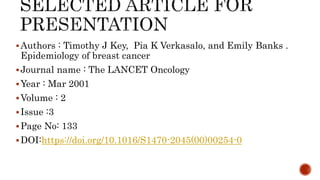
Authors : Timothy J Key, Pia K Verkasalo, and Emily Banks .
Epidemiology of breast cancer
Journal name : The LANCET Oncology
Year : Mar 2001
Volume : 2
Issue :3
Page No: 133
DOI:https://doi.org/10.1016/S1470-2045(00)00254-0
 With an Impact Factor of 54·433,the LANCET Oncology the world-leading
clinical oncology research journal globally (2021 Journal Citation Reports®,
Clarivate 2022).
 Publisher: Elsevier's Oncology Journal Network
 Total Indexing – 11
 Some Indexing sites are – Scopus , MEDLINE ,PubMed , Chemical Abstracts
, Essential Science Indicators ,etc .
 Editor :David Collingridge, Editor-in-Chief , gained a PhD in Tumour Biology
from the Gray Cancer Institute/University College London (UK) and held
research posts in the Department of Therapeutic Radiology, Yale University
(USA) and in the PET Oncology Group, Imperial College School of Medicine,
Hammersmith Hospital (UK)
 Peer reviewed and open access.
 Paid journal.
 Easy accessibility once accepted by the journal .
 Impact factor of the journal of the journal is good.
 Inclusion in major indexing sites such as scopus and Pubmed
The world-leading journal dedicated to clinical oncology research
 The LANCET Oncology is an open accessed, peer reviewed journal that
considers articles of all acpects related to the Oncology.
 The LANCET Oncology covers topics like clinical practice, advocate change
in health policy, and tackle issues related to global oncology. Topics included
are not limited to breast cancer but also- endocrine system cancer;
gastrointestinal cancer; genitourinary cancer; gynaecological cancer;
haematological cancer; head and neck cancer; neurooncology; paediatric
oncology; thoracic oncology; sarcoma; skin cancer; epidemiology, cancer
prevention, and cancer control; supportive care; imaging; and health-care
systems.
 The Lancet Oncology publish a range of article types that
encompass all aspects of oncological medicine: Articles, Review,
Policy Review, Personal View, Clinical Picture, Comment,
Correspondence, News, and Perspectives. It also
publish Series and Commissions (typically in partnership with
societies, governments, NGOs, and academic centres) that aim
to shape and drive positive change in clinical practice and health
policy in areas of need in global oncology.
EPIDEMIOLOGY OF BREAST CANCER
The title indicates the topic and focous of the study.
The title is complete and meaningful.
The title clearly reflects the aim and objective of the study.
The title is nither long and nor to short.
Title helps to understand the specificity of the topic.
The title does look catchy and is easy to understand.
 The Authors of the title are :
 Timothy J Key-
Imperial Cancer Research Fund Cancer Epidemiology Unit, University of
Oxford, UK
 Pia K Verkasalo
Imperial Cancer Research Fund Cancer Epidemiology Unit, University of
Oxford, UK.
 Emily Banks
Imperial Cancer Research Fund Cancer Epidemiology Unit, University of
Oxford, UK
 The names of the authors are mentioned clearly.
 The authors past experience and area of expertise are not mentioned.
 The authors credentials are not mentioned.
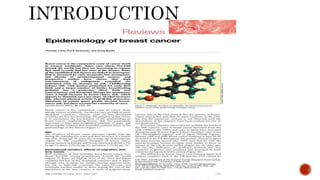
Breast cancer is the commonest cause of cancer death in
women worldwide. Rates vary about five-fold around the
world, but they are increasing in regions that until recently
had low rates of the disease.
Many of the established risk factors are linked to oestrogens.
Risk is increased by early menarche, late menopause, and
obesity in postmenopausal women, and prospective studies
have shown that high concentrations of endogenous oestradiol
are associated with an increase in risk.
 Childbearing reduces risk, with greater protection for early
first birth and a larger number of births; breastfeeding
probably has a protective effect
 Both oral contraceptives and hormonal therapy for
menopause cause a small increase in breast-cancer risk ,
Alcohol increases risk, whereas physical activity is probably
protective. Mutations in certain genes greatly increase
breast cancer risk, but these account for a minority of cases
The introduction is meaningful and is built in existing literature.
The introduction is logically presented with with opening ,body
and termination like need for the study.
The introduction expiains the basic epidemiology of the breast
cancer .
 Studies of the epidemiology of breast cancer have established that hormonal
factors have a key role in the causation of this disease. Factors that increase
exposure to oestrogens increase risk, and studies in postmenopausal women
have shown a direct association between high oestradiol concentrations and
breast-cancer risk. The low rates of breast cancer in some populations are to
a substantial extent to conditions that are not realistic or desirable for more
developed countries – late menarche, young age at first birth, and high parity.
Feasible changes in risk factors, such as obesity, alcohol consumption,
breastfeeding, and physical activity, could yield important reductions in
breast cancer risk. Further progress may come from the identification of new,
modifiable lifestyle (especially dietary) risk factors. Trials such as those of
tamoxifen and other selective oestrogen-receptor modulators may result in
effective methods for the chemoprevention of breast cancer.

 The conclusion is meaningful .
 The conclusion is supported by the result drawn.
PKV was supported by the European Commission (Marie
Curie Fellowship BMH4-CT98-5113) under the
Biomedicine and Health Programme, the Academy of
Finland (grant 42022), the Finnish Cancer Foundation,
and the Finnish Medical Society Duodecim. EB is funded
by the Medical Research Council.
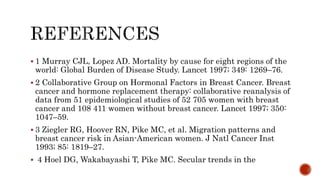
 1 Murray CJL, Lopez AD. Mortality by cause for eight regions of the
world: Global Burden of Disease Study. Lancet 1997; 349: 1269–76.
 2 Collaborative Group on Hormonal Factors in Breast Cancer. Breast
cancer and hormone replacement therapy: collaborative reanalysis of
data from 51 epidemiological studies of 52 705 women with breast
cancer and 108 411 women without breast cancer. Lancet 1997; 350:
1047–59.
 3 Ziegler RG, Hoover RN, Pike MC, et al. Migration patterns and
breast cancer risk in Asian-American women. J Natl Cancer Inst
1993; 85: 1819–27.
 4 Hoel DG, Wakabayashi T, Pike MC. Secular trends in the
 Abstract of the topic is not given in the article .
 Refrences are not given to some images.

 Findings are believable as the journal is reliable.
 Helps to understand the causes of breast cancer .
 Prospects for prevention are mentioned.
 Overall,the article is reliable and easy to understand.
 Title-epidemiology of breast cancer.
 Helps on developing the questionnaire.
 Findings of an article can be compared with that of my study .
 Will helpful for overall conduction of research .
THANK YOU

JOURNAL CLUB PRESENTATION.pptx

  • 1.
    Presented By: Name: AkshataRanganath Darandale PHARM D MGV’S Pharmacy College Panchavati, Nashik.
  • 2.
    Presented for thepartial fulfillment of requirement of – PHA 451 Journal Club / Health seminar
  • 3.
    Authors : TimothyJ Key, Pia K Verkasalo, and Emily Banks . Epidemiology of breast cancer Journal name : The LANCET Oncology Year : Mar 2001 Volume : 2 Issue :3 Page No: 133 DOI:https://doi.org/10.1016/S1470-2045(00)00254-0
  • 4.
     With anImpact Factor of 54·433,the LANCET Oncology the world-leading clinical oncology research journal globally (2021 Journal Citation Reports®, Clarivate 2022).  Publisher: Elsevier's Oncology Journal Network  Total Indexing – 11  Some Indexing sites are – Scopus , MEDLINE ,PubMed , Chemical Abstracts , Essential Science Indicators ,etc .  Editor :David Collingridge, Editor-in-Chief , gained a PhD in Tumour Biology from the Gray Cancer Institute/University College London (UK) and held research posts in the Department of Therapeutic Radiology, Yale University (USA) and in the PET Oncology Group, Imperial College School of Medicine, Hammersmith Hospital (UK)
  • 5.
     Peer reviewedand open access.  Paid journal.  Easy accessibility once accepted by the journal .  Impact factor of the journal of the journal is good.  Inclusion in major indexing sites such as scopus and Pubmed
  • 6.
    The world-leading journaldedicated to clinical oncology research  The LANCET Oncology is an open accessed, peer reviewed journal that considers articles of all acpects related to the Oncology.  The LANCET Oncology covers topics like clinical practice, advocate change in health policy, and tackle issues related to global oncology. Topics included are not limited to breast cancer but also- endocrine system cancer; gastrointestinal cancer; genitourinary cancer; gynaecological cancer; haematological cancer; head and neck cancer; neurooncology; paediatric oncology; thoracic oncology; sarcoma; skin cancer; epidemiology, cancer prevention, and cancer control; supportive care; imaging; and health-care systems.
  • 7.
     The LancetOncology publish a range of article types that encompass all aspects of oncological medicine: Articles, Review, Policy Review, Personal View, Clinical Picture, Comment, Correspondence, News, and Perspectives. It also publish Series and Commissions (typically in partnership with societies, governments, NGOs, and academic centres) that aim to shape and drive positive change in clinical practice and health policy in areas of need in global oncology.
  • 8.
  • 9.
    The title indicatesthe topic and focous of the study. The title is complete and meaningful. The title clearly reflects the aim and objective of the study. The title is nither long and nor to short. Title helps to understand the specificity of the topic. The title does look catchy and is easy to understand.
  • 10.
     The Authorsof the title are :  Timothy J Key- Imperial Cancer Research Fund Cancer Epidemiology Unit, University of Oxford, UK  Pia K Verkasalo Imperial Cancer Research Fund Cancer Epidemiology Unit, University of Oxford, UK.  Emily Banks Imperial Cancer Research Fund Cancer Epidemiology Unit, University of Oxford, UK
  • 11.
     The namesof the authors are mentioned clearly.  The authors past experience and area of expertise are not mentioned.  The authors credentials are not mentioned.
  • 13.
    Breast cancer isthe commonest cause of cancer death in women worldwide. Rates vary about five-fold around the world, but they are increasing in regions that until recently had low rates of the disease. Many of the established risk factors are linked to oestrogens. Risk is increased by early menarche, late menopause, and obesity in postmenopausal women, and prospective studies have shown that high concentrations of endogenous oestradiol are associated with an increase in risk.
  • 14.
     Childbearing reducesrisk, with greater protection for early first birth and a larger number of births; breastfeeding probably has a protective effect  Both oral contraceptives and hormonal therapy for menopause cause a small increase in breast-cancer risk , Alcohol increases risk, whereas physical activity is probably protective. Mutations in certain genes greatly increase breast cancer risk, but these account for a minority of cases
  • 15.
    The introduction ismeaningful and is built in existing literature. The introduction is logically presented with with opening ,body and termination like need for the study. The introduction expiains the basic epidemiology of the breast cancer .
  • 16.
     Studies ofthe epidemiology of breast cancer have established that hormonal factors have a key role in the causation of this disease. Factors that increase exposure to oestrogens increase risk, and studies in postmenopausal women have shown a direct association between high oestradiol concentrations and breast-cancer risk. The low rates of breast cancer in some populations are to a substantial extent to conditions that are not realistic or desirable for more developed countries – late menarche, young age at first birth, and high parity. Feasible changes in risk factors, such as obesity, alcohol consumption, breastfeeding, and physical activity, could yield important reductions in breast cancer risk. Further progress may come from the identification of new, modifiable lifestyle (especially dietary) risk factors. Trials such as those of tamoxifen and other selective oestrogen-receptor modulators may result in effective methods for the chemoprevention of breast cancer.
  • 17.
     The conclusionis meaningful .  The conclusion is supported by the result drawn.
  • 18.
    PKV was supportedby the European Commission (Marie Curie Fellowship BMH4-CT98-5113) under the Biomedicine and Health Programme, the Academy of Finland (grant 42022), the Finnish Cancer Foundation, and the Finnish Medical Society Duodecim. EB is funded by the Medical Research Council.
  • 19.
     1 MurrayCJL, Lopez AD. Mortality by cause for eight regions of the world: Global Burden of Disease Study. Lancet 1997; 349: 1269–76.  2 Collaborative Group on Hormonal Factors in Breast Cancer. Breast cancer and hormone replacement therapy: collaborative reanalysis of data from 51 epidemiological studies of 52 705 women with breast cancer and 108 411 women without breast cancer. Lancet 1997; 350: 1047–59.  3 Ziegler RG, Hoover RN, Pike MC, et al. Migration patterns and breast cancer risk in Asian-American women. J Natl Cancer Inst 1993; 85: 1819–27.  4 Hoel DG, Wakabayashi T, Pike MC. Secular trends in the
  • 21.
     Abstract ofthe topic is not given in the article .  Refrences are not given to some images. 
  • 22.
     Findings arebelievable as the journal is reliable.  Helps to understand the causes of breast cancer .  Prospects for prevention are mentioned.  Overall,the article is reliable and easy to understand.
  • 23.
     Title-epidemiology ofbreast cancer.  Helps on developing the questionnaire.  Findings of an article can be compared with that of my study .  Will helpful for overall conduction of research .
  • 24.