
The Ecology of
Breast Cancer
The promise of
prevention
and the hope for
healing
Ted Schettler MD,MPH
The Ecology of Breast Cancer
The Promise of Prevention
and the Hope for Healing
ByTed Schettler MD,MPH
This work is licensed under a Creative CommonsAttribution Non-Commerical NoDerivs 3.0 Unported License.
October 2013
iii
Contents
Foreword							 iv
Acknowledgements						 vi
Introduction	 						 1
Section I:An Ecological Framework
Chapter 1: Toward a systems perspective of breast cancer 		 6
Chapter 2: Breast cancer trends and risk factors			 19
Section II:LookingWithin the Complexity
Chapter 3: Diet,nutrition,and breast cancer				 27
Chapter 4: Exercise,physical activity,and breast cancer			 71
Chapter 5: Environmental chemicals,contaminants,and breast cancer	 95
Chapter 6: The electromagnetic spectrum and breast cancer		 126
Chapter 7: Stress,social support,and breast cancer 			 145
Section III:Re-designing for Prevention and Healing
Chapter 8: Designing for breast cancer prevention and improved outcomes	 164
Appendix A
Breast cancer,body weight,insulin resistance,and diabetes			 196
iv
The Ecology of Breast Cancer is a necessary book. It is fundamentally necessary to not only
understand but also embrace the complexity of the causes of this tragic epidemic disease.
Ted Schettler persuasively argues that breast cancer is ultimately a design problem. He situ-
ates the breast cancer epidemic among the other epidemic diseases of our time. He presents
breast cancer as a model for understanding the epidemics of learning disabilities, autistic
spectrum disorders, infertility, obesity, diabetes, Parkinson’s disease, Alzheimers, asthma,
other cancers, and many other conditions.
Schettler has been a leading voice in the international dialogue that has promoted an ecolog-
ical paradigm of health. The objectivity of his science and the breadth and depth of his vision
are widely recognized.
What is the ecological paradigm of health? It is a way of understanding biological systems
as they interact with their environmental contexts. We may equally speak of multi-causal
paradigms of disease – a familiar term in medicine. We may also speak of environmental
public health – a recognized term in the public health community.
In the environmental justice community the accepted term is cumulative impact – the total-
ity of the impact of the environment on health. Complexity theory is another language that
fits well with the ecological paradigm of health.What we are doing is pointing to the infinite
complexity of interactions in nested biological systems.
Foreword
v
If ending the epidemic of breast cancer seems utopian, Schettler’s paradigm actually sug-
gests many personal lifestyle and community design strategies that are likely to reduce the
incidence of breast cancer, increase resilience, and improve outcomes for those already
diagnosed.
The bad news about the complexity of breast cancer is that the causes are complex. The
good news is that a wide range of interventions can be beneficial—more so when they are
combined. Even better, the benefits redound to a wide range of health concerns – not just
breast cancer.
The Ecology of Breast Cancer is an heroic summary of an extremely complex body of science.
We must follow the science, embrace the complexity of breast cancer, and recognize the
promising insights that the ecological paradigm of breast cancer offers.
If we progress toward the personal, community, and global design changes that will reverse
the breast cancer epidemic, we will also reverse many of the other disease epidemics of our
time. That is a vision to live by.
						Michael Lerner
						Commonweal
						Fall, 2013
Michael Lerner is president of Commonweal, a nonprofit center in Bolinas, California that works in
health,education,environment and justice. He is co-founder of the Commonweal Cancer Help Program,
the Collaborative on Health and the Environment,andThe New School at Commonweal. He has co-led
Cancer Help Program retreats for 28 years. Most of the participants in the Cancer Help Program are
women with breast cancer.
vi
This book and the material that it draws on are due in large part to committed efforts
of countless scientists, clinicians, public health professionals, and advocates. I am particu-
larly mindful of the challenges involved in designing and carrying out scientific studies that
shed light on the origins of breast cancer and interventions that may help to prevent it and
improve outcomes. I have attempted to cite carefully the extensive work that I have summa-
rized and apologize for any omissions or errors.
I am also extraordinarily grateful to those who agreed to take time from their busy lives to
review various portions of this manuscript,including Susan Braun,Suzanne Fenton,Melinda
Irwin, Michael Lerner, Nancy Myers, Carolyn Raffensperger, Cheryl Rock, Julia Rowland,
Ruthann Rudel, Louis Slesin, and Patrice Sutton. Their comments and suggestions were
extremely valuable and improved the manuscript considerably. Any errors that remain are
entirely my responsibility. Many, many thanks also to Danielle Nierenberg for her invaluable
editing assistance. I am also grateful to Heather Sarantis, who devoted considerable time and
effort to layout and design. I hope that we have succeeded in making an extensive amount of
information accessible and useful.
We are grateful to the Jenifer Altman Foundation, the Cornell Douglas Foundation, the
Forsythia Foundation, and the Passport Foundation for your generous support of this proj-
ect.The Science and Environmental Health Network also deeply appreciates the ongoing
support of other family foundations and many individuals.
Acknowledgements
1
The diagnosis of breast cancer profoundly changes the lives of women, men, and their
families.At the same time that people struggle with making difficult treatment-related de-
cisions, they also commonly ask, why me? Why did this happen? The search for answers
usually raises more questions.
In important ways, like other complex diseases, breast cancer is a design problem. By that I
mean two things. First, although breast cancer is an ancient disease, it becomes much more
common in countries where people adopt industrialized,Western-styles of eating, moving
around, making and using consumer products, and general living.This strongly suggests that
as we collectively make choices about the way we live, we can actually design disturbing
breast cancer patterns into the complex fabric of society.This is not unique to breast cancer.
It also applies to diabetes, cardiovascular disease, cognitive decline, dementia, other kinds of
cancer, and asthma, among others.
Second, understanding, preventing, and treating breast cancer pose significant challenges
for designing research and interventions.To be effective, proposed solutions must confront
considerable complexity. Ideally they will connect and integrate knowledge from different
disciplines and perspectives. Science, art, health, and healing must converge in the process
of re-design.
Breast cancer is the most common invasive cancer among women in the United States, and
rates are rapidly increasing in many other countries throughout the world.After increasing
Introduction
2
for several decades, female breast cancer incidence in the U.S. began decreasing somewhat
in 2000 and has been relatively stable in recent years. In the U.S., about one in eight women
will develop breast cancer during their lives.The disease is about 100 times less common
among men. Fortunately, death rates from breast cancer have been declining over the past
25 years, with larger decreases in women younger than 50.These decreases are probably
due to a combination of more effective treatments and earlier detection. New therapies for
some sub-types of breast cancer have especially improved.
Women and men who undertake combinations of surgical, pharmaceutical, and radiation
therapies for breast cancer often wonder what else they might do to improve their long-
term outcomes.This project began with a goal of addressing that question. A number of
studies have examined the extent to which diet, exercise, weight control, stress reduction,
and other factors are associated with recurrence and survival following diagnosis and initial
treatment. My original intent was to summarize their findings, but for several reasons that
goal soon began to seem too narrow.
Even though I have spent many years treating illnesses and injuries in medical practice, I
have long been interested in the causes and primary prevention of diseases like breast cancer
that are related in complex ways to environmental conditions. Here, by “environment” I
mean the totality of the biologic, physical, chemical, built, nutritional, and social environ-
ments that humans have participated in creating throughout the world. In addition to its
effects on breast cancer prognosis,I wanted to look more extensively into the role this com-
plex environment might play in contributing to or preventing the disease in the first place.
Beyond that, since the latency period of breast cancer—the time between earliest tumor
initiation and clinical diagnosis—is often decades long, an unknown number of people har-
bor early stages of the disease for a number of years without knowing it. In fact, some very
early life experiences are clearly associated with breast cancer risk.For example,fetal dieth-
ylstilbestrol (DES) exposure or early onset of menarche increases breast cancer risk decades
later. Some studies also show that certain kinds of diets and exercise patterns, beginning
even in childhood, are linked to reduced risk or improved outcomes in people who develop
breast cancer much later. It is, therefore, increasingly clear that efforts to prevent breast
cancer and improve outcomes after diagnosis and treatment must begin in the earliest days
of fetal development, if not before. In short, there is no bright line between interventions
intended to make breast cancer less likely, slow its progression, perhaps even reverse its
course, and improving outcomes.As a result, the scope of this project expanded to include
breast cancer prevention.
Simply creating a list of known, probable, and plausible risk factors for breast cancer makes
it apparent that they encompass many aspects of our individual and collective lives.At the
population level, one or two variables do not stand out as overwhelmingly responsible for
3
changes in breast cancer incidence, although some individuals are at higher risk because
of certain susceptibility genes. Rather, breast cancer patterns are largely determined by a
complex mix of interacting, multi-level variables strongly pointing toward a more systemic
problem.
We will undoubtedly be more successful at preventing the disease and promoting healing
if we approach it through multi-level interventions. Individuals cannot do this alone. Op-
portunities and responsibilities lie within the range of activities of a large number of social,
political, and professional organizations and institutions. All health care practitioners, in-
cluding obstetricians and pediatricians, have important roles to play. Many public health
professionals who do not typically see their work as related to breast cancer will inevitably
see the connections if they step back and look at a bigger picture. Even more broadly, be-
cause of the complexity of breast cancer, decision-makers in all sectors whose activities
help to shape the conditions out of which breast cancer is more or less likely to arise can
make important contributions.They include teachers, city planners, farmers, legislators,
and business leaders whose decisions and priorities strongly influence breast cancer-related
features of the world we live in.
How this book is organized
This book is divided into three sections. Section I (chapters 1 and 2) briefly reviews the
history of breast cancer and the evolution of ideas about its origins. It concludes that an
ecological or eco-social framework is best suited to acknowledge and help clarify the com-
plexity of the disease as well as helping to design research and interventions.This section
includes a brief summary of breast cancer demographics, trends, and known risk factors.
Section II is comprised of five chapters addressing diet (chapter 3), exercise (chapter 4),
environmental chemicals (chapter 5), features of the electromagnetic spectrum including
vitamin D,light at night,and non-ionizing radiation (chapter 6),and stress (chapter 7).Each
of these reviews an extensive literature and because of that, begins with a summary of the
more detailed material that follows. In some instances, I found it particularly instructive
to review the history of research into these categories of risk factors and have occasionally
included discussions of older studies that influenced the direction and design of subsequent
investigations.
Section III (chapter 8) summarizes and begins to reassemble the various risk factors into a
more integrated whole. It explores implications for individuals, families, and communities
as well as health care providers, public health officials, and others who can make a differ-
ence.
4
Most of the material reviewed in this book is drawn from epidemiologic and laboratory an-
imal studies. I do not intend for it to be construed as medical advice. Nor, have I made any
attempt to review or comment on a range of conventional medical therapies or their alter-
natives. But I do hope that people interested in a comprehensive approach to breast cancer
prevention or treatment will find this material useful as they explore options.
Almost daily, medical journals and the press report new breast cancer research findings.
Undoubtedly, some of the conclusions I reach here will need to be modified as new infor-
mation becomes available. But, no matter how some of the details may change, it is my hope
that we will increasingly address breast cancer—its origins and treatment—as a systems
challenge, requiring an integrated, multi-level response.
Section 1
An Ecological Framework
6The Ecology of Breast Cancer
Breast cancer is an ancient disease. Its recorded history dates back to ancient Egypt
(3000-2500 BCE). Early documents describe what tumors looked like as they surfaced and
progressed.1,2
Recorded speculations about their origins appear much later. Hippocrates and
others espoused a humoral theory, thinking that imbalances among four bodily fluids—
blood, yellow bile, black bile, and phlegm—caused this to happen. Galen (130-c.200 CE)
subscribed to Hippocrates’ bodily humors theory, persuaded that he saw breast cancer more
often in melancholy (literally,“black bile”) women who were creative,kind,and considerate.
Some thought they saw cancer more generally in women who were anxious, depressed, or
grieving.3
For Galen and many who followed, breast cancer was a systemic disorder and not
confined to a single part of the body.
In the 17th
century, Italian physician Ramazzini saw that “tumors of this sort [breast cancer]
are found more often in nuns than in any other women. In my opinion, these tumors are not
due to amenorrhea, but rather to the celibate life led by these nuns.”4,5
Some theories pro-
posed that trauma or lymphatic or milk duct blockage was involved. But with the invention
of the microscope and emerging understanding of a cellular basis of anatomical structures,
cancer cells became visible, and breast cancer began to be seen as a more localized disease.
New anesthetic techniques aided a dramatic increase in surgery and, for decades, the radical
mastectomy, pioneered by William Halsted, dominated breast cancer treatment. Halsted
believed that removing enough tissue and precision to avoid spreading cancer cells during
surgery led to the best chances of cure.
Chapter 1
Toward a systems perspective of breast cancer
Toward a systems perspective
of breast cancer
7
In the late 19th
century Scottish surgeon George Beatson reported that removal of the ova-
ries in several of his patients caused remission of inoperable breast cancer.6,7
Hormones had
not yet been characterized, but Beatson saw lactation prolonged in farm animals after their
ovaries were removed.“Lactation is at one point perilously near becoming a cancerous pro-
cess if it is at all arrested,” he said.8
During ensuing years, scientists identified estrogen and other hormones.9
Surgeons some-
times added removal of the ovaries, adrenals, and pituitary glands to breast cancer treat-
ment.Thus, the emphasis on the cellular basis of cancer began to include consideration of
the general hormonal environment influencing tumor growth.
In his 1966 Nobel acceptance speech, Charles Huggins, a cancer biologist who studied the
hormone dependency of various cancers, observed,“The net increment of mass of a cancer
is a function of the interaction of the tumor and its soil. Self-control of cancers results from
a highly advantageous competition of host with his tumor.There are multiple factors which
restrain cancer - enzymatic, nutritional, immunologic, the genotype, and others. Prominent
among them is the endocrine status, both of tumor and host.”10
Huggins saw cancer not
just as a disease of aberrant cells but as one that requires a host environment favoring tu-
mor growth. Despite this understanding, with the development of techniques of molecular
biology that have enabled more detailed study of cells and sub-cellular parts, many cancer
biologists continued to focus their attention on the cancerous cell.
Cancer:A disease of cells or tissues?
Scientists have long been aware that cancer development is a multi-stage, multi-factorial
phenomenon.The models they use generally describe tumor initiation, promotion, progres-
sion, and metastasis. In a widely-cited paper, Hanahan andWeinberg listed six hallmarks of
cancer generally having to do with cancer cells—their response to various signals, evading
growth suppressors, activating invasion and metastasis, resisting cell death, and so on.11
Re-
cently, they added tumor promoting inflammation to their framework,12
but basically they
privilege the original mutated cancer cell as most important, with secondary contributions
from the nearby tissue microenvironment.This is the somatic mutation theory of carcino-
genesis.
Another view holds that cancer is a tissue-based disease.13,14
It proposes that changes in the
tissue environment that normally keep cellular proliferation in check are central to the ori-
gins of cancer.Advocates of this view point out that cellular proliferation is the default state
of most cells and gene mutations and changes in gene expression are common even within
cells that do not develop into cancer. Interactions with the surrounding tissue are essential
for modulating these activities and their effects. Experimental evidence in laboratory ani-
The Ecology of Breast Cancer 8
mals, for example, shows that tumors developing in the ductal epithelial cells of mammary
glands depend on exposure of the surrounding stroma to a carcinogen and not just epi-
thelial cell exposure.15
Moreover, using the same animal model, these authors showed that
epithelial cancer cells introduced into normal stroma could form normal, non-cancerous
mammary ducts.16
That is, the cancer cells could revert to normal.Thus, this theory holds,
stromal-epithelial interactions in the tissue environment are more important than events in
a mutated cell in the development and progression of cancer. From this it follows that an
integrated approach, whereby cancer causation occurs in all directions, namely bottom-up,
top-down, and reciprocally, will best illuminate the complexity of cancer and opportunities
for prevention.
These contrasting views differ with respect to the level of organization most appropriate
for understanding the origins of cancer. One emphasizes the primary role of aberrant cells,
while the other features an altered tissue environment and the importance of multi-level
interactions.
Breast cancer and the more general environment
The importance of the more general environment in the origins and progression of breast
cancer becomes clear after looking at evidence discussed in later chapters.We know that
latent, undiagnosed breast cancer develops over many years—in some cases over decades—
and may be undetected during life. A review of seven autopsy studies reported invasive
breast cancer in an average of 1.3 percent of 852 women ages 40-70 who had died from
other causes and were not known to have breast cancer while alive.17
The number of tissue
sections examined ranged from 9-275 per breast in five of the seven studies and was not
described in two. Carcinoma in situ (CIS)*
was reported in 8.9 percent on average. Highest
percentages were reported in studies where the breasts of the deceased were examined
more thoroughly. One of the studies included 110 consecutive autopsies of young and mid-
dle-aged women (ages 20-54), finding invasive breast cancer in two (1.8 percent) and CIS
in twenty (18 percent).18
* There are two kinds of carcinoma in situ, ductal and lobular. Ductal carcinoma in situ (DCIS) refers to
breast duct epithelial cells that have become “cancerous,” but still reside in their normal place. Lobular
CIS (LCIS) refers to cells in the lobules that have undergone similar changes. In this setting cancerous
means that there is an abnormal increase in the growth of the cells. CIS is nonlethal because it stays in
place, but is important because it may progress to invasive breast cancer. However, some cases of CIS
do not progress to invasive disease and predicting which ones will and when that may happen is difficult.
DCIS is commonly first identified by mammography since it frequently contains calcium deposits that
show up on the image. See also http://www.ncbi.nlm.nih.gov/pubmed/20956817 for access to a more
complete discussion.
Toward a systems perspective
of breast cancer
9
Although CIS is considered a precursor of breast cancer, some cases do not progress to in-
vasive disease. Recently, some medical professionals have argued that the term “carcinoma”
should not even be used in the name of this lesion since it contributes to over-diagnosis and
over-treatment.19
Predicting which ones will progress is an unsolved important problem.
For those that do progress to invasive breast cancer, whether some may actually sponta-
neously regress and disappear is unclear but of intense interest.
To help to address this question, scientists in Denmark compared breast cancer incidence in
women of comparable ages before and after breast cancer screening by mammography was
introduced.20
They reasoned that if mammography was simply going to enable a diagnosis of
breast cancer earlier, one would expect to see a drop in age-adjusted incidence in screened
women sometime after screening was initiated.They found that the increase in incidence
of breast cancer was closely related to the introduction of screening, but that little of this
increase was compensated for by a drop in incidence in previously screened women.They
concluded that one in three invasive breast cancers detected in a population offered screen-
ing mammography will not lead to symptoms or death.The percentage was considerably
higher (52 percent) when CIS was included.
This report sparked debate, and critics suggested that the findings could be explained by the
discontinuation of hormone replacement therapy that coincided with the study period. In
response, the study was repeated using data from an earlier period, when few women were
using hormone therapy.21
The study compared breast cancer incidence in two groups of
women aged 40-69 years. One group was screened repetitively during a six-year period and
a matched control group was screened only once, at six years.The research team hypothe-
sized that cumulative breast cancer incidence should be similar in the two groups after the
follow up period if no tumor regression occurred.They found 14 percent higher incidence
in the repetitively screened group, suggesting that some invasive breast cancers would re-
gress spontaneously if not diagnosed at screening.*
What are we to make of this?What does it tell us about the natural history of breast cancer?
Here are some things we know. CIS is relatively common. Some CIS progresses to invasive
breast cancer but some does not. CIS and invasive breast cancer can begin at a relatively
early age.The time that elapses between the initiation of breast cancer and when it becomes
clinically apparent—the latency period—varies considerably but can be spread out over
decades.22
Screening studies conclude that some breast cancers will spontaneously regress.
* Another explanation could be that repetitive screening actually caused the increased breast cancer in
that group. It’s unlikely because a six year follow up is generally too short to see cancer as a result of
radiation exposure, although it’s not out of the question. But this raises an important question about the
relative safety of using a known carcinogen (ionizing radiation) to diagnose breast cancer. New diagnos-
tic methods are urgently needed.
The Ecology of Breast Cancer 10
The general physiologic environment also influences the course of breast cancer after diag-
nosis.The internal environment is shaped by diet, activity levels, exposure to environmental
chemicals, stress, sleep, and other variables.They influence immune system function, levels
of inflammation, hormones, and various growth factors that promote tumor cell growth or
death.They establish a milieu intérieur (the environment within), a phrase coined by physiol-
ogist Claude Bernard. It is the context—Huggins’“soil”—that favors or discourages cancer
development and growth.
As we will see, community and societal characteristics can also strongly influence this inter-
nal environment. Breast cancer is not only a disease of individuals, but also of communities.
Breast cancer patterns arise out of the societies that we design. In that way, breast cancer is
profoundly a public health concern requiring a public health response (see Box 1.1). A larg-
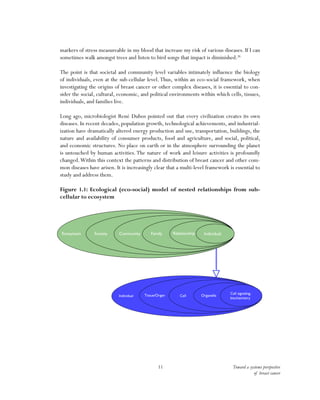
er framework that includes multiple levels of organization—the individual, family, commu-
nity, ecosystem, and society—and reciprocal interactions among them, is arguably essential
for better understanding the origins and prevention of breast cancer.
Breast cancer as an ecologic disorder
Ecologists often use a nested hierarchy of levels of organization to construct models and
design studies (see Figure 1.1).23
Here, hierarchy does not refer to importance or power but
is a way of describing relationships within a complex system. In that tradition, some epide-
miologists advocate an eco-social framework to help design investigations into the origins of
diseases as well as medical and public health interventions to prevent or treat them.24,25,26,27
An eco-social*
framework recognizes that context matters. It acknowledges the ways that
family, community, and societal experiences shape the health of individuals and populations.
What I eat may seem to be mostly a personal choice, but it’s not entirely.What the food sys-
tem produces, the price and availability of various kinds of food, opportunities I may or may
not have to grow my own food, and the impact of media and advertising will also strongly
influence my diet.
Similarly, my internal physiologic response to walking alone at night in an unlit urban neigh-
borhood or forest will be conditioned by how safe I think it is. If I live in a neighborhood that
I think is unsafe, I will most likely live in a state of constant vigilance that chronically raises
* This is sometimes called an ecologic or complexity framework. Terminology varies to some extent
because of the variables included in the model and also because of connotations associated with various
words. But the important commonality is the attempt to incorporate multiple level variables in a richly
interactive system undergoing change over time.
Toward a systems perspective
of breast cancer
11
markers of stress measureable in my blood that increase my risk of various diseases. If I can
sometimes walk amongst trees and listen to bird songs that impact is diminished.28
The point is that societal and community level variables intimately influence the biology
of individuals, even at the sub-cellular level.Thus, within an eco-social framework, when
investigating the origins of breast cancer or other complex diseases, it is essential to con-
sider the social, cultural, economic, and political environments within which cells, tissues,
individuals, and families live.
Long ago, microbiologist René Dubos pointed out that every civilization creates its own
diseases. In recent decades, population growth, technological achievements, and industrial-
ization have dramatically altered energy production and use, transportation, buildings, the
nature and availability of consumer products, food and agriculture, and social, political,
and economic structures. No place on earth or in the atmosphere surrounding the planet
is untouched by human activities. The nature of work and leisure activities is profoundly
changed.Within this context the patterns and distribution of breast cancer and other com-
mon diseases have arisen. It is increasingly clear that a multi-level framework is essential to
study and address them.
Figure 1.1: Ecological (eco-social) model of nested relationships from sub-
cellular to ecosystem
IndividualRelationshipFamilyCommunitySocietyEcosystem
Cell signaling;
biochemistry
OrganelleCellTissue/OrganIndividual
The Ecology of Breast Cancer 12
Box 1.1:Ecology,ecosystems,and regime shifts
Ecologists have long grappled with complex models to describe and study ecosystems.Their models feature
interactions among multi-level variables—microbes, soil, trees, forests, grasses, water, region, climate, di-
verse wildlife, people, farms, cities, and so on. In these models, interactions and feedback loops are primary
phenomena—not secondary. Impacts cascade through parts and subparts of this complexity over varying
timeframes.Interactions among mixtures of variables determine system structure and function—resilience or
vulnerability.These are science-based models that attempt to represent current understanding of ecosystem
dynamics.
Ecosystem disturbances can come from various levels—from changes somewhere in the internal food web
or a hurricane. A resilient ecological system is able to absorb and adapt to disturbances while maintaining
essential functions, structures, and feedback loops. A vulnerable system is operating close to a threshold,
where even small disturbances can push it beyond a tipping point so that structures and functions change
fundamentally. When that happens, a new relatively stable set of operating conditions makes it difficult, if not
impossible, for the system to revert to its previous state, even if a triggering event is removed.
There are many examples of this phenomenon.After a long period of fluctuating but slowly declining vegeta-
tion the Sahara region collapsed suddenly into a desert.29
A lake gradually but inexorably receiving excessive
nutrient loading from fertilizer runoff suddenly transforms from being fish-rich to fish-poor. Algal blooms
and plant growth accelerate, oxygen levels crash, a threshold is crossed, and the entire food web changes,
resulting in massive fish kills.This is a regime shift—the operating conditions of the lake have fundamentally
changed; its structure and function are different. New conditions in the lake are exceedingly stable and simply
stopping the flow of nutrients will not re-establish previous conditions in the short term.This kind of abrupt
and irreversible change can happen in vulnerable communities and people who are burdened with one or
more stressors.
Ecological scientists note that regime shifts can also occur as a result of crossing several smaller-scale thresh-
olds within a complex system.30
For example, small-scale social, economic, and ecologic changes in an ag-
ricultural region can cause threshold interactions that result in major system transformation—the regional
ecosystem, including its human communities, fundamentally changes.31
For most people living and working
in the region it’s a collapse.
Here are a few lessons from extensive information about ecosystem structure, function, and behavior:
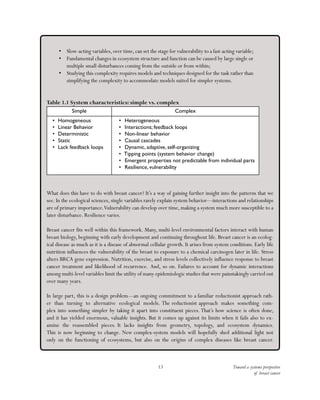
•	 Complex system characteristics differ from those in simpler systems in many important
ways (seeTable 1.1);
•	 Resilience or vulnerability are characteristics of system operating conditions; vulnerable
ecosystems are less able to absorb and adapt to disturbances than resilient ecosystems;
•	 System operating conditions are largely determined by interactions among multi-level vari-
ables, acting over varying timeframes; not by single variables in a constrained timeframe;
Toward a systems perspective
of breast cancer
13
•	 Slow-acting variables,over time,can set the stage for vulnerability to a fast-acting variable;
•	 Fundamental changes in ecosystem structure and function can be caused by large single or
multiple small disturbances coming from the outside or from within;
•	 Studying this complexity requires models and techniques designed for the task rather than
simplifying the complexity to accommodate models suited for simpler systems.
Table 1.1 System characteristics: simple vs. complex
Simple Complex
•	 Homogeneous
•	 Linear Behavior
•	 Deterministic
•	 Static
•	 Lack feedback loops
•	 Heterogeneous
•	 Interactions; feedback loops
•	 Non-linear behavior
•	 Causal cascades
•	 Dynamic, adaptive, self-organizing
•	 Tipping points (system behavior change)
•	 Emergent properties not predictable from individual parts
•	 Resilience, vulnerability
What does this have to do with breast cancer? It’s a way of gaining further insight into the patterns that we
see. In the ecological sciences, single variables rarely explain system behavior—interactions and relationships
are of primary importance.Vulnerability can develop over time, making a system much more susceptible to a
later disturbance. Resilience varies.
Breast cancer fits well within this framework. Many, multi-level environmental factors interact with human
breast biology, beginning with early development and continuing throughout life. Breast cancer is an ecolog-
ical disease as much as it is a disease of abnormal cellular growth. It arises from system conditions. Early life
nutrition influences the vulnerability of the breast to exposure to a chemical carcinogen later in life. Stress
alters BRCA gene expression. Nutrition, exercise, and stress levels collectively influence response to breast
cancer treatment and likelihood of recurrence. And, so on. Failures to account for dynamic interactions
among multi-level variables limit the utility of many epidemiologic studies that were painstakingly carried out
over many years.
In large part, this is a design problem—an ongoing commitment to a familiar reductionist approach rath-
er than turning to alternative ecological models. The reductionist approach makes something com-
plex into something simpler by taking it apart into constituent pieces. That’s how science is often done,
and it has yielded enormous, valuable insights. But it comes up against its limits when it fails also to ex-
amine the reassembled pieces. It lacks insights from geometry, topology, and ecosystem dynamics.
This is now beginning to change. New complex-system models will hopefully shed additional light not
only on the functioning of ecosystems, but also on the origins of complex diseases like breast cancer.
The Ecology of Breast Cancer 14
Breast cancer:An ecologic perspective
Breast cancer is a diverse group of diseases of different sub-types.Their biology differs with
respect to hormone-receptor features, menopausal status, and invasiveness.The origins of
breast cancer are multi-factorial, and risk factors among sub-types differ. Opportunities for
prevention and response to treatment vary.
One way to think about this is that different combinations of multi-level variables over time
create the conditions in which breast cancer can develop and progress. In many ways, this is
like a complex ecosystem and scientists are continuing to develop new models for studying
the disease that reflect this complexity (see Box 1.1).
One example moving in this direction is an evidence-based complex model of postmeno-
pausal breast cancer causation developed by scientists at the University of California San
Francisco. It includes biologic, societal/cultural, behavioral, and physical/chemical dimen-
sions.32
It also includes estimates of the strength of the associations and quality of evidence
that link these many variables together in a complex, interactive network.
This model is a step forward.The complexity becomes clear, and immediately we begin to
imagine new and different study designs and interventions. It’s not truly multi-level in that
it generally addresses variables at the individual- but not community- or societal-levels.
Assessments of neighborhood safety, for example, will influence activity levels and stress.
Federal farm crop subsidies can alter cancer risk through their influence on food prices and
availability. These additional levels could be included in system models.33
They highlight
additional opportunities not only for understanding the origins of diseases but also for in-
tervening in system dynamics.
Complex system models often look like a tangle of arrows with everything so interconnect-
ed that at first glance it seems impossible to sort out. But, these models serve a number of
different purposes.They acknowledge and communicate complexity, confirming the ines-
capably messy, systemic nature of the problem. Complex system models also provide a basic
architecture for organizing facts and categories. Once the top-level architecture is grasped,
it becomes easier to identify relevant variables and plan an approach for further study or
intervention.
These models also make clear that complex systems cannot be tightly micro-managed.
Quantitative impacts of changes in single variables will often be difficult to predict and even
to identify. Moreover, in order to prevent the development of cancer or improve outcomes
after diagnosis, broad and diversified strategies will be necessary to change the dynamics of
the system. Closer study of a complex model reveals features that help in deciding how and
where to intervene most effectively in the system—at multiple levels, leverage points, feed-
Toward a systems perspective
of breast cancer
15
back loops, and causal cascades. Combinations of multi-level interventions are more likely
to bring about outcomes as close to what we want as possible (See Box 1.2).
Box 1.2:Individual Health—Public Health:The North Karelia Project
Public health practitioners have long recognized the benefits—or risks—associated with small shifts in
determinants of health within populations. In 1985, epidemiologist Geoffrey Rose observed that a large
number of people at a small risk will give rise to more cases of a disease than a small number of people
at a large risk.34
The causes of cases of a disease in individuals, he said, differ from the causes of incidence
of that disease in a population.Why some individuals have hypertension is a different question from why
some populations have much hypertension, while in others it is rare.
Rose was interested in strategies for disease prevention. He recognized that small downward popula-
tion-wide shifts in blood pressure where hypertension was common could have large public health bene-
fits. Community-level interventions differed from what individuals could do to accomplish the same goal.
The North Karelia project in Finland put these ideas to work about 25 years after demographer,Vaino
Kannisto, published his doctoral thesis pointing out that eastern Finland had the highest heart disease
mortality in the world.35
By this time, the Framingham Heart Study, started in 1948, had begun to iden-
tify risk factors that contribute to cardiovascular disease by following its development over a long period
of time in a large group of participants. Based on Framingham findings, population-wide efforts to reduce
smoking, cholesterol, and blood pressure were undertaken in N. Karelia. Efforts involved not only indi-
vidual education and treatment but also work with the media, supermarkets, and agriculture.The results
were dramatic. In 35 years the annual age-adjusted coronary heart disease mortality rate among 35-64
year-old men declined 85 percent. Cancer-related mortality was also reduced, and all-cause mortality
reduced for men and women.
One early commentary on the North Karelia project critically called it “shot-gun prevention.”36
But, it
worked. It showed the value of multi-level interventions in a population rather than focusing on individ-
uals at highest risk. Data from five different surveys showed that an estimated 20 percent of the coronary
heart disease mortality could be prevented by reducing cholesterol levels in the entire population by 10
percent,while a 25 percent cholesterol reduction in only those with the highest levels would reduce mor-
tality by only five percent. Lifestyle changes, they concluded, are not just responsibilities of individuals
but also of communities.
We often debate which public health interventions should be directed at entire populations or focused
more on individuals at risk to address disorders such as cancer, diabetes, cardiovascular disease, obesity,
and dementia, among others. But it’s undeniably clear that prevention of complex diseases cannot be
achieved by individuals alone. Community- and societal-level interventions are also essential.
The Ecology of Breast Cancer 16
Historically, epidemiologic studies investigating the causes of breast cancer have typically
controlled for various confounders and other factors known to independently influence risk
while attempting to isolate the impact of a particular variable of interest.They have tended,
for example, to focus on particular aspects of diet, a specific chemical or physical exposure,
or exercise. They have contributed valuable information. Most basically, we have learned
that, for breast cancer, there is no smoking gun like the tobacco-lung cancer connection. It’s
truly a systemic problem. New study designs and interventions are urgently needed.
In 2008, Congress passed the Breast Cancer and Environmental Research Act, which re-
quired, among other provisions, the establishment of an interagency committee comprised
of scientists from Federal agencies, universities, and other non-Federal organizations to ex-
amine the status of breast cancer research in the United States and make recommendations
for improving it.This committee, known as the Interagency Breast Cancer and Environmen-
tal Research Coordinating Committee (IBCERCC), issued its final report in 2013, with a
clear call for prioritizing the prevention of breast cancer.37
They said:
•	 The complexity of breast cancer necessitates increased investment in research to
explore mechanisms underlying breast cancer over a person’s life span.Exploration
of the impact of environmental factors on breast development is needed, as altered
development may influence breast cancer risk. Gene-environment interactions and
epigenetic alterations — heritable changes that do not involve changes in DNA
sequence — that occur over the lifespan deserve more attention.
•	 Research must evaluate the impact of multiple risk factors and periods when the
breast may be most susceptible to exposures, and investigate how certain popula-
tions, such as underrepresented minorities, have disproportionate exposures and
different levels of breast cancer risk. By engaging researchers from many disci-
plines, new ways of thinking about breast cancer prevention can be developed.
•	 Research must include investigations into the effects of chemical and physical fac-
tors that potentially influence the risk of developing, and likelihood of surviving,
breast cancer. Characterizing the myriad of exposures in our environment in di-
verse population groups is part of this important challenge.
The committee called for:
•	 Trans-disciplinary coordination; and
•	 Transparency and inclusion of representatives of the general public and health af-
fected groups in planning, implementation, and translation of research findings,
built from the start into every funded program that focuses on breast cancer and
the environment.
Toward a systems perspective
of breast cancer
17
This committee is promoting new models for understanding the origins and treatment of
breast cancer.They emphasize the importance of a life-course approach, the timing of expo-
sures, and exposure to mixtures of risk factors. Multi-level, ecological frameworks are best
suited to this complex task.
References
1.	 Winchester D, Winchester D. Breast cancer: second edition. Hamilton, Ontario. BC Decker,
Inc. 2006.
2.	 Ekmektzoglou K, Xanthos T, German V, Zografos G. Breast cancer: from the earliest times
through to the end of the 20th
century. Eur J Obstet Gynecol Reprod Biol 2009; 145(1):3-8.
3.	 Berrios G. Melancholia and depression during the 19th century. A conceptual history. British
Journal of Psychiatry. 1988; 153: 298-304.
4.	 Mustacchi P. Ramazzini and Rigoni-Stern on parity and breast cancer. Clinical impression
and statistical corroboration. Arch Intern Med. 1961; 108:639-642.
5.	 Olson, James Stuart (2002). Bathsheba’s breast: women, cancer & history. Baltimore: The
Johns Hopkins University Press. pp. 32–33.
6.	 Beatson G. On treatment of inoperable cases of carcinoma of the mamma: suggestions for
a new method of treatment with illustrative cases. Lancet 1896;2:104–107.
7.	 Love R, Philips J. Oophorectomy for breast cancer: history revisited. JNCI J Natl Cancer
Inst. 2002; 94 (19): 1433-1434.
8.	 Stockwell S. Classics in oncology. George Thomas Beatson, M.D. (1848-1933). CA Cancer
J Clin. 1983; 33(2):105-121. Available at http://onlinelibrary.wiley.com/doi/10.3322/canj-
clin.33.2.105/pdf .
9.	 Allen E, Doisy E. An ovarian hormone: preliminary report on its localization, extraction and
partial purification and action in test animals. JAMA. 1923; 81:819 – 821.
10.	 Huggins C. Endocrine-induced regression of cancers. Science. 1967; 156(3778):1050-1054.
11.	 Hanahan D, Weinberg R. The hallmarks of cancer. Cell. 2000; 100:57-70.
12.	 Hanahan D, Weinberg R. Hallmarks of cancer: the next generation. Cell. 2011; 144:646-674.
13.	 Sonnenschein C, Soto A. The death of the cancer cell. Cancer Res. 2011; 71(13):4334-4337.
14.	 Sonnenschein C, Soto A. The aging of the 2000 and 2011 Hallmarks of Cancer reviews: A
critique. J Biosci. 2013; 38(3): 1–13.
15.	 Maffini M, Soto A, Calabro J, Ucci A, Sonnenschein C. The stroma as a crucial target in rat
mammary gland carcinogenesis.J. Cell Sci.2004; 117: 1495–1502.
16.	 Maffini M, Calabro J, Soto A, Sonnenschein C. Stromal regulation of neoplastic develop-
ment: Age-dependent normalization of neoplastic mammary cells by mammary stroma. Am.
J. Pathol. 2005; 167: 1405–1410.
17.	 Welch H, Black W. Using autopsy series to estimate the disease “reservoir” for ductal car-
cinoma in situ of the breast: how much more breast cancer can we find. Ann Intern Med.
1997; 127(11):1023-1028.
18.	 Nielsen M, Thomsen J, Primdahl S, Dyreborg U, Andersen J. Breast cancer and atypia among
young and middle-aged women: a study of 110 medicolegal autopsies. Br J Cancer. 1987;
56(6):814-819.
19.	 Esserman L, Thompson I. Overdiagnosis and overtreatment in cancer: an opportunity for
improvement. JAMA. 2013; ():-.doi:10.1001/jama.2013.108415. [Epub ahead of print]
The Ecology of Breast Cancer 18
20.	 Jorgensen K, Gotzsche P. Overdiagnosis in publicly organized mammography screening
programmes: systematic review of incidence trends. BMJ. Jul 9;339:b2587. Doi: 10.1136/
bmj. B2587.
21.	 Zahl P, Gotzsche P, Maehlen J. Natural history of breast cancers detected in the Swedish
mammography screening programme: a cohort study. Lancet Oncol. 2011; 12(12):1118-
1124.
22.	 Allred D, Wu Y, Mao S, Nagtegaal I, et al. Ductal carcinoma in situ and the emergence of
diversity during breast cancer evolution. Clin Cancer Res 2008;14:370–378.
23.	 Figure from: Stein J, Schettler T, Valenti M, Rohrer B. Environmental Threats to Healthy
Aging: with a closer look at Alzheimer’s and Parkinson’s disease. Greater Boston Physicians
for Social Responsibility, Science and Environmental Health Network. 2009. Available at:
http://www.agehealthy.org/.
24.	 Susser M, Susser E. Choosing a future for epidemiology: II. From black box to Chinese
boxes and eco-epidemiology. Am J Public Health. 1996; 86(5):674-677.
25.	 March D, Susser E. The eco- in eco-epidemiology. Int J Epidemiol. 2006; 35(6):1379-1383.
26.	 Krieger N. Theories for social epidemiology in the 21st
century: an ecosocial perspective.
Int J Epidemiol 2001; 30(4):668-677.
27.	 Krieger N. Proximal, distal, and the politics of causation: what’s level got to do with it. Am
J Public Health. 2008; 98(2):221-230.
28.	 Mitchell R, Popham F. Effect of exposure to natural environment on health inequalities: an
observational population study. Lancet 2008, 372(9650):1655-1660.
29.	 Scheffer M, Carpenter S. Catastrophic regime shifts in ecosystems: linking theory to obser-
vation. Trends Ecol Evolution. 2003; 18(12): 648-656.
30.	 Scheffer M, Carpenter S. Catastrophic regime shifts in ecosystems: linking theory to obser-
vation. Trends Ecol Evolution. 2003; 18(12): 648-656.
31.	 Kinzig A, Ryan P, Etienne M, Allison H, et al. Resilience and regime shifts: assessing cascad-
ing effects. Ecology and Society. 2006; 11(1):20. Available at http://www.ecologyandsociety.
org/vol11/iss1/art20/
32.	 IOM (Institute of Medicine). 2012. Breast cancer and the environment: A life course ap-
proach. Washington, DC: The National Academies Press. Figure 4-2; pg 180.
33.	 “Tackling obesities: Future choices” is a project of the Foresight Programme in the UK.
Their complex systems model for the origins of obesity is available at www.bis.gov.uk/
assets/foresight/docs/obesity/17.pdf It explicitly includes multiple levels of interaction
among variables.
34.	 Rose G. Sick individuals and sick populations. Int J Epidemiol. 1985; 14(1):32-38.
35.	 Puska P. From Framingham to North Karelia: from descriptive epidemiology to public
health action. Prog Cardiovasc Dis. 2010; 53(1):15-20.
36.	 Editorial: Shot-gun prevention? Int J Epidemiol. 1973; 2(3):219-220.
37.	 HHS Interagency Breast Cancer and the Environment Research Coordinating Committee.
Breast cancer and the environment: Prioritizing prevention. Available at: http://www.niehs.
nih.gov/about/boards/ibcercc/
19 Breast cancer trends
and risk factors
Breast cancer is the most common cancer in women and the second leading cause of can-
cer death in women after lung cancer in the United States.1
It is the leading cause of cancer
death in women worldwide.2
Breast cancer also occurs in men, though it is rare, accounting
for less than one percent of all breast cancer in the U.S.
The National Cancer Institute and the Center for Disease Control’s National Program of
Cancer Registries regularly collect information to produce estimates of cancer incidence
and mortality. Data collected by these surveillance systems indicated that approximately
227,000 new cases of invasive breast cancer and 63,000 new in situ cases would be diagnosed
in U.S women in 2012,with 2,200 new cases of breast cancer in men.3
Forty thousand wom-
en and 400 men were expected to die from breast cancer – 14 percent of all cancer deaths.
The risk of breast cancer increases with age, and the majority of women are diagnosed after
menopause.About half of all female breast cancer patients are diagnosed by age 61, and ap-
proximately 12 percent are diagnosed at ages younger than 45.4
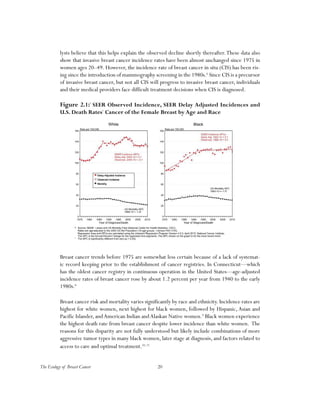
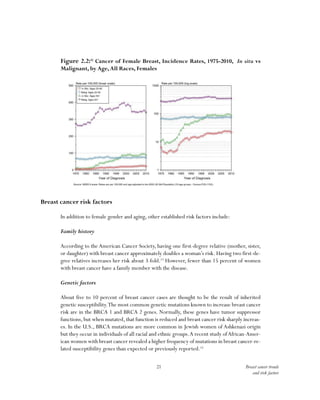
Data from the National Cancer Institute show breast cancer trends in the U.S. since 1975
and age-related incidence rates (See Figures 2.1 and 2.2). They show an increase in breast
cancer in individuals ages 50 and older until about 2003 when incidence rates began to
decline, most notably in white women.This was shortly after the Women’s Health Initia-
tive randomized study identified combined (estrogen plus progestin) hormone replacement
therapy as a risk factor for breast cancer and many women discontinued its use.5
Most ana-
Chapter 2
Breast cancer trends and risk factors
20The Ecology of Breast Cancer
lysts believe that this helps explain the observed decline shortly thereafter.These data also
show that invasive breast cancer incidence rates have been almost unchanged since 1975 in
women ages 20–49. However, the incidence rate of breast cancer in situ (CIS) has been ris-
ing since the introduction of mammography screening in the 1980s.6
Since CIS is a precursor
of invasive breast cancer, but not all CIS will progress to invasive breast cancer, individuals
and their medical providers face difficult treatment decisions when CIS is diagnosed.
Figure 2.1:7
SEER Observed Incidence, SEER Delay Adjusted Incidences and
U.S. Death Rates*
Cancer of the Female Breast by Age and Race
Breast cancer trends before 1975 are somewhat less certain because of a lack of systemat-
ic record keeping prior to the establishment of cancer registries. In Connecticut—which
has the oldest cancer registry in continuous operation in the United States—age-adjusted
incidence rates of breast cancer rose by about 1.2 percent per year from 1940 to the early
1980s.8
Breast cancer risk and mortality varies significantly by race and ethnicity. Incidence rates are
highest for white women, next highest for black women, followed by Hispanic, Asian and
Pacific Islander, andAmerican Indian andAlaskan Native women.9
Black women experience
the highest death rate from breast cancer despite lower incidence than white women. The
reasons for this disparity are not fully understood but likely include combinations of more
aggressive tumor types in many black women, later stage at diagnosis, and factors related to
access to care and optimal treatment.10, 11
*
21 Breast cancer trends
and risk factors
Figure 2.2:12
Cancer of Female Breast, Incidence Rates, 1975-2010, In situ vs
Malignant, by Age,All Races, Females
Breast cancer risk factors
In addition to female gender and aging, other established risk factors include:
Family history
According to the American Cancer Society, having one first-degree relative (mother, sister,
or daughter) with breast cancer approximately doubles a woman’s risk. Having two first-de-
gree relatives increases her risk about 3-fold.13
However, fewer than 15 percent of women
with breast cancer have a family member with the disease.
Genetic factors
About five to 10 percent of breast cancer cases are thought to be the result of inherited
genetic susceptibility.The most common genetic mutations known to increase breast cancer
risk are in the BRCA 1 and BRCA 2 genes. Normally, these genes have tumor suppressor
functions,but when mutated,that function is reduced and breast cancer risk sharply increas-
es. In the U.S., BRCA mutations are more common in Jewish women of Ashkenazi origin
but they occur in individuals of all racial and ethnic groups.A recent study ofAfrican-Amer-
ican women with breast cancer revealed a higher frequency of mutations in breast cancer-re-
lated susceptibility genes than expected or previously reported.14
22The Ecology of Breast Cancer
Personal history of breast cancer
Having cancer in one breast increases the risk of developing a new cancer in the same or
other breast.
Dense breast tissue
Dense breast tissue, as seen on a mammogram, contains more glandular and fibrous tissue
and less fatty tissue. Dense breast tissue is associated with a higher risk of breast cancer.
Other than age, pregnancy, menopausal status, and genetics, the reasons for dense breast
tissue are not fully understood.
Late age of first pregnancy or having no children (nulliparity)
Women who have had no children or who had their first child after age 30 have a slightly
higher breast cancer risk. Having many pregnancies and becoming pregnant at a younger age
reduces breast cancer risk.Maturational changes in the breast associated with pregnancy and
lactation are thought to reduce the susceptibility of breast tissue to cancer. Reduced number
of menstrual cycles may also play a role.
Early age of puberty
Earlier onset of menarche (menses) increases the risk of breast cancer. In the U.S. and many
other countries, the age of puberty in girls has been significantly declining, although the
reasons for this are not well understood.15
Most of the acceleration in the timing of puberty
is associated with earlier breast development (thelarche) while the timing of the onset of
menses has not declined as much.
Later age of menopause
Menopause after age 55 also slightly increases breast cancer risk. One plausible explanation
holds that earlier menarche and later menopause results in higher lifetime estrogen and
progesterone exposures.
Chest radiation
Ionizing radiation (e.g., X-rays) is known to increase the risk of breast cancer. According
to Breast Cancer and the Environment,16
a report from a committee convened by the Institute
of Medicine (IOM), some of the strongest evidence supports a causal association between
breast cancer and exposure to ionizing radiation.The committee also noted that population
exposures to ionizing radiation in medical imaging are increasing. Standards intended to
23 Breast cancer trends
and risk factors
minimize exposures from mammography exist and new imaging technologies could reduce
or eliminate that source. In addition, more needs to be done to minimize radiation ex-
posures from other medical procedures. Breast cancer risk is higher if radiation exposure
occurs during adolescence as the breasts are developing.This is particularly a concern when
chest radiation is used to treat another cancer during that time. Age-related windows of vul-
nerability to radiation and other environmental exposures are a recurrent theme explored
more fully in later chapters.
Recent oral contraceptive use
According to the IOM committee report, oral contraceptives modestly increase the risk of
breast cancer among current users—but this increased risk disappears within four years fol-
lowing cessation. However, the committee also notes that oral contraceptives are associated
with a long-term reduced risk of endometrial (uterine) and ovarian cancers.
Combination hormone therapy
The IOM committee concurred with the prevailing opinion that combination estrogen-pro-
gestin hormone replacement therapy increases the risk of breast cancer.This increased risk
was identified in theWomen’s Health Initiative study.
Cigarette smoking
Some major studies and reviews have concluded that active smoking increases breast cancer
risk. Evidence is also growing that being exposed to secondhand tobacco smoke (passive
smoking) increases the risk of breast cancer.17
Other factors reviewed by the IOM committee
Among other factors reviewed by the IOM committee,*
those most clearly associated with
increased breast cancer risk in epidemiologic studies are overweight and obesity among
post-menopausal women and alcohol consumption. Greater physical activity is associated
with decreased risk.These and other potential risk factors are more fully discussed in later
chapters.
With this as background, the following chapters address additional risk factors in more
detail. Evidence is often limited and sometimes conflicting. Keeping in mind the ecological
* The committee limited their review to a select group of potential risk factors. It was not intended to
be a comprehensive review.
24The Ecology of Breast Cancer
framework discussed in chapter 1, we are learning that much of the available epidemiologic
research is limited to some extent by various features of study design that did not (and often,
could not) account for the complexity. For example, as noted in chapter 3, after decades of
research on diet and breast cancer, it became clear that much of that work was limited by
its failure to account for confounding or effect modification by exercise.18
That is, exercise
can independently influence both diet and breast cancer risk.Thus, it can be a confounder
of the relationship. Exercise can also influence biologic pathways that do link diet to breast
cancer—for example, inflammation and oxidative stress.Thus, exercise is a potential effect
modifier of any relationship between diet and breast cancer.This has practical importance
beyond complicating epidemiologic study design. It means that well-designed interventions
can be mutually reinforcing and have benefits that may exceed what would be predicted by
considering them individually.
As noted by the IOM committee report, more complex models “which attempt to depict
the multiplicity of factors that seem to have a role in breast cancer, help underline the bio-
logical complexity of the pathways along which those factors may be acting, the difficulty
of distinguishing truly causal effects from associations with intermediate factors, and the
challenges of designing, conducting, and interpreting studies that try to evaluate risk factors
for the various forms of this disease.19
Although these challenges share similarities across the
spectrum of risk factors evaluated in this report, they may be particularly acute for evaluat-
ing risk relationships from exposures to environmental chemicals.”
References
1.	 American Cancer Society. Breast Cancer Overview [Internet]. Atlanta: American Cancer
Society; c2012a-13 [updated 2012 Dec 5]. Available from: http://www.cancer.org/Cancer/
BreastCancer/OverviewGuide/breast-cancer-overview-key-statistics.
2.	 American Cancer Society. Global Cancer Facts & Figures. 2nd edition. Atlanta: American
Cancer Society; 2011.
3.	 American Cancer Society. Breast Cancer Overview [Internet]. Atlanta: American Cancer
Society; c2012a-13 [updated 2012 Dec 5]. Available from: http://www.cancer.org/Cancer/
BreastCancer/OverviewGuide/breast-cancer-overview-key-statistics.
4.	 Howlader N, Noone A, Krapcho M, Neyman N, et al. SEER Cancer Statistics Review,
1975-2009 (Vintage 2009 Populations) [internet]. Bethesda (MD): National Cancer Institute;
c2012-3 [updated 2012 Aug 20] Available from: http://seer.cancer.gov/csr/1975_2009_
pops09/.
5.	 Rossouw J, Anderson G, Prentice R, LaCroix A, et al. Risks and benefits of estrogen plus
progestin in healthy postmenopausal women: principal results from the Women’s Health
Initiative randomized controlled trial. JAMA. 2002; 288(3):321-333.
6.	 Kerlikowske K. Epidemiology of ductal carcinoma in situ. J Natl Cancer Inst Monogr. 2010;
2010(41):139-141.
7.	 National Cancer Institute. Surveillance Epidemiology and End Results. Available at: http://
seer.cancer.gov/csr/1975_2010/browse_csr.php.
25 Breast cancer trends
and risk factors
8.	 Miller B, Feuer E, Hankey B. The increasing incidence of breast cancer since 1982: relevance
of early detection. Cancer Causes Control. 1991; 2(2):67-74.
9.	 Howlader N, Noone A, Krapcho M, Neyman N, et al. SEER Cancer Statistics Review,
1975-2009 (Vintage 2009 Populations) [internet]. Bethesda (MD): National Cancer Institute;
c2012-3 [updated 2012 Aug 20]. Available from: http://seer.cancer.gov/csr/1975_2009_
pops09/.
10.	 Amend K, Hicks D, Ambrosone CB. Breast cancer in African-American women: differences
in tumor biology from European-American women. Cancer Res. 2006;66(17):8327-8330.
11.	 For more detailed discussion of trends and tumor biology see Chapter 3 of “Breast Cancer
and the Environment: Prioritizing Prevention Report of the Interagency Breast Cancer and
Environmental Research Coordinating Committee,” available at http://www.niehs.nih.gov/
about/assets/docs/ibcercc_full.pdf. This report is the result of the 2008 Breast Cancer and
Environmental Research Act in which Congress required the Secretary of Health and Hu-
man Services to establish an Interagency Breast Cancer and Environmental Research Com-
mittee of federal and non-federal members to examine the current state of breast cancer and
the environment research and make recommendations for eliminating knowledge gaps.
12.	 National Cancer Institute. Surveillance Epidemiology and End Results. Available at: http://
seer.cancer.gov/csr/1975_2010/browse_csr.php.
13.	 American Cancer Society. Breast Cancer. Available at http://www.cancer.org/cancer/breast-
cancer/detailedguide/breast-cancer-risk-factors
14.	 Churpek J, Walsh T, Zheng Y, Casadei S, et al. Inherited mutations in breast cancer genes in
African American breast cancer patients revealed by targeted genomic capture and next-gen-
eration sequencing. J Clin Oncol 31, 2013 (suppl; abstr CRA1501). Available at: http://
meetinglibrary.asco.org/content/116465-132 .
15.	 Steingraber S. The falling age of puberty in US girls: what we know, what we need to
know. 2007. Available at http://www.breastcancerfund.org/media/publications/reports/
falling-age-of-puberty.html
16.	 IOM (Institute of Medicine). 2012. Breast cancer and the environment: A life course ap-
proach. Washington, DC: The National Academies Press. Available at http://www.iom.edu/
Reports/2011/Breast-Cancer-and-the-Environment-A-Life-Course-Approach.aspx
17.	 Printz C. Smoking studies produce new findings regarding breast and lung cancer link. Can-
cer. 2011; 117(13):2828-2829.
18.	 Holmes M, Chen W, Hankinson S, Willett W. Physical activity’s impact on the association of
fat and fiber intake with survival after breast cancer. Am J Epdemiol. 2009; 170(10):1250-
1256.
19.	 IOM (Institute of Medicine). 2012. Breast cancer and the environment: A life course ap-
proach. Washington, DC: The National Academies Press. Pg 181. Available at http://www.
iom.edu/Reports/2011/Breast-Cancer-and-the-Environment-A-Life-Course-Approach.aspx
Section 2
LookingWithin the Complexity
27 Diet, nutrition, and
breast cancer
Chapter 3
Diet, nutrition, and breast cancer
Chapter Summary
For many years,the relationship between diet and breast cancer has been of great interest.Scientists have
studied this connection particularly intensively over the past 30 years. Initial case-control studies were
followed by the addition of large prospective cohort observational studies and occasional intervention
trials. Inconsistency in findings is a recurrent theme. Perhaps this is inevitable for at least two reasons.
Breast cancer is not a single disease. It is comprised of different subtypes—classified according to
menopausal status, hormone receptor status, or other markers—with differing and complex biology.
Many studies attempting to shed light on their origins make no distinction. Beyond that, studies with a
singular focus on diet, by their design, often prevent understanding the ways diet can interact with other
risk factors such as exercise or exposure to environmental chemicals.The research agenda has largely
featured a reductionist approach—but that is slowly beginning to change.
At the outset, studies largely examined the influence of single dietary variables or macronutrients on
breast cancer risk and prognosis. Initial enthusiasm surrounding the role of dietary fat waned as results
from prospective cohort and intervention studies did not confirm findings from case-control studies
showing an association between higher dietary fat and breast cancer risk. Subsequent studies examined
the role of fruits,vegetables,soy,carbohydrates,dairy,and fiber.Occasional more recent studies examine
dietary patterns.
28The Ecology of Breast Cancer
Most analyses have assumed that if a nutrient group is related to breast cancer, the relationship will be in
the same direction—that is,if some particular food is beneficial,more will be more beneficial;or if some
is harmful, more will be more harmful. But that assumption may be incorrect.There may be optimal
amounts of nutrient groups or micronutrients, above and below, which breast cancer risk increases or
prognosis is poorer.This gives a J-shaped dose response curve that most existing epidemiologic studies
do not consider in data analyses.1
With a few exceptions, almost all early epidemiologic studies examined the influence of adult diet on
breast cancer risk. Most concentrate on current or fairly recent diet. But if most breast cancer has a
latency of 15-20 years or even longer, as experts generally agree, recent dietary information tells us
more about associations with cancer progression than initiation. Laboratory animal and more recent
human epidemiologic studies now show that diet in childhood and adolescence has a stronger link to
breast cancer risk—perhaps more than diet in adulthood.This has striking implications for breast cancer
prevention, as well as posing challenges for the design of future research.
Recent studies also show that exercise, which is often ignored in dietary studies, is a significant
confounder and may modify the effect of dietary variables on breast cancer risk. Exercise influences
what and how much individuals eat and is also independently associated with breast cancer risk. Exercise
influences some of the same biologic pathways through which dietary variables may act. The few
studies that consider diet and exercise together show the magnified value of eating well and exercising.
These reinforce the idea that breast cancer is a disease arising out of system conditions—the result of
interacting multi-level variables that begin early and extend throughout life.More complex analyses hold
the most promise for better understanding and designing interventions that help to prevent the disease
and improve outcomes.
Overweight and obesity are associated with an increased risk of post-menopausal breast cancer and
less favorable prognosis after diagnosis and initial treatment. Excess body weight typically has multiple
contributing causes, but dietary interventions, along with exercise, can help maintain a healthy body
weight and reduce risk.For premenopausal breast cancer,however,overweight and obesity are associated
with a slightly decreased risk.2
Dietary fat
Independent of weight gain, most analysts conclude that total dietary fat, within the range common in
the Western diet, has a weak, if any, association with breast cancer risk in general.3
Evidence linking
higher total dietary fat to breast cancer is stronger in post-menopausal women. Some evidence shows
that reducing total dietary fat to 20 percent or less of total calories, an uncommonly low level in the
United States, is likely to lower breast cancer risk.4
Higher amounts of saturated fat and trans-fats
modestly increase breast cancer risk.Trans-fats are, to a large extent, the result of partial hydrogenation
29 Diet, nutrition, and
breast cancer
of vegetable oils used in processed foods although some are present in trace amounts in meat and dairy.
In addition, trans-fats are clearly linked to cardiovascular disease risk and should be avoided.
Diets high in omega 6 fatty acids (FAs) (e.g., from corn, safflower, and soy oils; processed foods) that do
not also contain adequate amounts of omega 3 FAs (e.g., from wild fish, fish oil, flax, walnuts) are likely
to increase breast cancer risk. Laboratory animal studies clearly show this to be true, but epidemiologic
studies are somewhat inconsistent. Ideally, some omega 6s should be replaced with omega 3s and mono-
unsaturated FAs, like oleic acid in olive oil, which is prominent in the Mediterranean diet.*
Excessive
dietary levels of omega 6 FAs may be particularly problematic in individuals who disproportionately
metabolize them into higher levels of pro-inflammatory substances, based on genetic variability.
Meat
Results of studies of dietary meat in adulthood and breast cancer risk have been inconsistent and
largely negative. However, the Nurses’ Health Study (NHS) II found a strong association of higher meat
consumption during adolescence with increased premenopausal breast cancer risk. This is consistent
with additional findings described in this and other chapters suggesting that early-life experiences help
shape susceptibility to breast cancer.They provide strong support for beginning efforts to prevent breast
cancer early in life and continuing through adolescence and adulthood.
Fruits and vegetables
Despite inconsistent evidence in early studies, more recent analyses show that higher dietary levels of
fruits and vegetables significantly reduce the risk of developing breast cancer. Inconsistencies in the
evidence may be due to different ways of estimating consumption. Studies using serum measures of
carotenoids as a marker for fruit and vegetable consumption, rather than food-frequency questionnaires,
find a significant protective association with higher levels. The Women’s Healthy Eating and Living
(WHEL) intervention study and others also showed improved prognosis after breast cancer diagnosis in
individuals with the highest baseline levels of carotenoids.
Dietary pattern studies fairly consistently show modest risk reduction with a diet featuring plant-based
foods.And, aWHEL analysis of postmenopausal women with breast cancer found that a diet with more
than five servings of fruits and vegetables daily, combined with a level of exercise equivalent to brisk
walking 30 minutes daily, six days/week, reduced mortality risk by half over a 10 year period.5
* It should be emphasized that omega 6s and 3s are both essential fatty acids (FAs). But based on a large number of
animal studies and less consistent human data, high omega 6 FA intake in the setting of low omega 3 FA intake is likely
to increase the risk of breast cancer.
30The Ecology of Breast Cancer
It is increasingly clear that higher soy consumption decreases the risk of breast cancer, although the level
at which risk reduction becomes significant is uncertain,and the kind of soy-derived food is an important
consideration (Although not reviewed here, an expert panel concluded that higher soy consumption also
reduces the risk of uterine cancer.6
). Higher soy consumption more persuasively lowers breast cancer
risk in Asians than inWesterners, perhaps becauseAsians traditionally eat whole soy foods and consume
10-100 times more soy-derived isoflavones than Westerners. In many studies these larger amounts
appear to confer more significant protection. The traditional Asian diet includes tofu and fermented
soy products, such as miso and tempeh made from the whole bean. Soy oil and soy protein isolates are
more common in the United States, particularly in processed foods. Health benefits from this heavily
processed soy should not be inferred from the results of studies of more traditional soy-based food.
Available studies consistently show that higher soy consumption during childhood and adolescence is
associated with lower breast cancer risk than higher dietary levels in adulthood.The findings are striking.
Multiple mechanisms are likely to be involved. Here again, it looks as if early life experience may
influence breast cancer risk years later.This has profound implications for breast cancer research and
public policy.
Despite evidence in laboratory studies that genistein can cause breast cancer cells to proliferate,7
three
well designed, prospective studies with follow up periods of up to six years conclude that higher soy
consumption post-diagnosis and treatment is associated with improved survival and lower risk of
recurrence.The association is strongest inAsians,who may have been consuming traditional soy products
throughout life.These findings cannot, however, be generalized to include soy supplements or purified
isoflavones that may be added to processed, non-traditional soy food products. There is no evidence
that soy consumption at current levels inWesterners or Asians post-diagnosis interferes with tamoxifen
therapy and efficacy.
Other foods
Consistent,but limited,evidence from laboratory animal and epidemiologic studies points to a beneficial
role of dietary seaweed in breast cancer prevention—even more in combination with soy, fish, fruits,
and vegetables. Data also show a protective effect of mushrooms, which are commonly included in
traditional Asian diets in countries where breast cancer is less common.
The role of carbohydrates, glycemic index, and glycemic load in the origins or prognosis after treatment
of breast cancer is unclear.To the extent that refined carbohydrates, independently or along with other
dietary features,promote elevated blood sugar,insulin resistance,metabolic syndrome,or overt diabetes,
breast cancer risk will increase and prognosis after diagnosis will be less favorable. Comprehensive
efforts to normalize blood sugar, improve insulin sensitivity, and reduce insulin levels are likely to be
protective and beneficial.
31 Diet, nutrition, and
breast cancer
Breast cancer is less common in countries where people consume less meat and fat. But
many aspects of lifestyle are also markedly different in these countries than in affluentWest-
ern countries, including physical activity, body composition, diet other than meat and fat
consumption, and exposures to other environmental agents.Thus, cross-country compari-
sons are useful for generating hypotheses, but they are subject to considerable confounding
and more detailed studies are needed.
Dietary patterns
Some epidemiologic studies have addressed the association of breast cancer with dietary patterns rather
thansinglenutrientgroups.Ingeneral,dietsfeaturinghigheramountsoffruitsandvegetables,particularly
those that are darkly colored, traditional soy products, whole grains and less refined carbohydrates,
low-fat dairy, with poultry and fish and less red meat are associated with lower breast cancer risk. In
some studies, where tumor subtypes are considered, this relationship is stronger for estrogen-receptor
negative (ER-) breast cancer.
A number of observational and two large intervention studies provide varying levels of evidence that
lower levels of dietary saturated fat and higher amounts of fruits and vegetables may reduce or delay
cancer recurrence and improve survival. Higher amounts of dietary soy pre- and post-diagnosis are
associated with decreased mortality and may be associated with decreased likelihood of recurrence.
When combined with weight loss in people who are overweight and regular exercise, benefits of this
dietary pattern increase (SeeAppendixA).
Conclusions
Efforts to prevent breast cancer should begin in utero and continue throughout infancy, childhood,
adolescence, and adulthood. Significant opportunities to reduce breast cancer risk through dietary
interventions begin early in life and may be even more effective than steps taken later.That said, dietary
interventions in adulthood can also reduce risk and importantly, improve prognosis after the diagnosis
of breast cancer. Strong evidence shows that obesity is a significant risk factor for developing post-
menopausal breast cancer and for progression of pre- and post-menopausal breast cancer. Dietary
changes can be combined with other efforts aimed at weight control.
32The Ecology of Breast Cancer
Studying the impact of diet on breast cancer risk is complicated. Data are difficult to gather
and their quality varies significantly. Unlike laboratory animal studies, where careful dietary
control allows close monitoring of impacts, human studies are less precise.They often rely
on food frequency questionnaires to reconstruct dietary histories, even from the distant
past. Prospective studies can use food diaries since current eating patterns can be record-
ed more accurately than past practices can be recalled, but these too are often inaccurate.
Moreover, in a population where the differences in dietary fat or food groups may not vary
dramatically between the highest and lowest consumers, influences on cancer risk may be
difficult to identify, even when they exist.
In recent years it has become increasingly apparent that nutrition, along with other environ-
mental exposures, during fetal development, infancy, childhood, and adolescence influences
subsequent breast cancer risk—perhaps even more than adult diet.This conclusion is based
on diverse threads of evidence. Animal studies show that maternal diet during pregnancy
significantly alters mammary cancer risk in female offspring—including susceptibility to
mammary carcinogens before or after a first pregnancy.8,9
A prospective cohort study of 3,834 people who took part in a family diet and health sur-
vey between 1937 and 1939 reported increased cancer mortality, including breast-cancer
related deaths, associated with higher levels of total childhood energy intake.10
An ecologic
study found that during World War II in Norway, peri-pubertal women whose diets were
calorie-restricted but otherwise adequate had decreased risk of subsequent breast cancer
compared with women exposed to both severe calorie restriction and poor food quality.11
A retrospective analysis from Nurses’ Health Study (NHS) II found decreased risk of breast
cancer with higher intakes of vegetable fats (RR=0.58) and vitamin E (RR=0.61) in ado-
lescence and increased risk with a high glycemic diet (RR=1.47).12
Another analysis from
NHS II found that a higher level of meat consumption in adolescence increases the risk of
breast cancer (RR=1.34). Several studies show that increased soy consumption in childhood
decreases risk (see below).
These findings are among the increasingly persuasive evidence pointing to the developmen-
tal origins of adult diseases. They are consistent with studies of survivors of the atomic
bombing of Japan in WWII showing that radiation exposure during childhood and adoles-
cence most strongly increased breast cancer risk while exposure after age 40 had a much
smaller effect.13
Migration studies show that breast cancer risk remains low in first generation immigrants
who have spent their early life in a country with low risk of breast cancer, but increases
among second generation immigrants who spend their childhood in a country with higher
risk.14
And, in a study that was able to determine the age of participants at the time of ex-
33 Diet, nutrition, and
breast cancer
posure to the insecticide DDT, higher exposures before age 14 were associated with much
higher breast cancer risk but not in women who were older when exposed (see chapter 5).15
These findings are biologically plausible inasmuch as puberty and adolescence are times of
unique susceptibility to environmental exposures because of rapid cellular proliferation and
development of tissue architecture in the breast prior to pregnancy. Unique events during
fetal development are also likely to contribute. But as important as it may be, accurate infor-
mation about maternal, childhood, and adolescent nutrition can be extremely challenging
to acquire decades later.
In general, nutritional studies tend to control for other variables that influence breast can-
cer risk, such as age at menarche and menopause, history of pregnancies, and alcohol and
tobacco use, but some do that more rigorously than others.To add to the complexity, diet
probably has different influences on pre- and post-menopausal cancer risk, but many studies
do not report data by menopausal status, making interpretation difficult.
Case-control epidemiologic studies dominated early investigations.These compare diets of
people with breast cancer to a control group without cancer.They depend on dietary re-
call. Prospective cohort studies, which assemble a group of participants without cancer,
gather dietary and other relevant information, and periodically check on health status, soon
followed. In general, case-control studies are subject to more dietary recall bias than co-
hort studies, which may explain at least some of the differences in their findings. Popula-
tion-based, nested case-control studies are also fairly common in breast cancer research.
Even though they are of case-control design, they have the advantage of being drawn from
a fairly large, previously defined population being followed prospectively. They minimize
some of the difficulties associated with matching cases with controls and controlling for
recall bias.
The following sections summarize the results of many studies, most of which examined the
independent influence of dietary fat, meat, soy, or fruits and vegetables on breast cancer
risk or outcomes. Dietary pattern analysis shows up in more recent studies.This approach
may add value since people eat complex diets with important interactions among nutrients
that are likely to be missed when concentrating on single nutrient groups. Information from
studies looking at dietary influences on breast cancer outcomes following diagnosis is also
included.
The emphasis here is on prospective observational cohort studies and intervention trials,
although occasional case-control studies are included, along with some laboratory animal
data. Inconsistencies in findings are common, some of which are undoubtedly due to differ-
ences in study design. Moreover, virtually none of these studies considered exercise or ac-
tivity levels as a potential confounder or modifier of the effect of diet on breast cancer risk.
This is a regrettable shortcoming since the intertwined biologic effects of diet, exercise, and
34The Ecology of Breast Cancer
body weight can strongly influence breast cancer risk.Analyzing dietary data independently,
without accounting for interactions with exercise or other relevant variables, can obscure
its relevance.
Dietary fat and breast cancer
Initial enthusiasm for the idea that higher amounts of dietary fat would explain most of the
elevated incidence of breast cancer in some countries has waned to a large degree, based
on inconsistent results from a number of prospective studies. Until recently, however, these
studies almost always evaluated diets in adults rather than childhood or adolescence.Despite
inconsistent results, some conclusions can be drawn:
•	 Reduced dietary saturated fat and total fat may modestly reduce breast cancer risk,
particularly in post-menopausal women. In the Women’s Health Initiative inter-
vention study of post-menopausal women,reduced fat consumption was associated
with most risk reduction in women who had higher baseline levels of dietary fat.
Increasing trans fat consumption is associated with increased risk.16
•	 The NHS II found a significantly increased risk of premenopausal breast cancer
with higher dietary levels of animal fat. Premenopausal breast cancer risk was also
higher in women who had higher dietary levels of fat or red meat consumption
during adolescence.This will be important to keep in mind, along with other ad-
olescent dietary patterns discussed below, because childhood and adolescent diets
may have a greater influence on breast cancer risk than diets later in life.
•	 Studies examining the effect of total polyunsaturated FAs (PUFAs) on breast cancer
risk are inconsistent, but some studies with PUFA subtype analyses show that high
intake of omega 6 FAs combined with low levels of dietary omega 3s increase risk.
Relatively new evidence of individual differences in metabolism of omega 6 FAs
suggests the possibility that high dietary levels of omega 6 FAs may increase risk
more in people who, because of genetic variability, metabolize them more com-
pletely into pro-inflammatory compounds associated with a number of chronic
diseases, including cancer. In order to address this, reducing dietary omega 6 FAs
and adding long chain omega 3 FAs from fish or monounsaturated fats from, for
example, olive oil are likely to be most helpful, not only to reduce breast cancer
risk but also other chronic diseases in which inflammation plays a role.
35 Diet, nutrition, and
breast cancer
Study descriptions:Dietary fat and breast cancer
Many studies have examined the relationship between dietary fat and breast cancer risk
because the two are highly correlated at the national level, particularly for animal fat con-
sumption.17
Considerable laboratory animal data show that dietary fat can significantly en-
hance mammary tumor growth, apart from total calories consumed. In fact, a relationship
between dietary fat and breast cancer risk may begin as early as fetal development, and
changes in hormone levels may play a role.
In rodents, high levels of maternal dietary omega 6 FAs during pregnancy and lactation al-
ters breast development in offspring, increasing susceptibility to cancer later in life.18,19
High
levels of maternal dietary omega 6 FAs are also associated with higher estrogen levels in
pregnancy.A meta-analysis of animal studies concluded that omega 6 FAs had the strongest
mammary gland tumor promoting properties, while the effect of saturated fat was some-
what less, and omega 3 FAs seemed slightly protective.20
One study of 189 women who gave birth to single female babies showed that higher intake
of omega 6 FAs was associated with significantly higher umbilical cord blood levels of estriol
and testosterone.21
Higher dietary omega 3 FAs were linked to lower levels.A meta-analysis
of ten intervention studies found that a low-fat, high-fiber diet had an estrogen-lowering ef-
fect in premenopausal women.22
This occurred both in studies in which women lost weight
and when they did not. A recent study in Japan found higher dietary saturated fat intake
associated with higher estrogen levels in premenopausal adult women.23
Initial epidemiologic studies supported a link between dietary fat and breast cancer risk.
A large 2003 meta-analysis of 45 case-control and cohort studies concluded that higher
amounts of dietary fat during adulthood increased the risk of breast cancer by about 13
percent, largely attributable to saturated fat.24
But findings from several large, prospective
cohort studies have not been entirely consistent, and differences in study design make inter-
pretation more uncertain.
Prospective cohort studies
Nurse’s Health Studies: The NHS, established in 1976, is a prospective cohort study
consisting of 121,701 U.S. registered nurses aged 30–55 years at baseline. At enrollment,
women completed a mailed questionnaire regarding their medical histories and lifestyles.
Follow-up questionnaires are mailed every two years in order to update information on
health and lifestyle. In 1980, a food frequency questionnaire was added. A second Nurse’s
Health Study (NHS II) consisting of 116,671 female nurses 25-42 years old was begun in
1989.The NHS II racial/ethnic distribution is about 96 percent white with the remainder
being roughly similar numbers ofAfrican-Americans,Asians, and Hispanics.
36The Ecology of Breast Cancer
•	 NHS: dietary fat and breast cancer: NHS: 89,494 women 34-59 yrs old;
eight year follow up; 1,439 cases of breast cancer, including 774 post-meno-
pausal; adjusted for age, established risk factors; no positive association between
total fat intake and breast cancer incidence in the entire group or among just
post-menopausal women; no evidence of protective effect of dietary fiber.25
•	 NHS:Dietary fat and post-menopausal breast cancer: NHS; Over 80,000 par-
ticipants; average 20 years follow-up; no relationship between mid- to later life di-
etary fat and postmenopausal breast cancer risk.This was also true for specific kinds
offatwiththeexceptionoftransfatintakewheretheriskofbreastcancerincreasedby
8 percent for every 1 percent increase of trans fats as a percentage of total calories.26
•	 NHS II: Dietary fat and premenopausal breast cancer: NHS II; 90,655 pre-
menopausal women ages 26-46 years; >90 percent Caucasian; fat intake was
assessed with food-frequency questionnaires; eight years of follow-up; 714 cas-
es of pre-menopausal breast cancer; 25 percent increased risk of breast cancer
with total dietary fat although this was not statistically significant (RR 1.25;
95 percent CI 0.98-1.59); 33 percent increased risk associated with higher in-
take of animal fat. Higher intake of red meat and high-fat dairy each associat-
ed with increased risk of breast cancer, but this was largely attributable to
higher amounts of animal fat in general.27
The association between dietary ani-
mal fat and breast cancer was stronger in women who were using or who had
ever used oral contraceptives and in women whose tumors were ER+ or PR+.
•	 NHS II: Adolescent diet and premenopausal breast cancer: NHS II; 39,268
premenopausal women completed a 124-food item questionnaire about their di-
ets during high school; 7.5 yrs follow up; 455 cases of breast cancer occurred;
35 percent increased risk of breast cancer in the group with the highest total fat
consumption in adolescence compared to the lowest.28
The risk was higher for hor-
mone-receptor negative tumors than hormone-receptor positive tumors. Risk also
increased (34 percent) with highest red meat consumption during adolescence.29
In
this case, the increased risk associated with higher amounts of meat consumption
was not explained by higher amounts of animal fat alone—red meat independently
was associated with higher risk.Adolescent dietary milk, dairy, total carbohydrate,
glycemic index, dietary fiber were not associated with breast cancer risk.
Canadian National Breast Screening Study: 56,837 women;30
40-59 yrs. old at en-
rollment; dietary information obtained by questionnaire at the time of enrollment; over five
years of follow-up, 519 cases of breast cancer diagnosed; menopausal status of cases was
not specified, but most were post-menopausal at diagnosis. When dietary fat was treated
as a continuous variable in the statistical model, there was a 35 percent increased risk of
37 Diet, nutrition, and
breast cancer
breast cancer per 77 gm of dietary fat, (which represented the differences in dietary fat
between the highest and lowest quartiles; 47 percent vs. 31 percent of total calories from
fat), independent of total calories consumed; no evidence of an association with protein or
carbohydrate intake.
SwedishWomen’s Lifestyle and Health Cohort:31
49,261 women enrolled;30-49 yrs.
old; 9 percent post-menopausal at enrollment; dietary history over the past six months ob-
tained by questionnaire;average follow up 13 years; 974 cases of breast cancer;432 occurred
before the age of 50.Total fat was not associated with breast cancer risk before or after age 50;
compared to the lowest intakes, highest intake of monounsaturated fat was associated with a
significant 55 percent decreased risk of breast cancer after age 50;higher polyunsaturated fat
also associated with decreased risk while higher amounts of saturated fat associated with in-
creasedriskafterage50;thedecreasedriskwithPUFAsmostmarkedinER+andPR+tumors.
Swedish Mammography Screening Cohort study:32
61,471 women enrolled; 40-
76 yrs old; 4.2 years average follow up; 674 cases of breast cancer diagnosed; dietary his-
tory over past six months obtained by questionnaire. There was no association of breast
cancer risk with total dietary fat, adjusted for total calories. However, when treated as
continuous variables, increasing amounts of monounsaturated fat was associated with de-
creased risk of breast cancer whereas increasing amounts of PUFAs was associated with
increased risk. Results based on quartiles were in the same direction but not significant.
TheEuropeanProspectiveInvestigationintoCancerandNutrition(EPIC):EPIC
is a large prospective study in ten countries in the EU;319,826 participants;average 8.8 years
follow up; diet assessment through food frequency questionnaires and 24 hr. food recall in-
terviews in a subset.The study found a 13 percent increase in breast cancer risk for the high-
est consumers of saturated fat.33
This association did not vary with BMI or menopausal status
although in post-menopausal women,it was stronger among those who never used hormone
replacement therapy. No association with total fat, monounsaturated, or polyunsaturated fat
was found. Higher BMI34
and lower amounts of exercise35
were associated with increased
risk.Noconsistentfindingswithmeat,dairy,eggconsumption.36
Insubgroupanalyses,higher
processed meat consumption associated with 13 percent increased risk of BC in post-meno-
pausal women; no association with red meat consumption over all, but in countries where
red meat is typically cooked at higher temperatures,consumption associated with higher risk
of breast cancer.This suggests that carcinogens, such as heterocyclic amines and polyaromat-
ic hydrocarbons,produced by high temperature cooking,may play a role.In this study higher
butter consumption was also associated with increased risk of breast cancer in premenopausal
women. EPIC did not identify or analyze data by hormone receptor status of breast tumors.
38The Ecology of Breast Cancer
National Institutes of Health-AARP Diet and Health Study: dietary fat and
postmenopausal breast cancer: A U.S. study of 188,736 postmenopausal women
who completed a 124-item food-frequency questionnaire in 1995-1996; approximately
88 percent white, 6 percent African-American, 2 percent Hispanic; average follow up 4.4
years; 11 percent higher incidence of BC in women in highest quintile of total fat compared
to lowest; this association was also observed for all fat subtypes.37
There was no associa-
tion of meat intake or meat cooking methods with breast cancer after 8 years follow up.38
Women’s Health Initiative Dietary ModificationTrial (an intervention study):
TheWomen’s Health Initiative (WHI) trial is a prospective, randomized, intervention study
of 48,835 postmenopausal women, aged 50-79 years;39
81 percent white, 11 percent Afri-
can-American, 4 percent Hispanic; 4 percent Asian/Pacific,American Indian. Intervention
group: reduction of dietary fat to 20 percent of total energy, increased consumption of
fruits, vegetables, whole grains. Control group: given health related printed materials but
not advised to make any dietary changes; average follow up 8.1 years. Results: 9 percent
lower risk of breast cancer in intervention group although this was not statistically signifi-
cant; however, in subgroup analyses, women who had higher baseline percentages of total
energy from dietary fat experienced 22 percent reduction of risk of breast cancer from the
intervention; risk reduction from intervention much greater in ER+/PR- tumors. Only 14
percent of women met the dietary target of 20 percent of energy from fat. Fat mass reduc-
tion was greater in women in the intervention group than in controls.40
In theWHI prospective intervention study, breast cancer incidence was more dramatically
reduced by a low-fat diet in women who had experienced hot flashes compared to women
who had not (73 percent vs. 58 percent reduction).41
This finding was specific for ER+/
PR+ tumors and suggests that some post-menopausal women may particularly benefit from
low-fat dietary intervention.
Pooled analyses of prospective studies of dietary fat and breast cancer
A pooled analysis of 8 prospective cohort studies including 7,329 cases of breast cancer
among over 350,000 women concluded that the risk of breast cancer increased modestly
with increased saturated fat consumption (9 percent for every 5 percent increase in saturated
fat as a percentage of total caloric intake).42
Menopausal status did not alter this association.
A recent pooled analysis of data from 52 cohort and case control studies examining the rela-
tionship between dietary fat and breast cancer, published over the past 20 years concluded:43
•	 In studies that did not distinguish by menopausal status, there is a small but signif-
icant increased risk of breast cancer with increased amounts of dietary PUFA and
total fat;
39 Diet, nutrition, and
breast cancer
•	 Among post-menopausal studies only, breast cancer risk increases with higher di-
etary PUFA and total fat;
•	 Among pre-menopausal studies only, no increased risk of breast cancer with total
dietary fat or any subtypes.
Polyunsaturated fatty acids and breast cancer risk
A 2006 review of omega 3 FAs and cancer risk included analysis of 8 prospective studies
of breast cancer.44
Two of four using fish consumption as a marker for omega 3s found no
association with breast cancer risk, one found an increased risk, and one a decreased risk.
Studies that included omega 3s from all sources found no association.
A 2013 meta-analysis of 21 prospective cohort studies including 20,905 cases of breast
cancer among 883,585 participants found the highest level of dietary marine omega 3 FA
was associated with a 14 percent reduction in breast cancer risk, whether measured as di-
etary intake or as tissue biomarkers.45
This association was stronger in studies that did not
adjust for BMI. No significant association was observed for dietary fish or exposure to alpha
linolenic acid (a somewhat shorter-chain omega 3 FAs compared to marine omega 3 FAs).
Occasional studies examine breast cancer risk associated with varying combinations of ome-
ga 3 and omega 6 FAs.The large prospective Singapore Chinese Health Study of over 35,000
women 45-74 yrs of age found that higher intakes of omega 3 FA, primarily from fish/
shellfish was associated with a 24 percent lower risk of developing breast cancer. Moreover,
among women whose omega 3 FA intake was low, high levels of dietary omega 6 FAs was
associated with a near doubling of breast cancer risk.46
This was also reported in another
large prospective study in France.47
Several things could explain inconsistent outcomes of studies of the impacts of omega 6 and
omega 3 FAs. InAsian populations with low breast cancer incidence, marine fish are a major
source of long chain omega 3 FAs. In laboratory and some epidemiologic studies these have
the most protective effect with respect to breast cancer risk. In the typical Western diet,
alpha-linolenic acid, a shorter chain omega 3 FA, is dominant. Humans do not biochemi-
cally convert this FA to the longer chain omega 3 very efficiently.As a result, the omega 3
FAs in diets that do not contain marine fish may not be as protective.Traditional Asian diets
also often contain soy products and seaweed, which seem to confer additional protection,
as discussed below.
In addition to being incorporated into cell membranes throughout the body, omega 6 and
omega 3 FAs are enzymatically converted into a family of chemicals called eicosanoids,
which are signaling molecules that influence a number of biologic processes, including in-
flammation and immune system function. Omega 6 FAs are converted largely, although
40The Ecology of Breast Cancer
not entirely, into eicosanoids that promote inflammation. Omega 3 FAs, however, are con-
verted almost exclusively into anti-inflammatory compounds.Thus, a diet featuring higher
amounts of omega 6s and low amounts of omega 3s would generally be pro-inflammatory.
It is increasingly clear that chronic inflammation plays an important contextual role in car-
cinogenesis and cancer progression, as well as a number of other chronic diseases, including
cardiovascular disease, diabetes, metabolic syndrome, arthritis, asthma,Alzheimer’s disease,
and other neurodegenerative disorders.48,49,50
The dominant dietary omega 6 FA, linoleic acid, obtained from some vegetable oils, mar-
garine, and processed foods, is partially converted enzymatically into arachadonic acid, an
essential but inflammation-promoting eicosanoid. Early studies generally concluded that
only a small portion of dietary linoleic acid was converted into arachadonic acid, but now
it appears that enzyme levels influencing this conversion (FA desaturase) vary with genetic
inheritance.A recent study showed that the genetic variations responsible for higher enzyme
levels leading to higher levels of arachadonic acid production are much more common in
people ofAfrican than of European ancestry.51
The implications could be profound,sinceAf-
rican and African-American women are at higher risk of more aggressive and hormone-re-
ceptor-negative tumors than white American women.52
5-lipoxygenase is an additional enzyme that converts arachadonic acid to various inflam-
matory mediators called leukotrienes.The 5-lipoxygenase pathway has been implicated in
carcinogenesis and tumor progression in several different tissues.53
A case-control study of
White, Latina, and African-American women with breast cancer in the San Francisco area
found that women with a particular polymorphism of genes responsible for levels of this
enzyme and its activating protein were at an 80 percent increased risk of breast cancer only
if their diet contained high levels of linoleic acid, the most prominent omega 6 polyunsatu-
rated FA.54
In this study, the polymorphism associated with increased risk was rare in Afri-
can-American women and much more common inWhite and Latina participants.
Thus, health risks associated with high dietary levels of omega 6 FAs may be most marked
in people who more readily metabolize them into arachadonic acid and other pro-inflam-
matory compounds. Since linoleic-to-arachadonic acid conversion appears to be more pro-
nounced, on average, in African-Americans, this could help to explain black-white health
disparities for a number of diseases, including various kinds of cancer, where those differ-
ences cannot otherwise be fully accounted for. Gene-related differences in FA metabolism
may also help explain some of the inconsistency in the studies examining the relationship
between omega 6 FAs and breast cancer risk.
41 Diet, nutrition, and
breast cancer
Dietary meat and breast cancer
Among many case-control and cohort studies, evidence linking meat consumption to breast
cancer risk is inconsistent. Prospective studies generally find little or no relationship be-
tween meat consumption in mid- or later-life and breast cancer risk. But these studies usu-
ally determine meat consumption at baseline and perhaps one time thereafter in relatively
short periods of follow up and cannot shed light on the extent to which earlier life meat
consumption influences breast cancer risk. .
The NHS II found a significantly increased risk of pre-menopausal breast cancer with in-
creased meat consumption during adolescence. Moreover, several studies find that high-
er amounts of dietary meat in childhood are associated with earlier age at menarche—a
well-recognized risk factor for breast cancer (See Box 3.1).
Increased breast density is strongly associated with increased breast cancer risk. Data linking
meat consumption with increased breast density are mixed (See Box 3.2). Inconsistent find-
ings may be due to differences in study design, including the potential for “over controlling”
for age of menarche when analyzing data.
Thus, higher levels of meat consumption in childhood and adolescence may increase the risk
of premenopausal breast cancer significantly while meat consumption in mid-life and later is
probably not independently associated with breast cancer risk much,if at all.That said,other
reasons for keeping red meat consumption low, even in adulthood, include a reduced risk of
diabetes and cardiovascular disease55,56
as well as environmental benefits.57
It should also be noted that the nutritional profile of beef varies with production methods.
The omega 3 FA content is higher in grass-fed animals than in those fed corn.58,59
To my
knowledge, no study has examined the influence of variable kinds of animal feed or the use
of hormones during meat production on breast cancer risk.
Dietary meat and breast cancer study descriptions
The NHS II (see above) found an increased risk of premenopausal breast cancer with higher
levels of red meat consumption during adolescence.
A 2002 pooled analysis of data from eight prospective studies found no significant rela-
tionship between mid- or later life dietary meat and risk of pre- or post-menopausal breast
cancer.60
None of these eight studies attempted to estimate meat consumption earlier in life.
42The Ecology of Breast Cancer
Box 3.1:Should studies of diet and breast cancer always control for age at menarche?
Most investigations into impacts of environmental factors on breast cancer risk use statistical methods to con-
trol for known risk factors, such as age at menarche, age at first pregnancy, number of pregnancies, use of oral
contraceptives, and so on.This is intended to isolate the influence of the variable of interest, by mathematically
holding the other risk factors “constant.” In some circumstances, however, this might be an example of inappro-
priate “over-controlling.” Here’s why.
Although in NHS II, information was gathered about diet during high school, when presumably most partici-
pants had already undergone menarche, a study examining childhood dietary influences on breast cancer risk
that controlled for age at menarche would tend to miss the impacts of diet on both age of menarche and breast
cancer risk. For example, if higher childhood meat consumption advances the age of menarche and thereby, the
subsequent risk of breast cancer, controlling for age of menarche in statistical data analyses will tend to obscure
the influence of childhood dietary meat on cancer risk.
This is not just a theoretical concern. A prospective study of more than 3,000 girls in the United Kingdom,
followed since birth, found that earlier menarche was strongly associated with higher consumption of red meat,
total protein, animal protein and total energy measured at ages three and seven.61
There was no impact of total
dietary fat or fruit and vegetable consumption on age at menarche in this group.
A similarly designed study of 67 white girls born in Boston in the 1930s and 1940s found that age at menarche
was earlier with higher amounts of dietary animal protein at ages three-five and five-eight years and delayed with
higher vegetable protein intakes at three-five years.62
There was no association with total energy or fat intake.
A cross-sectional study in the UK found no difference in age at menarche among women who were life-long
vegetarians vs. those who became vegetarian as adults. However, age at menarche was later in those who became
vegetarian at age 10-14 years.63
Studies that measure protein intake around the time of menarche rather than earlier in childhood generally do
not find an association with the onset of menses.64,65
A second example arises from concerns that low levels of vitamin D may increase breast cancer risk (see chapter
6). Considerable evidence supports this relationship although epidemiologic studies are somewhat inconsistent.
However, a recent prospective study of 242 girls in Bogota, Columbia found that lower serum levels of vitamin
D were associated with significantly earlier menarche.66
This association remained after controlling for BMI. If
follow-up studies confirm this relationship, controlling for age of menarche when examining the link between
vitamin D and breast cancer would be inappropriate.
As more studies begin to look at the influence of early life diet or other environmental factors on breast cancer
risk, it will be important to avoid “over-controlling” for risk factors, like early onset of menses, which may actu-
ally be driven by the exposures of interest.
43 Diet, nutrition, and
breast cancer
A more recent meta-analysis of 10 studies found a significant 24 percent increased risk of
premenopausal breast cancer with increased meat consumption.67
This finding was largely
driven by case-control rather than cohort studies, which generally find no association when
meat consumption at study baseline is used as an estimate. One population-based case-con-
trol study that found an increased risk concluded that the association was particularly strong
with a high intake of well-done meat.68
This is consistent with the EPIC study, discussed
above.
The large, prospective NIH-AARP study of 120,755 post-menopausal women identified
3,818 cases of breast cancer in eight years of follow-up.69
Information on diet at baseline was
obtained by questionnaire, with follow-up at six months, including questions about meat
preparation and degree of “doneness.” Age-adjusted or fully-adjusted data analysis showed
no significant associations between meat consumption or methods of meat preparation and
breast cancer risk. Fully adjusted models controlled for age, BMI, height, age at first men-
Box 3.2: Diet and breast density
Increased breast density is strongly associated with increased risk of breast cancer70
and investigators
have wondered if childhood diets can influence breast cancer density in adulthood. Study results are
inconsistent.
A study of 250 women of Chinese ancestry who had migrated to the U.S. in adulthood found that in-
creased breast density after age 40, as determined by mammography, was strongly associated with higher
meat intake during adolescence.71
Interestingly, age at menarche was not associated with breast density
and was not adjusted for in the models examining the relationship between dietary meat and breast den-
sity.
The Minnesota Breast Cancer Family study found no association between diet at age 12 and later breast
density.72
This study did adjust for age at menarche in the final analysis.Was that appropriate or is it an
example of over-controlling in data analysis? Neither of these studies had information about diet in ear-
lier childhood.
A prospective study of 1,161 women in the UK collected data on dietary habits at age 4 and again at
several times during adulthood.73
The authors found no association between diet at age 4 and breast
density on mammography in adulthood. However, dietary patterns at age 4 were classified as breads and
fats, fried potatoes and fish, and milk, fruit, biscuits, with no attempt to examine the impact of meat in-
dependently. Moreover, data analyses were adjusted for age at menarche, potentially obscuring the effect
of childhood meat consumption on age at menarche. In this study, higher total energy in mid-adulthood
was associated with higher breast density 15 years later.
44The Ecology of Breast Cancer
strual period, age at first live birth, age at menopause, number of breast biopsies, family
history of breast cancer, menopausal hormone therapy, education, race, total energy intake,
saturated fat, alcohol, physical activity, and smoking.
In the prospective study of over 60,000 women in the Swedish Mammography Cohort over
an average of 17 years of follow up, no association was found between risk of breast cancer
and red meat consumption.74
However, higher consumption of pan-fried meat was associa-
tion with a 45 percent increased risk of breast cancer for ER+/PR- tumors.
Dairy product consumption and breast cancer risk
A relationship between breast cancer risk and milk and dairy consumption has been proposed
for many years and is biologically plausible. In addition to its nutritional composition, milk
contains various hormones and growth factors that are potentially associated with increased
breast cancer risk,including estrogens,progesterone,and insulin-like growth factors (IGFs).
Earlier age of menarche, a risk factor for breast cancer, is weakly associated with higher total
dairy consumption.75
In adolescent girls, milk consumption results in higher IGF-1 levels.76
IGF-1 promotes cellular proliferation and impedes apoptosis and higher levels may be as-
sociated with increased risk of breast cancer, although study results are inconsistent. In a
prospective study of pre-menarchal girls,higher levels of dairy consumption were associated
with more rapid height growth,77
which in turn is related to increased breast cancer risk.
But, epidemiologic studies have yielded inconsistent results regarding dairy consumption
and breast cancer,ranging from increased risk to reduced risk.78,79,80
Childhood or adolescent
milk consumption is associated with decreased risk in several studies.81,82,83
In laboratory studies, dietary milk in adulthood inhibits the regression of chemically in-
duced mammary gland tumors in rodents.84
On the other hand, dietary milk administered
to rodents before puberty reduced susceptibility to tumor development after administration
of a carcinogen (DMBA) in adulthood.85
Similarly, diethylstilbestrol, a synthetic estrogen,
administered in the neonatal period reduces susceptibility to a mammary gland carcinogen
(DMBA) administered in adulthood,86
whereas prenatal exposure increases mammary gland
cancer risk. This suggests that the impact of dietary cow’s milk on breast cancer risk, as
with other hormonally-active substances, may depend on life-stage and the relative timing
of other exposures. Dietary dairy products containing hormones and other growth factors
could promote tumors that have already been initiated, for example.The nature and timing
of co-exposures may underlie the inconsistencies of epidemiologic studies looking at dairy
products and breast cancer risk.
45 Diet, nutrition, and
breast cancer
Fruits and vegetables and breast cancer risk
Higher amounts of fruit and vegetable consumption appear to reduce breast cancer risk,
along with many other well-established benefits. Carotenoids are pigmented compounds in
many fruits and vegetables—particularly yellow and orange fruits and vegetables and green,
leafy vegetables.They are antioxidants; some inhibit cellular proliferation, induce apoptosis
(programmed cell death), and have other beneficial effects on physiology and metabolism.87
Beta-carotene, one of the major carotenoids, may be particularly important because it is
converted to vitamin A.Vitamin A is in turn converted to retinoic acid, which tends to re-
duce cellular proliferation and encourage cellular differentiation.Thus, dietary carotenoids
may not only reduce breast cancer risk but also be beneficial after breast cancer diagnosis.*
Carotenoid absorption from the intestine and the extent to which it is converted to vitamin
A is highly variable and can be affected by the food matrix, food-processing, and amounts of
dietary fat and fiber, as well as genetic differences in carotenoid metabolism.88
Enterolactone and enterodiol are two dietary lignans formed in the intestine from precur-
sors in whole grains,vegetables,fruits,and berries.Some data show that higher serum levels
of enterolactone are associated with reduced risk of post-menopausal breast cancer89
and
improved survival after diagnosis.90
Studies show that women eating a vegetarian diet excrete higher levels of estrogen in their
feces than do omnivores, reducing circulating levels.91
Lower levels of estrogen are likely to
contribute to lower breast cancer risk.
A meta-analysis of 26 studies looked at the role of dietary vegetables, fruit, carotene, or
vitamin C.92
It included more case-control than cohort studies of both pre- and post-meno-
pausal breast cancer. Study designs varied considerably, including dietary assessment ranging
from current diet to one, two, and five years prior to interview. All studies used a food-fre-
quency questionnaire to obtain information on diet, although there were large differences
in the number of food items listed. Data were analyzed in a number of ways and subject to
sensitivity analysis.The results showed a moderately protective role, particularly for higher
intake of vegetables, which showed a 25 percent reduction in breast cancer risk.
An analysis of eight prospective cohort studies from North American and Europe observed
only a weak, non-significant protective effect of fruits and vegetables in the adult diet, with
follow up ranging from five-10 years.93
Similarly, a large prospective study in the EU in
which most participants were 35-70 yrs old when entered, found no protective effect of
* The effects of dietary carotenoids may be quite different from effects of supplements, which may
not be beneficial.
46The Ecology of Breast Cancer
higher dietary fruits and vegetables after a relatively short average follow up period of 5.4
years.94
A number of studies have investigated associations of dietary carotenoids with breast cancer
risk. Two meta-analyses have been reported.The first pooled the results of seven case-con-
trol and four cohort studies and found that higher dietary levels of beta-carotene were as-
sociated with a 20 percent reduced risk of breast cancer.95
The second meta-analysis con-
sidered data from 33 studies—a mixture of case-control, nested case-control, and cohort
designs—and found a six percent reduced risk with the highest amounts of dietary beta-car-
otene and nine percent reduced risk with highest amounts of alpha-carotene.These studies
generally obtained dietary information in adulthood from food-frequency questionnaires.
In some cases, scientists have measured blood levels of carotenoids at the beginning of a
study and then followed participants over a period of time to see if there is an association
with subsequent development of breast cancer.A recent study analyzed data from eight pro-
spective studies using that approach.96
The time between blood collection and breast cancer
diagnosis ranged from 0.8 to 13.7 years, with an average of 4.3 years. The analysis included
3055 cases of breast cancer and 3,956 controls. Mean age at blood collection for cases was
51.3-66.0 in the eight studies, and 67 percent of all participants were postmenopausal.
The authors reported statistically significant decreased risk of breast cancer in women with
higher baseline levels of alpha-carotene (RR=0.87), beta-carotene (RR=0.83), lutein +
zeaxanthin (RR=0.84), lycopene (RR=0.78), and total carotenoids (RR=0.81).
Among the limitations of these studies is the lack of information about diet during childhood
and adolescence. Studying adult dietary habits will not help to clarify potential benefits (or
risks) associated with fruit and vegetable consumption during vulnerable periods of breast
development earlier in life.
Dietary soy and breast cancer risk
The effect of dietary soy on breast cancer risk has long been of interest primarily because
Asian women, living in their ancestral countries, whose diets traditionally include a variety
of soy products, are much less likely to develop breast cancer than women consuming a
more Western diet.The studies summarized below show that dietary soy appears to have
a protective effect against breast cancer and higher amounts in childhood and adolescence
seem to be particularly beneficial.That conclusion does not extend to soy formula in infancy
and subsequent breast cancer risk, which has not been investigated. It also does not extend
to highly processed soy components, common in processed food in the U.S., or to soy sup-
plements.97
47 Diet, nutrition, and
breast cancer
The biologic effects of soy isoflavones
Although the mechanisms by which dietary soy may be protective are not completely un-
derstood, animal studies show that pre-pubertal exposures to soy isoflavones, a family of
compounds in soy products, promote cellular differentiation so that the resulting tissue
structure is more mature and less likely to develop cancer. Pre-pubertal exposures also alter
the expression of a number of different genes, thereby influencing hormone receptor levels
and various other chemical signaling molecules and pathways in ways that would be expect-
ed to inhibit tumor development and progression (also reviewed inWarri, 2008).98
Soy isoflavones are sometimes called phytoestrogens because they have structural similarities
to the hormone estrogen and have some estrogenic activity, although it differs in important
ways from endogenous hormones.The impact of isoflavones on breast cancer risk deserves
a close look because of concerns that estrogenic stimulation may actually promote cancer
growth. But studies show that soy isoflavones have a diverse array of biologic activities,
including blocking cell signaling mechanisms important in cancer development, reducing
cellular proliferation, inducing apoptosis, altering hormone metabolism, and anti-oxidant
effects, among others.99,100
Estrogen-like compounds influence gene expression through multiple mechanisms. Estro-
gen receptor (ER)-alpha and ER-beta activation are among several receptor-mediated path-
ways—others include cell membrane bound receptors and estrogen-related receptors. Each
of these has different biologic activity when activated. (Chapter 5 discusses the influence
of bisphenol A, an environmental chemical, on these receptors and how it might influence
breast cancer risk by mechanisms independent of its activation of the classic estrogen recep-
tor).
Genistein and daidzein are two isoflavones at relatively high concentrations in soybeans and
soy products, particularly miso and tempeh. Several others, including glycitein, are present
in lower amounts. Intestinal bacteria can metabolize daidzein into another isoflavone called
equol. Equol has a particular affinity for the ER-beta receptor.This may be important be-
cause, in many studies, ER-beta activation inhibits breast cancer cell proliferation in tissue
cultures,while ER-alpha activation promotes proliferation.101
Equol also has anti-androgenic
activity.
Studies show that only 20-30 percent ofWestern adults harbor intestinal bacteria that me-
tabolize daidzein to equol, compared to 50-60 percent of Asian adults.102
Among Western
adults, vegetarians are more common equol-producers.This suggests that regular consump-
tion of larger amounts of soy products can modify intestinal bacterial composition, which
may help to explain discrepancies in the relationship between diet and health outcomes in
populations with different amounts of soy in their daily diets.
48The Ecology of Breast Cancer
Study summaries:Dietary soy and breast cancer risk
Individual and grouped epidemiologic studies, including some looking at differences in
Asian and Western populations, have produced different results. A 2006 meta-analysis of
18 studies (12 case- control, 6 cohort or nested case-control) found a 14 percent reduc-
tion of breast cancer risk associated with higher dietary soy intake.103
The magnitude of the
risk reduction was similar in Asian and Western populations and was slightly stronger for
pre-menopausal breast cancer. In this study, theWestern category includedAsianAmericans.
A 2008 meta-analysis looked at 8 studies conducted in Asia and in Asian Americans (1 co-
hort; 7 case-control) and separately, at 11 studies (4 cohort, 7 case-control) in Western
populations. Studies ofAsians, including women living inAsia andAsianAmericans, showed
a significant 29 percent reduction in both pre- and post-menopausal breast cancer risk in
women with highest soy consumption compared to those with the lowest.104
The meta-anal-
ysis of studies of Western populations, which did not include Asian Americans, found no
significant relationship between dietary soy and breast cancer risk.105
A 2011 meta-analysis of 14 prospective studies (cohort or nested case-control; average fol-
low-up 2-13 years) of dietary soy and breast cancer found higher isoflavone intake associated
with a 24 percent risk reduction inAsian but notWestern populations.106
Risk reduction was
greater among post-menopausal women.
These apparently inconsistent results may be reconcilable. Soy consumption was dramatical-
ly different in the two different populations in the 2008 meta-analysis. In the Asian studies,
20 mg. or more daily isoflavones in the highest vs. 5 mg. or less in the lowest subgroup com-
pared to 0.8 mg. or more vs. 0.15 mg. or less in theWestern population studies—a 25-fold
difference. Moreover, participants in the Western studies were more likely to obtain their
dietary isoflavones from soy fillers in baked goods and canned products, whereas Asians
were more likely to be consuming tofu and other traditionalAsian products.The amount and
ratios of isoflavones in soy-containing food can vary considerably depending on whether or
not the whole bean or just the protein isolate is used.107
These findings are consistent with a protective effect in Asian and Asian American women
who consume soy on a daily basis and who may well have been regularly consuming soy
products throughout their lives. It is entirely plausible that a protective effect is also realized
byWestern women under similar circumstances.
49 Diet, nutrition, and
breast cancer
Dietary soy in childhood and adolescence and subsequent breast cancer risk
A number of laboratory animal studies show that early life exposure to soy isoflavones can
influence mammary gland development and in some instances protect the mammary glands,
reducing the risk of cancer after later exposure to known mammary carcinogens.108
In ro-
dent studies, however, the effects of genistein on growth and development depend on the
dose, timing, and route of exposure.This is particularly important because many infants in
the U.S. consume soy formula soon after birth.
In mice treated with genistein soon after birth, a high dose caused a decrease in the number
of terminal end buds (TEBs) and decreased branching in the mammary gland at puberty,
while a low dose caused increased branching and ductal elongation.109
The high-dose chang-
es persisted into adulthood.
In rats, pre-pubertal genistein exposure decreased the number of TEBs in the mammary
glands of adults and increased the number of more mature lobules.110
Animals treated with
genistein pre-pubertally also had reduced numbers of mammary gland tumors after treat-
ment with DMBA, a mammary carcinogen.Another rodent study showed that higher expo-
sures to an isoflavone-rich or genistein-rich diet in utero and up to young adulthood reduced
mammary gland responsiveness to estrogen.111
These findings are all consistent with the hypothesis that dietary soy during childhood may
contribute to earlier breast tissue differentiation and reduced susceptibility to cancer.They
are also consistent with results of several epidemiologic studies published within the past
10 years.
A population-based case-control study of women of Chinese, Japanese, or Filipino descent
living in California or Hawaii examined the impact of dietary soy during childhood and
adolescence on subsequent breast cancer risk.112
The study included 597 cases and 966 con-
trols all of whom were 22-55 yrs old. Seventy-three percent of cases were premenopausal
at diagnosis. Dietary histories were obtained from participants and when possible, from
their mothers. Comparing highest soy intake with the lowest in childhood, adolescence,
and adulthood, breast cancer risk was reduced by 60 percent, 20 percent, and 24 percent
respectively.The risk reduction associated with higher soy intake in childhood was highly
significant, seen in women from all three countries, in all study sites, and women born in
Asia and the U.S.
Two studies of Asian or Asian American women in the 2008 meta-analysis mentioned above
had asked and found that higher soy consumption during adolescence had a more protective
association than high consumption in adulthood.113,114
50The Ecology of Breast Cancer
The Shanghai Women’s Health Study was included in the 2011 meta-analysis.115
This is a
prospective study of more than 70,000 women, 40-70 years old, with an average follow-up
of 7.4 years. Higher intake of soy protein and isoflavones was associated with a lower risk
of breast cancer, and this association was particularly strong for pre-menopausal women.
Information about the adolescent diet of participants had also been collected. Higher soy
intake during adolescence was highly significantly associated with lower breast cancer risk
in adulthood, independent of adult soy intake.Women with the highest adolescent and adult
soy intake showed the most dramatic reduction in breast cancer risk—60 percent lower than
women in the lower intake categories.
Similarly, in a population-based case control study of non-Asians in Canada, higher intake
of isoflavones, lignans, and total phytoestrogens in adolescence were each associated with
lower risk of breast cancer.116
Lignans are the principal phytoestrogen in typical Western
diets—present in grains, nuts, fruits, vegetables, tea, and coffee.
Thus, each study that examines the relationship between dietary soy in childhood and sub-
sequent breast cancer risk finds a protective association—higher intake is associated with
lower risk. Evidence consistently shows that higher soy intake in childhood and adolescence
is associated with even greater reduction of risk than higher amounts in adulthood. Most
laboratory animal studies also show a preventive effect of early-life soy isoflavone exposure
on mammary tumor development.117
Whether or not soy formula in infancy has an influence on breast cancer risk is an important
question that is largely unexplored. In addition, it is important to note that the findings in
these epidemiologic studies do not mean that soy supplements will be beneficial and pro-
tect against breast cancer. Dietary soy is consumed as part of a complex meal pattern. In
one study of soy supplements for six months in women at risk for breast cancer, aspirates
of breast epithelial cells showed a small increase in cellular proliferation in premenopausal
women using the supplements, suggesting an estrogenic effect.118
Whether or not this will
increase breast cancer risk is unknown.
Seaweed, mushrooms
Soy content is not the only difference between traditionalAsian andWestern diets. In Japan,
where breast cancer incidence has historically been quite low, although increasing in recent
years, diets regularly contain fish, seaweed, mushrooms, rice, and fruit as well as soy prod-
ucts.119
Sushi wrappings, seasonings, condiments, and other dishes contain seaweed, and it
can be a significant part of the daily diet.
51 Diet, nutrition, and
breast cancer
Brown, green, and red seaweeds are rich in unique polysaccharides (fucans), iodine, miner-
als, vitamins, and dietary fiber.120,121
Thirty years ago, cancer researcher JaneTeas wondered
if seaweed in the Japanese diet might help explain the low incidence of breast cancer in
that country compared to others.122
She proposed that alteration of cholesterol and hor-
mone metabolism, alteration of intestinal flora, increased consumption of iodine and other
trace minerals, and anti-oxidant properties might explain a protective effect. Anti-oxidant
and anti-tumor effects of seaweeds have been reported in studies in vitro and in vivo since
then.123,124
For example, extracts from two different kinds of seaweed, wakame and mekabu,
administered in drinking water dramatically reduced carcinogen-induced mammary tumors
in rodents.125
A case-control study in Korea found that increasing amounts of dietary seaweed (gim) were
associated with decreased breast cancer risk in both premenopausal and postmenopausal
women.126
This association was less robust when dietary soy, mushrooms, and vitamins were
taken into account—suggesting that dietary patterns are important.
Studies of Japanese postmenopausal breast cancer survivors report serum estrogen levels far
lower than in postmenopausal breast cancer survivors in the U.S.127,128
A double blind cross-
over study of 15 healthy non-Asian post-menopausal U.S. women showed that seaweed-soy
supplements caused significantly lower serum estrogen levels with a sharp increase in estro-
gen excretion.129
The amounts of seaweed associated with this effect are about four to seven
gm. daily, depending on body weight—well within the typical range of seaweed consump-
tion in Japan. Since higher estrogen levels drive cellular proliferation in ER+ breast cancer,
diets regularly containing soy and seaweed that reduce estrogen levels may therefore be
beneficial not only for breast cancer prevention but also after diagnosis.
Mushrooms are also more common in theAsian thanAmerican diet.A case-control study in
Korea found that post-menopausal women who ate mushrooms at least three times a week
had a sharply reduced breast cancer risk compared to women who ate few or no mush-
rooms.130
A subsequent study found reduced risk in both pre-menopausal and post-meno-
pausal Korean women.131
Risk reduction was highest for ER+/PR+ tumors in pre-meno-
pausal women. A protective effect of dietary mushrooms is plausible since studies show that
mushroom extracts reduce oxidative stress, inhibit cell proliferation, and reduce aromatase
activity, an enzyme essential for estrogen production.Aromatase inhibitors are now used to
treat some kinds of breast cancer.132
Carbohydrates and breast cancer
Studies investigating dietary carbohydrates and breast cancer risk have inconsistent results
but generally find no significant relationship.133,134
Occasional studies find an increased risk
52The Ecology of Breast Cancer
associated with higher consumption of sucrose-containing foods, including desserts. For ex-
ample, the Long Island Breast Cancer study found a 27 percent increased risk with higher
consumption of desserts, sweetened beverages, and added sugars.135
The risk was about
50 percent higher when just desserts were considered and was higher for pre-menopausal
than post-menopausal breast cancer. Other case-control studies have also found a modestly
increased risk of premenopausal breast cancer with higher intake of sweet foods and bever-
ages.136,137,138
However, some studies find no relationship.139,140
Dietary patterns
In recent years studies have begun to evaluate dietary patterns rather than concentrating
almost exclusively on individual nutrients.141
Intuitively, this makes sense. People eat food
and meals—not individual nutrients. Complex combinations of nutrients and food groups
have biologic effects that are independent of the contribution of individual nutrients in iso-
lation and cannot be predicted easily. One nutrient may influence the intestinal absorption
of another. Or, one may increase cancer risk while others are protective, and their impacts
in the aggregate will matter most. Dietary patterns also influence the composition of the
microbial inhabitants of the intestine (the intestinal microbiome), which in turn influences
systemic hormone levels.142
From a research perspective, the high degree of correlation of some nutrients also makes
it difficult to study their effects independently.The effect of a single nutrient may be too
small to detect, but combinations of nutrients may have a larger effect easier to see.These
are among the reasons that dietary pattern analysis has entered into breast cancer research.
But, dietary pattern analysis also presents new research challenges. How is a pattern de-
fined? Researchers often group dietary components together in various ways and name
them—for example, the “prudent healthy diet,” the “Mediterranean diet,” the “recommend-
ed food score,” among others—with the hope that useful groupings will become apparent
and move our understanding forward.
With few exceptions,dietary pattern analyses show reductions in breast cancer risk in wom-
en whose diets feature more plant based foods and seafood and less meat.The reduced risk in
some studies is small but in others quite dramatic. Overall the findings are quite consistent.
No research has yet addressed patterns of childhood and adolescent diets and breast cancer
risk.
53 Diet, nutrition, and
breast cancer
Study summaries:Dietary pattern analysis and breast cancer risk
In 2010, a meta-analysis of 39 case-control and cohort studies reported on dietary patterns
and breast cancer risk, using the prudent healthy,Western/unhealthy, and drinker dietary
patterns for analysis.143
The prudent/healthy pattern tended to have higher amounts of fruit,
vegetables, poultry, fish, low-fat dairy, and whole grains. Western/unhealthy dietary pat-
terns had higher amounts of red and/or processed meat, refined grains, potatoes, sweets,
and high-fat dairy. Drinker dietary patterns had higher amounts of wine, beer, and spirits.
In general the dietary information obtained in these studies was restricted to current or
fairly recent dietary habits. The analysis found a significant 10 percent decreased risk of
breast cancer among women in the highest compared with the lowest categories of intake of
the prudent/healthy diet. Higher intake of an unhealthy/Western diet was associated with
a slight increase in risk that was not statistically significant.The four studies identifying a
drinker dietary pattern collectively showed a 20 percent increased risk.
The analysis included a long-term follow up of participants in the NHS. It found a reduced
risk of ER-postmenopausal breast cancer with stronger adherence to the alternative Medi-
terranean Diet,*
Alternative Healthy Eating Index,†
and Recommended Food Score.‡144
The reduced risk was mostly explained by the vegetable component and higher polyunsat-
urated:saturated fat ratio of the Alternative Healthy Eating Index.The higher monounsat-
ured:saturated fat ratio in the Alternative Mediterranean Diet Score explained most of its
reduced risk. No association was observed with the nuts and soy component, cereal fiber,
white: red meat ratio, trans-fats, multivitamin use, or the alcohol component of that dietary
pattern.The vegetable component explained most of the reduced risk associated with the
Recommended Food Score.
* The Mediterranean diet scale is based on the intake of vegetables, legumes, fruits and nuts, dairy, ce-
reals, meat and meat products, fish, alcohol, and the monounsaturated:saturated fat ratio. Lower intake
of meat and dairy scores higher. The alternative Med diet excludes potato products from the vegetable
group, separates fruits and nuts into 2 groups, eliminates the dairy group, includes whole-grain products
only, includes only red and processed meats for the meat group, and assigns 1 point for alcohol intake
between 5 and 15 g/day
† The Healthy Eating Index contains 10 components consisting of grains, vegetables, fruit, milk, meat,
total fat, saturated fat, cholesterol, sodium, and diet variety. It reflect recommendations based on the
USDA Food Guide Pyramid and the 1995 Dietary Guidelines for Americans. The AHEI differs by re-
moving potatoes from vegetables, and including fruit, nuts and soy, white/red
meat ratio, trans fat and the polyunsaturated:saturated fat ratio, cereal fiber, and adding long-term mul-
tivitamin use, and alcohol intake.
‡ The RFS features fruits, vegetables, whole grains, lean meats or meat alternates, and low-fat dairy
products
54The Ecology of Breast Cancer
A more recent analysis of dietary data from 86,620 participants in the NHS examined
whether a low carbohydrate or the DASH (Dietary Approaches to Stop Hypertension) diet
was associated with postmenopausal breast cancer risk.145
The DASH diet features plant
proteins, fruits and vegetables, moderate amounts of low-fat dairy, and limited sugary foods
and salt. In up to 26 years of follow up, neither low-carbohydrate diets nor the DASH diet
were associated with overall incidence of breast cancer or ER+ breast cancer. But both the
vegetable/low-carbohydrate diet and the DASH diet were associated with decreased ER-
breast cancer risk.
A recent large prospective study of women 35-79 years of age in the UK found that stronger
adherence to a Mediterranean Diet was associated with a 35 percent reduced risk of devel-
oping breast cancer in pre-menopausal women over an average follow up period of nine
years, although the result did not quite reach statistical significance.146
The Mediterranean
Diet includes higher intakes of vegetables, fruits, legumes, whole grains, fish, and moderate
amounts of red wine during meals.
A prospective study of 20,967 women in the Melbourne (Australia) Collaborative Cohort
Study147
;27-76 years old at baseline;average follow-up 14.1 years;dietary habits ascertained
through food frequency questionnaire and 121 food items analyzed using principal factor
analysis, a technique for identifying groups of variables that explain most of the variability
in the diets of participants. For example, some groups of variables correlate well with high
vegetable intake, while others correlate with high intakes of fruits, cereals, or meat.These
were called the vegetable, fruit and salad, traditionalAustralian, and meat diets. Results:The
fruit and salad pattern correlated with reduced risk of breast cancer.The correlation was
much stronger for hormone receptor negative tumors.
Two recent studies are available from China, where breast cancer incidence is about 5-fold
lower than in the U.S. but recently increasing. In the Singapore Chinese Health Study; (a
prospective study of 34,028 women without cancer at baseline, 72 percent post-menopaus-
al; average 10.7 yrs follow-up); meat-dim sum vs. fruit-vegetable-soy dietary patterns; 30
percent decreased risk of post-menopausal breast cancer in women who highest adherence
to fruit-vegetable-soy dietary pattern compared to lowest adherence to that pattern.148
The second is a case-control study of 438 Chinese women with breast cancer and 438
controls.149
Dietary history over the previous year was obtained with food frequency ques-
tionnaires. After adjustment for confounders, women in the highest quartile of vegetable-
fruit-soy-milk-poultry-fish dietary pattern had a 74 percent decreased risk of breast cancer
compared to the lowest quartile.The refined grain-meat-pickle pattern was associated with
2.6-fold increased risk.
55 Diet, nutrition, and
breast cancer
Similarly,a case-control study in Korea showed an 86 percent decreased risk of breast cancer
in women with the highest intake of the vegetable-seafood pattern compared to the low-
est.150
This association was not affected by menopausal status. No significant differences in
risk were seen across the quartiles of the meat-starch pattern.
Diet and breast cancer outcomes following diagnosis
Interpreting available data addressing the relationship between diet and breast cancer prog-
nosis and survival is complex for a number of reasons.Pre-diagnosis as well as post-diagnosis
diets can influence breast cancer outcomes, and each introduces its own measurement chal-
lenges. Moreover, after the diagnosis of breast cancer, stress levels increase and individuals
often change their daily routines in various ways, including physical activity levels, diet,
and use of nutritional supplements.151
Individually and collectively these may influence out-
comes.Thus, isolating and evaluating the impacts of dietary variables is difficult.
Despite these challenges, a number of observational and two large intervention studies pro-
vide varying levels of evidence that lower levels of dietary saturated fat and higher amounts
of fruits and vegetables, combined with regular exercise and weight loss in people who
are overweight, reduces mortality following breast cancer diagnosis and treatment and may
also reduce or delay recurrence. Higher amounts of dietary soy pre- and post-diagnosis
are associated with decreased mortality and may be associated with decreased likelihood of
recurrence.
Study summaries: Dietary associations with breast cancer outcomes after diagnosis
and treatment
Conclusions from observational studies of the association between dietary fat and breast
cancer outcomes are mixed. In general, they find that higher levels of fat weakly increase the
risk of recurrence or death or that dietary fat has no discernible effect on outcomes.152,153,154,
155,156,158,159
Obesity, however, is associated with increased risk of all-cause and breast cancer
specific mortality after diagnosis in both pre- and post-menopausal cases.160
Diet, of course,
is not the only determinant of body weight, but it plays a substantial role, and dietary chang-
es can contribute significantly to weight loss in overweight or obese individuals diagnosed
with breast cancer.
Some evidence suggests an influence of dietary fat prior to diagnosis on breast cancer out-
comes.A 1994 Canadian study of 678 women with breast cancer found that lower levels of
pre-diagnosis dietary saturated fat and higher levels of beta-carotene and vitamin C were
associated with increased survival.161
The association with saturated fat was most marked in
post-menopausal women.
56The Ecology of Breast Cancer
A Swedish study examined the dietary patterns of 240 women recently diagnosed with
breast cancer (209 post-menopausal) and found that higher amounts of total and saturated
fat around the time of diagnosis were associated with shorter period of disease-free survival
over four years of follow-up in those with ER+ tumors.162
Initial analyses of data from the NHS showed that higher amounts of dietary fat were asso-
ciated with a modestly increased risk of death from any cause after the diagnosis of breast
cancer.163
The NHS also found that a prudent diet, high in fruit, vegetables, whole grains,
and low-fat dairy products was associated with lower overall mortality but not breast-cancer
specific mortality.164
Conversely, a diet high in refined grains, processed meat, high fat dairy,
and desserts was associated with higher mortality from non-breast cancer related causes.
Subsequently, however, when data were reanalyzed and included more breast cancer cases,
it became clear that the relationship between dietary fat and all-cause mortality was strongly
influenced by exercise levels.165
Higher levels of physical activity attenuated the relationship.
As it turned out, women who exercised more tended to have healthier diets with lower
amounts of fat, and more exercise, rather than lower dietary fat, largely explained the lower
mortality. In a subsequent analysis, greater adherence to the Mediterranean diet was asso-
ciated with lower overall but not breast-cancer specific mortality in women who were less
physically active.166
A 1992 study of 103 women in the UK with breast cancer (menopausal status not specified)
showed that higher levels of vegetable, fruit, beta-carotene, and fiber consumption was asso-
ciated with more favorable characteristics in tumors at diagnosis—smaller size, more highly
differentiated cells, and less blood vessel invasion.167
Over six years of follow up, higher
intake of beta-carotene in this group, as estimated by questionnaire responses shortly after
diagnosis, was associated with improved survival.168
Beta-carotene is a marker for fruit and
vegetable consumption and other nutrients in those foods may also be responsible for these
findings.
The Health, Eating, Activity, and Lifestyle (HEAL) study is a multicenter, multiethnic (58
percent white, 28 percent African American, 12 percent Hispanic, two percent Asian or
mixed ethnicity) cohort study of 1,183 breast cancer patients designed to examine whether
weight, physical activity levels, diet, and hormones influence breast cancer prognosis and
survival.169
A study of 688 members of the HEAL cohort (60 percent post-menopausal at
baseline), with an average follow up of 6.7 years, found no relationship between dietary
carbohydrates, glycemic load, and risk of death from any cause. However, higher levels of
dietary fiber (8.8 gm/day or more) were associated with decreased risk of death and breast
cancer recurrence, although this became statistically insignificant when adjusted for total
caloric intake. Higher dietary fiber in this study was associated with lower levels of a marker
of inflammation (C-reactive protein) in the blood, which may help to explain benefits of
fiber.170
57 Diet, nutrition, and
breast cancer
Another study of 516 post-menopausal women with breast cancer found that higher levels
of dietary fiber, fruits, and vegetables, and lower levels of dietary fat in the year prior to
diagnosis was associated with significantly lower risk of death from any cause over 7 years
of follow up.171
The CollaborativeWomen’s Longevity Study172
examined the relation between post-diagno-
sis dietary factors and survival in 4,441 women with invasive breast cancer.They were 20-79
years old at diagnosis and followed over a period of 7 years.The study used food-frequency
questionnaires and adjusted data for age, state of residence, menopausal status, smoking,
breast cancer stage, alcohol, and history of hormone replacement therapy.Women in the
highest compared to lowest levels of dietary saturated fat and trans fat had a significantly
higher risk of dying from any cause [for saturated fat (HR =1.41, 95 percent CI = 1.06-
1.87); for trans fat (HR = 1.78, 95 percent CI = 1.35-2.32]. Associations were similar,
though did not achieve statistical significance, for breast cancer-specific death.
Dietary soy prior to diagnosis and breast cancer prognosis
Two fairly large studies have looked at relationships between dietary soy prior to diagnosis
and course of the disease after diagnosis. In the population-based case control Long Island
Breast Cancer study, 1,508 women with breast cancer completed food frequency ques-
tionnaires reporting on their diets for the year prior to diagnosis.173
Over 6 years of follow
up, women with the highest intake of flavones, isoflavones, and anthocyanidins (in darkly
pigmented berries,red cabbage,eggplant) had reduced risk of death from any cause (37 per-
cent, 48 percent, and 36 percent reduction respectively) compared to those with the lowest
intake. Reductions in mortality were most marked among post-menopausal women. Breast
cancer specific mortality data were similar. Isoflavone intakes in this study ranged from very
low to 7.5 mg or more daily in the upper quintile.As previously noted, daily isoflavone in-
takes of 20 mg or more from traditional soy products are common among Asians.
In the Shanghai breast cancer study174
of 1,459 breast cancer patients, soy food intake was
assessed using a validated food frequency questionnaire at baseline. In an average follow-up
of 5.2 years, soy intake pre-diagnosis was unrelated to disease-free breast cancer survival
and this did not differ according to ER/PR status, tumor stage, age at diagnosis, body mass
index (BMI), or menopausal status. No information on tamoxifen use was provided.
These two studies are not comparable in that the Long Island study looked at risk of death
from breast cancer or other causes, whereas the Shanghai study used disease-free survival as
the outcome of interest.
58The Ecology of Breast Cancer
Dietary soy after breast cancer diagnosis
Because of concerns that phytoestrogens in soy products could stimulate breast cancer cell
growth and proliferation, many patients and health care providers have understandably been
cautious about consumption after diagnosis.Three prospective epidemiologic studies have
now addressed this concern.
The Shanghai Breast Cancer Survival Study:175
population-based, prospective study; 5033
participants with diagnosis of breast cancer; all had undergone surgical therapy and com-
binations of radiation, chemotherapy, immunotherapy, hormone therapy; 20-75 years old;
dietary and other information collected at 6, 18, 36, and 60 months; average follow up 3.9
years (range 0.5-6.2); women with the highest soy protein or soy isoflavone consumption
were 20-30 percent less likely to die or experience recurrence than women with the lowest
consumption.The associations of soy protein and isoflavones with mortality and recurrence
followed a linear dose-response pattern until soy protein intake reached 11 gm/day or soy
isoflavone intake reached 40 mg/day, where it leveled off.The adjusted four-year mortality
rates were 10.3 percent and 7.4 percent and 4-year recurrence rates were 11.2 percent
and 8.9 percent respectively for women in the lowest and highest quartiles of soy protein
intake. These reductions were seen in women with either ER+ or ER- tumors and were
independent of menopausal status. Benefits of tamoxifen were seen in the low and moderate
soy consumption groups. In women consuming highest amounts of soy, tamoxifen did not
confer additional benefits. And, women who had the highest level of soy food intake and
who did not take tamoxifen had a lower risk of mortality and a lower recurrence rate than
women who had the lowest level of soy food intake and used tamoxifen, suggesting that high
soy food intake and tamoxifen use may have a comparable effect on breast cancer outcomes.
Life After Cancer Epidemiology study:176
1,954 women from the U.S.; included white,
black, Hispanic, and Asians; criteria for enrollment included breast cancer diagnosis within
39 months; no other cancers within 5 yrs. of enrollment. Participants were 18-79 years
old, had completed cancer treatment aside from adjuvant hormone therapy, and were free
of recurrence. Soy use since diagnosis was determined by detailed questionnaire. Over an
average 6.3 yrs follow up, there was a borderline significant decreased risk of recurrent
breast cancer with increasing intake of daidzein and glycetin.Women with the highest intake
of these isoflavones had a 50 percent lower likelihood of recurrence. In post-menopausal
women who had ever used tamoxifen, higher intake of daidzein was associated with a signif-
icant 60 percent decreased likelihood of recurrence.When examined by hormone receptor
status, the reduced risk of recurrence with isoflavone intake was limited to those with ER+
or PR+ tumors.
A recent analysis of the association of dietary soy with breast cancer prognosis in the previ-
ously mentionedWHEL study also showed that higher soy isoflavone intakes were associated
59 Diet, nutrition, and
breast cancer
with decreased risk of death, with a 54 percent risk reduction at the highest intake.177
No
association with cancer recurrence or metastasis was found.
Thus, three studies which vary in ethnic composition, find no adverse effects of soy foods on
breast cancer prognosis and considerable evidence of a beneficial role.
	
Dietary intervention studies
Beginning in the late 1980s, two large prospective studies examined the effects of particular
dietary interventions on breast cancer outcomes, supplementing results of the observational
studies described above. In the Women’s Healthy Eating and Living (WHEL) study, over
3,000 women with breast cancer were followed for an average of 7.3 years.178
About 85
percent of participants were white, 4 percentAfricanAmerican, 11 percent Hispanic,Asian,
or other.Eligibility criteria included diagnosis of a primary operable stage I,II,or IIIA breast
cancer within the past 4 years; age at diagnosis was between 18 and 70 years; treatment with
axillary dissection and total mastectomy or lumpectomy followed by primary breast radia-
tion; no current or planned chemotherapy; no evidence of recurrent disease or new breast
cancer since completion of initial local treatment; and no other cancer in the past 10 years.
Women in the intervention group were encouraged to adopt a daily diet including 5 vegeta-
ble servings,16 oz.of vegetable juice,3 fruit servings,30 gm.of fiber and 20 percent energy
from fat.They received newsletters and were invited to cooking classes during the first year.
Women in the comparison group were advised to consume 5 servings of vegetables and fruit
daily, more than 20 gm fiber, and less than 30 percent of calories from fat.They were also
offered cooking classes and newsletters. At the beginning of the study, women randomly
assigned to both groups were already consuming about seven servings of vegetables and
fruits daily.
The intervention group increased their vegetable and fruit consumption, and their plasma
carotenoid concentrations were 73 percent higher than the comparison group at one year
and 43 percent higher at four years. But there were no differences in any breast cancer event
(local, regional, or distant recurrence, or new primary tumor) or overall mortality between
the intervention and comparison groups. However, higher blood levels of carotenoids were
associated with a significant delay in tumor recurrence, regardless of the study group.179
In
subgroup analyses, peri-menopausal and post-menopausal women who had higher levels of
estrogen at baseline were at higher risk of recurrence of disease.And women who had not
experienced hot flashes, presumably because of higher estrogen levels, were also at higher
risk of recurrence of disease.180
In an analysis of hormone levels at one year of follow up,
higher levels of dietary fiber and lower levels of fat had significantly lowered circulating es-
trogen levels in the intervention group, compared to baseline.181
60The Ecology of Breast Cancer
Another large study, the Women’s Intervention Nutrition Study (WINS), was launched
in 1987.182, 183
This was a randomized clinical trial involving 2,437 participants examining
whether dietary fat reduction would increase relapse-free survival in women between the
ages of 48 and 79 years with early-stage breast cancer. Eligibility criteria included complete-
ly resected unilateral invasive breast cancer, baseline caloric intake from fat of >20 percent,
and additional therapy appropriate to their condition (e.g., women with estrogen-recep-
tor-positive tumors must have daily tamoxifen, other chemotherapy optional; women with
estrogen-receptor-negative tumors must have chemotherapy). Eighty-five percent of par-
ticipants were white,5 percent Black,and the remainder Hispanic orAsian-Pacific Islanders.
At baseline, both the intervention and comparison groups obtained about 30 percent of
their calories from fat. During the trial, the intervention group succeeded in reducing
fat intake to an average of about 20 percent of calories. Although weight loss was not the
goal, the intervention group did experience significant weight reduction. After an average
follow-up of five years, relapse-free survival (lack of breast cancer recurrence at any site)
was 24 percent higher in the intervention group. In subgroup analyses, the intervention ef-
fect on relapse-free survival was greater in women with hormone-receptor negative disease
than in women with receptor-positive disease.This suggests that factors other than modified
estrogen levels are involved and may include reduced insulin levels or improved insulin
sensitivity.
WHEL/WINS interventions;summary
WHEL focused on a plant-based dietary pattern that also included reduction in fat.WINS
focused exclusively on dietary fat reduction. WHEL included women with pre- and
post-menopausal breast cancer, whileWINS participants were exclusively post-menopausal.
WHEL found no effect of that dietary intervention on prognosis although higher levels of
carotenoids, a marker for fruit and vegetable consumption, was associated with delayed
recurrence, regardless of the study group.WINS found a beneficial effect from dietary fat
reduction.
A subsequent analysis of data from the WHEL study found that the combination of higher
levels of dietary fruit and vegetables along with high levels of physical activity reduced the
risk of death over 10 years of follow up by half 184
(93 percent survival in the high vegetable/
fruit; high physical activity group vs. 86-87 percent survival in the other groups). This effect
was most marked in women with hormone receptor positive tumors. Once again, this high-
lights the difficulty interpreting dietary observational or interventional studies that have not
accounted for exercise levels among participants. Looked at another way, combinations of
dietary modifications and exercise are likely to be more beneficial than either alone.
61 Diet, nutrition, and
breast cancer
References
1.	 Goodwin P, Ennis M, Pritchard K, Koo J, et al. Diet and breast cancer: evidence that ex-
tremes in diet are associated with poor survival. J Clin Oncol 2003; 21(13):2500-2507.
2.	 Michels K, Terry K, Eliassen A, Hankinson S, Willett W. Adult weight change and incidence
of premenopausal breast cancer. Int J Cancer 2011; Mar 16. Doi: 10.1002/ijc.26069. [Epub
ahead of print]
3.	 Hunter D, Spiegelman D, Adami H, Beeson L, et al. Cohort studies of fat intake and the risk
of breast cancer—a pooled analysis. N Engl J Med 1996;334:356–361.
4.	 Wu A, Pike M, Stram D. Meta-analysis: dietary fat intake, serum estrogen levels, and the risk
of breast cancer. J Natl Cancer Inst. 1999; 91(6):529–534.
5.	 Pierce J, Stefanick M, Flatt S, et al. Greater survival after breast cancer in physical-
ly active women with high vegetable-fruit intake regardless of obesity. J Clin Oncol
2007;25(17):2345–2351.
6.	 The role of soy isoflavones in menopausal health: report of the North American Menopause
Society/Wulf H. Utian Translational Science Symposium in Chicago, IL (Ocober 2010) No
authors listed. Menopause 2011 Jun 16 [Epub ahead of print]
7.	 Ju Y, Doerge D, Woodling K, Hartman J, et al. Dietary genistein negates the inhibitory
effect of letrozole on the growth of aromatase-expressing estrogen-dependant human breast
cancer cells (MCF-7Ca) in vivo. Carcinogenesis 2008; 29:2162–2168.
8.	 Ariazi J, Haag J, Lindstrom M, Gould M. Mammary glands of sexually immature rats are
more susceptible than those of mature rats to the carcinogenic, lethal, and mutagenic effects
of N-nitroso-N-methylurea. Mol Carcinog 2005;43:155–164.
9.	 MacLennan M, Ma D. Role of dietary FAs in mammary gland development and breast can-
cer. Breast Cancer Res. 2010; 12(5):211.
10.	 Frankel S, Gunnell D, Peters T, et al. Childhood energy intake and adult mortality from
cancer: The Boyd Orr cohort study. BMJ 1998;316:499-504.
11.	 Tretli S, Gaard M. Lifestyle changes during adolescence and risk of breast cancer: An ecolog-
ic study of the effect of World War II in Norway. Cancer Causes Control 1996;7:507-512.
12.	 Frazier A, Li L, Cho E, et al. Adolescent diet and risk of breast cancer. Cancer Causes Con-
trol 2004;15:73-82.
13.	 Land C. Studies of cancer and radiation dose among atomic bomb survivors: the example of
breast cancer. JAMA. 1995;274:402-407.
14.	 Ziegler R, Hoover R, Pike M, Hildesheim A, Nomura A, West D. Migration patterns and
breast cancer risk in Asian-American women. J Natl Cancer Inst 1993;85:1819–1827.
15.	 Cohn B, Wolff M, Cirillo P, Sholtz R. DDT and breast cancer in young women: new data on
the significance of age at exposure. Environ Health Perspect 2007; 115(10):1406-1414.
16.	 For a history of dietary trans fat see http://www.heart.org/HEARTORG/GettingHealthy/
FatsAndOils/Fats101/A-History-of-Trans-Fat_UCM_301463_Article.jsp.
17.	 Rose D, Boyar A, Wynder E. International comparisons of mortality rates for cancer of the
breast, ovary, prostate, and colon, and per capita food consumption. Cancer 1986;58:2363–
2371.
18.	 Hilakivi-Clarke L, Clarke R, Onojafe I, Raygada M, et al. A maternal diet high in n-6 poly-
unsaturated fats alters mammary gland development, puberty onset, and breast cancer risk
among female rat off spring. Proc Natl Acad Sci U S A 1997, 94:9372-9377.
19.	 Hilakivi-Clarke L, Clarke R, Lippman M: The influence of maternal diet on breast cancer
risk among female off spring. Nutrition 1999, 15:392-401.
20.	 Fay M, Freedman L, Clifford C, Midthune D. Effect of different types and amounts
of fat on the development of mammary tumors in rodents: a review. Cancer Res 1997;
57(18):3979-3988.
62The Ecology of Breast Cancer
21.	 Nagata C, Iwasa S, Shiraki M, Sahashi Y, Shimizu H. Association of maternal fat and alcohol
intake with maternal and umbilical hormone levels and birth weight. Cancer Sci 2007,
98:869-873.
22.	 Wu A, Pike M, Stram D. Meta-analysis: dietary fat intake, serum estrogen levels, and the risk
of breast cancer. J Natl Cancer Inst. 1999; 91(6):529–534.
23.	 Tsuji M, Tamai Y, Wada K, Nakamura K, et al. Associations of intakes of fat, dietary fiber,
soy isoflavones, and alcohol with levels of sex hormones and prolactin in premenopausal
Japanese women. Cancer Causes Control. 2012; 23(5):683-689.
24.	 Boyd N, Stone J, Vogt K, Connelly B, et al. Dietary fat and breast cancer risk revisited: a
meta-analysis of the published literature. Br J Cancer 2003; 89(9):1672-1685.
25.	 Willett W, Hunter D, Stampfer M, Colditz G, et al. Dietary fat and fiber in relation to risk of
breast cancer. An 8-year follow-up. JAMA 1992; 268(15):2037-2044.
26.	 Kim E, Willett W, Colditz G, Hankinson S, et al. Dietary fat and risk of postmenopausal
breast cancer in a 20-year follow-up. Am J Epidemiol 2006; 164(10):990-997.
27.	 Cho E, Spiegelman D, Hunter D, Chen W, et al. Premenopausal fat intake and risk of breast
cancer. J Natl Cancer Inst 2003;95:1079–1085.
28.	 Linos E, Willett W, Cho E, Frazier L. Adolescent diet in relation to breast cancer risk among
premenopausal women. Cancer Epidemiol Biomarkers Prev 2010; 19(3):689-696.
29.	 Linos E, Willett W, Cho E, Colditz G, Frazier L. Red meat consumption during adolescence
among premenopausal women and risk of breast cancer. Cancer Epidemiol Biomarkers Prev
2008; 17(8):2146-2151.
30.	 Howe G, Friedenreich C, Jain M, Miller A. A cohort study of fat intake and risk of breast
cancer. J Natl Cancer Inst. 1991; 83:336-340.
31.	 Löf M, Sandin S, Lagiou P, et al. Dietary fat and breast cancer risk in the Swedish women’s
lifestyle and health cohort. Br J Cancer. 2007; 97(11):1570-6.
32.	 Wolk A, Bergström R, Hunter D, et al. A prospective study of association of monounsatu-
rated fat and other types of fat with risk of breast cancer. Arch Intern Med. 1998;158(1):41-
45.
33.	 Sieri S, Krogh V, Ferrari P, et al. Dietary fat and breast cancer risk in the European Prospec-
tive Investigation into Cancer and Nutrition. Am J Clin Nutr 2008;88(5):1304–12.
34.	 Lahmann PH, Hoffmann K, Allen N, et al. Body size and breast cancer risk: findings from
the European Prospective Investigation into Cancer and Nutrition (EPIC). Int J Cancer
2004;111(5):762–71.
35.	 Lahmann P, Friedenreich C, Schuit A, et al. Physical activity and breast cancer risk: the Eu-
ropean Prospective Investigation into Cancer and Nutrition. Cancer Epidemiol Biomarkers
Prev 2007;16(1):36–42.
36.	 Pala V, Krogh V, Berrino F, Sieri S, et al. Meat, eggs, dairy products, and risk of breast cancer
in the European Prospective Investigation into Cancer and Nutrition (EPIC) Cohort. Am J
Clin Nutr 2009; 90(3):602-612.
37.	 Thiebaut A, Kipnis V, Chang S, et al. Dietary fat and postmenopausal invasive breast cancer
in the National Institutes of Health–AARP Diet and Health Study cohort. J Natl Cancer
Inst 2007;99:451– 462.
38.	 Kabat G, Cross A, Park Y, Schatzkin A, et al. Meat intake and meat preparation in relation to
risk of postmenopausal breast cancer in the NIH-AARP diet and health study. Int J Cancer
2009; 124(10):2430-2435.
39.	 Prentice R, Caan B, Chlebowski R, Patterson R, et al. Low-fat dietary pattern and risk of
invasive breast cancer: the Women’s Health Initiative Randomized Controlled Dietary Modi-
fication Trial. JAMA 2006; 295(5):629-642.
63 Diet, nutrition, and
breast cancer
40.	 Carty C, Kooperberg C, Neuhouser M, Tinker L, et al. Low-fat dietary pattern and change in
body-composition traits in the Women’s Health Initiative Dietary Modification Trial. Am J
Clin Nutr 2011; 93(3):516-524.
41.	 Caan B, Aragaki A, Thomson C, Stefanick M. Vasomotor symptoms, adoption of a low-fat
dietary pattern, and risk of invasive breast cancer: a secondary analysis of the Women’s
Health Initiative randomized controlled dietary modification trial. J Clin Oncol 2009;
27(27):4500-4507.
42.	 Smith-Warner S, Spiegelman D, Adami H, Beeson WL, et al. Types of dietary fat and breast
cancer: a pooled analysis of cohort studies. Int J Cancer 2001;92:767–774.
43.	 Turner L. A meta-analysis of fat intake, reproduction, and breast cancer risk: An evolution-
ary perspective. Am J Hum Biol 2011 Jun 16. Doi 10.1002/ajhb.21176. [Epub ahead of
print]
44.	 MacLean C, Newberry S, Mojica W, Khanna P, et al. Effects ofomega-3 FAs on cancer risk: a
systematic review. JAMA 2006;295:403–415.
45.	 Zheng J, Hu X, Zhao Y, Yang J, Li D. Intake of fish and marine n-3 polyunsaturated FAs and
risk of breast cancer: meta-analysis of data from 21 independent prospective cohort studies.
BMJ. 2013; Jun 27;346:f3706. doi: 10.1136/bmj.f3706.
46.	 Gago-Dominguez M, Yuan J, Sun C, Lee H, Yu M. Opposing effects of dietary n-3 and n-6
fatty acids on mammary carcinogenesis: The Singapore Chinese Health Study. Br J Cancer.
2003;89:1686-1692.
47.	 Thiebaut A, Chajes V, Gerber M, Boutron-Ruault M, et al. Dietary intakes of omega-6 and
omega-3 polyunsaturated FAs and the risk of breast cancer. Int J Cancer. 2009; 124:924–931.
48.	 Harris R. Cyclooxygenase-2(cox-2) and the inflammogenesis of cancer. Subcell Biochem
2007; 42:93-126.
49.	 Stix G. A malignant flame. Sci American Jul 2007; 60-67.
50.	 Stein J, Schettler T, Rohrer B, Valenti M. Environmental Threats to Healthy Aging: with a
closer look at Alzheimer’s and Parkinson’s diseases. 2008. www.agehealthy.org Accessed
Jun 28, 2011.
51.	 Mathias R, Sergeant S, Ruczinski I, Torgerson D, et al. The impact of FADS genetic variants
on omega 6 polyunsaturated FA metabolism in African Americans. BMC Genet 2011; 12:50
http://www.biomedcentral.com/1471-2156/12/50
52.	 Stark A, Kleer C, Martin I, Awuah B, et al. African ancestry and higher prevalence of tri-
ple-negative breast cancer: findings from an international study. Cancer 2010; 116(21):4926-
4932.
53.	 Simopoulos A. Genetic variants in the metabolism of omega-6 and omega-3 FAs: their role
in the determination of nutritional requirements and chronic disease risk. Exp Biol Med
(Maywood). 2010; 235(7):785-795.
54.	 Wang J, John E, Ingles S. 5-lipoxygenase and 5-lipoxygenase-activating protein gene poly-
morphisms, dietary linoleic acid, and risk for breast cancer. Cancer Epidemiol Biomarkers
Prev 2008; 17(10):48-54.
55.	 Fung T, Schulze M, Manson J, Willett W, Hu F. Dietary patterns, meat intake, and the risk of
type 2 diabetes in women. Arch Intern Med 2004;164:2235–2240.
56.	 Hu F, Stampfer M, Manson J, et al. Dietary saturated fats and their food sources in relation
to the risk of coronary heart disease in women. Am J Clin Nutr 1999;70:1001–1008.
57.	 Friel S, Dangour A, Garnett T, Lock K. et al. Public health benefits of strategies to reduce
greenhouse-gas emissions: food and agriculture Lancet 2009; 374: 2016–2025.
58.	 O’Sullivan A, O’Sullivant K, Galvin K, Moloney A, et al. Grass silage versus maize silage
effects on retail packaged beef quality. J Anim Sci 2002; 80(6):1556-1563.
64The Ecology of Breast Cancer
59.	 Daly C,Abbott A, Doyle P, Nader G, Larson S. A review of FA profiles and antioxidant
content in grass-fed and grain-fed beef. Nutr J. 2010; Mar 10;9:10. doi: 10.1186/1475-2891-
9-10.
60.	 Missmer S, Smith-Warner S, Spiegelman D, Yaun S, et al. Meat and dairy food consumption
and breast cancer: a pooled analysis. Int J Epidemiol 2002; 31(1):78-85.
61.	 Rogers I, Northstone K, Dunger D, Cooper A, et al. Diet throughout childhood and age at
menarche in a contemporary cohort of British girls. Public Health Nutr 2010; 13(12):2052-
2063.
62.	 Berkey C, Gardner J, Frazier A et al. Relation of childhood diet and body size to menarche
and adolescent growth in girls. Am J Epidemiol. 2000; 152, 446–452.
63.	 Rosell M, Appleby P, Key T. Height, age at menarche, body weight and body mass index in
life-long vegetarians. 2005; Public Health Nutr 8, 870–875.
64.	 Petridou E, Syrigou E, Toupadaki N et al. Determinants of age at menarche as early life
predictors of breast cancer risk.1996; Int J Cancer 68, 193–198.
65.	 Maclure M, Travis L, Willett W et al. A prospective cohort study of nutrient intake and age
at menarche. 1991; Am J Clin Nutr 54, 649–656.
66.	 Villamor E, Marin C, Mora-Plazas M, Baylin A. Vitamin D deficiency and age at menarche: a
prospective study. Am J Clin Nutr 2011; 94(4): 1020-1025.
67.	 Taylor V, Misra M, Mukherjee S. Is red meat intake a risk factor for breast cancer among
premenopausal women? Breast Cancer Res Treatment 2009; 117(1):1-8.
68.	 Fu Z, Deming S, Fair A, Shrubsole M, et al. Well-done meat intake and meat-derived mu-
tagen exposures in relation to breast cancer risk: the Nashville Breast Health Study. Breast
Cancer Res Treat 2011 May 3, [Epub ahead of print]
69.	 Kabat G, Cross A, Park Y, et al. Meat intake and meat preparation in relation to risk of
postmenopausal breast cancer in the NIH-AARP diet and health study. Int J Cancer
2009;124:2430–2435.
70.	 Cummings S, Tice J, Bauer S, Browner W, et al. Prevention of breast cancer in post-
menopausal women: approaches to estimating and reducing risk. J Natl Cancer Inst 2009;
101(6):384-398.
71.	 Tseng M, Olufade T, Evers K, Byrne C. Adolescent lifestyle factors and adult breast density
in U.S. Chinese immigrant women. Nutr Cancer 2011; 63(3):342-349.
72.	 Sellers T, Vachon C, Pankratz V, Janney C, Fredericksen Z. Association of childhood and ad-
olescent anthropometric factors, physical activity, and diet with adult mammographic breast
density. Am J Epidemiol 2007; 166(4):456-464.
73.	 Mishra G, dos Santos Silva I, McNaughton S, et al. Energy intake and dietary patterns in
childhood and throughout adulthood and mammographic density: results from a British
prospective cohort. Cancer Causes Contol 2011; 22(2):227-235.
74.	 Larsson S, Bergkvist L, Wolk A. Long-term meat intake and risk of breast cancer by oestro-
gen and progesterone receptor status in a cohort of Swedish women. Eur J Cancer (Epub
ahead of print 20 June 2009).
75.	 Wiley AS. 2011b. Milk intake and total dairy consumption: associations with early menarche
in NHANES 1999-2004 PLoS One 6:e14685. doi: 10.1371/journal.pone.0014685.
76.	 Cadogan J, Eastell R, Jones N, Barker M. Milk intake and bone mineral acquisition in adoles-
cent girls: randomized, controlled intervention trial. BMJ 1997;315(7118):1255-1260.
77.	 Berkey C, Colditz G, Rockett H, Frazier A, Willett W. Dairy consumption and female height
growth: prospective cohort study. Cancer Epidemiol Biomarkers Prev 2009; 18(6):1881-
1887.
78.	 Cho E, Spiegelman D, Hunter D, Chen W, et al. Pre-menopausal fat intake and risk of breast
cancer. J Natl Cancer Inst 2003; 95:1079–1085. .
65 Diet, nutrition, and
breast cancer
79.	 Knekt P, Jarvinen R, Seppanen R, Pukkala E, Aromaa A: Intake of dairy products and the
risk of breast cancer.Br J Cancer 1996; 73: 687–691.
80.	 Michels K, Rosner B, Chumlea W, Colditz G, Willett WC. Preschool diet and adult risk of
breast cancer. Int J Cancer 2006; 118:749–754.
81.	 Hjartaker A, Laake P, Lund E. Childhood and adult milk consumption and risk of premeno-
pausal breast cancer in a cohort of 48,844 women—the Norwegian women and cancer
study. Int J Cancer 2001;93:888–893.
82.	 Pryor M, Slattery M, Robinson L, Egger M. Adolescent diet and breast cancer in Utah.
Cancer Res 1989;49:2161–2167.
83.	 Linos E, Willett W, Cho E, Frazier L. Adolescent diet in relation to breast cancer risk among
premenopausal women. Cancer Epidemiol Biomarkers Prev 2010; 19(3):689-696.
84.	 Qin L, Xu J, Tezuka H, Wang P, Hoshi K. Milk inhibits the regression of 7.12-dimethyl-
benz(a)anthracene-induced mammary tumors in ovariectomized rats. Nutr Cancer 2008;
60(4):505-510.
85.	 Nielsen T, Khan G, Davis J, Michels K, Hilakivi-Clarke L. Prepubertal exposure to cow’s
milk reduces susceptibility to carcinogen-induced mammary tumorigenesis in rats. Int J
Cancer. 2011; 128(1):12-20.
86.	 Kawaguchi H, Umekita Y, Souda M, Gejima K, et al. Effects of neonatally administered
high-dose diethylstilbestrol on the induction of mammary tumors induced by 7,12-dimethyl-
benz[a]anthracene in female rats. Vet Pathol 2009; 46(1):142-150.
87.	 Rock C. Carotenoids: biology and treatment. J Pharm Ther 1997; 75(3):185-197.
88.	 Haskell M. The challenge to reach nutritional adequacy for vitamin A: β-carotene bioavail-
ability and conversion—evidence in humans. Am J Clin Nutr 2012;96(5):1193S-1203S.
89.	 Zaineddin A, Vrieling A, Buck K, Becker S. Serum enterolactone and postmenopausal breast
cancer risk by estrogen, progesterone and herceptin 2 receptor status. Int J Cancer. 2012;
130(6):1401-1410.
90.	 Buck K, Vrieling A, Zaineddin A, Becker S, et al. Serum enterolactone and prognosis of
postmenopausal breast cancer. J Clin Oncol. 2011; 29(28):3730-3738.
91.	 Goldin B, Adlercreutz H, Dwyer J, Swenson L, et al. Effect of diet on excretion of estrogens
in pre- and postmenopausal women. Cancer Res. 1981; 41(9 Pt 2):3771-3773.
92.	 Gandini S, Merzenich H, Robertson C, Boyle P. Meta-analysis of studies on breast cancer
risk and diet: the role of fruit and vegetable consumption and the intake of associated mi-
cronutrients. Eur J Cancer 2000;36:636–646.
93.	 Smith-Warner SA, Spiegelman S-SY, Adami H-O, et al. Intake of fruits and vegetables and
risk of breast cancer. JAMA 2001;285:769–776.
94.	 Gonzalez C, Riboli E. Diet and cancer prevention: Contributions from the European
Prospective Investigation into Cancer and Nutrition (EPIC study). Eur J Cancer. 2010;
46(14):2555-2562.
95.	 Gandini S, Merzenich H, Robertson C, Boyle P. Meta-analysis of studies on breast cancer
risk and diet: the role of fruit and vegetable consumption and the intake of associated mi-
cronutrients. Eur J Cancer 2000;36:636–646.
96.	 Eliassen A, Hendrickson S, Brinton L, Buring J, et al. Circulating carotenoids and risk
of breast cancer: pooled analysis of eight prospective studies. J Natl Cancer Inst 2012;
104(24):1905-1916.
97.	 Reinwald S, Akabas S, Weaver C. Whole versus the piecemeal approach to evaluating soy. J
Nutr. 2010; 140(12):2335S-2343S.
98.	 Hilakivi-Clarke L, Andrade J, Helferich W. Is soy consumption good or bad for the breast? J
Nutr 2010; 140(12):2326S-2334S.
66The Ecology of Breast Cancer
99.	 Shanmugam M, Kannaiyan R, Sethi G. Targeting cell signaling and apoptotic pathways by
dietary agents: role in the prevention and treatment of cancer. Nutr Cancer 2011; 63(2):161-
173.
100.	Fuhrman B, Pfeiffer R, Xu X, Wu A, et al. Soy intake is associated with increased 2-hydroxyl-
ation and decreased 16-alpha-hydroxylation of estrogens in Asian-American women. Cancer
Epidemiol Biomarkers Prev 2009; 18(10):2751-2760.
101.	Leitman D, Paruthivil S, Vivar O, Saunier E, et al. Regulation of specific target genes and
biological responses by estrogen receptor subtype agonists. Curr Opin Pharmacol 2010;
10(6):629-636.
102.	Setchell K, Cole S. Method of defining equol-producer status and its frequency among vege-
tarians. J Nutr 2006;136:2188-2193.
103.	Trock B, Hilakivi-Clarke L, Clarke R. Meta-analysis of soy intake and breast cancer risk. J
Natl Cancer Inst 2006; 98(7):459-471.
104.	Wu A, Yu M, Tseng C, Pike M. Epidemiology of soy exposures and breast cancer risk. Br J
Cancer 2008; 98(1):9-14.
105.	Wu A, Yu M, Tseng C, Pike M. Epidemiology of soy exposures and breast cancer risk. Br J
Cancer 2008; 98(1):9-14.
106.	Dong J, Qin L. Soy isoflavones consumption and risk of breast cancer incidence or recur-
rence: a meta-analysis of prospective studies. Breast Cancer Res Treat 2011; 125(2):315-323.
107.	Setchell K, Cole S. Variations in isoflavone levels in soy foods and soy protein isolates
and issues related to isoflavone databases and food labeling. J Agric Food Chem. 2003;
51(14):4146-4155.
108.	Warri A, Saarinen N, Makela S, Hilakivi-Clarke L. The role of early life genistein exposures
in modifying breast cancer risk. Br J Cancer 2008; 98(9):1485-1493.
109.	Padilla-Banks E, Jefferson W, Newbold R. Neonatal exposure to the phytoestrogen genistein
alters mammary gland growth and developmental programming of hormone receptor levels.
Endocrinology. 2006; 147:4871–4882.
110.	Murrill W, Brown N, Zhang J, Manzolillo P, Barnes S, Lamartiniere C. Prepubertal genistein
exposure suppresses mammary cancer and enhances gland differentiation in rats. Carcino-
genesis. 1996; 17:1451–1457.
111.	Molzberger A, Vollmer G, Hertrampf T, Moller F, et al. In utero and postnatal exposure to
isoflavones results in a reduced responsivity of the mammary gland towards estradiol. Mol
Nutr Food Res. 2012; 56(3):399-409.
112.	Korde L, Wu A, Fears T, Nomura A, et al. Childhood soy intake and breast cancer risk in
Asian American women. Cancer Epidemiol Biomarkers Prev 2009;18(4):1050-1059.
113.	Shu X, Jin F, Dai Q,WenW, et al. Soyfood intake during adolescence and subsequent risk
of breast cancer among Chinese women. 2001; Cancer Epidemiol Biomarkers Prev 10:
483–488.
114.	Wu A, Wan P, Hankin J, Tseng C, et al. Adolescent and adult soy intake and risk of breast
cancer in Asian-Americans. Carcinogenesis 2002; 23: 1491–1496
115.	Lee S, Shu X, Li H, et al. Adolescent and adult soy food intake and breast cancer risk: results
from the Shanghai Women’s Health Study. Am J Clin Nutr 2009;89:1920-1926.
116.	Thanos J, Cotterchio M, Boucher BA, Kreiger N, Thompson L. Adolescent dietary phy-
toestrogen intake and breast cancer risk (Canada). Cancer Causes Control 2006;17:1253-
1261.
117.	Warri A, Saarinen N, Makela S, Hilakivi-Clarke L. The role of early life genistein exposures
in modifying breast cancer risk. Br J Cancer 2008; 98:1485-1493.
118.	Khan S, Chatterton R, Michel N, Bryk M, et al. Soy isoflavone supplementation for breast
cancer risk reduction: a randomized phase II trial. Cancer Prev Res (Philla). 2012; 5(2):309-
319.
67 Diet, nutrition, and
breast cancer
119.	Gomez S, Quach T, Horn-Ross P, Pham J, et al. Hidden breast cancer disparities in Asian
women: disaggregating incidence rates by ethnicity and migrant status. Am J Public Health
2010; 100 Suppl 1:S125-131.
120.	Ruperez P. Mineral content of edible marine seaweeds. Food Chem. 2002; 79, 23–26.
121.	Lahaye M. Marine algae as sources of fibres: determination of soluble and insoluble DF
contents in some sea vegetables. 1991; J Sci Food Agric 54, 587–594.
122.	Teas J. The consumption of seaweed as a protective factor in the etiology of breast cancer.
Med Hypotheses. 1981; 7(5):601-613.
123.	Yuan Y, Walsh N. Antioxidant and antiproliferative activities of extracts from a variety of
edible seaweeds. Food Chem Toxicol. 2006; 44, 1144–1150.
124.	Funahashi, H, Imai, T, Mase, T, Sekiya, M, et al. Seaweed prevents breast cancer? Japanese
Journal of Cancer Research. 2001; 92: 483–487.
125.	Funahashi H, Imai T, Mase T, Sekiya M, et al. Seaweed prevents breast cancer? Jpn J Cancer
Res 2001; 92(5):483-487.
126.	Yang Y, Nam S, Kong G, Kim M. A case-control study on seaweed consumption and the risk
of breast cancer. Br J Nutr 2010; 103(9):1345-1353.
127.	Miyoshi Y, Tanji Y, Taguchi T, Tamaki Y, Noguchi S. Association of serum estrone levels
with estrogen receptor positive breast cancer risk in postmenopausal Japanese women. Clin
Cancer Res 2003; 9:2229-2233.
128.	Rock C, Flatt S, Laughlin G, Gold E, Thomson C, et al. Reproductive steroid hormones
and recurrence-free survival in women with a history of breast cancer. Cancer Epidemiol
Biomarkers Prev. 2008;17:614–620.
129.	Teas J, Hurley T, Hebert J, Franke A, et al. Dietary seaweed modifies estrogen and phy-
toestrogen metabolism in healthy postmenopausal women. J Nutr 2009; 139(5):939-944.
130.	Hong S, Kim K, Nam S, Kong G, Kim M. A case-control study on the dietary intake of
mushrooms and breast cancer risk among Korean women. Int J Cancer 2008; 122(4):919-
923.
131.	Shin A, Kim J, Lim S, Kim G, Sung M. Dietary mushroom intake and the risk of breast
cancer based on hormone receptor status. Nutr Cancer 2010; 62(4):476-483.
132.	Chen S, Oh S, Phung S, Hur G, Ye J, et al. Anti-aromatase activity of phytochemicals in
white button mushrooms (Agaricus bisporus). Cancer Res 2006;66:12026–12034.
133.	Key T, Spencer E. Carbohydrates and cancer: an overview of the epidemiologic evidence.
Eur J Clin Nutr. 2007; 61(suppl1):S112-121.
134.	WCRF/AICR Systematic Literature Review Continuous Update Report. The Associations
between Food, Nutrition and Physical Activity and the Risk of Breast Cancer. 2008.
135.	Bradshaw P, Sagiv S, Kabat G, Satia J, et al. Consumption of sweet foods and breast cancer
risk: a case-control study of women on Long Island, New York. Cancer Causes Control.
2009; 20(8):1509-1515.
136.	Potischman N, Coates R, Swanson C, Carroll R, et al. Increased risk of early-stage breast
cancer related to consumption of sweet foods among women less than age 45 in the United
States. Cancer Causes Control. 2002; 13:937–946.
137.	Tavani A, Giordano L, Gallus S, Talamini R, et al. Consumption of sweet foods and breast
cancer risk in Italy. Ann Oncol. 2006; 17:341–345.
138.	Lubin J, Burns P, Blot W, Ziegler R, et al. Dietary factors and breast cancer risk. Int J Cancer.
1981; 28:685–689.
139.	McCann S, McCann W, Hong C, Marshall J, et al. Dietary patterns related to glycemic index
and load and risk of premenopausal and postmenopausal breast cancer in the Western New
York Exposure and Breast Cancer Study. Am J Clin Nutr. 2007; 86:465–471
140.	Terry P, Suzuki R, Hu F, Wolk A. A prospective study of major dietary patterns and the risk
of breast cancer. Cancer Epidemiol Biomarkers Prev. 2001; 10:1281–1285.
68The Ecology of Breast Cancer
141.	Hu F. Dietary pattern analysis: a new direction in nutritional epidemiology. Curr Opin Lipi-
dol 2002; 13: 3–9.
142.	Flores R, Shi J, Fuhrman B, Xu X, et al. Fecal microbial determinants of fecal and systemic
estrogens and estrogen metabolites: a cross-sectional study. J Transl Med. 2012; Dec 21:
10-253.
143.	Brennan S, Cantwell M, Cardwell C, Velentzis L, Woodside J. Dietary patterns and breast
cancer risk: a systematic review and meta-analysis. Am J Clin Nutr 2010; 91(5):1294-1302.
144.	Fung T, Hu F, McCullough M, Newby P, et al. Diet quality is associated with the risk of es-
trogen receptor-negative breast cancer in postmenopausal women. J Nutr 2006; 136(2):466-
472.
145.	Fung T, Hu F, Hankinson S, Willett W, Holmes M. Low-carbohydrate diets, dietary ap-
proaches to stop hypertension-style diets and the risk of postmenopausal breast cancer. Am
J Epidemiol 2011; 174(6):652-660.
146.	Cade J, Taylor E, Burley V, Greenwood D. Does the Mediterranean dietary pattern or the
Healthy Diet Index influence the risk of breast cancer in a large British cohort of women?
Eur J Clin Nutr 2011; May 18 [Epub ahead of print]
147.	Baglietto L, Krishnan K, Severi G, Hodge A, et al. Dietary patterns and risk of breast cancer.
Br J Cancer 2011; 104(3):524-531.
148.	Butler L, Wu A, Wang R, Koh W, et al. A vegetable-fruit-soy dietary pattern protects against
breast cancer among postmenopausal Singapore Chinese women. Am J Clin Nutr 2010;
91(4):1013-1019.
149.	Zhang C, Ho S, Fu J, Cheng S, et al. Dietary patterns and breast cancer risk among Chinese
women. Cancer Causes Control 2011; 22(1):115-124.
150.	Cho Y, Kim J, Shin A, Park K, Ro J. Dietary patterns and breast cancer risk in Korean wom-
en. Nutr Cancer 2010;62(8):1161-1169.
151.	Velentzis L, Keshtgar M, Woodside J, Leathem A, et al. Significant changes in dietary intake
and supplement use after breast cancer diagnosis in a UK multicentre study. Breast Cancer
Res Treat. 2011; 128(2):473-482.
152.	Gregorio D, Emrich L, Graham S, Marshall J, Nemoto T. Dietary fat consumption and sur-
vival among women with breast cancer. J Natl Cancer Inst 1985; 75(1):37-41.
153.	Newman S, Miller A, Howe G. A study of the effect of weight and dietary fat on breast
cancer survival time. Am J Epid 1986; 123(5):767-774.
154.	Beasly J, Newcomb P, Trentham-Dietz A, Hampton J, et al. Post-diagnosis dietary factors
and survival after invasive breast cancer. Breast Cancer Res Treat. 2011; 128(1):229-236.
155.	Nomura A, Marchand L, Kolonel L, Hankin J. The effect of dietary fat on breast cancer
survival among Caucasian and Japanese women in Hawaii. Breast Cancer Res Treat 1991;
18suppl 1:S135-141.
156.	Kyogoku S, Hirohata T, Nomura Y, Shigematsu T, et al. Diet and prognosis of breast cancer.
Nutr Cancer 1992; 17(3):271-277.
157.	Conroy S, Maskarinec G, Wilkens L, White K, et al. Obesity and breast cancer survival in
ethnically diverse postmenopausal women: the Multiethnic Cohort Study. Breast Cancer Res
Treat 2011; Apr 16 [Epub ahead of print]
158.	Holmes M, Stampfer M, Colditz G, Rosner B, et al. Dietary factors and the survival of wom-
en with breast carcinoma. Cancer 1999; 86:826–835.
159.	Hebert J, Hurley T, Ma Y. The effect of dietary exposures on recurrence and mortality in
early stage breast cancer. Breast Cancer Res Treat 1998; 51; 17–28.
160.	Protani M, Coory M, Martin J. Effect of obesity on survival of women with breast cancer:
systematic review and meta-analysis. Breast Cancer Res Treat 2010; 123:627–635.
161.	Jain M, Miller A, To T. Premorbid diet and the prognosis of women with breast cancer. J
Natl Cancer Inst 1994; 86(18):1390-1397.
69 Diet, nutrition, and
breast cancer
162.	Holm L, Nordevang E, Hjalmar M, Lidbrink E, et al. Treatment failure and dietary habits in
women with breast cancer. J Natl Cancer Inst 1993; 85(1):32-36.
163.	Holmes M, Stampfer M, Colditz G, Rosner B, et al. Dietary factors and the survival of wom-
en with breast carcinoma. Cancer. 1999;86(5):826–835;
164.	Kroenke C, Fung T, Hu F, Holmes M. Dietary patterns and survival after breast cancer
diagnosis. J Clin Oncol. 2005; 23: 9295–9303.
165.	Holmes M, Chen W, Hankinson S, Willett W. Physical activity’s impact on the association of
fat and fiber intake with survival after breast cancer. Am J Epidemiol 2009; 170(10):1250-
1256.
166.	Kim E, Willett W, Fung T, Rosner, et al. Diet quality indices and postmenopausal breast
cancer survival. Nutr Cancer 2011; 63(3):381-388.
167.	Ingram D, Roberts A, Nottage E. Host factors and breast cancer growth characteristics. Eur
J Cancer 1992;l28A:1153–1161.
168.	Ingram D. Diet and subsequent survival in women with breast cancer. Brit J Cancer
1994;69:592–595.
169.	Belle F, Kampman E, McTiernan A, Bernstein L, et al. Dietary fiber, carbohydrates, glycemic
index, and glycemic load in relation to breast cancer prognosis in the HEAL cohort. Cancer
Epidemiol Biomarkers Prev 2011; 20(5):890-899.
170.	Villasenor A, Ambs A, Ballard-Barbash R, Baumgartner K, et al. Dietary fiber is associated
with circulating concentrations of C-reactive protein in breast cancer survivors: the HEAL
study. Breast Cancer Res Treat 2011; 129(2):485-494.
171.	McEligot A, Largent J, Ziogas A, Peel D, Anton-Culver H. Dietary fat, fiber, vegetable, and
micronutrients are associated with overall survival in postmenopausal women diagnosed with
breast cancer. Nutr Cancer 2006; 55(2):132-140.
172.	Beasley J, Newcomb P, Trentham-Dietz A, Hampton J, et al. Post-diagnosis dietary factors
and survival after invasive breast cancer. Breast Cancer Res Treat. 2011; 128(1):229-236.
173.	Fink B, Steck S, Wolff M et al. Dietary flavonoid intake and breast cancer survival among
women on Long Island. Cancer Epidemiol Biomarkers Prev. 2007; 16(11):2285–2292.
174.	Boyapati S, Shu X, Ruan Z, Dai Q, et al. Soyfood intake and breast cancer survival: a follow-
up of the Shanghai Breast Cancer Study. Breast Cancer Res Treat 2005; 92(1):11–17
175.	Shu X, Zheng Y, Cai H, Gu K, et al. Soy food intake and breast cancer survival. JAMA 2009;
302(22):2437–2443.
176.	Guha N, Kwan M, Quesenberry C, Weltzien E, et al. Soy isoflavones and risk of cancer
recurrence in a cohort of breast cancer survivors: the Life After Cancer Epidemiology study.
Breast Cancer Res Treat 2009; 118(2):395–405.
177.	Caan B, Natarajan L, Parker B, Gold E, et al. Soy food consumption and breast cancer prog-
nosis. Cancer Epidemiol Biomarkers Prev 2011;20(5):854-858.
178.	Pierce J, Natarajan L, Caan B, Parker B, et al. Influence of a diet very high in vegetables,
fruit, and fiber and low in fat on prognosis following treatment for breast cancer: the Wom-
en’s Healthy Eating and Living (WHEL) randomized trial. JAMA 2007; 298(3):289-298.
179.	Rock C, Natarajan L, Pu M, Thomson C. Longitudinal biological exposure to carotenoids is
associated with breast cancer-free survival in the Women’s Healthy Eating and Living Study.
Cancer Epidemiol Biomarkers Prev. 2009; 18(2):486-494.
180.	Rock C, Flatt S, Laughlin G, Gold E, et al. Reproductive steroid hormones and recur-
rence-free survival in women with a history of breast cancer. Cancer Epidemiol Biomarkers
Prev 2008;17(3):614–620.
181.	Rock C, Flatt S, Thomson C, et al. Effects of a high-fiber, low-fat diet intervention on serum
concentrations of reproductive steroid hormones in women with a history of breast cancer.
J Clin Oncol 2004;22(12):2379–2387.
70The Ecology of Breast Cancer
182.	Chlebowski R, Blackburn G, Thomson C, et al. Dietary fat reduction and breast cancer out-
come: Interim efficacy results from the women’s intervention nutrition study. J Natl Cancer
Inst 2006;98(24):1767–1776.
183.	Blackburn G, Wang K. Dietary fat reduction and breast cancer outcome: results from the
Women’s Intervention Nutrition Study (WINS). Am J Clin Nutr 2007; 86(3):s878-881.
184.	Pierce J, Stefanick M, Flatt S, et al. Greater survival after breast cancer in physical-
ly active women with high vegetable-fruit intake regardless of obesity. J Clin Oncol
2007;25(17):2345–2351.
71 Exercise, physical activity,
and breast cancer
Chapter summary
Humans evolved in the context of physical activity levels very different from today.*
Sedentary living, more
common now than ever before, is unhealthy and increases the risk of many diseases and earlier death. In fact,
prolonged sitting itself is unhealthy, regardless of physical activity levels at other times.1,2
Physicalactivitybenefitshealthacrosstheentirelifespan.Stretching,resistance,andotheraerobicfitnessexercises
influence immune and endocrine function, cardiovascular, pulmonary, and muscular health, body composition,
and quality of life, including psychological well-being.
TheAmerican College of Sports Medicine recommends healthy adults and cancer survivors perform a minimum
of 30-minutes of moderate-intensity exercise five days a week to promote health.3,4
The American Institute for
Cancer Research (AICR) and theWorld Cancer Research Fund recommend even more–60 minutes of moderate-
intensity or 30 minutes of vigorous-intensity exercise daily to reduce cancer risk.5
In 1989, scientists from the National Cancer Institute examined the relationship between self-reported physical
activity and cancer in the first NHANES cohort, originally assembled from 1971 to 1975, designed to represent
* Exercise is a form of physical activity that is usually planned, structured, and done to improve some aspect of fitness
such as strength, flexibility, or aerobic endurance. Exercise also improves general health, well-being, and overall quality
of life. Physical activity includes activity that is part of daily life. Household, workplace, and lifestyle physical activity
are most common.
Chapter 4
Exercise, physical activity, and breast cancer
72The Ecology of Breast Cancer
the general population, and followed for about 10 years.6
They reported an increased risk of various kinds of
cancer among inactive individuals compared to very active people (80 percent increased risk for men and 30
percent increased risk for women), even after correcting for smoking and BMI.The association was strongest for
colorectal and lung cancer in men, and post-menopausal breast and cervical cancer in women.
Exercise,physical activity:breast cancer prevention
Strong evidence continues to show that increased physical activity helps to prevent post-menopausal breast,
colorectal, and endometrial cancer.7
Risk reduction ranges from 20 to 80 percent for post-menopausal breast
cancer with increasing physical activity.8
Evidence for prevention of pre-menopausal breast cancer is not as
strong.
Most studies show that increasing levels and duration of physical activity increase the benefit. One review finds
that moderate-to-vigorous intensity physical activity two to three hours/week is associated with an average
breast cancer risk reduction of nine percent compared to 30 percent decreased risk with 6.5 hours/week or
more.9
Studies that distinguish among kinds of physical activity find the greatest risk reductions for recreational activity
(average 20 percent decrease),followed by walking/cycling for transportation (14 percent),household work (14
percent), and occupational activity (13 percent).10
Increased physical activity is beneficial at all life stages.A 15-year follow-up of 3940 former college athletes and
their non-athlete classmates confirmed a significantly lower risk of breast cancer in the athletes.Among the entire
group of former athletes, breast cancer risk was 40 percent lower than among the non-athletes. For women
under age 45, former athletes experienced a striking 84 percent risk reduction.11
A prospective analysis of over 40,000 women participating in the Nurses’ Health Study II found that increased
amounts of physical activity in childhood, adolescence, and adulthood was associated with a decreased risk of
developingproliferativebenignbreastdisease—aconditiongenerallyconsideredanearlystageinthedevelopment
of breast cancer.12
Women engaged in 39–50 MET-hrs/week of physical activity seemed to be at lowest risk.
Thirty-nine MET-hrs/week is roughly equivalent to 13 hours/week of walking or 3.25 hours/week of running.
In general, higher lifetime levels are more consistently associated with decreased breast cancer risk than more
recent measures. Nonetheless, increased physical activity after age 50 appears to reduce risks more than levels
earlier in life. In studies that have examined the effects of exercise on breast cancer risk in various ethnic/racial
groups, the largest risk reduction was observed inAfrican-American andAsian women.
73 Exercise, physical activity,
and breast cancer
Exercise,physical activity:benefits after initial breast cancer treatment
Strong evidence, including results from randomized controlled trials, shows that regular exercise improves
numerous measures of health, well-being, and quality of life from the time of a diagnosis of cancer throughout
the pre-treatment and treatment periods and beyond. Most but not all studies show that women who regularly
exercise after breast cancer treatment experience reduced all-cause and breast-cancer specific mortality
compared to sedentary women over follow-up periods averaging four to eight years. In many studies, higher
levels of physical activity or exercise before diagnosis are also associated with improved survival after diagnosis
and treatment.
Biologic mechanisms linking physical activity and exercise to breast cancer risk
Multiple, inter-related biologic mechanisms probably explain how increasing physical activity levels help to
reduce breast cancer risk and improve prognosis following diagnosis and treatment.They include:
•	reduced adipose tissue,
•	changes in metabolism,
•	altered levels of various growth factors, hormones, and their metabolism,
•	improved immune function,
•	reduced chronic inflammation,
•	altered gene expression.
Most but not all studies that examine whether BMI has an influence on the effect of physical activity levels find
that increasing levels of exercise reduce breast cancer risk more in women with lower compared to higher
BMI. But this is not a consistent finding. It is likely that increased levels of physical activity have benefits that are
independent of BMI status.
A number of observational studies conclude that obesity is a risk factor for breast (post-menopausal only),
colorectal, endometrial, esophageal, pancreatic, and kidney cancer. Only a few, however, examine whether
weight loss lowers cancer risk. In patients who have undergone bariatric surgery, early evidence suggests that
to be true.After nearly 11 years of follow-up, a Swedish study found that women undergoing the surgery had a
42 percent lower overall cancer risk and a 32 percent lower weight than those of controls.13
Interestingly, men
who underwent the surgery had no reduction of cancer risk during the same period. Another study reported
that over an average of 12 years after surgery, women had a 27 percent lower total cancer incidence after a
31 percent reduction in weight compared with control subjects.14
However, breast cancer incidence was not
different between the groups.Again, men did not experience cancer risk reduction with the surgery.
Since elevated BMI is itself a risk factor for post-menopausal breast cancer, exercise should be combined with
dietary modifications and other efforts to reduce overweight or obesity,particularly in post-menopausal women.
After diagnosis and treatment of breast cancer, reducing overweight or obesity is beneficial in all women,
regardless of menopausal status.
74The Ecology of Breast Cancer
Interest in the influence of exercise on breast cancer risk began to rapidly grow in the
1980s after studies showed that increased physical activity was associated with fewer ovula-
tory menstrual cycles, particularly in adolescent girls.15
A 1987 study monitored 169 high
school girls for six months.16
Increasing amounts of physical activity, including moderate
levels of aerobic exercise about two hours weekly, was associated with higher likelihood of
anovulatory menstrual cycles.The authors wondered if this might reduce breast cancer risk.
Numerous studies of differing design have examined the relationship of exercise or physical
activity to breast cancer in detail. Some use comprehensive assessments of lifetime physical
activity, while others use shorter-term measures.They also classify the intensity of physical
activity in various ways. Many use metabolic equivalents (METs) as a measure. Metabolic
equivalents describe activity intensity relative to a person’s resting metabolic state, taking
into account basal energy expenditure, age, size, and level of fitness (SeeTable 4.1).
Alternatively, physical activity intensity may be stratified by heart and breathing rates: vigor-
ous (increases heart and breathing rates up to 80 percent or more of maximum), moderate
(increases heart rate to 60-70 percent of maximum), and light (minor effects on heart and
breathing rates).
Table 4.1: Intensity of physical activity expressed as metabolic equivalents
Physical Activity MET
Light Intensity Activities <3
sleeping 0.9
watching television 1.0
writing, desk work, typing 1.8
walking 1.7 mph (2.7 km/h), level ground, strolling, very slow 2.3
walking 2.5 mph (4 km/h) 2.9
Moderate Intensity Activities 3 to 6
bicycling, stationary, 50 watts, very light effort 3.0
walking 3.0 mph (4.8 km/h) 3.3
calisthenics, home exercise, light or moderate effort, general 3.5
walking 3.4 mph (5.5 km/h) 3.6
bicycling <10 mph (16 km/h), leisure, to work or for pleasure 4.0
bicycling, stationary, 100 watts, light effort 5.5
Vigorous Instensity Activities >6
jogging, general 7.0
calisthenics (e.g. pushups, situps, pullups, jumping jacks), heavy, vigorous effort 8.0
running jogging, in place 8.0
rope jumping 10.0
75 Exercise, physical activity,
and breast cancer
Individual studies of exercise and breast cancer risk
More than 70 cohort and case-control studies have examined the relationship between phys-
ical activity, exercise and breast cancer risk. Others have studied the relationship between
physical activity levels and breast cancer prognosis after diagnosis and treatment. Most stud-
ies are done in countries with low average levels of occupational, household, and transport
physical activity—thus, generally sedentary ways of life.Table 4.2 summarizes results of 17
large prospective cohort studies.
Summaries of published literature reviews
The most recent reviews have concluded that the evidence supporting a relationship be-
tween increased physical activity and decreased risk of breast cancer is convincing.17,18,19
Monninkhof, et al. reviewed 19 cohort studies and 29 case control studies and found strong
evidence for post-menopausal breast cancer risk reductions ranging from 20-80 percent
with increasing physical activity.The evidence for pre-menopausal breast cancer prevention
was weaker.20
Friedenreich and Cust reviewed 34 case-control and 28 cohort studies finding reduced
breast cancer risk with increased physical activity in three-quarters with greater risk re-
duction with more intense exercise.21
Studies that distinguished among kinds of physical
activity found the greatest risk reductions for recreational activity (average 20 percent de-
crease), followed by walking/cycling for transportation (14 percent), household work (14
percent), and occupational physical activity (13 percent). Increased physical activity seemed
to be beneficial at all life stages, but higher lifetime amounts were more consistently as-
sociated with decreased risk than more recent measures.There was, however, a tendency
for activity after age 50 to have a stronger risk reduction effect than activity earlier in life.
Among the studies that distinguished results according to menopausal status, both pre- and
post-menopausal women appeared to experience decreased risk with increased activity, but
the decrease was larger and most consistent for post-menopausal women. Sixteen of the
studies reviewed examined whether BMI had an influence on the effect of activity levels on
breast cancer risk. Increasing physical activity reduced cancer risk more in women with low
or normal BMI.This suggests that increased physical activity should be coupled with other
efforts to reduce overweight or obesity, particularly in post-menopausal women in whom
overweight is a risk factor for breast cancer. In studies that examined the effects of exercise
in various ethnic/racial groups,the largest risk reduction was observed inAfrican-American
andAsian women.
76The Ecology of Breast Cancer
Table 4.2: Individual prospective cohort studies
Study
Study
Population
(number of
cases) 
Follow-up
(years)
Levels of Physical
Activity Compared
Relative Risk (or Hazard Ratio) of Breast
Cancer in Physically Active Women
Compared with Inactive Women, RR or
hazard ratio HR (95 percent CI) 
Pre-
menopausal
Post-
menopausal
Pre- and
post-
menopausal
combined
NIH-AARP Diet
and Health Study22,
23
182,862
(6,609 cases)
7
At least 20 min. physical
activity at least 5 times/
wk that caused increased
breathing, heart rate, or
sweating
vs.
inactive
 
0.92
(0.85-1.00)*  
Nurses’ Health
Study 24
95,396
(4,782 cases)
20
27 or more
vs.
less than 3 MET hr/wk
 
0.88
(0.79-0.98)
 
French E3N
cohort 25
90,509
(3,424 cases)
11.4
22.3-33.8 MET hrs/wk
recreational activity
vs.
inactive
   
0.88
(0.79-0.98) 
[protective
effect
persisted
regardless of
family history,
nulliparity,
HRT use,
BMI]
French E3N
cohor
90,509
(3,424 cases)
11.4
33.8 or more MET hrs/wk
recreational activity
vs.
inactive
   
0.81
(0.72-0.92) 
EPIC 26 218,169
(3,423 cases)
6.4
Recreation:At least 42
vs.
less than 14 MET hrs/wk of
recreational activity
Household activity: > 90 vs <
23 Met hrs/wk
0.94
(0.76-1.15)
0.71 (0.55-0.90) 
0.96
(0.85-1.08)
0.81 (0.70-0.93)
 
California Teachers
Study27
110,599
(2,649 cases)
6.6
5 or more hrs/wk moderate
physical activity
vs.
inactive
   
ER- tumors
0.53 (0.33-
0.85); ER+
tumors 0.98
(0.82-1.16) 
Iowa Women’s
Health Study28
36,363
(2,548 cases)
15.3
High vs. low level of physical
activity  
0.91
(0.82-1.01)
0.66 (0.46-0.94)
for ER+/PR-
tumors
 
National Breast
Cancer Screening
Study-Canada29 ##
40,318
(2,545 cases)
16.4
At least 1 hr/day vigorous
physical activity
vs.
inactive
0.87
(0.68-1.09)
1.00
(0.78-1.29)
0.93
(0.78-1.10)
Cancer Prevention
Study II (CPS II)30
72,608
(1,520 cases)
5
At least 42
vs.
less than 7 MET hrs/wk
physical activity
 
0.71
(0.49-1.02) Non-
recreational
activity not
associated with
BC risk
 
77 Exercise, physical activity,
and breast cancer
Study
Study
Population
(number of
cases) 
Follow-up
(years)
Levels of Physical
Activity Compared
Relative Risk (or Hazard Ratio) of Breast
Cancer in Physically Active Women
Compared with Inactive Women, RR or
hazard ratio HR (95 percent CI) 
Pre-
menopausal
Post-
menopausal
Pre- and
post-
menopausal
combined
Norwegian-Swedish
Women’s Lifestyle
and Health Cohort
Study31
99,504
(1,166 cases)
9.1
Vigorous physical activity
vs.
no physical activity
1.24
(0.85-1.82)‡  
(7 percent of
cohort post-
menopausal at
enrollment)
A change from
being inactive
to active at
age 30;
RR 0.66 (0.44-
0.96)
   
Women’s Health
Initiative32
74,171
(1,780 cases)
4.7
Strenuous physical activity
3X/wk; (enough to sweat,
make heart beat fast); at ages
35 and at 50
 
0.82
(0.68-0.97); similar
risk reduction for
exercise at age 35
and 50; less effect
with exercise at
age 18
 
Breast Cancer
Detection
Demonstration
Project Follow-up
Study33
32,269
(1,506 cases)
8.4
Most vigorous
vs.
lower level of physical activity
 
0.87
(0.74-1.02); effect
largest in normal
weight women
 
Netherlands
Cohort Study34
62,537
(1,208 cases)
7.3
More than 90 minutes/day of
physical activity
vs.
less than 30 minutes/day
 
0.76
(0.58-0.99);
more marked
risk reduction
in women with
higher BMI
 
U.S. Radiologic
Technologies
cohort35
45,631
(864 cases)
8.9
At least 97
vs.
less than 9.5 MET hrs/wk
physical activity
 
0.91
(0.74-1.13)
U.S. Radiologic
Technologies
cohort
45,631
(864 cases)
8.9
Walking/hiking at least 10
hrs/wk
vs.
never walking/hiking
0.37 (0.16-
0.84)  
 
0.57
(0.34-0.95)
Nurses’ Health
Study II36
110,468
(849 cases)
10
27 or more
vs.
less than 3 MET hrs/wk;
running or jogging > 2 hrs/wk;
lifetime physical activity > 39
MET hrs/wk
1.04
(0.82-1.33)§
 
  
0.71
(0.45 – 1.12)
0.77 (0.64-0.93)
   
PLCO Cancer
Screening Trial37 #
27,541
(764 cases)
4.9
3 hrs/wk recreational activity
vs.
inactive
 
1.02
(0.79-1.30)
 
78The Ecology of Breast Cancer
Study
Study
Population
(number of
cases) 
Follow-up
(years)
Levels of Physical
Activity Compared
Relative Risk (or Hazard Ratio) of Breast
Cancer in Physically Active Women
Compared with Inactive Women, RR or
hazard ratio HR (95 percent CI) 
Pre-
menopausal
Post-
menopausal
Pre- and
post-
menopausal
combined
PLCO Cancer
Screening Trial 
 27,541
(764 cases)
 4.9
4 or more hrs/wk
recreational activity
vs.
inactive
 
0.78
(0.61-0.99)
 
Japan Public Health
Center-based
Prospective Study;
case-control
design38
53,578
(652 cases)
14.5
 Leisure-time physical activity
at least 3 days/wk
vs.
3 or fewer days/month###
0.66
(0.40-1.09)
0.78
(0.52-1.17)
0.73
(0.54-1.00)
Swedish Twins
Cohort39
9,539
(506 cases)
20
Regular vs. very little physical
activity
0.6
(0.4-1.0) regular
leisure physical
activity
Shanghai Women’s
Health Study40
73.049
(717 cases)
9
Non-occupational and
occupational physical activity
levels
HR 1.25,
(0.77-2.01)
for women
exercising more
than 8 MET h/
wk/yr in past
5 yrs
HR 0.73, (0.57-
0.92) for women
exercising more
than 8 MET h/wk/
yr; effect greater in
women with BMI
> 24
*
Additional analyses of 97,039 postmenopausal women (2,866 cases) found that women whose daily routines included activities such as
walking or heavy lifting/carrying had a lower risk of breast cancer compared to women who sat all day.
‡
This study also found no link between physical activity at age 30 and breast cancer risk (vigorous activity vs. no activity 1.20 (0.77-
1.95), nor between physical activity at age 14 and breast cancer risk (vigorous activity vs. no activity, RR was 1.05 (0.72-1.54).
§
Among 64,777 premenopausal women in this study, average lifetime physical activity was found to decrease risk of breast cancer. Women
who averaged at least 39 MET hours of physical activity a week during their lifetime had lower risk of breast cancer compared to inactive
women, RR was 0.77 (0.64-0.93).
 
#
This study also examined post-menopausal breast cancer risk associated with total energy intake (as estimated by food frequency
questionnaire), BMI in combination with various levels of exercise. Women with highest quartile of total energy intake, BMI >30, and less
than 4 hrs/wk of exercise had a 2.2-fold increased risk of breast cancer (RR 2.1; 1.27-3.45) compared to women in the lowest quartile of
energy intake, with BMI <30, and who exercised >4 hrs/wk. The relationship of energy intake to breast cancer risk was not dependent on
BMI or activity level.
##
This study found increased cancer risk in premenopausal women with highest energy intake, independent of BMI (for BMI <25, RR 1.44
(1.13–1.82); for BMI >25, RR 1.49 (1.12–1.99)). This increased risk was identified across exercise levels. This suggests that energy intake
and BMI may have different effects on pre-menopausal breast cancer risk, and BMI is not necessarily a good surrogate for energy intake.
###
In this study, most marked risk reduction for pre- and post-menopausal breast cancer seen with strenuous activity at age 12 and moderate
activity at age 20 and within the past 5 years.
79 Exercise, physical activity,
and breast cancer
Lynch, et al. reviewed 33 cohort and 40 case-control studies.41
Forty percent of the studies
found a statistically significant decrease in breast cancer risk when comparing the highest
with the lowest physical activity levels.An additional 11 percent had a borderline statistical-
ly significant risk reduction. Across all studies, there was a 25 percent risk reduction with
higher amounts of physical activity.Thirty-three of 41 studies that looked found increasing
risk reduction with increased amounts of exercise. In studies that distinguished menopausal
status, risk reduction was slightly greater for post-menopausal than pre-menopausal breast
cancer. Duration seemed to have a greater effect than intensity of physical activity. Moder-
ate-to-vigorous intensity activity two to three hours/week was associated with an average
risk reduction of nine percent, compared to 30 percent decreased risk with 6.5 hours/week
or more.
Chandran, et al. reviewed the role of diet, exercise, and BMI in breast cancer risk in Af-
rican-American women.42
In four case-control studies increasing physical activity tended
toward being protective against pre- and post-menopausal breast cancer. Studies including
African-American and white women suggested an even stronger protective effect of exer-
cise inAfrican-American women.
Physical activity or exercise before and after diagnosis of breast cancer: quality of life,
recurrence, and survival
Strong evidence,including results from randomized controlled trials,also shows that regular
exercise improves numerous measures of health and well-being from the time of a diagnosis
of cancer throughout the pre-treatment and treatment periods and beyond.43,44,45
Most but
not all studies show that regular exercise improves quality of life and reduces all-cause and
breast- cancer specific mortality over an average follow-up of four to eight years.
Physical activity/exercise at the time of diagnosis and initial treatment
For breast cancer specifically, physical activity levels, both before and after diagnosis and
treatment, can influence the likelihood of recurrence and the risk of death—from breast
cancer or any cause. Even short-term (12-week) involvement in a supervised exercise pro-
gram during and after treatment can improve quality of life and outcomes over the long
term.46
Many controlled and uncontrolled studies of the effects of exercise soon after the diagnosis
and during the treatment of breast cancer have been published.47,48
In a recent meta-analysis
of 82 controlled trials of exercise in people recently diagnosed with cancer, 66 were consid-
ered of high quality and 83 percent were conducted in breast cancer survivors.49
The major-
ity found significant benefits from exercise interventions. Early on, upper and lower body
80The Ecology of Breast Cancer
strength and self-esteem improved. Following initial treatment, participants experienced
significant benefits in aerobic fitness, upper and lower body strength, flexibility, lean body
mass, overall quality of life, vigor, fatigue reduction, and measures of hormone and immune
parameters (insulin-like growth factor 1 (IGF-1), IGF binding protein-3, cellular immunity,
and inflammatory markers).
The majority of exercise interventions were longer than five weeks—about half were more
than three months.Aerobic or combined activity interventions were the most common and
typically moderately or vigorously intense, three-five times per week, for 30 – 45 minutes
per session, both during and after initial cancer treatment.
Many participants were fearful of harm from exercise,particularly related to anemia,weight
loss,and lymphedema in their arms.With few exceptions,aerobic and upper body resistance
exercises were well tolerated with no evidence of adverse effects on the development or
worsening of lymphedema. One study did not exclude participants with anemia and found
no adverse effects of vigorous aerobic exercise even after recent hospital discharge following
high dose chemotherapy and stem cell transplantation.50
However, a number of authors cau-
tion against prolonged, repetitive high-intensity exercise in cancer survivors near the end of
treatment when immune function may be compromised because of the potential for added
adverse immune system impacts, as have been noted even in healthy people who exercise
excessively.51
Exercise also helps to diminish depression associated with the diagnosis and treatment of
cancer.52
Depression is not only important psychologically but also can increase inflamma-
tion and alter some immune system functions.53
This can promote conditions for tumor
growth, invasion, and metastasis.
One systematic review examined evidence that tai chi may be beneficial for BC survivors.54
Tai chi combines physical exercise with mindful meditation and breathing control and is
claimed to have positive effects on psychological health, quality of life, mood, flexibility, and
balance.The review included three randomized clinical trials in the U.S. and four controlled
clinical trials in Korea involving a total of 201 participants. Duration of treatment varied
from six to twelve weeks, with one to three supervised sessions weekly. None of the trials
found that tai chi improved quality of life or mood compared to controls. One trial found
improved range of motion of the shoulder joint, upper limb function, and daily life activity.
Three found favorable effects on pain and range of motion of the shoulder, but not on hand
grip strength, flexibility, and upper limb function compared with no treatment. No adverse
effects were reported.
81 Exercise, physical activity,
and breast cancer
Physical activity/exercise after the initial treatment period
Beyond the initial treatment period, increased exercise also appears to reduce both breast
cancer – specific and overall mortality over the longer term.55
The evidence is particularly
strong for post-menopausal breast cancer. Some evidence shows increased risk reduction
with increasing exercise levels. In general, highly significant reduction in risk of mortality
over the follow-up period of a number of studies is associated with exercise levels equiv-
alent to about two-three hours of brisk walking weekly (roughly nine MET hours/week).
Evidence that exercise reduces the risk of breast-cancer recurrence or that increased activity
is more or less beneficial for certain sub-groups of individuals—for example, women with
higher (or lower) BMI,hormone receptor status of tumors,stage of disease—is inconsistent.
Table 4.3 summarizes the results from a number of large cohort and population-based case
control studies examining the relationship between pre-diagnosis physical activity levels and
outcomes following diagnosis and treatment.Table 4.4 summarizes results of studies looking
at outcomes associated with varying levels of physical activity post-diagnosis and treatment.
Literature reviews of pre- and post-diagnosis exercise levels and breast cancer
outcomes
Ballard-Barbash, et al. systematically reviewed available observational studies and random-
ized trials of physical activity and cancer-specific and all-cause mortality and relevant bio-
markers in cancer survivors.56
None of the studies reported that higher levels of physical
activity were associated with an increased risk of death from breast cancer or any cause. For
breast cancer–specific mortality, four studies reported no association with physical activity,
seven studies observed non – statistically significant decreased risk of death that ranged
from 13 to 51 percent when comparing the highest with the lowest physical activity catego-
ries, and six studies observed statistically significant decreased risks of breast cancer-spe-
cific mortality that ranged from 41 to 51 percent.With regard to the association between
physical activity and mortality from any cause, two studies reported no effect, five studies
reported non – statistically significant reduced risks, and seven studies reported statistically
significant reduced risks.
Several possible reasons may explain inconsistencies in study results. Study participants may
not be comparable. For example, women in the Nurse’s Health Study were generally leaner
than those in LACE. Measures of physical activity levels are not the same among studies.
There may also be unaccounted for differences in the severity of disease, tumor types, or
other interventions, such as dietary changes.
82The Ecology of Breast Cancer
Table 4.3:Association of pre-diagnosis exercise on post-diagnosis outcomes
Study
Study
Population
(number of
participants) 
Follow-up
(years)
Levels of
Physical
Activity
Compared
Relative Risk of Recurrence or Mortality in
Physically Active Women Compared with
Inactive Women, RR (95 percent CI)  
Recurrence
All-cause
mortality
Breast-cancer
specific
mortality 
Population-based
case control
study;Alberta,
CA57
1231; 60 percent
post-menopausal
minimum of
8.3 years for
any cancer
progressions,
recurrences,
new primaries;
minimum of 10.3
years for
deaths
Lifetime level of
physical activity;
highest vs lowest
quartile
Moderate
intensity
recreational
activity decreased
the risk of
recurrence,
progression or
new primary
cancer RR 0.66;
(0.48–0.91)
No association
with total
physical activity;
Highest vs lowest
recreational
activity
HR 0.54, (0.36–
0.79)
No association
with total
physical activity;
Moderate
recreational
activity: HR 0.56,
(0.38–0.82)
Vigorous
recreational
activity: HR 0.74
(0.56–0.98)
WHI58 4,643 post-
menopausal
Physical activity
assessment pre-
diagnosis average
4.3 yrs.
Physical activity
assessment post-
diagnosis 1.8 yrs
Follow-up
average 3.3 yrs.
>9 MET-h/week
compared to
inactive
same
HR 0.61; (0.44–
0.87)
HR 0.54; (0.38–
0.79) HR 0.61; (0.35–
0.99)
Population-based
case control
study; NJ or
Atlanta59
1264; age 20-54;
85 percent per-
menopausal
Follow-up
average 8.5 yrs.
Physical activity
estimates at age
13, 20, and the
year prior to
diagnosis
Reduced
mortality
associated with
high physical
activity during
the previous year
in women with
BMI >25; HR
0.70 (0.49–0.99)
Population-based
case control
study;Australia60
451 cases; age
20-74
Average follow-
up 5.5 yrs.
Assessed
association of
physical activity
in the year before
diagnosis
No significant
association with
physical activity:
pre- or post-
menopausal cases
CA teachers
study61
3,539 cases; age
26-94 yrs; average
59 yrs
Median follow-up
of women who
died 38.5 mos;
medium follow-
up of women
who survived 64
mos.
Long-term (high-
school-age to age
54) and recent
exercise (last
3 yrs);
Strenuous
and moderate
exercise;
moderate
exercise by
quartile
Higher long-term
exercise RR
0.73 (0.55-0.96);
association
mostly in women
with BMI>25;
other levels no
effect
Intermediate
long-term
exercise RR
0.65 (0.45-0.93);
high long-term
exercise RR 0.53
(0.35-0.80).
Recent exercise-
no association
83 Exercise, physical activity,
and breast cancer
Study
Study
Population
(number of
participants) 
Follow-up
(years)
Levels of
Physical
Activity
Compared
Relative Risk of Recurrence or Mortality in
Physically Active Women Compared with
Inactive Women, RR (95 percent CI)  
Recurrence
All-cause
mortality
Breast-cancer
specific
mortality 
Breast cancer
family registry62
4,153 cases; ages
< 35 - >60 yrs.
Median follow-up
7.8 yrs.
HR 0.77
(0.60-1.00) for
recreational
physical activity
of >38.2 vs 0
MET-h/wk within
last 3 yrs.; effect
mostly in ER+
tumors; beneficial
effects also at < 9
MET hrs/wk; No
significant effect
of earlier physical
activity levels
Population-based
survival study;
Norwegian
Counties Study 63
1,364 cases; ages
27-79 yrs. at
diagnosis
Mean follow-up
8.2 yrs.
Level of leisure
physical activity in
the year prior to
study entry
HR 1.47, (1.08–
1.99) for pre-
diagnostic BMI
> 30 compared
to BMI 18.5-25*;
Active compared
to inactive
women: HR 0.60,
(0.36–0.99)
Population-based
case control
study; So. CA64
717 cases; all pre-
menopausal
10.4 yrs.
Lifetime
recreational
exercise history;
from menarche
to one yr. before
diagnosis
No association
of exercise with
breast cancer
survival
*effect stronger in pre/perimenopausal women. Women with BMI < 25 kg/m2 and age of diagnosis > 55 years had a 66 percent reduction in overall mortality
if they regularly exercised before diagnosis compared with sedentary women; HR = 0.34 (0.16–0.71). Women with the highest total cholesterol had a 29 percent
increase in mortality compared to women with the lowest cholesterol (HR = 1.29, [1.01–1.64]). Women with the highest blood pressure had a 41 percent increase
in mortality compared to women with the lowest BP. (HR = 1.41, [1.09–1.83]).
Table 4.4:Association of post-diagnosis exercise on outcomes
Study
Study
Population
(number of
participants) 
Follow-up
(years)
Levels of
Physical
Activity
Compared
Relative Risk of Recurrence or Mortality in
Physically Active Women Compared with
Inactive Women, RR (95 percent CI)  
Recurrence
All-cause
mortality
Breast-cancer
specific mortality 
Nurse’s health
study65
3,846 cases;
average age at
diagnosis 58 yrs.
Median length
of follow-up 83
months, and
maximum length
of
follow-up 321
months.
Level of physical
activity after
diagnosis
Decreasing
risk associated
with increasing
amounts of
physical activity
(by quintile) RR
0.53 (0.39-0.71);
0.36 (0.26- 0.51);
0.28 (0.19- 0.41);
0.17 (0.11-0.27)
84The Ecology of Breast Cancer
Study
Study
Population
(number of
participants) 
Follow-up
(years)
Levels of
Physical
Activity
Compared
Relative Risk of Recurrence or Mortality in
Physically Active Women Compared with
Inactive Women, RR (95 percent CI)  
Recurrence
All-cause
mortality
Breast-cancer
specific mortality 
WHI
4,643 post-
menopausal;
average follow-up
3.3 yrs.
Physical activity
assessment post-
diagnosis 1.8 yrs
Activity > 9 MET
hr/wk; HR 0.54;
(0.38–0.79)
Activity > 9 MET
hr/wk; HR 0.61;
(0.35–0.99)
China; Shanghai
Breast Cancer
Survival Study66
4826 cases,
mean age 53.5
yr; mostly
Asian; pre- and
postmenopausal;
interviewed 6,
18, 36 mos. after
diagnosis
Median median
follow-up 4.3 yrs.
Exercise
determined at
interview 6, 18,
36 mos. after
diagnosis
HR 0.65 (0.51-
0.84) for exercise
≥ 8.3 MET-h/wk
vs. no exercise
HR 0.59 (0.45-
0.76) at 36 mo.
after diagnosis
with exercise of
≥ 8.3 MET-h/wk
vs. no exercise
Life After Cancer
Epidemiology
Study, U.S. 67
(LACE)
Cohort study of
cancer survivors;
1970 cases, ages
18–79 yrs; mostly
white
Median follow-up
7.25 yrs.
Interviewed
at study entry;
mean 1.9 yrs.
post-diagnosis;
occupational,
household
care giving,
leisure-time,
transportation-
related physical
activity, in MET-
hr/wk, during the
preceding 6 mo
HR 0.91
(0.61-1.36) for
recurrence for
physical activity
of ≥ 62 vs <29
MET-h/wk =
HR 0.76 (0.48-
1.19) for death
from any cause
for physical
activity of ≥ 62
vs <29 MET-h/wk
HR 0.87 (0.48-
1.59) for death
from breast
cancer for
physical activity
of ≥ 62 vs <29
MET-h/wk
Health, Eating,
Activity, and
Lifestyle (HEAL)
Study; U.S.68
Cohort study of
cancer survivors;
933 cases;
mean age 55
yrs; multiethnic;
pre- and post-
menopausal
cases
Mean follow-up
7.25 yrs.
frequency and
duration of
leisure,
occupational,
household,
physical activity;
in MET hr/wk
HR 0.33 (0.15 to
0.73) for leisure
activity ≥ 9 vs 0
MET-h/wk
HR 0.65 (0.23-
1.8) for leisure
activity > 9 vs 0
MET-h/wk
Women’s Healthy
Eating and Living
Study
(WHEL) 69
A dietary RCT
in which physical
activity also
assessed;
2361 cases;
mean age 54
yrs; multiethnic;
pre- and post-
menopausal;
Mean follow-up
5.6 yrs.
frequency,
duration, and
intensity of
physical activity,
in
MET-h/wk,
interviewed after
treatment at
baseline and 1
yr later
HR 0.74 (0.50 to
1.10) for 24–107
vs 0–2.5 MET-
hr/wk
HR 0.47 (0.26-
0.84) for 24–107
vs 0–2.5 MET-hr/
wk =
Collaborative
Women’s
Longevity Study;
U.S. 70
4482 cases; mean
age 61.7 yrs;
mostly white;
pre- and post-
menopausal 88
– 2001;
pre- and
postmenopausal;
interviewed 2 y
after diagnosis
Frequency and
duration
of weekly leisure
physical activity
HR 0.44
(0.32-0.61) for
physical activity
of ≥ 21 vs <2.8
MET-h/wk
HR 0.49 (0.27-
0.89) for physical
activity ≥ 21 vs
<2.8 MET-h/wk
85 Exercise, physical activity,
and breast cancer
In summary, the authors concluded that there is fairly consistent evidence that increased
physical activity either before or after breast cancer diagnosis is associated with a reduction
in both breast cancer – specific mortality and overall mortality, with some evidence suggest-
ing increased risk reduction with increasing activity levels.
Mechanisms by which physical exercise may reduce breast cancer risk and improve
prognosis following diagnosis
Multiple, inter-related biologic mechanisms probably explain how increasing activity levels
help to reduce breast cancer risk and improve prognosis following diagnosis and treatment.
They include:
•	 reduced adipose tissue accumulation,
•	 changes in metabolism,
•	 altered levels of various growth factors, hormones, and their metabolism,
•	 improved immune function,
•	 reduced chronic inflammation,
•	 altered gene expression.A recent randomized exercise intervention study report-
ed that 6 months of moderately vigorous regular exercise modified methylation
patterns on a number of genes,including reducing methylation of a tumor suppres-
sor gene, allowing it to be more strongly expressed.71
In addition to estrogen and insulin, two additional hormones, leptin and adiponectin have
attracted considerable attention with respect to their role in post-menopausal breast cancer.
Leptin is a protein hormone manufactured primarily in adipose tissue. It is a key regulator
of appetite, food intake, and body weight and plays a role in energy balance and metabolism.
Elevated leptin levels are associated with overweight, obesity, and inflammation-related dis-
eases. A reduction in elevated leptin concentrations can lead to an improvement in blood
lipid levels, blood pressure, and insulin sensitivity.72
Adiponectin is an insulin-sensitizing,
anti-inflammatory hormone,also produced primarily in adipose tissue.It plays a central role
in energy homeostasis, as well as lipid and glucose metabolism.The Nurses’ Health Study
reported that higher levels of adiponectin were associated with lower postmenopausal breast
cancer risk.73
A systematic review concluded that measurement of adiponectin might serve
as a means for predicting risk of obesity-related cancers.74
Pre-menopause
The effects of exercise on levels of hormones and related growth factors in pre-menopausal
women are not entirely clear. Most studies show little or no relationship between exercise
and IGF-1 or IGFBP-3 levels in pre-menopausal women.75,76,77,78
86The Ecology of Breast Cancer
With regard to sex hormones, it is important to note that, unlike hormone-receptor-posi-
tive, post-menopausal breast cancer, the relationship between endogenous estrogen levels,
estrogen metabolites, and premenopausal breast cancer risk is less certain.79
Nonetheless,
the effect of exercise on estrogen levels in premenopausal women is at least plausibly relat-
ed to breast cancer risk. However, results of studies of this relationship in premenopausal
women have been inconsistent.
A recent study of 318 women (165 exercisers, 153 controls), using 24-hour urine collec-
tions at the mid-follicular phase of the menstrual cycle, found that the ratio of 2-hydroxy-
estrone:16α-hydroxyestrone was significantly increased in women who engaged in 30 min-
utes of aerobic exercise five days a week for 16 weeks.80
This estrogen metabolic profile
may reduce breast cancer risk since the 2-hydroxy metabolite of estrogen is less genotoxic
than the 16α-hydroxy metabolite.81
However, a smaller study of 32 women found no differ-
ence in estrogen metabolites between participants who engaged in aerobic exercise 30-40
min. four days/week for 12 weeks and controls.82
In this study, estrogen metabolites were
measured in a morning urine specimen once during the luteal phase of each menstrual cycle
during the trial.
Inconsistent findings may be due in part to the wide variability of estrogen levels during the
menstrual cycle, making it difficult to estimate total exposure to endogenous estrogen from
single or even a few measures during monthly cycles. A recent small study addressed this
problem by measuring hormone levels of seven healthy women 25-35 years old before and
after an exercise program intervention.83
Participants were healthy but believed to be at high
risk of breast cancer because of BRCA-status or family history.Urinary estrogen and proges-
terone metabolite levels were monitored daily at baseline during two menstrual cycles and
after the introduction of an exercise program to a maintenance level of 300 minute/week to
80-85 percent of aerobic capacity.This approach provided a more accurate estimate of hor-
mone levels throughout the menstrual cycles.Average total estrogen exposure declined by
18.9 percent and total progesterone exposure by 23.7 percent after the maintenance level
of exercise was achieved.The declines were mostly due to decreased luteal phase (post-ovu-
lation) levels.
Post-menopause
After menopause, when the ovaries are no longer producing estrogen, the enzyme aro-
matase continues to facilitate estrogen synthesis in adipose tissue.This is likely to contribute
to increased post-menopausal hormone-receptor-positive breast cancer risk. It also helps
to explain why reduced adipose tissue lowers the risk of post-menopausal breast cancer.
Although exercise will help with weight loss, other mechanisms are also probably involved.
87 Exercise, physical activity,
and breast cancer
The NIH-AARP Diet and Health study (90 percent Caucasian) found that post-menopausal
breast cancer risk was reduced by about 13 percent in women who reported the high-
est levels of relatively recent physical activity at baseline after 7 years of follow up.84
The
risk reduction was not entirely explained by BMI and was somewhat more pronounced for
ER-negative tumors.This has also been reported in some but not all other studies that distin-
guished tumor hormone-receptor status.85
Thus exercise may also reduce post-menopausal
breast cancer risk through non-estrogenic mechanisms.
In a study of over 1,000 post-menopausal women from the National Health and Nutri-
tion Examination Survey, increased activity was associated with reduced insulin resistance
and lower levels of markers of chronic inflammation.86
Even light-intensity activity reduced
markers of inflammation, while increased sedentary time increased levels, independent of
levels of exercise at other times. Chronic inflammation is increasingly well-established as a
promoter of carcinogenic processes.87
Three prospective, randomized, controlled trials examined biologic pathways that might
connect physical activity with post-menopausal breast cancer risk.A study of 173 post-meno-
pausal women from the Seattle area (87 intervention, 86 control) assessed the effect of
at least 45 minutes of moderate-intensity exercise, 5 days/week for 12 months on serum
hormone levels and other markers.88
It showed that exercise can lower levels of circulating
estrogens and increase levels of sex hormone binding globulin in previously sedentary, over-
weight/obese postmenopausal women. Loss of adipose tissue in addition to exercise was
necessary to see the changes.
The Sex Hormones and Physical Exercise (SHAPE) study randomly prescribed a 12-month
strength and aerobic training program of approximately 150 minutes per week to 189 sed-
entary post-menopausal women from the Netherlands. (96 intervention, 93 controls) At
the end of the year, estrogen levels were reduced an average of 17 percent in participants
who lost at least two percent of their body weight, whether or not they were in the exer-
cise-intervention group.89
Androgen levels (testosterone, androstenedione) also declined in
that group.
The Alberta Physical Activity and Breast Cancer Prevention (ALPHA) trial (320 partici-
pants; 160 exercise, 160 controls) involved a moderate- to vigorous-intensity physical activ-
ity intervention of approximately 225 min per week over 12 months.After one year, C-re-
active protein (CRP) levels—a marker of inflammation—were significantly lower in the
exercise-intervention group, though the effect seemed to be primarily mediated by weight
loss and higher levels of dietary fiber.Two other markers of inflammation (IL-6,TNF-alpha)
were unchanged. Other studies have not observed the same effect on CRP but this may be
attributable to lower intensity and amounts of exercise in those trials.90,91
88The Ecology of Breast Cancer
The HEAL study of pre- and post-menopausal women with breast cancer (see table 4.4)
reported statistically significantly lower levels of leptin, IGF-1, and CRP with increasing
levels of physical activity.92
The study found no association between activity levels and mam-
mographic breast density (mammograms taken one year before or 1-2 years after diagnosis),
insulin-like growth factor binding protein-3 (IGFBP-3), or the ratio of IGF-1 to IGFBP-3.
A recent study of 439 overweight/obese healthy 50-75 year old post-menopausal women
examined the effect of a 12-month intervention of a reduced calorie, weight loss diet, exer-
cise,or diet + exercise on levels of leptin and adiponectin.93
Eighty-five percent of the wom-
en were non-Hispanic white, seven percentAfrican-American, and the remainderAsian and
Hispanic.The diet had a total energy intake goal of 1200-2000 kcal/day and <30 percent
daily energy intake from fat.The weight loss goal was 10 percent by 6 months, with mainte-
nance thereafter.The exercise intervention goal was 45 minutes of moderate-to-vigorous in-
tensity exercise five days/week for 12 months.Adiponectin increased by 9.5 percent in the
diet group and 6.6 percent in the diet + exercise group, both significantly greater than in a
control group. Compared with controls, leptin significantly decreased with all interventions
(diet + exercise, -40.1 percent; diet, -27.1 percent; exercise, -12.7 percent). The results
were not influenced by the baseline BMI.Thus combinations of diet, exercise, and weight
loss may be particularly effective at beneficially altering concentrations of these hormones,
at least in this population of women.
A recent review94
of four primary prevention and five tertiary prevention (exercise interven-
tion following diagnosis and treatment) trials found:
•	 Primary prevention: All trials showed weight loss; three of 4 showed reduction
in estradiol levels; one showed reduction in insulin levels, insulin resistance, and
leptin in inactive, overweight, post-menopausal women.All of these trials were 12
months long and met the ACSM recommendations for intensity and duration of
exercise. None metAICR recommendations.
•	 Tertiary prevention:Trials involved combinations of aerobic and resistance exer-
cises.Two did not meet ACSM guidelines for cancer survivors. Most participants
were post-menopausal cancer survivors.The two trials that met ACSM guidelines
showed reduction in insulin levels.Two trials showed decreased IGF levels.The two
studies that examine immune function showed significant improvements, including
increased natural killer cell (NKC) activity. C-reactive protein, a marker of inflam-
mation, also moderately decreased.
In summary, multiple biologic mechanisms probably explain how exercise helps to reduce
pre-menopausal and post-menopausal breast cancer risk and improve prognosis following
diagnosis.They include mechanisms that may influence the likelihood of malignant trans-
89 Exercise, physical activity,
and breast cancer
formation of cells as well as mechanisms involved in tumor growth and progression.These
findings support a conceptual model of breast cancer in which the milieu intérieur (the en-
vironment within) plays an important role in the origins and progression or remission of
breast cancer.
References
1.	 Lynch B, Friedenreich C, Winkler E, Healy G, et al. Associations of objectively assessed
physical activity and sedentary time with biomarkers of breast cancer risk in postmenopausal
women: findings from NHANES (2003-2006). Breast Cancer Res Treat 2011; 130(1):183-
194.
2.	 Matthews C, George S, Moore S, Bowles. Amount of time spent in sedentary behaviors and
cause-specific mortality in US adults. Am J Clin Nutr 2012; 95(2):437-445.
3.	 Garber C, Blissmer B, Deschenes M, Franklin B, et al. American College of Sports Medicine
position stand. Quantity and quality of exercise for developing and maintaining cardiore-
spiratory, musculoskeletal, and neuromotor fitness in apparently healthy adults: guidance for
prescribing exercise. Med Sci Sports Exerc. 2011; 43(7):1334-1359.
4.	 Schmitz K, Courneya K, Matthews C, Demark-Wahnefried W, et al. American College of
Sports Medicine roundtable on exercise guidelines for cancer survivors. Med Sci Sports
Exerc 2010; 42(7):1409-1426.
5.	 World Cancer Research Fund / American Institute for Cancer Research. Food, Nutrition,
Physical Activity, and the Prevention of Cancer: a Global Perspective. Washington DC:
AICR, 2007
6.	 Albanes D, Blair A, Taylor P. Physical activity and risk of cancer in the NHANES I popula-
tion. Am J Public Health. 1989; 79(6): 744-750.
7.	 World Cancer Research Fund and the American Institute for Cancer Research (2007) Food,
nutrition, physical activity, and the prevention of cancer: A Global perspective. American
Institute for Cancer Research, Washington, DC.
8.	 Monninkhof E, Elias S, Vlems F, van der Tweel I, et al. Physical activity and breast cancer: a
systematic review. Epidemiology 2007; 18(1):137-157.
9.	 Lynch B, Neilson H, Friedenreich C. Physical activity and breast cancer prevention. Recent
Results Cancer Res. 2011; 186:13-42.
10.	 Friedenreich C, Cust A. Physical activity and breast cancer risk: impact of timing, type and
dose of activity and population subgroup effects. Br J Sports Med. 2008; 42(8):636-647
11.	 Wyshak G, Frisch R. Breast cancer among former college athletes compared to non-athletes.
Br J Cancer 2000; 82(3):726-730.
12.	 Jung M, Colditz G, Collins L, Schnitt S, et al. Lifetime physical activity and the incidence of
proliferative benign breast disease. Cancer Causes Control. 2011; 22(9):1297-1305.
13.	 Sjostrom L, Gummesson A, Sjostrom C, Narbro K, et al. Effects of bariatric surgery on
cancer incidence in obese patients in Sweden (Swedish Obese Subjects Study): a prospective,
controlled intervention trial. Lancet Oncol 2009; 10(7):653-662.
14.	 Adams T, Stroup A, Gress R, Adams K, et al. Cancer incidence and mortality after gastric
bypass surgery. Obesity. 2009; 17(4):796-802.
15.	 Henderson B, Ross R, Judd H, Krailo M, Pike M. Do regular ovulatory cycles increase breast
cancer risk? Cancer 1985; 56(5):1206-1208.
16.	 Bernstein L, Ross R, Lobo R, Hanisch R, et al. The effects of moderate physical activity
on menstrual cycle patterns in adolescence: implications for breast cancer prevention. Br J
Cancer 1987; 55(6):681-685.
90The Ecology of Breast Cancer
17.	 Friedenreich C, Cust A. Physical activity and breast cancer risk: impact of timing, type and
dose of activity and population subgroup effects. Br J Sports Med 2008; 42(8):636-647.
18.	 Monninkhof E, Elias S, Vlems F, van der Tweel I, et al. Physical activity and breast cancer: a
systematic review. Epidemiology 2007; 18(1):137-157.
19.	 Friedenreich C, Orenstein M. Physical activity and cancer prevention: etiologic evidence and
biologic mechanisms. J Nutr 2002; 132(11 Suppl): 3456S-3464S.
20.	 Monninkhof E, Elias S, Vlems F, van der Tweel I, et al. Physical activity and breast cancer: a
systematic review. Epidemiology 2007; 18(1):137-157.
21.	 Friedenreich C, Cust A. Physical activity and breast cancer risk: impact of timing, type and
dose of activity and population subgroup effects. Br J Sports Med. 2008; 42(8):636-647
22.	 Peters T, Schatzkin A, Gierach G, Moore S, et al. Physical activity and postmenopausal breast
cancer risk in the NIH-AARP diet and health study. Cancer Epidemiol Biomarkers Prev.
2009; 18(1):289-296.
23.	 George S, Irwin M, Matthews C, et al. Beyond recreational physical activity: examining occu-
pational and household activity, transportation activity, and sedentary behavior in relation to
postmenopausal breast cancer risk. Am J Public Health. 2010; 100(11):2288-2295.
24.	 Eliassen A, Hankinson S, Rosner B, Holmes M, Willett W. Physical activity and risk of breast
cancer among postmenopausal women. Arch Intern Med. 2010; 170(19):1758-1764
25.	 Tehard B, Friedenreich C, Oppert J, Clavel-Chapelon. Effect of physical activity on women
at increased risk of breast cancer: results from the E3N cohort study. Cancer Epidemiol
Biomarkers Prev. 2006; 15(1):57-64.
26.	 Lahmann PH, Friedenreich C, Schuit AJ, et al. Physical activity and breast cancer risk: the
European Prospective Investigation into Cancer and Nutrition. Cancer Epidemiol Biomark-
ers Prev. 16(1):36-42, 2007.
27.	 Dallal C, Sullivan-Halley J, Ross R, et al. Long-term recreational physical activity and risk
of invasive and in situ breast cancer: the California teachers study. 2007; Arch Intern Med.
167(4):408-415.
28.	 Bardia A, Hartmann L, Vachon C, et al. Recreational physical activity and risk of post-
menopausal breast cancer based on hormone receptor status. Arch Intern Med. 2006;
166(22):2478-2483.
29.	 Silvera SAN, Jain M, Howe G, et al. Energy balance and breast cancer risk: a prospective
cohort study. Breast Cancer Res Treat. 2006; 97(1):97-106.
30.	 Patel A, Calle E, Bernstein L, Wu A, Thun M. Recreational physical activity and risk of
postmenopausal breast cancer in a large cohort of US women. Cancer Causes and Control.
2003; 14(6):519-529.
31.	 Margolis K, Mucci L, Braaten T, et al. Physical activity in different periods of life and the
risk of breast cancer: the Norwegian-Swedish Women’s Lifestyle and Health cohort study.
Cancer Epidemiol Biomarkers Prev. 2005; 14(1):27-32.
32.	 McTiernan A, Kooperberg C, White E, et al. Recreational physical activity and the risk
of breast cancer in postmenopausal women: the Women’s Health Initiative Cohort Study.
JAMA. 2003; 290: 1331-1336.
33.	 Leitzmann M, Moore S, Peters T, et al. Prospective study of physical activity and risk of
postmenopausal breast cancer. Breast Cancer Res. 2008; 10(5):R92.
34.	 Dirx M, Voorrips L, Goldbohm R, et al. Baseline recreational physical activity, history of
sports participation, and postmenopausal breast carcinoma risk in the Netherlands Cohort
Study. Cancer. 2001; 92(6):1638-1649.
35.	 Howard R, Leitzmann M, Linet M, Freedman D. Physical activity and breast cancer risk
among pre- and postmenopausal women in the U.S. Radiologic Technologists cohort. Cancer
Causes Control. 2009; 20(3):323-33.
91 Exercise, physical activity,
and breast cancer
36.	 Colditz G, Feskanich D, Chen W, Hunter D, Willett W. Physical activity and risk of breast
cancer in premenopausal women. Br J Cancer. 2003; 89(5):847-851.
37.	 Chang S, Ziegler R, Dunn B, et al. Association of energy intake and energy balance with
postmenopausal breast cancer in the prostate, lung, colorectal, and ovarian cancer screening
trial. Cancer Epidemiol Biomarkers Prev. 2006; 15(2):334-341.
38.	 Suzuki R, Iwasaki M, Kasuga Y, et al. Leisure-time physical activity and breast cancer risk by
hormone receptor status: effective life periods and exercise intensity. Cancer Causes Control.
2010; 21(11):1787-1798.
39.	 Moradi T, Adami H, Ekbom A, et al. Physical activity and risk for breast cancer a prospective
cohort study among Swedish twins. Int J Cancer. 2002; 100:76-81.
40.	 Pronk A, Ji B, Shu X, Chow W, et al. Physical activity and breast cancer risk in Chinese wom-
en. Br J Cancer 2011; 105(9):1443-1450.
41.	 Lynch B, Neilson H, Friedenreich C. Physical activity and breast cancer prevention. Recent
Results Cancer Res. 2011; 186:13-42.
42.	 Chandran U, Hirshfield K, Bandera E. The role of anthropometric and nutritional factors on
breast cancer risk in African-American women. Public Health Nutr. 2012; 15(4):738-748.
43.	 Schmitz K, Holtzman J, Courneya K, Masse L, et al. Controlled physical activity trials in
cancer survivors: A systematic review and meta-analysis. Cancer Epidemiol Biomarkers Prev.
2005;14:1588 – 1595.
44.	 Speck R, Courneya K, Masse L, Duval S, Schmitz K. An update of controlled physical ac-
tivity trials in cancer survivors: a systematic review and meta-analysis. J Cancer Surviv. 2010;
4(2):87-100.
45.	 Courneya K, Friedenreich C. Framework PEACE : an organizational model for examining
physical exercise across the cancer experience. Ann Behav Med. 2001;23:263 –272.
46.	 Mutrie N, Campbell A, Barry S, Hefferon K, et al. Five-year follow-up of participants in
a randomized controlled trial showing benefits from exercise for breast cancer survivors
during adjuvant treatment. Are there lasting effects? J Cancer Surviv. 2012; Jul 27. [Epub
ahead of print]
47.	 Markes M, Brockow T, Resch K. Exercise for women receiving adjuvant therapy for breast
cancer. Cochrane Database Syst Rev. 2006; Cot 18(4):CD005001.
48.	 McNeely M, Campbell K, Rowe B, Klassen T, et al. Effects of exercise on breast cancer
patients and survivors: a systematic review and meta-analysis. CMAJ. 2006; 175(1):34-41.
49.	 Speck R, Courneya K, Masse L, Duval S, Schmitz K. An update of controlled physical ac-
tivity trials in cancer survivors: a systematic review and meta-analysis. J Cancer Surviv. 2010;
4(2):87-100.
50.	 Dimeo F, Tilmann M, Bertz H, Kanz L, et al. Aerobic exercise in the rehabilitation of cancer
patients after high dose chemotherapy and autologous peripheral stem cell transplantation.
Cancer. 1997;79:1717–1722.
51.	 Gleeson M. Immune function in sport and exercise. J Appl Physiol 2007; 103(2):693-699.
52.	 Mutrie N, Campbell A, Barry S, Hefferon K, et al. Five-year follow-up of participants in
a randomized controlled trial showing benefits from exercise for breast cancer survivors
during adjuvant treatment. Are there lasting effects? J Cancer Surviv. 2012; Jul 27. [Epub
ahead of print]
53.	 Cohen L, Cole S, Sood A, Prinsloo S, et al Depressive symptoms and cortisol rhythmicity
predict survival in patients with renal cell carcinoma: role of inflammatory signaling. PLoS
One. Aug 1, 2012; 10.1371/journal.pone.0042324.
54.	 Lee M, Choi T, Ernst E. Tai chi for breast cancer patients: a systematic review. Breast Cancer
Res Treat 2010; 120(2):309-316.
92The Ecology of Breast Cancer
55.	 Ballard-Barbash R, Friedenreich C, Courneya K, Siddiqi S, et al. Physical activity, biomark-
ers, and disease outcomes in cancer survivors: a systematic review. J Natl Cancer Inst 2012;
104(11):815-840.
56.	 Ballard-Barbash R, Friedenreich C, Courneya K, Siddiqi S, et al. Physical activity, biomark-
ers, and disease outcomes in cancer survivors: a systematic review. J Natl Cancer Inst 2012;
104(11):815-840.
57.	 Friedenreich C, Gregory J, Kopciuk K, Mackey J, Courneya K. Prospective cohort study of
lifetime physical activity and breast cancer survival. Int J Cancer 2009; 124(8):1954-1962.
58.	 Irwin M, McTiernan A, Manson J, Thomson C, et al. Physical activity and survival in
post-menopausal women with breast cancer: results from the women’s health initiative. Can-
cer Prev Res 2011; 4(4):522-529.
59.	 Abrahamson P, Gammon M, Lund M, Britton J, et al. Recreational physical activity and
survival among young women with breast cancer. Cancer 2006;107:1777–1785.
60.	 Rohan T, Fu W, Hiller J. Physical activity and survival from breast cancer. Eur J Cancer Prev
1995;4:419–424.
61.	 West-Wright C, Henderson K, Sullivan-Halley J, Ursin G, et al. Long-term and recent
recreational physical activity and survival after breast cancer: the California Teachers Study.
Cancer Epidemiol Biomarkers Prev 2009; 18(11):2851-2859.
62.	 Keegan T, Milne R, Andrulis I, et al. Past recreational physical activity, body size, and all-
cause mortality following breast cancer diagnosis: results from the Breast Cancer Family
Registry. Breast Cancer Res Treat. 2010; 123(2):531–542.
63.	 Emaus A, Veierod M, Tretli S, et al. Metabolic profile, physical activity, and mortality in
breast cancer patients. Breast Cancer Res Treat. 2010; 121(3):651–660.
64.	 Enger S, Bernstein L. Exercise activity, body size and premenopausal breast cancer. Br J
Cancer 2004; 90(11):2138-2141.
65.	 Holmes M, Chen W, Hankinson S, Willett W. Physical activity’s impact on the association of
fat and fiber intake with survival after breast cancer. Am J Epidemiol 2009; 170(10):1250-
1256.
66.	 Chen X, Lu W, Zheng W, et al. Exercise after diagnosis of breast cancer in association with
survival. Cancer Prev Res (Phila). 2011; 4(9):1409–1418.
67.	 Sternfeld B, Weltzien E, Quesenberry C, Castillo A, et al. Physical activity and risk of
recurrence and mortality in breast cancer survivors: findings from the LACE study. Cancer
Epidemiol Biomarkers Prev 2009; 18(1):87-95.
68.	 Irwin M, Smity A, McTiernan A, Ballard-Barbash R, et al. Influence of pre- and post-diag-
nosis physical activity on mortality in breast cancer survivors: the health, eating, activity, and
lifestyle study. J Clin Oncol 2008; 26(24):3958-3964.
69.	 Bertram L, Stefanick M, Saquib N, Natarajan L, et al. Physical activity, additional breast can-
cer events, and mortality among early-stage breast cancer survivors. Cancer Causes Control
2011; 22(3):427-435.
70.	 Holick C, Newcomb P, Trentham-Dietz A, Titus-Ernstoff L, et al. Physical activity and
survival after diagnosis of invasive breast cancer. Cancer Epidemiol Biomarkers Prev. 2008;
17(2):379-386.
71.	 Zeng H, Irwin M, Lu L, Risch H, et al. Physical activity and breast cancer survival: an epigen-
etic link through reduced methylation of a tumor suppressor gene L3MBTL1. Breast Cancer
Res Treat. 2012; 133(1):127-135.
72.	 Kelesidis T, Kelesidis I, Chou S, Mantzoros C. Narrative review: the role of leptin in human
physiology: emerging clinical applications. Ann Internal Med. 2010; 152:93-100.
73.	 Tworoger S, Eliassen A, Kelesidis T, Colditz G, et al. Plasma adiponectin concentrations and
risk of incident breast cancer. J Clin Endocrin Metab. 2007; 92:1510-1516.
93 Exercise, physical activity,
and breast cancer
74.	 Kelesidis I, Kelesidis T, Mantzoros C. Adiponectin and cancer: a systematic review. Br J
Cancer. 2006; 94:1221-1225.
75.	 Tworoger S, Missmer S, Eliassen A, Barbieri R, et al. Physical activity and inactivity in rela-
tion to sex hormone, prolactin, and insulin-like growth factor concentrations in premeno-
pausal women – exercise and premenopausal hormones. Cancer Causes Control. 2007;
18(7):743-752.
76.	 Allen N, Appleby P, Kaaks R, Rinaldi S, et al. Lifestyle determinants of serum insulin-like
growth-factor-I (IGF-I), C-peptide and hormone binding protein levels in British women.
2003; Cancer Causes Control 14:65–74.
77.	 Eliakim A, Brasel J, Mohan S, Barstow T, et al. Physical fitness, endurance training, and the
growth hormone-insulin-like growth factor I system in adolescent females. J Clin Endocrinol
Metab 1996; 81:3986–3992.
78.	 Arikawa A, Kurzer M, Thomas W, Schmitz K. No effect of exercise on insulin-like growth
factor-1, insulin, and glucose in young women participating in a 16-week randomized con-
trolled trial. Cancer Epidemiol Biomarkers Prev 2010; 19(11):2987-2990.
79.	 Eliassen A, Spiegelman D, Xu X, Keefer L, et al. Urinary estrogens and estrogen metabolites
and subsequent risk of breast cancer among premenopausal women. Cancer Res 2012; Jan
16 [Epub ahead of print].
80.	 Smith A, Phipps W, Thomas W, Schmitz K, Kurzer M. The effects of aerobic exercise on
estrogen metabolism in healthy premenopausal women. Cancer Epidemiol Biomarkers Prev.
2013; 22(5):756-764.
81.	 Bradlow H, Hershcopf R, Martucci C, Fishman J. Estradiol 16alpha-hydroxylation in the
mouse correlates with mammary tumor incidence and presence of murine mammary tumor
virus: a possible model for the hormonal etiology of breast cancer in humans. Proc Natl
Acad Sci U S A 1985;82:6295–6299.
82.	 Campbell K, Westerlind K, Harber V, Bell G, et al. Effects of aerobic exercise training on
estrogen metabolism in premenopausal women: a randomized controlled trial. Cancer Epide-
miol Biomarkers Prev 2007;16:731–739.
83.	 Kossman D, Williams N, Domchek S, Kurzer M, et al. Exercise lowers estrogen and proges-
terone levels in premenopausal women at high risk of breast cancer. J Appl Physiol 2011;
111(6):1687-1693.
84.	 Peters T, Schatzkin A, Gierach G, Moore S, et al. Physical activity and postmenopausal breast
cancer risk in the NIH-AARP diet and health study. Cancer Epidemiol Biomarkers Prev.
2009; 18(1):289-296.
85.	 Friedenreich C, Cust A. Physical activity and breast cancer risk: impact of timing, type and
dose of activity, and population sub-group effects. Br J Sports Med 2008; 42:636–647.
86.	 Lynch B, Friedenreich C, Winkler E, Healy G, et al. Associations of objectively assessed
physical activity and sedentary time with biomarkers of breast cancer risk in postmenopausal
women: findings from NHANES (2003-2006). Breast Cancer Res Treat. 2011; 130(1):183-
194.
87.	 Hanahan D, Weinberg R. Hallmarks of cancer: the next generation. Cell 2011; 144(5):646-
674.
88.	 McTiernan A, Tworoger S, Ulrich C et al. Effect of exercise on serum estrogens in post-
menopausal women: a 12-month randomized clinical trial. 2004; Cancer Res 64:2923–2928
89.	 Monninkhof E, Peeters P, Schuit A. Design of the sex hormones and physical exercise
(SHAPE) study. 2007; BMC Public Health 7.
90.	 Stewart L, Earnest C, Blair S, Church T. Effects of different doses of physical activity on
C-reactive protein among women. Med Sci Sports Exerc 2010;42:70 1–7.
94The Ecology of Breast Cancer
91.	 Jones S, Thomas G, Hesselsweet S, Alvarez-Reeves M, et al. Effect of exercise on markers
of inflammation in breast cancer survivors: the Yale Exercise and Survivorship Study. Cancer
Prev Res (Phila). 2102 Dec 4. [Epub ahead of print]
92.	 Irwin M, McTiernan A, Bernstein L, et al. Relationship of obesity and physical activity with
C-peptide, leptin, and insulin-like growth factors in breast cancer survivors. Cancer Epidemi-
ol Biomarkers Prev. 2005; 14(12): 2881–2888.
93.	 Abbenhardt C, McTiernan A, Alfano C, Wener M, et al. Effects of individual and combined
dietary weight loss and exercise interventions in postmenopausal women on adipnectin and
leptin levels. J Intern Med. 2013; Feb 25. doi: 10.1111/joim.12062. [Epub ahead of print]
94.	 Winzer B, Whiteman D, Reeves M, Paratz J. Physical activity and cancer prevention: a sys-
tematic review of clinical trials. Cancer Causes Control 2011; 22(6):811.826.
95 Environmental chemicals,
contaminants, and breast cancer
Chapter 5
Environmental chemicals,
contaminants, and breast cancer
Chapter Summary
More than 75 years ago, scientists began using coal tar derivatives to induce mammary gland cancer in
laboratory rodents in order to investigate the process of carcinogenesis and hormone dependency of
certain tumors.This animal model has been in widespread use ever since, but more general research into
the role of environmental chemicals in the origins of breast cancer has been slow to develop.
Early studies of environmental chemicals and breast cancer in humans dealt exclusively with exposures
in adults. But, recent developments have firmly established the importance of adopting a life-course
perspective when looking for the origins of breast cancer, including those related to chemical exposures.
For example, combination hormone replacement therapy after menopause is associated with increased
breast cancer risk within a few years, while diethylstilbestrol exposure in utero increases breast cancer
risk decades later. A life-course perspective makes epidemiologic studies of environmental chemicals
particularly challenging because of difficulty establishing an exposure history and variable latency
periods between relevant exposures and breast cancer diagnosis.
A variety of mechanisms are probably involved in chemical carcinogenesis in the breast. Endocrine
disrupting chemicals can alter breast development, tissue structure, and hormone responsiveness,
increasing susceptibility to cancer years later.1
They may promote early stages of cancer, long before it is
clinically apparent. Environmental chemicals or their metabolites can directly damage DNA, alter gene
expression, influence the cell cycle, cellular proliferation, and programmed cell death. They can also
modify the immune response to cancer.
96The Ecology of Breast Cancer
Studies of workplace-related chemical exposures and breast cancer risk are inadequate and historically
relatively uncommon. Now it appears increasingly likely that workplace exposures to known or
suspected carcinogens and endocrine disrupting chemicals can increase the risk of breast cancer. Specific
occupations, including chemical, rubber, plastics, and textile manufacturing, agriculture, and nursing
deserve urgent attention.
Rodent studies are relevant for evaluating risks to humans because the biological processes involved
in mammary gland growth, differentiation, development, and response to environmental stimuli are
similar. By enabling better understanding of risk factors for breast cancer and their mechanisms of
action, rodent studies can help to identify opportunities for breast cancer prevention.A recent literature
review using data from the National Toxicology Program, the International Agency for Research on
Cancer (IARC), the Carcinogenic Potency Database, and the Carcinogenesis Research Information
System identified 216 chemicals associated with increases in mammary gland tumors in at least one
well-conducted animal study.2
They include industrial chemicals, products of combustion, pesticides,
dyes, drinking water disinfection byproducts, pharmaceuticals, hormones, and research chemicals. Most
of these have been classified by IARC as carcinogenic, probably carcinogenic, or possibly carcinogenic to
humans. Unfortunately, human epidemiologic studies of these chemicals, some of which are commonly
encountered in food, air, water, or consumer products, are extremely limited or non-existent.
According to a report from the Institute of Medicine, the strongest evidence of chemically-related
increased breast cancer risk in humans comes from studies of combination hormone therapy products,
current use of oral contraceptives, alcohol consumption, and tobacco smoking.3
Evidence linking
passive smoking, other organic solvents, ethylene oxide, polycyclic aromatic hydrocarbons (PAHs), 1,3
butadiene, and some agricultural chemicals to breast cancer is not as strong but increasingly persuasive
(see box 5.2).
Other chemicals that alter mammary gland development and are associated with evidence of increased
cancer risk in animal studies include bisphenol A, cadmium, perfluorinated compounds, dioxins, and
atrazine.
In a 2011 paper from IARC,“Preventable ExposuresAssociated with Human Cancers,” the authors note
that every agent known now to be carcinogenic to humans “can be considered to represent cancers that
might have been prevented had scientists been able to predict cancer hazards earlier or had public health
authorities been willing to act more quickly when scientific information became available.” 4
Thereinliesachallenge. Whendoweknowenoughtoactandwhoshoulddecide? Randomizedcontrolled
trials of the effects of non-pharmaceutical chemicals on breast cancer risk will never be available. Even
well-designed prospective epidemiologic studies with accurate exposure assessment and long-term
follow up cannot provide meaningful data for decades. Moreover, it is exceedingly difficult to tease out
97 Environmental chemicals,
contaminants, and breast cancer
A brief history of environmental chemicals and breast cancer
More than 200 years ago Percival Pott, a London surgeon, recognized that chimney sweeps
can develop scrotal cancer from exposure to soot laden with polycyclic aromatic hydrocar-
bons (PAHs).This was the first time that an environmental chemical cause of cancer was
identified. It raised new questions about the origins of cancers in other organs. Many years
later, in the 1930s, studies showed PAHs could also cause mammary gland cancer in labo-
ratory animals.
PAHs occur naturally in coal and crude oil. They are common environmental pollutants
formed by the incomplete combustion of fossil fuels and wood. Coal tar sealants, creosote,
and asphalt have high concentrations of PAHs. Traffic-related air pollution and cosmetics
made of coal tar contain PAHs. Barbecuing, smoking, or charring food over a fire produces
PAHs.
Among the PAHs, 3,4-benzopyrene (BP); 3-methylcholanthrene (MCA); 2-acetylamino-
fluorene (2-AAF); and 7,12 dimethylbenzanthracene (DMBA) are most widely studied.
DMBA is more efficient than the others in inducing mammary cancer in susceptible strains
of animals, and the DMBA model is still widely used in research after more than 75 years. It
is sometimes called the Huggins model, named after Nobel prize-winning cancer biologist
Charles Huggins, who used it to investigate the hormone-dependency of various cancers,
including in the breast.5
Huggins realized that the chemical acted within a context that influenced its ability to cause
cancer. He sometimes called this context “the soil,” metaphorically comparing soil nutrient
requirements for seed germination and plant growth to a susceptible host environment for
cancer initiation and growth. Huggins and many others since have shown that the hormonal
the effect of chemicals within the noisy variability of hormones, other environmental exposures, diet,
exercise, stress, and other biologic and social factors.
Although understanding the role of environmental chemicals in the origin of breast cancer will always be
limited by research challenges, that need not keep us from taking action to minimize risk, based on what
we know. Despite uncertainties and data gaps, individuals, health care providers, public health officials,
and policy makers have multiple opportunities to intervene throughout the life course, based on sound,
early warnings and firmly established evidence, to reduce exposures to hazardous chemicals with the
goal of preventing breast cancer.
98The Ecology of Breast Cancer
environment, along with dietary manipulations at various times, can strongly influence the
capacity of DMBA to cause mammary tumors and their progression.6
Among the features of DMBA-induced mammary tumors:7
•	 The timing of exposure to DMBA strongly influences its potency;a single oral dose
at 50 days of age can induce mammary tumors in nearly 100 percent of susceptible
rodents, whereas earlier or later exposures are less effective.
•	 Sprague Dawley rats fed a diet consisting of 20 percent corn oil (high omega 6:3
fatty acid ratio) from weaning are much more susceptible to developing mammary
gland cancer after exposure to the carcinogen DMBA than animals fed a low fat diet
exposed to the same carcinogen.8
•	 Pre-pubertal dietary omega 3 fatty acids can help to protect against DMBA-induced
mammary tumors in laboratory rodents, but exceptionally high levels of this kind
of fat (39% of total calories) can actually promote mammary cancer development.9
•	 DMBA tumors are hormonally responsive.Reducing prolactin levels,removing the
ovaries, or treating with testosterone causes the tumors to regress. Moderate doses
of estrogen or progesterone treatments stimulate their growth, as does insulin.
High doses of estrogen can cause DMBA-induced tumors to regress
Although rodent strains differ in their susceptibility, most scientists agree that the DMBA
model is relevant for studying the origins of human breast cancer10
(see box 5.1). But, de-
spite decades of experience using this chemical to cause mammary cancer in laboratory
animals, the notion that other environmental chemicals could increase breast cancer risk in
humans has been slow to gain traction—probably for several inter-related reasons.
First, breast cancer has always been predominantly seen as a quintessential hormone-related
malignancy.In the late 19th century,Scottish surgeon George Beatson reported that removal
of the ovaries in several of his patients caused the remission of inoperable breast cancer.11,12
Then various hormones, including estrogen, were isolated and characterized.13
In 1932,
Lacassagne induced mammary cancer in male rodents with estrone, stimulating more re-
search into endocrine carcinogenesis.14
Many studies show that higher lifetime exposure to
estrogen is a predictor of breast cancer risk.
Thus, from the beginning, breast cancer research has been dominated by investigating the
roles of endogenous estrogen and other hormones. Relatively recently, however, a long and
growing list of chemicals present in the ambient environment or in consumer products have
been shown to have hormone-like activity or otherwise disrupt hormone function.The role
of these endocrine disruptors in the development of breast cancer is now gaining increased
attention.
99 Environmental chemicals,
contaminants, and breast cancer
Second, an appreciation of the importance of a life course perspective for understanding the
origins of breast cancer is relatively new. In the 1970s, the recognition that fetal exposure
to diethylstilbestrol (DES) could cause reproductive tract malignancies in humans decades
later stimulated entirely new avenues of research.15
Animal studies show that developmental
exposures to endocrine disrupting compounds can alter tissue architecture,hormone recep-
Box 5.1:Evolution of animal testing
Scientists have used laboratory animals to study the cancer-causing properties of chemicals since early
in the 20th century. In the U.S., the process became more standardized at the National Cancer Institute
in the 1960s and further developed at the National Toxicology Program beginning in 1978. Carcino-
genic assays generally utilize two or three dosage levels of the test chemical over two years in adult rats
and mice.Along with PAHs, ethylene oxide, methylnitrosourea, butylnitrosourea, ethylnitrosourea, and
urethan were among the first chemicals identified as mammary carcinogens in laboratory mice.16,17
By
1991, the NationalToxicology Program had reported that 198 of 379 chemicals were carcinogenic in at
least one of four long-term experiments.Among them, 27 chemicals were positive and seven chemicals
equivocal for causing mammary gland cancer.18
These findings added to the growing concern that exoge-
nous chemicals might be contributing to the rising incidence of breast cancer in the general population.
A recent literature review using data from the NationalToxicology Program, the International Agency
for Research on Cancer, the Carcinogenic Potency Database, and the Carcinogenesis Research Informa-
tion System identified 216 chemicals associated with increases in mammary gland tumors in at least one
well-conducted animal study.19
They include industrial chemicals, products of combustion, pesticides,
dyes, drinking water disinfection byproducts, pharmaceuticals, hormones, natural products, and re-
search chemicals. Of these, 73 have been present in consumer products or as contaminants of food, 35
are air pollutants, 29 are produced at more than one million pounds per year in the United States, 35
are air pollutants, and 25 have involved occupational exposures to more than 5000 women. Nearly all of
the chemicals can cause DNA mutations and most caused tumors in multiple organs and species.These
features mean that they are also likely to cause cancer in humans. Unfortunately, few of these chemicals
have been studied as causes of breast cancer in epidemiologic studies.
Rodents continue to be used because the biological processes involved in mammary gland growth and
differentiation are similar to humans. Scientists are now more systematically investigating the effects
of environmental chemicals on mammary gland development and subsequent cancer risk in laboratory
animals, but new protocols have not yet been incorporated into assessments used for regulatory pur-
poses.20
Nonetheless, it is increasingly clear that critical windows of vulnerability to chemical and other
environmental exposures occur prenatally and in infancy, puberty, and pregnancy, influencing the risk of
mammary gland cancer.21
100The Ecology of Breast Cancer
tors, hormone responsiveness, gene expression, and various biologic set points, increasing
cancer susceptibility in adulthood.22
Now we know that developmental exposure to DES and
probably the pesticide DDT increase breast cancer risk in humans as well.23,24
Widespread
early-life exposures to other endocrine disrupting chemicals are a growing concern.
Third, with few exceptions, human evidence for chemical carcinogens identified by the
International Agency for Research on Cancer (IARC) or the EPA comes primarily from
occupational studies.The large majority of these were conducted when most employees in
industry were men.Thus, the likelihood of identifying breast carcinogens in the workplace,
should they exist, was initially extremely low.A few early occupational studies reported no
excess of breast cancer-related deaths in workers exposed to various industrial chemicals.As
a result, for a long time scientists and public health officials interested in breast cancer saw
little reason to look more closely at environmental chemicals.25,26,27
Finally, studying the potential role of environmental chemicals in breast cancer causation
poses many challenges:
•	 Breast cancer is not a single disease but rather a collection of different diseases with
different etiologies. Environmental chemicals are likely to play a more important
role in some than in others.
•	 The biologic effects of chemicals depend on timing, duration, and magnitude of
exposure, and establishing an exposure history is often very difficult. Individuals
usually do not know and cannot report their exposure to environmental chemi-
cals in the ambient environment. Exposures in the workplace and from consumer
products are usually poorly characterized. Job histories, residential location, and
biomonitoring can add useful information, but each has limits.The long latency of
breast cancer makes it particularly difficult to overcome these challenges.
•	 Epidemiologic studies must deal with various kinds of bias and confounding. Inter-
actions among chemicals, nutrition, other behavioral factors, genetic background
and social circumstances create a complexity that is difficult to disentangle and
understand. Individual differences in metabolism of environmental chemicals and
differences in susceptibility due to underlying contextual features are likely to be
important in various subgroups, but these will be obscured in analyses of larger
populations.
Early Occupational studies
Studies of breast cancer risk associated with occupational chemical exposures did not begin
to appear in the medical literature until the 1970s. A report from the UK found that sin-
101 Environmental chemicals,
contaminants, and breast cancer
gle women hair-dressers had higher than expected deaths from breast cancer during 1959-
1963.28
Data related to married hair-dressers were lacking because they were classified
according to their husbands’ occupations, leaving many women out of the analysis.These
findings led to a number of cohort and case-control studies of varying design and length of
follow up that attempted to determine if regular exposure to hair dyes increased the risk of
breast cancer.
Laboratory studies (the Ames test) had shown that many hair dyes were mutagenic.They
contained aromatic amines or aromatic nitroso compounds that might be implicated in in-
creased breast cancer risk. Moreover, many hair sprays were aerosolized initially with vinyl
chloride29
and then methylene chloride, until banned from this use by the FDA in 1989.30
Both vinyl chloride and methylene chloride are mammary gland carcinogens in rodents.31
A recent evaluation of the literature by the IARC found that hair dyes are probably carcino-
genic in hairdressers and barbers. Most, although not all, studies of breast cancer specifically
found no association.32
A 2005 meta-analysis of studies from 1966-2005 found no increased
risk of breast cancer with the personal use of hair dyes, although the risk of blood-related
malignancies was slightly increased.33
This issue is complicated by changes in the formulations of hair dyes beginning in the 1980s
as some manufacturers moved away from more obviously carcinogenic chemicals after con-
cerns became public. Nonetheless, a recent study reports more evidence of DNA damage in
breast ductal epithelial cells in breast milk of women who use hair dyes compared to those
who do not.34
A report from a committee convened by the Institute of Medicine concluded
“current personal use of hair dyes is unlikely to be an important risk factor for breast can-
cer.”35
After the initial report related to hair dyes, additional occupational studies of other chemical
exposures and breast cancer risk occasionally began to appear. One found excess breast and
urinary tract cancer mortality among white women working in seventeen companies en-
gaged in polyvinyl chloride (PVC) fabrication.36
Soon after,a cluster of cancer in women was
reported in a Swedish factory where workers wrapped bearing rings that were covered with
anti-rust oil. Findings included excess mortality from cancer of the uterus, ovary, breast,
thyroid, brain, colon, and bladder.37
The authors suspected that N-phenyl-1-naphthylamine,
an anti-oxidant in the oil, or one of its derivatives was likely to be responsible.
An apparent cluster of breast cancer in women working in a coiling and wire-drawing area
of a lamp manufacturing department of Canadian General Electric prompted a study of all
women who had worked there for at least six months and long enough before to account for
the latency of cancer development.38
They found a significantly increased risk of breast and
102The Ecology of Breast Cancer
other gynecological cancers in women who worked in the area where they had been exposed
to the solvents methylene chloride and trichloroethylene.
Beyond the workplace:The evolution of epidemiologic studies in women
Support for a closer look at the role of exogenous carcinogens in the origins of breast cancer
in the general population grew with reports of chemicals regularly detected in breast milk.
Although the pesticide DDT and its residues had been detected in breast milk as early as the
1950s, newer studies showed additional fat-soluble chemical contaminants, including poly-
chlorinated biphenyls (PCBs) and the pesticides dieldrin, chlordane, and heptachlor. Some
of these chemicals were carcinogenic in animal testing, and they were known to concentrate
in fat tissue.39
DDT was reported to promote PAH-induced mammary gland cancer in male
rats.40
New technologies also enabled scientists to measure metals in breast tissue and breast milk.41
Despite the prevailing view that endogenous hormones were largely responsible for breast
cancer patterns, some scientists and public health advocates were increasingly concerned
that exposures to exogenous environmental agents were wrongly being ignored.
Results of initial studies of organochlorine chemicals residues in fat tissue or blood from
women with and without breast cancer were inconsistent. One showed no difference in lev-
els of these chemicals42
while others showed higher levels of PCBs, DDT, and DDE43,44
and
beta-hexachlorocyclohexane (HCH)45
in women with breast cancer.
A report from Israel found decreasing population-wide exposures to organochlorines in
milk associated with a reduction in breast cancer mortality, adding support to the hypothesis
that they might be causally related.46
Participants in a workshop convened at the Internation-
al Society for Environmental Epidemiology discussed whether organochlorine compounds
might contribute to breast cancer risk by altering estrogen production or metabolism.47
A
1992 review and commentary summarized experimental and epidemiologic evidence that
some organochlorines have estrogenic properties and are often, though not always, present
at higher levels in women with breast cancer.48
The emergence of a life-course perspective
In the late 1980s, new evidence showed that higher exposure to estrogens in the prenatal
period was associated with increased breast cancer risk.49.50
This suggested that prenatal im-
printing could alter the trajectory of breast development and create vulnerability, perhaps
through priming estrogen receptor responses later in life. Although the initial focus was on
estrogen levels, the possibility that early life exposures to other agents could also influence
103 Environmental chemicals,
contaminants, and breast cancer
breast cancer risk decades later began to get attention.51
After all, it was already known that
prenatal exposure to radiation increased the risk of leukemia in children, and intrauterine
exposure to diethylstilbestrol (DES) could cause vaginal adenocarcinoma in young girls and
women.More recent studies show that fetal exposure to DES also increases the risk of breast
cancer in women.52,53,54
Epidemiologist Nancy Krieger pointed out that after decades of research,known risk factors
accounted for only about one-third of breast cancer cases in the U.S.55
Krieger and others
proposed combinations of exposure to exogenous carcinogens and biologic susceptibility—
both of which are influenced by social conditions—as a way of explaining breast cancer pat-
terns and its social gradients.56
This might help explain why African-American women are
at higher risk of breast cancer than white women before age 40 but at lower risk after that.
A life-course perspective proposes that determinants of breast cancer risk begin early in
life when rapidly dividing ductal cells are more vulnerable to DNA damage than cells at
rest.After puberty, monthly fluctuations in breast cell growth related to the menstrual cy-
cle would sustain susceptibility to various exposures, including endogenous hormones that
could promote the growth of cells or tissues that had been initiated on pathways toward
cancer by exogenous agents. An early full term pregnancy would result in more complete
differentiation of breast tissue, making it ultimately less vulnerable to malignant transfor-
mation.This, Krieger said, “implies that the presumed joint determinants of breast cancer
incidence—exposure and susceptibility—cannot be examined statically,but instead must be
considered in relation to each other at every stage in a woman’s life.”
Several lines of evidence support the idea that early-life chemical exposures can increase
breast cancer risk. A 2001 review of epidemiologic studies concluded that most well con-
ducted, well controlled epidemiologic studies looking at exposures in adults did not find a
significant correlation between body burdens of DDT or DDE and breast cancer risk.57
Sim-
ilarly, results of studies of body burdens of dieldrin and breast cancer risk were inconsistent.
In 2007, however, scientists gained access to blood samples that had been collected from
a group of women much earlier in their lives and stored for later analysis.They averaged
26 years of age when blood was collected. In this group, high levels of serum DDT were
associated with a significant 5-fold increased risk of breast cancer among women who were
born after 1931.58
These women were under 14 years of age in 1945, when DDT came into
widespread use, and mostly less than 20 years old as DDT use peaked.This study clearly
supported the hypothesis that early life chemical exposures may influence breast cancer risk
even more than adult exposures.This finding is similar to evidence that breast cancer risk is
higher with radiation exposures earlier in life compared to later in adulthood.
More recently, a study using stored serum identified a six-fold increased risk of breast can-
cer before age 50 in women with higher levels of a certain kind of polychlorinated biphenyl
104The Ecology of Breast Cancer
(PCB 203) measured shortly after giving birth.59
Because PCBs are persistent, it can be
assumed that the levels were similar during pregnancy and probably during puberty.
Another intriguing observation comes from studies of the influence of birth order on breast
cancer risk. When the in utero origin of breast cancer was first proposed, most attention
focused on the hormonal environment within the uterus. Studies showed that estrogen lev-
els were higher in first pregnancies than in those that followed, leading to speculation that
breast cancer risk might differ by birth order and be higher women who had been first-
born.60
A 1991 study using data collected in the 1960s from three countries with high, me-
dium, and low breast cancer incidence found reduced risk of pre-menopausal breast cancer
in women who were not first-born but statistically significant only for those second-born.
(RR= 0.71)61
Since then, the results of other studies have been inconsistent.
A recent report finds that birth order is more strongly associated with breast cancer risk
when breastfeeding was taken into account. In this population-based case-control study,
being born later was associated with much lower breast cancer risk among breastfed women
(OR=0.58) who have three or more older siblings compared to first-born women.62
But,
this was not the case among non-breastfed women, suggesting that something in addition to
higher estrogen levels in first pregnancies may influence breast cancer risk.
Breast feeding lowers maternal levels of persistent, fat soluble chemicals that build up over
time by off-loading them to a nursing infant.Thus, fetuses and infants borne in subsequent
pregnancies will be exposed to lower levels. Breast fed first-born children will not only
be exposed to higher estrogen levels but also to higher levels of contaminants in utero and
during breast feeding, which may help explain a higher breast cancer risk than in siblings
born later.
In their recent report “Breast Cancer and the Environment:A Life CourseApproach” a com-
mittee convened by the Institute of Medicine has fully endorsed the importance of adopting
a life-course perspective for understanding the origins of breast cancer and breast cancer
risk.63
Endocrine disrupting chemicals are particularly of rapidly growing interest. Hor-
mones and other signaling molecules are critically important mediators of development in
cells, tissues, organs, and whole biologic systems. Small changes in hormone levels or func-
tion during development can alter tissue architecture, gene expression, and biochemical set
points, with consequences for disease risk many years later.
Animal studies showing the influence of early-life exposures to environmental chemicals
on mammary gland development and subsequent cancer risk make clear the challenges fac-
ing epidemiologists who seek to study the impacts of chemicals on breast cancer risk in
humans. In general, estimating developmental exposures to non-persistent chemicals and
following a cohort of women for decades in order to assess breast cancer risk is difficult
105 Environmental chemicals,
contaminants, and breast cancer
and expensive. Some large cohort studies have assessed certain early life variables, such as
birth weight, height, breast feeding, and childhood nutrition, but none has been designed to
measure or estimate exposure to non-persistent environmental chemicals, with the excep-
tion of DES, intentionally administered as a pharmacologic agent to pregnant women.The
increased breast cancer risk associated with fetal exposure to DES and higher exposure to
DDT before age 14 show that developmental exposures are important in humans, as they
are in laboratory animals.
Recent epidemiologic studies of environmental chemicals and breast cancer
In 2007, scientists from the Silent Spring Institute published a review of epidemiologic stud-
ies of chemicals and breast cancer, with an emphasis on those published within the previous
five years.64
Based on a relatively small number of studies, they concluded that evidence sup-
ported an association between breast cancer and PAHs as well as polychlorinated biphenyls
(PCBs) in conjunction with certain genetic profiles that influence hormone metabolism and
carcinogen activation. Some but not all studies show an increased risk of breast cancer with
higher levels of exposure to pesticides.
A recent population-based case control study in France65
found modest increases in breast
cancer risk that may be related to exposure to occupational carcinogens among nurses,
textile workers, rubber and plastics product makers, and in women employed in the manu-
facture of chemicals and non-metallic mineral products.
This study in France found a decreased incidence of breast cancer among women in agricul-
ture, as has also been reported in other European studies.66,67
In some countries, however,
including the U.S. and Canada, increased breast cancer risk is reported in female farmers
associated with some pesticide exposures.68,69
These discrepancies may be explained by dif-
fering agricultural practices and pesticide use in various countries.
A recent population-based case-control study in Canada found a greater than four-fold in-
creased risk of pre-menopausal breast cancer in women employed in the automotive plastics
industry.70
Metal working, food canning, and agricultural work were also associated with
significantly increased risk.The authors of this study noted that women are often exposed to
a “toxic soup” of chemicals in these occupations, including known or probable carcinogens
and endocrine disruptors, such as phthalates, bisphenolA, and flame retardants.
Nurses are at increased risk of breast cancer as well.71,72,73
They may be exposed to ionizing
radiation,chemotherapeutic agents,and ethylene oxide.They may also have worked rotating
night shifts and been exposed to excessive light at night, which increases breast cancer risk
(see chapter 6).74,75,76
106The Ecology of Breast Cancer
Specific chemicals and breast cancer
Endocrine disrupting compounds
Endocrine disrupting compounds (EDCs) interfere with hormone functions through a va-
riety of mechanisms.They may mimic or block the action of hormones, interfere with hor-
mone synthesis, metabolism, or excretion, alter the concentration of hormone receptors,
or interfere with gene transcription after a hormone-receptor complex has attached to re-
sponse elements on DNA. Early-life exposures to EDCs are of particular concern because
they can alter the trajectory of developmental processes with long-term consequences.77,78
In animal studies, prenatal or early postnatal exposure to some endocrine disrupting chemi-
cals causes permanent changes in mammary gland development, altering their susceptibility
to cancer-causing environmental agents later in life. Recently, Fenton et al. reviewed much
of this research.79
Examples of chemicals that can modify mammary gland development
and influence subsequent breast cancer risk in laboratory animals and in humans, if data are
available, include:
Diethylstilbestrol (DES)
Diethylstilbestrol is a synthetic estrogen given to some women during pregnancy in the
1950s through the early 1970s. Its purpose was to minimize the risk of miscarriage, de-
spite the lack of evidence that it was effective. In utero exposures were first shown to be
associated with increased risk of cancer of the female reproductive tract and more recently,
breast cancer.80
Laboratory rats exposed around the time of birth to 1-2 µg of DES have
an increased susceptibility to mammary gland cancer after later treatment with DMBA.81
In utero DES exposure probably increases cancer susceptibility by slowing mammary gland
maturation.82
The most mature structures of the mammary gland, lobules, are most resis-
tant to developing cancer after exposure to chemical carcinogens, while terminal end buds
are more susceptible. Prenatal DES exposure increases the number of terminal end buds.
Permanent re-programming of gene expression, through epigenetic mechanisms, is likely
to be involved.
Bisphenol A
BisphenolA (BPA) is a chemical that can be polymerized to make polycarbonate plastic. Un-
polymerized BPA can leach from polycarbonate food or beverage containers contaminating
what people eat and drink. BisphenolA is also a component of epoxy resins lining most food
and beverage cans. Food and beverages contaminated with BPA are a major source of human
exposures.A more-recently discovered route of exposure comes from handling printed re-
ceipt papers that are coated with BPA.83
In fact, many paper products contain BPA and are
107 Environmental chemicals,
contaminants, and breast cancer
likely to result in exposure through the skin.84
According to the Centers for Disease Control
and Prevention, over 90 percent of Americans have measureable BPA and its metabolites in
their urine.
Considerable scientific debate centers on the extent to which BPA exposures are rapidly
metabolized into an inactive form and excreted.85,86
This is an exceedingly important issue
because human exposures to BPA are ubiquitous.A large and rapidly growing body of exper-
imental evidence shows diverse adverse effects of BPA,often after exposures similar to those
experienced in the general population.87
This is not a circumstance in which professionals
charged with protecting the public’s health want to be wrong.
Most efforts to restrict BPA in consumer products have focused on exposures in infants and
children. Recently, the Food and DrugAdministration withdrew authorization to use BPA in
infant formula packaging, based on packaging manufacturers’ earlier decision to voluntarily
stop using it for that purpose rather than an agency determination that the use is unsafe.88
Evidence that free, active bisphenol A has been measured in amniotic fluid, umbilical cord
blood, and the livers of human fetuses is unaddressed by this decision.89,90,91,92,93
Efforts to
protect infants and children from exposure to BPA are laudable, but the developing human
fetus is also directly exposed to the active compound. Reducing or eliminating exposures in
adults as well is the only way to address that critical time window of vulnerability.
Bisphenol A is a relatively weak estrogenic agent as measured by its affinity for the classic
estrogen receptor. But, BPA has a number of other biologic activities, including interacting
with at least three other non-classic estrogen receptors with even higher affinity than en-
dogenous estrogen.94
It can also act as an androgen receptor antagonist and interact with the
thyroid hormone receptor.
Studies linking BisphenolA and breast cancer include:
•	 In mice, maternal exposure to low levels of BPA administered beneath the skin
during the second half of pregnancy and for several days after birth caused an in-
creased number of terminal end buds (TEBs) in the mammary glands, a decreased
rate of apoptosis in theTEBs, an increased percentage of cells expressing the pro-
gesterone receptor (PR) in the mammary gland, increased lateral branching, and
pre-cancerous changes.95,96
These changes increase the risk of mammary gland can-
cer in adult female animals.
•	 In Wistar rats, with gestational exposure alone, BPA increases the number of
terminal ducts, TEBs, alveolar buds, and pre-cancerous lesions in the mammary
gland.97
Prenatal exposure to BPA (via maternal subcutaneous dosing), coupled
108The Ecology of Breast Cancer
to a sub-carcinogenic dose of N-nitroso-N methylurea (NMU), resulted in an in-
creased percentage of cancers in the mammary gland.98
•	 In Wistar rats, maternal exposure to low levels of BPA administered beneath the
skin during pregnancy induces excessive cellular growth in mammary gland ducts
and pre-cancerous lesions in female offspring.99
•	 In Sprague-Dawley rats,subcutaneous maternal exposure to BPA at 250 microgms/
kg/day resulted in serum levels of active and inactive BPA similar to what has been
measured in humans.100
Occasional female offspring exposed at this level during
gestation and lactation developed mammary gland cancer beginning at post-natal
day 90 in the absence of any additional carcinogen exposure although the incidence
was not statistically significant.The authors concluded that BPA may act as a com-
plete mammary gland carcinogen.
These studies are sometimes criticized because the BPA was administered by injection rath-
er than via the gastrointestinal tract. Oral administration, some people argue, would more
closely mimic human dietary exposures and allow more rapid metabolism of BPA into the
inactive compound in the liver after intestinal absorption. Administration of the chemi-
cal by injection bypasses the detoxifying liver allowing longer exposure to the active com-
pound—a scenario many conclude is irrelevant for assessing human risks.
While the argument has some merit, numerous human studies document significant blood
levels of free, active BPA.101
These studies challenge the model of rapid BPA metabolism and
excretion. Significant human exposures to BPA may also occur through the skin or through
the mucous membranes of the mouth—pathways that also bypass rapid liver metabolism.
Nonetheless, a number of experimental studies have used oral dosing as the exposure route.
•	 In Sprague-Dawley rats, early postnatal oral maternal exposures to a low (25 mi-
crogm/kg) and high (250 microgm/kg) daily dose of BPA from day two postpar-
tum until weaning caused a dose-dependent increase in mammary gland cancer in
offspring subsequently treated with DMBA.102,103
Maternal gestational and lacta-
tional exposures to orally administered BPA also shift the window of susceptibility
to DMBA carcinogenesis and alter levels of proteins related to cell proliferation,
including estrogen and progesterone receptors, in the mammary glands of off-
spring.104
•	 In mice,oral maternal exposure to BPA at 25 microgm/kg/day and 250 microgm/
kg/day during gestation resulted in increased susceptibility to DMBA-induced
109 Environmental chemicals,
contaminants, and breast cancer
mammary gland cancer in female offspring.105
There was no effect of the lower
dose on mammary gland morphology, despite increased cancer risk.
•	 In rhesus monkeys, BPA administered orally (400 microgm/kg/gestational day
100-165 of pregnancy) advanced development of the mammary glands in female
offspring and resulted in more buds per ductal unit compared to controls.106
The
dose resulted in serum levels of unconjugated, active BPA similar to levels mea-
sured in humans.
Taken together, these findings show that environmentally-relevant exposures to BPA alter
development of the mammary gland in mice, rats, and monkeys.Whether administered by
injection or orally, the chemical increases susceptibility to and the risk of mammary gland
cancer in later life. No epidemiologic studies have explored the impacts of fetal, infant, or
childhood BPA exposures on breast development and breast cancer risk in humans.
Parabens
Parabens are a family of related compounds that includes esters of p-hydroxybenzoic acid.
They were first introduced as preservatives in pharmaceutical products in the 1920s, but are
now used in other applications.107
Various forms of parabens — methyl-, ethyl-, propyl-,
butyl-, and isobutyl-paraben — serve as preservatives in an array of foods, cosmetics, and
pharmaceuticals.108
Parabens have estrogen-like properties in cell cultures, causing proliferation of estrogen-re-
sponsive cells, although they are thousands of times less potent than naturally-occurring es-
trogen in this regard.109,110
However, studies also show that parabens alter gene expression in
estrogen responsive cells in patterns that differ from naturally-occurring estrogen.111
Thus,
parabens could plausibly have biologic effects not predicted solely by the potency of their
ability to activate the estrogen receptor and cause cell proliferation.112
Some parabens also
have anti-androgenic properties.113
In 2003,scientists proposed that parabens in underarm deodorants and antiperspirants could
be absorbed through the skin and might be related to increased risk of breast cancer, partic-
ularly since tumors disproportionately occur in the upper outer quadrant of the breast.114
Parabens have also been detected in breast cancer tissue after surgery, at concentrations
sufficient to stimulate proliferation of MCF-7 breast cancer cells in cell cultures.115,116
Two epidemiological studies of associations between cosmetic use and breast cancer in the
general population have been published. In a population-based case-control study of 813
case subjects and 793 controls, self-reported underarm antiperspirant/deodorant use was
not associated with an increased risk of breast cancer.117
This study is limited by the potential
110The Ecology of Breast Cancer
for exposure misclassification inasmuch as paraben exposures were not actually measured
and the study was unable to take into account other potential sources of parabens in cases
or controls.
In a retrospective study of 437 women diagnosed with breast cancer, frequency of use and
early onset use of deodorants/antiperspirants were associated with an earlier age of breast
cancer diagnosis.118
This study lacked age adjustment and controls. It was also undertaken
when deodorant use and breast cancer rates were both increasing, but the two could be
totally unrelated.
Whether or not parabens have any relationship to breast cancer risk remains unresolved.But
human exposures to parabens from various sources are nearly ubiquitous.119
This is, there-
fore, an important public health concern and highlights the need for controlled and detailed
evaluation of breast cancer risk from personal care products, taking into account product in-
gredients, effect of formulations, and total quantities applied, especially in potentially highly
sensitive subgroups such as babies and children.120
Cadmium
Human exposures to cadmium come from breathing cigarette smoke and polluted air from
fossil fuel and municipal waste combustion.Workers can be exposed by breathing air from
the smelting or refining of metals or in factories manufacturing batteries, coatings, or plas-
tics. Cadmium is also in pigments and plastics in many consumer products, including chil-
dren’s toys. Food grown in contaminated soil can contain cadmium. Exposures are wide-
spread in the general population.121
Cadmium is toxic to the lungs, kidneys, testes, and
placenta.122
It causes cancer in multiple organs in experimental animal studies, probably
through multiple mechanisms including genotoxicity, altered gene expression, disruption
of gene repair, and production of reactive oxygen species.123
It is also estrogenic.The EPA
classifies cadmium as a probable human carcinogen.
•	 Prenatal exposure to low levels of cadmium alters mammary development in
mice and rats, mimicking the effects of estrogen. In utero exposure to cadmi-
um at levels similar to those in the humans cause increased numbers of termi-
nal end buds and reduced alveolar buds in the mammary glands in adulthood.124
•	 A case–control study of urinary cadmium levels in 246 women with breast cancer in
Wisconsin found a two-fold higher risk in women with the highest levels of urinary
cadmium compared to the lowest,after adjustment for other risk factors,including
smoking.125
111 Environmental chemicals,
contaminants, and breast cancer
•	 A case-control study of 153 women with breast cancer and 431 controls found a
six-fold higher risk in women with the highest levels of urinary cadmium com-
pared to those with the lowest levels.126
Cadmium levels in the most highly ex-
posed women were higher than in the Wisconsin women in the previous study.
•	 A case-control study of 100 women with breast cancer in NewYork and 98 con-
trols found that women in the highest quartile of urinary cadmium had more than
twice the risk (OR=2.69) compared to women in the lowest quartile.127
The
same authors found a similar increased risk in 92 women with breast cancer and
2,884 without from the 1999-2008 NHANES cohort.
Atrazine
Atrazine is a widely-used agricultural herbicide, and it is a common surface and groundwa-
ter contaminant to which many people are exposed.128,129
•	 In some rodent studies, atrazine and its metabolites cause abnormal and de-
layed mammary gland development, resulting in less ductal branching and fewer
but more persistent TEBs130
while others find no long term effects on mamma-
ry gland development.131
However, since different rat strains were used in these
conflicting studies and experimental procedures differed as well (researchers
discarded some mammary gland specimens that did not contain the entire duc-
tal network in the study finding no effect), it’s difficult to draw firm conclu-
sions. Atrazine can also alter puberty timing in various rodent strains, although
the doses at which this occurs are unlikely to be encountered by people.132
•	 Lifetime dietary exposure to atrazine in Sprague-Dawley rats causes increases in
mammary gland cancer. However, there is considerable debate about whether at-
razine should be considered a human carcinogen. In these rats, atrazine suppresses
luteinizing hormone secretion resulting in a state of persistent estrus. It is hypoth-
esized that this results in prolonged exposure to elevated levels of estrogen and
prolactin, which may foster the development of mammary gland cancer in older
animals.133
If true,this mechanism of action may not be relevant to humans.134
How-
ever, since atrazine can also alter puberty timing in various rodent strains and alter
mammary gland development and milk production, other mechanisms that are rel-
evant to humans may influence breast cancer risk.This debate remains unresolved.
Perfluorinated compounds (PFCs)
Perfluorinated compounds are a family of chemicals long used as surfactants, to impart stain
resistance and as water repellants on materials and fabrics, and for non-stick properties
112The Ecology of Breast Cancer
on cooking utensils. They are environmentally persistent and many are bioaccumulative.
Human exposures are widespread, mostly from diet and contaminated drinking water and
dust.135
Perfluorooctanoic acid (PFOA) is a breakdown product of members of this family of
chemicals containing eight carbon atoms in the molecular backbone. Studies in mice show
altered mammary gland development after gestational exposure to PFOA at levels similar to
some more highly exposed people.136,137
Few human studies have attempted to examine the relationship between PFCs and breast
cancer risk. A case-control study of Inuit women in Greenland found significantly higher
levels of PFCs in the serum of cases compared to controls.138
Women with breast cancer
were more likely to be pre-menopausal than controls.The women with breast cancer also
had higher levels of PCBs.This study is limited by incomplete pregnancy information for a
number of participants.
A study of cancer incidence in an area contaminated with PFCs from a nearby DupontTeflon
manufacturing plant used drinking water levels of PFOA to estimate serum levels among
residents.139
Investigators found increases in testicular, kidney, prostate, and ovarian cancers
and non-Hodgkin lymphoma—but not breast cancer—associated with higher estimated se-
rum levels of PFOA.
Dioxins
Dioxins are a family of chlorine-containing chemicals formed by waste incineration, metal
smelting, coal fired boilers and cement kilns burning hazardous waste.140
Burning waste
containing polyvinylchloride (PVC), which contains large amounts of chlorine, can produce
significant amounts of various dioxins, depending on temperature and operating conditions
of the incinerator. Back yard burn barrels are notorious sources of dioxin emissions.
The toxicity of dioxins varies with number of chlorine atoms attached to the basic molec-
ular structure. In general, dioxins are persistent and bioaccumulative. Half-lives of dioxins
in humans range from seven to eleven years.141
Human exposures to dioxin are largely from
consuming contaminated food. Fortunately, dioxin levels in humans are decreasing as a re-
sult of more stringent controls on environmental releases.
The toxicity of dioxin is mediated through attachment to the aryl hydrocarbon receptor
(AhR), a nuclear receptor involved in metabolism of environmental chemicals, among other
functions.Activated AhR also interacts with the estrogen receptor, resulting in what some-
times appears to be an anti-estrogenic effect.142
The InternationalAgency for Research on Cancer (IARC) and the NationalToxicology Pro-
gram list the most potent dioxin,2,3,7,8-tetrachlorodibenzo-p-dioxin (TCDD),as a known
113 Environmental chemicals,
contaminants, and breast cancer
human carcinogen.This is based on occupational studies showing increased cancer mortality
in more highly exposed individuals. With regard to breast cancer, dioxins do not induce
mammary tumors in adult rats, but rats with pre-natal exposure toTCDD undergo altered
mammary gland development and are more susceptible to DMBA-induced mammary tu-
mors.143
This does not, however, occur in mice, in which prenatal exposure toTCDD delays
and reduces DMBA-induced mammary tumors.144
A 1991 study of workers exposed to dioxin in a German herbicide-production facility re-
ported excess deaths from breast cancer among women.145
An industrial explosion in Seve-
so, Italy in 1976 exposed a large population of people to substantial amounts of TCDD.
Blood levels ofTCDD in residents were measured and ongoing studies continue to look for
evidence of excess cancer and other health outcomes.After twenty years of follow up, wom-
en in the zone most highly contaminated withTCDD experienced a significant 2.5-fold in-
creased risk of breast cancer.146
Women who were young girls at the time of the incident are
just reaching the age when breast cancer is more likely, and future studies are forthcoming.
Additional chemical agents
Alcohol and other solvents
Many studies conclude that alcohol ingestion is a risk factor for breast cancer, and the effects
of alcohol may begin early in life. In laboratory animals, pre-pubertal exposure to moderate
levels of alcohol alters development of the mammary gland, resulting in increased numbers
ofTEBs and fewer more mature structures after puberty.147
Beginning in the 1980s, case-control studies reported 2-2.5 fold increased risk of breast
cancer in women who ingested any alcohol compared to women who did not drink.148,149,150
Since then, more than 100 epidemiologic studies have been conducted, confirming an in-
creased risk, and the IARC has concluded that alcohol consumption is causally related to
breast cancer.151
A recent review of studies examining risks associated with low levels of
alcohol consumption finds about a four percent increased risk of breast cancer at intakes
of up to one alcoholic drink/day and 40-50 percent increased risk associated with three or
more drinks/day.152
It should be noted, however, that the slight increased risk associated
with one alcoholic drink daily represents a very small increased individual risk and should
be considered alongside the cardiovascular benefits associated with a similar level of alcohol
ingestion. Coronary artery disease is a more common cause of death in post-menopausal
women than breast cancer.153
The mechanisms by which alcohol may increase breast cancer risk are not well understood.
They may include increased estrogen levels associated with alcohol ingestion (unlikely in
114The Ecology of Breast Cancer
post-menopausal women),exposure to toxic metabolites,and increased oxidative stress that
can damage DNA.154
Although a number of animal studies show increases in mammary gland cancer with expo-
sures to other organic solvents, studies in humans are few and generally inadequate. Expo-
sure assessments are often poor, follow up periods too short for a disease with long latency
like breast cancer, and most occupational studies have historically focused on men. An ex-
ception is the previously mentioned study of a breast cancer cluster at Canadian General
Electric implicating methylene chloride and trichloroethylene.
One population-based study in which the investigators undertook extensive efforts to es-
timate exposure levels found a 50-100 percent increased risk of breast cancer in women in
a community exposed to higher amounts of perchlorethylene that had leached into their
drinking water from the polyvinylchloride pipes in the water distribution system.155,156
A retrospective cohort study of over 270,000 women in the military found a 48 percent
increased risk of breast cancer in women less than 35 years of age with moderate to high ex-
posure potential to one or more volatile organic compounds, many of which are solvents.157
Several other studies also show an increased risk of breast cancer with occupational expo-
sure to solvents.158,159,160,161
A recently identified cluster of breast cancer in men who lived for varying periods of time
at the U.S. Marine base at Camp Lejeune in North Carolina where drinking water was con-
taminated with trichloroethylene and other organic solvents is actively being investigated by
the Centers for Disease Control and Prevention.162
Polycyclic aromatic hydrocarbons (PAHs)
Evaluation of the cancer causing potential of PAHs in humans is complicated by the hun-
dreds of forms of PAHs with differing compositions and properties. The IARC reviewed
sixty PAHs, with separate classifications for individual compounds.163
They concluded that
benzo(a)pyrene (BaP) was carcinogenic to humans (Group 1) “based on sufficient evidence
in animals and strong evidence that the mechanisms of carcinogenesis in animals also operate
in exposed human beings.”164
Several other PAHs were classified as probably carcinogenic in
humans.
The results of studies of the effects of estimated dietary PAHs on breast cancer risk in people
are inconsistent.A few studies have attempted to assess risks associated with certain periods
of exposure. A case-control study in NewYork examined exposure to traffic emissions at
specific times on the basis of residence.165
Higher exposure at the time of menarche was
associated with increased risk for premenopausal breast cancer (OR = 2.05; 95% CI 0.92–
115 Environmental chemicals,
contaminants, and breast cancer
4.54) Higher exposures at the time a woman had her first birth were associated with a sig-
nificantly increased risk for postmenopausal breast cancer (OR = 2.57,95% CI,1.16–5.69)
Studies looking at biomarkers of PAH exposures after diagnosis of breast cancer are also in-
consistent. In the population-based, case-control Long Island Breast Cancer Study, the pres-
ence of PAH-DNA adducts, which form after exposure to PAHs and are measured in white
blood cells, were associated with a 29 to 35 percent increase in the risk of breast cancer.166
In
contrast, results from the case-control ShanghaiWomen’s Health Study found no association
between PAH metabolites and oxidative stress markers and breast cancer.167
Some of the inconsistencies in findings in different studies may be due to genetic differences
in DNA-repair mechanisms. For example, in the Long Island breast cancer study, variations
in genetic profiles associated with DNA repair influenced the breast cancer risk associated
with PAH exposures.168
The IOM committee report concluded that epidemiologic studies of PAHs provide modest
support for their ability to cause human breast cancer (See Box 5.2).
Ethylene oxide
Ethylene oxide is a highly reactive gas used mainly as a chemical intermediate in the man-
ufacture of textiles, detergents, polyurethane foam, antifreeze, solvents, pharmaceuticals,
adhesives, and other products. Smaller amounts are used as a fumigant, a sterilant for food
(spices) and cosmetics, and in hospital sterilization of surgical equipment and plastic devices
that cannot be sterilized by steam.169
Exposure to ethylene oxide occurs mainly in the workplace, including hospitals. It is clas-
sified as a human carcinogen by both IARC and NTP on the basis of evidence from epide-
miologic and animal studies. Some studies find an increased risk of breast cancer in women
exposed to the sterilant ethylene oxide in health care facilities or manufacturing plants in
which the chemical is used.170,171
The IOM committee report concluded that ethylene oxide
is plausibly related to breast cancer risk after adult exposures.
116The Ecology of Breast Cancer
BOX 5.2:The Institute of Medicine report
In their 2012 report “Breast Cancer and the Environment: A life course approach,” a committee con-
vened by the Institute of Medicine reviewed the evidence linking select environmental variables to breast
cancer incidence.172
It was not a comprehensive review.The committee selected a limited set of factors
from an extensive list in order to illustrate a variety of environmental exposures, and to emphasize the
need for new approaches to research into environmental risks for breast cancer.The committee did not
review dietary variables.
For this review, the chemicals the committee selected included:
•	 Exogenous hormones: hormone replacement therapy (HRT), oral contraceptives (OCs)
•	 Consumer products and constituents: alkylphenols, bisphenol A, nail products, hair dyes, par-
abens, perfluorinated compounds, phthalates, polybrominated diphenyl ethers ( a family of
flame retardants)
•	 Industrial chemicals: benzene, 1,3 butadiene, PCBs, ethylene oxide, vinyl chloride
•	 Pesticides: DDT/DDE, aldrin, dieldrin, atrazine
•	 PAHs
•	 Dioxins
•	 Metals: Cadmium, arsenic, aluminum, lead, iron, mercury
The committee concluded that:
•	 The clearest evidence from epidemiologic studies of increased risk of breast cancer were: com-
bination (estrogen-progestin) hormone therapy products, current use of oral contraceptives,
alcohol consumption, and exposure to ionizing radiation.
•	 Some but not all reviews find active tobacco smoking causally related to increased risk of breast
cancer.
•	 The evidence linking passive smoking,shift work involving night work,benzene,1,3-butadiene,
and ethylene oxide to increased risk is less strong but suggestive.For bisphenolA, zearalenone*
,
vinyl chloride, and alkylphenols†
, human epidemiologic evidence regarding breast cancer is not
available or inconclusive, but laboratory studies provide a biologic basis for concern that they
may increase risk.
* Zearalenone is a potent estrogenic compound produced by some species of fungi. It can contaminate some kinds
of food, particularly corn.
† Alkylphenols are chemicals used in the production of detergents and other cleaning products, and as antioxidants in
products made from plastics and rubber. They are also found in personal care products, especially hair products, and
as an active component in many spermicides. Some alkylphenols or their breakdown products are estrogenic.
117 Environmental chemicals,
contaminants, and breast cancer
References
1.	 Diamanti-Kandarakis E, Bourguignon J, Guidice L, Hauser R, Prins G, et al. Endocrine-dis-
rupting chemicals: an Endocrine Society scientific statement. Endocr Rev. 2009; 30(4):293-
342.
2.	 Rudel R, Attfield K, Schifano J, Brody J. Chemicals causing mammary gland tumors in ani-
mals signal new directions for epidemiology, chemicals testing, and risk assessment for breast
cancer prevention. Cancer 2007; 109(12 suppl):2635-2666.
3.	 Committee on Breast Cancer and the Environment: Institute of Medicine. Breast Cancer
and the Environment: A Life Course Approach. Washington, DC: The National Academies
Press, 2012.
4.	 Cogliano V, Baan R, Straif K, Grosse Y, et al. Preventable exposures associated with human
cancers. J Natl Cancer Inst. 2011; 103(24):1827-1839.
5.	 Huggins C. Endocrine-induced regression of cancers. Science. 1967; 156(3778):1050-1054.
6.	 Russo J, Russo I. Biological and molecular bases of mammary carcinogenesis. Lab Invest.
1987;57:112–37.
7.	 Welsch C. Host factors affecting the growth of carcinogen-induced rat mammary carcino-
mas: a review and tribute to Charles Brenton Huggins. Cancer Res 1985; 45(8):3415-3443.
•	 Non-ionizing radiation and personal use of hair dyes, have not been associated with breast can-
cer risk in multiple, well-designed human studies.
•	 For several other factors, evidence was too limited or inconsistent to reach a conclusion (e.g.,
nail products, phthalates).
•	 For most of the factors examined, information on the potential for exposure at different life
stages to affect risk is limited or nonexistent.
•	 There is a need for future research “to better reflect the growing understanding of a life course
perspective whereby the potential for influencing breast cancer risk may depend exquisitely
on the timing of exposure, and an appreciation of the potential for different factors to play a
role in specific, etiologically distinct varieties of breast cancer based on histologic or molecular
subtype.”
Among their high priority research recommendations, the committee called for more systematic and
urgent investigation of:
•	 Chemicals with endocrine activity,
•	 Interactions between chemicals, such as BPA, polybrominated diphenyl ethers (PBDEs), zeara-
lenone, and certain dioxins and dioxin-like compounds,
•	 The importance of timing of exposure, diet, and other factors that may influence the relation-
ship of these types of compounds to breast cancer risk.
118The Ecology of Breast Cancer
8.	 Moral R, Escrich R, Solanas M, Vela E, et al. Diets high in corn oil or extra-virgin olive oil
provided from weaning advance sexual maturation and differentially modify susceptibility to
mammary carcinogenesis in female rats. Nutr Cancer. 2011; 63(3):410-420.
9.	 Olivo S, Hilakivi-Clarke L. Opposing effects of prepubertal low- and high-fat n-3 polyun-
saturated fatty acid diets on rat mammary tumorigenesis. Carcinogenesis. 2005; 26(9):1563-
1572.
10.	 Rudel RA, Fenton S, Ackerman J, Euling S, Makris S. Environmental exposures and mamma-
ry gland development: state of the science, public health implications, and research recom-
mendations. Environ Health Perspect.2011; 119:1053–1061.
11.	 Beatson G. On treatment of inoperable cases of carcinoma of the mamma: suggestions for
a new method of treatment with illustrative cases. Lancet 1896;2:104–107.
12.	 Love R, Philips J. Oophorectomy for breast cancer: history revisited. JNCI J Natl Cancer
Inst. 2002; 94 (19): 1433-1434.
13.	 Allen E, Doisy E. An ovarian hormone: preliminary report on its localization, extraction and
partial purification and action in test animals. JAMA. 1923; 81:819 – 821.
14.	 1Nisker J, Siiteri P. Estrogens and breast cancer. Clin Ob Gyn 1981; 24(1):301-322.
15.	 Herbst A,Ulfelder H, Poskanzer D. Adenocarcinoma of the vagina. Association of ma-
ternal stilbestrol therapy with tumor appearance in young women. N Engl J Med. 1971;
284(15):878-881.
16.	 Mirvish S. The carcinogenic action and metabolism of urethane and N-hydroxyurethan. Adv
Cancer Res. 1968; 11:1-42.
17.	 Reyniers J, Sacksteder M, Ashburn L. Multiple tumors in female germfree inbred albino mice
exposed to bedding treated with ethylene oxide. J Natl Cancer Inst. 1964; 32:1045-1057.
18.	 Huff J, Cirvello J, Haseman J, Bucher J. Chemicals associated with site-specific neoplasia in
1394 long-term carcinogenesis experiments in laboratory rodents. Environ Health Perspect
1991; 93:247-270.
19.	 Rudel R, et al. Chemicals causing mammary gland tumors in animals signal new directions
for epidemiology, chemicals testing, and risk assessment for breast cancer prevention. Cancer
2007; 109(12 suppl):2635-2666.
20.	 Brody J, Rudel RA, Kavanaugh-Lynch M. Testing chemicals for effects on breast develop-
ment, lactation, and cancer. Environ Health Perspect. 2011;119(8):a326-a327.
21.	 http://www.endocrinedisruption.com/prenatal.criticalwindows.overview.php
22.	 Diamanti-Kandarakis E, Bourguignon J, Guidice L, Hauser R, Prins G, et al. Endocrine-dis-
rupting chemicals: an Endocrine Society scientific statement. Endocr Rev. 2009; 30(4):293-
342.
23.	 Hoover R, Hyer M, Pfeiffer R, Adam E, et al. Adverse health outcomes in women exposed
in utero to diethylstilbestrol. N Engl J Med. 2011; 365(14):1304-1314.
24.	 Cohn B, Wolff M, Cirillo P, Sholtz R. DDT and breast cancer in young women: new data on
the significance of age at exposure. Environ Health Perspect. 2007; 115(10):1406-1414.
25.	 Andjelkovich D, Taulbee J, Blum S. Mortality of female workers in rubber manufacturing
plant. J Occup Med 1978; 20(6):409-413.
26.	 Magee P. The possible role of chemical carcinogens. Br J Cancer. 1973; 28(1):89-90.
27.	 Purchase I, Stafford J, Paddle G. Vinyl chloride: an assessment of the risk of occupational
exposure. Food Chem Toxicol 1987; 25(2):187-202.
28.	 Kinlen L, Harris R, Garrod A, Rodriguez K. Use of hair dyes by patients with breast cancer:
a case-control study. Br Med J. 1977; 2(6083):366-368.
29.	 http://www.chemicalindustryarchives.org/dirtysecrets/vinyl/4.asp
30.	 www.nrdc.org/health/files/methyleneChloride.pdf
119 Environmental chemicals,
contaminants, and breast cancer
31.	 Rudel RA, Attfield K, Schifano J, Brody J. Chemicals causing mammary gland tumors in ani-
mals signal new directions for epidemiology, chemicals testing, and risk assessment for breast
cancer prevention. Cancer. 2007; 109(12 suppl):2635-2666.
32.	 IARC Mongraph 99. Available at monographs.iarc.fr/ENG/Monographs/vol99/mono99-
17.pdf
33.	 Takkouche B, Etminan M, Montes-Martinez A. Personal use of hair dyes and risk of cancer:
a meta-analysis. JAMA. 2005; 293(20):2516-2525.
34.	 Ambrosone C, Abrams S, Gorlewska-Roberts K, Kadlubar F. Hair dye use, meat intake,
and tobacco exposure and presence of carcinogen-DNA adducts in exfoliated breast ductal
epithelial cells. Arch Biochem Biophys 2007; 464(2):169-175.
35.	 Committee on Breast Cancer and the Environment: Institute of Medicine. Breast Cancer
and the Environment: A Life Course Approach. Washington, DC: The National Academies
Press, 2012.
36.	 Chiazze L, Nichols W, Wong O. Mortality among employees of PVC fabricators. J Occup
Med. 1977; 19(9):623-628.
37.	 Jarvholm B, Lavenius B. A cohort study on cancer among workers exposed to an antirust oil.
Scand J Work Environ Health. 1981; 7(3):179-184.
38.	 Shannon H, Haines T, Bernholz C, Julian J, et al. Cancer Morbidity in Lamp Manufacturing
Workers. Amer J Indust Medicine 1988; 14: 281-290.
39.	 Rogan W, Bagniewska A, Domstra T. Current concepts: pollutants in breast milk. N Engl J
Med. 1980; 302: 1450-1453.
40.	 Scribner J, Mottet N. DDT acceleration of mammary gland tumors induced in the male
Sprague-Dawley rat by 2-acetamindophenathrene. Carcinogenesis. 1981; 2:1235–1239.
41.	 Rizk S, Sky-Peck H. Comparison between concentration of trace elements in normal and
neoplastic human breast tissue. Cancer Res. 1984; 44: 5390-5394.
42.	 Unger M, Kiaer H, Blichert-Toft M, Olsen J, Clausen J. Organochlorine compounds in hu-
man breast fat from deceased with and without breast cancer and in a biopsy material from
newly diagnosed patients undergoing breast surgery. Environ Res. 1984; 34(1):24-28.
43.	 Falck F, Ricci A, Wolff M, Godbold J, Deckers P. Pesticides and polychlorinated biphenyl
residues in human breast lipids and their relation to breast cancer. Arch Env Environ Health
1992; 47: 143-46.
44.	 Wolff M, Toniolo P, Lee E, Rivera M, Dubin N. Blood levels of organochlorine residues and
risk of breast cancer. J Natl Cancer Inst. 1993; 85(8):648-652.
45.	 Mussalo-Rauhamaa H, Hasanen E, Pyysalo H, Antervo K, et al. Occurrence of beta-hexa-
chlorocyclohexane in breast cancer patients. Cancer 1992; 66: 2124-2128.
46.	 Westin J, Richter E. The Israeli breast-cancer anomaly. Ann NY Acad Sci 1990; 609: 269-279.
47.	 Breast Cancer Prevention Collaborative Research Group. Breast cancer: environmental
factors. Lancet. 1992;340:904.
48.	 Davis D, Bradlow H, Wolff M, Woodruff T, et al. Medical hypothesis: xenoestrogens as
preventable causes of breast cancer. Environ Health Perspect. 1993; 101:372–377.
49.	 Ekbom A, Trichopoulos D, Adami H, Hsieh C, Lan S. Evidence of prenatal influences on
breast cancer risk. Lancet. 1992; 340:1015-1018.
50.	 Hsieh C, Lan S, Ekbom A, Petridou E, Adami H, Trichopoulos D. Twin membership and
breast cancer risk. Am J Epidemiol. 1992; 136: 1321-1326.
51.	 Trichopoulos D. Hypothesis: does breast cancer originate in utero? Lancet 1990; 335:
939-940.
52.	 Palmer J, Wise L, Hatch E, Troisi R, et al. Prenatal diethylstilbestrol exposure and risk of
breast cancer. 2006; Cancer Epidemiol Biomarkers Prev. 2006;15(8):1509–1514.
53.	 Troisi R, Hatch E, Titus-Ernstoff L, Hyer M, et al. Cancer risk in women prenatally exposed
to diethylstilbestrol. Int J Cancer. 2007;121(2):356–360.
120The Ecology of Breast Cancer
54.	 Hoover R, Hyer M, Pfeiffer R, Adam E, et al. Adverse health outcomes in women exposed
in utero to diethylstilbestrol. N Engl J Med. 2011; 365(14):1304-1314.
55.	 Krieger N. Exposure, susceptibility, and breast cancer risk: a hypothesis regarding exogenous
carcinogens, breast tissue development, and social gradients, including black/white differenc-
es, in breast cancer incidence. Breast Cancer Res Treat. 1989; 13(3):205-223.
56.	 Pudrovska T, Anikputa B. The role of early-life socioeconomic status in breast cancer inci-
dence and mortality: unraveling life course mechanisms. J Aging Health. 2012; 24(2):323-344.
57.	 Snedeker S. Pesticides and breast cancer risk: a review of DDT, DDE, and dieldrin. Environ
Health Perspect. 2001; 109(suppl 1):35-47.
58.	 Cohn B, Wolff M, Cirillo P, Sholtz R. DDT and breast cancer in young women: new data on
the significance of age at exposure. Environ Health Perspect. 2007; 115(10):1406-1414.
59.	 Cohn B, Terry M, Plumb M, Cirillo P. Exposure to polychlorinated biphenyl (PCB) con-
geners measured shortly after giving birth and subsequent risk of maternal breast cancer
before age 50. Breast Cancer Res Treat. 2012; 136(1): 267-275.
60.	 Bernstein L, Depue R, Ross R, Judd H, et al. Higher maternal levels of free estradiol in
first compared to second pregnancy: early gestational differences. JNCI 1986; 76: 1035 -
1039.
61.	 Hseih C, Tzonou A, Trichopoulos D. Birth order and breast cancer risk. Cancer Causes
Control 1991; 2(2):95-98.
62.	 Nichols H, Trentham-Dietz A, Sprague B, Hampton J, et al. Effects of birth order and
maternal age on breast cancer risk: modification by whether women had been breast-fed.
Epidemiology. 2008;19(3):417-423.
63.	 Committee on Breast Cancer and the Environment: Institute of Medicine. Breast Cancer
and the Environment: A Life Course Approach. Washington, DC: The National Academies
Press, 2012.
64.	 Brody J, Moysich K, Humblet O, Attfield K, et al. Environmental pollutants and breast
cancer: epidemiologic studies. Cancer. 2007; 109(12 Suppl):2667-2711.
65.	 Villeneuve S, Fevotte J, Anger A, Truong T, et al. Breast cancer risk by occupation and in-
dustry: analysis of the CECILE study, a population-based case-control study in France. Am J
Ind Med. 2011; 54(7):499-509.
66.	 Wiklund K, Dich J. 1994. Cancer risks among female farmers in Sweden. Cancer Causes
Control 5:449–457
67.	 Pukkala E, Martinsen J, Lynge E, Gunnarsdottir H, et al. Occupation and cancer—Fol-
low-up of 15 million people in five Nordic countries. Acta Oncol. 2009; 48:646–790.
68.	 Duell E, Millikan R, Savitz D, Newman B, et al. A population-based case-control study of
farming and breast cancer in North Carolina. Epidemiology. 2000; 11:523–531.
69.	 Engel L, Hill D, Hoppin J, Lubin J, et al. Pesticide use and breast cancer risk among farmers’
wives in the agricultural health study. Am J Epidemiol. 2005; 161:121–135.
70.	 Brophy J, Keith M, Watterson A, Park R, et al. Breast cancer risk in relation to occupations
with exposure to carcinogens and endocrine disruptors: a Canadian case-control study. Envi-
ron Health. 2012; 11(1): 87.
71.	 Kjaer T, Hansen J. Cancer incidence among large cohort of female Danish registered nurses.
Scand J Work Environ Health. 2009;35:446–453.
72.	 Pukkala E, Martinsen J, Lynge E, Gunnarsdottir H, et al. Occupation and cancer—Fol-
low-up of 15 million people in five Nordic countries. Acta Oncol. 2009; 48:646–790.
73.	 Petralia S, Dosemeci M, Adams E, Zahm S. Cancer mortality among women employed in
health care occupations in 24 U.S. states, 1984–1993. Am J Ind Med. 1999; 36:159–165.
74.	 Schernhammer E, Laden F, Speizer F, Willett W, et al. Roating night shifts and risk of breast
cancer in women participating in the nurses’ health study. J Natl Cancer Inst. 2001; 93:1563–
1568.
121 Environmental chemicals,
contaminants, and breast cancer
75.	 Schernhammer E, Kroenke C, Laden F, Hankinson S. Night work and risk of breast cancer.
Epidemiology. 2006; 17:108–111.
76.	 Pesch B, Harth V, Rabstein S, Baisch C, et al. Night work and breast cancer—Results from
the German GENICA study. Scand J Work Environ Health. 2010; 36:134–141.
77.	 Diamanti-Kandarakis E, Bourguignon J, Guidice L, Hauser R, Prins G, et al. Endocrine-dis-
rupting chemicals: an Endocrine Society scientific statement. Endocr Rev. 2009; 30(4):293-
342.
78.	 Grandjean P, Bellinger D, Bergman A, Cordier S, et al. The Faroes statement: human health
effects of developmental exposure to chemicals in our environment. Basic Clin Pharmacol
Toxicol. 2008; 102(2):73-75.
79.	 Fenton S, Reed C, Newbold R. Perinatal environmental exposures affect mammary develop-
ment, function, and cancer risk in adulthood. Annu Rev Pharmacol Toxicol. 2012; 52:455-
479. (publicly available at http://www.ncbi.nlm.nih.gov/pubmed/22017681)
80.	 Hoover R, Hyer M, Pfeiffer R, Adam E, et al. Adverse health outcomes in women exposed
in utero to diethylstilbestrol. N Engl J Med. 2011; 365(14):1304-1314.
81.	 Boylan E, Calhoon R. Mammary tumorigenesis in the rat following prenatal exposure
to diethylstilbestrol and postnatal treatment with 7,12-dimethylbenz[a]anthracene, J.
Toxicol. Environ. Health. 1979; 5(6): 1059–1071.
82.	 Jenkins S, Betancourt A, Wang J, Lamartiniere C. Endocrine-active chemicals in mammary
cancer causation and prevention. J Steroid Biochem Mol Biol. 2012; 129(3-5):191-200.
83.	 Mendum T, Stoler E, VanBenschoten H, Warner J. Concentration of bisphenol A in thermal
paper. Green Chem Lett Rev 2011; 4: 81 86.
84.	 Liao C, Kannan K. Widespread occurrence of bisphenol A in paper and paper products:
implications for human exposure. Environ Sci Technol. 2011; 45(21):9372-9379.
85.	 Vandenberg L, Hunt P, Myers J, Vom Saal F. Human exposures to bisphenol A: mismatches
between data and assumptions. Rev Environ Health. 2013; 28(1):37-58.
86.	 Doerge D, Twaddle N, Woodling K, Fisher J. Pharmacokinetics of bisphenol A in neonatal
and adult rhesus monkeys. Toxicol Appl Pharmacol. 2010; 248(1):1-11.
87.	 For a general review see: Rubin B. Bisphenol A: an endocrine disruptor with widespread
exposure and multiple effects. J Steroid Biochem Mol Biol. 2011; 127(1-2):27-34.
88.	 See http://www.fda.gov/Food/NewsEvents/ConstituentUpdates/ucm360147.htm
89.	 Shelby, M. NIH Publ 08-5994. Natl. Toxicol. Program; Research Triangle Park, N.C: 2008.
NTP-CERHR monograph on the potential human reproductive and developmental effects
of bisphenol A.
90.	 Edlow A, Chen M, Smity N, Lu C, McElrath T. Fetal bisphenol A exposure: concentration
of conjugated and unconjugated bisphenol A in amniotic fluid in the second and third
trimesters. Reprod Toxicol 2012; 34(1):1-7.
91.	 Zhang J, Cooke G, Curran I, Goodyer C, Cao X. GC-MS analysis of bisphenol A in human
placental and fetal liver samples. J Chromatogr B Analyt Technol Biomed Life Sci. 2011;
879(2):209-214.
92.	 Nahar M, Liao C, Kannan K, Dolinoy D. Fetal liver bisphenol A concentrations and bio-
transformation gene expression reveal variable exposure and altered capacity for metabolism
in humans. J Biochem Molecular Toxicology. 2012; . doi: 10.1002/jbt.21459 [Epub before
print]
93.	 Gerona R, Woodruff T, Dickenson C, Pan J, et al. BPA, BPA glucuronide, and BPA sulfate
in mid-gestation umbilical cord serum in a northern California cohort. Environ Sci Technol.
August 13, 2013. [Epub ahead of print]
94.	 Wetherill Y, Akingbemi B, Kanno J, McLachlan J, et al. In vitro molecular mechanisms of
bisphenol A action. Reprod. Toxicol. 2007;24:178–198.
122The Ecology of Breast Cancer
95.	 Munoz-de-Toro M, Markey C, Wadia P, Luque E, et al. Perinatal exposure to bisphenol-A
alters peripubertal mammary gland development in mice. Endocrinology. 2005; 146(9):4138–
4147.
96.	 Vandenberg L, Maffini M, Schaeberle C, Ucci A, et al. Perinatal exposure to the xenoestro-
gen bisphenol-A induces mammary intraductal hyperplasias in adult CD-1 mice. Reprod
Toxicol. 2008; 26:210–219.
97.	 Durando M, Kass L, Piva J, Sonnenschein C, et al. Prenatal bisphenol A exposure induces
preneoplastic lesions in the mammary gland in Wistar rats. Environ Health Perspect. 2007;
115(1):80–86.
98.	 Durando M, Kass L, Piva J, Sonnenschein C, et al. Prenatal bisphenol A exposure induc-
es preneoplastic lesions in the mammary gland in Wistar rats. Environ Health Perspect.
2007;115(1):80-86.
99.	 Murray T, Maffini M, Ucci A, Sonnenschein C, Soto A. Induction of mammary gland ductal
hyperplasias and carcinoma in situ following fetal bisphenol A exposure. Reprod Toxicol.
2007; 23(3):383–390.
100.	Acevedo N, Davis B, Schaeberle C, Sonnenschein C, Soto A. Perinatally Administered
Bisphenol A Acts as a Mammary Gland Carcinogen in Rats. Environ Health Perspect. 2013.
http://dx.doi.org/10.1289/ehp.1306734 [Epub ahead of print]
101.	Vandenberg L, Chahoud I, Heindel J, Padmanabhan V, et al. Urinary, circulating, and tissue
biomonitoring studies indicate widespread exposure to bisphenol A. Environ Health Per-
spect. 2010; 118(8):1055-1070.
102.	Lamartiniere C, Jenkins S, Betancourt A, Wang J, Russo J. Exposure to the endocrine dis-
ruptor bisphenol A alters susceptibility for mammary cancer. Horm Mol Biol Clin Investig
2011;5(2):45-52.
103.	Jenkins S, Raghuraman N, Eltoum I, Carpenter M, et al. Oral exposure to bisphenol A in-
creases dimethylbenzanthracene-induced mammary cancer in rats. Environ Health Perspect.
2009; 117(6):910-915.
104.	Betancourt A, Eltoum I, Desmond R, Russo J, Lamartiniere C. In utero exposure to bisphe-
nol A shifts the window of susceptibility for mammary carcinogenesis in the rat. Environ
Health Perspect. 2010; 118(11):1614-1619.
105.	Weber Lozada K, Keri R. Bisphenol A increases mammary cancer risk in two distinct mouse
models of breast cancer. Biol Reprod. 2011; 85(3):490—497.
106.	Tharp A, Maffini M, Hunt P, VandeVoort C, et al. Bisphenol A alters the development of
the rhesus monkey mammary gland. Proc Natl Acad USA. 2012; 109(21):8190-8195.
107.	Weyandt J, Ellsworth R, Hooke J, Shriver C, Ellsworth D. Environmental chemicals and
breast cancder risk—a structural chemistry perspective. Curr Med Chem. 2008; 15(26):2680-
2701.
108.	Rastogi S, Schouten A, de Kruijf N, Weijland J. Contents of methyl-, ethyl-, propyl-, butyl-
and benzylparaben in cosmetic products. Contact Dermatitis. 1995;32: 28-30.
109.	Byford J, Shaw L, Drew M, Pope G, et al. Oestrogenic activity of parabens in MCF7 human
breast cancer cells. J. Steroid Biochem. Mol. Biol.,2002;80:49-60.
110.	Gomez E, Pillon A, Fenet H, Rosain D, et al. Estrogenic activity of cosmetic components in
reporter cell lines: parabens, UV screens, and musks. J. Toxicol. Environ. Health A, 2005;68:
239-251.
111.	Pugazhendhi D, Sadler A, Darbre P, Comparison of the global gene expression profiles pro-
duced by methylparaben, n-butylparaben and 17β-oestradiol in MCF7 human breast cancer
cells. J. Appl. Toxicol., 2007; 27: 67-77.
112.	Zhang Z, Sun L, Hu Y, Jiao J, Hu J. Inverse antagonist activities of parabens on human oes-
trogen-related receptor γ (ERRγ): in vitro and in silico studies. Toxicol Appl Pharmacol. 2013;
270(1):16-22.
123 Environmental chemicals,
contaminants, and breast cancer
113.	Satoh K, Nonaka R, Ohyama K, Nagai K. Androgenic and antiandrogenic effects of
alkylphenols and parabens assessed using the reporter gene assay with stably transfected
CHO-K1 cells (AR-EcoScreen System). J. Health Sci. 2005; 51: 557–568.
114.	Darbre P. Underarm cosmetics and breast cancer. J Appl Toxicol. 2003; 23(2):89-95.
115.	Barr L, Metaxas G, Harbach C, Savoy L, Darbre P. Measurement of paraben concentrations
in human breast tissue at serial locations across the breast from axilla to sternum. J. Appl.
Toxicol. 2012;32: 219–232.
116.	Charles A, Darbre P. Combinations of parabens at concentrations measured in human
breast tissue can increase proliferation of MCF-7 human breast cancer cells. J Appl Toxicol.
2013; 33(5):390-398.
117.	Mirick D, Davis S, Thomas D. Antiperspirant use and the risk of breast cancer. J. Natl.
Cancer Inst.,2002;94: 1578-1580.
118.	McGrath K, An earlier age of breast cancer diagnosis related to more frequent use of anti-
perspirants/deodorants and underarm shaving. Eur. J. Cancer Prev. 2003;12: 479-485.
119.	Ye X, Bishop A, Reidy J, Needham L, Calafat A. Parabens as urinary biomarkers of expo-
sure in humans. Environ. Health Perspect. 2006; 114: 1843–1846.
120.	Darbre P, Harvey P. Paraben esters: review of recent studies of endocrine toxicity, absorp-
tion, esterase and human exposure, and discussion of potential human health risks. J Appl
Toxicol. 2008; 28(5):561-578.
121.	Centers for Disease Control. National Report on Human Exposurs to Environmental
Chemicals. Updated tables. 2013. Available at http://www.cdc.gov/exposurereport/.
122.	http://www.epa.gov/ttnatw01/hlthef/cadmium.html
123.	Huff J, Lunn R, Waalkes M, Tomatis L, Infante P. Cadmium-induced cancers in animals and
humans. Int J Occup Environ Health. 2007; 13:202–212.
124.	Johnson M, Kenney N, Stoica A, Hilakivi-Clarke L, et al. Cadmium mimics the in vivo effects
of estrogen in the uterus and mammary gland. Nat Med. 2003; 9:1081–1084.
125.	McElroy J, Shafer M, Trentham-Dietz A, Hampton J, Newcomb P. Cadmium exposure and
breast cancer risk. J Natl Cancer Inst. 2006; 98(12):869–873.
126.	Nagata C, Nagao Y, Nakamura K, Wada K, et al. Cadmium exposure and the risk of breast
cancer in Japanese women. Breast Cancer Res Treat. 2013; 138(1):235-239.
127.	Gallagher C, Chen J, Kovach J. Environmental cadmium and breast cancer risk. Aging. 2010;
2(11):804-814.
128.	http://www.epa.gov/pesticides/factsheets/atrazine_background.htm
129.	Natural Resources Defense Council. Poisoning the Well. Available at http://www.nrdc.org/
health/atrazine/ Accessed Nov 10, 2012.
130.	Rayner J, EnochR, Fenton S. Adverse effects of prenatal exposure to atrazine during a criti-
cal period of mammary gland growth.Toxicol. Sci. 2005; 87:255–266.
131.	Hovey R, Coder P, Wolf J, Sielken R, et al. Quantitative assessment of mammary gland
development in female Long Evans rats following in utero exposure to atrazine. Toxicol Sci
2011; 119(2):380-390.
132.	Davis L, Murr A, Best D, Fraites M, et al. The effects of prenatal exposure to atrazine on
pubertal and postnatal reproductive indices in the female rat. Reprod Toxicol 2011; 32(1):43-
51.
133.	Eldridge J, Wetzel L, Stevens J, Simpkins J. The mammary tumor response in triazine-treated
female rats: a threshold-mediated interaction with strain and species-specific reproductive
senescence. Steroids. 1999; 64(9):672-678.
134.	Wetzel L, Luempert L, Breckenridge C, Tisdel M, et al. Chronic effects of atrazine on estrus
and mammary tumor formation in female Sprague-Dawley and Fischer 344 rats. J. Toxicol.
Environ. Health. 1994; 43:169–182.
124The Ecology of Breast Cancer
135.	Centers for Disease Control and Prevention. National report on human exposure to envi-
ronmental chemicals. Available at http://www.cdc.gov/exposurereport/
136.	Macon M, Villanueva L, Tatum-Gibbs K, Zehr R, et al. Prenatal perfluorooctanoic acid ex-
posure in CD-1 mice: low dose developmental effects and internal dosimetry. 2011;Toxicol.
Sci. 122:134–145.
137.	White S, Calafat A, Kuklenyik L, Villanueva R, et al. Gestational PFOA exposure of mice is
associated with altered mammary gland development in dams and female offspring. Toxicol
Sci. 2007; 96(1):133–144.
138.	Bonefeld-Jorgensen E, Long M, Bossi R, Ayotte P, et al. Perfluorinated compounds are
related to breast cancer risk in Greenlandic Inuit: a case control study. Environ Health.
2011;10: 88. doi:  10.1186/1476-069X-10-88.
139.	Vieira V, Hoffman K, Shin HM, Weinberg J, et al. Perfluorooctanoic acid exposure and
cancer outcomes in a contaminated community: a geographical analysis. Environ Health
Perspect. 2013; 121(3):318-323.
140.	The Inventory of Sources and Environmental Releases of Dioxin-Like Compounds in the
United States: The Year 2000 Update (External Review Draft, March 2005; EPA/600/p-
03/002A). US EPA. National Center for Environmental Assessment. Available at: http://
www.epa.gov/ncea/pdfs/dioxin/2k-update/
141.	Schecter A, Birnbaum L, Ryan J, Constable J. Dioxins: an overview. Environ Res. 2006;
101(3):419-428.
142.	Matthews J, Gustafsson J. Estrogen receptor and aryl hydrocarbon receptor signaling path-
ways. Nucl Recept Signal. 2006; e016. Epub 2006 Jul 7.
143.	Jenkins S, Rowell C, Wang J, Lamartiniere C. Prenatal TCDD exposure predisposes for
mammary cancer in rats. Repro Toxicol 2007; 23(3):391-396.
144.	Wang T, Gavin H, Arlt V, Lawrence B, et al. Aryl hydrocarbon receptor activation during
pregnancy, and in adult nilliparous mice, delays the subsequent development of DMBA-in-
duced mammary tumors. Int J Cancer. 2011; 128(7):1509-1523.
145.	Manz A, Berger J, Dwyer J, Flesch-Janys, et al. Cancer mortality among workers in chemical
plant contaminated with dioxin. Lancet. 1991; 338(8773):959-964.
146.	Pesatori A, Consonni D, Rubagotti M, Grillo P, Bertazzi P. Cancer incidence in the popu-
lation exposed to dioxin after the “Seveso accident”: twenty years of follow-up. Environ
Health 2009; Sept 15:8:39.
147.	Singletary K, McNary M. Effect of moderate ethanol consumption on mammary gland
structural development and DNA synthesis in the female rat. Alcohol. 1992; 9(2):95-101.
148.	Rosenberg L, Slone D, Shapiro S, Kaufman D, et al. Breast cancer and alcoholic-beverage
consumption. Lancet. 1982; 1(8266):267-270.
149.	Talamini R, La Vecchia C, Decarli A, et al. Social factors, diet and breast cancer in a north-
ern Italian population. Br J Cancer. 1984; 49:723–729.
150.	Hiatt R, Klatsky A, Armstrong M. Alcohol and breast cancer. Prev Med. 1988; 17(6):683-
685.
151.	IARC Monographs on the Evaluation of carcinogenic risks to humans. Alcohol Consump-
tion and Ethyl Carbamate, Vol.96.Lyon, France: International Agency for Research on
Cancer, 2010.
152.	Seitz H, Pelucchi C, Bagnardi V, La Vecchia C. Epidemiology and pathophysiology of alco-
hol and breast cancer: Update 2012. Alcohol Alcohol. 2012; 47(3):204-212.
153.	Klatsky A. Alcohol and cardiovascular diseases. Expert Rev Cardiovasc Ther. 2009;7(5):499–
506.
154.	Brooks P, Zakari S. Moderate alcohol consumption and breast cancer in women: from
epidemiology to mechanisms and interventions. Alcohol Clin Exp Res. 2012; Oct 16. doi:
10.1111/j.1530-0277.2012.01888.x. [Epub ahead of print]
125 Environmental chemicals,
contaminants, and breast cancer
155.	Aschengrau A, Rogers S, Ozonoff D. Perchlorethylene-contaminated drinking water and
the risk of breast cancer: additional results from Cape Cod, Massachusetts, USA. Environ
Health Perspect. 2003; 111(2):167-173.
156.	Gallagher L, Viera V, Ozonoff D, Webster T, Aschengrau A. Risk of breast cancer following
exposure to tetraachloroethylene-contaminated drinking water in Cape Cod, Massachusetts:
reanalysis of a case-control study using modified exposure assessment. Environ Health.
2011; 10:47.
157.	Rennix C,Quinn M, Amoroso P, et al. Risk of breast cancer among enlisted Army women
occupationally exposed to volatile organic compounds.Am J Ind Med. 2005;48:157-167.
158.	Hansen J. Breast cancer risk among relatively young women employed in solvent-using
industries.Am J Ind Med1999;36:43-47.
159.	Blair A,Hartge P, Stewart P, et al. Mortality and cancer incidence of aircraft maintenance
workers exposed to trichloroethylene and other organic solvents and chemicals: extended
follow up. Occup Environ Med. 1998;55:161-171.
160.	Band P, Le N, Fang R, et al. Identification of occupational cancer risks in British Columbia.
A population-based case-control study of 995 incident breast cancer cases by menopausal
status, controlling for confounding factors. J Occup Environ Med 2000;42:284-310.
161.	Petralia S, Chow W, McLaughlin J, Jin F, et al. Occupational risk factors for breast cancer
among women in Shanghai. Am J Ind Med1998; 34(5):477-483.
162.	See “The few, the proud, the forgotten” at http://www.tftptf.com/
163.	IARC. 2010. Some non-heterocyclic polycyclic aromatic hydrocarbons and some related
exposures. IARC monographs on the evaluation of carcinogenic risks to humans.Vol. 92.
Lyon, France: IARC.
164.	IARC. 2005. Some non-heterocyclic polycyclic aromatic hydrocarbons and some related
exposures. IARC monographs on the evaluation of carcinogenic risks to humans. Vol. 92.
Lyon, France: IARC.
165.	Nie J, Beyea J, Bonner M, Han D, et al. Exposure to traffic emissions throughout life and
risk of breast cancer: The Western New York Exposures and Breast Cancer (WEB) study.
Cancer Causes Control. 2007;18(9):947–955.
166.	Gammon M, Sagiv S, Eng S, Shantakumar S, et al. Polycyclic aromatic hydrocarbon-DNA
adducts and breast cancer: A pooled analysis. Arch Environ Health. 2004; 59(12):640–649.
167.	Lee K, Shu X, Gao Y, Ji B, et al. Breast cancer and urinary biomarkers of polycyclic aromat-
ic hydrocarbon and oxidative stress in the Shanghai Women’s Health Study. Cancer Epidemi-
ol Biomarkers Prev. 2010;19(3):877–883.
168.	Crew K, Gammon M, Terry M, Zhang F, et al. Polymorphisms in nucleotide excision repair
genes, polycyclic aromatic hydrocarbon-DNA adducts, and breast cancer risk. Cancer Epi-
demiol Biomarkers Prev. 2007; 16(10):2033-2041.
169.	Agency for Toxic Substances and Disease Registry (ATSDR). Toxicological Profile for Eth-
ylene Oxide. U.S. Public Health Service, U.S. Department of Health and Human Services,
Atlanta, GA. 1990.
170.	Band P, Le N, Fang R, Deschamps M, et al. Identification of occupational cancer risks in
British Columbia. A population-based case-control study of 995 incident breast cancer
cases by menopausal status, controlling for confounding factors.J Occup Environ Med.
2000;42:284–310.
171.	Gunnarsdottir H, Rafnsson V. Cancer incidence among Icelandic nurses. J Occup Environ
Med. 1995;37:307–312.
172.	IOM (Institute of Medicine). 2012. Breast cancer and the environment: A life course ap-
proach.Washington, DC: The National Academies Press.
126The Ecology of Breast Cancer
Electromagnetic radiation is a form of energy emitted and absorbed by charged parti-
cles. It has wave-like characteristics as it moves through space.The electromagnetic spec-
trum is the range of wave-lengths and frequencies of electromagnetic radiation (see figure
6.1). Visible light occupies a small portion of this spectrum, bounded on the lower frequen-
cy side by infrared and above by ultraviolet. X-rays and gamma rays lie beyond ultraviolet at
much higher frequencies. Microwaves, radio frequency (RF) and extremely low frequency
(ELF) radiation lie below infrared. The entire spectrum frequency distribution covers many
orders of magnitude.
Sunlight includes ultraviolet light, which is responsible for initiating the conversion of vi-
tamin D precursors into the active hormone in most animals and some plants. ELF elec-
tromagnetic fields are generated by electrical and electronic appliances and power lines.
Radiation in the RF spectrum is generated by wireless devices such as cell phones and cord-
less phones, cellular antennas and towers, and broadcast transmission towers.This chapter
discusses the relationship of these diverse frequencies of electromagnetic radiation to breast
cancer.
Chapter 6
The electromagnetic spectrum and breast cancer:
Sunlight and vitamin D; shift work, artificial light,
and sleep; electromagnetic fields
127 The electromagnetic spectrum
and breast cancer
6.1Vitamin D and breast cancer
Summary
Studies addressing the relationship between dietary vitamin D, vitamin D serum levels, and
breast cancer are somewhat inconsistent, but most find higher vitamin D levels associated
with lower risk. Insufficient levels of vitamin D are exceedingly common in the U.S. pop-
ulation.Vitamin D insufficiency may be particularly important during fetal development,
childhood, and adolescence when cells are rapidly proliferating, tissues are developing, and
their hormone responsiveness is established.
Based on estimated current vitamin D intake levels,
measured serum levels, the benefits and safety of
higher levels, and the available evidence that points
toward lower breast cancer risk with higher levels of
vitamin D, achieving and maintaining serum levels of
25(OH)D in the range of 30-40 ng/mL is support-
able and highly unlikely to be associated with adverse
consequences.This serum level is entirely consistent
with conclusions of the IOM and the Endocrine Soci-
ety. For most people, achieving this serum level will
probably require some vitamin D supplementation,
beginning in pregnancy and continuing in infancy
and throughout life, as necessary.1,2
It is important
to recognize, however, that at some point, more is
not better. Excessive vitamin D intake carries its own
risks.Nonetheless,the margin of safety between cur-
rent intake levels and safe upper limits is sufficiently
large to justify supplementation, guided by laborato-
ry testing of serum levels of 25(OH)D.
Vitamin D:Biologic activity and breast cancer risk
Vitamin D is an ancient hormone. It is not a vitamin in the sense that it must be supplied
from dietary sources. Plants and animals have produced vitamin D as far back in evolution-
ary time as is traceable.3
Phytoplankton, zooplankton, almost all animals, and some fungi
Figure 6.1:The electromagnetic
spectrum*
*
FromWikipedia http://en.wikipedia.org/wiki/File:Elec-
tromagnetic-Spectrum.svg
128The Ecology of Breast Cancer
and plants exposed to ultraviolet rays from sunlight make forms of vitamin D from existing
precursors.*
It has diverse, essential biologic functions.4
Vitamin D deficiency causing abnormal calcium metabolism and rickets became a major
public health problem at the beginning of the industrial revolution when children began
to spend increasing amounts of time in sunless environments.The importance of sunlight
and consequences of its absence was confirmed.A search for food that would help prevent
rickets identified cod liver oil, the flesh of some fatty fish, and to a lesser extent, some
mushrooms and eggs that contain naturally-occurring vitamin D. In the United States many
dairy products and cereals are now fortified with vitamin D. It is also available as a dietary
supplement.
Vitamin D obtained from sun exposure, food, and supplements is biologically inert and
must undergo metabolic transformation to the active form. The liver converts vitamin D to
25-hydroxyvitamin D [25(OH)D], also known as calcidiol. A second step yields the phys-
iologically active 1,25-dihydroxyvitamin D [1,25(OH)2D], known as calcitriol. This con-
version occurs primarily in the kidney and to a lesser extent in other tissues, including the
breast. Calcitriol binds to vitamin D receptors (VDRs) and initiates biologic effects. Some
VDRs are present in the cell nucleus and, when occupied by vitamin D, interact with DNA
to modulate gene expression. OtherVDRs are present in cell membranes and when activat-
ed, initiate a different cascade of events.Vitamin D receptors are present in most body cells,
including the small intestine, colon, brain, heart, skin, prostate, gonads, breast, lympho-
cytes, osteoblasts, and β-islet pancreatic cells.
Historically, the role of vitamin D in calcium metabolism and bone health has received most
attention,but in recent years it has become clear that vitamin D has multiple functions in the
regulation of cellular growth and differentiation more generally. Inadequate vitamin D levels
have been linked to a range of acute and chronic illnesses, including some cancers, immune
disorders, infectious diseases, diabetes, neurocognitive disorders, and overall mortality.5
In support of the idea that inadequate levels of vitamin D might be linked to cancer, the
authors of a paper published in 1980 proposed that lower levels of vitamin D at higher lat-
* Here the term vitamin D refers to vitamin D2 (ergocalciferol) and vitamin D3 (cholecalciferol) Both
are produced by photolysis from naturally occurring precursors with light in the UVB spectrum (280–
320 nm). Vitamin D2 is produced from ergosterol, a compound found only in plants and fungi. Vitamin
D3 is produced from 7-dehydrocholesterol (7-DHC), found in high concentration in the skin of animals,
including humans, and some plants.
129 The electromagnetic spectrum
and breast cancer
itudes, where sun exposure is significantly less than at lower latitudes, might help explain
geographic differences in colon cancer patterns.6
More recent ecologic studies also show
higher breast cancer incidence or mortality at higher latitudes.7,8,9
In vitro laboratory studies show that 1,25(OH)2D can inhibit cellular proliferation and pro-
mote programmed cell death (apoptosis) and cellular differentiation in breast tissue.10,11
The
mammary glands of laboratory rodents lacking the vitamin D receptor show altered mam-
mary gland development with enhanced ductal proliferation and responsiveness to estrogen
and progesterone stimulation.12
A prospective study of 242 pre-puberal girls in Bogota, Columbia also found that lower
levels of plasma 25(OH)D were associated with earlier onset menarche.13
Laboratory studies show that rodents fed low levels of dietary vitamin D develop more
mammary tumors when exposed to a carcinogen than animals fed adequate amounts of vita-
min D.14
The effect is most marked in animals that were also fed a high fat diet, showing that
the combination of high fat diet and low levels of vitamin D created increased susceptibility
to tumor development after exposure to a carcinogen.Animal studies also show that vitamin
D can inhibit both early and later events in mammary tumor development.15
In vitro studies
of breast cancer cells show that vitamin D reduces aromatase levels.16,17
Aromatase is an
enzyme that aids in the conversion of androgens to estrogens, and aromatase inhibitors are
among the pharmaceutical agents used to treat ER+ breast cancer.Thus, based on extensive
laboratory data, a role for vitamin D in breast cancer prevention and treatment is plausible.
A number of epidemiologic studies have examined vitamin D status as a risk factor for breast
cancer. Challenges in study design include determining the optimal time for measuring vita-
min D status, using food frequency questionnaires to estimate dietary levels, accounting for
correlations between calcium and vitamin D status (each may influence breast cancer risk
independently), and estimating the primary source of vitamin D from exposure to sunlight.
Prospective observational studies
Some prospective observational studies attempt to examine breast cancer risk related to
estimates of vitamin D intake from food or supplements.
The Nurses’ Health Study included 88,691 pre- and post-menopausal women and estimated
vitamin D intake from repeated food frequency questionnaires and assessment of supple-
ment use.18
After 16 years of follow-up, the highest vs. lowest estimated total vitamin D
intake was associated with 28 percent lower risk of premenopausal breast cancer. There
was no association with post-menopausal breast cancer risk and no effect of supplemental
calcium. Among premenopausal women, high intake of low fat dairy foods was associated
130The Ecology of Breast Cancer
with about 30 percent decreased risk of breast cancer. But, vitamin D appeared to have a
protective effect independent of the “milk effect.” This effect was apparent when vitamin D
intake of > 500 IU daily was compared to <150 IU daily.
A recent analysis of data from the Nurses’ Health Study II (NHS) reports that women with
the highest levels of vitamin D intake during adolescence had a 21 percent reduced risk
of developing proliferative benign breast disease.19
This condition is associated with an in-
creased risk of breast cancer subsequently.20
The NHANES I epidemiologic 1971-1975 to 1992 follow-up study21
involved 4,747 white
women including 179 breast cancer cases. Non-white women were excluded because there
were too few breast cancer cases for a separate analysis. Participants were 25-74 yrs old and
baseline vitamin D levels were estimated from sunlight exposure, diet, and dietary supple-
ments. Sunlight vitamin D was classified as considerable, moderate, or low by dermatologi-
cal skin exam and self-report of time spent in the sun. Several measures of sunlight exposure
were associated with an approximately 30 percent decreased risk of breast cancer when
comparing highest to lowest. Intake of at least 200 IU vitamin D was associated with 20
percent decreased risk of breast cancer. Higher sun exposure and higher dietary vitamin D
intake in women who lived in an area of high solar radiation was associated with 64 percent
risk reduction.
The Cancer Prevention Study II nutrition cohort followed 68,567 post-menopausal, mostly
white women, using a baseline food frequency questionnaire and information about vitamin
D supplement use for past year.22
Over 9 years of follow-up there were 2855 incident cases
of breast cancer.Women with highest level of dietary calcium intake had 20 percent lower
risk of breast cancer.There was no association with supplemental calcium or vitamin D in-
take.Two or more dairy servings a day was associated with 20 percent decreased risk. For
estrogen receptor positive tumors, higher levels of dietary calcium, vitamin D, and dairy
were each associated with 20-30 percent decreased risk of breast cancer. This study did not
inquire about sun exposure or measure serum levels of vitamin D.
Serum levels of 25(OH)D and breast cancer risk
Some studies have examined the relationship between vitamin D status and breast cancer
risk by actually measuring serum levels of 25(OH)D rather than estimates of dietary sources
or sun exposure. A pooled analysis from the NHS and a British case-control study concluded
that women with 25(OH)D serum concentrations*
of >52 ng/mL had a 50 percent lower
* Serum levels of 25(OH)D can be expressed as ng/mL or nmol/L. Multiply levels expressed as ng/
mL by 2.5 to convert to equivalent levels expressed as nmol/L. For example, 20 ng 25(OH)D/mL is
equivalent to 50 nmol 25(OH)D/L.
131 The electromagnetic spectrum
and breast cancer
risk of breast cancer than those with levels < 13 ng/mL.23
The authors estimated that a
serum level of 50 ng/mL can be achieved by consuming about 4000 IU vitamin D daily or
alternatively, consuming 2000 IU vitamin D daily and spending about 12 minutes/day in the
noon time sun with 50 percent of skin exposed.
A recent meta-analysis of 9 studies (5 case-control; 4 nested case-control) reported that
seven of the nine studies showed a lower incidence of breast cancer with higher serum levels
of vitamin D.24
This association was significant in five studies.This association was stronger in
case-control (serum 25(OH)D levels measured after diagnosis; higher levels were associated
with 40 percent decreased risk) than nested case-control studies (serum levels measured
prior to diagnosis; higher levels were associated with 8 percent decreased risk).Thus, the
findings are ambiguous.
Recognizing that differences in study populations, including menopausal status and a wide
range of circulating levels of 25(OH)D, might explain these inconsistencies, the authors of
a recent meta-analysis examined prospective studies using a non-linear dose-response eval-
uation and looking at pre-and post-menopausal breast cancer risk separately.25
They found
steadily decreasing risk of post-menopausal breast cancer associated with serum levels of
25 (OH)D beginning at 27 ng/mL and continuing up to 35 ng/mL, where the risk decline
leveled off. There was no apparent association with risk of pre-menopausal breast cancer.
This finding supports the hypothesis that there is a threshold effect of vitamin D on breast
cancer risk and that intervention trials should be designed to use enough vitamin D to raise
serum levels at least into the 30-35 ng/mL range.
Another meta-analysis examined the impact of individually estimated vitamin D intake, se-
rum 25(OH)D levels, and calcium intake on breast cancer risk.26
The authors also found
decreased risk associated with higher levels of 25(OH)D, as well as with higher intake of
vitamin D and calcium.
A more recent nested case-control study in France found that higher levels of serum 25(OH)
D at baseline were associated with a 27 percent lower risk of breast cancer during 10 years
of follow up.27
In this study, the decreased risk was more pronounced in premenopausal
women.
A case–control study within the European Prospective Investigation into Cancer and Nutri-
tion (EPIC) cohort and consisting of 1,391 breast cancer cases and 1,391 controls did not
find a significant association between serum 25(OH)D levels and the risk of breast cancer.28
However, higher levels of 25(OH)D were associated with lower risk in women who had
taken hormone replacement therapy.
132The Ecology of Breast Cancer
A case-control study found that African Americans were at much higher risk of vitamin D
deficiency than European Americans. Low levels of vitamin D coupled with genetic varia-
tions in vitamin D metabolism were associated with much higher risk of ER- breast cancer
inAfricanAmericans, whereas those same genetic variations did not affect the risk of breast
cancer in European Americans.29,30
This suggests that baseline low levels of vitamin D in
AfricanAmerican women may increase the risk of aggressive breast cancer, particularly in a
subset of women who metabolize vitamin D in a certain way, and adds support to the call for
more vigorous vitamin D biomonitoring and supplementation when indicated.
Randomized controlled trials
TheWomen’s Health Initiative included 36,282 post-menopausal women aged 59-70 years
in a randomized, double blind study.31
Half were given vitamin D (400 IU daily) and cal-
cium (1000 mg daily) supplements; half were given a placebo. After an average follow up
of 7 years, there was no difference in breast cancer incidence in the two groups. However,
further analysis of data showed that women who were not taking vitamin D or calcium sup-
plements at the time the study began and who were assigned to the vitamin D-calcium sup-
plement intervention group had 14-20 percent decreased risk of all cancer, breast cancer,
and invasive breast cancer over seven years of follow up.32
Another population based, double blind, randomized controlled trial in 1179 postmeno-
pausal women followed for four years compared outcomes using vitamin D (1100 IU daily)
plus calcium (1400-1500 mg. daily), calcium alone, or placebo.33
The study was primarily
designed to study bone fracture incidence but the data were secondarily analyzed for cancer
incidence. Compared to women taking placebo, the risk of any cancer was 60 percent lower
in the vitamin D plus calcium group and 47 percent lower in the calcium-only group. Both
treatment and serum 25(OH)D concentrations were significant predictors of cancer risk,
including breast cancer.
Studies that assess relationship of time outdoors with breast cancer risk
The Ontario Women’s Diet and Health Study is a population based case control study of
3,101 women with breast cancer and 3,420 controls, ages 25-74 with an average age of 56
years.34
Sixty-eight percent were post-menopausal and most Caucasian. Detailed informa-
tion was collected about the amount of time spent out of doors at various ages.A decreased
risk of breast cancer was associated with increasing time spent outdoors (>21 vs < 6 hrs/
week) during the teenage years (29 percent lower risk), 20s-30s (36 percent lower risk),
40s-50s (26 percent lower risk), and 60s-75 years (50 percent lower risk), all statistically
significant. In this same study, vitamin D supplement use of 400 IU or more daily was asso-
ciated with a decreased risk of breast cancer.35
133 The electromagnetic spectrum
and breast cancer
Another population based case-control study in Ontario found a sharply reduced risk of
breast cancer in women who had spent more time outdoors during adolescence, but weaker
evidence of reduced risk with time spent outdoors from ages 20-29, and no evidence for
ages 45-54.36
Reduced risk was also associated with adolescent cod liver oil use and increas-
ing milk consumption. Cod liver oil is a rich source of vitamin D and milk a source of both
vitamin D and calcium.
Vitamin D post-diagnosis and recurrence
A study of 12,019 breast cancer survivors from four different cohorts in the U.S. and China
found that vitamin D supplement use after initial diagnosis and treatment was associated
with a 36 percent lower risk of recurrence in women with ER+ tumors but not ER- tu-
mors.37
This finding could be explained at least in part by reductions in levels of aromatase.
Vitamin D status of people in the United States: What level is healthy?
In 2011 an Institute of Medicine (IOM) expert panel concluded that most Americans had
adequate levels of vitamin D, based on their assessment that a serum level of 25(OH)D of
20 ng/mL (50 nmol/L) or greater was sufficient.38
A 2001-2004 NHANES survey had re-
ported the average 25(OH)D level was over 20 ng/mL in the study population. However,
people of color, particularly African-Americans, and older people are among those with
significantly lower levels.39
Children who are overweight or obese are also much more likely
to have serum 25OH-D levels less than 20 ng/mL.40
In contrast, the Endocrine Society Clinical Practice Guidelines recommend a target level
of serum 25(OH)D of at least 30 ng/mL, based on their assessment that levels at 20 ng/
mL are not adequate.41
Using the Endocrine Society guideline, over 50 percent of the U.S.
population has insufficient levels of vitamin D.
The IOM committee had been charged with determining whether dietary reference intakes
(DRIs) for calcium and vitamin D should be changed, based on new scientific information.
Dietary reference intakes are intended to improve public health in the general population
and provide recommendations for adequate and safe daily intakes of nutrients consumed
over many years, possibly a lifetime.Thus, the committee said, the need for sound, causal
evidence to make recommendations is essential.The IOM committee prioritized random-
ized clinical trials (RCTs) as providing the most persuasive evidence, although they supple-
mented their analysis with observational epidemiologic evidence but gave it lower standing.
After reviewing the available data addressing breast cancer, the IOM report says:“In summa-
ry, although experimental studies are suggestive of a role for vitamin D in breast biology, a
review of the available evidence from both randomized controlled trials and observational
134The Ecology of Breast Cancer
studies of associations between vitamin D and calcium and risk of breast cancer shows a
lack of consistency between study outcomes and insufficiently strong evidence to support
DRI development. Both retrospective and prospective studies do not show consistent asso-
ciations between estimated vitamin D intake or 25 (OH)D status and breast cancer risk.A
paucity of RCTs of vitamin D, calcium, or both with breast cancer as a primary outcome
further limited the strength of the evidence.”
The IOM committee found similar incomplete or inconsistent data for most other health
endpoints and based their final recommendations on the relationship between vitamin D,
calcium, and bone health alone, for which the data met their criteria for sufficiency.
The IOM report estimates that the average vitamin D intake for males in the U.S. is 300-400
IU daily; for females 200-400 IU daily.The estimates vary with age and do not account for
vitamin D from sun exposure.Thus, on average, vitamin D intake in the U.S. is below the
recommended daily intake (RDA) of 600 IU vitamin D daily and well below the estimated
safe upper limit.
The committee affirmed a RDA of 600 IU daily, except 800 IU daily for men and women >
70 yrs of age,based only on requirements for bone health.But the committee acknowledged
a safe upper limit of 1000-1500 IU in infants, 2500-3000 IU in children, and 4000 IU in
adolescents and adults
Vitamin D status during pregnancy
The American College of Obstetricians and Gynecologists (ACOG) recommends testing
only pregnant women who are at increased risk of vitamin D deficiency (e.g., women with
limited sun exposure, women with darker skin that limits absorption of vitamin D). If a
woman’s vitamin D levels are 20 ng/mL (50 nmol/ L) or less,ACOG recommends vitamin
D supplementation in a dosage of 1,000 to 2,000 IU daily.42
Vitamin D status in infancy
TheAmericanAcademy of Pediatrics recommends that all infants, whether breast fed or for-
mula fed, receive a vitamin D supplement, based on widespread inadequate serum levels.43
6.2 Shift work and breast cancer
In 2010, the InternationalAgency for Research on Cancer (IARC) concluded that shift work
that involves circadian rhythm disruption is “probably carcinogenic to humans.”44
Exposure
to light at night may help explain the relationship between shift work and cancer risk.
135 The electromagnetic spectrum
and breast cancer
The major hypothesized mechanism by which shift work and disrupted circadian rhythm
might influence breast cancer risk is through alteration in melatonin levels. Melatonin is
a hormone secreted by the pineal gland, located in the middle of the brain. Circulating
melatonin levels are lowest in daytime light and highest at night. Light at night depresses
melatonin levels and disrupts its rhythmic cycle.
Melatonin is a powerful anti-oxidant. It exerts this effect not only by scavenging DNA-dam-
aging free radicals but also by up-regulating antioxidant enzymes.45
Melatonin also regulates
the activity of other hormones and growth factors. It suppresses cell proliferation by delay-
ing the progression of the cell cycle.46
In breast cancer cells, this is most marked in those
that are ER+.47
Melatonin modulates gene transcription activity of the estrogen receptor
and other nuclear receptors. It reduces aromatase activity, thereby reducing estrogen lev-
els, promotes apoptosis in breast cancer cells, and may enhance DNA repair.48
Laboratory
animal studies show that melatonin significantly reduces the incidence and tumor size of rat
mammary cancers induced by DMBA or N-nitrosomethylurea (NMU).49
Additional evidence supporting the influence of melatonin comes from the observation that
blind women have a significantly lower breast cancer risk than women who are not, even
after controlling for known risk factors.50
The risk is more sharply reduced in women who
have no light perception at all. People who are blind tend to have reduced spikes of mel-
atonin, but higher baseline levels that vary considerably among individuals. It is unclear,
however, whether this fully explains their reduced risk.51,52
Other factors at play in shift work may also influence breast cancer risk. People who work
at night may spend less time outdoors in sunlight during the day and thereby have lower
vitamin D levels. One study in the UK found that women working at night had an average
8 percent lower vitamin D level than others after controlling for social class, BMI, and sea-
son.53
Surprisingly few studies have examined this relationship, however.
Most studies have examined breast cancer risk as it relates to shift work although some have
also investigated prostate, colon, and uterine cancer risks.The IARC identified eight studies
that examined the relationship between breast cancer and shift work that involved working
at night. Six of those studies, including two prospective cohort studies in nurses, showed a
modestly increased risk of breast cancer in long-term employees who worked night shifts.
The two studies not showing an increased risk had limitations in study design, according to
IARC.
A more recent systematic review and meta-analysis identified 12 case-control and four co-
hort studies examining night shift work as a risk factor for breast cancer.54
Many of the stud-
ies analyzed focused on nurses and most were comprised of relatively high-income, white
participants.This analysis excluded studies of airline crews because of other potentially com-
136The Ecology of Breast Cancer
plicating exposures such as cosmic radiation and time-zone changes.The authors reported a
nine percent increased risk per five years of night-shift work in case control studies but no
increased risk in cohort studies.
6.3 Sleep and breast cancer
In addition to shift work and light at night, epidemiologic studies have also investigated links
between sleep and breast cancer risk. Of six studies that have investigated sleep duration and
breast cancer, three found no association,55,56,57
one reported an increased risk with increased
sleep duration58
, one found an increased risk with short sleep duration (<6 hrs/day),59
and
one reported a decreased risk with increasing sleep duration and no association with sleep
quality.60
The metrics associated with the epidemiology of sleep are not yet standardized and this may
help explain disparate findings.61
Sleep duration,quality,and disturbance may be collectively
or independently related to disease risk. Erren proposed a “sleep-years” index to assess cu-
mulative sleep over decades as a possible approach.62
6.4 Radiation, electromagnetic fields and breast cancer
In general, electromagnetic radiation with frequencies higher than the visible spectrum has
sufficient energy to break chemical bonds, creating charged particles (ions) that can cause
DNA mutations, various other kinds of cellular damage, and cell death.63
This is ionizing
radiation.Lower-frequency radiation from ELF-EMFs and RF-EMFs does not have sufficient
energy to break chemical bonds and create highly reactive ions.Thus, it is called non-ion-
izing.
In the 20th century it became clear that ionizing radiation could cause mammary gland
tumors in laboratory animals and breast cancer in women who had undergone chest fluo-
roscopy for tuberculosis or X-irradiation for mastitis and in survivors of the atomic bomb-
ing in Japan.64,65,66,67
According to the 2008-2009 Annual Report of the President’s Cancer
Panel, while ionizing radiation exposures from radon, occupational, and other sources have
remained essentially stable over the past 30 years,Americans now are estimated to receive
nearly half of their total radiation exposure from medical imaging and other medical sourc-
es, compared with only 15 percent in the early 1980s.68
This panel and others have con-
cluded that reducing exposure to ionizing radiation, including from unnecessary medical
procedures, is an obvious and important way to reduce breast cancer risk.69
137 The electromagnetic spectrum
and breast cancer
Two kinds of non-ionizing radiation from EMFs are 1) extremely low frequency electro-
magnetic fields (ELF) from electrical and electronic appliances and power lines and 2) ra-
diofrequency radiation (RF) from wireless devices such as cell phones and cordless phones,
cellular antennas and towers, and broadcast transmission towers.70
Regulation of the non-ionizing electromagnetic spectrum is muddled. No agency routinely
monitors and responds to health concerns arising from exposure to ELF-EMF. The Food
and Drug Administration (FDA) has the regulatory authority to take action if a cell phone
is found to emit RF-EMFs of sufficient energy to pose a risk of harm. However, to a large
extent the FDA allows the Federal Communications Commission (FCC) to set regulatory
guidelines for emissions from cell phones, transmission antennas, and towers.The FCC cer-
tifies wireless devices, and all phones that are sold in the United States must comply with
FCC guidelines on RF exposure.
Some people believe that current regulations, promulgated in 1996 with minor updates in
2003, are out-of-date and not based on more current information that looks beyond ther-
mal effects of exposure.71
Indeed, there is evidence that the FCC has even failed to enforce
certain existing standards.72
After urging by the Government Accounting Office, the FCC
has recently agreed to undertake a review of cell phone exposure standards and the way the
phones are tested for compliance with that limit.73
Historically, scientists and concerned citizens have considered health effects associated with
exposure to EMFs against a backdrop of a commonly-held belief that non-ionizing EMFs that
do not generate heat could not plausibly have any adverse biologic effects.The field abounds
with skeptics convinced that radiation of insufficient energy to break chemical bonds, ionize
atoms, and at least produce heat cannot possibly be harmful. Data tell a different story.They
support often-ignored concerns that this is an important public health issue, particularly
since virtually everyone in today’s world is exposed to ELF-EMFs and RF-EMFs.This means
that even relatively small increases in disease risks can have large public health consequences.
This topic is mired in controversy.The BioInitiative 2012 report extensively reviews mech-
anisms by which ELF- and RF-EMFs can have diverse non-thermal adverse biologic effects
and a range of health effects linked to these exposures, including cancer.74
Potential mecha-
nisms for which there are varying levels of support include genotoxic effects, alterations in
gene expression, oxidative stress, up-regulation of stress responses, changes in permeability
of membranes and the blood brain barrier, reduced melatonin levels, and altered immune
function, among others.Another summary of “expert group reports” finds no “demonstrat-
ed health risk” from RF-EMF exposure from cell phones or other wireless technologies.75
This is a long-standing debate that is unlikely to be resolved anytime soon.
138The Ecology of Breast Cancer
With regard specifically to cancer, in 2001 the InternationalAgency for Research on Cancer
(IARC) classified ELF-EMF as possibly carcinogenic to humans, based on an association
between higher levels of exposure to EMFs from proximity to high voltage power lines and
increased risk of childhood leukemia. In 2011, IARC classified RF-EMFs (cell phones and
related technology) as possibly carcinogenic to humans, based on an increased risk of glio-
ma, a malignant brain tumor, associated with wireless phone use.76
Investigators have also
examined the possibility that exposure to ELF-EMF might be associated with an increased
risk of breast cancer.
Studying the health impacts of ELF-EMF exposure is challenging. Most importantly, expo-
sure assessments are difficult. At a basic level, it is not always obvious which aspect of the
EMF is most biologically important. ELF-EMF exposures have both electric field and mag-
netic field components. Most epidemiologic studies of ELF and breast cancer have focused
on associated magnetic fields. But it may be that electric field exposures also matter.77
More-
over, investigators often use estimates of average exposures, but peak exposures or even rate
of change may be equally or more important.And, since ELF-EMFs are not perceptible and
vary substantially with everyday circumstances, they must either be directly measured or
estimated using proxies based on conditions that influence exposure—e.g. occupation or
electric blanket use.Thus, epidemiologic studies are often limited by imprecise exposure
assessments, subject to exposure misclassification, and are likely to be biased toward finding
no association, even if one truly exists.
Decreased melatonin production associated with higher exposures is one proposed mecha-
nism by which ELF-EMF could influence breast cancer risk.As previously noted melatonin
is a powerful anti-oxidant and has various other properties that are likely to reduce breast
cancer risk. Laboratory studies show that melatonin can inhibit proliferation of ER+ breast
cancer cells. Studies in cell cultures show that ELF-EMFs can interfere with this effect.78,79
Other cell culture studies show that the magnetic field associated with ELF-EMF at typical
environmental levels can not only interfere with the suppressive action of melatonin but also
tamoxifen, a pharmaceutical estrogen antagonist commonly used in the treatment of ER+
breast cancer.80,81
Thus, ELF-EMFs could plausibly promote ER+ breast cancer.
Results from melatonin studies in various laboratory animal species and humans are incon-
sistent. Some show that ELF-EMFs reduce melatonin production and activity while others
do not.82
The reasons for these inconsistencies are not entirely clear but differences in study
design, including variable exposure patterns and timing of melatonin measurements, are
likely to be at least partly responsible.
A 2001 meta-analysis of 15 case-control and 21 cohort studies found a 12 percent increased
risk of breast cancer associated with higher ELF-EMF exposures in women [relative risk
1.12 (95 percent CI: 1.09, 1.15)] and a 37 percent increased risk in men [relative risk of
139 The electromagnetic spectrum
and breast cancer
1.37 (95 percent CI: 1.11, 1.71)].83
The findings in men may be particularly instructive
since men do not have many other known risk factors and breast cancer in men is much less
common than in women.In the 19 studies of men included in this meta-analysis (5 case-con-
trol; 14 cohort), nine used job title or job-exposure matrix to estimate ELF-EMF exposure
while the remainder used job title and various other estimates of exposure. Some degree of
exposure misclassification is almost inevitable, potentially biasing the results toward finding
no association, even if one exists.Thus, the 37 percent increase in relative risk may actually
be an under-estimate.
A more recent meta-analysis of 15 studies published between 2000 and 2009 found no sig-
nificant association between ELF-EMF exposure and female breast cancer risk (OR =0.988,
95 percent CI: 0.898–1.088), including subgroup analyses by exposure modes, menopausal
status, or estrogen receptor status.84
Subgroup exposure modes included occupational vs.
residential exposures and electric blanket exposures specifically.
No studies of RF-EMF and breast cancer have been published. However, IARC’s recognition
of the possible link of RF-EMF to brain cancer has raised concerns about other cancer risks
associated with widespread cell phone use and its accompanying infrastructure.Even though
RF-EMF is not ionizing radiation, some studies show evidence of genotoxicity associated
with experimental RF exposures similar to those from cell phones while others do not.85,86,87
This has sparked considerable debate inasmuch as exposure to RF-EMF is widespread.Ac-
cording to a UN report, about six billion people throughout the world now have access to
cell phones.88,89
Anecdotal reports of breast cancer in young women who carried their cell phones in their
bras have helped to reveal just how widespread the practice is today.90
Inasmuch as solid
tumors like breast and brain cancer have long latency periods, it will be many years before
definitive studies resolve uncertainties about the safety of cell phones and related technolo-
gies.To the extent that RF-EMF exposures raise cancer risks even modestly,the public health
consequences will be large because of such widespread exposures.
The best ways to reduce RF-EMF exposures from cell phones include:
•	 keep conversations on cell phones as short and infrequent as possible; use a land
line or send texts instead;
•	 do not put it against your body. Put it in your purse, your backpack, or your case;
•	 do not keep your cell phone in your bra or pocket;
•	 always try to keep it a few inches away from your body.The strength of the antenna
signal decreases quickly with increasing distance from the source;
•	 do not call in vehicles (car, bus, train). If your mobile does not have an external
antenna,the radiation levels go up in moving vehicles. This is because each time the
140The Ecology of Breast Cancer
cell phone connects to a new tower (the “handshake”) an increase in power follows
until an optimal level is established;
•	 avoid placing mobile calls in places with poor reception such as cellars or elevators.
The cell phone will increase its power (and thus the radiation) in such situations;
•	 use the speaker phone feature;
•	 plug in earphones while talking;
•	 use the hands-free device;
•	 keep the phone away from your head;
•	 do not sleep with it under your pillow;
•	 put your cell phone in airplane mode.
References
1.	 ACOG Committee on Obstetric Practice. ACOG Committee Opinion No. 495: Vitamin D:
screening and supplementation during pregnancy. Obstet Gynecol. 2011;118 (1):197-198.
2.	 Perrine C, Sharma A, Jeffers M, Serdula M, Scanlon K. Adherence to vitamin D recommen-
dations among US infants. Pediatrics. 2010; 125(4):627-632.
3.	 Bikle D. Vitamin D: an ancient hormone. Exp Dermatol. 2011; 20(1):7-13.
4.	 Holick M. Vitamin D: a millennium perspective. J Cell Biochem. 2003;88(2):296-307.
5.	 Hossein-Nezhad A, Holick M. Vitamin D for health: a global perspective. Mayo Clin Proc.
2013; 88(7):720-755.
6.	 Garland C, Garland F. Do sunlight and vitamin D reduce the likelihood of colon cancer? Int
J Epidemiol 1980; 9(3):227-231.
7.	 Mohr S, Garland C, Gorham E, et al. Relationship between low ultraviolet B irradiance and
higher breast cancer risk in 107 countries. Breast J. 2008;14(3):255–260.
8.	 Porojnicu A, Lagunova Z, Robsahm T, et al. Changes in risk of death from breast cancer
with season and latitude: sun exposure and breast cancer survival in Norway. Breast Cancer
Res Treat. 2007;102(3):323–328.
9.	 Grant W. An ecologic study of dietary and solar ultraviolet-B links to breast carcinoma mor-
tality rates. Cancer. 2002; 94(1):272–281.
10.	 Welsh J, Wietzke J, Zinser G, Byrne B, et al. Vitamin D-3 receptor as a target for breast can-
cer prevention. J Nutr. 2003;133:2425S–2433S.
11.	 Welsh J. Vitamin D and breast cancer: insights from animal models. Am J Clin Nutr.
2004;80:1721S–1724S.
12.	 Zinser G, Packman K, Welsh J. Vitamin D(3) receptor ablation alters mammary gland mor-
phogenesis. Development 2002; 129(13):3067-3076.
13.	 Villamor E, Marin C, Mora-Plazas M, Baylin A. Vitamin D deficiency and age at menarche: a
prospective study. Am J Clin Nutr. 2011; 94(4):1020-1025.
14.	 Jacobson, E, James K., Newmark H, Carroll, K. Effects of dietary fat, calcium and vitamin
D on growth and mammary tumorigenesis induced by 7,12-dimethylbenz(a)anthracene in
female Sprague-Dawley rats. Cancer Res. 1989; 49: 6300–6303.
15.	 Mehta R, Moriarty R, Mehta R, Penmasta R, et al. Prevention of preneoplastic lesion devel-
opment by a novel vitamin D analogue, 1-hydroxyvitamin D5. 1997; J. Natl. Cancer Inst. 89:
212–218.
16.	 Krishnan A, Swami S, Peng L, Wang J, et al. Tissue-selective regulation of aromatase expres-
sion by calcitriol: implications for breast cancer therapy. Endocrinology. 2010; 151(1):32-42.
141 The electromagnetic spectrum
and breast cancer
17.	 Krishnan A, Swami S, Feldman D. The potential therapeutic benefits of vitamin D in the
treatment of estrogen receptor positive breast cancer. Steroids. 2012;77(11):1107-1112.
18.	 Shin M, Holmes M, Hankinson S, Wu K, et al. Intake of dairy products, calcium and vitamin
D and risk of breast cancer. J Natl Cancer Inst. 2002;94:1301–1311.
19.	 Su X, Colditz G, Collins L, Baer H, et al. Adolescent intakes of vitamin D and calcium and
incidence of proliferative benign breast disease. Breast Cancer Res Treat 2012; May 24.
[Epub ahead of print]
20.	 Kabat G, Jones J, Olson N, Negassa A, et al. A multi-center prospective cohort study of
benign breast disease and risk of subsequent breast cancer. Cancer Causes Control 2010;
21(6): 821-828.
21.	 John E, Schwartz G, Dreon D, Koo J. Vitamin D and breast cancer risk: The NHANES I
Epidemiologic Follow-Up Study, 1971–1975 to 1992. Cancer Epidemiol Biomarkers Prev.
1999;8:399–406.
22.	 McCullough M, Rodriguez C, Diver W, Feigelson H, et al. Dairy, calcium, vitamin D intake
and postmenopausal breast cancer risk in the Cancer Prevention Study II Nutrition Cohort.
Cancer Epidemiol Biomarkers Prev. 2005;14:2898–2904.
23.	 Garland C, Gorham E, Mohr S, Grant W, et al. Vitamin D and prevention of breast cancer:
pooled analysis. J Steroid Biochem Mol Biol 2007; 103(3-5):708-711.
24.	 Yin L, Grandi N, Raum E, Haug U, et al. Meta-analysis: serum vitamin D and breast cancer
risk. Eur J Cancer 2010; 46(12):2196-2205.
25.	 Bauer S, Hankinson S, Bertone-Johnson E, Ding E. Plasma vitamin d levels, menopause,
and risk of breast cancer: dose-response meta-analysis of prospective studies. Medicine
(Baltimore). 2013; 123-131.
26.	 Chen P, Hu P, Xie D, Qin Y, et al. Meta-analysis of vitamin D, calcium and the prevention of
breast cancer. Breast Cancer Res Treat. 2010; 121(2):469-477.
27.	 Engel P, Fagherazzi G, Boutten A, Dupre T, et al. Serum 25(OH)vitamin D and risk of
breast cancer: a nested case-control study from the French E3N cohort. Cancer Epidemiol
Biomarkers Prev 2010; 19(9):2341-2350.
28.	 Kuhn T, Kaaks R, Becker S, Eomois P, et al. Plasma 25-hydroxyvitamin D and the risk of
breast cancer in the European prospective investigation into cancer and nutrition: a nested
case-control study. Int J Cancer. 2013; 133(7):1689-1700.
29.	 Yao S, Zirpoli G, Bovbjerg D, Jandorf L, et al. Variants in the vitamin D pathway, serum
levels of vitamin D, and estrogen receptor negative breast cancer among African-American
women: a case-control study. Breast Cancer Res 2012; 14(2):R58 [Epub ahead of print]
30.	 Yao S, Sucheston L, Millen A, Johnson C, et al. Pretreatment serum concentrations of 25-hy-
droxyvitamin D and breast cancer prognostic characteristics: a case-control and a case-series
study. PLoS One. 2011; 6(*2):e17251.
31.	 Chlebowski R, Johnson K, Kooperberg C, Pettinger M, et al. Calcium plus vitamin D supple-
mentation and the risk of breast cancer. J Natl Cancer Inst 2008; 100(22):1581-1591.
32.	 Bolland M, Grey A, Gamble G, Reid I. Calcium and vitamin D supplements and health
outcomes: a reanalysis of the Women’s Health Initiative (WHI) limited-access data set. Am J
Clin Nutr. 2011; 94(4):1144-1149.
33.	 Lappe J, Travers-Gustafson D, Davies K, Recker R, Heaney R. Vitamin D and calcium
supplementation reduces cancer risk: results of a randomized trial. Am J Clin Nutr. 2007;
85(6):1586-1591.
34.	 Anderson L, Cotterchio M, Kirsh V, Knight J. Ultraviolet sunlight exposure during adoles-
cence and adulthood and breast cancer risk: a population-based case-control study among
Ontario women. Am J Epidemiol 2011 Jun 9 [Epub ahead of print]
35.	 Anderson L, Cotterchio M, Vieth R, Knight J. Vitamin D and calcium intakes and breast
cancer risk in pre- and postmenopausal women. Am J Clin Nutr 2010; 91(6):1699-1707.
142The Ecology of Breast Cancer
36.	 Knight J, Lesosky M, Barnett H, Raboud J, Vieth R. Vitamin D and reduced risk of breast
cancer: a population-based case-control study. Cancer Epidemiol Biomarkers Prev 2007;
16(3):422-429.
37.	 Poole E, Shu X, Caan B, Flatt S, et al. Postdiagnosis supplement use and breast cancer prog-
nosis in the After Breast Cancer Pooling Project. Breast Cancer Res Treat. 2013; 139(2):529-
537.
38.	 IOM (Institute of Medicine). 2011. Dietary Reference Intakes for Calcium and Vitamin D.
Washington, DC: The National Academies Press.
39.	 Centers for Disease Control and Prevention. NCHS Data Brief. Vitamin D status: United
States; 2001-2006. Available at http://www.cdc.gov/nchs/data/databriefs/db59.htm .
40.	 Turer C, Lin H, Flores G. Prevalence of vitamin D deficiency among overweight and obese
US children. Pediatrics. 2013; 131(1):e152-161.
41.	 Endocrine Society Clinical Practice Guidelines. Available at http://www.guideline.gov/con-
tent.aspx?id=34761
42.	 ACOG Committee on Obstetric Practice. ACOG Committee Opinion No. 495: Vitamin D:
screening and supplementation during pregnancy. Obstet Gynecol. 2011;118 (1):197-198.
43.	 Perrine C, Sharma A, Jeffers M, Serdula M, Scanlon K. Adherence to vitamin D recommen-
dations among US infants. Pediatrics. 2010; 125(4):627-632.
44.	 IARC Monographs on the Evaluation of Carcinogenic Risks to Humans. Vol.98. Painting,
Firefighting, Shift Work. Lyon, France. 2010.
45.	 Hardeland R. Antioxidative protection by melatonin: multiplicity of mechanisms from radi-
cal detoxification to radical avoidance. Endocrine. 2005; 27 (2): 119–130.
46.	 Proietti S, Cucina A, Reiter R, Bizzarri M. Molecular mechanisms of melatonin’s inhibitory
actions on breast cancers. Cell Mol Life Sci. 2013; 70(12):2139-2157.
47.	 Hill S, Blask D, Xiang S, Yuan L, et al. Melatonin and associated signaling pathways that
control normal breast epithelium and breast cancer. J Mammary Gland Biol Neoplasia.
2011; 16(3):235-245.
48.	 Liu R, Fu A, Hoffman A, Zheng T, Zhu Y. Melatonin enhances DNA repair capacity possi-
bly by affecting genes involved in DNA damage responsive pathways. BMC Cell Biol. 2013;
Jan 7:14:1. Doi 10.1186/1471-2121-14-1.
49.	 Sanchez-Barcelo E, Cos S, Fernandez R et al. Melatonin and mammary cancer: a short
review. Endocr Relat Cancer. 2003; 10:153–159.
50.	 Flynn-Evans E, Stevens R, Tabandeh H, Schernhammer E, Lockley S. Total visual blindness
is protective against breast cancer. Cancer Causes Control. 2009; 20(9):1753-1756.
51.	 Lewy A, Newsome D. Different types of melatonin circadian secretory rhythms in some
blind subjects. J Clin Endocrinol Metab 1983;56:1103–1107.
52.	 Klerman E, Zeitzer J, Duffy J, Khalsa S, Czeisler C. Absence of an increase in the duration
of the circadian melatonin secretory episode in totally blind human subjects. J Clin Endocri-
nol Metab. 2001; 86(7):3166-3170.
53.	 Ward M, Berry D, Power C, Hypponen E. Working patterns and vitamin D status in mid-
life: a cross-sectional study of the 1958 British birth cohort. Occup Environ Med. 2011;
68(12):902-907.
54.	 Ijaz S, Verbeek J, Seidler A, Lindbohm M, et al. Night-shift work and breast cancer—a
systematic review and meta-analysis. Scand J Work Environ Health. 2013; 2013 Jun 26. pii:
3371. doi: 10.5271/sjweh.3371. [Epub ahead of print]
55.	 Pinheiro S, Schernhammer E, Tworoger S, Michels K. A prospective study on habitual dura-
tion of sleep and incidence of breast cancer in a large cohort of women. Cancer Res 2006;
66:5521–5525.
143 The electromagnetic spectrum
and breast cancer
56.	 Wu A, Stanczyk F, Wang R, Koh W-P, et al. Sleep duration, spot urinary 6-sulfatoxymel-
atonin levels and risk of breast cancer among Chinese women in Singapore. Int J Cancer
132:891–896.
57.	 Girschik J, Heyworth J, Fritschi L. Self-reported sleep duration, sleep quality, and breast
cancer risk in a population based case-control study. Am J Epidemiol [epub ahead of print]
doi:10.1093/aje/kws42.
58.	 McElroy J, Newcomb P, Titus-Ernstoff L, Trentham-Dietz A, et al. Duration of sleep and
breast cancer risk in a large population-based case-control study. J Sleep Res. 2006; 15:241–
249.
59.	 Kakizaki M, Kuriyama S, Sone T, Ohmori-Matsuda K, et al. Sleep duration and the risk of
breast cancer: the Ohsaki Cohort Study. Br J Cancer 2008; 99:1502–1505.
60.	 Verkasalo P, Lillberg K, Stevens R, Hublin C, et al. Sleep duration and breast cancer: a pro-
spective cohort study. Cancer Res 2005; 65:9595–9600.
61.	 Girschik J, Fritschi L, Erren T, Heyworth J. Quantitative exposure metrics for sleep distur-
bance and their association with breast cancer risk. Cancer Causes Control. 2013; 24(5):919-
928.
62.	 Erren T. Sleep duration and cancer risk: time to use a “sleep-years” index? Cancer Causs
Control.2012; 23(9):1399-1403.
63.	 US EPA. Radiation: Non-ionizing and ionizing. http://www.epa.gov/rpdweb00/under-
stand/#nonionizing
64.	 Simon N, Silverstone S. Radiation as a cause of breast cancer. Bull NY Acad Med. 1976;
52(7):741-751.
65.	 Mackenzie I. Breast cancer following multiple fluoroscopies. Br J Cancer. 1965; 19(1):1-8.
66.	 Adams E, Brues A. Breast cancer in female radium dial workers first employed before 1930.
J Occup Med 1980; 22(9):583-587.
67.	 Baverstock K, Papworth D, Vennart J. Risks of radiation at low dose rates. Lancet 1981;
1(8217):430-433.
68.	 President’s Cancer Panel. Reducing Environmental Cancer Risk: what we can do now. 2008-
2009. U.S. Dept of Health and Human Services; National Institutes of Health; Nation-
al Cancer Institute
69.	 IOM (Institute of Medicine). 2012. Breast cancer and the environment: A life course ap-
proach. Washington, DC: The National Academies Press.
70.	 US EPA. Radiation: Non-ionizing and ionizing. http://www.epa.gov/rpdweb00/under-
stand/#nonionizing
71.	 FCC Begins Review of its RF Safety Rules. Microwave News. March 29, 2013. Available at:
http://microwavenews.com/short-takes-archive/fcc-updating-rf-rules .
72.	 Cell Phone Carriers and the FCC: Cozy and Colluding. Microwave News. April 2, 2013.
Available at: http://microwavenews.com/news-center/cell-phone-carriers-fcc-cozy .
73.	 GAO to FCC:”Reassess” RF limits for cell phones. Microwave News. August 7, 2012.
Available at: http://microwavenews.com/short-takes-archive/gao-fcc-reassess-rf-limits-cell-
phones .
74.	 BioInitiative Working Group, Cindy Sage and David O. Carpenter, Editors. BioInitiative
Report: A Rationale for Biologically-based Public Exposure Standards for Electromagnetic
Radiation at www.bioinitiative.org, December 31, 2012.
75.	 L. Verschaeve. Evaluations of International Expert Group Reports on the Biological Effects
of Radiofrequency Fields. (2012). In Wireless Communications and Networks – Recent
Advances, Dr. Ali Eksim (Ed.), ISBN: 978-953-51-0189-5, InTech, Available from:  http://
www.intechopen.com/books/wireless-communications-and-networks-recent-advances/
evaluations-of-international-expert-group-reports-on-the-biological-effects-of-radiofrequen-
cy-fields .
144The Ecology of Breast Cancer
76.	 IARC. IARC classifies radiofrequency electromagnetic fields as possibly carcinogenic to
humans. www.iarc.fr/en/media-centre/pr/2011/pdfs/pr208_E.pdf
77.	 See: Both Electric and Magnetic Fields Seen as Critical to Cancer Risk. Microwave News.
1996; 16(4). Available at: microwavenews.com/news/backissues/j-a96issue.pdf.
78.	 Liburdy R, Sloma T, Sokolic R, Yaswen P. ELF magnetic fields, breast cancer, and mela-
tonin: 60 Hz fields block melatonin’s oncostatic action on ER+ breast cancer cell prolifera-
tion. J Pineal Res. 1993; 14(2):89-97.
79.	 Ishido M, Nitta H, Kabuto M. Magnetic fields (MF) of 50 Hz at 1.2 microT as well as 100
microT cause uncoupling of inhibitory pathways of adenylyl cyclase mediated by melatonin
1a receptor in MF-sensitive MCF-7 cells. Carcinogenesis. 2001; 22(7):1043-1048.
80.	 Harland J, Liburdy R. Environmental magnetic fields inhibit the antiproliferative action
of tamoxifen and melatonin in a human breast cancer cell line. Bioelectromagnetics. 1997;
18(8):555-562.
81.	 Girjert R, Schimming H, Korner W, Grunder C, Hanf V. Induction of tamoxifen resistance
in breast cancer cells by ELF electromagnetic fields. Biochem Biophys Res Commun. 2005;
336(4):1144-1149.
82.	 Touitou Y, Selmaoui B. The effects of extremely low-frequency magnetic fields on mela-
tonin and cortisol, two marker rhythms of the circadian system. Dialogues Clin Neurosci.
2012; 14(4):381-399.
83.	 Erren T. A meta-analysis of epidemiologic studies of electric and magnetic fields and breast
cancer in women and men. Bioelectromagnetics. 2001: Suppl 5:S105-119.
84.	 Chen C, Ma X, Zhong M, Yu Z. Extremely low-frequency electromagnetic fields exposure
and female breast cancer risk: a meta-analysis based on 24,339 cases and 60,628 controls.
Breast Cancer Res Treat. 2010; 123(2):569-576.
85.	 Diem E, Schwarz C, Adlkofer F, Jahn O, Rudiger H. Non-thermal DNA breakage by mo-
bile-phone radiation (1800 MHz) in human fibroblasts and in transformed GFSH-R17 rat
granulosa cells in vitro. Mutat Res. 2005; 583(2):178-183.
86.	 Vljavalazxmi, Prihoda T. Genetic damage in mammalian somatic cells exposed to radiof-
requency radiation: a meta-analysis of data from 63 publications (1990-2005). Radiat Res.
2008; 169(5):561-574.
87.	 Speit G, Schutz P, Hoffman H. Genotoxic effects of exposure to radiofrequency electro-
magnetic fields (RF-EMF) in cultured mammalian cells are not independently reproducible.
Mutat Res. 2007; 626(1-2):42-47.
88.	 See: “Radiation Research” and The Cult of Negative Results. Microwave News. 2006;
XXVI(4). Available at: microwavenews.com/sites/default/files/docs/mwn.7-06.RR.pdf.
89.	 http://www.un.org/apps/news/story.asp?NewsID=44452#.UgQX26z5GZ4
90.	 Dangers of cell phone usage revealed in radiation level studies. The Western Edition: San
Francisco. July 1, 2013. http://www.thewesternedition.com/?c=117&a=2380
145 Stress, social support,
and breast cancer
Chapter 7
Stress, social support, and breast cancer
Chapter summary
Stress depends on our surroundings, how we perceive them, and how we respond.The stress response
is non-specific. It involves the brain, endocrine, reproductive, and immune systems.The nature of the
response can be highly dependent on individual coping skills, personal history, age, health status, and
socio-cultural circumstances. Recent studies of stress have made considerable progress in demonstrating
mechanisms by which stress can influence health status as well as showing that reducing stress can im-
prove health and modify the course of diseases in beneficial ways.
Although many people feel strongly that stress can cause or increase the risk of developing cancer, evi-
dence is inconsistent. However, animal and human studies show that stress can promote tumor growth
through a variety of mechanisms.Thus, at least in some instances, stress may advance the time at which
a slowly-developing latent tumor becomes clinically apparent.
A variety of psychotherapeutic interventions can reduce stress and beneficially modify associated bio-
logic markers.Techniques that have undergone fairly rigorous scrutiny in epidemiologic studies and clin-
ical trials often involve variations on mind-body-spirit interventions. These include meditation, yoga,
mindfulness exercises, guided imagery, music, and cognitive behavioral therapy, among others. But, in
addition to psychotherapeutic interventions, establishing and taking advantage of existing social support
networks can markedly reduce stress and improve outcomes through many pathways, including pro-
viding services and needed resources as well as a sense of being valued, loved, and cared for by others.
146The Ecology of Breast Cancer
Many aspects of our social, political, physical, chemical, and biologic environments
shape conditions that foster health and promote disease. How we perceive and ultimately
experience what happens to us also plays a role. Stressors and our bio-psychosocial respons-
es to them involve the brain, endocrine, reproductive, and immune systems, with behavioral
and health consequences over the short- and long-term.This chapter reflects on a long his-
Improved quality of life
Rigorously conducted studies show that stress reduction can significantly improve quality of life in peo-
ple with breast cancer. In general, group therapy, education, structured and unstructured counseling,
and cognitive behavioral therapy help significantly to reduce anxiety, depression, and fatigue and gen-
erally improve functional ability and quality of life. For many people, guided imagery, music therapy,
meditation, and relaxation training are highly beneficial. A number of these interventions also improve
indicators of immune function.
Improved survival/delayed recurrence
Observational studies show the most significant associations of lower stress levels with improved out-
comes in groups of women who do not have metastatic disease at the time of initial diagnosis and treat-
ment. In groups of women with metastatic disease, reduced stress is not clearly associated with delayed
recurrence and improved survival, but within those groups some individuals appear to benefit. Stress
reduction is clearly associated with improved quality of life in women with all stages of the disease. It
is increasingly clear that outcomes improve most when conventional therapy is combined with more
comprehensive interventions that not only reduce stress but also improve diet, exercise, sleep, and social
support.
Stress is a subjective, highly individualized experience.Within large groups of study participants there
will always be individuals who will benefit more or less from a particular intervention.The results of the
studies described here may serve as a guide for developing general policies and recommendations. But
they should not be interpreted as being a definitive guide for all individuals and families making complex
treatment-related decisions. Some individuals are likely to benefit from psychological interventions and
practices more than others.This is a highly personal decision. However, considerable evidence supports
a choice to pursue psychological practices in response to a diagnosis of breast cancer. For breast cancer
prevention, the data are less clear. It is also important to keep in mind that stress reduction and the
development and maintenance of social support have proven benefits for a variety of other diseases and
disorders as well.
147 Stress, social support,
and breast cancer
tory of evolving theories of stress. It summarizes findings of epidemiologic studies address-
ing the role of stress and stress reduction related to breast cancer. It makes no attempt to
describe extensive studies in laboratory animals that add richer insight.
An immediate fight-or-flight stress reaction to an imminent danger can, of course, be life-
saving. Learning to cope with ordinary stressors of daily life so that they are not too dis-
ruptive is also healthy. But, unusual or prolonged stress, particularly when combined with
limited coping skills and resources needed to respond, can be detrimental to health. The
consequences of stress are not only deeply related to what happens to us but also who we
are, our interpretation of events, and where we live.
Long before current understanding of stress and stress-related diseases developed, theories
related to the role of personality and psychological variables in the origins of disease were
formulated. Michael Lerner reviews this history as it relates to cancer, including whether
there may be a “cancer-prone personality,” in Choices in Healing:Integrating the best of conven-
tional and complementary approaches to cancer.1
Briefly, Galen (c.130–c.210 A.D.) subscribed to Hippocrates’ bodily humors theory, which
held that differences in human moods are a consequence of imbalances in one of four bodily
fluids: blood, yellow bile, black bile, and phlegm. Galen saw breast cancer more often in
melancholy (literally,“black bile”) women. Outwardly, they were creative, kind, and consid-
erate. Some saw more cancer in women who were anxious, depressed, or grieving.2
Much later LaShan, Bahnson, and others proposed a role for “psychophysiological comple-
mentarity”—or mind-body connections—in the origins and treatment of cancer.3,4
Their
experiences began to convince them that “malignant processes are related to certain psy-
chosocial conditions and psychodynamic states,” although the mechanisms explaining those
relationships were unclear.
LeShan reported a statistically-significant relationship between cancer and 1) a lost rela-
tionship prior to the diagnosis; 2) an inability to express hostility in one’s own defense;
3) feelings of unworthiness and self-dislike; and 4) tension in the relationship with one or
both parents, when compared to a control group. Bahnson thought “the phenomenological
experience of loss, despair, and strain is the significant variable, since individuals react quite
differently to conditions of‘external’ stress.”
Much of this work was happening during a time of emerging interest in the physiology of
stress. Hans Selye, an endocrinologist and pioneer of research in this field, developed a
framework in many ways similar to Bahnson’s.5,6
Selye described what he called “the gen-
eral-adaptation syndrome” as having three chronologic stages: 1) the alarm reaction; 2) the
stage of resistance; and 3) the stage of exhaustion. He believed prolonged stress would even-
148The Ecology of Breast Cancer
tually exhaust an individual’s response capacity and result in “diseases of adaptation.” He saw
stress as the combination of external events and the way they are experienced, including
resultant changes in various neuroendocrine pathways, including cortisol, frequently called
the “stress hormone.” For Selye, stress was both the stimulus and response.
Selye’s study of stress took place within an evolving concept of homeostasis—an idea that
can also be traced to antiquity, where harmony and balance were associated with health,
while disharmony and imbalance led to disease. Selye’s work was influenced by 19th- centu-
ry experimental physiologist Claude Bernard, who spoke of the “milieu interieur”, and later
byWalter B. Cannon, both of whose work was rich with empirical measurements of physio-
logic responses to various stressors.
Homeostasis refers to maintenance of an internal physiologic balance. Feedback loops re-
sponding to changing conditions are fundamental to homeostatic processes. Physiologists
used terms like stresses and strains, but they were generally referring to specific stressors and
a specific adaptive response, rather than what Selye saw as a less specific stress-response par-
adigm that could be triggered and maintained by a number of different stressors.
Levels of hormones, neurotransmitters, and various markers of immune function normally
fluctuate in a pattern over the short- or medium-term timeframe.Various events—an infec-
tion, imminent danger, acute hunger—perturb them in useful, adaptive ways.As events re-
solve, homeostatic equilibrium is re-established. But some events—e.g., loss of a loved one,
prolonged hunger, financial hardship, job stress, chronic danger—along with the patterns
of arousal or emotion that they evoke in an individual, result in long term changes in these
same physiologic measures that can ultimately be mal-adaptive.7
It is now apparent that ongoing stress continues to alter a variety of neuroendocrine path-
ways, and this response can itself become damaging to health. Allostasis, a more recent
concept that builds on a homeostatic framework, refers to maintaining relative stability
through change.8,9,10,11
Allostasis incorporates the realization that the response to predictable
and unpredictable events often involves re-tuning of various physiologic processes because
of the way these events are experienced. Over the long-term, the response may turn out
to be mal-adaptive.Allostatic load refers to the cumulative cost of maintaining a semblance
of stability in the context of multiple stressors. Chronically stressful conditions can result
in long-term changes in stress hormones, neurotransmitters, markers of inflammation, and
other variables. Excessive allostatic load can increase the risk of a variety of illnesses, includ-
ing cardiovascular disorders, diabetes, asthma, and cancer.12,13,14
149 Stress, social support,
and breast cancer
Stress and breast cancer
The relationship of psychosocial stress to breast cancer onset or prognosis covers a range
of topics and is difficult to study. Personality, age, defense mechanisms, coping strategies,
history of psychological stress, socioeconomic status, and cultural history create a baseline
context. Within that diverse mix, stressful events happen—e.g., the loss of a partner, ill-
nesses, job loss, or financial difficulty—that can alter lifestyle, behavior, and outlook, trig-
gering changes in empirical measures of physiologic function in the brain, endocrine, and
immune systems.
Physiologic changes associated with stress depend to some extent on one’s capacity to cope.
Without coping mechanisms, an individual may react with feelings of helplessness or hope-
lessness. But coping mechanisms themselves may be of low- or high-cost. Facing a chal-
lenge and fears, participation in problem-solving, and seeking social support can improve
resilience and help restore health. In contrast, denial, avoidance of conflicts, suppression of
emotions, and disengagement may provide short-term benefits but are often ultimately det-
rimental.15
Within this context, individual differences in other known risk factors for breast
cancer increase the complexity,making it extremely challenging to identify the contribution
of stress to the onset or prognosis of the disease.
Mechanisms
Numerous independent and interconnected mechanisms can link stress to cancer initi-
ation and progression. The hypothalamic-pituitary-adrenal axis (HPA axis), involving the
hormones adrenalin (epinephrine), norepinephrine, and cortisol, among others, is deeply
involved in stress resilience and vulnerability. Mental processing of various stressors influ-
ences systemic levels of hormones and neurotransmitters.16
Independently and collectively,
components of this interactive system can alter and impair functions of the brain, endocrine,
reproductive, and immune systems, including antigen presentation,T cell proliferation, and
antibody- and cell-mediated immunity.17,18,19,20,21,22,23
Inasmuch as the immune system plays
a vital role in ongoing surveillance and elimination of cancer cells, functional impairments
may lead to increased risk of cancer or cancer progression. Stress-related hormones can in-
crease blood vessel growth in tumors, enhancing their viability.24
Stress can also increase the
levels of inflammatory mediators in the blood, enriching the tumor microenvironment.25
Stress can promote DNA damage as well as reduce tumor-suppressing gene function.26,27,28
One link is likely to be through cortisol. A study of 220 men and women 65-83 years old
found a strong correlation between higher 24-hour urinary levels of cortisol and oxidative
DNA damage.29
Another recent report found that expression of the normal, non-mutated
BRCA1 gene—which serves important breast tumor suppressor functions and when mu-
tated, sharply increases breast cancer risk—is enhanced by connecting with the unoccupied
150The Ecology of Breast Cancer
cortisol receptor. As cortisol levels rise, causing increased binding of cortisol receptors,
BRCA1 activity is reduced.30,31,32
Elevated cortisol levels may also influence breast cancer
outcome. Cortisol levels normally vary diurnally, with higher levels in the morning and
lower levels in the afternoon and evening. A study of 104 women with metastatic breast
cancer showed that, compared to those whose cortisol levels dipped normally later in the
day,women whose cortisol levels remained relatively constant were at risk of earlier death.33
Studies of stress as a risk factor for developing breast cancer
Many laboratory animal studies show stress-related changes in immune system function and
various aspects of the tumor environment that are associated with increased tumor develop-
ment and metastasis, as well as decreased response to chemotherapy and survival.34
Studies
of stress in humans find differing effects on markers of immune system function, depending
on study design, age of participants, coping mechanisms, and the nature of the stress being
investigated. Human studies generally distinguish between stress as a potential contributor
to the onset of breast cancer or as an influence on breast cancer progression and prognosis.
Many people believe that stress can increase the risk of cancer generally and breast can-
cer specifically.35
In epidemiologic studies, the hypotheses most commonly studied are that
breast cancer risk increases with 1) major stressful life events (e.g. death of a loved one); 2)
larger cumulative number of major life events; and 3) amount of self-perceived stress due to
major life events. Many studies attempt to examine one or more of these connections, and
their findings are inconsistent.
Several systematic reviews of the literature addressing stress as a causal contributor to the
onset of breast cancer have been published.
•	 In 1999, Petticrew, et al. reviewed 29 studies of sufficient quality to meet a min-
imal set of criteria.36
Fifteen were prospective studies, 14 of which were “limited
prospective,” meaning that stress exposure was assessed while participants were
waiting for but did not yet know the results of a breast biopsy. Fourteen studies
were case-control design. Combined analysis of twelve studies of bereavement as a
source of stress found no association with breast cancer risk (Three of the studies
identified a positive association, while nine did not.) Combined analysis of 15 stud-
ies examining other kinds of stress found that participants with breast cancer were
more than twice as likely (OR 2.63; 95 percent CI 2.34-2.96) to report significant
adverse life events.They included divorce or separation, job loss, financial prob-
lems, and interpersonal conflicts.When the analysis was limited just to studies of
high quality, based on author criteria, no apparent relationship was found.
151 Stress, social support,
and breast cancer
•	 A later meta-analysis used qualitative and quantitative data from 27 studies (10 ret-
rospective case-control, 4 prospective case-control, 9 limited prospective cohort
[participants waiting for biopsy results], and 4 prospective cohort studies).37
The
categories of stressful life events generally (OR 1.77, 95 percent CI 1.31–2.40),
death of spouse (OR 1.37,95 percent CI 1.10–1.71) and death of relative or friend
(OR 1.35, 95 percent CI 1.09–1.68) were associated with a modestly increased
risk of breast cancer. But after controlling for publication bias, death of a spouse
was the only stressful event that remained significantly associated with increased
risk.
At least some of the inconsistency in findings is likely to be due to differences in study design
and variability in the measures of stress. For example, marital separation and divorce may be
more stressful than bereavement after the death of a spouse.38
Stress may have more marked
effects on immune function when it is associated with depression.39
Incorporating these and
other more precise details into study design can be challenging.
Another limit of many studies follows from the latency period, perhaps as long as 15-20
years, between breast tumor initiation and when it becomes clinically apparent.Thus, stud-
ies that examine the influence of stressful events within the five years immediately before
diagnosis are more likely measuring their impacts on tumor promotion than as an initial
contributing cause.
Many studies also fail to consider the context in which major stressful events occur—an
important component of the maladaptive stress model. For example, a limited prospective
study of 514 women requiring follow up after a suspicious finding on mammography found
no relationship between a major stressful event within the past two years and the likelihood
of having breast cancer.40
However, further analysis showed that a major stressful event in
combination with lack of intimate emotional support was strongly associated with increased
risk. Models that integrate stressful events with the capacity and resources to respond better
accommodate the biology of stress than those addressing single variables independently.
The timing and duration of stress also appear to be important.A prospective study of 1213
women, averaging 43 years old at baseline, followed up14-16 years later, found that ma-
ternal death in childhood or lifelong depression with periods of severe exacerbation were
independently strongly associated with increased risk of breast cancer.41
In this study, recent
stressful events were not associated with increased risk.
Another limited prospective study in Finland found that women with breast cancer were
somewhat more likely to have reported more severe losses and cumulative stresses in child-
hood and adolescence than women with benign breast disease.42
152The Ecology of Breast Cancer
Stress reduction and quality of life in people with breast cancer
Many investigators have explored stress reduction as a way to help improve the lives and
survival of people with breast cancer.Adding to pre-existing sources of stress, a diagnosis of
cancer and various aspects of treatment are themselves, of course, highly stressful. Cancer
patients’ ability to carry out daily activities decreases, distress and depression may increase,
which depletes energy, disrupts sleep, and adds to fatigue. Survivors face fear of recurrence,
managing treatment-related physical and emotional effects, maintaining or resuming an in-
timate relationship with a partner, maintaining or establishing a social support network, and
reconsidering life’s meanings. Documented links among psychological factors and immune
system function, inflammation, blood vessel growth, and tumor promotion have led many
investigators to wonder if psychotherapeutic interventions might help to reduce symptoms,
delay recurrence, and increase survival.
Early trials of group therapy, self-hypnosis, and education reported improvements in mood,
pain, anxiety, self-perception, and adjustment in people dealing with cancer.43,44,45
Since
then, many additional studies of varying quality have attempted to assess the value of adding
psychotherapeutic interventions to the care of people with cancer.
A 1995 critical review by Fawzy and colleagues assessed the published literature examining
the value of education, behavioral training, individual psychotherapy, and group interven-
tions in the care of people with cancer.46
They concluded that a variety of psychological
therapies can help cancer patients in a variety of ways, saying,
“A short-term, structured, psycho-educational group intervention is the
model that we propose to be used for newly diagnosed patients and/or
patients with good prognoses.The focus is on learning how to live with
cancer.We also encourage the development of ongoing weekly group sup-
port programs for patients with advanced metastatic disease, based on the
studies of Spiegel et al., that focus on daily coping, pain management, and
dealing with the existential issues related to death and dying. Psychiatric
interventions should be used as an integral part of competent, compre-
hensive medical care and not as an independent treatment modality for
cancer.”
A 2002 systematic review of the benefits of various forms of psychotherapy in cancer thera-
py began by noting a strong existing view that psychotherapies may help in the care of people
with cancer by increasing their knowledge about their disease and treatment, improving
emotional adjustment, quality of life, coping skills, satisfaction with care, physical health
and functional adjustment; by reducing treatment-related and disease-related symptoms;
153 Stress, social support,
and breast cancer
by increasing patients’ compliance with traditional treatments; by improving indicators of
immune system function; and by increasing the length of survival or time to recurrence.47
The authors identified hundreds of studies and, based on rigorous pre-established quality
criteria, narrowed the final assessment to 34 trials with psychosocial outcomes, 38 trials
with side effect outcomes, and 10 trials with survival or immune system outcomes. Based
on their analysis, the authors made tentative recommendations for routinely incorporating
psychological therapies in treatment to improve cancer patients’ outcomes.They concluded
that:
•	 In general, group therapy, education, structured and unstructured counseling, and
cognitive behavioral therapy offer the most promise for their medium- and long-
term (up to five-six years) benefits for many psychosocial outcomes.
•	 For anxiety reduction, structured or unstructured counseling, including music
therapy, provides long-term benefits. Individual therapy, cognitive behavioral ther-
apy, communication skills training, guided imagery, and self-practice of chosen in-
terventions hold promise and warrant further exploration.
•	 Of all the strategies investigated, relaxation training, and guided imagery appeared
to be most beneficial for reducing treatment-related side effects.
•	 Interventions involving structured or unstructured counseling and guided imagery
improve patients’ general functional ability and quality of life.
•	 Group therapy improves patients’ coping or control skills and interventions in-
volving relaxation training, cognitive behavioral therapy, and communication skills
training warrant further exploration.
•	 Group therapy and cognitive behavioral therapy are beneficial for fatigue reduc-
tion.
•	 Although no intervention strategies clearly improved patients’ length of survival, a
number of interventions improved indicators of immune system function.
A more recent Cochrane review of individual psychosocial interventions intended to im-
prove quality of life and reduce general psychological distress in the first 12 months after
cancer diagnosis found modest but significant benefits.48
Cochrane reviews use strict eviden-
tiary criteria, and studies not meeting those criteria are not considered. In this review, only
randomized controlled trials of psychosocial interventions involving interpersonal dialogue
between a “trained helper” and individual newly diagnosed cancer patients were selected.
Only trials measuring quality of life and general psychological distress were included.Tri-
als involving a combination of pharmacological therapy and interpersonal dialogue were
excluded, as were trials involving couples, family members or group formats. In the end,
the review was based on 1249 people who took part in clinical trials to test psychosocial
interventions.
154The Ecology of Breast Cancer
The reviewers noted considerable variation in the style and delivery of psychosocial inter-
ventions—e.g. one or two discussions vs. ongoing contact; telephone vs. face-to-face inter-
ventions,etc. They said that the statistically combined results may be limited and susceptible
to criticism because of this.They also concluded that risk screening would help to identify
and target patients who are at most risk of emotional difficulties and, therefore, most in
need of support, along with consideration of a range of possible intervention types to suit
identified needs.
Stress reduction:influences on breast cancer recurrence and survival
In that chronic stress can impair immune system function, alter cellular signaling, promote
inflammation, and stimulate blood vessel growth, it seems plausible that pre-existing and
newly-added stress can enrich the tumor microenvironment and help to foster tumor recur-
rence, growth, and metastasis.49
An early prospective study of 208 white women with breast cancer, diagnosed 1958-1960,
asked participants about objective and subjective stress and social support in the five years
prior to diagnosis.The group was followed over 20 years.The relationships between stress
and survival were examined for three age groups:15-45,46-60,and 61 and older.Objective
stress was related to survival in the older group while subjective stress was related to surviv-
al in the youngest group. Neither was related to survival in women aged 46-60.When wom-
en aged 46-60 were eliminated from the analysis, stress and social involvement accounted
for twice as much variance in survival as the stage of cancer at the time of diagnosis.50
A case-control study of 50 women with recurrent breast cancer reported that women with
recurrent disease were nearly six times as likely to have experienced severe, stressful life
events—including death of a spouse or child, divorce, or otherwise severe breakdown in
family relationships—since their initial treatment, compared with 50 women whose breast
cancer was in remission.51
Less severe stressful events were associated with a two-fold in-
creased risk of recurrence.
Many clinicians and investigators have wondered if stress reduction might not only improve
the quality of life for breast cancer survivors but also reduce the risk of recurrence and
lengthen time of survival. In 1984, Morgenstern and colleagues published one of the first
studies that statistically evaluated the impacts of psychotherapeutic interventions on breast
cancer survival.52
It was a small retrospective study of 34 women with breast cancer and
matched controls.The intervention consisted of group discussions, meditation, and mental
imagery using drawings. Analysis showed a modest, statistically-insignificant survival ben-
efit. In 1993 this group published a larger study finding no survival benefit of a weekly
program of individual counseling, patient peer support, family therapy, and direction in
relaxation, positive mental imagery, and meditation.53
155 Stress, social support,
and breast cancer
Investigators have also prospectively examined the effect of supportive group therapy on
survival in women with metastatic breast cancer.
•	 In 1989 Spiegel and colleagues reported the results of a prospective study of pa-
tients with metastatic breast cancer, showing that 50 women who had received
weekly group therapy and who used self-hypnosis for pain management in addition
to routine care survived an average of 18 months longer than 36 women who re-
ceived routine care.54
It was a small study, and when the same group attempted to
replicate their findings with a larger number of participants, they found no added
survival benefit with supportive-expressive psychotherapeutic interventions in the
group analysis. However, a subgroup of women with ER negative tumors who par-
ticipated in the intervention survived significantly longer than their counterparts
who did not.55
It’s important to recognize that conventional breast cancer therapy
was rapidly improving during this time period so that any benefits of psychothera-
peutic interventions were likely to be more difficult to see and may well have been
most beneficial in women with the most treatment-resistant disease.
•	 A recent randomized controlled trial of supportive-expressive group therapy,
added to three classes in relaxation therapy in both the intervention and control
groups,among 485 women with metastatic breast cancer at baseline,found that the
intervention reduced and prevented depression,reduced hopeless-helplessness and
trauma symptoms, and improved social functioning. It did not improve survival.56
•	 In another randomized controlled trial of 235 women with metastatic breast can-
cer, designed to replicate the work of Spiegel, et al., 158 participated in weekly
supportive-expressive group therapy, while 77 did not.57
All women received ed-
ucational material and otherwise appropriate medical and psychosocial care.The
group therapy intervention did not prolong survival but significantly improved
mood and reduced pain perception, particularly in women who were more dis-
tressed at the outset of treatment.
•	 One long-term prospective study has examined the effects of a group psychosocial
intervention on survival and recurrence in 227 women with non-metastatic breast
cancer.58
Women were randomized to standard care or 4 months of weekly group-
based intervention and 8 months of monthly sessions.The intervention included
relaxation and stress reduction exercises,coping skills training,and health behavior
change related to diet and exercise. Intervention participants showed a significant
reduction in overall and breast cancer-specific mortality as well as 45 percent re-
duced risk of cancer recurrence at an average of 11 years follow-up.Those who did
experience recurrence were cancer free for an average of six months longer, after
controlling for multiple variables.Among those who died from breast cancer, me-
156The Ecology of Breast Cancer
dian survival time in the intervention group was 1.3 years longer.The psychosocial
intervention caused alterations in some stress-related immune processes that could
help to explain improved general health and altered disease course.59
This study
also shows the value of more comprehensive interventions, which not only help to
reduce stress but also improve diet,exercise,sleep,and social support.60
These will
be further discussed in chapter 8.
Adding psycho-social interventions to routine cancer care increasingly shows a variety of
benefits. Improved quality of life and reduced stress- and treatment-related symptoms are
well documented in women with metastatic and non-metastatic breast cancer. Psycho-social
interventions may independently contribute to delayed recurrence and improved survival
for at least some people, particularly those with non-metastatic disease at the outset and
perhaps for those with most treatment-resistant disease.The most beneficial designs of in-
terventions, their timing, and identification of subgroups of individuals who will benefit
most continue to be clarified.61
Body-mind-spirit;mindfulness-based stress reduction
Variations on body-mind-spirit interventions are increasingly employed as a component of
conventional breast cancer therapy. Mindfulness is a way of paying attention—of conscious-
ly being aware of our experience, in the present moment, without judgments.62
Mindfulness
exercises use techniques like walking and breathing meditation, yoga, mindful movement,
and psychological education.The intent is to help individuals become more aware of their
thoughts and feelings so that instead of being overwhelmed by them, they manage them
better.
Mindfulness-based stress reduction (MBSR) is a psycho-educational training initially devel-
oped by Kabat-Zinn for chronic pain patients and stress-related conditions.63
It is a group
program that can be conducted varying amounts of time—often for 8 weeks, with weekly
2.5-hours sessions and one full retreat day.The participants are given instructions for home
practice.
A meta-analysis of nine studies examined the impact of using MBSR on perceived stress,
depression, and anxiety in women with breast cancer.64
Participants in the studies were 45-
61 years old and more than 90 percent were Caucasian.Twenty-four studies were left out of
the analysis because of inadequate data or other design flaws.The meta-analysis found that
the use of MBSR significantly improved participants’ mental health by reducing perceived
stress, depression and anxiety.The effect was graded as moderate to large based on a scale
(the Cohen scale) calculated from the difference of means in two populations, accounting
for the standard deviation of the data. Another systematic review and meta-analysis limited
to randomized controlled trials and using Cochrane review criteria for study inclusion also
157 Stress, social support,
and breast cancer
found that the addition of MBSR to standard care significantly reduced depression and anx-
iety in women with breast cancer compared to standard care.65
Several studies examining physiologic changes in breast cancer patients who have participat-
ed in MBSR interventions report lower afternoon cortisol levels, a steeper diurnal cortisol
pattern compared to controls, improvements in measures of the immune function, and/or
reduced pro-inflammatory gene expression.66,67,68,69
Social support and stress reduction
Along with other interventions, strong social support can substantially help ameliorate the
stress response and improve outcomes in women with breast cancer. Social support has both
structural and functional dimensions.70,71
Structural support refers to the size and complexi-
ty of the network of reciprocal relationships that an individual has with friends,relatives,and
co-workers. The functional component has to do with what the network actually provides,
such as information, tangible contributions and services, and emotional support. It may
include information regarding medical care options, financial assistance, transportation, and
childcare, along with the perception of being loved, valued, and cared for.
Studies of the impact of social support on cancer survival often distinguish between net-
work size and how it is actually experienced by an individual with cancer.The association
with marital status is sometimes examined separately.These studies are challenging because
the size and perception of social support can be influenced by age, presence or absence of
depression, and socioeconomic status, each of which can independently influence disease
outcomes.
A 2010 meta-analysis of 87 studies addressing the association between social networks and
cancer survival includes an excellent discussion of some of these challenges.72
The authors
found that having high levels of perceived social support, larger social networks, and being
married were associated with decreases in the risk of mortality of 25 percent, 20 percent,
and 12 percent, respectively. In subgroup analyses, they reported a stronger association with
increased survival for larger network size (number of social contacts) in studies of breast
cancer and increased perceived support in studies of lymphoma and leukemia.
Several additional studies are also available:
•	 In a population-based study of younger women with breast cancer, 584 were fol-
lowed for up to 12.5 years.73
The mean age at diagnosis was 44 years, 81 percent
were married, and 29 percent were racial/ethnic minorities. They were partici-
pants in a psycho-educational intervention project addressing the needs of young-
er women soon after diagnosis, with evaluation of the association between social
158The Ecology of Breast Cancer
support and disease progression.Although the size of their social network did not
make a difference, women who reported increased contact with their social sup-
port network post-diagnosis experienced a 69 percent increased survival at up to
12.5 years, compared with those who maintained the same level of contact with
relatives and friends.The authors concluded that increasing social contact and sup-
port may increase the likelihood of survival by enhancing coping skills, providing
emotional support, and expanding opportunities for information-sharing.
•	 In an evaluation of 2,835 women 46-71 years old from the Nurses’ Health Study
who were diagnosed with stages one to four breast cancer, social networks were
evaluated on three occasions over ten years.74
Women who were socially isolated
before diagnosis had a 66 percent increased risk of all-cause mortality and a two-
fold increased risk of breast cancer mortality compared with women who were
socially integrated.Women without close relatives, friends, or living children had
elevated risks of breast cancer mortality and of all-cause mortality. Participation
in religious or community activities or having a close confidant was not related to
outcomes.The authors concluded that socially isolated women were likely to have
an elevated risk of mortality because of a lack of access to beneficial care-giving
from friends, relatives, and adult children.
•	 A group of 2,264 women, average 58 years old, from the Life After Cancer Epi-
demiology study who were diagnosed with early-stage, invasive breast cancer be-
tween 1997 and 2000, were evaluated for associations between social network size
and function and disease progression over an average of 10.8 years of follow up.75
Socially isolated women did not have an increased risk of recurrence or breast-can-
cer specific mortality but did experience higher all-cause mortality.Among those
with low levels of social support from friends and family, lack of religious/social
participation and lack of volunteering were associated with higher all-cause mor-
tality. Small networks and high levels of support were not associated with higher
mortality, consistent with other studies showing that the quality of support, inde-
pendent of network size, has value.
•	 A population-based, multi-center, case-control study of 4,589 women with inva-
sive breast cancer found that higher scores on a composite measure of social con-
nectedness as determined by the frequency of contacts with family and friends,
attendance of religious services, and participation in community activities was as-
sociated with a 15–28 percent reduced risk of death from any cause over an average
of 5.6 years of follow up.76
No significant associations were found between social
networks and breast cancer-specific mortality. The average age of study partici-
pants was 59 years; about 75 percent were post-menopausal.
159 Stress, social support,
and breast cancer
•	 An analysis of the association of social networks and survival in 4,530 women, av-
erage 64 years old, who were participants in theWomen’s Health Initiative study,
found that in those with high levels of social support, being married was related to
lower all-cause mortality.77
In contrast, among women with high social burdens,
those with a higher number of first-degree relatives, including siblings, parents,
and children, had higher all-cause and breast cancer-specific mortality.The authors
concluded that social relationships may have both beneficial and adverse influences
on breast cancer survival, depending on the context of women’s relationships.
References
1.	 Lerner M. Choices in Healing: Integrating the best of conventional and complementary
approaches to cancer. Cambridge; MIT Press, 1994.
2.	 Berrios G. Melancholia and depression during the 19th century. A conceptual history. British
Journal of Psychiatry. 1988; 153: 298-304.
3.	 LeShan L, Worthington R. Some recurrent life history patterns observed in patients with ma-
lignant disease. J Nerv Ment Dis. 1956; 124(5):460-465.
4.	 Bahnson C. Psychophysiological complementarity in malignancies: past work and future
vistas. Ann NY Acad Sci. 1969; 164(2):319-334.
5.	 Selye H. Stress and disease. Science. 1955; 122: 625-631.
6.	 Selye H, Fortier C. Adaptive reaction to stress. Psychosom Med. 1950; 12(3):149-157.
7.	 Sterling P, Eyer J. Biological basis of stress-related mortality. Soc Sci Med 1981;15E:3–42.
8.	 Sterling P, Eyer J. Biological basis of stress-related mortality. Soc Sci Med1981;15E:3–42.
9.	 McEwen B, Stellar E. Stress and the individual. Mechanisms leading to disease. Archives of
Internal Medicine 1993;153:2093–2101.
10.	 Karatsoreos I, McEwen B. Psychobiological allostasis: resistance, resilience and vulnerability.
Trends Cogn. Sci. 2011;15: 576–584.
11.	 Sapolsky R, Romero L, Munck A. How do glucocorticoids influence stress responses?
Integrating permissive, suppressive, stimulatory, and preparative actions. Endocr Rev. 2000;
21(1):55-89. Also,for links to lectures by Robert Sapolsky and others at a symposium on
stress and human health sponsored by the American Association for Advancement of Sci-
ence see http://www.aaas.org/programs/centers/pe/abelson/content_2008/abelson2008.
xml
12.	 Mattei J, Demissie S, Falcon L, Ordovas J, Tucker K. Allostatic load is associated with chron-
ic conditions in the Boston Puerto Rican Health Study. Soc Sci Med. 2010; 70(12):1988-1996.
13.	 Bahreinian S, Ball G, Vander Leek T, Colman I, et al. Allostatic load biomarkers and asthma
in adolescents. Am J Respir Crit Car Med. 2012; Sept 6. [Epub ahead of print]
14.	 Parente V, Hale L, Palermo T. Association between breast cancer and allostatic load by race:
National Health and Nutrition Examination Survey 1999-2008. Psychooncology. 2012; Jan
31. Doi: 10.1002/pon.3044. [Epub ahead of print]
15.	 Franklin T, Saab B, Mansuy I. Neural mechanisms of stress resilience and vulnerability.
Neuron. 2012; 75(5):747-761.
16.	 Franklin T, Saab B, Mansuy I. Neural mechanisms of stress resilience and vulnerability.
Neuron. 2012; 75(5):747-761.
17.	 Sapolsky R. The influence of social hierarchy on primate health. Science. 2005;
308(5722):648-652.
160The Ecology of Breast Cancer
18.	 Levy S, Herberman R, Lippman M, et al. Correlation of stress factors with sustained depres-
sion of natural killer cell activity and predicted prognosis in patients with breast cancer. J
Clin Oncol. 1987; 5:348-353.
19.	 Glaser R, Kiecolt-Glaser J. Stress-induced immune dysfunction: implications for health. Nat.
Rev. Immunol. 2005; 5: 243–251.
20.	 McEwen B, Stellar E. Stress and the individual. Mechanisms leading to disease. Archives of
Internal Medicine 1993;153:2093–2101.
21.	 Reiche E, Nunes S, Morimoto H. Stress, depression, the immune system, and cancer. Lancet
Oncol 5: 617–625.
22.	 Roberti M, Mordoh J, Levy E. Biological role of NK cells and immunotherapeutic approach-
es in breast cancer. Front Immunol 2012; 3:375. Doi. 10.3389/fimmu.2012.00375. Epub
2012 Dec 12.
23.	 Dhabhar F. Enhancing versus suppressive effects of stress on immune function: implica-
tions for immunoprotection and immunopathology. NeuroImmunoModulation. 2009; 16(5):
300–317.
24.	 Tilan J, Kitlinska J. Sympathetic neurotransmitters and tumor angiogenesis—link between
stress and cancer progression. J Oncol 2010; 2010:539706. doi: 10.1155/2010/539706. Epub
2010 May 20.
25.	 Powell N, Tarr A, Sheridan J. Psychosocial stress and inflammation in cancer. Brain Behav
Immun 2012; Jul 9 [Epub ahead of print]
26.	 Hara M, Kovacs J, Whalen E, Rajagopal S, et al. A stress response pathway regulates DNA
damage through beta-2- adrenoreceptors and beta-arrestin-1. Nature. 2011;477(7364):349-
353.
27.	 Flint M, Baum A, Episcopo B, Knickelbein K, et al. Chronic exposure to stress hormones
promotes transformation and tumorigenicity of 3T3 mouse fibroblasts. Stress. 2013;
16(1):114-121.
28.	 Gidron Y, Russ K, Tissarchondou H, Warner J: The relation between psychological factors
and DNA-damage: a critical review. Biol Psychol. 2006; 72:291-304.
29.	 Joergensen A, Broedbaek K, Weimann A, Semba R, et al. Association between urinary excre-
tion of cortisol and markers of oxidatively damaged DNA and RNA in humans. PLoS One.
2011; 6(6):e20795.
30.	 Thompson M, Jensen R, Obermiller P, Page D, Holt J. Decreased expression of BRCA1 ac-
celerates growth and is often present during sporadic breast cancer progression. Nat Genet
1995;9:444–450.
31.	 Antonova L, Mueller C. Hydrocortisone down-regulates the tumor suppressor gene BRCA1
in mammary cells: a possible molecular link between stress and breast cancer. Genes Chro-
mosomes Cancer 2008;47:341–352.
32.	 Ritter H, Antonova L, Mueller C. The unliganded glucocorticoid receptor positively regulates
the tumor suppressor gene BRCA1 through GABP beta. Mol Cancer Res. 2012; 10(4):558-
569.
33.	 Sephton S, Sapolsky R, Kraemer H, Spiegel D. Diurnal cortisol rhythm as a predictor of
breast cancer survival. J Natl Cancer Inst. 2000; 92(12):994-1000.
34.	 Reviewed in: Reiche E, Nunes S, Morimoto H. Stress, depression, the immune system, and
cancer. Lancet Oncol 5: 617–625.
35.	 Kolata G. Is there a link between stress and cancer? In: The New York Times. November 29
2005. http://www.nytimes.com/2005/11/29/health/29canc.html .
36.	 Petticrew M, Fraser J, Regan M. Adverse life-events and risk of breast cancer: a meta-analy-
sis. Br J Health Psych 1999;4 (1):1–17.
37.	 Duijts S, Zeegers M, Borne B. The association between stressful life events and breast cancer
risk: a meta-analysis. Int J Cancer. 2003; 107(6):1023-1029.
161 Stress, social support,
and breast cancer
38.	 Bloom B, Asher S, White S. Marital disruption as a stressor: a review and analysis. Psychol
Bull1987;85:867–94.
39.	 Schleifer S, Keller S, Bartlett J, et al. Immunity in young adults with major depressive disor-
der. Am J Psychiatry1996;153:477–82.
40.	 Price M, Tennant C, Butow P, Smith R, et al. The role of psychosocial factors in the devel-
opment of breast carcinoma: Part II. Life event stressors, social support, defense style, and
emotional control and their interactions. Cancer. 2001; 91(4):686-697.
41.	 Jacobs J, Bovasso G. Early and chronic stress and their relation to breast cancer. Psychol
Med 2000; 30(3):669-678.
42.	 Eskelinen M, Ollonen P: Life stress due to losses and deficit in childhood and adolescence
as breast cancer risk factor: a prospective case–control study in Kuopio, Finland. Anticancer
Res 2010, 30:4303-4308.
43.	 Ferlic M, Goldman A, Kennedy B. Group counseling in adult patients with advanced cancer.
Cancer 1979; 43: 760-766.
44.	 Lane D, Liss-Levinson W. Education and counseling for cancer patients—Lifting the shroud
of silence. Patient Counseling and Health Education. 1980;2(4): 154–160.
45.	 Spiegel D, Bloom J. Group therapy and hypnosis reduce metastatic breast carcinoma pain.
Psychosom Med. 1983; 45(4):333-339.
46.	 Fawzy F, Fawzy N, Arndt L, Pasnau R. Critical review of psychosocial interventions in can-
cer care. Arch Gen Psychiatry. 1995; 52(2):100-113.
47.	 Newell S, Sanson-Fisher R, Savolainen N. Systematic review of psychological therapies for
cancer patients: overview and recommendations for future research. J Natl Cancer Inst.
2002; 94(8):558-584.
48.	 Galway K, Black A, Cantwell M, Cardwell C, et al. Psychosocial interventions to improve
quality of life and emotional wellbeing for recently diagnosed cancer patients. Cochrane
Database Syst Rev. 2012; Nov 14; 11:CD007064.
49.	 Antoni M. Psychosocial intervention effects on adaptation, disease course, and biobehavioral
processes in cancer. Brain Behav Immun. 2012; May 22. [Epub ahead of print]
50.	 Funch D, Marshall J. The role of stress, social support and age in survival from breast can-
cer. J Psychosom Res. 1983; 27(1):77-83.
51.	 Ramirez A, Craig T, Watson J, Fentiman I, et al. Stress and relapse of breast cancer. Br Med J
1989;298:291-293.
52.	 Morgenstern H, Gellert G, Walter S, Ostfeld A, Siegel B. The impact of a psychosocial
support program on survival with breast cancer: the importance of selection bias in program
evaluation. J Chronic Dis. 1984; 37(4):273-282.
53.	 Gellert G, Maxwell R, Siegel B. Survival of breast cancer patients receiving adjunctive psy-
chosocial support therapy: a 10-year follow-up study. J Clin Oncol. 1993; 11(1):66–69.
54.	 Spiegel D, Bloom J, Kraemer H, Gottheil E. Effect of psychosocial treatment on survival of
patients with metastatic breast cancer. Lancet. 1989;2(8668):888-891.
55.	 Spiegel D, Butler L, Giese-Davis J, Koopman C, et al. Effects of supportive-expressive
group therapy on survival of patients with metastatic breast cancer: a randomized prospec-
tive trial. Cancer. 2007; 110(5):1130–1138.
56.	 Kissane D, Grabsch B, Clarke D, et al. Supportive–expressive group therapy for women with
metastatic breast cancer: survival and psychosocial outcome from a randomized controlled
trial. Psycho-Oncology 2007; 16:277–286.
57.	 Goodwin P, Leszcz, M, Ennis M, Koopmans J, et al. The effect of group psychosocial sup-
port on survival in metastatic breast cancer. N. Engl. J. Med. 2001; 345: 1719–1726.
58.	 Andersen B, Yang H, Farrar W, Golden-Kreutz D, et al. Psychologic intervention improves
survival for breast cancer patients: A randomized clinical trial. Cancer. 2008; 113: 3450–3458.
162The Ecology of Breast Cancer
59.	 Andersen B, Thornton L, Shapiro C, Farrar W, et al. Biobehavioral, immune and health
benefits following recurrence for psychological intervention participants. Clin. Cancer Res.
2010; 16: 3270–3278.
60.	 Block K, Gyllenhaal C, Tripathy D, Freels S, et al. Survival impact of integrative cancer care
in advanced metastatic breast cancer. Breast J. 2009; 15(4):357-366.
61.	 Antoni M. Psychosocial intervention effects on adaptation, disease course, and biobehavioral
processes in cancer. Brain Behav Immun. 2012; May 22. [Epub ahead of print]
62.	 Available from: http://www.mentalhealth.org.uk/publications. Mental Health Foundation—
Be Mindful Report, United Kingdom, 2010.
63.	 See http://www.youtube.com/watch?v=3nwwKbM_vJc
64.	 Zainal N, Booth S, Huppert F. The efficacy of mindfulness-based stress reduction on mental
health of breast cancer patients: a meta-analysis. Psychooncology. 2012 Sep 7. doi: 1002/
pon.3171. [Epub ahead of print]
65.	 Cramer H, Lauche R, Paul A, Dobos G. Mindfulness-based stress reduction for breast can-
cer-a systematic review and meta-analysis. Curr Oncol. 2012; 19(5):e343-352. doi: 10.3747/
co.19.1016.
66.	 Phillips K, Antoni M, Lechner S, Blomberg B, et al. Stress management intervention reduces
serum cortisol and increases relaxation. Psychosom Med. 2008; 70(9):1044-1049.
67.	 Antoni M, Lechner S, Diaz A, Vargas S, et al. Cognitive behavioral stress management
effects on psychosocial and physiologica adaptation in women undergoing treatment for
breast cancer. Brain Behav Immun. 2009; 23(5):580-591.
68.	 Hsiao F, Jow G, Kuo W, Chang K, et al. The effects of psychotherapy on psychological
well-being and diurnal cortisol patterns in breast cancer survivors. Psychother Psychosom.
2012; 81(3):173-182.
69.	 Antoni M, Lutgendorf S, Blomberg B, Carver C, et al. Cognitive –behavioral stress man-
agement reverses anziety-related leukocyte transcriptional dynamics. Biol Psychiatry. 2012;
71(4):366-372.
70.	 Chou A, Stewart S, Wild R, Bloom J. Social support and survival in young women with
breast carcinoma. Psychooncology. 2012;21(2):125-133.
71.	 Bloom J, Stewart S, Johnston M, Banks P, Fobair P. Sources of support and the physical and
mental well-being of young women with breast cancer.Soc Sci Med 2001;53(11):1513–1524.
72.	 Pinquart M, Duberstein P. Associations of social networks with cancer mortality: a me-
ta-analysis. Crit Rev Oncol Hematol 2010; 75(2):122-137. This paper is publicly available at
http://www.ncbi.nlm.nih.gov/pubmed/19604706
73.	 Chou A, Stewart S, Wild R, Bloom J. Social support and survival in young women with
breast carcinoma. Psychooncology. 2012; 21(2):125-133.
74.	 Kroenke C, Kubzansky L, Schernhammer E, Holmes M, Kawachi I. Social networks, social
support, and survival after breast cancer diagnosis. J Clin Oncol. 2006; 24(7):1105–1111.
75.	 Kroenke C, Quesenberry C, Kwan M, Sweeney C, et al. Social networks, social support, and
burden in relationships, and mortality after breast cancer diagnosis in the Life After Breast
Cancer Epidemiology (LACE) Study. Breast Cancer Res Treat. 2013; 137(1):261-271.
76.	 Beasley J, Newcomb P, Trentham-Dietz A, Hampton J, et al. Social networks and survival
after breast cancer diagnosis. J Cancer Surviv. 2010; 4(4):372-380.
77.	 Kroenke C, Michael Y, Tindle H, Gage E, et al. Social networks, social support and burden
in relationships, and mortality after breast cancer diagnosis. Breast Cancer Res Treat. 2012;
133(1):375-385.
Section 3
Re-designing for Prevention and
Healing
164The Ecology of Breast Cancer
Breast cancer has long been described as a malignant disease of cells related to hormones,
in which an individual’s maturation, reproductive history, and behavior play dominant roles.
But this narrative is woven into a far more general, complex fabric of communities and
society. Breast cancer increases when people in countries with low rates adopt U.S.-West-
ern styles of eating, working, moving around, communicating, making and using consumer
products, and general living. This is apparent, for example in Japan, China, and Greenland,
where recent breast cancer rates have increased sharply compared to historic patterns.1,2,3
Breast cancer risk increases in people who migrate from low-incidence to high-incidence
countries—particularly when they migrate at a younger age.Within two generations, immi-
grants are generally as likely to develop breast cancer as people who are native-born. One,
two, or even several variables do not explain these realities.
To a large extent breast cancer, like other common complex diseases, arises out of inter-
twined societal conditions largely of our own making. This chapter looks at steps that people
might take in their personal lives as well as other opportunities to re-design community and
societal conditions in ways less likely give rise to breast cancer and improve outcomes after
diagnosis and treatment.
Generally accepted individual risk factors, briefly discussed in Chapter 2, are simply in-
sufficient to explain differences in breast cancer patterns around the world. An ecological
framework is better suited—one in which multiple, multi-level variables collectively inter-
Chapter 8
Designing for breast cancer prevention
and improved outcomes
165 Designing for breast cancer
prevention and improved outcomes
act to create a context in which breast cancer is more or less likely to occur. Appropriate
interventions and a more informed research agenda can follow.
Additional breast cancer risk factors for which the strength of evidence varies from strong
to probable to plausible—certain kinds of diets, inadequate physical activity, exposures to
certain environmental chemicals or contaminants, non-ionizing radiation, inadequate vita-
min D status, shift work, light at night, and stress, and their societal determinants, also help
shape conditions that foster vulnerability to the disease and less favorable outcomes. Many
of these can only partially be addressed by changes in individual behavior. Multi-level public
health and policy interventions at the population level are also necessary in order to re-de-
sign system conditions in more favorable ways.To illustrate:
•	 People are often exposed to chemicals that are mammary gland carcinogens in
animal studies.These exposures can occur during fetal development, in the work-
place,and in the everyday life of children and adults.With virtually no requirement
for pre-market safety testing of most chemicals in commerce*
, it’s difficult to see
this as anything but societal failure to protect the general public from exposure to
hazardous chemicals almost certain to increase breast cancer risk.
•	 Over many years, federal subsidies and insurance programs for commodity crops
like wheat, corn, and soy beans, but not for fruits and vegetables, have handicapped
produce growers and promoted crops used disproportionately in cheaper, pro-
cessed, unhealthy junk food.The resulting food environment increases the risk of
cancer, obesity, diabetes, cardiovascular disease, cognitive decline, and dementia.
This is a predictable result of the way we have designed today’s dominant food
system.
•	 Lack of safe sidewalks and nearby parks and recreation areas result in reduced phys-
ical activity levels of neighborhood residents.4
Physical activity breaks in school not
only improve student fitness but also improve school performance, yet they are
increasingly absent because of budget cuts or different priorities.5,6
Their benefits
are lost, and the message to children is that exercise doesn’t really matter much.
* Pharmaceuticals and pesticides undergo required safety testing before being allowed onto the market.
Even among these chemicals, however, their impacts on the mammary glands of laboratory animals or
breasts of humans are poorly evaluated pre-market. Other industrial chemicals, including those pro-
duced and used in high volumes in various consumer products, are not required to undergo any pre-mar-
ket safety testing. The problem is particularly acute for thousands of chemicals that have been on the
market for decades without adequate evaluation. Current Federal regulatory authority to address the
concern is extremely limited. New legislation, recently introduced in the Senate, is under consideration.
166The Ecology of Breast Cancer
Opportunities to prevent breast cancer and to improve outcomes in breast cancer survivors
are readily available. Future research will no doubt help clarify which combinations are
most effective, but it’s clear that more than individual behavioral change is necessary. Com-
munities and society as a whole must also be involved.
Making sense of complexity
The biology of breast cancers includes differences as well as similarities.Pre- and post-meno-
pausal breast cancers share many but not all risk factors.The distribution of sub-types of
breast cancer differs among racial and ethnic groups. Some tumors are more aggressive
than others.Treatment varies.Despite this variability we’re learned some important general
lessons:
•	 Preventing breast cancer requires an historical, life-course perspective, certainly
beginning with fetal development and, in all likelihood, including aspects of the
health of parents and grandparents.
•	 With few exceptions, one, two, or several individual-level risk factors are rela-
tively poor at predicting whether or not a person will develop breast cancer or
explaining population trends and variability among populations.This disease is un-
like cancer of the lung where a high-impact exposure like cigarette smoking can
be a major focus for prevention.When multi-level,interacting variables contribute
somewhat similarly to risk, it’s a more systemic problem that must be approached
differently.
•	 Multi-level,ecologic models are best suited for understanding the origins of breast
cancer and for designing strategies to prevent it and improve outcomes after diag-
nosis.This is precisely the kind of problem those models are intended to address.
Individuals, families, and communities can use an ecological framework to help
them decide what to do. Multiple, multi-level interventions, based on a general
understanding of system dynamics, are more likely to shift those dynamics in fa-
vorable ways, making breast cancer less likely and improve outcomes after diagno-
sis—in an individual or across an entire population.
•	 This complexity also means that understanding cause-and-effect relationships in
breast cancer development and response to treatment interventions will always
be clouded by some degree of uncertainty. It does not yield to precise, granular
analysis. That need not be nor should it be a reason for failing to act, based on
available information.
167 Designing for breast cancer
prevention and improved outcomes
Thinking of breast cancer as a disease arising from complex system conditions seems over-
whelming at first. Models of interactions among many, multi-level variables related to
breast cancer are messy. Graphic representations are usually a tangle of arrows pointing
here and there with everything interconnected.They are difficult to interpret and it’s worth
asking, why even do this?
First, it helps to acknowledge and communicate complexity. It confirms the multi-level,
systemic nature of the problem. This highlights the need for broad, diversified efforts to
study and change the dynamics of the system. Individuals cannot do this alone.
Second, it helps in making sense of the complexity. Once a general, top-level architecture
becomes clear, it can be a screen for sifting through relevant variables in order to plan fur-
ther study and interventions.
Third, seeing the origins of breast cancer as a problem entailing complex systems dynamics
helps to shape thinking about ways and places to intervene most effectively. Systems science
highlights leverage points, feedback loops, and causal cascades as particularly influential
targets.7
That is not to say that single, proximate variables are unimportant.We should do
what we can, for example, to reduce unnecessary ionizing radiation exposure, particularly
in children, adolescents, and young adults when they are more vulnerable to radiation-in-
duced cancer, as a matter of personal choice and medical and public policy. But we can also
look upstream at the beginning of causal cascades with multiple downstream impacts—the
food system and individual diets, the built environment and physical activity, the material
economy and environmental chemical exposures, and so on. Then we can better design
interventions with the intention of reaping multiple downstream benefits.
Re-designing the terrain
All levels, individual to societal, contribute to the shape of system conditions—the ter-
rain—that increase or decrease the likelihood of breast cancer, its recurrence, or progres-
sion.(see Box 8.1). Opportunities to re-design the topography of that terrain begin with
fetal development and continue through childhood, adolescence, and well into adulthood.
They feature time-windows of vulnerability, when many influences, independently and col-
lectively, can push breast biology toward malignant transformation and tumor growth or
conversely, toward resilience and decreased risk. Efforts to change the design of that terrain
can continue throughout life, so that breast cancer or its recurrence after initial treatment is
less likely.Well-designed interventions can have the added benefit of helping to reduce the
risk of other diseases as well. But they cannot be accomplished by individuals alone. Public
health strategies to re-shape the terrain are essential and must include community organiza-
168The Ecology of Breast Cancer
tions,governments,businesses,schools,and health care institutions in more comprehensive,
multi-level approaches.
These summaries of specific risk factors are based on more detailed material from previous
chapters. Supporting references are not repeated here.This is not intended to be medical
advice since individuals’ needs, health status, and circumstances vary. But, these summaries
can offer general guidance, based on what is known about the associations of each variable
with breast cancer onset and prognosis after diagnosis and initial treatment.
Diet, nutrition, and the food environment (Chapter 3)
These conclusions are based on the findings of many studies examining links between diet
and breast cancer reviewed in Chapter 3. In addition to serving as a guide for individuals and
families, health care professionals, food-service providers, local, state, and federal govern-
ment officials, and other policy makers should be able to identify opportunities they have
to use this information to help improve diets and nutritional status in people of all ages. In
general, following these guidelines is likely to improve health in other ways as well, although
some individuals may have health conditions for which they are not appropriate.
•	 Beginning in childhood, emphasize consumption of fruits and vegetables.Yellow
and orange fruits and vegetables and leafy greens are particularly beneficial as they
contain higher levels of carotenoids. Many studies show foods containing higher
levels of carotenoids and associated substances to be beneficial for health general-
BOX 8.1:The biologic terrain
“Biologic terrain” is a concept that comes from Antoine Béchamp, Claude Bernard, and Louis Pasteur.
Bernard described the milieu intérieur—the internal physiologic environment and its relevance to health
and disease. Pasteur formulated the germ theory of disease and emphasized the invasion of the body by
external “germs” as an explanation for illnesses. Béchamp argued that germs could not invade a host and
create disease without internal host susceptibility.
It is widely claimed that, on his death bed, Pasteur said,“Bernard [or Béchamp] was right.The pathogen
is nothing.The terrain is everything” (“Le microbe n’est rien,le terrain est tout”). Pasteur had come to realize
how critical the internal terrain is to the susceptibility to infectious diseases.This concept can be broad-
ened beyond the biologic terrain of individuals to include the eco-social terrain in which people live.
That, too, helps shape the milieu intérieur. It is also applicable to most non-infectious as well as infectious
diseases.The eco-social terrain is a major determinant of who gets sick or remains healthy.
169 Designing for breast cancer
prevention and improved outcomes
ly. Studies also find a lower breast cancer risk and improved outcomes following
diagnosis and initial treatment with higher baseline carotenoid levels.Whether the
observed association between higher levels and reduced breast cancer risk is causal
is still somewhat uncertain since the data are largely from observational studies,
and carotenoids could also be a marker for other dietary factors associated with
decreased risk.8
But the data are quite consistent, and even in women diagnosed
with breast cancer higher baseline serum levels of carotenoids are associated with
improved prognosis following initial treatment.This does not mean that carotenoid
supplements should be used as a replacement for regular dietary sources since
foods containing high levels of carotenoids have other beneficial nutrients as well.
Fruits, including berries, also contain a variety of highly beneficial nutrients.
•	 Total fat should be limited to 20-35 percent of dietary calories.Total dietary fat, at
least in adulthood,is only weakly linked to breast cancer risk,but various sub-types
of dietary fat have very different health consequences.
»» Trans fats should be limited as much as possible.They are clearly associated
with increased risk of breast cancer and coronary heart disease.
»» Polyunsaturated fatty acids (FAs) are necessary and beneficial but excessive
intake of omega 6 FAs compared to omega 3 FAs may actually increase breast
cancer risk.This is clearly true in animal studies, although the evidence from
epidemiologic studies is somewhat inconsistent but quite suggestive. Since
the diet of most people contains a large excess of omega 6 FAs compared
to omega 3s, ingestion of food containing omega 3 FAs should be increased
while omega 6 FA consumption is reduced.Certain cold-water fish,like wild
salmon and sardines, are a rich source of beneficial long chain omega 3 FAs.*
Walnuts also contain beneficial omega 3 FAs. Of the common vegetable oils,
soy oil contains only about seven percent omega 3 FAs and canola oil slightly
more at 10 percent. Corn, safflower, and sunflower oils generally contain
less than one percent omega 3 FAs. Reducing consumption of processed
and fast foods and some polyunsaturated vegetable oils—corn, sunflower,
safflower, soy, and cottonseed, for example—will help reduce omega 6 FA
intake to healthier levels.
* Some marine and freshwater fish are contaminated with hazardous environmental chemicals such
as methylmercury, polychlorinated biphenyls, and flame retardants that should be avoided. Consumers
should check state fish advisories and information on the Food and Drug Administration website for
information about fish species to avoid.
170The Ecology of Breast Cancer
»» Monounsaturated fatty acids, such as oleic in extra virgin olive oil, are bene-
ficial and should also be emphasized as a replacement for oils high in omega
6 FAs. Olive oil is prominent in the Mediterranean diet, which is fairly con-
sistently associated with lower breast cancer risk.
»» Low-fat dairy is a good option for reducing total energy intake. Some studies
show that higher levels of animal fat from dairy and red meat in adolescence
and young adulthood are associated with increased risk of premenopausal
breast cancer.
•	 Limit red meat and avoid processed meat consumption, beginning in childhood, as
this is likely to reduce breast cancer risk and will have multiple additional benefits
throughout life, including reducing the risk of colon cancer and cardiovascular dis-
ease.9,10
Some experts recommend that red meat should be consumed only occa-
sionally,ifatall.11
Inadditiontosaturatedfatcontent,otherpropertiesofmeatcould
explain its associations with health effects demonstrated in epidemiologic studies.
Some people are concerned about steroid hormone residues present in meat from
these animals,even when good veterinary practices are followed.12
Whether or not
these residues are biologically significant to meat eaters is unresolved. Most but
not all beef production in the United States utilizes growth promoting hormones.
When cooking meat, avoid charring since this creates known carcinogens. Nuts,
fish, poultry, and legumes are good protein replacement sources.
•	 Include consumption of traditional soy products including tofu and fermented
miso and tempeh, beginning in childhood, based on evidence of reduced breast
cancer risk associated with higher dietary levels. Several studies show that child-
hood dietary soy is associated with even lower breast cancer risk than soy in adult-
hood. This does not, however, pertain to infant soy formula, where the impacts
on cancer risk are largely unexplored. Nor does it pertain to heavily-transformed
soy product additives in processed foods. Processed foods often contain soy oil
or soy protein isolates, which don’t resemble traditional soy products consumed
for centuries in countries with historically low rates of breast cancer. Organic soy
products are available for people who want to avoid genetically-modified food and
pesticide residues.
•	 Consider adding seaweed and mushrooms to diets on a regular basis as the few
available studies consistently show an association with lower breast cancer risk.
•	 Dietary carbohydrates are not directly linked to breast cancer risk, but a diet with
excessive refined carbohydrates can cause repetitive, exaggerated spikes in insulin
secretion and increase the risk of diabetes.13
Diabetes increases the risk of breast
171 Designing for breast cancer
prevention and improved outcomes
cancer. Elevated insulin levels can also promote breast cancer. Moreover, in the
context of insulin resistance and overweight, a high-carbohydrate diet can also in-
crease triglycerides and reduce high-density lipoprotein (HDL) cholesterol (“good”
cholesterol), increasing the risk of coronary heart disease. Compared to refined
sugar and carbohydrates common in processed food and beverages, whole grains
are healthier as they are a source of fiber and other micronutrients, less likely to
cause spikes in insulin secretion, and are associated with lower risk of heart disease
and diabetes.
•	 In individuals with insulin resistance or elevated fasting blood sugar (type 2 diabe-
tes or pre-diabetes), efforts to improve insulin sensitivity may be particularly help-
ful, including after diagnosis and initial treatment of breast cancer. A heart-healthy
or Mediterranean-like diet with emphasis on fruits, vegetables, nuts, whole grains,
olive oil, low-fat dairy, and fish, with minimal red meat and refined carbohydrates
helps to improve insulin sensitivity and reduce diabetes onset, even in people at
risk.14,15,16
In addition to dietary changes, exercise, and weight loss, clinical trials
using metformin, a pharmaceutical for treating type 2 diabetes, for prevention or
as part of the treatment of breast cancer are currently underway. Metformin im-
proves insulin sensitivity and lowers blood glucose levels. Some clinicians already
use metformin as one component of a more comprehensive approach to prevent
or treat various kinds of cancer.
•	 Breast feeding infants for at least six months is not only beneficial for the long-term
health of the child but is also associated with multiple maternal benefits, including
a reduced risk of breast cancer.17,18
•	 Limit alcohol intake.Alcohol consumption is generally accepted as a risk factor for
developing breast cancer. However, the risk of alcohol consumption after diagnosis
and treatment is much less clear. Some studies show that the risk of consuming
more than three-four drinks/week after breast cancer diagnosis may increase the
risk of recurrence19
while others do not and actually show reduced risk of cardio-
vascular and all-cause mortality with limited alcohol consumption.20
For recipes and further information see The Cancer Fighting Kitchen:Nourishing big-flavor rec-
ipes for cancer treatment and recovery21
and cookbooks available through the American Cancer
Society.22
How well are we doing?
General consensus from virtually every profession finds that today’s typical U.S. diet fea-
tures too many calories and unhealthy and often excessive dietary fats, salt, sugar and other
172The Ecology of Breast Cancer
refined carbohydrates, combined with inadequate fruits and vegetables, healthy fats, whole
grains, and micronutrients (see Box 8.2).This dietary pattern contributes substantially to a
range of costly diseases and disorders—including obesity, diabetes, cardiovascular disease,
cognitive decline, dementia, other neurodegenerative disorders, and various kinds of can-
cer.23,24,25,26
What people eat is decided by a mix of availability, cost, convenience, taste, and preferences,
shaped by agricultural policy, media, advertising, and culture. For decades, agricultural poli-
cy has made relatively inexpensive,calorie-rich,nutrient-poor food more readily available to
people across the country.33
Farm policies have favored large commodity crops like soybeans,
corn,and wheat,while lacking incentives for growers to increase fruit and vegetable produc-
tion.A 2008 report from the U.S. FederalTrade Commission concluded that the food indus-
try spent nearly two billion dollars annually marketing food to children and adolescents.34
The majority of these ads (72 percent) promote foods of low nutritional quality,even though
53 percent include a health-benefit claim.35
BOX 8.2:A brief summary of current U.S.dietary patterns and trends
•	 In 2000, on average, individuals in the US consumed roughly 300 more calories every
day than in 1985.27
Since 1970, average daily intake of calories from added fats and
oils has increased by 69 percent, driven primarily by increases in salad and cooking oil
consumption. Soy oil, in salad dressings, processed food, and for cooking comprises
68 percent of the fats and oils thatAmericans eat.28
•	 According to the Center for Disease Control and Prevention, fewer than 25 percent
of people in the U.S. consume at least five servings of fruits and vegetables daily.This
has been relatively constant over the past fifteen years.29
There is, however, significant
variability among states and the CDC encourages states to adopt policies that will
promote fruit and vegetable consumption and make them more accessible.30
•	 Total per capita meat consumption in the U.S. is among the highest in the world and
steadily rose from 1960 to 2007. It has fallen about 12 percent in the last five years.31
Declines in beef and increases in poultry consumption are most notable.Twenty-two
percent of the meat consumed in the U.S. is processed.
•	 Per capita consumption of refined sugars and sweeteners has steadily increased. Ac-
cording to the USDA, sugar and sweeteners continue to represent about 36-40 per-
cent of the steadily growing U.S. per capita consumption of carbohydrates.32
173 Designing for breast cancer
prevention and improved outcomes
Individuals can of course be encouraged to make healthier food choices,but clearly there are
unrealized opportunities for shaping food and agricultural policy in ways that make healthy
choices more affordable, accessible, and desirable. These efforts must address the entire
life course—beginning with fetal development. In addition to agricultural policy reforms,
state and local governments, individuals and organizations in health care delivery, childcare,
schools, and communities more generally have critical roles to play to encourage and enable
healthier food consumption.
Physical activity and exercise (Chapter 4)
Strong evidence shows risk reductions of 20-80 percent for post-menopausal breast cancer
with increasing physical activity. Evidence for exercise-related prevention of pre-menopaus-
al breast cancer is not as strong. Most studies show that increasing levels and duration of
physical activity increase the benefit. For example, one review finds that moderate-to-vig-
orous intensity physical activity two-three hours/week is associated with an average breast
cancer risk reduction of nine percent, compared to 30 percent decreased risk with 6.5
hours/week or more.36
Strong evidence, including results from randomized controlled trials, shows that regular
exercise also improves numerous measures of health and well-being from the time of a diag-
nosis of cancer throughout the pre-treatment and treatment periods and beyond. In short,
regular exercise not only helps to prevent cancer but also improves health and well-being
after the diagnosis and initial cancer treatment.
The American Institute for Cancer Research (AICR) and theWorld Cancer Research Fund
recommend 60 minutes of moderate-intensity or 30 minutes of vigorous-intensity exer-
cise daily to reduce cancer risk.37
The American College of Sports Medicine recommends
healthy adults and cancer survivors perform a minimum of 30 minutes of moderate-intensi-
ty exercise five days a week to promote health.38,39
Here are some ways people can meet exercise recommendations in a week, according to the
PhysicalActivity Guidelines forAmericans:
•	 Take a brisk walk for 30 minutes on five days (moderate intensity); exercise with
resistance bands two days (muscle strengthening).
•	 Run for 25 minutes three days (vigorous intensity); lift weights on two days.
•	 Take a brisk walk for 30 minutes two days (moderate); go dancing for an hour one
evening (moderate); mow the law for 30 minutes (moderate); do heavy gardening
two days (muscle strengthening).
174The Ecology of Breast Cancer
•	 Do 30 minutes of an aerobic dance class (vigorous); do 30 minutes of running one
day (vigorous); take a brisk walk for 30 minutes one day (moderate); do calisthen-
ics (sit-ups, push-ups) on three days.
•	 Bike to and from work for 30 minutes on three days (moderate); play softball for
60 minutes one day (moderate); use weight machines two days.
How well are we doing?
Unfortunately,most children,adolescents,and adults are not regularly physically active.Ac-
cording to the Centers for Disease Control and Prevention, most children and adolescents
aged nine-13 years do not participate in any organized physical activity during nonschool
hours.40
A 2009 survey indicated that only 18 percent of high school students had been
physically active for 60 minutes every day in the previous week. Only 33 percent of high
school students nationwide attended physical education classes 5 days/week compared to
43 percent of students in 1991. In 2005, fewer than 15 percent of children and adolescents
walked or bicycled to and from school.
A 2011 survey relying on self-reports found that only about 20 percent of U.S. adults met
the 2008 guidelines for both aerobic and muscle-strengthening physical activity. Nation-
wide, about half of U.S. adults met the aerobic activity guideline—at least 150 minutes per
week of moderate-intensity aerobic activity or 75 minutes of vigorous-intensity aerobic
activity.About 30 percent of adults met the guideline of muscle-strengthening activities at
least two times per week.41
Based on actual measurements of physical activity rather than
self reports, only about 10 percent of adults engage in 150 minutes or more of moderate
physical activity weekly.42
Clearly we have a long way to go to meet generally accepted physical activity guidelines that
will not only reduce cancer risk but also the risk of many other chronic conditions, includ-
ing cardiovascular disease, diabetes, cognitive decline, and dementia. And, it’s not just an
issue for adults. Increased physical activity improves academic performance among children
and is central to efforts to reduce childhood obesity.43,44
Physical activity levels are not just a matter of personal choice and behavior; policies at all
levels influence them (see Box 8.3).Partnerships are often necessary to improve conditions,
services,and environments that enable physical activity.They can establish bike paths,parks,
recreation programs, and infrastructure design and maintenance standards. Most studies
find that cycling infrastructure,trails,and park upgrades lead to increased physical activity.45
According to the Institute of Medicine and the Centers for Disease Control, given the
implications for the overall health, development, and academic success of children, schools
should also play a primary role in ensuring that all students have opportunities to engage in
175 Designing for breast cancer
prevention and improved outcomes
vigorous or moderate-intensity physical activity at least 60 minutes daily.46,47
Churches can
also become involved in promoting healthy levels of physical activity for all ages.48,49
BOX 8.3:What influences physical activity levels?
Total physical activity levels are a composite of activity at home, in the workplace, in transport, and during
leisure time. Most research into influences on physical activity levels has focused on leisure activity and
transport.Variables from all levels seem to matter—individual,interpersonal,the social,natural,and built
environments, policies, social and cultural norms, global media, and marketing.
At the personal level
•	 In adolescents, increased physical activity levels correlate with male sex, higher previ-
ous physical activity levels, self-efficacy, and family and social support.50,51
Self-effica-
cy—confidence in the ability to be physically active in specific situations—seems to be
a particularly strong influence in children and adolescents.
•	 In adults,health status and self-efficacy are the strongest associations with physical activ-
ity levels, followed by personal history of physical activity during adulthood and inten-
tion to exercise. Male sex, higher education level, and social support are also associated
with higher physical activity levels. Self-efficacy is linked to motives related to mastery,
physical fitness, social aspects of physical activity, psychological state, enjoyment, and
willingness to be fitter and look better than others.52
Being overweight, perceived ef-
fort,job strain,long working hours,and stress are associated with lower exercise levels.
Environmental attributes also influence leisure time physical activity levels
•	 For children, neighborhood walkability, traffic speed and volume, land-use mix (prox-
imity of homes to destinations such as shops), residential density, and access to recre-
ation facilities are the strongest associations.53
•	 For young people, neighborhood design, availability of recreation facilities, and the
transportation environment are the strongest associations.
•	 For adults, availability and location of recreation facilities, the transportation environ-
ment, and aesthetics are most strongly associated with physical activity levels.
Studies have not clearly identified environmental features consistently associated with physical activity lev-
els among older adults. But this is an area of intense interest as part of rapidly growing efforts to develop
and implement a national agenda related to the public health aspects of healthy aging.54
Efforts are under-
way in cities around the country.There also appear to be cultural differences. Physical activity increases
with age as people retire in someAsian nations.55
176The Ecology of Breast Cancer
Environmental chemicals and contaminants (Chapter 5)
Historically, interest in exploring connections between environmental chemicals and breast
cancer has been slow to develop, even though a chemical, dimethylbenz(a)anthracene, was
used to create the first animal model of breast cancer more than 75 years ago. Most labora-
tory animal and epidemiologic studies have focused on exposures in adults.According to a
report from the Institute of Medicine, the strongest existing epidemiologic evidence related
to chemical exposures shows increased breast cancer risk from combination hormone ther-
apy products, current use of oral contraceptives, alcohol consumption, and tobacco smok-
ing.56
Evidence linking passive smoking, other organic solvents, ethylene oxide, polycyclic
aromatic hydrocarbons (PAHs), 1,3 butadiene, and some agricultural chemicals to breast
cancer is increasingly persuasive. Over 200 chemicals have been identified as mammary
gland carcinogens in at least one well-conducted laboratory animal study, but few of these
have been examined in epidemiologic studies in people.57
Adult exposures are of course important, but a life-course perspective, beginning with in
utero fetal development, is essential for identifying the connections between chemicals and
breast cancer more completely. Laboratory animal studies show that early-life chemical ex-
posures can alter mammary gland development, increasing the risk of cancer in adulthood.
Bisphenol A, cadmium, perfluorinated compounds, dioxins, and diethylstilbestrol are ex-
amples of this. Human studies are limited, but data show that fetal exposure to diethylstil-
bestrol (DES) and, in all likelihood, early life exposures to DDT increase breast cancer risk.
These examples show that a comprehensive breast cancer prevention agenda must include
attention to chemical exposures beginning with fetal development and continuing through
childhood, adolescence, and adulthood. This perspective has gained broad support and is
slowly leading to fundamental changes in breast cancer research.
Chemicals identified as mammary gland carcinogens as well as those that can modify breast
development and increase cancer risk are encountered in consumer products, food, water,
various workplace settings, and the general environment. Unfortunately, it is virtually im-
possible for people to know the identity of or keep records of their exposures to potentially
hazardous chemicals in daily life. Bio-monitoring studies of blood, urine, breast milk, or
other tissues can identify specific chemicals and levels of exposure in workers or the general
population, but with the exception of persistent compounds, they give only a snapshot of
what’s present at the time of testing and no information about earlier exposures.
Except for substances like alcohol or tobacco smoke, the names of substances linked to
cancer in animal or human studies are likely to be unfamiliar to many people. Moreover,
manufacturers are not required to disclose the chemical makeup of many consumer prod-
ucts, claiming it to be “confidential business information.” And, with the exception of phar-
maceuticals, pesticides, and some food additives, no premarket safety testing of chemicals
177 Designing for breast cancer
prevention and improved outcomes
in consumer products is required, making it difficult for people to make more informed
decisions about what they are purchasing.
There are some differences in the workplace. Under the Hazard Communication require-
ments of the Occupational Safety and Health Administration regulations, workers are enti-
tled to access to Material Safety Data Sheets (MSDS) that will help them identify the chemi-
cals they may be exposed to at work.58
Although MSDS are often incomplete with regard to
health effects, they do enable workers to identify the name(s) of chemicals produced or used
in their workplace.They can then further investigate toxicity concerns in various databases
or discuss them with an informed health care provider.59
Some states have undertaken efforts to identify and reduce exposure to hazardous chemi-
cals, including carcinogens. For example, California’s Office of Environmental Health Haz-
ardAssessment maintains a list of chemicals known by the state to cause cancer or reproduc-
tive harm.60
TheWashington state Department of Ecology has generated a list of persistent,
bioaccumulative, toxic chemicals (PBTs) with the intent of phasing out their use, release,
and exposures in order to reduce and eliminate threats to human health and the environ-
ment.61
Some of the listed PBTs are carcinogens.The Maine Department of Environmental
Protection and the Minnesota Department of Health have also generated lists of chemicals
of concern.62,63
In Massachusetts, theToxics Use Reduction Act (TURA) program is an effort to reduce the
use of toxic chemicals in companies and communities. UnderTURA, Massachusetts compa-
nies that use or manufacture large quantities of any one of nearly 1,500 listed chemicals are
required to: (1) report their use and release of these chemicals every year; (2) prepare aTox-
ics Use Reduction Plan every two years describing how they can reduce their use of them.
A recent report identifies uses and trends of chemicals reported to theTURA program that
may cause cancer.64,65
Those linked specifically to breast/mammary gland cancer in at least
one laboratory animal or epidemiologic study include:
1. 1,2-dibromo-3-chloropropane			 11. Dioxins
2. 1,3-butadiene					 12. Ethylene dichloride
3. 1,4-dioxane					 13. Ethylene oxide
4. 2-methylaziridine				 14. Hexachlorobenzene
5. 3.3’-dichlorobenzidine dihydrochloride 		 15. Hydrazine
6. 4.4’-methylene bis(2-chloroaniline)		 16. Nitrobenzene
7. Acrylonitrile					17. o-aminoazotoluene
8. Benzene					 18. Polychlorinated biphenyls
9. Carbon tetrachloride				 19. Styrene monomer
10. Methylene chloride				 20. Toluene diisocyanate
178The Ecology of Breast Cancer
Consequently, Massachusetts workers and communities have access to more locally relevant
chemical information and can take steps to reduce exposures. State efforts to identify chem-
icals of concern will hopefully lead to their replacement with safer alternatives.
Recognizing the importance of protecting the developing fetus from chemical exposures,
the Royal College of Obstetricians and Gynecologists in the United Kingdom recently pub-
lished a position paper addressing concerns of expectant parents who want to do what they
can.66
They say:
“Epidemiological research has linked exposure to some of these chemi-
cals in pregnancy with adverse birth outcomes; pregnancy loss, preterm
birth, low birth weight, congenital defects, childhood morbidity, obesity,
cognitive dysfunction, impaired immune system development, asthma,
early puberty, adult disease and mortality (cardiovascular effects and can-
cer).”
“Under normal lifestyle and dietary conditions, the level of exposure of
most women to individual environmental chemicals will probably pose
minimal risk to the developing fetus/baby. However, women who are
pregnant are exposed to hundreds of chemicals at a low level. Potentially,
this exposure could operate additively or interactively and raises the pos-
sibility of ‘mixtures’ effects. On present evidence, it is impossible to as-
sess the risk,if any,of such exposures.Obtaining more definitive guidance
is likely to take many years; there is considerable uncertainty about the
risks of chemical exposure. The following steps would however reduce
overall chemical exposure:
•	 use fresh food rather than processed foods whenever possible;
•	 reduce use of foods/beverages in cans/plastic containers, including
their use for food storage.*
(Comment:This will help reduce expo-
sure to bisphenol A and other additives that can leach into food or
liquids resulting in direct human exposure);
* Most food and beverage cans are lined with a resin that can leach bisphenol A (BPA) into the container
contents, which is then directly ingested. Recently, the Food and Drug Administration has banned BPA
from infant formula packaging but this does not address the problem of fetal exposure resulting from
maternal ingestion of BPA-contaminated food or beverages. Free, biologically active BPA has been
repeatedly measured in umbilical cord blood and amniotic fluid, showing that the chemical crosses the
placenta, exposing the developing fetus. Animal studies show that in utero exposure to BPA alters mam-
mary gland development, thereby increasing cancer risk later in life. (chapter 5)
179 Designing for breast cancer
prevention and improved outcomes
•	 minimize the use of personal care products such as moisturizers,
cosmetics, shower gels and fragrances (Comment:This will help re-
duce exposure to chemicals that have been linked to developmental
abnormalities, primarily in animal tests. However, some manufac-
turers have reformulated their products in response to concerns.
See the Skin Deep data base referenced below);
•	 minimize the purchase of newly produced household furniture,fab-
rics, non–stick frying pans, and cars whilst pregnant/nursing;
•	 avoid the use of garden/household/pet pesticides or fungicides
(such as fly sprays or strips, rose sprays, flea powders);
•	 avoid paint fumes;
•	 only take over–the–counter analgesics or painkillers when neces-
sary; and
•	 do not assume safety of products based on the absence of ‘harm-
ful’ chemicals in theiringredients list, or the tag‘natural’ (herbal or
otherwise).
Despite uncertainty surrounding the effects of common environmental
chemicals, mothers should be made aware of the sources and routes of
exposure,the potential risks to the fetus/baby and the important role that
the mother can play in minimizing her baby’s chemical exposure. Such
information should be conveyed routinely at infertility, antenatal and well
woman clinics as well as via the media. In this way, women will be made
aware of the uncertainties which will enable them to make informed
choices regarding lifestyle changes which can be made to minimize envi-
ronmental chemical exposure to their unborn child.”
This position paper from a large,international medical organization gives good general guid-
ance to people who want to reduce exposures to potentially hazardous chemicals in their
daily lives. It could be supplemented with advice to make certain that drinking water is free
of dangerous contaminants, particularly for people who have private wells. And, reduction
in workplace exposures to potentially hazardous chemicals could also be added to this list.
Unfortunately,many women and men who are exposed to known,probable,or possible car-
cinogens in their workplace are fearful of losing their jobs if they push too hard for exposure
reduction or elimination.
This discussion also implicitly acknowledges important chemical safety data gaps and short-
comings in regulatory systems in the U.S. and abroad: fetuses, infants, children, adolescents,
and adults are routinely exposed to environmental chemicals of concern and many that have
not undergone adequate safety testing before entering the market. In the U.S., Federal reg-
ulations are outdated and ineffective for most industrial chemicals.67
180The Ecology of Breast Cancer
Recently, interest in regulatory reform in the U.S. has gained some momentum at the state
and Federal levels.But,truly protective measures are broadly opposed by many chemical and
product manufacturers who are concerned about economic competitiveness and maintain-
ing trade secrets.They argue that requirements for pre-market safety testing and disclosure
of results would put them at a competitive disadvantage. Now, consumers make purchasing
decisions in the context of considerable ignorance and uncertainty about the safety of what
they are buying, and that seems likely to continue.
A number of other organizations concerned about environmental chemicals and their rela-
tionship to breast cancer risk have made available resources that will help individuals make
more informed personal decisions with respect to purchases and use of consumer products.
They include, but are not limited to:
•	 The Silent Spring Institute (http://www.silentspring.org/):This organization
has an extensive catalog of resources at http://www.silentspring.org/our-publi-
cations.
•	 The Breast Cancer Fund (http://www.breastcancerfund.org/):Among an ar-
ray of resources, this organization publishes “State of the Evidence: The connec-
tion between breast cancer and the environment”, which is newly updated and
available at http://www.breastcancerfund.org/media/publications/state-of-the-
evidence/. Its user-friendly web-based format includes an extensive summary of
current science and recommendations addressing chemical exposures.
•	 Breast Cancer Action (http://www.bcaction.org/): This organization makes
available a number of resources addressing environmental links to breast cancer
and the failure of corporations and governmental agencies to evaluate chemicals for
their safety before they are marketed.
•	 EnvironmentalWorking Group (www.ewg.org):This organization has assem-
bled a searchable database, Skin Deep, which enables users to identify hazardous
chemicals, including carcinogens, in specific personal care products, see http://
www.ewg.org/skindeep/. Information about healthy fish consumption and un-
healthy fish contaminants associated with adverse health effects is also available on
their website.
Vitamin D (Chapter 6)
Studies addressing the relationship between vitamin D and breast cancer risk are inconsis-
tent,but most using serum levels as a marker of vitamin D status find higher levels associated
with lower risk. In 2011 an Institute of Medicine (IOM) expert panel concluded that most
Americans had adequate levels of vitamin D, based on their judgment that a serum level of
25OH-D of 20 ng/mL (50 nmol/L) or greater is sufficient. Average levels in the population
181 Designing for breast cancer
prevention and improved outcomes
sample they studied were slightly greater, although one-third of adults had 25OH-D levels
less than 20 ng/mL.68
Their conclusion was based only on a consideration of vitamin D and
bone health.The committee privileged randomized controlled trials as the gold standard,
finding the available evidence of insufficiently high quality to make population-wide recom-
mendations for dietary intake of vitamin D based on any other health endpoint.
The Endocrine Society Clinical Practice Guidelines recommend a target level 25OH-D of
at least 30ng/mL.69
They conclude that lower levels are inadequate. Using the Endocrine
Society guideline, over 50 percent of the U.S. population has insufficient levels of vitamin D.
People of color, particularly African-Americans, have significantly lower levels than people
with lighter skin because skin pigmentation tends to block UV light absorption and vitamin
D synthesis. Older peoples’ vitamin D levels also tend to be lower.70
But, compared to nor-
mal weight children,those who are overweight or obese are much more likely to have serum
25OH-D levels less than 20 ng/mL.71
Vitamin D sufficiency is important throughout life—beginning with fetal development,
childhood, and adolescence when cells are rapidly proliferating. The effects of vitamin D
are far more widespread than bone health.Vitamin D is a hormone with receptors in many
organs.
With regard to breast development, laboratory animal studies show that lack of a vitamin D
receptor results in enhanced mammary gland ductal elongation and branching and increased
responsiveness to hormonal stimulation.72
These are precisely the kinds of changes that in-
crease cancer risk.A prospective study also found earlier onset of menarche in girls with low
25OH-D levels.If this finding is confirmed it adds to the evidence for a link between vitamin
D and breast cancer and has broader implications for breast cancer research.
Given what we know about current population vitamin D status, the safety of higher lev-
els, and evidence that generally although inconsistently points toward lower breast cancer
risk with higher levels of vitamin D, achieving and maintaining serum levels of 25OH-D in
the range of 30-40 ng/mL is supportable and highly unlikely to be associated with adverse
consequences.This serum level is consistent with conclusions of both the IOM and the En-
docrine Society.
For most people, achieving this serum level will probably require vitamin D supplementa-
tion, beginning in pregnancy.The modest levels of vitamin D in many prenatal vitamins are
insufficient for achieving optimal serum levels.73,74
TheAmerican Congress of Obstetricians
and Gynecologists (ACOG) recommends testing pregnant women who are at increased risk
of vitamin D deficiency (e.g., women with limited sun exposure, women with darker skin
that limits absorption of vitamin D). If a woman’s vitamin D levels is 20 ng/mL (50 nmol/
182The Ecology of Breast Cancer
L) or less, ACOG recommends vitamin D supplementation in a dosage of 1,000 to 2,000
IU daily.75
The Centers for Disease Control and Prevention and the American Academy of Pediatrics
(AAP) also find that most U.S. infants and children are not consuming enough vitamin D ac-
cording to 2008 recommendations.76
The AAP recommends that all infants, whether being
breast fed or formula fed, receive a vitamin D supplement.
The IOM committee affirmed a recommended daily allowance (RDA) of 600 IU vitamin D
daily, except 800 IU daily for men and women > 70 yrs of age, based only on requirements
for bone health.The committee also acknowledged that many people are not receiving that
amount and recognized a safe upper limit of 1000-1500 IU in infants, 2500-3000 IU in chil-
dren, and 4000 IU in adolescents and adults
For many people, supplementation will need to continue through adolescence and adult-
hood. A supplement of 1000 IU- 2000 IU vitamin D daily will bring most people into the
range of 30-40 ng/mL, although some people may need more to achieve that level.77
How-
ever, excessive vitamin D intake can have adverse consequences and levels of supplementa-
tion beyond recognized safe upper limits should be guided by testing serum levels.
Night work; light at night (Chapter 6)
The International Agency for Research on Cancer (IARC) decision classifying shift work
with circadian rhythm disruption as probably carcinogenic to humans led to efforts to iden-
tify interventions to mitigate risk, especially related to breast cancer. For studies looking
specifically at breast cancer and duration of shift work, significantly increased risk becomes
apparent after about 20 years of working night-shifts, but it is unclear if risk also increases
with shorter duration. Nevertheless, since night work is a permanent feature of many occu-
pations, certain steps can be taken to minimize circadian disruption that may help to reduce
cancer risk:78
•	 Rapidly rotating shifts (one-two consecutive nights) cause less disruption of circa-
dian rhythms than slowly rotating shifts (three or more consecutive shifts).Delay of
circadian phase causes less disruption than advance of circadian phase and therefore
forward- rather than backward-rotating shifts are preferable.
•	 Permanent night work is an option to avoid circadian disruption and may be fea-
sible, particularly if a night-oriented rhythm during days off is possible. But, this
requires avoiding bright light during the day and making certain that sleep is ade-
quate.
183 Designing for breast cancer
prevention and improved outcomes
•	 Modified light intensity during work at night can help, such as working in bright
white light to increase adoption of a night rhythm or in dim red light to prevent
adoption.Dim red light suppresses melatonin less than bright white light,but there
may be a trade-off with alertness that is critical for performing many tasks.
•	 People working at night should be especially attentive to maintaining adequate lev-
els of vitamin D.
•	 Considering the potential risks and benefits, most analysts do not recommend ear-
lier or more intensive mammography screening in women night shift workers.
•	 Women who have breast cancer should be advised not to work night shifts because
of the strong experimental evidence showing that suppression of melatonin secre-
tion can facilitate tumor growth.
Ionizing radiation (Chapter 6)
Ionizing radiation is a firmly-established risk factor for breast cancer. In spite of this, ex-
cessive exposure to radiation from medical sources, including X-rays, CT scans, and other
medical imaging, is a large and growing problem.To reduce exposures:
•	 Individuals should discuss with their health care providers the need for medical
tests or procedures that involve radiation exposure. Key considerations include
personal history of radiation exposure, the expected benefit of the test, and alter-
native ways of obtaining the same information.
•	 To help limit cumulative medical radiation exposure, individuals and their health
care providers can create a record of all imaging or nuclear medicine tests and, if
known, the estimated radiation dose for each test.
•	 Medical and nursing schools, schools training nuclear medicine and radiology
health care workers, and professional organizations must undertake systematic ed-
ucation and evaluation of current standards of practice to make certain that radia-
tion exposures are minimized without sacrificing quality of care.
•	 Improved equipment design, regular calibration, and maintenance can also help
minimize exposures.
184The Ecology of Breast Cancer
Electromagnetic fields (Chapter 6)
The International Agency for Research on Cancer (IARC) has classified both extra low fre-
quency (ELF) and radio frequency (RF) electromagnetic fields (EMF) as possibly carcino-
genic in humans, but whether or not they increase the risk of breast cancer is an important
but unresolved question. But recent case reports of breast cancer in young women who
carried cell phones in their bras are extremely disturbing. Proposed mechanisms by which
EMFs could influence breast cancer risk for which there are varying levels of support in-
clude genotoxic effects, alterations in gene expression, oxidative stress, up-regulation of
stress responses,changes in permeability of membranes and the blood brain barrier,reduced
melatonin levels, and altered immune function.
Individuals, families, and communities will need to make their own decisions about how to
respond to the concerns raised by a large and growing body of literature addressing potential
health effects of ELF- and RF-EMF exposures.This has become a more urgent public health
matter as wireless technologies are increasingly deployed in virtually all aspects of our daily
lives.
For reducing exposures to ELF-EMF, these simple steps will help:
•	 Increase your distance from a source. For example, re-position electric alarm
clocks and other electric appliances farther away from your body while in bed.
•	 Use electric blankets only to warm the bed, turning them off before getting into
bed.
•	 Repair faulty wiring which may be generating higher than usual ELF-EMF. If high
voltage power lines are close to your house you may want to obtain EMF measure-
ments. In some instances, electric utility companies provide that service for free.
•	 Turn off electrical devices such as televisions and computers when not in use.
The best ways to reduce RF-EMF exposures from cell phones include:
•	 Keep conversations on cell phones as short and infrequent as possible; use a land
line or send texts instead.
•	 Do not put it against your body. Put it in your purse, your backpack, or your case.
•	 Do not keep your cell phone in your bra or pocket.
•	 Always try to keep it a few inches away from your body.The strength of the antenna
signal decreases quickly with increasing distance from the source.
•	 Do not call in vehicles (car, bus, train). If your mobile does not have an external
antenna, the radiation levels go up in moving vehicles.This is because each time the
cell phone connects to a new tower (the “handshake”) an increase in power follows
until an optimal level is established.
185 Designing for breast cancer
prevention and improved outcomes
•	 Avoid placing mobile calls in places with poor reception such as cellars or elevators.
The cell phone will increase its power (and thus the radiation) in such situations.
•	 Use the speaker phone feature.
•	 Plug in earphones while talking.
•	 Use the hands-free device.
•	 Keep the phone away from your head.
•	 Do not sleep with it under your pillow.
•	 Put your cell phone in airplane mode.
Other steps that will reduce exposures to RF-EMF:
•	 Avoid using cordless phones.
•	 Turn off wireless devices when not being used.
Stress reduction (Chapter 7)
Although many people feel that excessive stress can increase the risk of developing breast
cancer, the evidence is inconsistent.Yet, based on growing understanding of the underlying
biology, it’s entirely plausible that unusual or chronic stress could speed the growth and de-
velopment of an undiagnosed tumor. It is also increasingly apparent that after the diagnosis
of breast cancer, stress reduction can be an important part of a comprehensive treatment
plan that improves quality of life and can help to prevent or delay recurrence and improve
prognosis.
A variety of psychotherapeutic interventions can reduce stress. Techniques subjected to
fairly rigorous scrutiny in epidemiologic studies and clinical trials often involve varieties
of mind-body-spirit interventions. They include meditation, yoga, mindfulness exercises,
guided imagery, music, and cognitive behavioral therapy. Establishing and taking advantage
of existing social support networks can also markedly reduce stress and improve outcomes
after diagnosis and treatment.
Many studies show that stress reduction can significantly improve quality of life during the
initial treatment of breast cancer and thereafter. In general, group therapy, education, struc-
tured and unstructured counseling, and cognitive behavioral therapy help to reduce anxiety,
depression, and fatigue significantly and generally improve functional ability. For many peo-
ple, guided imagery, music therapy, meditation, and relaxation training are highly beneficial.
A number of these interventions also improve indicators of immune function.
The most significant associations of lower stress levels with improved survival are in women
who do not have metastatic disease at the time of initial diagnosis and treatment. But even
186The Ecology of Breast Cancer
with more advanced disease, in some individuals survival is prolonged. Indeed, there will
always be individuals who will benefit more or less from a particular intervention.
Improved quality of life is clearly associated with stress reduction in women with all stages
of breast cancer. In general, outcomes are more likely to improve when conventional thera-
py is combined with more comprehensive interventions that include stress reduction along
with optimizing diet, exercise, sleep, and social support.
Designing strategies for breast cancer prevention and improved outcomes into daily
life
Individual and societal-level variables associated with increased or decreased breast cancer
risk do not only act independently.They also combine into an interactive set of system con-
ditions that collectively increase or decrease risk—for individuals, groups of people, and
entire populations.To illustrate the importance of interactions, the effects of combinations
of dietary fat and chemical carcinogens on the mammary glands of rodents are among the
most widely studied. Since the 1970s many investigators have shown that various kinds of
dietary manipulations influence the susceptibility of the mammary gland to exposure to the
carcinogen DMBA.79
For example:
•	 Sprague Dawley rats fed a diet consisting of 20 percent corn oil (high omega 6:3
fatty acid ratio) from weaning are much more susceptible to developing mammary
gland cancer after exposure to the carcinogen DMBA than animals fed a low fat
diet exposed to the same carcinogen80
(see chapter 5 for discussion of DMBA as a
mammary gland carcinogen).The rats fed the high corn oil diet also gained slightly
more weight and reached puberty earlier. Rats fed a diet consisting of three per-
cent corn oil and 17 percent olive oil were only slightly more likely to develop
mammary tumors than low-fat control animals.
•	 Another rodent study showed that dietary fish oil (a source of long-chain omega 3
FAs) protected against DNA damage caused by exposure to DMBA while dietary
corn oil accentuated the DNA damage.81
•	 Pre-pubertal dietary omega 3 FAs can help to protect against DMBA-induced
mammary tumors in laboratory rodents, but exceptionally high levels of this kind
of fat (39 percent of total calories) can actually promote mammary cancer devel-
opment.82
187 Designing for breast cancer
prevention and improved outcomes
•	 One study carried the analysis a step further and administered black tea to rodents
that had been treated with DMBA and fed a high-fat corn oil diet. The high-fat
diet had the expected promoting effect on DMBA-induced mammary tumors,
but there were significantly fewer tumors in tea-drinking rats compared to wa-
ter-drinking control animals.83
•	 Another rodent study evaluated the effect of vitamin D and calcium on combi-
nations of high fat- and DMBA-induced mammary gland tumors.84
Inadequate
dietary vitamin D and calcium enhanced mammary tumor development with a
high-fat diet (20 percent sunflower seed oil,with high levels of omega 6 FAs) while
increased dietary levels of vitamin D and calcium were protective. Vitamin D and
calcium levels had no significant effect on tumor development in animals fed a low
fat diet.
•	 Demonstrating the importance of a lifespan and trans-generational perspective,
a study in rodents found that in utero exposures to a high fat diet (43 percent of
maternal calories from corn oil) or a regular rodent diet supplemented with 0.1
ppm ethinyl-estradiol resulted in increased risk of mammary gland tumors not
only in offspring daughters but also in granddaughters and great-granddaughters.85
Epigenetic mechanisms, resulting in heritable changes in gene expression without
gene mutations, are likely to explain the findings.
In people the study of interactions among risk factors for breast cancer has been slow to
evolve, although we’re beginning to see more evidence of the added benefit of combining
interventions in adults to prevent the disease or improve outcomes after diagnosis.This is
also the case in studies of people at risk of developing diabetes, where combinations of a
Mediterranean-like or heart-healthy diet, exercise, and weight control actually prevent the
onset of disease more effectively than pharmaceuticals.Based on studies discussed inAppen-
dixA, this is almost certain to decrease breast cancer risk as well. Moreover, comprehensive
treatment programs that include a healthy diet, exercise, stress reduction, improved sleep
patterns, and social support along with other conventional therapies significantly improve
breast cancer prognosis.86
But,§human data addressing combinations of efforts at preven-
tion of breast cancer, across the life course, beginning with fetal development, are virtually
non-existent.
Existing evidence shows that consuming a healthy diet beginning in infancy and childhood
(see above),maintaining a healthy weight,getting regular exercise,maintaining adequate vi-
tamin D levels, avoiding smoking, limiting alcohol consumption, and avoiding combination
hormone replacement therapy and unnecessary radiation exposure are each associated with
a significantly lower breast cancer risk. Current oral contraceptive use modestly increases
breast cancer risk. For women who are mothers, breast feeding their infants also reduces
188The Ecology of Breast Cancer
their own risk of breast cancer while providing numerous benefits to their children. Risk
reduction based on these interventions is best documented for breast cancer developing af-
ter age 50, although some of these interventions are clearly tied to reduced risk in younger
women as well.87
Avoiding exposure to carcinogens and chemicals that alter breast develop-
ment and increase cancer risk is almost certainly going to help as well.
These data help to show how important it is to consider an entire context—a web of in-
terlocking strategic interventions, across the life-course—when looking for opportunities
to reduce the risk of breast cancer and improve outcomes.Yet, the complexity of that con-
text means that it will always be difficult to identify precisely what the contribution of
each single intervention will be to outcomes. No study has looked at breast cancer links to
combinations of childhood and adolescent diet, exercise, and fetal exposures to endocrine
disrupting compounds. Nor, has any study examined how vitamin D status might influence
those associations.These kinds of studies would be extremely complex and resource inten-
sive—and nearly impossible to carry out.Yet, it is precisely these combinations of variables
that influence system conditions, as described in the ecological framework (chapter 1), that
make breast cancer more or less likely.
Incomplete data should not prevent us from acting, based on what we already know. Al-
though most established evidence targets steps that adults can undertake, we know enough
to conclude that more comprehensive efforts to prevent breast cancer need to begin with
fetal development and continue through childhood, adolescence, and throughout adult-
hood.What might this look like?
•	 Establish optimal baseline conditions during pregnancy. That means healthy nu-
trition, appropriate exercise, optimal maternal vitamin status including vitamin
D, and avoiding exposures to chemicals and other environmental agents that may
alter fetal development, increasing the risk of cancer and other diseases in child-
hood and years later.
•	 Infants should be exclusively breast fed if at all possible for at least six months
and given a vitamin D supplement as recommended by the American Academy of
Pediatrics.When solid food is begun, children should be introduced to a varied,
healthy diet, avoiding calorie-rich, nutrient-poor choices that are so commonly
pushed onto them by the food industry. Growing evidence shows that unhealthy
childhood and adolescent diets are strongly linked to adverse health outcomes in
adulthood, including breast cancer.
•	 Throughout infancy, childhood, adolescence, and adulthood efforts should be un-
dertaken to reduce or eliminate exposures to environmental chemicals and con-
189 Designing for breast cancer
prevention and improved outcomes
taminants that can alter breast development or otherwise damage breast tissue,
increasing cancer risk.
•	 Avoid unnecessary exposure to both ionizing (e.g., X-rays, CT scans) and non-ion-
izing radiation, as from cell phones carried close to the body. Early life is charac-
terized by time-windows of vulnerability to environmental influences. As we learn
more, it will not be at all surprising to find that breast cancer in younger women is
particularly strongly linked to early-life combinations of environmental exposures,
unhealthy diets,and sub-optimal vitamin D status,perhaps along with genetic vari-
ables that together establish a backdrop for other breast cancer risk factors.
•	 Regular exercise and physical activity within individual capabilities is an essential
part of a healthy childhood and adolescence as well as adult life. Studies show that
physical activity levels in early life significantly influence lifelong physical activity
patterns. And based on what we know about the benefits of combinations of a
healthy diet and regular exercise in adults, it would not be surprising to find them
even more beneficial when adopted in childhood.
•	 Vitamin D supplementation should continue throughout childhood and adoles-
cence and is likely to be necessary throughout life in most people to achieve opti-
mal serum levels.
Individuals and families will of course make their own family planning and medical de-
cisions. But many variables related to breast cancer risk must not only be addressed by
individuals but also by communities, businesses, schools, and society more generally. For
example, physical activity levels are not just a matter of personal choice. Land use planning
and zoning also play an important role by helping to determine neighborhood walkability,
access to parks, and availability of bike lanes for transportation. School policies can help to
ensure that exercise is a regular part of every student’s day. Ready access to farmers markets
and other sources of healthy, affordable food influence what people actually eat. Consumer
product reformulation, eliminating chemicals plausibly linked to breast cancer, will reduce
exposures. Exposure to mammary gland carcinogens in the workplace can be reduced by
using safer substitutes and improved worker protection. Individual efforts alone are not
sufficient to reduce breast cancer risk.
Multi-level interventions should be combined in integrated breast cancer prevention strat-
egies, just as the integrated approach to breast cancer care and treatment shows great
promise.88,89,90
This typically includes combinations of conventional medical therapy along
with nutritional interventions, exercise, stress reduction, and other treatment modalities,
depending on individual circumstances. Similarly, integrative approaches to breast cancer
190The Ecology of Breast Cancer
prevention will require combinations of multi-level interventions, beginning with fetal de-
velopment and continuing throughout the life course.
Historically, we have thought about breast cancer risk in individuals, and risk assessment
tools, such as the Gail model, have been developed for individuals to use.91
But, it looks as
if we have collectively although unintentionally also designed current breast cancer patterns
into the fabric of communities and society more generally.This argues for widespread in-
terventions at the population level as well as targeted interventions for individuals at higher
risk. In this way, we can imagine re-designing various aspects of the eco-social environment
to reduce not only breast cancer risk but also the risk of other common,chronic diseases for
everyone. Multi-factorial, multi-level changes will be necessary. Properly chosen, they will
undoubtedly have co-benefits that will improve public health in many ways.
Conclusions
Reports from two expert committees—one convened by the Institute of Medicine (IOM)
and the other a governmental interagency and non-governmental taskforce known as the
Interagency Breast Cancer and Environmental Research Coordinating Committee (IB-
CERCC)—acknowledge the importance of taking a more ecological view of the origins of
breast cancer (see chapter 1).92,93
Many of their observations and recommendations are also
explicit in the President’s Cancer Panel Report, “Reducing Environmental Cancer Risk:
What we can do now?”
These reports and numerous studies discussed throughout earlier chapters make clear that
successful efforts at breast cancer prevention must begin with fetal development and con-
tinue throughout life.Preventing breast cancer and improving outcomes following diagnosis
will require a multi-pronged public health response as well as individual actions.Although
we need a revised and expanded research agenda, individuals, communities, and govern-
ments do not need to wait to act. Combinations of a lifelong healthy eating, regular exer-
cise, maintaining healthy weight, healthy sleep patterns, maintenance of normal vitamin
D levels, avoidance of exposure to chemicals known or suspected to increase cancer risk,
avoiding smoking, limited alcohol consumption, avoidance of unnecessary exposure to ra-
diation, and reductions in chronic stress are almost certain to help prevent breast cancer.
Data also clearly show that lifelong healthy diet, regular exercise, healthy weight mainte-
nance, and stress reduction improve quality of life and reduce mortality after initial diagno-
sis and treatment of breast cancer.
191 Designing for breast cancer
prevention and improved outcomes
Individuals needing to make changes in their lives to address these opportunities can do that
in whatever sequence and combination works for them.They deserve and many will need
encouragement from health care providers, family, and support groups. From the perspec-
tive of population health, we must also more urgently, consistently, and comprehensively
design our communities and public policies in ways that also help to prevent this disease and
improve outcomes.
References
1.	 Jin F,Devesa S, Chow W, Zheng W, et al. Cancer incidence trends in urban Shanghi, 1972-
1994: an update. Int J Cancer. 1999; 83(4):435-440.
2.	 Katanoda K, Matsuda T, Matsuda A, Shibata A. An updated report of the trends in cancer
incidence and mortality in Japan. Jpn J Clin Oncol. 2013; 43(5):492-507.
3.	 Nielsen N, Hansen J. Breast cancer in Greenland--selected epidemiological, clinical, and
histological features. J Cancer Res Clin Oncol 1980, 98:287-299.
4.	 McCormack G, Shiell A. In search of causality: a systematic review of the relationship be-
tween the built environment and physical activity among adults. Int J Behav Nutr Phys Act.
2011; Nov 13;8:125. doi: 10.1186/1479-5868-8-125.
5.	 http://usatoday30.usatoday.com/news/education/2010-04-14-letsmoveinschool15_ST_N.
htm
6.	 IOM (Institute of Medicine). 2013. Educating the student body: Taking physical activity and
physical education to school.Washington, DC: The National Academies Press.
7.	 Meadows D. Leverage points: places to intervene in a system. Solutions. 2009; 1(1): 41-49.
Available at: http://thesolutionsjournal.com/node/419
8.	 Hendrickson S, Lindstrom S, Eliassen A, Rosner B, et al. Plasma carotenoid- and reti-
nol-weighted milti-SNP scores and breast cancer in the National Cancer Institute Breast and
Prostate Cancer Cohort Consortium. Cancer Epidemiol Biomarkers Prev. 2013; 22(5):927-
936.
9.	 American Institute for Cancer Research. See http://preventcancer.aicr.org/site/Page-
Server?pagename=recommendations_05_red_meat
10.	 American Heart Association. See http://www.heart.org/HEARTORG/GettingHealthy/
WeightManagement/LosingWeight/Eat-More-Chicken-Fish-and-Beans-than-Red-Meat_
UCM_320278_Article.jsp
11.	 Willett W, Stampfer M. Current evidence on healthy eating. Annu Rev Public Health. 2013;
34:77-95.
12.	 Henricks D, Gray S,Owenby J, Lackey B. Residues from anabolic preparations after good
veterinary practice. APMIS. 2001; 109(4):273-283.
13.	 Willett W, Stampfer M. Current evidence on healthy eating. Annu Rev Public Health. 2013;
34:77-95.
14.	 Knowler W, Barrett-Connor E, Fowler S, Hamman R, et al. Reduction in the incidence of
type 2 diabetes with lifestyle intervention or metformin. N Engl J Med. 2002; 346(6):393-
403.
15.	 Martinez-Gonzalez M, de la Fuente-Arrillaga C, Nunez-Cordoba J, Basterra-Gortari F, et al.
Adherence to Mediterranean diet and risk of developing diabetes: prospective cohort study.
BMJ. 2008; 336(7657): 1348-1351.
192The Ecology of Breast Cancer
16.	 Gillies C, Abrams K, Lambert P, Cooper N, et al. Pharmacological and lifestyle interventions
to prevent or delay type 2 diabetes in people with impaired glucose tolerance: systematic
review and meta-analysis. BMJ. 2007; 334(7588):299.
17.	 American Academy of Pediatrics. See http://www2.aap.org/breastfeeding/.
18.	 Ip S, Chung M, Raman G, et al. 2007. Breastfeeding and Maternal and Infant Health
Outcomes in Developed Countries. 153. Rockville, MD, Agency for Healthcare Research
and Quality. Evidence Report/Technology Assessment. 2007. Available at : http://www.
ncbi.nlm.nih.gov/books/NBK38337/.
19.	 Kwan M, Kushi L, Weltzien E, Tam E, et al. Alcohol consumption and breast cancer
recurrence and survival among women with early-stage breast cancer: the life after cancer
epidemiology study. J Clin Oncol 2010; 28(29):4410-4416.
20.	 Newcomb P, Kampman E, Trentham-Dietz A, Egan K, et al. Alcohol consumption before
and after breast cancer diagnosis: Associations with survival from breast cancer, cardiovascu-
lar disease, and other causes. J Clin Oncol 2013;Apr 8 [Epub ahead of print]
21.	 Katz R, Edelson M. The Cancer Fighting Kitchen: Nourishing big-flavor recipes for cancer
treatment and recovery. 2009. New York: Ten Speed Press.
22.	 A list is available at http://www.cancer.org/cancer/bookstore/acs-cooking-nutrition-books
23.	 Stein J, Schettler T, Rohrer B, Valenti M. Environmental threats to healthy aging: with a
closer look at Alzheimer’s and Parkinson’s diseases. 2008. Available at www.agehealthy.org/
pdf/GBPSRSEHN_HealthyAging1017.pdf
24.	 American Institute for Cancer Research. http://www.aicr.org/
25.	 American Heart Association. http://www.heart.org/HEARTORG/GettingHealthy/Di-
et-and-Lifestyle-Recommendations_UCM_305855_Article.jsp
26.	 Salas-Salavado J, Martinez-Gonzalez M, Bullo M, Ros E. The role of diet in the prevention
of type 2 diabetes. Nutr Metab Cardiovasc Dis. 2011; 21(suppl 2):B32-46.
27.	 Putnam J, Allshouse J, Kantor L. US per capita food supply trends: more calories, refined
carbohydrates, and fats. FoodReview[serial online]. 2002;25(3):2–15. Available at: http://
www.ers.usda.gov/publications/FoodReview/DEC2002/frvol25i3.pdf.
28.	 American Soybean Association. 2011. SoyStats: A Reference Guide to Important Soy-
bean Facts and Figures: US Fats & Edible Oils Consumption 2010. http://www.soystats.
com/2011/Default-frames.htm
29.	 Centers for Disease Control and Prevention. Office of Surveillance, epidemiology, and lab-
oratory services. Prevalence and trends data. Fruits and vegetables. Available at http://apps.
nccd.cdc.gov/BRFSS/display.asp
30.	 CDC. MMWR. State-specific trends in fruit and vegetable consumption among adults:
US—2000-2009. Available at http://www.cdc.gov/mmwr/preview/mmwrhtml/mm5935a1.
htm.
31.	 Daniel C, Cross A, Koebnick C, Sinha R. Trends in meat consumption in the USA. Public
Health Nutr. 2011; 14(4):575-583.
32.	 http://www.ers.usda.gov/topics/crops/sugar-sweeteners/background.aspx#production
33.	 Wallinga D. Agricultural policy and childhood obesity: A food systems and public health
commentary. Health Affairs. 2010; 29(3): 404–409.
34.	 Federal Trade Commission. Marketing Food to Children and Adolescents: A Review of In-
dustry Expenditures, Activities, and Self-Regulation. 2008. Available at http://www.ftc.gov/
opa/2008/07/foodmkting.shtm .
35.	 Castonguay J, Kunkel D, Wright P, Duff C. Healthy characters? An investigation of market-
ing practices in childrens’s food advertising. J Nutr Educ Behav. 2013 Jul 13. pii: S1499-
4046(13)00112-7. doi: 10.1016/j.jneb.2013.03.007. [Epub ahead of print]
36.	 Lynch B, Neilson H, Friedenreich C. Physical activity and breast cancer prevention. Recent
Results Cancer Res. 2011; 186:13-42.
193 Designing for breast cancer
prevention and improved outcomes
37.	 World Cancer Research Fund / American Institute for Cancer Research. Food, Nutrition,
Physical Activity, and the Prevention of Cancer: a Global Perspective. Washington DC:
AICR, 2007
38.	 Garber C, Blissmer B, Deschenes M, Franklin B, et al. American College of Sports Medicine
position stand. Quantity and quality of exercise for developing and maintaining cardiore-
spiratory, musculoskeletal, and neuromotor fitness in apparently healthy adults: guidance for
prescribing exercise. Med Sci Sports Exerc. 2011; 43(7):1334-1359.
39.	 Schmitz K, Courneya K, Matthews C, Demark-Wahnefried W, et al. American College of
Sports Medicine roundtable on exercise guidelines for cancer survivors. Med Sci Sports
Exerc 2010; 42(7):1409-1426.
40.	 Centers for Disease Control and Prevention. MMWR. School health guidelines to promote
healthy eating and physical activity. http://www.cdc.gov/mmwr/preview/mmwrhtml/
rr6005a1.htm?s_cid=rr6005a1_w
41.	 Centers for Disease Control and Prevention. MMWR. Adult Participation in Aerobic and
Muscle-Strengthening Physical Activities — United States, 2011. http://www.cdc.gov/
mmwr/preview/mmwrhtml/mm6217a2.htm
42.	 Tucker J, Welk G, Beyler N. Physical activity in US: adults compliance with the physical
activity guidelines for Americans. Am J Prev Med. 2011; 40(4):454-461.
43.	 Singh A, Uijtdewilligen L, Twisk J, van Mechelen W, Chinapaw M. Physical activity and
performance at school: a systematic review of the literature including methodological quality
assessment. Arch Pediatr Adolesc Med. 2012; 166(1):49-55.
44.	 Foresight Tackling obesities: future choices—project report. London: The Stationery Of-
fice, 2007. http://www.foresight.gov.uk/Obesity/obesity_final/Index.html.
45.	 McCormack G, Shiell A. In search of causality: a systematic review of the relationship be-
tween the built environment and physical activity among adults. Int J Behav Nutr Phys Act
2011; 8:125.
46.	 IOM (Institute of Medicine). 2013. Educating the student body: Taking physical activity and
physical education to school.Washington, DC: The National Academies Press.
47.	 Centers for Disease Control and Prevention. School health guidelines to promote healthy
eating and physical activity. Available at http://www.cdc.gov/healthyyouth/npao/strategies.
htm.
48.	 Thompson W, Berry D, Hu J. A church-based intervention to change attitudes about
physical activity among Black adolescent girls: a feasibility study. Public Health Nurs. 2013;
30(3):221-230.
49.	 Walkers for Wellness. See http://www.preventioninstitute.org/component/sbxmapper/
article/324.html
50.	 Bauman A, Reis R, Sallis J, Wells J, et al. Correlates of physical activity: why are some peo-
ple physically active and others are not? Lancet. 2012; 380(9838):258-271.
51.	 Williams L. Commitment to sport and exercise: re-examining the literature for a practical
and parsimonious model. J Prev Med Public Health. 2013; 46(suppl 1): S35-S42. Available
at http://www.ncbi.nlm.nih.gov/pmc/articles/PMC3567317/ .
52.	 Aaltonen S, Rottensteiner M, Kaprio J, Kujala U. Motives for physical activity among
active and inactive persons in their mid-30s. Scand J Med Sci Sports. 2013; doi: 10.1111/
sms.12040. [Epub ahead of print].
53.	 Ding D, Sallis J, Kerr J, Lee S, Rosenberg D. Neighborhood environment and physical activi-
ty among youth: a review. Am J Prev Med. 2011; 41:442–455.
54.	 See, for example: Centers for Disease Control and Prevention. Healthy Aging Research
Network. Available at http://www.prc-han.org/
194The Ecology of Breast Cancer
55.	 Bauman A, Ma G, Cuevas F, et al. Cross-national comparisons of socioeconomic differences
in the prevalence of leisure-time and occupational physical activity, and active commuting in
six Asia-Pacific countries. J Epidemiol Community Health 2011; 65:35–43.
56.	 IOM (Institute of Medicine). 2012. Breast cancer and the environment: A life course ap-
proach. Washington, DC: The National Academies Press.
57.	 Rudel R, Attfield K, Schifano J, Brody J. Chemicals causing mammary gland tumors in
animals signal new directions for epidemiology, chemicals testing, and risk assessment for
breast cancer prevention. Cancer. 2007; 109 (S12): 2635-2666. Available at http://www.
silentspring.org/our-publications/articles_summaries.
58.	 See http://www.osha.gov/pls/oshaweb/owadisp.show_document?p_table=standards&p_
id=10099
59.	 See, for example, TOXNET at http://toxnet.nlm.nih.gov/. This provides access to a num-
ber of databases of chemicals and their toxicity. See also CHE toxicant and disease database
at http://www.healthandenvironment.org/tddb .
60.	 See CA Office of Environmental Health Hazard Assessment at http://oehha.ca.gov/
prop65.html
61.	 See http://www.ecy.wa.gov/programs/swfa/pbt/list.html
62.	 See http://www.maine.gov/dep/safechem/highconcern/
63.	 See http://www.health.state.mn.us/divs/eh/hazardous/topics/toxfreekids/
64.	 National Toxicology Program. Report on Carcinogens; 12th
edition. Available at: http://ntp.
niehs.nih.gov/?objectid=03C9AF75-E1BF-FF40-DBA9EC0928DF8B15
65.	 Jacobs M, Tenney H, Massey R, Harriman H. Carcinogens report. Opportunities for cancer
prevention: trends in the use and release of carcinogens in Massachusetts. 2013. Available
at: http://www.turi.org/Our_Work/Toxic_Chemicals/Carcinogens_Report
66.	 Royal College of Obstetricians and Gynecologists. Chemical Exposures During Pregnancy:
Dealing with Potential, but Unproven, Risks to Child Health. Scientific Impact Paper No.
37. May, 2013. Available at: http://www.rcog.org.uk/files/rcog-corp/5.6.13ChemicalExpo-
sures.pdf
67.	 GAO-10-292T. Chemical Regulation: Observations on improving the Toxic Substances
Control Act. Dec 2, 2009. Available at http://www.gao.gov/products/GAO-10-292T .
68.	 IOM (Institute of Medicine). 2011. Dietary Reference Intakes for Calcium and Vitamin D.
Washington, DC: The National Academies Press.
69.	 Endocrine Society Clinical Practice Guidelines. Available at http://www.guideline.gov/
content.aspx?id=34761
70.	 Centers for Disease Control and Prevention. NCHS Data Brief. Vitamin D status: United
States; 2001-2006. Available at http://www.cdc.gov/nchs/data/databriefs/db59.htm .
71.	 Turer C, Lin H, Flores G. Prevalence of vitamin D deficiency among overweight and obese
US children. Pediatrics. 2013; 131(1):e152-161.
72.	 Zinser G, Packman K, Welsh J. Vitamin D(3) receptor ablation alters mammary gland mor-
phogenesis. Development 2002; 129:3067-3076.
73.	 Hollis B, Johnson D, Hulsey T, Ebeling M, Wagner C. Vitamin D supplementation during
pregnancy: double-blind, randomized clinical trial of safety and effectiveness. J Bone Miner
Res. 2011; 26(10): 2341-2357.
74.	 Wagner C, McNeil R, Hamilton S, Winkler J, et al. A randomized trial of vitamin D supple-
mentation in 2 community health center networks in South Carolina. Am J Obstet Gynecol.
2013; 208(2):137.e1-13.
75.	 ACOG Committee on Obstetric Practice. ACOG Committee Opinion No. 495: Vitamin D:
screening and supplementation during pregnancy. Obstet Gynecol. 2011;118 (1):197-198.
76.	 Perrine C, Sharma A, Jeffers M, Serdula M, Scanlon K. Adherence to vitamin D recommen-
dations among US infants. Pediatrics. 2010; 125(4):627-632.
195 Designing for breast cancer
prevention and improved outcomes
77.	 Willett W, Stampfer M. Current evidence on healthy eating. Annu Rev Public Health. 2013;
34:77-95.
78.	 Bonde J, Hansen J, Kolstad H, Mikkelsen S, et al. Work at night and breast cancer—report
on evidence-based options for preventive actions. Scand J Work Environ Health. 2012;
38(4):380-390.
79.	 Hopkins G, Carroll K. Relationship between amount and type of dietary fat in promotion
of mammary carcinogenesis induced by 7,12-dimethylbenz[a]anthracene. J Natl Cancer Inst.
1979; 62(4):1009-1012.
80.	 Moral R, Escrich R, Solanas M, Vela E, et al. Diets high in corn oil or extra-virgin olive oil
provided from weaning advance sexual maturation and differentially modify susceptibility to
mammary carcinogenesis in female rats. Nutr Cancer. 2011; 63(3):410-420.
81.	 Manna S, Janarthan M, Ghosh B, Rana B, et al. Fish oil regulates cell proliferation, protect
DNA damages and decrease HER-2/neu and c-Myc protein expression in rat mammary
carcinogenesis. Clin Nutr. 2010; 29(4):531-537.
82.	 Olivo S, Hilakivi-Clarke L. Opposing effects of prepubertal low- and high-fat n-3 polyun-
saturated fatty acid diets on rat mammary tumorigenesis. Carcinogenesis. 2005; 26(9):1563-
1572.
83.	 Rogers A, Hafer L, Iskander Y, Yang S. Black tea and mammary gland carcinogenesis by
7,12-dimethylbenz[a]anthracene in rats fed control or high fat diets. Carcinogenesis. 1998;
19(7):1269-1273.
84.	 Jacobson E, James K, Newmark H, Carroll K. Effects of dietary fat, calcium, and vitamin
D on growth and mammary tumorigenesis induced by 7,12-dimethylbenz(a)anthracene in
female Sprague-Dawley rats. Cancer Res. 1989; 49(22):6300-6303.
85.	 deAssis S, Warri A, Cruz M, Laja O, et al. High-fat or ethinyl-oestradiol intake during preg-
nancy increases mammary cancer risk in several generations of offspring. Nat Commun.
2012; 3:1053. doi: 10.1038/ncomms2058.
86.	 Block K, Gyllenhaal C, Tripathy D, Freels S, et al. Survival impact of integrative cancer care
in advanced metastatic breast cancer. Breast J. 2009; 15(4):357-366.
87.	 Buchanan N, Roland K, Rodriguez J, Miller J, Fairley T. Opportunities for public health
communication, intervention, and future research on breast cancer in younger women. J
Womens Health (Larchmt). 2013; 22(4):293-298.
88.	 Block K, Gyllenhaal C, Tripathy D, Freels S, et al. Survival impact of integrative cancer care
in advanced metastatic breast cancer. Breast J. 2009; 15(4):357-366.
89.	 Dobos G, Voiss P, Schwidde I,Choi KE, et al. Integrative oncology for breast can-
cer patients: introduction of an expert-based model. BMC Cancer. 2012; 12:539. doi: 
10.1186/1471-2407-12-539
90.	 Lu W, Ott M, Kennedy S, Mathav M, et al. Integrative tumor board: a case report and dis-
cussion from Dana-Farber Cancer Institute. Integr Cancer Ther. 2009; 8(3):235-241.
91.	 See for example http://ww5.komen.org/BreastCancer/GailAssessmentModel.html and
http://www.cancer.gov/bcrisktool/
92.	 IOM (Institute of Medicine). 2012. Breast cancer and the environment: A life course
approach. Washington, DC: The National Academies Press. Available at: http://www.iom.
edu/Reports/2011/Breast-Cancer-and-the-Environment-A-Life-Course-Approach.aspx
93.	 HHS Interagency Breast Cancer and the Environment Research Coordinating Committee.
Breast cancer and the environment: Prioritizing prevention. Available at: http://www.niehs.
nih.gov/about/boards/ibcercc/
196
Appendix A: Breast cancer, body weight, insulin resistance, and diabetes
Diet, physical activity levels, and body weight are major determinants of blood glucose
levels, baseline insulin levels, insulin sensitivity, and general metabolic profiles.1,2,3,4,5,6
Oth-
er factors that contribute to insulin resistance include stress and sleep deprivation. Newly
emerging data also find an association between insulin resistance and exposure to certain
environmental chemicals.7,8
Obesity is associated with increased risk of post-menopausal breast cancer as well as can-
cers of the colon, uterus, esophagus, gallbladder, pancreas, kidney, and thyroid.9
Obesity is
also a risk factor for diabetes among other disorders. Epidemiologic studies have found an
increased risk of several kinds of cancer in association with diabetes, including liver, pancre-
atic, colorectal, gynecologic, and breast.
Type 2 diabetes is characterized by elevated blood glucose caused by insulin resistance and
ultimate defects in insulin secretion. Early in the development of the disorder as insulin re-
sistance develops, increased secretion of insulin helps to keep blood glucose levels relatively
normal.10, 11
Ultimately β-cell function in the pancreas declines, insulin levels fall, and blood
glucose begins to rise.
Insulin increases the biologic activity of insulin-like growth factor I (IGF-I) by stimulating
IGF-1 production and decreasing some IGF binding proteins. Both insulin and IGF-1 can
promote tumor development and/or progression by stimulating cell proliferation and in-
hibiting apoptosis (programmed cell death).12
Insulin and IGF-1 also decrease levels of sex
hormone binding globulin (SHBG), thereby increasing bioavailable levels of testosterone
and estrogen. Insulin also stimulates sex hormone production in the ovary, primarily an-
drogens.13
Solid tumors are able to utilize glucose for energy production, even in the pres-
ence of relatively low oxygen levels.14
For these reasons, there is considerable interest and
concern about the role of elevated blood glucose, insulin, and IGF-1 levels in breast cancer
development, progression, and outcomes, whether or not clinical diabetes is present and
recognized. A number of large prospective studies report increased risk of breast cancer
with elevated levels of fasting blood glucose, although associations with insulin and IGF
levels are mixed.
Studies of glucose metabolism and breast cancer occurrence
In the Italian (ORDET) cohort of 10,673 participants, after an average follow up of 13.5
years, women with the highest glucose levels at baseline had a significantly greater risk of
breast cancer than those in the lowest. (RR 1.63)15
This association remained significant
when data from pre- and post-menopausal cases were analyzed separately. Highest insulin
resistance was also significantly associated with higher risk. In women over 55 years old at
197
diagnosis, the relative risk was more than 2-fold higher in those with the highest quartile of
glucose levels compared to the lowest.
In a population based study of 33,293 women and 31,304 men in Sweden, total cancer risk
in women increased by 26 percent with higher fasting blood sugar compared to lowest.
Pre-menopausal breast cancer risk was increased 2-fold with higher fasting blood sugar.16
In a population cohort study of 140,000 Austrian adults, after an average 8.4 yrs follow
up highest fasting blood sugar was associated with an increased likelihood of all cancers
combined (HR 1.20 in men; 1.28 in women). In post-menopausal women over 65, higher
fasting blood sugar was associated with increased breast cancer risk (HR 1.38).17
A pooled cohort study of 290,000 women from Austria, Norway, Sweden identified in-
creased risk of breast cancer incidence and mortality with increased glucose (RR=1.57)
and BMI in women over 60 after 11 years of follow up.In women less than 50,breast cancer
risk decreased with higher BMI but increased with higher levels of blood glucose.18
A nested case control study of 10,786 women who were 35-69 years old found significant-
ly increased risk of breast cancer in premenopausal and heavier post-menopausal women
with higher levels of fasting blood glucose after 5.5 years of follow up.With longer follow
up, (see the ORDET study above; the same cohort) breast cancer risk was increased for
all post-menopausal women with higher blood glucose.The findings were independent of
insulin and IGF-1 levels 19
In a study of 7,894 women aged 45-64 years from four U.S. communities, authors exam-
ined the association of breast cancer incidence with serum levels of insulin and glucose over
an average follow-up period of 7.1 years. 187 breast cancer cases were identified. Breast
cancer risk increased with higher BMI but not with serum insulin level. After adjustment
for age, race, and study site, the incidence of breast cancer was 60 percent higher among
diabetic women than among women with normal fasting glucose levels, but this increase
was no longer statistically significant after adjustment for body mass index.20
A study of 5,450 participants enrolled in theWomen’s Health Initiative examined the rela-
tionship between glucose, insulin, and insulin resistance measures at baseline and the risk
of breast cancer with an average 8-year follow-up period.All participants were post-meno-
pausal (age 50-79 at entry); it included black, Hispanic, Asian-Pacific, and white women;
during the follow up period 153 cases of invasive and 37 cases of carcinoma in situ were
diagnosed. Mean serum glucose and insulin levels were measured at baseline and at years 1,
3, and for some at year 6 of follow up. Glucose levels were higher in women who developed
198
breast cancer than in those that did not, and this relationship was significantly greater in
black women. Baseline insulin levels and insulin resistance were both significantly higher in
women who developed breast cancer.21
One prospective study of 9738 women, however, with up to 24 years follow up, found no
association of breast cancer with fasting blood sugar in pre- or post-menopausal women.22
Effect of diabetes on breast cancer outcome/prognosis
A meta-analysis of 8 studies showed a 49 percent increased risk of all cause mortality in
women with diabetes and breast cancer during the follow up period that ranged from 1-12
years.The authors noted that women with diabetes tend to be diagnosed at a more advanced
stage of breast cancer than non-diabetics and the presence of diabetes appeared to modify
treatment choices in varying ways.23
A more recent study of 3003 early stage breast cancer survivors, not included in this me-
ta-analysis, also found that chronically elevated blood sugar was associated with a shorter
disease-free period and two-fold increased risk of all cause mortality compared to partici-
pants with normal blood sugar levels.24
A study of 331 African American and 257 white women with stage I, II, or III breast can-
cer found that diabetes significantly shortened the period of disease-free survival following
initial treatment, adjusted for age, stage, nodal involvement, ER/PR status, and co-mor-
bidities.25
A prospective cohort study of 527 multiethnic women diagnosed with stage I-III breast can-
cer evaluated the association between adiponectin, insulin, glucose, and insulin resistance
levels and breast cancer mortality and all-cause mortality, over an average six years of fol-
low-up. Most participants did not have diabetes. Increasing insulin resistance was associated
with reduced breast cancer survival and reduced all-cause survival when all participants
were considered as a group.When the data were analyzed by subsets, this relationship re-
mained significant for African-American women and for women with ER positive tumors,
but not for Hispanic/non-Hispanic white women or women with ER negative tumors.
Higher levels of adiponectin were associated with longer breast cancer survival.26
Together, these studies show a less favorable prognosis in women with breast cancer who
also have diagnosed or undiagnosed diabetes or patients with different forms of glucose
intolerance, as measured by insulin resistance or elevated fasting blood glucose levels. As
noted in an editorial in the Journal of Oncology:
199
“The findings…highlight the influence of insulin resistance on breast cancer
progression. In the era of treatment selectivity and molecular-targeted anti-
cancer drugs, the accumulating evidence of common pathways linking breast
cancer and impaired glucose intolerance or diabetes is increasingly pointing the
way forward.The time has come to overcome the conventional tunnel vision
that results in two diseases being treated by separate clinicians, and to move
towards a comprehensive approach that ideally integrates oncologists, inter-
nists, nutritionists, and other health care professionals in an attempt to improve
breast cancer prognosis in a significant proportion of patients.”27
A number of plausible biologic pathways link obesity, insulin resistance, and diabetes to
increased breast cancer risk, particularly post-menopausal, and less favorable outcomes af-
ter diagnosis and treatment regardless of menopausal status.These biologic pathways are
favorably influenced by adoption of healthy dietary patterns, weight control, and regular
exercise, and their benefits are demonstrated in epidemiologic studies.28
They should be
routinely included in the daily lives of individuals and encouraged via public health policy
decisions.
References
1.	 Strasser B. Physical activity in obesity and metabolic syndrome. Ann NY Acad Sci. 2013;
1281:141-159.
2.	 Boule N, Haddad E, Kenney G, et al. Effects of exercise on glycemic control and body
mass in type 2 diabetes mellitus: a meta-analysis of controlled clinical trials. JAMA. 2001;
286:1218–1227.
3.	 Boule N, Weisnagel S, Lakka T ,et al. Effects of exercise training on glucose homeostasis:
the HERITAGE Family Study. Diabetes Care. 2005; 28:108–114.
4.	 Andersen C, Fernandez M. Dietary strategies to reduce metabolic syndrome. Rev Endocr
Metab Disord. 2013; Aug 13 [Epub ahead of print]
5.	 Weiss R, Bremer A, Lustig R. What is metabolic syndrome, and why are children getting it?
Ann NY Acad Sci. 2013; 1281:123-140.
6.	 Frassetto L,Schloetter M, Mietus-Synder M, Morris R, Sebastian A. Metabolic and physi-
ologic improvements from consuming a Paleolithic, hunter-gatherer type diet. Eur J Clin
Nutr. 2009; 63(8):947-955.
7.	 Alonso-Magdalena P, Quesada I, Nadal A. Endocrine disruptors in the etiology of type 2
diabetes mellitus. Nat Rev Endocrinol. 2011; 7(6):346-353.
8.	 Lee D. Persistent organic pollutants and obesity-related metabolic dysfunction: focusing on
type 2 diabetes. Epidemiol Health. 2012;34:e2012002. doi: 10.4178/epih/e2012002. Epub
2012 Jan 27.
9.	 Ligibel J, Srickler H. Obesity and its impact on breast cancer. Am Soc Clin Oncol Educ
Book. 2013; 2013:52-59.
10.	 Cavaghan M, Ehrmann D, Polansky K. Interactions between insulin resistance and insulin
secretion in the development of glucose intolerance. J Clin Invest. 2000; 106(3):329-333.
11.	 Mahler R, Adler M. Clinical review 102: Type 2 diabetes mellitus: update on diagnosis,
pathophysiology, and treatment. J Clin Endocrinol Metab. 1999; 84(4):1165-1171.
200
12.	 Kaaks R. Nutrition, hormones, and breast cancer: is insulin the missing link? Cancer Causes
Control. 1996; 7(6):605-625.
13.	 Poretsky L, Cataldo N, Rosenwaks Z, Giudice L. The insulin-related ovarian regulatory
system in health and disease. Endocrin Rev 1999 20(4):535-538.
14.	 Gatenby R. The potential role of transformation-induced metabolic changes in tumor-host
interaction. Cancer Res 1995; 55:4151–4156.
15.	 Sieri S, Muti P, Claudia A, Berrino F, et al. Prospective study on the role of glucose metabo-
lism in breast cancer occurrence. Int J Cancer 2011; doi: 10.1002/ijc.26071. [Epub ahead of
print]
16.	 Stattin, P, Bjor, O, Ferrari, P, Lukanova, A, Lenner, P, Lindahl, B, Hallmans, G, Kaaks, R.
Prospective study of hyperglycemia and cancer risk. Diabetes Care 2007; 30: 561-567.
17.	 Rapp, K, Schroeder, J, Klenk, J, Ulmer, H, Concin, H, Diem, G, Oberaigner, W, Weiland, S.
Fasting blood glucose and cancer risk in a cohort of more than 140,000 adults in Austria.
Diabetologia 2006; 49: 945-952.
18.	 Bjorge, T, Lukanova, A, Jonsson, H, Tretli, S, Ulmer, H, Manjer, J, Stocks, T, Selmer, R, Na-
gel, G, Almquist, M, Concin, H, Hallmans, G et al. Metabolic syndrome and breast cancer
in the mecan (metabolic syndrome and cancer) project. Cancer Epidemiol Biomarkers Prev
2010; 19: 1737-1745.
19.	 Muti, P, Quattrin, T, Grant, BJ, Krogh, V, Micheli, A, Schunemann, HJ, Ram, M, Freuden-
heim, JL, Sieri, S, Trevisan, M, Berrino, F. Fasting glucose is a risk factor for breast cancer: a
prospective study. Cancer Epidemiol Biomarkers Prev 2002; 11: 1361-1368.
20.	 Mink P, Shahar E, Rosamond W, Alberg A, Folsom A. Serum insulin and glucose levels
and breast cancer incidence: the atherosclerosis risk in communities study. Am J Epidemiol
2002; 156: 349-352.
21.	 Kabat, GC, Kim, M, Caan, BJ, Chlebowski, RT, Gunter, MJ, Ho, GY, Rodriguez, BL, Shika-
ny, JM, Strickler, HD, Vitolins, MZ, Rohan, TE. Repeated measures of serum glucose and
insulin in relation to postmenopausal breast cancer. Int J Cancer 2009; 125: 2704-2710.
22.	 Manjer, J, Kaaks, R, Riboli, E, Berglund, G. Risk of breast cancer in relation to anthropom-
etry, blood pressure, blood lipids and glucose metabolism: a prospective study within the
Malmo Preventive Project. Eur J Cancer Prev 2001; 10: 33-42.
23.	 Peairs K, Barone B, Snyder C, Yeh H, et al. Diabetes mellitus and breast cancer outcomes: a
systematic review and meta-analysis. J Clin Oncol 2011; 29(1):40-46.
24.	 Erickson K, Patterson R, Flatt S, Natarajan L, et al. Clinically defined type 2 diabetes melli-
tus and prognosis in early-stage breast cancer. J Clin Oncol 2011; 29(1):54-60.
25.	 Du W, Simon M. Racial disparities in treatment and survival of women with stage I-III
breast cancer at a large academic medical center in metropolitan Detroit. Breast Cancer Res
Treat 2005; 91(3):243-248.
26.	 Duggan C, Irwin M, Xiao L, Henderson K, et al. Associations of insulin resistance and
adiponectin with mortality in women with breast cancer. J Clin Oncol 2011; 29(1):32-39.
27.	 DeCensi A, Gennari A. Insulin breast cancer connection: confirmatory data set the stage for
better care. J Clin Oncol 2011; 29(1):7-10.
28.	 Ligibel J, Srickler H. Obesity and its impact on breast cancer. Am Soc Clin Oncol Educ
Book. 2013; 2013:52-59.
Ted Schettler is Science Director of the Science and Environmental Health Network.
(www.sehn.org) and the Collaborative on Health and the Environment (www.healthan-
denvironment.org). He also serves as a science advisor to Health CareWithout Harm, an
international collaborative effort to to transform the health care sector worldwide, without
compromising patient safety or care, so that it is ecologically sustainable and no longer a
source of harm to public health and the environment. Schettler has a medical degree from
CaseWestern Reserve University and a masters in public health from Harvard University.
He is co-author of Generations at Risk: Reproductive Health and the Environment, In Harm’sWay:
ToxicThreats to Child Development, and EnvironmentalThreats to Healthy Aging. He has also pub-
lished a number of articles on related topics in peer-reviewed journals and has served on
advisory committees of the US EPA and NationalAcademy of Sciences. He practiced medi-
cine in New England for over 30 years and now lives in California.
About the author

The Ecology of Breast Cancer - The Promise of Prevention and the Hope for Healing

  • 1.
    The Ecology of BreastCancer The promise of prevention and the hope for healing Ted Schettler MD,MPH
  • 2.
    The Ecology ofBreast Cancer The Promise of Prevention and the Hope for Healing ByTed Schettler MD,MPH This work is licensed under a Creative CommonsAttribution Non-Commerical NoDerivs 3.0 Unported License. October 2013
  • 4.
    iii Contents Foreword iv Acknowledgements vi Introduction 1 Section I:An Ecological Framework Chapter 1: Toward a systems perspective of breast cancer 6 Chapter 2: Breast cancer trends and risk factors 19 Section II:LookingWithin the Complexity Chapter 3: Diet,nutrition,and breast cancer 27 Chapter 4: Exercise,physical activity,and breast cancer 71 Chapter 5: Environmental chemicals,contaminants,and breast cancer 95 Chapter 6: The electromagnetic spectrum and breast cancer 126 Chapter 7: Stress,social support,and breast cancer 145 Section III:Re-designing for Prevention and Healing Chapter 8: Designing for breast cancer prevention and improved outcomes 164 Appendix A Breast cancer,body weight,insulin resistance,and diabetes 196
  • 5.
    iv The Ecology ofBreast Cancer is a necessary book. It is fundamentally necessary to not only understand but also embrace the complexity of the causes of this tragic epidemic disease. Ted Schettler persuasively argues that breast cancer is ultimately a design problem. He situ- ates the breast cancer epidemic among the other epidemic diseases of our time. He presents breast cancer as a model for understanding the epidemics of learning disabilities, autistic spectrum disorders, infertility, obesity, diabetes, Parkinson’s disease, Alzheimers, asthma, other cancers, and many other conditions. Schettler has been a leading voice in the international dialogue that has promoted an ecolog- ical paradigm of health. The objectivity of his science and the breadth and depth of his vision are widely recognized. What is the ecological paradigm of health? It is a way of understanding biological systems as they interact with their environmental contexts. We may equally speak of multi-causal paradigms of disease – a familiar term in medicine. We may also speak of environmental public health – a recognized term in the public health community. In the environmental justice community the accepted term is cumulative impact – the total- ity of the impact of the environment on health. Complexity theory is another language that fits well with the ecological paradigm of health.What we are doing is pointing to the infinite complexity of interactions in nested biological systems. Foreword
  • 6.
    v If ending theepidemic of breast cancer seems utopian, Schettler’s paradigm actually sug- gests many personal lifestyle and community design strategies that are likely to reduce the incidence of breast cancer, increase resilience, and improve outcomes for those already diagnosed. The bad news about the complexity of breast cancer is that the causes are complex. The good news is that a wide range of interventions can be beneficial—more so when they are combined. Even better, the benefits redound to a wide range of health concerns – not just breast cancer. The Ecology of Breast Cancer is an heroic summary of an extremely complex body of science. We must follow the science, embrace the complexity of breast cancer, and recognize the promising insights that the ecological paradigm of breast cancer offers. If we progress toward the personal, community, and global design changes that will reverse the breast cancer epidemic, we will also reverse many of the other disease epidemics of our time. That is a vision to live by. Michael Lerner Commonweal Fall, 2013 Michael Lerner is president of Commonweal, a nonprofit center in Bolinas, California that works in health,education,environment and justice. He is co-founder of the Commonweal Cancer Help Program, the Collaborative on Health and the Environment,andThe New School at Commonweal. He has co-led Cancer Help Program retreats for 28 years. Most of the participants in the Cancer Help Program are women with breast cancer.
  • 7.
    vi This book andthe material that it draws on are due in large part to committed efforts of countless scientists, clinicians, public health professionals, and advocates. I am particu- larly mindful of the challenges involved in designing and carrying out scientific studies that shed light on the origins of breast cancer and interventions that may help to prevent it and improve outcomes. I have attempted to cite carefully the extensive work that I have summa- rized and apologize for any omissions or errors. I am also extraordinarily grateful to those who agreed to take time from their busy lives to review various portions of this manuscript,including Susan Braun,Suzanne Fenton,Melinda Irwin, Michael Lerner, Nancy Myers, Carolyn Raffensperger, Cheryl Rock, Julia Rowland, Ruthann Rudel, Louis Slesin, and Patrice Sutton. Their comments and suggestions were extremely valuable and improved the manuscript considerably. Any errors that remain are entirely my responsibility. Many, many thanks also to Danielle Nierenberg for her invaluable editing assistance. I am also grateful to Heather Sarantis, who devoted considerable time and effort to layout and design. I hope that we have succeeded in making an extensive amount of information accessible and useful. We are grateful to the Jenifer Altman Foundation, the Cornell Douglas Foundation, the Forsythia Foundation, and the Passport Foundation for your generous support of this proj- ect.The Science and Environmental Health Network also deeply appreciates the ongoing support of other family foundations and many individuals. Acknowledgements
  • 8.
    1 The diagnosis ofbreast cancer profoundly changes the lives of women, men, and their families.At the same time that people struggle with making difficult treatment-related de- cisions, they also commonly ask, why me? Why did this happen? The search for answers usually raises more questions. In important ways, like other complex diseases, breast cancer is a design problem. By that I mean two things. First, although breast cancer is an ancient disease, it becomes much more common in countries where people adopt industrialized,Western-styles of eating, moving around, making and using consumer products, and general living.This strongly suggests that as we collectively make choices about the way we live, we can actually design disturbing breast cancer patterns into the complex fabric of society.This is not unique to breast cancer. It also applies to diabetes, cardiovascular disease, cognitive decline, dementia, other kinds of cancer, and asthma, among others. Second, understanding, preventing, and treating breast cancer pose significant challenges for designing research and interventions.To be effective, proposed solutions must confront considerable complexity. Ideally they will connect and integrate knowledge from different disciplines and perspectives. Science, art, health, and healing must converge in the process of re-design. Breast cancer is the most common invasive cancer among women in the United States, and rates are rapidly increasing in many other countries throughout the world.After increasing Introduction
  • 9.
    2 for several decades,female breast cancer incidence in the U.S. began decreasing somewhat in 2000 and has been relatively stable in recent years. In the U.S., about one in eight women will develop breast cancer during their lives.The disease is about 100 times less common among men. Fortunately, death rates from breast cancer have been declining over the past 25 years, with larger decreases in women younger than 50.These decreases are probably due to a combination of more effective treatments and earlier detection. New therapies for some sub-types of breast cancer have especially improved. Women and men who undertake combinations of surgical, pharmaceutical, and radiation therapies for breast cancer often wonder what else they might do to improve their long- term outcomes.This project began with a goal of addressing that question. A number of studies have examined the extent to which diet, exercise, weight control, stress reduction, and other factors are associated with recurrence and survival following diagnosis and initial treatment. My original intent was to summarize their findings, but for several reasons that goal soon began to seem too narrow. Even though I have spent many years treating illnesses and injuries in medical practice, I have long been interested in the causes and primary prevention of diseases like breast cancer that are related in complex ways to environmental conditions. Here, by “environment” I mean the totality of the biologic, physical, chemical, built, nutritional, and social environ- ments that humans have participated in creating throughout the world. In addition to its effects on breast cancer prognosis,I wanted to look more extensively into the role this com- plex environment might play in contributing to or preventing the disease in the first place. Beyond that, since the latency period of breast cancer—the time between earliest tumor initiation and clinical diagnosis—is often decades long, an unknown number of people har- bor early stages of the disease for a number of years without knowing it. In fact, some very early life experiences are clearly associated with breast cancer risk.For example,fetal dieth- ylstilbestrol (DES) exposure or early onset of menarche increases breast cancer risk decades later. Some studies also show that certain kinds of diets and exercise patterns, beginning even in childhood, are linked to reduced risk or improved outcomes in people who develop breast cancer much later. It is, therefore, increasingly clear that efforts to prevent breast cancer and improve outcomes after diagnosis and treatment must begin in the earliest days of fetal development, if not before. In short, there is no bright line between interventions intended to make breast cancer less likely, slow its progression, perhaps even reverse its course, and improving outcomes.As a result, the scope of this project expanded to include breast cancer prevention. Simply creating a list of known, probable, and plausible risk factors for breast cancer makes it apparent that they encompass many aspects of our individual and collective lives.At the population level, one or two variables do not stand out as overwhelmingly responsible for
  • 10.
    3 changes in breastcancer incidence, although some individuals are at higher risk because of certain susceptibility genes. Rather, breast cancer patterns are largely determined by a complex mix of interacting, multi-level variables strongly pointing toward a more systemic problem. We will undoubtedly be more successful at preventing the disease and promoting healing if we approach it through multi-level interventions. Individuals cannot do this alone. Op- portunities and responsibilities lie within the range of activities of a large number of social, political, and professional organizations and institutions. All health care practitioners, in- cluding obstetricians and pediatricians, have important roles to play. Many public health professionals who do not typically see their work as related to breast cancer will inevitably see the connections if they step back and look at a bigger picture. Even more broadly, be- cause of the complexity of breast cancer, decision-makers in all sectors whose activities help to shape the conditions out of which breast cancer is more or less likely to arise can make important contributions.They include teachers, city planners, farmers, legislators, and business leaders whose decisions and priorities strongly influence breast cancer-related features of the world we live in. How this book is organized This book is divided into three sections. Section I (chapters 1 and 2) briefly reviews the history of breast cancer and the evolution of ideas about its origins. It concludes that an ecological or eco-social framework is best suited to acknowledge and help clarify the com- plexity of the disease as well as helping to design research and interventions.This section includes a brief summary of breast cancer demographics, trends, and known risk factors. Section II is comprised of five chapters addressing diet (chapter 3), exercise (chapter 4), environmental chemicals (chapter 5), features of the electromagnetic spectrum including vitamin D,light at night,and non-ionizing radiation (chapter 6),and stress (chapter 7).Each of these reviews an extensive literature and because of that, begins with a summary of the more detailed material that follows. In some instances, I found it particularly instructive to review the history of research into these categories of risk factors and have occasionally included discussions of older studies that influenced the direction and design of subsequent investigations. Section III (chapter 8) summarizes and begins to reassemble the various risk factors into a more integrated whole. It explores implications for individuals, families, and communities as well as health care providers, public health officials, and others who can make a differ- ence.
  • 11.
    4 Most of thematerial reviewed in this book is drawn from epidemiologic and laboratory an- imal studies. I do not intend for it to be construed as medical advice. Nor, have I made any attempt to review or comment on a range of conventional medical therapies or their alter- natives. But I do hope that people interested in a comprehensive approach to breast cancer prevention or treatment will find this material useful as they explore options. Almost daily, medical journals and the press report new breast cancer research findings. Undoubtedly, some of the conclusions I reach here will need to be modified as new infor- mation becomes available. But, no matter how some of the details may change, it is my hope that we will increasingly address breast cancer—its origins and treatment—as a systems challenge, requiring an integrated, multi-level response.
  • 12.
  • 13.
    6The Ecology ofBreast Cancer Breast cancer is an ancient disease. Its recorded history dates back to ancient Egypt (3000-2500 BCE). Early documents describe what tumors looked like as they surfaced and progressed.1,2 Recorded speculations about their origins appear much later. Hippocrates and others espoused a humoral theory, thinking that imbalances among four bodily fluids— blood, yellow bile, black bile, and phlegm—caused this to happen. Galen (130-c.200 CE) subscribed to Hippocrates’ bodily humors theory, persuaded that he saw breast cancer more often in melancholy (literally,“black bile”) women who were creative,kind,and considerate. Some thought they saw cancer more generally in women who were anxious, depressed, or grieving.3 For Galen and many who followed, breast cancer was a systemic disorder and not confined to a single part of the body. In the 17th century, Italian physician Ramazzini saw that “tumors of this sort [breast cancer] are found more often in nuns than in any other women. In my opinion, these tumors are not due to amenorrhea, but rather to the celibate life led by these nuns.”4,5 Some theories pro- posed that trauma or lymphatic or milk duct blockage was involved. But with the invention of the microscope and emerging understanding of a cellular basis of anatomical structures, cancer cells became visible, and breast cancer began to be seen as a more localized disease. New anesthetic techniques aided a dramatic increase in surgery and, for decades, the radical mastectomy, pioneered by William Halsted, dominated breast cancer treatment. Halsted believed that removing enough tissue and precision to avoid spreading cancer cells during surgery led to the best chances of cure. Chapter 1 Toward a systems perspective of breast cancer
  • 14.
    Toward a systemsperspective of breast cancer 7 In the late 19th century Scottish surgeon George Beatson reported that removal of the ova- ries in several of his patients caused remission of inoperable breast cancer.6,7 Hormones had not yet been characterized, but Beatson saw lactation prolonged in farm animals after their ovaries were removed.“Lactation is at one point perilously near becoming a cancerous pro- cess if it is at all arrested,” he said.8 During ensuing years, scientists identified estrogen and other hormones.9 Surgeons some- times added removal of the ovaries, adrenals, and pituitary glands to breast cancer treat- ment.Thus, the emphasis on the cellular basis of cancer began to include consideration of the general hormonal environment influencing tumor growth. In his 1966 Nobel acceptance speech, Charles Huggins, a cancer biologist who studied the hormone dependency of various cancers, observed,“The net increment of mass of a cancer is a function of the interaction of the tumor and its soil. Self-control of cancers results from a highly advantageous competition of host with his tumor.There are multiple factors which restrain cancer - enzymatic, nutritional, immunologic, the genotype, and others. Prominent among them is the endocrine status, both of tumor and host.”10 Huggins saw cancer not just as a disease of aberrant cells but as one that requires a host environment favoring tu- mor growth. Despite this understanding, with the development of techniques of molecular biology that have enabled more detailed study of cells and sub-cellular parts, many cancer biologists continued to focus their attention on the cancerous cell. Cancer:A disease of cells or tissues? Scientists have long been aware that cancer development is a multi-stage, multi-factorial phenomenon.The models they use generally describe tumor initiation, promotion, progres- sion, and metastasis. In a widely-cited paper, Hanahan andWeinberg listed six hallmarks of cancer generally having to do with cancer cells—their response to various signals, evading growth suppressors, activating invasion and metastasis, resisting cell death, and so on.11 Re- cently, they added tumor promoting inflammation to their framework,12 but basically they privilege the original mutated cancer cell as most important, with secondary contributions from the nearby tissue microenvironment.This is the somatic mutation theory of carcino- genesis. Another view holds that cancer is a tissue-based disease.13,14 It proposes that changes in the tissue environment that normally keep cellular proliferation in check are central to the ori- gins of cancer.Advocates of this view point out that cellular proliferation is the default state of most cells and gene mutations and changes in gene expression are common even within cells that do not develop into cancer. Interactions with the surrounding tissue are essential for modulating these activities and their effects. Experimental evidence in laboratory ani-
  • 15.
    The Ecology ofBreast Cancer 8 mals, for example, shows that tumors developing in the ductal epithelial cells of mammary glands depend on exposure of the surrounding stroma to a carcinogen and not just epi- thelial cell exposure.15 Moreover, using the same animal model, these authors showed that epithelial cancer cells introduced into normal stroma could form normal, non-cancerous mammary ducts.16 That is, the cancer cells could revert to normal.Thus, this theory holds, stromal-epithelial interactions in the tissue environment are more important than events in a mutated cell in the development and progression of cancer. From this it follows that an integrated approach, whereby cancer causation occurs in all directions, namely bottom-up, top-down, and reciprocally, will best illuminate the complexity of cancer and opportunities for prevention. These contrasting views differ with respect to the level of organization most appropriate for understanding the origins of cancer. One emphasizes the primary role of aberrant cells, while the other features an altered tissue environment and the importance of multi-level interactions. Breast cancer and the more general environment The importance of the more general environment in the origins and progression of breast cancer becomes clear after looking at evidence discussed in later chapters.We know that latent, undiagnosed breast cancer develops over many years—in some cases over decades— and may be undetected during life. A review of seven autopsy studies reported invasive breast cancer in an average of 1.3 percent of 852 women ages 40-70 who had died from other causes and were not known to have breast cancer while alive.17 The number of tissue sections examined ranged from 9-275 per breast in five of the seven studies and was not described in two. Carcinoma in situ (CIS)* was reported in 8.9 percent on average. Highest percentages were reported in studies where the breasts of the deceased were examined more thoroughly. One of the studies included 110 consecutive autopsies of young and mid- dle-aged women (ages 20-54), finding invasive breast cancer in two (1.8 percent) and CIS in twenty (18 percent).18 * There are two kinds of carcinoma in situ, ductal and lobular. Ductal carcinoma in situ (DCIS) refers to breast duct epithelial cells that have become “cancerous,” but still reside in their normal place. Lobular CIS (LCIS) refers to cells in the lobules that have undergone similar changes. In this setting cancerous means that there is an abnormal increase in the growth of the cells. CIS is nonlethal because it stays in place, but is important because it may progress to invasive breast cancer. However, some cases of CIS do not progress to invasive disease and predicting which ones will and when that may happen is difficult. DCIS is commonly first identified by mammography since it frequently contains calcium deposits that show up on the image. See also http://www.ncbi.nlm.nih.gov/pubmed/20956817 for access to a more complete discussion.
  • 16.
    Toward a systemsperspective of breast cancer 9 Although CIS is considered a precursor of breast cancer, some cases do not progress to in- vasive disease. Recently, some medical professionals have argued that the term “carcinoma” should not even be used in the name of this lesion since it contributes to over-diagnosis and over-treatment.19 Predicting which ones will progress is an unsolved important problem. For those that do progress to invasive breast cancer, whether some may actually sponta- neously regress and disappear is unclear but of intense interest. To help to address this question, scientists in Denmark compared breast cancer incidence in women of comparable ages before and after breast cancer screening by mammography was introduced.20 They reasoned that if mammography was simply going to enable a diagnosis of breast cancer earlier, one would expect to see a drop in age-adjusted incidence in screened women sometime after screening was initiated.They found that the increase in incidence of breast cancer was closely related to the introduction of screening, but that little of this increase was compensated for by a drop in incidence in previously screened women.They concluded that one in three invasive breast cancers detected in a population offered screen- ing mammography will not lead to symptoms or death.The percentage was considerably higher (52 percent) when CIS was included. This report sparked debate, and critics suggested that the findings could be explained by the discontinuation of hormone replacement therapy that coincided with the study period. In response, the study was repeated using data from an earlier period, when few women were using hormone therapy.21 The study compared breast cancer incidence in two groups of women aged 40-69 years. One group was screened repetitively during a six-year period and a matched control group was screened only once, at six years.The research team hypothe- sized that cumulative breast cancer incidence should be similar in the two groups after the follow up period if no tumor regression occurred.They found 14 percent higher incidence in the repetitively screened group, suggesting that some invasive breast cancers would re- gress spontaneously if not diagnosed at screening.* What are we to make of this?What does it tell us about the natural history of breast cancer? Here are some things we know. CIS is relatively common. Some CIS progresses to invasive breast cancer but some does not. CIS and invasive breast cancer can begin at a relatively early age.The time that elapses between the initiation of breast cancer and when it becomes clinically apparent—the latency period—varies considerably but can be spread out over decades.22 Screening studies conclude that some breast cancers will spontaneously regress. * Another explanation could be that repetitive screening actually caused the increased breast cancer in that group. It’s unlikely because a six year follow up is generally too short to see cancer as a result of radiation exposure, although it’s not out of the question. But this raises an important question about the relative safety of using a known carcinogen (ionizing radiation) to diagnose breast cancer. New diagnos- tic methods are urgently needed.
  • 17.
    The Ecology ofBreast Cancer 10 The general physiologic environment also influences the course of breast cancer after diag- nosis.The internal environment is shaped by diet, activity levels, exposure to environmental chemicals, stress, sleep, and other variables.They influence immune system function, levels of inflammation, hormones, and various growth factors that promote tumor cell growth or death.They establish a milieu intérieur (the environment within), a phrase coined by physiol- ogist Claude Bernard. It is the context—Huggins’“soil”—that favors or discourages cancer development and growth. As we will see, community and societal characteristics can also strongly influence this inter- nal environment. Breast cancer is not only a disease of individuals, but also of communities. Breast cancer patterns arise out of the societies that we design. In that way, breast cancer is profoundly a public health concern requiring a public health response (see Box 1.1). A larg- er framework that includes multiple levels of organization—the individual, family, commu- nity, ecosystem, and society—and reciprocal interactions among them, is arguably essential for better understanding the origins and prevention of breast cancer. Breast cancer as an ecologic disorder Ecologists often use a nested hierarchy of levels of organization to construct models and design studies (see Figure 1.1).23 Here, hierarchy does not refer to importance or power but is a way of describing relationships within a complex system. In that tradition, some epide- miologists advocate an eco-social framework to help design investigations into the origins of diseases as well as medical and public health interventions to prevent or treat them.24,25,26,27 An eco-social* framework recognizes that context matters. It acknowledges the ways that family, community, and societal experiences shape the health of individuals and populations. What I eat may seem to be mostly a personal choice, but it’s not entirely.What the food sys- tem produces, the price and availability of various kinds of food, opportunities I may or may not have to grow my own food, and the impact of media and advertising will also strongly influence my diet. Similarly, my internal physiologic response to walking alone at night in an unlit urban neigh- borhood or forest will be conditioned by how safe I think it is. If I live in a neighborhood that I think is unsafe, I will most likely live in a state of constant vigilance that chronically raises * This is sometimes called an ecologic or complexity framework. Terminology varies to some extent because of the variables included in the model and also because of connotations associated with various words. But the important commonality is the attempt to incorporate multiple level variables in a richly interactive system undergoing change over time.
  • 18.
    Toward a systemsperspective of breast cancer 11 markers of stress measureable in my blood that increase my risk of various diseases. If I can sometimes walk amongst trees and listen to bird songs that impact is diminished.28 The point is that societal and community level variables intimately influence the biology of individuals, even at the sub-cellular level.Thus, within an eco-social framework, when investigating the origins of breast cancer or other complex diseases, it is essential to con- sider the social, cultural, economic, and political environments within which cells, tissues, individuals, and families live. Long ago, microbiologist René Dubos pointed out that every civilization creates its own diseases. In recent decades, population growth, technological achievements, and industrial- ization have dramatically altered energy production and use, transportation, buildings, the nature and availability of consumer products, food and agriculture, and social, political, and economic structures. No place on earth or in the atmosphere surrounding the planet is untouched by human activities. The nature of work and leisure activities is profoundly changed.Within this context the patterns and distribution of breast cancer and other com- mon diseases have arisen. It is increasingly clear that a multi-level framework is essential to study and address them. Figure 1.1: Ecological (eco-social) model of nested relationships from sub- cellular to ecosystem IndividualRelationshipFamilyCommunitySocietyEcosystem Cell signaling; biochemistry OrganelleCellTissue/OrganIndividual
  • 19.
    The Ecology ofBreast Cancer 12 Box 1.1:Ecology,ecosystems,and regime shifts Ecologists have long grappled with complex models to describe and study ecosystems.Their models feature interactions among multi-level variables—microbes, soil, trees, forests, grasses, water, region, climate, di- verse wildlife, people, farms, cities, and so on. In these models, interactions and feedback loops are primary phenomena—not secondary. Impacts cascade through parts and subparts of this complexity over varying timeframes.Interactions among mixtures of variables determine system structure and function—resilience or vulnerability.These are science-based models that attempt to represent current understanding of ecosystem dynamics. Ecosystem disturbances can come from various levels—from changes somewhere in the internal food web or a hurricane. A resilient ecological system is able to absorb and adapt to disturbances while maintaining essential functions, structures, and feedback loops. A vulnerable system is operating close to a threshold, where even small disturbances can push it beyond a tipping point so that structures and functions change fundamentally. When that happens, a new relatively stable set of operating conditions makes it difficult, if not impossible, for the system to revert to its previous state, even if a triggering event is removed. There are many examples of this phenomenon.After a long period of fluctuating but slowly declining vegeta- tion the Sahara region collapsed suddenly into a desert.29 A lake gradually but inexorably receiving excessive nutrient loading from fertilizer runoff suddenly transforms from being fish-rich to fish-poor. Algal blooms and plant growth accelerate, oxygen levels crash, a threshold is crossed, and the entire food web changes, resulting in massive fish kills.This is a regime shift—the operating conditions of the lake have fundamentally changed; its structure and function are different. New conditions in the lake are exceedingly stable and simply stopping the flow of nutrients will not re-establish previous conditions in the short term.This kind of abrupt and irreversible change can happen in vulnerable communities and people who are burdened with one or more stressors. Ecological scientists note that regime shifts can also occur as a result of crossing several smaller-scale thresh- olds within a complex system.30 For example, small-scale social, economic, and ecologic changes in an ag- ricultural region can cause threshold interactions that result in major system transformation—the regional ecosystem, including its human communities, fundamentally changes.31 For most people living and working in the region it’s a collapse. Here are a few lessons from extensive information about ecosystem structure, function, and behavior: • Complex system characteristics differ from those in simpler systems in many important ways (seeTable 1.1); • Resilience or vulnerability are characteristics of system operating conditions; vulnerable ecosystems are less able to absorb and adapt to disturbances than resilient ecosystems; • System operating conditions are largely determined by interactions among multi-level vari- ables, acting over varying timeframes; not by single variables in a constrained timeframe;
  • 20.
    Toward a systemsperspective of breast cancer 13 • Slow-acting variables,over time,can set the stage for vulnerability to a fast-acting variable; • Fundamental changes in ecosystem structure and function can be caused by large single or multiple small disturbances coming from the outside or from within; • Studying this complexity requires models and techniques designed for the task rather than simplifying the complexity to accommodate models suited for simpler systems. Table 1.1 System characteristics: simple vs. complex Simple Complex • Homogeneous • Linear Behavior • Deterministic • Static • Lack feedback loops • Heterogeneous • Interactions; feedback loops • Non-linear behavior • Causal cascades • Dynamic, adaptive, self-organizing • Tipping points (system behavior change) • Emergent properties not predictable from individual parts • Resilience, vulnerability What does this have to do with breast cancer? It’s a way of gaining further insight into the patterns that we see. In the ecological sciences, single variables rarely explain system behavior—interactions and relationships are of primary importance.Vulnerability can develop over time, making a system much more susceptible to a later disturbance. Resilience varies. Breast cancer fits well within this framework. Many, multi-level environmental factors interact with human breast biology, beginning with early development and continuing throughout life. Breast cancer is an ecolog- ical disease as much as it is a disease of abnormal cellular growth. It arises from system conditions. Early life nutrition influences the vulnerability of the breast to exposure to a chemical carcinogen later in life. Stress alters BRCA gene expression. Nutrition, exercise, and stress levels collectively influence response to breast cancer treatment and likelihood of recurrence. And, so on. Failures to account for dynamic interactions among multi-level variables limit the utility of many epidemiologic studies that were painstakingly carried out over many years. In large part, this is a design problem—an ongoing commitment to a familiar reductionist approach rath- er than turning to alternative ecological models. The reductionist approach makes something com- plex into something simpler by taking it apart into constituent pieces. That’s how science is often done, and it has yielded enormous, valuable insights. But it comes up against its limits when it fails also to ex- amine the reassembled pieces. It lacks insights from geometry, topology, and ecosystem dynamics. This is now beginning to change. New complex-system models will hopefully shed additional light not only on the functioning of ecosystems, but also on the origins of complex diseases like breast cancer.
  • 21.
    The Ecology ofBreast Cancer 14 Breast cancer:An ecologic perspective Breast cancer is a diverse group of diseases of different sub-types.Their biology differs with respect to hormone-receptor features, menopausal status, and invasiveness.The origins of breast cancer are multi-factorial, and risk factors among sub-types differ. Opportunities for prevention and response to treatment vary. One way to think about this is that different combinations of multi-level variables over time create the conditions in which breast cancer can develop and progress. In many ways, this is like a complex ecosystem and scientists are continuing to develop new models for studying the disease that reflect this complexity (see Box 1.1). One example moving in this direction is an evidence-based complex model of postmeno- pausal breast cancer causation developed by scientists at the University of California San Francisco. It includes biologic, societal/cultural, behavioral, and physical/chemical dimen- sions.32 It also includes estimates of the strength of the associations and quality of evidence that link these many variables together in a complex, interactive network. This model is a step forward.The complexity becomes clear, and immediately we begin to imagine new and different study designs and interventions. It’s not truly multi-level in that it generally addresses variables at the individual- but not community- or societal-levels. Assessments of neighborhood safety, for example, will influence activity levels and stress. Federal farm crop subsidies can alter cancer risk through their influence on food prices and availability. These additional levels could be included in system models.33 They highlight additional opportunities not only for understanding the origins of diseases but also for in- tervening in system dynamics. Complex system models often look like a tangle of arrows with everything so interconnect- ed that at first glance it seems impossible to sort out. But, these models serve a number of different purposes.They acknowledge and communicate complexity, confirming the ines- capably messy, systemic nature of the problem. Complex system models also provide a basic architecture for organizing facts and categories. Once the top-level architecture is grasped, it becomes easier to identify relevant variables and plan an approach for further study or intervention. These models also make clear that complex systems cannot be tightly micro-managed. Quantitative impacts of changes in single variables will often be difficult to predict and even to identify. Moreover, in order to prevent the development of cancer or improve outcomes after diagnosis, broad and diversified strategies will be necessary to change the dynamics of the system. Closer study of a complex model reveals features that help in deciding how and where to intervene most effectively in the system—at multiple levels, leverage points, feed-
  • 22.
    Toward a systemsperspective of breast cancer 15 back loops, and causal cascades. Combinations of multi-level interventions are more likely to bring about outcomes as close to what we want as possible (See Box 1.2). Box 1.2:Individual Health—Public Health:The North Karelia Project Public health practitioners have long recognized the benefits—or risks—associated with small shifts in determinants of health within populations. In 1985, epidemiologist Geoffrey Rose observed that a large number of people at a small risk will give rise to more cases of a disease than a small number of people at a large risk.34 The causes of cases of a disease in individuals, he said, differ from the causes of incidence of that disease in a population.Why some individuals have hypertension is a different question from why some populations have much hypertension, while in others it is rare. Rose was interested in strategies for disease prevention. He recognized that small downward popula- tion-wide shifts in blood pressure where hypertension was common could have large public health bene- fits. Community-level interventions differed from what individuals could do to accomplish the same goal. The North Karelia project in Finland put these ideas to work about 25 years after demographer,Vaino Kannisto, published his doctoral thesis pointing out that eastern Finland had the highest heart disease mortality in the world.35 By this time, the Framingham Heart Study, started in 1948, had begun to iden- tify risk factors that contribute to cardiovascular disease by following its development over a long period of time in a large group of participants. Based on Framingham findings, population-wide efforts to reduce smoking, cholesterol, and blood pressure were undertaken in N. Karelia. Efforts involved not only indi- vidual education and treatment but also work with the media, supermarkets, and agriculture.The results were dramatic. In 35 years the annual age-adjusted coronary heart disease mortality rate among 35-64 year-old men declined 85 percent. Cancer-related mortality was also reduced, and all-cause mortality reduced for men and women. One early commentary on the North Karelia project critically called it “shot-gun prevention.”36 But, it worked. It showed the value of multi-level interventions in a population rather than focusing on individ- uals at highest risk. Data from five different surveys showed that an estimated 20 percent of the coronary heart disease mortality could be prevented by reducing cholesterol levels in the entire population by 10 percent,while a 25 percent cholesterol reduction in only those with the highest levels would reduce mor- tality by only five percent. Lifestyle changes, they concluded, are not just responsibilities of individuals but also of communities. We often debate which public health interventions should be directed at entire populations or focused more on individuals at risk to address disorders such as cancer, diabetes, cardiovascular disease, obesity, and dementia, among others. But it’s undeniably clear that prevention of complex diseases cannot be achieved by individuals alone. Community- and societal-level interventions are also essential.
  • 23.
    The Ecology ofBreast Cancer 16 Historically, epidemiologic studies investigating the causes of breast cancer have typically controlled for various confounders and other factors known to independently influence risk while attempting to isolate the impact of a particular variable of interest.They have tended, for example, to focus on particular aspects of diet, a specific chemical or physical exposure, or exercise. They have contributed valuable information. Most basically, we have learned that, for breast cancer, there is no smoking gun like the tobacco-lung cancer connection. It’s truly a systemic problem. New study designs and interventions are urgently needed. In 2008, Congress passed the Breast Cancer and Environmental Research Act, which re- quired, among other provisions, the establishment of an interagency committee comprised of scientists from Federal agencies, universities, and other non-Federal organizations to ex- amine the status of breast cancer research in the United States and make recommendations for improving it.This committee, known as the Interagency Breast Cancer and Environmen- tal Research Coordinating Committee (IBCERCC), issued its final report in 2013, with a clear call for prioritizing the prevention of breast cancer.37 They said: • The complexity of breast cancer necessitates increased investment in research to explore mechanisms underlying breast cancer over a person’s life span.Exploration of the impact of environmental factors on breast development is needed, as altered development may influence breast cancer risk. Gene-environment interactions and epigenetic alterations — heritable changes that do not involve changes in DNA sequence — that occur over the lifespan deserve more attention. • Research must evaluate the impact of multiple risk factors and periods when the breast may be most susceptible to exposures, and investigate how certain popula- tions, such as underrepresented minorities, have disproportionate exposures and different levels of breast cancer risk. By engaging researchers from many disci- plines, new ways of thinking about breast cancer prevention can be developed. • Research must include investigations into the effects of chemical and physical fac- tors that potentially influence the risk of developing, and likelihood of surviving, breast cancer. Characterizing the myriad of exposures in our environment in di- verse population groups is part of this important challenge. The committee called for: • Trans-disciplinary coordination; and • Transparency and inclusion of representatives of the general public and health af- fected groups in planning, implementation, and translation of research findings, built from the start into every funded program that focuses on breast cancer and the environment.
  • 24.
    Toward a systemsperspective of breast cancer 17 This committee is promoting new models for understanding the origins and treatment of breast cancer.They emphasize the importance of a life-course approach, the timing of expo- sures, and exposure to mixtures of risk factors. Multi-level, ecological frameworks are best suited to this complex task. References 1. Winchester D, Winchester D. Breast cancer: second edition. Hamilton, Ontario. BC Decker, Inc. 2006. 2. Ekmektzoglou K, Xanthos T, German V, Zografos G. Breast cancer: from the earliest times through to the end of the 20th century. Eur J Obstet Gynecol Reprod Biol 2009; 145(1):3-8. 3. Berrios G. Melancholia and depression during the 19th century. A conceptual history. British Journal of Psychiatry. 1988; 153: 298-304. 4. Mustacchi P. Ramazzini and Rigoni-Stern on parity and breast cancer. Clinical impression and statistical corroboration. Arch Intern Med. 1961; 108:639-642. 5. Olson, James Stuart (2002). Bathsheba’s breast: women, cancer & history. Baltimore: The Johns Hopkins University Press. pp. 32–33. 6. Beatson G. On treatment of inoperable cases of carcinoma of the mamma: suggestions for a new method of treatment with illustrative cases. Lancet 1896;2:104–107. 7. Love R, Philips J. Oophorectomy for breast cancer: history revisited. JNCI J Natl Cancer Inst. 2002; 94 (19): 1433-1434. 8. Stockwell S. Classics in oncology. George Thomas Beatson, M.D. (1848-1933). CA Cancer J Clin. 1983; 33(2):105-121. Available at http://onlinelibrary.wiley.com/doi/10.3322/canj- clin.33.2.105/pdf . 9. Allen E, Doisy E. An ovarian hormone: preliminary report on its localization, extraction and partial purification and action in test animals. JAMA. 1923; 81:819 – 821. 10. Huggins C. Endocrine-induced regression of cancers. Science. 1967; 156(3778):1050-1054. 11. Hanahan D, Weinberg R. The hallmarks of cancer. Cell. 2000; 100:57-70. 12. Hanahan D, Weinberg R. Hallmarks of cancer: the next generation. Cell. 2011; 144:646-674. 13. Sonnenschein C, Soto A. The death of the cancer cell. Cancer Res. 2011; 71(13):4334-4337. 14. Sonnenschein C, Soto A. The aging of the 2000 and 2011 Hallmarks of Cancer reviews: A critique. J Biosci. 2013; 38(3): 1–13. 15. Maffini M, Soto A, Calabro J, Ucci A, Sonnenschein C. The stroma as a crucial target in rat mammary gland carcinogenesis.J. Cell Sci.2004; 117: 1495–1502. 16. Maffini M, Calabro J, Soto A, Sonnenschein C. Stromal regulation of neoplastic develop- ment: Age-dependent normalization of neoplastic mammary cells by mammary stroma. Am. J. Pathol. 2005; 167: 1405–1410. 17. Welch H, Black W. Using autopsy series to estimate the disease “reservoir” for ductal car- cinoma in situ of the breast: how much more breast cancer can we find. Ann Intern Med. 1997; 127(11):1023-1028. 18. Nielsen M, Thomsen J, Primdahl S, Dyreborg U, Andersen J. Breast cancer and atypia among young and middle-aged women: a study of 110 medicolegal autopsies. Br J Cancer. 1987; 56(6):814-819. 19. Esserman L, Thompson I. Overdiagnosis and overtreatment in cancer: an opportunity for improvement. JAMA. 2013; ():-.doi:10.1001/jama.2013.108415. [Epub ahead of print]
  • 25.
    The Ecology ofBreast Cancer 18 20. Jorgensen K, Gotzsche P. Overdiagnosis in publicly organized mammography screening programmes: systematic review of incidence trends. BMJ. Jul 9;339:b2587. Doi: 10.1136/ bmj. B2587. 21. Zahl P, Gotzsche P, Maehlen J. Natural history of breast cancers detected in the Swedish mammography screening programme: a cohort study. Lancet Oncol. 2011; 12(12):1118- 1124. 22. Allred D, Wu Y, Mao S, Nagtegaal I, et al. Ductal carcinoma in situ and the emergence of diversity during breast cancer evolution. Clin Cancer Res 2008;14:370–378. 23. Figure from: Stein J, Schettler T, Valenti M, Rohrer B. Environmental Threats to Healthy Aging: with a closer look at Alzheimer’s and Parkinson’s disease. Greater Boston Physicians for Social Responsibility, Science and Environmental Health Network. 2009. Available at: http://www.agehealthy.org/. 24. Susser M, Susser E. Choosing a future for epidemiology: II. From black box to Chinese boxes and eco-epidemiology. Am J Public Health. 1996; 86(5):674-677. 25. March D, Susser E. The eco- in eco-epidemiology. Int J Epidemiol. 2006; 35(6):1379-1383. 26. Krieger N. Theories for social epidemiology in the 21st century: an ecosocial perspective. Int J Epidemiol 2001; 30(4):668-677. 27. Krieger N. Proximal, distal, and the politics of causation: what’s level got to do with it. Am J Public Health. 2008; 98(2):221-230. 28. Mitchell R, Popham F. Effect of exposure to natural environment on health inequalities: an observational population study. Lancet 2008, 372(9650):1655-1660. 29. Scheffer M, Carpenter S. Catastrophic regime shifts in ecosystems: linking theory to obser- vation. Trends Ecol Evolution. 2003; 18(12): 648-656. 30. Scheffer M, Carpenter S. Catastrophic regime shifts in ecosystems: linking theory to obser- vation. Trends Ecol Evolution. 2003; 18(12): 648-656. 31. Kinzig A, Ryan P, Etienne M, Allison H, et al. Resilience and regime shifts: assessing cascad- ing effects. Ecology and Society. 2006; 11(1):20. Available at http://www.ecologyandsociety. org/vol11/iss1/art20/ 32. IOM (Institute of Medicine). 2012. Breast cancer and the environment: A life course ap- proach. Washington, DC: The National Academies Press. Figure 4-2; pg 180. 33. “Tackling obesities: Future choices” is a project of the Foresight Programme in the UK. Their complex systems model for the origins of obesity is available at www.bis.gov.uk/ assets/foresight/docs/obesity/17.pdf It explicitly includes multiple levels of interaction among variables. 34. Rose G. Sick individuals and sick populations. Int J Epidemiol. 1985; 14(1):32-38. 35. Puska P. From Framingham to North Karelia: from descriptive epidemiology to public health action. Prog Cardiovasc Dis. 2010; 53(1):15-20. 36. Editorial: Shot-gun prevention? Int J Epidemiol. 1973; 2(3):219-220. 37. HHS Interagency Breast Cancer and the Environment Research Coordinating Committee. Breast cancer and the environment: Prioritizing prevention. Available at: http://www.niehs. nih.gov/about/boards/ibcercc/
  • 26.
    19 Breast cancertrends and risk factors Breast cancer is the most common cancer in women and the second leading cause of can- cer death in women after lung cancer in the United States.1 It is the leading cause of cancer death in women worldwide.2 Breast cancer also occurs in men, though it is rare, accounting for less than one percent of all breast cancer in the U.S. The National Cancer Institute and the Center for Disease Control’s National Program of Cancer Registries regularly collect information to produce estimates of cancer incidence and mortality. Data collected by these surveillance systems indicated that approximately 227,000 new cases of invasive breast cancer and 63,000 new in situ cases would be diagnosed in U.S women in 2012,with 2,200 new cases of breast cancer in men.3 Forty thousand wom- en and 400 men were expected to die from breast cancer – 14 percent of all cancer deaths. The risk of breast cancer increases with age, and the majority of women are diagnosed after menopause.About half of all female breast cancer patients are diagnosed by age 61, and ap- proximately 12 percent are diagnosed at ages younger than 45.4 Data from the National Cancer Institute show breast cancer trends in the U.S. since 1975 and age-related incidence rates (See Figures 2.1 and 2.2). They show an increase in breast cancer in individuals ages 50 and older until about 2003 when incidence rates began to decline, most notably in white women.This was shortly after the Women’s Health Initia- tive randomized study identified combined (estrogen plus progestin) hormone replacement therapy as a risk factor for breast cancer and many women discontinued its use.5 Most ana- Chapter 2 Breast cancer trends and risk factors
  • 27.
    20The Ecology ofBreast Cancer lysts believe that this helps explain the observed decline shortly thereafter.These data also show that invasive breast cancer incidence rates have been almost unchanged since 1975 in women ages 20–49. However, the incidence rate of breast cancer in situ (CIS) has been ris- ing since the introduction of mammography screening in the 1980s.6 Since CIS is a precursor of invasive breast cancer, but not all CIS will progress to invasive breast cancer, individuals and their medical providers face difficult treatment decisions when CIS is diagnosed. Figure 2.1:7 SEER Observed Incidence, SEER Delay Adjusted Incidences and U.S. Death Rates* Cancer of the Female Breast by Age and Race Breast cancer trends before 1975 are somewhat less certain because of a lack of systemat- ic record keeping prior to the establishment of cancer registries. In Connecticut—which has the oldest cancer registry in continuous operation in the United States—age-adjusted incidence rates of breast cancer rose by about 1.2 percent per year from 1940 to the early 1980s.8 Breast cancer risk and mortality varies significantly by race and ethnicity. Incidence rates are highest for white women, next highest for black women, followed by Hispanic, Asian and Pacific Islander, andAmerican Indian andAlaskan Native women.9 Black women experience the highest death rate from breast cancer despite lower incidence than white women. The reasons for this disparity are not fully understood but likely include combinations of more aggressive tumor types in many black women, later stage at diagnosis, and factors related to access to care and optimal treatment.10, 11 *
  • 28.
    21 Breast cancertrends and risk factors Figure 2.2:12 Cancer of Female Breast, Incidence Rates, 1975-2010, In situ vs Malignant, by Age,All Races, Females Breast cancer risk factors In addition to female gender and aging, other established risk factors include: Family history According to the American Cancer Society, having one first-degree relative (mother, sister, or daughter) with breast cancer approximately doubles a woman’s risk. Having two first-de- gree relatives increases her risk about 3-fold.13 However, fewer than 15 percent of women with breast cancer have a family member with the disease. Genetic factors About five to 10 percent of breast cancer cases are thought to be the result of inherited genetic susceptibility.The most common genetic mutations known to increase breast cancer risk are in the BRCA 1 and BRCA 2 genes. Normally, these genes have tumor suppressor functions,but when mutated,that function is reduced and breast cancer risk sharply increas- es. In the U.S., BRCA mutations are more common in Jewish women of Ashkenazi origin but they occur in individuals of all racial and ethnic groups.A recent study ofAfrican-Amer- ican women with breast cancer revealed a higher frequency of mutations in breast cancer-re- lated susceptibility genes than expected or previously reported.14
  • 29.
    22The Ecology ofBreast Cancer Personal history of breast cancer Having cancer in one breast increases the risk of developing a new cancer in the same or other breast. Dense breast tissue Dense breast tissue, as seen on a mammogram, contains more glandular and fibrous tissue and less fatty tissue. Dense breast tissue is associated with a higher risk of breast cancer. Other than age, pregnancy, menopausal status, and genetics, the reasons for dense breast tissue are not fully understood. Late age of first pregnancy or having no children (nulliparity) Women who have had no children or who had their first child after age 30 have a slightly higher breast cancer risk. Having many pregnancies and becoming pregnant at a younger age reduces breast cancer risk.Maturational changes in the breast associated with pregnancy and lactation are thought to reduce the susceptibility of breast tissue to cancer. Reduced number of menstrual cycles may also play a role. Early age of puberty Earlier onset of menarche (menses) increases the risk of breast cancer. In the U.S. and many other countries, the age of puberty in girls has been significantly declining, although the reasons for this are not well understood.15 Most of the acceleration in the timing of puberty is associated with earlier breast development (thelarche) while the timing of the onset of menses has not declined as much. Later age of menopause Menopause after age 55 also slightly increases breast cancer risk. One plausible explanation holds that earlier menarche and later menopause results in higher lifetime estrogen and progesterone exposures. Chest radiation Ionizing radiation (e.g., X-rays) is known to increase the risk of breast cancer. According to Breast Cancer and the Environment,16 a report from a committee convened by the Institute of Medicine (IOM), some of the strongest evidence supports a causal association between breast cancer and exposure to ionizing radiation.The committee also noted that population exposures to ionizing radiation in medical imaging are increasing. Standards intended to
  • 30.
    23 Breast cancertrends and risk factors minimize exposures from mammography exist and new imaging technologies could reduce or eliminate that source. In addition, more needs to be done to minimize radiation ex- posures from other medical procedures. Breast cancer risk is higher if radiation exposure occurs during adolescence as the breasts are developing.This is particularly a concern when chest radiation is used to treat another cancer during that time. Age-related windows of vul- nerability to radiation and other environmental exposures are a recurrent theme explored more fully in later chapters. Recent oral contraceptive use According to the IOM committee report, oral contraceptives modestly increase the risk of breast cancer among current users—but this increased risk disappears within four years fol- lowing cessation. However, the committee also notes that oral contraceptives are associated with a long-term reduced risk of endometrial (uterine) and ovarian cancers. Combination hormone therapy The IOM committee concurred with the prevailing opinion that combination estrogen-pro- gestin hormone replacement therapy increases the risk of breast cancer.This increased risk was identified in theWomen’s Health Initiative study. Cigarette smoking Some major studies and reviews have concluded that active smoking increases breast cancer risk. Evidence is also growing that being exposed to secondhand tobacco smoke (passive smoking) increases the risk of breast cancer.17 Other factors reviewed by the IOM committee Among other factors reviewed by the IOM committee,* those most clearly associated with increased breast cancer risk in epidemiologic studies are overweight and obesity among post-menopausal women and alcohol consumption. Greater physical activity is associated with decreased risk.These and other potential risk factors are more fully discussed in later chapters. With this as background, the following chapters address additional risk factors in more detail. Evidence is often limited and sometimes conflicting. Keeping in mind the ecological * The committee limited their review to a select group of potential risk factors. It was not intended to be a comprehensive review.
  • 31.
    24The Ecology ofBreast Cancer framework discussed in chapter 1, we are learning that much of the available epidemiologic research is limited to some extent by various features of study design that did not (and often, could not) account for the complexity. For example, as noted in chapter 3, after decades of research on diet and breast cancer, it became clear that much of that work was limited by its failure to account for confounding or effect modification by exercise.18 That is, exercise can independently influence both diet and breast cancer risk.Thus, it can be a confounder of the relationship. Exercise can also influence biologic pathways that do link diet to breast cancer—for example, inflammation and oxidative stress.Thus, exercise is a potential effect modifier of any relationship between diet and breast cancer.This has practical importance beyond complicating epidemiologic study design. It means that well-designed interventions can be mutually reinforcing and have benefits that may exceed what would be predicted by considering them individually. As noted by the IOM committee report, more complex models “which attempt to depict the multiplicity of factors that seem to have a role in breast cancer, help underline the bio- logical complexity of the pathways along which those factors may be acting, the difficulty of distinguishing truly causal effects from associations with intermediate factors, and the challenges of designing, conducting, and interpreting studies that try to evaluate risk factors for the various forms of this disease.19 Although these challenges share similarities across the spectrum of risk factors evaluated in this report, they may be particularly acute for evaluat- ing risk relationships from exposures to environmental chemicals.” References 1. American Cancer Society. Breast Cancer Overview [Internet]. Atlanta: American Cancer Society; c2012a-13 [updated 2012 Dec 5]. Available from: http://www.cancer.org/Cancer/ BreastCancer/OverviewGuide/breast-cancer-overview-key-statistics. 2. American Cancer Society. Global Cancer Facts & Figures. 2nd edition. Atlanta: American Cancer Society; 2011. 3. American Cancer Society. Breast Cancer Overview [Internet]. Atlanta: American Cancer Society; c2012a-13 [updated 2012 Dec 5]. Available from: http://www.cancer.org/Cancer/ BreastCancer/OverviewGuide/breast-cancer-overview-key-statistics. 4. Howlader N, Noone A, Krapcho M, Neyman N, et al. SEER Cancer Statistics Review, 1975-2009 (Vintage 2009 Populations) [internet]. Bethesda (MD): National Cancer Institute; c2012-3 [updated 2012 Aug 20] Available from: http://seer.cancer.gov/csr/1975_2009_ pops09/. 5. Rossouw J, Anderson G, Prentice R, LaCroix A, et al. Risks and benefits of estrogen plus progestin in healthy postmenopausal women: principal results from the Women’s Health Initiative randomized controlled trial. JAMA. 2002; 288(3):321-333. 6. Kerlikowske K. Epidemiology of ductal carcinoma in situ. J Natl Cancer Inst Monogr. 2010; 2010(41):139-141. 7. National Cancer Institute. Surveillance Epidemiology and End Results. Available at: http:// seer.cancer.gov/csr/1975_2010/browse_csr.php.
  • 32.
    25 Breast cancertrends and risk factors 8. Miller B, Feuer E, Hankey B. The increasing incidence of breast cancer since 1982: relevance of early detection. Cancer Causes Control. 1991; 2(2):67-74. 9. Howlader N, Noone A, Krapcho M, Neyman N, et al. SEER Cancer Statistics Review, 1975-2009 (Vintage 2009 Populations) [internet]. Bethesda (MD): National Cancer Institute; c2012-3 [updated 2012 Aug 20]. Available from: http://seer.cancer.gov/csr/1975_2009_ pops09/. 10. Amend K, Hicks D, Ambrosone CB. Breast cancer in African-American women: differences in tumor biology from European-American women. Cancer Res. 2006;66(17):8327-8330. 11. For more detailed discussion of trends and tumor biology see Chapter 3 of “Breast Cancer and the Environment: Prioritizing Prevention Report of the Interagency Breast Cancer and Environmental Research Coordinating Committee,” available at http://www.niehs.nih.gov/ about/assets/docs/ibcercc_full.pdf. This report is the result of the 2008 Breast Cancer and Environmental Research Act in which Congress required the Secretary of Health and Hu- man Services to establish an Interagency Breast Cancer and Environmental Research Com- mittee of federal and non-federal members to examine the current state of breast cancer and the environment research and make recommendations for eliminating knowledge gaps. 12. National Cancer Institute. Surveillance Epidemiology and End Results. Available at: http:// seer.cancer.gov/csr/1975_2010/browse_csr.php. 13. American Cancer Society. Breast Cancer. Available at http://www.cancer.org/cancer/breast- cancer/detailedguide/breast-cancer-risk-factors 14. Churpek J, Walsh T, Zheng Y, Casadei S, et al. Inherited mutations in breast cancer genes in African American breast cancer patients revealed by targeted genomic capture and next-gen- eration sequencing. J Clin Oncol 31, 2013 (suppl; abstr CRA1501). Available at: http:// meetinglibrary.asco.org/content/116465-132 . 15. Steingraber S. The falling age of puberty in US girls: what we know, what we need to know. 2007. Available at http://www.breastcancerfund.org/media/publications/reports/ falling-age-of-puberty.html 16. IOM (Institute of Medicine). 2012. Breast cancer and the environment: A life course ap- proach. Washington, DC: The National Academies Press. Available at http://www.iom.edu/ Reports/2011/Breast-Cancer-and-the-Environment-A-Life-Course-Approach.aspx 17. Printz C. Smoking studies produce new findings regarding breast and lung cancer link. Can- cer. 2011; 117(13):2828-2829. 18. Holmes M, Chen W, Hankinson S, Willett W. Physical activity’s impact on the association of fat and fiber intake with survival after breast cancer. Am J Epdemiol. 2009; 170(10):1250- 1256. 19. IOM (Institute of Medicine). 2012. Breast cancer and the environment: A life course ap- proach. Washington, DC: The National Academies Press. Pg 181. Available at http://www. iom.edu/Reports/2011/Breast-Cancer-and-the-Environment-A-Life-Course-Approach.aspx
  • 33.
  • 34.
    27 Diet, nutrition,and breast cancer Chapter 3 Diet, nutrition, and breast cancer Chapter Summary For many years,the relationship between diet and breast cancer has been of great interest.Scientists have studied this connection particularly intensively over the past 30 years. Initial case-control studies were followed by the addition of large prospective cohort observational studies and occasional intervention trials. Inconsistency in findings is a recurrent theme. Perhaps this is inevitable for at least two reasons. Breast cancer is not a single disease. It is comprised of different subtypes—classified according to menopausal status, hormone receptor status, or other markers—with differing and complex biology. Many studies attempting to shed light on their origins make no distinction. Beyond that, studies with a singular focus on diet, by their design, often prevent understanding the ways diet can interact with other risk factors such as exercise or exposure to environmental chemicals.The research agenda has largely featured a reductionist approach—but that is slowly beginning to change. At the outset, studies largely examined the influence of single dietary variables or macronutrients on breast cancer risk and prognosis. Initial enthusiasm surrounding the role of dietary fat waned as results from prospective cohort and intervention studies did not confirm findings from case-control studies showing an association between higher dietary fat and breast cancer risk. Subsequent studies examined the role of fruits,vegetables,soy,carbohydrates,dairy,and fiber.Occasional more recent studies examine dietary patterns.
  • 35.
    28The Ecology ofBreast Cancer Most analyses have assumed that if a nutrient group is related to breast cancer, the relationship will be in the same direction—that is,if some particular food is beneficial,more will be more beneficial;or if some is harmful, more will be more harmful. But that assumption may be incorrect.There may be optimal amounts of nutrient groups or micronutrients, above and below, which breast cancer risk increases or prognosis is poorer.This gives a J-shaped dose response curve that most existing epidemiologic studies do not consider in data analyses.1 With a few exceptions, almost all early epidemiologic studies examined the influence of adult diet on breast cancer risk. Most concentrate on current or fairly recent diet. But if most breast cancer has a latency of 15-20 years or even longer, as experts generally agree, recent dietary information tells us more about associations with cancer progression than initiation. Laboratory animal and more recent human epidemiologic studies now show that diet in childhood and adolescence has a stronger link to breast cancer risk—perhaps more than diet in adulthood.This has striking implications for breast cancer prevention, as well as posing challenges for the design of future research. Recent studies also show that exercise, which is often ignored in dietary studies, is a significant confounder and may modify the effect of dietary variables on breast cancer risk. Exercise influences what and how much individuals eat and is also independently associated with breast cancer risk. Exercise influences some of the same biologic pathways through which dietary variables may act. The few studies that consider diet and exercise together show the magnified value of eating well and exercising. These reinforce the idea that breast cancer is a disease arising out of system conditions—the result of interacting multi-level variables that begin early and extend throughout life.More complex analyses hold the most promise for better understanding and designing interventions that help to prevent the disease and improve outcomes. Overweight and obesity are associated with an increased risk of post-menopausal breast cancer and less favorable prognosis after diagnosis and initial treatment. Excess body weight typically has multiple contributing causes, but dietary interventions, along with exercise, can help maintain a healthy body weight and reduce risk.For premenopausal breast cancer,however,overweight and obesity are associated with a slightly decreased risk.2 Dietary fat Independent of weight gain, most analysts conclude that total dietary fat, within the range common in the Western diet, has a weak, if any, association with breast cancer risk in general.3 Evidence linking higher total dietary fat to breast cancer is stronger in post-menopausal women. Some evidence shows that reducing total dietary fat to 20 percent or less of total calories, an uncommonly low level in the United States, is likely to lower breast cancer risk.4 Higher amounts of saturated fat and trans-fats modestly increase breast cancer risk.Trans-fats are, to a large extent, the result of partial hydrogenation
  • 36.
    29 Diet, nutrition,and breast cancer of vegetable oils used in processed foods although some are present in trace amounts in meat and dairy. In addition, trans-fats are clearly linked to cardiovascular disease risk and should be avoided. Diets high in omega 6 fatty acids (FAs) (e.g., from corn, safflower, and soy oils; processed foods) that do not also contain adequate amounts of omega 3 FAs (e.g., from wild fish, fish oil, flax, walnuts) are likely to increase breast cancer risk. Laboratory animal studies clearly show this to be true, but epidemiologic studies are somewhat inconsistent. Ideally, some omega 6s should be replaced with omega 3s and mono- unsaturated FAs, like oleic acid in olive oil, which is prominent in the Mediterranean diet.* Excessive dietary levels of omega 6 FAs may be particularly problematic in individuals who disproportionately metabolize them into higher levels of pro-inflammatory substances, based on genetic variability. Meat Results of studies of dietary meat in adulthood and breast cancer risk have been inconsistent and largely negative. However, the Nurses’ Health Study (NHS) II found a strong association of higher meat consumption during adolescence with increased premenopausal breast cancer risk. This is consistent with additional findings described in this and other chapters suggesting that early-life experiences help shape susceptibility to breast cancer.They provide strong support for beginning efforts to prevent breast cancer early in life and continuing through adolescence and adulthood. Fruits and vegetables Despite inconsistent evidence in early studies, more recent analyses show that higher dietary levels of fruits and vegetables significantly reduce the risk of developing breast cancer. Inconsistencies in the evidence may be due to different ways of estimating consumption. Studies using serum measures of carotenoids as a marker for fruit and vegetable consumption, rather than food-frequency questionnaires, find a significant protective association with higher levels. The Women’s Healthy Eating and Living (WHEL) intervention study and others also showed improved prognosis after breast cancer diagnosis in individuals with the highest baseline levels of carotenoids. Dietary pattern studies fairly consistently show modest risk reduction with a diet featuring plant-based foods.And, aWHEL analysis of postmenopausal women with breast cancer found that a diet with more than five servings of fruits and vegetables daily, combined with a level of exercise equivalent to brisk walking 30 minutes daily, six days/week, reduced mortality risk by half over a 10 year period.5 * It should be emphasized that omega 6s and 3s are both essential fatty acids (FAs). But based on a large number of animal studies and less consistent human data, high omega 6 FA intake in the setting of low omega 3 FA intake is likely to increase the risk of breast cancer.
  • 37.
    30The Ecology ofBreast Cancer It is increasingly clear that higher soy consumption decreases the risk of breast cancer, although the level at which risk reduction becomes significant is uncertain,and the kind of soy-derived food is an important consideration (Although not reviewed here, an expert panel concluded that higher soy consumption also reduces the risk of uterine cancer.6 ). Higher soy consumption more persuasively lowers breast cancer risk in Asians than inWesterners, perhaps becauseAsians traditionally eat whole soy foods and consume 10-100 times more soy-derived isoflavones than Westerners. In many studies these larger amounts appear to confer more significant protection. The traditional Asian diet includes tofu and fermented soy products, such as miso and tempeh made from the whole bean. Soy oil and soy protein isolates are more common in the United States, particularly in processed foods. Health benefits from this heavily processed soy should not be inferred from the results of studies of more traditional soy-based food. Available studies consistently show that higher soy consumption during childhood and adolescence is associated with lower breast cancer risk than higher dietary levels in adulthood.The findings are striking. Multiple mechanisms are likely to be involved. Here again, it looks as if early life experience may influence breast cancer risk years later.This has profound implications for breast cancer research and public policy. Despite evidence in laboratory studies that genistein can cause breast cancer cells to proliferate,7 three well designed, prospective studies with follow up periods of up to six years conclude that higher soy consumption post-diagnosis and treatment is associated with improved survival and lower risk of recurrence.The association is strongest inAsians,who may have been consuming traditional soy products throughout life.These findings cannot, however, be generalized to include soy supplements or purified isoflavones that may be added to processed, non-traditional soy food products. There is no evidence that soy consumption at current levels inWesterners or Asians post-diagnosis interferes with tamoxifen therapy and efficacy. Other foods Consistent,but limited,evidence from laboratory animal and epidemiologic studies points to a beneficial role of dietary seaweed in breast cancer prevention—even more in combination with soy, fish, fruits, and vegetables. Data also show a protective effect of mushrooms, which are commonly included in traditional Asian diets in countries where breast cancer is less common. The role of carbohydrates, glycemic index, and glycemic load in the origins or prognosis after treatment of breast cancer is unclear.To the extent that refined carbohydrates, independently or along with other dietary features,promote elevated blood sugar,insulin resistance,metabolic syndrome,or overt diabetes, breast cancer risk will increase and prognosis after diagnosis will be less favorable. Comprehensive efforts to normalize blood sugar, improve insulin sensitivity, and reduce insulin levels are likely to be protective and beneficial.
  • 38.
    31 Diet, nutrition,and breast cancer Breast cancer is less common in countries where people consume less meat and fat. But many aspects of lifestyle are also markedly different in these countries than in affluentWest- ern countries, including physical activity, body composition, diet other than meat and fat consumption, and exposures to other environmental agents.Thus, cross-country compari- sons are useful for generating hypotheses, but they are subject to considerable confounding and more detailed studies are needed. Dietary patterns Some epidemiologic studies have addressed the association of breast cancer with dietary patterns rather thansinglenutrientgroups.Ingeneral,dietsfeaturinghigheramountsoffruitsandvegetables,particularly those that are darkly colored, traditional soy products, whole grains and less refined carbohydrates, low-fat dairy, with poultry and fish and less red meat are associated with lower breast cancer risk. In some studies, where tumor subtypes are considered, this relationship is stronger for estrogen-receptor negative (ER-) breast cancer. A number of observational and two large intervention studies provide varying levels of evidence that lower levels of dietary saturated fat and higher amounts of fruits and vegetables may reduce or delay cancer recurrence and improve survival. Higher amounts of dietary soy pre- and post-diagnosis are associated with decreased mortality and may be associated with decreased likelihood of recurrence. When combined with weight loss in people who are overweight and regular exercise, benefits of this dietary pattern increase (SeeAppendixA). Conclusions Efforts to prevent breast cancer should begin in utero and continue throughout infancy, childhood, adolescence, and adulthood. Significant opportunities to reduce breast cancer risk through dietary interventions begin early in life and may be even more effective than steps taken later.That said, dietary interventions in adulthood can also reduce risk and importantly, improve prognosis after the diagnosis of breast cancer. Strong evidence shows that obesity is a significant risk factor for developing post- menopausal breast cancer and for progression of pre- and post-menopausal breast cancer. Dietary changes can be combined with other efforts aimed at weight control.
  • 39.
    32The Ecology ofBreast Cancer Studying the impact of diet on breast cancer risk is complicated. Data are difficult to gather and their quality varies significantly. Unlike laboratory animal studies, where careful dietary control allows close monitoring of impacts, human studies are less precise.They often rely on food frequency questionnaires to reconstruct dietary histories, even from the distant past. Prospective studies can use food diaries since current eating patterns can be record- ed more accurately than past practices can be recalled, but these too are often inaccurate. Moreover, in a population where the differences in dietary fat or food groups may not vary dramatically between the highest and lowest consumers, influences on cancer risk may be difficult to identify, even when they exist. In recent years it has become increasingly apparent that nutrition, along with other environ- mental exposures, during fetal development, infancy, childhood, and adolescence influences subsequent breast cancer risk—perhaps even more than adult diet.This conclusion is based on diverse threads of evidence. Animal studies show that maternal diet during pregnancy significantly alters mammary cancer risk in female offspring—including susceptibility to mammary carcinogens before or after a first pregnancy.8,9 A prospective cohort study of 3,834 people who took part in a family diet and health sur- vey between 1937 and 1939 reported increased cancer mortality, including breast-cancer related deaths, associated with higher levels of total childhood energy intake.10 An ecologic study found that during World War II in Norway, peri-pubertal women whose diets were calorie-restricted but otherwise adequate had decreased risk of subsequent breast cancer compared with women exposed to both severe calorie restriction and poor food quality.11 A retrospective analysis from Nurses’ Health Study (NHS) II found decreased risk of breast cancer with higher intakes of vegetable fats (RR=0.58) and vitamin E (RR=0.61) in ado- lescence and increased risk with a high glycemic diet (RR=1.47).12 Another analysis from NHS II found that a higher level of meat consumption in adolescence increases the risk of breast cancer (RR=1.34). Several studies show that increased soy consumption in childhood decreases risk (see below). These findings are among the increasingly persuasive evidence pointing to the developmen- tal origins of adult diseases. They are consistent with studies of survivors of the atomic bombing of Japan in WWII showing that radiation exposure during childhood and adoles- cence most strongly increased breast cancer risk while exposure after age 40 had a much smaller effect.13 Migration studies show that breast cancer risk remains low in first generation immigrants who have spent their early life in a country with low risk of breast cancer, but increases among second generation immigrants who spend their childhood in a country with higher risk.14 And, in a study that was able to determine the age of participants at the time of ex-
  • 40.
    33 Diet, nutrition,and breast cancer posure to the insecticide DDT, higher exposures before age 14 were associated with much higher breast cancer risk but not in women who were older when exposed (see chapter 5).15 These findings are biologically plausible inasmuch as puberty and adolescence are times of unique susceptibility to environmental exposures because of rapid cellular proliferation and development of tissue architecture in the breast prior to pregnancy. Unique events during fetal development are also likely to contribute. But as important as it may be, accurate infor- mation about maternal, childhood, and adolescent nutrition can be extremely challenging to acquire decades later. In general, nutritional studies tend to control for other variables that influence breast can- cer risk, such as age at menarche and menopause, history of pregnancies, and alcohol and tobacco use, but some do that more rigorously than others.To add to the complexity, diet probably has different influences on pre- and post-menopausal cancer risk, but many studies do not report data by menopausal status, making interpretation difficult. Case-control epidemiologic studies dominated early investigations.These compare diets of people with breast cancer to a control group without cancer.They depend on dietary re- call. Prospective cohort studies, which assemble a group of participants without cancer, gather dietary and other relevant information, and periodically check on health status, soon followed. In general, case-control studies are subject to more dietary recall bias than co- hort studies, which may explain at least some of the differences in their findings. Popula- tion-based, nested case-control studies are also fairly common in breast cancer research. Even though they are of case-control design, they have the advantage of being drawn from a fairly large, previously defined population being followed prospectively. They minimize some of the difficulties associated with matching cases with controls and controlling for recall bias. The following sections summarize the results of many studies, most of which examined the independent influence of dietary fat, meat, soy, or fruits and vegetables on breast cancer risk or outcomes. Dietary pattern analysis shows up in more recent studies.This approach may add value since people eat complex diets with important interactions among nutrients that are likely to be missed when concentrating on single nutrient groups. Information from studies looking at dietary influences on breast cancer outcomes following diagnosis is also included. The emphasis here is on prospective observational cohort studies and intervention trials, although occasional case-control studies are included, along with some laboratory animal data. Inconsistencies in findings are common, some of which are undoubtedly due to differ- ences in study design. Moreover, virtually none of these studies considered exercise or ac- tivity levels as a potential confounder or modifier of the effect of diet on breast cancer risk. This is a regrettable shortcoming since the intertwined biologic effects of diet, exercise, and
  • 41.
    34The Ecology ofBreast Cancer body weight can strongly influence breast cancer risk.Analyzing dietary data independently, without accounting for interactions with exercise or other relevant variables, can obscure its relevance. Dietary fat and breast cancer Initial enthusiasm for the idea that higher amounts of dietary fat would explain most of the elevated incidence of breast cancer in some countries has waned to a large degree, based on inconsistent results from a number of prospective studies. Until recently, however, these studies almost always evaluated diets in adults rather than childhood or adolescence.Despite inconsistent results, some conclusions can be drawn: • Reduced dietary saturated fat and total fat may modestly reduce breast cancer risk, particularly in post-menopausal women. In the Women’s Health Initiative inter- vention study of post-menopausal women,reduced fat consumption was associated with most risk reduction in women who had higher baseline levels of dietary fat. Increasing trans fat consumption is associated with increased risk.16 • The NHS II found a significantly increased risk of premenopausal breast cancer with higher dietary levels of animal fat. Premenopausal breast cancer risk was also higher in women who had higher dietary levels of fat or red meat consumption during adolescence.This will be important to keep in mind, along with other ad- olescent dietary patterns discussed below, because childhood and adolescent diets may have a greater influence on breast cancer risk than diets later in life. • Studies examining the effect of total polyunsaturated FAs (PUFAs) on breast cancer risk are inconsistent, but some studies with PUFA subtype analyses show that high intake of omega 6 FAs combined with low levels of dietary omega 3s increase risk. Relatively new evidence of individual differences in metabolism of omega 6 FAs suggests the possibility that high dietary levels of omega 6 FAs may increase risk more in people who, because of genetic variability, metabolize them more com- pletely into pro-inflammatory compounds associated with a number of chronic diseases, including cancer. In order to address this, reducing dietary omega 6 FAs and adding long chain omega 3 FAs from fish or monounsaturated fats from, for example, olive oil are likely to be most helpful, not only to reduce breast cancer risk but also other chronic diseases in which inflammation plays a role.
  • 42.
    35 Diet, nutrition,and breast cancer Study descriptions:Dietary fat and breast cancer Many studies have examined the relationship between dietary fat and breast cancer risk because the two are highly correlated at the national level, particularly for animal fat con- sumption.17 Considerable laboratory animal data show that dietary fat can significantly en- hance mammary tumor growth, apart from total calories consumed. In fact, a relationship between dietary fat and breast cancer risk may begin as early as fetal development, and changes in hormone levels may play a role. In rodents, high levels of maternal dietary omega 6 FAs during pregnancy and lactation al- ters breast development in offspring, increasing susceptibility to cancer later in life.18,19 High levels of maternal dietary omega 6 FAs are also associated with higher estrogen levels in pregnancy.A meta-analysis of animal studies concluded that omega 6 FAs had the strongest mammary gland tumor promoting properties, while the effect of saturated fat was some- what less, and omega 3 FAs seemed slightly protective.20 One study of 189 women who gave birth to single female babies showed that higher intake of omega 6 FAs was associated with significantly higher umbilical cord blood levels of estriol and testosterone.21 Higher dietary omega 3 FAs were linked to lower levels.A meta-analysis of ten intervention studies found that a low-fat, high-fiber diet had an estrogen-lowering ef- fect in premenopausal women.22 This occurred both in studies in which women lost weight and when they did not. A recent study in Japan found higher dietary saturated fat intake associated with higher estrogen levels in premenopausal adult women.23 Initial epidemiologic studies supported a link between dietary fat and breast cancer risk. A large 2003 meta-analysis of 45 case-control and cohort studies concluded that higher amounts of dietary fat during adulthood increased the risk of breast cancer by about 13 percent, largely attributable to saturated fat.24 But findings from several large, prospective cohort studies have not been entirely consistent, and differences in study design make inter- pretation more uncertain. Prospective cohort studies Nurse’s Health Studies: The NHS, established in 1976, is a prospective cohort study consisting of 121,701 U.S. registered nurses aged 30–55 years at baseline. At enrollment, women completed a mailed questionnaire regarding their medical histories and lifestyles. Follow-up questionnaires are mailed every two years in order to update information on health and lifestyle. In 1980, a food frequency questionnaire was added. A second Nurse’s Health Study (NHS II) consisting of 116,671 female nurses 25-42 years old was begun in 1989.The NHS II racial/ethnic distribution is about 96 percent white with the remainder being roughly similar numbers ofAfrican-Americans,Asians, and Hispanics.
  • 43.
    36The Ecology ofBreast Cancer • NHS: dietary fat and breast cancer: NHS: 89,494 women 34-59 yrs old; eight year follow up; 1,439 cases of breast cancer, including 774 post-meno- pausal; adjusted for age, established risk factors; no positive association between total fat intake and breast cancer incidence in the entire group or among just post-menopausal women; no evidence of protective effect of dietary fiber.25 • NHS:Dietary fat and post-menopausal breast cancer: NHS; Over 80,000 par- ticipants; average 20 years follow-up; no relationship between mid- to later life di- etary fat and postmenopausal breast cancer risk.This was also true for specific kinds offatwiththeexceptionoftransfatintakewheretheriskofbreastcancerincreasedby 8 percent for every 1 percent increase of trans fats as a percentage of total calories.26 • NHS II: Dietary fat and premenopausal breast cancer: NHS II; 90,655 pre- menopausal women ages 26-46 years; >90 percent Caucasian; fat intake was assessed with food-frequency questionnaires; eight years of follow-up; 714 cas- es of pre-menopausal breast cancer; 25 percent increased risk of breast cancer with total dietary fat although this was not statistically significant (RR 1.25; 95 percent CI 0.98-1.59); 33 percent increased risk associated with higher in- take of animal fat. Higher intake of red meat and high-fat dairy each associat- ed with increased risk of breast cancer, but this was largely attributable to higher amounts of animal fat in general.27 The association between dietary ani- mal fat and breast cancer was stronger in women who were using or who had ever used oral contraceptives and in women whose tumors were ER+ or PR+. • NHS II: Adolescent diet and premenopausal breast cancer: NHS II; 39,268 premenopausal women completed a 124-food item questionnaire about their di- ets during high school; 7.5 yrs follow up; 455 cases of breast cancer occurred; 35 percent increased risk of breast cancer in the group with the highest total fat consumption in adolescence compared to the lowest.28 The risk was higher for hor- mone-receptor negative tumors than hormone-receptor positive tumors. Risk also increased (34 percent) with highest red meat consumption during adolescence.29 In this case, the increased risk associated with higher amounts of meat consumption was not explained by higher amounts of animal fat alone—red meat independently was associated with higher risk.Adolescent dietary milk, dairy, total carbohydrate, glycemic index, dietary fiber were not associated with breast cancer risk. Canadian National Breast Screening Study: 56,837 women;30 40-59 yrs. old at en- rollment; dietary information obtained by questionnaire at the time of enrollment; over five years of follow-up, 519 cases of breast cancer diagnosed; menopausal status of cases was not specified, but most were post-menopausal at diagnosis. When dietary fat was treated as a continuous variable in the statistical model, there was a 35 percent increased risk of
  • 44.
    37 Diet, nutrition,and breast cancer breast cancer per 77 gm of dietary fat, (which represented the differences in dietary fat between the highest and lowest quartiles; 47 percent vs. 31 percent of total calories from fat), independent of total calories consumed; no evidence of an association with protein or carbohydrate intake. SwedishWomen’s Lifestyle and Health Cohort:31 49,261 women enrolled;30-49 yrs. old; 9 percent post-menopausal at enrollment; dietary history over the past six months ob- tained by questionnaire;average follow up 13 years; 974 cases of breast cancer;432 occurred before the age of 50.Total fat was not associated with breast cancer risk before or after age 50; compared to the lowest intakes, highest intake of monounsaturated fat was associated with a significant 55 percent decreased risk of breast cancer after age 50;higher polyunsaturated fat also associated with decreased risk while higher amounts of saturated fat associated with in- creasedriskafterage50;thedecreasedriskwithPUFAsmostmarkedinER+andPR+tumors. Swedish Mammography Screening Cohort study:32 61,471 women enrolled; 40- 76 yrs old; 4.2 years average follow up; 674 cases of breast cancer diagnosed; dietary his- tory over past six months obtained by questionnaire. There was no association of breast cancer risk with total dietary fat, adjusted for total calories. However, when treated as continuous variables, increasing amounts of monounsaturated fat was associated with de- creased risk of breast cancer whereas increasing amounts of PUFAs was associated with increased risk. Results based on quartiles were in the same direction but not significant. TheEuropeanProspectiveInvestigationintoCancerandNutrition(EPIC):EPIC is a large prospective study in ten countries in the EU;319,826 participants;average 8.8 years follow up; diet assessment through food frequency questionnaires and 24 hr. food recall in- terviews in a subset.The study found a 13 percent increase in breast cancer risk for the high- est consumers of saturated fat.33 This association did not vary with BMI or menopausal status although in post-menopausal women,it was stronger among those who never used hormone replacement therapy. No association with total fat, monounsaturated, or polyunsaturated fat was found. Higher BMI34 and lower amounts of exercise35 were associated with increased risk.Noconsistentfindingswithmeat,dairy,eggconsumption.36 Insubgroupanalyses,higher processed meat consumption associated with 13 percent increased risk of BC in post-meno- pausal women; no association with red meat consumption over all, but in countries where red meat is typically cooked at higher temperatures,consumption associated with higher risk of breast cancer.This suggests that carcinogens, such as heterocyclic amines and polyaromat- ic hydrocarbons,produced by high temperature cooking,may play a role.In this study higher butter consumption was also associated with increased risk of breast cancer in premenopausal women. EPIC did not identify or analyze data by hormone receptor status of breast tumors.
  • 45.
    38The Ecology ofBreast Cancer National Institutes of Health-AARP Diet and Health Study: dietary fat and postmenopausal breast cancer: A U.S. study of 188,736 postmenopausal women who completed a 124-item food-frequency questionnaire in 1995-1996; approximately 88 percent white, 6 percent African-American, 2 percent Hispanic; average follow up 4.4 years; 11 percent higher incidence of BC in women in highest quintile of total fat compared to lowest; this association was also observed for all fat subtypes.37 There was no associa- tion of meat intake or meat cooking methods with breast cancer after 8 years follow up.38 Women’s Health Initiative Dietary ModificationTrial (an intervention study): TheWomen’s Health Initiative (WHI) trial is a prospective, randomized, intervention study of 48,835 postmenopausal women, aged 50-79 years;39 81 percent white, 11 percent Afri- can-American, 4 percent Hispanic; 4 percent Asian/Pacific,American Indian. Intervention group: reduction of dietary fat to 20 percent of total energy, increased consumption of fruits, vegetables, whole grains. Control group: given health related printed materials but not advised to make any dietary changes; average follow up 8.1 years. Results: 9 percent lower risk of breast cancer in intervention group although this was not statistically signifi- cant; however, in subgroup analyses, women who had higher baseline percentages of total energy from dietary fat experienced 22 percent reduction of risk of breast cancer from the intervention; risk reduction from intervention much greater in ER+/PR- tumors. Only 14 percent of women met the dietary target of 20 percent of energy from fat. Fat mass reduc- tion was greater in women in the intervention group than in controls.40 In theWHI prospective intervention study, breast cancer incidence was more dramatically reduced by a low-fat diet in women who had experienced hot flashes compared to women who had not (73 percent vs. 58 percent reduction).41 This finding was specific for ER+/ PR+ tumors and suggests that some post-menopausal women may particularly benefit from low-fat dietary intervention. Pooled analyses of prospective studies of dietary fat and breast cancer A pooled analysis of 8 prospective cohort studies including 7,329 cases of breast cancer among over 350,000 women concluded that the risk of breast cancer increased modestly with increased saturated fat consumption (9 percent for every 5 percent increase in saturated fat as a percentage of total caloric intake).42 Menopausal status did not alter this association. A recent pooled analysis of data from 52 cohort and case control studies examining the rela- tionship between dietary fat and breast cancer, published over the past 20 years concluded:43 • In studies that did not distinguish by menopausal status, there is a small but signif- icant increased risk of breast cancer with increased amounts of dietary PUFA and total fat;
  • 46.
    39 Diet, nutrition,and breast cancer • Among post-menopausal studies only, breast cancer risk increases with higher di- etary PUFA and total fat; • Among pre-menopausal studies only, no increased risk of breast cancer with total dietary fat or any subtypes. Polyunsaturated fatty acids and breast cancer risk A 2006 review of omega 3 FAs and cancer risk included analysis of 8 prospective studies of breast cancer.44 Two of four using fish consumption as a marker for omega 3s found no association with breast cancer risk, one found an increased risk, and one a decreased risk. Studies that included omega 3s from all sources found no association. A 2013 meta-analysis of 21 prospective cohort studies including 20,905 cases of breast cancer among 883,585 participants found the highest level of dietary marine omega 3 FA was associated with a 14 percent reduction in breast cancer risk, whether measured as di- etary intake or as tissue biomarkers.45 This association was stronger in studies that did not adjust for BMI. No significant association was observed for dietary fish or exposure to alpha linolenic acid (a somewhat shorter-chain omega 3 FAs compared to marine omega 3 FAs). Occasional studies examine breast cancer risk associated with varying combinations of ome- ga 3 and omega 6 FAs.The large prospective Singapore Chinese Health Study of over 35,000 women 45-74 yrs of age found that higher intakes of omega 3 FA, primarily from fish/ shellfish was associated with a 24 percent lower risk of developing breast cancer. Moreover, among women whose omega 3 FA intake was low, high levels of dietary omega 6 FAs was associated with a near doubling of breast cancer risk.46 This was also reported in another large prospective study in France.47 Several things could explain inconsistent outcomes of studies of the impacts of omega 6 and omega 3 FAs. InAsian populations with low breast cancer incidence, marine fish are a major source of long chain omega 3 FAs. In laboratory and some epidemiologic studies these have the most protective effect with respect to breast cancer risk. In the typical Western diet, alpha-linolenic acid, a shorter chain omega 3 FA, is dominant. Humans do not biochemi- cally convert this FA to the longer chain omega 3 very efficiently.As a result, the omega 3 FAs in diets that do not contain marine fish may not be as protective.Traditional Asian diets also often contain soy products and seaweed, which seem to confer additional protection, as discussed below. In addition to being incorporated into cell membranes throughout the body, omega 6 and omega 3 FAs are enzymatically converted into a family of chemicals called eicosanoids, which are signaling molecules that influence a number of biologic processes, including in- flammation and immune system function. Omega 6 FAs are converted largely, although
  • 47.
    40The Ecology ofBreast Cancer not entirely, into eicosanoids that promote inflammation. Omega 3 FAs, however, are con- verted almost exclusively into anti-inflammatory compounds.Thus, a diet featuring higher amounts of omega 6s and low amounts of omega 3s would generally be pro-inflammatory. It is increasingly clear that chronic inflammation plays an important contextual role in car- cinogenesis and cancer progression, as well as a number of other chronic diseases, including cardiovascular disease, diabetes, metabolic syndrome, arthritis, asthma,Alzheimer’s disease, and other neurodegenerative disorders.48,49,50 The dominant dietary omega 6 FA, linoleic acid, obtained from some vegetable oils, mar- garine, and processed foods, is partially converted enzymatically into arachadonic acid, an essential but inflammation-promoting eicosanoid. Early studies generally concluded that only a small portion of dietary linoleic acid was converted into arachadonic acid, but now it appears that enzyme levels influencing this conversion (FA desaturase) vary with genetic inheritance.A recent study showed that the genetic variations responsible for higher enzyme levels leading to higher levels of arachadonic acid production are much more common in people ofAfrican than of European ancestry.51 The implications could be profound,sinceAf- rican and African-American women are at higher risk of more aggressive and hormone-re- ceptor-negative tumors than white American women.52 5-lipoxygenase is an additional enzyme that converts arachadonic acid to various inflam- matory mediators called leukotrienes.The 5-lipoxygenase pathway has been implicated in carcinogenesis and tumor progression in several different tissues.53 A case-control study of White, Latina, and African-American women with breast cancer in the San Francisco area found that women with a particular polymorphism of genes responsible for levels of this enzyme and its activating protein were at an 80 percent increased risk of breast cancer only if their diet contained high levels of linoleic acid, the most prominent omega 6 polyunsatu- rated FA.54 In this study, the polymorphism associated with increased risk was rare in Afri- can-American women and much more common inWhite and Latina participants. Thus, health risks associated with high dietary levels of omega 6 FAs may be most marked in people who more readily metabolize them into arachadonic acid and other pro-inflam- matory compounds. Since linoleic-to-arachadonic acid conversion appears to be more pro- nounced, on average, in African-Americans, this could help to explain black-white health disparities for a number of diseases, including various kinds of cancer, where those differ- ences cannot otherwise be fully accounted for. Gene-related differences in FA metabolism may also help explain some of the inconsistency in the studies examining the relationship between omega 6 FAs and breast cancer risk.
  • 48.
    41 Diet, nutrition,and breast cancer Dietary meat and breast cancer Among many case-control and cohort studies, evidence linking meat consumption to breast cancer risk is inconsistent. Prospective studies generally find little or no relationship be- tween meat consumption in mid- or later-life and breast cancer risk. But these studies usu- ally determine meat consumption at baseline and perhaps one time thereafter in relatively short periods of follow up and cannot shed light on the extent to which earlier life meat consumption influences breast cancer risk. . The NHS II found a significantly increased risk of pre-menopausal breast cancer with in- creased meat consumption during adolescence. Moreover, several studies find that high- er amounts of dietary meat in childhood are associated with earlier age at menarche—a well-recognized risk factor for breast cancer (See Box 3.1). Increased breast density is strongly associated with increased breast cancer risk. Data linking meat consumption with increased breast density are mixed (See Box 3.2). Inconsistent find- ings may be due to differences in study design, including the potential for “over controlling” for age of menarche when analyzing data. Thus, higher levels of meat consumption in childhood and adolescence may increase the risk of premenopausal breast cancer significantly while meat consumption in mid-life and later is probably not independently associated with breast cancer risk much,if at all.That said,other reasons for keeping red meat consumption low, even in adulthood, include a reduced risk of diabetes and cardiovascular disease55,56 as well as environmental benefits.57 It should also be noted that the nutritional profile of beef varies with production methods. The omega 3 FA content is higher in grass-fed animals than in those fed corn.58,59 To my knowledge, no study has examined the influence of variable kinds of animal feed or the use of hormones during meat production on breast cancer risk. Dietary meat and breast cancer study descriptions The NHS II (see above) found an increased risk of premenopausal breast cancer with higher levels of red meat consumption during adolescence. A 2002 pooled analysis of data from eight prospective studies found no significant rela- tionship between mid- or later life dietary meat and risk of pre- or post-menopausal breast cancer.60 None of these eight studies attempted to estimate meat consumption earlier in life.
  • 49.
    42The Ecology ofBreast Cancer Box 3.1:Should studies of diet and breast cancer always control for age at menarche? Most investigations into impacts of environmental factors on breast cancer risk use statistical methods to con- trol for known risk factors, such as age at menarche, age at first pregnancy, number of pregnancies, use of oral contraceptives, and so on.This is intended to isolate the influence of the variable of interest, by mathematically holding the other risk factors “constant.” In some circumstances, however, this might be an example of inappro- priate “over-controlling.” Here’s why. Although in NHS II, information was gathered about diet during high school, when presumably most partici- pants had already undergone menarche, a study examining childhood dietary influences on breast cancer risk that controlled for age at menarche would tend to miss the impacts of diet on both age of menarche and breast cancer risk. For example, if higher childhood meat consumption advances the age of menarche and thereby, the subsequent risk of breast cancer, controlling for age of menarche in statistical data analyses will tend to obscure the influence of childhood dietary meat on cancer risk. This is not just a theoretical concern. A prospective study of more than 3,000 girls in the United Kingdom, followed since birth, found that earlier menarche was strongly associated with higher consumption of red meat, total protein, animal protein and total energy measured at ages three and seven.61 There was no impact of total dietary fat or fruit and vegetable consumption on age at menarche in this group. A similarly designed study of 67 white girls born in Boston in the 1930s and 1940s found that age at menarche was earlier with higher amounts of dietary animal protein at ages three-five and five-eight years and delayed with higher vegetable protein intakes at three-five years.62 There was no association with total energy or fat intake. A cross-sectional study in the UK found no difference in age at menarche among women who were life-long vegetarians vs. those who became vegetarian as adults. However, age at menarche was later in those who became vegetarian at age 10-14 years.63 Studies that measure protein intake around the time of menarche rather than earlier in childhood generally do not find an association with the onset of menses.64,65 A second example arises from concerns that low levels of vitamin D may increase breast cancer risk (see chapter 6). Considerable evidence supports this relationship although epidemiologic studies are somewhat inconsistent. However, a recent prospective study of 242 girls in Bogota, Columbia found that lower serum levels of vitamin D were associated with significantly earlier menarche.66 This association remained after controlling for BMI. If follow-up studies confirm this relationship, controlling for age of menarche when examining the link between vitamin D and breast cancer would be inappropriate. As more studies begin to look at the influence of early life diet or other environmental factors on breast cancer risk, it will be important to avoid “over-controlling” for risk factors, like early onset of menses, which may actu- ally be driven by the exposures of interest.
  • 50.
    43 Diet, nutrition,and breast cancer A more recent meta-analysis of 10 studies found a significant 24 percent increased risk of premenopausal breast cancer with increased meat consumption.67 This finding was largely driven by case-control rather than cohort studies, which generally find no association when meat consumption at study baseline is used as an estimate. One population-based case-con- trol study that found an increased risk concluded that the association was particularly strong with a high intake of well-done meat.68 This is consistent with the EPIC study, discussed above. The large, prospective NIH-AARP study of 120,755 post-menopausal women identified 3,818 cases of breast cancer in eight years of follow-up.69 Information on diet at baseline was obtained by questionnaire, with follow-up at six months, including questions about meat preparation and degree of “doneness.” Age-adjusted or fully-adjusted data analysis showed no significant associations between meat consumption or methods of meat preparation and breast cancer risk. Fully adjusted models controlled for age, BMI, height, age at first men- Box 3.2: Diet and breast density Increased breast density is strongly associated with increased risk of breast cancer70 and investigators have wondered if childhood diets can influence breast cancer density in adulthood. Study results are inconsistent. A study of 250 women of Chinese ancestry who had migrated to the U.S. in adulthood found that in- creased breast density after age 40, as determined by mammography, was strongly associated with higher meat intake during adolescence.71 Interestingly, age at menarche was not associated with breast density and was not adjusted for in the models examining the relationship between dietary meat and breast den- sity. The Minnesota Breast Cancer Family study found no association between diet at age 12 and later breast density.72 This study did adjust for age at menarche in the final analysis.Was that appropriate or is it an example of over-controlling in data analysis? Neither of these studies had information about diet in ear- lier childhood. A prospective study of 1,161 women in the UK collected data on dietary habits at age 4 and again at several times during adulthood.73 The authors found no association between diet at age 4 and breast density on mammography in adulthood. However, dietary patterns at age 4 were classified as breads and fats, fried potatoes and fish, and milk, fruit, biscuits, with no attempt to examine the impact of meat in- dependently. Moreover, data analyses were adjusted for age at menarche, potentially obscuring the effect of childhood meat consumption on age at menarche. In this study, higher total energy in mid-adulthood was associated with higher breast density 15 years later.
  • 51.
    44The Ecology ofBreast Cancer strual period, age at first live birth, age at menopause, number of breast biopsies, family history of breast cancer, menopausal hormone therapy, education, race, total energy intake, saturated fat, alcohol, physical activity, and smoking. In the prospective study of over 60,000 women in the Swedish Mammography Cohort over an average of 17 years of follow up, no association was found between risk of breast cancer and red meat consumption.74 However, higher consumption of pan-fried meat was associa- tion with a 45 percent increased risk of breast cancer for ER+/PR- tumors. Dairy product consumption and breast cancer risk A relationship between breast cancer risk and milk and dairy consumption has been proposed for many years and is biologically plausible. In addition to its nutritional composition, milk contains various hormones and growth factors that are potentially associated with increased breast cancer risk,including estrogens,progesterone,and insulin-like growth factors (IGFs). Earlier age of menarche, a risk factor for breast cancer, is weakly associated with higher total dairy consumption.75 In adolescent girls, milk consumption results in higher IGF-1 levels.76 IGF-1 promotes cellular proliferation and impedes apoptosis and higher levels may be as- sociated with increased risk of breast cancer, although study results are inconsistent. In a prospective study of pre-menarchal girls,higher levels of dairy consumption were associated with more rapid height growth,77 which in turn is related to increased breast cancer risk. But, epidemiologic studies have yielded inconsistent results regarding dairy consumption and breast cancer,ranging from increased risk to reduced risk.78,79,80 Childhood or adolescent milk consumption is associated with decreased risk in several studies.81,82,83 In laboratory studies, dietary milk in adulthood inhibits the regression of chemically in- duced mammary gland tumors in rodents.84 On the other hand, dietary milk administered to rodents before puberty reduced susceptibility to tumor development after administration of a carcinogen (DMBA) in adulthood.85 Similarly, diethylstilbestrol, a synthetic estrogen, administered in the neonatal period reduces susceptibility to a mammary gland carcinogen (DMBA) administered in adulthood,86 whereas prenatal exposure increases mammary gland cancer risk. This suggests that the impact of dietary cow’s milk on breast cancer risk, as with other hormonally-active substances, may depend on life-stage and the relative timing of other exposures. Dietary dairy products containing hormones and other growth factors could promote tumors that have already been initiated, for example.The nature and timing of co-exposures may underlie the inconsistencies of epidemiologic studies looking at dairy products and breast cancer risk.
  • 52.
    45 Diet, nutrition,and breast cancer Fruits and vegetables and breast cancer risk Higher amounts of fruit and vegetable consumption appear to reduce breast cancer risk, along with many other well-established benefits. Carotenoids are pigmented compounds in many fruits and vegetables—particularly yellow and orange fruits and vegetables and green, leafy vegetables.They are antioxidants; some inhibit cellular proliferation, induce apoptosis (programmed cell death), and have other beneficial effects on physiology and metabolism.87 Beta-carotene, one of the major carotenoids, may be particularly important because it is converted to vitamin A.Vitamin A is in turn converted to retinoic acid, which tends to re- duce cellular proliferation and encourage cellular differentiation.Thus, dietary carotenoids may not only reduce breast cancer risk but also be beneficial after breast cancer diagnosis.* Carotenoid absorption from the intestine and the extent to which it is converted to vitamin A is highly variable and can be affected by the food matrix, food-processing, and amounts of dietary fat and fiber, as well as genetic differences in carotenoid metabolism.88 Enterolactone and enterodiol are two dietary lignans formed in the intestine from precur- sors in whole grains,vegetables,fruits,and berries.Some data show that higher serum levels of enterolactone are associated with reduced risk of post-menopausal breast cancer89 and improved survival after diagnosis.90 Studies show that women eating a vegetarian diet excrete higher levels of estrogen in their feces than do omnivores, reducing circulating levels.91 Lower levels of estrogen are likely to contribute to lower breast cancer risk. A meta-analysis of 26 studies looked at the role of dietary vegetables, fruit, carotene, or vitamin C.92 It included more case-control than cohort studies of both pre- and post-meno- pausal breast cancer. Study designs varied considerably, including dietary assessment ranging from current diet to one, two, and five years prior to interview. All studies used a food-fre- quency questionnaire to obtain information on diet, although there were large differences in the number of food items listed. Data were analyzed in a number of ways and subject to sensitivity analysis.The results showed a moderately protective role, particularly for higher intake of vegetables, which showed a 25 percent reduction in breast cancer risk. An analysis of eight prospective cohort studies from North American and Europe observed only a weak, non-significant protective effect of fruits and vegetables in the adult diet, with follow up ranging from five-10 years.93 Similarly, a large prospective study in the EU in which most participants were 35-70 yrs old when entered, found no protective effect of * The effects of dietary carotenoids may be quite different from effects of supplements, which may not be beneficial.
  • 53.
    46The Ecology ofBreast Cancer higher dietary fruits and vegetables after a relatively short average follow up period of 5.4 years.94 A number of studies have investigated associations of dietary carotenoids with breast cancer risk. Two meta-analyses have been reported.The first pooled the results of seven case-con- trol and four cohort studies and found that higher dietary levels of beta-carotene were as- sociated with a 20 percent reduced risk of breast cancer.95 The second meta-analysis con- sidered data from 33 studies—a mixture of case-control, nested case-control, and cohort designs—and found a six percent reduced risk with the highest amounts of dietary beta-car- otene and nine percent reduced risk with highest amounts of alpha-carotene.These studies generally obtained dietary information in adulthood from food-frequency questionnaires. In some cases, scientists have measured blood levels of carotenoids at the beginning of a study and then followed participants over a period of time to see if there is an association with subsequent development of breast cancer.A recent study analyzed data from eight pro- spective studies using that approach.96 The time between blood collection and breast cancer diagnosis ranged from 0.8 to 13.7 years, with an average of 4.3 years. The analysis included 3055 cases of breast cancer and 3,956 controls. Mean age at blood collection for cases was 51.3-66.0 in the eight studies, and 67 percent of all participants were postmenopausal. The authors reported statistically significant decreased risk of breast cancer in women with higher baseline levels of alpha-carotene (RR=0.87), beta-carotene (RR=0.83), lutein + zeaxanthin (RR=0.84), lycopene (RR=0.78), and total carotenoids (RR=0.81). Among the limitations of these studies is the lack of information about diet during childhood and adolescence. Studying adult dietary habits will not help to clarify potential benefits (or risks) associated with fruit and vegetable consumption during vulnerable periods of breast development earlier in life. Dietary soy and breast cancer risk The effect of dietary soy on breast cancer risk has long been of interest primarily because Asian women, living in their ancestral countries, whose diets traditionally include a variety of soy products, are much less likely to develop breast cancer than women consuming a more Western diet.The studies summarized below show that dietary soy appears to have a protective effect against breast cancer and higher amounts in childhood and adolescence seem to be particularly beneficial.That conclusion does not extend to soy formula in infancy and subsequent breast cancer risk, which has not been investigated. It also does not extend to highly processed soy components, common in processed food in the U.S., or to soy sup- plements.97
  • 54.
    47 Diet, nutrition,and breast cancer The biologic effects of soy isoflavones Although the mechanisms by which dietary soy may be protective are not completely un- derstood, animal studies show that pre-pubertal exposures to soy isoflavones, a family of compounds in soy products, promote cellular differentiation so that the resulting tissue structure is more mature and less likely to develop cancer. Pre-pubertal exposures also alter the expression of a number of different genes, thereby influencing hormone receptor levels and various other chemical signaling molecules and pathways in ways that would be expect- ed to inhibit tumor development and progression (also reviewed inWarri, 2008).98 Soy isoflavones are sometimes called phytoestrogens because they have structural similarities to the hormone estrogen and have some estrogenic activity, although it differs in important ways from endogenous hormones.The impact of isoflavones on breast cancer risk deserves a close look because of concerns that estrogenic stimulation may actually promote cancer growth. But studies show that soy isoflavones have a diverse array of biologic activities, including blocking cell signaling mechanisms important in cancer development, reducing cellular proliferation, inducing apoptosis, altering hormone metabolism, and anti-oxidant effects, among others.99,100 Estrogen-like compounds influence gene expression through multiple mechanisms. Estro- gen receptor (ER)-alpha and ER-beta activation are among several receptor-mediated path- ways—others include cell membrane bound receptors and estrogen-related receptors. Each of these has different biologic activity when activated. (Chapter 5 discusses the influence of bisphenol A, an environmental chemical, on these receptors and how it might influence breast cancer risk by mechanisms independent of its activation of the classic estrogen recep- tor). Genistein and daidzein are two isoflavones at relatively high concentrations in soybeans and soy products, particularly miso and tempeh. Several others, including glycitein, are present in lower amounts. Intestinal bacteria can metabolize daidzein into another isoflavone called equol. Equol has a particular affinity for the ER-beta receptor.This may be important be- cause, in many studies, ER-beta activation inhibits breast cancer cell proliferation in tissue cultures,while ER-alpha activation promotes proliferation.101 Equol also has anti-androgenic activity. Studies show that only 20-30 percent ofWestern adults harbor intestinal bacteria that me- tabolize daidzein to equol, compared to 50-60 percent of Asian adults.102 Among Western adults, vegetarians are more common equol-producers.This suggests that regular consump- tion of larger amounts of soy products can modify intestinal bacterial composition, which may help to explain discrepancies in the relationship between diet and health outcomes in populations with different amounts of soy in their daily diets.
  • 55.
    48The Ecology ofBreast Cancer Study summaries:Dietary soy and breast cancer risk Individual and grouped epidemiologic studies, including some looking at differences in Asian and Western populations, have produced different results. A 2006 meta-analysis of 18 studies (12 case- control, 6 cohort or nested case-control) found a 14 percent reduc- tion of breast cancer risk associated with higher dietary soy intake.103 The magnitude of the risk reduction was similar in Asian and Western populations and was slightly stronger for pre-menopausal breast cancer. In this study, theWestern category includedAsianAmericans. A 2008 meta-analysis looked at 8 studies conducted in Asia and in Asian Americans (1 co- hort; 7 case-control) and separately, at 11 studies (4 cohort, 7 case-control) in Western populations. Studies ofAsians, including women living inAsia andAsianAmericans, showed a significant 29 percent reduction in both pre- and post-menopausal breast cancer risk in women with highest soy consumption compared to those with the lowest.104 The meta-anal- ysis of studies of Western populations, which did not include Asian Americans, found no significant relationship between dietary soy and breast cancer risk.105 A 2011 meta-analysis of 14 prospective studies (cohort or nested case-control; average fol- low-up 2-13 years) of dietary soy and breast cancer found higher isoflavone intake associated with a 24 percent risk reduction inAsian but notWestern populations.106 Risk reduction was greater among post-menopausal women. These apparently inconsistent results may be reconcilable. Soy consumption was dramatical- ly different in the two different populations in the 2008 meta-analysis. In the Asian studies, 20 mg. or more daily isoflavones in the highest vs. 5 mg. or less in the lowest subgroup com- pared to 0.8 mg. or more vs. 0.15 mg. or less in theWestern population studies—a 25-fold difference. Moreover, participants in the Western studies were more likely to obtain their dietary isoflavones from soy fillers in baked goods and canned products, whereas Asians were more likely to be consuming tofu and other traditionalAsian products.The amount and ratios of isoflavones in soy-containing food can vary considerably depending on whether or not the whole bean or just the protein isolate is used.107 These findings are consistent with a protective effect in Asian and Asian American women who consume soy on a daily basis and who may well have been regularly consuming soy products throughout their lives. It is entirely plausible that a protective effect is also realized byWestern women under similar circumstances.
  • 56.
    49 Diet, nutrition,and breast cancer Dietary soy in childhood and adolescence and subsequent breast cancer risk A number of laboratory animal studies show that early life exposure to soy isoflavones can influence mammary gland development and in some instances protect the mammary glands, reducing the risk of cancer after later exposure to known mammary carcinogens.108 In ro- dent studies, however, the effects of genistein on growth and development depend on the dose, timing, and route of exposure.This is particularly important because many infants in the U.S. consume soy formula soon after birth. In mice treated with genistein soon after birth, a high dose caused a decrease in the number of terminal end buds (TEBs) and decreased branching in the mammary gland at puberty, while a low dose caused increased branching and ductal elongation.109 The high-dose chang- es persisted into adulthood. In rats, pre-pubertal genistein exposure decreased the number of TEBs in the mammary glands of adults and increased the number of more mature lobules.110 Animals treated with genistein pre-pubertally also had reduced numbers of mammary gland tumors after treat- ment with DMBA, a mammary carcinogen.Another rodent study showed that higher expo- sures to an isoflavone-rich or genistein-rich diet in utero and up to young adulthood reduced mammary gland responsiveness to estrogen.111 These findings are all consistent with the hypothesis that dietary soy during childhood may contribute to earlier breast tissue differentiation and reduced susceptibility to cancer.They are also consistent with results of several epidemiologic studies published within the past 10 years. A population-based case-control study of women of Chinese, Japanese, or Filipino descent living in California or Hawaii examined the impact of dietary soy during childhood and adolescence on subsequent breast cancer risk.112 The study included 597 cases and 966 con- trols all of whom were 22-55 yrs old. Seventy-three percent of cases were premenopausal at diagnosis. Dietary histories were obtained from participants and when possible, from their mothers. Comparing highest soy intake with the lowest in childhood, adolescence, and adulthood, breast cancer risk was reduced by 60 percent, 20 percent, and 24 percent respectively.The risk reduction associated with higher soy intake in childhood was highly significant, seen in women from all three countries, in all study sites, and women born in Asia and the U.S. Two studies of Asian or Asian American women in the 2008 meta-analysis mentioned above had asked and found that higher soy consumption during adolescence had a more protective association than high consumption in adulthood.113,114
  • 57.
    50The Ecology ofBreast Cancer The Shanghai Women’s Health Study was included in the 2011 meta-analysis.115 This is a prospective study of more than 70,000 women, 40-70 years old, with an average follow-up of 7.4 years. Higher intake of soy protein and isoflavones was associated with a lower risk of breast cancer, and this association was particularly strong for pre-menopausal women. Information about the adolescent diet of participants had also been collected. Higher soy intake during adolescence was highly significantly associated with lower breast cancer risk in adulthood, independent of adult soy intake.Women with the highest adolescent and adult soy intake showed the most dramatic reduction in breast cancer risk—60 percent lower than women in the lower intake categories. Similarly, in a population-based case control study of non-Asians in Canada, higher intake of isoflavones, lignans, and total phytoestrogens in adolescence were each associated with lower risk of breast cancer.116 Lignans are the principal phytoestrogen in typical Western diets—present in grains, nuts, fruits, vegetables, tea, and coffee. Thus, each study that examines the relationship between dietary soy in childhood and sub- sequent breast cancer risk finds a protective association—higher intake is associated with lower risk. Evidence consistently shows that higher soy intake in childhood and adolescence is associated with even greater reduction of risk than higher amounts in adulthood. Most laboratory animal studies also show a preventive effect of early-life soy isoflavone exposure on mammary tumor development.117 Whether or not soy formula in infancy has an influence on breast cancer risk is an important question that is largely unexplored. In addition, it is important to note that the findings in these epidemiologic studies do not mean that soy supplements will be beneficial and pro- tect against breast cancer. Dietary soy is consumed as part of a complex meal pattern. In one study of soy supplements for six months in women at risk for breast cancer, aspirates of breast epithelial cells showed a small increase in cellular proliferation in premenopausal women using the supplements, suggesting an estrogenic effect.118 Whether or not this will increase breast cancer risk is unknown. Seaweed, mushrooms Soy content is not the only difference between traditionalAsian andWestern diets. In Japan, where breast cancer incidence has historically been quite low, although increasing in recent years, diets regularly contain fish, seaweed, mushrooms, rice, and fruit as well as soy prod- ucts.119 Sushi wrappings, seasonings, condiments, and other dishes contain seaweed, and it can be a significant part of the daily diet.
  • 58.
    51 Diet, nutrition,and breast cancer Brown, green, and red seaweeds are rich in unique polysaccharides (fucans), iodine, miner- als, vitamins, and dietary fiber.120,121 Thirty years ago, cancer researcher JaneTeas wondered if seaweed in the Japanese diet might help explain the low incidence of breast cancer in that country compared to others.122 She proposed that alteration of cholesterol and hor- mone metabolism, alteration of intestinal flora, increased consumption of iodine and other trace minerals, and anti-oxidant properties might explain a protective effect. Anti-oxidant and anti-tumor effects of seaweeds have been reported in studies in vitro and in vivo since then.123,124 For example, extracts from two different kinds of seaweed, wakame and mekabu, administered in drinking water dramatically reduced carcinogen-induced mammary tumors in rodents.125 A case-control study in Korea found that increasing amounts of dietary seaweed (gim) were associated with decreased breast cancer risk in both premenopausal and postmenopausal women.126 This association was less robust when dietary soy, mushrooms, and vitamins were taken into account—suggesting that dietary patterns are important. Studies of Japanese postmenopausal breast cancer survivors report serum estrogen levels far lower than in postmenopausal breast cancer survivors in the U.S.127,128 A double blind cross- over study of 15 healthy non-Asian post-menopausal U.S. women showed that seaweed-soy supplements caused significantly lower serum estrogen levels with a sharp increase in estro- gen excretion.129 The amounts of seaweed associated with this effect are about four to seven gm. daily, depending on body weight—well within the typical range of seaweed consump- tion in Japan. Since higher estrogen levels drive cellular proliferation in ER+ breast cancer, diets regularly containing soy and seaweed that reduce estrogen levels may therefore be beneficial not only for breast cancer prevention but also after diagnosis. Mushrooms are also more common in theAsian thanAmerican diet.A case-control study in Korea found that post-menopausal women who ate mushrooms at least three times a week had a sharply reduced breast cancer risk compared to women who ate few or no mush- rooms.130 A subsequent study found reduced risk in both pre-menopausal and post-meno- pausal Korean women.131 Risk reduction was highest for ER+/PR+ tumors in pre-meno- pausal women. A protective effect of dietary mushrooms is plausible since studies show that mushroom extracts reduce oxidative stress, inhibit cell proliferation, and reduce aromatase activity, an enzyme essential for estrogen production.Aromatase inhibitors are now used to treat some kinds of breast cancer.132 Carbohydrates and breast cancer Studies investigating dietary carbohydrates and breast cancer risk have inconsistent results but generally find no significant relationship.133,134 Occasional studies find an increased risk
  • 59.
    52The Ecology ofBreast Cancer associated with higher consumption of sucrose-containing foods, including desserts. For ex- ample, the Long Island Breast Cancer study found a 27 percent increased risk with higher consumption of desserts, sweetened beverages, and added sugars.135 The risk was about 50 percent higher when just desserts were considered and was higher for pre-menopausal than post-menopausal breast cancer. Other case-control studies have also found a modestly increased risk of premenopausal breast cancer with higher intake of sweet foods and bever- ages.136,137,138 However, some studies find no relationship.139,140 Dietary patterns In recent years studies have begun to evaluate dietary patterns rather than concentrating almost exclusively on individual nutrients.141 Intuitively, this makes sense. People eat food and meals—not individual nutrients. Complex combinations of nutrients and food groups have biologic effects that are independent of the contribution of individual nutrients in iso- lation and cannot be predicted easily. One nutrient may influence the intestinal absorption of another. Or, one may increase cancer risk while others are protective, and their impacts in the aggregate will matter most. Dietary patterns also influence the composition of the microbial inhabitants of the intestine (the intestinal microbiome), which in turn influences systemic hormone levels.142 From a research perspective, the high degree of correlation of some nutrients also makes it difficult to study their effects independently.The effect of a single nutrient may be too small to detect, but combinations of nutrients may have a larger effect easier to see.These are among the reasons that dietary pattern analysis has entered into breast cancer research. But, dietary pattern analysis also presents new research challenges. How is a pattern de- fined? Researchers often group dietary components together in various ways and name them—for example, the “prudent healthy diet,” the “Mediterranean diet,” the “recommend- ed food score,” among others—with the hope that useful groupings will become apparent and move our understanding forward. With few exceptions,dietary pattern analyses show reductions in breast cancer risk in wom- en whose diets feature more plant based foods and seafood and less meat.The reduced risk in some studies is small but in others quite dramatic. Overall the findings are quite consistent. No research has yet addressed patterns of childhood and adolescent diets and breast cancer risk.
  • 60.
    53 Diet, nutrition,and breast cancer Study summaries:Dietary pattern analysis and breast cancer risk In 2010, a meta-analysis of 39 case-control and cohort studies reported on dietary patterns and breast cancer risk, using the prudent healthy,Western/unhealthy, and drinker dietary patterns for analysis.143 The prudent/healthy pattern tended to have higher amounts of fruit, vegetables, poultry, fish, low-fat dairy, and whole grains. Western/unhealthy dietary pat- terns had higher amounts of red and/or processed meat, refined grains, potatoes, sweets, and high-fat dairy. Drinker dietary patterns had higher amounts of wine, beer, and spirits. In general the dietary information obtained in these studies was restricted to current or fairly recent dietary habits. The analysis found a significant 10 percent decreased risk of breast cancer among women in the highest compared with the lowest categories of intake of the prudent/healthy diet. Higher intake of an unhealthy/Western diet was associated with a slight increase in risk that was not statistically significant.The four studies identifying a drinker dietary pattern collectively showed a 20 percent increased risk. The analysis included a long-term follow up of participants in the NHS. It found a reduced risk of ER-postmenopausal breast cancer with stronger adherence to the alternative Medi- terranean Diet,* Alternative Healthy Eating Index,† and Recommended Food Score.‡144 The reduced risk was mostly explained by the vegetable component and higher polyunsat- urated:saturated fat ratio of the Alternative Healthy Eating Index.The higher monounsat- ured:saturated fat ratio in the Alternative Mediterranean Diet Score explained most of its reduced risk. No association was observed with the nuts and soy component, cereal fiber, white: red meat ratio, trans-fats, multivitamin use, or the alcohol component of that dietary pattern.The vegetable component explained most of the reduced risk associated with the Recommended Food Score. * The Mediterranean diet scale is based on the intake of vegetables, legumes, fruits and nuts, dairy, ce- reals, meat and meat products, fish, alcohol, and the monounsaturated:saturated fat ratio. Lower intake of meat and dairy scores higher. The alternative Med diet excludes potato products from the vegetable group, separates fruits and nuts into 2 groups, eliminates the dairy group, includes whole-grain products only, includes only red and processed meats for the meat group, and assigns 1 point for alcohol intake between 5 and 15 g/day † The Healthy Eating Index contains 10 components consisting of grains, vegetables, fruit, milk, meat, total fat, saturated fat, cholesterol, sodium, and diet variety. It reflect recommendations based on the USDA Food Guide Pyramid and the 1995 Dietary Guidelines for Americans. The AHEI differs by re- moving potatoes from vegetables, and including fruit, nuts and soy, white/red meat ratio, trans fat and the polyunsaturated:saturated fat ratio, cereal fiber, and adding long-term mul- tivitamin use, and alcohol intake. ‡ The RFS features fruits, vegetables, whole grains, lean meats or meat alternates, and low-fat dairy products
  • 61.
    54The Ecology ofBreast Cancer A more recent analysis of dietary data from 86,620 participants in the NHS examined whether a low carbohydrate or the DASH (Dietary Approaches to Stop Hypertension) diet was associated with postmenopausal breast cancer risk.145 The DASH diet features plant proteins, fruits and vegetables, moderate amounts of low-fat dairy, and limited sugary foods and salt. In up to 26 years of follow up, neither low-carbohydrate diets nor the DASH diet were associated with overall incidence of breast cancer or ER+ breast cancer. But both the vegetable/low-carbohydrate diet and the DASH diet were associated with decreased ER- breast cancer risk. A recent large prospective study of women 35-79 years of age in the UK found that stronger adherence to a Mediterranean Diet was associated with a 35 percent reduced risk of devel- oping breast cancer in pre-menopausal women over an average follow up period of nine years, although the result did not quite reach statistical significance.146 The Mediterranean Diet includes higher intakes of vegetables, fruits, legumes, whole grains, fish, and moderate amounts of red wine during meals. A prospective study of 20,967 women in the Melbourne (Australia) Collaborative Cohort Study147 ;27-76 years old at baseline;average follow-up 14.1 years;dietary habits ascertained through food frequency questionnaire and 121 food items analyzed using principal factor analysis, a technique for identifying groups of variables that explain most of the variability in the diets of participants. For example, some groups of variables correlate well with high vegetable intake, while others correlate with high intakes of fruits, cereals, or meat.These were called the vegetable, fruit and salad, traditionalAustralian, and meat diets. Results:The fruit and salad pattern correlated with reduced risk of breast cancer.The correlation was much stronger for hormone receptor negative tumors. Two recent studies are available from China, where breast cancer incidence is about 5-fold lower than in the U.S. but recently increasing. In the Singapore Chinese Health Study; (a prospective study of 34,028 women without cancer at baseline, 72 percent post-menopaus- al; average 10.7 yrs follow-up); meat-dim sum vs. fruit-vegetable-soy dietary patterns; 30 percent decreased risk of post-menopausal breast cancer in women who highest adherence to fruit-vegetable-soy dietary pattern compared to lowest adherence to that pattern.148 The second is a case-control study of 438 Chinese women with breast cancer and 438 controls.149 Dietary history over the previous year was obtained with food frequency ques- tionnaires. After adjustment for confounders, women in the highest quartile of vegetable- fruit-soy-milk-poultry-fish dietary pattern had a 74 percent decreased risk of breast cancer compared to the lowest quartile.The refined grain-meat-pickle pattern was associated with 2.6-fold increased risk.
  • 62.
    55 Diet, nutrition,and breast cancer Similarly,a case-control study in Korea showed an 86 percent decreased risk of breast cancer in women with the highest intake of the vegetable-seafood pattern compared to the low- est.150 This association was not affected by menopausal status. No significant differences in risk were seen across the quartiles of the meat-starch pattern. Diet and breast cancer outcomes following diagnosis Interpreting available data addressing the relationship between diet and breast cancer prog- nosis and survival is complex for a number of reasons.Pre-diagnosis as well as post-diagnosis diets can influence breast cancer outcomes, and each introduces its own measurement chal- lenges. Moreover, after the diagnosis of breast cancer, stress levels increase and individuals often change their daily routines in various ways, including physical activity levels, diet, and use of nutritional supplements.151 Individually and collectively these may influence out- comes.Thus, isolating and evaluating the impacts of dietary variables is difficult. Despite these challenges, a number of observational and two large intervention studies pro- vide varying levels of evidence that lower levels of dietary saturated fat and higher amounts of fruits and vegetables, combined with regular exercise and weight loss in people who are overweight, reduces mortality following breast cancer diagnosis and treatment and may also reduce or delay recurrence. Higher amounts of dietary soy pre- and post-diagnosis are associated with decreased mortality and may be associated with decreased likelihood of recurrence. Study summaries: Dietary associations with breast cancer outcomes after diagnosis and treatment Conclusions from observational studies of the association between dietary fat and breast cancer outcomes are mixed. In general, they find that higher levels of fat weakly increase the risk of recurrence or death or that dietary fat has no discernible effect on outcomes.152,153,154, 155,156,158,159 Obesity, however, is associated with increased risk of all-cause and breast cancer specific mortality after diagnosis in both pre- and post-menopausal cases.160 Diet, of course, is not the only determinant of body weight, but it plays a substantial role, and dietary chang- es can contribute significantly to weight loss in overweight or obese individuals diagnosed with breast cancer. Some evidence suggests an influence of dietary fat prior to diagnosis on breast cancer out- comes.A 1994 Canadian study of 678 women with breast cancer found that lower levels of pre-diagnosis dietary saturated fat and higher levels of beta-carotene and vitamin C were associated with increased survival.161 The association with saturated fat was most marked in post-menopausal women.
  • 63.
    56The Ecology ofBreast Cancer A Swedish study examined the dietary patterns of 240 women recently diagnosed with breast cancer (209 post-menopausal) and found that higher amounts of total and saturated fat around the time of diagnosis were associated with shorter period of disease-free survival over four years of follow-up in those with ER+ tumors.162 Initial analyses of data from the NHS showed that higher amounts of dietary fat were asso- ciated with a modestly increased risk of death from any cause after the diagnosis of breast cancer.163 The NHS also found that a prudent diet, high in fruit, vegetables, whole grains, and low-fat dairy products was associated with lower overall mortality but not breast-cancer specific mortality.164 Conversely, a diet high in refined grains, processed meat, high fat dairy, and desserts was associated with higher mortality from non-breast cancer related causes. Subsequently, however, when data were reanalyzed and included more breast cancer cases, it became clear that the relationship between dietary fat and all-cause mortality was strongly influenced by exercise levels.165 Higher levels of physical activity attenuated the relationship. As it turned out, women who exercised more tended to have healthier diets with lower amounts of fat, and more exercise, rather than lower dietary fat, largely explained the lower mortality. In a subsequent analysis, greater adherence to the Mediterranean diet was asso- ciated with lower overall but not breast-cancer specific mortality in women who were less physically active.166 A 1992 study of 103 women in the UK with breast cancer (menopausal status not specified) showed that higher levels of vegetable, fruit, beta-carotene, and fiber consumption was asso- ciated with more favorable characteristics in tumors at diagnosis—smaller size, more highly differentiated cells, and less blood vessel invasion.167 Over six years of follow up, higher intake of beta-carotene in this group, as estimated by questionnaire responses shortly after diagnosis, was associated with improved survival.168 Beta-carotene is a marker for fruit and vegetable consumption and other nutrients in those foods may also be responsible for these findings. The Health, Eating, Activity, and Lifestyle (HEAL) study is a multicenter, multiethnic (58 percent white, 28 percent African American, 12 percent Hispanic, two percent Asian or mixed ethnicity) cohort study of 1,183 breast cancer patients designed to examine whether weight, physical activity levels, diet, and hormones influence breast cancer prognosis and survival.169 A study of 688 members of the HEAL cohort (60 percent post-menopausal at baseline), with an average follow up of 6.7 years, found no relationship between dietary carbohydrates, glycemic load, and risk of death from any cause. However, higher levels of dietary fiber (8.8 gm/day or more) were associated with decreased risk of death and breast cancer recurrence, although this became statistically insignificant when adjusted for total caloric intake. Higher dietary fiber in this study was associated with lower levels of a marker of inflammation (C-reactive protein) in the blood, which may help to explain benefits of fiber.170
  • 64.
    57 Diet, nutrition,and breast cancer Another study of 516 post-menopausal women with breast cancer found that higher levels of dietary fiber, fruits, and vegetables, and lower levels of dietary fat in the year prior to diagnosis was associated with significantly lower risk of death from any cause over 7 years of follow up.171 The CollaborativeWomen’s Longevity Study172 examined the relation between post-diagno- sis dietary factors and survival in 4,441 women with invasive breast cancer.They were 20-79 years old at diagnosis and followed over a period of 7 years.The study used food-frequency questionnaires and adjusted data for age, state of residence, menopausal status, smoking, breast cancer stage, alcohol, and history of hormone replacement therapy.Women in the highest compared to lowest levels of dietary saturated fat and trans fat had a significantly higher risk of dying from any cause [for saturated fat (HR =1.41, 95 percent CI = 1.06- 1.87); for trans fat (HR = 1.78, 95 percent CI = 1.35-2.32]. Associations were similar, though did not achieve statistical significance, for breast cancer-specific death. Dietary soy prior to diagnosis and breast cancer prognosis Two fairly large studies have looked at relationships between dietary soy prior to diagnosis and course of the disease after diagnosis. In the population-based case control Long Island Breast Cancer study, 1,508 women with breast cancer completed food frequency ques- tionnaires reporting on their diets for the year prior to diagnosis.173 Over 6 years of follow up, women with the highest intake of flavones, isoflavones, and anthocyanidins (in darkly pigmented berries,red cabbage,eggplant) had reduced risk of death from any cause (37 per- cent, 48 percent, and 36 percent reduction respectively) compared to those with the lowest intake. Reductions in mortality were most marked among post-menopausal women. Breast cancer specific mortality data were similar. Isoflavone intakes in this study ranged from very low to 7.5 mg or more daily in the upper quintile.As previously noted, daily isoflavone in- takes of 20 mg or more from traditional soy products are common among Asians. In the Shanghai breast cancer study174 of 1,459 breast cancer patients, soy food intake was assessed using a validated food frequency questionnaire at baseline. In an average follow-up of 5.2 years, soy intake pre-diagnosis was unrelated to disease-free breast cancer survival and this did not differ according to ER/PR status, tumor stage, age at diagnosis, body mass index (BMI), or menopausal status. No information on tamoxifen use was provided. These two studies are not comparable in that the Long Island study looked at risk of death from breast cancer or other causes, whereas the Shanghai study used disease-free survival as the outcome of interest.
  • 65.
    58The Ecology ofBreast Cancer Dietary soy after breast cancer diagnosis Because of concerns that phytoestrogens in soy products could stimulate breast cancer cell growth and proliferation, many patients and health care providers have understandably been cautious about consumption after diagnosis.Three prospective epidemiologic studies have now addressed this concern. The Shanghai Breast Cancer Survival Study:175 population-based, prospective study; 5033 participants with diagnosis of breast cancer; all had undergone surgical therapy and com- binations of radiation, chemotherapy, immunotherapy, hormone therapy; 20-75 years old; dietary and other information collected at 6, 18, 36, and 60 months; average follow up 3.9 years (range 0.5-6.2); women with the highest soy protein or soy isoflavone consumption were 20-30 percent less likely to die or experience recurrence than women with the lowest consumption.The associations of soy protein and isoflavones with mortality and recurrence followed a linear dose-response pattern until soy protein intake reached 11 gm/day or soy isoflavone intake reached 40 mg/day, where it leveled off.The adjusted four-year mortality rates were 10.3 percent and 7.4 percent and 4-year recurrence rates were 11.2 percent and 8.9 percent respectively for women in the lowest and highest quartiles of soy protein intake. These reductions were seen in women with either ER+ or ER- tumors and were independent of menopausal status. Benefits of tamoxifen were seen in the low and moderate soy consumption groups. In women consuming highest amounts of soy, tamoxifen did not confer additional benefits. And, women who had the highest level of soy food intake and who did not take tamoxifen had a lower risk of mortality and a lower recurrence rate than women who had the lowest level of soy food intake and used tamoxifen, suggesting that high soy food intake and tamoxifen use may have a comparable effect on breast cancer outcomes. Life After Cancer Epidemiology study:176 1,954 women from the U.S.; included white, black, Hispanic, and Asians; criteria for enrollment included breast cancer diagnosis within 39 months; no other cancers within 5 yrs. of enrollment. Participants were 18-79 years old, had completed cancer treatment aside from adjuvant hormone therapy, and were free of recurrence. Soy use since diagnosis was determined by detailed questionnaire. Over an average 6.3 yrs follow up, there was a borderline significant decreased risk of recurrent breast cancer with increasing intake of daidzein and glycetin.Women with the highest intake of these isoflavones had a 50 percent lower likelihood of recurrence. In post-menopausal women who had ever used tamoxifen, higher intake of daidzein was associated with a signif- icant 60 percent decreased likelihood of recurrence.When examined by hormone receptor status, the reduced risk of recurrence with isoflavone intake was limited to those with ER+ or PR+ tumors. A recent analysis of the association of dietary soy with breast cancer prognosis in the previ- ously mentionedWHEL study also showed that higher soy isoflavone intakes were associated
  • 66.
    59 Diet, nutrition,and breast cancer with decreased risk of death, with a 54 percent risk reduction at the highest intake.177 No association with cancer recurrence or metastasis was found. Thus, three studies which vary in ethnic composition, find no adverse effects of soy foods on breast cancer prognosis and considerable evidence of a beneficial role. Dietary intervention studies Beginning in the late 1980s, two large prospective studies examined the effects of particular dietary interventions on breast cancer outcomes, supplementing results of the observational studies described above. In the Women’s Healthy Eating and Living (WHEL) study, over 3,000 women with breast cancer were followed for an average of 7.3 years.178 About 85 percent of participants were white, 4 percentAfricanAmerican, 11 percent Hispanic,Asian, or other.Eligibility criteria included diagnosis of a primary operable stage I,II,or IIIA breast cancer within the past 4 years; age at diagnosis was between 18 and 70 years; treatment with axillary dissection and total mastectomy or lumpectomy followed by primary breast radia- tion; no current or planned chemotherapy; no evidence of recurrent disease or new breast cancer since completion of initial local treatment; and no other cancer in the past 10 years. Women in the intervention group were encouraged to adopt a daily diet including 5 vegeta- ble servings,16 oz.of vegetable juice,3 fruit servings,30 gm.of fiber and 20 percent energy from fat.They received newsletters and were invited to cooking classes during the first year. Women in the comparison group were advised to consume 5 servings of vegetables and fruit daily, more than 20 gm fiber, and less than 30 percent of calories from fat.They were also offered cooking classes and newsletters. At the beginning of the study, women randomly assigned to both groups were already consuming about seven servings of vegetables and fruits daily. The intervention group increased their vegetable and fruit consumption, and their plasma carotenoid concentrations were 73 percent higher than the comparison group at one year and 43 percent higher at four years. But there were no differences in any breast cancer event (local, regional, or distant recurrence, or new primary tumor) or overall mortality between the intervention and comparison groups. However, higher blood levels of carotenoids were associated with a significant delay in tumor recurrence, regardless of the study group.179 In subgroup analyses, peri-menopausal and post-menopausal women who had higher levels of estrogen at baseline were at higher risk of recurrence of disease.And women who had not experienced hot flashes, presumably because of higher estrogen levels, were also at higher risk of recurrence of disease.180 In an analysis of hormone levels at one year of follow up, higher levels of dietary fiber and lower levels of fat had significantly lowered circulating es- trogen levels in the intervention group, compared to baseline.181
  • 67.
    60The Ecology ofBreast Cancer Another large study, the Women’s Intervention Nutrition Study (WINS), was launched in 1987.182, 183 This was a randomized clinical trial involving 2,437 participants examining whether dietary fat reduction would increase relapse-free survival in women between the ages of 48 and 79 years with early-stage breast cancer. Eligibility criteria included complete- ly resected unilateral invasive breast cancer, baseline caloric intake from fat of >20 percent, and additional therapy appropriate to their condition (e.g., women with estrogen-recep- tor-positive tumors must have daily tamoxifen, other chemotherapy optional; women with estrogen-receptor-negative tumors must have chemotherapy). Eighty-five percent of par- ticipants were white,5 percent Black,and the remainder Hispanic orAsian-Pacific Islanders. At baseline, both the intervention and comparison groups obtained about 30 percent of their calories from fat. During the trial, the intervention group succeeded in reducing fat intake to an average of about 20 percent of calories. Although weight loss was not the goal, the intervention group did experience significant weight reduction. After an average follow-up of five years, relapse-free survival (lack of breast cancer recurrence at any site) was 24 percent higher in the intervention group. In subgroup analyses, the intervention ef- fect on relapse-free survival was greater in women with hormone-receptor negative disease than in women with receptor-positive disease.This suggests that factors other than modified estrogen levels are involved and may include reduced insulin levels or improved insulin sensitivity. WHEL/WINS interventions;summary WHEL focused on a plant-based dietary pattern that also included reduction in fat.WINS focused exclusively on dietary fat reduction. WHEL included women with pre- and post-menopausal breast cancer, whileWINS participants were exclusively post-menopausal. WHEL found no effect of that dietary intervention on prognosis although higher levels of carotenoids, a marker for fruit and vegetable consumption, was associated with delayed recurrence, regardless of the study group.WINS found a beneficial effect from dietary fat reduction. A subsequent analysis of data from the WHEL study found that the combination of higher levels of dietary fruit and vegetables along with high levels of physical activity reduced the risk of death over 10 years of follow up by half 184 (93 percent survival in the high vegetable/ fruit; high physical activity group vs. 86-87 percent survival in the other groups). This effect was most marked in women with hormone receptor positive tumors. Once again, this high- lights the difficulty interpreting dietary observational or interventional studies that have not accounted for exercise levels among participants. Looked at another way, combinations of dietary modifications and exercise are likely to be more beneficial than either alone.
  • 68.
    61 Diet, nutrition,and breast cancer References 1. Goodwin P, Ennis M, Pritchard K, Koo J, et al. Diet and breast cancer: evidence that ex- tremes in diet are associated with poor survival. J Clin Oncol 2003; 21(13):2500-2507. 2. Michels K, Terry K, Eliassen A, Hankinson S, Willett W. Adult weight change and incidence of premenopausal breast cancer. Int J Cancer 2011; Mar 16. Doi: 10.1002/ijc.26069. [Epub ahead of print] 3. Hunter D, Spiegelman D, Adami H, Beeson L, et al. Cohort studies of fat intake and the risk of breast cancer—a pooled analysis. N Engl J Med 1996;334:356–361. 4. Wu A, Pike M, Stram D. Meta-analysis: dietary fat intake, serum estrogen levels, and the risk of breast cancer. J Natl Cancer Inst. 1999; 91(6):529–534. 5. Pierce J, Stefanick M, Flatt S, et al. Greater survival after breast cancer in physical- ly active women with high vegetable-fruit intake regardless of obesity. J Clin Oncol 2007;25(17):2345–2351. 6. The role of soy isoflavones in menopausal health: report of the North American Menopause Society/Wulf H. Utian Translational Science Symposium in Chicago, IL (Ocober 2010) No authors listed. Menopause 2011 Jun 16 [Epub ahead of print] 7. Ju Y, Doerge D, Woodling K, Hartman J, et al. Dietary genistein negates the inhibitory effect of letrozole on the growth of aromatase-expressing estrogen-dependant human breast cancer cells (MCF-7Ca) in vivo. Carcinogenesis 2008; 29:2162–2168. 8. Ariazi J, Haag J, Lindstrom M, Gould M. Mammary glands of sexually immature rats are more susceptible than those of mature rats to the carcinogenic, lethal, and mutagenic effects of N-nitroso-N-methylurea. Mol Carcinog 2005;43:155–164. 9. MacLennan M, Ma D. Role of dietary FAs in mammary gland development and breast can- cer. Breast Cancer Res. 2010; 12(5):211. 10. Frankel S, Gunnell D, Peters T, et al. Childhood energy intake and adult mortality from cancer: The Boyd Orr cohort study. BMJ 1998;316:499-504. 11. Tretli S, Gaard M. Lifestyle changes during adolescence and risk of breast cancer: An ecolog- ic study of the effect of World War II in Norway. Cancer Causes Control 1996;7:507-512. 12. Frazier A, Li L, Cho E, et al. Adolescent diet and risk of breast cancer. Cancer Causes Con- trol 2004;15:73-82. 13. Land C. Studies of cancer and radiation dose among atomic bomb survivors: the example of breast cancer. JAMA. 1995;274:402-407. 14. Ziegler R, Hoover R, Pike M, Hildesheim A, Nomura A, West D. Migration patterns and breast cancer risk in Asian-American women. J Natl Cancer Inst 1993;85:1819–1827. 15. Cohn B, Wolff M, Cirillo P, Sholtz R. DDT and breast cancer in young women: new data on the significance of age at exposure. Environ Health Perspect 2007; 115(10):1406-1414. 16. For a history of dietary trans fat see http://www.heart.org/HEARTORG/GettingHealthy/ FatsAndOils/Fats101/A-History-of-Trans-Fat_UCM_301463_Article.jsp. 17. Rose D, Boyar A, Wynder E. International comparisons of mortality rates for cancer of the breast, ovary, prostate, and colon, and per capita food consumption. Cancer 1986;58:2363– 2371. 18. Hilakivi-Clarke L, Clarke R, Onojafe I, Raygada M, et al. A maternal diet high in n-6 poly- unsaturated fats alters mammary gland development, puberty onset, and breast cancer risk among female rat off spring. Proc Natl Acad Sci U S A 1997, 94:9372-9377. 19. Hilakivi-Clarke L, Clarke R, Lippman M: The influence of maternal diet on breast cancer risk among female off spring. Nutrition 1999, 15:392-401. 20. Fay M, Freedman L, Clifford C, Midthune D. Effect of different types and amounts of fat on the development of mammary tumors in rodents: a review. Cancer Res 1997; 57(18):3979-3988.
  • 69.
    62The Ecology ofBreast Cancer 21. Nagata C, Iwasa S, Shiraki M, Sahashi Y, Shimizu H. Association of maternal fat and alcohol intake with maternal and umbilical hormone levels and birth weight. Cancer Sci 2007, 98:869-873. 22. Wu A, Pike M, Stram D. Meta-analysis: dietary fat intake, serum estrogen levels, and the risk of breast cancer. J Natl Cancer Inst. 1999; 91(6):529–534. 23. Tsuji M, Tamai Y, Wada K, Nakamura K, et al. Associations of intakes of fat, dietary fiber, soy isoflavones, and alcohol with levels of sex hormones and prolactin in premenopausal Japanese women. Cancer Causes Control. 2012; 23(5):683-689. 24. Boyd N, Stone J, Vogt K, Connelly B, et al. Dietary fat and breast cancer risk revisited: a meta-analysis of the published literature. Br J Cancer 2003; 89(9):1672-1685. 25. Willett W, Hunter D, Stampfer M, Colditz G, et al. Dietary fat and fiber in relation to risk of breast cancer. An 8-year follow-up. JAMA 1992; 268(15):2037-2044. 26. Kim E, Willett W, Colditz G, Hankinson S, et al. Dietary fat and risk of postmenopausal breast cancer in a 20-year follow-up. Am J Epidemiol 2006; 164(10):990-997. 27. Cho E, Spiegelman D, Hunter D, Chen W, et al. Premenopausal fat intake and risk of breast cancer. J Natl Cancer Inst 2003;95:1079–1085. 28. Linos E, Willett W, Cho E, Frazier L. Adolescent diet in relation to breast cancer risk among premenopausal women. Cancer Epidemiol Biomarkers Prev 2010; 19(3):689-696. 29. Linos E, Willett W, Cho E, Colditz G, Frazier L. Red meat consumption during adolescence among premenopausal women and risk of breast cancer. Cancer Epidemiol Biomarkers Prev 2008; 17(8):2146-2151. 30. Howe G, Friedenreich C, Jain M, Miller A. A cohort study of fat intake and risk of breast cancer. J Natl Cancer Inst. 1991; 83:336-340. 31. Löf M, Sandin S, Lagiou P, et al. Dietary fat and breast cancer risk in the Swedish women’s lifestyle and health cohort. Br J Cancer. 2007; 97(11):1570-6. 32. Wolk A, Bergström R, Hunter D, et al. A prospective study of association of monounsatu- rated fat and other types of fat with risk of breast cancer. Arch Intern Med. 1998;158(1):41- 45. 33. Sieri S, Krogh V, Ferrari P, et al. Dietary fat and breast cancer risk in the European Prospec- tive Investigation into Cancer and Nutrition. Am J Clin Nutr 2008;88(5):1304–12. 34. Lahmann PH, Hoffmann K, Allen N, et al. Body size and breast cancer risk: findings from the European Prospective Investigation into Cancer and Nutrition (EPIC). Int J Cancer 2004;111(5):762–71. 35. Lahmann P, Friedenreich C, Schuit A, et al. Physical activity and breast cancer risk: the Eu- ropean Prospective Investigation into Cancer and Nutrition. Cancer Epidemiol Biomarkers Prev 2007;16(1):36–42. 36. Pala V, Krogh V, Berrino F, Sieri S, et al. Meat, eggs, dairy products, and risk of breast cancer in the European Prospective Investigation into Cancer and Nutrition (EPIC) Cohort. Am J Clin Nutr 2009; 90(3):602-612. 37. Thiebaut A, Kipnis V, Chang S, et al. Dietary fat and postmenopausal invasive breast cancer in the National Institutes of Health–AARP Diet and Health Study cohort. J Natl Cancer Inst 2007;99:451– 462. 38. Kabat G, Cross A, Park Y, Schatzkin A, et al. Meat intake and meat preparation in relation to risk of postmenopausal breast cancer in the NIH-AARP diet and health study. Int J Cancer 2009; 124(10):2430-2435. 39. Prentice R, Caan B, Chlebowski R, Patterson R, et al. Low-fat dietary pattern and risk of invasive breast cancer: the Women’s Health Initiative Randomized Controlled Dietary Modi- fication Trial. JAMA 2006; 295(5):629-642.
  • 70.
    63 Diet, nutrition,and breast cancer 40. Carty C, Kooperberg C, Neuhouser M, Tinker L, et al. Low-fat dietary pattern and change in body-composition traits in the Women’s Health Initiative Dietary Modification Trial. Am J Clin Nutr 2011; 93(3):516-524. 41. Caan B, Aragaki A, Thomson C, Stefanick M. Vasomotor symptoms, adoption of a low-fat dietary pattern, and risk of invasive breast cancer: a secondary analysis of the Women’s Health Initiative randomized controlled dietary modification trial. J Clin Oncol 2009; 27(27):4500-4507. 42. Smith-Warner S, Spiegelman D, Adami H, Beeson WL, et al. Types of dietary fat and breast cancer: a pooled analysis of cohort studies. Int J Cancer 2001;92:767–774. 43. Turner L. A meta-analysis of fat intake, reproduction, and breast cancer risk: An evolution- ary perspective. Am J Hum Biol 2011 Jun 16. Doi 10.1002/ajhb.21176. [Epub ahead of print] 44. MacLean C, Newberry S, Mojica W, Khanna P, et al. Effects ofomega-3 FAs on cancer risk: a systematic review. JAMA 2006;295:403–415. 45. Zheng J, Hu X, Zhao Y, Yang J, Li D. Intake of fish and marine n-3 polyunsaturated FAs and risk of breast cancer: meta-analysis of data from 21 independent prospective cohort studies. BMJ. 2013; Jun 27;346:f3706. doi: 10.1136/bmj.f3706. 46. Gago-Dominguez M, Yuan J, Sun C, Lee H, Yu M. Opposing effects of dietary n-3 and n-6 fatty acids on mammary carcinogenesis: The Singapore Chinese Health Study. Br J Cancer. 2003;89:1686-1692. 47. Thiebaut A, Chajes V, Gerber M, Boutron-Ruault M, et al. Dietary intakes of omega-6 and omega-3 polyunsaturated FAs and the risk of breast cancer. Int J Cancer. 2009; 124:924–931. 48. Harris R. Cyclooxygenase-2(cox-2) and the inflammogenesis of cancer. Subcell Biochem 2007; 42:93-126. 49. Stix G. A malignant flame. Sci American Jul 2007; 60-67. 50. Stein J, Schettler T, Rohrer B, Valenti M. Environmental Threats to Healthy Aging: with a closer look at Alzheimer’s and Parkinson’s diseases. 2008. www.agehealthy.org Accessed Jun 28, 2011. 51. Mathias R, Sergeant S, Ruczinski I, Torgerson D, et al. The impact of FADS genetic variants on omega 6 polyunsaturated FA metabolism in African Americans. BMC Genet 2011; 12:50 http://www.biomedcentral.com/1471-2156/12/50 52. Stark A, Kleer C, Martin I, Awuah B, et al. African ancestry and higher prevalence of tri- ple-negative breast cancer: findings from an international study. Cancer 2010; 116(21):4926- 4932. 53. Simopoulos A. Genetic variants in the metabolism of omega-6 and omega-3 FAs: their role in the determination of nutritional requirements and chronic disease risk. Exp Biol Med (Maywood). 2010; 235(7):785-795. 54. Wang J, John E, Ingles S. 5-lipoxygenase and 5-lipoxygenase-activating protein gene poly- morphisms, dietary linoleic acid, and risk for breast cancer. Cancer Epidemiol Biomarkers Prev 2008; 17(10):48-54. 55. Fung T, Schulze M, Manson J, Willett W, Hu F. Dietary patterns, meat intake, and the risk of type 2 diabetes in women. Arch Intern Med 2004;164:2235–2240. 56. Hu F, Stampfer M, Manson J, et al. Dietary saturated fats and their food sources in relation to the risk of coronary heart disease in women. Am J Clin Nutr 1999;70:1001–1008. 57. Friel S, Dangour A, Garnett T, Lock K. et al. Public health benefits of strategies to reduce greenhouse-gas emissions: food and agriculture Lancet 2009; 374: 2016–2025. 58. O’Sullivan A, O’Sullivant K, Galvin K, Moloney A, et al. Grass silage versus maize silage effects on retail packaged beef quality. J Anim Sci 2002; 80(6):1556-1563.
  • 71.
    64The Ecology ofBreast Cancer 59. Daly C,Abbott A, Doyle P, Nader G, Larson S. A review of FA profiles and antioxidant content in grass-fed and grain-fed beef. Nutr J. 2010; Mar 10;9:10. doi: 10.1186/1475-2891- 9-10. 60. Missmer S, Smith-Warner S, Spiegelman D, Yaun S, et al. Meat and dairy food consumption and breast cancer: a pooled analysis. Int J Epidemiol 2002; 31(1):78-85. 61. Rogers I, Northstone K, Dunger D, Cooper A, et al. Diet throughout childhood and age at menarche in a contemporary cohort of British girls. Public Health Nutr 2010; 13(12):2052- 2063. 62. Berkey C, Gardner J, Frazier A et al. Relation of childhood diet and body size to menarche and adolescent growth in girls. Am J Epidemiol. 2000; 152, 446–452. 63. Rosell M, Appleby P, Key T. Height, age at menarche, body weight and body mass index in life-long vegetarians. 2005; Public Health Nutr 8, 870–875. 64. Petridou E, Syrigou E, Toupadaki N et al. Determinants of age at menarche as early life predictors of breast cancer risk.1996; Int J Cancer 68, 193–198. 65. Maclure M, Travis L, Willett W et al. A prospective cohort study of nutrient intake and age at menarche. 1991; Am J Clin Nutr 54, 649–656. 66. Villamor E, Marin C, Mora-Plazas M, Baylin A. Vitamin D deficiency and age at menarche: a prospective study. Am J Clin Nutr 2011; 94(4): 1020-1025. 67. Taylor V, Misra M, Mukherjee S. Is red meat intake a risk factor for breast cancer among premenopausal women? Breast Cancer Res Treatment 2009; 117(1):1-8. 68. Fu Z, Deming S, Fair A, Shrubsole M, et al. Well-done meat intake and meat-derived mu- tagen exposures in relation to breast cancer risk: the Nashville Breast Health Study. Breast Cancer Res Treat 2011 May 3, [Epub ahead of print] 69. Kabat G, Cross A, Park Y, et al. Meat intake and meat preparation in relation to risk of postmenopausal breast cancer in the NIH-AARP diet and health study. Int J Cancer 2009;124:2430–2435. 70. Cummings S, Tice J, Bauer S, Browner W, et al. Prevention of breast cancer in post- menopausal women: approaches to estimating and reducing risk. J Natl Cancer Inst 2009; 101(6):384-398. 71. Tseng M, Olufade T, Evers K, Byrne C. Adolescent lifestyle factors and adult breast density in U.S. Chinese immigrant women. Nutr Cancer 2011; 63(3):342-349. 72. Sellers T, Vachon C, Pankratz V, Janney C, Fredericksen Z. Association of childhood and ad- olescent anthropometric factors, physical activity, and diet with adult mammographic breast density. Am J Epidemiol 2007; 166(4):456-464. 73. Mishra G, dos Santos Silva I, McNaughton S, et al. Energy intake and dietary patterns in childhood and throughout adulthood and mammographic density: results from a British prospective cohort. Cancer Causes Contol 2011; 22(2):227-235. 74. Larsson S, Bergkvist L, Wolk A. Long-term meat intake and risk of breast cancer by oestro- gen and progesterone receptor status in a cohort of Swedish women. Eur J Cancer (Epub ahead of print 20 June 2009). 75. Wiley AS. 2011b. Milk intake and total dairy consumption: associations with early menarche in NHANES 1999-2004 PLoS One 6:e14685. doi: 10.1371/journal.pone.0014685. 76. Cadogan J, Eastell R, Jones N, Barker M. Milk intake and bone mineral acquisition in adoles- cent girls: randomized, controlled intervention trial. BMJ 1997;315(7118):1255-1260. 77. Berkey C, Colditz G, Rockett H, Frazier A, Willett W. Dairy consumption and female height growth: prospective cohort study. Cancer Epidemiol Biomarkers Prev 2009; 18(6):1881- 1887. 78. Cho E, Spiegelman D, Hunter D, Chen W, et al. Pre-menopausal fat intake and risk of breast cancer. J Natl Cancer Inst 2003; 95:1079–1085. .
  • 72.
    65 Diet, nutrition,and breast cancer 79. Knekt P, Jarvinen R, Seppanen R, Pukkala E, Aromaa A: Intake of dairy products and the risk of breast cancer.Br J Cancer 1996; 73: 687–691. 80. Michels K, Rosner B, Chumlea W, Colditz G, Willett WC. Preschool diet and adult risk of breast cancer. Int J Cancer 2006; 118:749–754. 81. Hjartaker A, Laake P, Lund E. Childhood and adult milk consumption and risk of premeno- pausal breast cancer in a cohort of 48,844 women—the Norwegian women and cancer study. Int J Cancer 2001;93:888–893. 82. Pryor M, Slattery M, Robinson L, Egger M. Adolescent diet and breast cancer in Utah. Cancer Res 1989;49:2161–2167. 83. Linos E, Willett W, Cho E, Frazier L. Adolescent diet in relation to breast cancer risk among premenopausal women. Cancer Epidemiol Biomarkers Prev 2010; 19(3):689-696. 84. Qin L, Xu J, Tezuka H, Wang P, Hoshi K. Milk inhibits the regression of 7.12-dimethyl- benz(a)anthracene-induced mammary tumors in ovariectomized rats. Nutr Cancer 2008; 60(4):505-510. 85. Nielsen T, Khan G, Davis J, Michels K, Hilakivi-Clarke L. Prepubertal exposure to cow’s milk reduces susceptibility to carcinogen-induced mammary tumorigenesis in rats. Int J Cancer. 2011; 128(1):12-20. 86. Kawaguchi H, Umekita Y, Souda M, Gejima K, et al. Effects of neonatally administered high-dose diethylstilbestrol on the induction of mammary tumors induced by 7,12-dimethyl- benz[a]anthracene in female rats. Vet Pathol 2009; 46(1):142-150. 87. Rock C. Carotenoids: biology and treatment. J Pharm Ther 1997; 75(3):185-197. 88. Haskell M. The challenge to reach nutritional adequacy for vitamin A: β-carotene bioavail- ability and conversion—evidence in humans. Am J Clin Nutr 2012;96(5):1193S-1203S. 89. Zaineddin A, Vrieling A, Buck K, Becker S. Serum enterolactone and postmenopausal breast cancer risk by estrogen, progesterone and herceptin 2 receptor status. Int J Cancer. 2012; 130(6):1401-1410. 90. Buck K, Vrieling A, Zaineddin A, Becker S, et al. Serum enterolactone and prognosis of postmenopausal breast cancer. J Clin Oncol. 2011; 29(28):3730-3738. 91. Goldin B, Adlercreutz H, Dwyer J, Swenson L, et al. Effect of diet on excretion of estrogens in pre- and postmenopausal women. Cancer Res. 1981; 41(9 Pt 2):3771-3773. 92. Gandini S, Merzenich H, Robertson C, Boyle P. Meta-analysis of studies on breast cancer risk and diet: the role of fruit and vegetable consumption and the intake of associated mi- cronutrients. Eur J Cancer 2000;36:636–646. 93. Smith-Warner SA, Spiegelman S-SY, Adami H-O, et al. Intake of fruits and vegetables and risk of breast cancer. JAMA 2001;285:769–776. 94. Gonzalez C, Riboli E. Diet and cancer prevention: Contributions from the European Prospective Investigation into Cancer and Nutrition (EPIC study). Eur J Cancer. 2010; 46(14):2555-2562. 95. Gandini S, Merzenich H, Robertson C, Boyle P. Meta-analysis of studies on breast cancer risk and diet: the role of fruit and vegetable consumption and the intake of associated mi- cronutrients. Eur J Cancer 2000;36:636–646. 96. Eliassen A, Hendrickson S, Brinton L, Buring J, et al. Circulating carotenoids and risk of breast cancer: pooled analysis of eight prospective studies. J Natl Cancer Inst 2012; 104(24):1905-1916. 97. Reinwald S, Akabas S, Weaver C. Whole versus the piecemeal approach to evaluating soy. J Nutr. 2010; 140(12):2335S-2343S. 98. Hilakivi-Clarke L, Andrade J, Helferich W. Is soy consumption good or bad for the breast? J Nutr 2010; 140(12):2326S-2334S.
  • 73.
    66The Ecology ofBreast Cancer 99. Shanmugam M, Kannaiyan R, Sethi G. Targeting cell signaling and apoptotic pathways by dietary agents: role in the prevention and treatment of cancer. Nutr Cancer 2011; 63(2):161- 173. 100. Fuhrman B, Pfeiffer R, Xu X, Wu A, et al. Soy intake is associated with increased 2-hydroxyl- ation and decreased 16-alpha-hydroxylation of estrogens in Asian-American women. Cancer Epidemiol Biomarkers Prev 2009; 18(10):2751-2760. 101. Leitman D, Paruthivil S, Vivar O, Saunier E, et al. Regulation of specific target genes and biological responses by estrogen receptor subtype agonists. Curr Opin Pharmacol 2010; 10(6):629-636. 102. Setchell K, Cole S. Method of defining equol-producer status and its frequency among vege- tarians. J Nutr 2006;136:2188-2193. 103. Trock B, Hilakivi-Clarke L, Clarke R. Meta-analysis of soy intake and breast cancer risk. J Natl Cancer Inst 2006; 98(7):459-471. 104. Wu A, Yu M, Tseng C, Pike M. Epidemiology of soy exposures and breast cancer risk. Br J Cancer 2008; 98(1):9-14. 105. Wu A, Yu M, Tseng C, Pike M. Epidemiology of soy exposures and breast cancer risk. Br J Cancer 2008; 98(1):9-14. 106. Dong J, Qin L. Soy isoflavones consumption and risk of breast cancer incidence or recur- rence: a meta-analysis of prospective studies. Breast Cancer Res Treat 2011; 125(2):315-323. 107. Setchell K, Cole S. Variations in isoflavone levels in soy foods and soy protein isolates and issues related to isoflavone databases and food labeling. J Agric Food Chem. 2003; 51(14):4146-4155. 108. Warri A, Saarinen N, Makela S, Hilakivi-Clarke L. The role of early life genistein exposures in modifying breast cancer risk. Br J Cancer 2008; 98(9):1485-1493. 109. Padilla-Banks E, Jefferson W, Newbold R. Neonatal exposure to the phytoestrogen genistein alters mammary gland growth and developmental programming of hormone receptor levels. Endocrinology. 2006; 147:4871–4882. 110. Murrill W, Brown N, Zhang J, Manzolillo P, Barnes S, Lamartiniere C. Prepubertal genistein exposure suppresses mammary cancer and enhances gland differentiation in rats. Carcino- genesis. 1996; 17:1451–1457. 111. Molzberger A, Vollmer G, Hertrampf T, Moller F, et al. In utero and postnatal exposure to isoflavones results in a reduced responsivity of the mammary gland towards estradiol. Mol Nutr Food Res. 2012; 56(3):399-409. 112. Korde L, Wu A, Fears T, Nomura A, et al. Childhood soy intake and breast cancer risk in Asian American women. Cancer Epidemiol Biomarkers Prev 2009;18(4):1050-1059. 113. Shu X, Jin F, Dai Q,WenW, et al. Soyfood intake during adolescence and subsequent risk of breast cancer among Chinese women. 2001; Cancer Epidemiol Biomarkers Prev 10: 483–488. 114. Wu A, Wan P, Hankin J, Tseng C, et al. Adolescent and adult soy intake and risk of breast cancer in Asian-Americans. Carcinogenesis 2002; 23: 1491–1496 115. Lee S, Shu X, Li H, et al. Adolescent and adult soy food intake and breast cancer risk: results from the Shanghai Women’s Health Study. Am J Clin Nutr 2009;89:1920-1926. 116. Thanos J, Cotterchio M, Boucher BA, Kreiger N, Thompson L. Adolescent dietary phy- toestrogen intake and breast cancer risk (Canada). Cancer Causes Control 2006;17:1253- 1261. 117. Warri A, Saarinen N, Makela S, Hilakivi-Clarke L. The role of early life genistein exposures in modifying breast cancer risk. Br J Cancer 2008; 98:1485-1493. 118. Khan S, Chatterton R, Michel N, Bryk M, et al. Soy isoflavone supplementation for breast cancer risk reduction: a randomized phase II trial. Cancer Prev Res (Philla). 2012; 5(2):309- 319.
  • 74.
    67 Diet, nutrition,and breast cancer 119. Gomez S, Quach T, Horn-Ross P, Pham J, et al. Hidden breast cancer disparities in Asian women: disaggregating incidence rates by ethnicity and migrant status. Am J Public Health 2010; 100 Suppl 1:S125-131. 120. Ruperez P. Mineral content of edible marine seaweeds. Food Chem. 2002; 79, 23–26. 121. Lahaye M. Marine algae as sources of fibres: determination of soluble and insoluble DF contents in some sea vegetables. 1991; J Sci Food Agric 54, 587–594. 122. Teas J. The consumption of seaweed as a protective factor in the etiology of breast cancer. Med Hypotheses. 1981; 7(5):601-613. 123. Yuan Y, Walsh N. Antioxidant and antiproliferative activities of extracts from a variety of edible seaweeds. Food Chem Toxicol. 2006; 44, 1144–1150. 124. Funahashi, H, Imai, T, Mase, T, Sekiya, M, et al. Seaweed prevents breast cancer? Japanese Journal of Cancer Research. 2001; 92: 483–487. 125. Funahashi H, Imai T, Mase T, Sekiya M, et al. Seaweed prevents breast cancer? Jpn J Cancer Res 2001; 92(5):483-487. 126. Yang Y, Nam S, Kong G, Kim M. A case-control study on seaweed consumption and the risk of breast cancer. Br J Nutr 2010; 103(9):1345-1353. 127. Miyoshi Y, Tanji Y, Taguchi T, Tamaki Y, Noguchi S. Association of serum estrone levels with estrogen receptor positive breast cancer risk in postmenopausal Japanese women. Clin Cancer Res 2003; 9:2229-2233. 128. Rock C, Flatt S, Laughlin G, Gold E, Thomson C, et al. Reproductive steroid hormones and recurrence-free survival in women with a history of breast cancer. Cancer Epidemiol Biomarkers Prev. 2008;17:614–620. 129. Teas J, Hurley T, Hebert J, Franke A, et al. Dietary seaweed modifies estrogen and phy- toestrogen metabolism in healthy postmenopausal women. J Nutr 2009; 139(5):939-944. 130. Hong S, Kim K, Nam S, Kong G, Kim M. A case-control study on the dietary intake of mushrooms and breast cancer risk among Korean women. Int J Cancer 2008; 122(4):919- 923. 131. Shin A, Kim J, Lim S, Kim G, Sung M. Dietary mushroom intake and the risk of breast cancer based on hormone receptor status. Nutr Cancer 2010; 62(4):476-483. 132. Chen S, Oh S, Phung S, Hur G, Ye J, et al. Anti-aromatase activity of phytochemicals in white button mushrooms (Agaricus bisporus). Cancer Res 2006;66:12026–12034. 133. Key T, Spencer E. Carbohydrates and cancer: an overview of the epidemiologic evidence. Eur J Clin Nutr. 2007; 61(suppl1):S112-121. 134. WCRF/AICR Systematic Literature Review Continuous Update Report. The Associations between Food, Nutrition and Physical Activity and the Risk of Breast Cancer. 2008. 135. Bradshaw P, Sagiv S, Kabat G, Satia J, et al. Consumption of sweet foods and breast cancer risk: a case-control study of women on Long Island, New York. Cancer Causes Control. 2009; 20(8):1509-1515. 136. Potischman N, Coates R, Swanson C, Carroll R, et al. Increased risk of early-stage breast cancer related to consumption of sweet foods among women less than age 45 in the United States. Cancer Causes Control. 2002; 13:937–946. 137. Tavani A, Giordano L, Gallus S, Talamini R, et al. Consumption of sweet foods and breast cancer risk in Italy. Ann Oncol. 2006; 17:341–345. 138. Lubin J, Burns P, Blot W, Ziegler R, et al. Dietary factors and breast cancer risk. Int J Cancer. 1981; 28:685–689. 139. McCann S, McCann W, Hong C, Marshall J, et al. Dietary patterns related to glycemic index and load and risk of premenopausal and postmenopausal breast cancer in the Western New York Exposure and Breast Cancer Study. Am J Clin Nutr. 2007; 86:465–471 140. Terry P, Suzuki R, Hu F, Wolk A. A prospective study of major dietary patterns and the risk of breast cancer. Cancer Epidemiol Biomarkers Prev. 2001; 10:1281–1285.
  • 75.
    68The Ecology ofBreast Cancer 141. Hu F. Dietary pattern analysis: a new direction in nutritional epidemiology. Curr Opin Lipi- dol 2002; 13: 3–9. 142. Flores R, Shi J, Fuhrman B, Xu X, et al. Fecal microbial determinants of fecal and systemic estrogens and estrogen metabolites: a cross-sectional study. J Transl Med. 2012; Dec 21: 10-253. 143. Brennan S, Cantwell M, Cardwell C, Velentzis L, Woodside J. Dietary patterns and breast cancer risk: a systematic review and meta-analysis. Am J Clin Nutr 2010; 91(5):1294-1302. 144. Fung T, Hu F, McCullough M, Newby P, et al. Diet quality is associated with the risk of es- trogen receptor-negative breast cancer in postmenopausal women. J Nutr 2006; 136(2):466- 472. 145. Fung T, Hu F, Hankinson S, Willett W, Holmes M. Low-carbohydrate diets, dietary ap- proaches to stop hypertension-style diets and the risk of postmenopausal breast cancer. Am J Epidemiol 2011; 174(6):652-660. 146. Cade J, Taylor E, Burley V, Greenwood D. Does the Mediterranean dietary pattern or the Healthy Diet Index influence the risk of breast cancer in a large British cohort of women? Eur J Clin Nutr 2011; May 18 [Epub ahead of print] 147. Baglietto L, Krishnan K, Severi G, Hodge A, et al. Dietary patterns and risk of breast cancer. Br J Cancer 2011; 104(3):524-531. 148. Butler L, Wu A, Wang R, Koh W, et al. A vegetable-fruit-soy dietary pattern protects against breast cancer among postmenopausal Singapore Chinese women. Am J Clin Nutr 2010; 91(4):1013-1019. 149. Zhang C, Ho S, Fu J, Cheng S, et al. Dietary patterns and breast cancer risk among Chinese women. Cancer Causes Control 2011; 22(1):115-124. 150. Cho Y, Kim J, Shin A, Park K, Ro J. Dietary patterns and breast cancer risk in Korean wom- en. Nutr Cancer 2010;62(8):1161-1169. 151. Velentzis L, Keshtgar M, Woodside J, Leathem A, et al. Significant changes in dietary intake and supplement use after breast cancer diagnosis in a UK multicentre study. Breast Cancer Res Treat. 2011; 128(2):473-482. 152. Gregorio D, Emrich L, Graham S, Marshall J, Nemoto T. Dietary fat consumption and sur- vival among women with breast cancer. J Natl Cancer Inst 1985; 75(1):37-41. 153. Newman S, Miller A, Howe G. A study of the effect of weight and dietary fat on breast cancer survival time. Am J Epid 1986; 123(5):767-774. 154. Beasly J, Newcomb P, Trentham-Dietz A, Hampton J, et al. Post-diagnosis dietary factors and survival after invasive breast cancer. Breast Cancer Res Treat. 2011; 128(1):229-236. 155. Nomura A, Marchand L, Kolonel L, Hankin J. The effect of dietary fat on breast cancer survival among Caucasian and Japanese women in Hawaii. Breast Cancer Res Treat 1991; 18suppl 1:S135-141. 156. Kyogoku S, Hirohata T, Nomura Y, Shigematsu T, et al. Diet and prognosis of breast cancer. Nutr Cancer 1992; 17(3):271-277. 157. Conroy S, Maskarinec G, Wilkens L, White K, et al. Obesity and breast cancer survival in ethnically diverse postmenopausal women: the Multiethnic Cohort Study. Breast Cancer Res Treat 2011; Apr 16 [Epub ahead of print] 158. Holmes M, Stampfer M, Colditz G, Rosner B, et al. Dietary factors and the survival of wom- en with breast carcinoma. Cancer 1999; 86:826–835. 159. Hebert J, Hurley T, Ma Y. The effect of dietary exposures on recurrence and mortality in early stage breast cancer. Breast Cancer Res Treat 1998; 51; 17–28. 160. Protani M, Coory M, Martin J. Effect of obesity on survival of women with breast cancer: systematic review and meta-analysis. Breast Cancer Res Treat 2010; 123:627–635. 161. Jain M, Miller A, To T. Premorbid diet and the prognosis of women with breast cancer. J Natl Cancer Inst 1994; 86(18):1390-1397.
  • 76.
    69 Diet, nutrition,and breast cancer 162. Holm L, Nordevang E, Hjalmar M, Lidbrink E, et al. Treatment failure and dietary habits in women with breast cancer. J Natl Cancer Inst 1993; 85(1):32-36. 163. Holmes M, Stampfer M, Colditz G, Rosner B, et al. Dietary factors and the survival of wom- en with breast carcinoma. Cancer. 1999;86(5):826–835; 164. Kroenke C, Fung T, Hu F, Holmes M. Dietary patterns and survival after breast cancer diagnosis. J Clin Oncol. 2005; 23: 9295–9303. 165. Holmes M, Chen W, Hankinson S, Willett W. Physical activity’s impact on the association of fat and fiber intake with survival after breast cancer. Am J Epidemiol 2009; 170(10):1250- 1256. 166. Kim E, Willett W, Fung T, Rosner, et al. Diet quality indices and postmenopausal breast cancer survival. Nutr Cancer 2011; 63(3):381-388. 167. Ingram D, Roberts A, Nottage E. Host factors and breast cancer growth characteristics. Eur J Cancer 1992;l28A:1153–1161. 168. Ingram D. Diet and subsequent survival in women with breast cancer. Brit J Cancer 1994;69:592–595. 169. Belle F, Kampman E, McTiernan A, Bernstein L, et al. Dietary fiber, carbohydrates, glycemic index, and glycemic load in relation to breast cancer prognosis in the HEAL cohort. Cancer Epidemiol Biomarkers Prev 2011; 20(5):890-899. 170. Villasenor A, Ambs A, Ballard-Barbash R, Baumgartner K, et al. Dietary fiber is associated with circulating concentrations of C-reactive protein in breast cancer survivors: the HEAL study. Breast Cancer Res Treat 2011; 129(2):485-494. 171. McEligot A, Largent J, Ziogas A, Peel D, Anton-Culver H. Dietary fat, fiber, vegetable, and micronutrients are associated with overall survival in postmenopausal women diagnosed with breast cancer. Nutr Cancer 2006; 55(2):132-140. 172. Beasley J, Newcomb P, Trentham-Dietz A, Hampton J, et al. Post-diagnosis dietary factors and survival after invasive breast cancer. Breast Cancer Res Treat. 2011; 128(1):229-236. 173. Fink B, Steck S, Wolff M et al. Dietary flavonoid intake and breast cancer survival among women on Long Island. Cancer Epidemiol Biomarkers Prev. 2007; 16(11):2285–2292. 174. Boyapati S, Shu X, Ruan Z, Dai Q, et al. Soyfood intake and breast cancer survival: a follow- up of the Shanghai Breast Cancer Study. Breast Cancer Res Treat 2005; 92(1):11–17 175. Shu X, Zheng Y, Cai H, Gu K, et al. Soy food intake and breast cancer survival. JAMA 2009; 302(22):2437–2443. 176. Guha N, Kwan M, Quesenberry C, Weltzien E, et al. Soy isoflavones and risk of cancer recurrence in a cohort of breast cancer survivors: the Life After Cancer Epidemiology study. Breast Cancer Res Treat 2009; 118(2):395–405. 177. Caan B, Natarajan L, Parker B, Gold E, et al. Soy food consumption and breast cancer prog- nosis. Cancer Epidemiol Biomarkers Prev 2011;20(5):854-858. 178. Pierce J, Natarajan L, Caan B, Parker B, et al. Influence of a diet very high in vegetables, fruit, and fiber and low in fat on prognosis following treatment for breast cancer: the Wom- en’s Healthy Eating and Living (WHEL) randomized trial. JAMA 2007; 298(3):289-298. 179. Rock C, Natarajan L, Pu M, Thomson C. Longitudinal biological exposure to carotenoids is associated with breast cancer-free survival in the Women’s Healthy Eating and Living Study. Cancer Epidemiol Biomarkers Prev. 2009; 18(2):486-494. 180. Rock C, Flatt S, Laughlin G, Gold E, et al. Reproductive steroid hormones and recur- rence-free survival in women with a history of breast cancer. Cancer Epidemiol Biomarkers Prev 2008;17(3):614–620. 181. Rock C, Flatt S, Thomson C, et al. Effects of a high-fiber, low-fat diet intervention on serum concentrations of reproductive steroid hormones in women with a history of breast cancer. J Clin Oncol 2004;22(12):2379–2387.
  • 77.
    70The Ecology ofBreast Cancer 182. Chlebowski R, Blackburn G, Thomson C, et al. Dietary fat reduction and breast cancer out- come: Interim efficacy results from the women’s intervention nutrition study. J Natl Cancer Inst 2006;98(24):1767–1776. 183. Blackburn G, Wang K. Dietary fat reduction and breast cancer outcome: results from the Women’s Intervention Nutrition Study (WINS). Am J Clin Nutr 2007; 86(3):s878-881. 184. Pierce J, Stefanick M, Flatt S, et al. Greater survival after breast cancer in physical- ly active women with high vegetable-fruit intake regardless of obesity. J Clin Oncol 2007;25(17):2345–2351.
  • 78.
    71 Exercise, physicalactivity, and breast cancer Chapter summary Humans evolved in the context of physical activity levels very different from today.* Sedentary living, more common now than ever before, is unhealthy and increases the risk of many diseases and earlier death. In fact, prolonged sitting itself is unhealthy, regardless of physical activity levels at other times.1,2 Physicalactivitybenefitshealthacrosstheentirelifespan.Stretching,resistance,andotheraerobicfitnessexercises influence immune and endocrine function, cardiovascular, pulmonary, and muscular health, body composition, and quality of life, including psychological well-being. TheAmerican College of Sports Medicine recommends healthy adults and cancer survivors perform a minimum of 30-minutes of moderate-intensity exercise five days a week to promote health.3,4 The American Institute for Cancer Research (AICR) and theWorld Cancer Research Fund recommend even more–60 minutes of moderate- intensity or 30 minutes of vigorous-intensity exercise daily to reduce cancer risk.5 In 1989, scientists from the National Cancer Institute examined the relationship between self-reported physical activity and cancer in the first NHANES cohort, originally assembled from 1971 to 1975, designed to represent * Exercise is a form of physical activity that is usually planned, structured, and done to improve some aspect of fitness such as strength, flexibility, or aerobic endurance. Exercise also improves general health, well-being, and overall quality of life. Physical activity includes activity that is part of daily life. Household, workplace, and lifestyle physical activity are most common. Chapter 4 Exercise, physical activity, and breast cancer
  • 79.
    72The Ecology ofBreast Cancer the general population, and followed for about 10 years.6 They reported an increased risk of various kinds of cancer among inactive individuals compared to very active people (80 percent increased risk for men and 30 percent increased risk for women), even after correcting for smoking and BMI.The association was strongest for colorectal and lung cancer in men, and post-menopausal breast and cervical cancer in women. Exercise,physical activity:breast cancer prevention Strong evidence continues to show that increased physical activity helps to prevent post-menopausal breast, colorectal, and endometrial cancer.7 Risk reduction ranges from 20 to 80 percent for post-menopausal breast cancer with increasing physical activity.8 Evidence for prevention of pre-menopausal breast cancer is not as strong. Most studies show that increasing levels and duration of physical activity increase the benefit. One review finds that moderate-to-vigorous intensity physical activity two to three hours/week is associated with an average breast cancer risk reduction of nine percent compared to 30 percent decreased risk with 6.5 hours/week or more.9 Studies that distinguish among kinds of physical activity find the greatest risk reductions for recreational activity (average 20 percent decrease),followed by walking/cycling for transportation (14 percent),household work (14 percent), and occupational activity (13 percent).10 Increased physical activity is beneficial at all life stages.A 15-year follow-up of 3940 former college athletes and their non-athlete classmates confirmed a significantly lower risk of breast cancer in the athletes.Among the entire group of former athletes, breast cancer risk was 40 percent lower than among the non-athletes. For women under age 45, former athletes experienced a striking 84 percent risk reduction.11 A prospective analysis of over 40,000 women participating in the Nurses’ Health Study II found that increased amounts of physical activity in childhood, adolescence, and adulthood was associated with a decreased risk of developingproliferativebenignbreastdisease—aconditiongenerallyconsideredanearlystageinthedevelopment of breast cancer.12 Women engaged in 39–50 MET-hrs/week of physical activity seemed to be at lowest risk. Thirty-nine MET-hrs/week is roughly equivalent to 13 hours/week of walking or 3.25 hours/week of running. In general, higher lifetime levels are more consistently associated with decreased breast cancer risk than more recent measures. Nonetheless, increased physical activity after age 50 appears to reduce risks more than levels earlier in life. In studies that have examined the effects of exercise on breast cancer risk in various ethnic/racial groups, the largest risk reduction was observed inAfrican-American andAsian women.
  • 80.
    73 Exercise, physicalactivity, and breast cancer Exercise,physical activity:benefits after initial breast cancer treatment Strong evidence, including results from randomized controlled trials, shows that regular exercise improves numerous measures of health, well-being, and quality of life from the time of a diagnosis of cancer throughout the pre-treatment and treatment periods and beyond. Most but not all studies show that women who regularly exercise after breast cancer treatment experience reduced all-cause and breast-cancer specific mortality compared to sedentary women over follow-up periods averaging four to eight years. In many studies, higher levels of physical activity or exercise before diagnosis are also associated with improved survival after diagnosis and treatment. Biologic mechanisms linking physical activity and exercise to breast cancer risk Multiple, inter-related biologic mechanisms probably explain how increasing physical activity levels help to reduce breast cancer risk and improve prognosis following diagnosis and treatment.They include: • reduced adipose tissue, • changes in metabolism, • altered levels of various growth factors, hormones, and their metabolism, • improved immune function, • reduced chronic inflammation, • altered gene expression. Most but not all studies that examine whether BMI has an influence on the effect of physical activity levels find that increasing levels of exercise reduce breast cancer risk more in women with lower compared to higher BMI. But this is not a consistent finding. It is likely that increased levels of physical activity have benefits that are independent of BMI status. A number of observational studies conclude that obesity is a risk factor for breast (post-menopausal only), colorectal, endometrial, esophageal, pancreatic, and kidney cancer. Only a few, however, examine whether weight loss lowers cancer risk. In patients who have undergone bariatric surgery, early evidence suggests that to be true.After nearly 11 years of follow-up, a Swedish study found that women undergoing the surgery had a 42 percent lower overall cancer risk and a 32 percent lower weight than those of controls.13 Interestingly, men who underwent the surgery had no reduction of cancer risk during the same period. Another study reported that over an average of 12 years after surgery, women had a 27 percent lower total cancer incidence after a 31 percent reduction in weight compared with control subjects.14 However, breast cancer incidence was not different between the groups.Again, men did not experience cancer risk reduction with the surgery. Since elevated BMI is itself a risk factor for post-menopausal breast cancer, exercise should be combined with dietary modifications and other efforts to reduce overweight or obesity,particularly in post-menopausal women. After diagnosis and treatment of breast cancer, reducing overweight or obesity is beneficial in all women, regardless of menopausal status.
  • 81.
    74The Ecology ofBreast Cancer Interest in the influence of exercise on breast cancer risk began to rapidly grow in the 1980s after studies showed that increased physical activity was associated with fewer ovula- tory menstrual cycles, particularly in adolescent girls.15 A 1987 study monitored 169 high school girls for six months.16 Increasing amounts of physical activity, including moderate levels of aerobic exercise about two hours weekly, was associated with higher likelihood of anovulatory menstrual cycles.The authors wondered if this might reduce breast cancer risk. Numerous studies of differing design have examined the relationship of exercise or physical activity to breast cancer in detail. Some use comprehensive assessments of lifetime physical activity, while others use shorter-term measures.They also classify the intensity of physical activity in various ways. Many use metabolic equivalents (METs) as a measure. Metabolic equivalents describe activity intensity relative to a person’s resting metabolic state, taking into account basal energy expenditure, age, size, and level of fitness (SeeTable 4.1). Alternatively, physical activity intensity may be stratified by heart and breathing rates: vigor- ous (increases heart and breathing rates up to 80 percent or more of maximum), moderate (increases heart rate to 60-70 percent of maximum), and light (minor effects on heart and breathing rates). Table 4.1: Intensity of physical activity expressed as metabolic equivalents Physical Activity MET Light Intensity Activities <3 sleeping 0.9 watching television 1.0 writing, desk work, typing 1.8 walking 1.7 mph (2.7 km/h), level ground, strolling, very slow 2.3 walking 2.5 mph (4 km/h) 2.9 Moderate Intensity Activities 3 to 6 bicycling, stationary, 50 watts, very light effort 3.0 walking 3.0 mph (4.8 km/h) 3.3 calisthenics, home exercise, light or moderate effort, general 3.5 walking 3.4 mph (5.5 km/h) 3.6 bicycling <10 mph (16 km/h), leisure, to work or for pleasure 4.0 bicycling, stationary, 100 watts, light effort 5.5 Vigorous Instensity Activities >6 jogging, general 7.0 calisthenics (e.g. pushups, situps, pullups, jumping jacks), heavy, vigorous effort 8.0 running jogging, in place 8.0 rope jumping 10.0
  • 82.
    75 Exercise, physicalactivity, and breast cancer Individual studies of exercise and breast cancer risk More than 70 cohort and case-control studies have examined the relationship between phys- ical activity, exercise and breast cancer risk. Others have studied the relationship between physical activity levels and breast cancer prognosis after diagnosis and treatment. Most stud- ies are done in countries with low average levels of occupational, household, and transport physical activity—thus, generally sedentary ways of life.Table 4.2 summarizes results of 17 large prospective cohort studies. Summaries of published literature reviews The most recent reviews have concluded that the evidence supporting a relationship be- tween increased physical activity and decreased risk of breast cancer is convincing.17,18,19 Monninkhof, et al. reviewed 19 cohort studies and 29 case control studies and found strong evidence for post-menopausal breast cancer risk reductions ranging from 20-80 percent with increasing physical activity.The evidence for pre-menopausal breast cancer prevention was weaker.20 Friedenreich and Cust reviewed 34 case-control and 28 cohort studies finding reduced breast cancer risk with increased physical activity in three-quarters with greater risk re- duction with more intense exercise.21 Studies that distinguished among kinds of physical activity found the greatest risk reductions for recreational activity (average 20 percent de- crease), followed by walking/cycling for transportation (14 percent), household work (14 percent), and occupational physical activity (13 percent). Increased physical activity seemed to be beneficial at all life stages, but higher lifetime amounts were more consistently as- sociated with decreased risk than more recent measures.There was, however, a tendency for activity after age 50 to have a stronger risk reduction effect than activity earlier in life. Among the studies that distinguished results according to menopausal status, both pre- and post-menopausal women appeared to experience decreased risk with increased activity, but the decrease was larger and most consistent for post-menopausal women. Sixteen of the studies reviewed examined whether BMI had an influence on the effect of activity levels on breast cancer risk. Increasing physical activity reduced cancer risk more in women with low or normal BMI.This suggests that increased physical activity should be coupled with other efforts to reduce overweight or obesity, particularly in post-menopausal women in whom overweight is a risk factor for breast cancer. In studies that examined the effects of exercise in various ethnic/racial groups,the largest risk reduction was observed inAfrican-American andAsian women.
  • 83.
    76The Ecology ofBreast Cancer Table 4.2: Individual prospective cohort studies Study Study Population (number of cases)  Follow-up (years) Levels of Physical Activity Compared Relative Risk (or Hazard Ratio) of Breast Cancer in Physically Active Women Compared with Inactive Women, RR or hazard ratio HR (95 percent CI)  Pre- menopausal Post- menopausal Pre- and post- menopausal combined NIH-AARP Diet and Health Study22, 23 182,862 (6,609 cases) 7 At least 20 min. physical activity at least 5 times/ wk that caused increased breathing, heart rate, or sweating vs. inactive   0.92 (0.85-1.00)*   Nurses’ Health Study 24 95,396 (4,782 cases) 20 27 or more vs. less than 3 MET hr/wk   0.88 (0.79-0.98)   French E3N cohort 25 90,509 (3,424 cases) 11.4 22.3-33.8 MET hrs/wk recreational activity vs. inactive     0.88 (0.79-0.98)  [protective effect persisted regardless of family history, nulliparity, HRT use, BMI] French E3N cohor 90,509 (3,424 cases) 11.4 33.8 or more MET hrs/wk recreational activity vs. inactive     0.81 (0.72-0.92)  EPIC 26 218,169 (3,423 cases) 6.4 Recreation:At least 42 vs. less than 14 MET hrs/wk of recreational activity Household activity: > 90 vs < 23 Met hrs/wk 0.94 (0.76-1.15) 0.71 (0.55-0.90)  0.96 (0.85-1.08) 0.81 (0.70-0.93)   California Teachers Study27 110,599 (2,649 cases) 6.6 5 or more hrs/wk moderate physical activity vs. inactive     ER- tumors 0.53 (0.33- 0.85); ER+ tumors 0.98 (0.82-1.16)  Iowa Women’s Health Study28 36,363 (2,548 cases) 15.3 High vs. low level of physical activity   0.91 (0.82-1.01) 0.66 (0.46-0.94) for ER+/PR- tumors   National Breast Cancer Screening Study-Canada29 ## 40,318 (2,545 cases) 16.4 At least 1 hr/day vigorous physical activity vs. inactive 0.87 (0.68-1.09) 1.00 (0.78-1.29) 0.93 (0.78-1.10) Cancer Prevention Study II (CPS II)30 72,608 (1,520 cases) 5 At least 42 vs. less than 7 MET hrs/wk physical activity   0.71 (0.49-1.02) Non- recreational activity not associated with BC risk  
  • 84.
    77 Exercise, physicalactivity, and breast cancer Study Study Population (number of cases)  Follow-up (years) Levels of Physical Activity Compared Relative Risk (or Hazard Ratio) of Breast Cancer in Physically Active Women Compared with Inactive Women, RR or hazard ratio HR (95 percent CI)  Pre- menopausal Post- menopausal Pre- and post- menopausal combined Norwegian-Swedish Women’s Lifestyle and Health Cohort Study31 99,504 (1,166 cases) 9.1 Vigorous physical activity vs. no physical activity 1.24 (0.85-1.82)‡   (7 percent of cohort post- menopausal at enrollment) A change from being inactive to active at age 30; RR 0.66 (0.44- 0.96)     Women’s Health Initiative32 74,171 (1,780 cases) 4.7 Strenuous physical activity 3X/wk; (enough to sweat, make heart beat fast); at ages 35 and at 50   0.82 (0.68-0.97); similar risk reduction for exercise at age 35 and 50; less effect with exercise at age 18   Breast Cancer Detection Demonstration Project Follow-up Study33 32,269 (1,506 cases) 8.4 Most vigorous vs. lower level of physical activity   0.87 (0.74-1.02); effect largest in normal weight women   Netherlands Cohort Study34 62,537 (1,208 cases) 7.3 More than 90 minutes/day of physical activity vs. less than 30 minutes/day   0.76 (0.58-0.99); more marked risk reduction in women with higher BMI   U.S. Radiologic Technologies cohort35 45,631 (864 cases) 8.9 At least 97 vs. less than 9.5 MET hrs/wk physical activity   0.91 (0.74-1.13) U.S. Radiologic Technologies cohort 45,631 (864 cases) 8.9 Walking/hiking at least 10 hrs/wk vs. never walking/hiking 0.37 (0.16- 0.84)     0.57 (0.34-0.95) Nurses’ Health Study II36 110,468 (849 cases) 10 27 or more vs. less than 3 MET hrs/wk; running or jogging > 2 hrs/wk; lifetime physical activity > 39 MET hrs/wk 1.04 (0.82-1.33)§      0.71 (0.45 – 1.12) 0.77 (0.64-0.93)     PLCO Cancer Screening Trial37 # 27,541 (764 cases) 4.9 3 hrs/wk recreational activity vs. inactive   1.02 (0.79-1.30)  
  • 85.
    78The Ecology ofBreast Cancer Study Study Population (number of cases)  Follow-up (years) Levels of Physical Activity Compared Relative Risk (or Hazard Ratio) of Breast Cancer in Physically Active Women Compared with Inactive Women, RR or hazard ratio HR (95 percent CI)  Pre- menopausal Post- menopausal Pre- and post- menopausal combined PLCO Cancer Screening Trial   27,541 (764 cases)  4.9 4 or more hrs/wk recreational activity vs. inactive   0.78 (0.61-0.99)   Japan Public Health Center-based Prospective Study; case-control design38 53,578 (652 cases) 14.5  Leisure-time physical activity at least 3 days/wk vs. 3 or fewer days/month### 0.66 (0.40-1.09) 0.78 (0.52-1.17) 0.73 (0.54-1.00) Swedish Twins Cohort39 9,539 (506 cases) 20 Regular vs. very little physical activity 0.6 (0.4-1.0) regular leisure physical activity Shanghai Women’s Health Study40 73.049 (717 cases) 9 Non-occupational and occupational physical activity levels HR 1.25, (0.77-2.01) for women exercising more than 8 MET h/ wk/yr in past 5 yrs HR 0.73, (0.57- 0.92) for women exercising more than 8 MET h/wk/ yr; effect greater in women with BMI > 24 * Additional analyses of 97,039 postmenopausal women (2,866 cases) found that women whose daily routines included activities such as walking or heavy lifting/carrying had a lower risk of breast cancer compared to women who sat all day. ‡ This study also found no link between physical activity at age 30 and breast cancer risk (vigorous activity vs. no activity 1.20 (0.77- 1.95), nor between physical activity at age 14 and breast cancer risk (vigorous activity vs. no activity, RR was 1.05 (0.72-1.54). § Among 64,777 premenopausal women in this study, average lifetime physical activity was found to decrease risk of breast cancer. Women who averaged at least 39 MET hours of physical activity a week during their lifetime had lower risk of breast cancer compared to inactive women, RR was 0.77 (0.64-0.93).   # This study also examined post-menopausal breast cancer risk associated with total energy intake (as estimated by food frequency questionnaire), BMI in combination with various levels of exercise. Women with highest quartile of total energy intake, BMI >30, and less than 4 hrs/wk of exercise had a 2.2-fold increased risk of breast cancer (RR 2.1; 1.27-3.45) compared to women in the lowest quartile of energy intake, with BMI <30, and who exercised >4 hrs/wk. The relationship of energy intake to breast cancer risk was not dependent on BMI or activity level. ## This study found increased cancer risk in premenopausal women with highest energy intake, independent of BMI (for BMI <25, RR 1.44 (1.13–1.82); for BMI >25, RR 1.49 (1.12–1.99)). This increased risk was identified across exercise levels. This suggests that energy intake and BMI may have different effects on pre-menopausal breast cancer risk, and BMI is not necessarily a good surrogate for energy intake. ### In this study, most marked risk reduction for pre- and post-menopausal breast cancer seen with strenuous activity at age 12 and moderate activity at age 20 and within the past 5 years.
  • 86.
    79 Exercise, physicalactivity, and breast cancer Lynch, et al. reviewed 33 cohort and 40 case-control studies.41 Forty percent of the studies found a statistically significant decrease in breast cancer risk when comparing the highest with the lowest physical activity levels.An additional 11 percent had a borderline statistical- ly significant risk reduction. Across all studies, there was a 25 percent risk reduction with higher amounts of physical activity.Thirty-three of 41 studies that looked found increasing risk reduction with increased amounts of exercise. In studies that distinguished menopausal status, risk reduction was slightly greater for post-menopausal than pre-menopausal breast cancer. Duration seemed to have a greater effect than intensity of physical activity. Moder- ate-to-vigorous intensity activity two to three hours/week was associated with an average risk reduction of nine percent, compared to 30 percent decreased risk with 6.5 hours/week or more. Chandran, et al. reviewed the role of diet, exercise, and BMI in breast cancer risk in Af- rican-American women.42 In four case-control studies increasing physical activity tended toward being protective against pre- and post-menopausal breast cancer. Studies including African-American and white women suggested an even stronger protective effect of exer- cise inAfrican-American women. Physical activity or exercise before and after diagnosis of breast cancer: quality of life, recurrence, and survival Strong evidence,including results from randomized controlled trials,also shows that regular exercise improves numerous measures of health and well-being from the time of a diagnosis of cancer throughout the pre-treatment and treatment periods and beyond.43,44,45 Most but not all studies show that regular exercise improves quality of life and reduces all-cause and breast- cancer specific mortality over an average follow-up of four to eight years. Physical activity/exercise at the time of diagnosis and initial treatment For breast cancer specifically, physical activity levels, both before and after diagnosis and treatment, can influence the likelihood of recurrence and the risk of death—from breast cancer or any cause. Even short-term (12-week) involvement in a supervised exercise pro- gram during and after treatment can improve quality of life and outcomes over the long term.46 Many controlled and uncontrolled studies of the effects of exercise soon after the diagnosis and during the treatment of breast cancer have been published.47,48 In a recent meta-analysis of 82 controlled trials of exercise in people recently diagnosed with cancer, 66 were consid- ered of high quality and 83 percent were conducted in breast cancer survivors.49 The major- ity found significant benefits from exercise interventions. Early on, upper and lower body
  • 87.
    80The Ecology ofBreast Cancer strength and self-esteem improved. Following initial treatment, participants experienced significant benefits in aerobic fitness, upper and lower body strength, flexibility, lean body mass, overall quality of life, vigor, fatigue reduction, and measures of hormone and immune parameters (insulin-like growth factor 1 (IGF-1), IGF binding protein-3, cellular immunity, and inflammatory markers). The majority of exercise interventions were longer than five weeks—about half were more than three months.Aerobic or combined activity interventions were the most common and typically moderately or vigorously intense, three-five times per week, for 30 – 45 minutes per session, both during and after initial cancer treatment. Many participants were fearful of harm from exercise,particularly related to anemia,weight loss,and lymphedema in their arms.With few exceptions,aerobic and upper body resistance exercises were well tolerated with no evidence of adverse effects on the development or worsening of lymphedema. One study did not exclude participants with anemia and found no adverse effects of vigorous aerobic exercise even after recent hospital discharge following high dose chemotherapy and stem cell transplantation.50 However, a number of authors cau- tion against prolonged, repetitive high-intensity exercise in cancer survivors near the end of treatment when immune function may be compromised because of the potential for added adverse immune system impacts, as have been noted even in healthy people who exercise excessively.51 Exercise also helps to diminish depression associated with the diagnosis and treatment of cancer.52 Depression is not only important psychologically but also can increase inflamma- tion and alter some immune system functions.53 This can promote conditions for tumor growth, invasion, and metastasis. One systematic review examined evidence that tai chi may be beneficial for BC survivors.54 Tai chi combines physical exercise with mindful meditation and breathing control and is claimed to have positive effects on psychological health, quality of life, mood, flexibility, and balance.The review included three randomized clinical trials in the U.S. and four controlled clinical trials in Korea involving a total of 201 participants. Duration of treatment varied from six to twelve weeks, with one to three supervised sessions weekly. None of the trials found that tai chi improved quality of life or mood compared to controls. One trial found improved range of motion of the shoulder joint, upper limb function, and daily life activity. Three found favorable effects on pain and range of motion of the shoulder, but not on hand grip strength, flexibility, and upper limb function compared with no treatment. No adverse effects were reported.
  • 88.
    81 Exercise, physicalactivity, and breast cancer Physical activity/exercise after the initial treatment period Beyond the initial treatment period, increased exercise also appears to reduce both breast cancer – specific and overall mortality over the longer term.55 The evidence is particularly strong for post-menopausal breast cancer. Some evidence shows increased risk reduction with increasing exercise levels. In general, highly significant reduction in risk of mortality over the follow-up period of a number of studies is associated with exercise levels equiv- alent to about two-three hours of brisk walking weekly (roughly nine MET hours/week). Evidence that exercise reduces the risk of breast-cancer recurrence or that increased activity is more or less beneficial for certain sub-groups of individuals—for example, women with higher (or lower) BMI,hormone receptor status of tumors,stage of disease—is inconsistent. Table 4.3 summarizes the results from a number of large cohort and population-based case control studies examining the relationship between pre-diagnosis physical activity levels and outcomes following diagnosis and treatment.Table 4.4 summarizes results of studies looking at outcomes associated with varying levels of physical activity post-diagnosis and treatment. Literature reviews of pre- and post-diagnosis exercise levels and breast cancer outcomes Ballard-Barbash, et al. systematically reviewed available observational studies and random- ized trials of physical activity and cancer-specific and all-cause mortality and relevant bio- markers in cancer survivors.56 None of the studies reported that higher levels of physical activity were associated with an increased risk of death from breast cancer or any cause. For breast cancer–specific mortality, four studies reported no association with physical activity, seven studies observed non – statistically significant decreased risk of death that ranged from 13 to 51 percent when comparing the highest with the lowest physical activity catego- ries, and six studies observed statistically significant decreased risks of breast cancer-spe- cific mortality that ranged from 41 to 51 percent.With regard to the association between physical activity and mortality from any cause, two studies reported no effect, five studies reported non – statistically significant reduced risks, and seven studies reported statistically significant reduced risks. Several possible reasons may explain inconsistencies in study results. Study participants may not be comparable. For example, women in the Nurse’s Health Study were generally leaner than those in LACE. Measures of physical activity levels are not the same among studies. There may also be unaccounted for differences in the severity of disease, tumor types, or other interventions, such as dietary changes.
  • 89.
    82The Ecology ofBreast Cancer Table 4.3:Association of pre-diagnosis exercise on post-diagnosis outcomes Study Study Population (number of participants)  Follow-up (years) Levels of Physical Activity Compared Relative Risk of Recurrence or Mortality in Physically Active Women Compared with Inactive Women, RR (95 percent CI)   Recurrence All-cause mortality Breast-cancer specific mortality  Population-based case control study;Alberta, CA57 1231; 60 percent post-menopausal minimum of 8.3 years for any cancer progressions, recurrences, new primaries; minimum of 10.3 years for deaths Lifetime level of physical activity; highest vs lowest quartile Moderate intensity recreational activity decreased the risk of recurrence, progression or new primary cancer RR 0.66; (0.48–0.91) No association with total physical activity; Highest vs lowest recreational activity HR 0.54, (0.36– 0.79) No association with total physical activity; Moderate recreational activity: HR 0.56, (0.38–0.82) Vigorous recreational activity: HR 0.74 (0.56–0.98) WHI58 4,643 post- menopausal Physical activity assessment pre- diagnosis average 4.3 yrs. Physical activity assessment post- diagnosis 1.8 yrs Follow-up average 3.3 yrs. >9 MET-h/week compared to inactive same HR 0.61; (0.44– 0.87) HR 0.54; (0.38– 0.79) HR 0.61; (0.35– 0.99) Population-based case control study; NJ or Atlanta59 1264; age 20-54; 85 percent per- menopausal Follow-up average 8.5 yrs. Physical activity estimates at age 13, 20, and the year prior to diagnosis Reduced mortality associated with high physical activity during the previous year in women with BMI >25; HR 0.70 (0.49–0.99) Population-based case control study;Australia60 451 cases; age 20-74 Average follow- up 5.5 yrs. Assessed association of physical activity in the year before diagnosis No significant association with physical activity: pre- or post- menopausal cases CA teachers study61 3,539 cases; age 26-94 yrs; average 59 yrs Median follow-up of women who died 38.5 mos; medium follow- up of women who survived 64 mos. Long-term (high- school-age to age 54) and recent exercise (last 3 yrs); Strenuous and moderate exercise; moderate exercise by quartile Higher long-term exercise RR 0.73 (0.55-0.96); association mostly in women with BMI>25; other levels no effect Intermediate long-term exercise RR 0.65 (0.45-0.93); high long-term exercise RR 0.53 (0.35-0.80). Recent exercise- no association
  • 90.
    83 Exercise, physicalactivity, and breast cancer Study Study Population (number of participants)  Follow-up (years) Levels of Physical Activity Compared Relative Risk of Recurrence or Mortality in Physically Active Women Compared with Inactive Women, RR (95 percent CI)   Recurrence All-cause mortality Breast-cancer specific mortality  Breast cancer family registry62 4,153 cases; ages < 35 - >60 yrs. Median follow-up 7.8 yrs. HR 0.77 (0.60-1.00) for recreational physical activity of >38.2 vs 0 MET-h/wk within last 3 yrs.; effect mostly in ER+ tumors; beneficial effects also at < 9 MET hrs/wk; No significant effect of earlier physical activity levels Population-based survival study; Norwegian Counties Study 63 1,364 cases; ages 27-79 yrs. at diagnosis Mean follow-up 8.2 yrs. Level of leisure physical activity in the year prior to study entry HR 1.47, (1.08– 1.99) for pre- diagnostic BMI > 30 compared to BMI 18.5-25*; Active compared to inactive women: HR 0.60, (0.36–0.99) Population-based case control study; So. CA64 717 cases; all pre- menopausal 10.4 yrs. Lifetime recreational exercise history; from menarche to one yr. before diagnosis No association of exercise with breast cancer survival *effect stronger in pre/perimenopausal women. Women with BMI < 25 kg/m2 and age of diagnosis > 55 years had a 66 percent reduction in overall mortality if they regularly exercised before diagnosis compared with sedentary women; HR = 0.34 (0.16–0.71). Women with the highest total cholesterol had a 29 percent increase in mortality compared to women with the lowest cholesterol (HR = 1.29, [1.01–1.64]). Women with the highest blood pressure had a 41 percent increase in mortality compared to women with the lowest BP. (HR = 1.41, [1.09–1.83]). Table 4.4:Association of post-diagnosis exercise on outcomes Study Study Population (number of participants)  Follow-up (years) Levels of Physical Activity Compared Relative Risk of Recurrence or Mortality in Physically Active Women Compared with Inactive Women, RR (95 percent CI)   Recurrence All-cause mortality Breast-cancer specific mortality  Nurse’s health study65 3,846 cases; average age at diagnosis 58 yrs. Median length of follow-up 83 months, and maximum length of follow-up 321 months. Level of physical activity after diagnosis Decreasing risk associated with increasing amounts of physical activity (by quintile) RR 0.53 (0.39-0.71); 0.36 (0.26- 0.51); 0.28 (0.19- 0.41); 0.17 (0.11-0.27)
  • 91.
    84The Ecology ofBreast Cancer Study Study Population (number of participants)  Follow-up (years) Levels of Physical Activity Compared Relative Risk of Recurrence or Mortality in Physically Active Women Compared with Inactive Women, RR (95 percent CI)   Recurrence All-cause mortality Breast-cancer specific mortality  WHI 4,643 post- menopausal; average follow-up 3.3 yrs. Physical activity assessment post- diagnosis 1.8 yrs Activity > 9 MET hr/wk; HR 0.54; (0.38–0.79) Activity > 9 MET hr/wk; HR 0.61; (0.35–0.99) China; Shanghai Breast Cancer Survival Study66 4826 cases, mean age 53.5 yr; mostly Asian; pre- and postmenopausal; interviewed 6, 18, 36 mos. after diagnosis Median median follow-up 4.3 yrs. Exercise determined at interview 6, 18, 36 mos. after diagnosis HR 0.65 (0.51- 0.84) for exercise ≥ 8.3 MET-h/wk vs. no exercise HR 0.59 (0.45- 0.76) at 36 mo. after diagnosis with exercise of ≥ 8.3 MET-h/wk vs. no exercise Life After Cancer Epidemiology Study, U.S. 67 (LACE) Cohort study of cancer survivors; 1970 cases, ages 18–79 yrs; mostly white Median follow-up 7.25 yrs. Interviewed at study entry; mean 1.9 yrs. post-diagnosis; occupational, household care giving, leisure-time, transportation- related physical activity, in MET- hr/wk, during the preceding 6 mo HR 0.91 (0.61-1.36) for recurrence for physical activity of ≥ 62 vs <29 MET-h/wk = HR 0.76 (0.48- 1.19) for death from any cause for physical activity of ≥ 62 vs <29 MET-h/wk HR 0.87 (0.48- 1.59) for death from breast cancer for physical activity of ≥ 62 vs <29 MET-h/wk Health, Eating, Activity, and Lifestyle (HEAL) Study; U.S.68 Cohort study of cancer survivors; 933 cases; mean age 55 yrs; multiethnic; pre- and post- menopausal cases Mean follow-up 7.25 yrs. frequency and duration of leisure, occupational, household, physical activity; in MET hr/wk HR 0.33 (0.15 to 0.73) for leisure activity ≥ 9 vs 0 MET-h/wk HR 0.65 (0.23- 1.8) for leisure activity > 9 vs 0 MET-h/wk Women’s Healthy Eating and Living Study (WHEL) 69 A dietary RCT in which physical activity also assessed; 2361 cases; mean age 54 yrs; multiethnic; pre- and post- menopausal; Mean follow-up 5.6 yrs. frequency, duration, and intensity of physical activity, in MET-h/wk, interviewed after treatment at baseline and 1 yr later HR 0.74 (0.50 to 1.10) for 24–107 vs 0–2.5 MET- hr/wk HR 0.47 (0.26- 0.84) for 24–107 vs 0–2.5 MET-hr/ wk = Collaborative Women’s Longevity Study; U.S. 70 4482 cases; mean age 61.7 yrs; mostly white; pre- and post- menopausal 88 – 2001; pre- and postmenopausal; interviewed 2 y after diagnosis Frequency and duration of weekly leisure physical activity HR 0.44 (0.32-0.61) for physical activity of ≥ 21 vs <2.8 MET-h/wk HR 0.49 (0.27- 0.89) for physical activity ≥ 21 vs <2.8 MET-h/wk
  • 92.
    85 Exercise, physicalactivity, and breast cancer In summary, the authors concluded that there is fairly consistent evidence that increased physical activity either before or after breast cancer diagnosis is associated with a reduction in both breast cancer – specific mortality and overall mortality, with some evidence suggest- ing increased risk reduction with increasing activity levels. Mechanisms by which physical exercise may reduce breast cancer risk and improve prognosis following diagnosis Multiple, inter-related biologic mechanisms probably explain how increasing activity levels help to reduce breast cancer risk and improve prognosis following diagnosis and treatment. They include: • reduced adipose tissue accumulation, • changes in metabolism, • altered levels of various growth factors, hormones, and their metabolism, • improved immune function, • reduced chronic inflammation, • altered gene expression.A recent randomized exercise intervention study report- ed that 6 months of moderately vigorous regular exercise modified methylation patterns on a number of genes,including reducing methylation of a tumor suppres- sor gene, allowing it to be more strongly expressed.71 In addition to estrogen and insulin, two additional hormones, leptin and adiponectin have attracted considerable attention with respect to their role in post-menopausal breast cancer. Leptin is a protein hormone manufactured primarily in adipose tissue. It is a key regulator of appetite, food intake, and body weight and plays a role in energy balance and metabolism. Elevated leptin levels are associated with overweight, obesity, and inflammation-related dis- eases. A reduction in elevated leptin concentrations can lead to an improvement in blood lipid levels, blood pressure, and insulin sensitivity.72 Adiponectin is an insulin-sensitizing, anti-inflammatory hormone,also produced primarily in adipose tissue.It plays a central role in energy homeostasis, as well as lipid and glucose metabolism.The Nurses’ Health Study reported that higher levels of adiponectin were associated with lower postmenopausal breast cancer risk.73 A systematic review concluded that measurement of adiponectin might serve as a means for predicting risk of obesity-related cancers.74 Pre-menopause The effects of exercise on levels of hormones and related growth factors in pre-menopausal women are not entirely clear. Most studies show little or no relationship between exercise and IGF-1 or IGFBP-3 levels in pre-menopausal women.75,76,77,78
  • 93.
    86The Ecology ofBreast Cancer With regard to sex hormones, it is important to note that, unlike hormone-receptor-posi- tive, post-menopausal breast cancer, the relationship between endogenous estrogen levels, estrogen metabolites, and premenopausal breast cancer risk is less certain.79 Nonetheless, the effect of exercise on estrogen levels in premenopausal women is at least plausibly relat- ed to breast cancer risk. However, results of studies of this relationship in premenopausal women have been inconsistent. A recent study of 318 women (165 exercisers, 153 controls), using 24-hour urine collec- tions at the mid-follicular phase of the menstrual cycle, found that the ratio of 2-hydroxy- estrone:16α-hydroxyestrone was significantly increased in women who engaged in 30 min- utes of aerobic exercise five days a week for 16 weeks.80 This estrogen metabolic profile may reduce breast cancer risk since the 2-hydroxy metabolite of estrogen is less genotoxic than the 16α-hydroxy metabolite.81 However, a smaller study of 32 women found no differ- ence in estrogen metabolites between participants who engaged in aerobic exercise 30-40 min. four days/week for 12 weeks and controls.82 In this study, estrogen metabolites were measured in a morning urine specimen once during the luteal phase of each menstrual cycle during the trial. Inconsistent findings may be due in part to the wide variability of estrogen levels during the menstrual cycle, making it difficult to estimate total exposure to endogenous estrogen from single or even a few measures during monthly cycles. A recent small study addressed this problem by measuring hormone levels of seven healthy women 25-35 years old before and after an exercise program intervention.83 Participants were healthy but believed to be at high risk of breast cancer because of BRCA-status or family history.Urinary estrogen and proges- terone metabolite levels were monitored daily at baseline during two menstrual cycles and after the introduction of an exercise program to a maintenance level of 300 minute/week to 80-85 percent of aerobic capacity.This approach provided a more accurate estimate of hor- mone levels throughout the menstrual cycles.Average total estrogen exposure declined by 18.9 percent and total progesterone exposure by 23.7 percent after the maintenance level of exercise was achieved.The declines were mostly due to decreased luteal phase (post-ovu- lation) levels. Post-menopause After menopause, when the ovaries are no longer producing estrogen, the enzyme aro- matase continues to facilitate estrogen synthesis in adipose tissue.This is likely to contribute to increased post-menopausal hormone-receptor-positive breast cancer risk. It also helps to explain why reduced adipose tissue lowers the risk of post-menopausal breast cancer. Although exercise will help with weight loss, other mechanisms are also probably involved.
  • 94.
    87 Exercise, physicalactivity, and breast cancer The NIH-AARP Diet and Health study (90 percent Caucasian) found that post-menopausal breast cancer risk was reduced by about 13 percent in women who reported the high- est levels of relatively recent physical activity at baseline after 7 years of follow up.84 The risk reduction was not entirely explained by BMI and was somewhat more pronounced for ER-negative tumors.This has also been reported in some but not all other studies that distin- guished tumor hormone-receptor status.85 Thus exercise may also reduce post-menopausal breast cancer risk through non-estrogenic mechanisms. In a study of over 1,000 post-menopausal women from the National Health and Nutri- tion Examination Survey, increased activity was associated with reduced insulin resistance and lower levels of markers of chronic inflammation.86 Even light-intensity activity reduced markers of inflammation, while increased sedentary time increased levels, independent of levels of exercise at other times. Chronic inflammation is increasingly well-established as a promoter of carcinogenic processes.87 Three prospective, randomized, controlled trials examined biologic pathways that might connect physical activity with post-menopausal breast cancer risk.A study of 173 post-meno- pausal women from the Seattle area (87 intervention, 86 control) assessed the effect of at least 45 minutes of moderate-intensity exercise, 5 days/week for 12 months on serum hormone levels and other markers.88 It showed that exercise can lower levels of circulating estrogens and increase levels of sex hormone binding globulin in previously sedentary, over- weight/obese postmenopausal women. Loss of adipose tissue in addition to exercise was necessary to see the changes. The Sex Hormones and Physical Exercise (SHAPE) study randomly prescribed a 12-month strength and aerobic training program of approximately 150 minutes per week to 189 sed- entary post-menopausal women from the Netherlands. (96 intervention, 93 controls) At the end of the year, estrogen levels were reduced an average of 17 percent in participants who lost at least two percent of their body weight, whether or not they were in the exer- cise-intervention group.89 Androgen levels (testosterone, androstenedione) also declined in that group. The Alberta Physical Activity and Breast Cancer Prevention (ALPHA) trial (320 partici- pants; 160 exercise, 160 controls) involved a moderate- to vigorous-intensity physical activ- ity intervention of approximately 225 min per week over 12 months.After one year, C-re- active protein (CRP) levels—a marker of inflammation—were significantly lower in the exercise-intervention group, though the effect seemed to be primarily mediated by weight loss and higher levels of dietary fiber.Two other markers of inflammation (IL-6,TNF-alpha) were unchanged. Other studies have not observed the same effect on CRP but this may be attributable to lower intensity and amounts of exercise in those trials.90,91
  • 95.
    88The Ecology ofBreast Cancer The HEAL study of pre- and post-menopausal women with breast cancer (see table 4.4) reported statistically significantly lower levels of leptin, IGF-1, and CRP with increasing levels of physical activity.92 The study found no association between activity levels and mam- mographic breast density (mammograms taken one year before or 1-2 years after diagnosis), insulin-like growth factor binding protein-3 (IGFBP-3), or the ratio of IGF-1 to IGFBP-3. A recent study of 439 overweight/obese healthy 50-75 year old post-menopausal women examined the effect of a 12-month intervention of a reduced calorie, weight loss diet, exer- cise,or diet + exercise on levels of leptin and adiponectin.93 Eighty-five percent of the wom- en were non-Hispanic white, seven percentAfrican-American, and the remainderAsian and Hispanic.The diet had a total energy intake goal of 1200-2000 kcal/day and <30 percent daily energy intake from fat.The weight loss goal was 10 percent by 6 months, with mainte- nance thereafter.The exercise intervention goal was 45 minutes of moderate-to-vigorous in- tensity exercise five days/week for 12 months.Adiponectin increased by 9.5 percent in the diet group and 6.6 percent in the diet + exercise group, both significantly greater than in a control group. Compared with controls, leptin significantly decreased with all interventions (diet + exercise, -40.1 percent; diet, -27.1 percent; exercise, -12.7 percent). The results were not influenced by the baseline BMI.Thus combinations of diet, exercise, and weight loss may be particularly effective at beneficially altering concentrations of these hormones, at least in this population of women. A recent review94 of four primary prevention and five tertiary prevention (exercise interven- tion following diagnosis and treatment) trials found: • Primary prevention: All trials showed weight loss; three of 4 showed reduction in estradiol levels; one showed reduction in insulin levels, insulin resistance, and leptin in inactive, overweight, post-menopausal women.All of these trials were 12 months long and met the ACSM recommendations for intensity and duration of exercise. None metAICR recommendations. • Tertiary prevention:Trials involved combinations of aerobic and resistance exer- cises.Two did not meet ACSM guidelines for cancer survivors. Most participants were post-menopausal cancer survivors.The two trials that met ACSM guidelines showed reduction in insulin levels.Two trials showed decreased IGF levels.The two studies that examine immune function showed significant improvements, including increased natural killer cell (NKC) activity. C-reactive protein, a marker of inflam- mation, also moderately decreased. In summary, multiple biologic mechanisms probably explain how exercise helps to reduce pre-menopausal and post-menopausal breast cancer risk and improve prognosis following diagnosis.They include mechanisms that may influence the likelihood of malignant trans-
  • 96.
    89 Exercise, physicalactivity, and breast cancer formation of cells as well as mechanisms involved in tumor growth and progression.These findings support a conceptual model of breast cancer in which the milieu intérieur (the en- vironment within) plays an important role in the origins and progression or remission of breast cancer. References 1. Lynch B, Friedenreich C, Winkler E, Healy G, et al. Associations of objectively assessed physical activity and sedentary time with biomarkers of breast cancer risk in postmenopausal women: findings from NHANES (2003-2006). Breast Cancer Res Treat 2011; 130(1):183- 194. 2. Matthews C, George S, Moore S, Bowles. Amount of time spent in sedentary behaviors and cause-specific mortality in US adults. Am J Clin Nutr 2012; 95(2):437-445. 3. Garber C, Blissmer B, Deschenes M, Franklin B, et al. American College of Sports Medicine position stand. Quantity and quality of exercise for developing and maintaining cardiore- spiratory, musculoskeletal, and neuromotor fitness in apparently healthy adults: guidance for prescribing exercise. Med Sci Sports Exerc. 2011; 43(7):1334-1359. 4. Schmitz K, Courneya K, Matthews C, Demark-Wahnefried W, et al. American College of Sports Medicine roundtable on exercise guidelines for cancer survivors. Med Sci Sports Exerc 2010; 42(7):1409-1426. 5. World Cancer Research Fund / American Institute for Cancer Research. Food, Nutrition, Physical Activity, and the Prevention of Cancer: a Global Perspective. Washington DC: AICR, 2007 6. Albanes D, Blair A, Taylor P. Physical activity and risk of cancer in the NHANES I popula- tion. Am J Public Health. 1989; 79(6): 744-750. 7. World Cancer Research Fund and the American Institute for Cancer Research (2007) Food, nutrition, physical activity, and the prevention of cancer: A Global perspective. American Institute for Cancer Research, Washington, DC. 8. Monninkhof E, Elias S, Vlems F, van der Tweel I, et al. Physical activity and breast cancer: a systematic review. Epidemiology 2007; 18(1):137-157. 9. Lynch B, Neilson H, Friedenreich C. Physical activity and breast cancer prevention. Recent Results Cancer Res. 2011; 186:13-42. 10. Friedenreich C, Cust A. Physical activity and breast cancer risk: impact of timing, type and dose of activity and population subgroup effects. Br J Sports Med. 2008; 42(8):636-647 11. Wyshak G, Frisch R. Breast cancer among former college athletes compared to non-athletes. Br J Cancer 2000; 82(3):726-730. 12. Jung M, Colditz G, Collins L, Schnitt S, et al. Lifetime physical activity and the incidence of proliferative benign breast disease. Cancer Causes Control. 2011; 22(9):1297-1305. 13. Sjostrom L, Gummesson A, Sjostrom C, Narbro K, et al. Effects of bariatric surgery on cancer incidence in obese patients in Sweden (Swedish Obese Subjects Study): a prospective, controlled intervention trial. Lancet Oncol 2009; 10(7):653-662. 14. Adams T, Stroup A, Gress R, Adams K, et al. Cancer incidence and mortality after gastric bypass surgery. Obesity. 2009; 17(4):796-802. 15. Henderson B, Ross R, Judd H, Krailo M, Pike M. Do regular ovulatory cycles increase breast cancer risk? Cancer 1985; 56(5):1206-1208. 16. Bernstein L, Ross R, Lobo R, Hanisch R, et al. The effects of moderate physical activity on menstrual cycle patterns in adolescence: implications for breast cancer prevention. Br J Cancer 1987; 55(6):681-685.
  • 97.
    90The Ecology ofBreast Cancer 17. Friedenreich C, Cust A. Physical activity and breast cancer risk: impact of timing, type and dose of activity and population subgroup effects. Br J Sports Med 2008; 42(8):636-647. 18. Monninkhof E, Elias S, Vlems F, van der Tweel I, et al. Physical activity and breast cancer: a systematic review. Epidemiology 2007; 18(1):137-157. 19. Friedenreich C, Orenstein M. Physical activity and cancer prevention: etiologic evidence and biologic mechanisms. J Nutr 2002; 132(11 Suppl): 3456S-3464S. 20. Monninkhof E, Elias S, Vlems F, van der Tweel I, et al. Physical activity and breast cancer: a systematic review. Epidemiology 2007; 18(1):137-157. 21. Friedenreich C, Cust A. Physical activity and breast cancer risk: impact of timing, type and dose of activity and population subgroup effects. Br J Sports Med. 2008; 42(8):636-647 22. Peters T, Schatzkin A, Gierach G, Moore S, et al. Physical activity and postmenopausal breast cancer risk in the NIH-AARP diet and health study. Cancer Epidemiol Biomarkers Prev. 2009; 18(1):289-296. 23. George S, Irwin M, Matthews C, et al. Beyond recreational physical activity: examining occu- pational and household activity, transportation activity, and sedentary behavior in relation to postmenopausal breast cancer risk. Am J Public Health. 2010; 100(11):2288-2295. 24. Eliassen A, Hankinson S, Rosner B, Holmes M, Willett W. Physical activity and risk of breast cancer among postmenopausal women. Arch Intern Med. 2010; 170(19):1758-1764 25. Tehard B, Friedenreich C, Oppert J, Clavel-Chapelon. Effect of physical activity on women at increased risk of breast cancer: results from the E3N cohort study. Cancer Epidemiol Biomarkers Prev. 2006; 15(1):57-64. 26. Lahmann PH, Friedenreich C, Schuit AJ, et al. Physical activity and breast cancer risk: the European Prospective Investigation into Cancer and Nutrition. Cancer Epidemiol Biomark- ers Prev. 16(1):36-42, 2007. 27. Dallal C, Sullivan-Halley J, Ross R, et al. Long-term recreational physical activity and risk of invasive and in situ breast cancer: the California teachers study. 2007; Arch Intern Med. 167(4):408-415. 28. Bardia A, Hartmann L, Vachon C, et al. Recreational physical activity and risk of post- menopausal breast cancer based on hormone receptor status. Arch Intern Med. 2006; 166(22):2478-2483. 29. Silvera SAN, Jain M, Howe G, et al. Energy balance and breast cancer risk: a prospective cohort study. Breast Cancer Res Treat. 2006; 97(1):97-106. 30. Patel A, Calle E, Bernstein L, Wu A, Thun M. Recreational physical activity and risk of postmenopausal breast cancer in a large cohort of US women. Cancer Causes and Control. 2003; 14(6):519-529. 31. Margolis K, Mucci L, Braaten T, et al. Physical activity in different periods of life and the risk of breast cancer: the Norwegian-Swedish Women’s Lifestyle and Health cohort study. Cancer Epidemiol Biomarkers Prev. 2005; 14(1):27-32. 32. McTiernan A, Kooperberg C, White E, et al. Recreational physical activity and the risk of breast cancer in postmenopausal women: the Women’s Health Initiative Cohort Study. JAMA. 2003; 290: 1331-1336. 33. Leitzmann M, Moore S, Peters T, et al. Prospective study of physical activity and risk of postmenopausal breast cancer. Breast Cancer Res. 2008; 10(5):R92. 34. Dirx M, Voorrips L, Goldbohm R, et al. Baseline recreational physical activity, history of sports participation, and postmenopausal breast carcinoma risk in the Netherlands Cohort Study. Cancer. 2001; 92(6):1638-1649. 35. Howard R, Leitzmann M, Linet M, Freedman D. Physical activity and breast cancer risk among pre- and postmenopausal women in the U.S. Radiologic Technologists cohort. Cancer Causes Control. 2009; 20(3):323-33.
  • 98.
    91 Exercise, physicalactivity, and breast cancer 36. Colditz G, Feskanich D, Chen W, Hunter D, Willett W. Physical activity and risk of breast cancer in premenopausal women. Br J Cancer. 2003; 89(5):847-851. 37. Chang S, Ziegler R, Dunn B, et al. Association of energy intake and energy balance with postmenopausal breast cancer in the prostate, lung, colorectal, and ovarian cancer screening trial. Cancer Epidemiol Biomarkers Prev. 2006; 15(2):334-341. 38. Suzuki R, Iwasaki M, Kasuga Y, et al. Leisure-time physical activity and breast cancer risk by hormone receptor status: effective life periods and exercise intensity. Cancer Causes Control. 2010; 21(11):1787-1798. 39. Moradi T, Adami H, Ekbom A, et al. Physical activity and risk for breast cancer a prospective cohort study among Swedish twins. Int J Cancer. 2002; 100:76-81. 40. Pronk A, Ji B, Shu X, Chow W, et al. Physical activity and breast cancer risk in Chinese wom- en. Br J Cancer 2011; 105(9):1443-1450. 41. Lynch B, Neilson H, Friedenreich C. Physical activity and breast cancer prevention. Recent Results Cancer Res. 2011; 186:13-42. 42. Chandran U, Hirshfield K, Bandera E. The role of anthropometric and nutritional factors on breast cancer risk in African-American women. Public Health Nutr. 2012; 15(4):738-748. 43. Schmitz K, Holtzman J, Courneya K, Masse L, et al. Controlled physical activity trials in cancer survivors: A systematic review and meta-analysis. Cancer Epidemiol Biomarkers Prev. 2005;14:1588 – 1595. 44. Speck R, Courneya K, Masse L, Duval S, Schmitz K. An update of controlled physical ac- tivity trials in cancer survivors: a systematic review and meta-analysis. J Cancer Surviv. 2010; 4(2):87-100. 45. Courneya K, Friedenreich C. Framework PEACE : an organizational model for examining physical exercise across the cancer experience. Ann Behav Med. 2001;23:263 –272. 46. Mutrie N, Campbell A, Barry S, Hefferon K, et al. Five-year follow-up of participants in a randomized controlled trial showing benefits from exercise for breast cancer survivors during adjuvant treatment. Are there lasting effects? J Cancer Surviv. 2012; Jul 27. [Epub ahead of print] 47. Markes M, Brockow T, Resch K. Exercise for women receiving adjuvant therapy for breast cancer. Cochrane Database Syst Rev. 2006; Cot 18(4):CD005001. 48. McNeely M, Campbell K, Rowe B, Klassen T, et al. Effects of exercise on breast cancer patients and survivors: a systematic review and meta-analysis. CMAJ. 2006; 175(1):34-41. 49. Speck R, Courneya K, Masse L, Duval S, Schmitz K. An update of controlled physical ac- tivity trials in cancer survivors: a systematic review and meta-analysis. J Cancer Surviv. 2010; 4(2):87-100. 50. Dimeo F, Tilmann M, Bertz H, Kanz L, et al. Aerobic exercise in the rehabilitation of cancer patients after high dose chemotherapy and autologous peripheral stem cell transplantation. Cancer. 1997;79:1717–1722. 51. Gleeson M. Immune function in sport and exercise. J Appl Physiol 2007; 103(2):693-699. 52. Mutrie N, Campbell A, Barry S, Hefferon K, et al. Five-year follow-up of participants in a randomized controlled trial showing benefits from exercise for breast cancer survivors during adjuvant treatment. Are there lasting effects? J Cancer Surviv. 2012; Jul 27. [Epub ahead of print] 53. Cohen L, Cole S, Sood A, Prinsloo S, et al Depressive symptoms and cortisol rhythmicity predict survival in patients with renal cell carcinoma: role of inflammatory signaling. PLoS One. Aug 1, 2012; 10.1371/journal.pone.0042324. 54. Lee M, Choi T, Ernst E. Tai chi for breast cancer patients: a systematic review. Breast Cancer Res Treat 2010; 120(2):309-316.
  • 99.
    92The Ecology ofBreast Cancer 55. Ballard-Barbash R, Friedenreich C, Courneya K, Siddiqi S, et al. Physical activity, biomark- ers, and disease outcomes in cancer survivors: a systematic review. J Natl Cancer Inst 2012; 104(11):815-840. 56. Ballard-Barbash R, Friedenreich C, Courneya K, Siddiqi S, et al. Physical activity, biomark- ers, and disease outcomes in cancer survivors: a systematic review. J Natl Cancer Inst 2012; 104(11):815-840. 57. Friedenreich C, Gregory J, Kopciuk K, Mackey J, Courneya K. Prospective cohort study of lifetime physical activity and breast cancer survival. Int J Cancer 2009; 124(8):1954-1962. 58. Irwin M, McTiernan A, Manson J, Thomson C, et al. Physical activity and survival in post-menopausal women with breast cancer: results from the women’s health initiative. Can- cer Prev Res 2011; 4(4):522-529. 59. Abrahamson P, Gammon M, Lund M, Britton J, et al. Recreational physical activity and survival among young women with breast cancer. Cancer 2006;107:1777–1785. 60. Rohan T, Fu W, Hiller J. Physical activity and survival from breast cancer. Eur J Cancer Prev 1995;4:419–424. 61. West-Wright C, Henderson K, Sullivan-Halley J, Ursin G, et al. Long-term and recent recreational physical activity and survival after breast cancer: the California Teachers Study. Cancer Epidemiol Biomarkers Prev 2009; 18(11):2851-2859. 62. Keegan T, Milne R, Andrulis I, et al. Past recreational physical activity, body size, and all- cause mortality following breast cancer diagnosis: results from the Breast Cancer Family Registry. Breast Cancer Res Treat. 2010; 123(2):531–542. 63. Emaus A, Veierod M, Tretli S, et al. Metabolic profile, physical activity, and mortality in breast cancer patients. Breast Cancer Res Treat. 2010; 121(3):651–660. 64. Enger S, Bernstein L. Exercise activity, body size and premenopausal breast cancer. Br J Cancer 2004; 90(11):2138-2141. 65. Holmes M, Chen W, Hankinson S, Willett W. Physical activity’s impact on the association of fat and fiber intake with survival after breast cancer. Am J Epidemiol 2009; 170(10):1250- 1256. 66. Chen X, Lu W, Zheng W, et al. Exercise after diagnosis of breast cancer in association with survival. Cancer Prev Res (Phila). 2011; 4(9):1409–1418. 67. Sternfeld B, Weltzien E, Quesenberry C, Castillo A, et al. Physical activity and risk of recurrence and mortality in breast cancer survivors: findings from the LACE study. Cancer Epidemiol Biomarkers Prev 2009; 18(1):87-95. 68. Irwin M, Smity A, McTiernan A, Ballard-Barbash R, et al. Influence of pre- and post-diag- nosis physical activity on mortality in breast cancer survivors: the health, eating, activity, and lifestyle study. J Clin Oncol 2008; 26(24):3958-3964. 69. Bertram L, Stefanick M, Saquib N, Natarajan L, et al. Physical activity, additional breast can- cer events, and mortality among early-stage breast cancer survivors. Cancer Causes Control 2011; 22(3):427-435. 70. Holick C, Newcomb P, Trentham-Dietz A, Titus-Ernstoff L, et al. Physical activity and survival after diagnosis of invasive breast cancer. Cancer Epidemiol Biomarkers Prev. 2008; 17(2):379-386. 71. Zeng H, Irwin M, Lu L, Risch H, et al. Physical activity and breast cancer survival: an epigen- etic link through reduced methylation of a tumor suppressor gene L3MBTL1. Breast Cancer Res Treat. 2012; 133(1):127-135. 72. Kelesidis T, Kelesidis I, Chou S, Mantzoros C. Narrative review: the role of leptin in human physiology: emerging clinical applications. Ann Internal Med. 2010; 152:93-100. 73. Tworoger S, Eliassen A, Kelesidis T, Colditz G, et al. Plasma adiponectin concentrations and risk of incident breast cancer. J Clin Endocrin Metab. 2007; 92:1510-1516.
  • 100.
    93 Exercise, physicalactivity, and breast cancer 74. Kelesidis I, Kelesidis T, Mantzoros C. Adiponectin and cancer: a systematic review. Br J Cancer. 2006; 94:1221-1225. 75. Tworoger S, Missmer S, Eliassen A, Barbieri R, et al. Physical activity and inactivity in rela- tion to sex hormone, prolactin, and insulin-like growth factor concentrations in premeno- pausal women – exercise and premenopausal hormones. Cancer Causes Control. 2007; 18(7):743-752. 76. Allen N, Appleby P, Kaaks R, Rinaldi S, et al. Lifestyle determinants of serum insulin-like growth-factor-I (IGF-I), C-peptide and hormone binding protein levels in British women. 2003; Cancer Causes Control 14:65–74. 77. Eliakim A, Brasel J, Mohan S, Barstow T, et al. Physical fitness, endurance training, and the growth hormone-insulin-like growth factor I system in adolescent females. J Clin Endocrinol Metab 1996; 81:3986–3992. 78. Arikawa A, Kurzer M, Thomas W, Schmitz K. No effect of exercise on insulin-like growth factor-1, insulin, and glucose in young women participating in a 16-week randomized con- trolled trial. Cancer Epidemiol Biomarkers Prev 2010; 19(11):2987-2990. 79. Eliassen A, Spiegelman D, Xu X, Keefer L, et al. Urinary estrogens and estrogen metabolites and subsequent risk of breast cancer among premenopausal women. Cancer Res 2012; Jan 16 [Epub ahead of print]. 80. Smith A, Phipps W, Thomas W, Schmitz K, Kurzer M. The effects of aerobic exercise on estrogen metabolism in healthy premenopausal women. Cancer Epidemiol Biomarkers Prev. 2013; 22(5):756-764. 81. Bradlow H, Hershcopf R, Martucci C, Fishman J. Estradiol 16alpha-hydroxylation in the mouse correlates with mammary tumor incidence and presence of murine mammary tumor virus: a possible model for the hormonal etiology of breast cancer in humans. Proc Natl Acad Sci U S A 1985;82:6295–6299. 82. Campbell K, Westerlind K, Harber V, Bell G, et al. Effects of aerobic exercise training on estrogen metabolism in premenopausal women: a randomized controlled trial. Cancer Epide- miol Biomarkers Prev 2007;16:731–739. 83. Kossman D, Williams N, Domchek S, Kurzer M, et al. Exercise lowers estrogen and proges- terone levels in premenopausal women at high risk of breast cancer. J Appl Physiol 2011; 111(6):1687-1693. 84. Peters T, Schatzkin A, Gierach G, Moore S, et al. Physical activity and postmenopausal breast cancer risk in the NIH-AARP diet and health study. Cancer Epidemiol Biomarkers Prev. 2009; 18(1):289-296. 85. Friedenreich C, Cust A. Physical activity and breast cancer risk: impact of timing, type and dose of activity, and population sub-group effects. Br J Sports Med 2008; 42:636–647. 86. Lynch B, Friedenreich C, Winkler E, Healy G, et al. Associations of objectively assessed physical activity and sedentary time with biomarkers of breast cancer risk in postmenopausal women: findings from NHANES (2003-2006). Breast Cancer Res Treat. 2011; 130(1):183- 194. 87. Hanahan D, Weinberg R. Hallmarks of cancer: the next generation. Cell 2011; 144(5):646- 674. 88. McTiernan A, Tworoger S, Ulrich C et al. Effect of exercise on serum estrogens in post- menopausal women: a 12-month randomized clinical trial. 2004; Cancer Res 64:2923–2928 89. Monninkhof E, Peeters P, Schuit A. Design of the sex hormones and physical exercise (SHAPE) study. 2007; BMC Public Health 7. 90. Stewart L, Earnest C, Blair S, Church T. Effects of different doses of physical activity on C-reactive protein among women. Med Sci Sports Exerc 2010;42:70 1–7.
  • 101.
    94The Ecology ofBreast Cancer 91. Jones S, Thomas G, Hesselsweet S, Alvarez-Reeves M, et al. Effect of exercise on markers of inflammation in breast cancer survivors: the Yale Exercise and Survivorship Study. Cancer Prev Res (Phila). 2102 Dec 4. [Epub ahead of print] 92. Irwin M, McTiernan A, Bernstein L, et al. Relationship of obesity and physical activity with C-peptide, leptin, and insulin-like growth factors in breast cancer survivors. Cancer Epidemi- ol Biomarkers Prev. 2005; 14(12): 2881–2888. 93. Abbenhardt C, McTiernan A, Alfano C, Wener M, et al. Effects of individual and combined dietary weight loss and exercise interventions in postmenopausal women on adipnectin and leptin levels. J Intern Med. 2013; Feb 25. doi: 10.1111/joim.12062. [Epub ahead of print] 94. Winzer B, Whiteman D, Reeves M, Paratz J. Physical activity and cancer prevention: a sys- tematic review of clinical trials. Cancer Causes Control 2011; 22(6):811.826.
  • 102.
    95 Environmental chemicals, contaminants,and breast cancer Chapter 5 Environmental chemicals, contaminants, and breast cancer Chapter Summary More than 75 years ago, scientists began using coal tar derivatives to induce mammary gland cancer in laboratory rodents in order to investigate the process of carcinogenesis and hormone dependency of certain tumors.This animal model has been in widespread use ever since, but more general research into the role of environmental chemicals in the origins of breast cancer has been slow to develop. Early studies of environmental chemicals and breast cancer in humans dealt exclusively with exposures in adults. But, recent developments have firmly established the importance of adopting a life-course perspective when looking for the origins of breast cancer, including those related to chemical exposures. For example, combination hormone replacement therapy after menopause is associated with increased breast cancer risk within a few years, while diethylstilbestrol exposure in utero increases breast cancer risk decades later. A life-course perspective makes epidemiologic studies of environmental chemicals particularly challenging because of difficulty establishing an exposure history and variable latency periods between relevant exposures and breast cancer diagnosis. A variety of mechanisms are probably involved in chemical carcinogenesis in the breast. Endocrine disrupting chemicals can alter breast development, tissue structure, and hormone responsiveness, increasing susceptibility to cancer years later.1 They may promote early stages of cancer, long before it is clinically apparent. Environmental chemicals or their metabolites can directly damage DNA, alter gene expression, influence the cell cycle, cellular proliferation, and programmed cell death. They can also modify the immune response to cancer.
  • 103.
    96The Ecology ofBreast Cancer Studies of workplace-related chemical exposures and breast cancer risk are inadequate and historically relatively uncommon. Now it appears increasingly likely that workplace exposures to known or suspected carcinogens and endocrine disrupting chemicals can increase the risk of breast cancer. Specific occupations, including chemical, rubber, plastics, and textile manufacturing, agriculture, and nursing deserve urgent attention. Rodent studies are relevant for evaluating risks to humans because the biological processes involved in mammary gland growth, differentiation, development, and response to environmental stimuli are similar. By enabling better understanding of risk factors for breast cancer and their mechanisms of action, rodent studies can help to identify opportunities for breast cancer prevention.A recent literature review using data from the National Toxicology Program, the International Agency for Research on Cancer (IARC), the Carcinogenic Potency Database, and the Carcinogenesis Research Information System identified 216 chemicals associated with increases in mammary gland tumors in at least one well-conducted animal study.2 They include industrial chemicals, products of combustion, pesticides, dyes, drinking water disinfection byproducts, pharmaceuticals, hormones, and research chemicals. Most of these have been classified by IARC as carcinogenic, probably carcinogenic, or possibly carcinogenic to humans. Unfortunately, human epidemiologic studies of these chemicals, some of which are commonly encountered in food, air, water, or consumer products, are extremely limited or non-existent. According to a report from the Institute of Medicine, the strongest evidence of chemically-related increased breast cancer risk in humans comes from studies of combination hormone therapy products, current use of oral contraceptives, alcohol consumption, and tobacco smoking.3 Evidence linking passive smoking, other organic solvents, ethylene oxide, polycyclic aromatic hydrocarbons (PAHs), 1,3 butadiene, and some agricultural chemicals to breast cancer is not as strong but increasingly persuasive (see box 5.2). Other chemicals that alter mammary gland development and are associated with evidence of increased cancer risk in animal studies include bisphenol A, cadmium, perfluorinated compounds, dioxins, and atrazine. In a 2011 paper from IARC,“Preventable ExposuresAssociated with Human Cancers,” the authors note that every agent known now to be carcinogenic to humans “can be considered to represent cancers that might have been prevented had scientists been able to predict cancer hazards earlier or had public health authorities been willing to act more quickly when scientific information became available.” 4 Thereinliesachallenge. Whendoweknowenoughtoactandwhoshoulddecide? Randomizedcontrolled trials of the effects of non-pharmaceutical chemicals on breast cancer risk will never be available. Even well-designed prospective epidemiologic studies with accurate exposure assessment and long-term follow up cannot provide meaningful data for decades. Moreover, it is exceedingly difficult to tease out
  • 104.
    97 Environmental chemicals, contaminants,and breast cancer A brief history of environmental chemicals and breast cancer More than 200 years ago Percival Pott, a London surgeon, recognized that chimney sweeps can develop scrotal cancer from exposure to soot laden with polycyclic aromatic hydrocar- bons (PAHs).This was the first time that an environmental chemical cause of cancer was identified. It raised new questions about the origins of cancers in other organs. Many years later, in the 1930s, studies showed PAHs could also cause mammary gland cancer in labo- ratory animals. PAHs occur naturally in coal and crude oil. They are common environmental pollutants formed by the incomplete combustion of fossil fuels and wood. Coal tar sealants, creosote, and asphalt have high concentrations of PAHs. Traffic-related air pollution and cosmetics made of coal tar contain PAHs. Barbecuing, smoking, or charring food over a fire produces PAHs. Among the PAHs, 3,4-benzopyrene (BP); 3-methylcholanthrene (MCA); 2-acetylamino- fluorene (2-AAF); and 7,12 dimethylbenzanthracene (DMBA) are most widely studied. DMBA is more efficient than the others in inducing mammary cancer in susceptible strains of animals, and the DMBA model is still widely used in research after more than 75 years. It is sometimes called the Huggins model, named after Nobel prize-winning cancer biologist Charles Huggins, who used it to investigate the hormone-dependency of various cancers, including in the breast.5 Huggins realized that the chemical acted within a context that influenced its ability to cause cancer. He sometimes called this context “the soil,” metaphorically comparing soil nutrient requirements for seed germination and plant growth to a susceptible host environment for cancer initiation and growth. Huggins and many others since have shown that the hormonal the effect of chemicals within the noisy variability of hormones, other environmental exposures, diet, exercise, stress, and other biologic and social factors. Although understanding the role of environmental chemicals in the origin of breast cancer will always be limited by research challenges, that need not keep us from taking action to minimize risk, based on what we know. Despite uncertainties and data gaps, individuals, health care providers, public health officials, and policy makers have multiple opportunities to intervene throughout the life course, based on sound, early warnings and firmly established evidence, to reduce exposures to hazardous chemicals with the goal of preventing breast cancer.
  • 105.
    98The Ecology ofBreast Cancer environment, along with dietary manipulations at various times, can strongly influence the capacity of DMBA to cause mammary tumors and their progression.6 Among the features of DMBA-induced mammary tumors:7 • The timing of exposure to DMBA strongly influences its potency;a single oral dose at 50 days of age can induce mammary tumors in nearly 100 percent of susceptible rodents, whereas earlier or later exposures are less effective. • Sprague Dawley rats fed a diet consisting of 20 percent corn oil (high omega 6:3 fatty acid ratio) from weaning are much more susceptible to developing mammary gland cancer after exposure to the carcinogen DMBA than animals fed a low fat diet exposed to the same carcinogen.8 • Pre-pubertal dietary omega 3 fatty acids can help to protect against DMBA-induced mammary tumors in laboratory rodents, but exceptionally high levels of this kind of fat (39% of total calories) can actually promote mammary cancer development.9 • DMBA tumors are hormonally responsive.Reducing prolactin levels,removing the ovaries, or treating with testosterone causes the tumors to regress. Moderate doses of estrogen or progesterone treatments stimulate their growth, as does insulin. High doses of estrogen can cause DMBA-induced tumors to regress Although rodent strains differ in their susceptibility, most scientists agree that the DMBA model is relevant for studying the origins of human breast cancer10 (see box 5.1). But, de- spite decades of experience using this chemical to cause mammary cancer in laboratory animals, the notion that other environmental chemicals could increase breast cancer risk in humans has been slow to gain traction—probably for several inter-related reasons. First, breast cancer has always been predominantly seen as a quintessential hormone-related malignancy.In the late 19th century,Scottish surgeon George Beatson reported that removal of the ovaries in several of his patients caused the remission of inoperable breast cancer.11,12 Then various hormones, including estrogen, were isolated and characterized.13 In 1932, Lacassagne induced mammary cancer in male rodents with estrone, stimulating more re- search into endocrine carcinogenesis.14 Many studies show that higher lifetime exposure to estrogen is a predictor of breast cancer risk. Thus, from the beginning, breast cancer research has been dominated by investigating the roles of endogenous estrogen and other hormones. Relatively recently, however, a long and growing list of chemicals present in the ambient environment or in consumer products have been shown to have hormone-like activity or otherwise disrupt hormone function.The role of these endocrine disruptors in the development of breast cancer is now gaining increased attention.
  • 106.
    99 Environmental chemicals, contaminants,and breast cancer Second, an appreciation of the importance of a life course perspective for understanding the origins of breast cancer is relatively new. In the 1970s, the recognition that fetal exposure to diethylstilbestrol (DES) could cause reproductive tract malignancies in humans decades later stimulated entirely new avenues of research.15 Animal studies show that developmental exposures to endocrine disrupting compounds can alter tissue architecture,hormone recep- Box 5.1:Evolution of animal testing Scientists have used laboratory animals to study the cancer-causing properties of chemicals since early in the 20th century. In the U.S., the process became more standardized at the National Cancer Institute in the 1960s and further developed at the National Toxicology Program beginning in 1978. Carcino- genic assays generally utilize two or three dosage levels of the test chemical over two years in adult rats and mice.Along with PAHs, ethylene oxide, methylnitrosourea, butylnitrosourea, ethylnitrosourea, and urethan were among the first chemicals identified as mammary carcinogens in laboratory mice.16,17 By 1991, the NationalToxicology Program had reported that 198 of 379 chemicals were carcinogenic in at least one of four long-term experiments.Among them, 27 chemicals were positive and seven chemicals equivocal for causing mammary gland cancer.18 These findings added to the growing concern that exoge- nous chemicals might be contributing to the rising incidence of breast cancer in the general population. A recent literature review using data from the NationalToxicology Program, the International Agency for Research on Cancer, the Carcinogenic Potency Database, and the Carcinogenesis Research Informa- tion System identified 216 chemicals associated with increases in mammary gland tumors in at least one well-conducted animal study.19 They include industrial chemicals, products of combustion, pesticides, dyes, drinking water disinfection byproducts, pharmaceuticals, hormones, natural products, and re- search chemicals. Of these, 73 have been present in consumer products or as contaminants of food, 35 are air pollutants, 29 are produced at more than one million pounds per year in the United States, 35 are air pollutants, and 25 have involved occupational exposures to more than 5000 women. Nearly all of the chemicals can cause DNA mutations and most caused tumors in multiple organs and species.These features mean that they are also likely to cause cancer in humans. Unfortunately, few of these chemicals have been studied as causes of breast cancer in epidemiologic studies. Rodents continue to be used because the biological processes involved in mammary gland growth and differentiation are similar to humans. Scientists are now more systematically investigating the effects of environmental chemicals on mammary gland development and subsequent cancer risk in laboratory animals, but new protocols have not yet been incorporated into assessments used for regulatory pur- poses.20 Nonetheless, it is increasingly clear that critical windows of vulnerability to chemical and other environmental exposures occur prenatally and in infancy, puberty, and pregnancy, influencing the risk of mammary gland cancer.21
  • 107.
    100The Ecology ofBreast Cancer tors, hormone responsiveness, gene expression, and various biologic set points, increasing cancer susceptibility in adulthood.22 Now we know that developmental exposure to DES and probably the pesticide DDT increase breast cancer risk in humans as well.23,24 Widespread early-life exposures to other endocrine disrupting chemicals are a growing concern. Third, with few exceptions, human evidence for chemical carcinogens identified by the International Agency for Research on Cancer (IARC) or the EPA comes primarily from occupational studies.The large majority of these were conducted when most employees in industry were men.Thus, the likelihood of identifying breast carcinogens in the workplace, should they exist, was initially extremely low.A few early occupational studies reported no excess of breast cancer-related deaths in workers exposed to various industrial chemicals.As a result, for a long time scientists and public health officials interested in breast cancer saw little reason to look more closely at environmental chemicals.25,26,27 Finally, studying the potential role of environmental chemicals in breast cancer causation poses many challenges: • Breast cancer is not a single disease but rather a collection of different diseases with different etiologies. Environmental chemicals are likely to play a more important role in some than in others. • The biologic effects of chemicals depend on timing, duration, and magnitude of exposure, and establishing an exposure history is often very difficult. Individuals usually do not know and cannot report their exposure to environmental chemi- cals in the ambient environment. Exposures in the workplace and from consumer products are usually poorly characterized. Job histories, residential location, and biomonitoring can add useful information, but each has limits.The long latency of breast cancer makes it particularly difficult to overcome these challenges. • Epidemiologic studies must deal with various kinds of bias and confounding. Inter- actions among chemicals, nutrition, other behavioral factors, genetic background and social circumstances create a complexity that is difficult to disentangle and understand. Individual differences in metabolism of environmental chemicals and differences in susceptibility due to underlying contextual features are likely to be important in various subgroups, but these will be obscured in analyses of larger populations. Early Occupational studies Studies of breast cancer risk associated with occupational chemical exposures did not begin to appear in the medical literature until the 1970s. A report from the UK found that sin-
  • 108.
    101 Environmental chemicals, contaminants,and breast cancer gle women hair-dressers had higher than expected deaths from breast cancer during 1959- 1963.28 Data related to married hair-dressers were lacking because they were classified according to their husbands’ occupations, leaving many women out of the analysis.These findings led to a number of cohort and case-control studies of varying design and length of follow up that attempted to determine if regular exposure to hair dyes increased the risk of breast cancer. Laboratory studies (the Ames test) had shown that many hair dyes were mutagenic.They contained aromatic amines or aromatic nitroso compounds that might be implicated in in- creased breast cancer risk. Moreover, many hair sprays were aerosolized initially with vinyl chloride29 and then methylene chloride, until banned from this use by the FDA in 1989.30 Both vinyl chloride and methylene chloride are mammary gland carcinogens in rodents.31 A recent evaluation of the literature by the IARC found that hair dyes are probably carcino- genic in hairdressers and barbers. Most, although not all, studies of breast cancer specifically found no association.32 A 2005 meta-analysis of studies from 1966-2005 found no increased risk of breast cancer with the personal use of hair dyes, although the risk of blood-related malignancies was slightly increased.33 This issue is complicated by changes in the formulations of hair dyes beginning in the 1980s as some manufacturers moved away from more obviously carcinogenic chemicals after con- cerns became public. Nonetheless, a recent study reports more evidence of DNA damage in breast ductal epithelial cells in breast milk of women who use hair dyes compared to those who do not.34 A report from a committee convened by the Institute of Medicine concluded “current personal use of hair dyes is unlikely to be an important risk factor for breast can- cer.”35 After the initial report related to hair dyes, additional occupational studies of other chemical exposures and breast cancer risk occasionally began to appear. One found excess breast and urinary tract cancer mortality among white women working in seventeen companies en- gaged in polyvinyl chloride (PVC) fabrication.36 Soon after,a cluster of cancer in women was reported in a Swedish factory where workers wrapped bearing rings that were covered with anti-rust oil. Findings included excess mortality from cancer of the uterus, ovary, breast, thyroid, brain, colon, and bladder.37 The authors suspected that N-phenyl-1-naphthylamine, an anti-oxidant in the oil, or one of its derivatives was likely to be responsible. An apparent cluster of breast cancer in women working in a coiling and wire-drawing area of a lamp manufacturing department of Canadian General Electric prompted a study of all women who had worked there for at least six months and long enough before to account for the latency of cancer development.38 They found a significantly increased risk of breast and
  • 109.
    102The Ecology ofBreast Cancer other gynecological cancers in women who worked in the area where they had been exposed to the solvents methylene chloride and trichloroethylene. Beyond the workplace:The evolution of epidemiologic studies in women Support for a closer look at the role of exogenous carcinogens in the origins of breast cancer in the general population grew with reports of chemicals regularly detected in breast milk. Although the pesticide DDT and its residues had been detected in breast milk as early as the 1950s, newer studies showed additional fat-soluble chemical contaminants, including poly- chlorinated biphenyls (PCBs) and the pesticides dieldrin, chlordane, and heptachlor. Some of these chemicals were carcinogenic in animal testing, and they were known to concentrate in fat tissue.39 DDT was reported to promote PAH-induced mammary gland cancer in male rats.40 New technologies also enabled scientists to measure metals in breast tissue and breast milk.41 Despite the prevailing view that endogenous hormones were largely responsible for breast cancer patterns, some scientists and public health advocates were increasingly concerned that exposures to exogenous environmental agents were wrongly being ignored. Results of initial studies of organochlorine chemicals residues in fat tissue or blood from women with and without breast cancer were inconsistent. One showed no difference in lev- els of these chemicals42 while others showed higher levels of PCBs, DDT, and DDE43,44 and beta-hexachlorocyclohexane (HCH)45 in women with breast cancer. A report from Israel found decreasing population-wide exposures to organochlorines in milk associated with a reduction in breast cancer mortality, adding support to the hypothesis that they might be causally related.46 Participants in a workshop convened at the Internation- al Society for Environmental Epidemiology discussed whether organochlorine compounds might contribute to breast cancer risk by altering estrogen production or metabolism.47 A 1992 review and commentary summarized experimental and epidemiologic evidence that some organochlorines have estrogenic properties and are often, though not always, present at higher levels in women with breast cancer.48 The emergence of a life-course perspective In the late 1980s, new evidence showed that higher exposure to estrogens in the prenatal period was associated with increased breast cancer risk.49.50 This suggested that prenatal im- printing could alter the trajectory of breast development and create vulnerability, perhaps through priming estrogen receptor responses later in life. Although the initial focus was on estrogen levels, the possibility that early life exposures to other agents could also influence
  • 110.
    103 Environmental chemicals, contaminants,and breast cancer breast cancer risk decades later began to get attention.51 After all, it was already known that prenatal exposure to radiation increased the risk of leukemia in children, and intrauterine exposure to diethylstilbestrol (DES) could cause vaginal adenocarcinoma in young girls and women.More recent studies show that fetal exposure to DES also increases the risk of breast cancer in women.52,53,54 Epidemiologist Nancy Krieger pointed out that after decades of research,known risk factors accounted for only about one-third of breast cancer cases in the U.S.55 Krieger and others proposed combinations of exposure to exogenous carcinogens and biologic susceptibility— both of which are influenced by social conditions—as a way of explaining breast cancer pat- terns and its social gradients.56 This might help explain why African-American women are at higher risk of breast cancer than white women before age 40 but at lower risk after that. A life-course perspective proposes that determinants of breast cancer risk begin early in life when rapidly dividing ductal cells are more vulnerable to DNA damage than cells at rest.After puberty, monthly fluctuations in breast cell growth related to the menstrual cy- cle would sustain susceptibility to various exposures, including endogenous hormones that could promote the growth of cells or tissues that had been initiated on pathways toward cancer by exogenous agents. An early full term pregnancy would result in more complete differentiation of breast tissue, making it ultimately less vulnerable to malignant transfor- mation.This, Krieger said, “implies that the presumed joint determinants of breast cancer incidence—exposure and susceptibility—cannot be examined statically,but instead must be considered in relation to each other at every stage in a woman’s life.” Several lines of evidence support the idea that early-life chemical exposures can increase breast cancer risk. A 2001 review of epidemiologic studies concluded that most well con- ducted, well controlled epidemiologic studies looking at exposures in adults did not find a significant correlation between body burdens of DDT or DDE and breast cancer risk.57 Sim- ilarly, results of studies of body burdens of dieldrin and breast cancer risk were inconsistent. In 2007, however, scientists gained access to blood samples that had been collected from a group of women much earlier in their lives and stored for later analysis.They averaged 26 years of age when blood was collected. In this group, high levels of serum DDT were associated with a significant 5-fold increased risk of breast cancer among women who were born after 1931.58 These women were under 14 years of age in 1945, when DDT came into widespread use, and mostly less than 20 years old as DDT use peaked.This study clearly supported the hypothesis that early life chemical exposures may influence breast cancer risk even more than adult exposures.This finding is similar to evidence that breast cancer risk is higher with radiation exposures earlier in life compared to later in adulthood. More recently, a study using stored serum identified a six-fold increased risk of breast can- cer before age 50 in women with higher levels of a certain kind of polychlorinated biphenyl
  • 111.
    104The Ecology ofBreast Cancer (PCB 203) measured shortly after giving birth.59 Because PCBs are persistent, it can be assumed that the levels were similar during pregnancy and probably during puberty. Another intriguing observation comes from studies of the influence of birth order on breast cancer risk. When the in utero origin of breast cancer was first proposed, most attention focused on the hormonal environment within the uterus. Studies showed that estrogen lev- els were higher in first pregnancies than in those that followed, leading to speculation that breast cancer risk might differ by birth order and be higher women who had been first- born.60 A 1991 study using data collected in the 1960s from three countries with high, me- dium, and low breast cancer incidence found reduced risk of pre-menopausal breast cancer in women who were not first-born but statistically significant only for those second-born. (RR= 0.71)61 Since then, the results of other studies have been inconsistent. A recent report finds that birth order is more strongly associated with breast cancer risk when breastfeeding was taken into account. In this population-based case-control study, being born later was associated with much lower breast cancer risk among breastfed women (OR=0.58) who have three or more older siblings compared to first-born women.62 But, this was not the case among non-breastfed women, suggesting that something in addition to higher estrogen levels in first pregnancies may influence breast cancer risk. Breast feeding lowers maternal levels of persistent, fat soluble chemicals that build up over time by off-loading them to a nursing infant.Thus, fetuses and infants borne in subsequent pregnancies will be exposed to lower levels. Breast fed first-born children will not only be exposed to higher estrogen levels but also to higher levels of contaminants in utero and during breast feeding, which may help explain a higher breast cancer risk than in siblings born later. In their recent report “Breast Cancer and the Environment:A Life CourseApproach” a com- mittee convened by the Institute of Medicine has fully endorsed the importance of adopting a life-course perspective for understanding the origins of breast cancer and breast cancer risk.63 Endocrine disrupting chemicals are particularly of rapidly growing interest. Hor- mones and other signaling molecules are critically important mediators of development in cells, tissues, organs, and whole biologic systems. Small changes in hormone levels or func- tion during development can alter tissue architecture, gene expression, and biochemical set points, with consequences for disease risk many years later. Animal studies showing the influence of early-life exposures to environmental chemicals on mammary gland development and subsequent cancer risk make clear the challenges fac- ing epidemiologists who seek to study the impacts of chemicals on breast cancer risk in humans. In general, estimating developmental exposures to non-persistent chemicals and following a cohort of women for decades in order to assess breast cancer risk is difficult
  • 112.
    105 Environmental chemicals, contaminants,and breast cancer and expensive. Some large cohort studies have assessed certain early life variables, such as birth weight, height, breast feeding, and childhood nutrition, but none has been designed to measure or estimate exposure to non-persistent environmental chemicals, with the excep- tion of DES, intentionally administered as a pharmacologic agent to pregnant women.The increased breast cancer risk associated with fetal exposure to DES and higher exposure to DDT before age 14 show that developmental exposures are important in humans, as they are in laboratory animals. Recent epidemiologic studies of environmental chemicals and breast cancer In 2007, scientists from the Silent Spring Institute published a review of epidemiologic stud- ies of chemicals and breast cancer, with an emphasis on those published within the previous five years.64 Based on a relatively small number of studies, they concluded that evidence sup- ported an association between breast cancer and PAHs as well as polychlorinated biphenyls (PCBs) in conjunction with certain genetic profiles that influence hormone metabolism and carcinogen activation. Some but not all studies show an increased risk of breast cancer with higher levels of exposure to pesticides. A recent population-based case control study in France65 found modest increases in breast cancer risk that may be related to exposure to occupational carcinogens among nurses, textile workers, rubber and plastics product makers, and in women employed in the manu- facture of chemicals and non-metallic mineral products. This study in France found a decreased incidence of breast cancer among women in agricul- ture, as has also been reported in other European studies.66,67 In some countries, however, including the U.S. and Canada, increased breast cancer risk is reported in female farmers associated with some pesticide exposures.68,69 These discrepancies may be explained by dif- fering agricultural practices and pesticide use in various countries. A recent population-based case-control study in Canada found a greater than four-fold in- creased risk of pre-menopausal breast cancer in women employed in the automotive plastics industry.70 Metal working, food canning, and agricultural work were also associated with significantly increased risk.The authors of this study noted that women are often exposed to a “toxic soup” of chemicals in these occupations, including known or probable carcinogens and endocrine disruptors, such as phthalates, bisphenolA, and flame retardants. Nurses are at increased risk of breast cancer as well.71,72,73 They may be exposed to ionizing radiation,chemotherapeutic agents,and ethylene oxide.They may also have worked rotating night shifts and been exposed to excessive light at night, which increases breast cancer risk (see chapter 6).74,75,76
  • 113.
    106The Ecology ofBreast Cancer Specific chemicals and breast cancer Endocrine disrupting compounds Endocrine disrupting compounds (EDCs) interfere with hormone functions through a va- riety of mechanisms.They may mimic or block the action of hormones, interfere with hor- mone synthesis, metabolism, or excretion, alter the concentration of hormone receptors, or interfere with gene transcription after a hormone-receptor complex has attached to re- sponse elements on DNA. Early-life exposures to EDCs are of particular concern because they can alter the trajectory of developmental processes with long-term consequences.77,78 In animal studies, prenatal or early postnatal exposure to some endocrine disrupting chemi- cals causes permanent changes in mammary gland development, altering their susceptibility to cancer-causing environmental agents later in life. Recently, Fenton et al. reviewed much of this research.79 Examples of chemicals that can modify mammary gland development and influence subsequent breast cancer risk in laboratory animals and in humans, if data are available, include: Diethylstilbestrol (DES) Diethylstilbestrol is a synthetic estrogen given to some women during pregnancy in the 1950s through the early 1970s. Its purpose was to minimize the risk of miscarriage, de- spite the lack of evidence that it was effective. In utero exposures were first shown to be associated with increased risk of cancer of the female reproductive tract and more recently, breast cancer.80 Laboratory rats exposed around the time of birth to 1-2 µg of DES have an increased susceptibility to mammary gland cancer after later treatment with DMBA.81 In utero DES exposure probably increases cancer susceptibility by slowing mammary gland maturation.82 The most mature structures of the mammary gland, lobules, are most resis- tant to developing cancer after exposure to chemical carcinogens, while terminal end buds are more susceptible. Prenatal DES exposure increases the number of terminal end buds. Permanent re-programming of gene expression, through epigenetic mechanisms, is likely to be involved. Bisphenol A BisphenolA (BPA) is a chemical that can be polymerized to make polycarbonate plastic. Un- polymerized BPA can leach from polycarbonate food or beverage containers contaminating what people eat and drink. BisphenolA is also a component of epoxy resins lining most food and beverage cans. Food and beverages contaminated with BPA are a major source of human exposures.A more-recently discovered route of exposure comes from handling printed re- ceipt papers that are coated with BPA.83 In fact, many paper products contain BPA and are
  • 114.
    107 Environmental chemicals, contaminants,and breast cancer likely to result in exposure through the skin.84 According to the Centers for Disease Control and Prevention, over 90 percent of Americans have measureable BPA and its metabolites in their urine. Considerable scientific debate centers on the extent to which BPA exposures are rapidly metabolized into an inactive form and excreted.85,86 This is an exceedingly important issue because human exposures to BPA are ubiquitous.A large and rapidly growing body of exper- imental evidence shows diverse adverse effects of BPA,often after exposures similar to those experienced in the general population.87 This is not a circumstance in which professionals charged with protecting the public’s health want to be wrong. Most efforts to restrict BPA in consumer products have focused on exposures in infants and children. Recently, the Food and DrugAdministration withdrew authorization to use BPA in infant formula packaging, based on packaging manufacturers’ earlier decision to voluntarily stop using it for that purpose rather than an agency determination that the use is unsafe.88 Evidence that free, active bisphenol A has been measured in amniotic fluid, umbilical cord blood, and the livers of human fetuses is unaddressed by this decision.89,90,91,92,93 Efforts to protect infants and children from exposure to BPA are laudable, but the developing human fetus is also directly exposed to the active compound. Reducing or eliminating exposures in adults as well is the only way to address that critical time window of vulnerability. Bisphenol A is a relatively weak estrogenic agent as measured by its affinity for the classic estrogen receptor. But, BPA has a number of other biologic activities, including interacting with at least three other non-classic estrogen receptors with even higher affinity than en- dogenous estrogen.94 It can also act as an androgen receptor antagonist and interact with the thyroid hormone receptor. Studies linking BisphenolA and breast cancer include: • In mice, maternal exposure to low levels of BPA administered beneath the skin during the second half of pregnancy and for several days after birth caused an in- creased number of terminal end buds (TEBs) in the mammary glands, a decreased rate of apoptosis in theTEBs, an increased percentage of cells expressing the pro- gesterone receptor (PR) in the mammary gland, increased lateral branching, and pre-cancerous changes.95,96 These changes increase the risk of mammary gland can- cer in adult female animals. • In Wistar rats, with gestational exposure alone, BPA increases the number of terminal ducts, TEBs, alveolar buds, and pre-cancerous lesions in the mammary gland.97 Prenatal exposure to BPA (via maternal subcutaneous dosing), coupled
  • 115.
    108The Ecology ofBreast Cancer to a sub-carcinogenic dose of N-nitroso-N methylurea (NMU), resulted in an in- creased percentage of cancers in the mammary gland.98 • In Wistar rats, maternal exposure to low levels of BPA administered beneath the skin during pregnancy induces excessive cellular growth in mammary gland ducts and pre-cancerous lesions in female offspring.99 • In Sprague-Dawley rats,subcutaneous maternal exposure to BPA at 250 microgms/ kg/day resulted in serum levels of active and inactive BPA similar to what has been measured in humans.100 Occasional female offspring exposed at this level during gestation and lactation developed mammary gland cancer beginning at post-natal day 90 in the absence of any additional carcinogen exposure although the incidence was not statistically significant.The authors concluded that BPA may act as a com- plete mammary gland carcinogen. These studies are sometimes criticized because the BPA was administered by injection rath- er than via the gastrointestinal tract. Oral administration, some people argue, would more closely mimic human dietary exposures and allow more rapid metabolism of BPA into the inactive compound in the liver after intestinal absorption. Administration of the chemi- cal by injection bypasses the detoxifying liver allowing longer exposure to the active com- pound—a scenario many conclude is irrelevant for assessing human risks. While the argument has some merit, numerous human studies document significant blood levels of free, active BPA.101 These studies challenge the model of rapid BPA metabolism and excretion. Significant human exposures to BPA may also occur through the skin or through the mucous membranes of the mouth—pathways that also bypass rapid liver metabolism. Nonetheless, a number of experimental studies have used oral dosing as the exposure route. • In Sprague-Dawley rats, early postnatal oral maternal exposures to a low (25 mi- crogm/kg) and high (250 microgm/kg) daily dose of BPA from day two postpar- tum until weaning caused a dose-dependent increase in mammary gland cancer in offspring subsequently treated with DMBA.102,103 Maternal gestational and lacta- tional exposures to orally administered BPA also shift the window of susceptibility to DMBA carcinogenesis and alter levels of proteins related to cell proliferation, including estrogen and progesterone receptors, in the mammary glands of off- spring.104 • In mice,oral maternal exposure to BPA at 25 microgm/kg/day and 250 microgm/ kg/day during gestation resulted in increased susceptibility to DMBA-induced
  • 116.
    109 Environmental chemicals, contaminants,and breast cancer mammary gland cancer in female offspring.105 There was no effect of the lower dose on mammary gland morphology, despite increased cancer risk. • In rhesus monkeys, BPA administered orally (400 microgm/kg/gestational day 100-165 of pregnancy) advanced development of the mammary glands in female offspring and resulted in more buds per ductal unit compared to controls.106 The dose resulted in serum levels of unconjugated, active BPA similar to levels mea- sured in humans. Taken together, these findings show that environmentally-relevant exposures to BPA alter development of the mammary gland in mice, rats, and monkeys.Whether administered by injection or orally, the chemical increases susceptibility to and the risk of mammary gland cancer in later life. No epidemiologic studies have explored the impacts of fetal, infant, or childhood BPA exposures on breast development and breast cancer risk in humans. Parabens Parabens are a family of related compounds that includes esters of p-hydroxybenzoic acid. They were first introduced as preservatives in pharmaceutical products in the 1920s, but are now used in other applications.107 Various forms of parabens — methyl-, ethyl-, propyl-, butyl-, and isobutyl-paraben — serve as preservatives in an array of foods, cosmetics, and pharmaceuticals.108 Parabens have estrogen-like properties in cell cultures, causing proliferation of estrogen-re- sponsive cells, although they are thousands of times less potent than naturally-occurring es- trogen in this regard.109,110 However, studies also show that parabens alter gene expression in estrogen responsive cells in patterns that differ from naturally-occurring estrogen.111 Thus, parabens could plausibly have biologic effects not predicted solely by the potency of their ability to activate the estrogen receptor and cause cell proliferation.112 Some parabens also have anti-androgenic properties.113 In 2003,scientists proposed that parabens in underarm deodorants and antiperspirants could be absorbed through the skin and might be related to increased risk of breast cancer, partic- ularly since tumors disproportionately occur in the upper outer quadrant of the breast.114 Parabens have also been detected in breast cancer tissue after surgery, at concentrations sufficient to stimulate proliferation of MCF-7 breast cancer cells in cell cultures.115,116 Two epidemiological studies of associations between cosmetic use and breast cancer in the general population have been published. In a population-based case-control study of 813 case subjects and 793 controls, self-reported underarm antiperspirant/deodorant use was not associated with an increased risk of breast cancer.117 This study is limited by the potential
  • 117.
    110The Ecology ofBreast Cancer for exposure misclassification inasmuch as paraben exposures were not actually measured and the study was unable to take into account other potential sources of parabens in cases or controls. In a retrospective study of 437 women diagnosed with breast cancer, frequency of use and early onset use of deodorants/antiperspirants were associated with an earlier age of breast cancer diagnosis.118 This study lacked age adjustment and controls. It was also undertaken when deodorant use and breast cancer rates were both increasing, but the two could be totally unrelated. Whether or not parabens have any relationship to breast cancer risk remains unresolved.But human exposures to parabens from various sources are nearly ubiquitous.119 This is, there- fore, an important public health concern and highlights the need for controlled and detailed evaluation of breast cancer risk from personal care products, taking into account product in- gredients, effect of formulations, and total quantities applied, especially in potentially highly sensitive subgroups such as babies and children.120 Cadmium Human exposures to cadmium come from breathing cigarette smoke and polluted air from fossil fuel and municipal waste combustion.Workers can be exposed by breathing air from the smelting or refining of metals or in factories manufacturing batteries, coatings, or plas- tics. Cadmium is also in pigments and plastics in many consumer products, including chil- dren’s toys. Food grown in contaminated soil can contain cadmium. Exposures are wide- spread in the general population.121 Cadmium is toxic to the lungs, kidneys, testes, and placenta.122 It causes cancer in multiple organs in experimental animal studies, probably through multiple mechanisms including genotoxicity, altered gene expression, disruption of gene repair, and production of reactive oxygen species.123 It is also estrogenic.The EPA classifies cadmium as a probable human carcinogen. • Prenatal exposure to low levels of cadmium alters mammary development in mice and rats, mimicking the effects of estrogen. In utero exposure to cadmi- um at levels similar to those in the humans cause increased numbers of termi- nal end buds and reduced alveolar buds in the mammary glands in adulthood.124 • A case–control study of urinary cadmium levels in 246 women with breast cancer in Wisconsin found a two-fold higher risk in women with the highest levels of urinary cadmium compared to the lowest,after adjustment for other risk factors,including smoking.125
  • 118.
    111 Environmental chemicals, contaminants,and breast cancer • A case-control study of 153 women with breast cancer and 431 controls found a six-fold higher risk in women with the highest levels of urinary cadmium com- pared to those with the lowest levels.126 Cadmium levels in the most highly ex- posed women were higher than in the Wisconsin women in the previous study. • A case-control study of 100 women with breast cancer in NewYork and 98 con- trols found that women in the highest quartile of urinary cadmium had more than twice the risk (OR=2.69) compared to women in the lowest quartile.127 The same authors found a similar increased risk in 92 women with breast cancer and 2,884 without from the 1999-2008 NHANES cohort. Atrazine Atrazine is a widely-used agricultural herbicide, and it is a common surface and groundwa- ter contaminant to which many people are exposed.128,129 • In some rodent studies, atrazine and its metabolites cause abnormal and de- layed mammary gland development, resulting in less ductal branching and fewer but more persistent TEBs130 while others find no long term effects on mamma- ry gland development.131 However, since different rat strains were used in these conflicting studies and experimental procedures differed as well (researchers discarded some mammary gland specimens that did not contain the entire duc- tal network in the study finding no effect), it’s difficult to draw firm conclu- sions. Atrazine can also alter puberty timing in various rodent strains, although the doses at which this occurs are unlikely to be encountered by people.132 • Lifetime dietary exposure to atrazine in Sprague-Dawley rats causes increases in mammary gland cancer. However, there is considerable debate about whether at- razine should be considered a human carcinogen. In these rats, atrazine suppresses luteinizing hormone secretion resulting in a state of persistent estrus. It is hypoth- esized that this results in prolonged exposure to elevated levels of estrogen and prolactin, which may foster the development of mammary gland cancer in older animals.133 If true,this mechanism of action may not be relevant to humans.134 How- ever, since atrazine can also alter puberty timing in various rodent strains and alter mammary gland development and milk production, other mechanisms that are rel- evant to humans may influence breast cancer risk.This debate remains unresolved. Perfluorinated compounds (PFCs) Perfluorinated compounds are a family of chemicals long used as surfactants, to impart stain resistance and as water repellants on materials and fabrics, and for non-stick properties
  • 119.
    112The Ecology ofBreast Cancer on cooking utensils. They are environmentally persistent and many are bioaccumulative. Human exposures are widespread, mostly from diet and contaminated drinking water and dust.135 Perfluorooctanoic acid (PFOA) is a breakdown product of members of this family of chemicals containing eight carbon atoms in the molecular backbone. Studies in mice show altered mammary gland development after gestational exposure to PFOA at levels similar to some more highly exposed people.136,137 Few human studies have attempted to examine the relationship between PFCs and breast cancer risk. A case-control study of Inuit women in Greenland found significantly higher levels of PFCs in the serum of cases compared to controls.138 Women with breast cancer were more likely to be pre-menopausal than controls.The women with breast cancer also had higher levels of PCBs.This study is limited by incomplete pregnancy information for a number of participants. A study of cancer incidence in an area contaminated with PFCs from a nearby DupontTeflon manufacturing plant used drinking water levels of PFOA to estimate serum levels among residents.139 Investigators found increases in testicular, kidney, prostate, and ovarian cancers and non-Hodgkin lymphoma—but not breast cancer—associated with higher estimated se- rum levels of PFOA. Dioxins Dioxins are a family of chlorine-containing chemicals formed by waste incineration, metal smelting, coal fired boilers and cement kilns burning hazardous waste.140 Burning waste containing polyvinylchloride (PVC), which contains large amounts of chlorine, can produce significant amounts of various dioxins, depending on temperature and operating conditions of the incinerator. Back yard burn barrels are notorious sources of dioxin emissions. The toxicity of dioxins varies with number of chlorine atoms attached to the basic molec- ular structure. In general, dioxins are persistent and bioaccumulative. Half-lives of dioxins in humans range from seven to eleven years.141 Human exposures to dioxin are largely from consuming contaminated food. Fortunately, dioxin levels in humans are decreasing as a re- sult of more stringent controls on environmental releases. The toxicity of dioxin is mediated through attachment to the aryl hydrocarbon receptor (AhR), a nuclear receptor involved in metabolism of environmental chemicals, among other functions.Activated AhR also interacts with the estrogen receptor, resulting in what some- times appears to be an anti-estrogenic effect.142 The InternationalAgency for Research on Cancer (IARC) and the NationalToxicology Pro- gram list the most potent dioxin,2,3,7,8-tetrachlorodibenzo-p-dioxin (TCDD),as a known
  • 120.
    113 Environmental chemicals, contaminants,and breast cancer human carcinogen.This is based on occupational studies showing increased cancer mortality in more highly exposed individuals. With regard to breast cancer, dioxins do not induce mammary tumors in adult rats, but rats with pre-natal exposure toTCDD undergo altered mammary gland development and are more susceptible to DMBA-induced mammary tu- mors.143 This does not, however, occur in mice, in which prenatal exposure toTCDD delays and reduces DMBA-induced mammary tumors.144 A 1991 study of workers exposed to dioxin in a German herbicide-production facility re- ported excess deaths from breast cancer among women.145 An industrial explosion in Seve- so, Italy in 1976 exposed a large population of people to substantial amounts of TCDD. Blood levels ofTCDD in residents were measured and ongoing studies continue to look for evidence of excess cancer and other health outcomes.After twenty years of follow up, wom- en in the zone most highly contaminated withTCDD experienced a significant 2.5-fold in- creased risk of breast cancer.146 Women who were young girls at the time of the incident are just reaching the age when breast cancer is more likely, and future studies are forthcoming. Additional chemical agents Alcohol and other solvents Many studies conclude that alcohol ingestion is a risk factor for breast cancer, and the effects of alcohol may begin early in life. In laboratory animals, pre-pubertal exposure to moderate levels of alcohol alters development of the mammary gland, resulting in increased numbers ofTEBs and fewer more mature structures after puberty.147 Beginning in the 1980s, case-control studies reported 2-2.5 fold increased risk of breast cancer in women who ingested any alcohol compared to women who did not drink.148,149,150 Since then, more than 100 epidemiologic studies have been conducted, confirming an in- creased risk, and the IARC has concluded that alcohol consumption is causally related to breast cancer.151 A recent review of studies examining risks associated with low levels of alcohol consumption finds about a four percent increased risk of breast cancer at intakes of up to one alcoholic drink/day and 40-50 percent increased risk associated with three or more drinks/day.152 It should be noted, however, that the slight increased risk associated with one alcoholic drink daily represents a very small increased individual risk and should be considered alongside the cardiovascular benefits associated with a similar level of alcohol ingestion. Coronary artery disease is a more common cause of death in post-menopausal women than breast cancer.153 The mechanisms by which alcohol may increase breast cancer risk are not well understood. They may include increased estrogen levels associated with alcohol ingestion (unlikely in
  • 121.
    114The Ecology ofBreast Cancer post-menopausal women),exposure to toxic metabolites,and increased oxidative stress that can damage DNA.154 Although a number of animal studies show increases in mammary gland cancer with expo- sures to other organic solvents, studies in humans are few and generally inadequate. Expo- sure assessments are often poor, follow up periods too short for a disease with long latency like breast cancer, and most occupational studies have historically focused on men. An ex- ception is the previously mentioned study of a breast cancer cluster at Canadian General Electric implicating methylene chloride and trichloroethylene. One population-based study in which the investigators undertook extensive efforts to es- timate exposure levels found a 50-100 percent increased risk of breast cancer in women in a community exposed to higher amounts of perchlorethylene that had leached into their drinking water from the polyvinylchloride pipes in the water distribution system.155,156 A retrospective cohort study of over 270,000 women in the military found a 48 percent increased risk of breast cancer in women less than 35 years of age with moderate to high ex- posure potential to one or more volatile organic compounds, many of which are solvents.157 Several other studies also show an increased risk of breast cancer with occupational expo- sure to solvents.158,159,160,161 A recently identified cluster of breast cancer in men who lived for varying periods of time at the U.S. Marine base at Camp Lejeune in North Carolina where drinking water was con- taminated with trichloroethylene and other organic solvents is actively being investigated by the Centers for Disease Control and Prevention.162 Polycyclic aromatic hydrocarbons (PAHs) Evaluation of the cancer causing potential of PAHs in humans is complicated by the hun- dreds of forms of PAHs with differing compositions and properties. The IARC reviewed sixty PAHs, with separate classifications for individual compounds.163 They concluded that benzo(a)pyrene (BaP) was carcinogenic to humans (Group 1) “based on sufficient evidence in animals and strong evidence that the mechanisms of carcinogenesis in animals also operate in exposed human beings.”164 Several other PAHs were classified as probably carcinogenic in humans. The results of studies of the effects of estimated dietary PAHs on breast cancer risk in people are inconsistent.A few studies have attempted to assess risks associated with certain periods of exposure. A case-control study in NewYork examined exposure to traffic emissions at specific times on the basis of residence.165 Higher exposure at the time of menarche was associated with increased risk for premenopausal breast cancer (OR = 2.05; 95% CI 0.92–
  • 122.
    115 Environmental chemicals, contaminants,and breast cancer 4.54) Higher exposures at the time a woman had her first birth were associated with a sig- nificantly increased risk for postmenopausal breast cancer (OR = 2.57,95% CI,1.16–5.69) Studies looking at biomarkers of PAH exposures after diagnosis of breast cancer are also in- consistent. In the population-based, case-control Long Island Breast Cancer Study, the pres- ence of PAH-DNA adducts, which form after exposure to PAHs and are measured in white blood cells, were associated with a 29 to 35 percent increase in the risk of breast cancer.166 In contrast, results from the case-control ShanghaiWomen’s Health Study found no association between PAH metabolites and oxidative stress markers and breast cancer.167 Some of the inconsistencies in findings in different studies may be due to genetic differences in DNA-repair mechanisms. For example, in the Long Island breast cancer study, variations in genetic profiles associated with DNA repair influenced the breast cancer risk associated with PAH exposures.168 The IOM committee report concluded that epidemiologic studies of PAHs provide modest support for their ability to cause human breast cancer (See Box 5.2). Ethylene oxide Ethylene oxide is a highly reactive gas used mainly as a chemical intermediate in the man- ufacture of textiles, detergents, polyurethane foam, antifreeze, solvents, pharmaceuticals, adhesives, and other products. Smaller amounts are used as a fumigant, a sterilant for food (spices) and cosmetics, and in hospital sterilization of surgical equipment and plastic devices that cannot be sterilized by steam.169 Exposure to ethylene oxide occurs mainly in the workplace, including hospitals. It is clas- sified as a human carcinogen by both IARC and NTP on the basis of evidence from epide- miologic and animal studies. Some studies find an increased risk of breast cancer in women exposed to the sterilant ethylene oxide in health care facilities or manufacturing plants in which the chemical is used.170,171 The IOM committee report concluded that ethylene oxide is plausibly related to breast cancer risk after adult exposures.
  • 123.
    116The Ecology ofBreast Cancer BOX 5.2:The Institute of Medicine report In their 2012 report “Breast Cancer and the Environment: A life course approach,” a committee con- vened by the Institute of Medicine reviewed the evidence linking select environmental variables to breast cancer incidence.172 It was not a comprehensive review.The committee selected a limited set of factors from an extensive list in order to illustrate a variety of environmental exposures, and to emphasize the need for new approaches to research into environmental risks for breast cancer.The committee did not review dietary variables. For this review, the chemicals the committee selected included: • Exogenous hormones: hormone replacement therapy (HRT), oral contraceptives (OCs) • Consumer products and constituents: alkylphenols, bisphenol A, nail products, hair dyes, par- abens, perfluorinated compounds, phthalates, polybrominated diphenyl ethers ( a family of flame retardants) • Industrial chemicals: benzene, 1,3 butadiene, PCBs, ethylene oxide, vinyl chloride • Pesticides: DDT/DDE, aldrin, dieldrin, atrazine • PAHs • Dioxins • Metals: Cadmium, arsenic, aluminum, lead, iron, mercury The committee concluded that: • The clearest evidence from epidemiologic studies of increased risk of breast cancer were: com- bination (estrogen-progestin) hormone therapy products, current use of oral contraceptives, alcohol consumption, and exposure to ionizing radiation. • Some but not all reviews find active tobacco smoking causally related to increased risk of breast cancer. • The evidence linking passive smoking,shift work involving night work,benzene,1,3-butadiene, and ethylene oxide to increased risk is less strong but suggestive.For bisphenolA, zearalenone* , vinyl chloride, and alkylphenols† , human epidemiologic evidence regarding breast cancer is not available or inconclusive, but laboratory studies provide a biologic basis for concern that they may increase risk. * Zearalenone is a potent estrogenic compound produced by some species of fungi. It can contaminate some kinds of food, particularly corn. † Alkylphenols are chemicals used in the production of detergents and other cleaning products, and as antioxidants in products made from plastics and rubber. They are also found in personal care products, especially hair products, and as an active component in many spermicides. Some alkylphenols or their breakdown products are estrogenic.
  • 124.
    117 Environmental chemicals, contaminants,and breast cancer References 1. Diamanti-Kandarakis E, Bourguignon J, Guidice L, Hauser R, Prins G, et al. Endocrine-dis- rupting chemicals: an Endocrine Society scientific statement. Endocr Rev. 2009; 30(4):293- 342. 2. Rudel R, Attfield K, Schifano J, Brody J. Chemicals causing mammary gland tumors in ani- mals signal new directions for epidemiology, chemicals testing, and risk assessment for breast cancer prevention. Cancer 2007; 109(12 suppl):2635-2666. 3. Committee on Breast Cancer and the Environment: Institute of Medicine. Breast Cancer and the Environment: A Life Course Approach. Washington, DC: The National Academies Press, 2012. 4. Cogliano V, Baan R, Straif K, Grosse Y, et al. Preventable exposures associated with human cancers. J Natl Cancer Inst. 2011; 103(24):1827-1839. 5. Huggins C. Endocrine-induced regression of cancers. Science. 1967; 156(3778):1050-1054. 6. Russo J, Russo I. Biological and molecular bases of mammary carcinogenesis. Lab Invest. 1987;57:112–37. 7. Welsch C. Host factors affecting the growth of carcinogen-induced rat mammary carcino- mas: a review and tribute to Charles Brenton Huggins. Cancer Res 1985; 45(8):3415-3443. • Non-ionizing radiation and personal use of hair dyes, have not been associated with breast can- cer risk in multiple, well-designed human studies. • For several other factors, evidence was too limited or inconsistent to reach a conclusion (e.g., nail products, phthalates). • For most of the factors examined, information on the potential for exposure at different life stages to affect risk is limited or nonexistent. • There is a need for future research “to better reflect the growing understanding of a life course perspective whereby the potential for influencing breast cancer risk may depend exquisitely on the timing of exposure, and an appreciation of the potential for different factors to play a role in specific, etiologically distinct varieties of breast cancer based on histologic or molecular subtype.” Among their high priority research recommendations, the committee called for more systematic and urgent investigation of: • Chemicals with endocrine activity, • Interactions between chemicals, such as BPA, polybrominated diphenyl ethers (PBDEs), zeara- lenone, and certain dioxins and dioxin-like compounds, • The importance of timing of exposure, diet, and other factors that may influence the relation- ship of these types of compounds to breast cancer risk.
  • 125.
    118The Ecology ofBreast Cancer 8. Moral R, Escrich R, Solanas M, Vela E, et al. Diets high in corn oil or extra-virgin olive oil provided from weaning advance sexual maturation and differentially modify susceptibility to mammary carcinogenesis in female rats. Nutr Cancer. 2011; 63(3):410-420. 9. Olivo S, Hilakivi-Clarke L. Opposing effects of prepubertal low- and high-fat n-3 polyun- saturated fatty acid diets on rat mammary tumorigenesis. Carcinogenesis. 2005; 26(9):1563- 1572. 10. Rudel RA, Fenton S, Ackerman J, Euling S, Makris S. Environmental exposures and mamma- ry gland development: state of the science, public health implications, and research recom- mendations. Environ Health Perspect.2011; 119:1053–1061. 11. Beatson G. On treatment of inoperable cases of carcinoma of the mamma: suggestions for a new method of treatment with illustrative cases. Lancet 1896;2:104–107. 12. Love R, Philips J. Oophorectomy for breast cancer: history revisited. JNCI J Natl Cancer Inst. 2002; 94 (19): 1433-1434. 13. Allen E, Doisy E. An ovarian hormone: preliminary report on its localization, extraction and partial purification and action in test animals. JAMA. 1923; 81:819 – 821. 14. 1Nisker J, Siiteri P. Estrogens and breast cancer. Clin Ob Gyn 1981; 24(1):301-322. 15. Herbst A,Ulfelder H, Poskanzer D. Adenocarcinoma of the vagina. Association of ma- ternal stilbestrol therapy with tumor appearance in young women. N Engl J Med. 1971; 284(15):878-881. 16. Mirvish S. The carcinogenic action and metabolism of urethane and N-hydroxyurethan. Adv Cancer Res. 1968; 11:1-42. 17. Reyniers J, Sacksteder M, Ashburn L. Multiple tumors in female germfree inbred albino mice exposed to bedding treated with ethylene oxide. J Natl Cancer Inst. 1964; 32:1045-1057. 18. Huff J, Cirvello J, Haseman J, Bucher J. Chemicals associated with site-specific neoplasia in 1394 long-term carcinogenesis experiments in laboratory rodents. Environ Health Perspect 1991; 93:247-270. 19. Rudel R, et al. Chemicals causing mammary gland tumors in animals signal new directions for epidemiology, chemicals testing, and risk assessment for breast cancer prevention. Cancer 2007; 109(12 suppl):2635-2666. 20. Brody J, Rudel RA, Kavanaugh-Lynch M. Testing chemicals for effects on breast develop- ment, lactation, and cancer. Environ Health Perspect. 2011;119(8):a326-a327. 21. http://www.endocrinedisruption.com/prenatal.criticalwindows.overview.php 22. Diamanti-Kandarakis E, Bourguignon J, Guidice L, Hauser R, Prins G, et al. Endocrine-dis- rupting chemicals: an Endocrine Society scientific statement. Endocr Rev. 2009; 30(4):293- 342. 23. Hoover R, Hyer M, Pfeiffer R, Adam E, et al. Adverse health outcomes in women exposed in utero to diethylstilbestrol. N Engl J Med. 2011; 365(14):1304-1314. 24. Cohn B, Wolff M, Cirillo P, Sholtz R. DDT and breast cancer in young women: new data on the significance of age at exposure. Environ Health Perspect. 2007; 115(10):1406-1414. 25. Andjelkovich D, Taulbee J, Blum S. Mortality of female workers in rubber manufacturing plant. J Occup Med 1978; 20(6):409-413. 26. Magee P. The possible role of chemical carcinogens. Br J Cancer. 1973; 28(1):89-90. 27. Purchase I, Stafford J, Paddle G. Vinyl chloride: an assessment of the risk of occupational exposure. Food Chem Toxicol 1987; 25(2):187-202. 28. Kinlen L, Harris R, Garrod A, Rodriguez K. Use of hair dyes by patients with breast cancer: a case-control study. Br Med J. 1977; 2(6083):366-368. 29. http://www.chemicalindustryarchives.org/dirtysecrets/vinyl/4.asp 30. www.nrdc.org/health/files/methyleneChloride.pdf
  • 126.
    119 Environmental chemicals, contaminants,and breast cancer 31. Rudel RA, Attfield K, Schifano J, Brody J. Chemicals causing mammary gland tumors in ani- mals signal new directions for epidemiology, chemicals testing, and risk assessment for breast cancer prevention. Cancer. 2007; 109(12 suppl):2635-2666. 32. IARC Mongraph 99. Available at monographs.iarc.fr/ENG/Monographs/vol99/mono99- 17.pdf 33. Takkouche B, Etminan M, Montes-Martinez A. Personal use of hair dyes and risk of cancer: a meta-analysis. JAMA. 2005; 293(20):2516-2525. 34. Ambrosone C, Abrams S, Gorlewska-Roberts K, Kadlubar F. Hair dye use, meat intake, and tobacco exposure and presence of carcinogen-DNA adducts in exfoliated breast ductal epithelial cells. Arch Biochem Biophys 2007; 464(2):169-175. 35. Committee on Breast Cancer and the Environment: Institute of Medicine. Breast Cancer and the Environment: A Life Course Approach. Washington, DC: The National Academies Press, 2012. 36. Chiazze L, Nichols W, Wong O. Mortality among employees of PVC fabricators. J Occup Med. 1977; 19(9):623-628. 37. Jarvholm B, Lavenius B. A cohort study on cancer among workers exposed to an antirust oil. Scand J Work Environ Health. 1981; 7(3):179-184. 38. Shannon H, Haines T, Bernholz C, Julian J, et al. Cancer Morbidity in Lamp Manufacturing Workers. Amer J Indust Medicine 1988; 14: 281-290. 39. Rogan W, Bagniewska A, Domstra T. Current concepts: pollutants in breast milk. N Engl J Med. 1980; 302: 1450-1453. 40. Scribner J, Mottet N. DDT acceleration of mammary gland tumors induced in the male Sprague-Dawley rat by 2-acetamindophenathrene. Carcinogenesis. 1981; 2:1235–1239. 41. Rizk S, Sky-Peck H. Comparison between concentration of trace elements in normal and neoplastic human breast tissue. Cancer Res. 1984; 44: 5390-5394. 42. Unger M, Kiaer H, Blichert-Toft M, Olsen J, Clausen J. Organochlorine compounds in hu- man breast fat from deceased with and without breast cancer and in a biopsy material from newly diagnosed patients undergoing breast surgery. Environ Res. 1984; 34(1):24-28. 43. Falck F, Ricci A, Wolff M, Godbold J, Deckers P. Pesticides and polychlorinated biphenyl residues in human breast lipids and their relation to breast cancer. Arch Env Environ Health 1992; 47: 143-46. 44. Wolff M, Toniolo P, Lee E, Rivera M, Dubin N. Blood levels of organochlorine residues and risk of breast cancer. J Natl Cancer Inst. 1993; 85(8):648-652. 45. Mussalo-Rauhamaa H, Hasanen E, Pyysalo H, Antervo K, et al. Occurrence of beta-hexa- chlorocyclohexane in breast cancer patients. Cancer 1992; 66: 2124-2128. 46. Westin J, Richter E. The Israeli breast-cancer anomaly. Ann NY Acad Sci 1990; 609: 269-279. 47. Breast Cancer Prevention Collaborative Research Group. Breast cancer: environmental factors. Lancet. 1992;340:904. 48. Davis D, Bradlow H, Wolff M, Woodruff T, et al. Medical hypothesis: xenoestrogens as preventable causes of breast cancer. Environ Health Perspect. 1993; 101:372–377. 49. Ekbom A, Trichopoulos D, Adami H, Hsieh C, Lan S. Evidence of prenatal influences on breast cancer risk. Lancet. 1992; 340:1015-1018. 50. Hsieh C, Lan S, Ekbom A, Petridou E, Adami H, Trichopoulos D. Twin membership and breast cancer risk. Am J Epidemiol. 1992; 136: 1321-1326. 51. Trichopoulos D. Hypothesis: does breast cancer originate in utero? Lancet 1990; 335: 939-940. 52. Palmer J, Wise L, Hatch E, Troisi R, et al. Prenatal diethylstilbestrol exposure and risk of breast cancer. 2006; Cancer Epidemiol Biomarkers Prev. 2006;15(8):1509–1514. 53. Troisi R, Hatch E, Titus-Ernstoff L, Hyer M, et al. Cancer risk in women prenatally exposed to diethylstilbestrol. Int J Cancer. 2007;121(2):356–360.
  • 127.
    120The Ecology ofBreast Cancer 54. Hoover R, Hyer M, Pfeiffer R, Adam E, et al. Adverse health outcomes in women exposed in utero to diethylstilbestrol. N Engl J Med. 2011; 365(14):1304-1314. 55. Krieger N. Exposure, susceptibility, and breast cancer risk: a hypothesis regarding exogenous carcinogens, breast tissue development, and social gradients, including black/white differenc- es, in breast cancer incidence. Breast Cancer Res Treat. 1989; 13(3):205-223. 56. Pudrovska T, Anikputa B. The role of early-life socioeconomic status in breast cancer inci- dence and mortality: unraveling life course mechanisms. J Aging Health. 2012; 24(2):323-344. 57. Snedeker S. Pesticides and breast cancer risk: a review of DDT, DDE, and dieldrin. Environ Health Perspect. 2001; 109(suppl 1):35-47. 58. Cohn B, Wolff M, Cirillo P, Sholtz R. DDT and breast cancer in young women: new data on the significance of age at exposure. Environ Health Perspect. 2007; 115(10):1406-1414. 59. Cohn B, Terry M, Plumb M, Cirillo P. Exposure to polychlorinated biphenyl (PCB) con- geners measured shortly after giving birth and subsequent risk of maternal breast cancer before age 50. Breast Cancer Res Treat. 2012; 136(1): 267-275. 60. Bernstein L, Depue R, Ross R, Judd H, et al. Higher maternal levels of free estradiol in first compared to second pregnancy: early gestational differences. JNCI 1986; 76: 1035 - 1039. 61. Hseih C, Tzonou A, Trichopoulos D. Birth order and breast cancer risk. Cancer Causes Control 1991; 2(2):95-98. 62. Nichols H, Trentham-Dietz A, Sprague B, Hampton J, et al. Effects of birth order and maternal age on breast cancer risk: modification by whether women had been breast-fed. Epidemiology. 2008;19(3):417-423. 63. Committee on Breast Cancer and the Environment: Institute of Medicine. Breast Cancer and the Environment: A Life Course Approach. Washington, DC: The National Academies Press, 2012. 64. Brody J, Moysich K, Humblet O, Attfield K, et al. Environmental pollutants and breast cancer: epidemiologic studies. Cancer. 2007; 109(12 Suppl):2667-2711. 65. Villeneuve S, Fevotte J, Anger A, Truong T, et al. Breast cancer risk by occupation and in- dustry: analysis of the CECILE study, a population-based case-control study in France. Am J Ind Med. 2011; 54(7):499-509. 66. Wiklund K, Dich J. 1994. Cancer risks among female farmers in Sweden. Cancer Causes Control 5:449–457 67. Pukkala E, Martinsen J, Lynge E, Gunnarsdottir H, et al. Occupation and cancer—Fol- low-up of 15 million people in five Nordic countries. Acta Oncol. 2009; 48:646–790. 68. Duell E, Millikan R, Savitz D, Newman B, et al. A population-based case-control study of farming and breast cancer in North Carolina. Epidemiology. 2000; 11:523–531. 69. Engel L, Hill D, Hoppin J, Lubin J, et al. Pesticide use and breast cancer risk among farmers’ wives in the agricultural health study. Am J Epidemiol. 2005; 161:121–135. 70. Brophy J, Keith M, Watterson A, Park R, et al. Breast cancer risk in relation to occupations with exposure to carcinogens and endocrine disruptors: a Canadian case-control study. Envi- ron Health. 2012; 11(1): 87. 71. Kjaer T, Hansen J. Cancer incidence among large cohort of female Danish registered nurses. Scand J Work Environ Health. 2009;35:446–453. 72. Pukkala E, Martinsen J, Lynge E, Gunnarsdottir H, et al. Occupation and cancer—Fol- low-up of 15 million people in five Nordic countries. Acta Oncol. 2009; 48:646–790. 73. Petralia S, Dosemeci M, Adams E, Zahm S. Cancer mortality among women employed in health care occupations in 24 U.S. states, 1984–1993. Am J Ind Med. 1999; 36:159–165. 74. Schernhammer E, Laden F, Speizer F, Willett W, et al. Roating night shifts and risk of breast cancer in women participating in the nurses’ health study. J Natl Cancer Inst. 2001; 93:1563– 1568.
  • 128.
    121 Environmental chemicals, contaminants,and breast cancer 75. Schernhammer E, Kroenke C, Laden F, Hankinson S. Night work and risk of breast cancer. Epidemiology. 2006; 17:108–111. 76. Pesch B, Harth V, Rabstein S, Baisch C, et al. Night work and breast cancer—Results from the German GENICA study. Scand J Work Environ Health. 2010; 36:134–141. 77. Diamanti-Kandarakis E, Bourguignon J, Guidice L, Hauser R, Prins G, et al. Endocrine-dis- rupting chemicals: an Endocrine Society scientific statement. Endocr Rev. 2009; 30(4):293- 342. 78. Grandjean P, Bellinger D, Bergman A, Cordier S, et al. The Faroes statement: human health effects of developmental exposure to chemicals in our environment. Basic Clin Pharmacol Toxicol. 2008; 102(2):73-75. 79. Fenton S, Reed C, Newbold R. Perinatal environmental exposures affect mammary develop- ment, function, and cancer risk in adulthood. Annu Rev Pharmacol Toxicol. 2012; 52:455- 479. (publicly available at http://www.ncbi.nlm.nih.gov/pubmed/22017681) 80. Hoover R, Hyer M, Pfeiffer R, Adam E, et al. Adverse health outcomes in women exposed in utero to diethylstilbestrol. N Engl J Med. 2011; 365(14):1304-1314. 81. Boylan E, Calhoon R. Mammary tumorigenesis in the rat following prenatal exposure to diethylstilbestrol and postnatal treatment with 7,12-dimethylbenz[a]anthracene, J. Toxicol. Environ. Health. 1979; 5(6): 1059–1071. 82. Jenkins S, Betancourt A, Wang J, Lamartiniere C. Endocrine-active chemicals in mammary cancer causation and prevention. J Steroid Biochem Mol Biol. 2012; 129(3-5):191-200. 83. Mendum T, Stoler E, VanBenschoten H, Warner J. Concentration of bisphenol A in thermal paper. Green Chem Lett Rev 2011; 4: 81 86. 84. Liao C, Kannan K. Widespread occurrence of bisphenol A in paper and paper products: implications for human exposure. Environ Sci Technol. 2011; 45(21):9372-9379. 85. Vandenberg L, Hunt P, Myers J, Vom Saal F. Human exposures to bisphenol A: mismatches between data and assumptions. Rev Environ Health. 2013; 28(1):37-58. 86. Doerge D, Twaddle N, Woodling K, Fisher J. Pharmacokinetics of bisphenol A in neonatal and adult rhesus monkeys. Toxicol Appl Pharmacol. 2010; 248(1):1-11. 87. For a general review see: Rubin B. Bisphenol A: an endocrine disruptor with widespread exposure and multiple effects. J Steroid Biochem Mol Biol. 2011; 127(1-2):27-34. 88. See http://www.fda.gov/Food/NewsEvents/ConstituentUpdates/ucm360147.htm 89. Shelby, M. NIH Publ 08-5994. Natl. Toxicol. Program; Research Triangle Park, N.C: 2008. NTP-CERHR monograph on the potential human reproductive and developmental effects of bisphenol A. 90. Edlow A, Chen M, Smity N, Lu C, McElrath T. Fetal bisphenol A exposure: concentration of conjugated and unconjugated bisphenol A in amniotic fluid in the second and third trimesters. Reprod Toxicol 2012; 34(1):1-7. 91. Zhang J, Cooke G, Curran I, Goodyer C, Cao X. GC-MS analysis of bisphenol A in human placental and fetal liver samples. J Chromatogr B Analyt Technol Biomed Life Sci. 2011; 879(2):209-214. 92. Nahar M, Liao C, Kannan K, Dolinoy D. Fetal liver bisphenol A concentrations and bio- transformation gene expression reveal variable exposure and altered capacity for metabolism in humans. J Biochem Molecular Toxicology. 2012; . doi: 10.1002/jbt.21459 [Epub before print] 93. Gerona R, Woodruff T, Dickenson C, Pan J, et al. BPA, BPA glucuronide, and BPA sulfate in mid-gestation umbilical cord serum in a northern California cohort. Environ Sci Technol. August 13, 2013. [Epub ahead of print] 94. Wetherill Y, Akingbemi B, Kanno J, McLachlan J, et al. In vitro molecular mechanisms of bisphenol A action. Reprod. Toxicol. 2007;24:178–198.
  • 129.
    122The Ecology ofBreast Cancer 95. Munoz-de-Toro M, Markey C, Wadia P, Luque E, et al. Perinatal exposure to bisphenol-A alters peripubertal mammary gland development in mice. Endocrinology. 2005; 146(9):4138– 4147. 96. Vandenberg L, Maffini M, Schaeberle C, Ucci A, et al. Perinatal exposure to the xenoestro- gen bisphenol-A induces mammary intraductal hyperplasias in adult CD-1 mice. Reprod Toxicol. 2008; 26:210–219. 97. Durando M, Kass L, Piva J, Sonnenschein C, et al. Prenatal bisphenol A exposure induces preneoplastic lesions in the mammary gland in Wistar rats. Environ Health Perspect. 2007; 115(1):80–86. 98. Durando M, Kass L, Piva J, Sonnenschein C, et al. Prenatal bisphenol A exposure induc- es preneoplastic lesions in the mammary gland in Wistar rats. Environ Health Perspect. 2007;115(1):80-86. 99. Murray T, Maffini M, Ucci A, Sonnenschein C, Soto A. Induction of mammary gland ductal hyperplasias and carcinoma in situ following fetal bisphenol A exposure. Reprod Toxicol. 2007; 23(3):383–390. 100. Acevedo N, Davis B, Schaeberle C, Sonnenschein C, Soto A. Perinatally Administered Bisphenol A Acts as a Mammary Gland Carcinogen in Rats. Environ Health Perspect. 2013. http://dx.doi.org/10.1289/ehp.1306734 [Epub ahead of print] 101. Vandenberg L, Chahoud I, Heindel J, Padmanabhan V, et al. Urinary, circulating, and tissue biomonitoring studies indicate widespread exposure to bisphenol A. Environ Health Per- spect. 2010; 118(8):1055-1070. 102. Lamartiniere C, Jenkins S, Betancourt A, Wang J, Russo J. Exposure to the endocrine dis- ruptor bisphenol A alters susceptibility for mammary cancer. Horm Mol Biol Clin Investig 2011;5(2):45-52. 103. Jenkins S, Raghuraman N, Eltoum I, Carpenter M, et al. Oral exposure to bisphenol A in- creases dimethylbenzanthracene-induced mammary cancer in rats. Environ Health Perspect. 2009; 117(6):910-915. 104. Betancourt A, Eltoum I, Desmond R, Russo J, Lamartiniere C. In utero exposure to bisphe- nol A shifts the window of susceptibility for mammary carcinogenesis in the rat. Environ Health Perspect. 2010; 118(11):1614-1619. 105. Weber Lozada K, Keri R. Bisphenol A increases mammary cancer risk in two distinct mouse models of breast cancer. Biol Reprod. 2011; 85(3):490—497. 106. Tharp A, Maffini M, Hunt P, VandeVoort C, et al. Bisphenol A alters the development of the rhesus monkey mammary gland. Proc Natl Acad USA. 2012; 109(21):8190-8195. 107. Weyandt J, Ellsworth R, Hooke J, Shriver C, Ellsworth D. Environmental chemicals and breast cancder risk—a structural chemistry perspective. Curr Med Chem. 2008; 15(26):2680- 2701. 108. Rastogi S, Schouten A, de Kruijf N, Weijland J. Contents of methyl-, ethyl-, propyl-, butyl- and benzylparaben in cosmetic products. Contact Dermatitis. 1995;32: 28-30. 109. Byford J, Shaw L, Drew M, Pope G, et al. Oestrogenic activity of parabens in MCF7 human breast cancer cells. J. Steroid Biochem. Mol. Biol.,2002;80:49-60. 110. Gomez E, Pillon A, Fenet H, Rosain D, et al. Estrogenic activity of cosmetic components in reporter cell lines: parabens, UV screens, and musks. J. Toxicol. Environ. Health A, 2005;68: 239-251. 111. Pugazhendhi D, Sadler A, Darbre P, Comparison of the global gene expression profiles pro- duced by methylparaben, n-butylparaben and 17β-oestradiol in MCF7 human breast cancer cells. J. Appl. Toxicol., 2007; 27: 67-77. 112. Zhang Z, Sun L, Hu Y, Jiao J, Hu J. Inverse antagonist activities of parabens on human oes- trogen-related receptor γ (ERRγ): in vitro and in silico studies. Toxicol Appl Pharmacol. 2013; 270(1):16-22.
  • 130.
    123 Environmental chemicals, contaminants,and breast cancer 113. Satoh K, Nonaka R, Ohyama K, Nagai K. Androgenic and antiandrogenic effects of alkylphenols and parabens assessed using the reporter gene assay with stably transfected CHO-K1 cells (AR-EcoScreen System). J. Health Sci. 2005; 51: 557–568. 114. Darbre P. Underarm cosmetics and breast cancer. J Appl Toxicol. 2003; 23(2):89-95. 115. Barr L, Metaxas G, Harbach C, Savoy L, Darbre P. Measurement of paraben concentrations in human breast tissue at serial locations across the breast from axilla to sternum. J. Appl. Toxicol. 2012;32: 219–232. 116. Charles A, Darbre P. Combinations of parabens at concentrations measured in human breast tissue can increase proliferation of MCF-7 human breast cancer cells. J Appl Toxicol. 2013; 33(5):390-398. 117. Mirick D, Davis S, Thomas D. Antiperspirant use and the risk of breast cancer. J. Natl. Cancer Inst.,2002;94: 1578-1580. 118. McGrath K, An earlier age of breast cancer diagnosis related to more frequent use of anti- perspirants/deodorants and underarm shaving. Eur. J. Cancer Prev. 2003;12: 479-485. 119. Ye X, Bishop A, Reidy J, Needham L, Calafat A. Parabens as urinary biomarkers of expo- sure in humans. Environ. Health Perspect. 2006; 114: 1843–1846. 120. Darbre P, Harvey P. Paraben esters: review of recent studies of endocrine toxicity, absorp- tion, esterase and human exposure, and discussion of potential human health risks. J Appl Toxicol. 2008; 28(5):561-578. 121. Centers for Disease Control. National Report on Human Exposurs to Environmental Chemicals. Updated tables. 2013. Available at http://www.cdc.gov/exposurereport/. 122. http://www.epa.gov/ttnatw01/hlthef/cadmium.html 123. Huff J, Lunn R, Waalkes M, Tomatis L, Infante P. Cadmium-induced cancers in animals and humans. Int J Occup Environ Health. 2007; 13:202–212. 124. Johnson M, Kenney N, Stoica A, Hilakivi-Clarke L, et al. Cadmium mimics the in vivo effects of estrogen in the uterus and mammary gland. Nat Med. 2003; 9:1081–1084. 125. McElroy J, Shafer M, Trentham-Dietz A, Hampton J, Newcomb P. Cadmium exposure and breast cancer risk. J Natl Cancer Inst. 2006; 98(12):869–873. 126. Nagata C, Nagao Y, Nakamura K, Wada K, et al. Cadmium exposure and the risk of breast cancer in Japanese women. Breast Cancer Res Treat. 2013; 138(1):235-239. 127. Gallagher C, Chen J, Kovach J. Environmental cadmium and breast cancer risk. Aging. 2010; 2(11):804-814. 128. http://www.epa.gov/pesticides/factsheets/atrazine_background.htm 129. Natural Resources Defense Council. Poisoning the Well. Available at http://www.nrdc.org/ health/atrazine/ Accessed Nov 10, 2012. 130. Rayner J, EnochR, Fenton S. Adverse effects of prenatal exposure to atrazine during a criti- cal period of mammary gland growth.Toxicol. Sci. 2005; 87:255–266. 131. Hovey R, Coder P, Wolf J, Sielken R, et al. Quantitative assessment of mammary gland development in female Long Evans rats following in utero exposure to atrazine. Toxicol Sci 2011; 119(2):380-390. 132. Davis L, Murr A, Best D, Fraites M, et al. The effects of prenatal exposure to atrazine on pubertal and postnatal reproductive indices in the female rat. Reprod Toxicol 2011; 32(1):43- 51. 133. Eldridge J, Wetzel L, Stevens J, Simpkins J. The mammary tumor response in triazine-treated female rats: a threshold-mediated interaction with strain and species-specific reproductive senescence. Steroids. 1999; 64(9):672-678. 134. Wetzel L, Luempert L, Breckenridge C, Tisdel M, et al. Chronic effects of atrazine on estrus and mammary tumor formation in female Sprague-Dawley and Fischer 344 rats. J. Toxicol. Environ. Health. 1994; 43:169–182.
  • 131.
    124The Ecology ofBreast Cancer 135. Centers for Disease Control and Prevention. National report on human exposure to envi- ronmental chemicals. Available at http://www.cdc.gov/exposurereport/ 136. Macon M, Villanueva L, Tatum-Gibbs K, Zehr R, et al. Prenatal perfluorooctanoic acid ex- posure in CD-1 mice: low dose developmental effects and internal dosimetry. 2011;Toxicol. Sci. 122:134–145. 137. White S, Calafat A, Kuklenyik L, Villanueva R, et al. Gestational PFOA exposure of mice is associated with altered mammary gland development in dams and female offspring. Toxicol Sci. 2007; 96(1):133–144. 138. Bonefeld-Jorgensen E, Long M, Bossi R, Ayotte P, et al. Perfluorinated compounds are related to breast cancer risk in Greenlandic Inuit: a case control study. Environ Health. 2011;10: 88. doi:  10.1186/1476-069X-10-88. 139. Vieira V, Hoffman K, Shin HM, Weinberg J, et al. Perfluorooctanoic acid exposure and cancer outcomes in a contaminated community: a geographical analysis. Environ Health Perspect. 2013; 121(3):318-323. 140. The Inventory of Sources and Environmental Releases of Dioxin-Like Compounds in the United States: The Year 2000 Update (External Review Draft, March 2005; EPA/600/p- 03/002A). US EPA. National Center for Environmental Assessment. Available at: http:// www.epa.gov/ncea/pdfs/dioxin/2k-update/ 141. Schecter A, Birnbaum L, Ryan J, Constable J. Dioxins: an overview. Environ Res. 2006; 101(3):419-428. 142. Matthews J, Gustafsson J. Estrogen receptor and aryl hydrocarbon receptor signaling path- ways. Nucl Recept Signal. 2006; e016. Epub 2006 Jul 7. 143. Jenkins S, Rowell C, Wang J, Lamartiniere C. Prenatal TCDD exposure predisposes for mammary cancer in rats. Repro Toxicol 2007; 23(3):391-396. 144. Wang T, Gavin H, Arlt V, Lawrence B, et al. Aryl hydrocarbon receptor activation during pregnancy, and in adult nilliparous mice, delays the subsequent development of DMBA-in- duced mammary tumors. Int J Cancer. 2011; 128(7):1509-1523. 145. Manz A, Berger J, Dwyer J, Flesch-Janys, et al. Cancer mortality among workers in chemical plant contaminated with dioxin. Lancet. 1991; 338(8773):959-964. 146. Pesatori A, Consonni D, Rubagotti M, Grillo P, Bertazzi P. Cancer incidence in the popu- lation exposed to dioxin after the “Seveso accident”: twenty years of follow-up. Environ Health 2009; Sept 15:8:39. 147. Singletary K, McNary M. Effect of moderate ethanol consumption on mammary gland structural development and DNA synthesis in the female rat. Alcohol. 1992; 9(2):95-101. 148. Rosenberg L, Slone D, Shapiro S, Kaufman D, et al. Breast cancer and alcoholic-beverage consumption. Lancet. 1982; 1(8266):267-270. 149. Talamini R, La Vecchia C, Decarli A, et al. Social factors, diet and breast cancer in a north- ern Italian population. Br J Cancer. 1984; 49:723–729. 150. Hiatt R, Klatsky A, Armstrong M. Alcohol and breast cancer. Prev Med. 1988; 17(6):683- 685. 151. IARC Monographs on the Evaluation of carcinogenic risks to humans. Alcohol Consump- tion and Ethyl Carbamate, Vol.96.Lyon, France: International Agency for Research on Cancer, 2010. 152. Seitz H, Pelucchi C, Bagnardi V, La Vecchia C. Epidemiology and pathophysiology of alco- hol and breast cancer: Update 2012. Alcohol Alcohol. 2012; 47(3):204-212. 153. Klatsky A. Alcohol and cardiovascular diseases. Expert Rev Cardiovasc Ther. 2009;7(5):499– 506. 154. Brooks P, Zakari S. Moderate alcohol consumption and breast cancer in women: from epidemiology to mechanisms and interventions. Alcohol Clin Exp Res. 2012; Oct 16. doi: 10.1111/j.1530-0277.2012.01888.x. [Epub ahead of print]
  • 132.
    125 Environmental chemicals, contaminants,and breast cancer 155. Aschengrau A, Rogers S, Ozonoff D. Perchlorethylene-contaminated drinking water and the risk of breast cancer: additional results from Cape Cod, Massachusetts, USA. Environ Health Perspect. 2003; 111(2):167-173. 156. Gallagher L, Viera V, Ozonoff D, Webster T, Aschengrau A. Risk of breast cancer following exposure to tetraachloroethylene-contaminated drinking water in Cape Cod, Massachusetts: reanalysis of a case-control study using modified exposure assessment. Environ Health. 2011; 10:47. 157. Rennix C,Quinn M, Amoroso P, et al. Risk of breast cancer among enlisted Army women occupationally exposed to volatile organic compounds.Am J Ind Med. 2005;48:157-167. 158. Hansen J. Breast cancer risk among relatively young women employed in solvent-using industries.Am J Ind Med1999;36:43-47. 159. Blair A,Hartge P, Stewart P, et al. Mortality and cancer incidence of aircraft maintenance workers exposed to trichloroethylene and other organic solvents and chemicals: extended follow up. Occup Environ Med. 1998;55:161-171. 160. Band P, Le N, Fang R, et al. Identification of occupational cancer risks in British Columbia. A population-based case-control study of 995 incident breast cancer cases by menopausal status, controlling for confounding factors. J Occup Environ Med 2000;42:284-310. 161. Petralia S, Chow W, McLaughlin J, Jin F, et al. Occupational risk factors for breast cancer among women in Shanghai. Am J Ind Med1998; 34(5):477-483. 162. See “The few, the proud, the forgotten” at http://www.tftptf.com/ 163. IARC. 2010. Some non-heterocyclic polycyclic aromatic hydrocarbons and some related exposures. IARC monographs on the evaluation of carcinogenic risks to humans.Vol. 92. Lyon, France: IARC. 164. IARC. 2005. Some non-heterocyclic polycyclic aromatic hydrocarbons and some related exposures. IARC monographs on the evaluation of carcinogenic risks to humans. Vol. 92. Lyon, France: IARC. 165. Nie J, Beyea J, Bonner M, Han D, et al. Exposure to traffic emissions throughout life and risk of breast cancer: The Western New York Exposures and Breast Cancer (WEB) study. Cancer Causes Control. 2007;18(9):947–955. 166. Gammon M, Sagiv S, Eng S, Shantakumar S, et al. Polycyclic aromatic hydrocarbon-DNA adducts and breast cancer: A pooled analysis. Arch Environ Health. 2004; 59(12):640–649. 167. Lee K, Shu X, Gao Y, Ji B, et al. Breast cancer and urinary biomarkers of polycyclic aromat- ic hydrocarbon and oxidative stress in the Shanghai Women’s Health Study. Cancer Epidemi- ol Biomarkers Prev. 2010;19(3):877–883. 168. Crew K, Gammon M, Terry M, Zhang F, et al. Polymorphisms in nucleotide excision repair genes, polycyclic aromatic hydrocarbon-DNA adducts, and breast cancer risk. Cancer Epi- demiol Biomarkers Prev. 2007; 16(10):2033-2041. 169. Agency for Toxic Substances and Disease Registry (ATSDR). Toxicological Profile for Eth- ylene Oxide. U.S. Public Health Service, U.S. Department of Health and Human Services, Atlanta, GA. 1990. 170. Band P, Le N, Fang R, Deschamps M, et al. Identification of occupational cancer risks in British Columbia. A population-based case-control study of 995 incident breast cancer cases by menopausal status, controlling for confounding factors.J Occup Environ Med. 2000;42:284–310. 171. Gunnarsdottir H, Rafnsson V. Cancer incidence among Icelandic nurses. J Occup Environ Med. 1995;37:307–312. 172. IOM (Institute of Medicine). 2012. Breast cancer and the environment: A life course ap- proach.Washington, DC: The National Academies Press.
  • 133.
    126The Ecology ofBreast Cancer Electromagnetic radiation is a form of energy emitted and absorbed by charged parti- cles. It has wave-like characteristics as it moves through space.The electromagnetic spec- trum is the range of wave-lengths and frequencies of electromagnetic radiation (see figure 6.1). Visible light occupies a small portion of this spectrum, bounded on the lower frequen- cy side by infrared and above by ultraviolet. X-rays and gamma rays lie beyond ultraviolet at much higher frequencies. Microwaves, radio frequency (RF) and extremely low frequency (ELF) radiation lie below infrared. The entire spectrum frequency distribution covers many orders of magnitude. Sunlight includes ultraviolet light, which is responsible for initiating the conversion of vi- tamin D precursors into the active hormone in most animals and some plants. ELF elec- tromagnetic fields are generated by electrical and electronic appliances and power lines. Radiation in the RF spectrum is generated by wireless devices such as cell phones and cord- less phones, cellular antennas and towers, and broadcast transmission towers.This chapter discusses the relationship of these diverse frequencies of electromagnetic radiation to breast cancer. Chapter 6 The electromagnetic spectrum and breast cancer: Sunlight and vitamin D; shift work, artificial light, and sleep; electromagnetic fields
  • 134.
    127 The electromagneticspectrum and breast cancer 6.1Vitamin D and breast cancer Summary Studies addressing the relationship between dietary vitamin D, vitamin D serum levels, and breast cancer are somewhat inconsistent, but most find higher vitamin D levels associated with lower risk. Insufficient levels of vitamin D are exceedingly common in the U.S. pop- ulation.Vitamin D insufficiency may be particularly important during fetal development, childhood, and adolescence when cells are rapidly proliferating, tissues are developing, and their hormone responsiveness is established. Based on estimated current vitamin D intake levels, measured serum levels, the benefits and safety of higher levels, and the available evidence that points toward lower breast cancer risk with higher levels of vitamin D, achieving and maintaining serum levels of 25(OH)D in the range of 30-40 ng/mL is support- able and highly unlikely to be associated with adverse consequences.This serum level is entirely consistent with conclusions of the IOM and the Endocrine Soci- ety. For most people, achieving this serum level will probably require some vitamin D supplementation, beginning in pregnancy and continuing in infancy and throughout life, as necessary.1,2 It is important to recognize, however, that at some point, more is not better. Excessive vitamin D intake carries its own risks.Nonetheless,the margin of safety between cur- rent intake levels and safe upper limits is sufficiently large to justify supplementation, guided by laborato- ry testing of serum levels of 25(OH)D. Vitamin D:Biologic activity and breast cancer risk Vitamin D is an ancient hormone. It is not a vitamin in the sense that it must be supplied from dietary sources. Plants and animals have produced vitamin D as far back in evolution- ary time as is traceable.3 Phytoplankton, zooplankton, almost all animals, and some fungi Figure 6.1:The electromagnetic spectrum* * FromWikipedia http://en.wikipedia.org/wiki/File:Elec- tromagnetic-Spectrum.svg
  • 135.
    128The Ecology ofBreast Cancer and plants exposed to ultraviolet rays from sunlight make forms of vitamin D from existing precursors.* It has diverse, essential biologic functions.4 Vitamin D deficiency causing abnormal calcium metabolism and rickets became a major public health problem at the beginning of the industrial revolution when children began to spend increasing amounts of time in sunless environments.The importance of sunlight and consequences of its absence was confirmed.A search for food that would help prevent rickets identified cod liver oil, the flesh of some fatty fish, and to a lesser extent, some mushrooms and eggs that contain naturally-occurring vitamin D. In the United States many dairy products and cereals are now fortified with vitamin D. It is also available as a dietary supplement. Vitamin D obtained from sun exposure, food, and supplements is biologically inert and must undergo metabolic transformation to the active form. The liver converts vitamin D to 25-hydroxyvitamin D [25(OH)D], also known as calcidiol. A second step yields the phys- iologically active 1,25-dihydroxyvitamin D [1,25(OH)2D], known as calcitriol. This con- version occurs primarily in the kidney and to a lesser extent in other tissues, including the breast. Calcitriol binds to vitamin D receptors (VDRs) and initiates biologic effects. Some VDRs are present in the cell nucleus and, when occupied by vitamin D, interact with DNA to modulate gene expression. OtherVDRs are present in cell membranes and when activat- ed, initiate a different cascade of events.Vitamin D receptors are present in most body cells, including the small intestine, colon, brain, heart, skin, prostate, gonads, breast, lympho- cytes, osteoblasts, and β-islet pancreatic cells. Historically, the role of vitamin D in calcium metabolism and bone health has received most attention,but in recent years it has become clear that vitamin D has multiple functions in the regulation of cellular growth and differentiation more generally. Inadequate vitamin D levels have been linked to a range of acute and chronic illnesses, including some cancers, immune disorders, infectious diseases, diabetes, neurocognitive disorders, and overall mortality.5 In support of the idea that inadequate levels of vitamin D might be linked to cancer, the authors of a paper published in 1980 proposed that lower levels of vitamin D at higher lat- * Here the term vitamin D refers to vitamin D2 (ergocalciferol) and vitamin D3 (cholecalciferol) Both are produced by photolysis from naturally occurring precursors with light in the UVB spectrum (280– 320 nm). Vitamin D2 is produced from ergosterol, a compound found only in plants and fungi. Vitamin D3 is produced from 7-dehydrocholesterol (7-DHC), found in high concentration in the skin of animals, including humans, and some plants.
  • 136.
    129 The electromagneticspectrum and breast cancer itudes, where sun exposure is significantly less than at lower latitudes, might help explain geographic differences in colon cancer patterns.6 More recent ecologic studies also show higher breast cancer incidence or mortality at higher latitudes.7,8,9 In vitro laboratory studies show that 1,25(OH)2D can inhibit cellular proliferation and pro- mote programmed cell death (apoptosis) and cellular differentiation in breast tissue.10,11 The mammary glands of laboratory rodents lacking the vitamin D receptor show altered mam- mary gland development with enhanced ductal proliferation and responsiveness to estrogen and progesterone stimulation.12 A prospective study of 242 pre-puberal girls in Bogota, Columbia also found that lower levels of plasma 25(OH)D were associated with earlier onset menarche.13 Laboratory studies show that rodents fed low levels of dietary vitamin D develop more mammary tumors when exposed to a carcinogen than animals fed adequate amounts of vita- min D.14 The effect is most marked in animals that were also fed a high fat diet, showing that the combination of high fat diet and low levels of vitamin D created increased susceptibility to tumor development after exposure to a carcinogen.Animal studies also show that vitamin D can inhibit both early and later events in mammary tumor development.15 In vitro studies of breast cancer cells show that vitamin D reduces aromatase levels.16,17 Aromatase is an enzyme that aids in the conversion of androgens to estrogens, and aromatase inhibitors are among the pharmaceutical agents used to treat ER+ breast cancer.Thus, based on extensive laboratory data, a role for vitamin D in breast cancer prevention and treatment is plausible. A number of epidemiologic studies have examined vitamin D status as a risk factor for breast cancer. Challenges in study design include determining the optimal time for measuring vita- min D status, using food frequency questionnaires to estimate dietary levels, accounting for correlations between calcium and vitamin D status (each may influence breast cancer risk independently), and estimating the primary source of vitamin D from exposure to sunlight. Prospective observational studies Some prospective observational studies attempt to examine breast cancer risk related to estimates of vitamin D intake from food or supplements. The Nurses’ Health Study included 88,691 pre- and post-menopausal women and estimated vitamin D intake from repeated food frequency questionnaires and assessment of supple- ment use.18 After 16 years of follow-up, the highest vs. lowest estimated total vitamin D intake was associated with 28 percent lower risk of premenopausal breast cancer. There was no association with post-menopausal breast cancer risk and no effect of supplemental calcium. Among premenopausal women, high intake of low fat dairy foods was associated
  • 137.
    130The Ecology ofBreast Cancer with about 30 percent decreased risk of breast cancer. But, vitamin D appeared to have a protective effect independent of the “milk effect.” This effect was apparent when vitamin D intake of > 500 IU daily was compared to <150 IU daily. A recent analysis of data from the Nurses’ Health Study II (NHS) reports that women with the highest levels of vitamin D intake during adolescence had a 21 percent reduced risk of developing proliferative benign breast disease.19 This condition is associated with an in- creased risk of breast cancer subsequently.20 The NHANES I epidemiologic 1971-1975 to 1992 follow-up study21 involved 4,747 white women including 179 breast cancer cases. Non-white women were excluded because there were too few breast cancer cases for a separate analysis. Participants were 25-74 yrs old and baseline vitamin D levels were estimated from sunlight exposure, diet, and dietary supple- ments. Sunlight vitamin D was classified as considerable, moderate, or low by dermatologi- cal skin exam and self-report of time spent in the sun. Several measures of sunlight exposure were associated with an approximately 30 percent decreased risk of breast cancer when comparing highest to lowest. Intake of at least 200 IU vitamin D was associated with 20 percent decreased risk of breast cancer. Higher sun exposure and higher dietary vitamin D intake in women who lived in an area of high solar radiation was associated with 64 percent risk reduction. The Cancer Prevention Study II nutrition cohort followed 68,567 post-menopausal, mostly white women, using a baseline food frequency questionnaire and information about vitamin D supplement use for past year.22 Over 9 years of follow-up there were 2855 incident cases of breast cancer.Women with highest level of dietary calcium intake had 20 percent lower risk of breast cancer.There was no association with supplemental calcium or vitamin D in- take.Two or more dairy servings a day was associated with 20 percent decreased risk. For estrogen receptor positive tumors, higher levels of dietary calcium, vitamin D, and dairy were each associated with 20-30 percent decreased risk of breast cancer. This study did not inquire about sun exposure or measure serum levels of vitamin D. Serum levels of 25(OH)D and breast cancer risk Some studies have examined the relationship between vitamin D status and breast cancer risk by actually measuring serum levels of 25(OH)D rather than estimates of dietary sources or sun exposure. A pooled analysis from the NHS and a British case-control study concluded that women with 25(OH)D serum concentrations* of >52 ng/mL had a 50 percent lower * Serum levels of 25(OH)D can be expressed as ng/mL or nmol/L. Multiply levels expressed as ng/ mL by 2.5 to convert to equivalent levels expressed as nmol/L. For example, 20 ng 25(OH)D/mL is equivalent to 50 nmol 25(OH)D/L.
  • 138.
    131 The electromagneticspectrum and breast cancer risk of breast cancer than those with levels < 13 ng/mL.23 The authors estimated that a serum level of 50 ng/mL can be achieved by consuming about 4000 IU vitamin D daily or alternatively, consuming 2000 IU vitamin D daily and spending about 12 minutes/day in the noon time sun with 50 percent of skin exposed. A recent meta-analysis of 9 studies (5 case-control; 4 nested case-control) reported that seven of the nine studies showed a lower incidence of breast cancer with higher serum levels of vitamin D.24 This association was significant in five studies.This association was stronger in case-control (serum 25(OH)D levels measured after diagnosis; higher levels were associated with 40 percent decreased risk) than nested case-control studies (serum levels measured prior to diagnosis; higher levels were associated with 8 percent decreased risk).Thus, the findings are ambiguous. Recognizing that differences in study populations, including menopausal status and a wide range of circulating levels of 25(OH)D, might explain these inconsistencies, the authors of a recent meta-analysis examined prospective studies using a non-linear dose-response eval- uation and looking at pre-and post-menopausal breast cancer risk separately.25 They found steadily decreasing risk of post-menopausal breast cancer associated with serum levels of 25 (OH)D beginning at 27 ng/mL and continuing up to 35 ng/mL, where the risk decline leveled off. There was no apparent association with risk of pre-menopausal breast cancer. This finding supports the hypothesis that there is a threshold effect of vitamin D on breast cancer risk and that intervention trials should be designed to use enough vitamin D to raise serum levels at least into the 30-35 ng/mL range. Another meta-analysis examined the impact of individually estimated vitamin D intake, se- rum 25(OH)D levels, and calcium intake on breast cancer risk.26 The authors also found decreased risk associated with higher levels of 25(OH)D, as well as with higher intake of vitamin D and calcium. A more recent nested case-control study in France found that higher levels of serum 25(OH) D at baseline were associated with a 27 percent lower risk of breast cancer during 10 years of follow up.27 In this study, the decreased risk was more pronounced in premenopausal women. A case–control study within the European Prospective Investigation into Cancer and Nutri- tion (EPIC) cohort and consisting of 1,391 breast cancer cases and 1,391 controls did not find a significant association between serum 25(OH)D levels and the risk of breast cancer.28 However, higher levels of 25(OH)D were associated with lower risk in women who had taken hormone replacement therapy.
  • 139.
    132The Ecology ofBreast Cancer A case-control study found that African Americans were at much higher risk of vitamin D deficiency than European Americans. Low levels of vitamin D coupled with genetic varia- tions in vitamin D metabolism were associated with much higher risk of ER- breast cancer inAfricanAmericans, whereas those same genetic variations did not affect the risk of breast cancer in European Americans.29,30 This suggests that baseline low levels of vitamin D in AfricanAmerican women may increase the risk of aggressive breast cancer, particularly in a subset of women who metabolize vitamin D in a certain way, and adds support to the call for more vigorous vitamin D biomonitoring and supplementation when indicated. Randomized controlled trials TheWomen’s Health Initiative included 36,282 post-menopausal women aged 59-70 years in a randomized, double blind study.31 Half were given vitamin D (400 IU daily) and cal- cium (1000 mg daily) supplements; half were given a placebo. After an average follow up of 7 years, there was no difference in breast cancer incidence in the two groups. However, further analysis of data showed that women who were not taking vitamin D or calcium sup- plements at the time the study began and who were assigned to the vitamin D-calcium sup- plement intervention group had 14-20 percent decreased risk of all cancer, breast cancer, and invasive breast cancer over seven years of follow up.32 Another population based, double blind, randomized controlled trial in 1179 postmeno- pausal women followed for four years compared outcomes using vitamin D (1100 IU daily) plus calcium (1400-1500 mg. daily), calcium alone, or placebo.33 The study was primarily designed to study bone fracture incidence but the data were secondarily analyzed for cancer incidence. Compared to women taking placebo, the risk of any cancer was 60 percent lower in the vitamin D plus calcium group and 47 percent lower in the calcium-only group. Both treatment and serum 25(OH)D concentrations were significant predictors of cancer risk, including breast cancer. Studies that assess relationship of time outdoors with breast cancer risk The Ontario Women’s Diet and Health Study is a population based case control study of 3,101 women with breast cancer and 3,420 controls, ages 25-74 with an average age of 56 years.34 Sixty-eight percent were post-menopausal and most Caucasian. Detailed informa- tion was collected about the amount of time spent out of doors at various ages.A decreased risk of breast cancer was associated with increasing time spent outdoors (>21 vs < 6 hrs/ week) during the teenage years (29 percent lower risk), 20s-30s (36 percent lower risk), 40s-50s (26 percent lower risk), and 60s-75 years (50 percent lower risk), all statistically significant. In this same study, vitamin D supplement use of 400 IU or more daily was asso- ciated with a decreased risk of breast cancer.35
  • 140.
    133 The electromagneticspectrum and breast cancer Another population based case-control study in Ontario found a sharply reduced risk of breast cancer in women who had spent more time outdoors during adolescence, but weaker evidence of reduced risk with time spent outdoors from ages 20-29, and no evidence for ages 45-54.36 Reduced risk was also associated with adolescent cod liver oil use and increas- ing milk consumption. Cod liver oil is a rich source of vitamin D and milk a source of both vitamin D and calcium. Vitamin D post-diagnosis and recurrence A study of 12,019 breast cancer survivors from four different cohorts in the U.S. and China found that vitamin D supplement use after initial diagnosis and treatment was associated with a 36 percent lower risk of recurrence in women with ER+ tumors but not ER- tu- mors.37 This finding could be explained at least in part by reductions in levels of aromatase. Vitamin D status of people in the United States: What level is healthy? In 2011 an Institute of Medicine (IOM) expert panel concluded that most Americans had adequate levels of vitamin D, based on their assessment that a serum level of 25(OH)D of 20 ng/mL (50 nmol/L) or greater was sufficient.38 A 2001-2004 NHANES survey had re- ported the average 25(OH)D level was over 20 ng/mL in the study population. However, people of color, particularly African-Americans, and older people are among those with significantly lower levels.39 Children who are overweight or obese are also much more likely to have serum 25OH-D levels less than 20 ng/mL.40 In contrast, the Endocrine Society Clinical Practice Guidelines recommend a target level of serum 25(OH)D of at least 30 ng/mL, based on their assessment that levels at 20 ng/ mL are not adequate.41 Using the Endocrine Society guideline, over 50 percent of the U.S. population has insufficient levels of vitamin D. The IOM committee had been charged with determining whether dietary reference intakes (DRIs) for calcium and vitamin D should be changed, based on new scientific information. Dietary reference intakes are intended to improve public health in the general population and provide recommendations for adequate and safe daily intakes of nutrients consumed over many years, possibly a lifetime.Thus, the committee said, the need for sound, causal evidence to make recommendations is essential.The IOM committee prioritized random- ized clinical trials (RCTs) as providing the most persuasive evidence, although they supple- mented their analysis with observational epidemiologic evidence but gave it lower standing. After reviewing the available data addressing breast cancer, the IOM report says:“In summa- ry, although experimental studies are suggestive of a role for vitamin D in breast biology, a review of the available evidence from both randomized controlled trials and observational
  • 141.
    134The Ecology ofBreast Cancer studies of associations between vitamin D and calcium and risk of breast cancer shows a lack of consistency between study outcomes and insufficiently strong evidence to support DRI development. Both retrospective and prospective studies do not show consistent asso- ciations between estimated vitamin D intake or 25 (OH)D status and breast cancer risk.A paucity of RCTs of vitamin D, calcium, or both with breast cancer as a primary outcome further limited the strength of the evidence.” The IOM committee found similar incomplete or inconsistent data for most other health endpoints and based their final recommendations on the relationship between vitamin D, calcium, and bone health alone, for which the data met their criteria for sufficiency. The IOM report estimates that the average vitamin D intake for males in the U.S. is 300-400 IU daily; for females 200-400 IU daily.The estimates vary with age and do not account for vitamin D from sun exposure.Thus, on average, vitamin D intake in the U.S. is below the recommended daily intake (RDA) of 600 IU vitamin D daily and well below the estimated safe upper limit. The committee affirmed a RDA of 600 IU daily, except 800 IU daily for men and women > 70 yrs of age,based only on requirements for bone health.But the committee acknowledged a safe upper limit of 1000-1500 IU in infants, 2500-3000 IU in children, and 4000 IU in adolescents and adults Vitamin D status during pregnancy The American College of Obstetricians and Gynecologists (ACOG) recommends testing only pregnant women who are at increased risk of vitamin D deficiency (e.g., women with limited sun exposure, women with darker skin that limits absorption of vitamin D). If a woman’s vitamin D levels are 20 ng/mL (50 nmol/ L) or less,ACOG recommends vitamin D supplementation in a dosage of 1,000 to 2,000 IU daily.42 Vitamin D status in infancy TheAmericanAcademy of Pediatrics recommends that all infants, whether breast fed or for- mula fed, receive a vitamin D supplement, based on widespread inadequate serum levels.43 6.2 Shift work and breast cancer In 2010, the InternationalAgency for Research on Cancer (IARC) concluded that shift work that involves circadian rhythm disruption is “probably carcinogenic to humans.”44 Exposure to light at night may help explain the relationship between shift work and cancer risk.
  • 142.
    135 The electromagneticspectrum and breast cancer The major hypothesized mechanism by which shift work and disrupted circadian rhythm might influence breast cancer risk is through alteration in melatonin levels. Melatonin is a hormone secreted by the pineal gland, located in the middle of the brain. Circulating melatonin levels are lowest in daytime light and highest at night. Light at night depresses melatonin levels and disrupts its rhythmic cycle. Melatonin is a powerful anti-oxidant. It exerts this effect not only by scavenging DNA-dam- aging free radicals but also by up-regulating antioxidant enzymes.45 Melatonin also regulates the activity of other hormones and growth factors. It suppresses cell proliferation by delay- ing the progression of the cell cycle.46 In breast cancer cells, this is most marked in those that are ER+.47 Melatonin modulates gene transcription activity of the estrogen receptor and other nuclear receptors. It reduces aromatase activity, thereby reducing estrogen lev- els, promotes apoptosis in breast cancer cells, and may enhance DNA repair.48 Laboratory animal studies show that melatonin significantly reduces the incidence and tumor size of rat mammary cancers induced by DMBA or N-nitrosomethylurea (NMU).49 Additional evidence supporting the influence of melatonin comes from the observation that blind women have a significantly lower breast cancer risk than women who are not, even after controlling for known risk factors.50 The risk is more sharply reduced in women who have no light perception at all. People who are blind tend to have reduced spikes of mel- atonin, but higher baseline levels that vary considerably among individuals. It is unclear, however, whether this fully explains their reduced risk.51,52 Other factors at play in shift work may also influence breast cancer risk. People who work at night may spend less time outdoors in sunlight during the day and thereby have lower vitamin D levels. One study in the UK found that women working at night had an average 8 percent lower vitamin D level than others after controlling for social class, BMI, and sea- son.53 Surprisingly few studies have examined this relationship, however. Most studies have examined breast cancer risk as it relates to shift work although some have also investigated prostate, colon, and uterine cancer risks.The IARC identified eight studies that examined the relationship between breast cancer and shift work that involved working at night. Six of those studies, including two prospective cohort studies in nurses, showed a modestly increased risk of breast cancer in long-term employees who worked night shifts. The two studies not showing an increased risk had limitations in study design, according to IARC. A more recent systematic review and meta-analysis identified 12 case-control and four co- hort studies examining night shift work as a risk factor for breast cancer.54 Many of the stud- ies analyzed focused on nurses and most were comprised of relatively high-income, white participants.This analysis excluded studies of airline crews because of other potentially com-
  • 143.
    136The Ecology ofBreast Cancer plicating exposures such as cosmic radiation and time-zone changes.The authors reported a nine percent increased risk per five years of night-shift work in case control studies but no increased risk in cohort studies. 6.3 Sleep and breast cancer In addition to shift work and light at night, epidemiologic studies have also investigated links between sleep and breast cancer risk. Of six studies that have investigated sleep duration and breast cancer, three found no association,55,56,57 one reported an increased risk with increased sleep duration58 , one found an increased risk with short sleep duration (<6 hrs/day),59 and one reported a decreased risk with increasing sleep duration and no association with sleep quality.60 The metrics associated with the epidemiology of sleep are not yet standardized and this may help explain disparate findings.61 Sleep duration,quality,and disturbance may be collectively or independently related to disease risk. Erren proposed a “sleep-years” index to assess cu- mulative sleep over decades as a possible approach.62 6.4 Radiation, electromagnetic fields and breast cancer In general, electromagnetic radiation with frequencies higher than the visible spectrum has sufficient energy to break chemical bonds, creating charged particles (ions) that can cause DNA mutations, various other kinds of cellular damage, and cell death.63 This is ionizing radiation.Lower-frequency radiation from ELF-EMFs and RF-EMFs does not have sufficient energy to break chemical bonds and create highly reactive ions.Thus, it is called non-ion- izing. In the 20th century it became clear that ionizing radiation could cause mammary gland tumors in laboratory animals and breast cancer in women who had undergone chest fluo- roscopy for tuberculosis or X-irradiation for mastitis and in survivors of the atomic bomb- ing in Japan.64,65,66,67 According to the 2008-2009 Annual Report of the President’s Cancer Panel, while ionizing radiation exposures from radon, occupational, and other sources have remained essentially stable over the past 30 years,Americans now are estimated to receive nearly half of their total radiation exposure from medical imaging and other medical sourc- es, compared with only 15 percent in the early 1980s.68 This panel and others have con- cluded that reducing exposure to ionizing radiation, including from unnecessary medical procedures, is an obvious and important way to reduce breast cancer risk.69
  • 144.
    137 The electromagneticspectrum and breast cancer Two kinds of non-ionizing radiation from EMFs are 1) extremely low frequency electro- magnetic fields (ELF) from electrical and electronic appliances and power lines and 2) ra- diofrequency radiation (RF) from wireless devices such as cell phones and cordless phones, cellular antennas and towers, and broadcast transmission towers.70 Regulation of the non-ionizing electromagnetic spectrum is muddled. No agency routinely monitors and responds to health concerns arising from exposure to ELF-EMF. The Food and Drug Administration (FDA) has the regulatory authority to take action if a cell phone is found to emit RF-EMFs of sufficient energy to pose a risk of harm. However, to a large extent the FDA allows the Federal Communications Commission (FCC) to set regulatory guidelines for emissions from cell phones, transmission antennas, and towers.The FCC cer- tifies wireless devices, and all phones that are sold in the United States must comply with FCC guidelines on RF exposure. Some people believe that current regulations, promulgated in 1996 with minor updates in 2003, are out-of-date and not based on more current information that looks beyond ther- mal effects of exposure.71 Indeed, there is evidence that the FCC has even failed to enforce certain existing standards.72 After urging by the Government Accounting Office, the FCC has recently agreed to undertake a review of cell phone exposure standards and the way the phones are tested for compliance with that limit.73 Historically, scientists and concerned citizens have considered health effects associated with exposure to EMFs against a backdrop of a commonly-held belief that non-ionizing EMFs that do not generate heat could not plausibly have any adverse biologic effects.The field abounds with skeptics convinced that radiation of insufficient energy to break chemical bonds, ionize atoms, and at least produce heat cannot possibly be harmful. Data tell a different story.They support often-ignored concerns that this is an important public health issue, particularly since virtually everyone in today’s world is exposed to ELF-EMFs and RF-EMFs.This means that even relatively small increases in disease risks can have large public health consequences. This topic is mired in controversy.The BioInitiative 2012 report extensively reviews mech- anisms by which ELF- and RF-EMFs can have diverse non-thermal adverse biologic effects and a range of health effects linked to these exposures, including cancer.74 Potential mecha- nisms for which there are varying levels of support include genotoxic effects, alterations in gene expression, oxidative stress, up-regulation of stress responses, changes in permeability of membranes and the blood brain barrier, reduced melatonin levels, and altered immune function, among others.Another summary of “expert group reports” finds no “demonstrat- ed health risk” from RF-EMF exposure from cell phones or other wireless technologies.75 This is a long-standing debate that is unlikely to be resolved anytime soon.
  • 145.
    138The Ecology ofBreast Cancer With regard specifically to cancer, in 2001 the InternationalAgency for Research on Cancer (IARC) classified ELF-EMF as possibly carcinogenic to humans, based on an association between higher levels of exposure to EMFs from proximity to high voltage power lines and increased risk of childhood leukemia. In 2011, IARC classified RF-EMFs (cell phones and related technology) as possibly carcinogenic to humans, based on an increased risk of glio- ma, a malignant brain tumor, associated with wireless phone use.76 Investigators have also examined the possibility that exposure to ELF-EMF might be associated with an increased risk of breast cancer. Studying the health impacts of ELF-EMF exposure is challenging. Most importantly, expo- sure assessments are difficult. At a basic level, it is not always obvious which aspect of the EMF is most biologically important. ELF-EMF exposures have both electric field and mag- netic field components. Most epidemiologic studies of ELF and breast cancer have focused on associated magnetic fields. But it may be that electric field exposures also matter.77 More- over, investigators often use estimates of average exposures, but peak exposures or even rate of change may be equally or more important.And, since ELF-EMFs are not perceptible and vary substantially with everyday circumstances, they must either be directly measured or estimated using proxies based on conditions that influence exposure—e.g. occupation or electric blanket use.Thus, epidemiologic studies are often limited by imprecise exposure assessments, subject to exposure misclassification, and are likely to be biased toward finding no association, even if one truly exists. Decreased melatonin production associated with higher exposures is one proposed mecha- nism by which ELF-EMF could influence breast cancer risk.As previously noted melatonin is a powerful anti-oxidant and has various other properties that are likely to reduce breast cancer risk. Laboratory studies show that melatonin can inhibit proliferation of ER+ breast cancer cells. Studies in cell cultures show that ELF-EMFs can interfere with this effect.78,79 Other cell culture studies show that the magnetic field associated with ELF-EMF at typical environmental levels can not only interfere with the suppressive action of melatonin but also tamoxifen, a pharmaceutical estrogen antagonist commonly used in the treatment of ER+ breast cancer.80,81 Thus, ELF-EMFs could plausibly promote ER+ breast cancer. Results from melatonin studies in various laboratory animal species and humans are incon- sistent. Some show that ELF-EMFs reduce melatonin production and activity while others do not.82 The reasons for these inconsistencies are not entirely clear but differences in study design, including variable exposure patterns and timing of melatonin measurements, are likely to be at least partly responsible. A 2001 meta-analysis of 15 case-control and 21 cohort studies found a 12 percent increased risk of breast cancer associated with higher ELF-EMF exposures in women [relative risk 1.12 (95 percent CI: 1.09, 1.15)] and a 37 percent increased risk in men [relative risk of
  • 146.
    139 The electromagneticspectrum and breast cancer 1.37 (95 percent CI: 1.11, 1.71)].83 The findings in men may be particularly instructive since men do not have many other known risk factors and breast cancer in men is much less common than in women.In the 19 studies of men included in this meta-analysis (5 case-con- trol; 14 cohort), nine used job title or job-exposure matrix to estimate ELF-EMF exposure while the remainder used job title and various other estimates of exposure. Some degree of exposure misclassification is almost inevitable, potentially biasing the results toward finding no association, even if one exists.Thus, the 37 percent increase in relative risk may actually be an under-estimate. A more recent meta-analysis of 15 studies published between 2000 and 2009 found no sig- nificant association between ELF-EMF exposure and female breast cancer risk (OR =0.988, 95 percent CI: 0.898–1.088), including subgroup analyses by exposure modes, menopausal status, or estrogen receptor status.84 Subgroup exposure modes included occupational vs. residential exposures and electric blanket exposures specifically. No studies of RF-EMF and breast cancer have been published. However, IARC’s recognition of the possible link of RF-EMF to brain cancer has raised concerns about other cancer risks associated with widespread cell phone use and its accompanying infrastructure.Even though RF-EMF is not ionizing radiation, some studies show evidence of genotoxicity associated with experimental RF exposures similar to those from cell phones while others do not.85,86,87 This has sparked considerable debate inasmuch as exposure to RF-EMF is widespread.Ac- cording to a UN report, about six billion people throughout the world now have access to cell phones.88,89 Anecdotal reports of breast cancer in young women who carried their cell phones in their bras have helped to reveal just how widespread the practice is today.90 Inasmuch as solid tumors like breast and brain cancer have long latency periods, it will be many years before definitive studies resolve uncertainties about the safety of cell phones and related technolo- gies.To the extent that RF-EMF exposures raise cancer risks even modestly,the public health consequences will be large because of such widespread exposures. The best ways to reduce RF-EMF exposures from cell phones include: • keep conversations on cell phones as short and infrequent as possible; use a land line or send texts instead; • do not put it against your body. Put it in your purse, your backpack, or your case; • do not keep your cell phone in your bra or pocket; • always try to keep it a few inches away from your body.The strength of the antenna signal decreases quickly with increasing distance from the source; • do not call in vehicles (car, bus, train). If your mobile does not have an external antenna,the radiation levels go up in moving vehicles. This is because each time the
  • 147.
    140The Ecology ofBreast Cancer cell phone connects to a new tower (the “handshake”) an increase in power follows until an optimal level is established; • avoid placing mobile calls in places with poor reception such as cellars or elevators. The cell phone will increase its power (and thus the radiation) in such situations; • use the speaker phone feature; • plug in earphones while talking; • use the hands-free device; • keep the phone away from your head; • do not sleep with it under your pillow; • put your cell phone in airplane mode. References 1. ACOG Committee on Obstetric Practice. ACOG Committee Opinion No. 495: Vitamin D: screening and supplementation during pregnancy. Obstet Gynecol. 2011;118 (1):197-198. 2. Perrine C, Sharma A, Jeffers M, Serdula M, Scanlon K. Adherence to vitamin D recommen- dations among US infants. Pediatrics. 2010; 125(4):627-632. 3. Bikle D. Vitamin D: an ancient hormone. Exp Dermatol. 2011; 20(1):7-13. 4. Holick M. Vitamin D: a millennium perspective. J Cell Biochem. 2003;88(2):296-307. 5. Hossein-Nezhad A, Holick M. Vitamin D for health: a global perspective. Mayo Clin Proc. 2013; 88(7):720-755. 6. Garland C, Garland F. Do sunlight and vitamin D reduce the likelihood of colon cancer? Int J Epidemiol 1980; 9(3):227-231. 7. Mohr S, Garland C, Gorham E, et al. Relationship between low ultraviolet B irradiance and higher breast cancer risk in 107 countries. Breast J. 2008;14(3):255–260. 8. Porojnicu A, Lagunova Z, Robsahm T, et al. Changes in risk of death from breast cancer with season and latitude: sun exposure and breast cancer survival in Norway. Breast Cancer Res Treat. 2007;102(3):323–328. 9. Grant W. An ecologic study of dietary and solar ultraviolet-B links to breast carcinoma mor- tality rates. Cancer. 2002; 94(1):272–281. 10. Welsh J, Wietzke J, Zinser G, Byrne B, et al. Vitamin D-3 receptor as a target for breast can- cer prevention. J Nutr. 2003;133:2425S–2433S. 11. Welsh J. Vitamin D and breast cancer: insights from animal models. Am J Clin Nutr. 2004;80:1721S–1724S. 12. Zinser G, Packman K, Welsh J. Vitamin D(3) receptor ablation alters mammary gland mor- phogenesis. Development 2002; 129(13):3067-3076. 13. Villamor E, Marin C, Mora-Plazas M, Baylin A. Vitamin D deficiency and age at menarche: a prospective study. Am J Clin Nutr. 2011; 94(4):1020-1025. 14. Jacobson, E, James K., Newmark H, Carroll, K. Effects of dietary fat, calcium and vitamin D on growth and mammary tumorigenesis induced by 7,12-dimethylbenz(a)anthracene in female Sprague-Dawley rats. Cancer Res. 1989; 49: 6300–6303. 15. Mehta R, Moriarty R, Mehta R, Penmasta R, et al. Prevention of preneoplastic lesion devel- opment by a novel vitamin D analogue, 1-hydroxyvitamin D5. 1997; J. Natl. Cancer Inst. 89: 212–218. 16. Krishnan A, Swami S, Peng L, Wang J, et al. Tissue-selective regulation of aromatase expres- sion by calcitriol: implications for breast cancer therapy. Endocrinology. 2010; 151(1):32-42.
  • 148.
    141 The electromagneticspectrum and breast cancer 17. Krishnan A, Swami S, Feldman D. The potential therapeutic benefits of vitamin D in the treatment of estrogen receptor positive breast cancer. Steroids. 2012;77(11):1107-1112. 18. Shin M, Holmes M, Hankinson S, Wu K, et al. Intake of dairy products, calcium and vitamin D and risk of breast cancer. J Natl Cancer Inst. 2002;94:1301–1311. 19. Su X, Colditz G, Collins L, Baer H, et al. Adolescent intakes of vitamin D and calcium and incidence of proliferative benign breast disease. Breast Cancer Res Treat 2012; May 24. [Epub ahead of print] 20. Kabat G, Jones J, Olson N, Negassa A, et al. A multi-center prospective cohort study of benign breast disease and risk of subsequent breast cancer. Cancer Causes Control 2010; 21(6): 821-828. 21. John E, Schwartz G, Dreon D, Koo J. Vitamin D and breast cancer risk: The NHANES I Epidemiologic Follow-Up Study, 1971–1975 to 1992. Cancer Epidemiol Biomarkers Prev. 1999;8:399–406. 22. McCullough M, Rodriguez C, Diver W, Feigelson H, et al. Dairy, calcium, vitamin D intake and postmenopausal breast cancer risk in the Cancer Prevention Study II Nutrition Cohort. Cancer Epidemiol Biomarkers Prev. 2005;14:2898–2904. 23. Garland C, Gorham E, Mohr S, Grant W, et al. Vitamin D and prevention of breast cancer: pooled analysis. J Steroid Biochem Mol Biol 2007; 103(3-5):708-711. 24. Yin L, Grandi N, Raum E, Haug U, et al. Meta-analysis: serum vitamin D and breast cancer risk. Eur J Cancer 2010; 46(12):2196-2205. 25. Bauer S, Hankinson S, Bertone-Johnson E, Ding E. Plasma vitamin d levels, menopause, and risk of breast cancer: dose-response meta-analysis of prospective studies. Medicine (Baltimore). 2013; 123-131. 26. Chen P, Hu P, Xie D, Qin Y, et al. Meta-analysis of vitamin D, calcium and the prevention of breast cancer. Breast Cancer Res Treat. 2010; 121(2):469-477. 27. Engel P, Fagherazzi G, Boutten A, Dupre T, et al. Serum 25(OH)vitamin D and risk of breast cancer: a nested case-control study from the French E3N cohort. Cancer Epidemiol Biomarkers Prev 2010; 19(9):2341-2350. 28. Kuhn T, Kaaks R, Becker S, Eomois P, et al. Plasma 25-hydroxyvitamin D and the risk of breast cancer in the European prospective investigation into cancer and nutrition: a nested case-control study. Int J Cancer. 2013; 133(7):1689-1700. 29. Yao S, Zirpoli G, Bovbjerg D, Jandorf L, et al. Variants in the vitamin D pathway, serum levels of vitamin D, and estrogen receptor negative breast cancer among African-American women: a case-control study. Breast Cancer Res 2012; 14(2):R58 [Epub ahead of print] 30. Yao S, Sucheston L, Millen A, Johnson C, et al. Pretreatment serum concentrations of 25-hy- droxyvitamin D and breast cancer prognostic characteristics: a case-control and a case-series study. PLoS One. 2011; 6(*2):e17251. 31. Chlebowski R, Johnson K, Kooperberg C, Pettinger M, et al. Calcium plus vitamin D supple- mentation and the risk of breast cancer. J Natl Cancer Inst 2008; 100(22):1581-1591. 32. Bolland M, Grey A, Gamble G, Reid I. Calcium and vitamin D supplements and health outcomes: a reanalysis of the Women’s Health Initiative (WHI) limited-access data set. Am J Clin Nutr. 2011; 94(4):1144-1149. 33. Lappe J, Travers-Gustafson D, Davies K, Recker R, Heaney R. Vitamin D and calcium supplementation reduces cancer risk: results of a randomized trial. Am J Clin Nutr. 2007; 85(6):1586-1591. 34. Anderson L, Cotterchio M, Kirsh V, Knight J. Ultraviolet sunlight exposure during adoles- cence and adulthood and breast cancer risk: a population-based case-control study among Ontario women. Am J Epidemiol 2011 Jun 9 [Epub ahead of print] 35. Anderson L, Cotterchio M, Vieth R, Knight J. Vitamin D and calcium intakes and breast cancer risk in pre- and postmenopausal women. Am J Clin Nutr 2010; 91(6):1699-1707.
  • 149.
    142The Ecology ofBreast Cancer 36. Knight J, Lesosky M, Barnett H, Raboud J, Vieth R. Vitamin D and reduced risk of breast cancer: a population-based case-control study. Cancer Epidemiol Biomarkers Prev 2007; 16(3):422-429. 37. Poole E, Shu X, Caan B, Flatt S, et al. Postdiagnosis supplement use and breast cancer prog- nosis in the After Breast Cancer Pooling Project. Breast Cancer Res Treat. 2013; 139(2):529- 537. 38. IOM (Institute of Medicine). 2011. Dietary Reference Intakes for Calcium and Vitamin D. Washington, DC: The National Academies Press. 39. Centers for Disease Control and Prevention. NCHS Data Brief. Vitamin D status: United States; 2001-2006. Available at http://www.cdc.gov/nchs/data/databriefs/db59.htm . 40. Turer C, Lin H, Flores G. Prevalence of vitamin D deficiency among overweight and obese US children. Pediatrics. 2013; 131(1):e152-161. 41. Endocrine Society Clinical Practice Guidelines. Available at http://www.guideline.gov/con- tent.aspx?id=34761 42. ACOG Committee on Obstetric Practice. ACOG Committee Opinion No. 495: Vitamin D: screening and supplementation during pregnancy. Obstet Gynecol. 2011;118 (1):197-198. 43. Perrine C, Sharma A, Jeffers M, Serdula M, Scanlon K. Adherence to vitamin D recommen- dations among US infants. Pediatrics. 2010; 125(4):627-632. 44. IARC Monographs on the Evaluation of Carcinogenic Risks to Humans. Vol.98. Painting, Firefighting, Shift Work. Lyon, France. 2010. 45. Hardeland R. Antioxidative protection by melatonin: multiplicity of mechanisms from radi- cal detoxification to radical avoidance. Endocrine. 2005; 27 (2): 119–130. 46. Proietti S, Cucina A, Reiter R, Bizzarri M. Molecular mechanisms of melatonin’s inhibitory actions on breast cancers. Cell Mol Life Sci. 2013; 70(12):2139-2157. 47. Hill S, Blask D, Xiang S, Yuan L, et al. Melatonin and associated signaling pathways that control normal breast epithelium and breast cancer. J Mammary Gland Biol Neoplasia. 2011; 16(3):235-245. 48. Liu R, Fu A, Hoffman A, Zheng T, Zhu Y. Melatonin enhances DNA repair capacity possi- bly by affecting genes involved in DNA damage responsive pathways. BMC Cell Biol. 2013; Jan 7:14:1. Doi 10.1186/1471-2121-14-1. 49. Sanchez-Barcelo E, Cos S, Fernandez R et al. Melatonin and mammary cancer: a short review. Endocr Relat Cancer. 2003; 10:153–159. 50. Flynn-Evans E, Stevens R, Tabandeh H, Schernhammer E, Lockley S. Total visual blindness is protective against breast cancer. Cancer Causes Control. 2009; 20(9):1753-1756. 51. Lewy A, Newsome D. Different types of melatonin circadian secretory rhythms in some blind subjects. J Clin Endocrinol Metab 1983;56:1103–1107. 52. Klerman E, Zeitzer J, Duffy J, Khalsa S, Czeisler C. Absence of an increase in the duration of the circadian melatonin secretory episode in totally blind human subjects. J Clin Endocri- nol Metab. 2001; 86(7):3166-3170. 53. Ward M, Berry D, Power C, Hypponen E. Working patterns and vitamin D status in mid- life: a cross-sectional study of the 1958 British birth cohort. Occup Environ Med. 2011; 68(12):902-907. 54. Ijaz S, Verbeek J, Seidler A, Lindbohm M, et al. Night-shift work and breast cancer—a systematic review and meta-analysis. Scand J Work Environ Health. 2013; 2013 Jun 26. pii: 3371. doi: 10.5271/sjweh.3371. [Epub ahead of print] 55. Pinheiro S, Schernhammer E, Tworoger S, Michels K. A prospective study on habitual dura- tion of sleep and incidence of breast cancer in a large cohort of women. Cancer Res 2006; 66:5521–5525.
  • 150.
    143 The electromagneticspectrum and breast cancer 56. Wu A, Stanczyk F, Wang R, Koh W-P, et al. Sleep duration, spot urinary 6-sulfatoxymel- atonin levels and risk of breast cancer among Chinese women in Singapore. Int J Cancer 132:891–896. 57. Girschik J, Heyworth J, Fritschi L. Self-reported sleep duration, sleep quality, and breast cancer risk in a population based case-control study. Am J Epidemiol [epub ahead of print] doi:10.1093/aje/kws42. 58. McElroy J, Newcomb P, Titus-Ernstoff L, Trentham-Dietz A, et al. Duration of sleep and breast cancer risk in a large population-based case-control study. J Sleep Res. 2006; 15:241– 249. 59. Kakizaki M, Kuriyama S, Sone T, Ohmori-Matsuda K, et al. Sleep duration and the risk of breast cancer: the Ohsaki Cohort Study. Br J Cancer 2008; 99:1502–1505. 60. Verkasalo P, Lillberg K, Stevens R, Hublin C, et al. Sleep duration and breast cancer: a pro- spective cohort study. Cancer Res 2005; 65:9595–9600. 61. Girschik J, Fritschi L, Erren T, Heyworth J. Quantitative exposure metrics for sleep distur- bance and their association with breast cancer risk. Cancer Causes Control. 2013; 24(5):919- 928. 62. Erren T. Sleep duration and cancer risk: time to use a “sleep-years” index? Cancer Causs Control.2012; 23(9):1399-1403. 63. US EPA. Radiation: Non-ionizing and ionizing. http://www.epa.gov/rpdweb00/under- stand/#nonionizing 64. Simon N, Silverstone S. Radiation as a cause of breast cancer. Bull NY Acad Med. 1976; 52(7):741-751. 65. Mackenzie I. Breast cancer following multiple fluoroscopies. Br J Cancer. 1965; 19(1):1-8. 66. Adams E, Brues A. Breast cancer in female radium dial workers first employed before 1930. J Occup Med 1980; 22(9):583-587. 67. Baverstock K, Papworth D, Vennart J. Risks of radiation at low dose rates. Lancet 1981; 1(8217):430-433. 68. President’s Cancer Panel. Reducing Environmental Cancer Risk: what we can do now. 2008- 2009. U.S. Dept of Health and Human Services; National Institutes of Health; Nation- al Cancer Institute 69. IOM (Institute of Medicine). 2012. Breast cancer and the environment: A life course ap- proach. Washington, DC: The National Academies Press. 70. US EPA. Radiation: Non-ionizing and ionizing. http://www.epa.gov/rpdweb00/under- stand/#nonionizing 71. FCC Begins Review of its RF Safety Rules. Microwave News. March 29, 2013. Available at: http://microwavenews.com/short-takes-archive/fcc-updating-rf-rules . 72. Cell Phone Carriers and the FCC: Cozy and Colluding. Microwave News. April 2, 2013. Available at: http://microwavenews.com/news-center/cell-phone-carriers-fcc-cozy . 73. GAO to FCC:”Reassess” RF limits for cell phones. Microwave News. August 7, 2012. Available at: http://microwavenews.com/short-takes-archive/gao-fcc-reassess-rf-limits-cell- phones . 74. BioInitiative Working Group, Cindy Sage and David O. Carpenter, Editors. BioInitiative Report: A Rationale for Biologically-based Public Exposure Standards for Electromagnetic Radiation at www.bioinitiative.org, December 31, 2012. 75. L. Verschaeve. Evaluations of International Expert Group Reports on the Biological Effects of Radiofrequency Fields. (2012). In Wireless Communications and Networks – Recent Advances, Dr. Ali Eksim (Ed.), ISBN: 978-953-51-0189-5, InTech, Available from:  http:// www.intechopen.com/books/wireless-communications-and-networks-recent-advances/ evaluations-of-international-expert-group-reports-on-the-biological-effects-of-radiofrequen- cy-fields .
  • 151.
    144The Ecology ofBreast Cancer 76. IARC. IARC classifies radiofrequency electromagnetic fields as possibly carcinogenic to humans. www.iarc.fr/en/media-centre/pr/2011/pdfs/pr208_E.pdf 77. See: Both Electric and Magnetic Fields Seen as Critical to Cancer Risk. Microwave News. 1996; 16(4). Available at: microwavenews.com/news/backissues/j-a96issue.pdf. 78. Liburdy R, Sloma T, Sokolic R, Yaswen P. ELF magnetic fields, breast cancer, and mela- tonin: 60 Hz fields block melatonin’s oncostatic action on ER+ breast cancer cell prolifera- tion. J Pineal Res. 1993; 14(2):89-97. 79. Ishido M, Nitta H, Kabuto M. Magnetic fields (MF) of 50 Hz at 1.2 microT as well as 100 microT cause uncoupling of inhibitory pathways of adenylyl cyclase mediated by melatonin 1a receptor in MF-sensitive MCF-7 cells. Carcinogenesis. 2001; 22(7):1043-1048. 80. Harland J, Liburdy R. Environmental magnetic fields inhibit the antiproliferative action of tamoxifen and melatonin in a human breast cancer cell line. Bioelectromagnetics. 1997; 18(8):555-562. 81. Girjert R, Schimming H, Korner W, Grunder C, Hanf V. Induction of tamoxifen resistance in breast cancer cells by ELF electromagnetic fields. Biochem Biophys Res Commun. 2005; 336(4):1144-1149. 82. Touitou Y, Selmaoui B. The effects of extremely low-frequency magnetic fields on mela- tonin and cortisol, two marker rhythms of the circadian system. Dialogues Clin Neurosci. 2012; 14(4):381-399. 83. Erren T. A meta-analysis of epidemiologic studies of electric and magnetic fields and breast cancer in women and men. Bioelectromagnetics. 2001: Suppl 5:S105-119. 84. Chen C, Ma X, Zhong M, Yu Z. Extremely low-frequency electromagnetic fields exposure and female breast cancer risk: a meta-analysis based on 24,339 cases and 60,628 controls. Breast Cancer Res Treat. 2010; 123(2):569-576. 85. Diem E, Schwarz C, Adlkofer F, Jahn O, Rudiger H. Non-thermal DNA breakage by mo- bile-phone radiation (1800 MHz) in human fibroblasts and in transformed GFSH-R17 rat granulosa cells in vitro. Mutat Res. 2005; 583(2):178-183. 86. Vljavalazxmi, Prihoda T. Genetic damage in mammalian somatic cells exposed to radiof- requency radiation: a meta-analysis of data from 63 publications (1990-2005). Radiat Res. 2008; 169(5):561-574. 87. Speit G, Schutz P, Hoffman H. Genotoxic effects of exposure to radiofrequency electro- magnetic fields (RF-EMF) in cultured mammalian cells are not independently reproducible. Mutat Res. 2007; 626(1-2):42-47. 88. See: “Radiation Research” and The Cult of Negative Results. Microwave News. 2006; XXVI(4). Available at: microwavenews.com/sites/default/files/docs/mwn.7-06.RR.pdf. 89. http://www.un.org/apps/news/story.asp?NewsID=44452#.UgQX26z5GZ4 90. Dangers of cell phone usage revealed in radiation level studies. The Western Edition: San Francisco. July 1, 2013. http://www.thewesternedition.com/?c=117&a=2380
  • 152.
    145 Stress, socialsupport, and breast cancer Chapter 7 Stress, social support, and breast cancer Chapter summary Stress depends on our surroundings, how we perceive them, and how we respond.The stress response is non-specific. It involves the brain, endocrine, reproductive, and immune systems.The nature of the response can be highly dependent on individual coping skills, personal history, age, health status, and socio-cultural circumstances. Recent studies of stress have made considerable progress in demonstrating mechanisms by which stress can influence health status as well as showing that reducing stress can im- prove health and modify the course of diseases in beneficial ways. Although many people feel strongly that stress can cause or increase the risk of developing cancer, evi- dence is inconsistent. However, animal and human studies show that stress can promote tumor growth through a variety of mechanisms.Thus, at least in some instances, stress may advance the time at which a slowly-developing latent tumor becomes clinically apparent. A variety of psychotherapeutic interventions can reduce stress and beneficially modify associated bio- logic markers.Techniques that have undergone fairly rigorous scrutiny in epidemiologic studies and clin- ical trials often involve variations on mind-body-spirit interventions. These include meditation, yoga, mindfulness exercises, guided imagery, music, and cognitive behavioral therapy, among others. But, in addition to psychotherapeutic interventions, establishing and taking advantage of existing social support networks can markedly reduce stress and improve outcomes through many pathways, including pro- viding services and needed resources as well as a sense of being valued, loved, and cared for by others.
  • 153.
    146The Ecology ofBreast Cancer Many aspects of our social, political, physical, chemical, and biologic environments shape conditions that foster health and promote disease. How we perceive and ultimately experience what happens to us also plays a role. Stressors and our bio-psychosocial respons- es to them involve the brain, endocrine, reproductive, and immune systems, with behavioral and health consequences over the short- and long-term.This chapter reflects on a long his- Improved quality of life Rigorously conducted studies show that stress reduction can significantly improve quality of life in peo- ple with breast cancer. In general, group therapy, education, structured and unstructured counseling, and cognitive behavioral therapy help significantly to reduce anxiety, depression, and fatigue and gen- erally improve functional ability and quality of life. For many people, guided imagery, music therapy, meditation, and relaxation training are highly beneficial. A number of these interventions also improve indicators of immune function. Improved survival/delayed recurrence Observational studies show the most significant associations of lower stress levels with improved out- comes in groups of women who do not have metastatic disease at the time of initial diagnosis and treat- ment. In groups of women with metastatic disease, reduced stress is not clearly associated with delayed recurrence and improved survival, but within those groups some individuals appear to benefit. Stress reduction is clearly associated with improved quality of life in women with all stages of the disease. It is increasingly clear that outcomes improve most when conventional therapy is combined with more comprehensive interventions that not only reduce stress but also improve diet, exercise, sleep, and social support. Stress is a subjective, highly individualized experience.Within large groups of study participants there will always be individuals who will benefit more or less from a particular intervention.The results of the studies described here may serve as a guide for developing general policies and recommendations. But they should not be interpreted as being a definitive guide for all individuals and families making complex treatment-related decisions. Some individuals are likely to benefit from psychological interventions and practices more than others.This is a highly personal decision. However, considerable evidence supports a choice to pursue psychological practices in response to a diagnosis of breast cancer. For breast cancer prevention, the data are less clear. It is also important to keep in mind that stress reduction and the development and maintenance of social support have proven benefits for a variety of other diseases and disorders as well.
  • 154.
    147 Stress, socialsupport, and breast cancer tory of evolving theories of stress. It summarizes findings of epidemiologic studies address- ing the role of stress and stress reduction related to breast cancer. It makes no attempt to describe extensive studies in laboratory animals that add richer insight. An immediate fight-or-flight stress reaction to an imminent danger can, of course, be life- saving. Learning to cope with ordinary stressors of daily life so that they are not too dis- ruptive is also healthy. But, unusual or prolonged stress, particularly when combined with limited coping skills and resources needed to respond, can be detrimental to health. The consequences of stress are not only deeply related to what happens to us but also who we are, our interpretation of events, and where we live. Long before current understanding of stress and stress-related diseases developed, theories related to the role of personality and psychological variables in the origins of disease were formulated. Michael Lerner reviews this history as it relates to cancer, including whether there may be a “cancer-prone personality,” in Choices in Healing:Integrating the best of conven- tional and complementary approaches to cancer.1 Briefly, Galen (c.130–c.210 A.D.) subscribed to Hippocrates’ bodily humors theory, which held that differences in human moods are a consequence of imbalances in one of four bodily fluids: blood, yellow bile, black bile, and phlegm. Galen saw breast cancer more often in melancholy (literally,“black bile”) women. Outwardly, they were creative, kind, and consid- erate. Some saw more cancer in women who were anxious, depressed, or grieving.2 Much later LaShan, Bahnson, and others proposed a role for “psychophysiological comple- mentarity”—or mind-body connections—in the origins and treatment of cancer.3,4 Their experiences began to convince them that “malignant processes are related to certain psy- chosocial conditions and psychodynamic states,” although the mechanisms explaining those relationships were unclear. LeShan reported a statistically-significant relationship between cancer and 1) a lost rela- tionship prior to the diagnosis; 2) an inability to express hostility in one’s own defense; 3) feelings of unworthiness and self-dislike; and 4) tension in the relationship with one or both parents, when compared to a control group. Bahnson thought “the phenomenological experience of loss, despair, and strain is the significant variable, since individuals react quite differently to conditions of‘external’ stress.” Much of this work was happening during a time of emerging interest in the physiology of stress. Hans Selye, an endocrinologist and pioneer of research in this field, developed a framework in many ways similar to Bahnson’s.5,6 Selye described what he called “the gen- eral-adaptation syndrome” as having three chronologic stages: 1) the alarm reaction; 2) the stage of resistance; and 3) the stage of exhaustion. He believed prolonged stress would even-
  • 155.
    148The Ecology ofBreast Cancer tually exhaust an individual’s response capacity and result in “diseases of adaptation.” He saw stress as the combination of external events and the way they are experienced, including resultant changes in various neuroendocrine pathways, including cortisol, frequently called the “stress hormone.” For Selye, stress was both the stimulus and response. Selye’s study of stress took place within an evolving concept of homeostasis—an idea that can also be traced to antiquity, where harmony and balance were associated with health, while disharmony and imbalance led to disease. Selye’s work was influenced by 19th- centu- ry experimental physiologist Claude Bernard, who spoke of the “milieu interieur”, and later byWalter B. Cannon, both of whose work was rich with empirical measurements of physio- logic responses to various stressors. Homeostasis refers to maintenance of an internal physiologic balance. Feedback loops re- sponding to changing conditions are fundamental to homeostatic processes. Physiologists used terms like stresses and strains, but they were generally referring to specific stressors and a specific adaptive response, rather than what Selye saw as a less specific stress-response par- adigm that could be triggered and maintained by a number of different stressors. Levels of hormones, neurotransmitters, and various markers of immune function normally fluctuate in a pattern over the short- or medium-term timeframe.Various events—an infec- tion, imminent danger, acute hunger—perturb them in useful, adaptive ways.As events re- solve, homeostatic equilibrium is re-established. But some events—e.g., loss of a loved one, prolonged hunger, financial hardship, job stress, chronic danger—along with the patterns of arousal or emotion that they evoke in an individual, result in long term changes in these same physiologic measures that can ultimately be mal-adaptive.7 It is now apparent that ongoing stress continues to alter a variety of neuroendocrine path- ways, and this response can itself become damaging to health. Allostasis, a more recent concept that builds on a homeostatic framework, refers to maintaining relative stability through change.8,9,10,11 Allostasis incorporates the realization that the response to predictable and unpredictable events often involves re-tuning of various physiologic processes because of the way these events are experienced. Over the long-term, the response may turn out to be mal-adaptive.Allostatic load refers to the cumulative cost of maintaining a semblance of stability in the context of multiple stressors. Chronically stressful conditions can result in long-term changes in stress hormones, neurotransmitters, markers of inflammation, and other variables. Excessive allostatic load can increase the risk of a variety of illnesses, includ- ing cardiovascular disorders, diabetes, asthma, and cancer.12,13,14
  • 156.
    149 Stress, socialsupport, and breast cancer Stress and breast cancer The relationship of psychosocial stress to breast cancer onset or prognosis covers a range of topics and is difficult to study. Personality, age, defense mechanisms, coping strategies, history of psychological stress, socioeconomic status, and cultural history create a baseline context. Within that diverse mix, stressful events happen—e.g., the loss of a partner, ill- nesses, job loss, or financial difficulty—that can alter lifestyle, behavior, and outlook, trig- gering changes in empirical measures of physiologic function in the brain, endocrine, and immune systems. Physiologic changes associated with stress depend to some extent on one’s capacity to cope. Without coping mechanisms, an individual may react with feelings of helplessness or hope- lessness. But coping mechanisms themselves may be of low- or high-cost. Facing a chal- lenge and fears, participation in problem-solving, and seeking social support can improve resilience and help restore health. In contrast, denial, avoidance of conflicts, suppression of emotions, and disengagement may provide short-term benefits but are often ultimately det- rimental.15 Within this context, individual differences in other known risk factors for breast cancer increase the complexity,making it extremely challenging to identify the contribution of stress to the onset or prognosis of the disease. Mechanisms Numerous independent and interconnected mechanisms can link stress to cancer initi- ation and progression. The hypothalamic-pituitary-adrenal axis (HPA axis), involving the hormones adrenalin (epinephrine), norepinephrine, and cortisol, among others, is deeply involved in stress resilience and vulnerability. Mental processing of various stressors influ- ences systemic levels of hormones and neurotransmitters.16 Independently and collectively, components of this interactive system can alter and impair functions of the brain, endocrine, reproductive, and immune systems, including antigen presentation,T cell proliferation, and antibody- and cell-mediated immunity.17,18,19,20,21,22,23 Inasmuch as the immune system plays a vital role in ongoing surveillance and elimination of cancer cells, functional impairments may lead to increased risk of cancer or cancer progression. Stress-related hormones can in- crease blood vessel growth in tumors, enhancing their viability.24 Stress can also increase the levels of inflammatory mediators in the blood, enriching the tumor microenvironment.25 Stress can promote DNA damage as well as reduce tumor-suppressing gene function.26,27,28 One link is likely to be through cortisol. A study of 220 men and women 65-83 years old found a strong correlation between higher 24-hour urinary levels of cortisol and oxidative DNA damage.29 Another recent report found that expression of the normal, non-mutated BRCA1 gene—which serves important breast tumor suppressor functions and when mu- tated, sharply increases breast cancer risk—is enhanced by connecting with the unoccupied
  • 157.
    150The Ecology ofBreast Cancer cortisol receptor. As cortisol levels rise, causing increased binding of cortisol receptors, BRCA1 activity is reduced.30,31,32 Elevated cortisol levels may also influence breast cancer outcome. Cortisol levels normally vary diurnally, with higher levels in the morning and lower levels in the afternoon and evening. A study of 104 women with metastatic breast cancer showed that, compared to those whose cortisol levels dipped normally later in the day,women whose cortisol levels remained relatively constant were at risk of earlier death.33 Studies of stress as a risk factor for developing breast cancer Many laboratory animal studies show stress-related changes in immune system function and various aspects of the tumor environment that are associated with increased tumor develop- ment and metastasis, as well as decreased response to chemotherapy and survival.34 Studies of stress in humans find differing effects on markers of immune system function, depending on study design, age of participants, coping mechanisms, and the nature of the stress being investigated. Human studies generally distinguish between stress as a potential contributor to the onset of breast cancer or as an influence on breast cancer progression and prognosis. Many people believe that stress can increase the risk of cancer generally and breast can- cer specifically.35 In epidemiologic studies, the hypotheses most commonly studied are that breast cancer risk increases with 1) major stressful life events (e.g. death of a loved one); 2) larger cumulative number of major life events; and 3) amount of self-perceived stress due to major life events. Many studies attempt to examine one or more of these connections, and their findings are inconsistent. Several systematic reviews of the literature addressing stress as a causal contributor to the onset of breast cancer have been published. • In 1999, Petticrew, et al. reviewed 29 studies of sufficient quality to meet a min- imal set of criteria.36 Fifteen were prospective studies, 14 of which were “limited prospective,” meaning that stress exposure was assessed while participants were waiting for but did not yet know the results of a breast biopsy. Fourteen studies were case-control design. Combined analysis of twelve studies of bereavement as a source of stress found no association with breast cancer risk (Three of the studies identified a positive association, while nine did not.) Combined analysis of 15 stud- ies examining other kinds of stress found that participants with breast cancer were more than twice as likely (OR 2.63; 95 percent CI 2.34-2.96) to report significant adverse life events.They included divorce or separation, job loss, financial prob- lems, and interpersonal conflicts.When the analysis was limited just to studies of high quality, based on author criteria, no apparent relationship was found.
  • 158.
    151 Stress, socialsupport, and breast cancer • A later meta-analysis used qualitative and quantitative data from 27 studies (10 ret- rospective case-control, 4 prospective case-control, 9 limited prospective cohort [participants waiting for biopsy results], and 4 prospective cohort studies).37 The categories of stressful life events generally (OR 1.77, 95 percent CI 1.31–2.40), death of spouse (OR 1.37,95 percent CI 1.10–1.71) and death of relative or friend (OR 1.35, 95 percent CI 1.09–1.68) were associated with a modestly increased risk of breast cancer. But after controlling for publication bias, death of a spouse was the only stressful event that remained significantly associated with increased risk. At least some of the inconsistency in findings is likely to be due to differences in study design and variability in the measures of stress. For example, marital separation and divorce may be more stressful than bereavement after the death of a spouse.38 Stress may have more marked effects on immune function when it is associated with depression.39 Incorporating these and other more precise details into study design can be challenging. Another limit of many studies follows from the latency period, perhaps as long as 15-20 years, between breast tumor initiation and when it becomes clinically apparent.Thus, stud- ies that examine the influence of stressful events within the five years immediately before diagnosis are more likely measuring their impacts on tumor promotion than as an initial contributing cause. Many studies also fail to consider the context in which major stressful events occur—an important component of the maladaptive stress model. For example, a limited prospective study of 514 women requiring follow up after a suspicious finding on mammography found no relationship between a major stressful event within the past two years and the likelihood of having breast cancer.40 However, further analysis showed that a major stressful event in combination with lack of intimate emotional support was strongly associated with increased risk. Models that integrate stressful events with the capacity and resources to respond better accommodate the biology of stress than those addressing single variables independently. The timing and duration of stress also appear to be important.A prospective study of 1213 women, averaging 43 years old at baseline, followed up14-16 years later, found that ma- ternal death in childhood or lifelong depression with periods of severe exacerbation were independently strongly associated with increased risk of breast cancer.41 In this study, recent stressful events were not associated with increased risk. Another limited prospective study in Finland found that women with breast cancer were somewhat more likely to have reported more severe losses and cumulative stresses in child- hood and adolescence than women with benign breast disease.42
  • 159.
    152The Ecology ofBreast Cancer Stress reduction and quality of life in people with breast cancer Many investigators have explored stress reduction as a way to help improve the lives and survival of people with breast cancer.Adding to pre-existing sources of stress, a diagnosis of cancer and various aspects of treatment are themselves, of course, highly stressful. Cancer patients’ ability to carry out daily activities decreases, distress and depression may increase, which depletes energy, disrupts sleep, and adds to fatigue. Survivors face fear of recurrence, managing treatment-related physical and emotional effects, maintaining or resuming an in- timate relationship with a partner, maintaining or establishing a social support network, and reconsidering life’s meanings. Documented links among psychological factors and immune system function, inflammation, blood vessel growth, and tumor promotion have led many investigators to wonder if psychotherapeutic interventions might help to reduce symptoms, delay recurrence, and increase survival. Early trials of group therapy, self-hypnosis, and education reported improvements in mood, pain, anxiety, self-perception, and adjustment in people dealing with cancer.43,44,45 Since then, many additional studies of varying quality have attempted to assess the value of adding psychotherapeutic interventions to the care of people with cancer. A 1995 critical review by Fawzy and colleagues assessed the published literature examining the value of education, behavioral training, individual psychotherapy, and group interven- tions in the care of people with cancer.46 They concluded that a variety of psychological therapies can help cancer patients in a variety of ways, saying, “A short-term, structured, psycho-educational group intervention is the model that we propose to be used for newly diagnosed patients and/or patients with good prognoses.The focus is on learning how to live with cancer.We also encourage the development of ongoing weekly group sup- port programs for patients with advanced metastatic disease, based on the studies of Spiegel et al., that focus on daily coping, pain management, and dealing with the existential issues related to death and dying. Psychiatric interventions should be used as an integral part of competent, compre- hensive medical care and not as an independent treatment modality for cancer.” A 2002 systematic review of the benefits of various forms of psychotherapy in cancer thera- py began by noting a strong existing view that psychotherapies may help in the care of people with cancer by increasing their knowledge about their disease and treatment, improving emotional adjustment, quality of life, coping skills, satisfaction with care, physical health and functional adjustment; by reducing treatment-related and disease-related symptoms;
  • 160.
    153 Stress, socialsupport, and breast cancer by increasing patients’ compliance with traditional treatments; by improving indicators of immune system function; and by increasing the length of survival or time to recurrence.47 The authors identified hundreds of studies and, based on rigorous pre-established quality criteria, narrowed the final assessment to 34 trials with psychosocial outcomes, 38 trials with side effect outcomes, and 10 trials with survival or immune system outcomes. Based on their analysis, the authors made tentative recommendations for routinely incorporating psychological therapies in treatment to improve cancer patients’ outcomes.They concluded that: • In general, group therapy, education, structured and unstructured counseling, and cognitive behavioral therapy offer the most promise for their medium- and long- term (up to five-six years) benefits for many psychosocial outcomes. • For anxiety reduction, structured or unstructured counseling, including music therapy, provides long-term benefits. Individual therapy, cognitive behavioral ther- apy, communication skills training, guided imagery, and self-practice of chosen in- terventions hold promise and warrant further exploration. • Of all the strategies investigated, relaxation training, and guided imagery appeared to be most beneficial for reducing treatment-related side effects. • Interventions involving structured or unstructured counseling and guided imagery improve patients’ general functional ability and quality of life. • Group therapy improves patients’ coping or control skills and interventions in- volving relaxation training, cognitive behavioral therapy, and communication skills training warrant further exploration. • Group therapy and cognitive behavioral therapy are beneficial for fatigue reduc- tion. • Although no intervention strategies clearly improved patients’ length of survival, a number of interventions improved indicators of immune system function. A more recent Cochrane review of individual psychosocial interventions intended to im- prove quality of life and reduce general psychological distress in the first 12 months after cancer diagnosis found modest but significant benefits.48 Cochrane reviews use strict eviden- tiary criteria, and studies not meeting those criteria are not considered. In this review, only randomized controlled trials of psychosocial interventions involving interpersonal dialogue between a “trained helper” and individual newly diagnosed cancer patients were selected. Only trials measuring quality of life and general psychological distress were included.Tri- als involving a combination of pharmacological therapy and interpersonal dialogue were excluded, as were trials involving couples, family members or group formats. In the end, the review was based on 1249 people who took part in clinical trials to test psychosocial interventions.
  • 161.
    154The Ecology ofBreast Cancer The reviewers noted considerable variation in the style and delivery of psychosocial inter- ventions—e.g. one or two discussions vs. ongoing contact; telephone vs. face-to-face inter- ventions,etc. They said that the statistically combined results may be limited and susceptible to criticism because of this.They also concluded that risk screening would help to identify and target patients who are at most risk of emotional difficulties and, therefore, most in need of support, along with consideration of a range of possible intervention types to suit identified needs. Stress reduction:influences on breast cancer recurrence and survival In that chronic stress can impair immune system function, alter cellular signaling, promote inflammation, and stimulate blood vessel growth, it seems plausible that pre-existing and newly-added stress can enrich the tumor microenvironment and help to foster tumor recur- rence, growth, and metastasis.49 An early prospective study of 208 white women with breast cancer, diagnosed 1958-1960, asked participants about objective and subjective stress and social support in the five years prior to diagnosis.The group was followed over 20 years.The relationships between stress and survival were examined for three age groups:15-45,46-60,and 61 and older.Objective stress was related to survival in the older group while subjective stress was related to surviv- al in the youngest group. Neither was related to survival in women aged 46-60.When wom- en aged 46-60 were eliminated from the analysis, stress and social involvement accounted for twice as much variance in survival as the stage of cancer at the time of diagnosis.50 A case-control study of 50 women with recurrent breast cancer reported that women with recurrent disease were nearly six times as likely to have experienced severe, stressful life events—including death of a spouse or child, divorce, or otherwise severe breakdown in family relationships—since their initial treatment, compared with 50 women whose breast cancer was in remission.51 Less severe stressful events were associated with a two-fold in- creased risk of recurrence. Many clinicians and investigators have wondered if stress reduction might not only improve the quality of life for breast cancer survivors but also reduce the risk of recurrence and lengthen time of survival. In 1984, Morgenstern and colleagues published one of the first studies that statistically evaluated the impacts of psychotherapeutic interventions on breast cancer survival.52 It was a small retrospective study of 34 women with breast cancer and matched controls.The intervention consisted of group discussions, meditation, and mental imagery using drawings. Analysis showed a modest, statistically-insignificant survival ben- efit. In 1993 this group published a larger study finding no survival benefit of a weekly program of individual counseling, patient peer support, family therapy, and direction in relaxation, positive mental imagery, and meditation.53
  • 162.
    155 Stress, socialsupport, and breast cancer Investigators have also prospectively examined the effect of supportive group therapy on survival in women with metastatic breast cancer. • In 1989 Spiegel and colleagues reported the results of a prospective study of pa- tients with metastatic breast cancer, showing that 50 women who had received weekly group therapy and who used self-hypnosis for pain management in addition to routine care survived an average of 18 months longer than 36 women who re- ceived routine care.54 It was a small study, and when the same group attempted to replicate their findings with a larger number of participants, they found no added survival benefit with supportive-expressive psychotherapeutic interventions in the group analysis. However, a subgroup of women with ER negative tumors who par- ticipated in the intervention survived significantly longer than their counterparts who did not.55 It’s important to recognize that conventional breast cancer therapy was rapidly improving during this time period so that any benefits of psychothera- peutic interventions were likely to be more difficult to see and may well have been most beneficial in women with the most treatment-resistant disease. • A recent randomized controlled trial of supportive-expressive group therapy, added to three classes in relaxation therapy in both the intervention and control groups,among 485 women with metastatic breast cancer at baseline,found that the intervention reduced and prevented depression,reduced hopeless-helplessness and trauma symptoms, and improved social functioning. It did not improve survival.56 • In another randomized controlled trial of 235 women with metastatic breast can- cer, designed to replicate the work of Spiegel, et al., 158 participated in weekly supportive-expressive group therapy, while 77 did not.57 All women received ed- ucational material and otherwise appropriate medical and psychosocial care.The group therapy intervention did not prolong survival but significantly improved mood and reduced pain perception, particularly in women who were more dis- tressed at the outset of treatment. • One long-term prospective study has examined the effects of a group psychosocial intervention on survival and recurrence in 227 women with non-metastatic breast cancer.58 Women were randomized to standard care or 4 months of weekly group- based intervention and 8 months of monthly sessions.The intervention included relaxation and stress reduction exercises,coping skills training,and health behavior change related to diet and exercise. Intervention participants showed a significant reduction in overall and breast cancer-specific mortality as well as 45 percent re- duced risk of cancer recurrence at an average of 11 years follow-up.Those who did experience recurrence were cancer free for an average of six months longer, after controlling for multiple variables.Among those who died from breast cancer, me-
  • 163.
    156The Ecology ofBreast Cancer dian survival time in the intervention group was 1.3 years longer.The psychosocial intervention caused alterations in some stress-related immune processes that could help to explain improved general health and altered disease course.59 This study also shows the value of more comprehensive interventions, which not only help to reduce stress but also improve diet,exercise,sleep,and social support.60 These will be further discussed in chapter 8. Adding psycho-social interventions to routine cancer care increasingly shows a variety of benefits. Improved quality of life and reduced stress- and treatment-related symptoms are well documented in women with metastatic and non-metastatic breast cancer. Psycho-social interventions may independently contribute to delayed recurrence and improved survival for at least some people, particularly those with non-metastatic disease at the outset and perhaps for those with most treatment-resistant disease.The most beneficial designs of in- terventions, their timing, and identification of subgroups of individuals who will benefit most continue to be clarified.61 Body-mind-spirit;mindfulness-based stress reduction Variations on body-mind-spirit interventions are increasingly employed as a component of conventional breast cancer therapy. Mindfulness is a way of paying attention—of conscious- ly being aware of our experience, in the present moment, without judgments.62 Mindfulness exercises use techniques like walking and breathing meditation, yoga, mindful movement, and psychological education.The intent is to help individuals become more aware of their thoughts and feelings so that instead of being overwhelmed by them, they manage them better. Mindfulness-based stress reduction (MBSR) is a psycho-educational training initially devel- oped by Kabat-Zinn for chronic pain patients and stress-related conditions.63 It is a group program that can be conducted varying amounts of time—often for 8 weeks, with weekly 2.5-hours sessions and one full retreat day.The participants are given instructions for home practice. A meta-analysis of nine studies examined the impact of using MBSR on perceived stress, depression, and anxiety in women with breast cancer.64 Participants in the studies were 45- 61 years old and more than 90 percent were Caucasian.Twenty-four studies were left out of the analysis because of inadequate data or other design flaws.The meta-analysis found that the use of MBSR significantly improved participants’ mental health by reducing perceived stress, depression and anxiety.The effect was graded as moderate to large based on a scale (the Cohen scale) calculated from the difference of means in two populations, accounting for the standard deviation of the data. Another systematic review and meta-analysis limited to randomized controlled trials and using Cochrane review criteria for study inclusion also
  • 164.
    157 Stress, socialsupport, and breast cancer found that the addition of MBSR to standard care significantly reduced depression and anx- iety in women with breast cancer compared to standard care.65 Several studies examining physiologic changes in breast cancer patients who have participat- ed in MBSR interventions report lower afternoon cortisol levels, a steeper diurnal cortisol pattern compared to controls, improvements in measures of the immune function, and/or reduced pro-inflammatory gene expression.66,67,68,69 Social support and stress reduction Along with other interventions, strong social support can substantially help ameliorate the stress response and improve outcomes in women with breast cancer. Social support has both structural and functional dimensions.70,71 Structural support refers to the size and complexi- ty of the network of reciprocal relationships that an individual has with friends,relatives,and co-workers. The functional component has to do with what the network actually provides, such as information, tangible contributions and services, and emotional support. It may include information regarding medical care options, financial assistance, transportation, and childcare, along with the perception of being loved, valued, and cared for. Studies of the impact of social support on cancer survival often distinguish between net- work size and how it is actually experienced by an individual with cancer.The association with marital status is sometimes examined separately.These studies are challenging because the size and perception of social support can be influenced by age, presence or absence of depression, and socioeconomic status, each of which can independently influence disease outcomes. A 2010 meta-analysis of 87 studies addressing the association between social networks and cancer survival includes an excellent discussion of some of these challenges.72 The authors found that having high levels of perceived social support, larger social networks, and being married were associated with decreases in the risk of mortality of 25 percent, 20 percent, and 12 percent, respectively. In subgroup analyses, they reported a stronger association with increased survival for larger network size (number of social contacts) in studies of breast cancer and increased perceived support in studies of lymphoma and leukemia. Several additional studies are also available: • In a population-based study of younger women with breast cancer, 584 were fol- lowed for up to 12.5 years.73 The mean age at diagnosis was 44 years, 81 percent were married, and 29 percent were racial/ethnic minorities. They were partici- pants in a psycho-educational intervention project addressing the needs of young- er women soon after diagnosis, with evaluation of the association between social
  • 165.
    158The Ecology ofBreast Cancer support and disease progression.Although the size of their social network did not make a difference, women who reported increased contact with their social sup- port network post-diagnosis experienced a 69 percent increased survival at up to 12.5 years, compared with those who maintained the same level of contact with relatives and friends.The authors concluded that increasing social contact and sup- port may increase the likelihood of survival by enhancing coping skills, providing emotional support, and expanding opportunities for information-sharing. • In an evaluation of 2,835 women 46-71 years old from the Nurses’ Health Study who were diagnosed with stages one to four breast cancer, social networks were evaluated on three occasions over ten years.74 Women who were socially isolated before diagnosis had a 66 percent increased risk of all-cause mortality and a two- fold increased risk of breast cancer mortality compared with women who were socially integrated.Women without close relatives, friends, or living children had elevated risks of breast cancer mortality and of all-cause mortality. Participation in religious or community activities or having a close confidant was not related to outcomes.The authors concluded that socially isolated women were likely to have an elevated risk of mortality because of a lack of access to beneficial care-giving from friends, relatives, and adult children. • A group of 2,264 women, average 58 years old, from the Life After Cancer Epi- demiology study who were diagnosed with early-stage, invasive breast cancer be- tween 1997 and 2000, were evaluated for associations between social network size and function and disease progression over an average of 10.8 years of follow up.75 Socially isolated women did not have an increased risk of recurrence or breast-can- cer specific mortality but did experience higher all-cause mortality.Among those with low levels of social support from friends and family, lack of religious/social participation and lack of volunteering were associated with higher all-cause mor- tality. Small networks and high levels of support were not associated with higher mortality, consistent with other studies showing that the quality of support, inde- pendent of network size, has value. • A population-based, multi-center, case-control study of 4,589 women with inva- sive breast cancer found that higher scores on a composite measure of social con- nectedness as determined by the frequency of contacts with family and friends, attendance of religious services, and participation in community activities was as- sociated with a 15–28 percent reduced risk of death from any cause over an average of 5.6 years of follow up.76 No significant associations were found between social networks and breast cancer-specific mortality. The average age of study partici- pants was 59 years; about 75 percent were post-menopausal.
  • 166.
    159 Stress, socialsupport, and breast cancer • An analysis of the association of social networks and survival in 4,530 women, av- erage 64 years old, who were participants in theWomen’s Health Initiative study, found that in those with high levels of social support, being married was related to lower all-cause mortality.77 In contrast, among women with high social burdens, those with a higher number of first-degree relatives, including siblings, parents, and children, had higher all-cause and breast cancer-specific mortality.The authors concluded that social relationships may have both beneficial and adverse influences on breast cancer survival, depending on the context of women’s relationships. References 1. Lerner M. Choices in Healing: Integrating the best of conventional and complementary approaches to cancer. Cambridge; MIT Press, 1994. 2. Berrios G. Melancholia and depression during the 19th century. A conceptual history. British Journal of Psychiatry. 1988; 153: 298-304. 3. LeShan L, Worthington R. Some recurrent life history patterns observed in patients with ma- lignant disease. J Nerv Ment Dis. 1956; 124(5):460-465. 4. Bahnson C. Psychophysiological complementarity in malignancies: past work and future vistas. Ann NY Acad Sci. 1969; 164(2):319-334. 5. Selye H. Stress and disease. Science. 1955; 122: 625-631. 6. Selye H, Fortier C. Adaptive reaction to stress. Psychosom Med. 1950; 12(3):149-157. 7. Sterling P, Eyer J. Biological basis of stress-related mortality. Soc Sci Med 1981;15E:3–42. 8. Sterling P, Eyer J. Biological basis of stress-related mortality. Soc Sci Med1981;15E:3–42. 9. McEwen B, Stellar E. Stress and the individual. Mechanisms leading to disease. Archives of Internal Medicine 1993;153:2093–2101. 10. Karatsoreos I, McEwen B. Psychobiological allostasis: resistance, resilience and vulnerability. Trends Cogn. Sci. 2011;15: 576–584. 11. Sapolsky R, Romero L, Munck A. How do glucocorticoids influence stress responses? Integrating permissive, suppressive, stimulatory, and preparative actions. Endocr Rev. 2000; 21(1):55-89. Also,for links to lectures by Robert Sapolsky and others at a symposium on stress and human health sponsored by the American Association for Advancement of Sci- ence see http://www.aaas.org/programs/centers/pe/abelson/content_2008/abelson2008. xml 12. Mattei J, Demissie S, Falcon L, Ordovas J, Tucker K. Allostatic load is associated with chron- ic conditions in the Boston Puerto Rican Health Study. Soc Sci Med. 2010; 70(12):1988-1996. 13. Bahreinian S, Ball G, Vander Leek T, Colman I, et al. Allostatic load biomarkers and asthma in adolescents. Am J Respir Crit Car Med. 2012; Sept 6. [Epub ahead of print] 14. Parente V, Hale L, Palermo T. Association between breast cancer and allostatic load by race: National Health and Nutrition Examination Survey 1999-2008. Psychooncology. 2012; Jan 31. Doi: 10.1002/pon.3044. [Epub ahead of print] 15. Franklin T, Saab B, Mansuy I. Neural mechanisms of stress resilience and vulnerability. Neuron. 2012; 75(5):747-761. 16. Franklin T, Saab B, Mansuy I. Neural mechanisms of stress resilience and vulnerability. Neuron. 2012; 75(5):747-761. 17. Sapolsky R. The influence of social hierarchy on primate health. Science. 2005; 308(5722):648-652.
  • 167.
    160The Ecology ofBreast Cancer 18. Levy S, Herberman R, Lippman M, et al. Correlation of stress factors with sustained depres- sion of natural killer cell activity and predicted prognosis in patients with breast cancer. J Clin Oncol. 1987; 5:348-353. 19. Glaser R, Kiecolt-Glaser J. Stress-induced immune dysfunction: implications for health. Nat. Rev. Immunol. 2005; 5: 243–251. 20. McEwen B, Stellar E. Stress and the individual. Mechanisms leading to disease. Archives of Internal Medicine 1993;153:2093–2101. 21. Reiche E, Nunes S, Morimoto H. Stress, depression, the immune system, and cancer. Lancet Oncol 5: 617–625. 22. Roberti M, Mordoh J, Levy E. Biological role of NK cells and immunotherapeutic approach- es in breast cancer. Front Immunol 2012; 3:375. Doi. 10.3389/fimmu.2012.00375. Epub 2012 Dec 12. 23. Dhabhar F. Enhancing versus suppressive effects of stress on immune function: implica- tions for immunoprotection and immunopathology. NeuroImmunoModulation. 2009; 16(5): 300–317. 24. Tilan J, Kitlinska J. Sympathetic neurotransmitters and tumor angiogenesis—link between stress and cancer progression. J Oncol 2010; 2010:539706. doi: 10.1155/2010/539706. Epub 2010 May 20. 25. Powell N, Tarr A, Sheridan J. Psychosocial stress and inflammation in cancer. Brain Behav Immun 2012; Jul 9 [Epub ahead of print] 26. Hara M, Kovacs J, Whalen E, Rajagopal S, et al. A stress response pathway regulates DNA damage through beta-2- adrenoreceptors and beta-arrestin-1. Nature. 2011;477(7364):349- 353. 27. Flint M, Baum A, Episcopo B, Knickelbein K, et al. Chronic exposure to stress hormones promotes transformation and tumorigenicity of 3T3 mouse fibroblasts. Stress. 2013; 16(1):114-121. 28. Gidron Y, Russ K, Tissarchondou H, Warner J: The relation between psychological factors and DNA-damage: a critical review. Biol Psychol. 2006; 72:291-304. 29. Joergensen A, Broedbaek K, Weimann A, Semba R, et al. Association between urinary excre- tion of cortisol and markers of oxidatively damaged DNA and RNA in humans. PLoS One. 2011; 6(6):e20795. 30. Thompson M, Jensen R, Obermiller P, Page D, Holt J. Decreased expression of BRCA1 ac- celerates growth and is often present during sporadic breast cancer progression. Nat Genet 1995;9:444–450. 31. Antonova L, Mueller C. Hydrocortisone down-regulates the tumor suppressor gene BRCA1 in mammary cells: a possible molecular link between stress and breast cancer. Genes Chro- mosomes Cancer 2008;47:341–352. 32. Ritter H, Antonova L, Mueller C. The unliganded glucocorticoid receptor positively regulates the tumor suppressor gene BRCA1 through GABP beta. Mol Cancer Res. 2012; 10(4):558- 569. 33. Sephton S, Sapolsky R, Kraemer H, Spiegel D. Diurnal cortisol rhythm as a predictor of breast cancer survival. J Natl Cancer Inst. 2000; 92(12):994-1000. 34. Reviewed in: Reiche E, Nunes S, Morimoto H. Stress, depression, the immune system, and cancer. Lancet Oncol 5: 617–625. 35. Kolata G. Is there a link between stress and cancer? In: The New York Times. November 29 2005. http://www.nytimes.com/2005/11/29/health/29canc.html . 36. Petticrew M, Fraser J, Regan M. Adverse life-events and risk of breast cancer: a meta-analy- sis. Br J Health Psych 1999;4 (1):1–17. 37. Duijts S, Zeegers M, Borne B. The association between stressful life events and breast cancer risk: a meta-analysis. Int J Cancer. 2003; 107(6):1023-1029.
  • 168.
    161 Stress, socialsupport, and breast cancer 38. Bloom B, Asher S, White S. Marital disruption as a stressor: a review and analysis. Psychol Bull1987;85:867–94. 39. Schleifer S, Keller S, Bartlett J, et al. Immunity in young adults with major depressive disor- der. Am J Psychiatry1996;153:477–82. 40. Price M, Tennant C, Butow P, Smith R, et al. The role of psychosocial factors in the devel- opment of breast carcinoma: Part II. Life event stressors, social support, defense style, and emotional control and their interactions. Cancer. 2001; 91(4):686-697. 41. Jacobs J, Bovasso G. Early and chronic stress and their relation to breast cancer. Psychol Med 2000; 30(3):669-678. 42. Eskelinen M, Ollonen P: Life stress due to losses and deficit in childhood and adolescence as breast cancer risk factor: a prospective case–control study in Kuopio, Finland. Anticancer Res 2010, 30:4303-4308. 43. Ferlic M, Goldman A, Kennedy B. Group counseling in adult patients with advanced cancer. Cancer 1979; 43: 760-766. 44. Lane D, Liss-Levinson W. Education and counseling for cancer patients—Lifting the shroud of silence. Patient Counseling and Health Education. 1980;2(4): 154–160. 45. Spiegel D, Bloom J. Group therapy and hypnosis reduce metastatic breast carcinoma pain. Psychosom Med. 1983; 45(4):333-339. 46. Fawzy F, Fawzy N, Arndt L, Pasnau R. Critical review of psychosocial interventions in can- cer care. Arch Gen Psychiatry. 1995; 52(2):100-113. 47. Newell S, Sanson-Fisher R, Savolainen N. Systematic review of psychological therapies for cancer patients: overview and recommendations for future research. J Natl Cancer Inst. 2002; 94(8):558-584. 48. Galway K, Black A, Cantwell M, Cardwell C, et al. Psychosocial interventions to improve quality of life and emotional wellbeing for recently diagnosed cancer patients. Cochrane Database Syst Rev. 2012; Nov 14; 11:CD007064. 49. Antoni M. Psychosocial intervention effects on adaptation, disease course, and biobehavioral processes in cancer. Brain Behav Immun. 2012; May 22. [Epub ahead of print] 50. Funch D, Marshall J. The role of stress, social support and age in survival from breast can- cer. J Psychosom Res. 1983; 27(1):77-83. 51. Ramirez A, Craig T, Watson J, Fentiman I, et al. Stress and relapse of breast cancer. Br Med J 1989;298:291-293. 52. Morgenstern H, Gellert G, Walter S, Ostfeld A, Siegel B. The impact of a psychosocial support program on survival with breast cancer: the importance of selection bias in program evaluation. J Chronic Dis. 1984; 37(4):273-282. 53. Gellert G, Maxwell R, Siegel B. Survival of breast cancer patients receiving adjunctive psy- chosocial support therapy: a 10-year follow-up study. J Clin Oncol. 1993; 11(1):66–69. 54. Spiegel D, Bloom J, Kraemer H, Gottheil E. Effect of psychosocial treatment on survival of patients with metastatic breast cancer. Lancet. 1989;2(8668):888-891. 55. Spiegel D, Butler L, Giese-Davis J, Koopman C, et al. Effects of supportive-expressive group therapy on survival of patients with metastatic breast cancer: a randomized prospec- tive trial. Cancer. 2007; 110(5):1130–1138. 56. Kissane D, Grabsch B, Clarke D, et al. Supportive–expressive group therapy for women with metastatic breast cancer: survival and psychosocial outcome from a randomized controlled trial. Psycho-Oncology 2007; 16:277–286. 57. Goodwin P, Leszcz, M, Ennis M, Koopmans J, et al. The effect of group psychosocial sup- port on survival in metastatic breast cancer. N. Engl. J. Med. 2001; 345: 1719–1726. 58. Andersen B, Yang H, Farrar W, Golden-Kreutz D, et al. Psychologic intervention improves survival for breast cancer patients: A randomized clinical trial. Cancer. 2008; 113: 3450–3458.
  • 169.
    162The Ecology ofBreast Cancer 59. Andersen B, Thornton L, Shapiro C, Farrar W, et al. Biobehavioral, immune and health benefits following recurrence for psychological intervention participants. Clin. Cancer Res. 2010; 16: 3270–3278. 60. Block K, Gyllenhaal C, Tripathy D, Freels S, et al. Survival impact of integrative cancer care in advanced metastatic breast cancer. Breast J. 2009; 15(4):357-366. 61. Antoni M. Psychosocial intervention effects on adaptation, disease course, and biobehavioral processes in cancer. Brain Behav Immun. 2012; May 22. [Epub ahead of print] 62. Available from: http://www.mentalhealth.org.uk/publications. Mental Health Foundation— Be Mindful Report, United Kingdom, 2010. 63. See http://www.youtube.com/watch?v=3nwwKbM_vJc 64. Zainal N, Booth S, Huppert F. The efficacy of mindfulness-based stress reduction on mental health of breast cancer patients: a meta-analysis. Psychooncology. 2012 Sep 7. doi: 1002/ pon.3171. [Epub ahead of print] 65. Cramer H, Lauche R, Paul A, Dobos G. Mindfulness-based stress reduction for breast can- cer-a systematic review and meta-analysis. Curr Oncol. 2012; 19(5):e343-352. doi: 10.3747/ co.19.1016. 66. Phillips K, Antoni M, Lechner S, Blomberg B, et al. Stress management intervention reduces serum cortisol and increases relaxation. Psychosom Med. 2008; 70(9):1044-1049. 67. Antoni M, Lechner S, Diaz A, Vargas S, et al. Cognitive behavioral stress management effects on psychosocial and physiologica adaptation in women undergoing treatment for breast cancer. Brain Behav Immun. 2009; 23(5):580-591. 68. Hsiao F, Jow G, Kuo W, Chang K, et al. The effects of psychotherapy on psychological well-being and diurnal cortisol patterns in breast cancer survivors. Psychother Psychosom. 2012; 81(3):173-182. 69. Antoni M, Lutgendorf S, Blomberg B, Carver C, et al. Cognitive –behavioral stress man- agement reverses anziety-related leukocyte transcriptional dynamics. Biol Psychiatry. 2012; 71(4):366-372. 70. Chou A, Stewart S, Wild R, Bloom J. Social support and survival in young women with breast carcinoma. Psychooncology. 2012;21(2):125-133. 71. Bloom J, Stewart S, Johnston M, Banks P, Fobair P. Sources of support and the physical and mental well-being of young women with breast cancer.Soc Sci Med 2001;53(11):1513–1524. 72. Pinquart M, Duberstein P. Associations of social networks with cancer mortality: a me- ta-analysis. Crit Rev Oncol Hematol 2010; 75(2):122-137. This paper is publicly available at http://www.ncbi.nlm.nih.gov/pubmed/19604706 73. Chou A, Stewart S, Wild R, Bloom J. Social support and survival in young women with breast carcinoma. Psychooncology. 2012; 21(2):125-133. 74. Kroenke C, Kubzansky L, Schernhammer E, Holmes M, Kawachi I. Social networks, social support, and survival after breast cancer diagnosis. J Clin Oncol. 2006; 24(7):1105–1111. 75. Kroenke C, Quesenberry C, Kwan M, Sweeney C, et al. Social networks, social support, and burden in relationships, and mortality after breast cancer diagnosis in the Life After Breast Cancer Epidemiology (LACE) Study. Breast Cancer Res Treat. 2013; 137(1):261-271. 76. Beasley J, Newcomb P, Trentham-Dietz A, Hampton J, et al. Social networks and survival after breast cancer diagnosis. J Cancer Surviv. 2010; 4(4):372-380. 77. Kroenke C, Michael Y, Tindle H, Gage E, et al. Social networks, social support and burden in relationships, and mortality after breast cancer diagnosis. Breast Cancer Res Treat. 2012; 133(1):375-385.
  • 170.
    Section 3 Re-designing forPrevention and Healing
  • 171.
    164The Ecology ofBreast Cancer Breast cancer has long been described as a malignant disease of cells related to hormones, in which an individual’s maturation, reproductive history, and behavior play dominant roles. But this narrative is woven into a far more general, complex fabric of communities and society. Breast cancer increases when people in countries with low rates adopt U.S.-West- ern styles of eating, working, moving around, communicating, making and using consumer products, and general living. This is apparent, for example in Japan, China, and Greenland, where recent breast cancer rates have increased sharply compared to historic patterns.1,2,3 Breast cancer risk increases in people who migrate from low-incidence to high-incidence countries—particularly when they migrate at a younger age.Within two generations, immi- grants are generally as likely to develop breast cancer as people who are native-born. One, two, or even several variables do not explain these realities. To a large extent breast cancer, like other common complex diseases, arises out of inter- twined societal conditions largely of our own making. This chapter looks at steps that people might take in their personal lives as well as other opportunities to re-design community and societal conditions in ways less likely give rise to breast cancer and improve outcomes after diagnosis and treatment. Generally accepted individual risk factors, briefly discussed in Chapter 2, are simply in- sufficient to explain differences in breast cancer patterns around the world. An ecological framework is better suited—one in which multiple, multi-level variables collectively inter- Chapter 8 Designing for breast cancer prevention and improved outcomes
  • 172.
    165 Designing forbreast cancer prevention and improved outcomes act to create a context in which breast cancer is more or less likely to occur. Appropriate interventions and a more informed research agenda can follow. Additional breast cancer risk factors for which the strength of evidence varies from strong to probable to plausible—certain kinds of diets, inadequate physical activity, exposures to certain environmental chemicals or contaminants, non-ionizing radiation, inadequate vita- min D status, shift work, light at night, and stress, and their societal determinants, also help shape conditions that foster vulnerability to the disease and less favorable outcomes. Many of these can only partially be addressed by changes in individual behavior. Multi-level public health and policy interventions at the population level are also necessary in order to re-de- sign system conditions in more favorable ways.To illustrate: • People are often exposed to chemicals that are mammary gland carcinogens in animal studies.These exposures can occur during fetal development, in the work- place,and in the everyday life of children and adults.With virtually no requirement for pre-market safety testing of most chemicals in commerce* , it’s difficult to see this as anything but societal failure to protect the general public from exposure to hazardous chemicals almost certain to increase breast cancer risk. • Over many years, federal subsidies and insurance programs for commodity crops like wheat, corn, and soy beans, but not for fruits and vegetables, have handicapped produce growers and promoted crops used disproportionately in cheaper, pro- cessed, unhealthy junk food.The resulting food environment increases the risk of cancer, obesity, diabetes, cardiovascular disease, cognitive decline, and dementia. This is a predictable result of the way we have designed today’s dominant food system. • Lack of safe sidewalks and nearby parks and recreation areas result in reduced phys- ical activity levels of neighborhood residents.4 Physical activity breaks in school not only improve student fitness but also improve school performance, yet they are increasingly absent because of budget cuts or different priorities.5,6 Their benefits are lost, and the message to children is that exercise doesn’t really matter much. * Pharmaceuticals and pesticides undergo required safety testing before being allowed onto the market. Even among these chemicals, however, their impacts on the mammary glands of laboratory animals or breasts of humans are poorly evaluated pre-market. Other industrial chemicals, including those pro- duced and used in high volumes in various consumer products, are not required to undergo any pre-mar- ket safety testing. The problem is particularly acute for thousands of chemicals that have been on the market for decades without adequate evaluation. Current Federal regulatory authority to address the concern is extremely limited. New legislation, recently introduced in the Senate, is under consideration.
  • 173.
    166The Ecology ofBreast Cancer Opportunities to prevent breast cancer and to improve outcomes in breast cancer survivors are readily available. Future research will no doubt help clarify which combinations are most effective, but it’s clear that more than individual behavioral change is necessary. Com- munities and society as a whole must also be involved. Making sense of complexity The biology of breast cancers includes differences as well as similarities.Pre- and post-meno- pausal breast cancers share many but not all risk factors.The distribution of sub-types of breast cancer differs among racial and ethnic groups. Some tumors are more aggressive than others.Treatment varies.Despite this variability we’re learned some important general lessons: • Preventing breast cancer requires an historical, life-course perspective, certainly beginning with fetal development and, in all likelihood, including aspects of the health of parents and grandparents. • With few exceptions, one, two, or several individual-level risk factors are rela- tively poor at predicting whether or not a person will develop breast cancer or explaining population trends and variability among populations.This disease is un- like cancer of the lung where a high-impact exposure like cigarette smoking can be a major focus for prevention.When multi-level,interacting variables contribute somewhat similarly to risk, it’s a more systemic problem that must be approached differently. • Multi-level,ecologic models are best suited for understanding the origins of breast cancer and for designing strategies to prevent it and improve outcomes after diag- nosis.This is precisely the kind of problem those models are intended to address. Individuals, families, and communities can use an ecological framework to help them decide what to do. Multiple, multi-level interventions, based on a general understanding of system dynamics, are more likely to shift those dynamics in fa- vorable ways, making breast cancer less likely and improve outcomes after diagno- sis—in an individual or across an entire population. • This complexity also means that understanding cause-and-effect relationships in breast cancer development and response to treatment interventions will always be clouded by some degree of uncertainty. It does not yield to precise, granular analysis. That need not be nor should it be a reason for failing to act, based on available information.
  • 174.
    167 Designing forbreast cancer prevention and improved outcomes Thinking of breast cancer as a disease arising from complex system conditions seems over- whelming at first. Models of interactions among many, multi-level variables related to breast cancer are messy. Graphic representations are usually a tangle of arrows pointing here and there with everything interconnected.They are difficult to interpret and it’s worth asking, why even do this? First, it helps to acknowledge and communicate complexity. It confirms the multi-level, systemic nature of the problem. This highlights the need for broad, diversified efforts to study and change the dynamics of the system. Individuals cannot do this alone. Second, it helps in making sense of the complexity. Once a general, top-level architecture becomes clear, it can be a screen for sifting through relevant variables in order to plan fur- ther study and interventions. Third, seeing the origins of breast cancer as a problem entailing complex systems dynamics helps to shape thinking about ways and places to intervene most effectively. Systems science highlights leverage points, feedback loops, and causal cascades as particularly influential targets.7 That is not to say that single, proximate variables are unimportant.We should do what we can, for example, to reduce unnecessary ionizing radiation exposure, particularly in children, adolescents, and young adults when they are more vulnerable to radiation-in- duced cancer, as a matter of personal choice and medical and public policy. But we can also look upstream at the beginning of causal cascades with multiple downstream impacts—the food system and individual diets, the built environment and physical activity, the material economy and environmental chemical exposures, and so on. Then we can better design interventions with the intention of reaping multiple downstream benefits. Re-designing the terrain All levels, individual to societal, contribute to the shape of system conditions—the ter- rain—that increase or decrease the likelihood of breast cancer, its recurrence, or progres- sion.(see Box 8.1). Opportunities to re-design the topography of that terrain begin with fetal development and continue through childhood, adolescence, and well into adulthood. They feature time-windows of vulnerability, when many influences, independently and col- lectively, can push breast biology toward malignant transformation and tumor growth or conversely, toward resilience and decreased risk. Efforts to change the design of that terrain can continue throughout life, so that breast cancer or its recurrence after initial treatment is less likely.Well-designed interventions can have the added benefit of helping to reduce the risk of other diseases as well. But they cannot be accomplished by individuals alone. Public health strategies to re-shape the terrain are essential and must include community organiza-
  • 175.
    168The Ecology ofBreast Cancer tions,governments,businesses,schools,and health care institutions in more comprehensive, multi-level approaches. These summaries of specific risk factors are based on more detailed material from previous chapters. Supporting references are not repeated here.This is not intended to be medical advice since individuals’ needs, health status, and circumstances vary. But, these summaries can offer general guidance, based on what is known about the associations of each variable with breast cancer onset and prognosis after diagnosis and initial treatment. Diet, nutrition, and the food environment (Chapter 3) These conclusions are based on the findings of many studies examining links between diet and breast cancer reviewed in Chapter 3. In addition to serving as a guide for individuals and families, health care professionals, food-service providers, local, state, and federal govern- ment officials, and other policy makers should be able to identify opportunities they have to use this information to help improve diets and nutritional status in people of all ages. In general, following these guidelines is likely to improve health in other ways as well, although some individuals may have health conditions for which they are not appropriate. • Beginning in childhood, emphasize consumption of fruits and vegetables.Yellow and orange fruits and vegetables and leafy greens are particularly beneficial as they contain higher levels of carotenoids. Many studies show foods containing higher levels of carotenoids and associated substances to be beneficial for health general- BOX 8.1:The biologic terrain “Biologic terrain” is a concept that comes from Antoine Béchamp, Claude Bernard, and Louis Pasteur. Bernard described the milieu intérieur—the internal physiologic environment and its relevance to health and disease. Pasteur formulated the germ theory of disease and emphasized the invasion of the body by external “germs” as an explanation for illnesses. Béchamp argued that germs could not invade a host and create disease without internal host susceptibility. It is widely claimed that, on his death bed, Pasteur said,“Bernard [or Béchamp] was right.The pathogen is nothing.The terrain is everything” (“Le microbe n’est rien,le terrain est tout”). Pasteur had come to realize how critical the internal terrain is to the susceptibility to infectious diseases.This concept can be broad- ened beyond the biologic terrain of individuals to include the eco-social terrain in which people live. That, too, helps shape the milieu intérieur. It is also applicable to most non-infectious as well as infectious diseases.The eco-social terrain is a major determinant of who gets sick or remains healthy.
  • 176.
    169 Designing forbreast cancer prevention and improved outcomes ly. Studies also find a lower breast cancer risk and improved outcomes following diagnosis and initial treatment with higher baseline carotenoid levels.Whether the observed association between higher levels and reduced breast cancer risk is causal is still somewhat uncertain since the data are largely from observational studies, and carotenoids could also be a marker for other dietary factors associated with decreased risk.8 But the data are quite consistent, and even in women diagnosed with breast cancer higher baseline serum levels of carotenoids are associated with improved prognosis following initial treatment.This does not mean that carotenoid supplements should be used as a replacement for regular dietary sources since foods containing high levels of carotenoids have other beneficial nutrients as well. Fruits, including berries, also contain a variety of highly beneficial nutrients. • Total fat should be limited to 20-35 percent of dietary calories.Total dietary fat, at least in adulthood,is only weakly linked to breast cancer risk,but various sub-types of dietary fat have very different health consequences. »» Trans fats should be limited as much as possible.They are clearly associated with increased risk of breast cancer and coronary heart disease. »» Polyunsaturated fatty acids (FAs) are necessary and beneficial but excessive intake of omega 6 FAs compared to omega 3 FAs may actually increase breast cancer risk.This is clearly true in animal studies, although the evidence from epidemiologic studies is somewhat inconsistent but quite suggestive. Since the diet of most people contains a large excess of omega 6 FAs compared to omega 3s, ingestion of food containing omega 3 FAs should be increased while omega 6 FA consumption is reduced.Certain cold-water fish,like wild salmon and sardines, are a rich source of beneficial long chain omega 3 FAs.* Walnuts also contain beneficial omega 3 FAs. Of the common vegetable oils, soy oil contains only about seven percent omega 3 FAs and canola oil slightly more at 10 percent. Corn, safflower, and sunflower oils generally contain less than one percent omega 3 FAs. Reducing consumption of processed and fast foods and some polyunsaturated vegetable oils—corn, sunflower, safflower, soy, and cottonseed, for example—will help reduce omega 6 FA intake to healthier levels. * Some marine and freshwater fish are contaminated with hazardous environmental chemicals such as methylmercury, polychlorinated biphenyls, and flame retardants that should be avoided. Consumers should check state fish advisories and information on the Food and Drug Administration website for information about fish species to avoid.
  • 177.
    170The Ecology ofBreast Cancer »» Monounsaturated fatty acids, such as oleic in extra virgin olive oil, are bene- ficial and should also be emphasized as a replacement for oils high in omega 6 FAs. Olive oil is prominent in the Mediterranean diet, which is fairly con- sistently associated with lower breast cancer risk. »» Low-fat dairy is a good option for reducing total energy intake. Some studies show that higher levels of animal fat from dairy and red meat in adolescence and young adulthood are associated with increased risk of premenopausal breast cancer. • Limit red meat and avoid processed meat consumption, beginning in childhood, as this is likely to reduce breast cancer risk and will have multiple additional benefits throughout life, including reducing the risk of colon cancer and cardiovascular dis- ease.9,10 Some experts recommend that red meat should be consumed only occa- sionally,ifatall.11 Inadditiontosaturatedfatcontent,otherpropertiesofmeatcould explain its associations with health effects demonstrated in epidemiologic studies. Some people are concerned about steroid hormone residues present in meat from these animals,even when good veterinary practices are followed.12 Whether or not these residues are biologically significant to meat eaters is unresolved. Most but not all beef production in the United States utilizes growth promoting hormones. When cooking meat, avoid charring since this creates known carcinogens. Nuts, fish, poultry, and legumes are good protein replacement sources. • Include consumption of traditional soy products including tofu and fermented miso and tempeh, beginning in childhood, based on evidence of reduced breast cancer risk associated with higher dietary levels. Several studies show that child- hood dietary soy is associated with even lower breast cancer risk than soy in adult- hood. This does not, however, pertain to infant soy formula, where the impacts on cancer risk are largely unexplored. Nor does it pertain to heavily-transformed soy product additives in processed foods. Processed foods often contain soy oil or soy protein isolates, which don’t resemble traditional soy products consumed for centuries in countries with historically low rates of breast cancer. Organic soy products are available for people who want to avoid genetically-modified food and pesticide residues. • Consider adding seaweed and mushrooms to diets on a regular basis as the few available studies consistently show an association with lower breast cancer risk. • Dietary carbohydrates are not directly linked to breast cancer risk, but a diet with excessive refined carbohydrates can cause repetitive, exaggerated spikes in insulin secretion and increase the risk of diabetes.13 Diabetes increases the risk of breast
  • 178.
    171 Designing forbreast cancer prevention and improved outcomes cancer. Elevated insulin levels can also promote breast cancer. Moreover, in the context of insulin resistance and overweight, a high-carbohydrate diet can also in- crease triglycerides and reduce high-density lipoprotein (HDL) cholesterol (“good” cholesterol), increasing the risk of coronary heart disease. Compared to refined sugar and carbohydrates common in processed food and beverages, whole grains are healthier as they are a source of fiber and other micronutrients, less likely to cause spikes in insulin secretion, and are associated with lower risk of heart disease and diabetes. • In individuals with insulin resistance or elevated fasting blood sugar (type 2 diabe- tes or pre-diabetes), efforts to improve insulin sensitivity may be particularly help- ful, including after diagnosis and initial treatment of breast cancer. A heart-healthy or Mediterranean-like diet with emphasis on fruits, vegetables, nuts, whole grains, olive oil, low-fat dairy, and fish, with minimal red meat and refined carbohydrates helps to improve insulin sensitivity and reduce diabetes onset, even in people at risk.14,15,16 In addition to dietary changes, exercise, and weight loss, clinical trials using metformin, a pharmaceutical for treating type 2 diabetes, for prevention or as part of the treatment of breast cancer are currently underway. Metformin im- proves insulin sensitivity and lowers blood glucose levels. Some clinicians already use metformin as one component of a more comprehensive approach to prevent or treat various kinds of cancer. • Breast feeding infants for at least six months is not only beneficial for the long-term health of the child but is also associated with multiple maternal benefits, including a reduced risk of breast cancer.17,18 • Limit alcohol intake.Alcohol consumption is generally accepted as a risk factor for developing breast cancer. However, the risk of alcohol consumption after diagnosis and treatment is much less clear. Some studies show that the risk of consuming more than three-four drinks/week after breast cancer diagnosis may increase the risk of recurrence19 while others do not and actually show reduced risk of cardio- vascular and all-cause mortality with limited alcohol consumption.20 For recipes and further information see The Cancer Fighting Kitchen:Nourishing big-flavor rec- ipes for cancer treatment and recovery21 and cookbooks available through the American Cancer Society.22 How well are we doing? General consensus from virtually every profession finds that today’s typical U.S. diet fea- tures too many calories and unhealthy and often excessive dietary fats, salt, sugar and other
  • 179.
    172The Ecology ofBreast Cancer refined carbohydrates, combined with inadequate fruits and vegetables, healthy fats, whole grains, and micronutrients (see Box 8.2).This dietary pattern contributes substantially to a range of costly diseases and disorders—including obesity, diabetes, cardiovascular disease, cognitive decline, dementia, other neurodegenerative disorders, and various kinds of can- cer.23,24,25,26 What people eat is decided by a mix of availability, cost, convenience, taste, and preferences, shaped by agricultural policy, media, advertising, and culture. For decades, agricultural poli- cy has made relatively inexpensive,calorie-rich,nutrient-poor food more readily available to people across the country.33 Farm policies have favored large commodity crops like soybeans, corn,and wheat,while lacking incentives for growers to increase fruit and vegetable produc- tion.A 2008 report from the U.S. FederalTrade Commission concluded that the food indus- try spent nearly two billion dollars annually marketing food to children and adolescents.34 The majority of these ads (72 percent) promote foods of low nutritional quality,even though 53 percent include a health-benefit claim.35 BOX 8.2:A brief summary of current U.S.dietary patterns and trends • In 2000, on average, individuals in the US consumed roughly 300 more calories every day than in 1985.27 Since 1970, average daily intake of calories from added fats and oils has increased by 69 percent, driven primarily by increases in salad and cooking oil consumption. Soy oil, in salad dressings, processed food, and for cooking comprises 68 percent of the fats and oils thatAmericans eat.28 • According to the Center for Disease Control and Prevention, fewer than 25 percent of people in the U.S. consume at least five servings of fruits and vegetables daily.This has been relatively constant over the past fifteen years.29 There is, however, significant variability among states and the CDC encourages states to adopt policies that will promote fruit and vegetable consumption and make them more accessible.30 • Total per capita meat consumption in the U.S. is among the highest in the world and steadily rose from 1960 to 2007. It has fallen about 12 percent in the last five years.31 Declines in beef and increases in poultry consumption are most notable.Twenty-two percent of the meat consumed in the U.S. is processed. • Per capita consumption of refined sugars and sweeteners has steadily increased. Ac- cording to the USDA, sugar and sweeteners continue to represent about 36-40 per- cent of the steadily growing U.S. per capita consumption of carbohydrates.32
  • 180.
    173 Designing forbreast cancer prevention and improved outcomes Individuals can of course be encouraged to make healthier food choices,but clearly there are unrealized opportunities for shaping food and agricultural policy in ways that make healthy choices more affordable, accessible, and desirable. These efforts must address the entire life course—beginning with fetal development. In addition to agricultural policy reforms, state and local governments, individuals and organizations in health care delivery, childcare, schools, and communities more generally have critical roles to play to encourage and enable healthier food consumption. Physical activity and exercise (Chapter 4) Strong evidence shows risk reductions of 20-80 percent for post-menopausal breast cancer with increasing physical activity. Evidence for exercise-related prevention of pre-menopaus- al breast cancer is not as strong. Most studies show that increasing levels and duration of physical activity increase the benefit. For example, one review finds that moderate-to-vig- orous intensity physical activity two-three hours/week is associated with an average breast cancer risk reduction of nine percent, compared to 30 percent decreased risk with 6.5 hours/week or more.36 Strong evidence, including results from randomized controlled trials, shows that regular exercise also improves numerous measures of health and well-being from the time of a diag- nosis of cancer throughout the pre-treatment and treatment periods and beyond. In short, regular exercise not only helps to prevent cancer but also improves health and well-being after the diagnosis and initial cancer treatment. The American Institute for Cancer Research (AICR) and theWorld Cancer Research Fund recommend 60 minutes of moderate-intensity or 30 minutes of vigorous-intensity exer- cise daily to reduce cancer risk.37 The American College of Sports Medicine recommends healthy adults and cancer survivors perform a minimum of 30 minutes of moderate-intensi- ty exercise five days a week to promote health.38,39 Here are some ways people can meet exercise recommendations in a week, according to the PhysicalActivity Guidelines forAmericans: • Take a brisk walk for 30 minutes on five days (moderate intensity); exercise with resistance bands two days (muscle strengthening). • Run for 25 minutes three days (vigorous intensity); lift weights on two days. • Take a brisk walk for 30 minutes two days (moderate); go dancing for an hour one evening (moderate); mow the law for 30 minutes (moderate); do heavy gardening two days (muscle strengthening).
  • 181.
    174The Ecology ofBreast Cancer • Do 30 minutes of an aerobic dance class (vigorous); do 30 minutes of running one day (vigorous); take a brisk walk for 30 minutes one day (moderate); do calisthen- ics (sit-ups, push-ups) on three days. • Bike to and from work for 30 minutes on three days (moderate); play softball for 60 minutes one day (moderate); use weight machines two days. How well are we doing? Unfortunately,most children,adolescents,and adults are not regularly physically active.Ac- cording to the Centers for Disease Control and Prevention, most children and adolescents aged nine-13 years do not participate in any organized physical activity during nonschool hours.40 A 2009 survey indicated that only 18 percent of high school students had been physically active for 60 minutes every day in the previous week. Only 33 percent of high school students nationwide attended physical education classes 5 days/week compared to 43 percent of students in 1991. In 2005, fewer than 15 percent of children and adolescents walked or bicycled to and from school. A 2011 survey relying on self-reports found that only about 20 percent of U.S. adults met the 2008 guidelines for both aerobic and muscle-strengthening physical activity. Nation- wide, about half of U.S. adults met the aerobic activity guideline—at least 150 minutes per week of moderate-intensity aerobic activity or 75 minutes of vigorous-intensity aerobic activity.About 30 percent of adults met the guideline of muscle-strengthening activities at least two times per week.41 Based on actual measurements of physical activity rather than self reports, only about 10 percent of adults engage in 150 minutes or more of moderate physical activity weekly.42 Clearly we have a long way to go to meet generally accepted physical activity guidelines that will not only reduce cancer risk but also the risk of many other chronic conditions, includ- ing cardiovascular disease, diabetes, cognitive decline, and dementia. And, it’s not just an issue for adults. Increased physical activity improves academic performance among children and is central to efforts to reduce childhood obesity.43,44 Physical activity levels are not just a matter of personal choice and behavior; policies at all levels influence them (see Box 8.3).Partnerships are often necessary to improve conditions, services,and environments that enable physical activity.They can establish bike paths,parks, recreation programs, and infrastructure design and maintenance standards. Most studies find that cycling infrastructure,trails,and park upgrades lead to increased physical activity.45 According to the Institute of Medicine and the Centers for Disease Control, given the implications for the overall health, development, and academic success of children, schools should also play a primary role in ensuring that all students have opportunities to engage in
  • 182.
    175 Designing forbreast cancer prevention and improved outcomes vigorous or moderate-intensity physical activity at least 60 minutes daily.46,47 Churches can also become involved in promoting healthy levels of physical activity for all ages.48,49 BOX 8.3:What influences physical activity levels? Total physical activity levels are a composite of activity at home, in the workplace, in transport, and during leisure time. Most research into influences on physical activity levels has focused on leisure activity and transport.Variables from all levels seem to matter—individual,interpersonal,the social,natural,and built environments, policies, social and cultural norms, global media, and marketing. At the personal level • In adolescents, increased physical activity levels correlate with male sex, higher previ- ous physical activity levels, self-efficacy, and family and social support.50,51 Self-effica- cy—confidence in the ability to be physically active in specific situations—seems to be a particularly strong influence in children and adolescents. • In adults,health status and self-efficacy are the strongest associations with physical activ- ity levels, followed by personal history of physical activity during adulthood and inten- tion to exercise. Male sex, higher education level, and social support are also associated with higher physical activity levels. Self-efficacy is linked to motives related to mastery, physical fitness, social aspects of physical activity, psychological state, enjoyment, and willingness to be fitter and look better than others.52 Being overweight, perceived ef- fort,job strain,long working hours,and stress are associated with lower exercise levels. Environmental attributes also influence leisure time physical activity levels • For children, neighborhood walkability, traffic speed and volume, land-use mix (prox- imity of homes to destinations such as shops), residential density, and access to recre- ation facilities are the strongest associations.53 • For young people, neighborhood design, availability of recreation facilities, and the transportation environment are the strongest associations. • For adults, availability and location of recreation facilities, the transportation environ- ment, and aesthetics are most strongly associated with physical activity levels. Studies have not clearly identified environmental features consistently associated with physical activity lev- els among older adults. But this is an area of intense interest as part of rapidly growing efforts to develop and implement a national agenda related to the public health aspects of healthy aging.54 Efforts are under- way in cities around the country.There also appear to be cultural differences. Physical activity increases with age as people retire in someAsian nations.55
  • 183.
    176The Ecology ofBreast Cancer Environmental chemicals and contaminants (Chapter 5) Historically, interest in exploring connections between environmental chemicals and breast cancer has been slow to develop, even though a chemical, dimethylbenz(a)anthracene, was used to create the first animal model of breast cancer more than 75 years ago. Most labora- tory animal and epidemiologic studies have focused on exposures in adults.According to a report from the Institute of Medicine, the strongest existing epidemiologic evidence related to chemical exposures shows increased breast cancer risk from combination hormone ther- apy products, current use of oral contraceptives, alcohol consumption, and tobacco smok- ing.56 Evidence linking passive smoking, other organic solvents, ethylene oxide, polycyclic aromatic hydrocarbons (PAHs), 1,3 butadiene, and some agricultural chemicals to breast cancer is increasingly persuasive. Over 200 chemicals have been identified as mammary gland carcinogens in at least one well-conducted laboratory animal study, but few of these have been examined in epidemiologic studies in people.57 Adult exposures are of course important, but a life-course perspective, beginning with in utero fetal development, is essential for identifying the connections between chemicals and breast cancer more completely. Laboratory animal studies show that early-life chemical ex- posures can alter mammary gland development, increasing the risk of cancer in adulthood. Bisphenol A, cadmium, perfluorinated compounds, dioxins, and diethylstilbestrol are ex- amples of this. Human studies are limited, but data show that fetal exposure to diethylstil- bestrol (DES) and, in all likelihood, early life exposures to DDT increase breast cancer risk. These examples show that a comprehensive breast cancer prevention agenda must include attention to chemical exposures beginning with fetal development and continuing through childhood, adolescence, and adulthood. This perspective has gained broad support and is slowly leading to fundamental changes in breast cancer research. Chemicals identified as mammary gland carcinogens as well as those that can modify breast development and increase cancer risk are encountered in consumer products, food, water, various workplace settings, and the general environment. Unfortunately, it is virtually im- possible for people to know the identity of or keep records of their exposures to potentially hazardous chemicals in daily life. Bio-monitoring studies of blood, urine, breast milk, or other tissues can identify specific chemicals and levels of exposure in workers or the general population, but with the exception of persistent compounds, they give only a snapshot of what’s present at the time of testing and no information about earlier exposures. Except for substances like alcohol or tobacco smoke, the names of substances linked to cancer in animal or human studies are likely to be unfamiliar to many people. Moreover, manufacturers are not required to disclose the chemical makeup of many consumer prod- ucts, claiming it to be “confidential business information.” And, with the exception of phar- maceuticals, pesticides, and some food additives, no premarket safety testing of chemicals
  • 184.
    177 Designing forbreast cancer prevention and improved outcomes in consumer products is required, making it difficult for people to make more informed decisions about what they are purchasing. There are some differences in the workplace. Under the Hazard Communication require- ments of the Occupational Safety and Health Administration regulations, workers are enti- tled to access to Material Safety Data Sheets (MSDS) that will help them identify the chemi- cals they may be exposed to at work.58 Although MSDS are often incomplete with regard to health effects, they do enable workers to identify the name(s) of chemicals produced or used in their workplace.They can then further investigate toxicity concerns in various databases or discuss them with an informed health care provider.59 Some states have undertaken efforts to identify and reduce exposure to hazardous chemi- cals, including carcinogens. For example, California’s Office of Environmental Health Haz- ardAssessment maintains a list of chemicals known by the state to cause cancer or reproduc- tive harm.60 TheWashington state Department of Ecology has generated a list of persistent, bioaccumulative, toxic chemicals (PBTs) with the intent of phasing out their use, release, and exposures in order to reduce and eliminate threats to human health and the environ- ment.61 Some of the listed PBTs are carcinogens.The Maine Department of Environmental Protection and the Minnesota Department of Health have also generated lists of chemicals of concern.62,63 In Massachusetts, theToxics Use Reduction Act (TURA) program is an effort to reduce the use of toxic chemicals in companies and communities. UnderTURA, Massachusetts compa- nies that use or manufacture large quantities of any one of nearly 1,500 listed chemicals are required to: (1) report their use and release of these chemicals every year; (2) prepare aTox- ics Use Reduction Plan every two years describing how they can reduce their use of them. A recent report identifies uses and trends of chemicals reported to theTURA program that may cause cancer.64,65 Those linked specifically to breast/mammary gland cancer in at least one laboratory animal or epidemiologic study include: 1. 1,2-dibromo-3-chloropropane 11. Dioxins 2. 1,3-butadiene 12. Ethylene dichloride 3. 1,4-dioxane 13. Ethylene oxide 4. 2-methylaziridine 14. Hexachlorobenzene 5. 3.3’-dichlorobenzidine dihydrochloride 15. Hydrazine 6. 4.4’-methylene bis(2-chloroaniline) 16. Nitrobenzene 7. Acrylonitrile 17. o-aminoazotoluene 8. Benzene 18. Polychlorinated biphenyls 9. Carbon tetrachloride 19. Styrene monomer 10. Methylene chloride 20. Toluene diisocyanate
  • 185.
    178The Ecology ofBreast Cancer Consequently, Massachusetts workers and communities have access to more locally relevant chemical information and can take steps to reduce exposures. State efforts to identify chem- icals of concern will hopefully lead to their replacement with safer alternatives. Recognizing the importance of protecting the developing fetus from chemical exposures, the Royal College of Obstetricians and Gynecologists in the United Kingdom recently pub- lished a position paper addressing concerns of expectant parents who want to do what they can.66 They say: “Epidemiological research has linked exposure to some of these chemi- cals in pregnancy with adverse birth outcomes; pregnancy loss, preterm birth, low birth weight, congenital defects, childhood morbidity, obesity, cognitive dysfunction, impaired immune system development, asthma, early puberty, adult disease and mortality (cardiovascular effects and can- cer).” “Under normal lifestyle and dietary conditions, the level of exposure of most women to individual environmental chemicals will probably pose minimal risk to the developing fetus/baby. However, women who are pregnant are exposed to hundreds of chemicals at a low level. Potentially, this exposure could operate additively or interactively and raises the pos- sibility of ‘mixtures’ effects. On present evidence, it is impossible to as- sess the risk,if any,of such exposures.Obtaining more definitive guidance is likely to take many years; there is considerable uncertainty about the risks of chemical exposure. The following steps would however reduce overall chemical exposure: • use fresh food rather than processed foods whenever possible; • reduce use of foods/beverages in cans/plastic containers, including their use for food storage.* (Comment:This will help reduce expo- sure to bisphenol A and other additives that can leach into food or liquids resulting in direct human exposure); * Most food and beverage cans are lined with a resin that can leach bisphenol A (BPA) into the container contents, which is then directly ingested. Recently, the Food and Drug Administration has banned BPA from infant formula packaging but this does not address the problem of fetal exposure resulting from maternal ingestion of BPA-contaminated food or beverages. Free, biologically active BPA has been repeatedly measured in umbilical cord blood and amniotic fluid, showing that the chemical crosses the placenta, exposing the developing fetus. Animal studies show that in utero exposure to BPA alters mam- mary gland development, thereby increasing cancer risk later in life. (chapter 5)
  • 186.
    179 Designing forbreast cancer prevention and improved outcomes • minimize the use of personal care products such as moisturizers, cosmetics, shower gels and fragrances (Comment:This will help re- duce exposure to chemicals that have been linked to developmental abnormalities, primarily in animal tests. However, some manufac- turers have reformulated their products in response to concerns. See the Skin Deep data base referenced below); • minimize the purchase of newly produced household furniture,fab- rics, non–stick frying pans, and cars whilst pregnant/nursing; • avoid the use of garden/household/pet pesticides or fungicides (such as fly sprays or strips, rose sprays, flea powders); • avoid paint fumes; • only take over–the–counter analgesics or painkillers when neces- sary; and • do not assume safety of products based on the absence of ‘harm- ful’ chemicals in theiringredients list, or the tag‘natural’ (herbal or otherwise). Despite uncertainty surrounding the effects of common environmental chemicals, mothers should be made aware of the sources and routes of exposure,the potential risks to the fetus/baby and the important role that the mother can play in minimizing her baby’s chemical exposure. Such information should be conveyed routinely at infertility, antenatal and well woman clinics as well as via the media. In this way, women will be made aware of the uncertainties which will enable them to make informed choices regarding lifestyle changes which can be made to minimize envi- ronmental chemical exposure to their unborn child.” This position paper from a large,international medical organization gives good general guid- ance to people who want to reduce exposures to potentially hazardous chemicals in their daily lives. It could be supplemented with advice to make certain that drinking water is free of dangerous contaminants, particularly for people who have private wells. And, reduction in workplace exposures to potentially hazardous chemicals could also be added to this list. Unfortunately,many women and men who are exposed to known,probable,or possible car- cinogens in their workplace are fearful of losing their jobs if they push too hard for exposure reduction or elimination. This discussion also implicitly acknowledges important chemical safety data gaps and short- comings in regulatory systems in the U.S. and abroad: fetuses, infants, children, adolescents, and adults are routinely exposed to environmental chemicals of concern and many that have not undergone adequate safety testing before entering the market. In the U.S., Federal reg- ulations are outdated and ineffective for most industrial chemicals.67
  • 187.
    180The Ecology ofBreast Cancer Recently, interest in regulatory reform in the U.S. has gained some momentum at the state and Federal levels.But,truly protective measures are broadly opposed by many chemical and product manufacturers who are concerned about economic competitiveness and maintain- ing trade secrets.They argue that requirements for pre-market safety testing and disclosure of results would put them at a competitive disadvantage. Now, consumers make purchasing decisions in the context of considerable ignorance and uncertainty about the safety of what they are buying, and that seems likely to continue. A number of other organizations concerned about environmental chemicals and their rela- tionship to breast cancer risk have made available resources that will help individuals make more informed personal decisions with respect to purchases and use of consumer products. They include, but are not limited to: • The Silent Spring Institute (http://www.silentspring.org/):This organization has an extensive catalog of resources at http://www.silentspring.org/our-publi- cations. • The Breast Cancer Fund (http://www.breastcancerfund.org/):Among an ar- ray of resources, this organization publishes “State of the Evidence: The connec- tion between breast cancer and the environment”, which is newly updated and available at http://www.breastcancerfund.org/media/publications/state-of-the- evidence/. Its user-friendly web-based format includes an extensive summary of current science and recommendations addressing chemical exposures. • Breast Cancer Action (http://www.bcaction.org/): This organization makes available a number of resources addressing environmental links to breast cancer and the failure of corporations and governmental agencies to evaluate chemicals for their safety before they are marketed. • EnvironmentalWorking Group (www.ewg.org):This organization has assem- bled a searchable database, Skin Deep, which enables users to identify hazardous chemicals, including carcinogens, in specific personal care products, see http:// www.ewg.org/skindeep/. Information about healthy fish consumption and un- healthy fish contaminants associated with adverse health effects is also available on their website. Vitamin D (Chapter 6) Studies addressing the relationship between vitamin D and breast cancer risk are inconsis- tent,but most using serum levels as a marker of vitamin D status find higher levels associated with lower risk. In 2011 an Institute of Medicine (IOM) expert panel concluded that most Americans had adequate levels of vitamin D, based on their judgment that a serum level of 25OH-D of 20 ng/mL (50 nmol/L) or greater is sufficient. Average levels in the population
  • 188.
    181 Designing forbreast cancer prevention and improved outcomes sample they studied were slightly greater, although one-third of adults had 25OH-D levels less than 20 ng/mL.68 Their conclusion was based only on a consideration of vitamin D and bone health.The committee privileged randomized controlled trials as the gold standard, finding the available evidence of insufficiently high quality to make population-wide recom- mendations for dietary intake of vitamin D based on any other health endpoint. The Endocrine Society Clinical Practice Guidelines recommend a target level 25OH-D of at least 30ng/mL.69 They conclude that lower levels are inadequate. Using the Endocrine Society guideline, over 50 percent of the U.S. population has insufficient levels of vitamin D. People of color, particularly African-Americans, have significantly lower levels than people with lighter skin because skin pigmentation tends to block UV light absorption and vitamin D synthesis. Older peoples’ vitamin D levels also tend to be lower.70 But, compared to nor- mal weight children,those who are overweight or obese are much more likely to have serum 25OH-D levels less than 20 ng/mL.71 Vitamin D sufficiency is important throughout life—beginning with fetal development, childhood, and adolescence when cells are rapidly proliferating. The effects of vitamin D are far more widespread than bone health.Vitamin D is a hormone with receptors in many organs. With regard to breast development, laboratory animal studies show that lack of a vitamin D receptor results in enhanced mammary gland ductal elongation and branching and increased responsiveness to hormonal stimulation.72 These are precisely the kinds of changes that in- crease cancer risk.A prospective study also found earlier onset of menarche in girls with low 25OH-D levels.If this finding is confirmed it adds to the evidence for a link between vitamin D and breast cancer and has broader implications for breast cancer research. Given what we know about current population vitamin D status, the safety of higher lev- els, and evidence that generally although inconsistently points toward lower breast cancer risk with higher levels of vitamin D, achieving and maintaining serum levels of 25OH-D in the range of 30-40 ng/mL is supportable and highly unlikely to be associated with adverse consequences.This serum level is consistent with conclusions of both the IOM and the En- docrine Society. For most people, achieving this serum level will probably require vitamin D supplementa- tion, beginning in pregnancy.The modest levels of vitamin D in many prenatal vitamins are insufficient for achieving optimal serum levels.73,74 TheAmerican Congress of Obstetricians and Gynecologists (ACOG) recommends testing pregnant women who are at increased risk of vitamin D deficiency (e.g., women with limited sun exposure, women with darker skin that limits absorption of vitamin D). If a woman’s vitamin D levels is 20 ng/mL (50 nmol/
  • 189.
    182The Ecology ofBreast Cancer L) or less, ACOG recommends vitamin D supplementation in a dosage of 1,000 to 2,000 IU daily.75 The Centers for Disease Control and Prevention and the American Academy of Pediatrics (AAP) also find that most U.S. infants and children are not consuming enough vitamin D ac- cording to 2008 recommendations.76 The AAP recommends that all infants, whether being breast fed or formula fed, receive a vitamin D supplement. The IOM committee affirmed a recommended daily allowance (RDA) of 600 IU vitamin D daily, except 800 IU daily for men and women > 70 yrs of age, based only on requirements for bone health.The committee also acknowledged that many people are not receiving that amount and recognized a safe upper limit of 1000-1500 IU in infants, 2500-3000 IU in chil- dren, and 4000 IU in adolescents and adults For many people, supplementation will need to continue through adolescence and adult- hood. A supplement of 1000 IU- 2000 IU vitamin D daily will bring most people into the range of 30-40 ng/mL, although some people may need more to achieve that level.77 How- ever, excessive vitamin D intake can have adverse consequences and levels of supplementa- tion beyond recognized safe upper limits should be guided by testing serum levels. Night work; light at night (Chapter 6) The International Agency for Research on Cancer (IARC) decision classifying shift work with circadian rhythm disruption as probably carcinogenic to humans led to efforts to iden- tify interventions to mitigate risk, especially related to breast cancer. For studies looking specifically at breast cancer and duration of shift work, significantly increased risk becomes apparent after about 20 years of working night-shifts, but it is unclear if risk also increases with shorter duration. Nevertheless, since night work is a permanent feature of many occu- pations, certain steps can be taken to minimize circadian disruption that may help to reduce cancer risk:78 • Rapidly rotating shifts (one-two consecutive nights) cause less disruption of circa- dian rhythms than slowly rotating shifts (three or more consecutive shifts).Delay of circadian phase causes less disruption than advance of circadian phase and therefore forward- rather than backward-rotating shifts are preferable. • Permanent night work is an option to avoid circadian disruption and may be fea- sible, particularly if a night-oriented rhythm during days off is possible. But, this requires avoiding bright light during the day and making certain that sleep is ade- quate.
  • 190.
    183 Designing forbreast cancer prevention and improved outcomes • Modified light intensity during work at night can help, such as working in bright white light to increase adoption of a night rhythm or in dim red light to prevent adoption.Dim red light suppresses melatonin less than bright white light,but there may be a trade-off with alertness that is critical for performing many tasks. • People working at night should be especially attentive to maintaining adequate lev- els of vitamin D. • Considering the potential risks and benefits, most analysts do not recommend ear- lier or more intensive mammography screening in women night shift workers. • Women who have breast cancer should be advised not to work night shifts because of the strong experimental evidence showing that suppression of melatonin secre- tion can facilitate tumor growth. Ionizing radiation (Chapter 6) Ionizing radiation is a firmly-established risk factor for breast cancer. In spite of this, ex- cessive exposure to radiation from medical sources, including X-rays, CT scans, and other medical imaging, is a large and growing problem.To reduce exposures: • Individuals should discuss with their health care providers the need for medical tests or procedures that involve radiation exposure. Key considerations include personal history of radiation exposure, the expected benefit of the test, and alter- native ways of obtaining the same information. • To help limit cumulative medical radiation exposure, individuals and their health care providers can create a record of all imaging or nuclear medicine tests and, if known, the estimated radiation dose for each test. • Medical and nursing schools, schools training nuclear medicine and radiology health care workers, and professional organizations must undertake systematic ed- ucation and evaluation of current standards of practice to make certain that radia- tion exposures are minimized without sacrificing quality of care. • Improved equipment design, regular calibration, and maintenance can also help minimize exposures.
  • 191.
    184The Ecology ofBreast Cancer Electromagnetic fields (Chapter 6) The International Agency for Research on Cancer (IARC) has classified both extra low fre- quency (ELF) and radio frequency (RF) electromagnetic fields (EMF) as possibly carcino- genic in humans, but whether or not they increase the risk of breast cancer is an important but unresolved question. But recent case reports of breast cancer in young women who carried cell phones in their bras are extremely disturbing. Proposed mechanisms by which EMFs could influence breast cancer risk for which there are varying levels of support in- clude genotoxic effects, alterations in gene expression, oxidative stress, up-regulation of stress responses,changes in permeability of membranes and the blood brain barrier,reduced melatonin levels, and altered immune function. Individuals, families, and communities will need to make their own decisions about how to respond to the concerns raised by a large and growing body of literature addressing potential health effects of ELF- and RF-EMF exposures.This has become a more urgent public health matter as wireless technologies are increasingly deployed in virtually all aspects of our daily lives. For reducing exposures to ELF-EMF, these simple steps will help: • Increase your distance from a source. For example, re-position electric alarm clocks and other electric appliances farther away from your body while in bed. • Use electric blankets only to warm the bed, turning them off before getting into bed. • Repair faulty wiring which may be generating higher than usual ELF-EMF. If high voltage power lines are close to your house you may want to obtain EMF measure- ments. In some instances, electric utility companies provide that service for free. • Turn off electrical devices such as televisions and computers when not in use. The best ways to reduce RF-EMF exposures from cell phones include: • Keep conversations on cell phones as short and infrequent as possible; use a land line or send texts instead. • Do not put it against your body. Put it in your purse, your backpack, or your case. • Do not keep your cell phone in your bra or pocket. • Always try to keep it a few inches away from your body.The strength of the antenna signal decreases quickly with increasing distance from the source. • Do not call in vehicles (car, bus, train). If your mobile does not have an external antenna, the radiation levels go up in moving vehicles.This is because each time the cell phone connects to a new tower (the “handshake”) an increase in power follows until an optimal level is established.
  • 192.
    185 Designing forbreast cancer prevention and improved outcomes • Avoid placing mobile calls in places with poor reception such as cellars or elevators. The cell phone will increase its power (and thus the radiation) in such situations. • Use the speaker phone feature. • Plug in earphones while talking. • Use the hands-free device. • Keep the phone away from your head. • Do not sleep with it under your pillow. • Put your cell phone in airplane mode. Other steps that will reduce exposures to RF-EMF: • Avoid using cordless phones. • Turn off wireless devices when not being used. Stress reduction (Chapter 7) Although many people feel that excessive stress can increase the risk of developing breast cancer, the evidence is inconsistent.Yet, based on growing understanding of the underlying biology, it’s entirely plausible that unusual or chronic stress could speed the growth and de- velopment of an undiagnosed tumor. It is also increasingly apparent that after the diagnosis of breast cancer, stress reduction can be an important part of a comprehensive treatment plan that improves quality of life and can help to prevent or delay recurrence and improve prognosis. A variety of psychotherapeutic interventions can reduce stress. Techniques subjected to fairly rigorous scrutiny in epidemiologic studies and clinical trials often involve varieties of mind-body-spirit interventions. They include meditation, yoga, mindfulness exercises, guided imagery, music, and cognitive behavioral therapy. Establishing and taking advantage of existing social support networks can also markedly reduce stress and improve outcomes after diagnosis and treatment. Many studies show that stress reduction can significantly improve quality of life during the initial treatment of breast cancer and thereafter. In general, group therapy, education, struc- tured and unstructured counseling, and cognitive behavioral therapy help to reduce anxiety, depression, and fatigue significantly and generally improve functional ability. For many peo- ple, guided imagery, music therapy, meditation, and relaxation training are highly beneficial. A number of these interventions also improve indicators of immune function. The most significant associations of lower stress levels with improved survival are in women who do not have metastatic disease at the time of initial diagnosis and treatment. But even
  • 193.
    186The Ecology ofBreast Cancer with more advanced disease, in some individuals survival is prolonged. Indeed, there will always be individuals who will benefit more or less from a particular intervention. Improved quality of life is clearly associated with stress reduction in women with all stages of breast cancer. In general, outcomes are more likely to improve when conventional thera- py is combined with more comprehensive interventions that include stress reduction along with optimizing diet, exercise, sleep, and social support. Designing strategies for breast cancer prevention and improved outcomes into daily life Individual and societal-level variables associated with increased or decreased breast cancer risk do not only act independently.They also combine into an interactive set of system con- ditions that collectively increase or decrease risk—for individuals, groups of people, and entire populations.To illustrate the importance of interactions, the effects of combinations of dietary fat and chemical carcinogens on the mammary glands of rodents are among the most widely studied. Since the 1970s many investigators have shown that various kinds of dietary manipulations influence the susceptibility of the mammary gland to exposure to the carcinogen DMBA.79 For example: • Sprague Dawley rats fed a diet consisting of 20 percent corn oil (high omega 6:3 fatty acid ratio) from weaning are much more susceptible to developing mammary gland cancer after exposure to the carcinogen DMBA than animals fed a low fat diet exposed to the same carcinogen80 (see chapter 5 for discussion of DMBA as a mammary gland carcinogen).The rats fed the high corn oil diet also gained slightly more weight and reached puberty earlier. Rats fed a diet consisting of three per- cent corn oil and 17 percent olive oil were only slightly more likely to develop mammary tumors than low-fat control animals. • Another rodent study showed that dietary fish oil (a source of long-chain omega 3 FAs) protected against DNA damage caused by exposure to DMBA while dietary corn oil accentuated the DNA damage.81 • Pre-pubertal dietary omega 3 FAs can help to protect against DMBA-induced mammary tumors in laboratory rodents, but exceptionally high levels of this kind of fat (39 percent of total calories) can actually promote mammary cancer devel- opment.82
  • 194.
    187 Designing forbreast cancer prevention and improved outcomes • One study carried the analysis a step further and administered black tea to rodents that had been treated with DMBA and fed a high-fat corn oil diet. The high-fat diet had the expected promoting effect on DMBA-induced mammary tumors, but there were significantly fewer tumors in tea-drinking rats compared to wa- ter-drinking control animals.83 • Another rodent study evaluated the effect of vitamin D and calcium on combi- nations of high fat- and DMBA-induced mammary gland tumors.84 Inadequate dietary vitamin D and calcium enhanced mammary tumor development with a high-fat diet (20 percent sunflower seed oil,with high levels of omega 6 FAs) while increased dietary levels of vitamin D and calcium were protective. Vitamin D and calcium levels had no significant effect on tumor development in animals fed a low fat diet. • Demonstrating the importance of a lifespan and trans-generational perspective, a study in rodents found that in utero exposures to a high fat diet (43 percent of maternal calories from corn oil) or a regular rodent diet supplemented with 0.1 ppm ethinyl-estradiol resulted in increased risk of mammary gland tumors not only in offspring daughters but also in granddaughters and great-granddaughters.85 Epigenetic mechanisms, resulting in heritable changes in gene expression without gene mutations, are likely to explain the findings. In people the study of interactions among risk factors for breast cancer has been slow to evolve, although we’re beginning to see more evidence of the added benefit of combining interventions in adults to prevent the disease or improve outcomes after diagnosis.This is also the case in studies of people at risk of developing diabetes, where combinations of a Mediterranean-like or heart-healthy diet, exercise, and weight control actually prevent the onset of disease more effectively than pharmaceuticals.Based on studies discussed inAppen- dixA, this is almost certain to decrease breast cancer risk as well. Moreover, comprehensive treatment programs that include a healthy diet, exercise, stress reduction, improved sleep patterns, and social support along with other conventional therapies significantly improve breast cancer prognosis.86 But,§human data addressing combinations of efforts at preven- tion of breast cancer, across the life course, beginning with fetal development, are virtually non-existent. Existing evidence shows that consuming a healthy diet beginning in infancy and childhood (see above),maintaining a healthy weight,getting regular exercise,maintaining adequate vi- tamin D levels, avoiding smoking, limiting alcohol consumption, and avoiding combination hormone replacement therapy and unnecessary radiation exposure are each associated with a significantly lower breast cancer risk. Current oral contraceptive use modestly increases breast cancer risk. For women who are mothers, breast feeding their infants also reduces
  • 195.
    188The Ecology ofBreast Cancer their own risk of breast cancer while providing numerous benefits to their children. Risk reduction based on these interventions is best documented for breast cancer developing af- ter age 50, although some of these interventions are clearly tied to reduced risk in younger women as well.87 Avoiding exposure to carcinogens and chemicals that alter breast develop- ment and increase cancer risk is almost certainly going to help as well. These data help to show how important it is to consider an entire context—a web of in- terlocking strategic interventions, across the life-course—when looking for opportunities to reduce the risk of breast cancer and improve outcomes.Yet, the complexity of that con- text means that it will always be difficult to identify precisely what the contribution of each single intervention will be to outcomes. No study has looked at breast cancer links to combinations of childhood and adolescent diet, exercise, and fetal exposures to endocrine disrupting compounds. Nor, has any study examined how vitamin D status might influence those associations.These kinds of studies would be extremely complex and resource inten- sive—and nearly impossible to carry out.Yet, it is precisely these combinations of variables that influence system conditions, as described in the ecological framework (chapter 1), that make breast cancer more or less likely. Incomplete data should not prevent us from acting, based on what we already know. Al- though most established evidence targets steps that adults can undertake, we know enough to conclude that more comprehensive efforts to prevent breast cancer need to begin with fetal development and continue through childhood, adolescence, and throughout adult- hood.What might this look like? • Establish optimal baseline conditions during pregnancy. That means healthy nu- trition, appropriate exercise, optimal maternal vitamin status including vitamin D, and avoiding exposures to chemicals and other environmental agents that may alter fetal development, increasing the risk of cancer and other diseases in child- hood and years later. • Infants should be exclusively breast fed if at all possible for at least six months and given a vitamin D supplement as recommended by the American Academy of Pediatrics.When solid food is begun, children should be introduced to a varied, healthy diet, avoiding calorie-rich, nutrient-poor choices that are so commonly pushed onto them by the food industry. Growing evidence shows that unhealthy childhood and adolescent diets are strongly linked to adverse health outcomes in adulthood, including breast cancer. • Throughout infancy, childhood, adolescence, and adulthood efforts should be un- dertaken to reduce or eliminate exposures to environmental chemicals and con-
  • 196.
    189 Designing forbreast cancer prevention and improved outcomes taminants that can alter breast development or otherwise damage breast tissue, increasing cancer risk. • Avoid unnecessary exposure to both ionizing (e.g., X-rays, CT scans) and non-ion- izing radiation, as from cell phones carried close to the body. Early life is charac- terized by time-windows of vulnerability to environmental influences. As we learn more, it will not be at all surprising to find that breast cancer in younger women is particularly strongly linked to early-life combinations of environmental exposures, unhealthy diets,and sub-optimal vitamin D status,perhaps along with genetic vari- ables that together establish a backdrop for other breast cancer risk factors. • Regular exercise and physical activity within individual capabilities is an essential part of a healthy childhood and adolescence as well as adult life. Studies show that physical activity levels in early life significantly influence lifelong physical activity patterns. And based on what we know about the benefits of combinations of a healthy diet and regular exercise in adults, it would not be surprising to find them even more beneficial when adopted in childhood. • Vitamin D supplementation should continue throughout childhood and adoles- cence and is likely to be necessary throughout life in most people to achieve opti- mal serum levels. Individuals and families will of course make their own family planning and medical de- cisions. But many variables related to breast cancer risk must not only be addressed by individuals but also by communities, businesses, schools, and society more generally. For example, physical activity levels are not just a matter of personal choice. Land use planning and zoning also play an important role by helping to determine neighborhood walkability, access to parks, and availability of bike lanes for transportation. School policies can help to ensure that exercise is a regular part of every student’s day. Ready access to farmers markets and other sources of healthy, affordable food influence what people actually eat. Consumer product reformulation, eliminating chemicals plausibly linked to breast cancer, will reduce exposures. Exposure to mammary gland carcinogens in the workplace can be reduced by using safer substitutes and improved worker protection. Individual efforts alone are not sufficient to reduce breast cancer risk. Multi-level interventions should be combined in integrated breast cancer prevention strat- egies, just as the integrated approach to breast cancer care and treatment shows great promise.88,89,90 This typically includes combinations of conventional medical therapy along with nutritional interventions, exercise, stress reduction, and other treatment modalities, depending on individual circumstances. Similarly, integrative approaches to breast cancer
  • 197.
    190The Ecology ofBreast Cancer prevention will require combinations of multi-level interventions, beginning with fetal de- velopment and continuing throughout the life course. Historically, we have thought about breast cancer risk in individuals, and risk assessment tools, such as the Gail model, have been developed for individuals to use.91 But, it looks as if we have collectively although unintentionally also designed current breast cancer patterns into the fabric of communities and society more generally.This argues for widespread in- terventions at the population level as well as targeted interventions for individuals at higher risk. In this way, we can imagine re-designing various aspects of the eco-social environment to reduce not only breast cancer risk but also the risk of other common,chronic diseases for everyone. Multi-factorial, multi-level changes will be necessary. Properly chosen, they will undoubtedly have co-benefits that will improve public health in many ways. Conclusions Reports from two expert committees—one convened by the Institute of Medicine (IOM) and the other a governmental interagency and non-governmental taskforce known as the Interagency Breast Cancer and Environmental Research Coordinating Committee (IB- CERCC)—acknowledge the importance of taking a more ecological view of the origins of breast cancer (see chapter 1).92,93 Many of their observations and recommendations are also explicit in the President’s Cancer Panel Report, “Reducing Environmental Cancer Risk: What we can do now?” These reports and numerous studies discussed throughout earlier chapters make clear that successful efforts at breast cancer prevention must begin with fetal development and con- tinue throughout life.Preventing breast cancer and improving outcomes following diagnosis will require a multi-pronged public health response as well as individual actions.Although we need a revised and expanded research agenda, individuals, communities, and govern- ments do not need to wait to act. Combinations of a lifelong healthy eating, regular exer- cise, maintaining healthy weight, healthy sleep patterns, maintenance of normal vitamin D levels, avoidance of exposure to chemicals known or suspected to increase cancer risk, avoiding smoking, limited alcohol consumption, avoidance of unnecessary exposure to ra- diation, and reductions in chronic stress are almost certain to help prevent breast cancer. Data also clearly show that lifelong healthy diet, regular exercise, healthy weight mainte- nance, and stress reduction improve quality of life and reduce mortality after initial diagno- sis and treatment of breast cancer.
  • 198.
    191 Designing forbreast cancer prevention and improved outcomes Individuals needing to make changes in their lives to address these opportunities can do that in whatever sequence and combination works for them.They deserve and many will need encouragement from health care providers, family, and support groups. From the perspec- tive of population health, we must also more urgently, consistently, and comprehensively design our communities and public policies in ways that also help to prevent this disease and improve outcomes. References 1. Jin F,Devesa S, Chow W, Zheng W, et al. Cancer incidence trends in urban Shanghi, 1972- 1994: an update. Int J Cancer. 1999; 83(4):435-440. 2. Katanoda K, Matsuda T, Matsuda A, Shibata A. An updated report of the trends in cancer incidence and mortality in Japan. Jpn J Clin Oncol. 2013; 43(5):492-507. 3. Nielsen N, Hansen J. Breast cancer in Greenland--selected epidemiological, clinical, and histological features. J Cancer Res Clin Oncol 1980, 98:287-299. 4. McCormack G, Shiell A. In search of causality: a systematic review of the relationship be- tween the built environment and physical activity among adults. Int J Behav Nutr Phys Act. 2011; Nov 13;8:125. doi: 10.1186/1479-5868-8-125. 5. http://usatoday30.usatoday.com/news/education/2010-04-14-letsmoveinschool15_ST_N. htm 6. IOM (Institute of Medicine). 2013. Educating the student body: Taking physical activity and physical education to school.Washington, DC: The National Academies Press. 7. Meadows D. Leverage points: places to intervene in a system. Solutions. 2009; 1(1): 41-49. Available at: http://thesolutionsjournal.com/node/419 8. Hendrickson S, Lindstrom S, Eliassen A, Rosner B, et al. Plasma carotenoid- and reti- nol-weighted milti-SNP scores and breast cancer in the National Cancer Institute Breast and Prostate Cancer Cohort Consortium. Cancer Epidemiol Biomarkers Prev. 2013; 22(5):927- 936. 9. American Institute for Cancer Research. See http://preventcancer.aicr.org/site/Page- Server?pagename=recommendations_05_red_meat 10. American Heart Association. See http://www.heart.org/HEARTORG/GettingHealthy/ WeightManagement/LosingWeight/Eat-More-Chicken-Fish-and-Beans-than-Red-Meat_ UCM_320278_Article.jsp 11. Willett W, Stampfer M. Current evidence on healthy eating. Annu Rev Public Health. 2013; 34:77-95. 12. Henricks D, Gray S,Owenby J, Lackey B. Residues from anabolic preparations after good veterinary practice. APMIS. 2001; 109(4):273-283. 13. Willett W, Stampfer M. Current evidence on healthy eating. Annu Rev Public Health. 2013; 34:77-95. 14. Knowler W, Barrett-Connor E, Fowler S, Hamman R, et al. Reduction in the incidence of type 2 diabetes with lifestyle intervention or metformin. N Engl J Med. 2002; 346(6):393- 403. 15. Martinez-Gonzalez M, de la Fuente-Arrillaga C, Nunez-Cordoba J, Basterra-Gortari F, et al. Adherence to Mediterranean diet and risk of developing diabetes: prospective cohort study. BMJ. 2008; 336(7657): 1348-1351.
  • 199.
    192The Ecology ofBreast Cancer 16. Gillies C, Abrams K, Lambert P, Cooper N, et al. Pharmacological and lifestyle interventions to prevent or delay type 2 diabetes in people with impaired glucose tolerance: systematic review and meta-analysis. BMJ. 2007; 334(7588):299. 17. American Academy of Pediatrics. See http://www2.aap.org/breastfeeding/. 18. Ip S, Chung M, Raman G, et al. 2007. Breastfeeding and Maternal and Infant Health Outcomes in Developed Countries. 153. Rockville, MD, Agency for Healthcare Research and Quality. Evidence Report/Technology Assessment. 2007. Available at : http://www. ncbi.nlm.nih.gov/books/NBK38337/. 19. Kwan M, Kushi L, Weltzien E, Tam E, et al. Alcohol consumption and breast cancer recurrence and survival among women with early-stage breast cancer: the life after cancer epidemiology study. J Clin Oncol 2010; 28(29):4410-4416. 20. Newcomb P, Kampman E, Trentham-Dietz A, Egan K, et al. Alcohol consumption before and after breast cancer diagnosis: Associations with survival from breast cancer, cardiovascu- lar disease, and other causes. J Clin Oncol 2013;Apr 8 [Epub ahead of print] 21. Katz R, Edelson M. The Cancer Fighting Kitchen: Nourishing big-flavor recipes for cancer treatment and recovery. 2009. New York: Ten Speed Press. 22. A list is available at http://www.cancer.org/cancer/bookstore/acs-cooking-nutrition-books 23. Stein J, Schettler T, Rohrer B, Valenti M. Environmental threats to healthy aging: with a closer look at Alzheimer’s and Parkinson’s diseases. 2008. Available at www.agehealthy.org/ pdf/GBPSRSEHN_HealthyAging1017.pdf 24. American Institute for Cancer Research. http://www.aicr.org/ 25. American Heart Association. http://www.heart.org/HEARTORG/GettingHealthy/Di- et-and-Lifestyle-Recommendations_UCM_305855_Article.jsp 26. Salas-Salavado J, Martinez-Gonzalez M, Bullo M, Ros E. The role of diet in the prevention of type 2 diabetes. Nutr Metab Cardiovasc Dis. 2011; 21(suppl 2):B32-46. 27. Putnam J, Allshouse J, Kantor L. US per capita food supply trends: more calories, refined carbohydrates, and fats. FoodReview[serial online]. 2002;25(3):2–15. Available at: http:// www.ers.usda.gov/publications/FoodReview/DEC2002/frvol25i3.pdf. 28. American Soybean Association. 2011. SoyStats: A Reference Guide to Important Soy- bean Facts and Figures: US Fats & Edible Oils Consumption 2010. http://www.soystats. com/2011/Default-frames.htm 29. Centers for Disease Control and Prevention. Office of Surveillance, epidemiology, and lab- oratory services. Prevalence and trends data. Fruits and vegetables. Available at http://apps. nccd.cdc.gov/BRFSS/display.asp 30. CDC. MMWR. State-specific trends in fruit and vegetable consumption among adults: US—2000-2009. Available at http://www.cdc.gov/mmwr/preview/mmwrhtml/mm5935a1. htm. 31. Daniel C, Cross A, Koebnick C, Sinha R. Trends in meat consumption in the USA. Public Health Nutr. 2011; 14(4):575-583. 32. http://www.ers.usda.gov/topics/crops/sugar-sweeteners/background.aspx#production 33. Wallinga D. Agricultural policy and childhood obesity: A food systems and public health commentary. Health Affairs. 2010; 29(3): 404–409. 34. Federal Trade Commission. Marketing Food to Children and Adolescents: A Review of In- dustry Expenditures, Activities, and Self-Regulation. 2008. Available at http://www.ftc.gov/ opa/2008/07/foodmkting.shtm . 35. Castonguay J, Kunkel D, Wright P, Duff C. Healthy characters? An investigation of market- ing practices in childrens’s food advertising. J Nutr Educ Behav. 2013 Jul 13. pii: S1499- 4046(13)00112-7. doi: 10.1016/j.jneb.2013.03.007. [Epub ahead of print] 36. Lynch B, Neilson H, Friedenreich C. Physical activity and breast cancer prevention. Recent Results Cancer Res. 2011; 186:13-42.
  • 200.
    193 Designing forbreast cancer prevention and improved outcomes 37. World Cancer Research Fund / American Institute for Cancer Research. Food, Nutrition, Physical Activity, and the Prevention of Cancer: a Global Perspective. Washington DC: AICR, 2007 38. Garber C, Blissmer B, Deschenes M, Franklin B, et al. American College of Sports Medicine position stand. Quantity and quality of exercise for developing and maintaining cardiore- spiratory, musculoskeletal, and neuromotor fitness in apparently healthy adults: guidance for prescribing exercise. Med Sci Sports Exerc. 2011; 43(7):1334-1359. 39. Schmitz K, Courneya K, Matthews C, Demark-Wahnefried W, et al. American College of Sports Medicine roundtable on exercise guidelines for cancer survivors. Med Sci Sports Exerc 2010; 42(7):1409-1426. 40. Centers for Disease Control and Prevention. MMWR. School health guidelines to promote healthy eating and physical activity. http://www.cdc.gov/mmwr/preview/mmwrhtml/ rr6005a1.htm?s_cid=rr6005a1_w 41. Centers for Disease Control and Prevention. MMWR. Adult Participation in Aerobic and Muscle-Strengthening Physical Activities — United States, 2011. http://www.cdc.gov/ mmwr/preview/mmwrhtml/mm6217a2.htm 42. Tucker J, Welk G, Beyler N. Physical activity in US: adults compliance with the physical activity guidelines for Americans. Am J Prev Med. 2011; 40(4):454-461. 43. Singh A, Uijtdewilligen L, Twisk J, van Mechelen W, Chinapaw M. Physical activity and performance at school: a systematic review of the literature including methodological quality assessment. Arch Pediatr Adolesc Med. 2012; 166(1):49-55. 44. Foresight Tackling obesities: future choices—project report. London: The Stationery Of- fice, 2007. http://www.foresight.gov.uk/Obesity/obesity_final/Index.html. 45. McCormack G, Shiell A. In search of causality: a systematic review of the relationship be- tween the built environment and physical activity among adults. Int J Behav Nutr Phys Act 2011; 8:125. 46. IOM (Institute of Medicine). 2013. Educating the student body: Taking physical activity and physical education to school.Washington, DC: The National Academies Press. 47. Centers for Disease Control and Prevention. School health guidelines to promote healthy eating and physical activity. Available at http://www.cdc.gov/healthyyouth/npao/strategies. htm. 48. Thompson W, Berry D, Hu J. A church-based intervention to change attitudes about physical activity among Black adolescent girls: a feasibility study. Public Health Nurs. 2013; 30(3):221-230. 49. Walkers for Wellness. See http://www.preventioninstitute.org/component/sbxmapper/ article/324.html 50. Bauman A, Reis R, Sallis J, Wells J, et al. Correlates of physical activity: why are some peo- ple physically active and others are not? Lancet. 2012; 380(9838):258-271. 51. Williams L. Commitment to sport and exercise: re-examining the literature for a practical and parsimonious model. J Prev Med Public Health. 2013; 46(suppl 1): S35-S42. Available at http://www.ncbi.nlm.nih.gov/pmc/articles/PMC3567317/ . 52. Aaltonen S, Rottensteiner M, Kaprio J, Kujala U. Motives for physical activity among active and inactive persons in their mid-30s. Scand J Med Sci Sports. 2013; doi: 10.1111/ sms.12040. [Epub ahead of print]. 53. Ding D, Sallis J, Kerr J, Lee S, Rosenberg D. Neighborhood environment and physical activi- ty among youth: a review. Am J Prev Med. 2011; 41:442–455. 54. See, for example: Centers for Disease Control and Prevention. Healthy Aging Research Network. Available at http://www.prc-han.org/
  • 201.
    194The Ecology ofBreast Cancer 55. Bauman A, Ma G, Cuevas F, et al. Cross-national comparisons of socioeconomic differences in the prevalence of leisure-time and occupational physical activity, and active commuting in six Asia-Pacific countries. J Epidemiol Community Health 2011; 65:35–43. 56. IOM (Institute of Medicine). 2012. Breast cancer and the environment: A life course ap- proach. Washington, DC: The National Academies Press. 57. Rudel R, Attfield K, Schifano J, Brody J. Chemicals causing mammary gland tumors in animals signal new directions for epidemiology, chemicals testing, and risk assessment for breast cancer prevention. Cancer. 2007; 109 (S12): 2635-2666. Available at http://www. silentspring.org/our-publications/articles_summaries. 58. See http://www.osha.gov/pls/oshaweb/owadisp.show_document?p_table=standards&p_ id=10099 59. See, for example, TOXNET at http://toxnet.nlm.nih.gov/. This provides access to a num- ber of databases of chemicals and their toxicity. See also CHE toxicant and disease database at http://www.healthandenvironment.org/tddb . 60. See CA Office of Environmental Health Hazard Assessment at http://oehha.ca.gov/ prop65.html 61. See http://www.ecy.wa.gov/programs/swfa/pbt/list.html 62. See http://www.maine.gov/dep/safechem/highconcern/ 63. See http://www.health.state.mn.us/divs/eh/hazardous/topics/toxfreekids/ 64. National Toxicology Program. Report on Carcinogens; 12th edition. Available at: http://ntp. niehs.nih.gov/?objectid=03C9AF75-E1BF-FF40-DBA9EC0928DF8B15 65. Jacobs M, Tenney H, Massey R, Harriman H. Carcinogens report. Opportunities for cancer prevention: trends in the use and release of carcinogens in Massachusetts. 2013. Available at: http://www.turi.org/Our_Work/Toxic_Chemicals/Carcinogens_Report 66. Royal College of Obstetricians and Gynecologists. Chemical Exposures During Pregnancy: Dealing with Potential, but Unproven, Risks to Child Health. Scientific Impact Paper No. 37. May, 2013. Available at: http://www.rcog.org.uk/files/rcog-corp/5.6.13ChemicalExpo- sures.pdf 67. GAO-10-292T. Chemical Regulation: Observations on improving the Toxic Substances Control Act. Dec 2, 2009. Available at http://www.gao.gov/products/GAO-10-292T . 68. IOM (Institute of Medicine). 2011. Dietary Reference Intakes for Calcium and Vitamin D. Washington, DC: The National Academies Press. 69. Endocrine Society Clinical Practice Guidelines. Available at http://www.guideline.gov/ content.aspx?id=34761 70. Centers for Disease Control and Prevention. NCHS Data Brief. Vitamin D status: United States; 2001-2006. Available at http://www.cdc.gov/nchs/data/databriefs/db59.htm . 71. Turer C, Lin H, Flores G. Prevalence of vitamin D deficiency among overweight and obese US children. Pediatrics. 2013; 131(1):e152-161. 72. Zinser G, Packman K, Welsh J. Vitamin D(3) receptor ablation alters mammary gland mor- phogenesis. Development 2002; 129:3067-3076. 73. Hollis B, Johnson D, Hulsey T, Ebeling M, Wagner C. Vitamin D supplementation during pregnancy: double-blind, randomized clinical trial of safety and effectiveness. J Bone Miner Res. 2011; 26(10): 2341-2357. 74. Wagner C, McNeil R, Hamilton S, Winkler J, et al. A randomized trial of vitamin D supple- mentation in 2 community health center networks in South Carolina. Am J Obstet Gynecol. 2013; 208(2):137.e1-13. 75. ACOG Committee on Obstetric Practice. ACOG Committee Opinion No. 495: Vitamin D: screening and supplementation during pregnancy. Obstet Gynecol. 2011;118 (1):197-198. 76. Perrine C, Sharma A, Jeffers M, Serdula M, Scanlon K. Adherence to vitamin D recommen- dations among US infants. Pediatrics. 2010; 125(4):627-632.
  • 202.
    195 Designing forbreast cancer prevention and improved outcomes 77. Willett W, Stampfer M. Current evidence on healthy eating. Annu Rev Public Health. 2013; 34:77-95. 78. Bonde J, Hansen J, Kolstad H, Mikkelsen S, et al. Work at night and breast cancer—report on evidence-based options for preventive actions. Scand J Work Environ Health. 2012; 38(4):380-390. 79. Hopkins G, Carroll K. Relationship between amount and type of dietary fat in promotion of mammary carcinogenesis induced by 7,12-dimethylbenz[a]anthracene. J Natl Cancer Inst. 1979; 62(4):1009-1012. 80. Moral R, Escrich R, Solanas M, Vela E, et al. Diets high in corn oil or extra-virgin olive oil provided from weaning advance sexual maturation and differentially modify susceptibility to mammary carcinogenesis in female rats. Nutr Cancer. 2011; 63(3):410-420. 81. Manna S, Janarthan M, Ghosh B, Rana B, et al. Fish oil regulates cell proliferation, protect DNA damages and decrease HER-2/neu and c-Myc protein expression in rat mammary carcinogenesis. Clin Nutr. 2010; 29(4):531-537. 82. Olivo S, Hilakivi-Clarke L. Opposing effects of prepubertal low- and high-fat n-3 polyun- saturated fatty acid diets on rat mammary tumorigenesis. Carcinogenesis. 2005; 26(9):1563- 1572. 83. Rogers A, Hafer L, Iskander Y, Yang S. Black tea and mammary gland carcinogenesis by 7,12-dimethylbenz[a]anthracene in rats fed control or high fat diets. Carcinogenesis. 1998; 19(7):1269-1273. 84. Jacobson E, James K, Newmark H, Carroll K. Effects of dietary fat, calcium, and vitamin D on growth and mammary tumorigenesis induced by 7,12-dimethylbenz(a)anthracene in female Sprague-Dawley rats. Cancer Res. 1989; 49(22):6300-6303. 85. deAssis S, Warri A, Cruz M, Laja O, et al. High-fat or ethinyl-oestradiol intake during preg- nancy increases mammary cancer risk in several generations of offspring. Nat Commun. 2012; 3:1053. doi: 10.1038/ncomms2058. 86. Block K, Gyllenhaal C, Tripathy D, Freels S, et al. Survival impact of integrative cancer care in advanced metastatic breast cancer. Breast J. 2009; 15(4):357-366. 87. Buchanan N, Roland K, Rodriguez J, Miller J, Fairley T. Opportunities for public health communication, intervention, and future research on breast cancer in younger women. J Womens Health (Larchmt). 2013; 22(4):293-298. 88. Block K, Gyllenhaal C, Tripathy D, Freels S, et al. Survival impact of integrative cancer care in advanced metastatic breast cancer. Breast J. 2009; 15(4):357-366. 89. Dobos G, Voiss P, Schwidde I,Choi KE, et al. Integrative oncology for breast can- cer patients: introduction of an expert-based model. BMC Cancer. 2012; 12:539. doi:  10.1186/1471-2407-12-539 90. Lu W, Ott M, Kennedy S, Mathav M, et al. Integrative tumor board: a case report and dis- cussion from Dana-Farber Cancer Institute. Integr Cancer Ther. 2009; 8(3):235-241. 91. See for example http://ww5.komen.org/BreastCancer/GailAssessmentModel.html and http://www.cancer.gov/bcrisktool/ 92. IOM (Institute of Medicine). 2012. Breast cancer and the environment: A life course approach. Washington, DC: The National Academies Press. Available at: http://www.iom. edu/Reports/2011/Breast-Cancer-and-the-Environment-A-Life-Course-Approach.aspx 93. HHS Interagency Breast Cancer and the Environment Research Coordinating Committee. Breast cancer and the environment: Prioritizing prevention. Available at: http://www.niehs. nih.gov/about/boards/ibcercc/
  • 203.
    196 Appendix A: Breastcancer, body weight, insulin resistance, and diabetes Diet, physical activity levels, and body weight are major determinants of blood glucose levels, baseline insulin levels, insulin sensitivity, and general metabolic profiles.1,2,3,4,5,6 Oth- er factors that contribute to insulin resistance include stress and sleep deprivation. Newly emerging data also find an association between insulin resistance and exposure to certain environmental chemicals.7,8 Obesity is associated with increased risk of post-menopausal breast cancer as well as can- cers of the colon, uterus, esophagus, gallbladder, pancreas, kidney, and thyroid.9 Obesity is also a risk factor for diabetes among other disorders. Epidemiologic studies have found an increased risk of several kinds of cancer in association with diabetes, including liver, pancre- atic, colorectal, gynecologic, and breast. Type 2 diabetes is characterized by elevated blood glucose caused by insulin resistance and ultimate defects in insulin secretion. Early in the development of the disorder as insulin re- sistance develops, increased secretion of insulin helps to keep blood glucose levels relatively normal.10, 11 Ultimately β-cell function in the pancreas declines, insulin levels fall, and blood glucose begins to rise. Insulin increases the biologic activity of insulin-like growth factor I (IGF-I) by stimulating IGF-1 production and decreasing some IGF binding proteins. Both insulin and IGF-1 can promote tumor development and/or progression by stimulating cell proliferation and in- hibiting apoptosis (programmed cell death).12 Insulin and IGF-1 also decrease levels of sex hormone binding globulin (SHBG), thereby increasing bioavailable levels of testosterone and estrogen. Insulin also stimulates sex hormone production in the ovary, primarily an- drogens.13 Solid tumors are able to utilize glucose for energy production, even in the pres- ence of relatively low oxygen levels.14 For these reasons, there is considerable interest and concern about the role of elevated blood glucose, insulin, and IGF-1 levels in breast cancer development, progression, and outcomes, whether or not clinical diabetes is present and recognized. A number of large prospective studies report increased risk of breast cancer with elevated levels of fasting blood glucose, although associations with insulin and IGF levels are mixed. Studies of glucose metabolism and breast cancer occurrence In the Italian (ORDET) cohort of 10,673 participants, after an average follow up of 13.5 years, women with the highest glucose levels at baseline had a significantly greater risk of breast cancer than those in the lowest. (RR 1.63)15 This association remained significant when data from pre- and post-menopausal cases were analyzed separately. Highest insulin resistance was also significantly associated with higher risk. In women over 55 years old at
  • 204.
    197 diagnosis, the relativerisk was more than 2-fold higher in those with the highest quartile of glucose levels compared to the lowest. In a population based study of 33,293 women and 31,304 men in Sweden, total cancer risk in women increased by 26 percent with higher fasting blood sugar compared to lowest. Pre-menopausal breast cancer risk was increased 2-fold with higher fasting blood sugar.16 In a population cohort study of 140,000 Austrian adults, after an average 8.4 yrs follow up highest fasting blood sugar was associated with an increased likelihood of all cancers combined (HR 1.20 in men; 1.28 in women). In post-menopausal women over 65, higher fasting blood sugar was associated with increased breast cancer risk (HR 1.38).17 A pooled cohort study of 290,000 women from Austria, Norway, Sweden identified in- creased risk of breast cancer incidence and mortality with increased glucose (RR=1.57) and BMI in women over 60 after 11 years of follow up.In women less than 50,breast cancer risk decreased with higher BMI but increased with higher levels of blood glucose.18 A nested case control study of 10,786 women who were 35-69 years old found significant- ly increased risk of breast cancer in premenopausal and heavier post-menopausal women with higher levels of fasting blood glucose after 5.5 years of follow up.With longer follow up, (see the ORDET study above; the same cohort) breast cancer risk was increased for all post-menopausal women with higher blood glucose.The findings were independent of insulin and IGF-1 levels 19 In a study of 7,894 women aged 45-64 years from four U.S. communities, authors exam- ined the association of breast cancer incidence with serum levels of insulin and glucose over an average follow-up period of 7.1 years. 187 breast cancer cases were identified. Breast cancer risk increased with higher BMI but not with serum insulin level. After adjustment for age, race, and study site, the incidence of breast cancer was 60 percent higher among diabetic women than among women with normal fasting glucose levels, but this increase was no longer statistically significant after adjustment for body mass index.20 A study of 5,450 participants enrolled in theWomen’s Health Initiative examined the rela- tionship between glucose, insulin, and insulin resistance measures at baseline and the risk of breast cancer with an average 8-year follow-up period.All participants were post-meno- pausal (age 50-79 at entry); it included black, Hispanic, Asian-Pacific, and white women; during the follow up period 153 cases of invasive and 37 cases of carcinoma in situ were diagnosed. Mean serum glucose and insulin levels were measured at baseline and at years 1, 3, and for some at year 6 of follow up. Glucose levels were higher in women who developed
  • 205.
    198 breast cancer thanin those that did not, and this relationship was significantly greater in black women. Baseline insulin levels and insulin resistance were both significantly higher in women who developed breast cancer.21 One prospective study of 9738 women, however, with up to 24 years follow up, found no association of breast cancer with fasting blood sugar in pre- or post-menopausal women.22 Effect of diabetes on breast cancer outcome/prognosis A meta-analysis of 8 studies showed a 49 percent increased risk of all cause mortality in women with diabetes and breast cancer during the follow up period that ranged from 1-12 years.The authors noted that women with diabetes tend to be diagnosed at a more advanced stage of breast cancer than non-diabetics and the presence of diabetes appeared to modify treatment choices in varying ways.23 A more recent study of 3003 early stage breast cancer survivors, not included in this me- ta-analysis, also found that chronically elevated blood sugar was associated with a shorter disease-free period and two-fold increased risk of all cause mortality compared to partici- pants with normal blood sugar levels.24 A study of 331 African American and 257 white women with stage I, II, or III breast can- cer found that diabetes significantly shortened the period of disease-free survival following initial treatment, adjusted for age, stage, nodal involvement, ER/PR status, and co-mor- bidities.25 A prospective cohort study of 527 multiethnic women diagnosed with stage I-III breast can- cer evaluated the association between adiponectin, insulin, glucose, and insulin resistance levels and breast cancer mortality and all-cause mortality, over an average six years of fol- low-up. Most participants did not have diabetes. Increasing insulin resistance was associated with reduced breast cancer survival and reduced all-cause survival when all participants were considered as a group.When the data were analyzed by subsets, this relationship re- mained significant for African-American women and for women with ER positive tumors, but not for Hispanic/non-Hispanic white women or women with ER negative tumors. Higher levels of adiponectin were associated with longer breast cancer survival.26 Together, these studies show a less favorable prognosis in women with breast cancer who also have diagnosed or undiagnosed diabetes or patients with different forms of glucose intolerance, as measured by insulin resistance or elevated fasting blood glucose levels. As noted in an editorial in the Journal of Oncology:
  • 206.
    199 “The findings…highlight theinfluence of insulin resistance on breast cancer progression. In the era of treatment selectivity and molecular-targeted anti- cancer drugs, the accumulating evidence of common pathways linking breast cancer and impaired glucose intolerance or diabetes is increasingly pointing the way forward.The time has come to overcome the conventional tunnel vision that results in two diseases being treated by separate clinicians, and to move towards a comprehensive approach that ideally integrates oncologists, inter- nists, nutritionists, and other health care professionals in an attempt to improve breast cancer prognosis in a significant proportion of patients.”27 A number of plausible biologic pathways link obesity, insulin resistance, and diabetes to increased breast cancer risk, particularly post-menopausal, and less favorable outcomes af- ter diagnosis and treatment regardless of menopausal status.These biologic pathways are favorably influenced by adoption of healthy dietary patterns, weight control, and regular exercise, and their benefits are demonstrated in epidemiologic studies.28 They should be routinely included in the daily lives of individuals and encouraged via public health policy decisions. References 1. Strasser B. Physical activity in obesity and metabolic syndrome. Ann NY Acad Sci. 2013; 1281:141-159. 2. Boule N, Haddad E, Kenney G, et al. Effects of exercise on glycemic control and body mass in type 2 diabetes mellitus: a meta-analysis of controlled clinical trials. JAMA. 2001; 286:1218–1227. 3. Boule N, Weisnagel S, Lakka T ,et al. Effects of exercise training on glucose homeostasis: the HERITAGE Family Study. Diabetes Care. 2005; 28:108–114. 4. Andersen C, Fernandez M. Dietary strategies to reduce metabolic syndrome. Rev Endocr Metab Disord. 2013; Aug 13 [Epub ahead of print] 5. Weiss R, Bremer A, Lustig R. What is metabolic syndrome, and why are children getting it? Ann NY Acad Sci. 2013; 1281:123-140. 6. Frassetto L,Schloetter M, Mietus-Synder M, Morris R, Sebastian A. Metabolic and physi- ologic improvements from consuming a Paleolithic, hunter-gatherer type diet. Eur J Clin Nutr. 2009; 63(8):947-955. 7. Alonso-Magdalena P, Quesada I, Nadal A. Endocrine disruptors in the etiology of type 2 diabetes mellitus. Nat Rev Endocrinol. 2011; 7(6):346-353. 8. Lee D. Persistent organic pollutants and obesity-related metabolic dysfunction: focusing on type 2 diabetes. Epidemiol Health. 2012;34:e2012002. doi: 10.4178/epih/e2012002. Epub 2012 Jan 27. 9. Ligibel J, Srickler H. Obesity and its impact on breast cancer. Am Soc Clin Oncol Educ Book. 2013; 2013:52-59. 10. Cavaghan M, Ehrmann D, Polansky K. Interactions between insulin resistance and insulin secretion in the development of glucose intolerance. J Clin Invest. 2000; 106(3):329-333. 11. Mahler R, Adler M. Clinical review 102: Type 2 diabetes mellitus: update on diagnosis, pathophysiology, and treatment. J Clin Endocrinol Metab. 1999; 84(4):1165-1171.
  • 207.
    200 12. Kaaks R.Nutrition, hormones, and breast cancer: is insulin the missing link? Cancer Causes Control. 1996; 7(6):605-625. 13. Poretsky L, Cataldo N, Rosenwaks Z, Giudice L. The insulin-related ovarian regulatory system in health and disease. Endocrin Rev 1999 20(4):535-538. 14. Gatenby R. The potential role of transformation-induced metabolic changes in tumor-host interaction. Cancer Res 1995; 55:4151–4156. 15. Sieri S, Muti P, Claudia A, Berrino F, et al. Prospective study on the role of glucose metabo- lism in breast cancer occurrence. Int J Cancer 2011; doi: 10.1002/ijc.26071. [Epub ahead of print] 16. Stattin, P, Bjor, O, Ferrari, P, Lukanova, A, Lenner, P, Lindahl, B, Hallmans, G, Kaaks, R. Prospective study of hyperglycemia and cancer risk. Diabetes Care 2007; 30: 561-567. 17. Rapp, K, Schroeder, J, Klenk, J, Ulmer, H, Concin, H, Diem, G, Oberaigner, W, Weiland, S. Fasting blood glucose and cancer risk in a cohort of more than 140,000 adults in Austria. Diabetologia 2006; 49: 945-952. 18. Bjorge, T, Lukanova, A, Jonsson, H, Tretli, S, Ulmer, H, Manjer, J, Stocks, T, Selmer, R, Na- gel, G, Almquist, M, Concin, H, Hallmans, G et al. Metabolic syndrome and breast cancer in the mecan (metabolic syndrome and cancer) project. Cancer Epidemiol Biomarkers Prev 2010; 19: 1737-1745. 19. Muti, P, Quattrin, T, Grant, BJ, Krogh, V, Micheli, A, Schunemann, HJ, Ram, M, Freuden- heim, JL, Sieri, S, Trevisan, M, Berrino, F. Fasting glucose is a risk factor for breast cancer: a prospective study. Cancer Epidemiol Biomarkers Prev 2002; 11: 1361-1368. 20. Mink P, Shahar E, Rosamond W, Alberg A, Folsom A. Serum insulin and glucose levels and breast cancer incidence: the atherosclerosis risk in communities study. Am J Epidemiol 2002; 156: 349-352. 21. Kabat, GC, Kim, M, Caan, BJ, Chlebowski, RT, Gunter, MJ, Ho, GY, Rodriguez, BL, Shika- ny, JM, Strickler, HD, Vitolins, MZ, Rohan, TE. Repeated measures of serum glucose and insulin in relation to postmenopausal breast cancer. Int J Cancer 2009; 125: 2704-2710. 22. Manjer, J, Kaaks, R, Riboli, E, Berglund, G. Risk of breast cancer in relation to anthropom- etry, blood pressure, blood lipids and glucose metabolism: a prospective study within the Malmo Preventive Project. Eur J Cancer Prev 2001; 10: 33-42. 23. Peairs K, Barone B, Snyder C, Yeh H, et al. Diabetes mellitus and breast cancer outcomes: a systematic review and meta-analysis. J Clin Oncol 2011; 29(1):40-46. 24. Erickson K, Patterson R, Flatt S, Natarajan L, et al. Clinically defined type 2 diabetes melli- tus and prognosis in early-stage breast cancer. J Clin Oncol 2011; 29(1):54-60. 25. Du W, Simon M. Racial disparities in treatment and survival of women with stage I-III breast cancer at a large academic medical center in metropolitan Detroit. Breast Cancer Res Treat 2005; 91(3):243-248. 26. Duggan C, Irwin M, Xiao L, Henderson K, et al. Associations of insulin resistance and adiponectin with mortality in women with breast cancer. J Clin Oncol 2011; 29(1):32-39. 27. DeCensi A, Gennari A. Insulin breast cancer connection: confirmatory data set the stage for better care. J Clin Oncol 2011; 29(1):7-10. 28. Ligibel J, Srickler H. Obesity and its impact on breast cancer. Am Soc Clin Oncol Educ Book. 2013; 2013:52-59.
  • 208.
    Ted Schettler isScience Director of the Science and Environmental Health Network. (www.sehn.org) and the Collaborative on Health and the Environment (www.healthan- denvironment.org). He also serves as a science advisor to Health CareWithout Harm, an international collaborative effort to to transform the health care sector worldwide, without compromising patient safety or care, so that it is ecologically sustainable and no longer a source of harm to public health and the environment. Schettler has a medical degree from CaseWestern Reserve University and a masters in public health from Harvard University. He is co-author of Generations at Risk: Reproductive Health and the Environment, In Harm’sWay: ToxicThreats to Child Development, and EnvironmentalThreats to Healthy Aging. He has also pub- lished a number of articles on related topics in peer-reviewed journals and has served on advisory committees of the US EPA and NationalAcademy of Sciences. He practiced medi- cine in New England for over 30 years and now lives in California. About the author