M ANDIBULAR  M OLAR  R OOT  R ESECTION  V ERSUS  I MPLANT  T HERAPY  A RETROSPECTIVE  NONRANDOMIZED  STUDY Zafiropoulos GG ,  Hoffmann O ,  Kasaj A ,  Willershausen B ,  Deli G ,  Tatakis DN . Journal of Oral Implantology, 2009
I NTRODUCTION
INTRODUCTION Molar teeth with furcation involvement represent a treatment challenge that is further complicated by the multitude of available treatment options .
INTRODUCTION Degree of furcation involvement is a major determinant for the indicated treatment modality. One of the available treatments for molar with degree III furcation involvement is root resective therapy.
INTRODUCTION -  Although several studies have evaluated the outcomes of root resective therapy, only a limited number have directly compared root resective therapy with implant therapy . -  Published literature on the outcomes of root resective therapy and dental implants, revealed that success and complication rates vary depending on teeth treated and anatomical site. -  Because of such site-specific difference, in order to be valid, this study compared the therapeutic outcomes at the same anatomic site.
INTRODUCTION Purpose of study: To compare the longterm complication and survival rates of root resected mandibular molars relative to that of dental implants replacing mandibular molars.
M ATERIALS AND  M ETHODS
MATERIAL AND METHODS Patient population: -  Sixty patients ( 40 men, 20 women; mean age 49.9 years) treated from January 1993 to December 2001 were included in this retrospective study. -  All patients had history of chronic periodontitis with a minimum of 4 sites with CAL loss >4mm, radiographic evidence of bone loss, and BOP in at least 4 sites.
MATERIAL AND METHODS Inclusion criteria:  1  -  Grade III furcation involvement. 2  -  Radiographically estimated residual bone  ≥ 50% of the length of the retained root. 3  -  Root resective surgery performed on the 1st, or the 1st and 2nd molar. 4  -  No existing conditions that might interfere with periodontal or implant treatment. 5  -  No known drug allergies. 6  -  Maintenance for at least 48 months.
MATERIAL AND METHODS Exclusion criteria : 1  -  Root resective surgery on 2nd molar only. 2  -  Implant treatment either in edentulous mandibular molar areas or in the 2nd mandibular molar only. 3  -  Active periodontal disease. 4  -  Bruxism. 5  -  Smoking >10 cigarettes per day. 6  -  The presence of pregnancy, diabetes, history of medication, or drugs abuse .
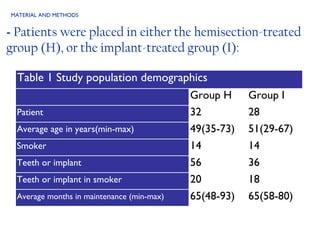
MATERIAL AND METHODS -  Patients were placed in either the hemisection-treated group (H), or the implant-treated group (I): Table 1 Study population demographics Group H Group I Patient 32 28 Average age in years(min-max) 49(35-73) 51(29-67) Smoker 14 14 Teeth or implant 56 36 Teeth or implant in smoker 20 18 Average months in maintenance (min-max) 65(48-93) 65(58-80)
T REATMENT  P ROCEDURES
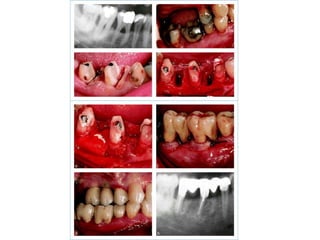
TREATMENT PROCEDURES  Group (H): 1  -  Endodontic treatment. 2  -  Custom-made gold posts & composite build-ups. 3  -  Root resection & extraction of the mesial root.  4  -  The extraction site was filled with xenograft and autologous bone and covered with resorbable membrane.  5  -  FPD included the 2 nd  premolar.  When both molars were treated, FPD included 2 nd  1 st  molar and premolar.
 
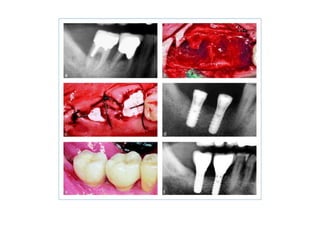
TREATMENT PROCEDURES  Group (I): 1  -  Atraumatic extraction. 2  -  Socket preservation by the use of nonresorbable dPTFE membrane. 3  -  Implants were placed 8 months after extraction. 4  -  Final restorations were delivered 6 months after implant placement.
 
TREATMENT PROCEDURES  Postoperative care: 1  -  Clindamycin 600mg/day for 4 days. 2  -  Oral analgesic diclofenac 100mg/day for 4 days. 3  -  0.1% chlorhexidine twice/day for 3 weeks. 4  -  Follow-up twice/month during the first 2 months, then once a month for the following 10 months.
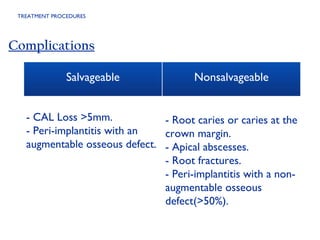
TREATMENT PROCEDURES  Complications - CAL Loss >5mm. - Peri-implantitis with an augmentable osseous defect. - Root caries or caries at the crown margin. - Apical abscesses. - Root fractures. - Peri-implantitis with a non-augmentable osseous defect(>50%). Salvageable Nonsalvageable
R ESULTS
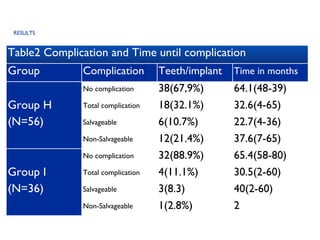
-  The occurrence and timing of post-treatment complication as well as CAL, BOP PLI were evaluated. RESULTS
RESULTS Table2 Complication and Time until complication Group Complication Teeth/implant Time in months Group H (N=56) No complication 38(67,9%) 64.1(48-39) Total complication 18(32.1%) 32.6(4-65) Salvageable 6(10.7%) 22.7(4-36) Non-Salvageable 12(21.4%) 37.6(7-65) Group I (N=36) No complication 32(88.9%) 65.4(58-80) Total complication 4(11.1%) 30.5(2-60) Salvageable 3(8.3) 40(2-60) Non-Salvageable 1(2.8%) 2
D ISCUSSION
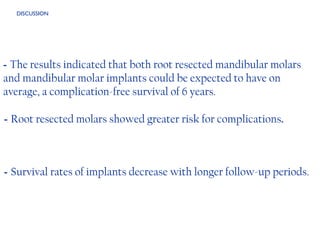
-  The results indicated that both root resected mandibular molars and mandibular molar implants could be expected to have on average, a complication-free survival of 6 years. -  Root resected molars showed greater risk for complications .  -  Survival rates of implants decrease with longer follow-up periods. DISCUSSION
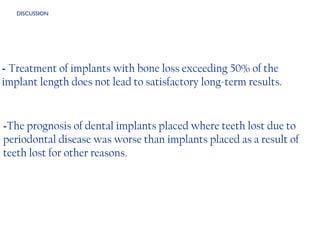
- The prognosis of dental implants placed where teeth lost due to periodontal disease was worse than implants placed as a result of teeth lost for other reasons. -  Treatment of implants with bone loss exceeding 50% of the implant length does not lead to satisfactory long-term results.  DISCUSSION
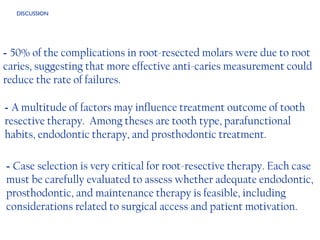
-  A multitude of factors may influence treatment outcome of tooth resective therapy.  Among theses are tooth type, parafunctional habits, endodontic therapy, and prosthodontic treatment. -  50% of the complications in root-resected molars were due to root caries, suggesting that more effective anti-caries measurement could reduce the rate of failures.  -  Case selection is very critical for root-resective therapy. Each case must be carefully evaluated to assess whether adequate endodontic, prosthodontic, and maintenance therapy is feasible, including considerations related to surgical access and patient motivation. DISCUSSION
C onclusion Within the limitations of this retrospective study, the results indicated that implants replacing periodontally involved mandibular molars had fewer complications than hemisected mandibular molar s . Further studies are needed to confirm and allow generalization of these findings.
Thank you
 

MANDIBULAR MOLAR ROOT RESECTION VERSUS

  • 1.
    M ANDIBULAR M OLAR R OOT R ESECTION V ERSUS I MPLANT T HERAPY A RETROSPECTIVE NONRANDOMIZED STUDY Zafiropoulos GG , Hoffmann O , Kasaj A , Willershausen B , Deli G , Tatakis DN . Journal of Oral Implantology, 2009
  • 2.
  • 3.
    INTRODUCTION Molar teethwith furcation involvement represent a treatment challenge that is further complicated by the multitude of available treatment options .
  • 4.
    INTRODUCTION Degree offurcation involvement is a major determinant for the indicated treatment modality. One of the available treatments for molar with degree III furcation involvement is root resective therapy.
  • 5.
    INTRODUCTION - Although several studies have evaluated the outcomes of root resective therapy, only a limited number have directly compared root resective therapy with implant therapy . - Published literature on the outcomes of root resective therapy and dental implants, revealed that success and complication rates vary depending on teeth treated and anatomical site. - Because of such site-specific difference, in order to be valid, this study compared the therapeutic outcomes at the same anatomic site.
  • 6.
    INTRODUCTION Purpose ofstudy: To compare the longterm complication and survival rates of root resected mandibular molars relative to that of dental implants replacing mandibular molars.
  • 7.
    M ATERIALS AND M ETHODS
  • 8.
    MATERIAL AND METHODSPatient population: - Sixty patients ( 40 men, 20 women; mean age 49.9 years) treated from January 1993 to December 2001 were included in this retrospective study. - All patients had history of chronic periodontitis with a minimum of 4 sites with CAL loss >4mm, radiographic evidence of bone loss, and BOP in at least 4 sites.
  • 9.
    MATERIAL AND METHODSInclusion criteria: 1 - Grade III furcation involvement. 2 - Radiographically estimated residual bone ≥ 50% of the length of the retained root. 3 - Root resective surgery performed on the 1st, or the 1st and 2nd molar. 4 - No existing conditions that might interfere with periodontal or implant treatment. 5 - No known drug allergies. 6 - Maintenance for at least 48 months.
  • 10.
    MATERIAL AND METHODSExclusion criteria : 1 - Root resective surgery on 2nd molar only. 2 - Implant treatment either in edentulous mandibular molar areas or in the 2nd mandibular molar only. 3 - Active periodontal disease. 4 - Bruxism. 5 - Smoking >10 cigarettes per day. 6 - The presence of pregnancy, diabetes, history of medication, or drugs abuse .
  • 11.
    MATERIAL AND METHODS- Patients were placed in either the hemisection-treated group (H), or the implant-treated group (I): Table 1 Study population demographics Group H Group I Patient 32 28 Average age in years(min-max) 49(35-73) 51(29-67) Smoker 14 14 Teeth or implant 56 36 Teeth or implant in smoker 20 18 Average months in maintenance (min-max) 65(48-93) 65(58-80)
  • 12.
    T REATMENT P ROCEDURES
  • 13.
    TREATMENT PROCEDURES Group (H): 1 - Endodontic treatment. 2 - Custom-made gold posts & composite build-ups. 3 - Root resection & extraction of the mesial root. 4 - The extraction site was filled with xenograft and autologous bone and covered with resorbable membrane. 5 - FPD included the 2 nd premolar. When both molars were treated, FPD included 2 nd 1 st molar and premolar.
  • 14.
  • 15.
    TREATMENT PROCEDURES Group (I): 1 - Atraumatic extraction. 2 - Socket preservation by the use of nonresorbable dPTFE membrane. 3 - Implants were placed 8 months after extraction. 4 - Final restorations were delivered 6 months after implant placement.
  • 16.
  • 17.
    TREATMENT PROCEDURES Postoperative care: 1 - Clindamycin 600mg/day for 4 days. 2 - Oral analgesic diclofenac 100mg/day for 4 days. 3 - 0.1% chlorhexidine twice/day for 3 weeks. 4 - Follow-up twice/month during the first 2 months, then once a month for the following 10 months.
  • 18.
    TREATMENT PROCEDURES Complications - CAL Loss >5mm. - Peri-implantitis with an augmentable osseous defect. - Root caries or caries at the crown margin. - Apical abscesses. - Root fractures. - Peri-implantitis with a non-augmentable osseous defect(>50%). Salvageable Nonsalvageable
  • 19.
  • 20.
    - Theoccurrence and timing of post-treatment complication as well as CAL, BOP PLI were evaluated. RESULTS
  • 21.
    RESULTS Table2 Complicationand Time until complication Group Complication Teeth/implant Time in months Group H (N=56) No complication 38(67,9%) 64.1(48-39) Total complication 18(32.1%) 32.6(4-65) Salvageable 6(10.7%) 22.7(4-36) Non-Salvageable 12(21.4%) 37.6(7-65) Group I (N=36) No complication 32(88.9%) 65.4(58-80) Total complication 4(11.1%) 30.5(2-60) Salvageable 3(8.3) 40(2-60) Non-Salvageable 1(2.8%) 2
  • 22.
  • 23.
    - Theresults indicated that both root resected mandibular molars and mandibular molar implants could be expected to have on average, a complication-free survival of 6 years. - Root resected molars showed greater risk for complications . - Survival rates of implants decrease with longer follow-up periods. DISCUSSION
  • 24.
    - The prognosisof dental implants placed where teeth lost due to periodontal disease was worse than implants placed as a result of teeth lost for other reasons. - Treatment of implants with bone loss exceeding 50% of the implant length does not lead to satisfactory long-term results. DISCUSSION
  • 25.
    - Amultitude of factors may influence treatment outcome of tooth resective therapy. Among theses are tooth type, parafunctional habits, endodontic therapy, and prosthodontic treatment. - 50% of the complications in root-resected molars were due to root caries, suggesting that more effective anti-caries measurement could reduce the rate of failures. - Case selection is very critical for root-resective therapy. Each case must be carefully evaluated to assess whether adequate endodontic, prosthodontic, and maintenance therapy is feasible, including considerations related to surgical access and patient motivation. DISCUSSION
  • 26.
    C onclusion Withinthe limitations of this retrospective study, the results indicated that implants replacing periodontally involved mandibular molars had fewer complications than hemisected mandibular molar s . Further studies are needed to confirm and allow generalization of these findings.
  • 27.
  • 28.