ENGLISH RESEARCH PROPOSAL


  IMPROVING SPEAKING SKILL THROUGH SIMULATION AS THE

  COMMUNICATIVE ACTIVITIES AT TENTH GRADE STUDENT OF

           TOURISM DEPARTMENT SMK NEGERI 1 KUBU

                       IN ACADEMIC YEAR 2012/2013


1.1 Background of Study

            Language is the most significant possession of human being to do

communication in conveying and sharing idea, feeling, emotion, and information

to people both in spoken and written forms. Language has an important role in

everyday life interactions. Nowadays, in global era, English is used as

international language for business, tourism, political and international

relationship.


            Related to the fact above, Broughton (2003: 1) states that English is an

international language and most people in the world use this language. It is the

most broadly studied as foreign language in the world. This fact can also be seen

in Indonesia. English is learnt widely either for general or specific purpose in

formal as well as information and education from the elementary school up to

junior and senior high school as well as universities or colleges.


            Richard (2008) states that a large percentage of the world’s language

learners study English in order to develop proficiency in speaking. This is caused

by the functions of speaking that cover many aspects of human interaction, such

                                          1
2


as involved expressing ideas and opinions, expressing a wish or a desire to do

something, negotiating, solving a particular problem, establishing and building

social relationship and friendships, maintaining business or other professional

reasons. Those are just a few reasons why people may wish to speak, and then it

seems fair to assume that speaking skills play a large part in this overall

competence.


            Furthermore, Harmer (2005) drawn that one of communicative

activities in English language teaching (ELT) is simulation. By applying

simulation in ELT classroom, the students are given an opportunity to practice

communicating in different social context and in different social roles. The

students are given more chances for practicing their English skills, particularly

their English speaking by carrying out the conversation in meaningful contexts

and functionally situations that commonly occurred in their daily activities.


            Since the speaking is an essential to improve, the researcher thinks

that it is necessary for the teacher to find out the applicable technique in order to

create a situation which leads the students to consider that learning is for fun.

From a lot of methods of teaching speaking, the researcher is interested in

applying the simulation to improve the students` ability in speaking skill.

Therefore, in accordance with the above facts, the researcher is highly motivated

to find out the effectiveness of simulation in improving the students` speaking

mastery.


1.2 Statement of Research Question
3


            Based on the background above, the researcher formulates research

questions as follows: to what extent can the students` ability in speaking be

improved trough Simulation of the tenth grade students of Tourism department at

SMK Negeri 1 Kubu in academic year 2012/2013?


1.3. Objectives of the Research

            Objective of the study is certainly intended to answer and solve the

research question which has been stated before. This thesis also has its purpose. In

line with the research question stated above, the objectives of this research are as

follows: to find out how far the use of simulation improve the students’ speaking

skills at the tenth grade students of Tourism department at SMK Negeri 1 Kubu.


1.4. Limitation of the study


       On account this fact, challenges related to the teaching of Speaking and

Understanding English at Basic Operational Level at the tenth grade students of

Tourism department at SMK Negeri 1 Kubu by using simulation.


1.5. Significance of the Study


               The result of the research are generally expected to be: (1) the

source of information to improve the teaching techniques in encouraging students

to speak English, (2) the useful information for teachers, particularly the English

teachers at SMK to develop their speaking class activities, so their activities

become more effectively, communicatively and functionally, (3) the source of
4


information for teachers or other researcher who want to have further study on

speaking activities.


1.6. Assumption


               In this investigation, the researcher thinks that is essential to make

some assumption for the purpose of emphasizing the present study. There are

some other variables that may be related and have effects to this research,

however the researcher only concerns with the variables as stated on research

question. In order to neutralize the compounding variables, it is essential, to state

some assumption as follows : (1) all subject under study are assumed to have

learnt English for the same period of time, (2) all subject under study are assumed

to have similar learning motivation, (3) all subjects under study are assumed to

have similar language experience and language exposure, (4) the instruments used

for collecting the data are constructed in such a way that they are supposed to be

valid and reliable.


1.7 Hypothesis

       Concerning the review of related literature and the conceptual framework

the hypothesis of this research are formulated as follows: (1) there is a significant

improvement of the students’ achievement in speaking taught by using simulation,

(2) the students are interested to speak English through simulation.


1.8 Definition of the Key Terms
5


            There are some terms, which are define operationally so as to avoid

misunderstanding on the part of the readers, that is, the speaking skill, Simulation,

and the students’ interest at tenth grade of SMK Negeri 1 Kubu.


      1. Speaking skill is an interactive process of constructing meaning that

         involves producing, receiving and processing information (Brown, 2001:

         26). It is form and meaning are dependent on the context in which it

         occurs, including the participant themselves, their collective experiences,

         the physical environment , and the purpose for speaking. It is often

         spontaneous, open-ended, and evolving. However, speech is not always

         unpredictable. Therefore, in line with this study the term `speaking skill`

         refers to the skill of the students in producing, receiving and processing

         information orally after they are taught through Simulation.


      2. Simulation is one of oral communicative activities that used as the

         teaching technique in improving the students’ speaking skills. By

         applying simulation in speaking class, the students carry out

         conversations in meaningful and functional context, and performing how

         to use English in the real situation.


      3. The students’ interest is the aspect that enables students to be active in

         speaking English. By simulating the teaching materials, the students’

         interest are hope to be improve, because they believe that the activities

         will be useful and matches with the situation when they get the job

         training or the world of work after graduated.
6


1.9 Theoretical Framework


            A scientific investigation is expected to contribute practical

significance and should be conducted on the basis of some relevant theoretical

constructs and empirical evidences. The present investigation is based on the

following theoretical framework:(1) Theory of speaking, (2) Technique of

teaching speaking, (3) Teaching speaking through Simulation Technique, (4)

Assessment of speaking.


1.10. Research Method


1.10.1 Setting and subject of the study


            The study is conducted at SMK N 1 Kubu. There `s only one class of

tenth grade students of SMK Negeri 1 Kubu in academic year of 2012/2013. The

total numbers of the student are 36 consisting of 26 females and 10 males. The

researcher is selected this class because they have crucial problem in speaking.


1.10.2 Research Design


            In this methodology the researcher acted as a teacher because this

study make use of classroom action research which is further defined as a cyclic

process of action.
7


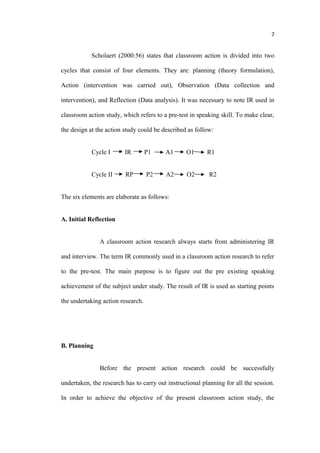
            Scholaert (2000:56) states that classroom action is divided into two

cycles that consist of four elements. They are: planning (theory formulation),

Action (intervention was carried out), Observation (Data collection and

intervention), and Reflection (Data analysis). It was necessary to note IR used in

classroom action study, which refers to a pre-test in speaking skill. To make clear,

the design at the action study could be described as follow:


            Cycle I      IR        P1    A1      O1       R1


            Cycle II     RP        P2    A2       O2       R2


The six elements are elaborate as follows:


A. Initial Reflection


               A classroom action research always starts from administering IR

and interview. The term IR commonly used in a classroom action research to refer

to the pre-test. The main purpose is to figure out the pre existing speaking

achievement of the subject under study. The result of IR is used as starting points

the undertaking action research.


B. Planning


               Before the present action research could be successfully

undertaken, the research has to carry out instructional planning for all the session.

In order to achieve the objective of the present classroom action study, the
8


researcher plan the instructional activities as follows: determining the subjects of

study of SMK N 1 Kubu, preparing pre-test in speaking, selecting the speaking

material, setting up the teaching scenario session for each, setting up the post test,

and constructing questionnaires to the subject under study.


C. Action


                Implementing the previously planned teaching scenario is the main

activity in this classroom action study. In line with the objective of the study,

action or classroom activities refers to what the research really do in the classroom

setting during the process of teaching speaking by using simulation technique.

The researcher will attempt to manage and conduct the previously planned

classroom activities in the teaching scenario, so that the objectives of teaching

speaking for each session can be most effectively and efficiently attained. There

are three main activities that the researcher will do in the classroom, they are: pre-

activity, whilst activity, and post activity.


D. Observation


            The observation will do during the process and after the process of

teaching learning activity. During the process, the researcher observes the

situation of the class and the ability of the students in speaking. The students seem

to enjoy the technique using simulation.


            Post-test is administered in order to know the result of the application

of simulation in speaking ability. The analysis on the result of the achievement on
9


speaking through simulation can be seen from the score got by the students in

mean score.


E. Reflection


                Reflection is a term that refers to a post test. The present classroom

action study is divided into 2 cycles and each cycle consists of 4 interconnected

sessions. Reflection is administered during the post activities of each session. At

the end of action, their mastery will be tested to know ether their mastery it

getting better or improve. The result of the entire whole reflections of post test in

cycle I are used as feedback and basis to plan the actions in cycle II much better.

During the action the researcher will observe directly the student`s interest and

involvement in teaching and learning process.


1.10.3 Research Instrument


            The research instruments are the tools which are used by the

researcher to collect the required data.


There are some instruments that are used in this study in obtaining the data,

namely:


1. Lesson Plan


            The lesson plan is prepared in order to have a clear description of

what to be done in classroom. It is a guideline for the teacher in conducting every

steps of the teaching plan. This lesson plan also will help teachers organize their
10


objective and methodologies; determines the purpose, aim, and rational of the

class time activity. This lesson plan involves the activities that are conducted, the

time allocation, the teachers` approach, and the material used in teaching and

learning process. It will help the teacher think through the best way to present the

information to the students.


2. The Test


              The tests are used to measure the students` achievement on the lesson

being though such as: pre test and post test. The pre test is conducted before the

treatment is carried out to know the students prior knowledge on speaking. After

pre test, the post test are conducted at the end of the cycle to measure the students`

achievement upon the lesson being present through simulation where the post test

is designed in the same form with the pre test.


3. Questionnaire


              The questionnaires are used to know the students` response on the

application of the simulation in order to help them to improve their

communication in English speaking. The questionnaire contains some items and

the questionnaire is distributed to all the end of the cycle.


1.10.4 Data Collection


              In this study, there are two kinds of data, namely: quantitative and

qualitative data. Quantitative data are obtained from the result of the test. The data

are collected through administering IR and post-tests. These data are presented in
11


the form of table and analyzed descriptively. While the qualitative data are

obtained from non-number data taken from observation during the treatments, the

questionnaire is administered at the end of cycle 1 respectively.


            Therefore, there are considerably three kinds of raw scored which are

obtained for the present class action study, those are:


            1. Score indicating the subjects` pre-existing mastery in speaking.

            2. Score showing the subjects` progress achievement in speaking

               English; and


            3. Scores showing the subjects` changing learning behaviors.


1.10.5 Data Analysis


            The data obtained for the present classroom action study are analyzed

descriptively so as to reveal the extent of the subjects` progress or increasing

mastery in speaking. The mean scores in reflection or post-tests for both cycle I


and cycle II. In order to find out the percentage of mean score of pre-test, post test

1, and post test 2, the score is analyzed by using the following formula:


           M = ∑X
                    N


Where:
12


            M = Mean score/average score of the students` achievement on

                  speaking skill.


            ∑X = The sum of the total score


            N = The total number of the students.


            The computing formula above is adopted from Heaton (2003:9). The

scores showing the subjects` positive changing behaviors are computed in the

form of percentage which refers to respective items on the questionnaires. The

means of IR scores and post-test scores are calculated and computed. The grand

mean of cycle I and cycle II is finally computed and compared.


            The grand mean of both cycles, cycle I and cycle II, is calculated by

totaling the means of the scores in each cycle and then divide by four. The amount

of the difference between the two means show increasing effectiveness of cycle I

and cycle II. This occurs because cycle II is the revised version cycle I.
13


                             REFERENCES


Broughton, Geoffrey. 2003. Teaching English as a Foreign Language. London:
       Franchise-Library University.
Brown. H. Douglas. 2001. Teaching by Principle: An Interactive Approach to
       Language Pedagogy. New York: Longman
Harmer, Jeremy. 2005. The Practice of English Language Teaching. New York:
        Longman.
Richards, J.C. 2008.Teaching Listening and Speaking. United Kingdom:
        Cambridge University Press
Schollaert, Rudy. 2000 Effective staff Development: An Evaluation Manual.
        Belgium: The Author and Grant Publisher
14

English research proposal

  • 1.
    ENGLISH RESEARCH PROPOSAL IMPROVING SPEAKING SKILL THROUGH SIMULATION AS THE COMMUNICATIVE ACTIVITIES AT TENTH GRADE STUDENT OF TOURISM DEPARTMENT SMK NEGERI 1 KUBU IN ACADEMIC YEAR 2012/2013 1.1 Background of Study Language is the most significant possession of human being to do communication in conveying and sharing idea, feeling, emotion, and information to people both in spoken and written forms. Language has an important role in everyday life interactions. Nowadays, in global era, English is used as international language for business, tourism, political and international relationship. Related to the fact above, Broughton (2003: 1) states that English is an international language and most people in the world use this language. It is the most broadly studied as foreign language in the world. This fact can also be seen in Indonesia. English is learnt widely either for general or specific purpose in formal as well as information and education from the elementary school up to junior and senior high school as well as universities or colleges. Richard (2008) states that a large percentage of the world’s language learners study English in order to develop proficiency in speaking. This is caused by the functions of speaking that cover many aspects of human interaction, such 1
  • 2.
    2 as involved expressingideas and opinions, expressing a wish or a desire to do something, negotiating, solving a particular problem, establishing and building social relationship and friendships, maintaining business or other professional reasons. Those are just a few reasons why people may wish to speak, and then it seems fair to assume that speaking skills play a large part in this overall competence. Furthermore, Harmer (2005) drawn that one of communicative activities in English language teaching (ELT) is simulation. By applying simulation in ELT classroom, the students are given an opportunity to practice communicating in different social context and in different social roles. The students are given more chances for practicing their English skills, particularly their English speaking by carrying out the conversation in meaningful contexts and functionally situations that commonly occurred in their daily activities. Since the speaking is an essential to improve, the researcher thinks that it is necessary for the teacher to find out the applicable technique in order to create a situation which leads the students to consider that learning is for fun. From a lot of methods of teaching speaking, the researcher is interested in applying the simulation to improve the students` ability in speaking skill. Therefore, in accordance with the above facts, the researcher is highly motivated to find out the effectiveness of simulation in improving the students` speaking mastery. 1.2 Statement of Research Question
  • 3.
    3 Based on the background above, the researcher formulates research questions as follows: to what extent can the students` ability in speaking be improved trough Simulation of the tenth grade students of Tourism department at SMK Negeri 1 Kubu in academic year 2012/2013? 1.3. Objectives of the Research Objective of the study is certainly intended to answer and solve the research question which has been stated before. This thesis also has its purpose. In line with the research question stated above, the objectives of this research are as follows: to find out how far the use of simulation improve the students’ speaking skills at the tenth grade students of Tourism department at SMK Negeri 1 Kubu. 1.4. Limitation of the study On account this fact, challenges related to the teaching of Speaking and Understanding English at Basic Operational Level at the tenth grade students of Tourism department at SMK Negeri 1 Kubu by using simulation. 1.5. Significance of the Study The result of the research are generally expected to be: (1) the source of information to improve the teaching techniques in encouraging students to speak English, (2) the useful information for teachers, particularly the English teachers at SMK to develop their speaking class activities, so their activities become more effectively, communicatively and functionally, (3) the source of
  • 4.
    4 information for teachersor other researcher who want to have further study on speaking activities. 1.6. Assumption In this investigation, the researcher thinks that is essential to make some assumption for the purpose of emphasizing the present study. There are some other variables that may be related and have effects to this research, however the researcher only concerns with the variables as stated on research question. In order to neutralize the compounding variables, it is essential, to state some assumption as follows : (1) all subject under study are assumed to have learnt English for the same period of time, (2) all subject under study are assumed to have similar learning motivation, (3) all subjects under study are assumed to have similar language experience and language exposure, (4) the instruments used for collecting the data are constructed in such a way that they are supposed to be valid and reliable. 1.7 Hypothesis Concerning the review of related literature and the conceptual framework the hypothesis of this research are formulated as follows: (1) there is a significant improvement of the students’ achievement in speaking taught by using simulation, (2) the students are interested to speak English through simulation. 1.8 Definition of the Key Terms
  • 5.
    5 There are some terms, which are define operationally so as to avoid misunderstanding on the part of the readers, that is, the speaking skill, Simulation, and the students’ interest at tenth grade of SMK Negeri 1 Kubu. 1. Speaking skill is an interactive process of constructing meaning that involves producing, receiving and processing information (Brown, 2001: 26). It is form and meaning are dependent on the context in which it occurs, including the participant themselves, their collective experiences, the physical environment , and the purpose for speaking. It is often spontaneous, open-ended, and evolving. However, speech is not always unpredictable. Therefore, in line with this study the term `speaking skill` refers to the skill of the students in producing, receiving and processing information orally after they are taught through Simulation. 2. Simulation is one of oral communicative activities that used as the teaching technique in improving the students’ speaking skills. By applying simulation in speaking class, the students carry out conversations in meaningful and functional context, and performing how to use English in the real situation. 3. The students’ interest is the aspect that enables students to be active in speaking English. By simulating the teaching materials, the students’ interest are hope to be improve, because they believe that the activities will be useful and matches with the situation when they get the job training or the world of work after graduated.
  • 6.
    6 1.9 Theoretical Framework A scientific investigation is expected to contribute practical significance and should be conducted on the basis of some relevant theoretical constructs and empirical evidences. The present investigation is based on the following theoretical framework:(1) Theory of speaking, (2) Technique of teaching speaking, (3) Teaching speaking through Simulation Technique, (4) Assessment of speaking. 1.10. Research Method 1.10.1 Setting and subject of the study The study is conducted at SMK N 1 Kubu. There `s only one class of tenth grade students of SMK Negeri 1 Kubu in academic year of 2012/2013. The total numbers of the student are 36 consisting of 26 females and 10 males. The researcher is selected this class because they have crucial problem in speaking. 1.10.2 Research Design In this methodology the researcher acted as a teacher because this study make use of classroom action research which is further defined as a cyclic process of action.
  • 7.
    7 Scholaert (2000:56) states that classroom action is divided into two cycles that consist of four elements. They are: planning (theory formulation), Action (intervention was carried out), Observation (Data collection and intervention), and Reflection (Data analysis). It was necessary to note IR used in classroom action study, which refers to a pre-test in speaking skill. To make clear, the design at the action study could be described as follow: Cycle I IR P1 A1 O1 R1 Cycle II RP P2 A2 O2 R2 The six elements are elaborate as follows: A. Initial Reflection A classroom action research always starts from administering IR and interview. The term IR commonly used in a classroom action research to refer to the pre-test. The main purpose is to figure out the pre existing speaking achievement of the subject under study. The result of IR is used as starting points the undertaking action research. B. Planning Before the present action research could be successfully undertaken, the research has to carry out instructional planning for all the session. In order to achieve the objective of the present classroom action study, the
  • 8.
    8 researcher plan theinstructional activities as follows: determining the subjects of study of SMK N 1 Kubu, preparing pre-test in speaking, selecting the speaking material, setting up the teaching scenario session for each, setting up the post test, and constructing questionnaires to the subject under study. C. Action Implementing the previously planned teaching scenario is the main activity in this classroom action study. In line with the objective of the study, action or classroom activities refers to what the research really do in the classroom setting during the process of teaching speaking by using simulation technique. The researcher will attempt to manage and conduct the previously planned classroom activities in the teaching scenario, so that the objectives of teaching speaking for each session can be most effectively and efficiently attained. There are three main activities that the researcher will do in the classroom, they are: pre- activity, whilst activity, and post activity. D. Observation The observation will do during the process and after the process of teaching learning activity. During the process, the researcher observes the situation of the class and the ability of the students in speaking. The students seem to enjoy the technique using simulation. Post-test is administered in order to know the result of the application of simulation in speaking ability. The analysis on the result of the achievement on
  • 9.
    9 speaking through simulationcan be seen from the score got by the students in mean score. E. Reflection Reflection is a term that refers to a post test. The present classroom action study is divided into 2 cycles and each cycle consists of 4 interconnected sessions. Reflection is administered during the post activities of each session. At the end of action, their mastery will be tested to know ether their mastery it getting better or improve. The result of the entire whole reflections of post test in cycle I are used as feedback and basis to plan the actions in cycle II much better. During the action the researcher will observe directly the student`s interest and involvement in teaching and learning process. 1.10.3 Research Instrument The research instruments are the tools which are used by the researcher to collect the required data. There are some instruments that are used in this study in obtaining the data, namely: 1. Lesson Plan The lesson plan is prepared in order to have a clear description of what to be done in classroom. It is a guideline for the teacher in conducting every steps of the teaching plan. This lesson plan also will help teachers organize their
  • 10.
    10 objective and methodologies;determines the purpose, aim, and rational of the class time activity. This lesson plan involves the activities that are conducted, the time allocation, the teachers` approach, and the material used in teaching and learning process. It will help the teacher think through the best way to present the information to the students. 2. The Test The tests are used to measure the students` achievement on the lesson being though such as: pre test and post test. The pre test is conducted before the treatment is carried out to know the students prior knowledge on speaking. After pre test, the post test are conducted at the end of the cycle to measure the students` achievement upon the lesson being present through simulation where the post test is designed in the same form with the pre test. 3. Questionnaire The questionnaires are used to know the students` response on the application of the simulation in order to help them to improve their communication in English speaking. The questionnaire contains some items and the questionnaire is distributed to all the end of the cycle. 1.10.4 Data Collection In this study, there are two kinds of data, namely: quantitative and qualitative data. Quantitative data are obtained from the result of the test. The data are collected through administering IR and post-tests. These data are presented in
  • 11.
    11 the form oftable and analyzed descriptively. While the qualitative data are obtained from non-number data taken from observation during the treatments, the questionnaire is administered at the end of cycle 1 respectively. Therefore, there are considerably three kinds of raw scored which are obtained for the present class action study, those are: 1. Score indicating the subjects` pre-existing mastery in speaking. 2. Score showing the subjects` progress achievement in speaking English; and 3. Scores showing the subjects` changing learning behaviors. 1.10.5 Data Analysis The data obtained for the present classroom action study are analyzed descriptively so as to reveal the extent of the subjects` progress or increasing mastery in speaking. The mean scores in reflection or post-tests for both cycle I and cycle II. In order to find out the percentage of mean score of pre-test, post test 1, and post test 2, the score is analyzed by using the following formula: M = ∑X N Where:
  • 12.
    12 M = Mean score/average score of the students` achievement on speaking skill. ∑X = The sum of the total score N = The total number of the students. The computing formula above is adopted from Heaton (2003:9). The scores showing the subjects` positive changing behaviors are computed in the form of percentage which refers to respective items on the questionnaires. The means of IR scores and post-test scores are calculated and computed. The grand mean of cycle I and cycle II is finally computed and compared. The grand mean of both cycles, cycle I and cycle II, is calculated by totaling the means of the scores in each cycle and then divide by four. The amount of the difference between the two means show increasing effectiveness of cycle I and cycle II. This occurs because cycle II is the revised version cycle I.
  • 13.
    13 REFERENCES Broughton, Geoffrey. 2003. Teaching English as a Foreign Language. London: Franchise-Library University. Brown. H. Douglas. 2001. Teaching by Principle: An Interactive Approach to Language Pedagogy. New York: Longman Harmer, Jeremy. 2005. The Practice of English Language Teaching. New York: Longman. Richards, J.C. 2008.Teaching Listening and Speaking. United Kingdom: Cambridge University Press Schollaert, Rudy. 2000 Effective staff Development: An Evaluation Manual. Belgium: The Author and Grant Publisher
  • 14.