Lecture 3: Money Talks

        Babbitt and e.e. cummings

                   English 104A
                   Spring 2012

                    9 April 2012


“Beauty is truth, truth beauty,” – that is all
Ye know on earth, and all ye need to know.
   —John Keats, “Ode on a Grecian Urn,” lines 49-50
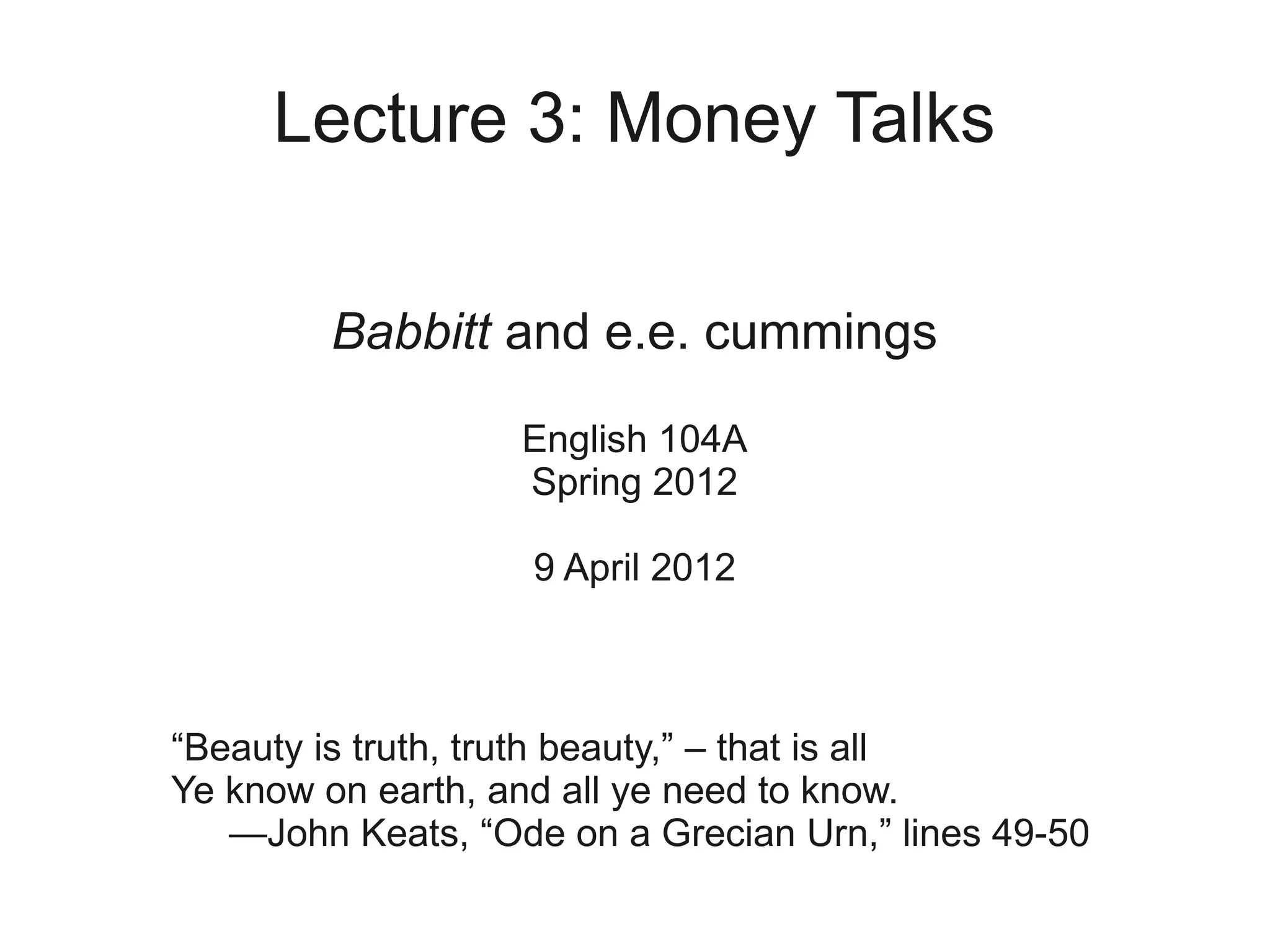
Amy Lowell (1874-1925)
           ●   Member of the
               prominent Lowell
               family
           ●   Socialite, poet.
           ●   A talented poet in her
               own right.
           ●   Played an essential
               role in bringing
               imagism to the
               attention of a wider
               public.
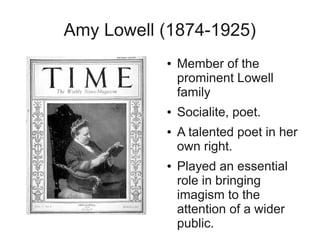
Edward Estlin Cummings (1894-1962)
                                ●   Often written “e.e.
                                    cummings”
                                    ●   There is no definitive
                                        evidence that cummings
                                        himself preferred this
                                        orthography
                                ●   Essayist, novelist, painter,
                                    playwright, and poet
                                ●   Probably best known for his
                                    formal poetic
                                    experimentation
  self-portrait, approx. 1920
                                ●   Rarely titled his poems.
e.e. cummings
●   Despite the heaviness of
    today’s selections,
    cummings is best known for
    his early, Romantic-
    influenced work, which is
    much lighter.
●   Key terms (for our
    purposes):
    ●   Syntactic/typographic
        experimentation
    ●   Modernism
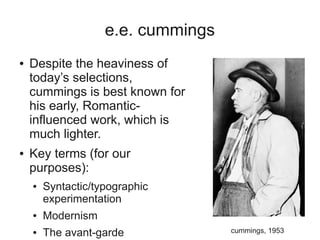
    ●   The avant-garde             cummings, 1953
Experiments within formal strictures
●   Cummings’s work often stretches the limits of
    traditional poetic form without abandoning it
    completely.
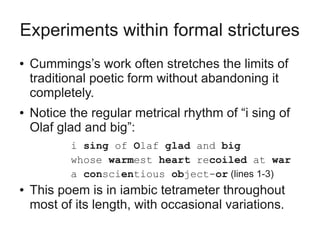
●   Notice the regular metrical rhythm of “i sing of
    Olaf glad and big”:
           i sing of Olaf glad and big
           whose warmest heart recoiled at war
           a conscientious object-or (lines 1-3)
●   This poem is in iambic tetrameter throughout
    most of its length, with occasional variations.
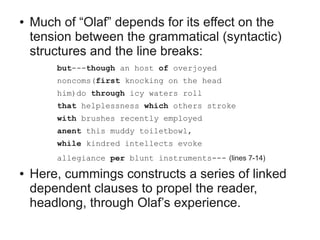
●   Much of “Olaf” depends for its effect on the
    tension between the grammatical (syntactic)
    structures and the line breaks:
        but---though an host of overjoyed
        noncoms(first knocking on the head
        him)do through icy waters roll
        that helplessness which others stroke
        with brushes recently employed
        anent this muddy toiletbowl,
        while kindred intellects evoke
        allegiance per blunt instruments--- (lines 7-14)
●   Here, cummings constructs a series of linked
    dependent clauses to propel the reader,
    headlong, through Olaf’s experience.
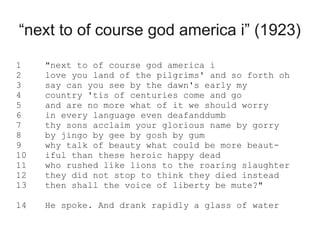
“next to of course god america i” (1923)

1    "next to of course god america i
2    love you land of the pilgrims' and so forth oh
3    say can you see by the dawn's early my
4    country 'tis of centuries come and go
5    and are no more what of it we should worry
6    in every language even deafanddumb
7    thy sons acclaim your glorious name by gorry
8    by jingo by gee by gosh by gum
9    why talk of beauty what could be more beaut-
10   iful than these heroic happy dead
11   who rushed like lions to the roaring slaughter
12   they did not stop to think they died instead
13   then shall the voice of liberty be mute?"

14   He spoke. And drank rapidly a glass of water
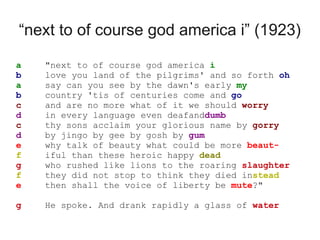
“next to of course god america i” (1923)

a   "next to of course god america i
b   love you land of the pilgrims' and so forth oh
a   say can you see by the dawn's early my
b   country 'tis of centuries come and go
c   and are no more what of it we should worry
d   in every language even deafanddumb
c   thy sons acclaim your glorious name by gorry
d   by jingo by gee by gosh by gum
e   why talk of beauty what could be more beaut-
f   iful than these heroic happy dead
g   who rushed like lions to the roaring slaughter
f   they did not stop to think they died instead
e   then shall the voice of liberty be mute?"

g   He spoke. And drank rapidly a glass of water
“next to of course god america i” (1923)
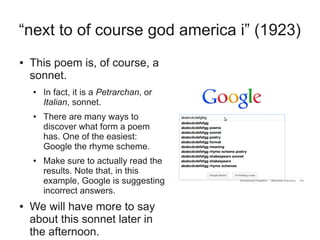
●   This poem is, of course, a
    sonnet.
    ●   In fact, it is a Petrarchan, or
        Italian, sonnet.
    ●   There are many ways to
        discover what form a poem
        has. One of the easiest:
        Google the rhyme scheme.
    ●   Make sure to actually read the
        results. Note that, in this
        example, Google is suggesting
        incorrect answers.
●   We will have more to say
    about this sonnet later in
    the afternoon.
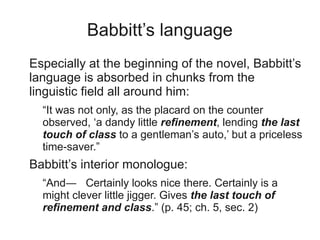
Babbitt’s language
Especially at the beginning of the novel, Babbitt’s
language is absorbed in chunks from the
linguistic field all around him:
  “It was not only, as the placard on the counter
  observed, ‘a dandy little refinement, lending the last
  touch of class to a gentleman’s auto,’ but a priceless
  time-saver.”
Babbitt’s interior monologue:
  “And― Certainly looks nice there. Certainly is a
  might clever little jigger. Gives the last touch of
  refinement and class.” (p. 45; ch. 5, sec. 2)
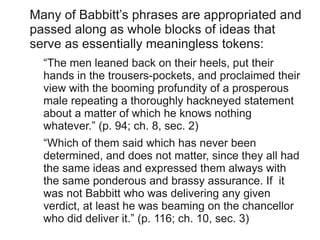
Many of Babbitt’s phrases are appropriated and
passed along as whole blocks of ideas that
serve as essentially meaningless tokens:
  “The men leaned back on their heels, put their
  hands in the trousers-pockets, and proclaimed their
  view with the booming profundity of a prosperous
  male repeating a thoroughly hackneyed statement
  about a matter of which he knows nothing
  whatever.” (p. 94; ch. 8, sec. 2)
  “Which of them said which has never been
  determined, and does not matter, since they all had
  the same ideas and expressed them always with
  the same ponderous and brassy assurance. If it
  was not Babbitt who was delivering any given
  verdict, at least he was beaming on the chancellor
  who did deliver it.” (p. 116; ch. 10, sec. 3)
Babbitt’s rise in social position is based on his
ability to put these phrases together in an
engaging manner:
  Babbitt, to Paul: “And remember how I wanted to be
  a lawyer and go into politics? I still think I might
  have made a go of it. I’ve kind of got the gift of the
  gab—anyway, I can think on my feet, and make
  some kind of a spiel on most anything, and of
  course that’s the thing you need in politics.” (p. 126;
  ch. 11, sec. 4)
  P.J. Maxwell (Paul’s lawyer): “The trouble with you,
  Babbitt, is that you’re one of those fellows who talk
  too readily. You like to hear your own voice. If there
  were anything for which I could put you in the
  witness-box, you’d get going and give the whole
  show away.” (p. 223; ch. 22, sec. 1)
“next to of course god america i” (1923)

1    "next to of course god america i
2    love you land of the pilgrims' and so forth oh
3    say can you see by the dawn's early my
4    country 'tis of centuries come and go
5    and are no more what of it we should worry
6    in every language even deafanddumb
7    thy sons acclaim your glorious name by gorry
8    by jingo by gee by gosh by gum
9    why talk of beauty what could be more beaut-
10   iful than these heroic happy dead
11   who rushed like lions to the roaring slaughter
12   they did not stop to think they died instead
13   then shall the voice of liberty be mute?"

14   He spoke. And drank rapidly a glass of water
“He had enormous and poetic admiration, though
very little understanding, of all mechanical
devices. They were his symbols of truth and
beauty. Regarding each new intricate mechanism
—metal lathe, two-jet carburetor, machine gun,
oxyacetylene welder—he learned one good
realistic-sounding phrase, and used it over and
over, with a delightful feeling of being technical
and initiated.” (Babbitt 57; ch. 6, sec. 1)
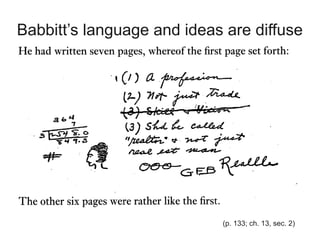
Babbitt’s language and ideas are diffuse


                            (p. 133; ch. 13, sec. 2)
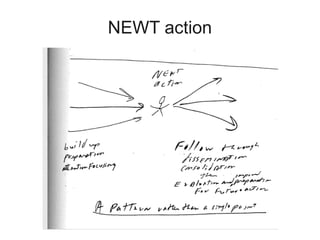
NEWT action
Babbitt’s language is in flux
This is because Babbitt himself is constantly
changing:
  “But dearie, I thought you always said these so-
  called ‘liberal’ people were the worst of—“
  “Rats! Woman never can understand the different
  definitions of a word. Depends on how you mean it.”
                               (p. 263, ch. 26, sec. 5)
Note that Babbitt here tries to portray himself as
having a stable identity, despite the changes in
his character throughout the novel.
The label “socialist”
●   Not always a description of a political position.
●   Sometimes, a way of labeling someone in such a
    way as to place them beyond the pale of those
    who engage in “reasonable” political discussion:
    ●   Babbitt: “to be an out-and-out spiritualist would be
        almost like being a socialist !” (p. 106; ch. 9, sec. 1)
    ●   Babbitt’s address to the Zenith Real Estate Board:
        “The worst menace to sound government is not the
        avowed socialists but a lot of cowards who work
        under cover—the long-haired gentry who call
        themselves ‘liberals’ and ‘radicals’ and ‘non-partisan’
        and ‘intelligentsia’ and God only know how many
        other trick names!” (p. 157; ch. 14, sec. 3)
“Now, these strikers: Honest, they’re not such
bad people. Just foolish. They don’t understand
the complications of merchandizing and profit, the
way we business men do, but sometimes I think
they’re about like the rest of us, and no more hogs
for wages than we are for profits.”
   “George! If people were to hear you talk like
that—of course I know you; I remember what a
wild crazy boy you were; I know you don’t mean a
word you say—but if people that didn’t understand
you were to hear you talking, they’d think you
were a regular socialist!” (p. 263; ch. 26, sec. 5)
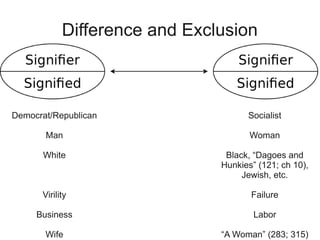
Difference and Exclusion


Democrat/Republican                  Socialist

       Man                            Woman

      White                     Black, “Dagoes and
                               Hunkies” (121; ch 10),
                                    Jewish, etc.

      Virility                        Failure

     Business                          Labor

       Wife                    “A Woman” (283; 315)
Money and Wealth
Colonel Snow: “Well, you can’t expect the decent
citizens to go on aiding you if you intend to side with
precisely the people who are trying to undermine us.”
(307; ch. 32, sec. 3)
“[...] so did the large national advertisers fix the
surface of his life, fix what he believed to be his
individuality. These advertised wares—toothpastes,
socks, tires, cameras, instantaneous hot-water heaters
—were his symbols and proofs of excellence; at first
the signs, then the substitutes, for joy and passion and
wisdom.” (79; ch. 7, sec. 3)
“Advertising in its entirety constitutes a useless
and unnecessary universe. It is pure connotation.
It contributes nothing to production or to the direct
practical application of things, yet it plays an
integral part in the system of objects, not merely
because it relates to consumption but also
because it itself becomes an object to be
consumed. A clear distinction must be drawn in
connection with advertising’s dual status as a
discourse on the object and an object in its own
right. It is as a useless, unnecessary discourse
that it comes to be consumable as a cultural
object.”
  ―Jean Baudrillard, The System of Objects (1968)
Media Credits
The photo of Amy Lowell (slide 2) taken from the front of Time
  magazine is in the public domain. Source:
  http://upload.wikimedia.org/wikipedia/commons/d/df/Amy_Lowell_Ti
  me_magazine_cover_1925.jpg
Cummings's self-portrait (slide 3) is in the public domain. Source:
 http://en.wikipedia.org/wiki/File:EECummings_pd4.jpg
The photo of e.e. cummings (slide 4) is in the public domain. Source:
  https://en.wikipedia.org/wiki/File:E._E._Cummings_NYWTS.jpg
George Babbitt's sketch (slide 15) is in the public domain because it
 is excerpted from a work whose copyright has expired.
I believe Newt Gingrich's sketch (slide 16) to be in the public domain
   because it was produced by an employee of the United States
   Federal Government during the performance of his duty.

Lecture 03 - Money Talks (9 April 2012)

  • 1.
    Lecture 3: MoneyTalks Babbitt and e.e. cummings English 104A Spring 2012 9 April 2012 “Beauty is truth, truth beauty,” – that is all Ye know on earth, and all ye need to know. —John Keats, “Ode on a Grecian Urn,” lines 49-50
  • 2.
    Amy Lowell (1874-1925) ● Member of the prominent Lowell family ● Socialite, poet. ● A talented poet in her own right. ● Played an essential role in bringing imagism to the attention of a wider public.
  • 3.
    Edward Estlin Cummings(1894-1962) ● Often written “e.e. cummings” ● There is no definitive evidence that cummings himself preferred this orthography ● Essayist, novelist, painter, playwright, and poet ● Probably best known for his formal poetic experimentation self-portrait, approx. 1920 ● Rarely titled his poems.
  • 4.
    e.e. cummings ● Despite the heaviness of today’s selections, cummings is best known for his early, Romantic- influenced work, which is much lighter. ● Key terms (for our purposes): ● Syntactic/typographic experimentation ● Modernism ● The avant-garde cummings, 1953
  • 5.
    Experiments within formalstrictures ● Cummings’s work often stretches the limits of traditional poetic form without abandoning it completely. ● Notice the regular metrical rhythm of “i sing of Olaf glad and big”: i sing of Olaf glad and big whose warmest heart recoiled at war a conscientious object-or (lines 1-3) ● This poem is in iambic tetrameter throughout most of its length, with occasional variations.
  • 6.
    Much of “Olaf” depends for its effect on the tension between the grammatical (syntactic) structures and the line breaks: but---though an host of overjoyed noncoms(first knocking on the head him)do through icy waters roll that helplessness which others stroke with brushes recently employed anent this muddy toiletbowl, while kindred intellects evoke allegiance per blunt instruments--- (lines 7-14) ● Here, cummings constructs a series of linked dependent clauses to propel the reader, headlong, through Olaf’s experience.
  • 7.
    “next to ofcourse god america i” (1923) 1 "next to of course god america i 2 love you land of the pilgrims' and so forth oh 3 say can you see by the dawn's early my 4 country 'tis of centuries come and go 5 and are no more what of it we should worry 6 in every language even deafanddumb 7 thy sons acclaim your glorious name by gorry 8 by jingo by gee by gosh by gum 9 why talk of beauty what could be more beaut- 10 iful than these heroic happy dead 11 who rushed like lions to the roaring slaughter 12 they did not stop to think they died instead 13 then shall the voice of liberty be mute?" 14 He spoke. And drank rapidly a glass of water
  • 8.
    “next to ofcourse god america i” (1923) a "next to of course god america i b love you land of the pilgrims' and so forth oh a say can you see by the dawn's early my b country 'tis of centuries come and go c and are no more what of it we should worry d in every language even deafanddumb c thy sons acclaim your glorious name by gorry d by jingo by gee by gosh by gum e why talk of beauty what could be more beaut- f iful than these heroic happy dead g who rushed like lions to the roaring slaughter f they did not stop to think they died instead e then shall the voice of liberty be mute?" g He spoke. And drank rapidly a glass of water
  • 9.
    “next to ofcourse god america i” (1923) ● This poem is, of course, a sonnet. ● In fact, it is a Petrarchan, or Italian, sonnet. ● There are many ways to discover what form a poem has. One of the easiest: Google the rhyme scheme. ● Make sure to actually read the results. Note that, in this example, Google is suggesting incorrect answers. ● We will have more to say about this sonnet later in the afternoon.
  • 10.
    Babbitt’s language Especially atthe beginning of the novel, Babbitt’s language is absorbed in chunks from the linguistic field all around him: “It was not only, as the placard on the counter observed, ‘a dandy little refinement, lending the last touch of class to a gentleman’s auto,’ but a priceless time-saver.” Babbitt’s interior monologue: “And― Certainly looks nice there. Certainly is a might clever little jigger. Gives the last touch of refinement and class.” (p. 45; ch. 5, sec. 2)
  • 11.
    Many of Babbitt’sphrases are appropriated and passed along as whole blocks of ideas that serve as essentially meaningless tokens: “The men leaned back on their heels, put their hands in the trousers-pockets, and proclaimed their view with the booming profundity of a prosperous male repeating a thoroughly hackneyed statement about a matter of which he knows nothing whatever.” (p. 94; ch. 8, sec. 2) “Which of them said which has never been determined, and does not matter, since they all had the same ideas and expressed them always with the same ponderous and brassy assurance. If it was not Babbitt who was delivering any given verdict, at least he was beaming on the chancellor who did deliver it.” (p. 116; ch. 10, sec. 3)
  • 12.
    Babbitt’s rise insocial position is based on his ability to put these phrases together in an engaging manner: Babbitt, to Paul: “And remember how I wanted to be a lawyer and go into politics? I still think I might have made a go of it. I’ve kind of got the gift of the gab—anyway, I can think on my feet, and make some kind of a spiel on most anything, and of course that’s the thing you need in politics.” (p. 126; ch. 11, sec. 4) P.J. Maxwell (Paul’s lawyer): “The trouble with you, Babbitt, is that you’re one of those fellows who talk too readily. You like to hear your own voice. If there were anything for which I could put you in the witness-box, you’d get going and give the whole show away.” (p. 223; ch. 22, sec. 1)
  • 13.
    “next to ofcourse god america i” (1923) 1 "next to of course god america i 2 love you land of the pilgrims' and so forth oh 3 say can you see by the dawn's early my 4 country 'tis of centuries come and go 5 and are no more what of it we should worry 6 in every language even deafanddumb 7 thy sons acclaim your glorious name by gorry 8 by jingo by gee by gosh by gum 9 why talk of beauty what could be more beaut- 10 iful than these heroic happy dead 11 who rushed like lions to the roaring slaughter 12 they did not stop to think they died instead 13 then shall the voice of liberty be mute?" 14 He spoke. And drank rapidly a glass of water
  • 14.
    “He had enormousand poetic admiration, though very little understanding, of all mechanical devices. They were his symbols of truth and beauty. Regarding each new intricate mechanism —metal lathe, two-jet carburetor, machine gun, oxyacetylene welder—he learned one good realistic-sounding phrase, and used it over and over, with a delightful feeling of being technical and initiated.” (Babbitt 57; ch. 6, sec. 1)
  • 15.
    Babbitt’s language andideas are diffuse (p. 133; ch. 13, sec. 2)
  • 16.
  • 17.
    Babbitt’s language isin flux This is because Babbitt himself is constantly changing: “But dearie, I thought you always said these so- called ‘liberal’ people were the worst of—“ “Rats! Woman never can understand the different definitions of a word. Depends on how you mean it.” (p. 263, ch. 26, sec. 5) Note that Babbitt here tries to portray himself as having a stable identity, despite the changes in his character throughout the novel.
  • 18.
    The label “socialist” ● Not always a description of a political position. ● Sometimes, a way of labeling someone in such a way as to place them beyond the pale of those who engage in “reasonable” political discussion: ● Babbitt: “to be an out-and-out spiritualist would be almost like being a socialist !” (p. 106; ch. 9, sec. 1) ● Babbitt’s address to the Zenith Real Estate Board: “The worst menace to sound government is not the avowed socialists but a lot of cowards who work under cover—the long-haired gentry who call themselves ‘liberals’ and ‘radicals’ and ‘non-partisan’ and ‘intelligentsia’ and God only know how many other trick names!” (p. 157; ch. 14, sec. 3)
  • 19.
    “Now, these strikers:Honest, they’re not such bad people. Just foolish. They don’t understand the complications of merchandizing and profit, the way we business men do, but sometimes I think they’re about like the rest of us, and no more hogs for wages than we are for profits.” “George! If people were to hear you talk like that—of course I know you; I remember what a wild crazy boy you were; I know you don’t mean a word you say—but if people that didn’t understand you were to hear you talking, they’d think you were a regular socialist!” (p. 263; ch. 26, sec. 5)
  • 20.
    Difference and Exclusion Democrat/Republican Socialist Man Woman White Black, “Dagoes and Hunkies” (121; ch 10), Jewish, etc. Virility Failure Business Labor Wife “A Woman” (283; 315)
  • 21.
    Money and Wealth ColonelSnow: “Well, you can’t expect the decent citizens to go on aiding you if you intend to side with precisely the people who are trying to undermine us.” (307; ch. 32, sec. 3) “[...] so did the large national advertisers fix the surface of his life, fix what he believed to be his individuality. These advertised wares—toothpastes, socks, tires, cameras, instantaneous hot-water heaters —were his symbols and proofs of excellence; at first the signs, then the substitutes, for joy and passion and wisdom.” (79; ch. 7, sec. 3)
  • 22.
    “Advertising in itsentirety constitutes a useless and unnecessary universe. It is pure connotation. It contributes nothing to production or to the direct practical application of things, yet it plays an integral part in the system of objects, not merely because it relates to consumption but also because it itself becomes an object to be consumed. A clear distinction must be drawn in connection with advertising’s dual status as a discourse on the object and an object in its own right. It is as a useless, unnecessary discourse that it comes to be consumable as a cultural object.” ―Jean Baudrillard, The System of Objects (1968)
  • 23.
    Media Credits The photoof Amy Lowell (slide 2) taken from the front of Time magazine is in the public domain. Source: http://upload.wikimedia.org/wikipedia/commons/d/df/Amy_Lowell_Ti me_magazine_cover_1925.jpg Cummings's self-portrait (slide 3) is in the public domain. Source: http://en.wikipedia.org/wiki/File:EECummings_pd4.jpg The photo of e.e. cummings (slide 4) is in the public domain. Source: https://en.wikipedia.org/wiki/File:E._E._Cummings_NYWTS.jpg George Babbitt's sketch (slide 15) is in the public domain because it is excerpted from a work whose copyright has expired. I believe Newt Gingrich's sketch (slide 16) to be in the public domain because it was produced by an employee of the United States Federal Government during the performance of his duty.