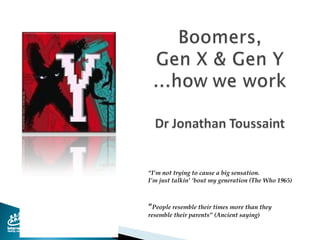
“ I’m not trying to cause a big sensation. I’m just talkin’ ‘bout my generation (The Who 1965) “ People resemble their times more than they resemble their parents” (Ancient saying)
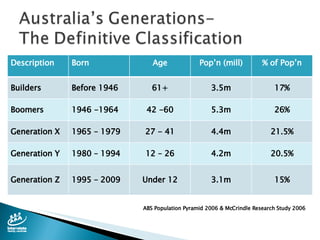
ABS Population Pyramid 2006 & McCrindle Research Study 2006 Description Born Age Pop’n (mill) % of Pop’n Builders Before 1946 61+ 3.5m 17% Boomers 1946 -1964 42 -60 5.3m 26% Generation X 1965 – 1979 27 - 41 4.4m 21.5% Generation Y 1980 – 1994 12 – 26 4.2m 20.5% Generation Z 1995 – 2009 Under 12 3.1m 15%
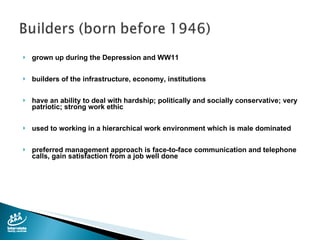
grown up during the Depression and WW11 builders of the infrastructure, economy, institutions  have an ability to deal with hardship; politically and socially conservative; very patriotic; strong work ethic used to working in a hierarchical work environment which is male dominated preferred management approach is face-to-face communication and telephone calls, gain satisfaction from a job well done
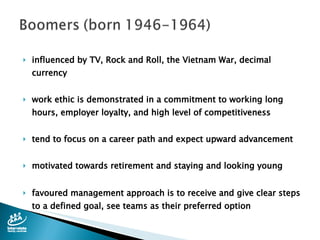
influenced by TV, Rock and Roll, the Vietnam War, decimal currency work ethic is demonstrated in a commitment to working long hours, employer loyalty, and high level of competitiveness tend to focus on a career path and expect upward advancement motivated towards retirement and staying and looking young favoured management approach is to receive and give clear steps to a defined goal, see teams as their preferred option
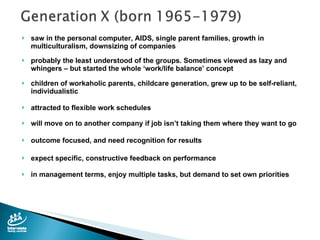
saw in the personal computer, AIDS, single parent families, growth in multiculturalism, downsizing of companies probably the least understood of the groups. Sometimes viewed as lazy and whingers – but started the whole ‘work/life balance’ concept children of workaholic parents, childcare generation, grew up to be self-reliant, individualistic attracted to flexible work schedules will move on to another company if job isn’t taking them where they want to go outcome focused, and need recognition for results expect specific, constructive feedback on performance in management terms, enjoy multiple tasks, but demand to set own priorities
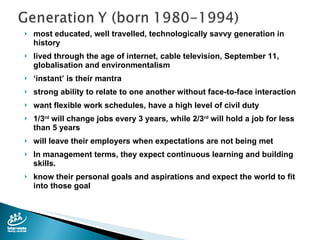
most educated, well travelled, technologically savvy generation in history lived through the age of internet, cable television, September 11, globalisation and environmentalism ‘ instant’ is their mantra strong ability to relate to one another without face-to-face interaction want flexible work schedules, have a high level of civil duty 1/3 rd  will change jobs every 3 years, while 2/3 rd  will hold a job for less than 5 years will leave their employers when expectations are not being met In management terms, they expect continuous learning and building skills. know their personal goals and aspirations and expect the world to fit into those goal
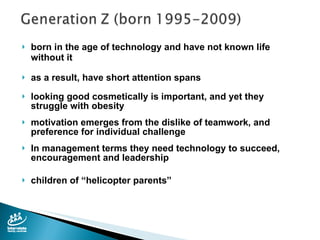
born in the age of technology and have not known life without it as a result, have short attention spans looking good cosmetically is important, and yet they struggle with obesity motivation emerges from the dislike of teamwork, and preference for individual challenge In management terms they need technology to succeed, encouragement and leadership children of “helicopter parents”
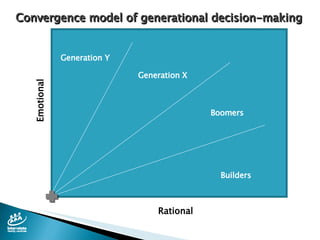
Emotional Convergence model of generational decision-making Rational Generation Y Generation X Boomers Builders
clash of working styles may cause frustration Boomer managers who pressure younger workers to work long hours may see their absentee rates soar and retention rates plummet benefit packages will no longer be one-size-fits-all health issues and stress management will become more of a concern
being aware of the value differences between people of different generations in the workplace sensitivity to communication differences  establish comfortable work environments, flexible work hours and project-centred rather than function-based responsibilities be flexible, challenging, creative and empowering in your management style the technologically savvy want access to information anytime, anywhere encourage staff to use the service of EAP’s in preventing issues from becoming serious and costly problems consider offering a cafeteria-style benefits package that allows for flexibility, so you can mix and match to meet your employee’s different needs
“ I’m not trying to cause a big sensation. I’m just talkin’ ‘bout my generation (The Who 1965) “ People resemble their times more than they resemble their parents” (Ancient saying)

Jonathan On Generations

  • 1.
  • 2.
    “ I’m nottrying to cause a big sensation. I’m just talkin’ ‘bout my generation (The Who 1965) “ People resemble their times more than they resemble their parents” (Ancient saying)
  • 3.
    ABS Population Pyramid2006 & McCrindle Research Study 2006 Description Born Age Pop’n (mill) % of Pop’n Builders Before 1946 61+ 3.5m 17% Boomers 1946 -1964 42 -60 5.3m 26% Generation X 1965 – 1979 27 - 41 4.4m 21.5% Generation Y 1980 – 1994 12 – 26 4.2m 20.5% Generation Z 1995 – 2009 Under 12 3.1m 15%
  • 4.
    grown up duringthe Depression and WW11 builders of the infrastructure, economy, institutions have an ability to deal with hardship; politically and socially conservative; very patriotic; strong work ethic used to working in a hierarchical work environment which is male dominated preferred management approach is face-to-face communication and telephone calls, gain satisfaction from a job well done
  • 5.
    influenced by TV,Rock and Roll, the Vietnam War, decimal currency work ethic is demonstrated in a commitment to working long hours, employer loyalty, and high level of competitiveness tend to focus on a career path and expect upward advancement motivated towards retirement and staying and looking young favoured management approach is to receive and give clear steps to a defined goal, see teams as their preferred option
  • 6.
    saw in thepersonal computer, AIDS, single parent families, growth in multiculturalism, downsizing of companies probably the least understood of the groups. Sometimes viewed as lazy and whingers – but started the whole ‘work/life balance’ concept children of workaholic parents, childcare generation, grew up to be self-reliant, individualistic attracted to flexible work schedules will move on to another company if job isn’t taking them where they want to go outcome focused, and need recognition for results expect specific, constructive feedback on performance in management terms, enjoy multiple tasks, but demand to set own priorities
  • 7.
    most educated, welltravelled, technologically savvy generation in history lived through the age of internet, cable television, September 11, globalisation and environmentalism ‘ instant’ is their mantra strong ability to relate to one another without face-to-face interaction want flexible work schedules, have a high level of civil duty 1/3 rd will change jobs every 3 years, while 2/3 rd will hold a job for less than 5 years will leave their employers when expectations are not being met In management terms, they expect continuous learning and building skills. know their personal goals and aspirations and expect the world to fit into those goal
  • 8.
    born in theage of technology and have not known life without it as a result, have short attention spans looking good cosmetically is important, and yet they struggle with obesity motivation emerges from the dislike of teamwork, and preference for individual challenge In management terms they need technology to succeed, encouragement and leadership children of “helicopter parents”
  • 9.
    Emotional Convergence modelof generational decision-making Rational Generation Y Generation X Boomers Builders
  • 10.
    clash of workingstyles may cause frustration Boomer managers who pressure younger workers to work long hours may see their absentee rates soar and retention rates plummet benefit packages will no longer be one-size-fits-all health issues and stress management will become more of a concern
  • 11.
    being aware ofthe value differences between people of different generations in the workplace sensitivity to communication differences establish comfortable work environments, flexible work hours and project-centred rather than function-based responsibilities be flexible, challenging, creative and empowering in your management style the technologically savvy want access to information anytime, anywhere encourage staff to use the service of EAP’s in preventing issues from becoming serious and costly problems consider offering a cafeteria-style benefits package that allows for flexibility, so you can mix and match to meet your employee’s different needs
  • 12.
    “ I’m nottrying to cause a big sensation. I’m just talkin’ ‘bout my generation (The Who 1965) “ People resemble their times more than they resemble their parents” (Ancient saying)