THE MACROECONOMIC BENEFITS
OF GENDER EQUALITY
6th Annual Meeting of the OECD Gender Budgeting Network | 22 September 2022
Jonas Fluchtmann, PhD
Economist - Social Policy Division
OECD Directorate for Employment,
Labour and Social Affairs
Gender gaps in labour force participation have closed
over time, but remain substantial
Source: OECD Employment Database and OECD labour-force projections
Labour force participation rates, 15 to 74 year-olds
84.1 82.2 81.1 79.3 78.8 77.2 76.1 74.9 74.3 74.0 73.1 73.4 73.0 72.6 72.6 72.4 72.2 71.8 71.6
46.0 46.3
50.6
52.8
55.0 54.3 54.7 54.9 56.2 57.1 57.4 58.4 58.6 58.8 59.1 59.3 59.3 59.2 59.2
0
10
20
30
40
50
60
70
80
90
100
Men Women
Across countries, men are still more likely to be
employed than women
Labour force participation, 15 to 74 year olds, 2021
Source: OECD Employment Database.
0
10
20
30
40
50
60
70
80
90
100
Women Men
• Growth accounting: Identify and decompose the sources of past economic growth.
– Using information on observed trends in macroeconomic indicators to split growth into its main components parts - labour, capital, and
total factor productivity
– Focus on the contribution of labour input to economic growth, in particular, on the contribution of women’s labour input.
– Changes in labour productivity, changes in the size of the working-age population, changes in the employment rate, and the changes in
average hours worked per employed person.
• Growth projection: Model the potential for future economic growth.
– Projected scenarios on the future development of male and female labour market outcomes in conjunction with the OECD Long-Term
Model (Guillemette and Turner, 2018; 2021).
– Baseline labour force development based on OECD in-house projections.
– Alternative scenarios modelled based on assumptions regarding changes in the gender gaps in labour force participation and working
hours
See previous work in OECD (2017), The Pursuit of Gender Equality: An Uphill Battle and OECD (2018), Is the Last Mile the
Longest? Economic Gains from Gender Equality in Nordic Countries.
Looking back and ahead: Two approaches to
measure the link to economic growth
Gender employment gaps have converged
substantially in Spain, but remained stable in Norway
Source: OECD Employment Database.
Employment to population ratios, 15 to 64 year-olds, 2000-2021
0
20
40
60
80
100
2000 2005 2010 2015 2020
EMP rate
Norway
0
20
40
60
80
100
2000 2005 2010 2015 2020
EMP rate Spain
Men Women
0
20
40
60
80
100
2000 2005 2010 2015 2020
EMP rate OECD Total
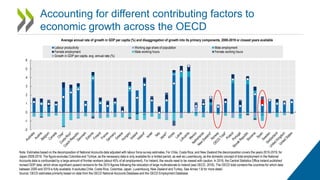
Accounting for different contributing factors to
economic growth across the OECD
-2
-1
0
1
2
3
4
5
6
Labour productivity Working age share of population Male employment
Female employment Male working hours Female working hours
Growth in GDP per capita, avg. annual rate (%)
Note: Estimates based on the decomposition of National Accounts data adjusted with labour force survey estimates. For Chile, Costa Rica, and New Zealand the decomposition covers the years 2010-2019, for
Japan 2009-2019. The figure excludes Colombia and Türkiye, as the necessary data is only available for a limited period, as well as Luxembourg, as the domestic concept of total employment in the National
Accounts data is confounded by a large amount of frontier workers (about 45% of all employment). For Ireland, the results need to be viewed with caution: In 2016, the Central Statistics Office Ireland published
revised GDP data, which show significant upward revisions for the 2015 figures following the relocation of large multinationals to Ireland (see OECD, 2016). The OECD total contains the countries for which data
between 2000 and 2019 is fully available. It excludes Chile, Costa Rica, Colombia, Japan, Luxembourg, New Zealand and Turkey. See Annex 1.B for more detail.
Source: OECD estimates primarily based on data from the OECD National Accounts Database and the OECD Employment Database.
Average annual rate of growth in GDP per capita (%) and disaggregation of growth into its primary components, 2000-2019 or closest years available
Accounting for different contributing factors to
economic growth across the OECD
-2
-1
0
1
2
3
4
5
6
Labour productivity Working age share of population Male employment
Female employment Male working hours Female working hours
Growth in GDP per capita, avg. annual rate (%)
Note: Estimates based on the decomposition of National Accounts data adjusted with labour force survey estimates. For Chile, Costa Rica, and New Zealand the decomposition covers the years 2010-2019, for
Japan 2009-2019. The figure excludes Colombia and Türkiye, as the necessary data is only available for a limited period, as well as Luxembourg, as the domestic concept of total employment in the National
Accounts data is confounded by a large amount of frontier workers (about 45% of all employment). For Ireland, the results need to be viewed with caution: In 2016, the Central Statistics Office Ireland published
revised GDP data, which show significant upward revisions for the 2015 figures following the relocation of large multinationals to Ireland (see OECD, 2016). The OECD total contains the countries for which data
between 2000 and 2019 is fully available. It excludes Chile, Costa Rica, Colombia, Japan, Luxembourg, New Zealand and Turkey. See Annex 1.B for more detail.
Source: OECD estimates primarily based on data from the OECD National Accounts Database and the OECD Employment Database.
Average annual rate of growth in GDP per capita (%) and disaggregation of growth into its primary components, 2000-2019 or closest years available
• Three scenarios for future of labour force participation and working hours
(2022-2060):
– Baseline: LFP rates of men and women are estimated based on current rates of labour market
entry and exit. Male and female working hours are fixed at the 2019 level. This scenario services
as the reference or business-as-usual scenario.
– Scenario A: gender LFP gaps reduced close fully by 2060.
– Scenario B: gender working hour gaps close fully by 2060.
• Projections on economic output based on a simplified version of the OECD Long-
Term Growth model (Guillemette and Turner, 2018; 2021).
– Input: Labour (male and female LFP & working hours), Productivity and Capital
Three alternative scenarios on convergence in labour
market outcomes
In some countries, only little gains are to be made on
the labour market…
Source: OECD estimates based on OECD population data, the OECD Employment Database and OECD labour-force projections.
Labour force participation rates, 15 to 74 year-olds
0
20
40
60
80
100
2000 2010 2020 2030 2040 2050 2060
LFP rate
Türkiye
0
20
40
60
80
100
2000 2010 2020 2030 2040 2050 2060
LFP rate Latvia
Male Baseline Female Baseline Male Scenario Female Scenario
0
20
40
60
80
100
2000 2010 2020 2030 2040 2050 2060
LFP rate OECD Total
In some countries, only little gains are to be made on
the labour market…
Source: OECD estimates based on OECD population data, the OECD Employment Database and OECD labour-force employment projections.
20
25
30
35
40
45
50
2000 2010 2020 2030 2040 2050 2060
HRS
Netherlands
20
25
30
35
40
45
50
2000 2010 2020 2030 2040 2050 2060
HRS United States
Male Baseline Female Baseline Male Scenario Female Scenario
20
25
30
35
40
45
50
2000 2010 2020 2030 2040 2050 2060
HRS OECD Total
Usual weekly working hours, 15 to 74 year-olds
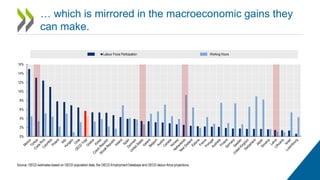
… which is mirrored in the macroeconomic gains they
can make.
Source: OECD estimates based on OECD population data, the OECD Employment Database and OECD labour-force projections.
0%
2%
4%
6%
8%
10%
12%
14%
16%
Labour Force Participation Working Hours
• For the forthcoming report ‘The Economic Case for Gender Equality in
Estonia’, we model three additional scenarios for the Estonian economy:
– Educational sorting: More women into STEM fields
• Productivity gap between male and female jobs closes (ages 15-24)
– Unpaid work and leave-taking: Weakening traditional gender norms in families
• LFP & hours gap close and productivity gap halves (ages 24-49)
– Life expectancy: Longer lives for men
• Life expectancy gap closes and LFP gap at older ages closes (ages 50+)
Detailed scenarios for Estonia
Scenario Detail Age
Difference in
projected potential
GDP, 2050, percent
Difference in the
average annual rate of
growth in potential
GDP, 2020-2050,
percentage points
Difference in
projected potential
GDP per capita, 2050,
percent
Difference in the
average annual rate of
growth in potential
GDP per capita, 2020-
2050, percentage
points
Educational sorting Productivity gap
closure (100%)
15-24 9.63 0.30 9.63 0.30
Unpaid work and
leave-taking
LFP & HRS gap
closure (100%) +
productivity gap
closure (50%)
25-49 10.30 0.33 10.30 0.33
Life expectancy
LFP gap closure
(100%) + life
expectancy gap
closure (100%)
50+ 0.96 0.03 -3.10 -0.10
Note: The first two scenarios assume no changes in the population development, whereas the male population increase in the last scenario. Therefore, potential GDP and
potential GDP per capita are similar in the first two scenarios and differ in the last scenario (as the population base increases). See Annex 7.B for a description of the method and
data used. LFP: Labour force participation rate; HRS: Working hours.
Source: OECD estimates based on OECD population data and Eurostat Population Projections, the OECD Employment Database and Employment Projections, the OECD Long-
Term Growth Model, and the Eurostat Structure of Earnings Survey.
Estimated difference in economic growth relative to the baseline, different gender gap scenarios
Email me Jonas.Fluchtmann@oecd.org
@OECD_Social
Follow us on Twitter
http://oe.cd/fdb
http://oe.cd/gender
Visit our website
Thank you!

Jonas Fluchtmann Presentation.pdf

  • 1.
    THE MACROECONOMIC BENEFITS OFGENDER EQUALITY 6th Annual Meeting of the OECD Gender Budgeting Network | 22 September 2022 Jonas Fluchtmann, PhD Economist - Social Policy Division OECD Directorate for Employment, Labour and Social Affairs
  • 2.
    Gender gaps inlabour force participation have closed over time, but remain substantial Source: OECD Employment Database and OECD labour-force projections Labour force participation rates, 15 to 74 year-olds 84.1 82.2 81.1 79.3 78.8 77.2 76.1 74.9 74.3 74.0 73.1 73.4 73.0 72.6 72.6 72.4 72.2 71.8 71.6 46.0 46.3 50.6 52.8 55.0 54.3 54.7 54.9 56.2 57.1 57.4 58.4 58.6 58.8 59.1 59.3 59.3 59.2 59.2 0 10 20 30 40 50 60 70 80 90 100 Men Women
  • 3.
    Across countries, menare still more likely to be employed than women Labour force participation, 15 to 74 year olds, 2021 Source: OECD Employment Database. 0 10 20 30 40 50 60 70 80 90 100 Women Men
  • 4.
    • Growth accounting:Identify and decompose the sources of past economic growth. – Using information on observed trends in macroeconomic indicators to split growth into its main components parts - labour, capital, and total factor productivity – Focus on the contribution of labour input to economic growth, in particular, on the contribution of women’s labour input. – Changes in labour productivity, changes in the size of the working-age population, changes in the employment rate, and the changes in average hours worked per employed person. • Growth projection: Model the potential for future economic growth. – Projected scenarios on the future development of male and female labour market outcomes in conjunction with the OECD Long-Term Model (Guillemette and Turner, 2018; 2021). – Baseline labour force development based on OECD in-house projections. – Alternative scenarios modelled based on assumptions regarding changes in the gender gaps in labour force participation and working hours See previous work in OECD (2017), The Pursuit of Gender Equality: An Uphill Battle and OECD (2018), Is the Last Mile the Longest? Economic Gains from Gender Equality in Nordic Countries. Looking back and ahead: Two approaches to measure the link to economic growth
  • 5.
    Gender employment gapshave converged substantially in Spain, but remained stable in Norway Source: OECD Employment Database. Employment to population ratios, 15 to 64 year-olds, 2000-2021 0 20 40 60 80 100 2000 2005 2010 2015 2020 EMP rate Norway 0 20 40 60 80 100 2000 2005 2010 2015 2020 EMP rate Spain Men Women 0 20 40 60 80 100 2000 2005 2010 2015 2020 EMP rate OECD Total
  • 6.
    Accounting for differentcontributing factors to economic growth across the OECD -2 -1 0 1 2 3 4 5 6 Labour productivity Working age share of population Male employment Female employment Male working hours Female working hours Growth in GDP per capita, avg. annual rate (%) Note: Estimates based on the decomposition of National Accounts data adjusted with labour force survey estimates. For Chile, Costa Rica, and New Zealand the decomposition covers the years 2010-2019, for Japan 2009-2019. The figure excludes Colombia and Türkiye, as the necessary data is only available for a limited period, as well as Luxembourg, as the domestic concept of total employment in the National Accounts data is confounded by a large amount of frontier workers (about 45% of all employment). For Ireland, the results need to be viewed with caution: In 2016, the Central Statistics Office Ireland published revised GDP data, which show significant upward revisions for the 2015 figures following the relocation of large multinationals to Ireland (see OECD, 2016). The OECD total contains the countries for which data between 2000 and 2019 is fully available. It excludes Chile, Costa Rica, Colombia, Japan, Luxembourg, New Zealand and Turkey. See Annex 1.B for more detail. Source: OECD estimates primarily based on data from the OECD National Accounts Database and the OECD Employment Database. Average annual rate of growth in GDP per capita (%) and disaggregation of growth into its primary components, 2000-2019 or closest years available
  • 7.
    Accounting for differentcontributing factors to economic growth across the OECD -2 -1 0 1 2 3 4 5 6 Labour productivity Working age share of population Male employment Female employment Male working hours Female working hours Growth in GDP per capita, avg. annual rate (%) Note: Estimates based on the decomposition of National Accounts data adjusted with labour force survey estimates. For Chile, Costa Rica, and New Zealand the decomposition covers the years 2010-2019, for Japan 2009-2019. The figure excludes Colombia and Türkiye, as the necessary data is only available for a limited period, as well as Luxembourg, as the domestic concept of total employment in the National Accounts data is confounded by a large amount of frontier workers (about 45% of all employment). For Ireland, the results need to be viewed with caution: In 2016, the Central Statistics Office Ireland published revised GDP data, which show significant upward revisions for the 2015 figures following the relocation of large multinationals to Ireland (see OECD, 2016). The OECD total contains the countries for which data between 2000 and 2019 is fully available. It excludes Chile, Costa Rica, Colombia, Japan, Luxembourg, New Zealand and Turkey. See Annex 1.B for more detail. Source: OECD estimates primarily based on data from the OECD National Accounts Database and the OECD Employment Database. Average annual rate of growth in GDP per capita (%) and disaggregation of growth into its primary components, 2000-2019 or closest years available
  • 8.
    • Three scenariosfor future of labour force participation and working hours (2022-2060): – Baseline: LFP rates of men and women are estimated based on current rates of labour market entry and exit. Male and female working hours are fixed at the 2019 level. This scenario services as the reference or business-as-usual scenario. – Scenario A: gender LFP gaps reduced close fully by 2060. – Scenario B: gender working hour gaps close fully by 2060. • Projections on economic output based on a simplified version of the OECD Long- Term Growth model (Guillemette and Turner, 2018; 2021). – Input: Labour (male and female LFP & working hours), Productivity and Capital Three alternative scenarios on convergence in labour market outcomes
  • 9.
    In some countries,only little gains are to be made on the labour market… Source: OECD estimates based on OECD population data, the OECD Employment Database and OECD labour-force projections. Labour force participation rates, 15 to 74 year-olds 0 20 40 60 80 100 2000 2010 2020 2030 2040 2050 2060 LFP rate Türkiye 0 20 40 60 80 100 2000 2010 2020 2030 2040 2050 2060 LFP rate Latvia Male Baseline Female Baseline Male Scenario Female Scenario 0 20 40 60 80 100 2000 2010 2020 2030 2040 2050 2060 LFP rate OECD Total
  • 10.
    In some countries,only little gains are to be made on the labour market… Source: OECD estimates based on OECD population data, the OECD Employment Database and OECD labour-force employment projections. 20 25 30 35 40 45 50 2000 2010 2020 2030 2040 2050 2060 HRS Netherlands 20 25 30 35 40 45 50 2000 2010 2020 2030 2040 2050 2060 HRS United States Male Baseline Female Baseline Male Scenario Female Scenario 20 25 30 35 40 45 50 2000 2010 2020 2030 2040 2050 2060 HRS OECD Total Usual weekly working hours, 15 to 74 year-olds
  • 11.
    … which ismirrored in the macroeconomic gains they can make. Source: OECD estimates based on OECD population data, the OECD Employment Database and OECD labour-force projections. 0% 2% 4% 6% 8% 10% 12% 14% 16% Labour Force Participation Working Hours
  • 12.
    • For theforthcoming report ‘The Economic Case for Gender Equality in Estonia’, we model three additional scenarios for the Estonian economy: – Educational sorting: More women into STEM fields • Productivity gap between male and female jobs closes (ages 15-24) – Unpaid work and leave-taking: Weakening traditional gender norms in families • LFP & hours gap close and productivity gap halves (ages 24-49) – Life expectancy: Longer lives for men • Life expectancy gap closes and LFP gap at older ages closes (ages 50+) Detailed scenarios for Estonia
  • 13.
    Detailed scenarios forEstonia Scenario Detail Age Difference in projected potential GDP, 2050, percent Difference in the average annual rate of growth in potential GDP, 2020-2050, percentage points Difference in projected potential GDP per capita, 2050, percent Difference in the average annual rate of growth in potential GDP per capita, 2020- 2050, percentage points Educational sorting Productivity gap closure (100%) 15-24 9.63 0.30 9.63 0.30 Unpaid work and leave-taking LFP & HRS gap closure (100%) + productivity gap closure (50%) 25-49 10.30 0.33 10.30 0.33 Life expectancy LFP gap closure (100%) + life expectancy gap closure (100%) 50+ 0.96 0.03 -3.10 -0.10 Note: The first two scenarios assume no changes in the population development, whereas the male population increase in the last scenario. Therefore, potential GDP and potential GDP per capita are similar in the first two scenarios and differ in the last scenario (as the population base increases). See Annex 7.B for a description of the method and data used. LFP: Labour force participation rate; HRS: Working hours. Source: OECD estimates based on OECD population data and Eurostat Population Projections, the OECD Employment Database and Employment Projections, the OECD Long- Term Growth Model, and the Eurostat Structure of Earnings Survey. Estimated difference in economic growth relative to the baseline, different gender gap scenarios
  • 14.
    Email me Jonas.Fluchtmann@oecd.org @OECD_Social Followus on Twitter http://oe.cd/fdb http://oe.cd/gender Visit our website Thank you!