FOREIGN DIRECT INVESTMENT
POLICY IN INDIA
• Yashovardhan
Agarwal - Legal Intern
INTRODUCTION
🞭 ‘Foreign investment’ is investment in an
enterprise by a Non-Resident irrespective of
whether this involves new equity capital or
re-investment of earnings. Foreign
investment is of two kinds – (i) Foreign Direct
Investment (FDI) and (ii) Foreign Portfolio
Investment. (As per Consolidated FDI Policy
April 1, 2010)
LEGAL BASIS
🞭 Foreign Direct Investment by non-resident in
resident entities through transfer or issue of
security to person resident outside India is a
‘Capital account transaction’ and
Government of India and Reserve Bank of
India regulate this under the FEMA, 1999
and its various regulations.
CONSOLIDATED FDI POLICY APRIL
1, 2010
• 🞭 Circular issued by Department of Industrial Policy and
Ministry of Commerce and Industry.
• 🞭 This circular consolidates into one document all the
prior policies/regulations on FDI which are contained
in FEMA, 1999, RBI Regulations under FEMA, 1999
and Press
by DIPP and reflects the current
Notes/Press Releases/Clarifications issued
‘policy
framework’ on FDI.
TWO MODES OF FDI
🞭 Automatic Route: FDI in sectors/activities to
the extent permitted under automatic route
does not require any prior approval either by
the Government or RBI. The investors are
only required to notify the Regional Office
concerned of RBI within 30 days of receipt of
inward remittances and file the required
documents with that office within 30 days of
issue of shares of foreign investors.
🞭 Governmental Approval: FDI in activities not
covered under the automatic route require
prior government approval. Approvals of all
such proposals
proposals
including
involving
composite
foreign
investment/foreign technical collaboration is
granted on the recommendations of Foreign
Investment Promotion Board (FIPB).
AUTOMATIC ROUTE
🞭 All items/activities for investment up to 100%
except those that require Government
approval.
🞭 Investment in public sector units including
SEZ, STPI, EOU.
GOVERNMENTAL APPROVAL
🞭 All proposals that require an industrial license
under any law in force in India.
🞭 All proposals in which the foreign collaborator
has a previous venture/tie up in India.
🞭 All proposals relating to acquisition of shares in
an existing Indian company in favour of a
foreign/NRI/OCB investor.
🞭 All proposals falling outside notified sectoral
policy/caps or under sectors in which FDI is not
permitted.
CONDITIONS ON ISSUE/TRANSFER OF
SHARES
🞭 Capital instruments to be issued within 180 days of receipt of
the inward remittance.
🞭 In case of Listed Companies, issue price for shares shall be
on the basis of SEBI guidelines.
🞭 In case of unlisted Companies, valuation of shares
shall be done by a Chartered Accountant.
🞭 The Share subscription amount received by the Company
shall be kept Foreign Currency Account, with the prior
written approval of RBI.
OVERSEAS DIRECT INVESTMENT
FRAMEWORK
• Section 6(3)(a) of FEMA, 1999 read with FEM(Permissible capitalAccount
Transactions), Regulations, 2000
• FEM (Transfer or issue of any Foreign security) Regulations, 2000 popularly
referred as (FEMA 120)
• AP(DIR Series) Circulars issued by RBI from time to time
• FAQ on Overseas Direct Investment released by RBI (as updated from time
to time)
• Liberalized Remittance Scheme of February 4, 2004 amended from time to
time
• FAQ on Liberalized Remittance Scheme – Applicable for resident Individuals
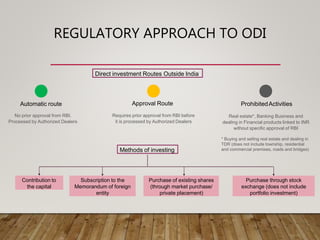
Methods of investing
Contribution to
the capital
Subscription to the
Memorandum of foreign
entity
Purchase of existing shares
(through market purchase/
private placement)
Purchase through stock
exchange (does not include
portfolio investment)
Automatic route Approval Route ProhibitedActivities
Direct investment Routes Outside India
No prior approval from RBI.
Processed by Authorized Dealers
Requires prior approval from RBI before
it is processed by Authorized Dealers
Real estate*, Banking Business and
dealing in Financial products linked to INR
without specific approval of RBI
* Buying and selling real estate and dealing in
TDR (does not include township, residential
and commercial premises, roads and bridges)
REGULATORY APPROACH TO ODI
ENTRY STRATEGIES FOR FOREIGN
INVESTORS
• As an Indian Company through,
• JV
• WOS
• As a Foreign Company
• Liaison Office
• Project Office
• Branch Office
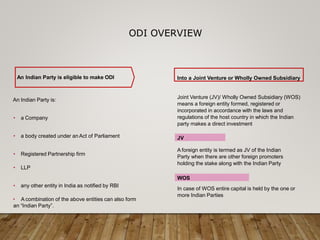
An Indian Party is eligible to make ODI
An Indian Party is:
• a Company
• a body created under an Act of Parliament
• Registered Partnership firm
• LLP
• any other entity in India as notified by RBI
• A combination of the above entities can also form
an “Indian Party”.
A foreign entity is termed as JV of the Indian
Party when there are other foreign promoters
holding the stake along with the Indian Party
In case of WOS entire capital is held by the one or
more Indian Parties
Into a Joint Venture or Wholly Owned Subsidiary
Joint Venture (JV)/ Wholly Owned Subsidiary (WOS)
means a foreign entity formed, registered or
incorporated in accordance with the laws and
regulations of the host country in which the Indian
party makes a direct investment
JV
WOS
ODI OVERVIEW
SHAREHOLDERS FROM COUNTRIES
BORDERING INDIA
• As per the Companies (Prospectus and Allotment of Securities) Amendment Rules, 2022 issued by the
ministry, no offer of any securities is to be made to an entity or a national of a country which shares
land border with India, unless prior approval has been obtained from the Indian government as per
Foreign Exchange Management (Non-debt Instruments) Rules, and is submitted along with the private
placement offer-cum-application letter.
• By way of a notification of 22 April 2020 issued by the Department of Economic Affairs of the Ministry
of Finance and amending the Foreign Exchange Management (Non-Debt Instrument) Rules 2019, the
government has introduced measures to curb opportunistic takeovers (direct or indirect) of Indian
companies by persons or entities of any country which shares a land border with India ('bordering
countries’).
• The notification limits itself to FDI and does not regulate foreign portfolio investments (ie, investments
of less than 10% in listed Indian companies) through registered foreign portfolio investment entities,
including those from a bordering country, whether direct or indirect. However, it is understood that the
government is considering additional checks on portfolio investments by Chinese investors.
• the following investments now require prior approval from the government:
• FDI by entities situated in a bordering country; and
• FDI where the beneficial owners reside in or are citizens of a bordering country.
HOW TO DETERMINE BENEFICIAL
OWNERS
• The Press Note and the FDI Policy do not provide the calculation methodology or
conditions for determining beneficial owners and a clarification is expected from
DIPP. This is important since many Indian companies and offshore entities, such as
private equity funds investing in India have Chinese investors. Ultimately a definition
may emerge that resembles Section 90 of the Companies Act, 2013 (“Act”) and
Companies (Significant Beneficial Ownership) Rules, 2019 (“Rules”).
• Under this, a “significant beneficial owner” in relation to a reporting company means
an individual, who acting alone or together, or through one or more persons or
trusts, possesses one or more of the following rights or entitlements:
• (i) holds indirectly, or together with any direct holdings, at least 10% of the shares or at least 10% of
the voting rights of the shares;
• (ii) has the right to receive or participate at least 10% of total distributable dividend in a financial year
whether directly or indirectly; or
• (iii) has right to exercise, or actually exercises, significant influence or control, in any manner other
than through direct-holdings alone. However the definitions in foreign exchange are different to the
Companies Act and need to be clarified.
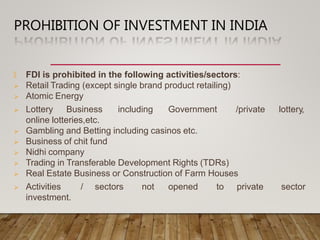
PROHIBITION OF INVESTMENT IN INDIA
🞭 FDI is prohibited in the following activities/sectors:
 Retail Trading (except single brand product retailing)
 Atomic Energy
 Lottery Business including Government /private lottery,
online lotteries,etc.
 Gambling and Betting including casinos etc.
 Business of chit fund
 Nidhi company
 Trading in Transferable Development Rights (TDRs)
 Real Estate Business or Construction of Farm Houses
 Activities / sectors not opened to private sector
investment.
PROHIBITION OF TRANSFER OF
OVERSEAS SHARES IN INDIA
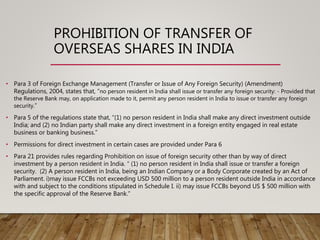
• Para 3 of Foreign Exchange Management (Transfer or Issue of Any Foreign Security) (Amendment)
Regulations, 2004, states that, “no person resident in India shall issue or transfer any foreign security: - Provided that
the Reserve Bank may, on application made to it, permit any person resident in India to issue or transfer any foreign
security.”
• Para 5 of the regulations state that, “(1) no person resident in India shall make any direct investment outside
India; and (2) no Indian party shall make any direct investment in a foreign entity engaged in real estate
business or banking business.”
• Permissions for direct investment in certain cases are provided under Para 6
• Para 21 provides rules regarding Prohibition on issue of foreign security other than by way of direct
investment by a person resident in India. “ (1) no person resident in India shall issue or transfer a foreign
security. (2) A person resident in India, being an Indian Company or a Body Corporate created by an Act of
Parliament. i)may issue FCCBs not exceeding USD 500 million to a person resident outside India in accordance
with and subject to the conditions stipulated in Schedule I. ii) may issue FCCBs beyond US $ 500 million with
the specific approval of the Reserve Bank.”
.
PROHIBITION OF TRANSFER OF OVERSEAS
SHARES IN INDIA
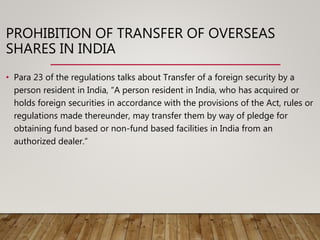
• Para 23 of the regulations talks about Transfer of a foreign security by a
person resident in India, “A person resident in India, who has acquired or
holds foreign securities in accordance with the provisions of the Act, rules or
regulations made thereunder, may transfer them by way of pledge for
obtaining fund based or non-fund based facilities in India from an
authorized dealer.”
CONDITIONS ON INVESTMENT
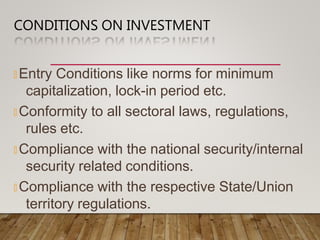
🞭 Entry Conditions like norms for minimum
capitalization, lock-in period etc.
🞭 Conformity to all sectoral laws, regulations,
rules etc.
🞭 Compliance with the national security/internal
security related conditions.
🞭 Compliance with the respective State/Union
territory regulations.
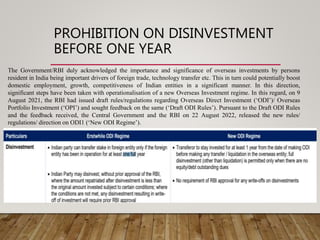
PROHIBITION ON DISINVESTMENT
BEFORE ONE YEAR
The Government/RBI duly acknowledged the importance and significance of overseas investments by persons
resident in India being important drivers of foreign trade, technology transfer etc. This in turn could potentially boost
domestic employment, growth, competitiveness of Indian entities in a significant manner. In this direction,
significant steps have been taken with operationalisation of a new Overseas Investment regime. In this regard, on 9
August 2021, the RBI had issued draft rules/regulations regarding Overseas Direct Investment (‘ODI’)/ Overseas
Portfolio Investment (‘OPI’) and sought feedback on the same (‘Draft ODI Rules’). Pursuant to the Draft ODI Rules
and the feedback received, the Central Government and the RBI on 22 August 2022, released the new rules/
regulations/ direction on ODI1 (‘New ODI Regime’).

FDI in India.pptx

  • 1.
    FOREIGN DIRECT INVESTMENT POLICYIN INDIA • Yashovardhan Agarwal - Legal Intern
  • 2.
    INTRODUCTION 🞭 ‘Foreign investment’is investment in an enterprise by a Non-Resident irrespective of whether this involves new equity capital or re-investment of earnings. Foreign investment is of two kinds – (i) Foreign Direct Investment (FDI) and (ii) Foreign Portfolio Investment. (As per Consolidated FDI Policy April 1, 2010)
  • 3.
    LEGAL BASIS 🞭 ForeignDirect Investment by non-resident in resident entities through transfer or issue of security to person resident outside India is a ‘Capital account transaction’ and Government of India and Reserve Bank of India regulate this under the FEMA, 1999 and its various regulations.
  • 4.
    CONSOLIDATED FDI POLICYAPRIL 1, 2010 • 🞭 Circular issued by Department of Industrial Policy and Ministry of Commerce and Industry. • 🞭 This circular consolidates into one document all the prior policies/regulations on FDI which are contained in FEMA, 1999, RBI Regulations under FEMA, 1999 and Press by DIPP and reflects the current Notes/Press Releases/Clarifications issued ‘policy framework’ on FDI.
  • 5.
    TWO MODES OFFDI 🞭 Automatic Route: FDI in sectors/activities to the extent permitted under automatic route does not require any prior approval either by the Government or RBI. The investors are only required to notify the Regional Office concerned of RBI within 30 days of receipt of inward remittances and file the required documents with that office within 30 days of issue of shares of foreign investors.
  • 6.
    🞭 Governmental Approval:FDI in activities not covered under the automatic route require prior government approval. Approvals of all such proposals proposals including involving composite foreign investment/foreign technical collaboration is granted on the recommendations of Foreign Investment Promotion Board (FIPB).
  • 7.
    AUTOMATIC ROUTE 🞭 Allitems/activities for investment up to 100% except those that require Government approval. 🞭 Investment in public sector units including SEZ, STPI, EOU.
  • 8.
    GOVERNMENTAL APPROVAL 🞭 Allproposals that require an industrial license under any law in force in India. 🞭 All proposals in which the foreign collaborator has a previous venture/tie up in India. 🞭 All proposals relating to acquisition of shares in an existing Indian company in favour of a foreign/NRI/OCB investor. 🞭 All proposals falling outside notified sectoral policy/caps or under sectors in which FDI is not permitted.
  • 9.
    CONDITIONS ON ISSUE/TRANSFEROF SHARES 🞭 Capital instruments to be issued within 180 days of receipt of the inward remittance. 🞭 In case of Listed Companies, issue price for shares shall be on the basis of SEBI guidelines. 🞭 In case of unlisted Companies, valuation of shares shall be done by a Chartered Accountant. 🞭 The Share subscription amount received by the Company shall be kept Foreign Currency Account, with the prior written approval of RBI.
  • 10.
    OVERSEAS DIRECT INVESTMENT FRAMEWORK •Section 6(3)(a) of FEMA, 1999 read with FEM(Permissible capitalAccount Transactions), Regulations, 2000 • FEM (Transfer or issue of any Foreign security) Regulations, 2000 popularly referred as (FEMA 120) • AP(DIR Series) Circulars issued by RBI from time to time • FAQ on Overseas Direct Investment released by RBI (as updated from time to time) • Liberalized Remittance Scheme of February 4, 2004 amended from time to time • FAQ on Liberalized Remittance Scheme – Applicable for resident Individuals
  • 11.
    Methods of investing Contributionto the capital Subscription to the Memorandum of foreign entity Purchase of existing shares (through market purchase/ private placement) Purchase through stock exchange (does not include portfolio investment) Automatic route Approval Route ProhibitedActivities Direct investment Routes Outside India No prior approval from RBI. Processed by Authorized Dealers Requires prior approval from RBI before it is processed by Authorized Dealers Real estate*, Banking Business and dealing in Financial products linked to INR without specific approval of RBI * Buying and selling real estate and dealing in TDR (does not include township, residential and commercial premises, roads and bridges) REGULATORY APPROACH TO ODI
  • 12.
    ENTRY STRATEGIES FORFOREIGN INVESTORS • As an Indian Company through, • JV • WOS • As a Foreign Company • Liaison Office • Project Office • Branch Office
  • 13.
    An Indian Partyis eligible to make ODI An Indian Party is: • a Company • a body created under an Act of Parliament • Registered Partnership firm • LLP • any other entity in India as notified by RBI • A combination of the above entities can also form an “Indian Party”. A foreign entity is termed as JV of the Indian Party when there are other foreign promoters holding the stake along with the Indian Party In case of WOS entire capital is held by the one or more Indian Parties Into a Joint Venture or Wholly Owned Subsidiary Joint Venture (JV)/ Wholly Owned Subsidiary (WOS) means a foreign entity formed, registered or incorporated in accordance with the laws and regulations of the host country in which the Indian party makes a direct investment JV WOS ODI OVERVIEW
  • 14.
    SHAREHOLDERS FROM COUNTRIES BORDERINGINDIA • As per the Companies (Prospectus and Allotment of Securities) Amendment Rules, 2022 issued by the ministry, no offer of any securities is to be made to an entity or a national of a country which shares land border with India, unless prior approval has been obtained from the Indian government as per Foreign Exchange Management (Non-debt Instruments) Rules, and is submitted along with the private placement offer-cum-application letter. • By way of a notification of 22 April 2020 issued by the Department of Economic Affairs of the Ministry of Finance and amending the Foreign Exchange Management (Non-Debt Instrument) Rules 2019, the government has introduced measures to curb opportunistic takeovers (direct or indirect) of Indian companies by persons or entities of any country which shares a land border with India ('bordering countries’). • The notification limits itself to FDI and does not regulate foreign portfolio investments (ie, investments of less than 10% in listed Indian companies) through registered foreign portfolio investment entities, including those from a bordering country, whether direct or indirect. However, it is understood that the government is considering additional checks on portfolio investments by Chinese investors. • the following investments now require prior approval from the government: • FDI by entities situated in a bordering country; and • FDI where the beneficial owners reside in or are citizens of a bordering country.
  • 15.
    HOW TO DETERMINEBENEFICIAL OWNERS • The Press Note and the FDI Policy do not provide the calculation methodology or conditions for determining beneficial owners and a clarification is expected from DIPP. This is important since many Indian companies and offshore entities, such as private equity funds investing in India have Chinese investors. Ultimately a definition may emerge that resembles Section 90 of the Companies Act, 2013 (“Act”) and Companies (Significant Beneficial Ownership) Rules, 2019 (“Rules”). • Under this, a “significant beneficial owner” in relation to a reporting company means an individual, who acting alone or together, or through one or more persons or trusts, possesses one or more of the following rights or entitlements: • (i) holds indirectly, or together with any direct holdings, at least 10% of the shares or at least 10% of the voting rights of the shares; • (ii) has the right to receive or participate at least 10% of total distributable dividend in a financial year whether directly or indirectly; or • (iii) has right to exercise, or actually exercises, significant influence or control, in any manner other than through direct-holdings alone. However the definitions in foreign exchange are different to the Companies Act and need to be clarified.
  • 16.
    PROHIBITION OF INVESTMENTIN INDIA 🞭 FDI is prohibited in the following activities/sectors:  Retail Trading (except single brand product retailing)  Atomic Energy  Lottery Business including Government /private lottery, online lotteries,etc.  Gambling and Betting including casinos etc.  Business of chit fund  Nidhi company  Trading in Transferable Development Rights (TDRs)  Real Estate Business or Construction of Farm Houses  Activities / sectors not opened to private sector investment.
  • 17.
    PROHIBITION OF TRANSFEROF OVERSEAS SHARES IN INDIA • Para 3 of Foreign Exchange Management (Transfer or Issue of Any Foreign Security) (Amendment) Regulations, 2004, states that, “no person resident in India shall issue or transfer any foreign security: - Provided that the Reserve Bank may, on application made to it, permit any person resident in India to issue or transfer any foreign security.” • Para 5 of the regulations state that, “(1) no person resident in India shall make any direct investment outside India; and (2) no Indian party shall make any direct investment in a foreign entity engaged in real estate business or banking business.” • Permissions for direct investment in certain cases are provided under Para 6 • Para 21 provides rules regarding Prohibition on issue of foreign security other than by way of direct investment by a person resident in India. “ (1) no person resident in India shall issue or transfer a foreign security. (2) A person resident in India, being an Indian Company or a Body Corporate created by an Act of Parliament. i)may issue FCCBs not exceeding USD 500 million to a person resident outside India in accordance with and subject to the conditions stipulated in Schedule I. ii) may issue FCCBs beyond US $ 500 million with the specific approval of the Reserve Bank.” .
  • 18.
    PROHIBITION OF TRANSFEROF OVERSEAS SHARES IN INDIA • Para 23 of the regulations talks about Transfer of a foreign security by a person resident in India, “A person resident in India, who has acquired or holds foreign securities in accordance with the provisions of the Act, rules or regulations made thereunder, may transfer them by way of pledge for obtaining fund based or non-fund based facilities in India from an authorized dealer.”
  • 19.
    CONDITIONS ON INVESTMENT 🞭Entry Conditions like norms for minimum capitalization, lock-in period etc. 🞭 Conformity to all sectoral laws, regulations, rules etc. 🞭 Compliance with the national security/internal security related conditions. 🞭 Compliance with the respective State/Union territory regulations.
  • 20.
    PROHIBITION ON DISINVESTMENT BEFOREONE YEAR The Government/RBI duly acknowledged the importance and significance of overseas investments by persons resident in India being important drivers of foreign trade, technology transfer etc. This in turn could potentially boost domestic employment, growth, competitiveness of Indian entities in a significant manner. In this direction, significant steps have been taken with operationalisation of a new Overseas Investment regime. In this regard, on 9 August 2021, the RBI had issued draft rules/regulations regarding Overseas Direct Investment (‘ODI’)/ Overseas Portfolio Investment (‘OPI’) and sought feedback on the same (‘Draft ODI Rules’). Pursuant to the Draft ODI Rules and the feedback received, the Central Government and the RBI on 22 August 2022, released the new rules/ regulations/ direction on ODI1 (‘New ODI Regime’).