Download as PDF, PPTX


![What
prac@@oners
say…
• ‘…
we
used
Google
Hangouts
–
they
all
wanted
to
use
video.
We
quickly
got
rid
of
that
–
they
all
found
it
very
distrac@ng.
They
preferred
the
audio
[only].
We
checked
in
at
the
start
with
video
so
that
everyone
saw
each
other
and
then
we’d
switch
it
off.’
• ‘[In
face-‐to-‐face]
I’m
more
aware
of
how
I
present
rather
than
what
I’m
understanding
or
clarifying
about
what
I
presented.’](https://image.slidesharecdn.com/johnheywood-virtualactionlearningpractice-basedobservations-161027081449/85/John-Heywood-Virtual-Action-Learning-practice-based-observations-7-320.jpg)

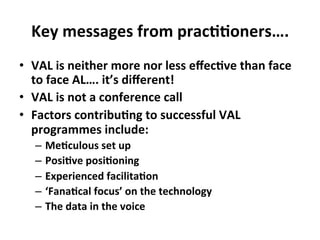


The document discusses the benefits and considerations of virtual action learning, highlighting advantages like reduced carbon footprint, time and cost savings, and enhanced diversity. It emphasizes the importance of effective listening and communication techniques, particularly in virtual settings, and shares insights from practitioners on the nuances of facilitating virtual learning compared to traditional face-to-face interactions. Key factors for success in virtual action learning include meticulous setup, positive positioning, and a focus on voice data, with the aim of helping participants access their own insights.


![[LDP] Virtual Leadership (11 03 10)](https://cdn.slidesharecdn.com/ss_thumbnails/ldpvirtualleadership11-03-10-100311095157-phpapp01-thumbnail.jpg?width=640&height=640&fit=bounds)


