JOHN DEWEY, 
‘AMERICA’S PHILOSOPHER’ 
1859-1952
INTRODUCING JOHN DEWEY 
http://www.youtube.com/watch?v=6MlHSgC_SnU
INTRODUCING DEWEY 
• Known as ‘America’s philosopher’. 
• He was an innovator in the school of pragmatist thought, where theory 
and practice are necessarilly interrelated. 
• His pragmatic approach to philosophy and life is highlighted by his 
consistent social engagement, which was always guided by philosophical 
principles. 
• He was the prime mover behind progressive educational change in 
America. 
• He was influenced by educators such as Rousseau and Froebel. 
• His in influence also translated to the U.K., particularly in the 60s, where 
it had (as one example you will know) an influence on the Plowden 
report. 
• His collected works is made up of 37 volumes, so we will not attempt a 
complete overview today but rather look at one of his texts which lays out 
his principles. 
• These principles will allow to discuss how his thinking takes into account 
the relationship between the individual and community.
MY PEDAGOGIC CREED 
The text we are going to look at is the one in your reading pack, ‘My 
Pedagogic Creed’, which was published in 1897 in the School 
Journal. 
It is a short but powerful text, which lays the educational principles with 
which he was to develop his later work. 
Although he changed and developed his philosophical and pedagogical 
thought throughout his career, ‘My Pedagogic Creed’ allows an 
insight into what originally fueled his lifelong engagement. 
One of his biographers, Alan Ryan, describes the text as ‘[shooting] 
from the hip.’ (Ryan, 1995:133)
TEACHER-CENTRED OR CHILD-CENTRED? 
Another of Dewey’s biographers, Robert B. Westbrook, introduces the text 
well: 
‘Dewey’s educational theory was far less child-centred and more teacher-centred 
than is often supposed. His confidence that children would 
develop a democratic character in the schools he envisioned was rooted 
less in a faith in the “spontaneous and crude capacities of the child” 
than in the ability of teachers to create an environment in the classroom 
in which they possessed the means to “mediate” these capcities “over 
into habits of social intelligence and responsiveness.” Dewey was calling 
upon teachers to artfully arrange things in the classroom so that “the 
right social growth” could be assured,…’ (Westbrook, 1991: 108-109) 
This is why it is not so easy to define Dewey as an ‘experiential’ or even 
‘progressive’ educator, as opposed to a ‘didactic’ educator, as his 
teaching philosophy aimed to incorporate whatever necessary to provide 
the best education possible for the individual and the community. It is 
the philosophical and pedagogical combination of these two goals which 
is the goal of ‘My Pedagogic Creed.’
WHAT EDUCATION IS 
‘I believe that all education proceeds by the participation of the individual in 
the social 
consciousness of the race. This process begins unconsciously almost at 
birth, and is 
continually shaping the individual's powers, saturating his consciousness, 
forming his 
habits, training his ideas, and arousing his feelings and emotions. Through 
this 
unconscious education the individual gradually comes to share in the 
intellectual and 
moral resources which humanity has succeeded in getting together.’
WHAT EDUCATION IS 
‘I believe that the only true education comes through the stimulation of the 
child's powers 
by the demands of the social situations in which he finds himself. Through these 
demands 
he is stimulated to act as a member of a unity, to emerge from his original 
narrowness of 
action and feeling, and to conceive of himself from the standpoint of the welfare 
of the 
group to which he belongs. Through the responses which others make to his own 
activities he comes to know what these mean in social terms. The value which 
they have 
is reflected back into them. For instance, through the response which is made to 
the 
child's instinctive babblings the child comes to know what those babblings mean; 
they are 
transformed into articulate language and thus the child is introduced into the 
consolidated 
wealth of ideas and emotions which are now summed up in language.’ 
Why is language such a good example of a connection between the individual 
and society? Perhaps because language is such a subtle means of self-expression 
– but is, by its nature, collective?
WHAT EDUCATION IS 
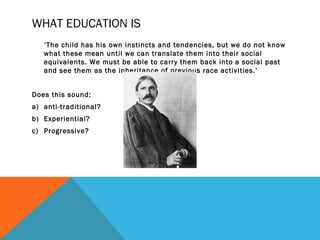
‘The child has his own instincts and tendencies, but we do not know 
what these mean until we can translate them into their social 
equivalents. We must be able to carry them back into a social past 
and see them as the inheritance of previous race activities.’ 
Does this sound: 
a) anti-traditional? 
b) Experiential? 
c) Progressive?
WHAT THE SCHOOL IS 
‘I believe that the school is primarily a social institution. Education 
being a social process, the school is simply that form of community 
life in which all those agencies areconcentrated that will be most 
effective in bringing the child to share in the inherited resources of 
the race, and to use his own powers for social ends.’
WHAT THE SCHOOL IS 
‘I believe that much of present education fails because it neglects this 
fundamental 
principle of the school as a form of community life. It conceives the school 
as a place 
where certain information is to be given, where certain lessons are to be ] 
earned, or 
where certain habits are to be formed. The value of these is conceived as 
lying largely in 
the remote future; the child must do these things for the sake of something 
else he is to 
do; they are mere preparation. As a result they do not become a part of the 
life experience 
of the child and so are not truly educative.’ 
What do you think Dewey would have thought of our current system of 
education in England? 
Does it seek to educate or does it simply direct itself towards the future? 
But isn’t education always for the future in one way or another?
THE SCHOOL AND SOCIAL PROGRESS - FOR 
DISCUSSION 
‘I believe that education is a regulation of the process of coming to share in the 
social 
consciousness; and that the adjustment of individual activity on the basis of this 
social 
consciousness is the only sure method of social reconstruction. 
I believe that this conception has due regard for both the individualistic and 
socialistic 
ideals. It is duly individual because it recognizes the formation of a certain 
character as 
the only genuine basis of right living. It is socialistic because it recognizes that 
this right 
character is not to be formed by merely individual precept, example, or 
exhortation, but 
rather by the influence of a certain form of institutional or community life upon 
the 
individual, and that the social organism through the school, as its organ, may 
determine 
ethical results.’
THE SCHOOL AND SOCIAL PROGRESS – FOR 
DISCUSSION 
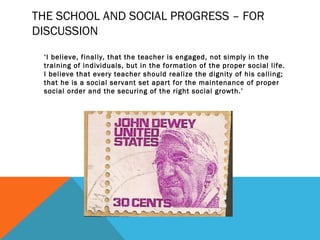
‘I believe, finally, that the teacher is engaged, not simply in the 
training of individuals, but in the formation of the proper social life. 
I believe that every teacher should realize the dignity of his calling; 
that he is a social servant set apart for the maintenance of proper 
social order and the securing of the right social growth.’

John dewey generals

  • 1.
    JOHN DEWEY, ‘AMERICA’SPHILOSOPHER’ 1859-1952
  • 2.
    INTRODUCING JOHN DEWEY http://www.youtube.com/watch?v=6MlHSgC_SnU
  • 3.
    INTRODUCING DEWEY •Known as ‘America’s philosopher’. • He was an innovator in the school of pragmatist thought, where theory and practice are necessarilly interrelated. • His pragmatic approach to philosophy and life is highlighted by his consistent social engagement, which was always guided by philosophical principles. • He was the prime mover behind progressive educational change in America. • He was influenced by educators such as Rousseau and Froebel. • His in influence also translated to the U.K., particularly in the 60s, where it had (as one example you will know) an influence on the Plowden report. • His collected works is made up of 37 volumes, so we will not attempt a complete overview today but rather look at one of his texts which lays out his principles. • These principles will allow to discuss how his thinking takes into account the relationship between the individual and community.
  • 4.
    MY PEDAGOGIC CREED The text we are going to look at is the one in your reading pack, ‘My Pedagogic Creed’, which was published in 1897 in the School Journal. It is a short but powerful text, which lays the educational principles with which he was to develop his later work. Although he changed and developed his philosophical and pedagogical thought throughout his career, ‘My Pedagogic Creed’ allows an insight into what originally fueled his lifelong engagement. One of his biographers, Alan Ryan, describes the text as ‘[shooting] from the hip.’ (Ryan, 1995:133)
  • 5.
    TEACHER-CENTRED OR CHILD-CENTRED? Another of Dewey’s biographers, Robert B. Westbrook, introduces the text well: ‘Dewey’s educational theory was far less child-centred and more teacher-centred than is often supposed. His confidence that children would develop a democratic character in the schools he envisioned was rooted less in a faith in the “spontaneous and crude capacities of the child” than in the ability of teachers to create an environment in the classroom in which they possessed the means to “mediate” these capcities “over into habits of social intelligence and responsiveness.” Dewey was calling upon teachers to artfully arrange things in the classroom so that “the right social growth” could be assured,…’ (Westbrook, 1991: 108-109) This is why it is not so easy to define Dewey as an ‘experiential’ or even ‘progressive’ educator, as opposed to a ‘didactic’ educator, as his teaching philosophy aimed to incorporate whatever necessary to provide the best education possible for the individual and the community. It is the philosophical and pedagogical combination of these two goals which is the goal of ‘My Pedagogic Creed.’
  • 6.
    WHAT EDUCATION IS ‘I believe that all education proceeds by the participation of the individual in the social consciousness of the race. This process begins unconsciously almost at birth, and is continually shaping the individual's powers, saturating his consciousness, forming his habits, training his ideas, and arousing his feelings and emotions. Through this unconscious education the individual gradually comes to share in the intellectual and moral resources which humanity has succeeded in getting together.’
  • 7.
    WHAT EDUCATION IS ‘I believe that the only true education comes through the stimulation of the child's powers by the demands of the social situations in which he finds himself. Through these demands he is stimulated to act as a member of a unity, to emerge from his original narrowness of action and feeling, and to conceive of himself from the standpoint of the welfare of the group to which he belongs. Through the responses which others make to his own activities he comes to know what these mean in social terms. The value which they have is reflected back into them. For instance, through the response which is made to the child's instinctive babblings the child comes to know what those babblings mean; they are transformed into articulate language and thus the child is introduced into the consolidated wealth of ideas and emotions which are now summed up in language.’ Why is language such a good example of a connection between the individual and society? Perhaps because language is such a subtle means of self-expression – but is, by its nature, collective?
  • 8.
    WHAT EDUCATION IS ‘The child has his own instincts and tendencies, but we do not know what these mean until we can translate them into their social equivalents. We must be able to carry them back into a social past and see them as the inheritance of previous race activities.’ Does this sound: a) anti-traditional? b) Experiential? c) Progressive?
  • 9.
    WHAT THE SCHOOLIS ‘I believe that the school is primarily a social institution. Education being a social process, the school is simply that form of community life in which all those agencies areconcentrated that will be most effective in bringing the child to share in the inherited resources of the race, and to use his own powers for social ends.’
  • 10.
    WHAT THE SCHOOLIS ‘I believe that much of present education fails because it neglects this fundamental principle of the school as a form of community life. It conceives the school as a place where certain information is to be given, where certain lessons are to be ] earned, or where certain habits are to be formed. The value of these is conceived as lying largely in the remote future; the child must do these things for the sake of something else he is to do; they are mere preparation. As a result they do not become a part of the life experience of the child and so are not truly educative.’ What do you think Dewey would have thought of our current system of education in England? Does it seek to educate or does it simply direct itself towards the future? But isn’t education always for the future in one way or another?
  • 11.
    THE SCHOOL ANDSOCIAL PROGRESS - FOR DISCUSSION ‘I believe that education is a regulation of the process of coming to share in the social consciousness; and that the adjustment of individual activity on the basis of this social consciousness is the only sure method of social reconstruction. I believe that this conception has due regard for both the individualistic and socialistic ideals. It is duly individual because it recognizes the formation of a certain character as the only genuine basis of right living. It is socialistic because it recognizes that this right character is not to be formed by merely individual precept, example, or exhortation, but rather by the influence of a certain form of institutional or community life upon the individual, and that the social organism through the school, as its organ, may determine ethical results.’
  • 12.
    THE SCHOOL ANDSOCIAL PROGRESS – FOR DISCUSSION ‘I believe, finally, that the teacher is engaged, not simply in the training of individuals, but in the formation of the proper social life. I believe that every teacher should realize the dignity of his calling; that he is a social servant set apart for the maintenance of proper social order and the securing of the right social growth.’