THINK BIG: SENDAI仙台
john kotaro barnes
Sendai workshop - Prof. kunio kudo
spring 2012
Recovery in the Aftermath of the 3/11/11 Tsunami
I
II
III
Sendai: Disaster Area Site Visit
Think Tank: Workshop
Spacial Layering
SENDAI: SITE VISIT
20:30 Boarded Shinkansen to Sendai from Tokyo Sta-
tion
21:30 Arrived in Sendai
22:00 Earth Quake
	
The streets within the city of Sendai appeared as any
bustling town should on a Saturday night in Japan. A
group of punk rockers smoke outside a convenience
store. A small earthquake shakes the overpass as we
walk from our hotel. A group of young college kids
begin sprinting as if to test our nerves. They are not
running from a “disaster” like the one that reached
inland towards the city a year and one week ago. Their
laughter as they sprint to make sure they catch the last
subway train before the system closes eases our nerves.
The memory of the disaster remains all around although
the urban activity stands as a testament to the ability of
human beings to carry on after a “disaster.” However,
even within the context and scale of an earthquake and
tsunami, the transfer of memories through generations
affects the resilience through the next “disaster.” This
event has proved that the usual method of using a sea
wall can, in a large enough event not only fail but am-
plify the impact. 	
The wall insulates and allows us to forget about the
scale and force of nature behind the tsunami. This
becomes truly disastrous when important decisions are
made behind this wall without the consideration of the
power of the ocean on the other side. The
wall is a overwhelming visual reminder
of the tragic change but not fails to com-
municate the respect of the force and hope
in the face future events. These memories
of what was lost and why are important in
order to recover successfully and sustain-
ably.
3/18/2012
9:00 Lecture at Trunk
10:00 Jun Umenai
11:00 Shunichi Koshimura
12:00 – Site Visit
SENDAI MUNICIPAL
WASTE WATER
TREATMENT PLANT
	
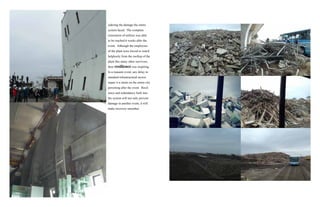
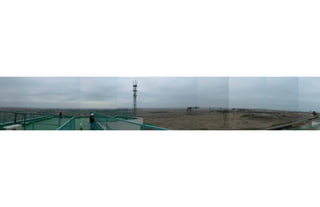
The wastewater treatment plant gave us
a more realistic look on the true strength
of the tsunami: located 200m from the
shoreline, it faced the brunt of the waves
catastrophic force. Not only were there
structural failures and debris still scat-
tered everywhere, the actual displacement
of the buildings and infrastructure of the
plant was measured in meters. However,
the plant’s manager offered us a sign of
hope in that the wastewater treatment plant
was able to rebound fairly quickly con-
ISendai: Disaster Area Site Visit
sidering the damage the entire
system faced. The complete
restoration of utilities was able
to be reached 6 weeks after the
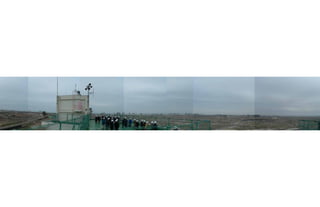
event. Although the employees
of the plant were forced to watch
helplessly from the rooftop of the
plant like many other survivors,
their resilience was inspiring.
In a tsunami event, any delay in
standard infrastructural access
repair is a strain on the entire city
persisting after the event. Resil-
ience and redundancy built into
the system will not only prevent
damage in another event, it will
make recovery smoother.
INCINERATOR
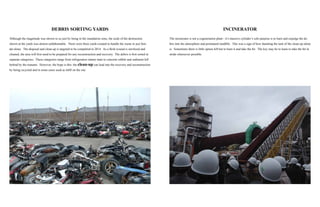
The incinerator is not a cogeneration plant - it’s massive cylinder’s sole purpose is to burn and expulge the de-
bris into the atmosphere and permanent landfills. This was a sign of how daunting the task of the clean-up alone
is. Sometimes there is little option left but to burn it and take the hit. The key may be to learn to take the hit in
stride whereever possible.
DEBRIS SORTING YARDS
Although the magnitude was shown to us just by being in the inundation zone, the scale of the destruction
shown at the yards was almost unfathomable. There were three yards created to handle the waste in just Sen-
dai alone. The disposal and clean-up is targeted to be completed in 2014. As a flesh wound is sterilized and
cleaned, the area will first need to be prepared for any reconstruction and recovery. The debris is first sorted in
separate categories. These categories range from refrigerators tatami mats to concrete rubble and sediment left
behind by the tsunami. However, the hope is this: the clean-up can lead into the recovery and reconstruction
by being recycled and in some cases used as infill on the site.
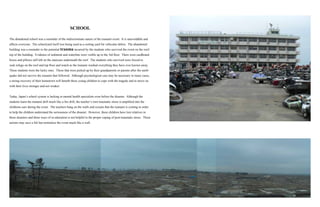
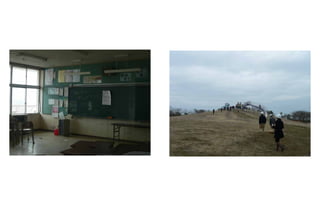
SCHOOL
The abandoned school was a reminder of the indiscriminate nature of the tsunami event. It is unavoidable and
affects everyone. The schoolyard itself was being used as a sorting yard for vehicular debris. The abandoned
building was a reminder to the potential trauma incurred by the students who survived the event on the roof-
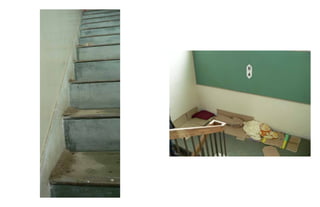
top of the building. Evidence of sediment and waterline were visible up to the 3rd floor. There were cardboard
boxes and pillows still left on the staircase underneath the roof. The students who survived were forced to
seek refuge on the roof and top floor and watch as the tsunami washed everything they have ever known away.
These students were the lucky ones. Those that were picked up by their grandparents or parents after the earth-
quake did not survive the tsunami that followed. Although psychological care may be necessary in many cases,
a strong recovery of their hometown will benefit these young children to cope with the tragedy and to move on
with their lives stronger and not weaker.
Today, Japan’s school system is lacking in mental health specialists even before the disaster. Although the
students learn the tsunami drill much like a fire drill, the teacher’s own traumatic stress is amplified into the
childrens ears during the event. The teachers bang on the walls and scream that the tsunami is coming in order
to help the children understand the seriousness of the disaster. However, these children have lost relatives in
these disasters and these ways of re-education is not helpful in the proper coping of post-traumatic stress. These
actions may save a life but normalize the event much like a wall.
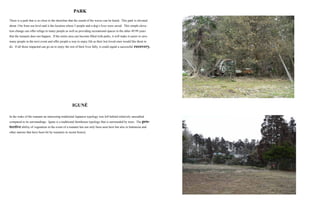
PARK
There is a park that is so close to the shoreline that the sound of the waves can be heard. This park is elevated
about 15m from sea level and is the location where 5 people and a dog’s lives were saved. This simple eleva-
tion change can offer refuge to many people as well as providing recreational spaces in the other 49.99 years
that the tsunami does not happen. If the entire area can become filled with parks, it will make it easier to save
many people in the next event and offer people a way to enjoy life as their lost loved ones would like them to
do. If all those impacted can go on to enjoy the rest of their lives fully, it could signal a successful recovery.
IGUNÉ
In the wake of the tsunami an interesting traditional Japanese typology was left behind relatively unscathed
compared to its surroundings. Igune is a traditional farmhouse typology that is surrounded by trees. The pro-
tective ability of vegetation in the event of a tsunami has not only been seen here but also in Indonesia and
other nations that have been hit by tsunamis in recent history.
IIThink Tank: Workshop
THINK TANK: WORKSHOP
After the site visit, seventy or so graduate architecture students from all over the world participated in an in-
tensive round robin think tank workshop where we discussed the disaster and its potential recovery. Many
ideas were thrown out and brain-stormed. In this context, we were able to exchange ideas with not only other
students but students who experienced the disaster first hand in Sendai. One group presented their contempla-
tion behind not doing anything in the disaster area. This brought up the conversation about how to deal with
recovery while preserving the memories of those lost. However, the unfortunate truth is that a funeral is not a
ceremony where the dead are physically present. It is a ceremony that is to aid in the recovery of those who lost
something with the deceased. Doing nothing would be allowing the wound to fester and not taking into consid-
eration to those survivors whose lives were dramatically changed forever as a result of this event. These people
not only desire to return to their lives, many desire to move back into the inundation zone with the knowldege
that another tsunami event is not a possibility but a inevitability. The question became: How can we heal the
scar?
In many of the groups a layering across the horizontal landscape from the sea was explored. The wall insulates
and separates. A system of layers were the distinction between them are created by a less invasive method than
a wall may do more to slowdown a tsunami than a wall that is asked to hold the disaster back completely. This
system may not be able to hold the wave but it may stop its reach inland. These layers may also work well the
other way around when the wave recedes. Our own debris and garbage will be stopped before it has the oppor-
tunity to reach the sea and harming the ocean wildlife that the Japanese are closely dependent on.
In terms of safety, it is important to educate everyone that may be at potential risk. This is everyone who re-
sides or works in the area as well as visitors that happen to be in the area at the moment of the event. In order
to do this, it was discussed that the escape route and protocol should and could be intuitive. On a horizontal
landscape it can be confusing which direction to flee and if one is in danger at all. As the clock winds down
after the earthquake event to the time of impact of the tsunami, this confusion can be the difference between life
and death.
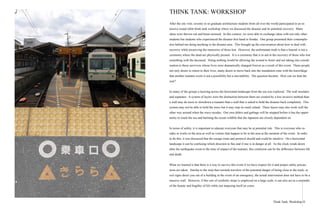
What we learned is that there is a way to survive this event if we have respect for it and proper safety precau-
tions are taken. Similar to the strip that reminds travelers of the potential danger of being close to the track, or
exit signs direct you out of a building in the event of an emergency, the actual intervention does not have to be a
massive wall. However, if this sort of symbolic stripe is employed on a large scale, it can also act as a reminder
of the beauty and fragility of life while not imposing itself on yours.
SPACIAL LAYERING
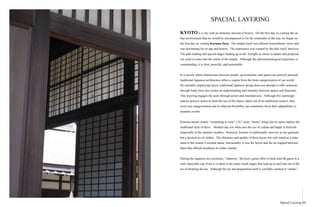
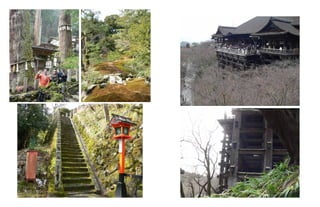
KYOTO is a city with an immense amount of history. On the first day, to contrast the ur-
ban environment that we would be encompassed in for the remainder of the trip, we began on
the first day ny visiting Kurama Dera. The temple itself was offered extraordinary views and
was fascinating for its age and history. The experience was created by the hike itself, however.
The path leading and spacial stages leading up to the brought us closer to nature and prepared
our souls to enter into the realm of the temple. Although this phenomenological experience is
commanding, it is slow, peaceful, and sustainable.
In a society where distinctions between people, governments, and spaces are actively pursued,
traditional Japanese architecture offers a respite from the brute categorization of our world.
By carefully employing layers, traditional Japanese design does not attempt to offer solutions
through brute force but creates an understanding and interplay between spaces and functions.
This layering engages the users through action and intended uses. Although this seemingly
tedious process seems to limit the use of the object, taken out of its traditional context, they
resist true categorization and its inherent flexibility can sometimes favor their adaptability to
dynamic events.
Kimono means simply “something to wear” (“ki” wear, “mono” thing) but its name implies the
traditional style of dress. Modern day use often sees the use of yukata and happi at festivals
(especially in the summer months). However, kimono is traditionally seen not as one garment
but a layered set of clothes. The character and quality of these layers not only acted as a state-
ment to the wearer’s societal status, functionally, it was the layers and the air trapped between
them that offered insulation in colder months.
	
During the Japanese tea ceremony, “chanoyu,” the host’s great effort to help lead the guest to a
truly enjoyable cup of tea is evident in the many small stages that lead up to and lead out of the
act of drinking the tea. Although the act and preparation itself is carefully curated in “chado,”
IIISpacial Layering
ing aspect of entering the realm of the otera of
jinja is not only emphasized through architecture
but is manifested in the act of cleansing oneself
in preparation. There are troughs with water
placed along the path before the actual shrine
or jinja. These are used to cleanse the hand and
mouth. Incense is also often used to purify the
visitor prior to entering.
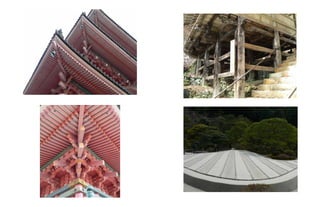
Although throughout history, the buddhist and
shinto traditions have become inseparably inter-
twined, there a some features that are associated
with buddhist temples. The pagoda generates
layers visually and physically on the vertical
axis. Traditionally the Oshiros of feudal japan
acted as a symbol of the resident’s height within
the government’s heirarchical layers.
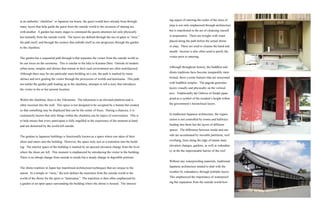
In traditional Japanese architecture, the organi-
zation is not controlled by rooms and hallways
feeding into them but the layers of different
spaces. The difference between inside and out-
side are accentuated by movable partitions, roof
overhang, lines along the edge of tatami mats,
elevation changes, gardens, as well as redundan-
cy in the the impermeable barrier of the roof.
	
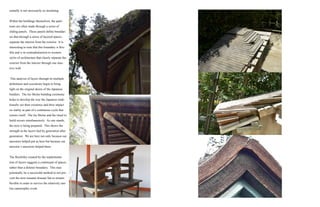
Without any waterproofing materials, traditional
Japanese architecture tended to deal with the
weather by redundancy through multiple layers.
This emphasized the importance of waterproof-
ing but separation from the outside world hori-
at an authentic “chashitsu” or Japanese tea house, the guest would have already been through
many layers that help guide the guest from the outside world to the occasion of sharing tea
with another. A garden has many stages to command the guests attention not only physically
but mentally from the outside world. The layers are defined through the use of gates or “mon,”
the path itself, and through the scenery that unfolds itself as one progresses through the garden
to the chashitsu.
The garden has a sequential path through it that separates the visitor from the outside world so
he can focus on the ceremony. This is similar to the hike to Kurama Dera. Outside of modern
urban areas, temples and shrines that remain in their rural environment are often multilayered.
Although there may be one particular main building on a site, the path is marked by many
shrines and torii guiding the visitor through the procession of worlds and kamisama. This path,
not unlike the garden path leading up to the chashitsu, attempts to tell a story that introduces
the visitor to his or her present location.
Within the chashitsu, there is the Tokonoma. The tokonoma is an elevated platform and is
often recessed into the wall. This space is not designed to be occupied by a human but created
so that something may be displayed that can be the center of focus. During a chanoyu, it is
customarily known that only things within the chashitsu can be topics of conversation. This is
to help ensure that every participant is fully engulfed in the experience of the moment at hand
and not distracted by the world left outside.
	
The genkan in Japanese buildings is functionally known as a space where one takes of their
shoes and enters into the building. However, the space truly acts as a transition into the build-
ing. The interior space of the building is marked by an upward elevation change from the level
where the shoes are left. This moment is emphasized by introducing the visitor to the building.
There is no abrupt change from outside to inside but a steady change in digestible portions.
	
The shinto tradition in Japan has manifested architectural techniques that are unique to the
nation. In a temple or “otera,” the torii defines the transition from the outside world to the
world of the shrine for the spirit or “kamisama.” The transition is then often emphasized by
a garden or an open space surrounding the building where the shrine is housed. The interest-
zontally is not necessarily as insulating.
Within the buildings themselves, the parti-
tions are often made through a series of
sliding panels. These panels define boundar-
ies that through a series of layered spaces,
separate the interior from the exterior. It is
interesting to note that this boundary is flex-
ible and is in contradistinction to western
styles of architecture that clearly separate the
exterior from the interior through one mas-
sive wall.
This analysis of layers through its multiple
definitions and executions begin to bring
light on the original desire of the Japanese
builders. The Ise Shrine building ceremony
helps to develop the way the Japanese tradi-
tionally see their existence and their impact
on reality as part of a continuous cycle that
renews itself. The Ise Shrine and the ritual to
build occurs simultaneously. As one stands,
the next is being prepared. This shows the
strength in the layers laid by generation after
generation. We are here not only because our
ancestors helped put us here but because our
ancestor’s ancestors helped them.
	
The flexibility created by the implementa-
tion of layers suggests a continuum of spaces
rather than a distinct boundary. This may
potentially be a successful method to not pre-
vent the next tsunami disaster but to remain
flexible in order to survive the relatively rare
but catastrophic event.
John barnes tradjap_sendai_final

John barnes tradjap_sendai_final

  • 1.
    THINK BIG: SENDAI仙台 johnkotaro barnes Sendai workshop - Prof. kunio kudo spring 2012 Recovery in the Aftermath of the 3/11/11 Tsunami
  • 2.
    I II III Sendai: Disaster AreaSite Visit Think Tank: Workshop Spacial Layering
  • 3.
    SENDAI: SITE VISIT 20:30Boarded Shinkansen to Sendai from Tokyo Sta- tion 21:30 Arrived in Sendai 22:00 Earth Quake The streets within the city of Sendai appeared as any bustling town should on a Saturday night in Japan. A group of punk rockers smoke outside a convenience store. A small earthquake shakes the overpass as we walk from our hotel. A group of young college kids begin sprinting as if to test our nerves. They are not running from a “disaster” like the one that reached inland towards the city a year and one week ago. Their laughter as they sprint to make sure they catch the last subway train before the system closes eases our nerves. The memory of the disaster remains all around although the urban activity stands as a testament to the ability of human beings to carry on after a “disaster.” However, even within the context and scale of an earthquake and tsunami, the transfer of memories through generations affects the resilience through the next “disaster.” This event has proved that the usual method of using a sea wall can, in a large enough event not only fail but am- plify the impact. The wall insulates and allows us to forget about the scale and force of nature behind the tsunami. This becomes truly disastrous when important decisions are made behind this wall without the consideration of the power of the ocean on the other side. The wall is a overwhelming visual reminder of the tragic change but not fails to com- municate the respect of the force and hope in the face future events. These memories of what was lost and why are important in order to recover successfully and sustain- ably. 3/18/2012 9:00 Lecture at Trunk 10:00 Jun Umenai 11:00 Shunichi Koshimura 12:00 – Site Visit SENDAI MUNICIPAL WASTE WATER TREATMENT PLANT The wastewater treatment plant gave us a more realistic look on the true strength of the tsunami: located 200m from the shoreline, it faced the brunt of the waves catastrophic force. Not only were there structural failures and debris still scat- tered everywhere, the actual displacement of the buildings and infrastructure of the plant was measured in meters. However, the plant’s manager offered us a sign of hope in that the wastewater treatment plant was able to rebound fairly quickly con- ISendai: Disaster Area Site Visit
  • 4.
    sidering the damagethe entire system faced. The complete restoration of utilities was able to be reached 6 weeks after the event. Although the employees of the plant were forced to watch helplessly from the rooftop of the plant like many other survivors, their resilience was inspiring. In a tsunami event, any delay in standard infrastructural access repair is a strain on the entire city persisting after the event. Resil- ience and redundancy built into the system will not only prevent damage in another event, it will make recovery smoother.
  • 5.
    INCINERATOR The incinerator isnot a cogeneration plant - it’s massive cylinder’s sole purpose is to burn and expulge the de- bris into the atmosphere and permanent landfills. This was a sign of how daunting the task of the clean-up alone is. Sometimes there is little option left but to burn it and take the hit. The key may be to learn to take the hit in stride whereever possible. DEBRIS SORTING YARDS Although the magnitude was shown to us just by being in the inundation zone, the scale of the destruction shown at the yards was almost unfathomable. There were three yards created to handle the waste in just Sen- dai alone. The disposal and clean-up is targeted to be completed in 2014. As a flesh wound is sterilized and cleaned, the area will first need to be prepared for any reconstruction and recovery. The debris is first sorted in separate categories. These categories range from refrigerators tatami mats to concrete rubble and sediment left behind by the tsunami. However, the hope is this: the clean-up can lead into the recovery and reconstruction by being recycled and in some cases used as infill on the site.
  • 8.
    SCHOOL The abandoned schoolwas a reminder of the indiscriminate nature of the tsunami event. It is unavoidable and affects everyone. The schoolyard itself was being used as a sorting yard for vehicular debris. The abandoned building was a reminder to the potential trauma incurred by the students who survived the event on the roof- top of the building. Evidence of sediment and waterline were visible up to the 3rd floor. There were cardboard boxes and pillows still left on the staircase underneath the roof. The students who survived were forced to seek refuge on the roof and top floor and watch as the tsunami washed everything they have ever known away. These students were the lucky ones. Those that were picked up by their grandparents or parents after the earth- quake did not survive the tsunami that followed. Although psychological care may be necessary in many cases, a strong recovery of their hometown will benefit these young children to cope with the tragedy and to move on with their lives stronger and not weaker. Today, Japan’s school system is lacking in mental health specialists even before the disaster. Although the students learn the tsunami drill much like a fire drill, the teacher’s own traumatic stress is amplified into the childrens ears during the event. The teachers bang on the walls and scream that the tsunami is coming in order to help the children understand the seriousness of the disaster. However, these children have lost relatives in these disasters and these ways of re-education is not helpful in the proper coping of post-traumatic stress. These actions may save a life but normalize the event much like a wall.
  • 11.
    PARK There is apark that is so close to the shoreline that the sound of the waves can be heard. This park is elevated about 15m from sea level and is the location where 5 people and a dog’s lives were saved. This simple eleva- tion change can offer refuge to many people as well as providing recreational spaces in the other 49.99 years that the tsunami does not happen. If the entire area can become filled with parks, it will make it easier to save many people in the next event and offer people a way to enjoy life as their lost loved ones would like them to do. If all those impacted can go on to enjoy the rest of their lives fully, it could signal a successful recovery. IGUNÉ In the wake of the tsunami an interesting traditional Japanese typology was left behind relatively unscathed compared to its surroundings. Igune is a traditional farmhouse typology that is surrounded by trees. The pro- tective ability of vegetation in the event of a tsunami has not only been seen here but also in Indonesia and other nations that have been hit by tsunamis in recent history.
  • 12.
    IIThink Tank: Workshop THINKTANK: WORKSHOP After the site visit, seventy or so graduate architecture students from all over the world participated in an in- tensive round robin think tank workshop where we discussed the disaster and its potential recovery. Many ideas were thrown out and brain-stormed. In this context, we were able to exchange ideas with not only other students but students who experienced the disaster first hand in Sendai. One group presented their contempla- tion behind not doing anything in the disaster area. This brought up the conversation about how to deal with recovery while preserving the memories of those lost. However, the unfortunate truth is that a funeral is not a ceremony where the dead are physically present. It is a ceremony that is to aid in the recovery of those who lost something with the deceased. Doing nothing would be allowing the wound to fester and not taking into consid- eration to those survivors whose lives were dramatically changed forever as a result of this event. These people not only desire to return to their lives, many desire to move back into the inundation zone with the knowldege that another tsunami event is not a possibility but a inevitability. The question became: How can we heal the scar? In many of the groups a layering across the horizontal landscape from the sea was explored. The wall insulates and separates. A system of layers were the distinction between them are created by a less invasive method than a wall may do more to slowdown a tsunami than a wall that is asked to hold the disaster back completely. This system may not be able to hold the wave but it may stop its reach inland. These layers may also work well the other way around when the wave recedes. Our own debris and garbage will be stopped before it has the oppor- tunity to reach the sea and harming the ocean wildlife that the Japanese are closely dependent on. In terms of safety, it is important to educate everyone that may be at potential risk. This is everyone who re- sides or works in the area as well as visitors that happen to be in the area at the moment of the event. In order to do this, it was discussed that the escape route and protocol should and could be intuitive. On a horizontal landscape it can be confusing which direction to flee and if one is in danger at all. As the clock winds down after the earthquake event to the time of impact of the tsunami, this confusion can be the difference between life and death. What we learned is that there is a way to survive this event if we have respect for it and proper safety precau- tions are taken. Similar to the strip that reminds travelers of the potential danger of being close to the track, or exit signs direct you out of a building in the event of an emergency, the actual intervention does not have to be a massive wall. However, if this sort of symbolic stripe is employed on a large scale, it can also act as a reminder of the beauty and fragility of life while not imposing itself on yours.
  • 13.
    SPACIAL LAYERING KYOTO isa city with an immense amount of history. On the first day, to contrast the ur- ban environment that we would be encompassed in for the remainder of the trip, we began on the first day ny visiting Kurama Dera. The temple itself was offered extraordinary views and was fascinating for its age and history. The experience was created by the hike itself, however. The path leading and spacial stages leading up to the brought us closer to nature and prepared our souls to enter into the realm of the temple. Although this phenomenological experience is commanding, it is slow, peaceful, and sustainable. In a society where distinctions between people, governments, and spaces are actively pursued, traditional Japanese architecture offers a respite from the brute categorization of our world. By carefully employing layers, traditional Japanese design does not attempt to offer solutions through brute force but creates an understanding and interplay between spaces and functions. This layering engages the users through action and intended uses. Although this seemingly tedious process seems to limit the use of the object, taken out of its traditional context, they resist true categorization and its inherent flexibility can sometimes favor their adaptability to dynamic events. Kimono means simply “something to wear” (“ki” wear, “mono” thing) but its name implies the traditional style of dress. Modern day use often sees the use of yukata and happi at festivals (especially in the summer months). However, kimono is traditionally seen not as one garment but a layered set of clothes. The character and quality of these layers not only acted as a state- ment to the wearer’s societal status, functionally, it was the layers and the air trapped between them that offered insulation in colder months. During the Japanese tea ceremony, “chanoyu,” the host’s great effort to help lead the guest to a truly enjoyable cup of tea is evident in the many small stages that lead up to and lead out of the act of drinking the tea. Although the act and preparation itself is carefully curated in “chado,” IIISpacial Layering
  • 14.
    ing aspect ofentering the realm of the otera of jinja is not only emphasized through architecture but is manifested in the act of cleansing oneself in preparation. There are troughs with water placed along the path before the actual shrine or jinja. These are used to cleanse the hand and mouth. Incense is also often used to purify the visitor prior to entering. Although throughout history, the buddhist and shinto traditions have become inseparably inter- twined, there a some features that are associated with buddhist temples. The pagoda generates layers visually and physically on the vertical axis. Traditionally the Oshiros of feudal japan acted as a symbol of the resident’s height within the government’s heirarchical layers. In traditional Japanese architecture, the organi- zation is not controlled by rooms and hallways feeding into them but the layers of different spaces. The difference between inside and out- side are accentuated by movable partitions, roof overhang, lines along the edge of tatami mats, elevation changes, gardens, as well as redundan- cy in the the impermeable barrier of the roof. Without any waterproofing materials, traditional Japanese architecture tended to deal with the weather by redundancy through multiple layers. This emphasized the importance of waterproof- ing but separation from the outside world hori- at an authentic “chashitsu” or Japanese tea house, the guest would have already been through many layers that help guide the guest from the outside world to the occasion of sharing tea with another. A garden has many stages to command the guests attention not only physically but mentally from the outside world. The layers are defined through the use of gates or “mon,” the path itself, and through the scenery that unfolds itself as one progresses through the garden to the chashitsu. The garden has a sequential path through it that separates the visitor from the outside world so he can focus on the ceremony. This is similar to the hike to Kurama Dera. Outside of modern urban areas, temples and shrines that remain in their rural environment are often multilayered. Although there may be one particular main building on a site, the path is marked by many shrines and torii guiding the visitor through the procession of worlds and kamisama. This path, not unlike the garden path leading up to the chashitsu, attempts to tell a story that introduces the visitor to his or her present location. Within the chashitsu, there is the Tokonoma. The tokonoma is an elevated platform and is often recessed into the wall. This space is not designed to be occupied by a human but created so that something may be displayed that can be the center of focus. During a chanoyu, it is customarily known that only things within the chashitsu can be topics of conversation. This is to help ensure that every participant is fully engulfed in the experience of the moment at hand and not distracted by the world left outside. The genkan in Japanese buildings is functionally known as a space where one takes of their shoes and enters into the building. However, the space truly acts as a transition into the build- ing. The interior space of the building is marked by an upward elevation change from the level where the shoes are left. This moment is emphasized by introducing the visitor to the building. There is no abrupt change from outside to inside but a steady change in digestible portions. The shinto tradition in Japan has manifested architectural techniques that are unique to the nation. In a temple or “otera,” the torii defines the transition from the outside world to the world of the shrine for the spirit or “kamisama.” The transition is then often emphasized by a garden or an open space surrounding the building where the shrine is housed. The interest-
  • 15.
    zontally is notnecessarily as insulating. Within the buildings themselves, the parti- tions are often made through a series of sliding panels. These panels define boundar- ies that through a series of layered spaces, separate the interior from the exterior. It is interesting to note that this boundary is flex- ible and is in contradistinction to western styles of architecture that clearly separate the exterior from the interior through one mas- sive wall. This analysis of layers through its multiple definitions and executions begin to bring light on the original desire of the Japanese builders. The Ise Shrine building ceremony helps to develop the way the Japanese tradi- tionally see their existence and their impact on reality as part of a continuous cycle that renews itself. The Ise Shrine and the ritual to build occurs simultaneously. As one stands, the next is being prepared. This shows the strength in the layers laid by generation after generation. We are here not only because our ancestors helped put us here but because our ancestor’s ancestors helped them. The flexibility created by the implementa- tion of layers suggests a continuum of spaces rather than a distinct boundary. This may potentially be a successful method to not pre- vent the next tsunami disaster but to remain flexible in order to survive the relatively rare but catastrophic event.