1	


April	
  2015	


   2	


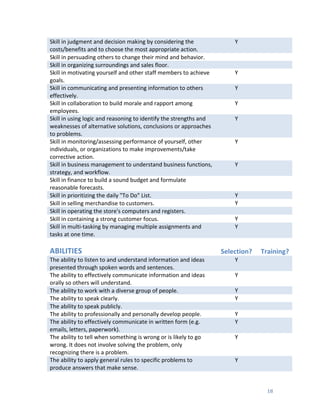
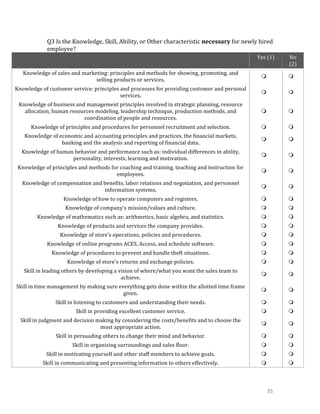
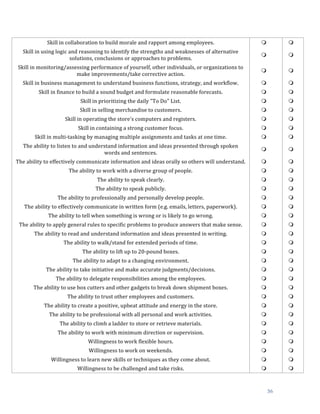
Table	
  of	
  Contents	


EXECUTIVE	
  SUMMARY………………………………………………………………………………………..3	


INTRODUCTION………………………………………………………………………………………………….4	


Job	
  Description………………………………………………………………………………………...4	


RESULTS…………………………………………………………………………………………………………….5	


Survey	
  Respondents…………………………………………………………………………………5	


Statistical	
  Analysis…….……………………………………………………………………………...5	


Survey	
  Results………………………………………………………………………………………….8	


   Table	
  1.1	
  ………………………………………………………………………………………………....8	


Table	
  1.2	
  ………………………………………………………………………………………………...12	


Table	
  1.3	
  ………………………………………………………………………………………………...17	


METHODOLOGY…………………………………………………………………………………………………20	


Job	
  Analysis	
  Technique…………………………...……………………………..………………...20	


Job	
  Analysis	
  Research……………………………………………………………………………...20	


Job	
  Analysis	
  Survey………………………………………………………………………………....21	


CONCLUSIONS	
  AND	
  RECOMMENDATIONS………………………………………………………....	
  22	


Discussion………………………………………………………………….……………………………22	


Additional	
  Thoughts………………………………………………...………………………….…..22	


REFERENCES……………………………………………………………………………………………………..24	


APPENDIX	
  A:	
  Job	
  Interview	
  Form……………………………………………………………………….25	


APPENDIX	
  B:	
  Job	
  Analysis	
  Questionnaire…….………………………………………………………29	


APPENDIX	
  C:	
  Alpha/ICC	
  for	
  Task	
  Importance……………………………………………………...42	


   3	


EXECUTIVE	
  SUMMARY	


This	
  report	
  describes	
  the	
  procedures	
  followed	
  in	
  the	
  job	
  analysis	
  conducted	
  
for	
  the	
  position	
  of	
  Retail	
  Store	
  Manager	
  at	
  Bath	
  and	
  Body	
  Works.	
  The	
  purpose	
  of	
  this	
  
job	
  analysis	
  was	
  to	
  identify	
  and	
  describe	
  the	
  necessary	
  components	
  for	
  the	
  position	
  
of	
   a	
   retail	
   store	
   manager.	
   The	
   results	
   from	
   this	
   report	
   can	
   be	
   used	
   for	
   various	
  
important	
   management	
   and	
   employment	
   decisions,	
   such	
   as:	
   recruitment	
   and	
  
selection,	
  determining	
  whether	
  training	
  is	
  needed,	
  and	
  to	
  make	
  sure	
  certain	
  legal	
  
requirements	
  are	
  met.	


   The	
  process	
  of	
  this	
  job	
  analysis	
  included	
  collecting	
  preliminary	
  information	
  
from	
  multiple	
  sources	
  online	
  about	
  the	
  position	
  and	
  interviewing	
  the	
  job	
  incumbent	
  
to	
  identify	
  the	
  job	
  tasks	
  and	
  other	
  characteristics	
  that	
  were	
  the	
  basis	
  for	
  building	
  the	
  
job	
  analysis	
  survey.	
  This	
  survey	
  was	
  administered	
  to	
  several	
  subject	
  matter	
  experts	
  
(SMEs),	
  including	
  the	
  job	
  incumbent,	
  the	
  incumbent's	
  co-­‐manager,	
  the	
  incumbent's	
  
supervisor,	
  and	
  two	
  of	
  the	
  incumbent's	
  subordinates.	
  This	
  job	
  analysis	
  focused	
  on	
  
the	
   tasks,	
   responsibilities,	
   knowledges,	
   skills,	
   abilities,	
   and	
   other	
   characteristics	
  
(KSAOs)	
  required	
  for	
  the	
  position.	


   Analyses	
   were	
   performed	
   on	
   the	
   survey	
   responses	
   to	
   determine	
   level	
   of	
  
difficulty,	
   criticality,	
   and	
   the	
   importance	
   of	
   the	
   job	
   tasks.	
   Personal	
   attributes	
  
including	
  knowledges,	
  skills,	
  abilities,	
  and	
  other	
  characteristics	
  were	
  also	
  analyzed	
  
to	
  determine	
  whether	
  they	
  were	
  necessary,	
  practical,	
  whether	
  trouble	
  was	
  likely	
  if	
  
ignored,	
  and	
  a	
  superior	
  vs.	
  an	
  average	
  worker.	


   This	
  job	
  analysis	
  contributes	
  important	
  information	
  on	
  the	
  tasks/duties	
  and	
  
characteristics	
   for	
   the	
   selection	
   of	
   the	
   most	
   qualified	
   retail	
   store	
   managers.	
   The	
  
included	
   data	
   will	
   also	
   detail	
   how	
   the	
   analysis	
   can	
   be	
   utilized	
   to	
   determine	
   what	
  
areas	
  employees	
  need	
  training	
  on.	
  Overall,	
  the	
  job	
  analysis	
  provided	
  is	
  an	
  effective	
  
instrument	
   for	
   recruitment/selection	
   and	
   training	
   purposes	
   by	
   offering	
   valuable	
  
information	
   about	
   the	
   job	
   tasks	
   and	
   KSAOs	
   executed	
   and	
   required	
   for	
   the	
   Retail	
  
Store	
  Manager	
  at	
  Bath	
  and	
  Body	
  Works.	


   4	


INTRODUCTION	
  
A	
  job	
  analysis	
  is	
  referred	
  to	
  as	
  the	
  “process	
  of	
  discovery	
  of	
  the	
  nature	
  of	
  the	
  
job”	
   (Brannick	
   et	
   al.,	
   2007).	
   In	
   order	
   to	
   be	
   valuable	
   for	
   organizations,	
   the	
   job	
  
analysis	
  must	
  be	
  done	
  systematically,	
  carefully,	
  and	
  thoroughly.	
  	
  Job	
  analyses	
  have	
  
many	
  practical	
  implications	
  for	
  organizations	
  such	
  as,	
  delivering	
  a	
  firm	
  foundation	
  
for	
   many	
   important	
   employment	
   or	
   management	
   decisions,	
   in	
   addition	
   to	
   being	
  
legally	
  defensible	
  in	
  court.	
  	
  
Bath	
   and	
   Body	
   Works	
   is	
   currently	
   transitioning	
   into	
   a	
   High-­‐Performance	
  
selling	
   business.	
   In	
   result	
   of	
   this	
   vast	
   company	
   transformation,	
   many	
   of	
   the	
   job	
  
positions	
  are	
  in	
  need	
  of	
  being	
  altered	
  and	
  brought	
  up-­‐to-­‐date.	
  The	
  purpose	
  of	
  this	
  
project	
  is	
  to	
  conduct	
  an	
  updated	
  task	
  and	
  KSAO	
  based	
  job	
  analysis	
  on	
  a	
  Retail	
  Store	
  
Manager	
  for	
  Bath	
  and	
  Body	
  Works,	
  by	
  describing	
  what	
  is	
  done	
  on	
  the	
  job	
  and	
  how.	
  It	
  
creates	
  an	
  overall	
  description	
  of	
  the	
  job	
  and	
  allows	
  one	
  to	
  understand	
  the	
  necessary	
  
characteristics	
   required	
   to	
   perform	
   the	
   job	
   effectively.	
   The	
   job	
   analysis	
   results	
  
provide	
   essential	
   information	
   to	
   develop	
   selection	
   procedures	
   and	
   to	
   design	
  
training	
  programs	
  related	
  to	
  the	
  retail	
  store	
  manager	
  position.	


Job	
  Description	
  
The	
   Retail	
   Store	
   Manager	
   at	
   Bath	
   and	
   Body	
   Works	
   is	
   responsible	
   for	
   all	
  
aspects	
  of	
  managing	
  a	
  single	
  retail	
  store	
  including:	
  	
  
Ø containing	
  complete	
  operation	
  liability	
  to	
  achieve	
  sales,	
  service,	
  customer	
  
satisfaction	
  and	
  profitability	
  goals	
  for	
  the	
  store	
  that	
  are	
  in	
  compliance	
  with	
  
company	
  procedures	
  
Ø developing	
  and	
  implementing	
  short-­‐term/long-­‐term	
  plans	
  to	
  achieve	
  goals	
  
Ø guaranteeing	
  the	
  maintenance	
  of	
  expected	
  operational	
  and	
  merchandising	
  
standards	
  
Ø ensuring	
  all	
  employees	
  maintain	
  store	
  presentation	
  and	
  support	
  brand	
  
consistency	
  
Ø providing	
  effective	
  coaching	
  and	
  training	
  to	
  staff	
  in	
  the	
  areas	
  of	
  customer	
  
service,	
  product	
  knowledge,	
  inventory	
  control	
  and	
  merchandising	
  in	
  addition	
  
to	
  offering	
  developmental	
  opportunities	
  
Ø handling	
  all	
  store	
  loss	
  prevention	
  issues	
  and	
  reports	
  to	
  District	
  Manager	
  
regularly	


   5	
  
RESULTS	


Survey	
  Respondents	


-­‐Response	
  Rate	
  of	
  Questionnaire:	
  100%	


-­‐Demographics	
  of	
  Respondents:	
  
Ethnicity	
  origin	
  (race):	
  White	
  100%	
  
	
   Gender:	
  Female	
  100%	


   Mean	
  Age	
  (in	
  years):	
  40.4	
  
	
   Current	
  Position	
  Held:	


  District	
  Manager	
  (Supervisor):	
  1	


  Store	
  Manager	
  (Incumbents):	
  2	


  Sales	
  Leads	
  (Subordinates):	
  	
  2	


Statistical	
  Analysis	


   Data	
  analyses	
  were	
  performed	
  on	
  the	
  results	
  of	
  the	
  questionnaire	
  given	
  to	
  
the	
  job	
  incumbents	
  and	
  subject	
  matter	
  experts.	
  The	
  item	
  ratings	
  (for	
  both	
  tasks	
  and	
  
KSAOs)	
   of	
   the	
   questionnaire	
   can	
   be	
   seen	
   in	
   Tables	
   1.1	
   and	
   1.2.	
   The	
   mean	
   and	
  
standard	
   deviations	
   were	
   calculated	
   to	
   rank	
   tasks	
   in	
   order	
   of	
   importance.	
   The	
  
rankings	
   allow	
   one	
   to	
   make	
   a	
   clear	
   decision	
   on	
   what	
   to	
   select	
   and/or	
   train	
  
employees	
  on.	


Intraclass	
  correlation	
  coefficient	
  (ICC)	
  for	
  task	
  importance	


The	
   intraclass	
   correlation	
   coefficient	
   (ICC)	
   was	
   calculated	
   to	
   assess	
   the	
  
consistency	
   between	
   the	
   ratings	
   of	
   the	
   five	
   different	
   judges	
   for	
   task	
   importance.	
  
With	
  measuring	
  consistency,	
  average	
  measures	
  ICC	
  (see	
  Appendix	
  C)	
  are	
  identical	
  to	
  
Cronbach's	
   alpha.	
   Average	
   measures	
   ICC	
   tells	
   you	
   an	
   index	
   for	
   the	
   reliability	
   of	
  
different	
  raters	
  averaged	
  together.	
  A	
  high	
  degree	
  of	
  reliability	
  was	
  found	
  for	
  average	
  
measures	
  of	
  ICC	
  at	
  .938	
  with	
  a	
  95%	
  confidence	
  interval	
  from	
  .824-­‐.993.	


Single	
  measures	
  ICC	
  tells	
  you	
  an	
  index	
  for	
  the	
  reliability	
  of	
  the	
  ratings	
  for	
  one	
  
typical,	
  single	
  rater.	
  A	
  low	
  degree	
  of	
  reliability	
  was	
  found	
  for	
  single	
  measures	
  of	
  ICC	
  
at	
   .226	
   with	
   a	
   95%	
   confidence	
   interval	
   from	
   .082-­‐.719.	
   If	
   this	
   is	
   high,	
   one	
   might	
  
choose	
  to	
  inquire	
  from	
  just	
  one	
  rater	
  for	
  that	
  sort	
  of	
  task.	
  However,	
  we	
  advise	
  that	
  
you	
  use	
  as	
  many	
  raters	
  as	
  possible	
  because	
  this	
  allows	
  for	
  stronger	
  reliability	
  and	
  
evidence	
  for	
  your	
  job	
  analysis.	
  In	
  reference	
  to	
  our	
  findings,	
  our	
  single	
  measures	
  or	
  
reliability	
  of	
  one	
  rater	
  is	
  quite	
  low,	
  but	
  constructively	
  had	
  a	
  very	
  high	
  consistency	
  
between	
  our	
  five	
  different	
  raters.	


   6	


A.	
  TASKS	


Importance	


A	
  task	
  importance	
  value	
  was	
  computed	
  for	
  each	
  of	
  the	
  52	
  task	
  statements.	
  
This	
   value	
   is	
   calculated	
   by	
   the	
   simple	
   sum	
   of	
   task	
   difficulty	
   and	
   criticality.	
   These	
  
values	
  as	
  seen	
  in	
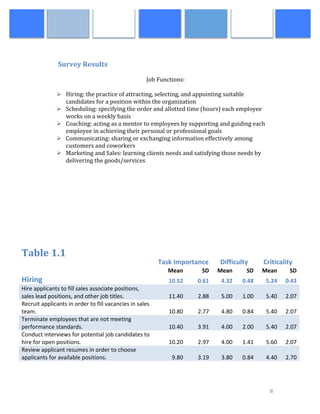
  Table	
  1.1	
  may	
  range	
  from	
  a	
  minimum	
  score	
  of	
  2	
  to	
  a	
  maximum	
  of	
  
14.	
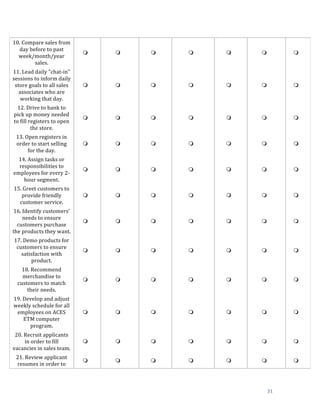
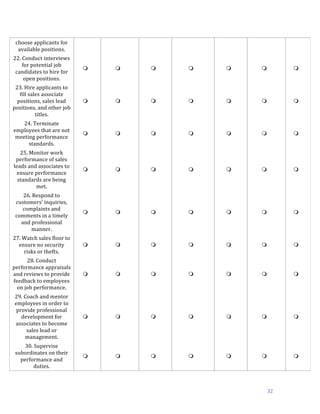
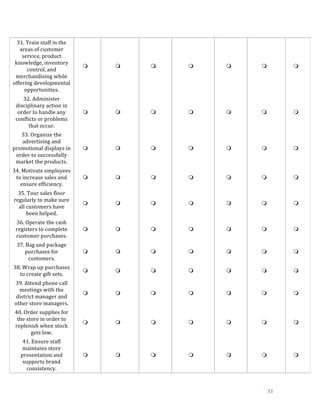
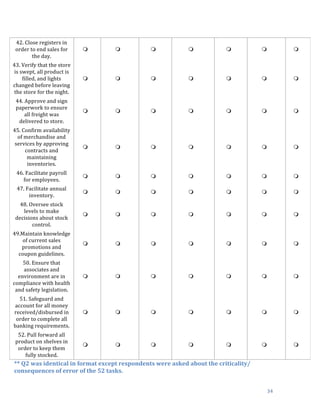
  The	
  tasks	
  were	
  then	
  ranked	
  in	
  order	
  from	
  most	
  important	
  to	
  least	
  important.	
  
The	
  mean	
  scores	
  and	
  standard	
  deviations	
  for	
  task	
  importance,	
  task	
  difficulty,	
  and	
  
task	
  criticality	
  can	
  also	
  be	
  found	
  on	
  Table	
  1.1.	
  These	
  calculations	
  were	
  computed	
  by	
  	
  
using	
  the	
  responses	
  across	
  all	
  five	
  raters.	
  This	
  was	
  also	
  done	
  for	
  each	
  of	
  the	
  five	
  
major	
   duties/functions.	
   The	
   final	
   step	
   in	
   this	
   process	
   was	
   to	
   organize	
   all	
   tasks	
  
within	
  major	
  duties/function	
  categories	
  (keeping	
  tasks	
  in	
  order	
  from	
  most	
  to	
  least	
  
important).	


Difficulty	


A	
  task	
  difficulty	
  rating	
  was	
  computed	
  for	
  each	
  of	
  the	
  52	
  task	
  statements	
  by	
  all	
  
five	
  raters.	
  Refer	
  to	
  Table	
  1.1	
  that	
  provides	
  the	
  means	
  and	
  standard	
  deviations	
  of	
  
these	
   difficulty	
   ratings	
   for	
   each	
   task,	
   as	
   well	
   as	
   major	
   duties/functions.	
   These	
  
ratings	
  can	
  range	
  from	
  a	
  minimum	
  score	
  of	
  a	
  2	
  to	
  a	
  maximum	
  score	
  of	
  a	
  14	
  (scale	
  
points	
  1-­‐7).	
  The	
  difficulty	
  ratings	
  were	
  utilized	
  to	
  create	
  the	
  importance	
  value	
  for	
  
each	
  task.	


Criticality/Consequences	
  of	
  Error	


A	
  criticality/consequences	
  of	
  error	
  rating	
  was	
  computed	
  for	
  each	
  of	
  the	
  52	
  
statements	
  by	
  all	
  five	
  raters.	
  Table	
  1.1	
  provides	
  the	
  means	
  and	
  standard	
  deviations	
  
of	
  these	
  criticality	
  ratings	
  for	
  each	
  task,	
  as	
  well	
  as	
  the	
  major	
  duties/functions.	
  These	
  
ratings	
  also	
  can	
  range	
  from	
  a	
  minimum	
  score	
  of	
  2	
  to	
  a	
  maximum	
  score	
  of	
  a	
  14	
  (scale	
  
points	
  1-­‐7).	
  	
  The	
  criticality	
  ratings	
  were	
  also	
  utilized	
  to	
  create	
  the	
  importance	
  value	
  
for	
  each	
  task.	


   7	


B.	
  KSAOs	


   Necessary	


A	
   necessity	
   or	
   “necessary	
   for	
   new	
   worker”	
   rating	
   was	
   generated	
   for	
   each	
  
knowledge,	
   skill,	
   ability	
   and	
   other	
   characteristics,	
   by	
   all	
   five	
   raters.	
   The	
   rater’s	
  
answer	
  of	
  “yes/no”	
  to	
  each	
  KSAO	
  for	
  necessity	
  was	
  tallied	
  and	
  a	
  total	
  was	
  computed	
  
(refer	
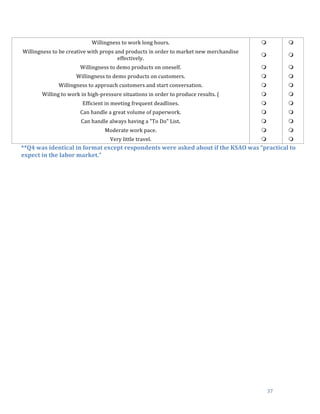
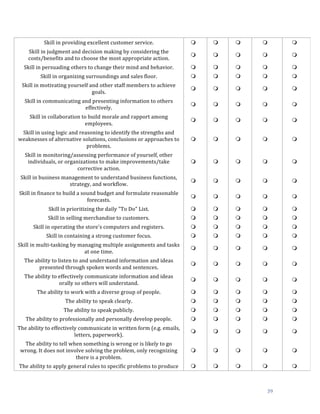
  to	
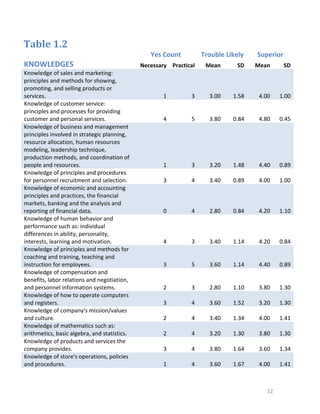
  Table	
  1.2).	


   Practical	


A	
   practicality	
   or	
   “practical	
   to	
   expect”	
   rating	
   was	
   computed	
   for	
   each	
  
knowledge,	
   skill,	
   ability	
   and	
   other	
   characteristic,	
   by	
   all	
   five	
   raters.	
   Similar	
   to	
  
necessity,	
  the	
  rater’s	
  answer	
  of	
  “yes/no”	
  to	
  each	
  KSAO	
  for	
  practicality	
  was	
  tallied	
  
and	
  a	
  total	
  was	
  computed	
  (refer	
  to	
  Table	
  1.2).	


Trouble	
  Likely	


A	
  trouble	
  likely	
  rating	
  was	
  generated	
  for	
  each	
  KSAO	
  on	
  a	
  1-­‐5	
  scale.	
  The	
  mean	
  
and	
  standard	
  deviations	
  as	
  seen	
  in	
  Table	
  1.2	
  were	
  calculated	
  across	
  all	
  the	
  raters	
  for	
  
each	
  KSAO.	


Superior	


A	
  superior	
  from	
  average	
  worker	
  rating	
  was	
  generated	
  for	
  each	
  KSAO	
  on	
  a	
  1-­‐5	
  
scale	
  identical	
  to	
  the	
  trouble	
  likely	
  scale.	
  The	
  mean	
  and	
  standard	
  deviations	
  as	
  seen	
  
in	
  Table	
  1.2	
  were	
  calculated	
  across	
  all	
  the	
  raters	
  for	
  each	
  KSAO.	


   8	


Survey	
  Results	


Job	
  Functions:	


Ø Hiring:	
  the	
  practice	
  of	
  attracting,	
  selecting,	
  and	
  appointing	
  suitable	
  
candidates	
  for	
  a	
  position	
  within	
  the	
  organization	
  
Ø Scheduling:	
  specifying	
  the	
  order	
  and	
  allotted	
  time	
  (hours)	
  each	
  employee	
  
works	
  on	
  a	
  weekly	
  basis	
  
Ø Coaching:	
  acting	
  as	
  a	
  mentor	
  to	
  employees	
  by	
  supporting	
  and	
  guiding	
  each	
  
employee	
  in	
  achieving	
  their	
  personal	
  or	
  professional	
  goals	
  
Ø Communicating:	
  sharing	
  or	
  exchanging	
  information	
  effectively	
  among	
  
customers	
  and	
  coworkers	
  
Ø Marketing	
  and	
  Sales:	
  learning	
  clients	
  needs	
  and	
  satisfying	
  those	
  needs	
  by	
  
delivering	
  the	
  goods/services	


Table	
  1.1	


Task	
  Importance	


Difficulty	


Criticality	
  
	
   Mean	
   SD	
   Mean	
   SD	
   Mean	
   SD	
  
Hiring	
   10.52	
   0.61	
   4.32	
   0.48	
   5.24	
   0.43	
  
Hire	
  applicants	
  to	
  fill	
  sales	
  associate	
  positions,	
  
sales	
  lead	
  positions,	
  and	
  other	
  job	
  titles.	
   11.40	
   2.88	
   5.00	
   1.00	
   5.40	
   2.07	
  
Recruit	
  applicants	
  in	
  order	
  to	
  fill	
  vacancies	
  in	
  sales	
  
team.	
   10.80	
   2.77	
   4.80	
   0.84	
   5.40	
   2.07	
  
Terminate	
  employees	
  that	
  are	
  not	
  meeting	
  
performance	
  standards.	
   10.40	
   3.91	
   4.00	
   2.00	
   5.40	
   2.07	
  
Conduct	
  interviews	
  for	
  potential	
  job	
  candidates	
  to	
  
hire	
  for	
  open	
  positions.	
   10.20	
   2.97	
   4.00	
   1.41	
   5.60	
   2.07	
  
Review	
  applicant	
  resumes	
  in	
  order	
  to	
  choose	
  
applicants	
  for	
  available	
  positions.	
   9.80	
   3.19	
   3.80	
   0.84	
   4.40	
   2.70	


   9	
  
Task	
  Importance	
   Difficulty	
   Criticality	
  
	
   Mean	
   SD	
   Mean	
   SD	
   Mean	
   SD	
  
Scheduling	
   9.80	
   0.57	
   3.40	
   0.57	
   5.60	
   0.57	
  
Develop	
  and	
  adjust	
  weekly	
  schedule	
  for	
  all	
  
employees	
  on	
  ACES	
  and	
  ETM	
  computer	
  programs.	
   10.20	
   2.74	
   3.80	
   1.10	
   5.20	
   1.92	
  
Facilitate	
  payroll	
  for	
  employees.	
   9.40	
   1.22	
   3.00	
   1.22	
   6.00	
   1.00	


Task	
  Importance	


Difficulty	


Criticality	
  
	
   Mean	
   SD	
   Mean	
   SD	
   Mean	
   SD	


Coaching	
   9.11	
   0.50	
   2.80	
   0.28	
   5.86	
   0.39	
  
Monitor	
  work	
  performance	
  of	
  sales	
  leads	
  and	
  
associates	
  to	
  ensure	
  performance	
  standards	
  are	
  
being	
  met.	
   9.60	
   2.49	
   3.00	
   1.00	
   5.20	
   1.92	
  
Coach	
  and	
  mentor	
  employees	
  in	
  order	
  to	
  provide	
  
professional	
  development	
  for	
  associates	
  to	
  
become	
  sales	
  lead	
  or	
  management.	
   9.60	
   1.48	
   3.20	
   1.30	
   5.60	
   0.55	
  
Train	
  staff	
  in	
  the	
  areas	
  of	
  customer	
  service,	
  
product	
  knowledge,	
  inventory	
  control,	
  and	
  
merchandising	
  while	
  offering	
  developmental	
  
opportunities.	
   9.40	
   1.30	
   3.00	
   1.00	
   5.80	
   0.84	
  
Motivate	
  employees	
  to	
  increase	
  sales	
  and	
  ensure	
  
efficiency.	
   9.40	
   1.10	
   2.80	
   1.10	
   6.40	
   0.89	
  
Conduct	
  performance	
  appraisals	
  and	
  reviews	
  to	
  
provide	
  feedback	
  to	
  employees	
  on	
  job	
  
performance.	
   8.80	
   1.14	
   2.60	
   1.14	
   6.00	
   1.22	
  
Supervise	
  subordinates	
  on	
  their	
  performance	
  and	
  
duties.	
   8.60	
   0.45	
   2.60	
   0.89	
   6.20	
   0.84	
  
Ensure	
  staff	
  maintains	
  store	
  presentation	
  and	
  
supports	
  brand	
  consistency.	
   8.40	
   0.84	
   2.40	
   0.55	
   5.80	
   0.84	


Task	
  Importance	


Difficulty	


Criticality	
  
	
   Mean	
   SD	
   Mean	
   SD	
   Mean	
   SD	


Communicating	
   8.47	
   0.66	
   2.43	
   0.65	
   6.08	
   0.29	
  
Organize	
  the	
  advertising	
  and	
  promotional	
  displays	
  
in	
  order	
  to	
  successfully	
  market	
  the	
  products.	
   9.60	
   1.30	
   3.80	
   1.10	
   6.00	
   0.71	
  
Oversee	
  stock	
  levels	
  to	
  make	
  decisions	
  about	
  stock	
  
control.	
   9.60	
   1.52	
   3.60	
   1.34	
   6.00	
   0.71	


   10	
  
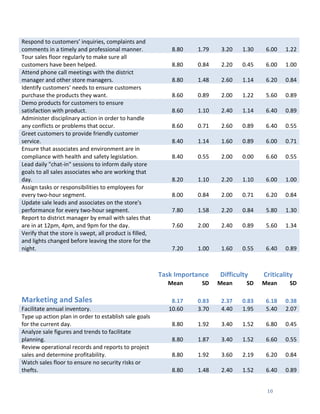
Respond	
  to	
  customers’	
  inquiries,	
  complaints	
  and	
  
comments	
  in	
  a	
  timely	
  and	
  professional	
  manner.	
   8.80	
   1.79	
   3.20	
   1.30	
   6.00	
   1.22	
  
Tour	
  sales	
  floor	
  regularly	
  to	
  make	
  sure	
  all	
  
customers	
  have	
  been	
  helped.	
   8.80	
   0.84	
   2.20	
   0.45	
   6.00	
   1.00	
  
Attend	
  phone	
  call	
  meetings	
  with	
  the	
  district	
  
manager	
  and	
  other	
  store	
  managers.	
   8.80	
   1.48	
   2.60	
   1.14	
   6.20	
   0.84	
  
Identify	
  customers’	
  needs	
  to	
  ensure	
  customers	
  
purchase	
  the	
  products	
  they	
  want.	
   8.60	
   0.89	
   2.00	
   1.22	
   5.60	
   0.89	
  
Demo	
  products	
  for	
  customers	
  to	
  ensure	
  
satisfaction	
  with	
  product.	
   8.60	
   1.10	
   2.40	
   1.14	
   6.40	
   0.89	
  
Administer	
  disciplinary	
  action	
  in	
  order	
  to	
  handle	
  
any	
  conflicts	
  or	
  problems	
  that	
  occur.	
   8.60	
   0.71	
   2.60	
   0.89	
   6.40	
   0.55	
  
Greet	
  customers	
  to	
  provide	
  friendly	
  customer	
  
service.	
   8.40	
   1.14	
   1.60	
   0.89	
   6.00	
   0.71	
  
Ensure	
  that	
  associates	
  and	
  environment	
  are	
  in	
  
compliance	
  with	
  health	
  and	
  safety	
  legislation.	
   8.40	
   0.55	
   2.00	
   0.00	
   6.60	
   0.55	
  
Lead	
  daily	
  "chat-­‐in"	
  sessions	
  to	
  inform	
  daily	
  store	
  
goals	
  to	
  all	
  sales	
  associates	
  who	
  are	
  working	
  that	
  
day.	
   8.20	
   1.10	
   2.20	
   1.10	
   6.00	
   1.00	
  
Assign	
  tasks	
  or	
  responsibilities	
  to	
  employees	
  for	
  
every	
  two-­‐hour	
  segment.	
   8.00	
   0.84	
   2.00	
   0.71	
   6.20	
   0.84	
  
Update	
  sale	
  leads	
  and	
  associates	
  on	
  the	
  store's	
  
performance	
  for	
  every	
  two-­‐hour	
  segment.	
   7.80	
   1.58	
   2.20	
   0.84	
   5.80	
   1.30	
  
Report	
  to	
  district	
  manager	
  by	
  email	
  with	
  sales	
  that	
  
are	
  in	
  at	
  12pm,	
  4pm,	
  and	
  9pm	
  for	
  the	
  day.	
   7.60	
   2.00	
   2.40	
   0.89	
   5.60	
   1.34	
  
Verify	
  that	
  the	
  store	
  is	
  swept,	
  all	
  product	
  is	
  filled,	
  
and	
  lights	
  changed	
  before	
  leaving	
  the	
  store	
  for	
  the	
  
night.	
   7.20	
   1.00	
   1.60	
   0.55	
   6.40	
   0.89	
  
	
   Task	
  Importance	


Difficulty	


Criticality	
  
	
   Mean	
   SD	
   Mean	
   SD	
   Mean	
   SD	


Marketing	
  and	
  Sales	
   8.17	
   0.83	
   2.37	
   0.83	
   6.18	
   0.38	
  
Facilitate	
  annual	
  inventory.	
   10.60	
   3.70	
   4.40	
   1.95	
   5.40	
   2.07	
  
Type	
  up	
  action	
  plan	
  in	
  order	
  to	
  establish	
  sale	
  goals	
  
for	
  the	
  current	
  day.	
   8.80	
   1.92	
   3.40	
   1.52	
   6.80	
   0.45	
  
Analyze	
  sale	
  figures	
  and	
  trends	
  to	
  facilitate	
  
planning.	
   8.80	
   1.87	
   3.40	
   1.52	
   6.60	
   0.55	
  
Review	
  operational	
  records	
  and	
  reports	
  to	
  project	
  
sales	
  and	
  determine	
  profitability.	
   8.80	
   1.92	
   3.60	
   2.19	
   6.20	
   0.84	
  
Watch	
  sales	
  floor	
  to	
  ensure	
  no	
  security	
  risks	
  or	
  
thefts.	
   8.80	
   1.48	
   2.40	
   1.52	
   6.40	
   0.89	


   11	


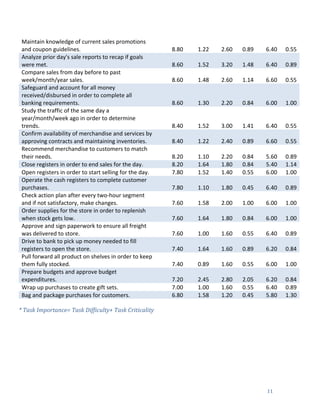
*	
  Task	
  Importance=	
  Task	
  Difficulty+	
  Task	
  Criticality	


Maintain	
  knowledge	
  of	
  current	
  sales	
  promotions	
  
and	
  coupon	
  guidelines.	
   8.80	
   1.22	
   2.60	
   0.89	
   6.40	
   0.55	
  
Analyze	
  prior	
  day's	
  sale	
  reports	
  to	
  recap	
  if	
  goals	
  
were	
  met.	
   8.60	
   1.52	
   3.20	
   1.48	
   6.40	
   0.89	
  
Compare	
  sales	
  from	
  day	
  before	
  to	
  past	
  
week/month/year	
  sales.	
   8.60	
   1.48	
   2.60	
   1.14	
   6.60	
   0.55	
  
Safeguard	
  and	
  account	
  for	
  all	
  money	
  
received/disbursed	
  in	
  order	
  to	
  complete	
  all	
  
banking	
  requirements.	
   8.60	
   1.30	
   2.20	
   0.84	
   6.00	
   1.00	
  
Study	
  the	
  traffic	
  of	
  the	
  same	
  day	
  a	
  
year/month/week	
  ago	
  in	
  order	
  to	
  determine	
  
trends.	
   8.40	
   1.52	
   3.00	
   1.41	
   6.40	
   0.55	
  
Confirm	
  availability	
  of	
  merchandise	
  and	
  services	
  by	
  
approving	
  contracts	
  and	
  maintaining	
  inventories.	
   8.40	
   1.22	
   2.40	
   0.89	
   6.60	
   0.55	
  
Recommend	
  merchandise	
  to	
  customers	
  to	
  match	
  
their	
  needs.	
   8.20	
   1.10	
   2.20	
   0.84	
   5.60	
   0.89	
  
Close	
  registers	
  in	
  order	
  to	
  end	
  sales	
  for	
  the	
  day.	
   8.20	
   1.64	
   1.80	
   0.84	
   5.40	
   1.14	
  
Open	
  registers	
  in	
  order	
  to	
  start	
  selling	
  for	
  the	
  day.	
   7.80	
   1.52	
   1.40	
   0.55	
   6.00	
   1.00	
  
Operate	
  the	
  cash	
  registers	
  to	
  complete	
  customer	
  
purchases.	
   7.80	
   1.10	
   1.80	
   0.45	
   6.40	
   0.89	
  
Check	
  action	
  plan	
  after	
  every	
  two-­‐hour	
  segment	
  
and	
  if	
  not	
  satisfactory,	
  make	
  changes.	
   7.60	
   1.58	
   2.00	
   1.00	
   6.00	
   1.00	
  
Order	
  supplies	
  for	
  the	
  store	
  in	
  order	
  to	
  replenish	
  
when	
  stock	
  gets	
  low.	
   7.60	
   1.64	
   1.80	
   0.84	
   6.00	
   1.00	
  
Approve	
  and	
  sign	
  paperwork	
  to	
  ensure	
  all	
  freight	
  
was	
  delivered	
  to	
  store.	
   7.60	
   1.00	
   1.60	
   0.55	
   6.40	
   0.89	
  
Drive	
  to	
  bank	
  to	
  pick	
  up	
  money	
  needed	
  to	
  fill	
  
registers	
  to	
  open	
  the	
  store.	
   7.40	
   1.64	
   1.60	
   0.89	
   6.20	
   0.84	
  
Pull	
  forward	
  all	
  product	
  on	
  shelves	
  in	
  order	
  to	
  keep	
  
them	
  fully	
  stocked.	
   7.40	
   0.89	
   1.60	
   0.55	
   6.00	
   1.00	
  
Prepare	
  budgets	
  and	
  approve	
  budget	
  
expenditures.	
   7.20	
   2.45	
   2.80	
   2.05	
   6.20	
   0.84	
  
Wrap	
  up	
  purchases	
  to	
  create	
  gift	
  sets.	
   7.00	
   1.00	
   1.60	
   0.55	
   6.40	
   0.89	
  
Bag	
  and	
  package	
  purchases	
  for	
  customers.	
   6.80	
   1.58	
   1.20	
   0.45	
   5.80	
   1.30	


   12	
  
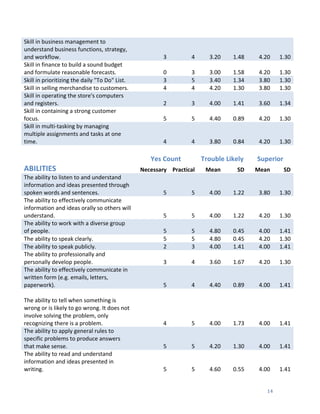
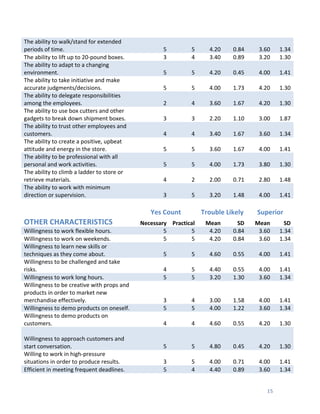
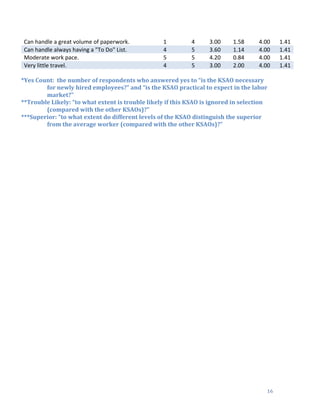
Table	
  1.2	
  
	
   Yes	
  Count	
   Trouble	
  Likely	
   Superior	
  
KNOWLEDGES	
   Necessary	
   Practical	
   Mean	
   SD	
   Mean	
   SD	
  
Knowledge	
  of	
  sales	
  and	
  marketing:	
  
principles	
  and	
  methods	
  for	
  showing,	
  
promoting,	
  and	
  selling	
  products	
  or	
  
services.	
   1	
   3	
   3.00	
   1.58	
   4.00	
   1.00	
  
Knowledge	
  of	
  customer	
  service:	
  
principles	
  and	
  processes	
  for	
  providing	
  
customer	
  and	
  personal	
  services.	
   4	
   5	
   3.80	
   0.84	
   4.80	
   0.45	
  
Knowledge	
  of	
  business	
  and	
  management	
  
principles	
  involved	
  in	
  strategic	
  planning,	
  
resource	
  allocation,	
  human	
  resources	
  
modeling,	
  leadership	
  technique,	
  
production	
  methods,	
  and	
  coordination	
  of	
  
people	
  and	
  resources.	
   1	
   3	
   3.20	
   1.48	
   4.40	
   0.89	
  
Knowledge	
  of	
  principles	
  and	
  procedures	
  
for	
  personnel	
  recruitment	
  and	
  selection.	
   3	
   4	
   3.40	
   0.89	
   4.00	
   1.00	
  
Knowledge	
  of	
  economic	
  and	
  accounting	
  
principles	
  and	
  practices,	
  the	
  financial	
  
markets,	
  banking	
  and	
  the	
  analysis	
  and	
  
reporting	
  of	
  financial	
  data.	
   0	
   4	
   2.80	
   0.84	
   4.20	
   1.10	
  
Knowledge	
  of	
  human	
  behavior	
  and	
  
performance	
  such	
  as:	
  individual	
  
differences	
  in	
  ability,	
  personality,	
  
interests,	
  learning	
  and	
  motivation.	
   4	
   3	
   3.40	
   1.14	
   4.20	
   0.84	
  
Knowledge	
  of	
  principles	
  and	
  methods	
  for	
  
coaching	
  and	
  training,	
  teaching	
  and	
  
instruction	
  for	
  employees.	
   3	
   5	
   3.60	
   1.14	
   4.40	
   0.89	
  
Knowledge	
  of	
  compensation	
  and	
  
benefits,	
  labor	
  relations	
  and	
  negotiation,	
  
and	
  personnel	
  information	
  systems.	
   2	
   3	
   2.80	
   1.10	
   3.80	
   1.30	
  
Knowledge	
  of	
  how	
  to	
  operate	
  computers	
  
and	
  registers.	
   3	
   4	
   3.60	
   1.52	
   3.20	
   1.30	
  
Knowledge	
  of	
  company's	
  mission/values	
  
and	
  culture.	
   2	
   4	
   3.40	
   1.34	
   4.00	
   1.41	
  
Knowledge	
  of	
  mathematics	
  such	
  as:	
  
arithmetics,	
  basic	
  algebra,	
  and	
  statistics.	
   2	
   4	
   3.20	
   1.30	
   3.80	
   1.30	
  
Knowledge	
  of	
  products	
  and	
  services	
  the	
  
company	
  provides.	
   3	
   4	
   3.80	
   1.64	
   3.60	
   1.34	
  
Knowledge	
  of	
  store's	
  operations,	
  policies	
  
and	
  procedures.	
   1	
   4	
   3.60	
   1.67	
   4.00	
   1.41	


   13	


Knowledge	
  of	
  online	
  programs	
  ACES,	
  
Access,	
  and	
  schedule	
  software.	


1	


2	


3.00	


1.22	


3.80	


1.30	
  
Knowledge	
  of	
  procedures	
  to	
  prevent	
  and	
  
handle	
  theft	
  situations.	
   2	
   4	
   3.80	
   1.79	
   4.00	
   1.41	
  
Knowledge	
  of	
  store's	
  returns	
  and	
  
exchange	
  policies.	
   1	
   3	
   3.60	
   1.95	
   4.20	
   1.30	


Yes	
  Count	
   Trouble	
  Likely	
   Superior	
  
SKILLS	
   Necessary	
   Practical	
   Mean	
   SD	
   Mean	
   SD	
  
Skill	
  in	
  leading	
  others	
  by	
  developing	
  a	
  
vision	
  of	
  where/what	
  you	
  want	
  the	
  sales	
  
team	
  to	
  achieve.	
   3	
   5	
   3.80	
   1.30	
   4.20	
   1.30	
  
Skill	
  in	
  time	
  management	
  by	
  making	
  sure	
  
everything	
  gets	
  done	
  within	
  the	
  allotted	
  
time	
  frame	
  given.	
   4	
   4	
   4.20	
   0.84	
   4.20	
   1.30	
  
Skill	
  in	
  listening	
  to	
  customers	
  and	
  
understanding	
  their	
  needs.	
   4	
   5	
   4.20	
   1.10	
   4.20	
   1.30	
  
Skill	
  in	
  providing	
  excellent	
  customer	
  
service.	
   4	
   5	
   4.40	
   0.89	
   4.20	
   1.30	
  
Skill	
  in	
  judgment	
  and	
  decision	
  making	
  by	
  
considering	
  the	
  costs/benefits	
  and	
  to	
  
choose	
  the	
  most	
  appropriate	
  action.	
   3	
   4	
   3.80	
   1.79	
   4.20	
   1.30	
  
Skill	
  in	
  persuading	
  others	
  to	
  change	
  their	
  
mind	
  and	
  behavior.	
   2	
   5	
   3.40	
   1.14	
   4.00	
   1.41	
  
Skill	
  in	
  organizing	
  surroundings	
  and	
  sales	
  
floor.	
   2	
   4	
   3.60	
   1.14	
   4.00	
   1.41	
  
Skill	
  in	
  motivating	
  yourself	
  and	
  other	
  staff	
  
members	
  to	
  achieve	
  goals.	
   4	
   5	
   3.80	
   0.84	
   4.20	
   1.30	
  
Skill	
  in	
  communicating	
  and	
  presenting	
  
information	
  to	
  others	
  effectively.	
   4	
   5	
   3.80	
   1.64	
   4.00	
   1.22	


Skill	
  in	
  collaboration	
  to	
  build	
  morale	
  and	
  
rapport	
  among	
  employees.	


3	


5	


3.40	


1.52	


4.20	


1.30	
  
Skill	
  in	
  using	
  logic	
  and	
  reasoning	
  to	
  
identify	
  the	
  strengths	
  and	
  weaknesses	
  of	
  
alternative	
  solutions,	
  conclusions	
  or	
  
approaches	
  to	
  problems.	
   3	
   4	
   3.80	
   0.84	
   4.20	
   1.30	
  
Skill	
  in	
  monitoring/assessing	
  performance	
  
of	
  yourself,	
  other	
  individuals,	
  or	
  
organizations	
  to	
  make	
  
improvements/take	
  corrective	
  action.	
   3	
   5	
   4.20	
   0.84	
   4.00	
   1.22	


   14	
  
Skill	
  in	
  business	
  management	
  to	
  
understand	
  business	
  functions,	
  strategy,	
  
and	
  workflow.	
   3	
   4	
   3.20	
   1.48	
   4.20	
   1.30	
  
Skill	
  in	
  finance	
  to	
  build	
  a	
  sound	
  budget	
  
and	
  formulate	
  reasonable	
  forecasts.	
   0	
   3	
   3.00	
   1.58	
   4.20	
   1.30	
  
Skill	
  in	
  prioritizing	
  the	
  daily	
  "To	
  Do"	
  List.	
   3	
   5	
   3.40	
   1.34	
   3.80	
   1.30	
  
Skill	
  in	
  selling	
  merchandise	
  to	
  customers.	
   4	
   4	
   4.20	
   1.30	
   3.80	
   1.30	
  
Skill	
  in	
  operating	
  the	
  store's	
  computers	
  
and	
  registers.	
   2	
   3	
   4.00	
   1.41	
   3.60	
   1.34	
  
Skill	
  in	
  containing	
  a	
  strong	
  customer	
  
focus.	
   5	
   5	
   4.40	
   0.89	
   4.20	
   1.30	
  
Skill	
  in	
  multi-­‐tasking	
  by	
  managing	
  
multiple	
  assignments	
  and	
  tasks	
  at	
  one	
  
time.	
   4	
   4	
   3.80	
   0.84	
   4.20	
   1.30	


Yes	
  Count	
   Trouble	
  Likely	
   Superior	
  
ABILITIES	
   Necessary	
   Practical	
   Mean	
   SD	
   Mean	
   SD	
  
The	
  ability	
  to	
  listen	
  to	
  and	
  understand	
  
information	
  and	
  ideas	
  presented	
  through	
  
spoken	
  words	
  and	
  sentences.	
   5	
   5	
   4.00	
   1.22	
   3.80	
   1.30	
  
The	
  ability	
  to	
  effectively	
  communicate	
  
information	
  and	
  ideas	
  orally	
  so	
  others	
  will	
  
understand.	
   5	
   5	
   4.00	
   1.22	
   4.20	
   1.30	
  
The	
  ability	
  to	
  work	
  with	
  a	
  diverse	
  group	
  
of	
  people.	
   5	
   5	
   4.80	
   0.45	
   4.00	
   1.41	
  
The	
  ability	
  to	
  speak	
  clearly.	
   5	
   5	
   4.80	
   0.45	
   4.20	
   1.30	
  
The	
  ability	
  to	
  speak	
  publicly.	
   2	
   3	
   4.00	
   1.41	
   4.00	
   1.41	
  
The	
  ability	
  to	
  professionally	
  and	
  
personally	
  develop	
  people.	
   3	
   4	
   3.60	
   1.67	
   4.20	
   1.30	
  
The	
  ability	
  to	
  effectively	
  communicate	
  in	
  
written	
  form	
  (e.g.	
  emails,	
  letters,	
  
paperwork).	
   5	
   4	
   4.40	
   0.89	
   4.00	
   1.41	


The	
  ability	
  to	
  tell	
  when	
  something	
  is	
  
wrong	
  or	
  is	
  likely	
  to	
  go	
  wrong.	
  It	
  does	
  not	
  
involve	
  solving	
  the	
  problem,	
  only	
  
recognizing	
  there	
  is	
  a	
  problem.	


4	


5	


4.00	


1.73	


4.00	


1.41	
  
The	
  ability	
  to	
  apply	
  general	
  rules	
  to	
  
specific	
  problems	
  to	
  produce	
  answers	
  
that	
  make	
  sense.	
   5	
   5	
   4.20	
   1.30	
   4.00	
   1.41	
  
The	
  ability	
  to	
  read	
  and	
  understand	
  
information	
  and	
  ideas	
  presented	
  in	
  
writing.	
   5	
   5	
   4.60	
   0.55	
   4.00	
   1.41	


   15	
  
The	
  ability	
  to	
  walk/stand	
  for	
  extended	
  
periods	
  of	
  time.	
   5	
   5	
   4.20	
   0.84	
   3.60	
   1.34	
  
The	
  ability	
  to	
  lift	
  up	
  to	
  20-­‐pound	
  boxes.	
   3	
   4	
   3.40	
   0.89	
   3.20	
   1.30	
  
The	
  ability	
  to	
  adapt	
  to	
  a	
  changing	
  
environment.	
   5	
   5	
   4.20	
   0.45	
   4.00	
   1.41	
  
The	
  ability	
  to	
  take	
  initiative	
  and	
  make	
  
accurate	
  judgments/decisions.	
   5	
   5	
   4.00	
   1.73	
   4.20	
   1.30	
  
The	
  ability	
  to	
  delegate	
  responsibilities	
  
among	
  the	
  employees.	
   2	
   4	
   3.60	
   1.67	
   4.20	
   1.30	
  
The	
  ability	
  to	
  use	
  box	
  cutters	
  and	
  other	
  
gadgets	
  to	
  break	
  down	
  shipment	
  boxes.	
   3	
   3	
   2.20	
   1.10	
   3.00	
   1.87	
  
The	
  ability	
  to	
  trust	
  other	
  employees	
  and	
  
customers.	
   4	
   4	
   3.40	
   1.67	
   3.60	
   1.34	
  
The	
  ability	
  to	
  create	
  a	
  positive,	
  upbeat	
  
attitude	
  and	
  energy	
  in	
  the	
  store.	
   5	
   5	
   3.60	
   1.67	
   4.00	
   1.41	
  
The	
  ability	
  to	
  be	
  professional	
  with	
  all	
  
personal	
  and	
  work	
  activities.	
   5	
   5	
   4.00	
   1.73	
   3.80	
   1.30	
  
The	
  ability	
  to	
  climb	
  a	
  ladder	
  to	
  store	
  or	
  
retrieve	
  materials.	
   4	
   2	
   2.00	
   0.71	
   2.80	
   1.48	
  
The	
  ability	
  to	
  work	
  with	
  minimum	
  
direction	
  or	
  supervision.	
   3	
   5	
   3.20	
   1.48	
   4.00	
   1.41	


Yes	
  Count	
   Trouble	
  Likely	
   Superior	
  
OTHER	
  CHARACTERISTICS	
   Necessary	
   Practical	
   Mean	
   SD	
   Mean	
   SD	
  
Willingness	
  to	
  work	
  flexible	
  hours.	
   5	
   5	
   4.20	
   0.84	
   3.60	
   1.34	
  
Willingness	
  to	
  work	
  on	
  weekends.	
   5	
   5	
   4.20	
   0.84	
   3.60	
   1.34	
  
Willingness	
  to	
  learn	
  new	
  skills	
  or	
  
techniques	
  as	
  they	
  come	
  about.	
   5	
   5	
   4.60	
   0.55	
   4.00	
   1.41	
  
Willingness	
  to	
  be	
  challenged	
  and	
  take	
  
risks.	
   4	
   5	
   4.40	
   0.55	
   4.00	
   1.41	
  
Willingness	
  to	
  work	
  long	
  hours.	
   5	
   5	
   3.20	
   1.30	
   3.60	
   1.34	
  
Willingness	
  to	
  be	
  creative	
  with	
  props	
  and	
  
products	
  in	
  order	
  to	
  market	
  new	
  
merchandise	
  effectively.	
   3	
   4	
   3.00	
   1.58	
   4.00	
   1.41	
  
Willingness	
  to	
  demo	
  products	
  on	
  oneself.	
   5	
   5	
   4.00	
   1.22	
   3.60	
   1.34	
  
Willingness	
  to	
  demo	
  products	
  on	
  
customers.	
   4	
   4	
   4.60	
   0.55	
   4.20	
   1.30	
  
Willingness	
  to	
  approach	
  customers	
  and	
  
start	
  conversation.	


5	


5	


4.80	


0.45	


4.20	


1.30	
  
Willing	
  to	
  work	
  in	
  high-­‐pressure	
  
situations	
  in	
  order	
  to	
  produce	
  results.	
   3	
   5	
   4.00	
   0.71	
   4.00	
   1.41	
  
Efficient	
  in	
  meeting	
  frequent	
  deadlines.	
   5	
   4	
   4.40	
   0.89	
   3.60	
   1.34	


   16	
  
Can	
  handle	
  a	
  great	
  volume	
  of	
  paperwork.	
   1	
   4	
   3.00	
   1.58	
   4.00	
   1.41	
  
Can	
  handle	
  always	
  having	
  a	
  "To	
  Do"	
  List.	
   4	
   5	
   3.60	
   1.14	
   4.00	
   1.41	
  
Moderate	
  work	
  pace.	
   5	
   5	
   4.20	
   0.84	
   4.00	
   1.41	
  
Very	
  little	
  travel.	
   4	
   5	
   3.00	
   2.00	
   4.00	
   1.41	


*Yes	
  Count:	
  	
  the	
  number	
  of	
  respondents	
  who	
  answered	
  yes	
  to	
  “is	
  the	
  KSAO	
  necessary	
  
for	
  newly	
  hired	
  employees?”	
  and	
  “is	
  the	
  KSAO	
  practical	
  to	
  expect	
  in	
  the	
  labor	
  
market?”	
  
**Trouble	
  Likely:	
  “to	
  what	
  extent	
  is	
  trouble	
  likely	
  if	
  this	
  KSAO	
  is	
  ignored	
  in	
  selection	
  
(compared	
  with	
  the	
  other	
  KSAOs)?”	
  
***Superior:	
  “to	
  what	
  extent	
  do	
  different	
  levels	
  of	
  the	
  KSAO	
  distinguish	
  the	
  superior	
  
from	
  the	
  average	
  worker	
  (compared	
  with	
  the	
  other	
  KSAOs)?”	


   17	
  
Table	
  1.3	


Knowledges	


Selection?	


Training?	
  
Knowledge	
  of	
  sales	
  and	
  marketing:	
  principles	
  and	
  methods	
  for	
  
showing,	
  promoting,	
  and	
  selling	
  products	
  or	
  services.	


Knowledge	
  of	
  customer	
  service:	
  principles	
  and	
  processes	
  for	
  
providing	
  customer	
  and	
  personal	
  services.	
  
Y	
   	
  
Knowledge	
  of	
  business	
  and	
  management	
  principles	
  involved	
  in	
  
strategic	
  planning,	
  resource	
  allocation,	
  human	
  resources	
  
modeling,	
  leadership	
  technique,	
  production	
  methods,	
  and	
  
coordination	
  of	
  people	
  and	
  resources.	


Knowledge	
  of	
  principles	
  and	
  procedures	
  for	
  personnel	
  
recruitment	
  and	
  selection.	
  
Y	
   	
  
Knowledge	
  of	
  economic	
  and	
  accounting	
  principles	
  and	
  
practices,	
  the	
  financial	
  markets,	
  banking	
  and	
  the	
  analysis	
  and	
  
reporting	
  of	
  financial	
  data.	


Knowledge	
  of	
  human	
  behavior	
  and	
  performance	
  such	
  as:	
  
individual	
  differences	
  in	
  ability,	
  personality,	
  interests,	
  learning	
  
and	
  motivation.	
  
Y	
   	
  
Knowledge	
  of	
  principles	
  and	
  methods	
  for	
  coaching	
  and	
  training,	
  
teaching	
  and	
  instruction	
  for	
  employees.	
  
Y	
   	
  
Knowledge	
  of	
  compensation	
  and	
  benefits,	
  labor	
  relations	
  and	
  
negotiation,	
  and	
  personnel	
  information	
  systems.	


Knowledge	
  of	
  how	
  to	
  operate	
  computers	
  and	
  registers.	
   Y	
   	
  
Knowledge	
  of	
  company's	
  mission/values	
  and	
  culture.	


Knowledge	
  of	
  mathematics	
  such	
  as:	
  arithmetics,	
  basic	
  algebra,	
  
and	
  statistics.	


Knowledge	
  of	
  products	
  and	
  services	
  the	
  company	
  provides.	
   Y	
   	
  
Knowledge	
  of	
  store's	
  operations,	
  policies	
  and	
  procedures.	


Knowledge	
  of	
  online	
  programs	
  ACES,	
  Access,	
  and	
  schedule	
  
software.	
  
	
   Y	
  
Knowledge	
  of	
  procedures	
  to	
  prevent	
  and	
  handle	
  theft	
  
situations.	


Knowledge	
  of	
  store's	
  returns	
  and	
  exchange	
  policies.	


SKILLS	


Selection?	


Training?	
  
Skill	
  in	
  leading	
  others	
  by	
  developing	
  a	
  vision	
  of	
  where/what	
  you	
  
want	
  the	
  sales	
  team	
  to	
  achieve.	
  
Y	
   	
  
Skill	
  in	
  time	
  management	
  by	
  making	
  sure	
  everything	
  gets	
  done	
  
within	
  the	
  allotted	
  time	
  frame	
  given.	
  
Y	
   	
  
Skill	
  in	
  listening	
  to	
  customers	
  and	
  understanding	
  their	
  needs.	
   Y	
   	
  
Skill	
  in	
  providing	
  excellent	
  customer	
  service.	
   Y	


   18	
  
Skill	
  in	
  judgment	
  and	
  decision	
  making	
  by	
  considering	
  the	
  
costs/benefits	
  and	
  to	
  choose	
  the	
  most	
  appropriate	
  action.	
  
Y	
   	
  
Skill	
  in	
  persuading	
  others	
  to	
  change	
  their	
  mind	
  and	
  behavior.	


Skill	
  in	
  organizing	
  surroundings	
  and	
  sales	
  floor.	


Skill	
  in	
  motivating	
  yourself	
  and	
  other	
  staff	
  members	
  to	
  achieve	
  
goals.	
  
Y	
   	
  
Skill	
  in	
  communicating	
  and	
  presenting	
  information	
  to	
  others	
  
effectively.	
  
Y	
   	
  
Skill	
  in	
  collaboration	
  to	
  build	
  morale	
  and	
  rapport	
  among	
  
employees.	
  
Y	
   	
  
Skill	
  in	
  using	
  logic	
  and	
  reasoning	
  to	
  identify	
  the	
  strengths	
  and	
  
weaknesses	
  of	
  alternative	
  solutions,	
  conclusions	
  or	
  approaches	
  
to	
  problems.	
  
Y	
   	
  
Skill	
  in	
  monitoring/assessing	
  performance	
  of	
  yourself,	
  other	
  
individuals,	
  or	
  organizations	
  to	
  make	
  improvements/take	
  
corrective	
  action.	
  
Y	
   	
  
Skill	
  in	
  business	
  management	
  to	
  understand	
  business	
  functions,	
  
strategy,	
  and	
  workflow.	
  
Y	
   	
  
Skill	
  in	
  finance	
  to	
  build	
  a	
  sound	
  budget	
  and	
  formulate	
  
reasonable	
  forecasts.	


Skill	
  in	
  prioritizing	
  the	
  daily	
  "To	
  Do"	
  List.	
   Y	
   	
  
Skill	
  in	
  selling	
  merchandise	
  to	
  customers.	
   Y	
   	
  
Skill	
  in	
  operating	
  the	
  store's	
  computers	
  and	
  registers.	


Skill	
  in	
  containing	
  a	
  strong	
  customer	
  focus.	
   Y	
   	
  
Skill	
  in	
  multi-­‐tasking	
  by	
  managing	
  multiple	
  assignments	
  and	
  
tasks	
  at	
  one	
  time.	
  
Y	


ABILITIES	


Selection?	


Training?	
  
The	
  ability	
  to	
  listen	
  to	
  and	
  understand	
  information	
  and	
  ideas	
  
presented	
  through	
  spoken	
  words	
  and	
  sentences.	
  
Y	
   	
  
The	
  ability	
  to	
  effectively	
  communicate	
  information	
  and	
  ideas	
  
orally	
  so	
  others	
  will	
  understand.	
  
Y	
   	
  
The	
  ability	
  to	
  work	
  with	
  a	
  diverse	
  group	
  of	
  people.	
   Y	
   	
  
The	
  ability	
  to	
  speak	
  clearly.	
   Y	
   	
  
The	
  ability	
  to	
  speak	
  publicly.	


The	
  ability	
  to	
  professionally	
  and	
  personally	
  develop	
  people.	
   Y	
   	
  
The	
  ability	
  to	
  effectively	
  communicate	
  in	
  written	
  form	
  (e.g.	
  
emails,	
  letters,	
  paperwork).	
  
Y	
   	
  
The	
  ability	
  to	
  tell	
  when	
  something	
  is	
  wrong	
  or	
  is	
  likely	
  to	
  go	
  
wrong.	
  It	
  does	
  not	
  involve	
  solving	
  the	
  problem,	
  only	
  
recognizing	
  there	
  is	
  a	
  problem.	
  
Y	
   	
  
The	
  ability	
  to	
  apply	
  general	
  rules	
  to	
  specific	
  problems	
  to	
  
produce	
  answers	
  that	
  make	
  sense.	
  
Y	


   19	
  
The	
  ability	
  to	
  read	
  and	
  understand	
  information	
  and	
  ideas	
  
presented	
  in	
  writing.	
  
Y	
   	
  
The	
  ability	
  to	
  walk/stand	
  for	
  extended	
  periods	
  of	
  time.	
   Y	
   	
  
The	
  ability	
  to	
  lift	
  up	
  to	
  20-­‐pound	
  boxes.	
   Y	
   	
  
The	
  ability	
  to	
  adapt	
  to	
  a	
  changing	
  environment.	
   Y	
   	
  
The	
  ability	
  to	
  take	
  initiative	
  and	
  make	
  accurate	
  
judgments/decisions.	
  
Y	
   	
  
The	
  ability	
  to	
  delegate	
  responsibilities	
  among	
  the	
  employees.	


The	
  ability	
  to	
  use	
  box	
  cutters	
  and	
  other	
  gadgets	
  to	
  break	
  down	
  
shipment	
  boxes.	
  
Y	
   	
  
The	
  ability	
  to	
  trust	
  other	
  employees	
  and	
  customers.	
   Y	
   	
  
The	
  ability	
  to	
  create	
  a	
  positive,	
  upbeat	
  attitude	
  and	
  energy	
  in	
  
the	
  store.	
  
Y	
   	
  
The	
  ability	
  to	
  be	
  professional	
  with	
  all	
  personal	
  and	
  work	
  
activities.	
  
Y	
   	
  
The	
  ability	
  to	
  climb	
  a	
  ladder	
  to	
  store	
  or	
  retrieve	
  materials.	


The	
  ability	
  to	
  work	
  with	
  minimum	
  direction	
  or	
  supervision.	
   Y	


OTHER	
  CHARACTERISTICS	


Selection?	


Training?	
  
Willingness	
  to	
  work	
  flexible	
  hours.	
   Y	
   	
  
Willingness	
  to	
  work	
  on	
  weekends.	
   Y	
   	
  
Willingness	
  to	
  learn	
  new	
  skills	
  or	
  techniques	
  as	
  they	
  come	
  
about.	
  
Y	
   	
  
Willingness	
  to	
  be	
  challenged	
  and	
  take	
  risks.	
   Y	
   	
  
Willingness	
  to	
  work	
  long	
  hours.	
   Y	
   	
  
Willingness	
  to	
  be	
  creative	
  with	
  props	
  and	
  products	
  in	
  order	
  to	
  
market	
  new	
  merchandise	
  effectively.	
  
Y	
   	
  
Willingness	
  to	
  demo	
  products	
  on	
  oneself.	
   Y	
   	
  
Willingness	
  to	
  demo	
  products	
  on	
  customers.	
   Y	
   	
  
Willingness	
  to	
  approach	
  customers	
  and	
  start	
  conversation.	
   Y	
   	
  
Willing	
  to	
  work	
  in	
  high-­‐pressure	
  situations	
  in	
  order	
  to	
  produce	
  
results.	
  
Y	
   	
  
Efficient	
  in	
  meeting	
  frequent	
  deadlines.	
   Y	
   	
  
Can	
  handle	
  a	
  great	
  volume	
  of	
  paperwork.	


Can	
  handle	
  always	
  having	
  a	
  "To	
  Do"	
  List.	
   Y	
   	
  
Moderate	
  work	
  pace.	
   Y	
   	
  
Very	
  little	
  travel.	
   Y	


   20	


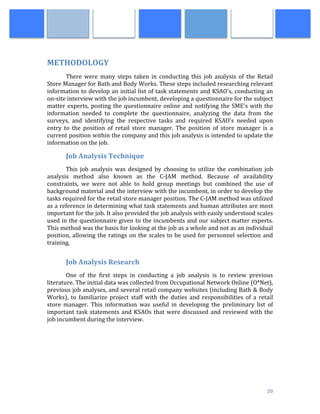
METHODOLOGY	
  
There	
   were	
   many	
   steps	
   taken	
   in	
   conducting	
   this	
   job	
   analysis	
   of	
   the	
   Retail	
  
Store	
  Manager	
  for	
  Bath	
  and	
  Body	
  Works.	
  These	
  steps	
  included	
  researching	
  relevant	
  
information	
  to	
  develop	
  an	
  initial	
  list	
  of	
  task	
  statements	
  and	
  KSAO's,	
  conducting	
  an	
  
on-­‐site	
  interview	
  with	
  the	
  job	
  incumbent,	
  developing	
  a	
  questionnaire	
  for	
  the	
  subject	
  
matter	
  experts,	
  posting	
  the	
  questionnaire	
  online	
  and	
  notifying	
  the	
  SME's	
  with	
  the	
  
information	
   needed	
   to	
   complete	
   the	
   questionnaire,	
   analyzing	
   the	
   data	
   from	
   the	
  
surveys,	
   and	
   identifying	
   the	
   respective	
   tasks	
   and	
   required	
   KSAO's	
   needed	
   upon	
  
entry	
   to	
   the	
   position	
   of	
   retail	
   store	
   manager.	
   The	
   position	
   of	
   store	
   manager	
   is	
   a	
  
current	
  position	
  within	
  the	
  company	
  and	
  this	
  job	
  analysis	
  is	
  intended	
  to	
  update	
  the	
  
information	
  on	
  the	
  job.	
  
Job	
  Analysis	
  Technique	
  
This	
   job	
   analysis	
   was	
   designed	
   by	
   choosing	
   to	
   utilize	
   the	
   combination	
   job	
  
analysis	
   method	
   also	
   known	
   as	
   the	
   C-­‐JAM	
   method.	
   Because	
   of	
   availability	
  
constraints,	
   we	
   were	
   not	
   able	
   to	
   hold	
   group	
   meetings	
   but	
   combined	
   the	
   use	
   of	
  
background	
  material	
  and	
  the	
  interview	
  with	
  the	
  incumbent,	
  in	
  order	
  to	
  develop	
  the	
  
tasks	
  required	
  for	
  the	
  retail	
  store	
  manager	
  position.	
  The	
  C-­‐JAM	
  method	
  was	
  utilized	
  
as	
  a	
  reference	
  in	
  determining	
  what	
  task	
  statements	
  and	
  human	
  attributes	
  are	
  most	
  
important	
  for	
  the	
  job.	
  It	
  also	
  provided	
  the	
  job	
  analysis	
  with	
  easily	
  understood	
  scales	
  
used	
  in	
  the	
  questionnaire	
  given	
  to	
  the	
  incumbents	
  and	
  our	
  subject	
  matter	
  experts.	
  
This	
  method	
  was	
  the	
  basis	
  for	
  looking	
  at	
  the	
  job	
  as	
  a	
  whole	
  and	
  not	
  as	
  an	
  individual	
  
position,	
  allowing	
  the	
  ratings	
  on	
  the	
  scales	
  to	
  be	
  used	
  for	
  personnel	
  selection	
  and	
  
training.	


Job	
  Analysis	
  Research	


   One	
   of	
   the	
   first	
   steps	
   in	
   conducting	
   a	
   job	
   analysis	
   is	
   to	
   review	
   previous	
  
literature.	
  The	
  initial	
  data	
  was	
  collected	
  from	
  Occupational	
  Network	
  Online	
  (O*Net),	
  
previous	
  job	
  analyses,	
  and	
  several	
  retail	
  company	
  websites	
  (including	
  Bath	
  &	
  Body	
  
Works),	
   to	
   familiarize	
   project	
   staff	
   with	
   the	
   duties	
   and	
   responsibilities	
   of	
   a	
   retail	
  
store	
   manager.	
   This	
   information	
   was	
   useful	
   in	
   developing	
   the	
   preliminary	
   list	
   of	
  
important	
  task	
  statements	
  and	
  KSAOs	
  that	
  were	
  discussed	
  and	
  reviewed	
  with	
  the	
  
job	
  incumbent	
  during	
  the	
  interview.	


   21	


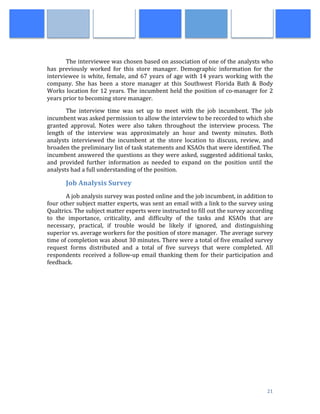
The	
  interviewee	
  was	
  chosen	
  based	
  on	
  association	
  of	
  one	
  of	
  the	
  analysts	
  who	
  
has	
   previously	
   worked	
   for	
   this	
   store	
   manager.	
   Demographic	
   information	
   for	
   the	
  
interviewee	
  is	
  white,	
  female,	
  and	
  67	
  years	
  of	
  age	
  with	
  14	
  years	
  working	
  with	
  the	
  
company.	
   She	
   has	
   been	
   a	
   store	
   manager	
   at	
   this	
   Southwest	
   Florida	
   Bath	
   &	
   Body	
  
Works	
  location	
  for	
  12	
  years.	
  The	
  incumbent	
  held	
  the	
  position	
  of	
  co-­‐manager	
  for	
  2	
  
years	
  prior	
  to	
  becoming	
  store	
  manager.	


   The	
   interview	
   time	
   was	
   set	
   up	
   to	
   meet	
   with	
   the	
   job	
   incumbent.	
   The	
   job	
  
incumbent	
  was	
  asked	
  permission	
  to	
  allow	
  the	
  interview	
  to	
  be	
  recorded	
  to	
  which	
  she	
  
granted	
   approval.	
   Notes	
   were	
   also	
   taken	
   throughout	
   the	
   interview	
   process.	
   The	
  
length	
   of	
   the	
   interview	
   was	
   approximately	
   an	
   hour	
   and	
   twenty	
   minutes.	
   Both	
  
analysts	
   interviewed	
   the	
   incumbent	
   at	
   the	
   store	
   location	
   to	
   discuss,	
   review,	
   and	
  
broaden	
  the	
  preliminary	
  list	
  of	
  task	
  statements	
  and	
  KSAOs	
  that	
  were	
  identified.	
  The	
  
incumbent	
  answered	
  the	
  questions	
  as	
  they	
  were	
  asked,	
  suggested	
  additional	
  tasks,	
  
and	
   provided	
   further	
   information	
   as	
   needed	
   to	
   expand	
   on	
   the	
   position	
   until	
   the	
  
analysts	
  had	
  a	
  full	
  understanding	
  of	
  the	
  position.	
  
Job	
  Analysis	
  Survey	


   A	
  job	
  analysis	
  survey	
  was	
  posted	
  online	
  and	
  the	
  job	
  incumbent,	
  in	
  addition	
  to	
  
four	
  other	
  subject	
  matter	
  experts,	
  was	
  sent	
  an	
  email	
  with	
  a	
  link	
  to	
  the	
  survey	
  using	
  
Qualtrics.	
  The	
  subject	
  matter	
  experts	
  were	
  instructed	
  to	
  fill	
  out	
  the	
  survey	
  according	
  
to	
   the	
   importance,	
   criticality,	
   and	
   difficulty	
   of	
   the	
   tasks	
   and	
   KSAOs	
   that	
   are	
  
necessary,	
   practical,	
   if	
   trouble	
   would	
   be	
   likely	
   if	
   ignored,	
   and	
   distinguishing	
  
superior	
  vs.	
  average	
  workers	
  for	
  the	
  position	
  of	
  store	
  manager.	
  	
  The	
  average	
  survey	
  
time	
  of	
  completion	
  was	
  about	
  30	
  minutes.	
  There	
  were	
  a	
  total	
  of	
  five	
  emailed	
  survey	
  
request	
   forms	
   distributed	
   and	
   a	
   total	
   of	
   five	
   surveys	
   that	
   were	
   completed.	
   All	
  
respondents	
  received	
  a	
  follow-­‐up	
  email	
  thanking	
  them	
  for	
  their	
  participation	
  and	
  
feedback.	


   22	


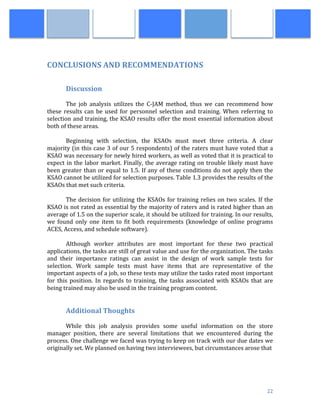
CONCLUSIONS	
  AND	
  RECOMMENDATIONS	


   Discussion	


The	
   job	
   analysis	
   utilizes	
   the	
   C-­‐JAM	
   method,	
   thus	
   we	
   can	
   recommend	
   how	
  
these	
  results	
  can	
  be	
  used	
  for	
  personnel	
  selection	
  and	
  training.	
   When	
  referring	
  to	
  
selection	
  and	
  training,	
  the	
  KSAO	
  results	
  offer	
  the	
  most	
  essential	
  information	
  about	
  
both	
  of	
  these	
  areas.	


Beginning	
   with	
   selection,	
   the	
   KSAOs	
   must	
   meet	
   three	
   criteria.	
   A	
   clear	
  
majority	
  (in	
  this	
  case	
  3	
  of	
  our	
  5	
  respondents)	
  of	
  the	
  raters	
  must	
  have	
  voted	
  that	
  a	
  
KSAO	
  was	
  necessary	
  for	
  newly	
  hired	
  workers,	
  as	
  well	
  as	
  voted	
  that	
  it	
  is	
  practical	
  to	
  
expect	
  in	
  the	
  labor	
  market.	
  Finally,	
  the	
  average	
  rating	
  on	
  trouble	
  likely	
  must	
  have	
  
been	
  greater	
  than	
  or	
  equal	
  to	
  1.5.	
  If	
  any	
  of	
  these	
  conditions	
  do	
  not	
  apply	
  then	
  the	
  
KSAO	
  cannot	
  be	
  utilized	
  for	
  selection	
  purposes.	
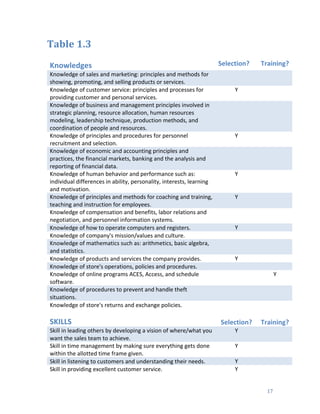
  Table	
  1.3	
  provides	
  the	
  results	
  of	
  the	
  
KSAOs	
  that	
  met	
  such	
  criteria.	


The	
  decision	
  for	
  utilizing	
  the	
  KSAOs	
  for	
  training	
  relies	
  on	
  two	
  scales.	
  If	
  the	
  
KSAO	
  is	
  not	
  rated	
  as	
  essential	
  by	
  the	
  majority	
  of	
  raters	
  and	
  is	
  rated	
  higher	
  than	
  an	
  
average	
  of	
  1.5	
  on	
  the	
  superior	
  scale,	
  it	
  should	
  be	
  utilized	
  for	
  training.	
  In	
  our	
  results,	
  
we	
   found	
   only	
   one	
   item	
   to	
   fit	
   both	
   requirements	
   (knowledge	
   of	
   online	
   programs	
  
ACES,	
  Access,	
  and	
  schedule	
  software).	


   Although	
   worker	
   attributes	
   are	
   most	
   important	
   for	
   these	
   two	
   practical	
  
applications,	
  the	
  tasks	
  are	
  still	
  of	
  great	
  value	
  and	
  use	
  for	
  the	
  organization.	
  The	
  tasks	
  
and	
   their	
   importance	
   ratings	
   can	
   assist	
   in	
   the	
   design	
   of	
   work	
   sample	
   tests	
   for	
  
selection.	
   Work	
   sample	
   tests	
   must	
   have	
   items	
   that	
   are	
   representative	
   of	
   the	
  
important	
  aspects	
  of	
  a	
  job,	
  so	
  these	
  tests	
  may	
  utilize	
  the	
  tasks	
  rated	
  most	
  important	
  
for	
   this	
   position.	
   In	
   regards	
   to	
   training,	
   the	
   tasks	
   associated	
   with	
   KSAOs	
   that	
   are	
  
being	
  trained	
  may	
  also	
  be	
  used	
  in	
  the	
  training	
  program	
  content.	


Additional	
  Thoughts	


   While	
   this	
   job	
   analysis	
   provides	
   some	
   useful	
   information	
   on	
   the	
   store	
  
manager	
   position,	
   there	
   are	
   several	
   limitations	
   that	
   we	
   encountered	
   during	
   the	
  
process.	
  One	
  challenge	
  we	
  faced	
  was	
  trying	
  to	
  keep	
  on	
  track	
  with	
  our	
  due	
  dates	
  we	
  
originally	
  set.	
  We	
  planned	
  on	
  having	
  two	
  interviewees,	
  but	
  circumstances	
  arose	
  that	


   23	


only	
  allowed	
  us	
  to	
  interview	
  one	
  incumbent.	
  It	
  might	
  have	
  been	
  beneficial	
  if	
  we	
  had	
  
utilized	
   a	
   Gantt	
   chart	
   or	
   created	
   stricter	
   deadlines	
   so	
   that	
   our	
   interviewees	
   had	
  
exact	
  timeframes	
  of	
  when	
  the	
  interview	
  and	
  questionnaires	
  responses	
  needed	
  to	
  be	
  
completed.	


Another	
   challenge	
   encountered	
   was	
   only	
   being	
   able	
   to	
   use	
   our	
   results	
   for	
  
selection	
   and	
   training	
   purposes.	
   Job	
   analyses	
   have	
   countless	
   other	
   purposes	
   of	
  
interest	
  to	
  organizations	
  including:	
  job	
  classifications,	
  job	
  evaluations,	
  performance	
  
appraisals,	
  workforce	
  planning,	
  efficiency	
  and	
  safety.	
  Since	
  our	
  group	
  only	
  used	
  the	
  
C-­‐JAM	
  method	
  to	
  design	
  the	
  job	
  analysis,	
  our	
  results	
  could	
  only	
  apply	
  to	
  practical	
  
implications	
   in	
   the	
   selection	
   and	
   training	
   domains.	
   For	
   future	
   job	
   analyses,	
   we	
  
recommend	
  utilizing	
  various	
  methods	
  so	
  results	
  can	
  serve	
  for	
  multiple	
  purposes.	


What	
  we	
  learned	
  from	
  this	
  experience	
  is	
  that	
  a	
  job	
  analysis	
  is	
  an	
  extensive	
  
process.	
  Initially,	
  we	
  anticipated	
  that	
  writing	
  the	
  task	
  statements	
  and	
  KSAOs	
  was	
  
going	
  to	
  be	
  a	
  quick	
  and	
  simple	
  phase	
  of	
  the	
  project.	
  However,	
  this	
  took	
  more	
  time	
  
and	
  editing	
  than	
  expected.	
  Although	
  it	
  did	
  seem	
  like	
  a	
  tedious	
  step,	
  it	
  provided	
  our	
  
project	
  staff	
  with	
  practice	
  in	
  writing	
  effective	
  and	
  good	
  task	
  statements/KSAOs.	
  We	
  
learned	
  a	
  good	
  task	
  statement	
  is	
  one	
  that	
  is	
  clear	
  and	
  easy	
  to	
  read,	
  free	
  of	
  jargon,	
  
specific	
  and	
  describes	
  what	
  is	
  done/how.	


Also	
  through	
  this	
  project	
  we	
  have	
  learned	
  that	
  a	
  job	
  analysis	
  can	
  be	
  of	
  great	
  
importance	
   for	
   employment	
   practices	
   especially	
   when	
   dealing	
   with	
   lawsuits	
   and	
  
court	
   cases.	
   Since	
   our	
   job	
   analysis	
   is	
   useful	
   for	
   the	
   purpose	
   of	
   selection	
   it	
   is	
  
extremely	
   important	
   that	
   the	
   job	
   analysis	
   is	
   legally	
   defensible.	
   The	
   job	
   analysts	
  
should	
  make	
  sure	
  that	
  all	
  the	
  information	
  being	
  produced	
  is	
  job	
  related,	
  to	
  make	
  
sure	
  to	
  document	
  every	
  step	
  of	
  the	
  process,	
  utilize	
  multiple	
  collection	
  methods,	
  have	
  
a	
  variety	
  of	
  sources,	
  and	
  have	
  diverse	
  respondents.	
  These	
  are	
  critical	
  elements	
  in	
  
providing	
  legal	
  support	
  for	
  the	
  job	
  analysis.	


   24	


REFERENCES	


Brannick,	
  M.T.,	
  Levine,	
  E.L.,	
  &	
  Morgeson,	
  F.P.	
  (2007).	
  Job	
  and	
  work	
  analysis:	


Methods,	
  research,	
  and	
  applications	
  for	
  human	
  resource	
  management.	
  (2nd	
  
ed.).	
  Los	
  Angeles,	
  CA:	
  Sage	
  Publications,	
  Inc.	


National	
  Center	
  for	
  O*NET	
  Development.	
  11-­‐2022.00.	
  O*NET	
  OnLine.	
  Retrieved	
  	
  
April	
  9,	
  2015,	
  from	
  http://www.onetonline.org/link/summary/11-­‐2022.00	


   25	


APPENDIX	
  A:	
  Job	
  Interview	
  Form	
  
Name of Employee: Marylinda Snowwhite
Job Title: Retail Store Manager
Job Analysts: Diane and Marissa
Company: Bath and Body Works
Location: Bell Tower Shops- Fort Myers, FL
Date: 02/27/15
Initial question:
Describe in as much detail, what your typical workday looks like…
Job Criteria:
What is the official job title for the position you hold?
How long have you worked at this company?
How long have you worked in this position?
Did you hold a position in the company before?
Did you hold an equivalent position in another company before?
What are job titles of people above you that you report to each day?
What are job titles of people below you that report to you each day?
What educational requirements or education equivalents are there for this
position?
What would be the minimum qualifications for this position?
What additional qualifications would be beneficial to the job?
What types of prior work experience are essential for effective performance in
this job?
How long (months/years are needed?)
What does it take to do your job?
Explain some of the toughest elements of your work.
Who else would have the best understanding of your role?
Supervisor Interview:
What would bare minimum qualifications for an applicant look like?
What additional qualifications would be beneficial to the job?
What activities would you want to see a job applicant performing before hiring or
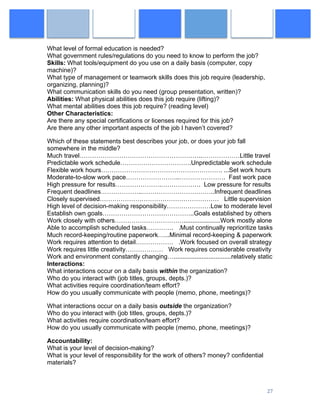
promoting them?
What information would you need to select the right person for the job?
What types of prior work experience, knowledge, skills, are essential for effective
performance in this job?
How do you know when this person has done good or bad work?
 
	
   26	
  
Major Functions:
What is the main reason/purpose for this job’s existence?
What wouldn’t happen if this job were vacant?
What are the duties, responsibilities, and essential functions of the job?
We’d like you to think about four or five major functions of the job and what would
they be. If you would please list each of them for us and then we will ask you
some questions about each separately to gather the details on each of them.
(*Ask “Tasks Under Major Function” questions below for each task listed)
What other job-related duties do you perform?
How would you define success in your work?
How do you determine what to do when you show up on the job?
What powers and authorities do you have?
How will your boss know when you have done good or bad work?
What are the time expectations: daily hours? flexible hours? weekend/night
requirements? overtime?
Tasks Under Major Functions:
What are the specific activities or tasks you perform to accomplish the major
function?
Tell me all the steps that you would take to accomplish that.
How do you prepare for the task?
How long does this task take?
Are there follow-up activities?
Non-routine Tasks:
What tasks are performed only occasionally, such as:
• daily?
• weekly?
• monthly?
• quarterly?
• annually?
Tell me all the steps you would take to accomplish that.
How do you prepare for the task?
How long does this task take?
Follow-up activities?
Critical Incidents:
Could you give us an example of critical incident that has occurred?
How was the situation handled?
Ask for one negative situation and one of exemplary performance.
KSAOs: What do you feel you need for the job based on...
Knowledges:
What areas of technical knowledge does this job require?
What knowledge of computer programs is needed for this job?
What knowledge of safety does this job require?
 
	
   27	
  
What level of formal education is needed?
What government rules/regulations do you need to know to perform the job?
Skills: What tools/equipment do you use on a daily basis (computer, copy
machine)?
What type of management or teamwork skills does this job require (leadership,
organizing, planning)?
What communication skills do you need (group presentation, written)?
Abilities: What physical abilities does this job require (lifting)?
What mental abilities does this job require? (reading level)
Other Characteristics:
Are there any special certifications or licenses required for this job?
Are there any other important aspects of the job I haven’t covered?
Which of these statements best describes your job, or does your job fall
somewhere in the middle?
Much travel…………………………………………………..………………Little travel
Predictable work schedule…………………………….Unpredictable work schedule
Flexible work hours…………………………………………………. ...Set work hours
Moderate-to-slow work pace……………………..…………………. Fast work pace
High pressure for results………………….………………. Low pressure for results
Frequent deadlines………………..……………………………..Infrequent deadlines
Closely supervised………………………………………………… Little supervision
High level of decision-making responsibility…………………Low to moderate level
Establish own goals……………………………………..Goals established by others
Work closely with others…………………………….....................Work mostly alone
Able to accomplish scheduled tasks…………. .Must continually reprioritize tasks
Much record-keeping/routine paperwork…...Minimal record-keeping & paperwork
Work requires attention to detail……………… .Work focused on overall strategy
Work requires little creativity……………… Work requires considerable creativity
Work and environment constantly changing….................................relatively static
Interactions:
What interactions occur on a daily basis within the organization?
Who do you interact with (job titles, groups, depts.)?
What activities require coordination/team effort?
How do you usually communicate with people (memo, phone, meetings)?
What interactions occur on a daily basis outside the organization?
Who do you interact with (job titles, groups, depts.)?
What activities require coordination/team effort?
How do you usually communicate with people (memo, phone, meetings)?
Accountability:
What is your level of decision-making?
What is your level of responsibility for the work of others? money? confidential
materials?
 
	
   28	
  
Working Conditions:
Describe your working conditions.
Sitting, standing, walking, indoors, outdoors?
What level of physical activity is required – occasional, moderate, or frequent?
Describe the most physically demanding activity of the position.
Do you have an office on premises?
Are you required to work from home?
Are you required to travel?
Do you work alongside other managers, supervisors, subordinates?
Are you required to work long shifts, weekends, holidays?
What equipment/tools are used on the job?
Are there safety requirements needed for the job?
Training:
What types of KSA would you most want to train incumbents to be highly
effective?
What skills should the incumbent have to develop to ensure he/she will perform
the job as it changes in the future?
Do you see this job position or any specific aspects of this job changing in the
near future?
Demographics:
Gender:
Race:
Age:
Additional Questions/Concerns: Do you have any questions for us?
 
	
   29	
  
APPENDIX B: Job	
  Analysis	
  Questionnaire


The	
  following	
  survey	
  was	
  created	
  to	
  measure	
  various	
  aspects	
  of	
  the	
  Bath	
  and	
  Body	
  
Works	
  Retail	
  Store	
  Manager	
  job	
  position.	


Please	
  answer	
  the	
  following	
  questions	
  to	
  the	
  best	
  of	
  your	
  ability	
  in	
  order	
  to	
  ensure	
  
the	
  most	
  accurate	
  results.	
  The	
  ratings	
  you	
  provide	
  should	
  be	
  based	
  on	
  the	
  job	
  in	
  
general,	
  not	
  on	
  the	
  workers’	
  own	
  job	
  or	
  the	
  positions	
  directly	
  supervised/observed	
  
by	
  the	
  group	
  members.	


We	
  highly	
  value	
  your	
  input	
  and	
  feedback!	


Q1	
  Please	
  rate	
  each	
  task	
  statement	
  based	
  on	
  the	
  level	
  of	
  difficulty	
  (difficulty	
  in	
  
doing	
  a	
  task	
  correctly	
  relative	
  to	
  all	
  other	
  tasks	
  within	
  a	
  single	
  job)	
  using	
  the	
  scale	
  
provided.	


   30	
  
	
   Task	
  Difficulty	


One	
  of	
  
the	
  
easiest	
  
of	
  all	
  
tasks	
  
(1)	
  	
  
Considerably	
  
easier	
  than	
  
most	
  tasks	
  
(2)	
  
Easier	
  
than	
  most	
  
tasks	
  
performed	
  
(3)	
  	
  
Approximately	
  
half	
  of	
  the	
  
tasks	
  are	
  more	
  
difficult,	
  half	
  
less	


(4)	
  	
  
Harder	
  
than	
  most	
  
tasks	
  
performed	
  
(5)	
  	
  
Considerably	
  
harder	
  than	
  
most	
  tasks	
  
performed	
  
(6)	
  	
  
One	
  of	
  
the	
  
most	
  
difficult	
  
of	
  all	
  
tasks	
  
(7)	
  	
  
1.	
  Analyze	
  prior	
  day's	
  
sale	
  reports	
  to	
  recap	
  if	
  
goals	
  were	
  met.	
  	
  
m 	
   m 	
   m 	
   m 	
   m 	
   m 	
   m 	
  
2.	
  Type	
  up	
  action	
  plan	
  
in	
  order	
  to	
  establish	
  
sale	
  goals	
  for	
  the	
  
current	
  day.	
  	
  
m 	
   m 	
   m 	
   m 	
   m 	
   m 	
   m 	
  
3.	
  Analyze	
  sale	
  figures	
  
and	
  trends	
  to	
  facilitate	
  
planning.	
  	
  
m 	
   m 	
   m 	
   m 	
   m 	
   m 	
   m 	
  
4.	
  Study	
  the	
  traffic	
  of	
  
the	
  same	
  day	
  a	
  
year/month/week	
  ago	
  
in	
  order	
  to	
  determine	
  
trends.	
  
m 	
   m 	
   m 	
   m 	
   m 	
   m 	
   m 	
  
5.	
  Report	
  to	
  district	
  
manager	
  by	
  email	
  with	
  
sales	
  that	
  are	
  in	
  at	
  
12pm,	
  4pm,	
  and	
  9pm	
  
for	
  the	
  day.	
  
m 	
   m 	
   m 	
   m 	
   m 	
   m 	
   m 	
  
6.	
  Check	
  action	
  plan	
  
after	
  every	
  2-­‐hour	
  
segment	
  and	
  if	
  not	
  
satisfactory,	
  make	
  
changes.	
  	
  
m 	
   m 	
   m 	
   m 	
   m 	
   m 	
   m 	
  
7.	
  Prepare	
  budgets	
  and	
  
approve	
  budget	
  
expenditures.	
  	
  
m 	
   m 	
   m 	
   m 	
   m 	
   m 	
   m 	
  
8.	
  Review	
  operational	
  
records	
  and	
  reports	
  to	
  
project	
  sales	
  and	
  
determine	
  profitability.	
  
m 	
   m 	
   m 	
   m 	
   m 	
   m 	
   m 	
  
9.	
  Update	
  sale	
  leads	
  
and	
  associates	
  on	
  the	
  
store's	
  performance	
  for	
  
every	
  two-­‐hour	
  
segment.	
  	
  
m 	
   m 	
   m 	
   m 	
   m 	
   m 	
   m 	


   31	
  
10.	
  Compare	
  sales	
  from	
  
day	
  before	
  to	
  past	
  
week/month/year	
  
sales.	
  	
  
m 	
   m 	
   m 	
   m 	
   m 	
   m 	
   m 	
  
11.	
  Lead	
  daily	
  "chat-­‐in"	
  
sessions	
  to	
  inform	
  daily	
  
store	
  goals	
  to	
  all	
  sales	
  
associates	
  who	
  are	
  
working	
  that	
  day.	
  	
  
m 	
   m 	
   m 	
   m 	
   m 	
   m 	
   m 	
  
12.	
  Drive	
  to	
  bank	
  to	
  
pick	
  up	
  money	
  needed	
  
to	
  fill	
  registers	
  to	
  open	
  
the	
  store.	
  	
  
m 	
   m 	
   m 	
   m 	
   m 	
   m 	
   m 	
  
13.	
  Open	
  registers	
  in	
  
order	
  to	
  start	
  selling	
  
for	
  the	
  day.	
  
m 	
   m 	
   m 	
   m 	
   m 	
   m 	
   m 	
  
14.	
  Assign	
  tasks	
  or	
  
responsibilities	
  to	
  
employees	
  for	
  every	
  2-­‐
hour	
  segment.	
  	
  
m 	
   m 	
   m 	
   m 	
   m 	
   m 	
   m 	
  
15.	
  Greet	
  customers	
  to	
  
provide	
  friendly	
  
customer	
  service.	
  	
  
m 	
   m 	
   m 	
   m 	
   m 	
   m 	
   m 	
  
16.	
  Identify	
  customers’	
  
needs	
  to	
  ensure	
  
customers	
  purchase	
  
the	
  products	
  they	
  want.	
  	
  
m 	
   m 	
   m 	
   m 	
   m 	
   m 	
   m 	
  
17.	
  Demo	
  products	
  for	
  
customers	
  to	
  ensure	
  
satisfaction	
  with	
  
product.	
  	
  
m 	
   m 	
   m 	
   m 	
   m 	
   m 	
   m 	
  
18.	
  Recommend	
  
merchandise	
  to	
  
customers	
  to	
  match	
  
their	
  needs.	
  	
  
m 	
   m 	
   m 	
   m 	
   m 	
   m 	
   m 	
  
19.	
  Develop	
  and	
  adjust	
  
weekly	
  schedule	
  for	
  all	
  
employees	
  on	
  ACES	
  
ETM	
  computer	
  
program.	
  	
  
m 	
   m 	
   m 	
   m 	
   m 	
   m 	
   m 	
  
20.	
  Recruit	
  applicants	
  
in	
  order	
  to	
  fill	
  
vacancies	
  in	
  sales	
  team.	
  	
  
m 	
   m 	
   m 	
   m 	
   m 	
   m 	
   m 	
  
21.	
  Review	
  applicant	
  
resumes	
  in	
  order	
  to	
  
m 	
   m 	
   m 	
   m 	
   m 	
   m 	
   m 	


   32	
  
choose	
  applicants	
  for	
  
available	
  positions.	
  	
  
22.	
  Conduct	
  interviews	
  
for	
  potential	
  job	
  
candidates	
  to	
  hire	
  for	
  
open	
  positions.	
  
m 	
   m 	
   m 	
   m 	
   m 	
   m 	
   m 	
  
23.	
  Hire	
  applicants	
  to	
  
fill	
  sales	
  associate	
  
positions,	
  sales	
  lead	
  
positions,	
  and	
  other	
  job	
  
titles.	
  	
  
m 	
   m 	
   m 	
   m 	
   m 	
   m 	
   m 	
  
24.	
  Terminate	
  
employees	
  that	
  are	
  not	
  
meeting	
  performance	
  
standards.	
  
m 	
   m 	
   m 	
   m 	
   m 	
   m 	
   m 	
  
25.	
  Monitor	
  work	
  
performance	
  of	
  sales	
  
leads	
  and	
  associates	
  to	
  
ensure	
  performance	
  
standards	
  are	
  being	
  
met.	
  	
  
m 	
   m 	
   m 	
   m 	
   m 	
   m 	
   m 	
  
26.	
  Respond	
  to	
  
customers’	
  inquiries,	
  
complaints	
  and	
  
comments	
  in	
  a	
  timely	
  
and	
  professional	
  
manner.	
  
m 	
   m 	
   m 	
   m 	
   m 	
   m 	
   m 	
  
27.	
  Watch	
  sales	
  floor	
  to	
  
ensure	
  no	
  security	
  
risks	
  or	
  thefts.	
  	
  
m 	
   m 	
   m 	
   m 	
   m 	
   m 	
   m 	
  
28.	
  Conduct	
  
performance	
  appraisals	
  
and	
  reviews	
  to	
  provide	
  
feedback	
  to	
  employees	
  
on	
  job	
  performance.	
  	
  
m 	
   m 	
   m 	
   m 	
   m 	
   m 	
   m 	
  
29.	
  Coach	
  and	
  mentor	
  
employees	
  in	
  order	
  to	
  
provide	
  professional	
  
development	
  for	
  
associates	
  to	
  become	
  
sales	
  lead	
  or	
  
management.	
  	
  
m 	
   m 	
   m 	
   m 	
   m 	
   m 	
   m 	
  
30.	
  Supervise	
  
subordinates	
  on	
  their	
  
performance	
  and	
  
duties.	
  
m 	
   m 	
   m 	
   m 	
   m 	
   m 	
   m 	


   33	
  
31.	
  Train	
  staff	
  in	
  the	
  
areas	
  of	
  customer	
  
service,	
  product	
  
knowledge,	
  inventory	
  
control,	
  and	
  
merchandising	
  while	
  
offering	
  developmental	
  
opportunities.	
  	
  
m 	
   m 	
   m 	
   m 	
   m 	
   m 	
   m 	
  
32.	
  Administer	
  
disciplinary	
  action	
  in	
  
order	
  to	
  handle	
  any	
  
conflicts	
  or	
  problems	
  
that	
  occur.	
  	
  
m 	
   m 	
   m 	
   m 	
   m 	
   m 	
   m 	
  
33.	
  Organize	
  the	
  
advertising	
  and	
  
promotional	
  displays	
  in	
  
order	
  to	
  successfully	
  
market	
  the	
  products.	
  
m 	
   m 	
   m 	
   m 	
   m 	
   m 	
   m 	
  
34.	
  Motivate	
  employees	
  
to	
  increase	
  sales	
  and	
  
ensure	
  efficiency.	
  
m 	
   m 	
   m 	
   m 	
   m 	
   m 	
   m 	
  
35.	
  Tour	
  sales	
  floor	
  
regularly	
  to	
  make	
  sure	
  
all	
  customers	
  have	
  
been	
  helped.	
  
m 	
   m 	
   m 	
   m 	
   m 	
   m 	
   m 	
  
36.	
  Operate	
  the	
  cash	
  
registers	
  to	
  complete	
  
customer	
  purchases.	
  	
  
m 	
   m 	
   m 	
   m 	
   m 	
   m 	
   m 	
  
37.	
  Bag	
  and	
  package	
  
purchases	
  for	
  
customers.	
  	
  
m 	
   m 	
   m 	
   m 	
   m 	
   m 	
   m 	
  
38.	
  Wrap	
  up	
  purchases	
  
to	
  create	
  gift	
  sets.	
  	
  
m 	
   m 	
   m 	
   m 	
   m 	
   m 	
   m 	
  
39.	
  Attend	
  phone	
  call	
  
meetings	
  with	
  the	
  
district	
  manager	
  and	
  
other	
  store	
  managers.	
  	
  
m 	
   m 	
   m 	
   m 	
   m 	
   m 	
   m 	
  
40.	
  Order	
  supplies	
  for	
  
the	
  store	
  in	
  order	
  to	
  
replenish	
  when	
  stock	
  
gets	
  low.	
  
m 	
   m 	
   m 	
   m 	
   m 	
   m 	
   m 	
  
41.	
  Ensure	
  staff	
  
maintains	
  store	
  
presentation	
  and	
  
supports	
  brand	
  
consistency.	
  	
  
m 	
   m 	
   m 	
   m 	
   m 	
   m 	
   m 	


   34	
  
42.	
  Close	
  registers	
  in	
  
order	
  to	
  end	
  sales	
  for	
  
the	
  day.	
  	
  
m 	
   m 	
   m 	
   m 	
   m 	
   m 	
   m 	
  
43.	
  Verify	
  that	
  the	
  store	
  
is	
  swept,	
  all	
  product	
  is	
  
filled,	
  and	
  lights	
  
changed	
  before	
  leaving	
  
the	
  store	
  for	
  the	
  night.	
  	
  
m 	
   m 	
   m 	
   m 	
   m 	
   m 	
   m 	
  
44.	
  Approve	
  and	
  sign	
  
paperwork	
  to	
  ensure	
  
all	
  freight	
  was	
  
delivered	
  to	
  store.	
  
m 	
   m 	
   m 	
   m 	
   m 	
   m 	
   m 	
  
45.	
  Confirm	
  availability	
  
of	
  merchandise	
  and	
  
services	
  by	
  approving	
  
contracts	
  and	
  
maintaining	
  
inventories.	
  	
  
m 	
   m 	
   m 	
   m 	
   m 	
   m 	
   m 	
  
46.	
  Facilitate	
  payroll	
  
for	
  employees.	
  
m 	
   m 	
   m 	
   m 	
   m 	
   m 	
   m 	
  
47.	
  Facilitate	
  annual	
  
inventory.	
  
m 	
   m 	
   m 	
   m 	
   m 	
   m 	
   m 	
  
48.	
  Oversee	
  stock	
  
levels	
  to	
  make	
  
decisions	
  about	
  stock	
  
control.	
  
m 	
   m 	
   m 	
   m 	
   m 	
   m 	
   m 	
  
49.Maintain	
  knowledge	
  
of	
  current	
  sales	
  
promotions	
  and	
  
coupon	
  guidelines.	
  	
  
m 	
   m 	
   m 	
   m 	
   m 	
   m 	
   m 	
  
50.	
  Ensure	
  that	
  
associates	
  and	
  
environment	
  are	
  in	
  
compliance	
  with	
  health	
  
and	
  safety	
  legislation.	
  	
  
m 	
   m 	
   m 	
   m 	
   m 	
   m 	
   m 	
  
51.	
  Safeguard	
  and	
  
account	
  for	
  all	
  money	
  
received/disbursed	
  in	
  
order	
  to	
  complete	
  all	
  
banking	
  requirements.	
  	
  
m 	
   m 	
   m 	
   m 	
   m 	
   m 	
   m 	
  
52.	
  Pull	
  forward	
  all	
  
product	
  on	
  shelves	
  in	
  
order	
  to	
  keep	
  them	
  
fully	
  stocked.	
  	
  
m 	
   m 	
   m 	
   m 	
   m 	
   m 	
   m 	
  
**	
  Q2	
  was	
  identical	
  in	
  format	
  except	
  respondents	
  were	
  asked	
  about	
  the	
  criticality/	
  
consequences	
  of	
  error	
  of	
  the	
  52	
  tasks.	


   35	
  
Q3	
  Is	
  the	
  Knowledge,	
  Skill,	
  Ability,	
  or	
  Other	
  characteristic	
  necessary	
  for	
  newly	
  hired	
  
employee?	
  
	
   Yes	
  (1)	
   No	
  
(2)	
  
Knowledge	
  of	
  sales	
  and	
  marketing:	
  principles	
  and	
  methods	
  for	
  showing,	
  promoting,	
  and	
  
selling	
  products	
  or	
  services.	
  
m 	
   m 	
  
Knowledge	
  of	
  customer	
  service:	
  principles	
  and	
  processes	
  for	
  providing	
  customer	
  and	
  personal	
  
services.	
  	
  
m 	
   m 	
  
Knowledge	
  of	
  business	
  and	
  management	
  principles	
  involved	
  in	
  strategic	
  planning,	
  resource	
  
allocation,	
  human	
  resources	
  modeling,	
  leadership	
  technique,	
  production	
  methods,	
  and	
  
coordination	
  of	
  people	
  and	
  resources.	
  	
  
m 	
   m 	
  
Knowledge	
  of	
  principles	
  and	
  procedures	
  for	
  personnel	
  recruitment	
  and	
  selection.	
  	
   m 	
   m 	
  
Knowledge	
  of	
  economic	
  and	
  accounting	
  principles	
  and	
  practices,	
  the	
  financial	
  markets,	
  
banking	
  and	
  the	
  analysis	
  and	
  reporting	
  of	
  financial	
  data.	
  	
  
m 	
   m 	
  
Knowledge	
  of	
  human	
  behavior	
  and	
  performance	
  such	
  as:	
  individual	
  differences	
  in	
  ability,	
  
personality,	
  interests,	
  learning	
  and	
  motivation.	
  
m 	
   m 	
  
Knowledge	
  of	
  principles	
  and	
  methods	
  for	
  coaching	
  and	
  training,	
  teaching	
  and	
  instruction	
  for	
  
employees.	
  	
  
m 	
   m 	
  
Knowledge	
  of	
  compensation	
  and	
  benefits,	
  labor	
  relations	
  and	
  negotiation,	
  and	
  personnel	
  
information	
  systems.	
  	
  
m 	
   m 	
  
Knowledge	
  of	
  how	
  to	
  operate	
  computers	
  and	
  registers.	
  	
   m 	
   m 	
  
Knowledge	
  of	
  company's	
  mission/values	
  and	
  culture.	
  	
   m 	
   m 	
  
Knowledge	
  of	
  mathematics	
  such	
  as:	
  arithmetics,	
  basic	
  algebra,	
  and	
  statistics.	
  	
   m 	
   m 	
  
Knowledge	
  of	
  products	
  and	
  services	
  the	
  company	
  provides.	
  	
   m 	
   m 	
  
Knowledge	
  of	
  store's	
  operations,	
  policies	
  and	
  procedures.	
  	
   m 	
   m 	
  
Knowledge	
  of	
  online	
  programs	
  ACES,	
  Access,	
  and	
  schedule	
  software.	
  	
   m 	
   m 	
  
Knowledge	
  of	
  procedures	
  to	
  prevent	
  and	
  handle	
  theft	
  situations.	
  	
   m 	
   m 	
  
Knowledge	
  of	
  store's	
  returns	
  and	
  exchange	
  policies.	
  	
   m 	
   m 	
  
Skill	
  in	
  leading	
  others	
  by	
  developing	
  a	
  vision	
  of	
  where/what	
  you	
  want	
  the	
  sales	
  team	
  to	
  
achieve.	
  	
  
m 	
   m 	
  
Skill	
  in	
  time	
  management	
  by	
  making	
  sure	
  everything	
  gets	
  done	
  within	
  the	
  allotted	
  time	
  frame	
  
given.	
  	
  
m 	
   m 	
  
Skill	
  in	
  listening	
  to	
  customers	
  and	
  understanding	
  their	
  needs.	
  	
   m 	
   m 	
  
Skill	
  in	
  providing	
  excellent	
  customer	
  service.	
  	
   m 	
   m 	
  
Skill	
  in	
  judgment	
  and	
  decision	
  making	
  by	
  considering	
  the	
  costs/benefits	
  and	
  to	
  choose	
  the	
  
most	
  appropriate	
  action.	
  	
  
m 	
   m 	
  
Skill	
  in	
  persuading	
  others	
  to	
  change	
  their	
  mind	
  and	
  behavior.	
  	
   m 	
   m 	
  
Skill	
  in	
  organizing	
  surroundings	
  and	
  sales	
  floor.	
  	
   m 	
   m 	
  
Skill	
  in	
  motivating	
  yourself	
  and	
  other	
  staff	
  members	
  to	
  achieve	
  goals.	
  	
   m 	
   m 	
  
Skill	
  in	
  communicating	
  and	
  presenting	
  information	
  to	
  others	
  effectively.	
  	
   m 	
   m 	


   36	
  
Skill	
  in	
  collaboration	
  to	
  build	
  morale	
  and	
  rapport	
  among	
  employees.	
   m 	
   m 	
  
Skill	
  in	
  using	
  logic	
  and	
  reasoning	
  to	
  identify	
  the	
  strengths	
  and	
  weaknesses	
  of	
  alternative	
  
solutions,	
  conclusions	
  or	
  approaches	
  to	
  problems.	
  
m 	
   m 	
  
Skill	
  in	
  monitoring/assessing	
  performance	
  of	
  yourself,	
  other	
  individuals,	
  or	
  organizations	
  to	
  
make	
  improvements/take	
  corrective	
  action.	
  	
  
m 	
   m 	
  
Skill	
  in	
  business	
  management	
  to	
  understand	
  business	
  functions,	
  strategy,	
  and	
  workflow.	
  	
   m 	
   m 	
  
Skill	
  in	
  finance	
  to	
  build	
  a	
  sound	
  budget	
  and	
  formulate	
  reasonable	
  forecasts.	
  	
   m 	
   m 	
  
Skill	
  in	
  prioritizing	
  the	
  daily	
  "To	
  Do"	
  List.	
  	
   m 	
   m 	
  
Skill	
  in	
  selling	
  merchandise	
  to	
  customers.	
  	
   m 	
   m 	
  
Skill	
  in	
  operating	
  the	
  store's	
  computers	
  and	
  registers.	
  	
   m 	
   m 	
  
Skill	
  in	
  containing	
  a	
  strong	
  customer	
  focus.	
  	
   m 	
   m 	
  
Skill	
  in	
  multi-­‐tasking	
  by	
  managing	
  multiple	
  assignments	
  and	
  tasks	
  at	
  one	
  time.	
   m 	
   m 	
  
The	
  ability	
  to	
  listen	
  to	
  and	
  understand	
  information	
  and	
  ideas	
  presented	
  through	
  spoken	
  
words	
  and	
  sentences.	
  	
  
m 	
   m 	
  
The	
  ability	
  to	
  effectively	
  communicate	
  information	
  and	
  ideas	
  orally	
  so	
  others	
  will	
  understand.	
  	
   m 	
   m 	
  
The	
  ability	
  to	
  work	
  with	
  a	
  diverse	
  group	
  of	
  people.	
  	
   m 	
   m 	
  
The	
  ability	
  to	
  speak	
  clearly.	
  	
   m 	
   m 	
  
The	
  ability	
  to	
  speak	
  publicly.	
  	
   m 	
   m 	
  
The	
  ability	
  to	
  professionally	
  and	
  personally	
  develop	
  people.	
   m 	
   m 	
  
The	
  ability	
  to	
  effectively	
  communicate	
  in	
  written	
  form	
  (e.g.	
  emails,	
  letters,	
  paperwork).	
  	
   m 	
   m 	
  
The	
  ability	
  to	
  tell	
  when	
  something	
  is	
  wrong	
  or	
  is	
  likely	
  to	
  go	
  wrong.	
  	
   m 	
   m 	
  
The	
  ability	
  to	
  apply	
  general	
  rules	
  to	
  specific	
  problems	
  to	
  produce	
  answers	
  that	
  make	
  sense.	
  	
   m 	
   m 	
  
The	
  ability	
  to	
  read	
  and	
  understand	
  information	
  and	
  ideas	
  presented	
  in	
  writing.	
  	
   m 	
   m 	
  
The	
  ability	
  to	
  walk/stand	
  for	
  extended	
  periods	
  of	
  time.	
  	
   m 	
   m 	
  
The	
  ability	
  to	
  lift	
  up	
  to	
  20-­‐pound	
  boxes.	
  	
   m 	
   m 	
  
The	
  ability	
  to	
  adapt	
  to	
  a	
  changing	
  environment.	
  	
   m 	
   m 	
  
The	
  ability	
  to	
  take	
  initiative	
  and	
  make	
  accurate	
  judgments/decisions.	
  	
   m 	
   m 	
  
The	
  ability	
  to	
  delegate	
  responsibilities	
  among	
  the	
  employees.	
  	
   m 	
   m 	
  
The	
  ability	
  to	
  use	
  box	
  cutters	
  and	
  other	
  gadgets	
  to	
  break	
  down	
  shipment	
  boxes.	
  	
   m 	
   m 	
  
The	
  ability	
  to	
  trust	
  other	
  employees	
  and	
  customers.	
   m 	
   m 	
  
The	
  ability	
  to	
  create	
  a	
  positive,	
  upbeat	
  attitude	
  and	
  energy	
  in	
  the	
  store.	
  	
   m 	
   m 	
  
The	
  ability	
  to	
  be	
  professional	
  with	
  all	
  personal	
  and	
  work	
  activities.	
  	
   m 	
   m 	
  
The	
  ability	
  to	
  climb	
  a	
  ladder	
  to	
  store	
  or	
  retrieve	
  materials.	
  	
   m 	
   m 	
  
The	
  ability	
  to	
  work	
  with	
  minimum	
  direction	
  or	
  supervision.	
  	
   m 	
   m 	
  
Willingness	
  to	
  work	
  flexible	
  hours.	
  	
   m 	
   m 	
  
Willingness	
  to	
  work	
  on	
  weekends.	
   m 	
   m 	
  
Willingness	
  to	
  learn	
  new	
  skills	
  or	
  techniques	
  as	
  they	
  come	
  about.	
  	
   m 	
   m 	
  
Willingness	
  to	
  be	
  challenged	
  and	
  take	
  risks.	
  	
   m 	
   m 	


   37	
  
Willingness	
  to	
  work	
  long	
  hours.	
  	
   m 	
   m 	
  
Willingness	
  to	
  be	
  creative	
  with	
  props	
  and	
  products	
  in	
  order	
  to	
  market	
  new	
  merchandise	
  
effectively.	
  	
  
m 	
   m 	
  
Willingness	
  to	
  demo	
  products	
  on	
  oneself.	
  	
   m 	
   m 	
  
Willingness	
  to	
  demo	
  products	
  on	
  customers.	
   m 	
   m 	
  
Willingness	
  to	
  approach	
  customers	
  and	
  start	
  conversation.	
  	
   m 	
   m 	
  
Willing	
  to	
  work	
  in	
  high-­‐pressure	
  situations	
  in	
  order	
  to	
  produce	
  results.	
  (	
   m 	
   m 	
  
Efficient	
  in	
  meeting	
  frequent	
  deadlines.	
  	
   m 	
   m 	
  
Can	
  handle	
  a	
  great	
  volume	
  of	
  paperwork.	
  	
   m 	
   m 	
  
Can	
  handle	
  always	
  having	
  a	
  "To	
  Do"	
  List.	
  	
   m 	
   m 	
  
Moderate	
  work	
  pace.	
  	
   m 	
   m 	
  
Very	
  little	
  travel.	
  	
   m 	
   m 	
  
**Q4	
  was	
  identical	
  in	
  format	
  except	
  respondents	
  were	
  asked	
  about	
  if	
  the	
  KSAO	
  was	
  “practical	
  to	
  
expect	
  in	
  the	
  labor	
  market.”	


   38	
  
Q5	
  To	
  what	
  extent	
  is	
  trouble	
  likely	
  if	
  this	
  Knowledge,	
  Skill,	
  Ability,	
  or	
  Other	
  
characteristic	
  is	
  ignored	
  in	
  selection	
  (compared	
  with	
  other	
  KSAOs)?	
  
	
   1=	
  
Very	
  
little	
  
or	
  
none	
  
(1)	
  
2=	
  To	
  
some	
  
exten
t	
  (2)	
  
3=	
  To	
  
a	
  great	
  
extent	
  
(3)	
  
4=	
  To	
  a	
  
very	
  
great	
  
extent	
  (4)	
  
5=	
  To	
  an	
  
extremel
y	
  great	
  
extent	
  
(5)	
  
Knowledge	
  of	
  sales	
  and	
  marketing:	
  principles	
  and	
  methods	
  for	
  
showing,	
  promoting,	
  and	
  selling	
  products	
  or	
  services.	
  	
  
m 	
   m 	
   m 	
   m 	
   m 	
  
Knowledge	
  of	
  customer	
  service:	
  principles	
  and	
  processes	
  for	
  
providing	
  customer	
  and	
  personal	
  services.	
  
m 	
   m 	
   m 	
   m 	
   m 	
  
Knowledge	
  of	
  business	
  and	
  management	
  principles	
  involved	
  in	
  
strategic	
  planning,	
  resource	
  allocation,	
  human	
  resources	
  
modeling,	
  leadership	
  technique,	
  production	
  methods,	
  and	
  
coordination	
  of	
  people	
  and	
  resources.	
  	
  
m 	
   m 	
   m 	
   m 	
   m 	
  
Knowledge	
  of	
  principles	
  and	
  procedures	
  for	
  personnel	
  
recruitment	
  and	
  selection.	
  	
  
m 	
   m 	
   m 	
   m 	
   m 	
  
Knowledge	
  of	
  economic	
  and	
  accounting	
  principles	
  and	
  practices,	
  
the	
  financial	
  markets,	
  banking	
  and	
  the	
  analysis	
  and	
  reporting	
  of	
  
financial	
  data.	
  
m 	
   m 	
   m 	
   m 	
   m 	
  
Knowledge	
  of	
  human	
  behavior	
  and	
  performance	
  such	
  as:	
  
individual	
  differences	
  in	
  ability,	
  personality,	
  interests,	
  learning	
  
and	
  motivation.	
  (	
  
m 	
   m 	
   m 	
   m 	
   m 	
  
Knowledge	
  of	
  principles	
  and	
  methods	
  for	
  coaching	
  and	
  training,	
  
teaching	
  and	
  instruction	
  for	
  employees.	
  	
  
m 	
   m 	
   m 	
   m 	
   m 	
  
Knowledge	
  of	
  compensation	
  and	
  benefits,	
  labor	
  relations	
  and	
  
negotiation,	
  and	
  personnel	
  information	
  systems.	
  	
  
m 	
   m 	
   m 	
   m 	
   m 	
  
Knowledge	
  of	
  how	
  to	
  operate	
  computers	
  and	
  registers.	
  	
   m 	
   m 	
   m 	
   m 	
   m 	
  
Knowledge	
  of	
  company's	
  mission/values	
  and	
  culture.	
  	
   m 	
   m 	
   m 	
   m 	
   m 	
  
Knowledge	
  of	
  mathematics	
  such	
  as:	
  arithmetics,	
  basic	
  algebra,	
  and	
  
statistics.	
  	
  
m 	
   m 	
   m 	
   m 	
   m 	
  
Knowledge	
  of	
  products	
  and	
  services	
  the	
  company	
  provides.	
  	
   m 	
   m 	
   m 	
   m 	
   m 	
  
Knowledge	
  of	
  store's	
  operations,	
  policies	
  and	
  procedures.	
  	
   m 	
   m 	
   m 	
   m 	
   m 	
  
Knowledge	
  of	
  online	
  programs	
  ACES,	
  Access,	
  and	
  schedule	
  
software.	
  	
  
m 	
   m 	
   m 	
   m 	
   m 	
  
Knowledge	
  of	
  procedures	
  to	
  prevent	
  and	
  handle	
  theft	
  situations.	
  	
   m 	
   m 	
   m 	
   m 	
   m 	
  
Knowledge	
  of	
  store's	
  returns	
  and	
  exchange	
  policies.	
  	
   m 	
   m 	
   m 	
   m 	
   m 	
  
Skill	
  in	
  leading	
  others	
  by	
  developing	
  a	
  vision	
  of	
  where/what	
  you	
  
want	
  the	
  sales	
  team	
  to	
  achieve.	
  	
  
m 	
   m 	
   m 	
   m 	
   m 	
  
Skill	
  in	
  time	
  management	
  by	
  making	
  sure	
  everything	
  gets	
  done	
  
within	
  the	
  allotted	
  time	
  frame	
  given.	
  	
  
m 	
   m 	
   m 	
   m 	
   m 	
  
Skill	
  in	
  listening	
  to	
  customers	
  and	
  understanding	
  their	
  needs.	
  	
   m 	
   m 	
   m 	
   m 	
   m 	


   39	
  
Skill	
  in	
  providing	
  excellent	
  customer	
  service.	
  	
   m 	
   m 	
   m 	
   m 	
   m 	
  
Skill	
  in	
  judgment	
  and	
  decision	
  making	
  by	
  considering	
  the	
  
costs/benefits	
  and	
  to	
  choose	
  the	
  most	
  appropriate	
  action.	
  	
  
m 	
   m 	
   m 	
   m 	
   m 	
  
Skill	
  in	
  persuading	
  others	
  to	
  change	
  their	
  mind	
  and	
  behavior.	
  	
   m 	
   m 	
   m 	
   m 	
   m 	
  
Skill	
  in	
  organizing	
  surroundings	
  and	
  sales	
  floor.	
   m 	
   m 	
   m 	
   m 	
   m 	
  
Skill	
  in	
  motivating	
  yourself	
  and	
  other	
  staff	
  members	
  to	
  achieve	
  
goals.	
  	
  
m 	
   m 	
   m 	
   m 	
   m 	
  
Skill	
  in	
  communicating	
  and	
  presenting	
  information	
  to	
  others	
  
effectively.	
  	
  
m 	
   m 	
   m 	
   m 	
   m 	
  
Skill	
  in	
  collaboration	
  to	
  build	
  morale	
  and	
  rapport	
  among	
  
employees.	
  	
  
m 	
   m 	
   m 	
   m 	
   m 	
  
Skill	
  in	
  using	
  logic	
  and	
  reasoning	
  to	
  identify	
  the	
  strengths	
  and	
  
weaknesses	
  of	
  alternative	
  solutions,	
  conclusions	
  or	
  approaches	
  to	
  
problems.	
  	
  
m 	
   m 	
   m 	
   m 	
   m 	
  
Skill	
  in	
  monitoring/assessing	
  performance	
  of	
  yourself,	
  other	
  
individuals,	
  or	
  organizations	
  to	
  make	
  improvements/take	
  
corrective	
  action.	
  	
  
m 	
   m 	
   m 	
   m 	
   m 	
  
Skill	
  in	
  business	
  management	
  to	
  understand	
  business	
  functions,	
  
strategy,	
  and	
  workflow.	
  	
  
m 	
   m 	
   m 	
   m 	
   m 	
  
Skill	
  in	
  finance	
  to	
  build	
  a	
  sound	
  budget	
  and	
  formulate	
  reasonable	
  
forecasts.	
  	
  
m 	
   m 	
   m 	
   m 	
   m 	
  
Skill	
  in	
  prioritizing	
  the	
  daily	
  "To	
  Do"	
  List.	
  	
   m 	
   m 	
   m 	
   m 	
   m 	
  
Skill	
  in	
  selling	
  merchandise	
  to	
  customers.	
  	
   m 	
   m 	
   m 	
   m 	
   m 	
  
Skill	
  in	
  operating	
  the	
  store's	
  computers	
  and	
  registers.	
  	
   m 	
   m 	
   m 	
   m 	
   m 	
  
Skill	
  in	
  containing	
  a	
  strong	
  customer	
  focus.	
  	
   m 	
   m 	
   m 	
   m 	
   m 	
  
Skill	
  in	
  multi-­‐tasking	
  by	
  managing	
  multiple	
  assignments	
  and	
  tasks	
  
at	
  one	
  time.	
  	
  
m 	
   m 	
   m 	
   m 	
   m 	
  
The	
  ability	
  to	
  listen	
  to	
  and	
  understand	
  information	
  and	
  ideas	
  
presented	
  through	
  spoken	
  words	
  and	
  sentences.	
  
m 	
   m 	
   m 	
   m 	
   m 	
  
The	
  ability	
  to	
  effectively	
  communicate	
  information	
  and	
  ideas	
  
orally	
  so	
  others	
  will	
  understand.	
  	
  
m 	
   m 	
   m 	
   m 	
   m 	
  
The	
  ability	
  to	
  work	
  with	
  a	
  diverse	
  group	
  of	
  people.	
  	
   m 	
   m 	
   m 	
   m 	
   m 	
  
The	
  ability	
  to	
  speak	
  clearly.	
  	
   m 	
   m 	
   m 	
   m 	
   m 	
  
The	
  ability	
  to	
  speak	
  publicly.	
   m 	
   m 	
   m 	
   m 	
   m 	
  
The	
  ability	
  to	
  professionally	
  and	
  personally	
  develop	
  people.	
  	
   m 	
   m 	
   m 	
   m 	
   m 	
  
The	
  ability	
  to	
  effectively	
  communicate	
  in	
  written	
  form	
  (e.g.	
  emails,	
  
letters,	
  paperwork).	
  	
  
m 	
   m 	
   m 	
   m 	
   m 	
  
The	
  ability	
  to	
  tell	
  when	
  something	
  is	
  wrong	
  or	
  is	
  likely	
  to	
  go	
  
wrong.	
  It	
  does	
  not	
  involve	
  solving	
  the	
  problem,	
  only	
  recognizing	
  
there	
  is	
  a	
  problem.	
  
m 	
   m 	
   m 	
   m 	
   m 	
  
The	
  ability	
  to	
  apply	
  general	
  rules	
  to	
  specific	
  problems	
  to	
  produce	
   m 	
   m 	
   m 	
   m 	
   m 	


   40	
  
answers	
  that	
  make	
  sense.	
  	
  
The	
  ability	
  to	
  read	
  and	
  understand	
  information	
  and	
  ideas	
  
presented	
  in	
  writing.	
  
m 	
   m 	
   m 	
   m 	
   m 	
  
The	
  ability	
  to	
  walk/stand	
  for	
  extended	
  periods	
  of	
  time.	
  	
   m 	
   m 	
   m 	
   m 	
   m 	
  
The	
  ability	
  to	
  lift	
  up	
  to	
  20-­‐pound	
  boxes.	
  	
   m 	
   m 	
   m 	
   m 	
   m 	
  
The	
  ability	
  to	
  adapt	
  to	
  a	
  changing	
  environment.	
  	
   m 	
   m 	
   m 	
   m 	
   m 	
  
The	
  ability	
  to	
  take	
  initiative	
  and	
  make	
  accurate	
  
judgments/decisions.	
  	
  
m 	
   m 	
   m 	
   m 	
   m 	
  
The	
  ability	
  to	
  delegate	
  responsibilities	
  among	
  the	
  employees.	
  	
   m 	
   m 	
   m 	
   m 	
   m 	
  
The	
  ability	
  to	
  use	
  box	
  cutters	
  and	
  other	
  gadgets	
  to	
  break	
  down	
  
shipment	
  boxes.	
  	
  
m 	
   m 	
   m 	
   m 	
   m 	
  
The	
  ability	
  to	
  trust	
  other	
  employees	
  and	
  customers.	
  	
   m 	
   m 	
   m 	
   m 	
   m 	
  
The	
  ability	
  to	
  create	
  a	
  positive,	
  upbeat	
  attitude	
  and	
  energy	
  in	
  the	
  
store.	
  	
  
m 	
   m 	
   m 	
   m 	
   m 	
  
The	
  ability	
  to	
  be	
  professional	
  with	
  all	
  personal	
  and	
  work	
  activities.	
  	
   m 	
   m 	
   m 	
   m 	
   m 	
  
The	
  ability	
  to	
  climb	
  a	
  ladder	
  to	
  store	
  or	
  retrieve	
  materials.	
  	
   m 	
   m 	
   m 	
   m 	
   m 	
  
The	
  ability	
  to	
  work	
  with	
  minimum	
  direction	
  or	
  supervision.	
  	
   m 	
   m 	
   m 	
   m 	
   m 	
  
Willingness	
  to	
  work	
  flexible	
  hours.	
  	
   m 	
   m 	
   m 	
   m 	
   m 	
  
Willingness	
  to	
  work	
  on	
  weekends.	
  	
   m 	
   m 	
   m 	
   m 	
   m 	
  
Willingness	
  to	
  learn	
  new	
  skills	
  or	
  techniques	
  as	
  they	
  come	
  about.	
  	
   m 	
   m 	
   m 	
   m 	
   m 	
  
Willingness	
  to	
  be	
  challenged	
  and	
  take	
  risks.	
  	
   m 	
   m 	
   m 	
   m 	
   m 	
  
Willingness	
  to	
  work	
  long	
  hours.	
  	
   m 	
   m 	
   m 	
   m 	
   m 	
  
Willingness	
  to	
  be	
  creative	
  with	
  props	
  and	
  products	
  in	
  order	
  to	
  
market	
  new	
  merchandise	
  effectively.	
  	
  
m 	
   m 	
   m 	
   m 	
   m 	
  
Willingness	
  to	
  demo	
  products	
  on	
  oneself.	
  	
   m 	
   m 	
   m 	
   m 	
   m 	
  
Willingness	
  to	
  demo	
  products	
  on	
  customers.	
  	
   m 	
   m 	
   m 	
   m 	
   m 	
  
Willingness	
  to	
  approach	
  customers	
  and	
  start	
  conversation.	
  	
   m 	
   m 	
   m 	
   m 	
   m 	
  
Willing	
  to	
  work	
  in	
  high-­‐pressure	
  situations	
  in	
  order	
  to	
  produce	
  
results.	
  	
  
m 	
   m 	
   m 	
   m 	
   m 	
  
Efficient	
  in	
  meeting	
  frequent	
  deadlines.	
  	
   m 	
   m 	
   m 	
   m 	
   m 	
  
Can	
  handle	
  a	
  great	
  volume	
  of	
  paperwork.	
  	
   m 	
   m 	
   m 	
   m 	
   m 	
  
Can	
  handle	
  always	
  having	
  a	
  "To	
  Do"	
  List.	
  	
   m 	
   m 	
   m 	
   m 	
   m 	
  
Moderate	
  work	
  pace.	
  	
   m 	
   m 	
   m 	
   m 	
   m 	
  
Very	
  little	
  travel.	
  	
   m 	
   m 	
   m 	
   m 	
   m 	
  
**Q6	
  was identical in format except respondents were asked “to	
  what	
  extent	
  do	
  different	
  levels	
  of	
  the	
  
KSAO	
  distinguish	
  the	
  superior	
  from	
  the	
  average	
  worker."	


   41	


Please	
  provide	
  the	
  following	
  demographic	
  information.	
  (optional)	


Q7	
  Ethnicity	
  origin	
  (or	
  race):	
  How	
  would	
  you	
  best	
  define	
  your	
  ethnicity?	
  
m White	
  	
  
m Hispanic	
  or	
  Latino	
  	
  
m Black	
  or	
  African	
  American	
  	
  
m Native	
  American	
  or	
  American	
  Indian	
  
m Asian/Pacific	
  Islander	
  	
  
m Other	
  	
  ____________________	


Q8	
  What	
  is	
  your	
  gender?	
  
m Male	
  	
  
m Female	
  	
  
m Other	


Q9	
  Please	
  enter	
  your	
  age:	
  (in	
  years)	


Q10	
  What	
  position	
  do	
  you	
  currently	
  hold	
  at	
  Bath	
  and	
  Body	
  Works?	


Thank	
  you	
  for	
  taking	
  the	
  time	
  to	
  complete	
  this	
  survey!	
  Your	
  response	
  has	
  been	
  
recorded.	


   42	


APPENDIX C: Alpha/ICC	
  for	
  Task	
  Importance


Reliability Statistics
Cronbach's
Alpha
Cronbach's
Alpha
Based on
Standardize
d Items
N of
Items
.938 .960 52
Intraclass Correlation Coefficient
Intraclass
Correlationb
95% Confidence Interval F Test with True Value 0
Lower
Bound Upper Bound Value df1 df2 Sig
Single Measures .226a
.082 .719 16.165 4 204 .000
Average
Measures
.938c
.824 .993 16.165 4 204 .000
Two-way mixed effects model where people effects are random and measures effects are fixed.
a. The estimator is the same, whether the interaction effect is present or not.
b. Type C intraclass correlation coefficients using a consistency definition. The between-measure
variance is excluded from the denominator variance.
c. This estimate is computed assuming the interaction effect is absent, because it is not estimable
otherwise.

Job Analysis Project

  • 1.
        1           April  2015    
  • 2.
        2     Table  of  Contents     EXECUTIVE  SUMMARY………………………………………………………………………………………..3     INTRODUCTION………………………………………………………………………………………………….4       Job  Description………………………………………………………………………………………...4     RESULTS…………………………………………………………………………………………………………….5       Survey  Respondents…………………………………………………………………………………5       Statistical  Analysis…….……………………………………………………………………………...5       Survey  Results………………………………………………………………………………………….8         Table  1.1  ………………………………………………………………………………………………....8       Table  1.2  ………………………………………………………………………………………………...12       Table  1.3  ………………………………………………………………………………………………...17     METHODOLOGY…………………………………………………………………………………………………20       Job  Analysis  Technique…………………………...……………………………..………………...20     Job  Analysis  Research……………………………………………………………………………...20       Job  Analysis  Survey………………………………………………………………………………....21     CONCLUSIONS  AND  RECOMMENDATIONS………………………………………………………....  22       Discussion………………………………………………………………….……………………………22       Additional  Thoughts………………………………………………...………………………….…..22     REFERENCES……………………………………………………………………………………………………..24     APPENDIX  A:  Job  Interview  Form……………………………………………………………………….25     APPENDIX  B:  Job  Analysis  Questionnaire…….………………………………………………………29     APPENDIX  C:  Alpha/ICC  for  Task  Importance……………………………………………………...42  
  • 3.
        3       EXECUTIVE  SUMMARY                     This  report  describes  the  procedures  followed  in  the  job  analysis  conducted   for  the  position  of  Retail  Store  Manager  at  Bath  and  Body  Works.  The  purpose  of  this   job  analysis  was  to  identify  and  describe  the  necessary  components  for  the  position   of   a   retail   store   manager.   The   results   from   this   report   can   be   used   for   various   important   management   and   employment   decisions,   such   as:   recruitment   and   selection,  determining  whether  training  is  needed,  and  to  make  sure  certain  legal   requirements  are  met.                   The  process  of  this  job  analysis  included  collecting  preliminary  information   from  multiple  sources  online  about  the  position  and  interviewing  the  job  incumbent   to  identify  the  job  tasks  and  other  characteristics  that  were  the  basis  for  building  the   job  analysis  survey.  This  survey  was  administered  to  several  subject  matter  experts   (SMEs),  including  the  job  incumbent,  the  incumbent's  co-­‐manager,  the  incumbent's   supervisor,  and  two  of  the  incumbent's  subordinates.  This  job  analysis  focused  on   the   tasks,   responsibilities,   knowledges,   skills,   abilities,   and   other   characteristics   (KSAOs)  required  for  the  position.                   Analyses   were   performed   on   the   survey   responses   to   determine   level   of   difficulty,   criticality,   and   the   importance   of   the   job   tasks.   Personal   attributes   including  knowledges,  skills,  abilities,  and  other  characteristics  were  also  analyzed   to  determine  whether  they  were  necessary,  practical,  whether  trouble  was  likely  if   ignored,  and  a  superior  vs.  an  average  worker.                   This  job  analysis  contributes  important  information  on  the  tasks/duties  and   characteristics   for   the   selection   of   the   most   qualified   retail   store   managers.   The   included   data   will   also   detail   how   the   analysis   can   be   utilized   to   determine   what   areas  employees  need  training  on.  Overall,  the  job  analysis  provided  is  an  effective   instrument   for   recruitment/selection   and   training   purposes   by   offering   valuable   information   about   the   job   tasks   and   KSAOs   executed   and   required   for   the   Retail   Store  Manager  at  Bath  and  Body  Works.              
  • 4.
        4     INTRODUCTION   A  job  analysis  is  referred  to  as  the  “process  of  discovery  of  the  nature  of  the   job”   (Brannick   et   al.,   2007).   In   order   to   be   valuable   for   organizations,   the   job   analysis  must  be  done  systematically,  carefully,  and  thoroughly.    Job  analyses  have   many  practical  implications  for  organizations  such  as,  delivering  a  firm  foundation   for   many   important   employment   or   management   decisions,   in   addition   to   being   legally  defensible  in  court.     Bath   and   Body   Works   is   currently   transitioning   into   a   High-­‐Performance   selling   business.   In   result   of   this   vast   company   transformation,   many   of   the   job   positions  are  in  need  of  being  altered  and  brought  up-­‐to-­‐date.  The  purpose  of  this   project  is  to  conduct  an  updated  task  and  KSAO  based  job  analysis  on  a  Retail  Store   Manager  for  Bath  and  Body  Works,  by  describing  what  is  done  on  the  job  and  how.  It   creates  an  overall  description  of  the  job  and  allows  one  to  understand  the  necessary   characteristics   required   to   perform   the   job   effectively.   The   job   analysis   results   provide   essential   information   to   develop   selection   procedures   and   to   design   training  programs  related  to  the  retail  store  manager  position.     Job  Description   The   Retail   Store   Manager   at   Bath   and   Body   Works   is   responsible   for   all   aspects  of  managing  a  single  retail  store  including:     Ø containing  complete  operation  liability  to  achieve  sales,  service,  customer   satisfaction  and  profitability  goals  for  the  store  that  are  in  compliance  with   company  procedures   Ø developing  and  implementing  short-­‐term/long-­‐term  plans  to  achieve  goals   Ø guaranteeing  the  maintenance  of  expected  operational  and  merchandising   standards   Ø ensuring  all  employees  maintain  store  presentation  and  support  brand   consistency   Ø providing  effective  coaching  and  training  to  staff  in  the  areas  of  customer   service,  product  knowledge,  inventory  control  and  merchandising  in  addition   to  offering  developmental  opportunities   Ø handling  all  store  loss  prevention  issues  and  reports  to  District  Manager   regularly        
  • 5.
        5   RESULTS     Survey  Respondents     -­‐Response  Rate  of  Questionnaire:  100%     -­‐Demographics  of  Respondents:   Ethnicity  origin  (race):  White  100%     Gender:  Female  100%       Mean  Age  (in  years):  40.4     Current  Position  Held:              District  Manager  (Supervisor):  1                Store  Manager  (Incumbents):  2                Sales  Leads  (Subordinates):    2     Statistical  Analysis         Data  analyses  were  performed  on  the  results  of  the  questionnaire  given  to   the  job  incumbents  and  subject  matter  experts.  The  item  ratings  (for  both  tasks  and   KSAOs)   of   the   questionnaire   can   be   seen   in   Tables   1.1   and   1.2.   The   mean   and   standard   deviations   were   calculated   to   rank   tasks   in   order   of   importance.   The   rankings   allow   one   to   make   a   clear   decision   on   what   to   select   and/or   train   employees  on.       Intraclass  correlation  coefficient  (ICC)  for  task  importance     The   intraclass   correlation   coefficient   (ICC)   was   calculated   to   assess   the   consistency   between   the   ratings   of   the   five   different   judges   for   task   importance.   With  measuring  consistency,  average  measures  ICC  (see  Appendix  C)  are  identical  to   Cronbach's   alpha.   Average   measures   ICC   tells   you   an   index   for   the   reliability   of   different  raters  averaged  together.  A  high  degree  of  reliability  was  found  for  average   measures  of  ICC  at  .938  with  a  95%  confidence  interval  from  .824-­‐.993.     Single  measures  ICC  tells  you  an  index  for  the  reliability  of  the  ratings  for  one   typical,  single  rater.  A  low  degree  of  reliability  was  found  for  single  measures  of  ICC   at   .226   with   a   95%   confidence   interval   from   .082-­‐.719.   If   this   is   high,   one   might   choose  to  inquire  from  just  one  rater  for  that  sort  of  task.  However,  we  advise  that   you  use  as  many  raters  as  possible  because  this  allows  for  stronger  reliability  and   evidence  for  your  job  analysis.  In  reference  to  our  findings,  our  single  measures  or   reliability  of  one  rater  is  quite  low,  but  constructively  had  a  very  high  consistency   between  our  five  different  raters.    
  • 6.
        6     A.  TASKS     Importance     A  task  importance  value  was  computed  for  each  of  the  52  task  statements.   This   value   is   calculated   by   the   simple   sum   of   task   difficulty   and   criticality.   These   values  as  seen  in  Table  1.1  may  range  from  a  minimum  score  of  2  to  a  maximum  of   14.  The  tasks  were  then  ranked  in  order  from  most  important  to  least  important.   The  mean  scores  and  standard  deviations  for  task  importance,  task  difficulty,  and   task  criticality  can  also  be  found  on  Table  1.1.  These  calculations  were  computed  by     using  the  responses  across  all  five  raters.  This  was  also  done  for  each  of  the  five   major   duties/functions.   The   final   step   in   this   process   was   to   organize   all   tasks   within  major  duties/function  categories  (keeping  tasks  in  order  from  most  to  least   important).       Difficulty     A  task  difficulty  rating  was  computed  for  each  of  the  52  task  statements  by  all   five  raters.  Refer  to  Table  1.1  that  provides  the  means  and  standard  deviations  of   these   difficulty   ratings   for   each   task,   as   well   as   major   duties/functions.   These   ratings  can  range  from  a  minimum  score  of  a  2  to  a  maximum  score  of  a  14  (scale   points  1-­‐7).  The  difficulty  ratings  were  utilized  to  create  the  importance  value  for   each  task.         Criticality/Consequences  of  Error     A  criticality/consequences  of  error  rating  was  computed  for  each  of  the  52   statements  by  all  five  raters.  Table  1.1  provides  the  means  and  standard  deviations   of  these  criticality  ratings  for  each  task,  as  well  as  the  major  duties/functions.  These   ratings  also  can  range  from  a  minimum  score  of  2  to  a  maximum  score  of  a  14  (scale   points  1-­‐7).    The  criticality  ratings  were  also  utilized  to  create  the  importance  value   for  each  task.                  
  • 7.
        7           B.  KSAOs       Necessary     A   necessity   or   “necessary   for   new   worker”   rating   was   generated   for   each   knowledge,   skill,   ability   and   other   characteristics,   by   all   five   raters.   The   rater’s   answer  of  “yes/no”  to  each  KSAO  for  necessity  was  tallied  and  a  total  was  computed   (refer  to  Table  1.2).       Practical     A   practicality   or   “practical   to   expect”   rating   was   computed   for   each   knowledge,   skill,   ability   and   other   characteristic,   by   all   five   raters.   Similar   to   necessity,  the  rater’s  answer  of  “yes/no”  to  each  KSAO  for  practicality  was  tallied   and  a  total  was  computed  (refer  to  Table  1.2).     Trouble  Likely     A  trouble  likely  rating  was  generated  for  each  KSAO  on  a  1-­‐5  scale.  The  mean   and  standard  deviations  as  seen  in  Table  1.2  were  calculated  across  all  the  raters  for   each  KSAO.       Superior     A  superior  from  average  worker  rating  was  generated  for  each  KSAO  on  a  1-­‐5   scale  identical  to  the  trouble  likely  scale.  The  mean  and  standard  deviations  as  seen   in  Table  1.2  were  calculated  across  all  the  raters  for  each  KSAO.                          
  • 8.
        8       Survey  Results     Job  Functions:     Ø Hiring:  the  practice  of  attracting,  selecting,  and  appointing  suitable   candidates  for  a  position  within  the  organization   Ø Scheduling:  specifying  the  order  and  allotted  time  (hours)  each  employee   works  on  a  weekly  basis   Ø Coaching:  acting  as  a  mentor  to  employees  by  supporting  and  guiding  each   employee  in  achieving  their  personal  or  professional  goals   Ø Communicating:  sharing  or  exchanging  information  effectively  among   customers  and  coworkers   Ø Marketing  and  Sales:  learning  clients  needs  and  satisfying  those  needs  by   delivering  the  goods/services       Table  1.1                         Task  Importance                       Difficulty                       Criticality     Mean   SD   Mean   SD   Mean   SD   Hiring   10.52   0.61   4.32   0.48   5.24   0.43   Hire  applicants  to  fill  sales  associate  positions,   sales  lead  positions,  and  other  job  titles.   11.40   2.88   5.00   1.00   5.40   2.07   Recruit  applicants  in  order  to  fill  vacancies  in  sales   team.   10.80   2.77   4.80   0.84   5.40   2.07   Terminate  employees  that  are  not  meeting   performance  standards.   10.40   3.91   4.00   2.00   5.40   2.07   Conduct  interviews  for  potential  job  candidates  to   hire  for  open  positions.   10.20   2.97   4.00   1.41   5.60   2.07   Review  applicant  resumes  in  order  to  choose   applicants  for  available  positions.   9.80   3.19   3.80   0.84   4.40   2.70          
  • 9.
        9   Task  Importance   Difficulty   Criticality     Mean   SD   Mean   SD   Mean   SD   Scheduling   9.80   0.57   3.40   0.57   5.60   0.57   Develop  and  adjust  weekly  schedule  for  all   employees  on  ACES  and  ETM  computer  programs.   10.20   2.74   3.80   1.10   5.20   1.92   Facilitate  payroll  for  employees.   9.40   1.22   3.00   1.22   6.00   1.00         Task  Importance       Difficulty       Criticality     Mean   SD   Mean   SD   Mean   SD     Coaching   9.11   0.50   2.80   0.28   5.86   0.39   Monitor  work  performance  of  sales  leads  and   associates  to  ensure  performance  standards  are   being  met.   9.60   2.49   3.00   1.00   5.20   1.92   Coach  and  mentor  employees  in  order  to  provide   professional  development  for  associates  to   become  sales  lead  or  management.   9.60   1.48   3.20   1.30   5.60   0.55   Train  staff  in  the  areas  of  customer  service,   product  knowledge,  inventory  control,  and   merchandising  while  offering  developmental   opportunities.   9.40   1.30   3.00   1.00   5.80   0.84   Motivate  employees  to  increase  sales  and  ensure   efficiency.   9.40   1.10   2.80   1.10   6.40   0.89   Conduct  performance  appraisals  and  reviews  to   provide  feedback  to  employees  on  job   performance.   8.80   1.14   2.60   1.14   6.00   1.22   Supervise  subordinates  on  their  performance  and   duties.   8.60   0.45   2.60   0.89   6.20   0.84   Ensure  staff  maintains  store  presentation  and   supports  brand  consistency.   8.40   0.84   2.40   0.55   5.80   0.84       Task  Importance       Difficulty       Criticality     Mean   SD   Mean   SD   Mean   SD     Communicating   8.47   0.66   2.43   0.65   6.08   0.29   Organize  the  advertising  and  promotional  displays   in  order  to  successfully  market  the  products.   9.60   1.30   3.80   1.10   6.00   0.71   Oversee  stock  levels  to  make  decisions  about  stock   control.   9.60   1.52   3.60   1.34   6.00   0.71  
  • 10.
        10   Respond  to  customers’  inquiries,  complaints  and   comments  in  a  timely  and  professional  manner.   8.80   1.79   3.20   1.30   6.00   1.22   Tour  sales  floor  regularly  to  make  sure  all   customers  have  been  helped.   8.80   0.84   2.20   0.45   6.00   1.00   Attend  phone  call  meetings  with  the  district   manager  and  other  store  managers.   8.80   1.48   2.60   1.14   6.20   0.84   Identify  customers’  needs  to  ensure  customers   purchase  the  products  they  want.   8.60   0.89   2.00   1.22   5.60   0.89   Demo  products  for  customers  to  ensure   satisfaction  with  product.   8.60   1.10   2.40   1.14   6.40   0.89   Administer  disciplinary  action  in  order  to  handle   any  conflicts  or  problems  that  occur.   8.60   0.71   2.60   0.89   6.40   0.55   Greet  customers  to  provide  friendly  customer   service.   8.40   1.14   1.60   0.89   6.00   0.71   Ensure  that  associates  and  environment  are  in   compliance  with  health  and  safety  legislation.   8.40   0.55   2.00   0.00   6.60   0.55   Lead  daily  "chat-­‐in"  sessions  to  inform  daily  store   goals  to  all  sales  associates  who  are  working  that   day.   8.20   1.10   2.20   1.10   6.00   1.00   Assign  tasks  or  responsibilities  to  employees  for   every  two-­‐hour  segment.   8.00   0.84   2.00   0.71   6.20   0.84   Update  sale  leads  and  associates  on  the  store's   performance  for  every  two-­‐hour  segment.   7.80   1.58   2.20   0.84   5.80   1.30   Report  to  district  manager  by  email  with  sales  that   are  in  at  12pm,  4pm,  and  9pm  for  the  day.   7.60   2.00   2.40   0.89   5.60   1.34   Verify  that  the  store  is  swept,  all  product  is  filled,   and  lights  changed  before  leaving  the  store  for  the   night.   7.20   1.00   1.60   0.55   6.40   0.89     Task  Importance       Difficulty     Criticality     Mean   SD   Mean   SD   Mean   SD     Marketing  and  Sales   8.17   0.83   2.37   0.83   6.18   0.38   Facilitate  annual  inventory.   10.60   3.70   4.40   1.95   5.40   2.07   Type  up  action  plan  in  order  to  establish  sale  goals   for  the  current  day.   8.80   1.92   3.40   1.52   6.80   0.45   Analyze  sale  figures  and  trends  to  facilitate   planning.   8.80   1.87   3.40   1.52   6.60   0.55   Review  operational  records  and  reports  to  project   sales  and  determine  profitability.   8.80   1.92   3.60   2.19   6.20   0.84   Watch  sales  floor  to  ensure  no  security  risks  or   thefts.   8.80   1.48   2.40   1.52   6.40   0.89  
  • 11.
        11     *  Task  Importance=  Task  Difficulty+  Task  Criticality           Maintain  knowledge  of  current  sales  promotions   and  coupon  guidelines.   8.80   1.22   2.60   0.89   6.40   0.55   Analyze  prior  day's  sale  reports  to  recap  if  goals   were  met.   8.60   1.52   3.20   1.48   6.40   0.89   Compare  sales  from  day  before  to  past   week/month/year  sales.   8.60   1.48   2.60   1.14   6.60   0.55   Safeguard  and  account  for  all  money   received/disbursed  in  order  to  complete  all   banking  requirements.   8.60   1.30   2.20   0.84   6.00   1.00   Study  the  traffic  of  the  same  day  a   year/month/week  ago  in  order  to  determine   trends.   8.40   1.52   3.00   1.41   6.40   0.55   Confirm  availability  of  merchandise  and  services  by   approving  contracts  and  maintaining  inventories.   8.40   1.22   2.40   0.89   6.60   0.55   Recommend  merchandise  to  customers  to  match   their  needs.   8.20   1.10   2.20   0.84   5.60   0.89   Close  registers  in  order  to  end  sales  for  the  day.   8.20   1.64   1.80   0.84   5.40   1.14   Open  registers  in  order  to  start  selling  for  the  day.   7.80   1.52   1.40   0.55   6.00   1.00   Operate  the  cash  registers  to  complete  customer   purchases.   7.80   1.10   1.80   0.45   6.40   0.89   Check  action  plan  after  every  two-­‐hour  segment   and  if  not  satisfactory,  make  changes.   7.60   1.58   2.00   1.00   6.00   1.00   Order  supplies  for  the  store  in  order  to  replenish   when  stock  gets  low.   7.60   1.64   1.80   0.84   6.00   1.00   Approve  and  sign  paperwork  to  ensure  all  freight   was  delivered  to  store.   7.60   1.00   1.60   0.55   6.40   0.89   Drive  to  bank  to  pick  up  money  needed  to  fill   registers  to  open  the  store.   7.40   1.64   1.60   0.89   6.20   0.84   Pull  forward  all  product  on  shelves  in  order  to  keep   them  fully  stocked.   7.40   0.89   1.60   0.55   6.00   1.00   Prepare  budgets  and  approve  budget   expenditures.   7.20   2.45   2.80   2.05   6.20   0.84   Wrap  up  purchases  to  create  gift  sets.   7.00   1.00   1.60   0.55   6.40   0.89   Bag  and  package  purchases  for  customers.   6.80   1.58   1.20   0.45   5.80   1.30  
  • 12.
        12   Table  1.2     Yes  Count   Trouble  Likely   Superior   KNOWLEDGES   Necessary   Practical   Mean   SD   Mean   SD   Knowledge  of  sales  and  marketing:   principles  and  methods  for  showing,   promoting,  and  selling  products  or   services.   1   3   3.00   1.58   4.00   1.00   Knowledge  of  customer  service:   principles  and  processes  for  providing   customer  and  personal  services.   4   5   3.80   0.84   4.80   0.45   Knowledge  of  business  and  management   principles  involved  in  strategic  planning,   resource  allocation,  human  resources   modeling,  leadership  technique,   production  methods,  and  coordination  of   people  and  resources.   1   3   3.20   1.48   4.40   0.89   Knowledge  of  principles  and  procedures   for  personnel  recruitment  and  selection.   3   4   3.40   0.89   4.00   1.00   Knowledge  of  economic  and  accounting   principles  and  practices,  the  financial   markets,  banking  and  the  analysis  and   reporting  of  financial  data.   0   4   2.80   0.84   4.20   1.10   Knowledge  of  human  behavior  and   performance  such  as:  individual   differences  in  ability,  personality,   interests,  learning  and  motivation.   4   3   3.40   1.14   4.20   0.84   Knowledge  of  principles  and  methods  for   coaching  and  training,  teaching  and   instruction  for  employees.   3   5   3.60   1.14   4.40   0.89   Knowledge  of  compensation  and   benefits,  labor  relations  and  negotiation,   and  personnel  information  systems.   2   3   2.80   1.10   3.80   1.30   Knowledge  of  how  to  operate  computers   and  registers.   3   4   3.60   1.52   3.20   1.30   Knowledge  of  company's  mission/values   and  culture.   2   4   3.40   1.34   4.00   1.41   Knowledge  of  mathematics  such  as:   arithmetics,  basic  algebra,  and  statistics.   2   4   3.20   1.30   3.80   1.30   Knowledge  of  products  and  services  the   company  provides.   3   4   3.80   1.64   3.60   1.34   Knowledge  of  store's  operations,  policies   and  procedures.   1   4   3.60   1.67   4.00   1.41  
  • 13.
        13     Knowledge  of  online  programs  ACES,   Access,  and  schedule  software.       1       2       3.00       1.22       3.80       1.30   Knowledge  of  procedures  to  prevent  and   handle  theft  situations.   2   4   3.80   1.79   4.00   1.41   Knowledge  of  store's  returns  and   exchange  policies.   1   3   3.60   1.95   4.20   1.30       Yes  Count   Trouble  Likely   Superior   SKILLS   Necessary   Practical   Mean   SD   Mean   SD   Skill  in  leading  others  by  developing  a   vision  of  where/what  you  want  the  sales   team  to  achieve.   3   5   3.80   1.30   4.20   1.30   Skill  in  time  management  by  making  sure   everything  gets  done  within  the  allotted   time  frame  given.   4   4   4.20   0.84   4.20   1.30   Skill  in  listening  to  customers  and   understanding  their  needs.   4   5   4.20   1.10   4.20   1.30   Skill  in  providing  excellent  customer   service.   4   5   4.40   0.89   4.20   1.30   Skill  in  judgment  and  decision  making  by   considering  the  costs/benefits  and  to   choose  the  most  appropriate  action.   3   4   3.80   1.79   4.20   1.30   Skill  in  persuading  others  to  change  their   mind  and  behavior.   2   5   3.40   1.14   4.00   1.41   Skill  in  organizing  surroundings  and  sales   floor.   2   4   3.60   1.14   4.00   1.41   Skill  in  motivating  yourself  and  other  staff   members  to  achieve  goals.   4   5   3.80   0.84   4.20   1.30   Skill  in  communicating  and  presenting   information  to  others  effectively.   4   5   3.80   1.64   4.00   1.22     Skill  in  collaboration  to  build  morale  and   rapport  among  employees.       3       5       3.40       1.52       4.20       1.30   Skill  in  using  logic  and  reasoning  to   identify  the  strengths  and  weaknesses  of   alternative  solutions,  conclusions  or   approaches  to  problems.   3   4   3.80   0.84   4.20   1.30   Skill  in  monitoring/assessing  performance   of  yourself,  other  individuals,  or   organizations  to  make   improvements/take  corrective  action.   3   5   4.20   0.84   4.00   1.22  
  • 14.
        14   Skill  in  business  management  to   understand  business  functions,  strategy,   and  workflow.   3   4   3.20   1.48   4.20   1.30   Skill  in  finance  to  build  a  sound  budget   and  formulate  reasonable  forecasts.   0   3   3.00   1.58   4.20   1.30   Skill  in  prioritizing  the  daily  "To  Do"  List.   3   5   3.40   1.34   3.80   1.30   Skill  in  selling  merchandise  to  customers.   4   4   4.20   1.30   3.80   1.30   Skill  in  operating  the  store's  computers   and  registers.   2   3   4.00   1.41   3.60   1.34   Skill  in  containing  a  strong  customer   focus.   5   5   4.40   0.89   4.20   1.30   Skill  in  multi-­‐tasking  by  managing   multiple  assignments  and  tasks  at  one   time.   4   4   3.80   0.84   4.20   1.30       Yes  Count   Trouble  Likely   Superior   ABILITIES   Necessary   Practical   Mean   SD   Mean   SD   The  ability  to  listen  to  and  understand   information  and  ideas  presented  through   spoken  words  and  sentences.   5   5   4.00   1.22   3.80   1.30   The  ability  to  effectively  communicate   information  and  ideas  orally  so  others  will   understand.   5   5   4.00   1.22   4.20   1.30   The  ability  to  work  with  a  diverse  group   of  people.   5   5   4.80   0.45   4.00   1.41   The  ability  to  speak  clearly.   5   5   4.80   0.45   4.20   1.30   The  ability  to  speak  publicly.   2   3   4.00   1.41   4.00   1.41   The  ability  to  professionally  and   personally  develop  people.   3   4   3.60   1.67   4.20   1.30   The  ability  to  effectively  communicate  in   written  form  (e.g.  emails,  letters,   paperwork).   5   4   4.40   0.89   4.00   1.41     The  ability  to  tell  when  something  is   wrong  or  is  likely  to  go  wrong.  It  does  not   involve  solving  the  problem,  only   recognizing  there  is  a  problem.           4           5           4.00           1.73           4.00           1.41   The  ability  to  apply  general  rules  to   specific  problems  to  produce  answers   that  make  sense.   5   5   4.20   1.30   4.00   1.41   The  ability  to  read  and  understand   information  and  ideas  presented  in   writing.   5   5   4.60   0.55   4.00   1.41  
  • 15.
        15   The  ability  to  walk/stand  for  extended   periods  of  time.   5   5   4.20   0.84   3.60   1.34   The  ability  to  lift  up  to  20-­‐pound  boxes.   3   4   3.40   0.89   3.20   1.30   The  ability  to  adapt  to  a  changing   environment.   5   5   4.20   0.45   4.00   1.41   The  ability  to  take  initiative  and  make   accurate  judgments/decisions.   5   5   4.00   1.73   4.20   1.30   The  ability  to  delegate  responsibilities   among  the  employees.   2   4   3.60   1.67   4.20   1.30   The  ability  to  use  box  cutters  and  other   gadgets  to  break  down  shipment  boxes.   3   3   2.20   1.10   3.00   1.87   The  ability  to  trust  other  employees  and   customers.   4   4   3.40   1.67   3.60   1.34   The  ability  to  create  a  positive,  upbeat   attitude  and  energy  in  the  store.   5   5   3.60   1.67   4.00   1.41   The  ability  to  be  professional  with  all   personal  and  work  activities.   5   5   4.00   1.73   3.80   1.30   The  ability  to  climb  a  ladder  to  store  or   retrieve  materials.   4   2   2.00   0.71   2.80   1.48   The  ability  to  work  with  minimum   direction  or  supervision.   3   5   3.20   1.48   4.00   1.41       Yes  Count   Trouble  Likely   Superior   OTHER  CHARACTERISTICS   Necessary   Practical   Mean   SD   Mean   SD   Willingness  to  work  flexible  hours.   5   5   4.20   0.84   3.60   1.34   Willingness  to  work  on  weekends.   5   5   4.20   0.84   3.60   1.34   Willingness  to  learn  new  skills  or   techniques  as  they  come  about.   5   5   4.60   0.55   4.00   1.41   Willingness  to  be  challenged  and  take   risks.   4   5   4.40   0.55   4.00   1.41   Willingness  to  work  long  hours.   5   5   3.20   1.30   3.60   1.34   Willingness  to  be  creative  with  props  and   products  in  order  to  market  new   merchandise  effectively.   3   4   3.00   1.58   4.00   1.41   Willingness  to  demo  products  on  oneself.   5   5   4.00   1.22   3.60   1.34   Willingness  to  demo  products  on   customers.   4   4   4.60   0.55   4.20   1.30   Willingness  to  approach  customers  and   start  conversation.       5       5       4.80       0.45       4.20       1.30   Willing  to  work  in  high-­‐pressure   situations  in  order  to  produce  results.   3   5   4.00   0.71   4.00   1.41   Efficient  in  meeting  frequent  deadlines.   5   4   4.40   0.89   3.60   1.34  
  • 16.
        16   Can  handle  a  great  volume  of  paperwork.   1   4   3.00   1.58   4.00   1.41   Can  handle  always  having  a  "To  Do"  List.   4   5   3.60   1.14   4.00   1.41   Moderate  work  pace.   5   5   4.20   0.84   4.00   1.41   Very  little  travel.   4   5   3.00   2.00   4.00   1.41     *Yes  Count:    the  number  of  respondents  who  answered  yes  to  “is  the  KSAO  necessary   for  newly  hired  employees?”  and  “is  the  KSAO  practical  to  expect  in  the  labor   market?”   **Trouble  Likely:  “to  what  extent  is  trouble  likely  if  this  KSAO  is  ignored  in  selection   (compared  with  the  other  KSAOs)?”   ***Superior:  “to  what  extent  do  different  levels  of  the  KSAO  distinguish  the  superior   from  the  average  worker  (compared  with  the  other  KSAOs)?”                                          
  • 17.
        17   Table  1.3     Knowledges     Selection?     Training?   Knowledge  of  sales  and  marketing:  principles  and  methods  for   showing,  promoting,  and  selling  products  or  services.     Knowledge  of  customer  service:  principles  and  processes  for   providing  customer  and  personal  services.   Y     Knowledge  of  business  and  management  principles  involved  in   strategic  planning,  resource  allocation,  human  resources   modeling,  leadership  technique,  production  methods,  and   coordination  of  people  and  resources.       Knowledge  of  principles  and  procedures  for  personnel   recruitment  and  selection.   Y     Knowledge  of  economic  and  accounting  principles  and   practices,  the  financial  markets,  banking  and  the  analysis  and   reporting  of  financial  data.       Knowledge  of  human  behavior  and  performance  such  as:   individual  differences  in  ability,  personality,  interests,  learning   and  motivation.   Y     Knowledge  of  principles  and  methods  for  coaching  and  training,   teaching  and  instruction  for  employees.   Y     Knowledge  of  compensation  and  benefits,  labor  relations  and   negotiation,  and  personnel  information  systems.       Knowledge  of  how  to  operate  computers  and  registers.   Y     Knowledge  of  company's  mission/values  and  culture.       Knowledge  of  mathematics  such  as:  arithmetics,  basic  algebra,   and  statistics.       Knowledge  of  products  and  services  the  company  provides.   Y     Knowledge  of  store's  operations,  policies  and  procedures.       Knowledge  of  online  programs  ACES,  Access,  and  schedule   software.     Y   Knowledge  of  procedures  to  prevent  and  handle  theft   situations.       Knowledge  of  store's  returns  and  exchange  policies.       SKILLS     Selection?     Training?   Skill  in  leading  others  by  developing  a  vision  of  where/what  you   want  the  sales  team  to  achieve.   Y     Skill  in  time  management  by  making  sure  everything  gets  done   within  the  allotted  time  frame  given.   Y     Skill  in  listening  to  customers  and  understanding  their  needs.   Y     Skill  in  providing  excellent  customer  service.   Y    
  • 18.
        18   Skill  in  judgment  and  decision  making  by  considering  the   costs/benefits  and  to  choose  the  most  appropriate  action.   Y     Skill  in  persuading  others  to  change  their  mind  and  behavior.       Skill  in  organizing  surroundings  and  sales  floor.       Skill  in  motivating  yourself  and  other  staff  members  to  achieve   goals.   Y     Skill  in  communicating  and  presenting  information  to  others   effectively.   Y     Skill  in  collaboration  to  build  morale  and  rapport  among   employees.   Y     Skill  in  using  logic  and  reasoning  to  identify  the  strengths  and   weaknesses  of  alternative  solutions,  conclusions  or  approaches   to  problems.   Y     Skill  in  monitoring/assessing  performance  of  yourself,  other   individuals,  or  organizations  to  make  improvements/take   corrective  action.   Y     Skill  in  business  management  to  understand  business  functions,   strategy,  and  workflow.   Y     Skill  in  finance  to  build  a  sound  budget  and  formulate   reasonable  forecasts.       Skill  in  prioritizing  the  daily  "To  Do"  List.   Y     Skill  in  selling  merchandise  to  customers.   Y     Skill  in  operating  the  store's  computers  and  registers.       Skill  in  containing  a  strong  customer  focus.   Y     Skill  in  multi-­‐tasking  by  managing  multiple  assignments  and   tasks  at  one  time.   Y       ABILITIES     Selection?     Training?   The  ability  to  listen  to  and  understand  information  and  ideas   presented  through  spoken  words  and  sentences.   Y     The  ability  to  effectively  communicate  information  and  ideas   orally  so  others  will  understand.   Y     The  ability  to  work  with  a  diverse  group  of  people.   Y     The  ability  to  speak  clearly.   Y     The  ability  to  speak  publicly.       The  ability  to  professionally  and  personally  develop  people.   Y     The  ability  to  effectively  communicate  in  written  form  (e.g.   emails,  letters,  paperwork).   Y     The  ability  to  tell  when  something  is  wrong  or  is  likely  to  go   wrong.  It  does  not  involve  solving  the  problem,  only   recognizing  there  is  a  problem.   Y     The  ability  to  apply  general  rules  to  specific  problems  to   produce  answers  that  make  sense.   Y    
  • 19.
        19   The  ability  to  read  and  understand  information  and  ideas   presented  in  writing.   Y     The  ability  to  walk/stand  for  extended  periods  of  time.   Y     The  ability  to  lift  up  to  20-­‐pound  boxes.   Y     The  ability  to  adapt  to  a  changing  environment.   Y     The  ability  to  take  initiative  and  make  accurate   judgments/decisions.   Y     The  ability  to  delegate  responsibilities  among  the  employees.       The  ability  to  use  box  cutters  and  other  gadgets  to  break  down   shipment  boxes.   Y     The  ability  to  trust  other  employees  and  customers.   Y     The  ability  to  create  a  positive,  upbeat  attitude  and  energy  in   the  store.   Y     The  ability  to  be  professional  with  all  personal  and  work   activities.   Y     The  ability  to  climb  a  ladder  to  store  or  retrieve  materials.       The  ability  to  work  with  minimum  direction  or  supervision.   Y       OTHER  CHARACTERISTICS     Selection?     Training?   Willingness  to  work  flexible  hours.   Y     Willingness  to  work  on  weekends.   Y     Willingness  to  learn  new  skills  or  techniques  as  they  come   about.   Y     Willingness  to  be  challenged  and  take  risks.   Y     Willingness  to  work  long  hours.   Y     Willingness  to  be  creative  with  props  and  products  in  order  to   market  new  merchandise  effectively.   Y     Willingness  to  demo  products  on  oneself.   Y     Willingness  to  demo  products  on  customers.   Y     Willingness  to  approach  customers  and  start  conversation.   Y     Willing  to  work  in  high-­‐pressure  situations  in  order  to  produce   results.   Y     Efficient  in  meeting  frequent  deadlines.   Y     Can  handle  a  great  volume  of  paperwork.       Can  handle  always  having  a  "To  Do"  List.   Y     Moderate  work  pace.   Y     Very  little  travel.   Y            
  • 20.
        20     METHODOLOGY   There   were   many   steps   taken   in   conducting   this   job   analysis   of   the   Retail   Store  Manager  for  Bath  and  Body  Works.  These  steps  included  researching  relevant   information  to  develop  an  initial  list  of  task  statements  and  KSAO's,  conducting  an   on-­‐site  interview  with  the  job  incumbent,  developing  a  questionnaire  for  the  subject   matter  experts,  posting  the  questionnaire  online  and  notifying  the  SME's  with  the   information   needed   to   complete   the   questionnaire,   analyzing   the   data   from   the   surveys,   and   identifying   the   respective   tasks   and   required   KSAO's   needed   upon   entry   to   the   position   of   retail   store   manager.   The   position   of   store   manager   is   a   current  position  within  the  company  and  this  job  analysis  is  intended  to  update  the   information  on  the  job.   Job  Analysis  Technique   This   job   analysis   was   designed   by   choosing   to   utilize   the   combination   job   analysis   method   also   known   as   the   C-­‐JAM   method.   Because   of   availability   constraints,   we   were   not   able   to   hold   group   meetings   but   combined   the   use   of   background  material  and  the  interview  with  the  incumbent,  in  order  to  develop  the   tasks  required  for  the  retail  store  manager  position.  The  C-­‐JAM  method  was  utilized   as  a  reference  in  determining  what  task  statements  and  human  attributes  are  most   important  for  the  job.  It  also  provided  the  job  analysis  with  easily  understood  scales   used  in  the  questionnaire  given  to  the  incumbents  and  our  subject  matter  experts.   This  method  was  the  basis  for  looking  at  the  job  as  a  whole  and  not  as  an  individual   position,  allowing  the  ratings  on  the  scales  to  be  used  for  personnel  selection  and   training.     Job  Analysis  Research                   One   of   the   first   steps   in   conducting   a   job   analysis   is   to   review   previous   literature.  The  initial  data  was  collected  from  Occupational  Network  Online  (O*Net),   previous  job  analyses,  and  several  retail  company  websites  (including  Bath  &  Body   Works),   to   familiarize   project   staff   with   the   duties   and   responsibilities   of   a   retail   store   manager.   This   information   was   useful   in   developing   the   preliminary   list   of   important  task  statements  and  KSAOs  that  were  discussed  and  reviewed  with  the   job  incumbent  during  the  interview.                            
  • 21.
        21     The  interviewee  was  chosen  based  on  association  of  one  of  the  analysts  who   has   previously   worked   for   this   store   manager.   Demographic   information   for   the   interviewee  is  white,  female,  and  67  years  of  age  with  14  years  working  with  the   company.   She   has   been   a   store   manager   at   this   Southwest   Florida   Bath   &   Body   Works  location  for  12  years.  The  incumbent  held  the  position  of  co-­‐manager  for  2   years  prior  to  becoming  store  manager.                   The   interview   time   was   set   up   to   meet   with   the   job   incumbent.   The   job   incumbent  was  asked  permission  to  allow  the  interview  to  be  recorded  to  which  she   granted   approval.   Notes   were   also   taken   throughout   the   interview   process.   The   length   of   the   interview   was   approximately   an   hour   and   twenty   minutes.   Both   analysts   interviewed   the   incumbent   at   the   store   location   to   discuss,   review,   and   broaden  the  preliminary  list  of  task  statements  and  KSAOs  that  were  identified.  The   incumbent  answered  the  questions  as  they  were  asked,  suggested  additional  tasks,   and   provided   further   information   as   needed   to   expand   on   the   position   until   the   analysts  had  a  full  understanding  of  the  position.   Job  Analysis  Survey                   A  job  analysis  survey  was  posted  online  and  the  job  incumbent,  in  addition  to   four  other  subject  matter  experts,  was  sent  an  email  with  a  link  to  the  survey  using   Qualtrics.  The  subject  matter  experts  were  instructed  to  fill  out  the  survey  according   to   the   importance,   criticality,   and   difficulty   of   the   tasks   and   KSAOs   that   are   necessary,   practical,   if   trouble   would   be   likely   if   ignored,   and   distinguishing   superior  vs.  average  workers  for  the  position  of  store  manager.    The  average  survey   time  of  completion  was  about  30  minutes.  There  were  a  total  of  five  emailed  survey   request   forms   distributed   and   a   total   of   five   surveys   that   were   completed.   All   respondents  received  a  follow-­‐up  email  thanking  them  for  their  participation  and   feedback.                            
  • 22.
        22       CONCLUSIONS  AND  RECOMMENDATIONS             Discussion       The   job   analysis   utilizes   the   C-­‐JAM   method,   thus   we   can   recommend   how   these  results  can  be  used  for  personnel  selection  and  training.   When  referring  to   selection  and  training,  the  KSAO  results  offer  the  most  essential  information  about   both  of  these  areas.     Beginning   with   selection,   the   KSAOs   must   meet   three   criteria.   A   clear   majority  (in  this  case  3  of  our  5  respondents)  of  the  raters  must  have  voted  that  a   KSAO  was  necessary  for  newly  hired  workers,  as  well  as  voted  that  it  is  practical  to   expect  in  the  labor  market.  Finally,  the  average  rating  on  trouble  likely  must  have   been  greater  than  or  equal  to  1.5.  If  any  of  these  conditions  do  not  apply  then  the   KSAO  cannot  be  utilized  for  selection  purposes.  Table  1.3  provides  the  results  of  the   KSAOs  that  met  such  criteria.       The  decision  for  utilizing  the  KSAOs  for  training  relies  on  two  scales.  If  the   KSAO  is  not  rated  as  essential  by  the  majority  of  raters  and  is  rated  higher  than  an   average  of  1.5  on  the  superior  scale,  it  should  be  utilized  for  training.  In  our  results,   we   found   only   one   item   to   fit   both   requirements   (knowledge   of   online   programs   ACES,  Access,  and  schedule  software).       Although   worker   attributes   are   most   important   for   these   two   practical   applications,  the  tasks  are  still  of  great  value  and  use  for  the  organization.  The  tasks   and   their   importance   ratings   can   assist   in   the   design   of   work   sample   tests   for   selection.   Work   sample   tests   must   have   items   that   are   representative   of   the   important  aspects  of  a  job,  so  these  tests  may  utilize  the  tasks  rated  most  important   for   this   position.   In   regards   to   training,   the   tasks   associated   with   KSAOs   that   are   being  trained  may  also  be  used  in  the  training  program  content.       Additional  Thoughts           While   this   job   analysis   provides   some   useful   information   on   the   store   manager   position,   there   are   several   limitations   that   we   encountered   during   the   process.  One  challenge  we  faced  was  trying  to  keep  on  track  with  our  due  dates  we   originally  set.  We  planned  on  having  two  interviewees,  but  circumstances  arose  that    
  • 23.
        23         only  allowed  us  to  interview  one  incumbent.  It  might  have  been  beneficial  if  we  had   utilized   a   Gantt   chart   or   created   stricter   deadlines   so   that   our   interviewees   had   exact  timeframes  of  when  the  interview  and  questionnaires  responses  needed  to  be   completed.         Another   challenge   encountered   was   only   being   able   to   use   our   results   for   selection   and   training   purposes.   Job   analyses   have   countless   other   purposes   of   interest  to  organizations  including:  job  classifications,  job  evaluations,  performance   appraisals,  workforce  planning,  efficiency  and  safety.  Since  our  group  only  used  the   C-­‐JAM  method  to  design  the  job  analysis,  our  results  could  only  apply  to  practical   implications   in   the   selection   and   training   domains.   For   future   job   analyses,   we   recommend  utilizing  various  methods  so  results  can  serve  for  multiple  purposes.       What  we  learned  from  this  experience  is  that  a  job  analysis  is  an  extensive   process.  Initially,  we  anticipated  that  writing  the  task  statements  and  KSAOs  was   going  to  be  a  quick  and  simple  phase  of  the  project.  However,  this  took  more  time   and  editing  than  expected.  Although  it  did  seem  like  a  tedious  step,  it  provided  our   project  staff  with  practice  in  writing  effective  and  good  task  statements/KSAOs.  We   learned  a  good  task  statement  is  one  that  is  clear  and  easy  to  read,  free  of  jargon,   specific  and  describes  what  is  done/how.     Also  through  this  project  we  have  learned  that  a  job  analysis  can  be  of  great   importance   for   employment   practices   especially   when   dealing   with   lawsuits   and   court   cases.   Since   our   job   analysis   is   useful   for   the   purpose   of   selection   it   is   extremely   important   that   the   job   analysis   is   legally   defensible.   The   job   analysts   should  make  sure  that  all  the  information  being  produced  is  job  related,  to  make   sure  to  document  every  step  of  the  process,  utilize  multiple  collection  methods,  have   a  variety  of  sources,  and  have  diverse  respondents.  These  are  critical  elements  in   providing  legal  support  for  the  job  analysis.                              
  • 24.
        24         REFERENCES     Brannick,  M.T.,  Levine,  E.L.,  &  Morgeson,  F.P.  (2007).  Job  and  work  analysis:       Methods,  research,  and  applications  for  human  resource  management.  (2nd   ed.).  Los  Angeles,  CA:  Sage  Publications,  Inc.     National  Center  for  O*NET  Development.  11-­‐2022.00.  O*NET  OnLine.  Retrieved     April  9,  2015,  from  http://www.onetonline.org/link/summary/11-­‐2022.00                                                                  
  • 25.
        25       APPENDIX  A:  Job  Interview  Form   Name of Employee: Marylinda Snowwhite Job Title: Retail Store Manager Job Analysts: Diane and Marissa Company: Bath and Body Works Location: Bell Tower Shops- Fort Myers, FL Date: 02/27/15 Initial question: Describe in as much detail, what your typical workday looks like… Job Criteria: What is the official job title for the position you hold? How long have you worked at this company? How long have you worked in this position? Did you hold a position in the company before? Did you hold an equivalent position in another company before? What are job titles of people above you that you report to each day? What are job titles of people below you that report to you each day? What educational requirements or education equivalents are there for this position? What would be the minimum qualifications for this position? What additional qualifications would be beneficial to the job? What types of prior work experience are essential for effective performance in this job? How long (months/years are needed?) What does it take to do your job? Explain some of the toughest elements of your work. Who else would have the best understanding of your role? Supervisor Interview: What would bare minimum qualifications for an applicant look like? What additional qualifications would be beneficial to the job? What activities would you want to see a job applicant performing before hiring or promoting them? What information would you need to select the right person for the job? What types of prior work experience, knowledge, skills, are essential for effective performance in this job? How do you know when this person has done good or bad work?
  • 26.
        26   Major Functions: What is the main reason/purpose for this job’s existence? What wouldn’t happen if this job were vacant? What are the duties, responsibilities, and essential functions of the job? We’d like you to think about four or five major functions of the job and what would they be. If you would please list each of them for us and then we will ask you some questions about each separately to gather the details on each of them. (*Ask “Tasks Under Major Function” questions below for each task listed) What other job-related duties do you perform? How would you define success in your work? How do you determine what to do when you show up on the job? What powers and authorities do you have? How will your boss know when you have done good or bad work? What are the time expectations: daily hours? flexible hours? weekend/night requirements? overtime? Tasks Under Major Functions: What are the specific activities or tasks you perform to accomplish the major function? Tell me all the steps that you would take to accomplish that. How do you prepare for the task? How long does this task take? Are there follow-up activities? Non-routine Tasks: What tasks are performed only occasionally, such as: • daily? • weekly? • monthly? • quarterly? • annually? Tell me all the steps you would take to accomplish that. How do you prepare for the task? How long does this task take? Follow-up activities? Critical Incidents: Could you give us an example of critical incident that has occurred? How was the situation handled? Ask for one negative situation and one of exemplary performance. KSAOs: What do you feel you need for the job based on... Knowledges: What areas of technical knowledge does this job require? What knowledge of computer programs is needed for this job? What knowledge of safety does this job require?
  • 27.
        27   What level of formal education is needed? What government rules/regulations do you need to know to perform the job? Skills: What tools/equipment do you use on a daily basis (computer, copy machine)? What type of management or teamwork skills does this job require (leadership, organizing, planning)? What communication skills do you need (group presentation, written)? Abilities: What physical abilities does this job require (lifting)? What mental abilities does this job require? (reading level) Other Characteristics: Are there any special certifications or licenses required for this job? Are there any other important aspects of the job I haven’t covered? Which of these statements best describes your job, or does your job fall somewhere in the middle? Much travel…………………………………………………..………………Little travel Predictable work schedule…………………………….Unpredictable work schedule Flexible work hours…………………………………………………. ...Set work hours Moderate-to-slow work pace……………………..…………………. Fast work pace High pressure for results………………….………………. Low pressure for results Frequent deadlines………………..……………………………..Infrequent deadlines Closely supervised………………………………………………… Little supervision High level of decision-making responsibility…………………Low to moderate level Establish own goals……………………………………..Goals established by others Work closely with others…………………………….....................Work mostly alone Able to accomplish scheduled tasks…………. .Must continually reprioritize tasks Much record-keeping/routine paperwork…...Minimal record-keeping & paperwork Work requires attention to detail……………… .Work focused on overall strategy Work requires little creativity……………… Work requires considerable creativity Work and environment constantly changing….................................relatively static Interactions: What interactions occur on a daily basis within the organization? Who do you interact with (job titles, groups, depts.)? What activities require coordination/team effort? How do you usually communicate with people (memo, phone, meetings)? What interactions occur on a daily basis outside the organization? Who do you interact with (job titles, groups, depts.)? What activities require coordination/team effort? How do you usually communicate with people (memo, phone, meetings)? Accountability: What is your level of decision-making? What is your level of responsibility for the work of others? money? confidential materials?
  • 28.
        28   Working Conditions: Describe your working conditions. Sitting, standing, walking, indoors, outdoors? What level of physical activity is required – occasional, moderate, or frequent? Describe the most physically demanding activity of the position. Do you have an office on premises? Are you required to work from home? Are you required to travel? Do you work alongside other managers, supervisors, subordinates? Are you required to work long shifts, weekends, holidays? What equipment/tools are used on the job? Are there safety requirements needed for the job? Training: What types of KSA would you most want to train incumbents to be highly effective? What skills should the incumbent have to develop to ensure he/she will perform the job as it changes in the future? Do you see this job position or any specific aspects of this job changing in the near future? Demographics: Gender: Race: Age: Additional Questions/Concerns: Do you have any questions for us?
  • 29.
        29   APPENDIX B: Job  Analysis  Questionnaire           The  following  survey  was  created  to  measure  various  aspects  of  the  Bath  and  Body   Works  Retail  Store  Manager  job  position.             Please  answer  the  following  questions  to  the  best  of  your  ability  in  order  to  ensure   the  most  accurate  results.  The  ratings  you  provide  should  be  based  on  the  job  in   general,  not  on  the  workers’  own  job  or  the  positions  directly  supervised/observed   by  the  group  members.           We  highly  value  your  input  and  feedback!         Q1  Please  rate  each  task  statement  based  on  the  level  of  difficulty  (difficulty  in   doing  a  task  correctly  relative  to  all  other  tasks  within  a  single  job)  using  the  scale   provided.      
  • 30.
        30     Task  Difficulty     One  of   the   easiest   of  all   tasks   (1)     Considerably   easier  than   most  tasks   (2)   Easier   than  most   tasks   performed   (3)     Approximately   half  of  the   tasks  are  more   difficult,  half   less                                 (4)     Harder   than  most   tasks   performed   (5)     Considerably   harder  than   most  tasks   performed   (6)     One  of   the   most   difficult   of  all   tasks   (7)     1.  Analyze  prior  day's   sale  reports  to  recap  if   goals  were  met.     m   m   m   m   m   m   m   2.  Type  up  action  plan   in  order  to  establish   sale  goals  for  the   current  day.     m   m   m   m   m   m   m   3.  Analyze  sale  figures   and  trends  to  facilitate   planning.     m   m   m   m   m   m   m   4.  Study  the  traffic  of   the  same  day  a   year/month/week  ago   in  order  to  determine   trends.   m   m   m   m   m   m   m   5.  Report  to  district   manager  by  email  with   sales  that  are  in  at   12pm,  4pm,  and  9pm   for  the  day.   m   m   m   m   m   m   m   6.  Check  action  plan   after  every  2-­‐hour   segment  and  if  not   satisfactory,  make   changes.     m   m   m   m   m   m   m   7.  Prepare  budgets  and   approve  budget   expenditures.     m   m   m   m   m   m   m   8.  Review  operational   records  and  reports  to   project  sales  and   determine  profitability.   m   m   m   m   m   m   m   9.  Update  sale  leads   and  associates  on  the   store's  performance  for   every  two-­‐hour   segment.     m   m   m   m   m   m   m  
  • 31.
        31   10.  Compare  sales  from   day  before  to  past   week/month/year   sales.     m   m   m   m   m   m   m   11.  Lead  daily  "chat-­‐in"   sessions  to  inform  daily   store  goals  to  all  sales   associates  who  are   working  that  day.     m   m   m   m   m   m   m   12.  Drive  to  bank  to   pick  up  money  needed   to  fill  registers  to  open   the  store.     m   m   m   m   m   m   m   13.  Open  registers  in   order  to  start  selling   for  the  day.   m   m   m   m   m   m   m   14.  Assign  tasks  or   responsibilities  to   employees  for  every  2-­‐ hour  segment.     m   m   m   m   m   m   m   15.  Greet  customers  to   provide  friendly   customer  service.     m   m   m   m   m   m   m   16.  Identify  customers’   needs  to  ensure   customers  purchase   the  products  they  want.     m   m   m   m   m   m   m   17.  Demo  products  for   customers  to  ensure   satisfaction  with   product.     m   m   m   m   m   m   m   18.  Recommend   merchandise  to   customers  to  match   their  needs.     m   m   m   m   m   m   m   19.  Develop  and  adjust   weekly  schedule  for  all   employees  on  ACES   ETM  computer   program.     m   m   m   m   m   m   m   20.  Recruit  applicants   in  order  to  fill   vacancies  in  sales  team.     m   m   m   m   m   m   m   21.  Review  applicant   resumes  in  order  to   m   m   m   m   m   m   m  
  • 32.
        32   choose  applicants  for   available  positions.     22.  Conduct  interviews   for  potential  job   candidates  to  hire  for   open  positions.   m   m   m   m   m   m   m   23.  Hire  applicants  to   fill  sales  associate   positions,  sales  lead   positions,  and  other  job   titles.     m   m   m   m   m   m   m   24.  Terminate   employees  that  are  not   meeting  performance   standards.   m   m   m   m   m   m   m   25.  Monitor  work   performance  of  sales   leads  and  associates  to   ensure  performance   standards  are  being   met.     m   m   m   m   m   m   m   26.  Respond  to   customers’  inquiries,   complaints  and   comments  in  a  timely   and  professional   manner.   m   m   m   m   m   m   m   27.  Watch  sales  floor  to   ensure  no  security   risks  or  thefts.     m   m   m   m   m   m   m   28.  Conduct   performance  appraisals   and  reviews  to  provide   feedback  to  employees   on  job  performance.     m   m   m   m   m   m   m   29.  Coach  and  mentor   employees  in  order  to   provide  professional   development  for   associates  to  become   sales  lead  or   management.     m   m   m   m   m   m   m   30.  Supervise   subordinates  on  their   performance  and   duties.   m   m   m   m   m   m   m  
  • 33.
        33   31.  Train  staff  in  the   areas  of  customer   service,  product   knowledge,  inventory   control,  and   merchandising  while   offering  developmental   opportunities.     m   m   m   m   m   m   m   32.  Administer   disciplinary  action  in   order  to  handle  any   conflicts  or  problems   that  occur.     m   m   m   m   m   m   m   33.  Organize  the   advertising  and   promotional  displays  in   order  to  successfully   market  the  products.   m   m   m   m   m   m   m   34.  Motivate  employees   to  increase  sales  and   ensure  efficiency.   m   m   m   m   m   m   m   35.  Tour  sales  floor   regularly  to  make  sure   all  customers  have   been  helped.   m   m   m   m   m   m   m   36.  Operate  the  cash   registers  to  complete   customer  purchases.     m   m   m   m   m   m   m   37.  Bag  and  package   purchases  for   customers.     m   m   m   m   m   m   m   38.  Wrap  up  purchases   to  create  gift  sets.     m   m   m   m   m   m   m   39.  Attend  phone  call   meetings  with  the   district  manager  and   other  store  managers.     m   m   m   m   m   m   m   40.  Order  supplies  for   the  store  in  order  to   replenish  when  stock   gets  low.   m   m   m   m   m   m   m   41.  Ensure  staff   maintains  store   presentation  and   supports  brand   consistency.     m   m   m   m   m   m   m  
  • 34.
        34   42.  Close  registers  in   order  to  end  sales  for   the  day.     m   m   m   m   m   m   m   43.  Verify  that  the  store   is  swept,  all  product  is   filled,  and  lights   changed  before  leaving   the  store  for  the  night.     m   m   m   m   m   m   m   44.  Approve  and  sign   paperwork  to  ensure   all  freight  was   delivered  to  store.   m   m   m   m   m   m   m   45.  Confirm  availability   of  merchandise  and   services  by  approving   contracts  and   maintaining   inventories.     m   m   m   m   m   m   m   46.  Facilitate  payroll   for  employees.   m   m   m   m   m   m   m   47.  Facilitate  annual   inventory.   m   m   m   m   m   m   m   48.  Oversee  stock   levels  to  make   decisions  about  stock   control.   m   m   m   m   m   m   m   49.Maintain  knowledge   of  current  sales   promotions  and   coupon  guidelines.     m   m   m   m   m   m   m   50.  Ensure  that   associates  and   environment  are  in   compliance  with  health   and  safety  legislation.     m   m   m   m   m   m   m   51.  Safeguard  and   account  for  all  money   received/disbursed  in   order  to  complete  all   banking  requirements.     m   m   m   m   m   m   m   52.  Pull  forward  all   product  on  shelves  in   order  to  keep  them   fully  stocked.     m   m   m   m   m   m   m   **  Q2  was  identical  in  format  except  respondents  were  asked  about  the  criticality/   consequences  of  error  of  the  52  tasks.  
  • 35.
        35   Q3  Is  the  Knowledge,  Skill,  Ability,  or  Other  characteristic  necessary  for  newly  hired   employee?     Yes  (1)   No   (2)   Knowledge  of  sales  and  marketing:  principles  and  methods  for  showing,  promoting,  and   selling  products  or  services.   m   m   Knowledge  of  customer  service:  principles  and  processes  for  providing  customer  and  personal   services.     m   m   Knowledge  of  business  and  management  principles  involved  in  strategic  planning,  resource   allocation,  human  resources  modeling,  leadership  technique,  production  methods,  and   coordination  of  people  and  resources.     m   m   Knowledge  of  principles  and  procedures  for  personnel  recruitment  and  selection.     m   m   Knowledge  of  economic  and  accounting  principles  and  practices,  the  financial  markets,   banking  and  the  analysis  and  reporting  of  financial  data.     m   m   Knowledge  of  human  behavior  and  performance  such  as:  individual  differences  in  ability,   personality,  interests,  learning  and  motivation.   m   m   Knowledge  of  principles  and  methods  for  coaching  and  training,  teaching  and  instruction  for   employees.     m   m   Knowledge  of  compensation  and  benefits,  labor  relations  and  negotiation,  and  personnel   information  systems.     m   m   Knowledge  of  how  to  operate  computers  and  registers.     m   m   Knowledge  of  company's  mission/values  and  culture.     m   m   Knowledge  of  mathematics  such  as:  arithmetics,  basic  algebra,  and  statistics.     m   m   Knowledge  of  products  and  services  the  company  provides.     m   m   Knowledge  of  store's  operations,  policies  and  procedures.     m   m   Knowledge  of  online  programs  ACES,  Access,  and  schedule  software.     m   m   Knowledge  of  procedures  to  prevent  and  handle  theft  situations.     m   m   Knowledge  of  store's  returns  and  exchange  policies.     m   m   Skill  in  leading  others  by  developing  a  vision  of  where/what  you  want  the  sales  team  to   achieve.     m   m   Skill  in  time  management  by  making  sure  everything  gets  done  within  the  allotted  time  frame   given.     m   m   Skill  in  listening  to  customers  and  understanding  their  needs.     m   m   Skill  in  providing  excellent  customer  service.     m   m   Skill  in  judgment  and  decision  making  by  considering  the  costs/benefits  and  to  choose  the   most  appropriate  action.     m   m   Skill  in  persuading  others  to  change  their  mind  and  behavior.     m   m   Skill  in  organizing  surroundings  and  sales  floor.     m   m   Skill  in  motivating  yourself  and  other  staff  members  to  achieve  goals.     m   m   Skill  in  communicating  and  presenting  information  to  others  effectively.     m   m  
  • 36.
        36   Skill  in  collaboration  to  build  morale  and  rapport  among  employees.   m   m   Skill  in  using  logic  and  reasoning  to  identify  the  strengths  and  weaknesses  of  alternative   solutions,  conclusions  or  approaches  to  problems.   m   m   Skill  in  monitoring/assessing  performance  of  yourself,  other  individuals,  or  organizations  to   make  improvements/take  corrective  action.     m   m   Skill  in  business  management  to  understand  business  functions,  strategy,  and  workflow.     m   m   Skill  in  finance  to  build  a  sound  budget  and  formulate  reasonable  forecasts.     m   m   Skill  in  prioritizing  the  daily  "To  Do"  List.     m   m   Skill  in  selling  merchandise  to  customers.     m   m   Skill  in  operating  the  store's  computers  and  registers.     m   m   Skill  in  containing  a  strong  customer  focus.     m   m   Skill  in  multi-­‐tasking  by  managing  multiple  assignments  and  tasks  at  one  time.   m   m   The  ability  to  listen  to  and  understand  information  and  ideas  presented  through  spoken   words  and  sentences.     m   m   The  ability  to  effectively  communicate  information  and  ideas  orally  so  others  will  understand.     m   m   The  ability  to  work  with  a  diverse  group  of  people.     m   m   The  ability  to  speak  clearly.     m   m   The  ability  to  speak  publicly.     m   m   The  ability  to  professionally  and  personally  develop  people.   m   m   The  ability  to  effectively  communicate  in  written  form  (e.g.  emails,  letters,  paperwork).     m   m   The  ability  to  tell  when  something  is  wrong  or  is  likely  to  go  wrong.     m   m   The  ability  to  apply  general  rules  to  specific  problems  to  produce  answers  that  make  sense.     m   m   The  ability  to  read  and  understand  information  and  ideas  presented  in  writing.     m   m   The  ability  to  walk/stand  for  extended  periods  of  time.     m   m   The  ability  to  lift  up  to  20-­‐pound  boxes.     m   m   The  ability  to  adapt  to  a  changing  environment.     m   m   The  ability  to  take  initiative  and  make  accurate  judgments/decisions.     m   m   The  ability  to  delegate  responsibilities  among  the  employees.     m   m   The  ability  to  use  box  cutters  and  other  gadgets  to  break  down  shipment  boxes.     m   m   The  ability  to  trust  other  employees  and  customers.   m   m   The  ability  to  create  a  positive,  upbeat  attitude  and  energy  in  the  store.     m   m   The  ability  to  be  professional  with  all  personal  and  work  activities.     m   m   The  ability  to  climb  a  ladder  to  store  or  retrieve  materials.     m   m   The  ability  to  work  with  minimum  direction  or  supervision.     m   m   Willingness  to  work  flexible  hours.     m   m   Willingness  to  work  on  weekends.   m   m   Willingness  to  learn  new  skills  or  techniques  as  they  come  about.     m   m   Willingness  to  be  challenged  and  take  risks.     m   m  
  • 37.
        37   Willingness  to  work  long  hours.     m   m   Willingness  to  be  creative  with  props  and  products  in  order  to  market  new  merchandise   effectively.     m   m   Willingness  to  demo  products  on  oneself.     m   m   Willingness  to  demo  products  on  customers.   m   m   Willingness  to  approach  customers  and  start  conversation.     m   m   Willing  to  work  in  high-­‐pressure  situations  in  order  to  produce  results.  (   m   m   Efficient  in  meeting  frequent  deadlines.     m   m   Can  handle  a  great  volume  of  paperwork.     m   m   Can  handle  always  having  a  "To  Do"  List.     m   m   Moderate  work  pace.     m   m   Very  little  travel.     m   m   **Q4  was  identical  in  format  except  respondents  were  asked  about  if  the  KSAO  was  “practical  to   expect  in  the  labor  market.”  
  • 38.
        38   Q5  To  what  extent  is  trouble  likely  if  this  Knowledge,  Skill,  Ability,  or  Other   characteristic  is  ignored  in  selection  (compared  with  other  KSAOs)?     1=   Very   little   or   none   (1)   2=  To   some   exten t  (2)   3=  To   a  great   extent   (3)   4=  To  a   very   great   extent  (4)   5=  To  an   extremel y  great   extent   (5)   Knowledge  of  sales  and  marketing:  principles  and  methods  for   showing,  promoting,  and  selling  products  or  services.     m   m   m   m   m   Knowledge  of  customer  service:  principles  and  processes  for   providing  customer  and  personal  services.   m   m   m   m   m   Knowledge  of  business  and  management  principles  involved  in   strategic  planning,  resource  allocation,  human  resources   modeling,  leadership  technique,  production  methods,  and   coordination  of  people  and  resources.     m   m   m   m   m   Knowledge  of  principles  and  procedures  for  personnel   recruitment  and  selection.     m   m   m   m   m   Knowledge  of  economic  and  accounting  principles  and  practices,   the  financial  markets,  banking  and  the  analysis  and  reporting  of   financial  data.   m   m   m   m   m   Knowledge  of  human  behavior  and  performance  such  as:   individual  differences  in  ability,  personality,  interests,  learning   and  motivation.  (   m   m   m   m   m   Knowledge  of  principles  and  methods  for  coaching  and  training,   teaching  and  instruction  for  employees.     m   m   m   m   m   Knowledge  of  compensation  and  benefits,  labor  relations  and   negotiation,  and  personnel  information  systems.     m   m   m   m   m   Knowledge  of  how  to  operate  computers  and  registers.     m   m   m   m   m   Knowledge  of  company's  mission/values  and  culture.     m   m   m   m   m   Knowledge  of  mathematics  such  as:  arithmetics,  basic  algebra,  and   statistics.     m   m   m   m   m   Knowledge  of  products  and  services  the  company  provides.     m   m   m   m   m   Knowledge  of  store's  operations,  policies  and  procedures.     m   m   m   m   m   Knowledge  of  online  programs  ACES,  Access,  and  schedule   software.     m   m   m   m   m   Knowledge  of  procedures  to  prevent  and  handle  theft  situations.     m   m   m   m   m   Knowledge  of  store's  returns  and  exchange  policies.     m   m   m   m   m   Skill  in  leading  others  by  developing  a  vision  of  where/what  you   want  the  sales  team  to  achieve.     m   m   m   m   m   Skill  in  time  management  by  making  sure  everything  gets  done   within  the  allotted  time  frame  given.     m   m   m   m   m   Skill  in  listening  to  customers  and  understanding  their  needs.     m   m   m   m   m  
  • 39.
        39   Skill  in  providing  excellent  customer  service.     m   m   m   m   m   Skill  in  judgment  and  decision  making  by  considering  the   costs/benefits  and  to  choose  the  most  appropriate  action.     m   m   m   m   m   Skill  in  persuading  others  to  change  their  mind  and  behavior.     m   m   m   m   m   Skill  in  organizing  surroundings  and  sales  floor.   m   m   m   m   m   Skill  in  motivating  yourself  and  other  staff  members  to  achieve   goals.     m   m   m   m   m   Skill  in  communicating  and  presenting  information  to  others   effectively.     m   m   m   m   m   Skill  in  collaboration  to  build  morale  and  rapport  among   employees.     m   m   m   m   m   Skill  in  using  logic  and  reasoning  to  identify  the  strengths  and   weaknesses  of  alternative  solutions,  conclusions  or  approaches  to   problems.     m   m   m   m   m   Skill  in  monitoring/assessing  performance  of  yourself,  other   individuals,  or  organizations  to  make  improvements/take   corrective  action.     m   m   m   m   m   Skill  in  business  management  to  understand  business  functions,   strategy,  and  workflow.     m   m   m   m   m   Skill  in  finance  to  build  a  sound  budget  and  formulate  reasonable   forecasts.     m   m   m   m   m   Skill  in  prioritizing  the  daily  "To  Do"  List.     m   m   m   m   m   Skill  in  selling  merchandise  to  customers.     m   m   m   m   m   Skill  in  operating  the  store's  computers  and  registers.     m   m   m   m   m   Skill  in  containing  a  strong  customer  focus.     m   m   m   m   m   Skill  in  multi-­‐tasking  by  managing  multiple  assignments  and  tasks   at  one  time.     m   m   m   m   m   The  ability  to  listen  to  and  understand  information  and  ideas   presented  through  spoken  words  and  sentences.   m   m   m   m   m   The  ability  to  effectively  communicate  information  and  ideas   orally  so  others  will  understand.     m   m   m   m   m   The  ability  to  work  with  a  diverse  group  of  people.     m   m   m   m   m   The  ability  to  speak  clearly.     m   m   m   m   m   The  ability  to  speak  publicly.   m   m   m   m   m   The  ability  to  professionally  and  personally  develop  people.     m   m   m   m   m   The  ability  to  effectively  communicate  in  written  form  (e.g.  emails,   letters,  paperwork).     m   m   m   m   m   The  ability  to  tell  when  something  is  wrong  or  is  likely  to  go   wrong.  It  does  not  involve  solving  the  problem,  only  recognizing   there  is  a  problem.   m   m   m   m   m   The  ability  to  apply  general  rules  to  specific  problems  to  produce   m   m   m   m   m  
  • 40.
        40   answers  that  make  sense.     The  ability  to  read  and  understand  information  and  ideas   presented  in  writing.   m   m   m   m   m   The  ability  to  walk/stand  for  extended  periods  of  time.     m   m   m   m   m   The  ability  to  lift  up  to  20-­‐pound  boxes.     m   m   m   m   m   The  ability  to  adapt  to  a  changing  environment.     m   m   m   m   m   The  ability  to  take  initiative  and  make  accurate   judgments/decisions.     m   m   m   m   m   The  ability  to  delegate  responsibilities  among  the  employees.     m   m   m   m   m   The  ability  to  use  box  cutters  and  other  gadgets  to  break  down   shipment  boxes.     m   m   m   m   m   The  ability  to  trust  other  employees  and  customers.     m   m   m   m   m   The  ability  to  create  a  positive,  upbeat  attitude  and  energy  in  the   store.     m   m   m   m   m   The  ability  to  be  professional  with  all  personal  and  work  activities.     m   m   m   m   m   The  ability  to  climb  a  ladder  to  store  or  retrieve  materials.     m   m   m   m   m   The  ability  to  work  with  minimum  direction  or  supervision.     m   m   m   m   m   Willingness  to  work  flexible  hours.     m   m   m   m   m   Willingness  to  work  on  weekends.     m   m   m   m   m   Willingness  to  learn  new  skills  or  techniques  as  they  come  about.     m   m   m   m   m   Willingness  to  be  challenged  and  take  risks.     m   m   m   m   m   Willingness  to  work  long  hours.     m   m   m   m   m   Willingness  to  be  creative  with  props  and  products  in  order  to   market  new  merchandise  effectively.     m   m   m   m   m   Willingness  to  demo  products  on  oneself.     m   m   m   m   m   Willingness  to  demo  products  on  customers.     m   m   m   m   m   Willingness  to  approach  customers  and  start  conversation.     m   m   m   m   m   Willing  to  work  in  high-­‐pressure  situations  in  order  to  produce   results.     m   m   m   m   m   Efficient  in  meeting  frequent  deadlines.     m   m   m   m   m   Can  handle  a  great  volume  of  paperwork.     m   m   m   m   m   Can  handle  always  having  a  "To  Do"  List.     m   m   m   m   m   Moderate  work  pace.     m   m   m   m   m   Very  little  travel.     m   m   m   m   m   **Q6  was identical in format except respondents were asked “to  what  extent  do  different  levels  of  the   KSAO  distinguish  the  superior  from  the  average  worker."          
  • 41.
        41         Please  provide  the  following  demographic  information.  (optional)     Q7  Ethnicity  origin  (or  race):  How  would  you  best  define  your  ethnicity?   m White     m Hispanic  or  Latino     m Black  or  African  American     m Native  American  or  American  Indian   m Asian/Pacific  Islander     m Other    ____________________     Q8  What  is  your  gender?   m Male     m Female     m Other       Q9  Please  enter  your  age:  (in  years)     Q10  What  position  do  you  currently  hold  at  Bath  and  Body  Works?     Thank  you  for  taking  the  time  to  complete  this  survey!  Your  response  has  been   recorded.                                              
  • 42.
        42       APPENDIX C: Alpha/ICC  for  Task  Importance         Reliability Statistics Cronbach's Alpha Cronbach's Alpha Based on Standardize d Items N of Items .938 .960 52 Intraclass Correlation Coefficient Intraclass Correlationb 95% Confidence Interval F Test with True Value 0 Lower Bound Upper Bound Value df1 df2 Sig Single Measures .226a .082 .719 16.165 4 204 .000 Average Measures .938c .824 .993 16.165 4 204 .000 Two-way mixed effects model where people effects are random and measures effects are fixed. a. The estimator is the same, whether the interaction effect is present or not. b. Type C intraclass correlation coefficients using a consistency definition. The between-measure variance is excluded from the denominator variance. c. This estimate is computed assuming the interaction effect is absent, because it is not estimable otherwise.