The new industrial (r)evolution:
from supply chains to
consumer-centric demand chains
RELINKING THE SUPPLY CHAIN.
RETHINKING PROPERTY.
Research Report | February 2016
Contents
The new industrial (r)evolution | 01
02.01.
05.
03. 04.
Staying ahead of the
game – the challenges
and opportunities for
corporates, developers
and investors
Welcome
Page: 03 Page: 04-05 Page: 06-19 Page: 20-23
Introduction
Disturbing the flow: the
risks and opportunities
from megatrends
Identifying the game-
changers and harnessing
their potential
Appendix. Methodology
Page: 24
Key take-aways
The technological changes that are driving the fourth industrial revolution will transform
production-led supply chains to consumer-centric demand chains - by improving the visibility of
consumer demand, enhancing the responsiveness of supply chains and improving the ability to track
and trace products. Warehouses will remain critical for delivering customer service but technology will
drive changes in warehouse operations, labour requirements and building design.
Globalisation and right-shoring will drive changes in the location of industrial and logistics
facilities. Europe could benefit from more reshoring and nearshoring. Increasingly, supply chains
will need to be segmented by product demand characteristics to be both lean and agile.
Efficient city logistics will become more and more important due to the challenges of last mile
fulfilment and a range of other issues - including increasing competition for land, congestion and the
growing importance of sustainability.
Developers and investors must think how they can future proof their buildings. 20 years ago
cell phones had one function. 15 years ago Amazon was an online bookstore. 5 years ago same-day
was limited to pizza delivery. In the life of a typical distribution building, warehouse operations will be
transformed. Here’s one scenario – driverless vehicles and warehouses full of robots.
Major corporates need to better integrate their property and supply chain decision-making to
optimise the performance of their distribution property network.
02 | The new industrial (r)evolution
Warehouses are critical components in
most modern supply chains due to their
role in storing and moving raw materials,
components, work-in-progress and
finished goods through supply chains to
end customers, and in processing any
associated ‘reverse flows’ - such as used
products, packaging or returns of online
purchases. Increasingly, they also perform
value-adding activities, including final
assembly or pre-retail activities. In addition,
they are involved in the flow of information
along supply chains, which has become
more important as supply chains have
become more complex, customer service
levels have become more demanding and
technology advances at a bewildering pace.
Over the past five years, European
logistics property markets have registered
robust demand from occupiers despite
relatively sluggish economic growth. This
suggests that wider supply chain changes,
such as the growth of e-commerce and
online retail, have been critical drivers of
demand. To understand logistics property
markets we need to understand these
supply chain drivers.
Over recent years there has been a
proliferation of research into supply chain
trends and logistics property markets.
However, rarely are these considered
together; in most cases there is a
‘disconnect’.
Similarly, although logistics and supply chain
management are now widely recognised
by businesses as a source of competitive
advantage in many companies there is still
a ‘disconnect’ between their logistics and
supply chain operations and the property
that supports them. This is often because
logistics property is not considered
strategically. Moreover, corporate real estate
teams are not always well integrated with the
wider business, as highlighted in JLL’s Global
Corporate Real Estate Trends 2015 survey.
Recently, across the EMEA region and also
globally, JLL has attempted to bridge these
disconnects by putting supply chains at the
heart of its logistics and industrial services
and by making the case for property to be put
at the very centre of corporate supply chain
strategies. Through business acquisition,
selective recruitment and investment in
technology, JLL now provides an integrated
suite of supply chain and property services.
This report endeavours to bridge the
research disconnect by focusing on how
supply chain trends will affect logistics
property requirements and industrial and
logistics markets in Europe. It spotlights
three major trends:
●● The impact of technology, including
e-commerce and the digitisation of
retail, big data, the Internet of Things
(IoT), ‘uberisation’, 3D printing, robotics,
augmented reality, autonomous vehicles
and drones.
●● Globalisation and the right-shoring of
industrial and logistics assets.
●● City logistics, involving the optimisation of
logistics in major urban areas.
These are big topics that require much
attention.
This high-level study is the first stage in
a programme of research that the EMEA
Logistics and Industrial team at JLL
intends to roll out over the next 24 months.
Subsequent insight papers will build on
this by looking in detail at specific topics,
geographies and case studies.
Our overall aim is to highlight the key
changes that will shape future supply
chains and drive occupier demand for
logistics property over the next 5-10 years
in Europe. By providing insight into how
supply chains could be modified, we aim
to help businesses plan their future physical
distribution networks and spotlight how
developers and investors can unlock value
and enhance the performance of their logistics
property assets. A better awareness of
supply chain trends is critical to a better
understanding of real estate opportunities
– whether you are a corporate occupier,
a developer or an investor.
Guy Gueirard
Regional Director, EMEA Logistics 
Industrial, JLL
Welcome
The new industrial (r)evolution | 03
Disturbing the flow: the risks and
opportunities from megatrends
The new industrial (r)evolution | 05
Existing research highlights a number of
major disruptive forces - global megatrends -
that will have an impact across all types
of businesses and geographies creating
both opportunities and risks. These include:
●● Globalisation and the shift in global
economic power;
●● Demographic change, including an
ageing population;
●● Urbanisation, the world’s growing
urban population;
●● Accelerating technological change; and
●● Sustainability, including climate change
and resource scarcity.
These forces will have profound impacts
on future supply chains, especially where
they converge and interact. Based on our
first supply chain workshop1
, the three
trends that we believe will have the most
significant impact on supply chains and
logistics property demand over the next
5-10 years will be technological change,
globalisation and urbanisation. These
trends are considered to be most important
because of their more tangible impact on
the future location of industrial and logistics
property and the type of buildings required
by corporate occupiers. Demographic
change is considered less crucial
in a European context than globally, as
populations in Europe are relatively stable,
if ageing in general. Sustainability is already
a major factor but is not considered in detail
in this study except as a driver of change in
city logistics. A recent JLL study has already
focused on sustainability trends.2
●● Technological change is already
transforming supply chains and property
demand, most obviously with the
digitisation of retail. How will the interplay
of ‘big data’, the Internet of Things (IoT)
‘uberisation’ and 3D printing drive change
in future supply chains and property
demand?
●● Globalisation has driven huge changes in
supply chains over the past 25 years but
more recently there has been a significant
attention to ‘right-shoring’, involving the
strategic positioning of supply chain
assets (supply, manufacturing and
logistics) locally, regionally and globally.
How will these trends impact the future
location of industrial and logistics
facilities?
●● Urbanisation is driving a growth in cities.
How will this growth, and other changes
such as the expansion of e-commerce,
drive new models of city logistics?
1
See Appendix. Methodology.
2 
JLL, The big eight for UK real estate. Understanding
critical sustainability trends and what they mean for the
future of your business
Introduction
Identifying the game-changers
and harnessing their potential
Key Supply Chain Challenges
Traditionally, the key challenges driving
supply chain management have been
balancing cost containment with improving
customer service.
Against a background of rapid change, our
survey confirms the continuing importance
of these two issues, with 64% of respondents
emphasising cost reduction as a key priority
and 62% highlighting improving customer
service.
More surprisingly, given the speed of
change, was the relatively low proportion
of respondents (24%) that cited building
higher supply chain resilience as a key
priority. This is something which we believe
will become more important partly due to
the opportunities and risks associated
with accelerating technological change.
Digital Disruption and the fourth
industrial revolution
In the next 5-10 years many technologies
and innovations will drive further big changes.
Considered together they are often believed
to be driving a ‘fourth industrial revolution’.
To date, much of the weight of discussion
around this subject has been on the impact on
manufacturing and factories. Indeed the term
‘Industrie 4.0’ originates from Germany and
has been officially adopted by the German
government to promote smart manufacturing
and smart factories.
Our focus in this report is on the logistics and
supply chain impacts. We consider:
●● The continuing growth of e-commerce and
the digitisation of retail
●● Big data
●● The Internet of Things (IoT)
●● The ‘uberisation’ of logistics
●● 3D printing
●● Robotics
●● Augmented reality
●● Autonomous vehicles
●● Drones
E-commerce and the digitisation
of retail
E-commerce and the digitisation of retail have
been extensively researched and commented
on. Online retail spending is predicted to
continue growing across Europe, with a
significant increase in cross-border spending,
and this will put logistics at the forefront of
retail, as the distinction between warehouses
and shops blurs.
The new industrial (r)evolution | 07
Large e-commerce
players, who demand
high service levels
(as a differentiating
factor) and low
prices, combined with
narrowing delivery
windows and increasing
restrictions present a
fundamental challenge
to the way delivery
is undertaken and its
related business model.
– Interview with Jerome Charlez,
Terragnita
08 | The new industrial (r)evolution
3
JLL, A new logistics landscape. The impact of multi-
channel retail on logistics, 2013.
Any competitor not
using big data will
probably be at a
disadvantage in a
period when logistics
providers have to
provide flexible
offerings.
– Interview with the CEO
of a leading supply chain
organisation
The new industrial (r)evolution | 09
JLL has already highlighted that the growth
of online retail is driving demand for a range
of different types of warehouses including3
:
●● Mega fulfilment centres, where
merchandise is stored and picked at an
item level;
●● Parcel sortation centres;
●● Local parcel delivery centres;
●● Dot.com warehouses for the fulfilment
of online grocery orders;
●● Return processing centres;
●● Local delivery centres, e.g. for same-day
fulfilment.
The significance of online retail as a driver
of warehouse demand was confirmed by
our survey.
With the rise in mobile apps and the improved
ability to monitor purchases in real-time,
consumer expectations are becoming more
and more demanding. Looking forward, a
wider move to more same-day delivery offers
will fuel demand for additional parcel/postal
facilities and local distribution depots in major
cities. For example, Amazon in the UK has
already acquired a number of buildings in
London and Birmingham to service it ‘Prime
Now’ service while Argos has become the
first high street retailer to provide a nationwide
same-day service (‘Fast Track’) using its
distribution and store network. Across Europe,
we expect that same-day e-fulfilment will
drive requirements for smaller local facilities
in closer proximity to customers
and alternative options to home delivery,
including click and collect kiosks and parcel
lockers. Examples include DHL’s Packstation
network in Germany or the InPost network in
the UK, and Doodle’s network of collection
stores, mainly at UK mainline train stations
and universities.
24% of respondents cited
an increase in dedicated
e-fulfilment distribution
centres to serve local
populations when asked how
they expected the role of
warehouses to change in the
next two to three years.
23% said increasing space
dedicated to e-fulfilment
when asked what would
drive changes in physical
distribution networks over
the next two to three years.
As this market becomes more
competitive, the challenges facing
retailers, manufacturers and logistics
service providers will increase. For
example, International Data Corporation
(IDC) recently predicted that, by 2017,
50% of manufacturers will explore the
viability of ‘micrologistics networks’ –
involving multiple forward inventory
stocking locations, closer to customers
to enable the promise of accelerated delivery
for select products to customers driven by the
expansion of omni-channel retail.
Big data
‘Big data’ will have a huge impact on
supply chains. In particular, by enhancing
the visibility of end customer demand or
by providing insight into future demand,
big data will facilitate a shift from
production-led supply chain management
to consumer-centric demand chain
management. This is much more than a
change in semantics as it will move the
emphasis away from the supply of products
that are pushed out to market towards the
demand for products and thus better join up
producers with consumers. This shift – from
supply chains to demand chains - has been
much discussed over 20 years or more but big
data has the potential
to make it happen. This is re-emphasised
by our survey, although, as it also highlights,
the key will be finding ways of utilising the
data available. One possible way this could
be overcome is through open-sourcing.
Essentially, businesses can begin to rely
on open-sourcing by opening their software’s
code to allow their users and employees
the ability to manipulate programmes and
applications to better drive connectivity
within their operations.
37% said this is because
there is too much
unstructured data to
handle effectively.
35% thought the greatest
potential change from
big data was in predictive
demand modelling.
However, 63% said that they
were not effectively utilising
the data created by new
technologies to improve their
performance.
30% said that there is a lack
of skills in data management
/ analytics.
Survey respondents thought
the biggest effect on their
supply chain strategies over
the next 5-10 years would
come from ‘big data’ (51%)
and data analytics (44%).
10 | The new industrial (r)evolution The new industrial (r)evolution | 11
6
http://www.timocom.co.uk/The-Freight-Exchange/
Warehousing-exchange
7
Wohlers Report 2015 for 3D printer market.
From an industrial and logistics property
perspective, the potential of big data to
enhance the visibility of end demand along
supply chains will enable the volume of
inventory in the supply chain to be reduced -
through the substitution of information
for inventory. At the same time, it will make
supply chains more responsive to end
customer demand, so facilitating an increase
in the velocity of inventory through supply
chains. Overall, therefore, we anticipate that
big data will lead to less demand for logistics
facilities to hold stock and more demand
for facilities to handle a rapid throughput.
Furthermore, warehouses will have to have
secure and ubiquitous wireless access.
The Internet of Things
The Internet of Things (IoT) refers to the
connection to the Internet of physical
objects.4
It is not a new concept and many
of the essential components, such as
semi-conductors and wireless networks,
have existed for decades. There are a
number of trends driving the IoT including:
the availability of cheaper semiconductors,
sensors, controllers and transmitters that
need to be embedded within physical objects;
wider network availability and increased
capacity; improvements in data management
and storage; and developments in analytics
and applications.
The IoT will transform manufacturing in a
number of ways, such as through smart
devices and ‘smart factories’. For example,
by providing advanced information on
machines that might malfunction, it could
trigger early maintenance or replacement and
avoid a complete breakdown of a device or an
entire production line. It would also increase
visibility as to where and when spare parts
are needed.
The IoT could also revolutionise future supply
chains.5
For instance, it has the capacity:
●● To provide the next generation of ‘track
and trace’ enhancing the visibility of the
movement of goods along supply chains;
●● To help businesses monitor and respond
to supply chain risks; and
●● To improve asset utilisation in warehouse
operations and freight transport
operations.
In addition, the IoT has the potential to
radically change whole geographies - e.g.
being an integral component of ‘smart cities’.
One example in this respect is the potential
for it to manage traffic flows and parking in
cities which could have significant logistics
implications such as optimising freight flows.
This is just one illustration of one megatrend
(technology) interacting with another (city
logistics).
When asked about the
logistics benefits of
the Internet of Things,
approaching one-quarter
(23%) of respondents thought
it would optimise how people,
systems and assets work
together to enhance efficiency.
4 
For a fuller definition see Gartner: ‘The Internet of
Things (IoT) is the network of physical objects that
contain embedded technology to communicate and
sense or interact with their internal states or the external
environment.’
http://www.gartner.com/it-glossary/internet-of-things/
5 
DHL/Cisco, Internet of Things in Logistics, 2015
In our view, the IoT is likely to have much
more effects on supply chains than on
logistics buildings. As with ‘big data’, it
will require serious technology investment
throughout the supply chain which will include
ensuring that every warehouse has secure
and ubiquitous wireless access.
Uberisation’ and the sharing
economy
‘Uberisation’ refers to the use of technology
platforms (the Internet and apps) by people
and businesses to directly access goods
or services. The apps match demand with
supply to provide an on-demand solution.
This technology has the potential to match
demand and supply across a range of
logistics services, for example to enable
warehouse or transport capacity to be
shared.
15% of respondents said
that Uber style deliveries
would be the route of choice
for deliveries of online
orders.
While such sharing is not new - for instance
TimoCom claims to operate Europe’s largest
online warehouse exchange with 30,000
possibilities covering 44 countries - we believe
‘uberisation’ will grow more significantly in the
future to deliver ‘ad hoc’ warehouse space on
demand.6
This could enable businesses to flex
their warehouse capacity more effectively to
meet variations in demand.
3D printing
3D printing has grown significantly over 20
years or more, but the global market for
3D printers and related services remains
relatively small at around $US4.1 billion.7
3D printing is being used in rapid prototyping
and in certain industries, such as automotive
and aerospace to make components and
healthcare to make prosthetics. It has proved
particularly suitable for making customised
products in small production runs.
Based on feedback from our interviews, it
appears that that 3D printing will not challenge
existing global supply chains by driving more
local production on a significant scale. Indeed,
few of those interviewed believe it will affect
logistics strategies over the next 5-10 years.
However, it could play a significant role in
certain supply chains particularly for spare
parts which need to be rapidly supplied.
In this case, it may be possible to print a
particular part locally rather than keep it in
stock and ship it to where it is required. In
the future, warehouses holding spare parts
may only stock certain parts (e.g. fast-moving
parts). 3D printing may be used to make
slow-moving parts prior to dispatch or to print
spare parts locally. Overall, therefore, while
3D printing could help to create leaner and
more agile supply chains, we think its impact
on warehouses and distribution facilities will
be modest.
12 | The new industrial (r)evolution
8 
According to the IFR, Europe accounted for about 28%
of operational robots in 2014 with Germany being the
largest European user of industrial robots followed by
Italy and Spain.
9
http://www.bbc.co.uk/news/business-20754979
The new industrial (r)evolution | 13
10
Quoted in DHL, Augmented Reality in Logistics, 2014
11 
DHL estimates that warehouse operations account
for about 20% of logistics costs and that picking
accounts for 55% to 65% of the total cost of warehouse
operations. DHL, Augmented Reality in Logistics, 2014,
page 13.
Automation and Robotics
Automation has been increasing in
manufacturing and warehousing but it
is the greater use of robots enabled by
developments in artificial intelligence (AI)
that is particularly significant. They are
now able to perform more complex tasks
involving higher levels of movement and
the ability to change sequences without
manual intervention.
Robots are generally more common in
manufacturing operations, particularly
automotive production, than in warehouses,
but sales of both industrial robots and robotic
logistic systems are rising. According to the
International Federation of Robots (IFR),
global sales of industrial robots grew by an
average of 17% per annum between 2010
and 2014 while the worldwide stock of
industrial robots is predicted to increase
from around 1.5 million units in 2014 to
2.3 million units in 2018.8
The IFR reports that some 2,700 robotic
logistics systems were installed worldwide
in 2014, 27% more than in 2013. Within this
category, sales of automated guided vehicles
(AGVs) rose by 29%. The IFR predicts that
at least 14,500 logistics systems will be sold
over 2015 to 2018.
50% of survey respondents
stated that they currently use
some form of automation in
their warehouses operations
and of these 55% said
they have robots in their
warehouse operations.
In general, robots in the form of AGVs
have been used in warehouses for some
years (e.g. to move pallets) but they are
not commonly used in picking operations.
However, we believe this will change because
of the opportunity to deliver big productivity
benefits in terms of pick rates and accuracy.
For instance:
●● The installation of robotic pickers by
online fashion retailer Net-a-Porter at its
distribution centre in south London has
reportedly made the pick rate over 500%
faster.9
●● Amazon, which acquired Kiva Systems
in 2012 and only started employing these
robots in its warehouses in 2014, recently
reported that it had up to 30,000 Kiva
robots working in13 distribution centres
(DCs), compared with 15,000 in 10 DCs
at the end of 2014. The Kiva robots bring
goods on mobile shelving to pickers.
The wider application of robotics in production
and logistics operations could propel
significant changes in location by reducing the
reliance on large and costly work forces.
●● Globally, this could re-inforce a trend to
the reshoring or nearshoring of industrial
capacity because one of the main drivers
behind offshoring (lower labour costs)
would be less significant. Nevertheless,
there are clearly other barriers to
reshoring or nearshoring, including the
costs of moving production or sourcing
back, and the industrial capabilities in the
home, or neighbouring, countries.
●● Locally, it could reduce the current
importance of having a large accessible
labour supply in any location assessment
for large new logistics facilities. In the
future fewer workers may be required
in warehouses but the type of jobs will
require higher skills.
Moreover, the wider use of robots in picking
could lead to a demand for taller buildings to
minimise footprint while maximising the full
cube of the building. In future, if the use of
robots becomes more widespread this could
lead to other changes, such as a reduced
need for staff amenity space or car parking.
Augmented Reality
Augmented reality (AR) has been defined as
the expansion of physical reality by adding
layers of computer-generated information to
the real environment.10
AR has the potential
to improve warehouse operations, and
particularly the picking process which is a
significant warehouses cost and critical for
customer service.11
For example, AR headsets
or glasses may calculate the optimal route
to the correct picking face and tell the user
that he or she is in the correct location and
picking the right product, thereby increasing
efficiency and pick accuracy. However, we
do not see AR having significant implications
for logistics property.
Only 6% of respondents use
augmented reality in their
warehouse operations.
Autonomous vehicles
Future advances in technology will create
vehicle-to-vehicle and vehicle-to-infra-
structure communication enabling vehicles
to operate autonomously, i.e without drivers.
For instance, carmakers are already
contemplating a future of driverless vehicles,
and shared vehicles, rather than individual
car ownership.
54% of survey respondents
thought that autonomous
vehicles could be adopted
within the next 10 years.
We expect autonomous vehicles to lead
to big changes in the automotive sector–
both in manufacturing and associated supply
chains. Autonomous vehicles could also
impact labour issues within the logistics
sector, which is currently experiencing
shortages, particularly of drivers of large
good vehicles.
Our interviews also highlighted that
autonomous vehicles are seen as having
a significant potential particularly in smaller
cities that have less complex geographies.
However, there is a range of factors - e.g.
technological, infrastructure, legal, insurance
and labour issues - that are likely to make the
significant operation of autonomous vehicles
for logistics operations a more distant
prospect that the 5 to 10-year horizon of
this report.
14 | The new industrial (r)evolution
12
http://www.fosterandpartners.com/news/
archive/2015/09/proposals-for-droneport-project-
launched-to-save-lives-and-build-economies/
The new industrial (r)evolution | 15
De-globalisation can
be viewed as a hedge
against country risk, but
it incurs transformation
costs and reduces the
lifetime of the assets at
any given location…
impacting profitability.
– Interview with Jerome Charlez,
Terragnita
13
Reshoring involves the relocation of previously
offshored or outsourced activities back to the home
country; nearshoring involves the relocation of these
activities to a country close to the home country.
14
ILO, Reshoring in Europe: Trends and Policy Issues,
23/9/2015 Dachs, Bernard and Zanker, Christoph,
‘Backshoring of Production Activities in European
Manufacturing’, December 2014
If these barriers are overcome, warehouses
will have to be designed to permit the use
of automated vehicles, which may change
dock and yard designs. Again, there is the
potential to move away from a labour force
in order to allow for the use of automated
goods vehicles. Furthermore, how to manage
these vehicles from a warehouse and ensure
their maintenance will require investment in
additional infrastructure and IT both within and
out of the warehouse.
Drones
The commercial application of drones has
generated considerable interest over the past
two to three years. Although drones are being
used for delivery in certain specific instances
(e.g. DHL has used a drone to deliver medical
supplies to the North Sea island of Juist) we
believe that their use in consumer markets
for the mass delivery of parcels to homes is
not likely to develop significantly in the next
5-10 years due to the existing regulation of air
space, associated safer / security concerns,
and commercial viability issues compared
with existing logistics models. As a result,
in our opinion, drones will have a minimal
impact on logistics property across Europe
over this timeframe. Even so, we think they
could have a more significant role to play
in delivering certain low pay load products
(such as pharmaceutical drugs or vaccines)
in countries with fewer regulations over air
space and less well developed logistics
infrastructure.
For example, the architect Lord Foster has
launched proposals for a Droneport project
in Rwanda to support drone routes capable
of delivering urgent supplies to remote areas.
The project is a collaboration between Redline
partners led by Afrotech, École polytechnique
fédérale de Lausanne (EPFL), the Norman
Foster Foundation and Foster + Partners.12
Risk of under-estimating disruptive
potential from new technologies
While most survey responses, along with the
common market sentiment among logistics
and supply chain professionals, point to a
limited impact of new technologies on logistics
and warehouses, past experience highlights
the risk of under-estimating the disruptive
potential of technological change. It only
takes one pioneer to significantly disrupt an
entire sector. Over the last decade, we have
seen many spectacular business failures of
prominent global brands that have not taken
the threat of innovative disruption seriously.
Corporates will need to review their business
strategies more often than in the past – and
undertake regular reviews of their distribution
networks to ensure that they remain fit for
purpose.
In the typical life of a distribution building
warehouse operations will be transformed.
Think – what are the key building and
location attributes if driverless good
vehicles deliver into, and from,
warehouses full of robots?
Globalisation and right-shoring
Globalisation has transformed supply chains
over the past 25 years. In particular, since
China joined the World Trade Organisation
(2001) and liberalised its markets, there has
been a massive shift in industrial capacity
from developed countries to China and
Asia Pacific more widely. This shift reflects
decisions to off-shore production and
decisions to serve new emerging and
rapidly-growing consumer markets. As a
result, supply chains have become longer,
more complex to manage and subject to
greater risks.
Over recent years there has been much
interest in Europe (and North America) in
right-shoring including the potential to
reshore or nearshore industrial activities.13
While reshoring and nearshoring have
received significant media coverage and
generated public policy interest the extent
of reshoring or nearshoring in Europe is
difficult to assess or measure. Although there
is no consensus, the available evidence from
other studies and aggregate data on trade,
global supply chain jobs and FDI flows, is
that reshoring and nearshoring is happening
in Europe, but on a modest scale overall and
particularly so when compared with the
United States. In the U.S., the Reshoring
Initiative estimates that in 2014 reshored
jobs back to the USA offset off-shored jobs
for the first time.
Notably, technology sectors, such as electrical
equipment and the computer industry, which
are more RD intensive, have a higher
propensity to reshore/nearshore than firms
making standardised products.14
The principal drivers of reshoring and
nearshoring are usually considered to include
rising labour costs in China, ‘hidden costs’
related to long supply chains, quality issues
and increasing supply chain risks.
In the future we believe there will be an
increase in the diversity of manufacturing
and sourcing strategies involving not just an
assessment of costs (total landed costs).
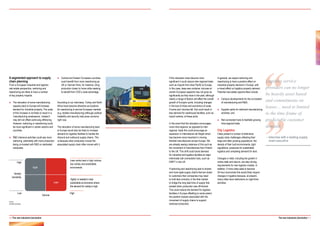
For example, businesses may adopt a more
segmented approach to supply chain
planning, offshoring production of products
which have a relatively stable demand profile
but reshoring or nearshoring production or
sourcing of products for which demand is
more volatile, so that these supply chains can
be more responsive to end customer demand.
16 | The new industrial (r)evolution
Lean works best in high volume,
low variety and predictable
enviroments
‘Agility’ is needed in less
predictable enviroments where
the demand for variety is high
Volume
High
High
Low
Variety/
Variability
Agile
Lean
The new industrial (r)evolution | 17
Logistics service
providers can no longer
be heavily asset based
and commitments on
leases… need to limited
to the time frame of
predictable customer
demand.
– Interview with a leading supply
chain executive
A segmented approach to supply
chain planning
From a European industrial and logistics
real estate perspective, reshoring and
nearshoring are likely to have a number
of key property impacts.
●● The relocation of some manufacturing
capacity back to Europe will increase
demand for industrial property. The scale
of this increase is not likely to result in a
‘manufacturing renaissance’; indeed it
may still not offset continuing offshoring.
However, reshoring or nearshoring could
be more significant in certain sectors and
countries.
●● RD intensive activities could see more
reshoring, potentially with more production
being co-located with RD on dedicated
campuses.
●● Central and Eastern European countries
could benefit from more nearshoring as
UK or German firms, for instance, bring
production closer to home while seeking
to benefit from CEE’s costs advantage.
According to our interviews, Turkey and North
Africa have become attractive as locations
for nearshoring to service European markets
(e.g. textiles manufacturing) although political
instability and security risks pose concerns
right now.
The relocation of some manufacturing back
to Europe would also be likely to increase
demand for logistics facilities to handle the
inbound and outbound supply chains. This
is because when production moves the
associated supply chain often moves with it.
If this relocation does become more
significant it could reduce inter-regional trade,
such as imports from Asia Pacific to Europe.
In this case, deep-sea container volumes at
certain European seaports may not grow as
significantly as they have in the past, although
clearly a range of factors will affect the overall
growth of Europe’s ports, including changes
in the size of ships and economics of scale.
If some port volumes fall, this could result in
less demand for warehouse facilities, such as
import centres, at these ports.
In the event that the relocation encourages
more intra-regional, as opposed to inter-
regional, trade this could encourage an
expansion in international rail freight which
has become more important in moving
finished manufactures across Europe. We
are already seeing instances of this such as
the movement of manufactures from Poland
to the UK. This shift could boost demand
for industrial and logistics facilities at major
intermodal (rail connected) hubs, such as
DIRFT in the UK.
If reshoring and nearshoring lead to shorter
and more agile supply chains that are closer
to customers then companies may need
to hold less inventory in the final market
to bridge the long lead time of supply that
existed when production was off-shored.
This could reduce the demand for logistics
facilities in Europe offsetting to some extent
the positive impacts associated with the
movement of supply chains to support
reshored production.
In general, we expect reshoring and
nearshoring to have a positive effect on
industrial property demand in Europe, with
a mixed effect on logistics property demand.
Potential real estate opportunities include:
●● Campus developments for the co-location
of manufacturing and RD;
●● Supplier parks for reshored manufacturing
activities; and
●● Rail-connected hubs to facilitate growing
intra-regional trade.
City Logistics
Cities present a number of distinctive
supply chain challenges reflecting their
large and often growing populations, the
density of their built environments, tight
regulations, pressures for sustainable
logistics and competing demand for land.
Changes in retail, including the growth in
online retail and returns, are also driving
requirements for new logistics models. In
addition, if more cities seek to become
24-hour economies this would likely require
changes in logistics because, at present,
many cities have restrictions on night-time
activities.
Source:
Cranfield University
18 | The new industrial (r)evolution
City planners do not
necessarily know the
best way to deal with
freight deliveries.
– Interview with Wolfgang
Lehmacher, WEF
The new industrial (r)evolution | 19
The consumer market
is rapidly becoming a
24-hour environment…
assets do not operate
24 hours and there is
a large level of under-
utilisation.
Interview with Simon Morris, GAC
 Consolidation centres serving a
destination owned by a single
landlord, such as a specific shopping
centre, high street or airport.
 Consolidation centres designed to
serve a specific town or city.
Although currently fairly modest in number,
interest in consolidation centres is growing
particularly among town and city planning
authorities because they are proven to
reduce traffic. They can also provide a range
of logistics benefits, such as better inventory
control, product availability and customer
service as well as the opportunity to carry
out value adding activities.
UK cases of established consolidation
centres serving destinations owned by a
single landlord include the consolidation
centre:
Operated by DHL for Heathrow Airport,
which is a mandatory scheme.
At Sheffield, run by Clipper Logistics,
to service retailers in the Meadowhall
shopping centre in Sheffield, owned by
Land Securities.
At Enfield in north London, also operated
by Clipper Logistics, to service retailers on
Regents Street in central London for the
Crown Estate.
We believe that the challenges of city logistics
will drive significant new demand for logistics
property in and around cities. We expect
growing demand for a range of different types
of warehouses.
●● Facilities to fulfil last mile deliveries,
collection points and facilities to process
returns. Demand for these facilities is
expanding due to the ongoing growth
in online retail, including online grocery
which lags online retail spending in
general. For example, the Rewe Group,
one of Germany’s largest supermarket
brands, has established a highly
automated distribution centre located at
Kelsterbach within the wider Frankfurt
area to deliver fresh produce to their
customers, with the customer able to set
times for home deliveries or collect the
items in one of the brand’s supermarkets.
The new distribution centre is part of a
new service called ‘Rewe Digital’ that aims
to ‘digitise the German grocery market’
according to the retailer.
●● Shared user urban consolidation
centres, such as those already existing in
a number of major cities. These include:
 Special project urban consolidation
centres (UCCs) used for non-
retail purposes, such as for major
construction sites; these often serve
a single site and operate for a given
period of time.
Examples of consolidation centres
servicing specific cities on the European
continent include:
The CityPorto consolidation centre
serving Padova in northern Italy. This
voluntary scheme has been operationing
since 2004 and involves a consolidation
centre located at the Interporto Padova
freight village (3 km outside the city
centre) where goods are consolidated for
onward delivery into the city centre via an
environmentally-friendly fleet of hybrid and
CNG vehicles.
The Monaco consolidation centre, owned
by the Principality of Monaco, which is
based to the south west of Monaco. With
a few exceptions, goods vehicles over
8.5 tonnes are banned from entering
Monaco, which means that if vehicles
over this weight have deliveries to
make into Monaco they have to use the
consolidation centre.
A new consolidation centre established
to service Brussels. Since September
2014 a consortium has been running an
urban consolidation centre in the TIR
Centre (owned by the Port of Brussels)
to consolidate deliveries from all over
Belgium into Brussels with onward final
delivery being undertaken by less polluting
vehicles such as compressed natural gas
(CNG) and diesel Euro 5 trucks.
●● Multi-modal logistics platform in
cities, including platforms that utilise rail
and/ or inland waterways. For example,
since 2011 Geodis has operated its
‘Distripolis’ urban logistics service in Paris
which combines grouped deliveries by
train, barge or full trucks to multi-modal
platforms in and around the city with
final delivery either directly from these
platforms or via ‘Blue’ environmental
urban bases located in the city that use
light electric vehicles or power-assisted
tricycles.
●● Multi-storey ramped logistics facilities.
These types of developments are
common in parts of Asia Pacific – such
as Japan (Tokyo and Osaka), China
(Shanghai), Hong Kong and Singapore
but are almost without precedent in
Europe. We think that there is potential
for this type of development in selective
major cities, such as London, where the
demand for land is intense and the stock
of industrial land is very tight.
In some large cities we could also witness the
further transformation of retail banking units
in town and city high streets into logistics /
storage space as the banks continue to
reduce the number of their branches.
The French company Sogaris is one
example of a developer that is focusing
on urban logistics. It has a three-level
approach incorporating: logistics platforms
at the gateway to cities; multi-user
logistics ‘hotels’ in densely built-up
areas; and urban distribution spaces for
distribution within local neighbourhoods.
Staying ahead of the game – the
challenges and opportunities for
corporates, developers and investors
The new industrial (r)evolution | 21
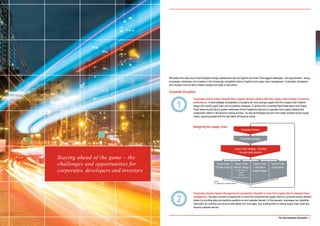
Corporates need to better integrate their property decision-making with their supply chain strategy to enhance
performance. A more strategic consideration of property will more strongly support the firm’s supply chain network
design and overall supply chain and competitive strategies. To achieve this Corporate Real Estate teams and Supply
Chain teams should have a greater awareness of their respective roles and co-operate more closely, starting their
collaboration earlier in the decision-making process. As new technologies become more widely adopted across supply
chains, acquiring people with the right talent will become critical.
Corporates should embrace the opportunity provided by ‘big data’ to move from supply chain to demand chain
management. ‘Big data’ provides an opportunity to move from production-led supply chains to consumer-centric demand
chains by providing data and predictive analytics on end customer demand. In this scenario, businesses can substitute
information for inventory and become both leaner and more agile, thus enabling them to reduce supply chain costs and
improve customer service.
We believe the rapid pace of technological change, globalisation and city logistics are three of the biggest challenges - and opportunities - facing
businesses, developers and investors in the increasingly competitive arena of logistics and supply chain management. Corporates, developers
and investors must be alert to these changes and ready to take action.
Corporate Occupiers
1
2
Corporate strategy
Competitive strategy
Supply Chain
Process Design
Supply Chain
Information
System Design
Source:
JLL adapted from Cranfield University
Supply Chain
Organization
Supply Chain
Network Design
Supply chain strategy - including
the real estate element
How many facilities?
Where?
How Big?
Own, lease or outsource?
Designing the supply chain
22 | The new industrial (r)evolution
Corporates should evaluate the potential of other technologies to transform their supply chains and specific
industrial or warehouse operations. For example, the IoT will offer opportunities to enhance supply chain visibility
and increase asset utilisation, while the wider application of robotics could change warehouse operations and improve
productivity. Senior executives in supply chains need to consider appropriate future talent acquisition to secure people
with relevant technology skills.
Corporates must put cyber security at the forefront of their planning to ensure resilient supply chains as the
growing reliance on technology will make the logistics sector more at risk from technology failures or deliberate cyber
threats.
‘Right-shoring’ implies a more sophisticated approach to evaluating the global positioning of industrial and
logistics assets. In choosing locations, corporates need to take account of total landed costs, the variability / volatility of
end customer demand and supply chain risks.
The distinctive attributes of big cities, coupled with the particular challenges associated with the growth of
e-commerce and last mile fulfilment, suggest a need to rethink city logistics. Businesses should look at more
collaborative approaches, including shared user facilities and consolidation, and multi-modal options.
Developers and Investors
Developers and investors, who are experts in property markets, need a stronger appreciation of how
megatrends and wider supply chain trends are likely to impact these markets. Connecting research into these
wider trends with their own property market knowledge and analysis will help.
Crucial for developers and investors will be evaluating how global megatrends will affect the type of buildings
and locations occupiers will require. Some trends will have big impacts on supply chains but less impact on buildings,
whereas others will have more direct and pronounced implications for buildings and locations.
The new industrial (r)evolution | 23
Advances in technology will have big impacts on supply chains and enhance the utilisation of assets (property
and transport) and their productivity. Developers need to embrace changing technologies and fit out future properties
in order to meet these. We also expect greater automation in industrial and warehouse operations. In the next 5 to 10
years, we anticipate the impact on the type of buildings and locations to be less dramatic than the impact on supply
chains – but longer term we see huge impacts. Over the next 5-10 years, we foresee:
●● Less future demand for warehouses to function as storage facilities as overall inventory is reduced;
●● A trend toward more buildings used for rapid throughput as customer service requirements become more
demanding;
●● A trend towards taller buildings, as more storage facilities are automated;
●● A need for all warehouses to have secure wireless Internet access throughout their buildings.
Longer term - but still within the typical life of a distribution building - we see big changes, including driverless good
vehicles delivering into, and from, warehouses full of robots.
Globalisation will continue but European industrial and logistics markets are likely to see more reshoring and
nearshoring. Our view is that this will increase industrial property demand - although off shoring will continue – yet the
aggregate effect on the demand for warehousing will be mixed.
The challenge of city logistics will drive demand for a range of warehouses in and around major European
cities. Our view is that this will create opportunities but will require more imaginative approaches involving shared user
facilities for consolidation, multi-modal platforms and potentially multi-storey ramped warehouses where the competition
for land is particularly intense. Along with city planning authorities and businesses, developers and investors will be
pivotal to implementing more sustainable and smarter city logistics solutions.
The role of logistics and supply chain management has often been defined in terms of ‘seven rights’ – delivering the
right product, in the right quantity, to the right customer, at the right place, at the right time, in the right condition at the
right price. In our view, the right properties in the right locations are also key to this performance but, in addition,
landlords and developers might need to consider more innovative approaches in meeting customer requirements for
agility and flexibility in their supply chains. As the pace of change accelerates, businesses, developers and investors all
need to understand the key supply chain drivers to unlock value from their property.
3
4
5
6
7
8
9
10
11
24 | The new industrial (r)evolution
Appendix. Methodology
This study has been produced in partnership with Transport Intelligence, a leading provider of
market research solutions to the global logistics industry and an advisor to the World Economic
Forum, World Bank, UN and European Commission.
Our research methodology incorporated five main components:
1. A review of existing research on global megatrends;
2. A workshop with supply chain experts to identify the megatrends most likely to have the
greatest impact on supply chains and logistics property demand over the next 5-10 years;
3. 30 in-depth interviews with senior supply chain executives or thought leaders;
4. An online questionnaire survey with responses from over 200 companies including major
retailers, manufacturing companies and logistics service providers; and
5. A second expert workshop to triangulate the findings from the interviews and questionnaire
survey.
We would like to thank everyone who participated and contributed to this study, especially
those who provided insights and observations via interviews, or who completed our online
questionnaire survey.
Guy Gueirard
Head of EMEA Logistics  Industrial
+33 (0)6 59 03 74 54
guy.gueirard@eu.jll.com
About JLL
JLL (NYSE: JLL) is a professional services and investment management firm offering specialized real
estate services to clients seeking increased value by owning, occupying and investing in real estate.
With annual fee revenue of $4.7 billion and gross revenue wof $5.4 billion, JLL has more than 230
corporate offices, operates in 80 countries and has a global workforce of approximately 58,000. On
behalf of its clients, the firm provides management and real estate outsourcing services for a property
portfolio of 3.4 billion square feet, or 316 million square meters, and completed $118 billion in sales,
acquisitions and finance transactions in 2014. Its investment management business, LaSalle Investment
Management, has $57.2 billion of real estate assets under management. JLL is the brand name, and a
registered trademark, of Jones Lang LaSalle Incorporated.
For further information, visit www.jll.eu.
Jones Lang LaSalle
© 2016 Jones Lang LaSalle IP, Inc. The items in this publication have been compiled from the
various sources acknowledged. The information is from sources we deem reliable; however, no
representation or warranty is made to the accuracy thereof.
Jon Sleeman
EMEA Logistics  Industrial Research
+44 (0)207 087 5515
jon.sleeman@eu.jll.com
Alexandra Tornow
EMEA Logistics  Industrial Research
+49 (0)69 2003 1352
alexandra.tornow@eu.jll.com
Ryan Loftus
EMEA Logistics  Industrial Research
+44 (0)20 7087 5659
ryan.loftus@eu.jll.com

JLL-The new industrial revolution_final

  • 1.
    The new industrial(r)evolution: from supply chains to consumer-centric demand chains RELINKING THE SUPPLY CHAIN. RETHINKING PROPERTY. Research Report | February 2016
  • 2.
    Contents The new industrial(r)evolution | 01 02.01. 05. 03. 04. Staying ahead of the game – the challenges and opportunities for corporates, developers and investors Welcome Page: 03 Page: 04-05 Page: 06-19 Page: 20-23 Introduction Disturbing the flow: the risks and opportunities from megatrends Identifying the game- changers and harnessing their potential Appendix. Methodology Page: 24
  • 3.
    Key take-aways The technologicalchanges that are driving the fourth industrial revolution will transform production-led supply chains to consumer-centric demand chains - by improving the visibility of consumer demand, enhancing the responsiveness of supply chains and improving the ability to track and trace products. Warehouses will remain critical for delivering customer service but technology will drive changes in warehouse operations, labour requirements and building design. Globalisation and right-shoring will drive changes in the location of industrial and logistics facilities. Europe could benefit from more reshoring and nearshoring. Increasingly, supply chains will need to be segmented by product demand characteristics to be both lean and agile. Efficient city logistics will become more and more important due to the challenges of last mile fulfilment and a range of other issues - including increasing competition for land, congestion and the growing importance of sustainability. Developers and investors must think how they can future proof their buildings. 20 years ago cell phones had one function. 15 years ago Amazon was an online bookstore. 5 years ago same-day was limited to pizza delivery. In the life of a typical distribution building, warehouse operations will be transformed. Here’s one scenario – driverless vehicles and warehouses full of robots. Major corporates need to better integrate their property and supply chain decision-making to optimise the performance of their distribution property network. 02 | The new industrial (r)evolution Warehouses are critical components in most modern supply chains due to their role in storing and moving raw materials, components, work-in-progress and finished goods through supply chains to end customers, and in processing any associated ‘reverse flows’ - such as used products, packaging or returns of online purchases. Increasingly, they also perform value-adding activities, including final assembly or pre-retail activities. In addition, they are involved in the flow of information along supply chains, which has become more important as supply chains have become more complex, customer service levels have become more demanding and technology advances at a bewildering pace. Over the past five years, European logistics property markets have registered robust demand from occupiers despite relatively sluggish economic growth. This suggests that wider supply chain changes, such as the growth of e-commerce and online retail, have been critical drivers of demand. To understand logistics property markets we need to understand these supply chain drivers. Over recent years there has been a proliferation of research into supply chain trends and logistics property markets. However, rarely are these considered together; in most cases there is a ‘disconnect’. Similarly, although logistics and supply chain management are now widely recognised by businesses as a source of competitive advantage in many companies there is still a ‘disconnect’ between their logistics and supply chain operations and the property that supports them. This is often because logistics property is not considered strategically. Moreover, corporate real estate teams are not always well integrated with the wider business, as highlighted in JLL’s Global Corporate Real Estate Trends 2015 survey. Recently, across the EMEA region and also globally, JLL has attempted to bridge these disconnects by putting supply chains at the heart of its logistics and industrial services and by making the case for property to be put at the very centre of corporate supply chain strategies. Through business acquisition, selective recruitment and investment in technology, JLL now provides an integrated suite of supply chain and property services. This report endeavours to bridge the research disconnect by focusing on how supply chain trends will affect logistics property requirements and industrial and logistics markets in Europe. It spotlights three major trends: ●● The impact of technology, including e-commerce and the digitisation of retail, big data, the Internet of Things (IoT), ‘uberisation’, 3D printing, robotics, augmented reality, autonomous vehicles and drones. ●● Globalisation and the right-shoring of industrial and logistics assets. ●● City logistics, involving the optimisation of logistics in major urban areas. These are big topics that require much attention. This high-level study is the first stage in a programme of research that the EMEA Logistics and Industrial team at JLL intends to roll out over the next 24 months. Subsequent insight papers will build on this by looking in detail at specific topics, geographies and case studies. Our overall aim is to highlight the key changes that will shape future supply chains and drive occupier demand for logistics property over the next 5-10 years in Europe. By providing insight into how supply chains could be modified, we aim to help businesses plan their future physical distribution networks and spotlight how developers and investors can unlock value and enhance the performance of their logistics property assets. A better awareness of supply chain trends is critical to a better understanding of real estate opportunities – whether you are a corporate occupier, a developer or an investor. Guy Gueirard Regional Director, EMEA Logistics Industrial, JLL Welcome The new industrial (r)evolution | 03
  • 4.
    Disturbing the flow:the risks and opportunities from megatrends The new industrial (r)evolution | 05 Existing research highlights a number of major disruptive forces - global megatrends - that will have an impact across all types of businesses and geographies creating both opportunities and risks. These include: ●● Globalisation and the shift in global economic power; ●● Demographic change, including an ageing population; ●● Urbanisation, the world’s growing urban population; ●● Accelerating technological change; and ●● Sustainability, including climate change and resource scarcity. These forces will have profound impacts on future supply chains, especially where they converge and interact. Based on our first supply chain workshop1 , the three trends that we believe will have the most significant impact on supply chains and logistics property demand over the next 5-10 years will be technological change, globalisation and urbanisation. These trends are considered to be most important because of their more tangible impact on the future location of industrial and logistics property and the type of buildings required by corporate occupiers. Demographic change is considered less crucial in a European context than globally, as populations in Europe are relatively stable, if ageing in general. Sustainability is already a major factor but is not considered in detail in this study except as a driver of change in city logistics. A recent JLL study has already focused on sustainability trends.2 ●● Technological change is already transforming supply chains and property demand, most obviously with the digitisation of retail. How will the interplay of ‘big data’, the Internet of Things (IoT) ‘uberisation’ and 3D printing drive change in future supply chains and property demand? ●● Globalisation has driven huge changes in supply chains over the past 25 years but more recently there has been a significant attention to ‘right-shoring’, involving the strategic positioning of supply chain assets (supply, manufacturing and logistics) locally, regionally and globally. How will these trends impact the future location of industrial and logistics facilities? ●● Urbanisation is driving a growth in cities. How will this growth, and other changes such as the expansion of e-commerce, drive new models of city logistics? 1 See Appendix. Methodology. 2 JLL, The big eight for UK real estate. Understanding critical sustainability trends and what they mean for the future of your business Introduction
  • 5.
    Identifying the game-changers andharnessing their potential Key Supply Chain Challenges Traditionally, the key challenges driving supply chain management have been balancing cost containment with improving customer service. Against a background of rapid change, our survey confirms the continuing importance of these two issues, with 64% of respondents emphasising cost reduction as a key priority and 62% highlighting improving customer service. More surprisingly, given the speed of change, was the relatively low proportion of respondents (24%) that cited building higher supply chain resilience as a key priority. This is something which we believe will become more important partly due to the opportunities and risks associated with accelerating technological change. Digital Disruption and the fourth industrial revolution In the next 5-10 years many technologies and innovations will drive further big changes. Considered together they are often believed to be driving a ‘fourth industrial revolution’. To date, much of the weight of discussion around this subject has been on the impact on manufacturing and factories. Indeed the term ‘Industrie 4.0’ originates from Germany and has been officially adopted by the German government to promote smart manufacturing and smart factories. Our focus in this report is on the logistics and supply chain impacts. We consider: ●● The continuing growth of e-commerce and the digitisation of retail ●● Big data ●● The Internet of Things (IoT) ●● The ‘uberisation’ of logistics ●● 3D printing ●● Robotics ●● Augmented reality ●● Autonomous vehicles ●● Drones E-commerce and the digitisation of retail E-commerce and the digitisation of retail have been extensively researched and commented on. Online retail spending is predicted to continue growing across Europe, with a significant increase in cross-border spending, and this will put logistics at the forefront of retail, as the distinction between warehouses and shops blurs. The new industrial (r)evolution | 07
  • 6.
    Large e-commerce players, whodemand high service levels (as a differentiating factor) and low prices, combined with narrowing delivery windows and increasing restrictions present a fundamental challenge to the way delivery is undertaken and its related business model. – Interview with Jerome Charlez, Terragnita 08 | The new industrial (r)evolution 3 JLL, A new logistics landscape. The impact of multi- channel retail on logistics, 2013. Any competitor not using big data will probably be at a disadvantage in a period when logistics providers have to provide flexible offerings. – Interview with the CEO of a leading supply chain organisation The new industrial (r)evolution | 09 JLL has already highlighted that the growth of online retail is driving demand for a range of different types of warehouses including3 : ●● Mega fulfilment centres, where merchandise is stored and picked at an item level; ●● Parcel sortation centres; ●● Local parcel delivery centres; ●● Dot.com warehouses for the fulfilment of online grocery orders; ●● Return processing centres; ●● Local delivery centres, e.g. for same-day fulfilment. The significance of online retail as a driver of warehouse demand was confirmed by our survey. With the rise in mobile apps and the improved ability to monitor purchases in real-time, consumer expectations are becoming more and more demanding. Looking forward, a wider move to more same-day delivery offers will fuel demand for additional parcel/postal facilities and local distribution depots in major cities. For example, Amazon in the UK has already acquired a number of buildings in London and Birmingham to service it ‘Prime Now’ service while Argos has become the first high street retailer to provide a nationwide same-day service (‘Fast Track’) using its distribution and store network. Across Europe, we expect that same-day e-fulfilment will drive requirements for smaller local facilities in closer proximity to customers and alternative options to home delivery, including click and collect kiosks and parcel lockers. Examples include DHL’s Packstation network in Germany or the InPost network in the UK, and Doodle’s network of collection stores, mainly at UK mainline train stations and universities. 24% of respondents cited an increase in dedicated e-fulfilment distribution centres to serve local populations when asked how they expected the role of warehouses to change in the next two to three years. 23% said increasing space dedicated to e-fulfilment when asked what would drive changes in physical distribution networks over the next two to three years. As this market becomes more competitive, the challenges facing retailers, manufacturers and logistics service providers will increase. For example, International Data Corporation (IDC) recently predicted that, by 2017, 50% of manufacturers will explore the viability of ‘micrologistics networks’ – involving multiple forward inventory stocking locations, closer to customers to enable the promise of accelerated delivery for select products to customers driven by the expansion of omni-channel retail. Big data ‘Big data’ will have a huge impact on supply chains. In particular, by enhancing the visibility of end customer demand or by providing insight into future demand, big data will facilitate a shift from production-led supply chain management to consumer-centric demand chain management. This is much more than a change in semantics as it will move the emphasis away from the supply of products that are pushed out to market towards the demand for products and thus better join up producers with consumers. This shift – from supply chains to demand chains - has been much discussed over 20 years or more but big data has the potential to make it happen. This is re-emphasised by our survey, although, as it also highlights, the key will be finding ways of utilising the data available. One possible way this could be overcome is through open-sourcing. Essentially, businesses can begin to rely on open-sourcing by opening their software’s code to allow their users and employees the ability to manipulate programmes and applications to better drive connectivity within their operations. 37% said this is because there is too much unstructured data to handle effectively. 35% thought the greatest potential change from big data was in predictive demand modelling. However, 63% said that they were not effectively utilising the data created by new technologies to improve their performance. 30% said that there is a lack of skills in data management / analytics. Survey respondents thought the biggest effect on their supply chain strategies over the next 5-10 years would come from ‘big data’ (51%) and data analytics (44%).
  • 7.
    10 | Thenew industrial (r)evolution The new industrial (r)evolution | 11 6 http://www.timocom.co.uk/The-Freight-Exchange/ Warehousing-exchange 7 Wohlers Report 2015 for 3D printer market. From an industrial and logistics property perspective, the potential of big data to enhance the visibility of end demand along supply chains will enable the volume of inventory in the supply chain to be reduced - through the substitution of information for inventory. At the same time, it will make supply chains more responsive to end customer demand, so facilitating an increase in the velocity of inventory through supply chains. Overall, therefore, we anticipate that big data will lead to less demand for logistics facilities to hold stock and more demand for facilities to handle a rapid throughput. Furthermore, warehouses will have to have secure and ubiquitous wireless access. The Internet of Things The Internet of Things (IoT) refers to the connection to the Internet of physical objects.4 It is not a new concept and many of the essential components, such as semi-conductors and wireless networks, have existed for decades. There are a number of trends driving the IoT including: the availability of cheaper semiconductors, sensors, controllers and transmitters that need to be embedded within physical objects; wider network availability and increased capacity; improvements in data management and storage; and developments in analytics and applications. The IoT will transform manufacturing in a number of ways, such as through smart devices and ‘smart factories’. For example, by providing advanced information on machines that might malfunction, it could trigger early maintenance or replacement and avoid a complete breakdown of a device or an entire production line. It would also increase visibility as to where and when spare parts are needed. The IoT could also revolutionise future supply chains.5 For instance, it has the capacity: ●● To provide the next generation of ‘track and trace’ enhancing the visibility of the movement of goods along supply chains; ●● To help businesses monitor and respond to supply chain risks; and ●● To improve asset utilisation in warehouse operations and freight transport operations. In addition, the IoT has the potential to radically change whole geographies - e.g. being an integral component of ‘smart cities’. One example in this respect is the potential for it to manage traffic flows and parking in cities which could have significant logistics implications such as optimising freight flows. This is just one illustration of one megatrend (technology) interacting with another (city logistics). When asked about the logistics benefits of the Internet of Things, approaching one-quarter (23%) of respondents thought it would optimise how people, systems and assets work together to enhance efficiency. 4 For a fuller definition see Gartner: ‘The Internet of Things (IoT) is the network of physical objects that contain embedded technology to communicate and sense or interact with their internal states or the external environment.’ http://www.gartner.com/it-glossary/internet-of-things/ 5 DHL/Cisco, Internet of Things in Logistics, 2015 In our view, the IoT is likely to have much more effects on supply chains than on logistics buildings. As with ‘big data’, it will require serious technology investment throughout the supply chain which will include ensuring that every warehouse has secure and ubiquitous wireless access. Uberisation’ and the sharing economy ‘Uberisation’ refers to the use of technology platforms (the Internet and apps) by people and businesses to directly access goods or services. The apps match demand with supply to provide an on-demand solution. This technology has the potential to match demand and supply across a range of logistics services, for example to enable warehouse or transport capacity to be shared. 15% of respondents said that Uber style deliveries would be the route of choice for deliveries of online orders. While such sharing is not new - for instance TimoCom claims to operate Europe’s largest online warehouse exchange with 30,000 possibilities covering 44 countries - we believe ‘uberisation’ will grow more significantly in the future to deliver ‘ad hoc’ warehouse space on demand.6 This could enable businesses to flex their warehouse capacity more effectively to meet variations in demand. 3D printing 3D printing has grown significantly over 20 years or more, but the global market for 3D printers and related services remains relatively small at around $US4.1 billion.7 3D printing is being used in rapid prototyping and in certain industries, such as automotive and aerospace to make components and healthcare to make prosthetics. It has proved particularly suitable for making customised products in small production runs. Based on feedback from our interviews, it appears that that 3D printing will not challenge existing global supply chains by driving more local production on a significant scale. Indeed, few of those interviewed believe it will affect logistics strategies over the next 5-10 years. However, it could play a significant role in certain supply chains particularly for spare parts which need to be rapidly supplied. In this case, it may be possible to print a particular part locally rather than keep it in stock and ship it to where it is required. In the future, warehouses holding spare parts may only stock certain parts (e.g. fast-moving parts). 3D printing may be used to make slow-moving parts prior to dispatch or to print spare parts locally. Overall, therefore, while 3D printing could help to create leaner and more agile supply chains, we think its impact on warehouses and distribution facilities will be modest.
  • 8.
    12 | Thenew industrial (r)evolution 8 According to the IFR, Europe accounted for about 28% of operational robots in 2014 with Germany being the largest European user of industrial robots followed by Italy and Spain. 9 http://www.bbc.co.uk/news/business-20754979 The new industrial (r)evolution | 13 10 Quoted in DHL, Augmented Reality in Logistics, 2014 11 DHL estimates that warehouse operations account for about 20% of logistics costs and that picking accounts for 55% to 65% of the total cost of warehouse operations. DHL, Augmented Reality in Logistics, 2014, page 13. Automation and Robotics Automation has been increasing in manufacturing and warehousing but it is the greater use of robots enabled by developments in artificial intelligence (AI) that is particularly significant. They are now able to perform more complex tasks involving higher levels of movement and the ability to change sequences without manual intervention. Robots are generally more common in manufacturing operations, particularly automotive production, than in warehouses, but sales of both industrial robots and robotic logistic systems are rising. According to the International Federation of Robots (IFR), global sales of industrial robots grew by an average of 17% per annum between 2010 and 2014 while the worldwide stock of industrial robots is predicted to increase from around 1.5 million units in 2014 to 2.3 million units in 2018.8 The IFR reports that some 2,700 robotic logistics systems were installed worldwide in 2014, 27% more than in 2013. Within this category, sales of automated guided vehicles (AGVs) rose by 29%. The IFR predicts that at least 14,500 logistics systems will be sold over 2015 to 2018. 50% of survey respondents stated that they currently use some form of automation in their warehouses operations and of these 55% said they have robots in their warehouse operations. In general, robots in the form of AGVs have been used in warehouses for some years (e.g. to move pallets) but they are not commonly used in picking operations. However, we believe this will change because of the opportunity to deliver big productivity benefits in terms of pick rates and accuracy. For instance: ●● The installation of robotic pickers by online fashion retailer Net-a-Porter at its distribution centre in south London has reportedly made the pick rate over 500% faster.9 ●● Amazon, which acquired Kiva Systems in 2012 and only started employing these robots in its warehouses in 2014, recently reported that it had up to 30,000 Kiva robots working in13 distribution centres (DCs), compared with 15,000 in 10 DCs at the end of 2014. The Kiva robots bring goods on mobile shelving to pickers. The wider application of robotics in production and logistics operations could propel significant changes in location by reducing the reliance on large and costly work forces. ●● Globally, this could re-inforce a trend to the reshoring or nearshoring of industrial capacity because one of the main drivers behind offshoring (lower labour costs) would be less significant. Nevertheless, there are clearly other barriers to reshoring or nearshoring, including the costs of moving production or sourcing back, and the industrial capabilities in the home, or neighbouring, countries. ●● Locally, it could reduce the current importance of having a large accessible labour supply in any location assessment for large new logistics facilities. In the future fewer workers may be required in warehouses but the type of jobs will require higher skills. Moreover, the wider use of robots in picking could lead to a demand for taller buildings to minimise footprint while maximising the full cube of the building. In future, if the use of robots becomes more widespread this could lead to other changes, such as a reduced need for staff amenity space or car parking. Augmented Reality Augmented reality (AR) has been defined as the expansion of physical reality by adding layers of computer-generated information to the real environment.10 AR has the potential to improve warehouse operations, and particularly the picking process which is a significant warehouses cost and critical for customer service.11 For example, AR headsets or glasses may calculate the optimal route to the correct picking face and tell the user that he or she is in the correct location and picking the right product, thereby increasing efficiency and pick accuracy. However, we do not see AR having significant implications for logistics property. Only 6% of respondents use augmented reality in their warehouse operations. Autonomous vehicles Future advances in technology will create vehicle-to-vehicle and vehicle-to-infra- structure communication enabling vehicles to operate autonomously, i.e without drivers. For instance, carmakers are already contemplating a future of driverless vehicles, and shared vehicles, rather than individual car ownership. 54% of survey respondents thought that autonomous vehicles could be adopted within the next 10 years. We expect autonomous vehicles to lead to big changes in the automotive sector– both in manufacturing and associated supply chains. Autonomous vehicles could also impact labour issues within the logistics sector, which is currently experiencing shortages, particularly of drivers of large good vehicles. Our interviews also highlighted that autonomous vehicles are seen as having a significant potential particularly in smaller cities that have less complex geographies. However, there is a range of factors - e.g. technological, infrastructure, legal, insurance and labour issues - that are likely to make the significant operation of autonomous vehicles for logistics operations a more distant prospect that the 5 to 10-year horizon of this report.
  • 9.
    14 | Thenew industrial (r)evolution 12 http://www.fosterandpartners.com/news/ archive/2015/09/proposals-for-droneport-project- launched-to-save-lives-and-build-economies/ The new industrial (r)evolution | 15 De-globalisation can be viewed as a hedge against country risk, but it incurs transformation costs and reduces the lifetime of the assets at any given location… impacting profitability. – Interview with Jerome Charlez, Terragnita 13 Reshoring involves the relocation of previously offshored or outsourced activities back to the home country; nearshoring involves the relocation of these activities to a country close to the home country. 14 ILO, Reshoring in Europe: Trends and Policy Issues, 23/9/2015 Dachs, Bernard and Zanker, Christoph, ‘Backshoring of Production Activities in European Manufacturing’, December 2014 If these barriers are overcome, warehouses will have to be designed to permit the use of automated vehicles, which may change dock and yard designs. Again, there is the potential to move away from a labour force in order to allow for the use of automated goods vehicles. Furthermore, how to manage these vehicles from a warehouse and ensure their maintenance will require investment in additional infrastructure and IT both within and out of the warehouse. Drones The commercial application of drones has generated considerable interest over the past two to three years. Although drones are being used for delivery in certain specific instances (e.g. DHL has used a drone to deliver medical supplies to the North Sea island of Juist) we believe that their use in consumer markets for the mass delivery of parcels to homes is not likely to develop significantly in the next 5-10 years due to the existing regulation of air space, associated safer / security concerns, and commercial viability issues compared with existing logistics models. As a result, in our opinion, drones will have a minimal impact on logistics property across Europe over this timeframe. Even so, we think they could have a more significant role to play in delivering certain low pay load products (such as pharmaceutical drugs or vaccines) in countries with fewer regulations over air space and less well developed logistics infrastructure. For example, the architect Lord Foster has launched proposals for a Droneport project in Rwanda to support drone routes capable of delivering urgent supplies to remote areas. The project is a collaboration between Redline partners led by Afrotech, École polytechnique fédérale de Lausanne (EPFL), the Norman Foster Foundation and Foster + Partners.12 Risk of under-estimating disruptive potential from new technologies While most survey responses, along with the common market sentiment among logistics and supply chain professionals, point to a limited impact of new technologies on logistics and warehouses, past experience highlights the risk of under-estimating the disruptive potential of technological change. It only takes one pioneer to significantly disrupt an entire sector. Over the last decade, we have seen many spectacular business failures of prominent global brands that have not taken the threat of innovative disruption seriously. Corporates will need to review their business strategies more often than in the past – and undertake regular reviews of their distribution networks to ensure that they remain fit for purpose. In the typical life of a distribution building warehouse operations will be transformed. Think – what are the key building and location attributes if driverless good vehicles deliver into, and from, warehouses full of robots? Globalisation and right-shoring Globalisation has transformed supply chains over the past 25 years. In particular, since China joined the World Trade Organisation (2001) and liberalised its markets, there has been a massive shift in industrial capacity from developed countries to China and Asia Pacific more widely. This shift reflects decisions to off-shore production and decisions to serve new emerging and rapidly-growing consumer markets. As a result, supply chains have become longer, more complex to manage and subject to greater risks. Over recent years there has been much interest in Europe (and North America) in right-shoring including the potential to reshore or nearshore industrial activities.13 While reshoring and nearshoring have received significant media coverage and generated public policy interest the extent of reshoring or nearshoring in Europe is difficult to assess or measure. Although there is no consensus, the available evidence from other studies and aggregate data on trade, global supply chain jobs and FDI flows, is that reshoring and nearshoring is happening in Europe, but on a modest scale overall and particularly so when compared with the United States. In the U.S., the Reshoring Initiative estimates that in 2014 reshored jobs back to the USA offset off-shored jobs for the first time. Notably, technology sectors, such as electrical equipment and the computer industry, which are more RD intensive, have a higher propensity to reshore/nearshore than firms making standardised products.14 The principal drivers of reshoring and nearshoring are usually considered to include rising labour costs in China, ‘hidden costs’ related to long supply chains, quality issues and increasing supply chain risks. In the future we believe there will be an increase in the diversity of manufacturing and sourcing strategies involving not just an assessment of costs (total landed costs). For example, businesses may adopt a more segmented approach to supply chain planning, offshoring production of products which have a relatively stable demand profile but reshoring or nearshoring production or sourcing of products for which demand is more volatile, so that these supply chains can be more responsive to end customer demand.
  • 10.
    16 | Thenew industrial (r)evolution Lean works best in high volume, low variety and predictable enviroments ‘Agility’ is needed in less predictable enviroments where the demand for variety is high Volume High High Low Variety/ Variability Agile Lean The new industrial (r)evolution | 17 Logistics service providers can no longer be heavily asset based and commitments on leases… need to limited to the time frame of predictable customer demand. – Interview with a leading supply chain executive A segmented approach to supply chain planning From a European industrial and logistics real estate perspective, reshoring and nearshoring are likely to have a number of key property impacts. ●● The relocation of some manufacturing capacity back to Europe will increase demand for industrial property. The scale of this increase is not likely to result in a ‘manufacturing renaissance’; indeed it may still not offset continuing offshoring. However, reshoring or nearshoring could be more significant in certain sectors and countries. ●● RD intensive activities could see more reshoring, potentially with more production being co-located with RD on dedicated campuses. ●● Central and Eastern European countries could benefit from more nearshoring as UK or German firms, for instance, bring production closer to home while seeking to benefit from CEE’s costs advantage. According to our interviews, Turkey and North Africa have become attractive as locations for nearshoring to service European markets (e.g. textiles manufacturing) although political instability and security risks pose concerns right now. The relocation of some manufacturing back to Europe would also be likely to increase demand for logistics facilities to handle the inbound and outbound supply chains. This is because when production moves the associated supply chain often moves with it. If this relocation does become more significant it could reduce inter-regional trade, such as imports from Asia Pacific to Europe. In this case, deep-sea container volumes at certain European seaports may not grow as significantly as they have in the past, although clearly a range of factors will affect the overall growth of Europe’s ports, including changes in the size of ships and economics of scale. If some port volumes fall, this could result in less demand for warehouse facilities, such as import centres, at these ports. In the event that the relocation encourages more intra-regional, as opposed to inter- regional, trade this could encourage an expansion in international rail freight which has become more important in moving finished manufactures across Europe. We are already seeing instances of this such as the movement of manufactures from Poland to the UK. This shift could boost demand for industrial and logistics facilities at major intermodal (rail connected) hubs, such as DIRFT in the UK. If reshoring and nearshoring lead to shorter and more agile supply chains that are closer to customers then companies may need to hold less inventory in the final market to bridge the long lead time of supply that existed when production was off-shored. This could reduce the demand for logistics facilities in Europe offsetting to some extent the positive impacts associated with the movement of supply chains to support reshored production. In general, we expect reshoring and nearshoring to have a positive effect on industrial property demand in Europe, with a mixed effect on logistics property demand. Potential real estate opportunities include: ●● Campus developments for the co-location of manufacturing and RD; ●● Supplier parks for reshored manufacturing activities; and ●● Rail-connected hubs to facilitate growing intra-regional trade. City Logistics Cities present a number of distinctive supply chain challenges reflecting their large and often growing populations, the density of their built environments, tight regulations, pressures for sustainable logistics and competing demand for land. Changes in retail, including the growth in online retail and returns, are also driving requirements for new logistics models. In addition, if more cities seek to become 24-hour economies this would likely require changes in logistics because, at present, many cities have restrictions on night-time activities. Source: Cranfield University
  • 11.
    18 | Thenew industrial (r)evolution City planners do not necessarily know the best way to deal with freight deliveries. – Interview with Wolfgang Lehmacher, WEF The new industrial (r)evolution | 19 The consumer market is rapidly becoming a 24-hour environment… assets do not operate 24 hours and there is a large level of under- utilisation. Interview with Simon Morris, GAC Consolidation centres serving a destination owned by a single landlord, such as a specific shopping centre, high street or airport. Consolidation centres designed to serve a specific town or city. Although currently fairly modest in number, interest in consolidation centres is growing particularly among town and city planning authorities because they are proven to reduce traffic. They can also provide a range of logistics benefits, such as better inventory control, product availability and customer service as well as the opportunity to carry out value adding activities. UK cases of established consolidation centres serving destinations owned by a single landlord include the consolidation centre: Operated by DHL for Heathrow Airport, which is a mandatory scheme. At Sheffield, run by Clipper Logistics, to service retailers in the Meadowhall shopping centre in Sheffield, owned by Land Securities. At Enfield in north London, also operated by Clipper Logistics, to service retailers on Regents Street in central London for the Crown Estate. We believe that the challenges of city logistics will drive significant new demand for logistics property in and around cities. We expect growing demand for a range of different types of warehouses. ●● Facilities to fulfil last mile deliveries, collection points and facilities to process returns. Demand for these facilities is expanding due to the ongoing growth in online retail, including online grocery which lags online retail spending in general. For example, the Rewe Group, one of Germany’s largest supermarket brands, has established a highly automated distribution centre located at Kelsterbach within the wider Frankfurt area to deliver fresh produce to their customers, with the customer able to set times for home deliveries or collect the items in one of the brand’s supermarkets. The new distribution centre is part of a new service called ‘Rewe Digital’ that aims to ‘digitise the German grocery market’ according to the retailer. ●● Shared user urban consolidation centres, such as those already existing in a number of major cities. These include: Special project urban consolidation centres (UCCs) used for non- retail purposes, such as for major construction sites; these often serve a single site and operate for a given period of time. Examples of consolidation centres servicing specific cities on the European continent include: The CityPorto consolidation centre serving Padova in northern Italy. This voluntary scheme has been operationing since 2004 and involves a consolidation centre located at the Interporto Padova freight village (3 km outside the city centre) where goods are consolidated for onward delivery into the city centre via an environmentally-friendly fleet of hybrid and CNG vehicles. The Monaco consolidation centre, owned by the Principality of Monaco, which is based to the south west of Monaco. With a few exceptions, goods vehicles over 8.5 tonnes are banned from entering Monaco, which means that if vehicles over this weight have deliveries to make into Monaco they have to use the consolidation centre. A new consolidation centre established to service Brussels. Since September 2014 a consortium has been running an urban consolidation centre in the TIR Centre (owned by the Port of Brussels) to consolidate deliveries from all over Belgium into Brussels with onward final delivery being undertaken by less polluting vehicles such as compressed natural gas (CNG) and diesel Euro 5 trucks. ●● Multi-modal logistics platform in cities, including platforms that utilise rail and/ or inland waterways. For example, since 2011 Geodis has operated its ‘Distripolis’ urban logistics service in Paris which combines grouped deliveries by train, barge or full trucks to multi-modal platforms in and around the city with final delivery either directly from these platforms or via ‘Blue’ environmental urban bases located in the city that use light electric vehicles or power-assisted tricycles. ●● Multi-storey ramped logistics facilities. These types of developments are common in parts of Asia Pacific – such as Japan (Tokyo and Osaka), China (Shanghai), Hong Kong and Singapore but are almost without precedent in Europe. We think that there is potential for this type of development in selective major cities, such as London, where the demand for land is intense and the stock of industrial land is very tight. In some large cities we could also witness the further transformation of retail banking units in town and city high streets into logistics / storage space as the banks continue to reduce the number of their branches. The French company Sogaris is one example of a developer that is focusing on urban logistics. It has a three-level approach incorporating: logistics platforms at the gateway to cities; multi-user logistics ‘hotels’ in densely built-up areas; and urban distribution spaces for distribution within local neighbourhoods.
  • 12.
    Staying ahead ofthe game – the challenges and opportunities for corporates, developers and investors The new industrial (r)evolution | 21 Corporates need to better integrate their property decision-making with their supply chain strategy to enhance performance. A more strategic consideration of property will more strongly support the firm’s supply chain network design and overall supply chain and competitive strategies. To achieve this Corporate Real Estate teams and Supply Chain teams should have a greater awareness of their respective roles and co-operate more closely, starting their collaboration earlier in the decision-making process. As new technologies become more widely adopted across supply chains, acquiring people with the right talent will become critical. Corporates should embrace the opportunity provided by ‘big data’ to move from supply chain to demand chain management. ‘Big data’ provides an opportunity to move from production-led supply chains to consumer-centric demand chains by providing data and predictive analytics on end customer demand. In this scenario, businesses can substitute information for inventory and become both leaner and more agile, thus enabling them to reduce supply chain costs and improve customer service. We believe the rapid pace of technological change, globalisation and city logistics are three of the biggest challenges - and opportunities - facing businesses, developers and investors in the increasingly competitive arena of logistics and supply chain management. Corporates, developers and investors must be alert to these changes and ready to take action. Corporate Occupiers 1 2 Corporate strategy Competitive strategy Supply Chain Process Design Supply Chain Information System Design Source: JLL adapted from Cranfield University Supply Chain Organization Supply Chain Network Design Supply chain strategy - including the real estate element How many facilities? Where? How Big? Own, lease or outsource? Designing the supply chain
  • 13.
    22 | Thenew industrial (r)evolution Corporates should evaluate the potential of other technologies to transform their supply chains and specific industrial or warehouse operations. For example, the IoT will offer opportunities to enhance supply chain visibility and increase asset utilisation, while the wider application of robotics could change warehouse operations and improve productivity. Senior executives in supply chains need to consider appropriate future talent acquisition to secure people with relevant technology skills. Corporates must put cyber security at the forefront of their planning to ensure resilient supply chains as the growing reliance on technology will make the logistics sector more at risk from technology failures or deliberate cyber threats. ‘Right-shoring’ implies a more sophisticated approach to evaluating the global positioning of industrial and logistics assets. In choosing locations, corporates need to take account of total landed costs, the variability / volatility of end customer demand and supply chain risks. The distinctive attributes of big cities, coupled with the particular challenges associated with the growth of e-commerce and last mile fulfilment, suggest a need to rethink city logistics. Businesses should look at more collaborative approaches, including shared user facilities and consolidation, and multi-modal options. Developers and Investors Developers and investors, who are experts in property markets, need a stronger appreciation of how megatrends and wider supply chain trends are likely to impact these markets. Connecting research into these wider trends with their own property market knowledge and analysis will help. Crucial for developers and investors will be evaluating how global megatrends will affect the type of buildings and locations occupiers will require. Some trends will have big impacts on supply chains but less impact on buildings, whereas others will have more direct and pronounced implications for buildings and locations. The new industrial (r)evolution | 23 Advances in technology will have big impacts on supply chains and enhance the utilisation of assets (property and transport) and their productivity. Developers need to embrace changing technologies and fit out future properties in order to meet these. We also expect greater automation in industrial and warehouse operations. In the next 5 to 10 years, we anticipate the impact on the type of buildings and locations to be less dramatic than the impact on supply chains – but longer term we see huge impacts. Over the next 5-10 years, we foresee: ●● Less future demand for warehouses to function as storage facilities as overall inventory is reduced; ●● A trend toward more buildings used for rapid throughput as customer service requirements become more demanding; ●● A trend towards taller buildings, as more storage facilities are automated; ●● A need for all warehouses to have secure wireless Internet access throughout their buildings. Longer term - but still within the typical life of a distribution building - we see big changes, including driverless good vehicles delivering into, and from, warehouses full of robots. Globalisation will continue but European industrial and logistics markets are likely to see more reshoring and nearshoring. Our view is that this will increase industrial property demand - although off shoring will continue – yet the aggregate effect on the demand for warehousing will be mixed. The challenge of city logistics will drive demand for a range of warehouses in and around major European cities. Our view is that this will create opportunities but will require more imaginative approaches involving shared user facilities for consolidation, multi-modal platforms and potentially multi-storey ramped warehouses where the competition for land is particularly intense. Along with city planning authorities and businesses, developers and investors will be pivotal to implementing more sustainable and smarter city logistics solutions. The role of logistics and supply chain management has often been defined in terms of ‘seven rights’ – delivering the right product, in the right quantity, to the right customer, at the right place, at the right time, in the right condition at the right price. In our view, the right properties in the right locations are also key to this performance but, in addition, landlords and developers might need to consider more innovative approaches in meeting customer requirements for agility and flexibility in their supply chains. As the pace of change accelerates, businesses, developers and investors all need to understand the key supply chain drivers to unlock value from their property. 3 4 5 6 7 8 9 10 11
  • 14.
    24 | Thenew industrial (r)evolution Appendix. Methodology This study has been produced in partnership with Transport Intelligence, a leading provider of market research solutions to the global logistics industry and an advisor to the World Economic Forum, World Bank, UN and European Commission. Our research methodology incorporated five main components: 1. A review of existing research on global megatrends; 2. A workshop with supply chain experts to identify the megatrends most likely to have the greatest impact on supply chains and logistics property demand over the next 5-10 years; 3. 30 in-depth interviews with senior supply chain executives or thought leaders; 4. An online questionnaire survey with responses from over 200 companies including major retailers, manufacturing companies and logistics service providers; and 5. A second expert workshop to triangulate the findings from the interviews and questionnaire survey. We would like to thank everyone who participated and contributed to this study, especially those who provided insights and observations via interviews, or who completed our online questionnaire survey.
  • 15.
    Guy Gueirard Head ofEMEA Logistics Industrial +33 (0)6 59 03 74 54 guy.gueirard@eu.jll.com About JLL JLL (NYSE: JLL) is a professional services and investment management firm offering specialized real estate services to clients seeking increased value by owning, occupying and investing in real estate. With annual fee revenue of $4.7 billion and gross revenue wof $5.4 billion, JLL has more than 230 corporate offices, operates in 80 countries and has a global workforce of approximately 58,000. On behalf of its clients, the firm provides management and real estate outsourcing services for a property portfolio of 3.4 billion square feet, or 316 million square meters, and completed $118 billion in sales, acquisitions and finance transactions in 2014. Its investment management business, LaSalle Investment Management, has $57.2 billion of real estate assets under management. JLL is the brand name, and a registered trademark, of Jones Lang LaSalle Incorporated. For further information, visit www.jll.eu. Jones Lang LaSalle © 2016 Jones Lang LaSalle IP, Inc. The items in this publication have been compiled from the various sources acknowledged. The information is from sources we deem reliable; however, no representation or warranty is made to the accuracy thereof. Jon Sleeman EMEA Logistics Industrial Research +44 (0)207 087 5515 jon.sleeman@eu.jll.com Alexandra Tornow EMEA Logistics Industrial Research +49 (0)69 2003 1352 alexandra.tornow@eu.jll.com Ryan Loftus EMEA Logistics Industrial Research +44 (0)20 7087 5659 ryan.loftus@eu.jll.com