Optimal Management, LLC
Resident at Skolkovo Innovation Center
Winner of Enterprise Applications & Big Data pitch
session at Startup Village 2013 in Skolkovo
Participant in Platform Development
Accelerator for SAP HANA
Participant in SAP Startup Focus Development Accelerator
Participant in IBM Global Entrepreneur
Participant in IBM PartnerWorld
We use mathematical models and optimization
methods for management of enterprises
2
Problem
We solve a compelling challenge within Enterprise
Management:
• Optimization of internal supply chains for
multinational companies that yields the largest after
tax profit for the enterprise
To solve this problem we use heavy mathematical models,
new computational algorithms, Big Data tools and parallel
computing cluster power.
Our deep optimization can increase the profit of a
multinational enterprise to 5-10% and more.
3
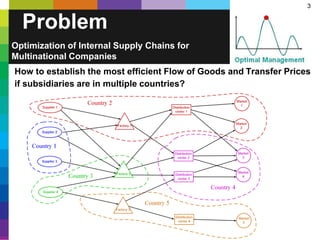
Problem
Optimization of Internal Supply Chains for
Multinational Companies
How to establish the most efficient Flow of Goods and Transfer Prices
if subsidiaries are in multiple countries?
4
• Expansion of globalization leads to complex supply
chains
• Tax authorities increase tax requirements across the
world
• Current optimization techniques use methods of linear
programming and therefore are limited in scope
• Optimization calculations for a mid size company involve
millions of variables and several terabytes of data
Background of the
Problem
5
Market Size
• SCM market was estimated by Gartner at
$8.9B in 2013 with annual growth 7.3%
o SAP 23.9% (first)
o Oracle 16.3% (second)
• Share of SCM market for multinational
companies is near 25% and will grow with
expansion of globalization
• Several thousands of companies in the world
have internal multinational supply chain
6
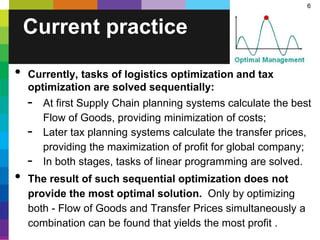
• Currently, tasks of logistics optimization and tax
optimization are solved sequentially:
- At first Supply Chain planning systems calculate the best
Flow of Goods, providing minimization of costs;
- Later tax planning systems calculate the transfer prices,
providing the maximization of profit for global company;
- In both stages, tasks of linear programming are solved.
• The result of such sequential optimization does not
provide the most optimal solution. Only by optimizing
both - Flow of Goods and Transfer Prices simultaneously a
combination can be found that yields the most profit .
Current practice
7
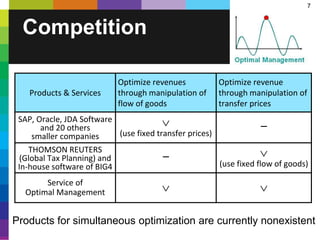
Competition
Products for simultaneous optimization are currently nonexistent
Products & Services
Optimize revenues
through manipulation of
flow of goods
Optimize revenue
through manipulation of
transfer prices
SAP, Oracle, JDA Software
and 20 others
smaller companies

(use fixed transfer prices)
─
THOMSON REUTERS
(Global Tax Planning) and
In-house software of BIG4
─ 
(use fixed flow of goods)
Service of
Optimal Management  
8
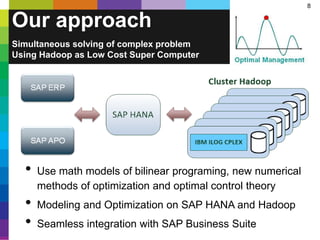
Our approach
Simultaneous solving of complex problem
Using Hadoop as Low Cost Super Computer
• Use math models of bilinear programing, new numerical
methods of optimization and optimal control theory
• Modeling and Optimization on SAP HANA and Hadoop
• Seamless integration with SAP Business Suite
9
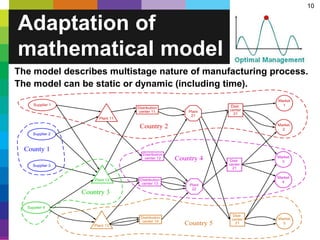
Supply chain structure is constructed by taking into
account the multistage nature of manufacturing processes.
The Multinational Supply Chain includes:
• Countries (various tax jurisdictions)
• Internal and external suppliers
• Manufacturing plants
• Distribution centers
• Market zones
• Items of goods (including all raw materials, semi-
products, finished products)
• Available transportation routes
Supply chain
structure
10
Adaptation of
mathematical model
The model describes multistage nature of manufacturing process.
The model can be static or dynamic (including time).
11
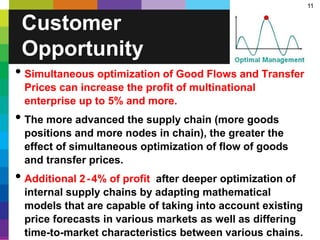
• Simultaneous optimization of Good Flows and Transfer
Prices can increase the profit of multinational
enterprise up to 5% and more.
• The more advanced the supply chain (more goods
positions and more nodes in chain), the greater the
effect of simultaneous optimization of flow of goods
and transfer prices.
• Additional 2-4% of profit after deeper optimization of
internal supply chains by adapting mathematical
models that are capable of taking into account existing
price forecasts in various markets as well as differing
time-to-market characteristics between various chains.
Customer
Opportunity
12
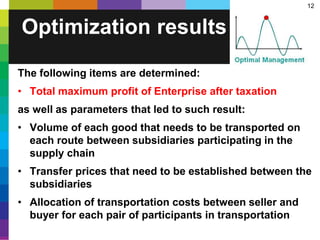
The following items are determined:
• Total maximum profit of Enterprise after taxation
as well as parameters that led to such result:
• Volume of each good that needs to be transported on
each route between subsidiaries participating in the
supply chain
• Transfer prices that need to be established between the
subsidiaries
• Allocation of transportation costs between seller and
buyer for each pair of participants in transportation
Optimization results
13
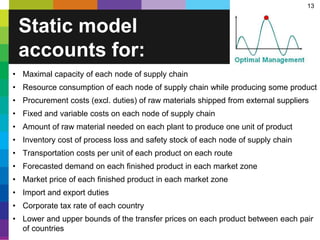
• Maximal capacity of each node of supply chain
• Resource consumption of each node of supply chain while producing some product
• Procurement costs (excl. duties) of raw materials shipped from external suppliers
• Fixed and variable costs on each node of supply chain
• Amount of raw material needed on each plant to produce one unit of product
• Inventory cost of process loss and safety stock of each node of supply chain
• Transportation costs per unit of each product on each route
• Forecasted demand on each finished product in each market zone
• Market price of each finished product in each market zone
• Import and export duties
• Corporate tax rate of each country
• Lower and upper bounds of the transfer prices on each product between each pair
of countries
Static model
accounts for:
14
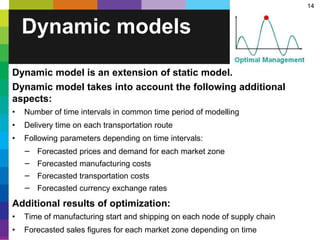
Dynamic model is an extension of static model.
Dynamic model takes into account the following additional
aspects:
• Number of time intervals in common time period of modelling
• Delivery time on each transportation route
• Following parameters depending on time intervals:
– Forecasted prices and demand for each market zone
– Forecasted manufacturing costs
– Forecasted transportation costs
– Forecasted currency exchange rates
Additional results of optimization:
• Time of manufacturing start and shipping on each node of supply chain
• Forecasted sales figures for each market zone depending on time
Dynamic models
15
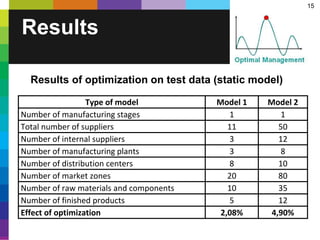
Results
Type of model Model 1 Model 2
Number of manufacturing stages 1 1
Total number of suppliers 11 50
Number of internal suppliers 3 12
Number of manufacturing plants 3 8
Number of distribution centers 8 10
Number of market zones 20 80
Number of raw materials and components 10 35
Number of finished products 5 12
Effect of optimization 2,08% 4,90%
Results of optimization on test data (static model)
16
Potential customers
Described problem is crucial for to the most industrial
companies that run subsidiary business units and
competing for the customers on global level. Most of the
large business companies as well as the higher level of
middle business companies fit these criteria.
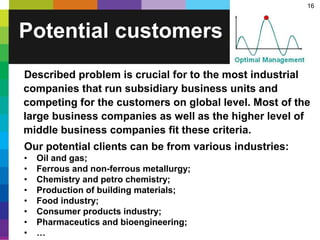
Our potential clients can be from various industries:
• Oil and gas;
• Ferrous and non-ferrous metallurgy;
• Chemistry and petro chemistry;
• Production of building materials;
• Food industry;
• Consumer products industry;
• Pharmaceutics and bioengineering;
• …
17
Team
• Experienced CEO with years of executive experience
• World renowned CSO
• 2 Dr.Sc and 2 Ph.D
• 200+ publications on Optimal Control and Optimization
• SAP guru consultants on EAM and SCM
• Experienced Project Managers and Architects
• International experience
• Combination of silver maturity and enthusiasm of youth
• Attracting most talented students
18
Team
Chief Executive Director of Business Director of Project
Officer Development Management
Scientific Director, Head of Imitational Head of Supply Chain
Regular Member of Modelling group, Doctor Optimization group, Doctor
Academy of Sciences of Technical Sciences of Phys.-Math. Sciences
19
Solution as a
service
While product is developing, we offer solution as a service.
The entire service process consists of following steps:
• Gathering of basic structure of customer’s supply chain
• Estimation of costs on calculation and full data gathering
• Approval for parameters taking into account
• Fitting of the math model to the client
• Gathering all necessary data for the developed model
• Transformation of gathered data into computational model
• Performing the calculation
• Applying of results
By analogy to the tasks of logistics optimization, static
model calculates for 18 months ahead every 6 months.
Dynamic model calculates weekly or monthly.
20
Sales & Marketing
• Market through SAP, IBM and Skolkovo
• Direct sales
• Sales through partners
For a small startup like ours, getting to the clients of such
caliber is hard. That is why we are looking for partners –
consulting companies that specialize in supply chain
optimization and also transfer pricing. Currently:
o We have solid agreements with partners in
Switzerland, Germany, Mexico
o We are in talks with potential partners in USA, India,
South Korea, Portugal, Cyprus
21
Business model
when product will be developed
The company will get its revenue from:
• Licensing the products
o Sales through partners - Consulting companies
o Sales through partners - SAP Partners
o Sales through partners - IBM Partners
o Sales through SAP Price List
o Sales through IBM Sales Managers
o Direct sales
• Revenue from consulting services on development of
mathematical models as well as training fees from
partners involved in integration
50% revenue
sharing model
with the
companies
selling our
products
22
Contacts
Contact persons:
• In USA & Great Britain – Vitaliy Baklikov
phone: +1 240 620 1229
e-mail: vitaliy.baklikov@optimalmngmnt.com
• In Russia & CIS – Andrey Sukhobokov
phone: +7 903 577 9667
e-mail: andrey.sukhobokov@optimalmngmnt.com

Optimal management presentation for investors about supply chains optimization

  • 1.
    Optimal Management, LLC Residentat Skolkovo Innovation Center Winner of Enterprise Applications & Big Data pitch session at Startup Village 2013 in Skolkovo Participant in Platform Development Accelerator for SAP HANA Participant in SAP Startup Focus Development Accelerator Participant in IBM Global Entrepreneur Participant in IBM PartnerWorld We use mathematical models and optimization methods for management of enterprises
  • 2.
    2 Problem We solve acompelling challenge within Enterprise Management: • Optimization of internal supply chains for multinational companies that yields the largest after tax profit for the enterprise To solve this problem we use heavy mathematical models, new computational algorithms, Big Data tools and parallel computing cluster power. Our deep optimization can increase the profit of a multinational enterprise to 5-10% and more.
  • 3.
    3 Problem Optimization of InternalSupply Chains for Multinational Companies How to establish the most efficient Flow of Goods and Transfer Prices if subsidiaries are in multiple countries?
  • 4.
    4 • Expansion ofglobalization leads to complex supply chains • Tax authorities increase tax requirements across the world • Current optimization techniques use methods of linear programming and therefore are limited in scope • Optimization calculations for a mid size company involve millions of variables and several terabytes of data Background of the Problem
  • 5.
    5 Market Size • SCMmarket was estimated by Gartner at $8.9B in 2013 with annual growth 7.3% o SAP 23.9% (first) o Oracle 16.3% (second) • Share of SCM market for multinational companies is near 25% and will grow with expansion of globalization • Several thousands of companies in the world have internal multinational supply chain
  • 6.
    6 • Currently, tasksof logistics optimization and tax optimization are solved sequentially: - At first Supply Chain planning systems calculate the best Flow of Goods, providing minimization of costs; - Later tax planning systems calculate the transfer prices, providing the maximization of profit for global company; - In both stages, tasks of linear programming are solved. • The result of such sequential optimization does not provide the most optimal solution. Only by optimizing both - Flow of Goods and Transfer Prices simultaneously a combination can be found that yields the most profit . Current practice
  • 7.
    7 Competition Products for simultaneousoptimization are currently nonexistent Products & Services Optimize revenues through manipulation of flow of goods Optimize revenue through manipulation of transfer prices SAP, Oracle, JDA Software and 20 others smaller companies  (use fixed transfer prices) ─ THOMSON REUTERS (Global Tax Planning) and In-house software of BIG4 ─  (use fixed flow of goods) Service of Optimal Management  
  • 8.
    8 Our approach Simultaneous solvingof complex problem Using Hadoop as Low Cost Super Computer • Use math models of bilinear programing, new numerical methods of optimization and optimal control theory • Modeling and Optimization on SAP HANA and Hadoop • Seamless integration with SAP Business Suite
  • 9.
    9 Supply chain structureis constructed by taking into account the multistage nature of manufacturing processes. The Multinational Supply Chain includes: • Countries (various tax jurisdictions) • Internal and external suppliers • Manufacturing plants • Distribution centers • Market zones • Items of goods (including all raw materials, semi- products, finished products) • Available transportation routes Supply chain structure
  • 10.
    10 Adaptation of mathematical model Themodel describes multistage nature of manufacturing process. The model can be static or dynamic (including time).
  • 11.
    11 • Simultaneous optimizationof Good Flows and Transfer Prices can increase the profit of multinational enterprise up to 5% and more. • The more advanced the supply chain (more goods positions and more nodes in chain), the greater the effect of simultaneous optimization of flow of goods and transfer prices. • Additional 2-4% of profit after deeper optimization of internal supply chains by adapting mathematical models that are capable of taking into account existing price forecasts in various markets as well as differing time-to-market characteristics between various chains. Customer Opportunity
  • 12.
    12 The following itemsare determined: • Total maximum profit of Enterprise after taxation as well as parameters that led to such result: • Volume of each good that needs to be transported on each route between subsidiaries participating in the supply chain • Transfer prices that need to be established between the subsidiaries • Allocation of transportation costs between seller and buyer for each pair of participants in transportation Optimization results
  • 13.
    13 • Maximal capacityof each node of supply chain • Resource consumption of each node of supply chain while producing some product • Procurement costs (excl. duties) of raw materials shipped from external suppliers • Fixed and variable costs on each node of supply chain • Amount of raw material needed on each plant to produce one unit of product • Inventory cost of process loss and safety stock of each node of supply chain • Transportation costs per unit of each product on each route • Forecasted demand on each finished product in each market zone • Market price of each finished product in each market zone • Import and export duties • Corporate tax rate of each country • Lower and upper bounds of the transfer prices on each product between each pair of countries Static model accounts for:
  • 14.
    14 Dynamic model isan extension of static model. Dynamic model takes into account the following additional aspects: • Number of time intervals in common time period of modelling • Delivery time on each transportation route • Following parameters depending on time intervals: – Forecasted prices and demand for each market zone – Forecasted manufacturing costs – Forecasted transportation costs – Forecasted currency exchange rates Additional results of optimization: • Time of manufacturing start and shipping on each node of supply chain • Forecasted sales figures for each market zone depending on time Dynamic models
  • 15.
    15 Results Type of modelModel 1 Model 2 Number of manufacturing stages 1 1 Total number of suppliers 11 50 Number of internal suppliers 3 12 Number of manufacturing plants 3 8 Number of distribution centers 8 10 Number of market zones 20 80 Number of raw materials and components 10 35 Number of finished products 5 12 Effect of optimization 2,08% 4,90% Results of optimization on test data (static model)
  • 16.
    16 Potential customers Described problemis crucial for to the most industrial companies that run subsidiary business units and competing for the customers on global level. Most of the large business companies as well as the higher level of middle business companies fit these criteria. Our potential clients can be from various industries: • Oil and gas; • Ferrous and non-ferrous metallurgy; • Chemistry and petro chemistry; • Production of building materials; • Food industry; • Consumer products industry; • Pharmaceutics and bioengineering; • …
  • 17.
    17 Team • Experienced CEOwith years of executive experience • World renowned CSO • 2 Dr.Sc and 2 Ph.D • 200+ publications on Optimal Control and Optimization • SAP guru consultants on EAM and SCM • Experienced Project Managers and Architects • International experience • Combination of silver maturity and enthusiasm of youth • Attracting most talented students
  • 18.
    18 Team Chief Executive Directorof Business Director of Project Officer Development Management Scientific Director, Head of Imitational Head of Supply Chain Regular Member of Modelling group, Doctor Optimization group, Doctor Academy of Sciences of Technical Sciences of Phys.-Math. Sciences
  • 19.
    19 Solution as a service Whileproduct is developing, we offer solution as a service. The entire service process consists of following steps: • Gathering of basic structure of customer’s supply chain • Estimation of costs on calculation and full data gathering • Approval for parameters taking into account • Fitting of the math model to the client • Gathering all necessary data for the developed model • Transformation of gathered data into computational model • Performing the calculation • Applying of results By analogy to the tasks of logistics optimization, static model calculates for 18 months ahead every 6 months. Dynamic model calculates weekly or monthly.
  • 20.
    20 Sales & Marketing •Market through SAP, IBM and Skolkovo • Direct sales • Sales through partners For a small startup like ours, getting to the clients of such caliber is hard. That is why we are looking for partners – consulting companies that specialize in supply chain optimization and also transfer pricing. Currently: o We have solid agreements with partners in Switzerland, Germany, Mexico o We are in talks with potential partners in USA, India, South Korea, Portugal, Cyprus
  • 21.
    21 Business model when productwill be developed The company will get its revenue from: • Licensing the products o Sales through partners - Consulting companies o Sales through partners - SAP Partners o Sales through partners - IBM Partners o Sales through SAP Price List o Sales through IBM Sales Managers o Direct sales • Revenue from consulting services on development of mathematical models as well as training fees from partners involved in integration 50% revenue sharing model with the companies selling our products
  • 22.
    22 Contacts Contact persons: • InUSA & Great Britain – Vitaliy Baklikov phone: +1 240 620 1229 e-mail: vitaliy.baklikov@optimalmngmnt.com • In Russia & CIS – Andrey Sukhobokov phone: +7 903 577 9667 e-mail: andrey.sukhobokov@optimalmngmnt.com