The Johnson & Johnson Story 
Fikry Isaac, MD, MPH, FACOEM 
Vice President, Global Health Services 
Chief Medical Officer, Health & Wellness Solutions 
Worksite Wellness Council of Massachusetts 
September 19, 2014
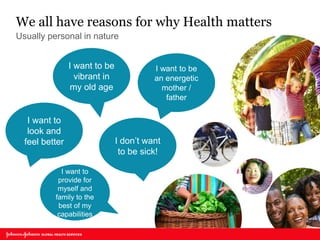
We all have reasons for why Health matters 
Usually personal in nature 
I want to be an energetic mother / father 
I want to look and feel better 
I want to be vibrant in my old age 
I don’t want to be sick! 
I want to provide for myself and family to the best of my capabilities
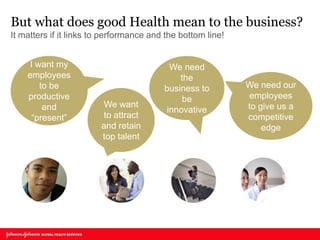
But what does good Health mean to the business? 
It matters if it links to performance and the bottom line! 
I want my employees to be productive and “present” 
We need the business to be innovative 
We need our employees to give us a competitive edge 
We want to attract and retain top talent
Leading with a purpose 
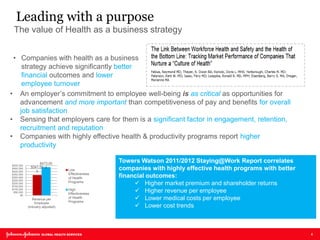
•Companies with health as a business strategy achieve significantly better financial outcomes and lower employee turnover 
Towers Watson 2011/2012 Staying@Work Report correlates companies with highly effective health programs with better financial outcomes: 
Higher market premium and shareholder returns 
Higher revenue per employee 
Lower medical costs per employee 
Lower cost trends 
$341,000 
$473,000 
$0 
$50,000 
$100,000 
$150,000 
$200,000 
$250,000 
$300,000 
$350,000 
$400,000 
$450,000 
$500,000 
Revenue per 
Employee 
(Industry adjusted) 
Low 
Effectiveness 
of Health 
Programs 
High 
Effectiveness 
of Health 
Programs 
The value of Health as a business strategy 
4 
•An employer’s commitment to employee well-being is as critical as opportunities for advancement and more important than competitiveness of pay and benefits for overall job satisfaction 
•Sensing that employers care for them is a significant factor in engagement, retention, recruitment and reputation 
•Companies with highly effective health & productivity programs report higher productivity
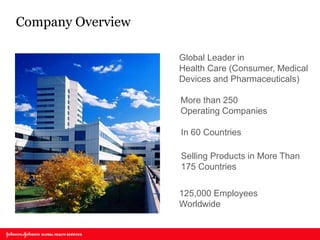
Global Leader in Health Care (Consumer, Medical Devices and Pharmaceuticals) 
More than 250 Operating Companies 
In 60 Countries 
Selling Products in More Than 175 Countries 
125,000 Employees Worldwide 
Company Overview
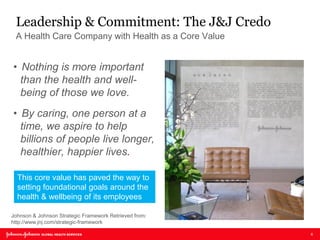
Leadership & Commitment: The J&J Credo 
A Health Care Company with Health as a Core Value 
6 
•Nothing is more important than the health and well- being of those we love. 
•By caring, one person at a time, we aspire to help billions of people live longer, healthier, happier lives. 
This core value has paved the way to setting foundational goals around the health & wellbeing of its employees 
Johnson & Johnson Strategic Framework Retrieved from: http://www.jnj.com/strategic-framework
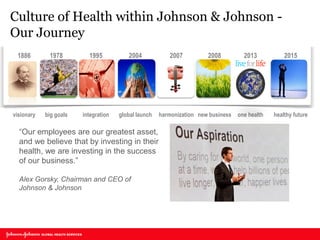
Culture of Health within Johnson & Johnson - Our Journey 
Fix The Health Care Crisis One Employee at a Time 
2007 
harmonization 
2004 
global launch 
1978 
big goals 
2015 healthy future 
2008 
new business 
1995 integration 
1886 
visionary 
2013 
one health 
“Our employees are our greatest asset, and we believe that by investing in their health, we are investing in the success of our business.” 
Alex Gorsky, Chairman and CEO of Johnson & Johnson
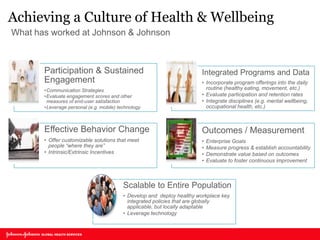
Achieving a Culture of Health & Wellbeing 
Participation & Sustained Engagement 
•Communication Strategies 
•Evaluate engagement scores and other measures of end-user satisfaction 
•Leverage personal (e.g. mobile) technology 
Integrated Programs and Data 
•Incorporate program offerings into the daily routine (healthy eating, movement, etc.) 
•Evaluate participation and retention rates 
•Integrate disciplines (e.g. mental wellbeing, occupational health, etc.) 
Effective Behavior Change 
•Offer customizable solutions that meet people “where they are” 
•Intrinsic/Extrinsic Incentives 
Outcomes / Measurement 
•Enterprise Goals 
•Measure progress & establish accountability 
•Demonstrate value based on outcomes 
•Evaluate to foster continuous improvement 
Scalable to Entire Population 
•Develop and deploy healthy workplace key integrated policies that are globally applicable, but locally adaptable 
•Leverage technology 
What has worked at Johnson & Johnson
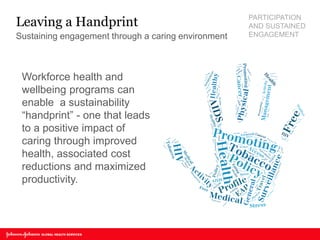
Leaving a Handprint 
Sustaining engagement through a caring environment 
Workforce health and wellbeing programs can enable a sustainability “handprint” - one that leads to a positive impact of caring through improved health, associated cost reductions and maximized productivity. 
PARTICIPATION AND SUSTAINED ENGAGEMENT
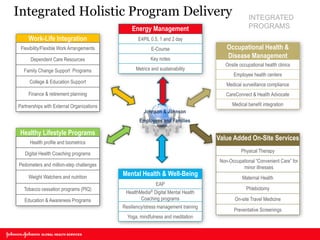
Johnson & Johnson 
Employees and Families 
Integrated Holistic Program Delivery 
Mental Health & Well-Being 
EAP 
HealthMedia® Digital Mental Health Coaching programs 
Resiliency/stress management training 
Yoga, mindfulness and meditation 
Healthy Lifestyle Programs 
Health profile and biometrics 
Digital Health Coaching programs 
Pedometers and million-step challenges 
Weight Watchers and nutrition 
Tobacco cessation programs (PIQ) 
Education & Awareness Programs 
Occupational Health & Disease Management 
Onsite occupational health clinics 
Employee health centers 
Medical surveillance compliance 
CareConnect & Health Advocate 
Medical benefit integration 
Value Added On-Site Services 
Physical Therapy 
Non-Occupational “Convenient Care” for minor illnesses 
Maternal Health 
Phlebotomy 
On-site Travel Medicine 
Preventative Screenings 
Work-Life Integration 
Flexibility/Flexible Work Arrangements 
Dependent Care Resources 
Family Change Support Programs 
College & Education Support 
Finance & retirement planning 
Partnerships with External Organizations 
INTEGRATED PROGRAMS 
Energy Management 
E4PIL 0.5, 1 and 2 day 
E-Course 
Key notes 
Metrics and sustainability
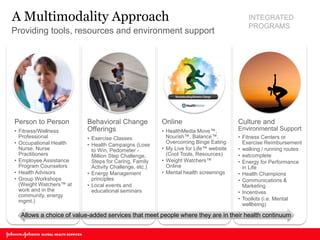
A Multimodality Approach 
Providing tools, resources and environment support 
Person to Person 
•Fitness/Wellness Professional 
•Occupational Health Nurse, Nurse Practitioners 
•Employee Assistance Program Counselors 
•Health Advisors 
•Group Workshops (Weight Watchers™ at work and in the community, energy mgmt.) 
Behavioral Change Offerings 
•Exercise Classes 
•Health Campaigns (Lose to Win, Pedometer - Million Step Challenge, Steps for Caring, Family Activity Challenge, etc.) 
•Energy Management principles 
•Local events and educational seminars 
Online 
•HealthMedia Move™, Nourish™, Balance™, Overcoming Binge Eating 
•My Live for Life™ website (Cool Tools, Resources) 
•Weight Watchers™ Online 
•Mental health screenings 
Culture and Environmental Support 
•Fitness Centers or Exercise Reimbursement 
•walking / running routes 
•eatcomplete 
•Energy for Performance in Life 
•Health Champions 
•Communications & Marketing 
•Incentives 
•Toolkits (i.e. Mental wellbeing) 
Allows a choice of value-added services that meet people where they are in their health continuum 
INTEGRATED PROGRAMS
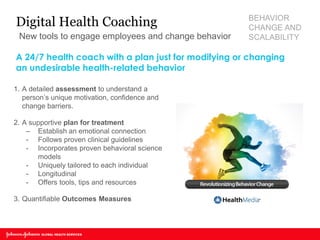
1.A detailed assessment to understand a person’s unique motivation, confidence and change barriers. 
2.A supportive plan for treatment 
–Establish an emotional connection 
-Follows proven clinical guidelines 
-Incorporates proven behavioral science models 
-Uniquely tailored to each individual 
-Longitudinal 
-Offers tools, tips and resources 
3.Quantifiable Outcomes Measures 
A 24/7 health coach with a plan just for modifying or changing an undesirable health-related behavior 
Digital Health Coaching 
New tools to engage employees and change behavior 
BEHAVIOR CHANGE AND SCALABILITY
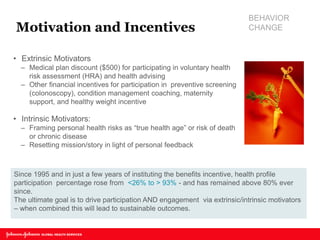
Motivation and Incentives 
•Extrinsic Motivators 
–Medical plan discount ($500) for participating in voluntary health risk assessment (HRA) and health advising 
–Other financial incentives for participation in preventive screening (colonoscopy), condition management coaching, maternity support, and healthy weight incentive 
•Intrinsic Motivators: 
–Framing personal health risks as “true health age” or risk of death or chronic disease 
–Resetting mission/story in light of personal feedback 
Since 1995 and in just a few years of instituting the benefits incentive, health profile participation percentage rose from <26% to > 93% - and has remained above 80% ever since. The ultimate goal is to drive participation AND engagement via extrinsic/intrinsic motivators – when combined this will lead to sustainable outcomes. 
BEHAVIOR CHANGE
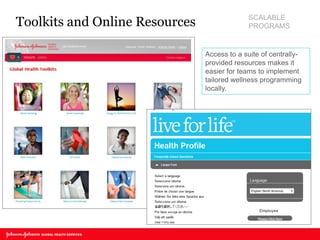
Toolkits and Online Resources 
Access to a suite of centrally- provided resources makes it easier for teams to implement tailored wellness programming locally. 
SCALABLE PROGRAMS
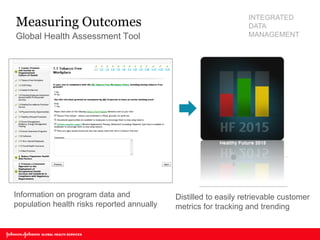
Measuring Outcomes 
Global Health Assessment Tool 
Information on program data and population health risks reported annually 
Distilled to easily retrievable customer metrics for tracking and trending 
INTEGRATED DATA MANAGEMENT
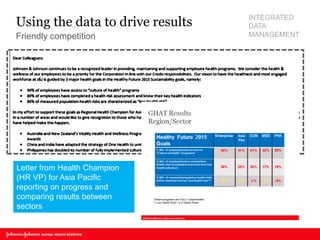
Using the data to drive results 
Friendly competition 
Letter from Health Champion (HR VP) for Asia Pacific reporting on progress and comparing results between sectors 
INTEGRATED DATA MANAGEMENT
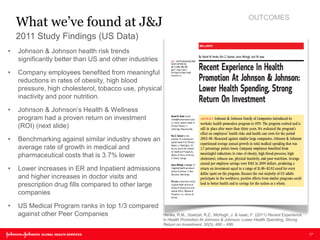
Henke, R.M., Goetzel, R.Z., McHugh, J. & Isaac, F. (2011) Recent Experience in Health Promotion At Johnson & Johnson: Lower Health Spending, Strong Return on Investment. 30(3). 490 – 499 
What we’ve found at J&J 
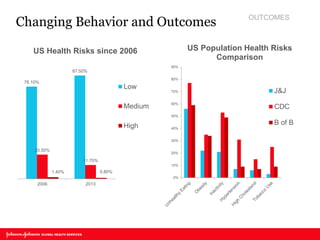
•Johnson & Johnson health risk trends significantly better than US and other industries 
•Company employees benefited from meaningful reductions in rates of obesity, high blood pressure, high cholesterol, tobacco use, physical inactivity and poor nutrition. 
•Johnson & Johnson’s Health & Wellness program had a proven return on investment (ROI) (next slide) 
•Benchmarking against similar industry shows an average rate of growth in medical and pharmaceutical costs that is 3.7% lower 
•Lower increases in ER and Inpatient admissions and higher increases in doctor visits and prescription drug fills compared to other large companies 
•US Medical Program ranks in top 1/3 compared against other Peer Companies 
17 
OUTCOMES 
2011 Study Findings (US Data)
Changing Behavior and Outcomes 
78.10% 
87.50% 
20.50% 
11.70% 
1.40% 
0.80% 
2006 
2013 
US Health Risks since 2006 
Low 
Medium 
High 
0% 
10% 
20% 
30% 
40% 
50% 
60% 
70% 
80% 
90% 
US Population Health Risks Comparison 
J&J 
CDC 
B of B 
OUTCOMES
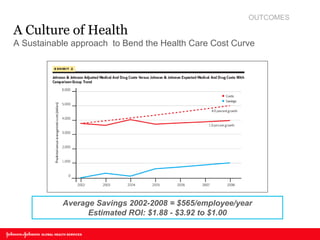
A Culture of Health A Sustainable approach to Bend the Health Care Cost Curve 
Average Savings 2002-2008 = $565/employee/year 
Estimated ROI: $1.88 - $3.92 to $1.00 
OUTCOMES
Key Takeaways 
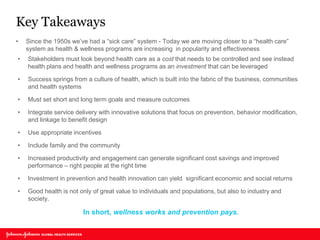
•Since the 1950s we’ve had a “sick care” system - Today we are moving closer to a “health care” system as health & wellness programs are increasing in popularity and effectiveness 
•Stakeholders must look beyond health care as a cost that needs to be controlled and see instead health plans and health and wellness programs as an investment that can be leveraged 
•Success springs from a culture of health, which is built into the fabric of the business, communities and health systems 
•Must set short and long term goals and measure outcomes 
•Integrate service delivery with innovative solutions that focus on prevention, behavior modification, and linkage to benefit design 
•Use appropriate incentives 
•Include family and the community 
•Increased productivity and engagement can generate significant cost savings and improved performance – right people at the right time 
•Investment in prevention and health innovation can yield significant economic and social returns 
•Good health is not only of great value to individuals and populations, but also to industry and society. 
In short, wellness works and prevention pays.
21 
Thank You

Jj keynote 1 dr. isaac

  • 1.
    The Johnson &Johnson Story Fikry Isaac, MD, MPH, FACOEM Vice President, Global Health Services Chief Medical Officer, Health & Wellness Solutions Worksite Wellness Council of Massachusetts September 19, 2014
  • 2.
    We all havereasons for why Health matters Usually personal in nature I want to be an energetic mother / father I want to look and feel better I want to be vibrant in my old age I don’t want to be sick! I want to provide for myself and family to the best of my capabilities
  • 3.
    But what doesgood Health mean to the business? It matters if it links to performance and the bottom line! I want my employees to be productive and “present” We need the business to be innovative We need our employees to give us a competitive edge We want to attract and retain top talent
  • 4.
    Leading with apurpose •Companies with health as a business strategy achieve significantly better financial outcomes and lower employee turnover Towers Watson 2011/2012 Staying@Work Report correlates companies with highly effective health programs with better financial outcomes: Higher market premium and shareholder returns Higher revenue per employee Lower medical costs per employee Lower cost trends $341,000 $473,000 $0 $50,000 $100,000 $150,000 $200,000 $250,000 $300,000 $350,000 $400,000 $450,000 $500,000 Revenue per Employee (Industry adjusted) Low Effectiveness of Health Programs High Effectiveness of Health Programs The value of Health as a business strategy 4 •An employer’s commitment to employee well-being is as critical as opportunities for advancement and more important than competitiveness of pay and benefits for overall job satisfaction •Sensing that employers care for them is a significant factor in engagement, retention, recruitment and reputation •Companies with highly effective health & productivity programs report higher productivity
  • 5.
    Global Leader inHealth Care (Consumer, Medical Devices and Pharmaceuticals) More than 250 Operating Companies In 60 Countries Selling Products in More Than 175 Countries 125,000 Employees Worldwide Company Overview
  • 6.
    Leadership & Commitment:The J&J Credo A Health Care Company with Health as a Core Value 6 •Nothing is more important than the health and well- being of those we love. •By caring, one person at a time, we aspire to help billions of people live longer, healthier, happier lives. This core value has paved the way to setting foundational goals around the health & wellbeing of its employees Johnson & Johnson Strategic Framework Retrieved from: http://www.jnj.com/strategic-framework
  • 7.
    Culture of Healthwithin Johnson & Johnson - Our Journey Fix The Health Care Crisis One Employee at a Time 2007 harmonization 2004 global launch 1978 big goals 2015 healthy future 2008 new business 1995 integration 1886 visionary 2013 one health “Our employees are our greatest asset, and we believe that by investing in their health, we are investing in the success of our business.” Alex Gorsky, Chairman and CEO of Johnson & Johnson
  • 8.
    Achieving a Cultureof Health & Wellbeing Participation & Sustained Engagement •Communication Strategies •Evaluate engagement scores and other measures of end-user satisfaction •Leverage personal (e.g. mobile) technology Integrated Programs and Data •Incorporate program offerings into the daily routine (healthy eating, movement, etc.) •Evaluate participation and retention rates •Integrate disciplines (e.g. mental wellbeing, occupational health, etc.) Effective Behavior Change •Offer customizable solutions that meet people “where they are” •Intrinsic/Extrinsic Incentives Outcomes / Measurement •Enterprise Goals •Measure progress & establish accountability •Demonstrate value based on outcomes •Evaluate to foster continuous improvement Scalable to Entire Population •Develop and deploy healthy workplace key integrated policies that are globally applicable, but locally adaptable •Leverage technology What has worked at Johnson & Johnson
  • 9.
    Leaving a Handprint Sustaining engagement through a caring environment Workforce health and wellbeing programs can enable a sustainability “handprint” - one that leads to a positive impact of caring through improved health, associated cost reductions and maximized productivity. PARTICIPATION AND SUSTAINED ENGAGEMENT
  • 10.
    Johnson & Johnson Employees and Families Integrated Holistic Program Delivery Mental Health & Well-Being EAP HealthMedia® Digital Mental Health Coaching programs Resiliency/stress management training Yoga, mindfulness and meditation Healthy Lifestyle Programs Health profile and biometrics Digital Health Coaching programs Pedometers and million-step challenges Weight Watchers and nutrition Tobacco cessation programs (PIQ) Education & Awareness Programs Occupational Health & Disease Management Onsite occupational health clinics Employee health centers Medical surveillance compliance CareConnect & Health Advocate Medical benefit integration Value Added On-Site Services Physical Therapy Non-Occupational “Convenient Care” for minor illnesses Maternal Health Phlebotomy On-site Travel Medicine Preventative Screenings Work-Life Integration Flexibility/Flexible Work Arrangements Dependent Care Resources Family Change Support Programs College & Education Support Finance & retirement planning Partnerships with External Organizations INTEGRATED PROGRAMS Energy Management E4PIL 0.5, 1 and 2 day E-Course Key notes Metrics and sustainability
  • 11.
    A Multimodality Approach Providing tools, resources and environment support Person to Person •Fitness/Wellness Professional •Occupational Health Nurse, Nurse Practitioners •Employee Assistance Program Counselors •Health Advisors •Group Workshops (Weight Watchers™ at work and in the community, energy mgmt.) Behavioral Change Offerings •Exercise Classes •Health Campaigns (Lose to Win, Pedometer - Million Step Challenge, Steps for Caring, Family Activity Challenge, etc.) •Energy Management principles •Local events and educational seminars Online •HealthMedia Move™, Nourish™, Balance™, Overcoming Binge Eating •My Live for Life™ website (Cool Tools, Resources) •Weight Watchers™ Online •Mental health screenings Culture and Environmental Support •Fitness Centers or Exercise Reimbursement •walking / running routes •eatcomplete •Energy for Performance in Life •Health Champions •Communications & Marketing •Incentives •Toolkits (i.e. Mental wellbeing) Allows a choice of value-added services that meet people where they are in their health continuum INTEGRATED PROGRAMS
  • 12.
    1.A detailed assessmentto understand a person’s unique motivation, confidence and change barriers. 2.A supportive plan for treatment –Establish an emotional connection -Follows proven clinical guidelines -Incorporates proven behavioral science models -Uniquely tailored to each individual -Longitudinal -Offers tools, tips and resources 3.Quantifiable Outcomes Measures A 24/7 health coach with a plan just for modifying or changing an undesirable health-related behavior Digital Health Coaching New tools to engage employees and change behavior BEHAVIOR CHANGE AND SCALABILITY
  • 13.
    Motivation and Incentives •Extrinsic Motivators –Medical plan discount ($500) for participating in voluntary health risk assessment (HRA) and health advising –Other financial incentives for participation in preventive screening (colonoscopy), condition management coaching, maternity support, and healthy weight incentive •Intrinsic Motivators: –Framing personal health risks as “true health age” or risk of death or chronic disease –Resetting mission/story in light of personal feedback Since 1995 and in just a few years of instituting the benefits incentive, health profile participation percentage rose from <26% to > 93% - and has remained above 80% ever since. The ultimate goal is to drive participation AND engagement via extrinsic/intrinsic motivators – when combined this will lead to sustainable outcomes. BEHAVIOR CHANGE
  • 14.
    Toolkits and OnlineResources Access to a suite of centrally- provided resources makes it easier for teams to implement tailored wellness programming locally. SCALABLE PROGRAMS
  • 15.
    Measuring Outcomes GlobalHealth Assessment Tool Information on program data and population health risks reported annually Distilled to easily retrievable customer metrics for tracking and trending INTEGRATED DATA MANAGEMENT
  • 16.
    Using the datato drive results Friendly competition Letter from Health Champion (HR VP) for Asia Pacific reporting on progress and comparing results between sectors INTEGRATED DATA MANAGEMENT
  • 17.
    Henke, R.M., Goetzel,R.Z., McHugh, J. & Isaac, F. (2011) Recent Experience in Health Promotion At Johnson & Johnson: Lower Health Spending, Strong Return on Investment. 30(3). 490 – 499 What we’ve found at J&J •Johnson & Johnson health risk trends significantly better than US and other industries •Company employees benefited from meaningful reductions in rates of obesity, high blood pressure, high cholesterol, tobacco use, physical inactivity and poor nutrition. •Johnson & Johnson’s Health & Wellness program had a proven return on investment (ROI) (next slide) •Benchmarking against similar industry shows an average rate of growth in medical and pharmaceutical costs that is 3.7% lower •Lower increases in ER and Inpatient admissions and higher increases in doctor visits and prescription drug fills compared to other large companies •US Medical Program ranks in top 1/3 compared against other Peer Companies 17 OUTCOMES 2011 Study Findings (US Data)
  • 18.
    Changing Behavior andOutcomes 78.10% 87.50% 20.50% 11.70% 1.40% 0.80% 2006 2013 US Health Risks since 2006 Low Medium High 0% 10% 20% 30% 40% 50% 60% 70% 80% 90% US Population Health Risks Comparison J&J CDC B of B OUTCOMES
  • 19.
    A Culture ofHealth A Sustainable approach to Bend the Health Care Cost Curve Average Savings 2002-2008 = $565/employee/year Estimated ROI: $1.88 - $3.92 to $1.00 OUTCOMES
  • 20.
    Key Takeaways •Sincethe 1950s we’ve had a “sick care” system - Today we are moving closer to a “health care” system as health & wellness programs are increasing in popularity and effectiveness •Stakeholders must look beyond health care as a cost that needs to be controlled and see instead health plans and health and wellness programs as an investment that can be leveraged •Success springs from a culture of health, which is built into the fabric of the business, communities and health systems •Must set short and long term goals and measure outcomes •Integrate service delivery with innovative solutions that focus on prevention, behavior modification, and linkage to benefit design •Use appropriate incentives •Include family and the community •Increased productivity and engagement can generate significant cost savings and improved performance – right people at the right time •Investment in prevention and health innovation can yield significant economic and social returns •Good health is not only of great value to individuals and populations, but also to industry and society. In short, wellness works and prevention pays.
  • 21.