The Role and Impact of Rewards &
Recognition Corporate Wellness Programs
Overview of Today’s Seminar


   Poll Questions
   Benefits of a Worksite Wellness Program
   Employee Incentives in a Wellness
    Program
   Health Care Costs in Today’s Workplace
   Ways to Fund a Program
   Employee Engagement
   ROI/Savings in a Wellness Program
   Creating/Implementing a Program
   How Do You Pick a Wellness Partner?
   Q&A
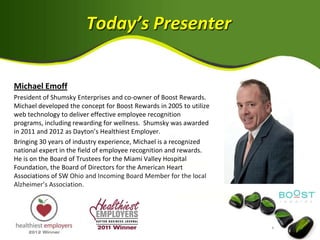
Today’s Presenter


Michael Emoff
President of Shumsky Enterprises and co-owner of Boost Rewards.
Michael developed the concept for Boost Rewards in 2005 to utilize
web technology to deliver effective employee recognition
programs, including rewarding for wellness. Shumsky was awarded
in 2011 and 2012 as Dayton’s Healthiest Employer.
Bringing 30 years of industry experience, Michael is a recognized
national expert in the field of employee recognition and rewards.
He is on the Board of Trustees for the Miami Valley Hospital
Foundation, the Board of Directors for the American Heart
Associations of SW Ohio and Incoming Board Member for the local
Alzheimer’s Association.
Poll Question #1


 Is your company administering an
employee wellness program in 2012?

          A. Yes
          B. No
          C. Considering
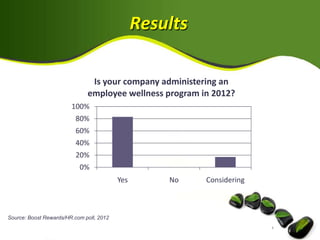
Results

                               Is your company administering an
                              employee wellness program in 2012?
                        100%
                          80%
                          60%
                          40%
                          20%
                           0%
                                          Yes       No    Considering


Source: Boost Rewards/HR.com poll, 2012
FACT


• Starbucks Coffee’s Chairman recently noted
  that his company spends $200 million per year
  on insurance for its employees--more than the
  company spends on coffee.


Source: Welcoa, 2009
Benefits of a Wellness Program

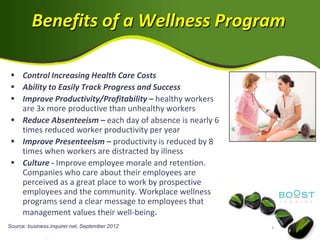
  Control Increasing Health Care Costs
  Ability to Easily Track Progress and Success
  Improve Productivity/Profitability – healthy workers
   are 3x more productive than unhealthy workers
  Reduce Absenteeism – each day of absence is nearly 6
   times reduced worker productivity per year
  Improve Presenteeism – productivity is reduced by 8
   times when workers are distracted by illness
  Culture - Improve employee morale and retention.
   Companies who care about their employees are
   perceived as a great place to work by prospective
   employees and the community. Workplace wellness
   programs send a clear message to employees that
   management values their well-being.
Source: business.inquirer.net, September 2012
Employee Incentives

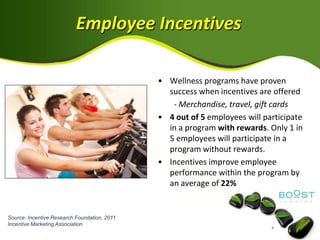
                                              • Wellness programs have proven
                                                success when incentives are offered
                                                 - Merchandise, travel, gift cards
                                              • 4 out of 5 employees will participate
                                                in a program with rewards. Only 1 in
                                                5 employees will participate in a
                                                program without rewards.
                                              • Incentives improve employee
                                                performance within the program by
                                                an average of 22%


Source: Incentive Research Foundation, 2011
Incentive Marketing Association
Poll Question #2


How important is reducing health care costs to
              your company?
             1 = not important at all
             2 = less than important
                  3 = important
            4 = moderately important
             5 = extremely important
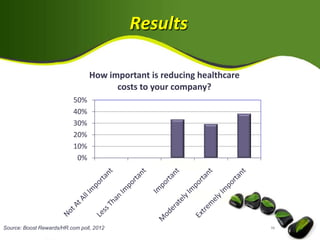
Results

                                 How important is reducing healthcare
                                       costs to your company?
                           50%
                           40%
                           30%
                           20%
                           10%
                            0%


Source: Boost Rewards/HR.com poll, 2012
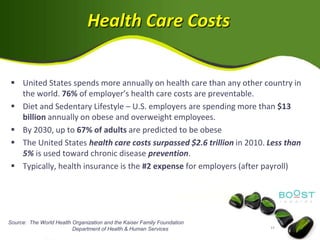
Health Care Costs


  United States spends more annually on health care than any other country in
   the world. 76% of employer’s health care costs are preventable.
  Diet and Sedentary Lifestyle – U.S. employers are spending more than $13
   billion annually on obese and overweight employees.
  By 2030, up to 67% of adults are predicted to be obese
  The United States health care costs surpassed $2.6 trillion in 2010. Less than
   5% is used toward chronic disease prevention.
  Typically, health insurance is the #2 expense for employers (after payroll)


Source: The World Health Organization and the Kaiser Family Foundation
                         Department of Health & Human Services
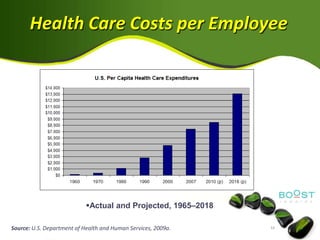
Health Care Costs per Employee


                            Actual and Projected, 1965–2018

Source: U.S. Department of Health and Human Services, 2009a.
Ways to Fund A Program


• You can receive government grants to create and
  implement a wellness program:
   • http://www.firstvitals.com/employers.aspx
• Programs can be divided into two categories: HIPAA
  compliant (measureable results) and non-HIPAA
  compliant (based on participation only, not results)
• Employees receive up to 20% off of insurance
  coverage
Ways to Fund A Program


• Through your insurance
  provider:
   • Write a letter to your
     company’s insurance broker
     for assistance
   • Broker submits to insurance
     provider (United
     Healthcare, Anthem, etc.)
   • Receive up to $300 per
     employee
Poll Question #3

 Do you believe offering a wellness program
affects your company’s insurance premiums?
        A. Not at all affects premiums
         B. Slightly affects premiums
       C. Moderately affects premiums
       D. Significantly affects premiums
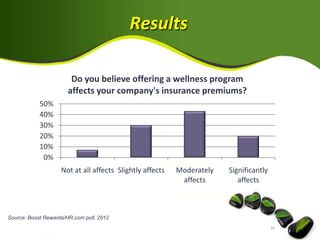
Results

                        Do you believe offering a wellness program
                       affects your company's insurance premiums?
            50%
            40%
            30%
            20%
            10%
             0%
                    Not at all affects Slightly affects   Moderately   Significantly
                                                           affects        affects


Source: Boost Rewards/HR.com poll, 2012
Wellness Programs & Insurance Premiums


• Rising insurance premiums will not stop unless behaviors are controlled
• GOOD NEWS: Almost all of the top health issues in US are preventable
• Launch a successful wellness program and your annual renewal rates with
  your insurance provider may decrease
• A wellness program is typically only about 3% of an employer’s current
  health care costs
Proven Case Study

• Johnson & Johnson began its wellness program in
  1979 and now saves an estimated $9 to $10 million
  annually.
• This company was studied for 5 years prior to
  program launch & four years after:
      • “A well-conceived health and wellness program that focuses on
        prevention, self-care, risk factor reduction, and disease management
        can produce substantial benefits for employers and their employees.”


Source:
Incentive Research Foundation, July 2011
Poll Question #4

What is the biggest obstacle in achieving a
            successful program?
             A. Limited Budget
         B. Employee Engagement
        C. Executive-level Support
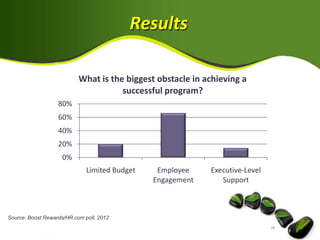
Results

                           What is the biggest obstacle in achieving a
                                      successful program?
                   80%
                   60%
                   40%
                   20%
                     0%
                              Limited Budget    Employee    Executive-Level
                                               Engagement      Support


Source: Boost Rewards/HR.com poll, 2012
Employee Engagement

• 58% of companies state the biggest obstacle is lack of
  employee engagement, which leads to low
  participation
• Where incentives were offered, participation grew
  from 26% to 90%


 Source: Incentive Marketing Association
 Long term study by Johnson & Johnson
ROI and Savings in Wellness Programs


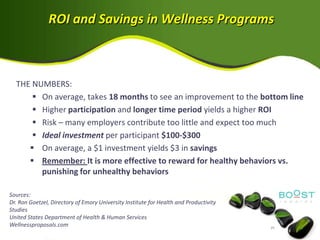
  THE NUMBERS:
       On average, takes 18 months to see an improvement to the bottom line
       Higher participation and longer time period yields a higher ROI
       Risk – many employers contribute too little and expect too much
       Ideal investment per participant $100-$300
      On average, a $1 investment yields $3 in savings
      Remember: It is more effective to reward for healthy behaviors vs.
        punishing for unhealthy behaviors

Sources:
Dr. Ron Goetzel, Directory of Emory University Institute for Health and Productivity
Studies
United States Department of Health & Human Services
Wellnessproposals.com
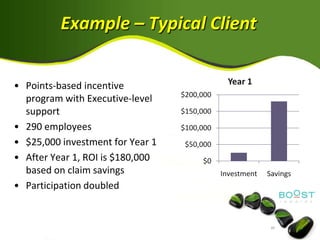
Example – Typical Client


• Points-based incentive                       Year 1
                                  $200,000
  program with Executive-level
  support                         $150,000

• 290 employees                   $100,000
• $25,000 investment for Year 1    $50,000
• After Year 1, ROI is $180,000        $0
  based on claim savings                     Investment   Savings
• Participation doubled
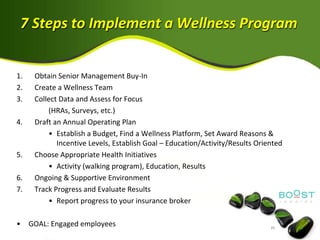
7 Steps to Implement a Wellness Program


1.    Obtain Senior Management Buy-In
2.    Create a Wellness Team
3.    Collect Data and Assess for Focus
          (HRAs, Surveys, etc.)
4.    Draft an Annual Operating Plan
          • Establish a Budget, Find a Wellness Platform, Set Award Reasons &
             Incentive Levels, Establish Goal – Education/Activity/Results Oriented
5.    Choose Appropriate Health Initiatives
          • Activity (walking program), Education, Results
6.    Ongoing & Supportive Environment
7.    Track Progress and Evaluate Results
          • Report progress to your insurance broker

•    GOAL: Engaged employees
What can you do to implement change?


• Write your Representative
      https://writerep.house.gov/writerep/welcome.shtml

• Raise Awareness
• Educate your employees and communicate in a
  positive manner
• Start or re-launch your company’s wellness program!
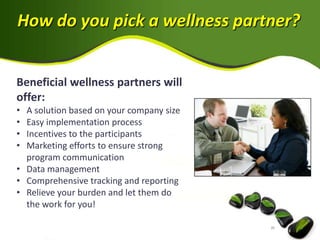
How do you pick a wellness partner?


Beneficial wellness partners will
offer:
• A solution based on your company size
• Easy implementation process
• Incentives to the participants
• Marketing efforts to ensure strong
  program communication
• Data management
• Comprehensive tracking and reporting
• Relieve your burden and let them do
  the work for you!
Q&A


                 Michael Emoff

         www.boostrewards.com

Michael.Emoff@boostrewards.com

Motivation Show Presentation Final20121005

  • 1.
    The Role andImpact of Rewards & Recognition Corporate Wellness Programs
  • 2.
    Overview of Today’sSeminar  Poll Questions  Benefits of a Worksite Wellness Program  Employee Incentives in a Wellness Program  Health Care Costs in Today’s Workplace  Ways to Fund a Program  Employee Engagement  ROI/Savings in a Wellness Program  Creating/Implementing a Program  How Do You Pick a Wellness Partner?  Q&A
  • 3.
    Today’s Presenter Michael Emoff Presidentof Shumsky Enterprises and co-owner of Boost Rewards. Michael developed the concept for Boost Rewards in 2005 to utilize web technology to deliver effective employee recognition programs, including rewarding for wellness. Shumsky was awarded in 2011 and 2012 as Dayton’s Healthiest Employer. Bringing 30 years of industry experience, Michael is a recognized national expert in the field of employee recognition and rewards. He is on the Board of Trustees for the Miami Valley Hospital Foundation, the Board of Directors for the American Heart Associations of SW Ohio and Incoming Board Member for the local Alzheimer’s Association.
  • 4.
    Poll Question #1 Is your company administering an employee wellness program in 2012? A. Yes B. No C. Considering
  • 5.
    Results Is your company administering an employee wellness program in 2012? 100% 80% 60% 40% 20% 0% Yes No Considering Source: Boost Rewards/HR.com poll, 2012
  • 6.
    FACT • Starbucks Coffee’sChairman recently noted that his company spends $200 million per year on insurance for its employees--more than the company spends on coffee. Source: Welcoa, 2009
  • 7.
    Benefits of aWellness Program  Control Increasing Health Care Costs  Ability to Easily Track Progress and Success  Improve Productivity/Profitability – healthy workers are 3x more productive than unhealthy workers  Reduce Absenteeism – each day of absence is nearly 6 times reduced worker productivity per year  Improve Presenteeism – productivity is reduced by 8 times when workers are distracted by illness  Culture - Improve employee morale and retention. Companies who care about their employees are perceived as a great place to work by prospective employees and the community. Workplace wellness programs send a clear message to employees that management values their well-being. Source: business.inquirer.net, September 2012
  • 8.
    Employee Incentives • Wellness programs have proven success when incentives are offered - Merchandise, travel, gift cards • 4 out of 5 employees will participate in a program with rewards. Only 1 in 5 employees will participate in a program without rewards. • Incentives improve employee performance within the program by an average of 22% Source: Incentive Research Foundation, 2011 Incentive Marketing Association
  • 9.
    Poll Question #2 Howimportant is reducing health care costs to your company? 1 = not important at all 2 = less than important 3 = important 4 = moderately important 5 = extremely important
  • 10.
    Results How important is reducing healthcare costs to your company? 50% 40% 30% 20% 10% 0% Source: Boost Rewards/HR.com poll, 2012
  • 11.
    Health Care Costs  United States spends more annually on health care than any other country in the world. 76% of employer’s health care costs are preventable.  Diet and Sedentary Lifestyle – U.S. employers are spending more than $13 billion annually on obese and overweight employees.  By 2030, up to 67% of adults are predicted to be obese  The United States health care costs surpassed $2.6 trillion in 2010. Less than 5% is used toward chronic disease prevention.  Typically, health insurance is the #2 expense for employers (after payroll) Source: The World Health Organization and the Kaiser Family Foundation Department of Health & Human Services
  • 12.
    Health Care Costsper Employee Actual and Projected, 1965–2018 Source: U.S. Department of Health and Human Services, 2009a.
  • 13.
    Ways to FundA Program • You can receive government grants to create and implement a wellness program: • http://www.firstvitals.com/employers.aspx • Programs can be divided into two categories: HIPAA compliant (measureable results) and non-HIPAA compliant (based on participation only, not results) • Employees receive up to 20% off of insurance coverage
  • 14.
    Ways to FundA Program • Through your insurance provider: • Write a letter to your company’s insurance broker for assistance • Broker submits to insurance provider (United Healthcare, Anthem, etc.) • Receive up to $300 per employee
  • 15.
    Poll Question #3 Do you believe offering a wellness program affects your company’s insurance premiums? A. Not at all affects premiums B. Slightly affects premiums C. Moderately affects premiums D. Significantly affects premiums
  • 16.
    Results Do you believe offering a wellness program affects your company's insurance premiums? 50% 40% 30% 20% 10% 0% Not at all affects Slightly affects Moderately Significantly affects affects Source: Boost Rewards/HR.com poll, 2012
  • 17.
    Wellness Programs &Insurance Premiums • Rising insurance premiums will not stop unless behaviors are controlled • GOOD NEWS: Almost all of the top health issues in US are preventable • Launch a successful wellness program and your annual renewal rates with your insurance provider may decrease • A wellness program is typically only about 3% of an employer’s current health care costs
  • 18.
    Proven Case Study •Johnson & Johnson began its wellness program in 1979 and now saves an estimated $9 to $10 million annually. • This company was studied for 5 years prior to program launch & four years after: • “A well-conceived health and wellness program that focuses on prevention, self-care, risk factor reduction, and disease management can produce substantial benefits for employers and their employees.” Source: Incentive Research Foundation, July 2011
  • 19.
    Poll Question #4 Whatis the biggest obstacle in achieving a successful program? A. Limited Budget B. Employee Engagement C. Executive-level Support
  • 20.
    Results What is the biggest obstacle in achieving a successful program? 80% 60% 40% 20% 0% Limited Budget Employee Executive-Level Engagement Support Source: Boost Rewards/HR.com poll, 2012
  • 21.
    Employee Engagement • 58%of companies state the biggest obstacle is lack of employee engagement, which leads to low participation • Where incentives were offered, participation grew from 26% to 90% Source: Incentive Marketing Association Long term study by Johnson & Johnson
  • 22.
    ROI and Savingsin Wellness Programs THE NUMBERS:  On average, takes 18 months to see an improvement to the bottom line  Higher participation and longer time period yields a higher ROI  Risk – many employers contribute too little and expect too much  Ideal investment per participant $100-$300  On average, a $1 investment yields $3 in savings  Remember: It is more effective to reward for healthy behaviors vs. punishing for unhealthy behaviors Sources: Dr. Ron Goetzel, Directory of Emory University Institute for Health and Productivity Studies United States Department of Health & Human Services Wellnessproposals.com
  • 23.
    Example – TypicalClient • Points-based incentive Year 1 $200,000 program with Executive-level support $150,000 • 290 employees $100,000 • $25,000 investment for Year 1 $50,000 • After Year 1, ROI is $180,000 $0 based on claim savings Investment Savings • Participation doubled
  • 24.
    7 Steps toImplement a Wellness Program 1. Obtain Senior Management Buy-In 2. Create a Wellness Team 3. Collect Data and Assess for Focus (HRAs, Surveys, etc.) 4. Draft an Annual Operating Plan • Establish a Budget, Find a Wellness Platform, Set Award Reasons & Incentive Levels, Establish Goal – Education/Activity/Results Oriented 5. Choose Appropriate Health Initiatives • Activity (walking program), Education, Results 6. Ongoing & Supportive Environment 7. Track Progress and Evaluate Results • Report progress to your insurance broker • GOAL: Engaged employees
  • 25.
    What can youdo to implement change? • Write your Representative https://writerep.house.gov/writerep/welcome.shtml • Raise Awareness • Educate your employees and communicate in a positive manner • Start or re-launch your company’s wellness program!
  • 26.
    How do youpick a wellness partner? Beneficial wellness partners will offer: • A solution based on your company size • Easy implementation process • Incentives to the participants • Marketing efforts to ensure strong program communication • Data management • Comprehensive tracking and reporting • Relieve your burden and let them do the work for you!
  • 27.
    Q&A Michael Emoff www.boostrewards.com Michael.Emoff@boostrewards.com

Editor's Notes

  • #8 Using a standard program such as BOOST would relieve HR of program administration.
  • #19 Mike begins his presentation on this slide
  • #22 Begin a program using a spreadsheet - Mike
  • #23 Indirect/direct costs: Refer to Chris’ slide #6: improved morale, happy employeesDirect: clear-cut savings to the companyIndirect: those that cannot be measured but still have an effect on bottom-line
  • #26 Healthy Workforce ActProvide wellness events & literatureBoost Rewards – contact us for more information