This Idea submitted for evaluation and consideration on April 9, 2014 by: 
Jimmie Dale Bowling 
3610 County Road 55 
Scobey, MS 38953 
(662) 822‐3986 
E‐mail: jbowling@lonesomedove.co 
 
Theory: 
Combine two forms of green energy power generation into one small 500 Kw utility box (called “Mini‐
Power Units” or MPU) that can be remotely located and controlled over a wide area and can provide 
base load power as well as cycle plant power (to rapidly response to peak load demands). 
Basic Concept: 
One of the combined forms of green energy power generation is a 300 Kw Fuel cell powered from 
Natural Gas or Propane (Fuel Cell Energy DFC300MA 300 Kw Power Plant). This Power Plant will act as 
base load running continuously as required by the Grid. Each Fuel Cell will be scheduled to be shut down 
once every quarter for PM. 
The other combined form of green energy power generation will be four (4) 50 Kw Power Plants whose 
engine is driven by waste heat from the fuel cell and which can be turned off and on as demanded. This 
is “new technology” and is not widely known about. These will act as cycle plants for peak loading. 
These are called the Liberator and are produced by Power Verde, Inc. Each Cycle Plant engine will be 
scheduled to be shut down once every quarter for PM and will have real‐time vibration and temperature 
monitoring (CBM). 
The basic combined system (minus additional plumbing and electrical cables) would be for the most part 
self‐contained in a hardened, easily movable utility boxes (MPU) about 10’Wx20’Lx10’H. These MPUs 
would be small enough to be positioned at individual home or small business sites without making a 
huge “eyesore” or creating a space problem. 
Multiple MPUs would be placed at individual home or small business sites throughout an area and 
linked to the grid via smart meters. Some co‐arrangement with the home owner/business owner would 
have to be developed so that it is a win/win situation for both the property owner and the power 
company placing the unit on the property. 
A pre‐determined number of MPUs (let’s say 500 equaling 250 Mega Watts of power generation) would 
be remotely linked to a site or area control center (ACC) similar to the control center of a large 665 
Mega Watt power plant. Operators would control and monitor all MPUs and follow all energy 
production rules and regulations in their operating area or site.  
Site or area control centers would be linked to larger district or regional control centers (RCC) for 
monitoring and power distribution management. 
A remote control master main line connector/disconnect would be controlled by the ACC and RCC 
allowing immediate disconnect of any group of MPUs in the event of an emergency on the grid where all 
power needed to be removed. 
The 300 Kw fuel cell, being base load, would in most cases be started manually on site to ensure the 
system is running normally, but remote controls for shut down and start up would be available at the 
ACC. All equipment operating parameters would be monitored by the ACC. 
The four 50 Kw Power Plants (being cycle plants) would be started and shut down remotely based on 
needs. All operating parameters would be monitored by the ACC. 
How it works: 
Operation is simple. The hydrogen fuel cell which is fueled with propane or natural gas would generate 
stable base load electricity of 300 Kw. In the process, the fuel cell heats water to approximate 720 
degree F which discharges at approximate 6 gallons per minute (as recyclable water). This 720 degree F 
water at 6 gallons per minute provides enough waste heat to power four of the Power Verde 50 Kw 
waste heat driven power plants. These four power plants provide another 200 Kw of electrical power 
(using no additional fuel). Once the water exits a power plant, it still must be cooled to a lower degree 
before it can be sent back to the fuel cell for reuse. This is done in two ways: first a water‐to‐water heat 
exchanger is placed in the loop as the water heads back to the fuel cell. This heat exchanger can provide 
hot water for house hold or business use. Second, as the hot water waste stream exits the heat 
exchanger, if it has not cooled to an acceptable level to reenter the fuel cell, it is routed into an 
underground loop for further cooling. 
Benefits: 
Increases green energy output from 300 Kw to 500 Kw with no increase in fuel consumption (producing 
.5 Mw of power at a fuel cost of 300 Kw). That essentially increase the efficiency of this power plant to 
around 80% efficient. The only other green power generation in the world that is this clean and efficient 
is hydro. It is virtually “getting something for nothing”. The extra 200 Kw is generated from a heat waste 
and consumes zero energy (except that required to run liquid pumps and control voltage) during the 
production process. 
Zero pollution. Replaces power plants that generate greenhouse gases with true Green Energy power 
plants.  
Provides for more stable and consistent energy production. Reduces risk that currently exist of large 
base load system being brought down by mechanical, weather or even worse, terrorist 
Divides a huge Megawatt generating capabilities into small individual units while maintaining the same 
amount of combined energy output. This division of a very large power generation (such as a 665 
Megawatt power plant) into smaller networked units spread out over a very large area completely 
eliminates the possibility of immediate loss of a single large power generator (such as a 665 Megawatt 
power plant) providing a very stable grid network versus what we have now. 


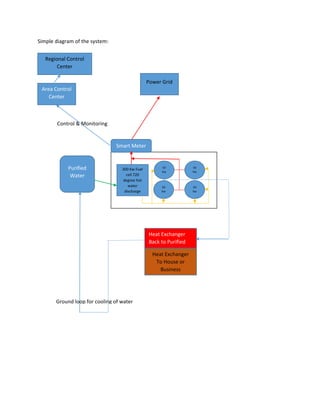
Simple diagram of the system: 


               Control & Monitoring 


300 Kw Fuel 
cell 720 
degree hot 
water 
discharge
50 
Kw
50 
Kw
50 
Kw
Smart Meter 
50 
Kw
Area Control 
Center 
Regional Control 
Center 
Purified 
Water 
Power Grid 
Heat Exchanger 
Back to Purified 
Heat Exchanger 
To House or 
Business 
Ground loop for cooling of water

Jimmie Bowling Mini Power Unit