Click to add title
CCS in an Uncertain Policy
Landscape
Jim Watson, Research Director
UKCCSRC Biannual Meeting, Cambridge, 2-3 April 2014
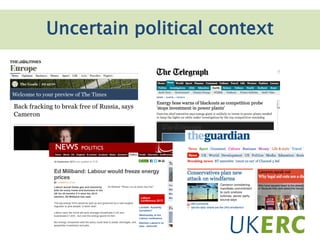
Uncertain political context
‘We need to cut our energy costs. We’re going to do
this by investing in new sources of energy: new nuclear
power, renewables, and a shale gas revolution. We’re
going to do this by promoting energy efficiency.’
George Osborne MP, Budget Speech, March 2014
Uncertain political context
Our energy security is best served by minimising our
exposure to the volatile global fossil fuel markets,
enhancing our energy efficiency and maximising home-
grown low carbon energy, as well as cleaner
indigenous reserves, such as natural gas, to help ease
the low carbon transition.
Ed Davey MP, Secretary of State for Energy & Climate
Change, Mar 2014
Uncertain political context
Click to add title
UKERC flagship project:
Energy strategies under uncertainty
Aims:
To generate, synthesise and communicate evidence about
the range and nature of the risks and uncertainties facing UK
energy policy and the achievement policy goals
To identify strategies for mitigating risks and managing
uncertainties for public policy and the private sector
3. Innovation systems & development
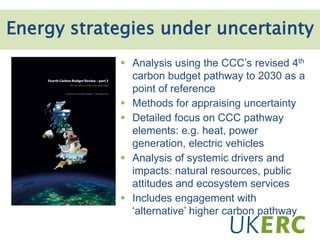
 Analysis using the CCC’s revised 4th
carbon budget pathway to 2030 as a
point of reference
 Methods for appraising uncertainty
 Detailed focus on CCC pathway
elements: e.g. heat, power
generation, electric vehicles
 Analysis of systemic drivers and
impacts: natural resources, public
attitudes and ecosystem services
 Includes engagement with
‘alternative’ higher carbon pathway
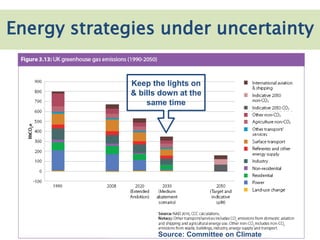
Energy strategies under uncertainty
Keep the lights on
& bills down at the
same time
Source: Committee on Climate
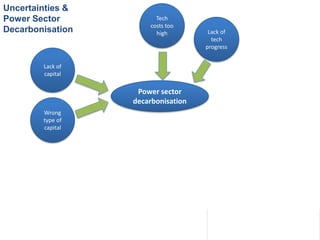
Power sector
decarbonisation
6.TPA
Tech
costs too
high Lack of
tech
progress
Wrong
type of
capital
Lack of
capital
Uncertainties &
Power Sector
Decarbonisation
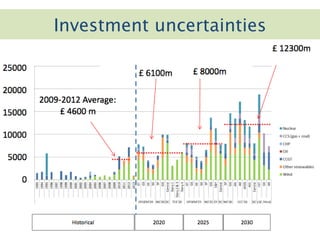
Click to add titleInvestment uncertainties
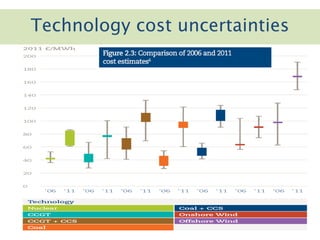
Click to add titleTechnology cost uncertainties
2006 ranges from 2006 UK Energy White paper
2011 ranges from Arup 2011 and Parsons Brinckerhoff 2011
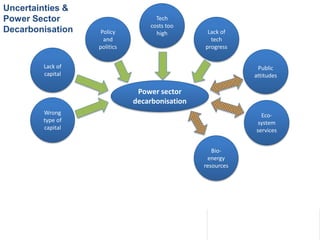
Power sector
decarbonisation
6.TPA
Bio-
energy
resources
Public
attitudes
Tech
costs too
high Lack of
tech
progress
Wrong
type of
capital
Lack of
capital
Policy
and
politics
Uncertainties &
Power Sector
Decarbonisation
Eco-
system
services
Click to add titlePublic attitudes and values
Public attitudes often framed very narrowly by expert
debates: on ‘acceptance’ of specific technical options
Publics often pragmatic about change, but unlikely to
settle for change out of line with longer-term
trajectories that reflect their underlying values.
Beware of potential ‘non transitions’: continued fossil
fuel use, carbon capture and storage and bio-energy
If public values not included in decision-making and
new ‘social contract’ for change, resistance to energy
system transformations or specific conflicts more likely
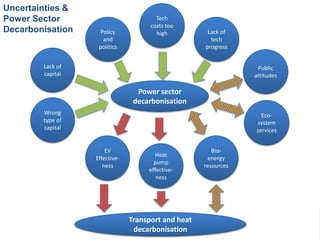
Power sector
decarbonisation
6.TPA
Bio-
energy
resources
EV
Effective-
ness
Heat
pump
effective-
ness
Public
attitudes
Tech
costs too
high Lack of
tech
progress
Wrong
type of
capital
Lack of
capital
Policy
and
politics
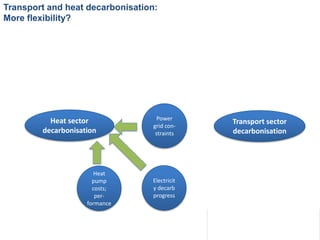
Transport and heat
decarbonisation
Uncertainties &
Power Sector
Decarbonisation
Eco-
system
services
Heat sector
decarbonisation
Transport sector
decarbonisation
Power
grid con-
straints
Heat
pump
costs;
per-
formance
Electricit
y decarb
progress
Transport and heat decarbonisation:
More flexibility?
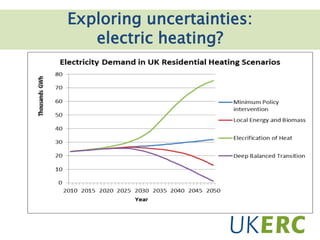
Exploring uncertainties:
electric heating?
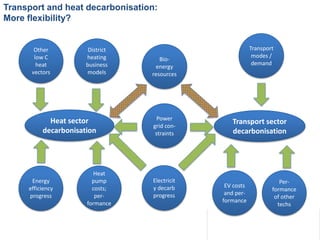
Heat sector
decarbonisation
Bio-
energy
resources
Transport sector
decarbonisation
District
heating
business
models
Other
low C
heat
vectors
Power
grid con-
straints
Heat
pump
costs;
per-
formance
Energy
efficiency
progress
Electricit
y decarb
progress
Transport and heat decarbonisation:
More flexibility?
Transport
modes /
demand
EV costs
and per-
formance
Per-
formance
of other
techs
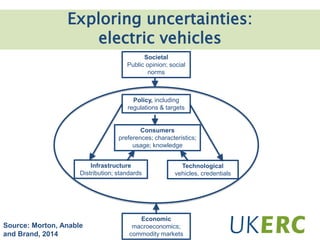
Exploring uncertainties:
electric vehicles
Consumers
preferences; characteristics;
usage; knowledge
Societal
Public opinion; social
norms
Economic
macroeconomics;
commodity markets
Technological
vehicles, credentials
Infrastructure
Distribution; standards
Policy, including
regulations & targets
Source: Morton, Anable
and Brand, 2014
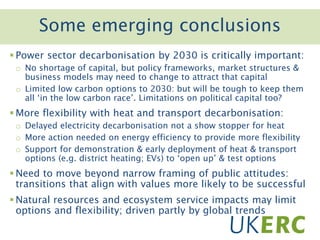
Click to add titleSome emerging conclusions
 Power sector decarbonisation by 2030 is critically important:
o No shortage of capital, but policy frameworks, market structures &
business models may need to change to attract that capital
o Limited low carbon options to 2030: but will be tough to keep them
all ‘in the low carbon race’. Limitations on political capital too?
 More flexibility with heat and transport decarbonisation:
o Delayed electricity decarbonisation not a show stopper for heat
o More action needed on energy efficiency to provide more flexibility
o Support for demonstration & early deployment of heat & transport
options (e.g. district heating; EVs) to ‘open up’ & test options
 Need to move beyond narrow framing of public attitudes:
transitions that align with values more likely to be successful
 Natural resources and ecosystem service impacts may limit
options and flexibility; driven partly by global trends
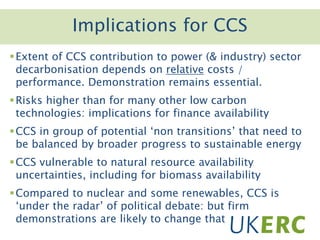
Click to add titleImplications for CCS
Extent of CCS contribution to power (& industry) sector
decarbonisation depends on relative costs /
performance. Demonstration remains essential.
Risks higher than for many other low carbon
technologies: implications for finance availability
CCS in group of potential ‘non transitions’ that need to
be balanced by broader progress to sustainable energy
CCS vulnerable to natural resource availability
uncertainties, including for biomass availability
Compared to nuclear and some renewables, CCS is
‘under the radar’ of political debate: but firm
demonstrations are likely to change that
Click to add title
Thanks
http://www.ukerc.ac.uk
https://twitter.com/watsonjim2

CCS in an uncertain policy landscape - Prof Jim Watson at the UKCCSRC Biannual April 2014

  • 1.
    Click to addtitle CCS in an Uncertain Policy Landscape Jim Watson, Research Director UKCCSRC Biannual Meeting, Cambridge, 2-3 April 2014
  • 2.
  • 3.
    ‘We need tocut our energy costs. We’re going to do this by investing in new sources of energy: new nuclear power, renewables, and a shale gas revolution. We’re going to do this by promoting energy efficiency.’ George Osborne MP, Budget Speech, March 2014 Uncertain political context
  • 4.
    Our energy securityis best served by minimising our exposure to the volatile global fossil fuel markets, enhancing our energy efficiency and maximising home- grown low carbon energy, as well as cleaner indigenous reserves, such as natural gas, to help ease the low carbon transition. Ed Davey MP, Secretary of State for Energy & Climate Change, Mar 2014 Uncertain political context
  • 5.
    Click to addtitle UKERC flagship project: Energy strategies under uncertainty Aims: To generate, synthesise and communicate evidence about the range and nature of the risks and uncertainties facing UK energy policy and the achievement policy goals To identify strategies for mitigating risks and managing uncertainties for public policy and the private sector
  • 6.
    3. Innovation systems& development  Analysis using the CCC’s revised 4th carbon budget pathway to 2030 as a point of reference  Methods for appraising uncertainty  Detailed focus on CCC pathway elements: e.g. heat, power generation, electric vehicles  Analysis of systemic drivers and impacts: natural resources, public attitudes and ecosystem services  Includes engagement with ‘alternative’ higher carbon pathway Energy strategies under uncertainty
  • 7.
    Energy strategies underuncertainty Keep the lights on & bills down at the same time Source: Committee on Climate
  • 8.
    Power sector decarbonisation 6.TPA Tech costs too highLack of tech progress Wrong type of capital Lack of capital Uncertainties & Power Sector Decarbonisation
  • 9.
    Click to addtitleInvestment uncertainties
  • 10.
    Click to addtitleTechnology cost uncertainties 2006 ranges from 2006 UK Energy White paper 2011 ranges from Arup 2011 and Parsons Brinckerhoff 2011
  • 11.
    Power sector decarbonisation 6.TPA Bio- energy resources Public attitudes Tech costs too highLack of tech progress Wrong type of capital Lack of capital Policy and politics Uncertainties & Power Sector Decarbonisation Eco- system services
  • 12.
    Click to addtitlePublic attitudes and values Public attitudes often framed very narrowly by expert debates: on ‘acceptance’ of specific technical options Publics often pragmatic about change, but unlikely to settle for change out of line with longer-term trajectories that reflect their underlying values. Beware of potential ‘non transitions’: continued fossil fuel use, carbon capture and storage and bio-energy If public values not included in decision-making and new ‘social contract’ for change, resistance to energy system transformations or specific conflicts more likely
  • 13.
    Power sector decarbonisation 6.TPA Bio- energy resources EV Effective- ness Heat pump effective- ness Public attitudes Tech costs too highLack of tech progress Wrong type of capital Lack of capital Policy and politics Transport and heat decarbonisation Uncertainties & Power Sector Decarbonisation Eco- system services
  • 14.
    Heat sector decarbonisation Transport sector decarbonisation Power gridcon- straints Heat pump costs; per- formance Electricit y decarb progress Transport and heat decarbonisation: More flexibility?
  • 15.
  • 16.
    Heat sector decarbonisation Bio- energy resources Transport sector decarbonisation District heating business models Other lowC heat vectors Power grid con- straints Heat pump costs; per- formance Energy efficiency progress Electricit y decarb progress Transport and heat decarbonisation: More flexibility? Transport modes / demand EV costs and per- formance Per- formance of other techs
  • 17.
    Exploring uncertainties: electric vehicles Consumers preferences;characteristics; usage; knowledge Societal Public opinion; social norms Economic macroeconomics; commodity markets Technological vehicles, credentials Infrastructure Distribution; standards Policy, including regulations & targets Source: Morton, Anable and Brand, 2014
  • 18.
    Click to addtitleSome emerging conclusions  Power sector decarbonisation by 2030 is critically important: o No shortage of capital, but policy frameworks, market structures & business models may need to change to attract that capital o Limited low carbon options to 2030: but will be tough to keep them all ‘in the low carbon race’. Limitations on political capital too?  More flexibility with heat and transport decarbonisation: o Delayed electricity decarbonisation not a show stopper for heat o More action needed on energy efficiency to provide more flexibility o Support for demonstration & early deployment of heat & transport options (e.g. district heating; EVs) to ‘open up’ & test options  Need to move beyond narrow framing of public attitudes: transitions that align with values more likely to be successful  Natural resources and ecosystem service impacts may limit options and flexibility; driven partly by global trends
  • 19.
    Click to addtitleImplications for CCS Extent of CCS contribution to power (& industry) sector decarbonisation depends on relative costs / performance. Demonstration remains essential. Risks higher than for many other low carbon technologies: implications for finance availability CCS in group of potential ‘non transitions’ that need to be balanced by broader progress to sustainable energy CCS vulnerable to natural resource availability uncertainties, including for biomass availability Compared to nuclear and some renewables, CCS is ‘under the radar’ of political debate: but firm demonstrations are likely to change that
  • 20.
    Click to addtitle Thanks http://www.ukerc.ac.uk https://twitter.com/watsonjim2