Deep Neural Networks
Convolutional Networks II
Bhiksha Raj
Fall 2021
1
Story so far
• Pattern classification tasks such as “does this picture contain a cat”, or
“does this recording include HELLO” are best performed by scanning for
the target pattern
• Scanning an input with a network and combining the outcomes is
equivalent to scanning with individual neurons hierarchically
– First level neurons scan the input
– Higher-level neurons scan the “maps” formed by lower-level neurons
– A final “decision” unit or subnetwork makes the final decision
• Deformations in the input can be handled by “pooling”
• For 2-D (or higher-dimensional) scans, the structure is called a
convolutional network
• For 1-D scan along time, it is called a Time-delay neural network
2
3
A little history
• How do animals see?
– What is the neural process from eye to recognition?
• Early research:
– largely based on behavioral studies
• Study behavioral judgment in response to visual stimulation
• Visual illusions
– and gestalt
• Brain has innate tendency to organize disconnected bits into whole objects
– But no real understanding of how the brain processed images
4
Hubel and Wiesel 1959
• First study on neural correlates of vision.
– “Receptive Fields in Cat Striate Cortex”
• “Striate Cortex”: Approximately equal to the V1 visual cortex
– “Striate” – defined by structure, “V1” – functional definition
• 24 cats, anaesthetized, immobilized, on artificial respirators
– Anaesthetized with truth serum
– Electrodes into brain
• Do not report if cats survived experiment, but claim brain tissue was studied
5
Hubel and Wiesel 1959
• Light of different wavelengths incident on the retina
through fully open (slitted) Iris
– Defines immediate (20ms) response of retinal cells
• Beamed light of different patterns into the eyes and
measured neural responses in striate cortex
6
Hubel and Wiesel 1959
• Restricted retinal areas which on illumination influenced the firing of single cortical
units were called receptive fields.
– These fields were usually subdivided into excitatory and inhibitory regions.
• Findings:
– A light stimulus covering the whole receptive field, or diffuse illumination of the whole retina,
was ineffective in driving most units, as excitatory regions cancelled inhibitory regions
• Light must fall on excitatory regions and NOT fall on inhibitory regions, resulting in clear patterns
– A spot of light gave greater response for some directions of movement than others.
• Can be used to determine the receptive field
– Receptive fields could be oriented in a vertical, horizontal or oblique manner.
• Based on the arrangement of excitatory and inhibitory regions within receptive fields.
mice
monkey
From Huberman and Neil, 2011
From Hubel and Wiesel
7
Hubel and Wiesel 59
• Response as orientation of input light rotates
– Note spikes – this neuron is sensitive to vertical bands
8
Hubel and Wiesel
• Oriented slits of light were the most effective stimuli for activating
striate cortex neurons
• The orientation selectivity resulted from the previous level of input
because lower-level neurons responding to a slit also responded to
patterns of spots if they were aligned with the same orientation as
the slit.
• In a later paper (Hubel & Wiesel, 1962), they showed that within
the striate cortex, two levels of processing could be identified
– Between neurons referred to as simple S-cells and complex C-cells.
– Both types responded to oriented slits of light, but complex cells were
not “confused” by spots of light while simple cells could be confused
9
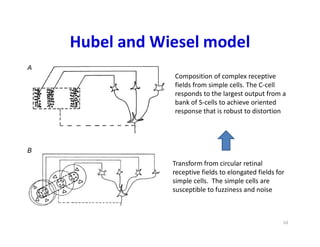
Hubel and Wiesel model
• ll
Transform from circular retinal
receptive fields to elongated fields for
simple cells. The simple cells are
susceptible to fuzziness and noise
Composition of complex receptive
fields from simple cells. The C-cell
responds to the largest output from a
bank of S-cells to achieve oriented
response that is robust to distortion
10
Hubel and Wiesel
• Complex C-cells build from similarly oriented simple cells
– They “fine-tune” the response of the simple cell
• Show complex buildup – building more complex patterns
by composing early neural responses
– Successive transformation through Simple-Complex
combination layers
• Demonstrated more and more complex responses in
later papers
– Later experiments were on waking macaque monkeys
• Too horrible to recall
11
Hubel and Wiesel
• Complex cells build from similarly oriented simple cells
– The “tune” the response of the simple cell and have similar response to the simple cell
• Show complex buildup – from point response of retina to oriented response of
simple cells to cleaner response of complex cells
• Lead to more complex model of building more complex patterns by composing
early neural responses
– Successive transformations through Simple-Complex combination layers
• Demonstrated more and more complex responses in later papers
• Experiments done by others were on waking monkeys
– Too horrible to recall
12
Adding insult to injury..
• “However, this model cannot accommodate
the color, spatial frequency and many other
features to which neurons are tuned. The
exact organization of all these cortical columns
within V1 remains a hot topic of current
research.”
13
Poll 1
14
Poll 1
15
According to Hubel and Wiesel which type of cells found patterns in the input and which cells “cleaned”
up these patterns?
 S cells find patterns and C cells clean them up
 C cells find patterns and S cells clean them up
Forward to 1980
• Kunihiko Fukushima
• Recognized deficiencies in the
Hubel-Wiesel model
• One of the chief problems: Position invariance of
input
– Your grandmother cell fires even if your grandmother
moves to a different location in your field of vision
Kunihiko Fukushima
16
NeoCognitron
• Visual system consists of a hierarchy of modules, each comprising a
layer of “S-cells” followed by a layer of “C-cells”
– is the lth layer of S cells, is the lth layer of C cells
• S-cells respond to the signal in the previous layer
• C-cells confirm the S-cells’ response
• Only S-cells are “plastic” (i.e. learnable), C-cells are fixed in their
response
Figures from Fukushima, ‘80
17
NeoCognitron
• Each simple-complex module includes a layer of S-cells and a layer of C-cells
• S-cells are organized in rectangular groups called S-planes.
– All the cells within an S-plane have identical learned responses
• C-cells too are organized into rectangular groups called C-planes
– One C-plane per S-plane
– All C-cells have identical fixed response
• In Fukushima’s original work, each C and S cell “looks” at an elliptical region in the
previous plane
Each cell in a plane “looks” at a slightly shifted
region of the input than the adjacent cells in
the plane.
… “through” the previous layer planes
18
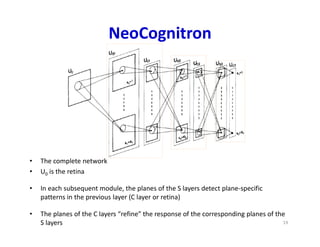
NeoCognitron
• The complete network
• U0 is the retina
• In each subsequent module, the planes of the S layers detect plane-specific
patterns in the previous layer (C layer or retina)
• The planes of the C layers “refine” the response of the corresponding planes of the
S layers 19
Neocognitron
• S cells: RELU like activation
– is a RELU
• C cells: Also RELU like, but with an inhibitory bias
– Fires if weighted combination of S cells fires strongly
enough
–
20
Neocognitron
• S cells: RELU like activation
– is a RELU
• C cells: Also RELU like, but with an inhibitory bias
– Fires if weighted combination of S cells fires strongly
enough
–
Could simply replace these
strange functions with a
RELU and a max
21
NeoCognitron
• The deeper the layer, the larger the receptive field of
each neuron
– Cell planes get smaller with layer number
– Number of planes increases
• i.e the number of complex pattern detectors increases with layer 22
Learning in the neocognitron
• Unsupervised learning
• Randomly initialize S cells, perform Hebbian learning updates in response to input
– update = product of input and output : ∆𝑤 = 𝑥 𝑦
• Within any layer, at any position, only the maximum S from all the layers is
selected for update
– Also viewed as max-valued cell from each S column
• Ensures only one of the planes picks up any feature
• If multiple max selections are on the same plane, only the largest is chosen
– But across all positions, multiple planes will be selected
• Updates are distributed across all cells within the plane
max
23
Learning in the neocognitron
• Ensures different planes learn different features
– E.g. Given many examples of the character “A” the different cell
planes in the S-C layers may learn the patterns shown
• Given other characters, other planes will learn their components
– Going up the layers goes from local to global receptor fields
• Winner-take-all strategy makes it robust to distortion
• Unsupervised: Effectively clustering
24
Neocognitron – finale
• Fukushima showed it successfully learns to
cluster semantic visual concepts
– E.g. number or characters, even in noise
25
Poll 2
26
Poll 2
27
Fukushima’s model is an unsupervised CNN, true or false
 True
 False
Supervision can be added to Fukushima’s model, true or false
 True
 False
Adding Supervision
• The neocognitron is fully unsupervised
– Semantic labels are automatically learned
• Can we add external supervision?
• Various proposals:
– Temporal correlation: Homma, Atlas, Marks, ‘88
– TDNN: Lang, Waibel et. al., 1989, ‘90
• Convolutional neural networks: LeCun
28
Supervising the neocognitron
• Add an extra decision layer after the final C layer
– Produces a class-label output
• We now have a fully feed forward MLP with shared parameters
– All the S-cells within an S-plane have the same weights
• Simple backpropagation can now train the S-cell weights in every plane of
every layer
– C-cells are not updated
Output
class
label(s)
29
Scanning vs. multiple filters
• Note: The original Neocognitron actually uses many
identical copies of a neuron in each S and C plane
– Mathematically identical to “scanning” with a single copy
30
Supervising the neocognitron
• The Math
– Assuming square receptive fields, rather than elliptical ones
– Receptive field of S cells in lth layer is
– Receptive field of C cells in lth layer is
• C cells “stride” by more than one pixel, resulting in a shrinking, or “downsampling” of
the maps
Output
class
label(s)
31
Supervising the neocognitron
• This is, identical to “scanning” (convolving) with a
single neuron/filter (what LeNet actually did)
Output
class
label(s)
𝑺,𝒍,𝒏 𝑺,𝒍,𝒏 𝑪,𝒍 𝟏,𝒑
𝑲𝒍
𝑲𝒍
𝒑
𝑪,𝒍,𝒏
∈ , , ∈( , )
𝑺,𝒍,𝒏
32
Convolutional Neural Networks
33
Story so far
• The mammalian visual cortex contains of S cells, which capture oriented
visual patterns and C cells which perform a “majority” vote over groups of
S cells for robustness to noise and positional jitter
• The neocognitron emulates this behavior with planar banks of S and C
cells with identical response, to enable shift invariance
– Only S cells are learned
– C cells perform the equivalent of a max over groups of S cells for robustness
– Unsupervised learning results in learning useful patterns
• LeCun’s LeNet added external supervision to the neocognitron
– S planes of cells with identical response are modelled by a scan (convolution)
over image planes by a single neuron
– C planes are emulated by cells that perform a max over groups of S cells
• Reducing the size of the S planes
– Giving us a “Convolutional Neural Network” 34
The general architecture of a
convolutional neural network
• A convolutional neural network comprises “convolutional” and “downsampling” layers
– Convolutional layers comprise neurons that scan their input for patterns
• Correspond to S planes
– Downsampling layers perform max operations on groups of outputs from the convolutional layers
• Correspond to C planes
– The two may occur in any sequence, but typically they alternate
• Followed by an MLP with one or more layers
Multi-layer
Perceptron
Output
35
The general architecture of a
convolutional neural network
• A convolutional neural network comprises of “convolutional” and
“downsampling” layers
– The two may occur in any sequence, but typically they alternate
• Followed by an MLP with one or more layers
Multi-layer
Perceptron
Output
36
The general architecture of a
convolutional neural network
• Convolutional layers and the MLP are learnable
– Their parameters must be learned from training data for the target
classification task
• Down-sampling layers are fixed and generally not learnable
Multi-layer
Perceptron
Output
37
A convolutional layer
• A convolutional layer comprises of a series of “maps”
– Corresponding the “S-planes” in the Neocognitron
– Variously called feature maps or activation maps
Maps
Previous
layer
38
A convolutional layer
• Each activation map has two components
– An affine map, obtained by convolution over maps in the previous layer
• Each affine map has, associated with it, a learnable filter
– An activation that operates on the output of the convolution
Previous
layer
Previous
layer
39
A convolutional layer: affine map
• All the maps in the previous layer contribute
to each convolution
Previous
layer
Previous
layer
40
A convolutional layer: affine map
• All the maps in the previous layer contribute to
each convolution
– Consider the contribution of a single map
Previous
layer
Previous
layer
41
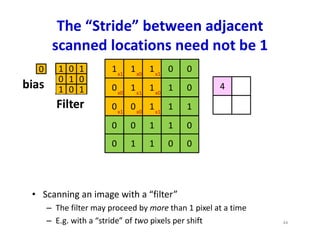
What is a convolution
• Scanning an image with a “filter”
– Note: a filter is really just a perceptron, with weights
and a bias
1 1 1 0 0
0 1 1 1 0
1 1 1
0 0
0 0 0
1 1
0 1 0
1 0
Example 5x5 image with binary
pixels
1 0 1
0 1 0
1
1 0
0
Example 3x3 filter
bias
42
What is a convolution
• Scanning an image with a “filter”
– At each location, the “filter and the underlying map values are
multiplied component wise, and the products are added along with
the bias
1 0 1
0 1 0
1
1 0
Input Map
Filter
0
bias
43
The “Stride” between adjacent
scanned locations need not be 1
• Scanning an image with a “filter”
– The filter may proceed by more than 1 pixel at a time
– E.g. with a “stride” of two pixels per shift
1 1 1 0 0
0 1 1 1 0
1 1 1
0 0
0 0 0
1 1
0 1 0
1 0
4
x1 x0 x1
x0 x1 x0
x1
x1 x0
1 0 1
0 1 0
1
1 0
Filter
0
bias
44
The “Stride” between adjacent
scanned locations need not be 1
• Scanning an image with a “filter”
– The filter may proceed by more than 1 pixel at a time
– E.g. with a “hop” of two pixels per shift
1 1 1 0 0
0 1 1 1 0
1 1 1
0 0
0 0 0
1 1
0 1 0
1 0
x1 x0 x1
x0 x1 x0
x1
x1 x0
1 0 1
0 1 0
1
1 0
Filter
0
bias 4 4
45
The “Stride” between adjacent
scanned locations need not be 1
• Scanning an image with a “filter”
– The filter may proceed by more than 1 pixel at a time
– E.g. with a “hop” of two pixels per shift
1 1 1 0 0
0 1 1 1 0
1 1 1
0 0
0 0 0
1 1
0 1 0
1 0
x1 x0 x1
x0 x1 x0
x1
x1 x0
1 0 1
0 1 0
1
1 0
Filter
0
bias 4 4
2
46
The “Stride” between adjacent
scanned locations need not be 1
• Scanning an image with a “filter”
– The filter may proceed by more than 1 pixel at a time
– E.g. with a “hop” of two pixels per shift
1 1 1 0 0
0 1 1 1 0
1 1 1
0 0
0 0 0
1 1
0 1 0
1 0
x1 x0 x1
x0 x1 x0
x1
x1 x0
1 0 1
0 1 0
1
1 0
Filter
0
bias 4 4
2 4
47
What really happens
• Each output is computed from multiple maps simultaneously
• There are as many weights (for each output map) as
size of the filter x no. of maps in previous layer
Previous
layer
filter
Input layer
Output map
48
What really happens
• Each output is computed from multiple maps simultaneously
• There are as many weights (for each output map) as
size of the filter x no. of maps in previous layer
𝑧 1,𝑖, 𝑗 = 𝑤 1,𝑚, 𝑘, 𝑙 𝐼 𝑚, 𝑖 + 𝑙 − 1, 𝑗 + 𝑘 − 1 + 𝑏
Previous
layer
Input layer
Output map
49
What really happens
• Each output is computed from multiple maps simultaneously
• There are as many weights (for each output map) as
size of the filter x no. of maps in previous layer
𝑧 1,𝑖, 𝑗 = 𝑤 1,𝑚, 𝑘, 𝑙 𝐼 𝑚, 𝑖 + 𝑙 − 1, 𝑗 + 𝑘 − 1 + 𝑏
Previous
layer
Input layer
Output map
50
What really happens
• Each output is computed from multiple maps simultaneously
• There are as many weights (for each output map) as
size of the filter x no. of maps in previous layer
Previous
layer
𝑧 1,𝑖, 𝑗 = 𝑤 1,𝑚, 𝑘, 𝑙 𝐼 𝑚, 𝑖 + 𝑙 − 1, 𝑗 + 𝑘 − 1 + 𝑏
Input layer
Output map
51
What really happens
• Each output is computed from multiple maps simultaneously
• There are as many weights (for each output map) as
size of the filter x no. of maps in previous layer
Previous
layer
𝑧 1,𝑖, 𝑗 = 𝑤 1,𝑚, 𝑘, 𝑙 𝐼 𝑚, 𝑖 + 𝑙 − 1, 𝑗 + 𝑘 − 1 + 𝑏
Input layer
Output map
52
What really happens
• Each output is computed from multiple maps simultaneously
• There are as many weights (for each output map) as
size of the filter x no. of maps in previous layer
Previous
layer
𝑧 1,𝑖, 𝑗 = 𝑤 1,𝑚, 𝑘, 𝑙 𝐼 𝑚, 𝑖 + 𝑙 − 1, 𝑗 + 𝑘 − 1 + 𝑏
Input layer
Output map
53
What really happens
• Each output is computed from multiple maps simultaneously
• There are as many weights (for each output map) as
size of the filter x no. of maps in previous layer
Previous
layer
𝑧 1,𝑖, 𝑗 = 𝑤 1,𝑚, 𝑘, 𝑙 𝐼 𝑚, 𝑖 + 𝑙 − 1, 𝑗 + 𝑘 − 1 + 𝑏
Input layer
Output map
54
What really happens
• Each output is computed from multiple maps simultaneously
• There are as many weights (for each output map) as
size of the filter x no. of maps in previous layer
𝑧 1,𝑖, 𝑗 = 𝑤 1,𝑚, 𝑘, 𝑙 𝐼 𝑚, 𝑖 + 𝑙 − 1, 𝑗 + 𝑘 − 1 + 𝑏
Previous
layer
Input layer
Output map
55
What really happens
• Each output is computed from multiple maps simultaneously
• There are as many weights (for each output map) as
size of the filter x no. of maps in previous layer
Previous
layer
𝑧 1,𝑖, 𝑗 = 𝑤 1,𝑚, 𝑘, 𝑙 𝐼 𝑚, 𝑖 + 𝑙 − 1, 𝑗 + 𝑘 − 1 + 𝑏
Input layer
Output map
56
What really happens
• Each output is computed from multiple maps simultaneously
• There are as many weights (for each output map) as
size of the filter x no. of maps in previous layer
Previous
layer
𝑧 1,𝑖, 𝑗 = 𝑤 1,𝑚, 𝑘, 𝑙 𝐼 𝑚, 𝑖 + 𝑙 − 1, 𝑗 + 𝑘 − 1 + 𝑏
Input layer
Output map
57
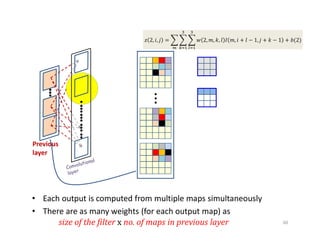
• Each output is computed from multiple maps simultaneously
• There are as many weights (for each output map) as
size of the filter x no. of maps in previous layer
𝑧 2,𝑖, 𝑗 = 𝑤 2,𝑚, 𝑘, 𝑙 𝐼 𝑚, 𝑖 + 𝑙 − 1, 𝑗 + 𝑘 − 1 + 𝑏(2)
Previous
layer
filter1 filter2
58
• Each output is computed from multiple maps simultaneously
• There are as many weights (for each output map) as
size of the filter x no. of maps in previous layer
Previous
layer
𝑧 2,𝑖, 𝑗 = 𝑤 2,𝑚, 𝑘, 𝑙 𝐼 𝑚, 𝑖 + 𝑙 − 1, 𝑗 + 𝑘 − 1 + 𝑏(2)
59
• Each output is computed from multiple maps simultaneously
• There are as many weights (for each output map) as
size of the filter x no. of maps in previous layer
Previous
layer
𝑧 2,𝑖, 𝑗 = 𝑤 2,𝑚, 𝑘, 𝑙 𝐼 𝑚, 𝑖 + 𝑙 − 1, 𝑗 + 𝑘 − 1 + 𝑏(2)
60
A different view
• ..A stacked arrangement of planes
• We can view the joint processing of the various
maps as processing the stack using a three-
dimensional filter
Stacked arrangement
of kth layer of maps
Filter applied to kth layer of maps
(convolutive component plus bias)
61
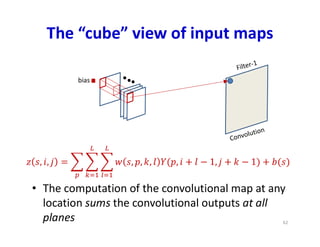
The “cube” view of input maps
• The computation of the convolutional map at any
location sums the convolutional outputs at all
planes
bias
62
• The computation of the convolutional map at any
location sums the convolutional outputs at all
planes
One map
bias
The “cube” view of input maps
63
• The computation of the convolutional map at any
location sums the convolutional outputs at all
planes
All maps
bias
The “cube” view of input maps
64
• The computation of the convolutional map at any
location sums the convolutional outputs at all
planes
bias
The “cube” view of input maps
65
• The computation of the convolutional map at any
location sums the convolutional outputs at all
planes
bias
The “cube” view of input maps
66
• The computation of the convolutional map at any
location sums the convolutional outputs at all
planes
bias
The “cube” view of input maps
67
• The computation of the convolutional map at any
location sums the convolutional outputs at all
planes
bias
The “cube” view of input maps
68
• The computation of the convolutional map at any
location sums the convolutional outputs at all
planes
bias
The “cube” view of input maps
69
CNN: Vector notation to compute a
single output map
The weight W(l,j)is now a 3D Dl-1xKlxKl tensor (assuming
square receptive fields)
The product in blue is a tensor inner product with a
scalar output
Y(0) = Image
for l = 1:L # layers operate on vector at (x,y)
for x = 1:Wl-1-Kl+1
for y = 1:Hl-1-Kl+1
for j = 1:Dl
segment = Y(l-1,:,x:x+Kl-1,y:y+Kl-1) #3D tensor
z(l,j,x,y) = W(l,j).segment #tensor inner prod.
Y(l,j,x,y) = activation(z(l,j,x,y))
Y = softmax( {Y(L,:,:,:)} )
70
Engineering consideration: The size of
the result of the convolution
• The size of the output of the convolution operation depends on
implementation factors
– The size of the input, the size of the filter, and the stride
• And may not be identical to the size of the input
– Let’s take a brief look at this for completeness sake
bias
71
The size of the convolution
1 0 1
0 1 0
1
1 0
Input Map
Filter
0
bias
• Image size: 5x5
• Filter: 3x3
• “Stride”: 1
• Output size = ?
72
The size of the convolution
1 0 1
0 1 0
1
1 0
Input Map
Filter
0
bias
• Image size: 5x5
• Filter: 3x3
• Stride: 1
• Output size = ? 73
The size of the convolution
• Image size: 5x5
• Filter: 3x3
• Stride: 2
• Output size = ?
1 1 1 0 0
0 1 1 1 0
1 1 1
0 0
0 0 0
1 1
0 1 0
1 0
1 0 1
0 1 0
1
1 0
Filter
0
bias 4 4
2 4
74
The size of the convolution
• Image size: 5x5
• Filter: 3x3
• Stride: 2
• Output size = ?
1 1 1 0 0
0 1 1 1 0
1 1 1
0 0
0 0 0
1 1
0 1 0
1 0
1 0 1
0 1 0
1
1 0
Filter
0
bias 4 4
2 4
75
The size of the convolution
• Image size:
• Filter:
• Stride: 1
• Output size = (N-M)+1 on each side
1 1 1 0 0
0 1 1 1 0
1 1 1
0 0
0 0 0
1 1
0 1 0
1 0
Filter
0
bias
?
76
The size of the convolution
• Image size:
• Filter:
• Stride:
• Output size = ?
1 1 1 0 0
0 1 1 1 0
1 1 1
0 0
0 0 0
1 1
0 1 0
1 0
Filter
0
bias
?
77
The size of the convolution
• Image size:
• Filter:
• Stride:
• Output size (each side) =
– Assuming you’re not allowed to go beyond the edge of the input
1 1 1 0 0
0 1 1 1 0
1 1 1
0 0
0 0 0
1 1
0 1 0
1 0
Filter
0
bias
?
78
Convolution Size
• Simple convolution size pattern:
– Image size:
– Filter:
– Stride:
– Output size (each side) =
• Assuming you’re not allowed to go beyond the edge of the input
• Results in a reduction in the output size
– Even if
– Sometimes not considered acceptable
• If there’s no active downsampling, through max pooling and/or
, then the output map should ideally be the same size as the
input
79
Solution
• Zero-pad the input
– Pad the input image/map all around
• Add PL rows of zeros on the left and PR rows of zeros on the right
• Add PL rows of zeros on the top and PL rows of zeros at the bottom
– PL and PR chosen such that:
• PL = PR OR | PL – PR| = 1
• PL+ PR = M-1
– For stride 1, the result of the convolution is the same size as the original
image
1 1 1 0 0
0 1 1 1 0
1 1 1
0 0
0 0 0
1 1
0 1 0
1 0
1 0 1
0 1 0
1
1 0
Filter
0
bias
0
0
0
0
0
0
0
0
0
0
0 0 0 0 0
0 0
0 0 0 0 0
0 0
80
Solution
• Zero-pad the input
– Pad the input image/map all around
– Pad as symmetrically as possible, such that..
– For stride 1, the result of the convolution is the
same size as the original image
1 1 1 0 0
0 1 1 1 0
1 1 1
0 0
0 0 0
1 1
0 1 0
1 0
1 0 1
0 1 0
1
1 0
Filter
0
bias
0
0
0
0
0
0
0
0
0
0
0 0 0 0 0
0 0
0 0 0 0 0
0 0
81
Zero padding
• For an width filter:
– Odd : Pad on both left and right with columns of zeros
– Even : Pad one side with columns of zeros, and the other with
columns of zeros
– The resulting image is width
– The result of the convolution is width
• The top/bottom zero padding follows the same rules to maintain
map height after convolution
• For hop size , zero padding is adjusted to ensure that the size
of the convolved output is
– Achieved by first zero padding the image with
columns/rows of zeros and then applying above rules
82
A convolutional layer
• The convolution operation results in an affine map
• An Activation is finally applied to every entry in the map
Previous
layer
Previous
layer
83
Convolutional neural net:
Vector notation
The weight W(l,j)is now a 4D DlxDl-1xKlxKl tensor (assuming
square receptive fields)
The product in blue is a tensor inner product with a
scalar output
Y(0) = Image
for l = 1:L # layers operate on vector at (x,y)
for x = 1:Wl-1-Kl+1
for y = 1:Hl-1-Kl+1
segment = Y(l-1,:,x:x+Kl-1,y:y+Kl-1) #3D tensor
z(l,:,x,y) = W(l).segment #tensor inner prod.
Y(l,:,x,y) = activation(z(l,;,x,y))
Y = softmax( {Y(L,:,:,:)} )
84
The other component
Downsampling/Pooling
• Convolution (and activation) layers are followed intermittently by
“downsampling with pooling” layers
– Typically (but not always) “max” pooling
– Often, they alternate with convolution, though this is not necessary
Multi-layer
Perceptron
Output
85
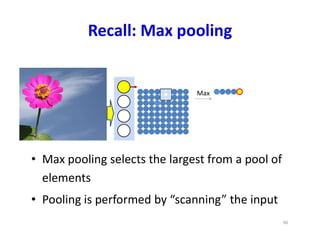
Max pooling
• Max pooling selects the largest from a pool of
elements
• Pooling is performed by “scanning” the input
Max
3 1
4 6
Max
6
86
Recall: Max pooling
Max
1 3
6 5
Max
6 6
• Max pooling selects the largest from a pool of
elements
• Pooling is performed by “scanning” the input
87
Recall: Max pooling
Max
3 2
5 7
Max
6 6 7
• Max pooling selects the largest from a pool of
elements
• Pooling is performed by “scanning” the input
88
Recall: Max pooling
Max
• Max pooling selects the largest from a pool of
elements
• Pooling is performed by “scanning” the input
89
Recall: Max pooling
Max
• Max pooling selects the largest from a pool of
elements
• Pooling is performed by “scanning” the input
90
Recall: Max pooling
Max
• Max pooling scans with a stride of 1 confer
jitter-robustness, but do not constitute
downsampling
• Downsampling requires a stride greater than 1
91
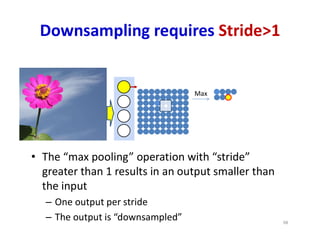
Downsampling requires Stride>1
• The “max pooling” operation with “stride”
greater than 1 results in an output smaller than
the input
– One output per stride
– The output is “downsampled”
Max
92
• The “max pooling” operation with “stride”
greater than 1 results in an output smaller than
the input
– One output per stride
– The output is “downsampled”
Max
Downsampling requires Stride>1
93
• The “max pooling” operation with “stride”
greater than 1 results in an output smaller than
the input
– One output per stride
– The output is “downsampled”
Max
Downsampling requires Stride>1
94
• The “max pooling” operation with “stride”
greater than 1 results in an output smaller than
the input
– One output per stride
– The output is “downsampled”
Max
Downsampling requires Stride>1
95
• The “max pooling” operation with “stride”
greater than 1 results in an output smaller than
the input
– One output per stride
– The output is “downsampled”
Max
Downsampling requires Stride>1
96
• The “max pooling” operation with “stride”
greater than 1 results in an output smaller than
the input
– One output per stride
– The output is “downsampled”
Max
Downsampling requires Stride>1
97
• The “max pooling” operation with “stride”
greater than 1 results in an output smaller than
the input
– One output per stride
– The output is “downsampled”
Max
Downsampling requires Stride>1
98
• The “max pooling” operation with “stride”
greater than 1 results in an output smaller than
the input
– One output per stride
– The output is “downsampled”
Max
Downsampling requires Stride>1
99
• The “max pooling” operation with “stride”
greater than 1 results in an output smaller than
the input
– One output per stride
– The output is “downsampled”
Downsampling requires Stride>1
Max
100
Max Pooling layer at layer
Max pooling
for j = 1:Dl
m = 1
for x = 1:stride(l):Wl-1-Kl+1
n = 1
for y = 1:stride(l):Hl-1-Kl+1
pidx(l,j,m,n) = maxidx(Y(l-1,j,x:x+Kl-1,y:y+Kl-1))
Y(l,j,m,n) = Y(l-1,j,pidx(l,j,m,n))
n = n+1
m = m+1
101
a) Performed separately for every map (j).
*) Not combining multiple maps within a single max operation.
b) Keeping track of location of max
1 1 2 4
5 6 7 8
3 2 1 0
1 2 3 4
Single depth slice
x
y
max pool with 2x2 filters
and stride 2 6 8
3 4
Downsampling: Size of output
• An picture compressed by a pooling filter with
stride results in an output map of side
• Typically do not zero pad
1 1 2 4
5 6 7 8
3 2 1 0
1 2 3 4
Single depth slice
x
y
Mean pool with 2x2
filters and stride 2 3.25 5.25
2 2
Alternative to Max pooling:
Mean Pooling
• Compute the mean of the pool, instead of the max
Mean Pooling layer at layer
Mean pooling
for j = 1:Dl
m = 1
for x = 1:stride(l):Wl-1-Kl+1
n = 1
for y = 1:stride(l):Hl-1-Kl+1
Y(l,j,m,n) = mean(Y(l-1,j,x:x+Kl-1,y:y+Kl-1))
n = n+1
m = m+1
104
a) Performed separately for every map (j)
Alternative to Max pooling:
-norm
• Compute a p-norm of the pool
1 1 2 4
5 6 7 8
3 2 1 0
1 2 3 4
Single depth slice
x
y
P-norm with 2x2 filters
and stride 2, = 5 4.86 8
2.38 3.16
,
Other options
• The pooling may even be a learned filter
• The same network is applied on each block
• (Again, a shared parameter network)
1 1 2 4
5 6 7 8
3 2 1 0
1 2 3 4
Single depth slice
x
y
Network applies to each
2x2 block and strides by
2 in this example
6 8
3 4
Network in network
Or even only with conovlutions
• Downsampling may even be done by a simple convolution
layer with stride larger than 1
– Replacing the maxpooling layer with a conv layer
Just a plain old convolution
layer with stride>1
107
Fully convolutional network
(no pooling)
The weight W(l,j)is now a 3D Dl-1xKlxKl tensor (assuming
square receptive fields)
The product in blue is a tensor inner product with a
scalar output
Y(0) = Image
for l = 1:L # layers operate on vector at (x,y)
for x,m = 1:stride(l):Wl-1-Kl+1 # double indices
for y,n = 1:stride(l):Hl-1-Kl+1
for j = 1:Dl
segment = y(l-1,:,x:x+Kl-1,y:y+Kl-1) #3D tensor
z(l,j,m,n) = W(l,j).segment #tensor inner prod.
Y(l,j,m,n) = activation(z(l,j,m,n))
Y = softmax( {Y(L,:,:,:)} )
108
Poll 3
109
Poll 3
110
The fully convolutional neural net is identical to a scanning MLP with distributed representation: true or
false
 True
 False
The fully convolutional neural network is a shift-invariant pattern detector, true or false
 True
 False
Story so far
• The convolutional neural network is a supervised version of
a computational model of mammalian vision
• It includes
– Convolutional layers comprising learned filters that scan the
outputs of the previous layer
– “Downsampling by pooling” layers that vote over groups of
outputs from the convolutional layer
• Convolution can change the size of the output. This may be
controlled via zero padding.
• Pooling layers may perform max, p-norms, or be learned
• Regular convolutional layers with stride > 1 also perform
downsampling
111
Setting everything together
• Typical image classification task
– Assuming maxpooling..
112
Convolutional Neural Networks
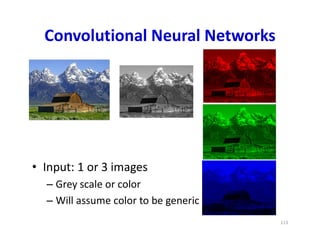
• Input: 1 or 3 images
– Grey scale or color
– Will assume color to be generic
113
• Input: 3 pictures
Convolutional Neural Networks
114
• Input: 3 pictures
Convolutional Neural Networks
115
Preprocessing
• Large images are a problem
– Too much detail
– Will need big networks
• Typically scaled to small sizes, e.g. 128x128 or
even 32x32
– Based on how much will fit on your GPU
– Typically cropped to square images
– Filters are also typically square
116
• Input: 3 pictures
Convolutional Neural Networks
117
• Input is convolved with a set of K1 filters
– Typically K1 is a power of 2, e.g. 2, 4, 8, 16, 32,..
– Filters are typically 5x5, 3x3, or even 1x1
Convolutional Neural Networks
K1 total filters
Filter size:
118
• Input is convolved with a set of K1 filters
– Typically K1 is a power of 2, e.g. 2, 4, 8, 16, 32,..
– Filters are typically 5x5, 3x3, or even 1x1
Convolutional Neural Networks
Small enough to capture fine features
(particularly important for scaled-down images)
K1 total filters
Filter size:
119
• Input is convolved with a set of K1 filters
– Typically K1 is a power of 2, e.g. 2, 4, 8, 16, 32,..
– Filters are typically 5x5, 3x3, or even 1x1
Convolutional Neural Networks
What on earth is this?
Small enough to capture fine features
(particularly important for scaled-down images)
K1 total filters
Filter size:
120
• A 1x1 filter is simply a perceptron that operates over the depth of the
stack of maps, but has no spatial extent
– Takes one pixel from each of the maps (at a given location) as input
– A non-distributed layer of the scanning MLP
The 1x1 filter
121
• Input is convolved with a set of K1 filters
– Typically K1 is a power of 2, e.g. 2, 4, 8, 16, 32,..
– Better notation: Filters are typically 5x5(x3), 3x3(x3), or
even 1x1(x3)
Convolutional Neural Networks
K1 total filters
Filter size:
122
• Input is convolved with a set of K1 filters
– Typically K1 is a power of 2, e.g. 2, 4, 8, 16, 32,..
– Better notation: Filters are typically 5x5(x3), 3x3(x3), or even 1x1(x3)
– Typical stride: 1 or 2
Convolutional Neural Networks
Total number of parameters:
Parameters to choose: , and
1. Number of filters
2. Size of filters
3. Stride of convolution
K1 total filters
Filter size:
123
• The input may be zero-padded according to
the size of the chosen filters
Convolutional Neural Networks
K1 total filters
Filter size:
124
• First convolutional layer: Several convolutional filters
– Filters are “3-D” (third dimension is color)
– Convolution followed typically by a RELU activation
• Each filter creates a single 2-D output map
Convolutional Neural Networks
K1 filters of size:
𝐿 × 𝐿 × 3
𝑧 (𝑖, 𝑗) = 𝑤 𝑐, 𝑘, 𝑙 𝐼 𝑖 + 𝑘, 𝑗 + 𝑙 + 𝑏
( )
∈{ , , }
The layer includes a convolution operation
followed by an activation (typically RELU)
125
Learnable parameters in the first
convolutional layer
• The first convolutional layer comprises filters,
each of size
– Spatial span:
– Depth : 3 (3 colors)
• This represents a total of parameters
– “+ 1” because each filter also has a bias
• All of these parameters must be learned
126
• First downsampling layer: From each block of each
map, pool down to a single value
– For max pooling, during training keep track of which position
had the highest value
Convolutional Neural Networks
𝐼/𝐷 × (𝐼/𝐷
Filter size:
𝐿 × 𝐿 × 3
pool
The layer pools PxP blocks
of into a single value
It employs a stride D between
adjacent blocks
∈ ( ),
∈ ( )
𝑋𝑤𝑖𝑛(𝑖) = [ 𝑖 − 1 𝐷 + 1, 𝑖 − 1 𝐷 + 𝑃]
𝑌𝑤𝑖𝑛(𝑗) = [ 𝑗 − 1 𝐷 + 1, 𝑗 − 1 𝐷 + 𝑃]
127
• First downsampling layer: From each block of each
map, pool down to a single value
– For max pooling, during training keep track of which position
had the highest value
Convolutional Neural Networks
𝐼/𝐷 × (𝐼/𝐷
Filter size:
𝐿 × 𝐿 × 3
Parameters to choose:
Size of pooling block
Pooling stride
pool
Choices: Max pooling or
mean pooling?
Or learned pooling?
∈ ( ),
∈ ( )
𝑋𝑤𝑖𝑛(𝑖) = [ 𝑖 − 1 𝐷 + 1, 𝑖 − 1 𝐷 + 𝑃]
𝑌𝑤𝑖𝑛(𝑗) = [ 𝑗 − 1 𝐷 + 1, 𝑗 − 1 𝐷 + 𝑃]
128
• First downsampling layer: From each block of each
map, pool down to a single value
– For max pooling, during training keep track of which position
had the highest value
𝐼/𝐷 × (𝐼/𝐷
Convolutional Neural Networks
Filter size:
𝐿 × 𝐿 × 3
pool
∈ ( ),
∈ ( )
𝑋𝑤𝑖𝑛(𝑖) = [ 𝑖 − 1 𝐷 + 1, 𝑖 − 1 𝐷 + 𝑃]
𝑌𝑤𝑖𝑛(𝑗) = [ 𝑗 − 1 𝐷 + 1, 𝑗 − 1 𝐷 + 𝑃]
129
• First downsampling layer: From each block of each
map, pool down to a single value
– For max pooling, during training keep track of which position
had the highest value
Convolutional Neural Networks
𝐼/𝐷 × (𝐼/𝐷
Filter size:
𝐿 × 𝐿 × 3
pool
∈ ( ),
∈ ( )
𝑋𝑤𝑖𝑛(𝑖) = [ 𝑖 − 1 𝐷 + 1, 𝑖 − 1 𝐷 + 𝑃]
𝑌𝑤𝑖𝑛(𝑗) = [ 𝑗 − 1 𝐷 + 1, 𝑗 − 1 𝐷 + 𝑃]
𝐾 = 𝐾 . Just using the
new index 𝐾 for notational
uniformity.
Pooling layers do not change
the number of maps because
pooling is performed individually
on each of the maps in the
previous layer.
130
• First pooling layer: Drawing it differently for
convenience
Convolutional Neural Networks
1
1
𝐾1 × 𝐼 × 𝐼 𝐾2 × 𝐼/𝐷 × 𝐼/𝐷
2
131
• First pooling layer: Drawing it differently for
convenience
1
1
𝐾1 × 𝐼 × 𝐼 𝐾2 × 𝐼/𝐷 × 𝐼/𝐷
Convolutional Neural Networks
2
Jargon: Filters are often called “Kernels”
The outputs of individual filters are called “channels”
The number of filters ( 1, 2, etc) is the number of channels
132
• Second convolutional layer: 3-D filters resulting in 2-D maps
– Alternately, a kernel with output channels
Convolutional Neural Networks
2 3 3
3
3
( )
1
1
𝐾1 × 𝐼 × 𝐼 𝐾2 × 𝐼/𝐷 × 𝐼/𝐷
2
133
• Second convolutional layer: 3-D filters resulting in 2-D maps
2 3 3
3
3
( )
Convolutional Neural Networks
1
1
𝐾1 × 𝐼 × 𝐼 𝐾2 × 𝐼/𝐷 × 𝐼/𝐷
2
Total number of parameters:
All these parameters must be learned
Parameters to choose: , and
1. Number of filters
2. Size of filters
3. Stride of convolution
134
Convolutional Neural Networks
• Second convolutional layer: 3-D filters resulting in 2 2-D maps
• Second pooling layer: Pooling operations: outcome reduced 2D
maps
2 3 3
3
3
1
1
𝐾1 × 𝐼 × 𝐼 𝐾2 × 𝐼/𝐷 × 𝐼/𝐷
2
4
∈ ( ),
∈ ( )
135
2 3 3
3
3
Convolutional Neural Networks
1
1
𝐾1 × 𝐼 × 𝐼 𝐾2 × 𝐼/𝐷 × 𝐼/𝐷
2
4
• Second convolutional layer: 3-D filters resulting in 2 2-D maps
• Second pooling layer: Pooling operations: outcome reduced 2D
maps
∈ ( ),
∈ ( )
Parameters to choose:
Size of pooling block 4
Pooling stride 4
136
Convolutional Neural Networks
• This continues for several layers until the final convolved output is fed to
a softmax
– Or a full MLP
3
1
1
𝐾1 × 𝐼 × 𝐼
4
2 3 3
3
𝐾2 × 𝐼/𝐷 × 𝐼/𝐷
2
137
The Size of the Layers
• Each convolution layer with stride 1 typically maintains the size of the image
– With appropriate zero padding
– If performed without zero padding it will decrease the size of the input
• Each convolution layer will generally increase the number of maps from the
previous layer
– Increasing layers reduces the amount of information lost by subsequent
downsampling
• Each pooling layer with stride decreases the size of the maps by a factor of
• Filters within a layer must all be the same size, but sizes may vary with layer
– Similarly for pooling, may vary with layer
• In general the number of convolutional filters increases with layers
138
Parameters to choose (design choices)
• Number of convolutional and downsampling layers
– And arrangement (order in which they follow one another)
• For each convolution layer:
– Number of filters
– Spatial extent of filter
• The “depth” of the filter is fixed by the number of filters in the previous layer 𝐾
– The stride
• For each downsampling/pooling layer:
– Spatial extent of filter
– The stride
• For the final MLP:
– Number of layers, and number of neurons in each layer
139
Poll 4
140
Poll 4
141
What is the relationship between the number of channels in the output of a convolutional layer and the
number of neurons in the corresponding layer of a scanning MLP
 They are the same
The two are not related
Digit classification
142
Training
• Training is as in the case of the regular MLP
– The only difference is in the structure of the network
• Training examples of (Image, class) are provided
• Define a divergence between the desired output and true output of the
network in response to any input
• Network parameters are trained through variants of gradient descent
• Gradients are computed through backpropagation
1 2
3
143
Learning the network
• Parameters to be learned:
– The weights of the neurons in the final MLP
– The (weights and biases of the) filters for every convolutional layer
3
1
1
𝐾1 × 𝐼 × 𝐼
3
learnable learnable
learnable
2 3 3
3
𝐾2 × 𝐼/𝐷 × 𝐼/𝐷
2
144
Learning the CNN
• In the final “flat” multi-layer perceptron, all the weights and biases
of each of the perceptrons must be learned
• In the convolutional layers the filters must be learned
• Let each layer have maps
– is the number of maps (colours) in the input
• Let the filters in the th layer be size
• For the th layer we will require filter parameters
• Total parameters required for the convolutional layers:
∈
145
Defining the loss
• The loss for a single instance
1
convolve convolve
Div()
d(x)
y(x)
Input: x
Div (y(x),d(x))
3
1
𝐾1 × 𝐼 × 𝐼
4
2 3 3
3
𝐾2 × 𝐼/𝐷 × 𝐼/𝐷
2
146
Problem Setup
• Given a training set of input-output pairs
• The loss on the ith instance is
• The total loss
• Minimize w.r.t
147
Training CNNs through Gradient Descent
• Gradient descent algorithm:
• Initialize all weights and biases
• Do:
– For every layer for all filter indices update:
•
• Until has converged
148
Total training loss:
Assuming the bias is also
represented as a weight
Training CNNs through Gradient Descent
• Gradient descent algorithm:
• Initialize all weights and biases
• Do:
– For every layer for all filter indices update:
•
• Until has converged
149
Total training loss:
Assuming the bias is also
represented as a weight
The derivative
• Computing the derivative
150
Total derivative:
Total training loss:
The derivative
• Computing the derivative
151
Total derivative:
Total training loss:
Backpropagation: Final flat layers
• Backpropagation continues in the usual manner
until the computation of the derivative of the
divergence w.r.t the inputs to the first “flat” layer
– Important to recall: the first flat layer is only the
“flattening” of the maps from the final convolutional
layer
( )
1 2
3
Conventional backprop until here
152
Backpropagation: Convolutional and
Pooling layers
• Backpropagation from the flat MLP requires
special consideration of
– The shared computation in the convolutional layers
– The pooling layers (particularly maxout)
1 2
3
Need adjustments here
( )
153
Backprop through a CNN
• In the next class…
154
Learning the network
• Have shown the derivative of divergence w.r.t every intermediate output,
and every free parameter (filter weights)
• Can now be embedded in gradient descent framework to learn the
network
2
2
155
Story so far
• The convolutional neural network is a supervised
version of a computational model of mammalian vision
• It includes
– Convolutional layers comprising learned filters that scan
the outputs of the previous layer
– Downsampling layers that operate over groups of outputs
from the convolutional layer to reduce network size
• The parameters of the network can be learned through
regular back propagation
– Continued in next lecture.. 156

lec10.CNN2.pdf..........................

  • 1.
    Deep Neural Networks ConvolutionalNetworks II Bhiksha Raj Fall 2021 1
  • 2.
    Story so far •Pattern classification tasks such as “does this picture contain a cat”, or “does this recording include HELLO” are best performed by scanning for the target pattern • Scanning an input with a network and combining the outcomes is equivalent to scanning with individual neurons hierarchically – First level neurons scan the input – Higher-level neurons scan the “maps” formed by lower-level neurons – A final “decision” unit or subnetwork makes the final decision • Deformations in the input can be handled by “pooling” • For 2-D (or higher-dimensional) scans, the structure is called a convolutional network • For 1-D scan along time, it is called a Time-delay neural network 2
  • 3.
  • 4.
    A little history •How do animals see? – What is the neural process from eye to recognition? • Early research: – largely based on behavioral studies • Study behavioral judgment in response to visual stimulation • Visual illusions – and gestalt • Brain has innate tendency to organize disconnected bits into whole objects – But no real understanding of how the brain processed images 4
  • 5.
    Hubel and Wiesel1959 • First study on neural correlates of vision. – “Receptive Fields in Cat Striate Cortex” • “Striate Cortex”: Approximately equal to the V1 visual cortex – “Striate” – defined by structure, “V1” – functional definition • 24 cats, anaesthetized, immobilized, on artificial respirators – Anaesthetized with truth serum – Electrodes into brain • Do not report if cats survived experiment, but claim brain tissue was studied 5
  • 6.
    Hubel and Wiesel1959 • Light of different wavelengths incident on the retina through fully open (slitted) Iris – Defines immediate (20ms) response of retinal cells • Beamed light of different patterns into the eyes and measured neural responses in striate cortex 6
  • 7.
    Hubel and Wiesel1959 • Restricted retinal areas which on illumination influenced the firing of single cortical units were called receptive fields. – These fields were usually subdivided into excitatory and inhibitory regions. • Findings: – A light stimulus covering the whole receptive field, or diffuse illumination of the whole retina, was ineffective in driving most units, as excitatory regions cancelled inhibitory regions • Light must fall on excitatory regions and NOT fall on inhibitory regions, resulting in clear patterns – A spot of light gave greater response for some directions of movement than others. • Can be used to determine the receptive field – Receptive fields could be oriented in a vertical, horizontal or oblique manner. • Based on the arrangement of excitatory and inhibitory regions within receptive fields. mice monkey From Huberman and Neil, 2011 From Hubel and Wiesel 7
  • 8.
    Hubel and Wiesel59 • Response as orientation of input light rotates – Note spikes – this neuron is sensitive to vertical bands 8
  • 9.
    Hubel and Wiesel •Oriented slits of light were the most effective stimuli for activating striate cortex neurons • The orientation selectivity resulted from the previous level of input because lower-level neurons responding to a slit also responded to patterns of spots if they were aligned with the same orientation as the slit. • In a later paper (Hubel & Wiesel, 1962), they showed that within the striate cortex, two levels of processing could be identified – Between neurons referred to as simple S-cells and complex C-cells. – Both types responded to oriented slits of light, but complex cells were not “confused” by spots of light while simple cells could be confused 9
  • 10.
    Hubel and Wieselmodel • ll Transform from circular retinal receptive fields to elongated fields for simple cells. The simple cells are susceptible to fuzziness and noise Composition of complex receptive fields from simple cells. The C-cell responds to the largest output from a bank of S-cells to achieve oriented response that is robust to distortion 10
  • 11.
    Hubel and Wiesel •Complex C-cells build from similarly oriented simple cells – They “fine-tune” the response of the simple cell • Show complex buildup – building more complex patterns by composing early neural responses – Successive transformation through Simple-Complex combination layers • Demonstrated more and more complex responses in later papers – Later experiments were on waking macaque monkeys • Too horrible to recall 11
  • 12.
    Hubel and Wiesel •Complex cells build from similarly oriented simple cells – The “tune” the response of the simple cell and have similar response to the simple cell • Show complex buildup – from point response of retina to oriented response of simple cells to cleaner response of complex cells • Lead to more complex model of building more complex patterns by composing early neural responses – Successive transformations through Simple-Complex combination layers • Demonstrated more and more complex responses in later papers • Experiments done by others were on waking monkeys – Too horrible to recall 12
  • 13.
    Adding insult toinjury.. • “However, this model cannot accommodate the color, spatial frequency and many other features to which neurons are tuned. The exact organization of all these cortical columns within V1 remains a hot topic of current research.” 13
  • 14.
  • 15.
    Poll 1 15 According toHubel and Wiesel which type of cells found patterns in the input and which cells “cleaned” up these patterns?  S cells find patterns and C cells clean them up  C cells find patterns and S cells clean them up
  • 16.
    Forward to 1980 •Kunihiko Fukushima • Recognized deficiencies in the Hubel-Wiesel model • One of the chief problems: Position invariance of input – Your grandmother cell fires even if your grandmother moves to a different location in your field of vision Kunihiko Fukushima 16
  • 17.
    NeoCognitron • Visual systemconsists of a hierarchy of modules, each comprising a layer of “S-cells” followed by a layer of “C-cells” – is the lth layer of S cells, is the lth layer of C cells • S-cells respond to the signal in the previous layer • C-cells confirm the S-cells’ response • Only S-cells are “plastic” (i.e. learnable), C-cells are fixed in their response Figures from Fukushima, ‘80 17
  • 18.
    NeoCognitron • Each simple-complexmodule includes a layer of S-cells and a layer of C-cells • S-cells are organized in rectangular groups called S-planes. – All the cells within an S-plane have identical learned responses • C-cells too are organized into rectangular groups called C-planes – One C-plane per S-plane – All C-cells have identical fixed response • In Fukushima’s original work, each C and S cell “looks” at an elliptical region in the previous plane Each cell in a plane “looks” at a slightly shifted region of the input than the adjacent cells in the plane. … “through” the previous layer planes 18
  • 19.
    NeoCognitron • The completenetwork • U0 is the retina • In each subsequent module, the planes of the S layers detect plane-specific patterns in the previous layer (C layer or retina) • The planes of the C layers “refine” the response of the corresponding planes of the S layers 19
  • 20.
    Neocognitron • S cells:RELU like activation – is a RELU • C cells: Also RELU like, but with an inhibitory bias – Fires if weighted combination of S cells fires strongly enough – 20
  • 21.
    Neocognitron • S cells:RELU like activation – is a RELU • C cells: Also RELU like, but with an inhibitory bias – Fires if weighted combination of S cells fires strongly enough – Could simply replace these strange functions with a RELU and a max 21
  • 22.
    NeoCognitron • The deeperthe layer, the larger the receptive field of each neuron – Cell planes get smaller with layer number – Number of planes increases • i.e the number of complex pattern detectors increases with layer 22
  • 23.
    Learning in theneocognitron • Unsupervised learning • Randomly initialize S cells, perform Hebbian learning updates in response to input – update = product of input and output : ∆𝑤 = 𝑥 𝑦 • Within any layer, at any position, only the maximum S from all the layers is selected for update – Also viewed as max-valued cell from each S column • Ensures only one of the planes picks up any feature • If multiple max selections are on the same plane, only the largest is chosen – But across all positions, multiple planes will be selected • Updates are distributed across all cells within the plane max 23
  • 24.
    Learning in theneocognitron • Ensures different planes learn different features – E.g. Given many examples of the character “A” the different cell planes in the S-C layers may learn the patterns shown • Given other characters, other planes will learn their components – Going up the layers goes from local to global receptor fields • Winner-take-all strategy makes it robust to distortion • Unsupervised: Effectively clustering 24
  • 25.
    Neocognitron – finale •Fukushima showed it successfully learns to cluster semantic visual concepts – E.g. number or characters, even in noise 25
  • 26.
  • 27.
    Poll 2 27 Fukushima’s modelis an unsupervised CNN, true or false  True  False Supervision can be added to Fukushima’s model, true or false  True  False
  • 28.
    Adding Supervision • Theneocognitron is fully unsupervised – Semantic labels are automatically learned • Can we add external supervision? • Various proposals: – Temporal correlation: Homma, Atlas, Marks, ‘88 – TDNN: Lang, Waibel et. al., 1989, ‘90 • Convolutional neural networks: LeCun 28
  • 29.
    Supervising the neocognitron •Add an extra decision layer after the final C layer – Produces a class-label output • We now have a fully feed forward MLP with shared parameters – All the S-cells within an S-plane have the same weights • Simple backpropagation can now train the S-cell weights in every plane of every layer – C-cells are not updated Output class label(s) 29
  • 30.
    Scanning vs. multiplefilters • Note: The original Neocognitron actually uses many identical copies of a neuron in each S and C plane – Mathematically identical to “scanning” with a single copy 30
  • 31.
    Supervising the neocognitron •The Math – Assuming square receptive fields, rather than elliptical ones – Receptive field of S cells in lth layer is – Receptive field of C cells in lth layer is • C cells “stride” by more than one pixel, resulting in a shrinking, or “downsampling” of the maps Output class label(s) 31
  • 32.
    Supervising the neocognitron •This is, identical to “scanning” (convolving) with a single neuron/filter (what LeNet actually did) Output class label(s) 𝑺,𝒍,𝒏 𝑺,𝒍,𝒏 𝑪,𝒍 𝟏,𝒑 𝑲𝒍 𝑲𝒍 𝒑 𝑪,𝒍,𝒏 ∈ , , ∈( , ) 𝑺,𝒍,𝒏 32
  • 33.
  • 34.
    Story so far •The mammalian visual cortex contains of S cells, which capture oriented visual patterns and C cells which perform a “majority” vote over groups of S cells for robustness to noise and positional jitter • The neocognitron emulates this behavior with planar banks of S and C cells with identical response, to enable shift invariance – Only S cells are learned – C cells perform the equivalent of a max over groups of S cells for robustness – Unsupervised learning results in learning useful patterns • LeCun’s LeNet added external supervision to the neocognitron – S planes of cells with identical response are modelled by a scan (convolution) over image planes by a single neuron – C planes are emulated by cells that perform a max over groups of S cells • Reducing the size of the S planes – Giving us a “Convolutional Neural Network” 34
  • 35.
    The general architectureof a convolutional neural network • A convolutional neural network comprises “convolutional” and “downsampling” layers – Convolutional layers comprise neurons that scan their input for patterns • Correspond to S planes – Downsampling layers perform max operations on groups of outputs from the convolutional layers • Correspond to C planes – The two may occur in any sequence, but typically they alternate • Followed by an MLP with one or more layers Multi-layer Perceptron Output 35
  • 36.
    The general architectureof a convolutional neural network • A convolutional neural network comprises of “convolutional” and “downsampling” layers – The two may occur in any sequence, but typically they alternate • Followed by an MLP with one or more layers Multi-layer Perceptron Output 36
  • 37.
    The general architectureof a convolutional neural network • Convolutional layers and the MLP are learnable – Their parameters must be learned from training data for the target classification task • Down-sampling layers are fixed and generally not learnable Multi-layer Perceptron Output 37
  • 38.
    A convolutional layer •A convolutional layer comprises of a series of “maps” – Corresponding the “S-planes” in the Neocognitron – Variously called feature maps or activation maps Maps Previous layer 38
  • 39.
    A convolutional layer •Each activation map has two components – An affine map, obtained by convolution over maps in the previous layer • Each affine map has, associated with it, a learnable filter – An activation that operates on the output of the convolution Previous layer Previous layer 39
  • 40.
    A convolutional layer:affine map • All the maps in the previous layer contribute to each convolution Previous layer Previous layer 40
  • 41.
    A convolutional layer:affine map • All the maps in the previous layer contribute to each convolution – Consider the contribution of a single map Previous layer Previous layer 41
  • 42.
    What is aconvolution • Scanning an image with a “filter” – Note: a filter is really just a perceptron, with weights and a bias 1 1 1 0 0 0 1 1 1 0 1 1 1 0 0 0 0 0 1 1 0 1 0 1 0 Example 5x5 image with binary pixels 1 0 1 0 1 0 1 1 0 0 Example 3x3 filter bias 42
  • 43.
    What is aconvolution • Scanning an image with a “filter” – At each location, the “filter and the underlying map values are multiplied component wise, and the products are added along with the bias 1 0 1 0 1 0 1 1 0 Input Map Filter 0 bias 43
  • 44.
    The “Stride” betweenadjacent scanned locations need not be 1 • Scanning an image with a “filter” – The filter may proceed by more than 1 pixel at a time – E.g. with a “stride” of two pixels per shift 1 1 1 0 0 0 1 1 1 0 1 1 1 0 0 0 0 0 1 1 0 1 0 1 0 4 x1 x0 x1 x0 x1 x0 x1 x1 x0 1 0 1 0 1 0 1 1 0 Filter 0 bias 44
  • 45.
    The “Stride” betweenadjacent scanned locations need not be 1 • Scanning an image with a “filter” – The filter may proceed by more than 1 pixel at a time – E.g. with a “hop” of two pixels per shift 1 1 1 0 0 0 1 1 1 0 1 1 1 0 0 0 0 0 1 1 0 1 0 1 0 x1 x0 x1 x0 x1 x0 x1 x1 x0 1 0 1 0 1 0 1 1 0 Filter 0 bias 4 4 45
  • 46.
    The “Stride” betweenadjacent scanned locations need not be 1 • Scanning an image with a “filter” – The filter may proceed by more than 1 pixel at a time – E.g. with a “hop” of two pixels per shift 1 1 1 0 0 0 1 1 1 0 1 1 1 0 0 0 0 0 1 1 0 1 0 1 0 x1 x0 x1 x0 x1 x0 x1 x1 x0 1 0 1 0 1 0 1 1 0 Filter 0 bias 4 4 2 46
  • 47.
    The “Stride” betweenadjacent scanned locations need not be 1 • Scanning an image with a “filter” – The filter may proceed by more than 1 pixel at a time – E.g. with a “hop” of two pixels per shift 1 1 1 0 0 0 1 1 1 0 1 1 1 0 0 0 0 0 1 1 0 1 0 1 0 x1 x0 x1 x0 x1 x0 x1 x1 x0 1 0 1 0 1 0 1 1 0 Filter 0 bias 4 4 2 4 47
  • 48.
    What really happens •Each output is computed from multiple maps simultaneously • There are as many weights (for each output map) as size of the filter x no. of maps in previous layer Previous layer filter Input layer Output map 48
  • 49.
    What really happens •Each output is computed from multiple maps simultaneously • There are as many weights (for each output map) as size of the filter x no. of maps in previous layer 𝑧 1,𝑖, 𝑗 = 𝑤 1,𝑚, 𝑘, 𝑙 𝐼 𝑚, 𝑖 + 𝑙 − 1, 𝑗 + 𝑘 − 1 + 𝑏 Previous layer Input layer Output map 49
  • 50.
    What really happens •Each output is computed from multiple maps simultaneously • There are as many weights (for each output map) as size of the filter x no. of maps in previous layer 𝑧 1,𝑖, 𝑗 = 𝑤 1,𝑚, 𝑘, 𝑙 𝐼 𝑚, 𝑖 + 𝑙 − 1, 𝑗 + 𝑘 − 1 + 𝑏 Previous layer Input layer Output map 50
  • 51.
    What really happens •Each output is computed from multiple maps simultaneously • There are as many weights (for each output map) as size of the filter x no. of maps in previous layer Previous layer 𝑧 1,𝑖, 𝑗 = 𝑤 1,𝑚, 𝑘, 𝑙 𝐼 𝑚, 𝑖 + 𝑙 − 1, 𝑗 + 𝑘 − 1 + 𝑏 Input layer Output map 51
  • 52.
    What really happens •Each output is computed from multiple maps simultaneously • There are as many weights (for each output map) as size of the filter x no. of maps in previous layer Previous layer 𝑧 1,𝑖, 𝑗 = 𝑤 1,𝑚, 𝑘, 𝑙 𝐼 𝑚, 𝑖 + 𝑙 − 1, 𝑗 + 𝑘 − 1 + 𝑏 Input layer Output map 52
  • 53.
    What really happens •Each output is computed from multiple maps simultaneously • There are as many weights (for each output map) as size of the filter x no. of maps in previous layer Previous layer 𝑧 1,𝑖, 𝑗 = 𝑤 1,𝑚, 𝑘, 𝑙 𝐼 𝑚, 𝑖 + 𝑙 − 1, 𝑗 + 𝑘 − 1 + 𝑏 Input layer Output map 53
  • 54.
    What really happens •Each output is computed from multiple maps simultaneously • There are as many weights (for each output map) as size of the filter x no. of maps in previous layer Previous layer 𝑧 1,𝑖, 𝑗 = 𝑤 1,𝑚, 𝑘, 𝑙 𝐼 𝑚, 𝑖 + 𝑙 − 1, 𝑗 + 𝑘 − 1 + 𝑏 Input layer Output map 54
  • 55.
    What really happens •Each output is computed from multiple maps simultaneously • There are as many weights (for each output map) as size of the filter x no. of maps in previous layer 𝑧 1,𝑖, 𝑗 = 𝑤 1,𝑚, 𝑘, 𝑙 𝐼 𝑚, 𝑖 + 𝑙 − 1, 𝑗 + 𝑘 − 1 + 𝑏 Previous layer Input layer Output map 55
  • 56.
    What really happens •Each output is computed from multiple maps simultaneously • There are as many weights (for each output map) as size of the filter x no. of maps in previous layer Previous layer 𝑧 1,𝑖, 𝑗 = 𝑤 1,𝑚, 𝑘, 𝑙 𝐼 𝑚, 𝑖 + 𝑙 − 1, 𝑗 + 𝑘 − 1 + 𝑏 Input layer Output map 56
  • 57.
    What really happens •Each output is computed from multiple maps simultaneously • There are as many weights (for each output map) as size of the filter x no. of maps in previous layer Previous layer 𝑧 1,𝑖, 𝑗 = 𝑤 1,𝑚, 𝑘, 𝑙 𝐼 𝑚, 𝑖 + 𝑙 − 1, 𝑗 + 𝑘 − 1 + 𝑏 Input layer Output map 57
  • 58.
    • Each outputis computed from multiple maps simultaneously • There are as many weights (for each output map) as size of the filter x no. of maps in previous layer 𝑧 2,𝑖, 𝑗 = 𝑤 2,𝑚, 𝑘, 𝑙 𝐼 𝑚, 𝑖 + 𝑙 − 1, 𝑗 + 𝑘 − 1 + 𝑏(2) Previous layer filter1 filter2 58
  • 59.
    • Each outputis computed from multiple maps simultaneously • There are as many weights (for each output map) as size of the filter x no. of maps in previous layer Previous layer 𝑧 2,𝑖, 𝑗 = 𝑤 2,𝑚, 𝑘, 𝑙 𝐼 𝑚, 𝑖 + 𝑙 − 1, 𝑗 + 𝑘 − 1 + 𝑏(2) 59
  • 60.
    • Each outputis computed from multiple maps simultaneously • There are as many weights (for each output map) as size of the filter x no. of maps in previous layer Previous layer 𝑧 2,𝑖, 𝑗 = 𝑤 2,𝑚, 𝑘, 𝑙 𝐼 𝑚, 𝑖 + 𝑙 − 1, 𝑗 + 𝑘 − 1 + 𝑏(2) 60
  • 61.
    A different view •..A stacked arrangement of planes • We can view the joint processing of the various maps as processing the stack using a three- dimensional filter Stacked arrangement of kth layer of maps Filter applied to kth layer of maps (convolutive component plus bias) 61
  • 62.
    The “cube” viewof input maps • The computation of the convolutional map at any location sums the convolutional outputs at all planes bias 62
  • 63.
    • The computationof the convolutional map at any location sums the convolutional outputs at all planes One map bias The “cube” view of input maps 63
  • 64.
    • The computationof the convolutional map at any location sums the convolutional outputs at all planes All maps bias The “cube” view of input maps 64
  • 65.
    • The computationof the convolutional map at any location sums the convolutional outputs at all planes bias The “cube” view of input maps 65
  • 66.
    • The computationof the convolutional map at any location sums the convolutional outputs at all planes bias The “cube” view of input maps 66
  • 67.
    • The computationof the convolutional map at any location sums the convolutional outputs at all planes bias The “cube” view of input maps 67
  • 68.
    • The computationof the convolutional map at any location sums the convolutional outputs at all planes bias The “cube” view of input maps 68
  • 69.
    • The computationof the convolutional map at any location sums the convolutional outputs at all planes bias The “cube” view of input maps 69
  • 70.
    CNN: Vector notationto compute a single output map The weight W(l,j)is now a 3D Dl-1xKlxKl tensor (assuming square receptive fields) The product in blue is a tensor inner product with a scalar output Y(0) = Image for l = 1:L # layers operate on vector at (x,y) for x = 1:Wl-1-Kl+1 for y = 1:Hl-1-Kl+1 for j = 1:Dl segment = Y(l-1,:,x:x+Kl-1,y:y+Kl-1) #3D tensor z(l,j,x,y) = W(l,j).segment #tensor inner prod. Y(l,j,x,y) = activation(z(l,j,x,y)) Y = softmax( {Y(L,:,:,:)} ) 70
  • 71.
    Engineering consideration: Thesize of the result of the convolution • The size of the output of the convolution operation depends on implementation factors – The size of the input, the size of the filter, and the stride • And may not be identical to the size of the input – Let’s take a brief look at this for completeness sake bias 71
  • 72.
    The size ofthe convolution 1 0 1 0 1 0 1 1 0 Input Map Filter 0 bias • Image size: 5x5 • Filter: 3x3 • “Stride”: 1 • Output size = ? 72
  • 73.
    The size ofthe convolution 1 0 1 0 1 0 1 1 0 Input Map Filter 0 bias • Image size: 5x5 • Filter: 3x3 • Stride: 1 • Output size = ? 73
  • 74.
    The size ofthe convolution • Image size: 5x5 • Filter: 3x3 • Stride: 2 • Output size = ? 1 1 1 0 0 0 1 1 1 0 1 1 1 0 0 0 0 0 1 1 0 1 0 1 0 1 0 1 0 1 0 1 1 0 Filter 0 bias 4 4 2 4 74
  • 75.
    The size ofthe convolution • Image size: 5x5 • Filter: 3x3 • Stride: 2 • Output size = ? 1 1 1 0 0 0 1 1 1 0 1 1 1 0 0 0 0 0 1 1 0 1 0 1 0 1 0 1 0 1 0 1 1 0 Filter 0 bias 4 4 2 4 75
  • 76.
    The size ofthe convolution • Image size: • Filter: • Stride: 1 • Output size = (N-M)+1 on each side 1 1 1 0 0 0 1 1 1 0 1 1 1 0 0 0 0 0 1 1 0 1 0 1 0 Filter 0 bias ? 76
  • 77.
    The size ofthe convolution • Image size: • Filter: • Stride: • Output size = ? 1 1 1 0 0 0 1 1 1 0 1 1 1 0 0 0 0 0 1 1 0 1 0 1 0 Filter 0 bias ? 77
  • 78.
    The size ofthe convolution • Image size: • Filter: • Stride: • Output size (each side) = – Assuming you’re not allowed to go beyond the edge of the input 1 1 1 0 0 0 1 1 1 0 1 1 1 0 0 0 0 0 1 1 0 1 0 1 0 Filter 0 bias ? 78
  • 79.
    Convolution Size • Simpleconvolution size pattern: – Image size: – Filter: – Stride: – Output size (each side) = • Assuming you’re not allowed to go beyond the edge of the input • Results in a reduction in the output size – Even if – Sometimes not considered acceptable • If there’s no active downsampling, through max pooling and/or , then the output map should ideally be the same size as the input 79
  • 80.
    Solution • Zero-pad theinput – Pad the input image/map all around • Add PL rows of zeros on the left and PR rows of zeros on the right • Add PL rows of zeros on the top and PL rows of zeros at the bottom – PL and PR chosen such that: • PL = PR OR | PL – PR| = 1 • PL+ PR = M-1 – For stride 1, the result of the convolution is the same size as the original image 1 1 1 0 0 0 1 1 1 0 1 1 1 0 0 0 0 0 1 1 0 1 0 1 0 1 0 1 0 1 0 1 1 0 Filter 0 bias 0 0 0 0 0 0 0 0 0 0 0 0 0 0 0 0 0 0 0 0 0 0 0 0 80
  • 81.
    Solution • Zero-pad theinput – Pad the input image/map all around – Pad as symmetrically as possible, such that.. – For stride 1, the result of the convolution is the same size as the original image 1 1 1 0 0 0 1 1 1 0 1 1 1 0 0 0 0 0 1 1 0 1 0 1 0 1 0 1 0 1 0 1 1 0 Filter 0 bias 0 0 0 0 0 0 0 0 0 0 0 0 0 0 0 0 0 0 0 0 0 0 0 0 81
  • 82.
    Zero padding • Foran width filter: – Odd : Pad on both left and right with columns of zeros – Even : Pad one side with columns of zeros, and the other with columns of zeros – The resulting image is width – The result of the convolution is width • The top/bottom zero padding follows the same rules to maintain map height after convolution • For hop size , zero padding is adjusted to ensure that the size of the convolved output is – Achieved by first zero padding the image with columns/rows of zeros and then applying above rules 82
  • 83.
    A convolutional layer •The convolution operation results in an affine map • An Activation is finally applied to every entry in the map Previous layer Previous layer 83
  • 84.
    Convolutional neural net: Vectornotation The weight W(l,j)is now a 4D DlxDl-1xKlxKl tensor (assuming square receptive fields) The product in blue is a tensor inner product with a scalar output Y(0) = Image for l = 1:L # layers operate on vector at (x,y) for x = 1:Wl-1-Kl+1 for y = 1:Hl-1-Kl+1 segment = Y(l-1,:,x:x+Kl-1,y:y+Kl-1) #3D tensor z(l,:,x,y) = W(l).segment #tensor inner prod. Y(l,:,x,y) = activation(z(l,;,x,y)) Y = softmax( {Y(L,:,:,:)} ) 84
  • 85.
    The other component Downsampling/Pooling •Convolution (and activation) layers are followed intermittently by “downsampling with pooling” layers – Typically (but not always) “max” pooling – Often, they alternate with convolution, though this is not necessary Multi-layer Perceptron Output 85
  • 86.
    Max pooling • Maxpooling selects the largest from a pool of elements • Pooling is performed by “scanning” the input Max 3 1 4 6 Max 6 86
  • 87.
    Recall: Max pooling Max 13 6 5 Max 6 6 • Max pooling selects the largest from a pool of elements • Pooling is performed by “scanning” the input 87
  • 88.
    Recall: Max pooling Max 32 5 7 Max 6 6 7 • Max pooling selects the largest from a pool of elements • Pooling is performed by “scanning” the input 88
  • 89.
    Recall: Max pooling Max •Max pooling selects the largest from a pool of elements • Pooling is performed by “scanning” the input 89
  • 90.
    Recall: Max pooling Max •Max pooling selects the largest from a pool of elements • Pooling is performed by “scanning” the input 90
  • 91.
    Recall: Max pooling Max •Max pooling scans with a stride of 1 confer jitter-robustness, but do not constitute downsampling • Downsampling requires a stride greater than 1 91
  • 92.
    Downsampling requires Stride>1 •The “max pooling” operation with “stride” greater than 1 results in an output smaller than the input – One output per stride – The output is “downsampled” Max 92
  • 93.
    • The “maxpooling” operation with “stride” greater than 1 results in an output smaller than the input – One output per stride – The output is “downsampled” Max Downsampling requires Stride>1 93
  • 94.
    • The “maxpooling” operation with “stride” greater than 1 results in an output smaller than the input – One output per stride – The output is “downsampled” Max Downsampling requires Stride>1 94
  • 95.
    • The “maxpooling” operation with “stride” greater than 1 results in an output smaller than the input – One output per stride – The output is “downsampled” Max Downsampling requires Stride>1 95
  • 96.
    • The “maxpooling” operation with “stride” greater than 1 results in an output smaller than the input – One output per stride – The output is “downsampled” Max Downsampling requires Stride>1 96
  • 97.
    • The “maxpooling” operation with “stride” greater than 1 results in an output smaller than the input – One output per stride – The output is “downsampled” Max Downsampling requires Stride>1 97
  • 98.
    • The “maxpooling” operation with “stride” greater than 1 results in an output smaller than the input – One output per stride – The output is “downsampled” Max Downsampling requires Stride>1 98
  • 99.
    • The “maxpooling” operation with “stride” greater than 1 results in an output smaller than the input – One output per stride – The output is “downsampled” Max Downsampling requires Stride>1 99
  • 100.
    • The “maxpooling” operation with “stride” greater than 1 results in an output smaller than the input – One output per stride – The output is “downsampled” Downsampling requires Stride>1 Max 100
  • 101.
    Max Pooling layerat layer Max pooling for j = 1:Dl m = 1 for x = 1:stride(l):Wl-1-Kl+1 n = 1 for y = 1:stride(l):Hl-1-Kl+1 pidx(l,j,m,n) = maxidx(Y(l-1,j,x:x+Kl-1,y:y+Kl-1)) Y(l,j,m,n) = Y(l-1,j,pidx(l,j,m,n)) n = n+1 m = m+1 101 a) Performed separately for every map (j). *) Not combining multiple maps within a single max operation. b) Keeping track of location of max
  • 102.
    1 1 24 5 6 7 8 3 2 1 0 1 2 3 4 Single depth slice x y max pool with 2x2 filters and stride 2 6 8 3 4 Downsampling: Size of output • An picture compressed by a pooling filter with stride results in an output map of side • Typically do not zero pad
  • 103.
    1 1 24 5 6 7 8 3 2 1 0 1 2 3 4 Single depth slice x y Mean pool with 2x2 filters and stride 2 3.25 5.25 2 2 Alternative to Max pooling: Mean Pooling • Compute the mean of the pool, instead of the max
  • 104.
    Mean Pooling layerat layer Mean pooling for j = 1:Dl m = 1 for x = 1:stride(l):Wl-1-Kl+1 n = 1 for y = 1:stride(l):Hl-1-Kl+1 Y(l,j,m,n) = mean(Y(l-1,j,x:x+Kl-1,y:y+Kl-1)) n = n+1 m = m+1 104 a) Performed separately for every map (j)
  • 105.
    Alternative to Maxpooling: -norm • Compute a p-norm of the pool 1 1 2 4 5 6 7 8 3 2 1 0 1 2 3 4 Single depth slice x y P-norm with 2x2 filters and stride 2, = 5 4.86 8 2.38 3.16 ,
  • 106.
    Other options • Thepooling may even be a learned filter • The same network is applied on each block • (Again, a shared parameter network) 1 1 2 4 5 6 7 8 3 2 1 0 1 2 3 4 Single depth slice x y Network applies to each 2x2 block and strides by 2 in this example 6 8 3 4 Network in network
  • 107.
    Or even onlywith conovlutions • Downsampling may even be done by a simple convolution layer with stride larger than 1 – Replacing the maxpooling layer with a conv layer Just a plain old convolution layer with stride>1 107
  • 108.
    Fully convolutional network (nopooling) The weight W(l,j)is now a 3D Dl-1xKlxKl tensor (assuming square receptive fields) The product in blue is a tensor inner product with a scalar output Y(0) = Image for l = 1:L # layers operate on vector at (x,y) for x,m = 1:stride(l):Wl-1-Kl+1 # double indices for y,n = 1:stride(l):Hl-1-Kl+1 for j = 1:Dl segment = y(l-1,:,x:x+Kl-1,y:y+Kl-1) #3D tensor z(l,j,m,n) = W(l,j).segment #tensor inner prod. Y(l,j,m,n) = activation(z(l,j,m,n)) Y = softmax( {Y(L,:,:,:)} ) 108
  • 109.
  • 110.
    Poll 3 110 The fullyconvolutional neural net is identical to a scanning MLP with distributed representation: true or false  True  False The fully convolutional neural network is a shift-invariant pattern detector, true or false  True  False
  • 111.
    Story so far •The convolutional neural network is a supervised version of a computational model of mammalian vision • It includes – Convolutional layers comprising learned filters that scan the outputs of the previous layer – “Downsampling by pooling” layers that vote over groups of outputs from the convolutional layer • Convolution can change the size of the output. This may be controlled via zero padding. • Pooling layers may perform max, p-norms, or be learned • Regular convolutional layers with stride > 1 also perform downsampling 111
  • 112.
    Setting everything together •Typical image classification task – Assuming maxpooling.. 112
  • 113.
    Convolutional Neural Networks •Input: 1 or 3 images – Grey scale or color – Will assume color to be generic 113
  • 114.
    • Input: 3pictures Convolutional Neural Networks 114
  • 115.
    • Input: 3pictures Convolutional Neural Networks 115
  • 116.
    Preprocessing • Large imagesare a problem – Too much detail – Will need big networks • Typically scaled to small sizes, e.g. 128x128 or even 32x32 – Based on how much will fit on your GPU – Typically cropped to square images – Filters are also typically square 116
  • 117.
    • Input: 3pictures Convolutional Neural Networks 117
  • 118.
    • Input isconvolved with a set of K1 filters – Typically K1 is a power of 2, e.g. 2, 4, 8, 16, 32,.. – Filters are typically 5x5, 3x3, or even 1x1 Convolutional Neural Networks K1 total filters Filter size: 118
  • 119.
    • Input isconvolved with a set of K1 filters – Typically K1 is a power of 2, e.g. 2, 4, 8, 16, 32,.. – Filters are typically 5x5, 3x3, or even 1x1 Convolutional Neural Networks Small enough to capture fine features (particularly important for scaled-down images) K1 total filters Filter size: 119
  • 120.
    • Input isconvolved with a set of K1 filters – Typically K1 is a power of 2, e.g. 2, 4, 8, 16, 32,.. – Filters are typically 5x5, 3x3, or even 1x1 Convolutional Neural Networks What on earth is this? Small enough to capture fine features (particularly important for scaled-down images) K1 total filters Filter size: 120
  • 121.
    • A 1x1filter is simply a perceptron that operates over the depth of the stack of maps, but has no spatial extent – Takes one pixel from each of the maps (at a given location) as input – A non-distributed layer of the scanning MLP The 1x1 filter 121
  • 122.
    • Input isconvolved with a set of K1 filters – Typically K1 is a power of 2, e.g. 2, 4, 8, 16, 32,.. – Better notation: Filters are typically 5x5(x3), 3x3(x3), or even 1x1(x3) Convolutional Neural Networks K1 total filters Filter size: 122
  • 123.
    • Input isconvolved with a set of K1 filters – Typically K1 is a power of 2, e.g. 2, 4, 8, 16, 32,.. – Better notation: Filters are typically 5x5(x3), 3x3(x3), or even 1x1(x3) – Typical stride: 1 or 2 Convolutional Neural Networks Total number of parameters: Parameters to choose: , and 1. Number of filters 2. Size of filters 3. Stride of convolution K1 total filters Filter size: 123
  • 124.
    • The inputmay be zero-padded according to the size of the chosen filters Convolutional Neural Networks K1 total filters Filter size: 124
  • 125.
    • First convolutionallayer: Several convolutional filters – Filters are “3-D” (third dimension is color) – Convolution followed typically by a RELU activation • Each filter creates a single 2-D output map Convolutional Neural Networks K1 filters of size: 𝐿 × 𝐿 × 3 𝑧 (𝑖, 𝑗) = 𝑤 𝑐, 𝑘, 𝑙 𝐼 𝑖 + 𝑘, 𝑗 + 𝑙 + 𝑏 ( ) ∈{ , , } The layer includes a convolution operation followed by an activation (typically RELU) 125
  • 126.
    Learnable parameters inthe first convolutional layer • The first convolutional layer comprises filters, each of size – Spatial span: – Depth : 3 (3 colors) • This represents a total of parameters – “+ 1” because each filter also has a bias • All of these parameters must be learned 126
  • 127.
    • First downsamplinglayer: From each block of each map, pool down to a single value – For max pooling, during training keep track of which position had the highest value Convolutional Neural Networks 𝐼/𝐷 × (𝐼/𝐷 Filter size: 𝐿 × 𝐿 × 3 pool The layer pools PxP blocks of into a single value It employs a stride D between adjacent blocks ∈ ( ), ∈ ( ) 𝑋𝑤𝑖𝑛(𝑖) = [ 𝑖 − 1 𝐷 + 1, 𝑖 − 1 𝐷 + 𝑃] 𝑌𝑤𝑖𝑛(𝑗) = [ 𝑗 − 1 𝐷 + 1, 𝑗 − 1 𝐷 + 𝑃] 127
  • 128.
    • First downsamplinglayer: From each block of each map, pool down to a single value – For max pooling, during training keep track of which position had the highest value Convolutional Neural Networks 𝐼/𝐷 × (𝐼/𝐷 Filter size: 𝐿 × 𝐿 × 3 Parameters to choose: Size of pooling block Pooling stride pool Choices: Max pooling or mean pooling? Or learned pooling? ∈ ( ), ∈ ( ) 𝑋𝑤𝑖𝑛(𝑖) = [ 𝑖 − 1 𝐷 + 1, 𝑖 − 1 𝐷 + 𝑃] 𝑌𝑤𝑖𝑛(𝑗) = [ 𝑗 − 1 𝐷 + 1, 𝑗 − 1 𝐷 + 𝑃] 128
  • 129.
    • First downsamplinglayer: From each block of each map, pool down to a single value – For max pooling, during training keep track of which position had the highest value 𝐼/𝐷 × (𝐼/𝐷 Convolutional Neural Networks Filter size: 𝐿 × 𝐿 × 3 pool ∈ ( ), ∈ ( ) 𝑋𝑤𝑖𝑛(𝑖) = [ 𝑖 − 1 𝐷 + 1, 𝑖 − 1 𝐷 + 𝑃] 𝑌𝑤𝑖𝑛(𝑗) = [ 𝑗 − 1 𝐷 + 1, 𝑗 − 1 𝐷 + 𝑃] 129
  • 130.
    • First downsamplinglayer: From each block of each map, pool down to a single value – For max pooling, during training keep track of which position had the highest value Convolutional Neural Networks 𝐼/𝐷 × (𝐼/𝐷 Filter size: 𝐿 × 𝐿 × 3 pool ∈ ( ), ∈ ( ) 𝑋𝑤𝑖𝑛(𝑖) = [ 𝑖 − 1 𝐷 + 1, 𝑖 − 1 𝐷 + 𝑃] 𝑌𝑤𝑖𝑛(𝑗) = [ 𝑗 − 1 𝐷 + 1, 𝑗 − 1 𝐷 + 𝑃] 𝐾 = 𝐾 . Just using the new index 𝐾 for notational uniformity. Pooling layers do not change the number of maps because pooling is performed individually on each of the maps in the previous layer. 130
  • 131.
    • First poolinglayer: Drawing it differently for convenience Convolutional Neural Networks 1 1 𝐾1 × 𝐼 × 𝐼 𝐾2 × 𝐼/𝐷 × 𝐼/𝐷 2 131
  • 132.
    • First poolinglayer: Drawing it differently for convenience 1 1 𝐾1 × 𝐼 × 𝐼 𝐾2 × 𝐼/𝐷 × 𝐼/𝐷 Convolutional Neural Networks 2 Jargon: Filters are often called “Kernels” The outputs of individual filters are called “channels” The number of filters ( 1, 2, etc) is the number of channels 132
  • 133.
    • Second convolutionallayer: 3-D filters resulting in 2-D maps – Alternately, a kernel with output channels Convolutional Neural Networks 2 3 3 3 3 ( ) 1 1 𝐾1 × 𝐼 × 𝐼 𝐾2 × 𝐼/𝐷 × 𝐼/𝐷 2 133
  • 134.
    • Second convolutionallayer: 3-D filters resulting in 2-D maps 2 3 3 3 3 ( ) Convolutional Neural Networks 1 1 𝐾1 × 𝐼 × 𝐼 𝐾2 × 𝐼/𝐷 × 𝐼/𝐷 2 Total number of parameters: All these parameters must be learned Parameters to choose: , and 1. Number of filters 2. Size of filters 3. Stride of convolution 134
  • 135.
    Convolutional Neural Networks •Second convolutional layer: 3-D filters resulting in 2 2-D maps • Second pooling layer: Pooling operations: outcome reduced 2D maps 2 3 3 3 3 1 1 𝐾1 × 𝐼 × 𝐼 𝐾2 × 𝐼/𝐷 × 𝐼/𝐷 2 4 ∈ ( ), ∈ ( ) 135
  • 136.
    2 3 3 3 3 ConvolutionalNeural Networks 1 1 𝐾1 × 𝐼 × 𝐼 𝐾2 × 𝐼/𝐷 × 𝐼/𝐷 2 4 • Second convolutional layer: 3-D filters resulting in 2 2-D maps • Second pooling layer: Pooling operations: outcome reduced 2D maps ∈ ( ), ∈ ( ) Parameters to choose: Size of pooling block 4 Pooling stride 4 136
  • 137.
    Convolutional Neural Networks •This continues for several layers until the final convolved output is fed to a softmax – Or a full MLP 3 1 1 𝐾1 × 𝐼 × 𝐼 4 2 3 3 3 𝐾2 × 𝐼/𝐷 × 𝐼/𝐷 2 137
  • 138.
    The Size ofthe Layers • Each convolution layer with stride 1 typically maintains the size of the image – With appropriate zero padding – If performed without zero padding it will decrease the size of the input • Each convolution layer will generally increase the number of maps from the previous layer – Increasing layers reduces the amount of information lost by subsequent downsampling • Each pooling layer with stride decreases the size of the maps by a factor of • Filters within a layer must all be the same size, but sizes may vary with layer – Similarly for pooling, may vary with layer • In general the number of convolutional filters increases with layers 138
  • 139.
    Parameters to choose(design choices) • Number of convolutional and downsampling layers – And arrangement (order in which they follow one another) • For each convolution layer: – Number of filters – Spatial extent of filter • The “depth” of the filter is fixed by the number of filters in the previous layer 𝐾 – The stride • For each downsampling/pooling layer: – Spatial extent of filter – The stride • For the final MLP: – Number of layers, and number of neurons in each layer 139
  • 140.
  • 141.
    Poll 4 141 What isthe relationship between the number of channels in the output of a convolutional layer and the number of neurons in the corresponding layer of a scanning MLP  They are the same The two are not related
  • 142.
  • 143.
    Training • Training isas in the case of the regular MLP – The only difference is in the structure of the network • Training examples of (Image, class) are provided • Define a divergence between the desired output and true output of the network in response to any input • Network parameters are trained through variants of gradient descent • Gradients are computed through backpropagation 1 2 3 143
  • 144.
    Learning the network •Parameters to be learned: – The weights of the neurons in the final MLP – The (weights and biases of the) filters for every convolutional layer 3 1 1 𝐾1 × 𝐼 × 𝐼 3 learnable learnable learnable 2 3 3 3 𝐾2 × 𝐼/𝐷 × 𝐼/𝐷 2 144
  • 145.
    Learning the CNN •In the final “flat” multi-layer perceptron, all the weights and biases of each of the perceptrons must be learned • In the convolutional layers the filters must be learned • Let each layer have maps – is the number of maps (colours) in the input • Let the filters in the th layer be size • For the th layer we will require filter parameters • Total parameters required for the convolutional layers: ∈ 145
  • 146.
    Defining the loss •The loss for a single instance 1 convolve convolve Div() d(x) y(x) Input: x Div (y(x),d(x)) 3 1 𝐾1 × 𝐼 × 𝐼 4 2 3 3 3 𝐾2 × 𝐼/𝐷 × 𝐼/𝐷 2 146
  • 147.
    Problem Setup • Givena training set of input-output pairs • The loss on the ith instance is • The total loss • Minimize w.r.t 147
  • 148.
    Training CNNs throughGradient Descent • Gradient descent algorithm: • Initialize all weights and biases • Do: – For every layer for all filter indices update: • • Until has converged 148 Total training loss: Assuming the bias is also represented as a weight
  • 149.
    Training CNNs throughGradient Descent • Gradient descent algorithm: • Initialize all weights and biases • Do: – For every layer for all filter indices update: • • Until has converged 149 Total training loss: Assuming the bias is also represented as a weight
  • 150.
    The derivative • Computingthe derivative 150 Total derivative: Total training loss:
  • 151.
    The derivative • Computingthe derivative 151 Total derivative: Total training loss:
  • 152.
    Backpropagation: Final flatlayers • Backpropagation continues in the usual manner until the computation of the derivative of the divergence w.r.t the inputs to the first “flat” layer – Important to recall: the first flat layer is only the “flattening” of the maps from the final convolutional layer ( ) 1 2 3 Conventional backprop until here 152
  • 153.
    Backpropagation: Convolutional and Poolinglayers • Backpropagation from the flat MLP requires special consideration of – The shared computation in the convolutional layers – The pooling layers (particularly maxout) 1 2 3 Need adjustments here ( ) 153
  • 154.
    Backprop through aCNN • In the next class… 154
  • 155.
    Learning the network •Have shown the derivative of divergence w.r.t every intermediate output, and every free parameter (filter weights) • Can now be embedded in gradient descent framework to learn the network 2 2 155
  • 156.
    Story so far •The convolutional neural network is a supervised version of a computational model of mammalian vision • It includes – Convolutional layers comprising learned filters that scan the outputs of the previous layer – Downsampling layers that operate over groups of outputs from the convolutional layer to reduce network size • The parameters of the network can be learned through regular back propagation – Continued in next lecture.. 156