Download to read offline
![Ho Dac Loc / International Journal of Engineering Research and Applications (IJERA)
ISSN: 2248-9622 www.ijera.com
Vol. 3, Issue 4, Jul-Aug 2013, pp.1659-1661
1659 | P a g e
Dc Motor Control Based On Fuzzy Logic System
Ho Dac Loc
HUTECH Institute of High-Technology, Ho Chi Minh City, Viet Nam
Abstract:
This paper presents an application of an
adaptive fuzzy logic controller (AFLC) for a DC
motor system with nonlinear friction. The
developed AFLC ensures that: 1) the close-loop
system is globally stable and 2) the tracking error
converges to zero asymptotically and a cost
function is minimized. The simulation results
show that the proposed AFLC operates well and
provides good quality of the control system.
Keywords: control; DC motors; fuzzy logic sytem.
I. Introduction
The high-quality servos are largely
described by nonlinear models. Their performance is
often limited by nonlinear phenomena such as
friction and backlash. Therefore, we consider a
problem of this type, namely, a servo with nonlinear
friction, which causes difficulties and gives rise to
poor performance in precision servos.
Friction compensation has been considered before. In
order to address better the demands of high fidelity
control, adaptive friction compensation algorithms
have recently appeared in the literature. The use of a
recursive least-squares algorithm to estimate the
parameters in a nonlinear friction model was
described by Canudas et al. [1]. Friedland and Park
[2] presented another adaptive friction compensation
scheme which was based upon a Lyapunov-like
argument involving the position error. Many other
studies on friction compensation are reported in a
survey paper [3]. However, these methods are based
on the characteristics of the nonlinearity and
knowledge of some of the parameters, in contrast to
the adaptive methods considered here.
Recently, advances in the area of artificial
neural networks have provided the potential for new
approaches to the control of nonlinear systems
through learning process. Relevant features of the
neural networks in the control context include their
ability to model arbitrary differential nonlinear
functions, and their intrinsic on-line adaptation and
learning capabilities. Narenda and Parthasaraty [4]
have shown by the simulations that the neural
networks can be used effectively for the identification
and control of nonlinear dynamic processes. In
robotics, Kawato et al. [5] used an hierarchical neural
network model as add-on component to the
conventional linear controller in order to control the
movement of a robot. Lewis et al. [6] proposed a
multilayer neural-net robot controller with guaranteed
tracking performance. Jang J.O. and Jeon G.J. [7]
proposed a neural network control method of
compensation of the nonlinear friction. The neural-
network controller consists of a linear controller in
parallel, which is employed to compensate for
nonlinear friction effects. The proposed neural
network control method has been implemented on a
DC motor system.
In this paper, we propose an adaptive fuzzy
logic controller (AFLC) for nonlinear dynamic
systems. The proposed AFLC consists of a simple
fuzzy logic controller and an adaptive law, which
adjusts the free parameters of the controller for the
purpose of controlling plant to track a reference
trajectory. The adaptive fuzzy logic control method
has been implemented on a DC motor system with
nonlinear friction.
This paper is organized as follows. The
proposed structure scheme of AFLC for DC motor
with friction is presented in section 2. The adaptive
fuzzy logic control method is described in section 3.
Simulation results are shown in section 4. Some
conclusions are given in section 5.
II. Description of Adaptive Fuzzy
Logic Control System
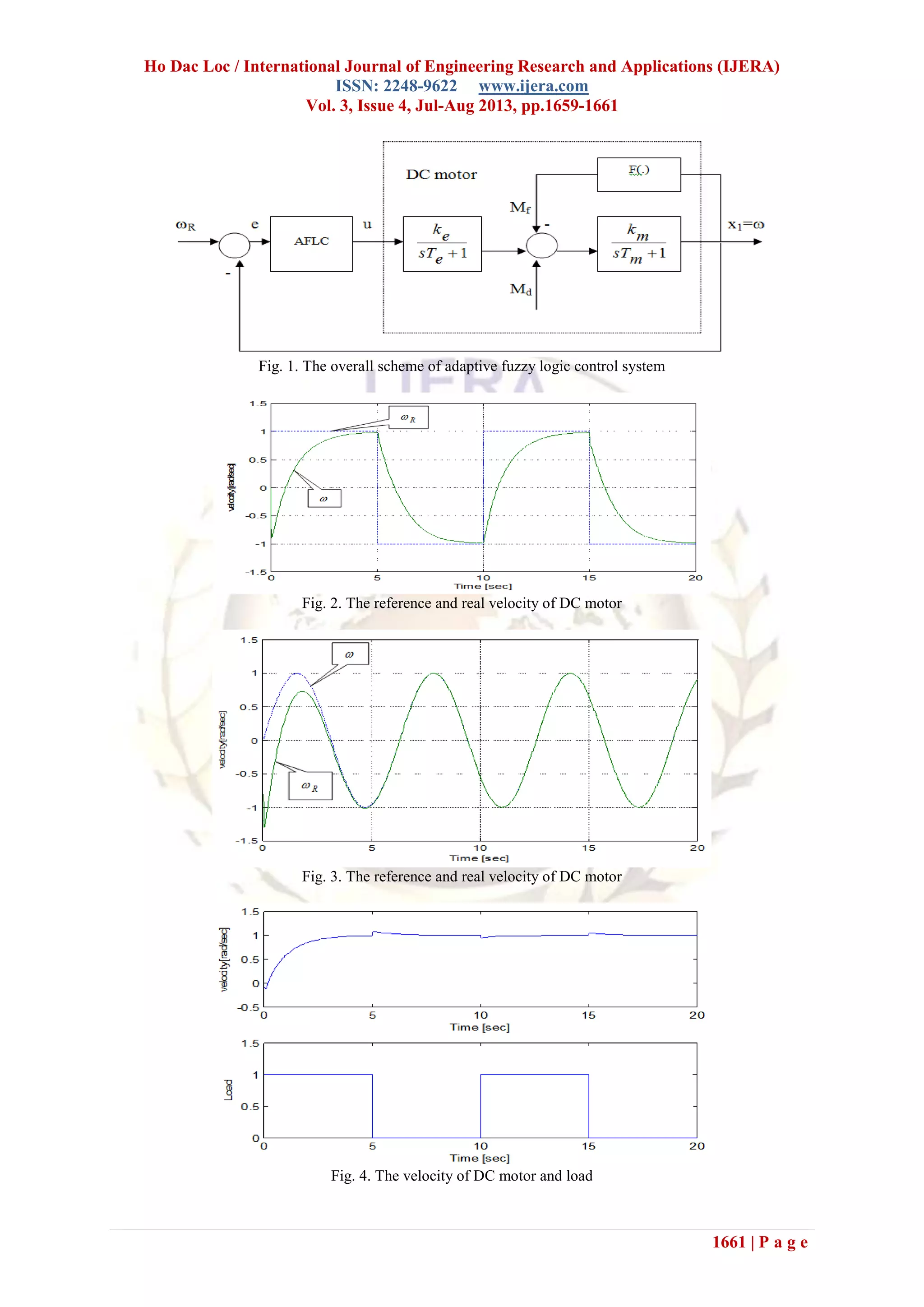
The overall scheme of adaptive fuzzy logic
control system, which is considered in this paper, is
shown in Fig.1. A DC motor with a permanent
magnet was used in our control system. Such a motor
is used in robots and precision servos. The motor
with nonlinear friction can be described by the
following model:
u
T
k
x
T
x
xFMx
T
k
x
T
x
e
e
e
d
m
m
m
22
1211
1
1
(1)
where 1x is the velocity of the motor shaft, Md
is the load disturbance, ke and km are the gains, Te
and Tm are the time coefficients. The friction model
is [7]:
sgnexpsgn 210 FM f
(2)
III. An adaptive fuzzy logic controller
for the DC motor system
In this section, we first setup the control
objectives and show how to develop an AFLC to
achieve them.
Control objectives. Determine a feed back control
,euu (based on fuzzy logic system) and an](https://image.slidesharecdn.com/jd3416591661-130813004857-phpapp02/75/Jd3416591661-1-2048.jpg)
![Ho Dac Loc / International Journal of Engineering Research and Applications (IJERA)
ISSN: 2248-9622 www.ijera.com
Vol. 3, Issue 4, Jul-Aug 2013, pp.1659-1661
1660 | P a g e
adaptive law for adjusting the parameter vector
such that the following conditions are met:
a) the close-loop system must be stable;
b) 0limlim
e
t
R
t
, where R is
the reference velocity of the motor shaft;
c) the coat function
0
2
2
dtJ is
minimized, where
eke .
The conditions a), b) and c) can be ensured by
applying the following simple fuzzy logic control:
eT
L
j
ej
A
ej
A
L
j
ej
A
ej
A
j
eu
1
21
1
21,
(3)
where 2,1, i
j
iA are the input linguistic variables,
j
i
A
is input membership function, L is the number
of fuzzy logic control rules,
LT ,...,
2
,
1
are updated using the adaptation law [9]:
eeke
(4)
where is the positive constant determining the speed
of the algorithm, k is the positive constant
determining quality of the control system.
We simply summarize the method based on (3) and
(4) by following these steps:
Step 1. Fuzzy logic controller construction
- Define fuzzy sets Lji
j
iA ,1,2,1, , where L
is the number of rules.
- Define membership functions j
i
A
.
- Construct control signal by form of (3).
Step 2. On-line adaptation
- Apply the feedback control (3) to the plant (1).
- Use the adaptive law (4) to adjust the parameter
vector .
1. Simulations
In this section, we apply the AFLC developed in this
paper to control the DC motor with nonlinear friction.
The computer simulation of control system is done
by the language MATLAB.
The simulation result of the DC motor with AFLC is
shown in Fig.2, in which we can see that the
developed AFLC could achieve the reference
velocity of DC motor.
We also investigate the motor velocity with the
sinusoidal reference signal. The simulation results
appear in Fig.3. The response of the control system,
where the load is changed, is shown in Fig.4. From
this we can see that the AFLC achieves good
trajectory.
IV. Conclusion
In this paper, we have developed an adaptive
fuzzy logic controller for a DC motor system with
nonlinear friction. The developed AFLC ensures that:
1) the close-loop system is globally stable and 2) the
tracking error converges to zero asymptotically and a
cost function is minimized. The simulation results
show that the proposed AFLC operates well and
provides good quality of the control system.
References
[1] C. Cadunas, K.J. Astrom, K. Braun.
Adaptive friction compensation in DC-
motor drives. IEEE J. Robot. Automat RA-3
(6) (1987) 681-685.
[2] B. Friedland, Y.J. Park. On adaptive friction
compensation. IEEE Trans. Auto. contr. 37
(10) (1992) 1609-1612.
[3] B. Armstrong-Helouvry, P. Dupont, C
candudas De Wit. A survey of models
analysis tools and compensation method for
the control of machines with friction.
Automatica 30 (7) (1994) 1083-1138.
[4] K.S. Narenda, K. Parthasarathy.
Identification and control of dynamical
systems using neural networks. IEEE Trans.
Neural Networks 1 (1) (1990) 4-27.
[5] M. Kawato et al. A hierarchical model for
voluntary movement and its application to
robotics. IEEE Contr. Systenes Mag. 8 (1)
(1998) 8-15.
[6] F.L. Lewis, A. Yesildirek, K. Lui.
Multilayer neural-net robot controller with
guaranteed tracking performance. IEEE
Trans. Neural Networks 7 (2) (1996) 388-
399.
[7] J.O. Jang, G.J. Jeon. A parallel neuro-
controller for DC motors containing
nonlinear friction. Neurocomputing 30
(2000) 233-248.](https://image.slidesharecdn.com/jd3416591661-130813004857-phpapp02/75/Jd3416591661-2-2048.jpg)

This paper presents an Adaptive Fuzzy Logic Controller (AFLC) designed for controlling a DC motor system with nonlinear friction, ensuring global stability and minimal tracking error. The developed AFLC method was evaluated through simulations, demonstrating effective performance in achieving desired motor velocity while compensating for friction. The results indicate that the proposed control system operates efficiently, satisfying essential control objectives.


