Journal of Occupational Health Psychology                                           Copyright 1998 by the Educational Publishing Foundation
1998, Vol. 3, No. 4, 322-355                                                                                            1076-8998/98/$3.00


                             The Job Content Questionnaire (JCQ):
                         An Instrument for Internationally Comparative
                        Assessments of Psychosocial Job Characteristics
                        Robert Karasek                                                 Chantal Brisson
            University of Massachusetts Lowell                                           Laval University

                      Norito Kawakami                                   Irene Houtman and Paulien Bongers
                          Gifu University                                   National Institute for Work and Health

                                                      Benjamin Amick
                                                New England Medical Center


                Part I discusses the Job Content Questionnaire (JCQ), designed to measure scales assessing
                psychological demands, decision latitude, social support, physical demands, and job insecurity.
                Part II describes the reliability of the JCQ scales in a cross-national context using 10,288 men and
                6,313 women from 6 studies conducted in 4 countries. Substantial similarity in means, standard
                deviations, and correlations among the scales, and in correlations between scales and demographic
                variables, is found for both men and women in all studies. Reliability is good for most scales.
                Results suggest that psychological job characteristics are more similar across national boundaries
                than across occupations.


   This article consists of three parts. Part I introduces            Part II reports the cross-national validity, for men
the Job Content Questionnaire (JCQ) as a tool for                  and women, of the JCQ scales in six broadly
psychosocial job assessment. First, a description of               representative populations from four advanced indus-
scales and their underlying theoretical concepts is                trial societies: the United States, Canada, the
presented. This is followed by a discussion of                     Netherlands, and Japan. JCQ scale means, standard
empirical issues in the development of the question-               deviations, reliabilities, and correlations are com-
naire and its validity. Part I concludes with a                    pared. Part III reviews comparison of the intercountry
discussion of measurement issues, administrative                   and interoccupation differences in the scales, dis-
issues, and future challenges.                                     cusses specific scales issues, and discusses the
                                                                   implications of the study for interpretation of
                                                                   psychosocial job assessment questionnaires.
   Robert Karasek, Department of Work Environment,
University of Massachusetts Lowell; Chantal Brisson,                                           PART I
Department of Preventive and Social Medicine, Laval
University, Quebec City, Quebec, Canada; Norito Kawakami,
School of Medicine, Department of Public Health, Gifu                    The Job Content Questionnaire (JCQ):
University, Gifu, Japan; Irene Houtman and Panlien
Bongers, National Institute for Work and Health, Amster-                Psychosocial Job Assessment Instrument
dam; Benjamin Amick, The Health Institute, New England
Medical Center, Boston.                                                              Instrument Overview
   The Job Content Questionnaire (JCQ) is copyrighted.
Users should request the instrument from the JCQ Center               The JCQ is a self-administered instrument de-
(see the JCQ UsagePolicy section). The JCQ is provided             signed to measure social and psychological character-
with research documentation to most users free of charge,
but commercial and very large research projects pay a usage        istics of jobs. The best-known scales--(a) decision
fee to support comparative reliability analysis and instru-        latitude, (b) psychological demands, and (c) social
ment development on a nonprofit basis through the JCQ              support--are used to measure the high-demand/low-
Center, University of Massachusetts Lowell.                        control/low-support model of job strain development.
   Correspondence concerning this article should be ad-            The demand/control model predicts, first, stress-related
dressed to Robert Karasek, Department of Work Environ-
ment, University of Massachusetts, Lowell, Massachusetts           risk and, second, active-passive behavioral correlates of
01854.                                                             jobs. Other aspects of work demands are assessed as well:

                                                                322
SPECIAL SECTION: JOB CONTENT QUESTIONNAIRE                                        323

(d) physical demands and (e) job insecurity. The            psychological strain occur when the psychological
instrument has a recommended length of 49 questions.        demands are high and the worker's decision latitude
   All scales can be used for microlevel, job-              is low: job strain. Low social support at work further
characteristic analytic purposes, such as assessing the     increases risk. A second set of hypotheses, related to
relative risks of individuals' exposures to different       what might be called good stress, involves active
work settings to predict job-related illness develop-       behavior development under conditions of high
ment, psychological distress, coronary heart disease,       demands and high decision latitude, which predict
musculoskeletal disease, and reproductive disorders.        motivation, new learning behaviors, and coping
The scales also allow testing of hypotheses about           pattern development (of course, the active behavior
activation, worker motivation, and job satisfaction         hypotheses are contingent on demands not being too
and have been used for such studies. The conceptual         high). The reverse is predicted for low demands
framework underlying the JCQ allows its application         coupled with low decision latitude: a very unmotivat-
in social policy as a measure of work quality               ing job setting leading to negative job learning or
(Karasek, 1998), in addition to the more commonly           gradual loss of previously acquired skills.
assessed work quantity issues: wages, hours, and               A dynamic version of the model integrates the job
benefits. Broader economic development issues of            strain and active behavior hypotheses with personal-
skill utilization as well as social costs of market-based   ity characteristics measuring accumulated strain and
economic development are beginning to be addressed          self-esteem development (Karasek & Theorell, 1990)
(Karasek & Theorell, 1990) using the instrument. No         with the goal of predicting strain development and
personality orientation scales or measures of non-job       learning over time. The model is based on measures
stressors are included--two areas in which the user         of psychological demands of work combined with a
may want to supplement the instrument.                      measure of task control and skill use (decision
   The JCQ has been translated into over a dozen            latitude). The psychological demand dimension re-
languages. The instrument is nationally standardiz-         lates to "how hard workers work" (mental work load;
able by detailed occupation in several countries,           Meshkati, Hancock, & Rahami, 1990), organization
providing an occupational scoring system. An active         constraints on task completion, and conflicting
users' group supports usage of the JCQ, and an              demands. It includes subscales shown in Table 1
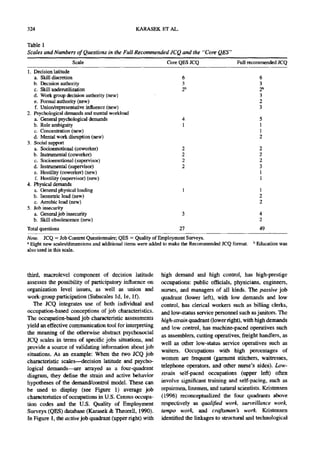
international board of researchers decides on policy        (Subscales 2a, 2b; see Karasek & Theorell, 1990).
and development issues.                                     The "recommended version" includes additional
                                                            specific measures of cognitive workload (Subscaies
                                                            2c, 2d).
    JCQ Scales and Their Theoretical Bases

   The JCQ arose out of the adaptive response to
serve the new empirically based areas of social             Scales la and lb: Components of Decision
epidemiology, behavioral medicine, and psychosocial         Latitude--Skill Discretion and Decision
job analysis, requiring a multidisciplinary theoretical     Authority
model. Because the primary theoretical model upon
which the JCQ is based and discussions of alternative         The worker's control over the performance of his
scale formulations in its domain are extensively            or her own job is measured by two theoretically
reviewed elsewhere (de Jonge & Kompier, 1997;               distinct subdimensions of decision latitude that are
Karasek, 1979, 1997; Karasek & Theorell, 1990;              usually highly correlated: skill discretion and deci-
Kristensen, 1995, 1996; Landsbergis, SchnaU, War-           sion authority (Karasek & Theorell, 1990). Skill
ren, Schwartz, & Pickering, 1994), this article only        discretion (Subscale la) is measured by a set of
presents outlines of those arguments by way of an           questions that assess the level of skill and creativity
introduction to the JCQ scales.                             required on the job and the flexibility permitted the
                                                            worker in deciding what skills to employ (similar to
                                                            variety; e.g., Hackman & Lawler, 1971). A second
Scale 1: Decision Latitude and Scale 2:                     subdimension, decision authority (Subscale lb),
Psychological Demands                                       assesses the organizationally mediated possibilities
                                                            for workers to make decisions about their work
   The most commonly used demand/control model              (autonomy; e.g., Hackman & Lawler, 1971). A
hypothesis (Karasek, 1979, 1997; Karasek & Theo-            question on skills required by the job allows
rell, 1990) predicts that the most adverse reactions of     assessment of skill underutilization (Subscale lc). A
324                                            KARASEK El" AL.

Table 1
Scales and Numbers of Questions in the Full Recommended JCQ and the "Core QES"
                   Scale                                     Core QES JCQ                   Full recommended JCQ
1. Decision latitude
   a. Skill discretion                                              6                                 6
   b. Decision authority                                            3                                 3
   c. Skill underufilization                                        2b                                2b
   d. Work group decision authority (new)                                                             3
   e. Formal authority (new)                                                                          2
   f. Union/representative influence (new)                                                            3
2. Psychological demands and mental workload
   a. General psychological demands                                 4                                 5
   b. Role ambiguity                                                1                                 1
   c. Concentration (new)                                                                             1
   d. Mental work disruption (new)                                                                    2
3. Social support
   a. Socioemotional (coworker)                                     2                                 2
   b. Instrumental (coworker)                                       2                                 2
   c. Socioemotional (supervisor)                                   2                                 2
   d. Instrumental (supervisor)                                     2                                 3
   e. Hostility (coworker) (new)                                                                       1
   f. Hostility (supervisor) (new)                                                                     1
4. Physical demands
   a. General physical loading                                      1                                 1
   b. Isometric load (new)                                                                            2
   c. Aerobic load (new)                                                                              2
5. Job insecurity
   a. Generaijob insecurity                                         3                                 4
   b. Skill obsolescence (new)                                                                        2
Total que~ions                                                    27                                  49
Note. JCQ = Job Content Questionnaire; QES = Quality of Employment Surveys.
a Eight new scales/dimensions and additional items were added to make the Recommended JCQ format.   b Education was
also used in this scale.


third, macrolevel component of decision latitude          high demand and high control, has high-prestige
assesses the possibility of participatory influence on    occupations: public officials, physicians, engineers,
organization level issues, as well as union and           nurses, and managers of all kinds. The passive job
work-group participation (Subscales ld, le, If).          quadrant (lower left), with low demands and low
   The JCQ integrates use of both individual and          control, has clerical workers such as billing clerks,
occupation-based conceptions of job characteristics.      and low-status service personnel such as janitors. The
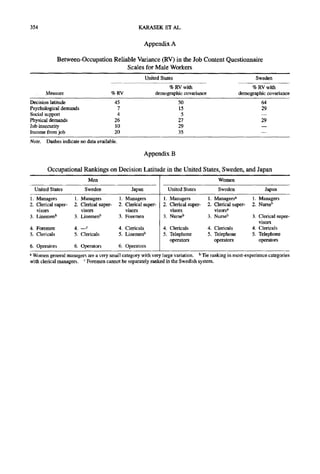
The occupation-based job characteristic assessments       high-strain quadrant (lower right), with high demands
yield an effective communication tool for interpreting    and low control, has machine-paced operatives such
the meaning of the otherwise abstract psychosocial
                                                          as assemblers, cutting operatives, freight handlers, as
JCQ scales in terms of specific jobs situations, and
                                                          well as other low-status service operatives such as
provide a source of validating information about job
                                                          waiters. Occupations with high percentages of
situations. As an example: When the two JCQ job
                                                          women are frequent (garment stitchers, waitresses,
characteristic scales---decision latitude and psycho-
logical demands--are arrayed as a four-quadrant           telephone operators, and other nurse's aides). Low-
diagram, they define the strain and active behavior       strain self-paced occupations (upper left) often
hypotheses of the demand/control model. These can         involve significant training and self-pacing, such as
be used to display (see Figure 1) average job             repairmen, linemen, and natural scientists. Kristensen
characteristics of occupations in U.S. Census occupa-     (1996) reconceptualized the four quadrants above
tion codes and the U.S. Quality of Employment             respectively as qualified work, surveillance work,
Surveys (QES) database (Karasek & Theorell, 1990).        tempo work, and craftsman's work. Kristensen
In Figure 1, the active job quadrant (upper right) with   identified the linkages to structural and technological
Decision          l

                                 L'tit:dAichite_Lc
                                                 t

                                                              Engineer
                     • Natural                 Programmer Farmer
                                                        O
                       Scientist              •         ~]~ Teacher--H.S.

                                     • Publc
                                                                WIFManager-trade
                                    • Officials • Physician
                           +0.50     Bank Officer
           • Lineman                    • Clerk
                           • Foreman       Supervisor
                     O Repairman..~ O Nurse


 I         I
                     o_Machinist • Carpenter
                       050
                                                  /
                                                      +0.5~
                                                                                   Psychological
                                                                                     Demands
                                                                                                   k-
                                                                                                        1
                       I         I                I     il~ Fireman
                                                                  t
                           Stationary         • Health • Off. Computer
                         • EngineerA~ I         Technician Operator
                                 _ WBilling Clerk
                                 ~lhDeliveryman
• Watchman                       WSales Clerk
                                           I
                              • Dispatcher
                                         -0.5o-
                                              • Gas Station
                              O Janitor          Attendant
                                             • Cutting      tWaitress
                              • Miner    -      OperativeO Nurse's Aide
                                      O        • Freight handler
                                        Construction • Telephone
                                        Laborer         Operator/,f--~
                                                  "         " Keypuncher / Si t n t ~
                                                                 ~ /Gm a '~gh O
                                                                     ae
                                                                     r~

                                                                           stitcher,-,,~.,~
                                                         O Assembler-
                                                           electric/trans, mfg.


     Figure I. The occupational distribution of psychological demands and decision latitude
     (U.S. male and female workers; N = 4,495). From "The Political Impfications of Psychosocial
     Work Redesign: A Model of the Psychosocial Class S~ucture" (p. 177), by R. A. Karasek, in
     J. V. Johnson and G. Johansson (Eds.), The Psychosocial Work Environment: Work
     Organization, Democratization, andHealth, 1991, Amityville, N-Y:Baywood. Copyright 1989
     by Baywood Publishing Company. Reprinted with permission.
326                                               KARASEK ET AL.

developments in production processes, thus making it         the Job Insecurity Scale section) because specific
more useful in job redesign contexts.                        events of unemployment are relatively low frequency,
                                                             even when the fear of job insecurity can be more
Scale 3: Social Support                                      widely experienced (Subscale 5a). The job insecurity
                                                             effect can depend on the labor market requirements
   The demand/control model has been expanded by             for particular skills, limiting future career develop-
Johnson (Johnson, 1986; Johnson & Hall, 1988) with           ment possibilities (Subscale 5b).
the addition of social support as a third dimension.
The primary hypothesis, that jobs which are high in
                                                                    Theoretical Interpretation of Scales
demands, low in control, and also low in social
support at work carry the highest risk of illness, has
                                                                      and Implications: Sociological
been empirically successful in a number of chronic                      and Psychological Origins
disease studies (Johnson, 1989; Karasek & Theorell,
                                                                The JCQ provides advantages to researchers by
1990). Karasek and Theorell (1990), Karasek, Trian-
                                                             integrating strengths of multiple disciplines. How-
tis, and Chaudhry (1982), and Johnson and Hall
                                                             ever, it also presents the JCQ users with the challenge
(1988) discussed the differential impacts of support
                                                             of reconcifing multiple scientific literaanes when findings
from coworkers and from supervisors and, within
                                                             are reported. We briefly outline major linkages below.
these, the separate impacts of instrumental and
                                                                The primary hypotheses of the JCQ, resulting from
socioemotional support, respectively (Subscales 3a,
                                                             the demand/control model, are both psychological
3b, 3c, 3d). Interpersonal hostility is also included as a
                                                             and sociological in nature and methodology. The JCQ
measure of social support deficit (Subscales 3e, 3f). The
                                                             is sociological in that it presumes existence of
social support addition acknowledges the need of any
                                                             socially "objective" environments that systemati-
theory of job stress and behavior development to assess
                                                             cally affect individual well-being and behavior. There
social relations at the workplace.
                                                             is a focus on (a) major social institutional settings, (b)
                                                             broad population groups, (c) covariance of measures
Scale 4: Physical Demands                                    with major demographic categories, and (d) its
                                                             hypotheses, which evolved from sociological life
   The "demanding costs" of work activity are not            stress and illness as well as work alienation traditions.
just mental but also physical. Indeed, the more              Also, consistent with much sociological literature,
traditional concept of workloads involves physical           associations are usually controlled for social class (for
loads. Physiological effects of stress on the cardiovas-     contrasting perspectives, see Ganster & Schaubroeck,
cular system, the effectiveness of mental functioning,       1991; Karasek & Theorell, 1990).
and general fatigue are shown in much research                  However, there are also differences with classic
literature to depend on both mental and physical             sociological approaches. The JCQ is based on a
loads, and thus this measure is also included in the         theoretical foundation that implies an alternative,
JCQ. Although the original QES questionnaire                 psychosocial class model, which appears to predict
contains only a single item on physical exertion             health outcomes more effectively than the conven-
(Subseale 4a), the recommended form of the JCQ               tional class model (Karasek, 1997, 1998; Karasek &
includes static (Subscale 4b) as well as dynamic             Theorell, 1990, chapters 5, 9, 10). Kristensen (1996)
physical loads (Subscale 4c), both shown to be               and Karasek and Theorell (1990) noted that the scales
important for musculoskeletal disorder development.          and methods also lend themselves to understanding of
                                                             the social and technological structure of production
Scale 5: Job Insecurity                                      processes. Such associations allow interpretation of
                                                             JCQ findings for human capital and economic
   Work's psychological burden consists not only of          development studies.
the work of carrying out the task but also in the               A variety of methodological techniques from both
human costs of adapting to labor market dynamics.            sociology and psychometrics are used: scale reliabil-
These have become increasingly important in the last         ity analysis, scale construction techniques, multilevel
several years, because the global economy has had            causal analyses, and data reduction techniques such
job-displacing effects in many countries and in-             as factor analysis. The JCQ uses sociological
creased reported job insecurity (Lohr, 1996). Measure-       questionnaire assessment methods to collect valid
ment of these items poses statistical challenges (see        data on social environments. The JCQ occupation
SPECIAL SECTION: JOB CONTENT QUESTIONNAIRE                                        327

approach uses the worker's occupation as an alterna-          Empirical Basis of JCQ Scale Development
tive unit of analysis to the individual's own job
reports, allowing linkage to other insights available       Origin: Stage IfPre-1984
for occupational experience.
                                                               The JCQ has developed in stages. Historically, the
   The JCQ also reflects a psychological focus and is
                                                            origin of the instrument, which predates the "recom-
probably used more often by psychologists than by
                                                            mended version JCQ" in 1985, involved analyses of
sociologists. It addresses classic psychological topics
                                                            broad pools of job characteristic survey data in two
such as the behavioral basis for emotion-driven
                                                            countries. The core questions for the JCQ scales are
psychological distress, psychosomatic illness develop-
                                                            taken from the three nationally representative samples
ment, and changes in microlevel behavior related to         of the much analyzed QES gathered by the University
social situations. There is a presumption that psycho-      of Michigan Survey Research Center in 1969, 1972,
social experiences are a major determinant of health        and 1977 for the U.S. Department of Labor. Each of
and well-being, mediated by the neurophysiological          the three QES surveys was eclectically designed and
mechanisms, as well as behavioral pathways.                 surveyed over 1,000 aspects of work experience, in a
   Psychologically, the JCQ--demand/control method          manner often using different questions from survey to
reflects a stimulus approach, as opposed to a               survey. Our research group (Karasek et al., 1988;
relational approach, which emphasizes personal              Schwartz, Pieper, & Karasek, 1988) conducted
cognitive interpretation of the person-environment          extensive statistical analyses, analyses of theoretical
relationship. The JCQ assumes that behavior is, to a        coherence, and analyses of individual questions
significant extent, generated by social environments        predicting efficiency for these large groups of
and their constraints outside the individual. The           questions in the early 1980s. These confirmed that
cognitive psychological claim that decision choices         major aspects of the core content of the psychosocial
constitute the primary mental workload is contrary to       work experience could be captured by the small
the demand/control hypothesis that social demands           number of QES questions. On this basis, a small
are moderated by the behavioral degree of freedom           subset of the questions was selected to create the Job
that decision opportunities present (Karasek, 1997).        Characteristic Linkage System (Schwartz et al.,
The JCQ-demand/control approach also often treats           1988). Approximately two thirds of the linkage
emotional response as a dependent variable derived          system questions were sufficiently similar (with
from work-related behaviorial requirements.                 minor adaptations and corrections) across the years to
   There are also significant congruencies with             yield common assessment of absolute scale scores: a
psychophysiology, as well as some differences in            QES-based JCQ "core" (see Table 1, column 2). The
focus. Most previous stress theories were developed         three QES survey question sets had 27 questions in
to describe reactions to "inevitable" acute stress in       common in the psychosocial area, which allowed
                                                            development of a pooled sample of all 4,900
situations threatening biological survival (Cannon,
                                                            respondents, still by far the largest nationally
 1914; Seyle, 1936/1976). The demand/control model
                                                            representative U.S. data set on psychosocial job
was, however, developed for work environments in
                                                            characteristics. This core serves as the source of
which stressors are chronic, not initially life threaten-
                                                            standard score data for JCQ occupational mean scores
ing, and are the products of sophisticated human
                                                            and a basis for time-related comparisons in the scales
organizational decision making. The controllability of      (statistical reliability is discussed in Karasek &
the stressor was found to be important and appears to       Theorell, 1990, Appendix 1).
have become even more important as we develop                  The validation for the utility of such scales was
even more complex demands and limitations on                also developed from a similar set of questions in
individual behavior. However, significant consistency       longitudinal, Swedish nationally representative data-
with classic psychophysiology is demonstrated by            bases, which could be analyzed extensively for
Frankenhaeuser and Johansson's (1986) psychologi-           covariations with other social and individual data
cal research, which shows the congruence of two             (Karasek, 1976, 1979; Karasek & TheoreU, 1990) and
primary patterns of physiological response (adrena-         which had extensive health outcome data. These
line related and cortisol related) with the main            analyses, while confirming the demand/control model
hypotheses of the demand/control model--allowing            utility, also illuminated the importance of demo-
linkage among physiological response, social situa-         graphic, occupational, and social relations data, and
tion, and emotional response patterns.                      broadly assessed work demand and hazard data
328                                             KARASEK ET AL.

(Karasek et al., 1981; Karasek, Schwartz, & Pieper,        should assess a single underlying theoretical con-
1983) and implied that a future measurement                struct. In JCQ design, true statistical reliability is
instrument should not be restricted to the demand/         sometimes balanced against a goal of a specific
control task questions alone.                              content interpretability. Thus, the scales are also
                                                           composed of subscales with separate interpretability
                                                           (see Table 1 and discussion above), a goal which
Stage II: JCQ Recommended Version--1985
                                                           competes with scale statistical reliability. The ques-
   The next stage was the development of the JCQ           tions should also be standardizable questions. The
Recommended Version 1.1 in response to request for         JCQ has also had the goal of covering the most
an instrument to assess the psychosocial hypotheses        important aspects of qualitative work situations with a
and demand/control models. This is the current             small enough number of scales that the interactions
version of the instrument. The design of the current       between the scales can be feasibly examined.
JCQ was initiated by request from the U.S. National
Heart, Lung and Blood Institute's request for scales
                                                           Toward "Objective "Assessment:
for the U.S. Framingham Offspring Study. The JCQ
                                                           Rating Versus Evaluation
authors were aware of the length limitations posed by
research teams in national survey designs and the             An important goal of the JCQ is gathering
hesitancy of other researchers adopting question sets      "objective" data about work environments relevant
not of their own design, thus, the design of the new       for prevention-oriented goals of improving social and
JCQ instrument in 1984 focused on a very short,            psychological working conditions. The Swedish
efficient questionnaire that could be self-administered    Level of Living Survey (Johansson, 1971) was a
in 15 rain, with minimal participant guidance.             methodological guide: The bias in the questionnaire
   The original QES core was not theoretically precise     response by the participant, while inevitable, was
in several areas (particularly psychological and           designed to be minimized. The questions are designed
physical demands). To add precision to the theoretical     to report about, but not evaluate, the participant's
constructs of the QES core, to expand theoretical          usual or main job. Thus, the JCQ questions use simple
coverage of both psychological and physical de-            language so there are meaningful responses possible
mands, to expand job insecurity and social support         by all employed respondents, presented in a language
scale coverage, and to assist in discriminant validity,    simple enough to be understood by participants at all
we included additional newly drafted questions (see        education levels. The response set is designed to
Table 1, column 1) to the QES questions, yielding the      assess the validity of the statement about the work
present set of scales used in the JCQ data sets. These     environment on a 4-point scale, facilitating the
expansions formed the Recommended JCQ Instru-              similar quantitative weighting of questions.
ment Version (see Table 1, column 2), with 49                 Use of participants' own questionnaire reports
questions, which is the most commonly used version         about their jobs, of course, automatically introduces
(14 additional new questions and 8 additional QES          self-perceptions--the source of the major critique of
questions had been added beyond the original core).        validity of instruments such as the JCQ (see the
Additional question sets cover physical work hazards,      Implication for Broad Interpretability of Psychoso-
computer interfaces, customer interaction, and psycho-     cial JCQs section). In many cases, self-reports on job
logical strain scales. An update of the recommended        conditions are the only feasible information-gathering
version in 1995 (Version 1.5) included pilot versions      strategy about workers' detailed social working
of a set of global economy questions and more              conditions. For example, it would take an outside
standardizable psychological strain scales.                observer much time to understand the social support
                                                           situation of the worker. Frese and Zapft (1988)
JCQ Focus and Scale Design Criteria                        claimed that the risk of self-report bias depends on the
                                                           degree to which the questions require a complex
   The multiple goals underlying JCQ construction          burden of evaluative cognition by the participant. The
introduce competing design criteria: (a) standard          JCQ objective assessment goal means that the
scale reliability assessment, (b) coverage breadth, (c)    questions attempt to minimize this self-reflexive
scale length economy, (d) scale number economy, and        component: They report about jobs, but minimize
(e) specific content interpretability. A pure concept of   evaluation of them. Questions of the type "lack of
statistical reliability means that a set of questions      decision making is important for me" and "the time
SPECIAL SECTION: JOB CONTENT QUESTIONNAIRE                                        329

pressures are too much for me" are replaced by               The same occupational basis that provides the
questions that emphasize simple assessments of            standardized scores is also the basis of an often
environmental conditions only, such as: "I have           utilized occupational score linkage system (Schwartz
freedom to make decisions about my job" and "My           et al., 1988). The JCQ job characteristic scales can be
job requires I work fast." Such linguistic distinctions   linked to other databases through U.S. three-digit
have been considered quite significant in other           census occupation codes (1970) and also to four-digit
psychological research contexts: for example, state-      U.S. Standard Industrial Classification (industry
trait response differentiations based on phrasing         classification) codes. This database linkage system
differences such as "Today I feel angry" versus "I        allows psychosocial job content scores to be associ-
usually feel angry."                                      ated with health and productivity outcomes in
   Sources of difficulty remain, however. Self-           national or company databases already in existence
reflexive judgments remain in two psychological           (such as U.S. Census, Commerce, or U.S. National
demand questions: "work hard" and "work fast" (see        Center for Health Statistics data), for which direct
Appendix A). Also, the JCQ goal of broad coverage         questionnaire data collection would not be feasible.
on jobs characteristics with a short set of questions
means that many questions elicit summary judgments
                                                          Aggregate Scoring Methods for Work Groups
about some quality of the job (skill requirements,
decision possibilities). Questions about more specific       Bias of findings could potentially occur with
job situations could avoid this problem, but would        self-reported psychosocial work environment and
likely make the questionnaire longer or the questions     dependent variables such as depression, exhaustion,
unjudgable by some respondents, and therefore the         and dissatisfaction (see the Implications for Broad
responses difficult to compare across groups.             Interpretability of Psychosocial JCQs section). One
                                                          remedy is to aggregate self-report responses by work
                                                          groups with similar work situations, thus diluting
Occupation-Based Analysis
                                                          individual biases (Kristensen, 1996). This is, of
and Score Standardization                                 course, the basis of the occupation database linkage
   In addition to direct administration of JCQ            system suggested above, but systems of mixed
questionnaires to workers, the JCQ system offers a        self-report and work-group aggregated assessment
second set of occupation-based methodologies. There       have also been successfully applied (Vahtera, Pentti,
is an extensive system of JCQ scores scales by            & Uutela, 1996).
detailed occupation and gender in several countries          The alternative of expert observations is certainly
that is the basis of (a) the JCQ occupational score       theoretically desirable, but in practice it has problems.
standardization system and (b) the occupational           Expert observations are costly, time consuming, and
linkage system.                                           in assessment of social interactions do not obviously
   Detailed scoring procedures for the JCQ scales are     generate more accurate measures resulting in low
described in the JCQ Questionnaire and User's Guide       interrater reliability. There are also theoretical biases
(Karasek, 1985). Most of the scales have been             involved in the very concept of standard "expert"
standardized by detailed occupation codes for several     measures: It is much easier to measure the easily
national populations (for the U.S. population: Karasek    observed, repetitive quality of the low-status assembly-
& Theorell, 1990, Appendix; Schwartz et al., 1988;        line jobs than the diverse tasks of nigh-status
with related scales standardized in Sweden [work          managers or professionals. Thus, measurement reli-
exposure matrix: Johnson & Johansson, 1991;               ability for the most potent set of psychosocial job
Johnson & Stewart, 1993]). The JCQ questions can be       characteristics (decision latitude, skill, and decision
compared to national scale scores for detailed census     autonomy) is probably correlated with scale level--a
code by sex and by four-digit industry code. This         complex confounding of content and validity (for all
allows unique assessment of differences between a         methodologies, not just the JCQ).
target group and "national norms" for psychosocial
job dimensions. This allows JCQ users involved in         Scale Statistical Validity
practically oriented job analyses, small populations,
or single-plant studies to compare their findings with       The most substantial compilation of reliability
national averages on the scales (broken down by sex,      findings is presented in the following section (Part II).
occupation, and industry).                                However, previous reliability analyses of the scales
330                                            KARASEK ET AL.

very similar to the JCQ scales have been published         update has cataloged 41 studies of the major coronary
for the U.S. national populations (Q.E.S. database:        heart disease risk factors (blood pressure, serum
Karasek & Theorell, 1990, Appendix 1; Schwartz et          cholesterol, and smoking) testing associations with
al., 1988). Kawakarni and Fujigaki (1996) and              job strain. In over a dozen studies of blood pressure
Kawakami, Kobayashi, Araki, Haratani, and Furui            using sophisticated ambulatory assessment technolo-
(1995) published the first studies on the reliability of   gies, all show either positive or mixed positive
recommended format JCQ scales (omitting physical           results. However, less-sophisticated blood pressure
demands and job insecurity). The study concluded           measurement technologies show no consistent associa-
that the JCQ is reliable for Japanese populations and      tions, and smoking and cholesterol have mixed
found Japanese occupation scale ratings that are           positive and null associations.
similar to those in the United States (see Appendix A).       Consistent associations between mental strain and
Brisson et al. (in press) showed JCQ scale reliabilities   JCQ-like scales are also reported (see Bourbonnais,
to be good and confirmed the scale structure               Busson, Moisan, & Vezina, 1996; Karasek &
(Larocque, Brisson, & Blanchet, in press) from both        Theorell, 1990), but differential effects of job
random population survey and a white-collar survey         characteristics are noted. Measures of exhaustion and
from Quebec, Canada. A 1993 large-scale sample in          burnout are more consistently associated with high
the United States (Amick, Mangione, & Wu, 1998)            psychological demands, whereas depression and
reported JCQ scales to be reliable, as well as scale       anxiety measures are more strongly associated with
structure confirmation, but some scales differ signifi-    low decision latitude.
cantly from the recommended JCQ format. Sante                 Occupational musculoskeletal injury prediction is
Quebec (1994) showed acceptable JCQ scale reliabili-       reviewed by Bongers, de Winter, Kompier, and
ties in the Netherlands, but some factor structure         Hildebrandt (1993), who found support for the
differences arose.                                         predictive utility of the demand/control/support model,
                                                           particularly for upper extremity disorders. Many
                                                           additional studies using the demand/control model
Predictive Validity                                        and JCQ scales have been undertaken since then,
                                                           including associations with pregnancy disorders
   It is beyond the scope of this article to review the
                                                           (Brandt & Neilsen, 1992; Fenster et al., 1995)and
extensive research literature using the JCQ and
                                                           immune system disfunctions (Kawakami & Fujigaki,
JCQ-like scales to predict illness (much research is
                                                           1996; Peters et al., 1998).
based on similar, but not exactly equivalent scales).
Comprehensive reviews are presented by Marmot and
Theorell (1988), Kristensen (1989), Schnall and
                                                            JCQ Measurement and Administrative Issues
Landbergis (1994), Kristensen (1995), Kasl (1996),
and Tbeorell and Karasek (1996). However, in
summary, it can be stated that the JCQ scales and          JCQ Administration
JCQ-like scales demonstrate substantial predictive
validity with respect to stress-related chronic disease       The JCQ is designed for self-administration and
in international and U.S. research.                        has often been included as a section in other
   Job strain and heart disease associations constitute    questionnaire instruments in which a short introduc-
the broadest base of empirical support for the model.      tory sentence about how to respond to the questions is
JCQ scales or similar scales associate significantly       included. The completion time is short, approxi-
with cardiovascular mortality using a wide range of        mately 15 min for the full recommended version.
methodologies. Landsbergis (augmenting his earlier         Professional assistance, such as the research person
review [Schnall & Landsbergis, 1994] by personal           reviewing the instructions, has also often occurred.
communication, December 1997) tabulated 72 pub-               In addition to the standard JCQ questions, JCQ
lished studies of cardiovascular disease (CVD) or          users are encouraged to add their own specific
CVD risk factors testing associations with job strain      "umbrella questions" that refer to the measurement
using JCQ-like scales. Of the 36 studies investigating     of specific job conditions in the surveyed work sites.
CVD or mortality, over two thirds showed positive          Although the umbrella questions would differ be-
associations (i.e., either all significant or mixed        tween studies, they could be factor analyzed with the
significant positive results) with job strain, and many    other JCQ questions and correlated with the standard
of these were positive cohort studies. Landsbergis's       JCQ scales used as reference points.
SPECIAL SECTION: JOB CONTENT QUESTIONNAIRE                                       331

JCQ Breadth of Use and Scale Consistency                  back translation into English submitted to the JCQ
                                                          Center, and a copy of the translated instrument.
   The instrument has been selected for large studies        Adaptation of the JCQ for housework and home-
of job conditions in the United States, Canada,           role work, student status, and unemployment has also
Europe, and Japan. The JCQ is being used by large         been undertaken but presents challenges because
studies in Europe (over 50,000 participants) and          these less-structured social roles mean less specific
Japan (over 40,000 participants) for the study of job     questionnaire language. Adaptation of the JCQ for
strain, heart disease, and absenteeism. The short         low-education workers and workers in less economi-
length and predictive validity appear to be the major     cally developed countries for Spanish-speaking work-
reasons for its success. Length is mentioned as a         ers has also been undertaken.
crucial instrument parameter by many users (a
substantial number would like an even shorter
instrument; there is no validated shorter instrument
                                                          JCQ Usage Policy
with standardizable scores at present). Because of the
                                                             The JCQ is copyrighted and not published in the
active international collaboration by JCQ researchers,
                                                          public domain; however, it is the goal of the JCQ
the effort invested bymany individual JCQ projects in
                                                          Center to make it available to all researchers who
the past is now yielding collective benefits with the
                                                          request it with substantial supporting documentation,
development of comparative databases that further
                                                          and to promote scientific development in the area
enhance the data interpretability of each study.          through a users' network. The JCQ Questionnaire and
                                                          User's Guide and research documentation are pro-
JCQ Usage Study: Compliance                               vided free of charge to most users. However, JCQ use
With Recommended Format                                   by large research studies (over 750 participants) and
                                                          commercial users requires payment of per-nse
   The JCQ has retained the same recommended              charges. Registration in a JCQ users' project database
format (Version 1.1) since 1985 (see Appendix C). To      for the users' network for all users and a copy of the
test the consistency of scale use and to assess the       researcher's JCQ and demographic data for future
utilization of the JCQ, in 1995 Robert Karasek            reliability analyses (large studies only) are required.
conducted a survey of all contactable JCQ users.          Contact the JCQ Center, Department of Work
From the 246 recorded requests, 130 projects were         Environment, University of Massachusetts Lowell,
estimated to have been completed by that time. The        Lowell, Massachusetts 01854, for details of policy,
most consistently used scales are the decision latitude   fees, and requirements.
scales, with 85% reporting compliance with the
standard version. Psychological demands has 69%
                                                                Summary of lnstrument Description
using the recommended nine-question version and
another 19% using the older five-question (QES core)
                                                                 and Notes on Future Challenges
version. Standard version social support was used            To summarize description of the instrument, we
74% of the time. However, physical demands are            include at this point several comments that reflect
included in only 58% of the studies and job insecurity    information in the second, empirical section of this
in only 36% of the studies. The skill utilization         article.
question, important for work quality policy and              1. The 1995 study of usage consistency demon-
productivity outcomes, is included in 42% of these        strates that the JCQ has provided a common set of
studies.                                                  scales used with consistency throughout almost 100
                                                          studies, including large national studies, of psychoso-
Translations Into Other Languages                         cial factors at work. This breadth of use is a unique
                                                          occurrence for measurement of psychosocial work
   Authorized translations of the full JCQ instrument     characteristics in the United States and internation-
from English, which have been specifically approved       ally, and it helps to overcome the major scientific
and which are available from the JCQ Center, are          deficit of such instruments: the lack of comparative
French-Canadian, French-Belgium, Flemish-Bel-             assessment capability across databases (see discus-
gium, Spanish, Swedish, Dutch, Italian, and Japanese.     sion in Santer & Murphy, 1995).
Other language translations are in process. The              2. As a result of the empirical review in the
authorized process requires requesting permission, a      following section (Part II of this article), the JCQ
332                                             KARASEK ET AL.

recommended version since 1985 (and provisionally                 b. For psychological workload and social
augmented in 1995) remains the "recommended                 support, improved scale performance may require
version." The need to expand from the earlier "QES          linguistic tool development and local consensual
core questions" is validated. In particular, some of        validation of response meanings. Additional measure-
these additions are crucial for continued psychosocial      ment methods beyond questionnaire use involving
research: Job insecurity is of increasing importance        observations or interview methods that can be linked
because of the global economy, and the physical             to the JCQ are also needed. Parts of these activities
demand scale is of increasing importance because of         may involve establishing new languages for social
the increasing prevalence of musculoskeletal disor-         policy purpose in these areas---a social advocacy task.
ders in many countries. The "skill level required"                c. Dropout of highly "stressed" participants
questions (the seventh skill discretion question) is        from studies, especially in more rigorous scientific
crucial for work-quality policy discussions.                protocols, appears to be a much larger problem than
   The predictive validity of the scales, while not         previously assumed and is growing as stresses of
reviewed in detail in this article, is probably the major   modern life make participation in scientific studies
reason for the success of the instrument. In general, it    difficult for certain groups (temporary and transitional
can be concluded that the JCQ seems to be potentially       employees, marginal economic groups in all settings,
useful in capturing important elements of psychoso-         and many populations outside of the developed
cial experience at work in many countries, and thus         industrial countries).
allows an internationally comparative understanding               d. Organization-level job factors are also not
of "qualitative costs" and "benefits of work."              studied in the JCQ, and their effects on determining
   On the basis of the findings of the analysis of 12       job structures appear to be significant (Warren, 1998).
separate male and female populations, we can find no        Whether this analysis needs to be a part of an
compelling reasons to reject the JCQ scales on the          expanded JCQ or separate measurements approach,
basis of inconsistency of means and standard                such topics should be explored for further compara-
deviations or Cronbach alpha reliability. However,          tive analyses.
factor analyses results noted above do raise questions            e. New work patterns that involve computer-
about inclusion of certain questions, a potential basis     based communication, network communication, and
for future revision of the JCQ scales.                      mass-media communication serve as the mode of
   Although some of the tables in the empirical             social coordination in ever larger numbers of social
reliability test (Part II of this article) are based on     activities. These may require significantly altered
restricted forms of some scales in order to ensure          methodologies for assessing psychosocial work
compatibility with several older databases, the largest     experience.
of the new studies now being collected in Europe and              f. Quantitative work aspects of work (particu-
Japan include almost complete versions of all of the        larly hours of work, spouse work time, income, etc.)
recommended JCQ scales, which further bolsters the          certainly need no proof of importance but should be
utility of using the full scales in the future.             simultaneously gathered and used along with JCQ
   3. Although an integrated review of the JCQ scale's      assessments when broad policy implications are to be
shortcomings and future improvement directions is           understood.
beyond the scope of this article, some preliminary                g. Psychosocial experiences outside of work in
observations about future challenges for the JCQ can        the home and community, and across the life span
be made, reflecting both this article and the current       (jointly with work experience) must be made a part of
social context of rapidly changing working conditions.      psychosocial analytic frameworks even when work-
      a. The area of work quality needs to be opened        place effects are the primary scientific focus.
up to international political and economic policy                 h. The creative behavior side of psychosocial
discussions, an important challenge given the accelera-     workplace behavior needs to be given further
tion of global economic linkages. JCQ expansions,           measurement emphasis, including social interactions
such as the pilot versions of the JCQ global economy        which make it possible. To start, more attention
scales, could assist this. Assessment of socially           should be paid to existing active job hypotheses to
determined possibilities for control, demand, and           facilitate further integration with the active coping
social integration deriving from broad global eco-          health and well-being research themes of psychoso-
nomic changes could be assessed.                            cial research. This extension would also allow new
SPECIAL SECTION: JOB CONTENT QUESTIONNAIRE                                       333

forms of nonmarket productive output to be better         and heart disease in U.S. and Swedish samples but
assessed, and would assist comprehensive dialogue         found different retrospectively reported ratings for
about costs and benefits of "the new work organiza-       work and family stressors in the two countries (with
tion." "Conducive economic policy" could serve as         work being less important in the United States). Kasl
one basis for this expansion (Karasek, 1998; Karasek      (1996) speculated that the toll of unemployment and
& Theorell, 1990).                                        the nature of work in general is less important for U.S.
     i. Modified assessment methods for psychoso-         workers than for European workers. However, this
cial working conditions in less-developed economies       has not been tested with direct empirical data on
must also be integrated with existing JCQ scales          individual work situations in broadly representative
usage, which has primarily focused on developed           populations.
countries. These must assess the relationship between        Additionally, there has been much discussion of
psychosocial work costs and benefits and more             international differences in work organizational cul-
conventional economic rewards and demographic             tures, as when Japanese just-in-time assembly meth-
transformations.                                          ods were introduced into the United States and
                                                          Europe (Berggren, 1992). One empirical investiga-
                                                          tion of work organization and company policies
                      PART 1I                             across seven automobile manufacturers in four
                                                          countries shows that "teamwork" is very differently
                                                          understood due to national (Japanese, French, Italian,
      International Comparison o f the JCQ                and German) differences, regional, and company
            Scales in Four Countries                      culture (Frieling, Freiboth, Henniges, & Saager,
                                                          1997), although the relative magnitude of intercom-
                     Rationale
                                                          party versus intercountry sources was not assessed.
   Trends in working conditions show increased risks         Some useful internationally comparative findings
to well-being arising from social and psychological       exist for scales very similar to the JCQ. Typical of
characteristics of work in Europe and Japan in            these findings are U.S., Swedish, and Japanese studies
reported national statistics (Dhondt, 1994, 1998;         which show that the ranking of occupations on
Paoli, 1997; Shimomitzu & Levi, 1992). Available          decision latitude scales is very similar in the United
anecdotal reports in the United States in the 1990s       States, Japan, and Sweden (see Appendix B).
also suggest growing problems of work-relate.d            Unfortunately, the utility of many studies that are
pressures. Comparative assessment of these psychoso-      potentially similar is limited by lack of truly
cial exposures between countries in the global            comparable scales in each study. In general, absolute
economy could open up the area of "work quality" to       scale scores are important for JCQ research because
international political and economic policy discus-       they allow comparative analysis of national and
sions. However, significant progress requires interna-    occupational differences and facilitate comparative
tional comparisons with standardized instruments--an      formulation of some "job strain" definitions. Also,
area in which progress has so far been slight. The        although validation studies for the JCQ scales have
international comparisons would also provide an           been published for some populations, the cross-
important reference standard for many homogeneous         national validity of the JCQ has not been systemati-
population studies. These challenges motivate the         cally assessed. Neither has the comparative reliability
present investigation.                                    and validity of the JCQ scales been tested separately
   Most international comparative analyses of work        for male and female workers. Hall (1994) argued for
focus on economic outcomes. It is well known that         the importance of examining women's job character-
there are national differences in the distribution of     istics separately. International comparisons of poten-
income, with greater disparities (i.e., higher standard   tial gender differences could be useful because female
deviations) occurring in the United States between        labor participation patterns vary significantly by
high and low incomes than in Canada, Europe, or           COuntry.
Japan. Furthermore, these disparities have increased         From a psychometric perspective, the process of
in recent years in the United States.                     scale validation will often examine scale reliability
   Similar differences might be expected for psycho-      statistics across multiple populations, with the
social job characteristics. For example, Orth-Gomer       presumption that the scale should perform in a similar
(1979) reported similar associations between stress       manner across populations. Differences between the
334                                                 KARASEK ET AL.


populations themselves are not the focus. However,                                       Method
from a sociological perspective, the population
differences or similarities are of interest. We will also                             Populations
follow psychometric tradition and assess the consis-
tency of the scale performance across populations. In              The six populations studied come from the United States
the case of job characteristics, the most common                (2), Canada-Quebec (2), the Netherlands, and Japan (see
                                                                Table 2). The number of participants in each study ranged
sociological hypothesis would be that major national            from 580 to 6,053 for a total of 16,601 participants (38%
differences do exist in scale characteristics, because          women and 62% men). The participation rates ranged from
the JCQ reflects organizational characteristics of the          65% to 93% (see Table 2). The age boundaries span the full
major social institutional framework of m o d e m               adult working life, age 20 to 65 (retirement age), but the
                                                                Japanese sample's age span is from age 20 to 60. Part-time
societies--frameworks that have been demonstrated
                                                                workers are included if work time is greater than 20 hr/week
to differ between countries from many perspectives.             except for the two Canadian samples, which include only
                                                                full-time workers (->35 hr/week).
                                                                   Two populations include the full occupational spectrum--
                       Objectives                               managers and professionals, clericals, line workers in white-
                                                                and blue-collar occupations, and services workers----based
   The main objective of the study is to compare mean           on random samples of their geographical location work-
values, reliability, and validity of the JCQ scales             forces: (a) the U:S. QES samples from the 1970s (three
                                                                separate national samples combined; see Karasek &
across six studies conducted in four different
                                                                Theorell, 1990, Appendix 1) and (b) the Quebec province
countries. Complementary objectives are (a) to assess           stratified random (Sante-Quebec, 1994) sample from 1990.
the extent of similarities and differences found under          Three other samples are broadly inclusive of the full
relatively different national contexts (the United              occupational spectrum from manager to line worker: the
States, Quebec-Canada, the Netherlands, and Japan);             more recent U.S. New England Medical Center (NEMC)
                                                                sample, the Dutch sample, and the Japanese sample. The
(b) to assess potential differences by gender; and (c)          U.S. NEMC data include representative samples from all
to compare these differences to published findings              status levels in 16 large U.S. workplaces in seven
about scale differences due to occupation.                      corporations (full samples of 12 middle-sized workplaces


Table 2
Population Definition for the Studies
                                                                  Participant
      Study country        Date          N           %            instrument                      Population type
U.S. QES                   1970s      4,319         73      QES/JCQ                   National random population sample
                                     M = 2841
                                     F = 1478
U.S. NEMC                  1994       6,053         71      Base JCQ (modified) a      Broadly representative: 16 large
                                                                                         employers, blue and white collar
                                     M = 3676
                                     F = 2377
Canada-Quebec              1990        1,232        77      Full JCQ (minus)b          Provincial, stratified random
                                     M = 707                                               population sample
                                     F = 525
Canada-Quebec-white        1994       2,666         73e     Full JCQ (minus)b          Regional, 8 companies
  collar only                        M = 1364       65a
                                     F = 1302
Netherlands                1994        1,751        86      Full JCQ                   Broadly representative: 34 compa-
                                     M = 1228                                             hies, blue and white collar (limited
                                     F = 523                                             job mobility/variety)
Japan                      1993          580        93      Full JCQ (minus) b         2 companies, blue and white collar
                                     M = 472
                                     F = 108
Note. QES = Quality of Employment Surveys; JCQ = Job Content Questionnaire; NEMC = New England Medical
Center; M = male; F = female.
a Some signlficandy different scales.
b Minus some scales.
¢ Participation for the full population who completed the psychological demands and decision latitude scales.
d Participation for the population who completed also the social support scales.
SPECIAL SECTION: JOB CONTENT QUESTIONNAIRE                                                      335


and random samples of 4 very large workplaces, representa-            researcher sent the tabulated data to RK, who constructed
tive of the U.S. workforce in many respects) but omit                 the final tables.
workers in smaller companies, a lesser fraction of the
workforce. The Dutch sample includes white- and blue-
collar workers from 34 companies, across a range of                                             Analyses
company sizes and industry branches. It deviates from
random selection in that only workers with relatively fixed              All analyses were conducted separately for women and
work locations and a limited number of tasks were selected            men in the six populations. Mean values and standard
to facilitate physical ergonomic job assessments (however,            deviations of each scale were calculated. We used an
this does not exclude professionals such as teachers, nurses,         analysis of variance (ANOVA) to evaluate statistical
and some managers). The Japanese sample (Haratani et al.,             differences between scale means across populations. Given
 1997) includes white- and blue-collar workers from two               that the samples are large, statistically significant differences
companies with fairly technically sophisticated output                between means across populations are expected even for
(telecommunications and power utility). The sixth sample, the         small and potentially nonmeaningful differences. Therefore,
second Canadian database from Quebec, is conapesed of only            the proportion of variance explained by the study site was
white-collm workers employed in eight white-collar organiza-          presented to quantify the magnitude of the variations
tions engaged in semipublic, public, or private service activities.   between means. Reliability of the scales was assessed by the
                                                                      internal consistency as measured by the Cronbach's alpha
                                                                      coefficients. Concurrent validity was assessed by correla-
                         Instrument                                   tions between scales and subscales and by correlation of
                                                                      scales with age a n d education. To assess variability in
                                                                      correlation coefficients, we computed range and mean
   Our intent was to use the full recommended JCQ scales              correlations across the six samples. A simple scale was used
(Karasek, 1985). However, some questions were missing in              to quantify variability on the basis of the range of correlation
some of the older studies. Therefore, the "lowest common              coefficients among the six populations: L = low variability
denominator of questions" was found to maximize compara-              (i.e., a difference between the highest and the lowest
tive possibilities. For psychological demands, the five-              correlations coefficients < .20); M = moderate variability
question QES version is used, because the full nine-question          (i.e., a difference that varies from .20 to .35); and H = high
version was only available in four of the studies (for all            variability (i.e., a difference > .35).
correlations, separate tabulations have been made for the full           Some factorial validity analyses conducted in these
nine-questions version). For the physical demands scale,              populations axe summarized here, but no tables are
although five of the studies had the one-question version,            presented because of space limitations. The exact methodolo-
only the relatively recent Dutch sample had the full                  gies of these analyses are not always consistent across
recommended five-question scale, and thus, most tabula-               populations. Separate factor analyses of decision latitude
tions are based on the one-question version. Only the                 and psychological demands; then decision latitude, psycho-
Canadian sample had the five-question social support scale,           logical demands, and social support; and finally, all scales
but all of the other samples had a QES-based four-question            together have been reported. Sometimes the two decision
version, which is used in the tables. No study had the full           latitude subscales and the psychological demand scale have
six-question job insecurity scale, thus a special two-question        been tested as two factors, sometimes as three. All analyses
version of the scale, available in three studies (U.S. QES;           were conducted using standard statistical analysis programs
U.S. NEMC; and the Netherlands), was computed only for                (Study 1, 5, 6; SAS Institute, 1990; and Study 2, 3, 4; Stata
this article. The original English version of the JCQ was             Statistical Software, 1997).
used, or validated tramlafions in French (Brisson, Dion, et al.;
Brisson, Larocque, et al., 1998; Larocque, Brisson, & Blanchet,
in press), in Dutch (Houtman, 1995; Reuvers et al., 1998), and in      Comparison of Between-Occupation Variance
Japanese (Kawakami & Fujigaki, 1996; Kawakawi et al.,                         and Occupational Rankings
1995).
                                                                         Although consistent coding of occupations across all the
                                                                      databases was not possible for this article, the use of
                      Data Collection                                 interoccupation differences in job characteristics present an
                                                                      important reference standard for assessing the relative
   The instrument was self-administered in most studies               importance of intercountry differences. Thus, the results for
(Study 1, 2, 4, 5, 6) or administered during a face-to-face           the one study database that does have an interoecupation
interview (Study 3). Self-administration was usually done at          ANOVA (U.S. QES) are included here, and an occupational
the workplace. Workers were allowed by their employers to             ANOVA for scales similar to the JCQ in Sweden is also
fill in the questionnaire during regular working hours.               presented (Swedish scales from Johnson and Stewart, 1993;
Although data on all samples had previously been collected,           U.S. scales from the U.S. QES study in this article; Schwartz
tabulated, and in some eases published by participating               et al., 1988). The Swedish analysis is based on a similar
researchers, this previous material did not always follow             scale for decision latitude; however, the support scale in
exact JCQ guidelines or was not presented in a comparable             Sweden is only a "possibility-of" assessment (mainly
manner. Therefore, for the parpose of the present article, one        instrumental) and only for coworkers. Also, the Swedish
of us (RK) requested participating researchers to retabulate          psychological demand scale is assessed more subjectively
data following defined JCQ guidelines (as modified above)             and has fewer questions than the U.S. scales. The
to allow meaningful comparisons. Each participating                   between-occupation variance reported is a percentage of the
336                                                KARASEK ET AL.

Cronbach alpha reliable scale variance (this represents           For psychological demands (five items), the U.S.
between .60 and .75 of the total variance for the Swedish      NEMC women's population is higher than others, but
scales). An additional person-based demographic contribu-
tion to psychosocial scales between occupation is also         otherwise there are no major deviations for men or
reported in both U.S. and Swedish studies. This addition       women on this scale. The physical demands scale
increases the variance somewhat, of course, not because of     does not show consistently higher levels for men than
the job alone, but because of the interaction of person and    for women. It shows a substantially lower level in the
job (e.g., the additional effect of age on the decision
anthority of managers). This effect is roughly corrected for   U.S. NEMC sample than in the U.S. QES sample. The
in the Swedish sample by assuming the same average             job insecurity scale (based on the specially calculated
contributions from demographics in Sweden as in the United     comparable subscale across populations) shows a
States, averaged across scales.                                substantially higher level in the 1990s in the United
   The rankings of occupations on the JCQ decision latitude
scale are compared for the seven occupations reported in       States than it did in the 1970s.
Kawakami et al.'s (1995) two-company study, compared              One highly consistent finding observed in all
with the JCQ scale rankings of the same occupations in the     studies is the gender differences in skill discretion and
U.S. and Swedish nationally random samples, The U.S. and
                                                               decision authority. Indeed, women have consistently
Japanese studies use the JCQ scales reported in this study,
whereas a similar, non-JCQ scale is used in Sweden             lower scale means for both these subscales. These
(Johnson, Stewart, Friediund, Hall, & Theorell, 1990).         gender differences tend to be smaller in the Quebec
                                                               stratified random population sample than in the other
                                                               samples. The gender differences average about a
                         Results                               quarter of the population's standard deviation.
                                                                  The scale standard deviations are generally higher,
Means and Standard Deviations of JCQ Scales                    as would be expected in the first three populations,
                                                               which have broadly representative samples, than in
   The means are very similar across studies (see              others in which restrictions of populations do occur,
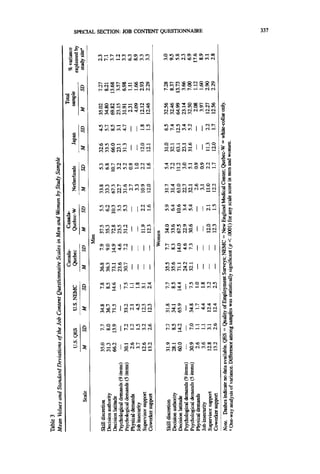
Table 3). Although the difference between means are            for both men and women. In three representative
statistically significant among the studies for all            samples, the standard deviations are very similar on
scales, the proportions of the variance of scale scores        all scales.
explained by study site are small, that is, generally
less than 5% for men and women for the more reliable
scales. Within men samples, the proportions ex-
                                                                      Internal Consistency of JCQ Scales
plained ranged from 1% to 4% for decision latitude,
psychological demands, supervisor support, and                    Internal consistency of the scales tend to be similar
coworker support (averaging 2.5%). These propor-
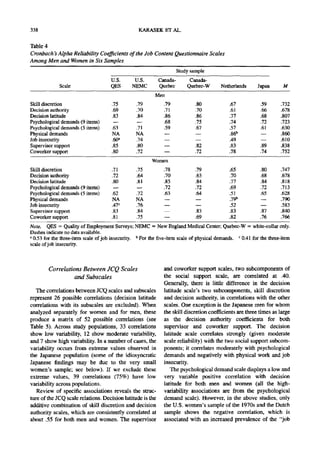
                                                               across populations and between men and women (see
tions were, respectively, 6% and 9% for physical
                                                               Table 4). The Cronbach's alpha coefficients are
demands and job insecurity, where only three studies
                                                               generally acceptable (overall average alpha for
have data and there are reliability limitations for the
                                                               women is .73 and for men is .74). The highest and
scale forms included in the study. Within women
                                                               most acceptable values of the coefficients are found
samples, the proportions explained ranged from 3%
                                                               for the decision latitude, physical demands, supervi-
to 10% for decision latitude, psychological demands,
                                                               sor support, and coworker support scales. However,
job insecurity, supervisor support, and coworker
                                                               the psychological demands scale, with five questions,
support (averaging 4.8%), whereas it was much
                                                               is only borderline (Nunnaly & Bernstein, 1994).
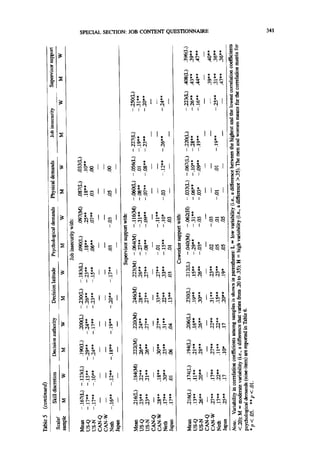
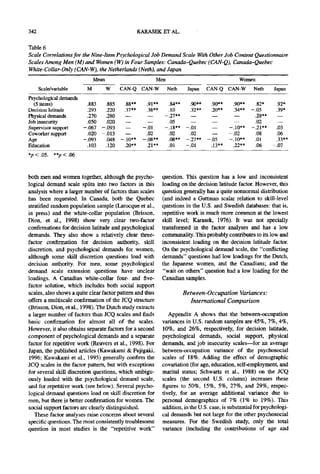
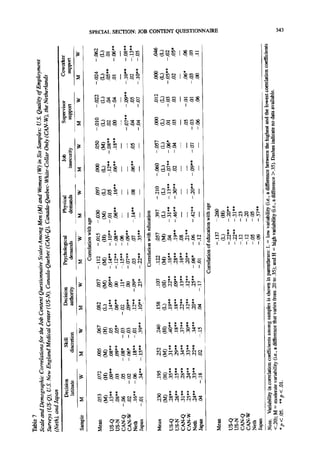
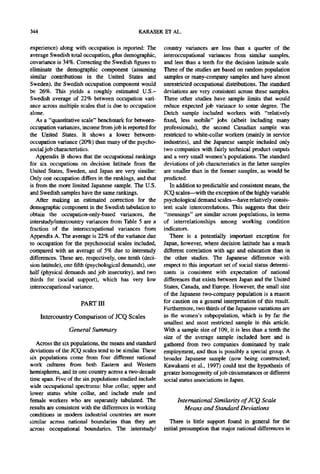
greater (17%) for the single-question physical de-
mand scale.                                                    Some minor deviations occur for the skill discretion
   Although differences between samples are gener-             scale, which falls to borderline levels in the Dutch
ally small, some specific tendencies can be observed.          study for men and women and for the decision
The decision latitude means are the highest in the two         authority scale for men. However, taken as a single
Quebec samples for both men and women. The                     scale, the decision latitude scale has quite acceptable
decision latitude means and more specifically the              coefficients. The skill discretion scale has a low
decision authority means are lower in the U.S. QES             reliability for Japanese men but is acceptable for
(1970s) sample than in the U.S. NEMC (1994)                    Japanese women. Decision latitude has good reliabil-
sample for both men and women. The decision                    ity in Japanese women but remains low for men. The
latitude means are the lowest in Japan and U.S. QES            job insecurity scale also has low coefficients in two
(1970) in both men and women, although for women,              out of the three populations for which data are
the Netherlands sample is as low as Japan's.                   available.
SPECIAL SECTION: JOB CONTENT QUESTIONNAIRE                    337


                 ~   ~           I     I ~


                                                               0


     z


                 ~~11~

                                                          II       "
                                                          ~v


                                                ~ ~       ~.~


                                                      ~            °


c~


                 ~,~.~   ~   .
                                     ~~ ~ ' ~
338                                                KARASEK ET AL.


Table 4
Cronbach 's Alpha Reliability Coefficients of the Job Content Questionnaire Scales
Among Men and Women in Six Samples
                                                                       Study sample
                                      U.S.       U,S.        Canada-        Canada-
              Scale                   QES       NEMC         Quebec        Quebec-W        Netherlands         Japan       M
                                                           Men
Skill discretion                       .75        .79          .79             .80             .67              .59       .732
Decision authority                     .69        .70          .71             .70             .61              .66       .678
Decision latitude                      .83        .84          .86             .86             .77              .68       .807
Psychological demands (9 items)         --        --           .68             .75             .74              .72       .723
Psychological demands (5 items)        .63        .71          .59             .67             .57              .61       .630
Physical demands                       NA         NA           --              --              .86b             --        .860
Job insecurity                         .60a       .74          --              --              .49              --        .610
Supervisor support                     .85        .80          --              .82             .83              .89       .838
Coworker support                       .80        .72          --              .72             .78              .74       .752
                                                          Women
Skill discretion                       .71        .75          .78             .79             .65              .80       .747
Decision authority                     .72        .64          .70             .63             .70              .68       .678
Decision latitude                      .80        .81          .85             .84             .77              .84       .818
Psychological demands (9 items)         --        --           .72             .72             .69              .72       .713
Psychological demands (5 items)        .62        .72          .63             .64             .51              .65       .628
Physical demands                       NA         NA           --              --              .79b             --        .790
Job insecurity                         .47c       .76          --              --              .52              --        .583
Supervisor support                     .83        .84          --              .83             .83              .87       .840
Coworker support                       .81        .75          --              .69             .82              .76       .766
Note. QES = Quality of Employment Surveys; NEMC = New England Medical Center; Quebec-W = white-collar only.
Dashes indicate no data available.
a 0.53 for the three-item scale of job insecurity, b For the five-item scale of physical demands,     c 0.41 for the three-item
scale of job insecurity.


          Correlations Between JCQ Scales                      and coworker support scales, two subcomponents of
                    and Subscales                              the social support scale, are correlated at .40.
                                                               Generally, there is little difference in the decision
  The correlations between JCQ scales and subscales            latitude scale's two subcomponents, skill discretion
represent 26 possible correlations (decision latitude          and decision authority, in correlations with the other
correlations with its subscales are excluded). When            scales. One exception is the Japanese men for whom
analyzed separately for women and for men, these               the skill discretion coefficients are three times as large
produce a matrix of 52 possible correlations (see              as the decision authority coefficients for both
Table 5). Across study populations, 33 correlations            supervisor and coworker support. The decision
show low variability, 12 show moderate variability,            latitude scale correlates strongly (given moderate
and 7 show high variability. In a number of cases, the         scale reliability) with the two social support subcom-
variability occurs from extreme values observed in             ponents; it correlates moderately with psychological
the Japanese population (some of the idiosyncratic             demands and negatively with physical work and job
Japanese findings may be due to the very small                 insecurity.
women's sample; see below). If we exclude these                   The psychological demand scale displays a low and
extreme values, 39 correlations (75%) have low                 very variable positive correlation with decision
variability across populations.                                latitude for both men and women (all the high-
   Review of specific associations reveals the struc-          variability associations are from the psychological
ture of the JCQ scale relations. Decision latitude is the      demand scale). However, in the above studies, only
additive combination of skill discretion and decision          the U.S. women's sample of the 1970s and the Dutch
authority scales, which are consistently correlated at         sample shows the negative correlation, which is
about .55 for both men and women. The supervisor               associated with an increased prevalence of the "job
SPECIAL SECTION: JOB CONTENT QUESTIONNAIRE                                        339

strain" combination. The correlation is actually            age correlations with any scale. Education has strong
strongly positive in the small sample of Japanese           negative correlations with decision latitude and
women. Correlations of psychological demands with           physical demands, but low correlations otherwise.
decision latitude are somewhat higher for men than          There is a moderately strong and consistent negative
for women. The findings for the nine-questionversion        association between age and education (about -.20)
of the psychological demand scale show similar              in all of the samples (which is much stronger for the
variability.                                                Japanese women). These correlations may reflect
   The psychological demands scale varies across            intergenerational differences in education levels
populations in its correlation with physical demands.       (lower levels for older generation workers) and the
It is strongly positive in two out of three populations     broad age range (20 to 65 years) of included
where it is available, but very low in the third one (the   participants.
U.S. NEMC sample). Psychological demands has                   The Japanese sample has substantially different
major associational variability with supervisor sup-        correlations of decision latitude scale with age and
port: In the U.S. QES it is strongly negatively             education than the other populations. There is no
correlated, in Japan it is uncorrelated, and in other       association between education and either skill discre-
populations it has a low correlation. Physical              tion or decision authority for the Japanese men and
demands show a consistent negative association with         negative correlations for the Japanese women, but a
decision latitude, and correlations are stronger for        strong positive association exists in all other samples.
men than for women. Job insecurity shows generally          For the Japanese women, a high positive association
consistent associations with other scales, particularly     between age and psychological demands is also
a moderately strong negative correlation with the           observed. Additionally, they have a high positive
decision latitude, supervisor, and coworker support         correlation between age and skill discretion and a
scales.                                                     weaker negative correlation between education and
   Correlations between the nine-item version of the        skill discretion (although this correlation reduces to
psychological demands scale and other JCQ scales            zero when age is adjusted; Kawakami et al., 1995).
are shown in Table 6. The correlation between the           Correlations of supervisor support and decision
five-item and the nine-item versions is high (.88). The     latitude with education are also very small for the
variability of associations with other scales remains       Japanese sample but are strongly positive for the
with the nine-item version (among the four popula-          other samples.
tions for which it is available). The nine-item version        Several consistent gender-related exceptions are
has a more positive overall correlation with decision       observed. Demands are in general more consistently
latitude.                                                   related to decision latitude for men than for women:
   The physical demands scale displays a low and            Physical demands are more highly negatively corre-
variable positive correlation with job insecurity for       lated with decision latitude and education for men,
both men and women and a low and negative                   and psychological demand associations with decision
correlation with supervisor and coworker support,           latitude are somewhat higher for men than for
except for the U.S. QES women's sample and the              women. Physical demands are more highly negatively
Japanese women's sample.                                    correlated with education for men than for women,
                                                            and psychological demands are negatively correlated
                                                            with age for men, except for the Dutch sample, but
         Correlations of JCQ Scales With                    weaker for women, except for the Japanese sample
               Age and Education                            and for one Canadian sample, in which correlations
                                                            for men and women are nearly the same.
   Correlations of JCQ scales with age and education
represent 32 possible correlations (see Table 7). Of
these, 16 display low variability across populations,                Factorial Validity of JCQ Scales
10 show moderate variability,and 6 show high variability.
Here particularly, extreme values are observed in the          The U.S. population from the 1970s shows a clear
Japanese sample. After excluding them, 26 correla-          factor pattern corresponding to the JCQ scales for
tions (81%) have low variability across populations.        men (which is not surprising because this was the
   The correlations with age and education are, in          JCQ defining base sample) and also for women. Also
general, lower than those observed between the JCQ          in the United States, the NEMC sample from the early
scales and subscales themselves. There are no strong        1990s shows a confirming pattern for most factors for
340              KARASEK       ET AL.


      x_.


                           @


                                            I   I    I   I    I


                                                ~t       4t

                                        I       i    I   I    I


                                 I      I       I    I   I    I


                                 il     I       I    I   i    I

      ..~   k.


       k.                               i       I        I    I


                                                I    I   I    I


                                                ~CYZ
SPECIAL SECTION: JOB CONTENT QUESTIONNAIRE                                                                                                       341


                                                  I         L   I            I        I        I           I               I


                                                  I         I   I            I         I       I           I               I


                                                                                     §'~                                   -I
                                                      I             I        I"        I       I           I


o.~.o                                                                                ~ .               .           .               o


                                                      I     I       I            I     t           I       t                   I


    .~o.                                                  ~             ~g
                                  I                   II1               II                 I       I           I       I


                                                                    I   II                 I       I           I


                                 [....
     .~.
I            I           I         I


     •           .           o

 I           I           I            I


             I           I            I


                                 oo

             I           I             (


         •           o

    I            I           I            I


    I            I           I            I                                                                                            •r   II


                                              J       ~ o o Z
342                                             KARASEK ET AL.

Table 6
Scale Correlations for the Nine-Item Psychological Job Demand Scale With Other Job Content Questionnaire
Scales Among Men (M) and Women (W) in Four Samples: Canada-Quebec (CAN-Q), Canada-Quebec
White-Collar-Only (CAN-W), the Netherlands (Neth ), and Japan
                              Mean                         Men                                 Women
      Scale/variable      M          W   CAN-Q CAN-W             Neth    Japan   CAN-Q CAN-W          Neth     Japan
Psychological demands
  (5 items)               .883   .885   .88**   .91"*          .84**   .90**       .90**     .90**     .82*      .92*
Decision latitude         .293   .220   .37**   .38**          .10     .32**       .20**     .34**   -.05        .39*
Physical demands          .270   .280    --      --          -.27**     --          --        --       .28**      --
Job insecurity            .050   .020   --       --            .05      --          --        --       .02        --
Supervisor support      -.067 -.093      --   -.01           -.18"* -.01            --     -.I0"*    -.21"*      .03
Coworker support          .020 -.013     --     .02            .02     .02          --     -.02        .08       .06
Age                     -.093    .048 -.10"* -.08**            .08** -.27**      -.05      -.10"*      .01       .33**
Education                 .103   .120   .20**   .21"*          .01   -.01          .13"*     .22**     .06     -.07
*p < .05. **p < .06


both men and women together, although the psycho-           question. This question has a low and inconsistent
logical demand scale splits into two factors in this        loading on the decision latitude factor. However, this
analysis where a larger number of factors than scales       question generally has a quite nonnormal distribution
has been requested. In Canada, both the Quebec              (and indeed a Guttman scalar relation to skill-level
stratified random population sample (Larocque et al.,       questions in the U.S. and Swedish databases: that is,
in press) and the white-collar population (Brisson,         repetitive work is much more common at the lowest
Dion, et al., 1998) show very clear two-factor              skill level; Karasek, 1976). It was not specially
confirmations for decision latitude and psychological       transformed in the factor analyses and has a low
demands. They also show a relatively clear three-           communality. This probably contributes to its low and
factor confirmation for decision authority, skill           inconsistent loading on the decision latitude factor.
discretion, and psychological demands for women,            On the psychological demand scale, the "conflicting
although some skill discretion questions load with          demands" questions had low loadings for the Dutch,
decision authority. For men, some psychological             the Japanese women, and the Canadians; and the
demand scale extension questions have unclear               "wait on others" question had a low loading for the
loadings. A Canadian white-collar four- and five-           Canadian samples.
factor solution, which includes both social support
scales, also shows a quite clear factor pattern and thus                Between-Occupation Variances:
offers a multiscale confirmation of the JCQ structure                      International Comparison
(Brisson, Dion, et al., 1998). The Dutch study extracts
a larger number of factors than JCQ scales and finds           Appendix A shows that the between-occupation
basic confirmation for almost all of the scales.            variances in U.S. random samples are 45%, 7%, 4%,
However, it also obtains separate factors for a second      10%, and 26%, respectively, for decision latitude,
component of psychological demands and a separate           psychological demands, social support, physical
factor for repetitive work (Reuvers et al., 1998). For      demands, and job insecurity scales for an average
Japan, the published articles (Kawakami & Fujigaki,         between-occupation variance of the psychosocial
1996; Kawakami et al., 1995) generally confirm the          scales of 18%. Adding the effect of demographic
JCQ scales in the factor pattern, but with exceptions       covafiation (for age, education, self-employment, and
for several skill discretion questions, which ambigu-       marital status; Schwartz et al., 1988) on the JCQ
ously loaded with the psychological demand scale,           scales (the second U.S. column) increases these
and for repetitive work (see below). Several psycho-        figures to 50%, 15%, 5%, 27%, and 29%, respec-
logical demand questions load on skill discretion for       tively, for an average additional variance due to
men, but there is better confirmation for women. The        personal demographics of 7% (1% to 19%). This
social support factors are clearly distinguished.           addition, in the U.S. case, is substantial for psychologi-
   These factor analyses raise concerns about several       cal demands but not large for the other psychosocial
specific questions. The most consistently troublesome       measures. For the Swedish study, only the total
question in most studies is the "repetitive work"           variance (including the contributions of age and
SPECIAL SECTION: JOB C O N T E N T Q U E S T I O N N A I R E                                                                                                                                                                  343


                                  I                       I                I           I               I                                    I

                                                                                                                                        .                                   *   ¢~
                                  o . e ~ . S.                            ° ~o..
                                                                          ,-1. -
                                  I                                        I                           I                                    I                                       I


                                                                                                                   ~ 3 ,~ s
                                                                                                                   o._,~                                                    s s~
                                                                               •           .               o


                                      I                   I                I                           I

                                                                                                                                                                                                                                                      "0
                                                                                                                                                                                                                                                      I=
                                      I                                                                I                                                                            II

                                  ° **
                                  ~ 1                                                  ~1
                                                  I                                                                I                            I           I

                                                                                                                                                                                                                                                      ..4

                                                                                                                                                    •           .                       °


                                                  I                                                                }                            I                                                                                                     A

                                                                                                                   0                        * *
                                              ,.~-I                            I~1                                         •       ~                .               .


                                                                                                                       I                        II                                                                                               e ,,~
                                                                                                                                                                                                        #~       **                      .

                                                                                                                   ~ . .                                                                    °
                                                                                                                                                                                                                     . ~ ¢!. ¢!. ~. ~ .
                              #           I           I                                    I                                                                                                                 I   I       I   I   I   I       I
                                                                                                                                                                                                        0
                                                  * *                      *                           *
                                                                                                                                                                                                        ~   ~        .
                                          I           I I I I                                                                                                                                                I   I       I' I" I" I" I"
                                                                                                               0                                                                                        o
                                                  * * ~ *                                              *                                    * * * *

     .~ &                                 I           IIII                                                 I                                                                                    I

                                                                                                                                       ~ * * * * *
                                                          ~ $ ~
                                                                                               I                                                                                                I

                                                                                                                                                                                                                                                           ee
                                                                                                                   ~                            .                       ~
                                                                  I
                                                                                                                                                * * * * ~
                                                                                                                   ~                            * * * * *
                                                                                                                               .        ~               m               ~   m   ~
                                                                  III                                                                                                                               i

                                                                                                                                                * * * * *

                                              ~               ~                                                                ov                       . . . . . .                                                                                        d
                                                                  II
                                                                                                                                                * * * ~ *


                                                                                                                                                                                                    I
                  .=o.8 I ~                                                        I               I
                                                                                                                                                                                                                                                 I~        ¢~   °


                                                                                                                                                    * * * * *                                                                                    ~ V
                                                                                                                       0                            * * * * *

                                                                      I                                                                                                                                                                                    II
t~   ~   ~..-~,


                                                                                                                                                    ~                                   Z
344                                           KARASEK ET AL.

experience) along with occupation is reported: The       country variances are less than a quarter of the
average Swedish total occupation, plus demographic,      interoccupational variances from similar samples,
covariance is 34%. Correcting the Swedish figures to     and less than a tenth for the decision latitude scale.
eliminate the demographic component (assuming            Three of the studies are based on random population
similar contributions in the United States and           samples or many-company samples and have almost
Sweden), the Swedish occupation component would          unrestricted occupational distributions. The standard
be 26%. This yields a roughly estimated U.S.-            deviations are very consistent across these samples.
Swedish average of 22% between occupation vari-          Three other studies have sample limits that would
ance across multiple scales that is due to occupation    reduce expected job variance to some degree. The
alone.                                                   Dutch sample included workers with "relatively
   As a "quantitative scale" benchmark for between-      fixed, less mobile" jobs (albeit including many
occupation variances, income from job is reported for    professionals), the second Canadian sample was
the United States. It shows a lower between-             restricted to white-collar workers (mainly in service
occupation variance (20%) than many of the psycho-       industries), and the Japanese sample included only
social job characteristics.                              two companies with fairly technical product outputs
   Appendix B shows that the occupational rankings       and a very small women's populations. The standard
for six occupations on decision latitude from the        deviations of job characteristics in the latter samples
United States, Sweden, and Japan are very similar:       are smaller than in the former samples, as would be
Only one occupation differs in the rankings, and that    predicted.
is from the more limited Japanese sample. The U.S.          In addition to predictable and consistent means, the
and Swedish samples have the same rankings.              JCQ scales--with the exception of the highly variable
   After making an estimated correction for the          psychological demand scales--have relatively consis-
demographic component in the Swedish tabulation to       tent scale intercorrelations. This suggests that their
obtain the occupation-only-based variances, the          "meanings" are similar across populations, in terms
interstudy/intercountry variances from Table 5 are a     of interrelationships among working condition
fraction of the interoccupational variances from         indicators.
Appendix A. The average is 22% of the variance due          There is a potentially important exception for
to occupation for the psychosocial scales included,      Japan, however, where decision latitude has a much
compared with an average of 5% due to interstudy         different correlation with age and education than in
differences. These are, respectively, one tenth (deci-   the other studies. The Japanese difference with
sion latitude), one fifth (psychological demands), one   respect to this important set of social status determi-
half (physical demands and job insecurity), and two      nants is consistent with expectation of national
thirds for (social support), which has very low          differences that exists between Japan and the United
interoccupational variance.                              States, Canada, and Europe. However, the small size
                                                         of the Japanese two-company population is a reason
                     PART III                            for caution on a general interpretation of this result.
                                                         Furthermore, two thirds of the Japanese variations are
      Intercountry Comparison of JCQ Scales              in the women's subpopulation, which is by far the
                                                         smallest and most restricted sample in this article.
                General Summary                          With a sample size of 109, it is less than a tenth the
                                                         size of the average sample included here and is
   Across the six populations, the means and standard    gathered from two companies dominated by male
deviations of the JCQ scales tend to be similar. These   employment, and thus is possibly a special group. A
six populations come from four different national        broader Japanese sample (now being constructed;
work cultures from both Eastern and Western              Kawakami et ai., 1997) could test the hypothesis of
hemispheres, and in one country across a two-decade      greater homogeneity of job circumstances or different
time span. Five of the six populations studied include   social status associations in Japan.
wide occupational spectrums: blue collar, upper and
lower status white collar, and include male and
female workers who are separately tabulated. The              International Similarity of JCQ Scale
results are consistent with the differences in working           Means and Standard Deviations
conditions in modern industrial countries are more
similar across national boundaries than they are           There is little support found in general for the
across occupational boundaries. The interstudy/          initial presumption that major national differences in
SPECIAL SECTION: JOB CONTENT QUESTIONNAIRE                                     345

psychosocial job characteristics exist between coun- poorly by occupation, it is three quarters. The
tries. There are some limitations in overall conclu- magnitude of person-based demographic differences,
sions about the psychosocial characterization of assessed in a covariariance test (which is one
work: Not all measures of working conditions are component of individually based variance in job
included; working hours are omitted. Nevertheless,        assessments), can be clearly estimated (in the United
our findings imply that although differences in social States). They add about another third on average to
conditions of work certainly can exist, they are the occupational variances (however, these contribu-
smaller in relative magnitude than might have been tions are as large as the occupational differences for
expected between the countries in our sample: small psychological demands and job insecurity scales).
by comparison to occupational differences in the             The findings, together with the occupational
same countries (as has been studied in the United variance findings, suggest small "workplace cross-
States, Sweden, and Japan). One possible conclusion national" differences and much larger and consistent
is that at the macrosocial level, differences remain, interoccupational differences. That is, the differences
reflecting the impact of national differences, but at the between managers and assembly workers are "rela-
 "reductionist" microlevel, job characteristics tend to tively" similar in every country. The consistency of
be homogeneous.                                           the standard deviations of the samples suggests that
    It cannot be said that small differences between similar interoccupational differences exist in those
study means is evidence that the JCQ lacks ability to samples as well (i.e., manager and line worker
discriminate "objective" difference: The JCQ has a differences).
strong and consistent ability to discriminate detailed       This study does not assess working hours, commut-
occupation. Indeed, some of its scales discriminate ing time, or spouse's work time, all of which could
occupation better than income (see Appendix A; also contribute to the psychosocial costs of work, and
 Schwartz et al., 1988), certainly a "hard empirical" which may differ between the United States, Canada,
measure. It has clearly been shown in several samples Europe, and Japan. Japan has had the most clearly
 (see Appendix B) that consistent interoccupational expressed concern; "death by overwork" (karoshi;
 differences exist on the JCQ decision latitude scales, Uehata, 1991) is a publicly discussed issue, and
 which are shown to be impoaant for the social working hours appear to be significantly in excess of
 organization of work from many other points of reported statistics (Shimomitzu & Levi, 1993).
 reference.                                               Increased pressure to work hours in excess of the
    A full ANOVA (not included in this article), across traditional 40 hours is also noted in the United States
 countries and occupations, would need to properly (Schor, 1991). Because official statistics can underre-
 test the hypothesis that variation in psychosocial       port working hours, it would be desirable to assess
 working conditions in industrialized countries today these in the future in the JCQ. Physical work hazards
 is primarily "within occupation" and that smaller are also omitted (see Paoli, 1997, for a European
 fraction remains between countries. It was unfortu- comparison of relative magnitudes of these effects).
 nately not possible to include direct comparison of Thus, the overall scope of working burdens is
 occupational means by study as a result of different underestimated by looking only at this study's results.
 occupational coding schemes and incomplete coding However, this study does assess the previously
 in some databases (future publications will attempt to unassessed (internationally) and "soft," but increas-
 compare these results). However, the other published ingly important, social and psychological character of
 data included in this article allow a preliminary work. It finds that the dimensional structure of work
 assessment. When we compare the 45% (U.S.)                appears similar across countries.
 between-occupation variance for the most reliable           With these limitations in mind, a broad conclusion
 scale, decision latitude, it can be seen that the of this study seems justifiable: for workers' jobs, the
 between-study, "national" variations are less than global economy is apparently already here. The
 one tenth of between-occupation variance for this global economy in advanced industrial societies has
 scale, an order of magnitude. For psychological created many consistent conditions of employment--
 demand, the "national" variance is roughly a fifth of overcoming the centuries-old national bases for
 the occupational variance reported in the other different work content and replacing it with an
 studies. For job insecurity and physical demands, emerging set of psychosocial, "work quality" interna-
 where our group of studies provides a less certain tional norms for working behavior. Because many of
 comparative base, the fraction is roughly one half, these new measures are outside of the currently
 and for the social support scales, which discriminate studied "quantitative" job attributes such as wages,
346                                             KARASEK ET AL.

hours, and benefits, it is even more vital that they        scales help define their meanings. For example, the
become well understood as quickly as possible. In the       relationship between decision latitude and social
early 20th century, major international borrowing of        support, and each of their relationships to age and
social relationship-determining work organization           education, help define the meaning of both concepts:
practices might have seemed unthinkable. However,           how much of decision authority is related to good
over the last several decades, global workplace             relationship with supervisors, how much to age or to
homogenization appears to have occurred---drivenby          educational background. The correlation of psycho-
global economic market pressures---to the extent that       logical demands with the decision latitude subscales
its consequences are now an eminently researchable          assesses the degree to which "responsibility" is
topic.                                                      related to authority, or how much psychological
                                                            demands is related to skill level. The correlation
                                                            between psychological demands and physical de-
                   Job Insecurity                           mands shows the inseparability in some work settings
                                                            of these two types of demands in the work process.
   The job insecurity scale shows a potentially             Strong connections in physiological effects also exist.
important difference in means between studies, but
the small number of studies makes it difficult to draw
rigorous conclusions. The job insecurity scale (based              International Gender Comparisons
on the specially calculated comparable subscale
across populations) shows a substantially higher level         The primary gender differences found are system-
in the 1990s in the United States than it did in the        atically lower skill discretion and decision authority
1970s (by over 1.5 standard deviations--a major             for women in all of the studies: about a quarter of the
difference). This difference is consistent with public      overall population standard deviation between male
perceptions of high job insecurity in the 1990s, with       and female workers for each scale. In the United
up to 50% of the working population feeling insecure        States, the difference for decision latitude is larger,
(Lohr, 1996). Also, the job insecurity scale level in the   and in the Quebec regional sample, the difference is
United States in the 1990s is substantially higher than     smaller than in the other samples. In general, this
in the Netherlands. The sample in the Netherlands           difference reflects the enduring sex differences in
only includes employed workers in stable companies          both authority and opportunities to use and develop
(but this is true also of the U.S. NEMC sample in the       skills in the workplace across all the countries
1990s). The finding stands in contrast to the               studied: a deficit of good psychosocial working
conventional "quantitative" international compari-          conditions for women. Although this may not be as
sons, which usually rate the United States more             large as gender-based wage differences, it would be
favorable on job security because of the substantially      expected to contribute to reduced well-being for
lower national rates of unemployment. However, the          women in general, because stressor-strain relation-
U.S. "safety net" for the unemployed is generally less      ships are often found to be generally similar for men
secure than that in the Netherlands. Fear of job loss       and women in later adulthood (Frankenhaeuser &
can apparently be high even when the national               Johansson, 1986; Karasek, 1990).
unemploymentrate is low--and indeed the U.S. press             Otherwise, the gender differences found in scale
recorded such fears due to downsizing in the early          means in this four-country comparison are not large.
1990s in the United States because of perceptions of a      Scales reliabilities and most scale correlations are
weakening social contrast in the country to support         also similar. However, both psychological and
worker entitlements (Gleckman, 1995).                       physical demands are more positively correlated to
                                                            decision latitude, and sometimes with age and
                                                            education for men than for women, implying clearer
      Discussion of Correlations and Meaning                patterning of work role definitions by age and
                                                            education for men. Finally, although the level of
   The consistent relationship between the scales is an     psychological demands are similar for men and
important confirmation of the consistent meaning of         women across studies, the psychological demand
the JCQ scales in different national work cultures and      variable seems to have even more variable associa-
by gender (albeit with the notable exceptions               tions with other scales for women than it does for
mentioned earlier). The correlations between the            men.
SPECIAL SECTION: JOB CONTENT QUESTIONNAIRE                                           347

            Specific JCQ Scale Results                      logical demand phenomena consistently could then
                                                            be a reflection of the relatively poor precision of
           Psychological Demand Scale                       general current public discourse in these areas: not an
                                                            "unimportant" problem but just a "new" problem.
   The psychological demand scale has been criti-           Aggregate occupation scoring system methods (Frese
cized by researchers who have used the demand/              & Zapft, 1988; Karasek et al., 1988) or work
control framework for several deficiencies: sensitivity     group-based assessments (Vahtera et al., 1996) can
to bias related to health status (Kristensen, 1996) and     reduce relative error variance in scales by averaging
its less consistent ability to predict outcomes such as     out reporting discrepancies in multiple persons'
heart disease in simultaneous association with deci-        reports of a single work setting, but they cannot
sion latitude (Johnson, Stewart, Hall, Fredlund, &          resupply variance lost as a result of imprecision in the
Theorell, 1996; Karasek & Theorell, 1990; Theorell          original assessments.
et al., 1998).                                                 Other job assessment methods might be developed
                                                            that can overcome such "language deficits" by
Inconsistency of Meaning                                    proactively assisting workers in generating reliable,
                                                            consensus reports in this area. One example of such
   The psychological demand scale provides some             language development methods for job assessment is
assurance of its reliability across diverse populations.    the "conducive dialogue" in which mapping of social
Nevertheless, the psychological demand scale has the        relationships in production activity provides the basis
most variable of all correlations in the JCQ scale          for development of new languages about job alterna-
correlation matrix: In fact a majority of the variability   fives (Karasek, 1990). Unfortunately, these methods
for the entire set of JCQ scales occurs in conjunction      are much more time consuming than survey methods.
with this scale. The variability in the association of
the psychological demands scale across samples
supports the interpretation that its meaning may differ     Collinearity With Decision Latitude
by population group. This variability is congruent
with the lack of consistent between-occupational               The correlation between psychological demands
discrimination of psychological demands in U.S.             and decision latitude is an important issue for testing
samples (Schwartz et al., 1988) and higher, but still       the demand/control model. A positive correlation can
inferior, discrimination in Swedish samples (Johnson        indicate collinearity difficulties and be a source of
& Stewart, 1993).                                           weak tests of association because the high-strain
   One possible reason for this instability of meaning      combination (high demands, low control) would be
could be that work's qualitative issues are simply          an infrequent occurrence under such conditions.
historically lagging behind in awareness, and thus in       Because decision latitude is the substantially more
contemporary language formation. By contrast, social        statistically reliable of the two scales (particularly
discourse in modern industrial societies has a good         between occupations), their common variance with a
language for quantitative occupational differences--        dependent variable is likely to be attributed to
certainly for physical demands and wages, but now           decision latitude in hierarchical linear regression
even for skill use and social authority. "Social            models. The correlation observed in the above studies
bargains" around these quantitative issues have, over       is on average positive and stronger than previously
centuries, been incorporated into the different bound-      observed (Karasek & Theorell, 1990). Only the U.S.
aries of existing occupational categories (butcher,         women's sample of the 1970s and the Dutch sample
baker, carpenter, etc.), yielding almost quantitative       show the negative correlations (associated with
precision of meaning. However, negotiations about           frequent high-demand/low-control conditions) that
psychological pressures and social support have local,      were reported as a major contributor to the work-
person-related validity--at least in the early stages of    related psychosocial stress risk for women (Karasek
social discourse. Perhaps the "linguistic bargaining"       & Theorell, 1990). The positive correlation gives rise
(Habermas, 1984) in this area has not yet generated a       to another form of the same problem: The low-job-
sufficiently consistent vocabulary across diverse           strain population can be small--in fact too small to
groups and situations to leave an imprint on                test reliably. The correlation is also positive in several
institutional or occupational structures (which would,      major study databases in heart disease research (.31;
in turn, reinforce the consistency of meaning). Thus,       S. Stansfield, personal communication, June 28,
the inability of a set of questions to assess psycho-       1998) in the Whitehall database (Marmot, Bosma,
348                                              KARASEK ET AL.

 Hemingway, Brnnner, & Stansfeld, 1997) and the              in social interaction (Hochschild, 1983; see, alterna-
 occupational linkage-based tests (Karasek et al.,          tively, Marshall, Barnett, & Sayer, 1997) and
  1988), which could partly explain the relatively          cognitive workloads. Emotional contact remains
 poorer showing of psychological demands in predic-         excluded in the present JCQ. However, there is
 tion of coronary heart disease in those studies            evidence that the nine-question recommended JCQ
 (Bosma, Peter, Siegrist, & Marmot, 1998). This is a        scale version is an improvement for cognitive
 problem in other studies in which the demand/control       workloads, and the correlation is higher with skill
 model is tested with dichotomous or trichomous             discretion, which also assesses cognitive engagement.
 scales in which the high-demand/low-decision lati-         This version may be a more "white-collar sensitive"
 tude combination is the exposure condition. The            psychological demand formulation. The implication
 problem requires enlargement of the exposure criteria      of the higher physical demands scale correlation of
 and thus diminished sensitivity.                           the shorter five-question version of the scale (only the
    Both the multicoUinearity and the disappearing          Dutch sample allows this direct comparison) implies
 exposure group problem are compounded when the             that the five-question version--perhaps explicitly the
 associations with age are included. Table 7 shows a         "work hard" and "work fast" questions--assesses
 consistent negative association between age and            physical as well as psychological loads. For most
 psychological demands (and even a small positive           illness-causation hypotheses, this is not a substantive
 correlation with age and,°decision latitude), meaning      disadvantage: Most of the psychophysiological costs
 that the frequency of "high-strain" job holders is less    of work occur during the high levels of autonomous
 in older age cohorts. Of course, older populations are     nervous system arousal (sympathetic or fight-or-flight
 often at higher risk (for coronary heart disease). This    response) to which physical demands certainly also
effect~s a three-way interaction in which psychologi-       contribute physiologically.This can, however, lead to
cal demands is the lowest reliability measure of the        interpretative ambiguities.
three. Similarly, the higher correlations of education
with decision latitude and the still positive correlation
of education and psychological demands mean there
                                                                            Job Insecurity Scale
will be relatively few high-status, high-strain jobs.           In the broad area of job insecurity, the JCQ scale
Thus, social class, education, or decision latitude          includes two types of information: (a) overall
could claim common variance between psychological            assessments of job insecurity and future career
demands and the dependent variable in hierarchical          prospects and (b) specific data about layoff and work
linear regressions.                                         instability history. Although a statistically more
    Another problem, related both to psychological          homogeneous scale could be achieved by dropping
demands and to job strain in general, is underreport-        some aspects of the JCQ measure (indeed the alpha
ing in high-strain jobs. High-strain job incumbents,         scores of the two questions included for the specially
time pressured by practical situations almost by            calculated comparative version of the scale have
definition (often with multiple jobs, uncertain jobs, or    higher reliability than the more comprehensive
temporary jobs), consistently report being too harried      version; see Karasek & Theorell, 1990, Statistical
to participate in complicated research projects.            Appendix), the robustness of the scale's interpretabil-
Although population studies of job characteristics          ity would suffer. Unfortunately, both of the versions
with very simple questionnaires might find only a           included in this study fall short of the full JCQ
moderate dropout of high-strain participants, the           recommended scale version, which has not been
dropout rate increases differentially for high-stress       reported here. Whether its greater inclusiveness leads
groups with the more difficult study protocols (Costas      to a higher overall alpha or a lower one cannot be
& R. A. Karasek, personal communication, March 30,          judged at this time.
1997). Such protocols are important for confirming
illness etiology and for long-term follow-ups. These
are the cornerstones of strong scientific confirmation            Implication for Broad Interpretability
of causal associations. The magnitude of this source                     o f Psychosocial JCQs:
of bias is not clear.                                                The "Self-Report Bias" Issue

Insufficient Coverage                                          The most discussed aspect of questionnaire-based
                                                            instruments for workplace research is the issue of
   The psychological demand scale has been criti-           objective validity of self-report questionnaires. The
cized for failure to adequately cover emotional labor       findings above shed additional light on the ongoing
SPECIAL SECTION: JOB CONTENT QUESTIONNAIRE                                         349

debate about self-report bias in the use of question-      availability of vocabulary about precise category
naire-based job assessment. The issue is whether           boundaries in each area of job experience.
self-reported variations on the scales correspond to          However, the critique of potential bias in the scales
the "objective reality" that other knowledgeable           (Brief, Burke, George, Robinson, & Webster, 1988;
observers would also report, or whether there is           Ganster & Schaubroek, 1991) can also easily be
something idiosyncratic about the observer himself or      overdone, leading to Type II statistical errors. The
herself that make such reports unreliable as an            current form of this critical position claims that
assessment of the external environment--wbether            JCQ-like job assessment methodologies really tap a
this be due to demographic status (e.g., aging or          personality-based "negative affect factor" that ac-
gender), national culture, or enduring characteristics     counts for both respondents' negative descriptions
of the personality. As an estimate of these person-        about their job and their negative emotional state.
based effects, demographic status adds an average of          Take, for example, a common but potentially
7% of the variance in the job scales (as covariates to     misleading application of the "triviality trap." In this
occupation in U.S. national studies; Schwartz et al.,      trap, the typical associations between the job
 1988). In Table 3 we showed interstudy differences        characteristics and mood states, when assessed by
that could be presumed to reflect national differences     questionnaires, are spuriously inflated by common
in culture with respect to work explain an average of      questionnaire response behavior for both sets of
5% of the scale variance. The suggestion of the            variables, which then accounts for the observed
present study, then, further narrows down the              associations. The recommended solution proposed in
alternative, person-based explanations to the prima        Brief et al. (1988) and Watson and Pennebaker (1989)
facie claim that the job scales measure the work           and endorsed by Ganster and Schanbroeck (1991) is
environment. The question now remains whether the          that these associations should be controlled for
vast remaining portion of the variance in the scales       person-based measures of negative affect. This cure is
exists due either to the job or to pure personality.       worse than the problem itself. It potentially creates a
                                                           problem by overcontrolling the associations. Claim-
There is no doubt much random error variance in the
                                                           ing the negligible remaining relationship is clear
scales (assessed in Table 4), but this is not of
                                                           evidence of a no-job/well-being association and is a
consequence to this debate because it will not
                                                           "triviality turnaronnd."
contribute to causal associations in either direction.
                                                              Consider application of this trap with specific
Because the debate seems to have come down on the
                                                           questions used in JCQ research: "My job requires
side of psychological characteristics attributed to
                                                           working fast" and "There is little decision freedom
persons as the source of such scale variance, we now
                                                           on my job" in the job measure category; and, in the
reassess the self-report bias critique.
                                                           dependent variable category, psychological strain and
   The critique of self-reports begins with cautions
                                                           mood reports such as "The future looks hopeless"
about methodological weaknesses of questionnaire
                                                           and "I have sleeping difficulties" (of course, the
reports. Two problems in particular limit causal
                                                           alternative outcome for much of the above-cited
interpretations in this area: (a) individual differences
                                                           research is quite objective coronary heart disease
in perceptions of stressors exist and (b) common-          diagnoses).
method variance could inflate associations between            The negative affect control solution is often based
job measures and self-reported well-being measures.        on other questionnaires that assess trait-based nega-
This later problem varies by scale, however: poten-        tive affect (often trait anxiety has been used) that have
tially significant for psychological demand scales         very much in common with m o o d state measurement
(where Hackman and Lawler, 1971; Frese and Zapft,          instruments, which are the studies' primary dependent
 1988; and Kirmeyer and Dougherty, 1988, show              variable. In fact, they are often based on the very
worker-observer reliabilities of .32, .35, and .35,        same questionnaire items with different formats and
respectively), and probably insignificant for decision     instructions (Spielberger, Gorsuch, Lushene, Vagg, &
latitude scales (where Hackman and Lawler, 1971;           Jacobs, 1983; Spielberger & Sydeman, 1994, p. 296).
Frese and Zapft, 1988; and Caiffm, 1983, show              For illustrative purposes, consider the trait measure
worker-observer reliabilities of .71, .54, and .65 to      of anger: I am [generally feel] quick tempered" and
.75, respectively). This limitation may relect the         "feel infuriated when I do a good job and get a poor
magnitude of cognitive assessment required by the          evaluation." Suppose the state anger questions: "I am
questionnaire format (Frese & Zapft, 1988), and also       furious [right now]" and "I am mad" measure the
the degree of worker familiarity with or the               dependent variable. In the negative-affect adjustment
350                                                 KARASEK ET AL.

  solution, job/well-being and state associations are             states and reporting pattern. Given the systematic and
 controlled with trait measures of this type. In this             objectively linked associations between job character-
 example, an association between "My job requires                 istics and occupation around the world in findings
 working fast" and "[Right now], I am furious,"                   such as those reviewed above, and negative well-
 controlled by "[Generally] I feel mad" used as a                 being associations in literature of many of the same
 measure of negative affect. Finding that most of the             countries cited in Part I, this critique necessarily takes
 association disappears, researchers in this tradition            on further implication that may represent a heavy,
 have often concluded that most of the variance can be            unexpected burden of proof for its advocates. The
 accounted for by negative affectivity--a personality             implicationis that the industrial world's low-decision-
 trait--and not by job conditions. However useful                 latitude populations are generally afflicted with the
 such trait measures may be as approximations in other           consistent, social-class-based personality deficit of
 research contexts, for the close cause-and-effect               negative affectivity--which compels such people to
 simultaneous control of this research context, we               systematically complain--but who have "objec-
 would not endorse the validity of claims to "pure               tively" nothing to complain about--in their similar
 state" and "pure trait" measurement status, even                jobs in the United States, in Japan, in Canada, in
 when other research has confirmed state-trait differen-         Sweden, in the Netherlands, and so on.
 tiation, as in the case of Spielberger et al.'s scales. It is       The critiques of self-report job analysis scales may
 certainly not clear that they have been endorsed by             be having the unfortunate effect of taking the heat off
 their originators for such purposes. The trait measures         the world's business leaders to humanize work
can easily include state components that overcontrol             environments. Humane-sounding work-design
the associations and cause "I3rpeII errors. The result is        buzzwords were commonly used in many "reengineer-
an underestimation of job effects, an understatement             ing" job change programs in the United States in the
of "valid" disease state prevalence, and a false                 early 1990s. However, these changes appear to have
attribution of disease state to person characteristics.          had very negative impacts on broad groups of
    Indeed, recent research (Dollard & Winefield,                workers, particularly because of unexamined psycho-
                                                                 social consequences. The discussion of these topics,
 1998) that explicitly test for the possibility of such
                                                                 sometimes emanating from U.S. business schools,
overcontrol with negative affectivity, using job
                                                                 which in particular should know the dangers, seems
experience cohorts to test whether negative affectivity
                                                                 instead to be preoccupied with the above critique of
is itself associated with duration of exposure to
                                                                 psychosocial research.
stressful job circumstances, finds that it is. This type
                                                                     In conclusion, psychosocial researchers have admit-
of finding even further undermines the interpretation
                                                                 ted to limitations of these measures. It is now time for
that controlling for such measures should be used as a
                                                                 the detractors to reassess them in light of broad
basis for rejecting associations between job and
                                                                 workplace reality that is presently evolving. Research-
well-being: The presumably "pure" traits are not pure
                                                                 ers in this area need to do as much as they can to
methodologically but are also impure in that short-
                                                                 validate a social and political discussion, as well as
term measurements can be partly the long-term
                                                                 scientific discussion of these topics, which are
results of environmentalexperience at work (longitu-
                                                                 affecting so many people, now on a global scale.
dinal effects noted in Johnson et al., 1996; Karasek &
Theorell, 1990). Certainly, many of these personality
trait measures are at least as contaminated by                                         References
common-method variance problems as the job
                                                                 Amick, B., Mangione, T., & Wu, V. (1998). Work
characteristics they attempt to purify. They are also              organization and drinking: A test of two psychosocial
usually assessed in samples in which there is limited              exposure models. Manuscriptsubmittedfor publication.
variance in environmental stressors, which also                  Berggren, C. (1992). Alternatives to lean production: Work
undermines associations with job measures. For good                organization in the Swedish auto industry. Ithaca, NY:
                                                                   ILR Press.
reasons, ethical committees ensure that laboratory               Bongers, P. M., de Winter, C. R., Kompier, M. A. J., &
stressors are far from the potency of truly difficult              Hildebrandt, V. H. (1993): Psychosocialfactors at work
work situations, which also limits the likelihood of               and musculoskeletal disease. Scandinavian Journal of
discovery of social environmenteffects here.                       Work, Environment and Health, 19, 297-312.
    The negative affect critique of job and well-being           Bosma, H., Peter, R., Siegrist,J., & Marmot,M. (1998). Two
                                                                   alternative job stress models and the risk of coronary
associations, of course, implies its own causal                    heart disease. American Journal of Public Health, 88,
hypothesis: Personality causes the negative emotional              68-74.
SPECIAL SECTION: JOB CONTENT QUESTIONNAIRE                                                 351

Bourbonnals, R., Brisson, C., Moisan, J., & Vezina, M.                automobile industry. International Journal of Industrial
   (1996). Job sla'ain and psychological distress in white-           Ergonomics, 20, 371-388.
   collar workers. Scandinavian Journal of Work Environ-           Ganster, D. G., & Schaubroeck, J. (1991). Work stress and
   ment and Health, 22, 139-145.                                      employee health. Journal of Management, 17, 235-271.
Brandt, L. P., & Neilsen, C. V. (1992). Job stress and adverse     Gleckman, H. (1995, November 20). Rewriting the social
   outcome of pregnancy: A causal link or recall bias?                contract. Business Week, p. 70.
   American Journal of Epidemiology, 135, 302-311.                 Griffen, R. W. (1983). Objective and social sources of
Brief, A., Burke, M., George, J., Robinson, B., & Webster, J.         information in task redesign: A field experiment.
   (1988). Should negative affectivity remain an unmea-               Administrative Science Quarterly, 28, 184-200.
   sured variable in the study of job stress? Journal of           Habermas, J. (1984). Theory of communicative active action
   Applied Psychology, 73, 207-214.                                   (Vol. 1). Cambridge, England: Polity Press.
Bfisson, C., Dion, G., Blanchet, C., Moisan, J., Guinont, C.,      Hackman, J. R., & Lawler, E. E. (1971). Employee reactions
   & Vezina, M. (1998). Reliability and validity of the               to job characteristics. Journal of Applied Psychology, 55,
   French version of the 16-item psychological demand and             259-286.
   decision latitude scale of the Karasek Job Content              Hall, E. M. (1994). Women, work, and health: Employment
   Questionnaire in white-collar workers. Manuscript sub-             as a risk factor for coronary heart disease. Journal of
   mitted for publication.                                            Preventive Cardiology, 4, 365-384.
Brisson, C., Laroque, B., Bourbonnais, R., Dion, G.,               Haratani, T., Kawakami, N., Kobayashi, E, Ishizaki, M.,
   Moisan, J., Blanchet, C., Guimont, C., Vinet, A., Vezina,          Hayashi, T., Masumoto, T., Hiro, H., Aizawa, Y.,
   M., Dagenais, G., & Laflamme, N. (1998, August). The               Hashimoto, S., & Araki, S. (1997, August). Work stress,
   Job Content Questionnaire (JCQ) in the Canadian                    depression, accidents and sick absence: Preliminary
   samples. Paper presented at the First International               findings from the Japan Work Stress Cohort Study. Paper
   Conference on Psychosocial Factors at Work, Copenha-               presented at the 15th Asian Conference on Occupational
   gen, Denmark.                                                      Health, Kuala Lumpur, Malaysia.
Cannon, W. B. (1914). The emergency function of the                Hochschild, A. (1983). The managed heart: Commercializa-
   adrenal medulla in pain and the major emotions.                    tion of human feeling. Berkeley: University of California
   American Journal of Physiology, 33, 356-372.                       Press.
de Jonge, J., & Kompier, M. A. J. (1997). A critical               Houtman, I. (1995, May). Reliability and validity of the
   examination of the demand-control-support model from a             Dutch version of the Karasek Job Content Questionnaire.
   work psychological perspective. International Journal of           Paper presented at the NIOSH/APA Conference on
   Stress Management, 4, 235-258.                                     Stress, Work and Health, Washington, DC.
Dhondt, S. (1994). Monitoring occupational health and              Johansson, S. (1971). Om LevnadsnivdandersOkningen [On
   safety in Europe: Time constraints and its implications.           the national survey of level of living]. Stockholm:
   Leiden, The Netherlands: TNO-Gezondheidsonderzoek                  Allmamma F6flaget.
   (Netherlands Institute for Health and Prevention).              Johnson, J. V. (1986). The impact of workplace social
Dhondt, S. (1998). Time constraints and autonomy at work              support, job demands and work control upon cardiovascu-
   in the European Union. Dublin, Republic of Ireland:                lar disease in Sweden. Unpublished doctoral dissertation,
   European Foundation for the Improvement of Living and              Johns Hopkins University.
   Working Conditions.                                             Johnson, J. V. (1989). Collective control: Strategies for
Dollard, M. E, & Winefield, A. H. (1998). A test of the               survival in the workplace. International Journal of
   demand-control/support model of work stress in correc-             Health Services, 19, 469--480.
   tional officers. Journal of Occupational Health Psychol-        Johnson, J. V., & Hall, E. M. (1988). Job strain, work place
   ogy, 3, 243-264.                                                   social support, and cardiovascular disease: A cross-
Fenster, L., Schaefer, C., Mathur, A., Hiatt, R. A., Pieper, C.,      sectional study of a random sample of the Swedish
   & Hubbard, A. E. (1995). Psychologic stress in the                 working population. American Journal of Public Health,
   workplace and spontaneous abortion. American Journal               78, 1336-1342.
   of Epidemiology, 142, 117-183.                                  Johnson, J. V., & Johansson, G. (Eds.). (1991). The
Fox, M. L., Dwyer, D. J., & Ganster, D. G. (1993). Effects of         psychosocial work environment: Work organization,
   stressful job demands and control on physiological and             democratization and health. In Essays in memory of Bertil
   attitudinal outcomes in a hospital setting. Academy of             Gardell. Amityville, NY: Baywood.
   Management Journal, 36, 289-318.                                Johnson, J. V., & Stewart, W. (1993). Measuring work
Frankenhaeuser, M., & Johansson, G. (1986). Stress at work:           organization exposure over the life course with a
   Psychobiological and psychosocial aspects. International          job-exposure matrix. Scandinavian Journal of Work,
   Review of Applied Psychology, 35, 287-299.                         Environment and Health, 19, 21-28.
Frese, M., & Zapft, D. (1988). Methodological issues in the        Johnson, J. V., Stewart, W., Friedlund, P., Hall, E. M., &
   study of work stress: Objective vs. subjective measure-           Theorell, T. (1990). Psychosocial job exposure matrix:
   ment of work stress and the question of longitudinal              An occupationally aggregated attribution system for
   studies. In C. L. Cooper & R. Payne (Eds.), Causes,                work environment exposure characteristics (Stress Re-
   coping and consequences of stress at work (pp. 375-411).           search Report No. 221). Stockholm: National Institute for
   New York: Wiley.                                                  Psychosocial Factors and Health.
Frieling, E., Freiboth, M., Henniges, D., & Saager, C.             Johnson, J. V., Stewart, W., Hall, E. M., Fredlund, P., &
   (1997). Effects of team work on the working conditions of         Theorell, T. (1996). Long-term psychosocial work
   short cycled track work: A case study from the European           environment and cardiovascular mortality among Swed-
352                                                   KARASEK ET AL.

  ish men. American Journal of Public Health, 86,                     telecommunication and electric power companies in
  324-331.                                                            Japan: Reliability and validity of the Japanese version of
Karasek, R. A. (1976). The impact of the work environment             Job Content Questionnaire. International Journal of
  on life outside the job. Unpublished doctoral dissertation,        Behavioral Medicine, 2, 358-375.
  Massachusetts Institute of Technology.                           Kawakami, N., Tanigawa, T., Araki, S., Nakata, A., Sakurai,
Karasek, R. A. (1979). Job demands, job decision latitude,            S., Yokoyama, K., & Morita, Y. 0997). Effects of job
  and mental strain: Implications for job redesign. Adminis-          strain on helper-inducer (CD4 +CD29 + ) and suppressor-
  trative Science Quarterly, 24, 285-308.                             inducer (CD4+CIMSRA+) T cells in Japanese blue-
Karasek, R. A. (1985). Job Content Questionnaire and                  collar workers. Psychotherapy and Psychosomatics, 66,
  user's guide. Lowell: University of Massachusetts                   192-198.
  Lowell, Department of Work Environment.                          Kirmeyer, S. L., & Dougherty, T. W. (1988). Workload,
Karasek, R. A. (1990). Lower health risk with increased job          tension, and coping: Moderating effects of supervision
  control among white-collar workers. Journal of Occupa-              support. Personnel Psychology, 41, 125-139.
  tional Behaviour, 11, 171-185.                                   Kristensen, T. S. (1989). Cardiovascular diseases and the
Karasek, R. A. (1991). The political implications of                  work environment: A critical review of the epidemiologic
  psychosocial work redesign: A model of the psychosocial             literature on chemical factors. Scandinavian Journal of
  class structure. In J. V. Johnson & G. Johansson (Eds.),            Work, Environment and Health, 15, 245-264.
  The psychosocial work environment: Work organization,            Kristensen, T. S. (1995). The demand-control-support
  democratization, and health (pp. 163-190). Amityville,              model: Methodological challenges for future research.
  NY: Baywood.                                                       Stress Medicine, 11, 17-26.
Karasek, R. A. (1997). Demand/control model: A social,             Kristensen, T. S. (1996). Job stress and cardiovascular
  emotional, and physiological approach to stress risk and            disease: A theoretical critical review. Journal of Occupa-
  active behavior development. In ILO encyclopedia of
                                                                      tional Health Psychology, 1, 246-260.
  occupational health and safety. Geneva: ILO.
                                                                   Landsbergis, P. A., Schnall, P. L., Warren, K., Schwartz,
Karasek, R. A. (1998). The new work organization,
                                                                     J. E., & Picketing, T. (1994). Association between
  conducive production, and work quality policy. In M.
                                                                      ambulatory blood pressure and alternative formulations
  Marmot (Ed.), Labor market changes and job insecurity:
                                                                      of job strain. Scandanavian Journal of Work Environment
  A challenge for social weUfare and health promotion (pp.
                                                                      and Health, 20, 349-363.
  78-105). Copenhagen: WHO/Europe.
Karasek, R. A., Baker, D., Marxer, F., Ahlbom, A., &               Larocque, B., Brisson, C., & Blancbet, C. (in press).
  Theorell, T. (1981). Job decision latitude, job demands,           Coherence interne, validite factorielle et validite discrimi-
  and cardiovascular disease: A prospective study of                  nante de la traduction francaise des EcheUes de demande
  Swedish men. American Journal of Public Health, 71,                psychologique et de latitude decisionnelle du "Job
  694-705.                                                           Content Questionnaire" de Karasek [Internal consistency,
Karasek, R. A., Schwartz, J., & Pieper, C. (1983). Validation         factorial validity, and discriminant validity of the French
  of a survey instrument for job-related cardiovascular               version of the Karasek Job Content Questionnaire]. Revue
  illness. New York: Columbia University, Department of              d'Epidemiologie et de Sante Publique.
  Industrial Engineering and Operations Research.                  Lohr, S. (1996, December 29). Though upbeat on the
Karasek, R. A., & TheoreU, T. (1990). Healthy work: Stress,          economy, people still fear for their jobs. New York I~mes, p.
  productivity, and the reconstruction of working life. New           26.
  York: Basic Books.                                               Marmot, M. G., Bosma, H., Hemingway, H., Brunner, E., &
Karasek, R. A., Theorell, T., Schwartz, J., Schnall, P., Pieper,      Stansfeld, S. (1997). Contribution of job control and other
  C., & Michela, J. (1988). Job characteristics in relation to        risk factors to social variations in coronary heart disease
  the prevalence of myocardial infarction in the U.S. HES             incidence. Lancet, 350, 235-239.
  and HANES. American Journal of Public Health, 78,                Marmot, M. G., & Tbeorell, T. (1988). Social class and
  910-918.                                                            cardiovascular disease: The contribution of work. Interna-
Karasek, R. A., Triantis, K., & Chaudhry, S. (1982).                  tional Journal of Health Services, 18, 659--674.
  Co-worker and supervisor support as moderators of                Marshall, N., Barnett, R., & Sayer, A. (1997). The changing
  associations between task characteristics and mental                workforce, job stress, and psychological distress. Journal
  strain. Journal of Occupational Behavior, 3, 147-160.               of Occupational Health Psychology, 2, 99-107.
Kasl, S. V. (1989). An epidemiological perspective on the          Meshkati, N., Hancock, P., & Rahami, M. (1990). Tech-
  role of job control in health. In S. Sauter, J. J. Hun~ll, &        niques in mental workload assessment. In Ergonomic task
  C. L. Cooper (Eds.), Job control and worker health                  analysis (pp. 65-93). London: Taylor & Francis.
  (pp. 161-189). New York: Wiley.                                  Nunnally, J. C., & Bernstein, I. H. (1994). Psychometric
Kasl, S. V. (1996). The influence of the work environment on          theory (3rd ed.). New York: McGraw-Hill.
  cardiovascular health: A historical, conceptual, and             Orth-Gomer, K. (1979). Iscbemic heart disease and psycho-
  methodological perspective. Journal of Occupational                 logical stress in Stockholm and New York. Journal of
  Health Psychology, 1, 42-56.                                        Psychosomatic Research, 23, 165-173.
Kawakami, N., & Fujigaki, Y. (1996). Reliability and               Paoli, E (1997). Second European survey on working
  validity of the Japanese version of Job Content Question-           conditions, 1996. Dublin, Republic of Ireland: European
  naire: Replication and extension in computer company                Foundation for the Improvement of Living and Working
  employees. Industrial Health, 34, 295-306.                          Conditions.
Kawakami, N., Kobayashi, E, Araki, S., Haratani, T., &             Peters, M., Godaert, G. C. R., Ballieux, R. E., Brosschot,
  Furui, H. (1995). Assessment of job stress dimensions               I. E, Sweep, C. G. J., Swinkels, L. M. J. W., Vliet, M.,
  based on the job demands-control model of employees of              Heijman, C. J. (1998), Immune responses to experimental
SPECIAL SECTION: JOB CONTENT QUESTIONNAIRE                                                353

   stress: Effects of mental effort and uncontrollability.          Jacobs, G. (1983). Manual for the state-trait anxiety
   Manuscript submitted for publication.                            inventory. Palo Alto, CA: Consulting Psychologists Press.
Reuvers, M., de Jonge, J., Houtman, I., Bongers, P., &           Spielberger, D., & Sydeman, S. (1994). State-trait anxiety
   Kompier, M. (1998). Linear or nonlinear effects of job           inventory and state--trait anger expression inventory. In
   characteristics on subjective outcomes and sickness              M. Maruish (Ed.), The use of psychological tests for
   absence? Manuscript submitted for publication.                   treatment planning and outcome assessment (pp. 292-
Sante-Quebec. (1994). Et votre ca va? Rapport d'enquire             321). Hillsdale, NJ: Erlbaum.
   que coise sur la sante cardiovasculaire [What about your      Stata statistical software: Release 5.0 [computer software].
   heart? Report of the Quebec Cardiovascular Health                (1997). College Station, TX: Stata
   Survey]. Vieneuil, France: Govemement du Quebec.              Theorell, T., & Karasek, R. A. (1996). Current issues relating
SAS Institute. (1990). SAS/Stat. user's guide (Version 6, 4th       to psychosocial job strain and cardiovascular disease
   ed). Cary, NC: Author.                                           research. Journal of Occupational Health Psychology, 1,
Sauter, S. L., & Murphy, L. M. (1995). The changing face of         9-26.
   work and stress. In S. L. Sauter & L. M. Murphy (Eds.),       Theorell, T., Tsutsumi, A., Hallquist, J., Reuterwall, C.,
   Organizational risk factors for job stress (pp. 1--6).           Hogstedt, J., Fredlund, P., Emlund, N., & Johnson, J. V.
   Washington, DC: American Psychological Association.              (1998). Decision latitude, job strain, and myocardial
Schnall, P. L., & Landsbergis, P. A. (1994). Job strain and         infarction: A study of working men in Stockholm.
   cardiovascular disease. Annual Review of Public Health,          American Journal of Public Health, 88, 382-388.
   15, 381-411.                                                  Uehata, T. (1991). Long working hours and occupational
Schor, J. B. (1991). The overworked American: The                   stress-related cardiovascular attacks among middle-aged
   unexpected decline of leisure. New York: Basic Books.            workers in Japan. Journal of Human Ergology, 20,
Schwartz, J., Pieper, C., & Karasek, R. A. (1988). A                147-153.
   procedure for linking job characteristics to health           Vahtera, J., Pentti, J., & Uutela, A. (1996). The effect of
   surveys. American Journal of Public Health, 78,                  objective job demands on registered sickness absence
   904-909.                                                         spells: Do personal, social and job-related resources act
Seyle, H. (1976). The stress of life. New York: McGraw-Hill.        as moderators? Work & Stress, 10, 286-308.
   (Original work published 1936)                                Warren, (1998). Psychosocial, biomechanical, and organiza-
Shimomitzu, T., & Levi, L. (1992). Recent working life              tional contributors to development of musculoskeletal
   changes in Japan. European Journal of Public Health, 2,          disorders in the Dutch Monitor Survey. Unpublished
   76-86.                                                           doctoral dissertation, University of Massachusetts Low-
Siegrist, J. A. (1996). Adverse health effects of high-effort/      ell, Department of Work Environment.
   low-reward conditions. Journal of Occupational Health         Watson, D., & Pennebaker, J. (1989). Health complaints,
   Psychology, 1, 27-41.                                            stress, and disease: Exploring the central role of negative
Spielberger, C., Gorsuch, R., Lushene, R., Vagg, P., &              affectivity. Psychological Review, 96, 234-254.


                                                (Appendix follows on next page)
354                                                                KARASEK ET AL.


                                                                      Appendix A


               Between-Occupation Reliable Variance (RV) in the Job Content Questionnaire
                                                            Scales for Male Workers
                                                                      United States                                                         Sweden
                                                                                  % RV with                                           % RV with
         Measure                                 % RV                        demographic covariance                              demographic covariance
Decision latitude                                   45                                      50                                                  64
Psychological demands                                7                                      15                                                  29
Social support                                       4                                       5                                                  --
Physical demands                                    26                                      27                                                  29
Job insecurity                                      10                                      29                                                  --
Income from job                                     20                                      35                                                  --
Note.    Dashes indicate no data available.

                                                                      Appendix B


          O c c u p a t i o n a l R a n k i n g s o n D e c i s i o n L a t i t u d e in t h e U n i t e d S t a t e s , S w e d e n , a n d J a p a n
                                   Men                                                                               Women
    United States                Sweden                       Japan                  United States                   Sweden                       Japan
1. Managers               1. Managers                 1. Managers                 1. Managers                 1. Managers a               1. Managers
2. Clerical super-        2. Clerical super-          2. Clerical super-          2. Clerical super-          2. Clerical super-          2. Nurseb
   visors                    visors                      visors                      visors                      visorsa
3. Linemenb               3. Linemen~                 3. Foremen                  3. Nurseb                   3. Nurseb                   3. Clerical super-
                                                                                                                                             visors
4. Foremen                4. c                        4. Clericals                4. Clericals                4. Clericals                4. Clericals
5. Clericals              5. Clericals                5. Linemenb                 5. Telephone                5. Telephone                5. Telephone
                                                                                     operators                   operators                   operators
6. Operators              6. Operators                6. Operators
aWomen general managers are a very small category with very large variation, b Tie ranking in most-experience categories
with clerical managers, c Foremen cannot be separately ranked in the Swedish system.
SPECIAL SECTION: JOB CONTENT QUESTIONNAIRE                                           355


                                                    Appendix C

                        Job C o n t e n t Questionnaire (JCQ) R e c o m m e n d e d Version
                      (Version 1.11, u n c h a n g e d since 1985; A b b r e v i a t e d Wordings)
la. Skill Discretion
   "learn new things"; "repetitive work"; "requires creativity"; "high skill level"; "variety"; "develop own abilities"
lb. Decision Authority
   "allows own decisions"; "little decision freedom"; "a lot of say"
lc. Skill Utilization
   "education required by job" (also requires education)
1. Decision Latitude
   = a weighted sum of la and lb
2. Psychological Job Demands
   "work fast"; "work hard"; "no excessive work"; "enough time"; "conflicting demands"; "intense concentration"#;
      "tasks interrupted"#; "hectic job"#; "wait on others"#
3a. Supervisor Social Support
   "supervisor concerned"; "supervisor pays attention"; "hostile supervisor"#; "helpful supervisor"; "supervisor good
      organizer"
3b. Coworker Social Support
   "coworkers competent"; "coworkers interested in me"; "hostile coworkers"#; "friendly coworkers"; "coworkers work
     together"#; "coworkers helpful"
4. Physical Job Demands
   "much physical effort": "lift heavy loads"#; "rapid physical activity"#; "awkward body position"#; "awkward ann
     positions"#
5. Job Insecurity
   "steady work"; "job security"; "recent layofl~"#; "future layoff"; "career possibilities"#; "skills valuable"#
Note. The symbol # indicates questions were added in 1985 to create the recommended version. For scale scoring, see the
Job Content Questionnaire and User's Guide (Karasek, 1985). The macrodecision scales are not included here because of
lack of broad use. Additional recommended "global economy" questions (5) were added in 1995 (September 1995, revision
1.5), but these are still informal recommendations, because pilot data have not been reviewed.


                                                                                         Received March 12, 1998
                                                                                    Revision received June 3, 1998
                                                                                           Accepted July 16, 1998 •


                           Acknowledgment of Reviewers for Volume 3

          The editor gratefully acknowledges the assistance of the following persons who
          served as ad hoc reviewers o f manuscripts submitted to the Journal of
          Occupational Health Psychology in lt598,

          Ryan Amacher                         Mark Eakin                       Kenneth Price
          Charles Bond                         Cathy Henney                     Jody Reinhartz
          Nancy Burns                          Scott Keller                     Arie Shirom
          Carolyn Cason                        Jeff McGee                       Kai Spratt
          Thomas Dougherty                     Gary McMahan

JCQ SCALE

  • 1.
    Journal of OccupationalHealth Psychology Copyright 1998 by the Educational Publishing Foundation 1998, Vol. 3, No. 4, 322-355 1076-8998/98/$3.00 The Job Content Questionnaire (JCQ): An Instrument for Internationally Comparative Assessments of Psychosocial Job Characteristics Robert Karasek Chantal Brisson University of Massachusetts Lowell Laval University Norito Kawakami Irene Houtman and Paulien Bongers Gifu University National Institute for Work and Health Benjamin Amick New England Medical Center Part I discusses the Job Content Questionnaire (JCQ), designed to measure scales assessing psychological demands, decision latitude, social support, physical demands, and job insecurity. Part II describes the reliability of the JCQ scales in a cross-national context using 10,288 men and 6,313 women from 6 studies conducted in 4 countries. Substantial similarity in means, standard deviations, and correlations among the scales, and in correlations between scales and demographic variables, is found for both men and women in all studies. Reliability is good for most scales. Results suggest that psychological job characteristics are more similar across national boundaries than across occupations. This article consists of three parts. Part I introduces Part II reports the cross-national validity, for men the Job Content Questionnaire (JCQ) as a tool for and women, of the JCQ scales in six broadly psychosocial job assessment. First, a description of representative populations from four advanced indus- scales and their underlying theoretical concepts is trial societies: the United States, Canada, the presented. This is followed by a discussion of Netherlands, and Japan. JCQ scale means, standard empirical issues in the development of the question- deviations, reliabilities, and correlations are com- naire and its validity. Part I concludes with a pared. Part III reviews comparison of the intercountry discussion of measurement issues, administrative and interoccupation differences in the scales, dis- issues, and future challenges. cusses specific scales issues, and discusses the implications of the study for interpretation of psychosocial job assessment questionnaires. Robert Karasek, Department of Work Environment, University of Massachusetts Lowell; Chantal Brisson, PART I Department of Preventive and Social Medicine, Laval University, Quebec City, Quebec, Canada; Norito Kawakami, School of Medicine, Department of Public Health, Gifu The Job Content Questionnaire (JCQ): University, Gifu, Japan; Irene Houtman and Panlien Bongers, National Institute for Work and Health, Amster- Psychosocial Job Assessment Instrument dam; Benjamin Amick, The Health Institute, New England Medical Center, Boston. Instrument Overview The Job Content Questionnaire (JCQ) is copyrighted. Users should request the instrument from the JCQ Center The JCQ is a self-administered instrument de- (see the JCQ UsagePolicy section). The JCQ is provided signed to measure social and psychological character- with research documentation to most users free of charge, but commercial and very large research projects pay a usage istics of jobs. The best-known scales--(a) decision fee to support comparative reliability analysis and instru- latitude, (b) psychological demands, and (c) social ment development on a nonprofit basis through the JCQ support--are used to measure the high-demand/low- Center, University of Massachusetts Lowell. control/low-support model of job strain development. Correspondence concerning this article should be ad- The demand/control model predicts, first, stress-related dressed to Robert Karasek, Department of Work Environ- ment, University of Massachusetts, Lowell, Massachusetts risk and, second, active-passive behavioral correlates of 01854. jobs. Other aspects of work demands are assessed as well: 322
  • 2.
    SPECIAL SECTION: JOBCONTENT QUESTIONNAIRE 323 (d) physical demands and (e) job insecurity. The psychological strain occur when the psychological instrument has a recommended length of 49 questions. demands are high and the worker's decision latitude All scales can be used for microlevel, job- is low: job strain. Low social support at work further characteristic analytic purposes, such as assessing the increases risk. A second set of hypotheses, related to relative risks of individuals' exposures to different what might be called good stress, involves active work settings to predict job-related illness develop- behavior development under conditions of high ment, psychological distress, coronary heart disease, demands and high decision latitude, which predict musculoskeletal disease, and reproductive disorders. motivation, new learning behaviors, and coping The scales also allow testing of hypotheses about pattern development (of course, the active behavior activation, worker motivation, and job satisfaction hypotheses are contingent on demands not being too and have been used for such studies. The conceptual high). The reverse is predicted for low demands framework underlying the JCQ allows its application coupled with low decision latitude: a very unmotivat- in social policy as a measure of work quality ing job setting leading to negative job learning or (Karasek, 1998), in addition to the more commonly gradual loss of previously acquired skills. assessed work quantity issues: wages, hours, and A dynamic version of the model integrates the job benefits. Broader economic development issues of strain and active behavior hypotheses with personal- skill utilization as well as social costs of market-based ity characteristics measuring accumulated strain and economic development are beginning to be addressed self-esteem development (Karasek & Theorell, 1990) (Karasek & Theorell, 1990) using the instrument. No with the goal of predicting strain development and personality orientation scales or measures of non-job learning over time. The model is based on measures stressors are included--two areas in which the user of psychological demands of work combined with a may want to supplement the instrument. measure of task control and skill use (decision The JCQ has been translated into over a dozen latitude). The psychological demand dimension re- languages. The instrument is nationally standardiz- lates to "how hard workers work" (mental work load; able by detailed occupation in several countries, Meshkati, Hancock, & Rahami, 1990), organization providing an occupational scoring system. An active constraints on task completion, and conflicting users' group supports usage of the JCQ, and an demands. It includes subscales shown in Table 1 international board of researchers decides on policy (Subscales 2a, 2b; see Karasek & Theorell, 1990). and development issues. The "recommended version" includes additional specific measures of cognitive workload (Subscaies 2c, 2d). JCQ Scales and Their Theoretical Bases The JCQ arose out of the adaptive response to serve the new empirically based areas of social Scales la and lb: Components of Decision epidemiology, behavioral medicine, and psychosocial Latitude--Skill Discretion and Decision job analysis, requiring a multidisciplinary theoretical Authority model. Because the primary theoretical model upon which the JCQ is based and discussions of alternative The worker's control over the performance of his scale formulations in its domain are extensively or her own job is measured by two theoretically reviewed elsewhere (de Jonge & Kompier, 1997; distinct subdimensions of decision latitude that are Karasek, 1979, 1997; Karasek & Theorell, 1990; usually highly correlated: skill discretion and deci- Kristensen, 1995, 1996; Landsbergis, SchnaU, War- sion authority (Karasek & Theorell, 1990). Skill ren, Schwartz, & Pickering, 1994), this article only discretion (Subscale la) is measured by a set of presents outlines of those arguments by way of an questions that assess the level of skill and creativity introduction to the JCQ scales. required on the job and the flexibility permitted the worker in deciding what skills to employ (similar to variety; e.g., Hackman & Lawler, 1971). A second Scale 1: Decision Latitude and Scale 2: subdimension, decision authority (Subscale lb), Psychological Demands assesses the organizationally mediated possibilities for workers to make decisions about their work The most commonly used demand/control model (autonomy; e.g., Hackman & Lawler, 1971). A hypothesis (Karasek, 1979, 1997; Karasek & Theo- question on skills required by the job allows rell, 1990) predicts that the most adverse reactions of assessment of skill underutilization (Subscale lc). A
  • 3.
    324 KARASEK El" AL. Table 1 Scales and Numbers of Questions in the Full Recommended JCQ and the "Core QES" Scale Core QES JCQ Full recommended JCQ 1. Decision latitude a. Skill discretion 6 6 b. Decision authority 3 3 c. Skill underufilization 2b 2b d. Work group decision authority (new) 3 e. Formal authority (new) 2 f. Union/representative influence (new) 3 2. Psychological demands and mental workload a. General psychological demands 4 5 b. Role ambiguity 1 1 c. Concentration (new) 1 d. Mental work disruption (new) 2 3. Social support a. Socioemotional (coworker) 2 2 b. Instrumental (coworker) 2 2 c. Socioemotional (supervisor) 2 2 d. Instrumental (supervisor) 2 3 e. Hostility (coworker) (new) 1 f. Hostility (supervisor) (new) 1 4. Physical demands a. General physical loading 1 1 b. Isometric load (new) 2 c. Aerobic load (new) 2 5. Job insecurity a. Generaijob insecurity 3 4 b. Skill obsolescence (new) 2 Total que~ions 27 49 Note. JCQ = Job Content Questionnaire; QES = Quality of Employment Surveys. a Eight new scales/dimensions and additional items were added to make the Recommended JCQ format. b Education was also used in this scale. third, macrolevel component of decision latitude high demand and high control, has high-prestige assesses the possibility of participatory influence on occupations: public officials, physicians, engineers, organization level issues, as well as union and nurses, and managers of all kinds. The passive job work-group participation (Subscales ld, le, If). quadrant (lower left), with low demands and low The JCQ integrates use of both individual and control, has clerical workers such as billing clerks, occupation-based conceptions of job characteristics. and low-status service personnel such as janitors. The The occupation-based job characteristic assessments high-strain quadrant (lower right), with high demands yield an effective communication tool for interpreting and low control, has machine-paced operatives such the meaning of the otherwise abstract psychosocial as assemblers, cutting operatives, freight handlers, as JCQ scales in terms of specific jobs situations, and well as other low-status service operatives such as provide a source of validating information about job waiters. Occupations with high percentages of situations. As an example: When the two JCQ job women are frequent (garment stitchers, waitresses, characteristic scales---decision latitude and psycho- logical demands--are arrayed as a four-quadrant telephone operators, and other nurse's aides). Low- diagram, they define the strain and active behavior strain self-paced occupations (upper left) often hypotheses of the demand/control model. These can involve significant training and self-pacing, such as be used to display (see Figure 1) average job repairmen, linemen, and natural scientists. Kristensen characteristics of occupations in U.S. Census occupa- (1996) reconceptualized the four quadrants above tion codes and the U.S. Quality of Employment respectively as qualified work, surveillance work, Surveys (QES) database (Karasek & Theorell, 1990). tempo work, and craftsman's work. Kristensen In Figure 1, the active job quadrant (upper right) with identified the linkages to structural and technological
  • 4.
    Decision l L'tit:dAichite_Lc t Engineer • Natural Programmer Farmer O Scientist • ~]~ Teacher--H.S. • Publc WIFManager-trade • Officials • Physician +0.50 Bank Officer • Lineman • Clerk • Foreman Supervisor O Repairman..~ O Nurse I I o_Machinist • Carpenter 050 / +0.5~ Psychological Demands k- 1 I I I il~ Fireman t Stationary • Health • Off. Computer • EngineerA~ I Technician Operator _ WBilling Clerk ~lhDeliveryman • Watchman WSales Clerk I • Dispatcher -0.5o- • Gas Station O Janitor Attendant • Cutting tWaitress • Miner - OperativeO Nurse's Aide O • Freight handler Construction • Telephone Laborer Operator/,f--~ " " Keypuncher / Si t n t ~ ~ /Gm a '~gh O ae r~ stitcher,-,,~.,~ O Assembler- electric/trans, mfg. Figure I. The occupational distribution of psychological demands and decision latitude (U.S. male and female workers; N = 4,495). From "The Political Impfications of Psychosocial Work Redesign: A Model of the Psychosocial Class S~ucture" (p. 177), by R. A. Karasek, in J. V. Johnson and G. Johansson (Eds.), The Psychosocial Work Environment: Work Organization, Democratization, andHealth, 1991, Amityville, N-Y:Baywood. Copyright 1989 by Baywood Publishing Company. Reprinted with permission.
  • 5.
    326 KARASEK ET AL. developments in production processes, thus making it the Job Insecurity Scale section) because specific more useful in job redesign contexts. events of unemployment are relatively low frequency, even when the fear of job insecurity can be more Scale 3: Social Support widely experienced (Subscale 5a). The job insecurity effect can depend on the labor market requirements The demand/control model has been expanded by for particular skills, limiting future career develop- Johnson (Johnson, 1986; Johnson & Hall, 1988) with ment possibilities (Subscale 5b). the addition of social support as a third dimension. The primary hypothesis, that jobs which are high in Theoretical Interpretation of Scales demands, low in control, and also low in social support at work carry the highest risk of illness, has and Implications: Sociological been empirically successful in a number of chronic and Psychological Origins disease studies (Johnson, 1989; Karasek & Theorell, The JCQ provides advantages to researchers by 1990). Karasek and Theorell (1990), Karasek, Trian- integrating strengths of multiple disciplines. How- tis, and Chaudhry (1982), and Johnson and Hall ever, it also presents the JCQ users with the challenge (1988) discussed the differential impacts of support of reconcifing multiple scientific literaanes when findings from coworkers and from supervisors and, within are reported. We briefly outline major linkages below. these, the separate impacts of instrumental and The primary hypotheses of the JCQ, resulting from socioemotional support, respectively (Subscales 3a, the demand/control model, are both psychological 3b, 3c, 3d). Interpersonal hostility is also included as a and sociological in nature and methodology. The JCQ measure of social support deficit (Subscales 3e, 3f). The is sociological in that it presumes existence of social support addition acknowledges the need of any socially "objective" environments that systemati- theory of job stress and behavior development to assess cally affect individual well-being and behavior. There social relations at the workplace. is a focus on (a) major social institutional settings, (b) broad population groups, (c) covariance of measures Scale 4: Physical Demands with major demographic categories, and (d) its hypotheses, which evolved from sociological life The "demanding costs" of work activity are not stress and illness as well as work alienation traditions. just mental but also physical. Indeed, the more Also, consistent with much sociological literature, traditional concept of workloads involves physical associations are usually controlled for social class (for loads. Physiological effects of stress on the cardiovas- contrasting perspectives, see Ganster & Schaubroeck, cular system, the effectiveness of mental functioning, 1991; Karasek & Theorell, 1990). and general fatigue are shown in much research However, there are also differences with classic literature to depend on both mental and physical sociological approaches. The JCQ is based on a loads, and thus this measure is also included in the theoretical foundation that implies an alternative, JCQ. Although the original QES questionnaire psychosocial class model, which appears to predict contains only a single item on physical exertion health outcomes more effectively than the conven- (Subseale 4a), the recommended form of the JCQ tional class model (Karasek, 1997, 1998; Karasek & includes static (Subscale 4b) as well as dynamic Theorell, 1990, chapters 5, 9, 10). Kristensen (1996) physical loads (Subscale 4c), both shown to be and Karasek and Theorell (1990) noted that the scales important for musculoskeletal disorder development. and methods also lend themselves to understanding of the social and technological structure of production Scale 5: Job Insecurity processes. Such associations allow interpretation of JCQ findings for human capital and economic Work's psychological burden consists not only of development studies. the work of carrying out the task but also in the A variety of methodological techniques from both human costs of adapting to labor market dynamics. sociology and psychometrics are used: scale reliabil- These have become increasingly important in the last ity analysis, scale construction techniques, multilevel several years, because the global economy has had causal analyses, and data reduction techniques such job-displacing effects in many countries and in- as factor analysis. The JCQ uses sociological creased reported job insecurity (Lohr, 1996). Measure- questionnaire assessment methods to collect valid ment of these items poses statistical challenges (see data on social environments. The JCQ occupation
  • 6.
    SPECIAL SECTION: JOBCONTENT QUESTIONNAIRE 327 approach uses the worker's occupation as an alterna- Empirical Basis of JCQ Scale Development tive unit of analysis to the individual's own job reports, allowing linkage to other insights available Origin: Stage IfPre-1984 for occupational experience. The JCQ has developed in stages. Historically, the The JCQ also reflects a psychological focus and is origin of the instrument, which predates the "recom- probably used more often by psychologists than by mended version JCQ" in 1985, involved analyses of sociologists. It addresses classic psychological topics broad pools of job characteristic survey data in two such as the behavioral basis for emotion-driven countries. The core questions for the JCQ scales are psychological distress, psychosomatic illness develop- taken from the three nationally representative samples ment, and changes in microlevel behavior related to of the much analyzed QES gathered by the University social situations. There is a presumption that psycho- of Michigan Survey Research Center in 1969, 1972, social experiences are a major determinant of health and 1977 for the U.S. Department of Labor. Each of and well-being, mediated by the neurophysiological the three QES surveys was eclectically designed and mechanisms, as well as behavioral pathways. surveyed over 1,000 aspects of work experience, in a Psychologically, the JCQ--demand/control method manner often using different questions from survey to reflects a stimulus approach, as opposed to a survey. Our research group (Karasek et al., 1988; relational approach, which emphasizes personal Schwartz, Pieper, & Karasek, 1988) conducted cognitive interpretation of the person-environment extensive statistical analyses, analyses of theoretical relationship. The JCQ assumes that behavior is, to a coherence, and analyses of individual questions significant extent, generated by social environments predicting efficiency for these large groups of and their constraints outside the individual. The questions in the early 1980s. These confirmed that cognitive psychological claim that decision choices major aspects of the core content of the psychosocial constitute the primary mental workload is contrary to work experience could be captured by the small the demand/control hypothesis that social demands number of QES questions. On this basis, a small are moderated by the behavioral degree of freedom subset of the questions was selected to create the Job that decision opportunities present (Karasek, 1997). Characteristic Linkage System (Schwartz et al., The JCQ-demand/control approach also often treats 1988). Approximately two thirds of the linkage emotional response as a dependent variable derived system questions were sufficiently similar (with from work-related behaviorial requirements. minor adaptations and corrections) across the years to There are also significant congruencies with yield common assessment of absolute scale scores: a psychophysiology, as well as some differences in QES-based JCQ "core" (see Table 1, column 2). The focus. Most previous stress theories were developed three QES survey question sets had 27 questions in to describe reactions to "inevitable" acute stress in common in the psychosocial area, which allowed development of a pooled sample of all 4,900 situations threatening biological survival (Cannon, respondents, still by far the largest nationally 1914; Seyle, 1936/1976). The demand/control model representative U.S. data set on psychosocial job was, however, developed for work environments in characteristics. This core serves as the source of which stressors are chronic, not initially life threaten- standard score data for JCQ occupational mean scores ing, and are the products of sophisticated human and a basis for time-related comparisons in the scales organizational decision making. The controllability of (statistical reliability is discussed in Karasek & the stressor was found to be important and appears to Theorell, 1990, Appendix 1). have become even more important as we develop The validation for the utility of such scales was even more complex demands and limitations on also developed from a similar set of questions in individual behavior. However, significant consistency longitudinal, Swedish nationally representative data- with classic psychophysiology is demonstrated by bases, which could be analyzed extensively for Frankenhaeuser and Johansson's (1986) psychologi- covariations with other social and individual data cal research, which shows the congruence of two (Karasek, 1976, 1979; Karasek & TheoreU, 1990) and primary patterns of physiological response (adrena- which had extensive health outcome data. These line related and cortisol related) with the main analyses, while confirming the demand/control model hypotheses of the demand/control model--allowing utility, also illuminated the importance of demo- linkage among physiological response, social situa- graphic, occupational, and social relations data, and tion, and emotional response patterns. broadly assessed work demand and hazard data
  • 7.
    328 KARASEK ET AL. (Karasek et al., 1981; Karasek, Schwartz, & Pieper, should assess a single underlying theoretical con- 1983) and implied that a future measurement struct. In JCQ design, true statistical reliability is instrument should not be restricted to the demand/ sometimes balanced against a goal of a specific control task questions alone. content interpretability. Thus, the scales are also composed of subscales with separate interpretability (see Table 1 and discussion above), a goal which Stage II: JCQ Recommended Version--1985 competes with scale statistical reliability. The ques- The next stage was the development of the JCQ tions should also be standardizable questions. The Recommended Version 1.1 in response to request for JCQ has also had the goal of covering the most an instrument to assess the psychosocial hypotheses important aspects of qualitative work situations with a and demand/control models. This is the current small enough number of scales that the interactions version of the instrument. The design of the current between the scales can be feasibly examined. JCQ was initiated by request from the U.S. National Heart, Lung and Blood Institute's request for scales Toward "Objective "Assessment: for the U.S. Framingham Offspring Study. The JCQ Rating Versus Evaluation authors were aware of the length limitations posed by research teams in national survey designs and the An important goal of the JCQ is gathering hesitancy of other researchers adopting question sets "objective" data about work environments relevant not of their own design, thus, the design of the new for prevention-oriented goals of improving social and JCQ instrument in 1984 focused on a very short, psychological working conditions. The Swedish efficient questionnaire that could be self-administered Level of Living Survey (Johansson, 1971) was a in 15 rain, with minimal participant guidance. methodological guide: The bias in the questionnaire The original QES core was not theoretically precise response by the participant, while inevitable, was in several areas (particularly psychological and designed to be minimized. The questions are designed physical demands). To add precision to the theoretical to report about, but not evaluate, the participant's constructs of the QES core, to expand theoretical usual or main job. Thus, the JCQ questions use simple coverage of both psychological and physical de- language so there are meaningful responses possible mands, to expand job insecurity and social support by all employed respondents, presented in a language scale coverage, and to assist in discriminant validity, simple enough to be understood by participants at all we included additional newly drafted questions (see education levels. The response set is designed to Table 1, column 1) to the QES questions, yielding the assess the validity of the statement about the work present set of scales used in the JCQ data sets. These environment on a 4-point scale, facilitating the expansions formed the Recommended JCQ Instru- similar quantitative weighting of questions. ment Version (see Table 1, column 2), with 49 Use of participants' own questionnaire reports questions, which is the most commonly used version about their jobs, of course, automatically introduces (14 additional new questions and 8 additional QES self-perceptions--the source of the major critique of questions had been added beyond the original core). validity of instruments such as the JCQ (see the Additional question sets cover physical work hazards, Implication for Broad Interpretability of Psychoso- computer interfaces, customer interaction, and psycho- cial JCQs section). In many cases, self-reports on job logical strain scales. An update of the recommended conditions are the only feasible information-gathering version in 1995 (Version 1.5) included pilot versions strategy about workers' detailed social working of a set of global economy questions and more conditions. For example, it would take an outside standardizable psychological strain scales. observer much time to understand the social support situation of the worker. Frese and Zapft (1988) JCQ Focus and Scale Design Criteria claimed that the risk of self-report bias depends on the degree to which the questions require a complex The multiple goals underlying JCQ construction burden of evaluative cognition by the participant. The introduce competing design criteria: (a) standard JCQ objective assessment goal means that the scale reliability assessment, (b) coverage breadth, (c) questions attempt to minimize this self-reflexive scale length economy, (d) scale number economy, and component: They report about jobs, but minimize (e) specific content interpretability. A pure concept of evaluation of them. Questions of the type "lack of statistical reliability means that a set of questions decision making is important for me" and "the time
  • 8.
    SPECIAL SECTION: JOBCONTENT QUESTIONNAIRE 329 pressures are too much for me" are replaced by The same occupational basis that provides the questions that emphasize simple assessments of standardized scores is also the basis of an often environmental conditions only, such as: "I have utilized occupational score linkage system (Schwartz freedom to make decisions about my job" and "My et al., 1988). The JCQ job characteristic scales can be job requires I work fast." Such linguistic distinctions linked to other databases through U.S. three-digit have been considered quite significant in other census occupation codes (1970) and also to four-digit psychological research contexts: for example, state- U.S. Standard Industrial Classification (industry trait response differentiations based on phrasing classification) codes. This database linkage system differences such as "Today I feel angry" versus "I allows psychosocial job content scores to be associ- usually feel angry." ated with health and productivity outcomes in Sources of difficulty remain, however. Self- national or company databases already in existence reflexive judgments remain in two psychological (such as U.S. Census, Commerce, or U.S. National demand questions: "work hard" and "work fast" (see Center for Health Statistics data), for which direct Appendix A). Also, the JCQ goal of broad coverage questionnaire data collection would not be feasible. on jobs characteristics with a short set of questions means that many questions elicit summary judgments Aggregate Scoring Methods for Work Groups about some quality of the job (skill requirements, decision possibilities). Questions about more specific Bias of findings could potentially occur with job situations could avoid this problem, but would self-reported psychosocial work environment and likely make the questionnaire longer or the questions dependent variables such as depression, exhaustion, unjudgable by some respondents, and therefore the and dissatisfaction (see the Implications for Broad responses difficult to compare across groups. Interpretability of Psychosocial JCQs section). One remedy is to aggregate self-report responses by work groups with similar work situations, thus diluting Occupation-Based Analysis individual biases (Kristensen, 1996). This is, of and Score Standardization course, the basis of the occupation database linkage In addition to direct administration of JCQ system suggested above, but systems of mixed questionnaires to workers, the JCQ system offers a self-report and work-group aggregated assessment second set of occupation-based methodologies. There have also been successfully applied (Vahtera, Pentti, is an extensive system of JCQ scores scales by & Uutela, 1996). detailed occupation and gender in several countries The alternative of expert observations is certainly that is the basis of (a) the JCQ occupational score theoretically desirable, but in practice it has problems. standardization system and (b) the occupational Expert observations are costly, time consuming, and linkage system. in assessment of social interactions do not obviously Detailed scoring procedures for the JCQ scales are generate more accurate measures resulting in low described in the JCQ Questionnaire and User's Guide interrater reliability. There are also theoretical biases (Karasek, 1985). Most of the scales have been involved in the very concept of standard "expert" standardized by detailed occupation codes for several measures: It is much easier to measure the easily national populations (for the U.S. population: Karasek observed, repetitive quality of the low-status assembly- & Theorell, 1990, Appendix; Schwartz et al., 1988; line jobs than the diverse tasks of nigh-status with related scales standardized in Sweden [work managers or professionals. Thus, measurement reli- exposure matrix: Johnson & Johansson, 1991; ability for the most potent set of psychosocial job Johnson & Stewart, 1993]). The JCQ questions can be characteristics (decision latitude, skill, and decision compared to national scale scores for detailed census autonomy) is probably correlated with scale level--a code by sex and by four-digit industry code. This complex confounding of content and validity (for all allows unique assessment of differences between a methodologies, not just the JCQ). target group and "national norms" for psychosocial job dimensions. This allows JCQ users involved in Scale Statistical Validity practically oriented job analyses, small populations, or single-plant studies to compare their findings with The most substantial compilation of reliability national averages on the scales (broken down by sex, findings is presented in the following section (Part II). occupation, and industry). However, previous reliability analyses of the scales
  • 9.
    330 KARASEK ET AL. very similar to the JCQ scales have been published update has cataloged 41 studies of the major coronary for the U.S. national populations (Q.E.S. database: heart disease risk factors (blood pressure, serum Karasek & Theorell, 1990, Appendix 1; Schwartz et cholesterol, and smoking) testing associations with al., 1988). Kawakarni and Fujigaki (1996) and job strain. In over a dozen studies of blood pressure Kawakami, Kobayashi, Araki, Haratani, and Furui using sophisticated ambulatory assessment technolo- (1995) published the first studies on the reliability of gies, all show either positive or mixed positive recommended format JCQ scales (omitting physical results. However, less-sophisticated blood pressure demands and job insecurity). The study concluded measurement technologies show no consistent associa- that the JCQ is reliable for Japanese populations and tions, and smoking and cholesterol have mixed found Japanese occupation scale ratings that are positive and null associations. similar to those in the United States (see Appendix A). Consistent associations between mental strain and Brisson et al. (in press) showed JCQ scale reliabilities JCQ-like scales are also reported (see Bourbonnais, to be good and confirmed the scale structure Busson, Moisan, & Vezina, 1996; Karasek & (Larocque, Brisson, & Blanchet, in press) from both Theorell, 1990), but differential effects of job random population survey and a white-collar survey characteristics are noted. Measures of exhaustion and from Quebec, Canada. A 1993 large-scale sample in burnout are more consistently associated with high the United States (Amick, Mangione, & Wu, 1998) psychological demands, whereas depression and reported JCQ scales to be reliable, as well as scale anxiety measures are more strongly associated with structure confirmation, but some scales differ signifi- low decision latitude. cantly from the recommended JCQ format. Sante Occupational musculoskeletal injury prediction is Quebec (1994) showed acceptable JCQ scale reliabili- reviewed by Bongers, de Winter, Kompier, and ties in the Netherlands, but some factor structure Hildebrandt (1993), who found support for the differences arose. predictive utility of the demand/control/support model, particularly for upper extremity disorders. Many additional studies using the demand/control model Predictive Validity and JCQ scales have been undertaken since then, including associations with pregnancy disorders It is beyond the scope of this article to review the (Brandt & Neilsen, 1992; Fenster et al., 1995)and extensive research literature using the JCQ and immune system disfunctions (Kawakami & Fujigaki, JCQ-like scales to predict illness (much research is 1996; Peters et al., 1998). based on similar, but not exactly equivalent scales). Comprehensive reviews are presented by Marmot and Theorell (1988), Kristensen (1989), Schnall and JCQ Measurement and Administrative Issues Landbergis (1994), Kristensen (1995), Kasl (1996), and Tbeorell and Karasek (1996). However, in summary, it can be stated that the JCQ scales and JCQ Administration JCQ-like scales demonstrate substantial predictive validity with respect to stress-related chronic disease The JCQ is designed for self-administration and in international and U.S. research. has often been included as a section in other Job strain and heart disease associations constitute questionnaire instruments in which a short introduc- the broadest base of empirical support for the model. tory sentence about how to respond to the questions is JCQ scales or similar scales associate significantly included. The completion time is short, approxi- with cardiovascular mortality using a wide range of mately 15 min for the full recommended version. methodologies. Landsbergis (augmenting his earlier Professional assistance, such as the research person review [Schnall & Landsbergis, 1994] by personal reviewing the instructions, has also often occurred. communication, December 1997) tabulated 72 pub- In addition to the standard JCQ questions, JCQ lished studies of cardiovascular disease (CVD) or users are encouraged to add their own specific CVD risk factors testing associations with job strain "umbrella questions" that refer to the measurement using JCQ-like scales. Of the 36 studies investigating of specific job conditions in the surveyed work sites. CVD or mortality, over two thirds showed positive Although the umbrella questions would differ be- associations (i.e., either all significant or mixed tween studies, they could be factor analyzed with the significant positive results) with job strain, and many other JCQ questions and correlated with the standard of these were positive cohort studies. Landsbergis's JCQ scales used as reference points.
  • 10.
    SPECIAL SECTION: JOBCONTENT QUESTIONNAIRE 331 JCQ Breadth of Use and Scale Consistency back translation into English submitted to the JCQ Center, and a copy of the translated instrument. The instrument has been selected for large studies Adaptation of the JCQ for housework and home- of job conditions in the United States, Canada, role work, student status, and unemployment has also Europe, and Japan. The JCQ is being used by large been undertaken but presents challenges because studies in Europe (over 50,000 participants) and these less-structured social roles mean less specific Japan (over 40,000 participants) for the study of job questionnaire language. Adaptation of the JCQ for strain, heart disease, and absenteeism. The short low-education workers and workers in less economi- length and predictive validity appear to be the major cally developed countries for Spanish-speaking work- reasons for its success. Length is mentioned as a ers has also been undertaken. crucial instrument parameter by many users (a substantial number would like an even shorter instrument; there is no validated shorter instrument JCQ Usage Policy with standardizable scores at present). Because of the The JCQ is copyrighted and not published in the active international collaboration by JCQ researchers, public domain; however, it is the goal of the JCQ the effort invested bymany individual JCQ projects in Center to make it available to all researchers who the past is now yielding collective benefits with the request it with substantial supporting documentation, development of comparative databases that further and to promote scientific development in the area enhance the data interpretability of each study. through a users' network. The JCQ Questionnaire and User's Guide and research documentation are pro- JCQ Usage Study: Compliance vided free of charge to most users. However, JCQ use With Recommended Format by large research studies (over 750 participants) and commercial users requires payment of per-nse The JCQ has retained the same recommended charges. Registration in a JCQ users' project database format (Version 1.1) since 1985 (see Appendix C). To for the users' network for all users and a copy of the test the consistency of scale use and to assess the researcher's JCQ and demographic data for future utilization of the JCQ, in 1995 Robert Karasek reliability analyses (large studies only) are required. conducted a survey of all contactable JCQ users. Contact the JCQ Center, Department of Work From the 246 recorded requests, 130 projects were Environment, University of Massachusetts Lowell, estimated to have been completed by that time. The Lowell, Massachusetts 01854, for details of policy, most consistently used scales are the decision latitude fees, and requirements. scales, with 85% reporting compliance with the standard version. Psychological demands has 69% Summary of lnstrument Description using the recommended nine-question version and another 19% using the older five-question (QES core) and Notes on Future Challenges version. Standard version social support was used To summarize description of the instrument, we 74% of the time. However, physical demands are include at this point several comments that reflect included in only 58% of the studies and job insecurity information in the second, empirical section of this in only 36% of the studies. The skill utilization article. question, important for work quality policy and 1. The 1995 study of usage consistency demon- productivity outcomes, is included in 42% of these strates that the JCQ has provided a common set of studies. scales used with consistency throughout almost 100 studies, including large national studies, of psychoso- Translations Into Other Languages cial factors at work. This breadth of use is a unique occurrence for measurement of psychosocial work Authorized translations of the full JCQ instrument characteristics in the United States and internation- from English, which have been specifically approved ally, and it helps to overcome the major scientific and which are available from the JCQ Center, are deficit of such instruments: the lack of comparative French-Canadian, French-Belgium, Flemish-Bel- assessment capability across databases (see discus- gium, Spanish, Swedish, Dutch, Italian, and Japanese. sion in Santer & Murphy, 1995). Other language translations are in process. The 2. As a result of the empirical review in the authorized process requires requesting permission, a following section (Part II of this article), the JCQ
  • 11.
    332 KARASEK ET AL. recommended version since 1985 (and provisionally b. For psychological workload and social augmented in 1995) remains the "recommended support, improved scale performance may require version." The need to expand from the earlier "QES linguistic tool development and local consensual core questions" is validated. In particular, some of validation of response meanings. Additional measure- these additions are crucial for continued psychosocial ment methods beyond questionnaire use involving research: Job insecurity is of increasing importance observations or interview methods that can be linked because of the global economy, and the physical to the JCQ are also needed. Parts of these activities demand scale is of increasing importance because of may involve establishing new languages for social the increasing prevalence of musculoskeletal disor- policy purpose in these areas---a social advocacy task. ders in many countries. The "skill level required" c. Dropout of highly "stressed" participants questions (the seventh skill discretion question) is from studies, especially in more rigorous scientific crucial for work-quality policy discussions. protocols, appears to be a much larger problem than The predictive validity of the scales, while not previously assumed and is growing as stresses of reviewed in detail in this article, is probably the major modern life make participation in scientific studies reason for the success of the instrument. In general, it difficult for certain groups (temporary and transitional can be concluded that the JCQ seems to be potentially employees, marginal economic groups in all settings, useful in capturing important elements of psychoso- and many populations outside of the developed cial experience at work in many countries, and thus industrial countries). allows an internationally comparative understanding d. Organization-level job factors are also not of "qualitative costs" and "benefits of work." studied in the JCQ, and their effects on determining On the basis of the findings of the analysis of 12 job structures appear to be significant (Warren, 1998). separate male and female populations, we can find no Whether this analysis needs to be a part of an compelling reasons to reject the JCQ scales on the expanded JCQ or separate measurements approach, basis of inconsistency of means and standard such topics should be explored for further compara- deviations or Cronbach alpha reliability. However, tive analyses. factor analyses results noted above do raise questions e. New work patterns that involve computer- about inclusion of certain questions, a potential basis based communication, network communication, and for future revision of the JCQ scales. mass-media communication serve as the mode of Although some of the tables in the empirical social coordination in ever larger numbers of social reliability test (Part II of this article) are based on activities. These may require significantly altered restricted forms of some scales in order to ensure methodologies for assessing psychosocial work compatibility with several older databases, the largest experience. of the new studies now being collected in Europe and f. Quantitative work aspects of work (particu- Japan include almost complete versions of all of the larly hours of work, spouse work time, income, etc.) recommended JCQ scales, which further bolsters the certainly need no proof of importance but should be utility of using the full scales in the future. simultaneously gathered and used along with JCQ 3. Although an integrated review of the JCQ scale's assessments when broad policy implications are to be shortcomings and future improvement directions is understood. beyond the scope of this article, some preliminary g. Psychosocial experiences outside of work in observations about future challenges for the JCQ can the home and community, and across the life span be made, reflecting both this article and the current (jointly with work experience) must be made a part of social context of rapidly changing working conditions. psychosocial analytic frameworks even when work- a. The area of work quality needs to be opened place effects are the primary scientific focus. up to international political and economic policy h. The creative behavior side of psychosocial discussions, an important challenge given the accelera- workplace behavior needs to be given further tion of global economic linkages. JCQ expansions, measurement emphasis, including social interactions such as the pilot versions of the JCQ global economy which make it possible. To start, more attention scales, could assist this. Assessment of socially should be paid to existing active job hypotheses to determined possibilities for control, demand, and facilitate further integration with the active coping social integration deriving from broad global eco- health and well-being research themes of psychoso- nomic changes could be assessed. cial research. This extension would also allow new
  • 12.
    SPECIAL SECTION: JOBCONTENT QUESTIONNAIRE 333 forms of nonmarket productive output to be better and heart disease in U.S. and Swedish samples but assessed, and would assist comprehensive dialogue found different retrospectively reported ratings for about costs and benefits of "the new work organiza- work and family stressors in the two countries (with tion." "Conducive economic policy" could serve as work being less important in the United States). Kasl one basis for this expansion (Karasek, 1998; Karasek (1996) speculated that the toll of unemployment and & Theorell, 1990). the nature of work in general is less important for U.S. i. Modified assessment methods for psychoso- workers than for European workers. However, this cial working conditions in less-developed economies has not been tested with direct empirical data on must also be integrated with existing JCQ scales individual work situations in broadly representative usage, which has primarily focused on developed populations. countries. These must assess the relationship between Additionally, there has been much discussion of psychosocial work costs and benefits and more international differences in work organizational cul- conventional economic rewards and demographic tures, as when Japanese just-in-time assembly meth- transformations. ods were introduced into the United States and Europe (Berggren, 1992). One empirical investiga- tion of work organization and company policies PART 1I across seven automobile manufacturers in four countries shows that "teamwork" is very differently understood due to national (Japanese, French, Italian, International Comparison o f the JCQ and German) differences, regional, and company Scales in Four Countries culture (Frieling, Freiboth, Henniges, & Saager, 1997), although the relative magnitude of intercom- Rationale party versus intercountry sources was not assessed. Trends in working conditions show increased risks Some useful internationally comparative findings to well-being arising from social and psychological exist for scales very similar to the JCQ. Typical of characteristics of work in Europe and Japan in these findings are U.S., Swedish, and Japanese studies reported national statistics (Dhondt, 1994, 1998; which show that the ranking of occupations on Paoli, 1997; Shimomitzu & Levi, 1992). Available decision latitude scales is very similar in the United anecdotal reports in the United States in the 1990s States, Japan, and Sweden (see Appendix B). also suggest growing problems of work-relate.d Unfortunately, the utility of many studies that are pressures. Comparative assessment of these psychoso- potentially similar is limited by lack of truly cial exposures between countries in the global comparable scales in each study. In general, absolute economy could open up the area of "work quality" to scale scores are important for JCQ research because international political and economic policy discus- they allow comparative analysis of national and sions. However, significant progress requires interna- occupational differences and facilitate comparative tional comparisons with standardized instruments--an formulation of some "job strain" definitions. Also, area in which progress has so far been slight. The although validation studies for the JCQ scales have international comparisons would also provide an been published for some populations, the cross- important reference standard for many homogeneous national validity of the JCQ has not been systemati- population studies. These challenges motivate the cally assessed. Neither has the comparative reliability present investigation. and validity of the JCQ scales been tested separately Most international comparative analyses of work for male and female workers. Hall (1994) argued for focus on economic outcomes. It is well known that the importance of examining women's job character- there are national differences in the distribution of istics separately. International comparisons of poten- income, with greater disparities (i.e., higher standard tial gender differences could be useful because female deviations) occurring in the United States between labor participation patterns vary significantly by high and low incomes than in Canada, Europe, or COuntry. Japan. Furthermore, these disparities have increased From a psychometric perspective, the process of in recent years in the United States. scale validation will often examine scale reliability Similar differences might be expected for psycho- statistics across multiple populations, with the social job characteristics. For example, Orth-Gomer presumption that the scale should perform in a similar (1979) reported similar associations between stress manner across populations. Differences between the
  • 13.
    334 KARASEK ET AL. populations themselves are not the focus. However, Method from a sociological perspective, the population differences or similarities are of interest. We will also Populations follow psychometric tradition and assess the consis- tency of the scale performance across populations. In The six populations studied come from the United States the case of job characteristics, the most common (2), Canada-Quebec (2), the Netherlands, and Japan (see Table 2). The number of participants in each study ranged sociological hypothesis would be that major national from 580 to 6,053 for a total of 16,601 participants (38% differences do exist in scale characteristics, because women and 62% men). The participation rates ranged from the JCQ reflects organizational characteristics of the 65% to 93% (see Table 2). The age boundaries span the full major social institutional framework of m o d e m adult working life, age 20 to 65 (retirement age), but the Japanese sample's age span is from age 20 to 60. Part-time societies--frameworks that have been demonstrated workers are included if work time is greater than 20 hr/week to differ between countries from many perspectives. except for the two Canadian samples, which include only full-time workers (->35 hr/week). Two populations include the full occupational spectrum-- Objectives managers and professionals, clericals, line workers in white- and blue-collar occupations, and services workers----based The main objective of the study is to compare mean on random samples of their geographical location work- values, reliability, and validity of the JCQ scales forces: (a) the U:S. QES samples from the 1970s (three separate national samples combined; see Karasek & across six studies conducted in four different Theorell, 1990, Appendix 1) and (b) the Quebec province countries. Complementary objectives are (a) to assess stratified random (Sante-Quebec, 1994) sample from 1990. the extent of similarities and differences found under Three other samples are broadly inclusive of the full relatively different national contexts (the United occupational spectrum from manager to line worker: the States, Quebec-Canada, the Netherlands, and Japan); more recent U.S. New England Medical Center (NEMC) sample, the Dutch sample, and the Japanese sample. The (b) to assess potential differences by gender; and (c) U.S. NEMC data include representative samples from all to compare these differences to published findings status levels in 16 large U.S. workplaces in seven about scale differences due to occupation. corporations (full samples of 12 middle-sized workplaces Table 2 Population Definition for the Studies Participant Study country Date N % instrument Population type U.S. QES 1970s 4,319 73 QES/JCQ National random population sample M = 2841 F = 1478 U.S. NEMC 1994 6,053 71 Base JCQ (modified) a Broadly representative: 16 large employers, blue and white collar M = 3676 F = 2377 Canada-Quebec 1990 1,232 77 Full JCQ (minus)b Provincial, stratified random M = 707 population sample F = 525 Canada-Quebec-white 1994 2,666 73e Full JCQ (minus)b Regional, 8 companies collar only M = 1364 65a F = 1302 Netherlands 1994 1,751 86 Full JCQ Broadly representative: 34 compa- M = 1228 hies, blue and white collar (limited F = 523 job mobility/variety) Japan 1993 580 93 Full JCQ (minus) b 2 companies, blue and white collar M = 472 F = 108 Note. QES = Quality of Employment Surveys; JCQ = Job Content Questionnaire; NEMC = New England Medical Center; M = male; F = female. a Some signlficandy different scales. b Minus some scales. ¢ Participation for the full population who completed the psychological demands and decision latitude scales. d Participation for the population who completed also the social support scales.
  • 14.
    SPECIAL SECTION: JOBCONTENT QUESTIONNAIRE 335 and random samples of 4 very large workplaces, representa- researcher sent the tabulated data to RK, who constructed tive of the U.S. workforce in many respects) but omit the final tables. workers in smaller companies, a lesser fraction of the workforce. The Dutch sample includes white- and blue- collar workers from 34 companies, across a range of Analyses company sizes and industry branches. It deviates from random selection in that only workers with relatively fixed All analyses were conducted separately for women and work locations and a limited number of tasks were selected men in the six populations. Mean values and standard to facilitate physical ergonomic job assessments (however, deviations of each scale were calculated. We used an this does not exclude professionals such as teachers, nurses, analysis of variance (ANOVA) to evaluate statistical and some managers). The Japanese sample (Haratani et al., differences between scale means across populations. Given 1997) includes white- and blue-collar workers from two that the samples are large, statistically significant differences companies with fairly technically sophisticated output between means across populations are expected even for (telecommunications and power utility). The sixth sample, the small and potentially nonmeaningful differences. Therefore, second Canadian database from Quebec, is conapesed of only the proportion of variance explained by the study site was white-collm workers employed in eight white-collar organiza- presented to quantify the magnitude of the variations tions engaged in semipublic, public, or private service activities. between means. Reliability of the scales was assessed by the internal consistency as measured by the Cronbach's alpha coefficients. Concurrent validity was assessed by correla- Instrument tions between scales and subscales and by correlation of scales with age a n d education. To assess variability in correlation coefficients, we computed range and mean Our intent was to use the full recommended JCQ scales correlations across the six samples. A simple scale was used (Karasek, 1985). However, some questions were missing in to quantify variability on the basis of the range of correlation some of the older studies. Therefore, the "lowest common coefficients among the six populations: L = low variability denominator of questions" was found to maximize compara- (i.e., a difference between the highest and the lowest tive possibilities. For psychological demands, the five- correlations coefficients < .20); M = moderate variability question QES version is used, because the full nine-question (i.e., a difference that varies from .20 to .35); and H = high version was only available in four of the studies (for all variability (i.e., a difference > .35). correlations, separate tabulations have been made for the full Some factorial validity analyses conducted in these nine-questions version). For the physical demands scale, populations axe summarized here, but no tables are although five of the studies had the one-question version, presented because of space limitations. The exact methodolo- only the relatively recent Dutch sample had the full gies of these analyses are not always consistent across recommended five-question scale, and thus, most tabula- populations. Separate factor analyses of decision latitude tions are based on the one-question version. Only the and psychological demands; then decision latitude, psycho- Canadian sample had the five-question social support scale, logical demands, and social support; and finally, all scales but all of the other samples had a QES-based four-question together have been reported. Sometimes the two decision version, which is used in the tables. No study had the full latitude subscales and the psychological demand scale have six-question job insecurity scale, thus a special two-question been tested as two factors, sometimes as three. All analyses version of the scale, available in three studies (U.S. QES; were conducted using standard statistical analysis programs U.S. NEMC; and the Netherlands), was computed only for (Study 1, 5, 6; SAS Institute, 1990; and Study 2, 3, 4; Stata this article. The original English version of the JCQ was Statistical Software, 1997). used, or validated tramlafions in French (Brisson, Dion, et al.; Brisson, Larocque, et al., 1998; Larocque, Brisson, & Blanchet, in press), in Dutch (Houtman, 1995; Reuvers et al., 1998), and in Comparison of Between-Occupation Variance Japanese (Kawakami & Fujigaki, 1996; Kawakawi et al., and Occupational Rankings 1995). Although consistent coding of occupations across all the databases was not possible for this article, the use of Data Collection interoccupation differences in job characteristics present an important reference standard for assessing the relative The instrument was self-administered in most studies importance of intercountry differences. Thus, the results for (Study 1, 2, 4, 5, 6) or administered during a face-to-face the one study database that does have an interoecupation interview (Study 3). Self-administration was usually done at ANOVA (U.S. QES) are included here, and an occupational the workplace. Workers were allowed by their employers to ANOVA for scales similar to the JCQ in Sweden is also fill in the questionnaire during regular working hours. presented (Swedish scales from Johnson and Stewart, 1993; Although data on all samples had previously been collected, U.S. scales from the U.S. QES study in this article; Schwartz tabulated, and in some eases published by participating et al., 1988). The Swedish analysis is based on a similar researchers, this previous material did not always follow scale for decision latitude; however, the support scale in exact JCQ guidelines or was not presented in a comparable Sweden is only a "possibility-of" assessment (mainly manner. Therefore, for the parpose of the present article, one instrumental) and only for coworkers. Also, the Swedish of us (RK) requested participating researchers to retabulate psychological demand scale is assessed more subjectively data following defined JCQ guidelines (as modified above) and has fewer questions than the U.S. scales. The to allow meaningful comparisons. Each participating between-occupation variance reported is a percentage of the
  • 15.
    336 KARASEK ET AL. Cronbach alpha reliable scale variance (this represents For psychological demands (five items), the U.S. between .60 and .75 of the total variance for the Swedish NEMC women's population is higher than others, but scales). An additional person-based demographic contribu- tion to psychosocial scales between occupation is also otherwise there are no major deviations for men or reported in both U.S. and Swedish studies. This addition women on this scale. The physical demands scale increases the variance somewhat, of course, not because of does not show consistently higher levels for men than the job alone, but because of the interaction of person and for women. It shows a substantially lower level in the job (e.g., the additional effect of age on the decision anthority of managers). This effect is roughly corrected for U.S. NEMC sample than in the U.S. QES sample. The in the Swedish sample by assuming the same average job insecurity scale (based on the specially calculated contributions from demographics in Sweden as in the United comparable subscale across populations) shows a States, averaged across scales. substantially higher level in the 1990s in the United The rankings of occupations on the JCQ decision latitude scale are compared for the seven occupations reported in States than it did in the 1970s. Kawakami et al.'s (1995) two-company study, compared One highly consistent finding observed in all with the JCQ scale rankings of the same occupations in the studies is the gender differences in skill discretion and U.S. and Swedish nationally random samples, The U.S. and decision authority. Indeed, women have consistently Japanese studies use the JCQ scales reported in this study, whereas a similar, non-JCQ scale is used in Sweden lower scale means for both these subscales. These (Johnson, Stewart, Friediund, Hall, & Theorell, 1990). gender differences tend to be smaller in the Quebec stratified random population sample than in the other samples. The gender differences average about a Results quarter of the population's standard deviation. The scale standard deviations are generally higher, Means and Standard Deviations of JCQ Scales as would be expected in the first three populations, which have broadly representative samples, than in The means are very similar across studies (see others in which restrictions of populations do occur, Table 3). Although the difference between means are for both men and women. In three representative statistically significant among the studies for all samples, the standard deviations are very similar on scales, the proportions of the variance of scale scores all scales. explained by study site are small, that is, generally less than 5% for men and women for the more reliable scales. Within men samples, the proportions ex- Internal Consistency of JCQ Scales plained ranged from 1% to 4% for decision latitude, psychological demands, supervisor support, and Internal consistency of the scales tend to be similar coworker support (averaging 2.5%). These propor- across populations and between men and women (see tions were, respectively, 6% and 9% for physical Table 4). The Cronbach's alpha coefficients are demands and job insecurity, where only three studies generally acceptable (overall average alpha for have data and there are reliability limitations for the women is .73 and for men is .74). The highest and scale forms included in the study. Within women most acceptable values of the coefficients are found samples, the proportions explained ranged from 3% for the decision latitude, physical demands, supervi- to 10% for decision latitude, psychological demands, sor support, and coworker support scales. However, job insecurity, supervisor support, and coworker the psychological demands scale, with five questions, support (averaging 4.8%), whereas it was much is only borderline (Nunnaly & Bernstein, 1994). greater (17%) for the single-question physical de- mand scale. Some minor deviations occur for the skill discretion Although differences between samples are gener- scale, which falls to borderline levels in the Dutch ally small, some specific tendencies can be observed. study for men and women and for the decision The decision latitude means are the highest in the two authority scale for men. However, taken as a single Quebec samples for both men and women. The scale, the decision latitude scale has quite acceptable decision latitude means and more specifically the coefficients. The skill discretion scale has a low decision authority means are lower in the U.S. QES reliability for Japanese men but is acceptable for (1970s) sample than in the U.S. NEMC (1994) Japanese women. Decision latitude has good reliabil- sample for both men and women. The decision ity in Japanese women but remains low for men. The latitude means are the lowest in Japan and U.S. QES job insecurity scale also has low coefficients in two (1970) in both men and women, although for women, out of the three populations for which data are the Netherlands sample is as low as Japan's. available.
  • 16.
    SPECIAL SECTION: JOBCONTENT QUESTIONNAIRE 337 ~ ~ I I ~ 0 z ~~11~ II " ~v ~ ~ ~.~ ~ ° c~ ~,~.~ ~ . ~~ ~ ' ~
  • 17.
    338 KARASEK ET AL. Table 4 Cronbach 's Alpha Reliability Coefficients of the Job Content Questionnaire Scales Among Men and Women in Six Samples Study sample U.S. U,S. Canada- Canada- Scale QES NEMC Quebec Quebec-W Netherlands Japan M Men Skill discretion .75 .79 .79 .80 .67 .59 .732 Decision authority .69 .70 .71 .70 .61 .66 .678 Decision latitude .83 .84 .86 .86 .77 .68 .807 Psychological demands (9 items) -- -- .68 .75 .74 .72 .723 Psychological demands (5 items) .63 .71 .59 .67 .57 .61 .630 Physical demands NA NA -- -- .86b -- .860 Job insecurity .60a .74 -- -- .49 -- .610 Supervisor support .85 .80 -- .82 .83 .89 .838 Coworker support .80 .72 -- .72 .78 .74 .752 Women Skill discretion .71 .75 .78 .79 .65 .80 .747 Decision authority .72 .64 .70 .63 .70 .68 .678 Decision latitude .80 .81 .85 .84 .77 .84 .818 Psychological demands (9 items) -- -- .72 .72 .69 .72 .713 Psychological demands (5 items) .62 .72 .63 .64 .51 .65 .628 Physical demands NA NA -- -- .79b -- .790 Job insecurity .47c .76 -- -- .52 -- .583 Supervisor support .83 .84 -- .83 .83 .87 .840 Coworker support .81 .75 -- .69 .82 .76 .766 Note. QES = Quality of Employment Surveys; NEMC = New England Medical Center; Quebec-W = white-collar only. Dashes indicate no data available. a 0.53 for the three-item scale of job insecurity, b For the five-item scale of physical demands, c 0.41 for the three-item scale of job insecurity. Correlations Between JCQ Scales and coworker support scales, two subcomponents of and Subscales the social support scale, are correlated at .40. Generally, there is little difference in the decision The correlations between JCQ scales and subscales latitude scale's two subcomponents, skill discretion represent 26 possible correlations (decision latitude and decision authority, in correlations with the other correlations with its subscales are excluded). When scales. One exception is the Japanese men for whom analyzed separately for women and for men, these the skill discretion coefficients are three times as large produce a matrix of 52 possible correlations (see as the decision authority coefficients for both Table 5). Across study populations, 33 correlations supervisor and coworker support. The decision show low variability, 12 show moderate variability, latitude scale correlates strongly (given moderate and 7 show high variability. In a number of cases, the scale reliability) with the two social support subcom- variability occurs from extreme values observed in ponents; it correlates moderately with psychological the Japanese population (some of the idiosyncratic demands and negatively with physical work and job Japanese findings may be due to the very small insecurity. women's sample; see below). If we exclude these The psychological demand scale displays a low and extreme values, 39 correlations (75%) have low very variable positive correlation with decision variability across populations. latitude for both men and women (all the high- Review of specific associations reveals the struc- variability associations are from the psychological ture of the JCQ scale relations. Decision latitude is the demand scale). However, in the above studies, only additive combination of skill discretion and decision the U.S. women's sample of the 1970s and the Dutch authority scales, which are consistently correlated at sample shows the negative correlation, which is about .55 for both men and women. The supervisor associated with an increased prevalence of the "job
  • 18.
    SPECIAL SECTION: JOBCONTENT QUESTIONNAIRE 339 strain" combination. The correlation is actually age correlations with any scale. Education has strong strongly positive in the small sample of Japanese negative correlations with decision latitude and women. Correlations of psychological demands with physical demands, but low correlations otherwise. decision latitude are somewhat higher for men than There is a moderately strong and consistent negative for women. The findings for the nine-questionversion association between age and education (about -.20) of the psychological demand scale show similar in all of the samples (which is much stronger for the variability. Japanese women). These correlations may reflect The psychological demands scale varies across intergenerational differences in education levels populations in its correlation with physical demands. (lower levels for older generation workers) and the It is strongly positive in two out of three populations broad age range (20 to 65 years) of included where it is available, but very low in the third one (the participants. U.S. NEMC sample). Psychological demands has The Japanese sample has substantially different major associational variability with supervisor sup- correlations of decision latitude scale with age and port: In the U.S. QES it is strongly negatively education than the other populations. There is no correlated, in Japan it is uncorrelated, and in other association between education and either skill discre- populations it has a low correlation. Physical tion or decision authority for the Japanese men and demands show a consistent negative association with negative correlations for the Japanese women, but a decision latitude, and correlations are stronger for strong positive association exists in all other samples. men than for women. Job insecurity shows generally For the Japanese women, a high positive association consistent associations with other scales, particularly between age and psychological demands is also a moderately strong negative correlation with the observed. Additionally, they have a high positive decision latitude, supervisor, and coworker support correlation between age and skill discretion and a scales. weaker negative correlation between education and Correlations between the nine-item version of the skill discretion (although this correlation reduces to psychological demands scale and other JCQ scales zero when age is adjusted; Kawakami et al., 1995). are shown in Table 6. The correlation between the Correlations of supervisor support and decision five-item and the nine-item versions is high (.88). The latitude with education are also very small for the variability of associations with other scales remains Japanese sample but are strongly positive for the with the nine-item version (among the four popula- other samples. tions for which it is available). The nine-item version Several consistent gender-related exceptions are has a more positive overall correlation with decision observed. Demands are in general more consistently latitude. related to decision latitude for men than for women: The physical demands scale displays a low and Physical demands are more highly negatively corre- variable positive correlation with job insecurity for lated with decision latitude and education for men, both men and women and a low and negative and psychological demand associations with decision correlation with supervisor and coworker support, latitude are somewhat higher for men than for except for the U.S. QES women's sample and the women. Physical demands are more highly negatively Japanese women's sample. correlated with education for men than for women, and psychological demands are negatively correlated with age for men, except for the Dutch sample, but Correlations of JCQ Scales With weaker for women, except for the Japanese sample Age and Education and for one Canadian sample, in which correlations for men and women are nearly the same. Correlations of JCQ scales with age and education represent 32 possible correlations (see Table 7). Of these, 16 display low variability across populations, Factorial Validity of JCQ Scales 10 show moderate variability,and 6 show high variability. Here particularly, extreme values are observed in the The U.S. population from the 1970s shows a clear Japanese sample. After excluding them, 26 correla- factor pattern corresponding to the JCQ scales for tions (81%) have low variability across populations. men (which is not surprising because this was the The correlations with age and education are, in JCQ defining base sample) and also for women. Also general, lower than those observed between the JCQ in the United States, the NEMC sample from the early scales and subscales themselves. There are no strong 1990s shows a confirming pattern for most factors for
  • 19.
    340 KARASEK ET AL. x_. @ I I I I I ~t 4t I i I I I I I I I I I il I I I i I ..~ k. k. i I I I I I I I ~CYZ
  • 20.
    SPECIAL SECTION: JOBCONTENT QUESTIONNAIRE 341 I L I I I I I I I I I I I I I I §'~ -I I I I" I I I o.~.o ~ . . . o I I I I t I t I .~o. ~ ~g I II1 II I I I I I II I I I [.... .~. I I I I • . o I I I I I I I oo I I ( • o I I I I I I I I •r II J ~ o o Z
  • 21.
    342 KARASEK ET AL. Table 6 Scale Correlations for the Nine-Item Psychological Job Demand Scale With Other Job Content Questionnaire Scales Among Men (M) and Women (W) in Four Samples: Canada-Quebec (CAN-Q), Canada-Quebec White-Collar-Only (CAN-W), the Netherlands (Neth ), and Japan Mean Men Women Scale/variable M W CAN-Q CAN-W Neth Japan CAN-Q CAN-W Neth Japan Psychological demands (5 items) .883 .885 .88** .91"* .84** .90** .90** .90** .82* .92* Decision latitude .293 .220 .37** .38** .10 .32** .20** .34** -.05 .39* Physical demands .270 .280 -- -- -.27** -- -- -- .28** -- Job insecurity .050 .020 -- -- .05 -- -- -- .02 -- Supervisor support -.067 -.093 -- -.01 -.18"* -.01 -- -.I0"* -.21"* .03 Coworker support .020 -.013 -- .02 .02 .02 -- -.02 .08 .06 Age -.093 .048 -.10"* -.08** .08** -.27** -.05 -.10"* .01 .33** Education .103 .120 .20** .21"* .01 -.01 .13"* .22** .06 -.07 *p < .05. **p < .06 both men and women together, although the psycho- question. This question has a low and inconsistent logical demand scale splits into two factors in this loading on the decision latitude factor. However, this analysis where a larger number of factors than scales question generally has a quite nonnormal distribution has been requested. In Canada, both the Quebec (and indeed a Guttman scalar relation to skill-level stratified random population sample (Larocque et al., questions in the U.S. and Swedish databases: that is, in press) and the white-collar population (Brisson, repetitive work is much more common at the lowest Dion, et al., 1998) show very clear two-factor skill level; Karasek, 1976). It was not specially confirmations for decision latitude and psychological transformed in the factor analyses and has a low demands. They also show a relatively clear three- communality. This probably contributes to its low and factor confirmation for decision authority, skill inconsistent loading on the decision latitude factor. discretion, and psychological demands for women, On the psychological demand scale, the "conflicting although some skill discretion questions load with demands" questions had low loadings for the Dutch, decision authority. For men, some psychological the Japanese women, and the Canadians; and the demand scale extension questions have unclear "wait on others" question had a low loading for the loadings. A Canadian white-collar four- and five- Canadian samples. factor solution, which includes both social support scales, also shows a quite clear factor pattern and thus Between-Occupation Variances: offers a multiscale confirmation of the JCQ structure International Comparison (Brisson, Dion, et al., 1998). The Dutch study extracts a larger number of factors than JCQ scales and finds Appendix A shows that the between-occupation basic confirmation for almost all of the scales. variances in U.S. random samples are 45%, 7%, 4%, However, it also obtains separate factors for a second 10%, and 26%, respectively, for decision latitude, component of psychological demands and a separate psychological demands, social support, physical factor for repetitive work (Reuvers et al., 1998). For demands, and job insecurity scales for an average Japan, the published articles (Kawakami & Fujigaki, between-occupation variance of the psychosocial 1996; Kawakami et al., 1995) generally confirm the scales of 18%. Adding the effect of demographic JCQ scales in the factor pattern, but with exceptions covafiation (for age, education, self-employment, and for several skill discretion questions, which ambigu- marital status; Schwartz et al., 1988) on the JCQ ously loaded with the psychological demand scale, scales (the second U.S. column) increases these and for repetitive work (see below). Several psycho- figures to 50%, 15%, 5%, 27%, and 29%, respec- logical demand questions load on skill discretion for tively, for an average additional variance due to men, but there is better confirmation for women. The personal demographics of 7% (1% to 19%). This social support factors are clearly distinguished. addition, in the U.S. case, is substantial for psychologi- These factor analyses raise concerns about several cal demands but not large for the other psychosocial specific questions. The most consistently troublesome measures. For the Swedish study, only the total question in most studies is the "repetitive work" variance (including the contributions of age and
  • 22.
    SPECIAL SECTION: JOBC O N T E N T Q U E S T I O N N A I R E 343 I I I I I I . * ¢~ o . e ~ . S. ° ~o.. ,-1. - I I I I I ~ 3 ,~ s o._,~ s s~ • . o I I I I "0 I= I I II ° ** ~ 1 ~1 I I I I ..4 • . ° I } I A 0 * * ,.~-I I~1 • ~ . . I II e ,,~ #~ ** . ~ . . ° . ~ ¢!. ¢!. ~. ~ . # I I I I I I I I I I 0 * * * * ~ ~ . I I I I I I I I' I" I" I" I" 0 o * * ~ * * * * * * .~ & I IIII I I ~ * * * * * ~ $ ~ I I ee ~ . ~ I * * * * ~ ~ * * * * * . ~ m ~ m ~ III i * * * * * ~ ~ ov . . . . . . d II * * * ~ * I .=o.8 I ~ I I I~ ¢~ ° * * * * * ~ V 0 * * * * * I II t~ ~ ~..-~, ~ Z
  • 23.
    344 KARASEK ET AL. experience) along with occupation is reported: The country variances are less than a quarter of the average Swedish total occupation, plus demographic, interoccupational variances from similar samples, covariance is 34%. Correcting the Swedish figures to and less than a tenth for the decision latitude scale. eliminate the demographic component (assuming Three of the studies are based on random population similar contributions in the United States and samples or many-company samples and have almost Sweden), the Swedish occupation component would unrestricted occupational distributions. The standard be 26%. This yields a roughly estimated U.S.- deviations are very consistent across these samples. Swedish average of 22% between occupation vari- Three other studies have sample limits that would ance across multiple scales that is due to occupation reduce expected job variance to some degree. The alone. Dutch sample included workers with "relatively As a "quantitative scale" benchmark for between- fixed, less mobile" jobs (albeit including many occupation variances, income from job is reported for professionals), the second Canadian sample was the United States. It shows a lower between- restricted to white-collar workers (mainly in service occupation variance (20%) than many of the psycho- industries), and the Japanese sample included only social job characteristics. two companies with fairly technical product outputs Appendix B shows that the occupational rankings and a very small women's populations. The standard for six occupations on decision latitude from the deviations of job characteristics in the latter samples United States, Sweden, and Japan are very similar: are smaller than in the former samples, as would be Only one occupation differs in the rankings, and that predicted. is from the more limited Japanese sample. The U.S. In addition to predictable and consistent means, the and Swedish samples have the same rankings. JCQ scales--with the exception of the highly variable After making an estimated correction for the psychological demand scales--have relatively consis- demographic component in the Swedish tabulation to tent scale intercorrelations. This suggests that their obtain the occupation-only-based variances, the "meanings" are similar across populations, in terms interstudy/intercountry variances from Table 5 are a of interrelationships among working condition fraction of the interoccupational variances from indicators. Appendix A. The average is 22% of the variance due There is a potentially important exception for to occupation for the psychosocial scales included, Japan, however, where decision latitude has a much compared with an average of 5% due to interstudy different correlation with age and education than in differences. These are, respectively, one tenth (deci- the other studies. The Japanese difference with sion latitude), one fifth (psychological demands), one respect to this important set of social status determi- half (physical demands and job insecurity), and two nants is consistent with expectation of national thirds for (social support), which has very low differences that exists between Japan and the United interoccupational variance. States, Canada, and Europe. However, the small size of the Japanese two-company population is a reason PART III for caution on a general interpretation of this result. Furthermore, two thirds of the Japanese variations are Intercountry Comparison of JCQ Scales in the women's subpopulation, which is by far the smallest and most restricted sample in this article. General Summary With a sample size of 109, it is less than a tenth the size of the average sample included here and is Across the six populations, the means and standard gathered from two companies dominated by male deviations of the JCQ scales tend to be similar. These employment, and thus is possibly a special group. A six populations come from four different national broader Japanese sample (now being constructed; work cultures from both Eastern and Western Kawakami et ai., 1997) could test the hypothesis of hemispheres, and in one country across a two-decade greater homogeneity of job circumstances or different time span. Five of the six populations studied include social status associations in Japan. wide occupational spectrums: blue collar, upper and lower status white collar, and include male and female workers who are separately tabulated. The International Similarity of JCQ Scale results are consistent with the differences in working Means and Standard Deviations conditions in modern industrial countries are more similar across national boundaries than they are There is little support found in general for the across occupational boundaries. The interstudy/ initial presumption that major national differences in
  • 24.
    SPECIAL SECTION: JOBCONTENT QUESTIONNAIRE 345 psychosocial job characteristics exist between coun- poorly by occupation, it is three quarters. The tries. There are some limitations in overall conclu- magnitude of person-based demographic differences, sions about the psychosocial characterization of assessed in a covariariance test (which is one work: Not all measures of working conditions are component of individually based variance in job included; working hours are omitted. Nevertheless, assessments), can be clearly estimated (in the United our findings imply that although differences in social States). They add about another third on average to conditions of work certainly can exist, they are the occupational variances (however, these contribu- smaller in relative magnitude than might have been tions are as large as the occupational differences for expected between the countries in our sample: small psychological demands and job insecurity scales). by comparison to occupational differences in the The findings, together with the occupational same countries (as has been studied in the United variance findings, suggest small "workplace cross- States, Sweden, and Japan). One possible conclusion national" differences and much larger and consistent is that at the macrosocial level, differences remain, interoccupational differences. That is, the differences reflecting the impact of national differences, but at the between managers and assembly workers are "rela- "reductionist" microlevel, job characteristics tend to tively" similar in every country. The consistency of be homogeneous. the standard deviations of the samples suggests that It cannot be said that small differences between similar interoccupational differences exist in those study means is evidence that the JCQ lacks ability to samples as well (i.e., manager and line worker discriminate "objective" difference: The JCQ has a differences). strong and consistent ability to discriminate detailed This study does not assess working hours, commut- occupation. Indeed, some of its scales discriminate ing time, or spouse's work time, all of which could occupation better than income (see Appendix A; also contribute to the psychosocial costs of work, and Schwartz et al., 1988), certainly a "hard empirical" which may differ between the United States, Canada, measure. It has clearly been shown in several samples Europe, and Japan. Japan has had the most clearly (see Appendix B) that consistent interoccupational expressed concern; "death by overwork" (karoshi; differences exist on the JCQ decision latitude scales, Uehata, 1991) is a publicly discussed issue, and which are shown to be impoaant for the social working hours appear to be significantly in excess of organization of work from many other points of reported statistics (Shimomitzu & Levi, 1993). reference. Increased pressure to work hours in excess of the A full ANOVA (not included in this article), across traditional 40 hours is also noted in the United States countries and occupations, would need to properly (Schor, 1991). Because official statistics can underre- test the hypothesis that variation in psychosocial port working hours, it would be desirable to assess working conditions in industrialized countries today these in the future in the JCQ. Physical work hazards is primarily "within occupation" and that smaller are also omitted (see Paoli, 1997, for a European fraction remains between countries. It was unfortu- comparison of relative magnitudes of these effects). nately not possible to include direct comparison of Thus, the overall scope of working burdens is occupational means by study as a result of different underestimated by looking only at this study's results. occupational coding schemes and incomplete coding However, this study does assess the previously in some databases (future publications will attempt to unassessed (internationally) and "soft," but increas- compare these results). However, the other published ingly important, social and psychological character of data included in this article allow a preliminary work. It finds that the dimensional structure of work assessment. When we compare the 45% (U.S.) appears similar across countries. between-occupation variance for the most reliable With these limitations in mind, a broad conclusion scale, decision latitude, it can be seen that the of this study seems justifiable: for workers' jobs, the between-study, "national" variations are less than global economy is apparently already here. The one tenth of between-occupation variance for this global economy in advanced industrial societies has scale, an order of magnitude. For psychological created many consistent conditions of employment-- demand, the "national" variance is roughly a fifth of overcoming the centuries-old national bases for the occupational variance reported in the other different work content and replacing it with an studies. For job insecurity and physical demands, emerging set of psychosocial, "work quality" interna- where our group of studies provides a less certain tional norms for working behavior. Because many of comparative base, the fraction is roughly one half, these new measures are outside of the currently and for the social support scales, which discriminate studied "quantitative" job attributes such as wages,
  • 25.
    346 KARASEK ET AL. hours, and benefits, it is even more vital that they scales help define their meanings. For example, the become well understood as quickly as possible. In the relationship between decision latitude and social early 20th century, major international borrowing of support, and each of their relationships to age and social relationship-determining work organization education, help define the meaning of both concepts: practices might have seemed unthinkable. However, how much of decision authority is related to good over the last several decades, global workplace relationship with supervisors, how much to age or to homogenization appears to have occurred---drivenby educational background. The correlation of psycho- global economic market pressures---to the extent that logical demands with the decision latitude subscales its consequences are now an eminently researchable assesses the degree to which "responsibility" is topic. related to authority, or how much psychological demands is related to skill level. The correlation between psychological demands and physical de- Job Insecurity mands shows the inseparability in some work settings of these two types of demands in the work process. The job insecurity scale shows a potentially Strong connections in physiological effects also exist. important difference in means between studies, but the small number of studies makes it difficult to draw rigorous conclusions. The job insecurity scale (based International Gender Comparisons on the specially calculated comparable subscale across populations) shows a substantially higher level The primary gender differences found are system- in the 1990s in the United States than it did in the atically lower skill discretion and decision authority 1970s (by over 1.5 standard deviations--a major for women in all of the studies: about a quarter of the difference). This difference is consistent with public overall population standard deviation between male perceptions of high job insecurity in the 1990s, with and female workers for each scale. In the United up to 50% of the working population feeling insecure States, the difference for decision latitude is larger, (Lohr, 1996). Also, the job insecurity scale level in the and in the Quebec regional sample, the difference is United States in the 1990s is substantially higher than smaller than in the other samples. In general, this in the Netherlands. The sample in the Netherlands difference reflects the enduring sex differences in only includes employed workers in stable companies both authority and opportunities to use and develop (but this is true also of the U.S. NEMC sample in the skills in the workplace across all the countries 1990s). The finding stands in contrast to the studied: a deficit of good psychosocial working conventional "quantitative" international compari- conditions for women. Although this may not be as sons, which usually rate the United States more large as gender-based wage differences, it would be favorable on job security because of the substantially expected to contribute to reduced well-being for lower national rates of unemployment. However, the women in general, because stressor-strain relation- U.S. "safety net" for the unemployed is generally less ships are often found to be generally similar for men secure than that in the Netherlands. Fear of job loss and women in later adulthood (Frankenhaeuser & can apparently be high even when the national Johansson, 1986; Karasek, 1990). unemploymentrate is low--and indeed the U.S. press Otherwise, the gender differences found in scale recorded such fears due to downsizing in the early means in this four-country comparison are not large. 1990s in the United States because of perceptions of a Scales reliabilities and most scale correlations are weakening social contrast in the country to support also similar. However, both psychological and worker entitlements (Gleckman, 1995). physical demands are more positively correlated to decision latitude, and sometimes with age and education for men than for women, implying clearer Discussion of Correlations and Meaning patterning of work role definitions by age and education for men. Finally, although the level of The consistent relationship between the scales is an psychological demands are similar for men and important confirmation of the consistent meaning of women across studies, the psychological demand the JCQ scales in different national work cultures and variable seems to have even more variable associa- by gender (albeit with the notable exceptions tions with other scales for women than it does for mentioned earlier). The correlations between the men.
  • 26.
    SPECIAL SECTION: JOBCONTENT QUESTIONNAIRE 347 Specific JCQ Scale Results logical demand phenomena consistently could then be a reflection of the relatively poor precision of Psychological Demand Scale general current public discourse in these areas: not an "unimportant" problem but just a "new" problem. The psychological demand scale has been criti- Aggregate occupation scoring system methods (Frese cized by researchers who have used the demand/ & Zapft, 1988; Karasek et al., 1988) or work control framework for several deficiencies: sensitivity group-based assessments (Vahtera et al., 1996) can to bias related to health status (Kristensen, 1996) and reduce relative error variance in scales by averaging its less consistent ability to predict outcomes such as out reporting discrepancies in multiple persons' heart disease in simultaneous association with deci- reports of a single work setting, but they cannot sion latitude (Johnson, Stewart, Hall, Fredlund, & resupply variance lost as a result of imprecision in the Theorell, 1996; Karasek & Theorell, 1990; Theorell original assessments. et al., 1998). Other job assessment methods might be developed that can overcome such "language deficits" by Inconsistency of Meaning proactively assisting workers in generating reliable, consensus reports in this area. One example of such The psychological demand scale provides some language development methods for job assessment is assurance of its reliability across diverse populations. the "conducive dialogue" in which mapping of social Nevertheless, the psychological demand scale has the relationships in production activity provides the basis most variable of all correlations in the JCQ scale for development of new languages about job alterna- correlation matrix: In fact a majority of the variability fives (Karasek, 1990). Unfortunately, these methods for the entire set of JCQ scales occurs in conjunction are much more time consuming than survey methods. with this scale. The variability in the association of the psychological demands scale across samples supports the interpretation that its meaning may differ Collinearity With Decision Latitude by population group. This variability is congruent with the lack of consistent between-occupational The correlation between psychological demands discrimination of psychological demands in U.S. and decision latitude is an important issue for testing samples (Schwartz et al., 1988) and higher, but still the demand/control model. A positive correlation can inferior, discrimination in Swedish samples (Johnson indicate collinearity difficulties and be a source of & Stewart, 1993). weak tests of association because the high-strain One possible reason for this instability of meaning combination (high demands, low control) would be could be that work's qualitative issues are simply an infrequent occurrence under such conditions. historically lagging behind in awareness, and thus in Because decision latitude is the substantially more contemporary language formation. By contrast, social statistically reliable of the two scales (particularly discourse in modern industrial societies has a good between occupations), their common variance with a language for quantitative occupational differences-- dependent variable is likely to be attributed to certainly for physical demands and wages, but now decision latitude in hierarchical linear regression even for skill use and social authority. "Social models. The correlation observed in the above studies bargains" around these quantitative issues have, over is on average positive and stronger than previously centuries, been incorporated into the different bound- observed (Karasek & Theorell, 1990). Only the U.S. aries of existing occupational categories (butcher, women's sample of the 1970s and the Dutch sample baker, carpenter, etc.), yielding almost quantitative show the negative correlations (associated with precision of meaning. However, negotiations about frequent high-demand/low-control conditions) that psychological pressures and social support have local, were reported as a major contributor to the work- person-related validity--at least in the early stages of related psychosocial stress risk for women (Karasek social discourse. Perhaps the "linguistic bargaining" & Theorell, 1990). The positive correlation gives rise (Habermas, 1984) in this area has not yet generated a to another form of the same problem: The low-job- sufficiently consistent vocabulary across diverse strain population can be small--in fact too small to groups and situations to leave an imprint on test reliably. The correlation is also positive in several institutional or occupational structures (which would, major study databases in heart disease research (.31; in turn, reinforce the consistency of meaning). Thus, S. Stansfield, personal communication, June 28, the inability of a set of questions to assess psycho- 1998) in the Whitehall database (Marmot, Bosma,
  • 27.
    348 KARASEK ET AL. Hemingway, Brnnner, & Stansfeld, 1997) and the in social interaction (Hochschild, 1983; see, alterna- occupational linkage-based tests (Karasek et al., tively, Marshall, Barnett, & Sayer, 1997) and 1988), which could partly explain the relatively cognitive workloads. Emotional contact remains poorer showing of psychological demands in predic- excluded in the present JCQ. However, there is tion of coronary heart disease in those studies evidence that the nine-question recommended JCQ (Bosma, Peter, Siegrist, & Marmot, 1998). This is a scale version is an improvement for cognitive problem in other studies in which the demand/control workloads, and the correlation is higher with skill model is tested with dichotomous or trichomous discretion, which also assesses cognitive engagement. scales in which the high-demand/low-decision lati- This version may be a more "white-collar sensitive" tude combination is the exposure condition. The psychological demand formulation. The implication problem requires enlargement of the exposure criteria of the higher physical demands scale correlation of and thus diminished sensitivity. the shorter five-question version of the scale (only the Both the multicoUinearity and the disappearing Dutch sample allows this direct comparison) implies exposure group problem are compounded when the that the five-question version--perhaps explicitly the associations with age are included. Table 7 shows a "work hard" and "work fast" questions--assesses consistent negative association between age and physical as well as psychological loads. For most psychological demands (and even a small positive illness-causation hypotheses, this is not a substantive correlation with age and,°decision latitude), meaning disadvantage: Most of the psychophysiological costs that the frequency of "high-strain" job holders is less of work occur during the high levels of autonomous in older age cohorts. Of course, older populations are nervous system arousal (sympathetic or fight-or-flight often at higher risk (for coronary heart disease). This response) to which physical demands certainly also effect~s a three-way interaction in which psychologi- contribute physiologically.This can, however, lead to cal demands is the lowest reliability measure of the interpretative ambiguities. three. Similarly, the higher correlations of education with decision latitude and the still positive correlation of education and psychological demands mean there Job Insecurity Scale will be relatively few high-status, high-strain jobs. In the broad area of job insecurity, the JCQ scale Thus, social class, education, or decision latitude includes two types of information: (a) overall could claim common variance between psychological assessments of job insecurity and future career demands and the dependent variable in hierarchical prospects and (b) specific data about layoff and work linear regressions. instability history. Although a statistically more Another problem, related both to psychological homogeneous scale could be achieved by dropping demands and to job strain in general, is underreport- some aspects of the JCQ measure (indeed the alpha ing in high-strain jobs. High-strain job incumbents, scores of the two questions included for the specially time pressured by practical situations almost by calculated comparative version of the scale have definition (often with multiple jobs, uncertain jobs, or higher reliability than the more comprehensive temporary jobs), consistently report being too harried version; see Karasek & Theorell, 1990, Statistical to participate in complicated research projects. Appendix), the robustness of the scale's interpretabil- Although population studies of job characteristics ity would suffer. Unfortunately, both of the versions with very simple questionnaires might find only a included in this study fall short of the full JCQ moderate dropout of high-strain participants, the recommended scale version, which has not been dropout rate increases differentially for high-stress reported here. Whether its greater inclusiveness leads groups with the more difficult study protocols (Costas to a higher overall alpha or a lower one cannot be & R. A. Karasek, personal communication, March 30, judged at this time. 1997). Such protocols are important for confirming illness etiology and for long-term follow-ups. These are the cornerstones of strong scientific confirmation Implication for Broad Interpretability of causal associations. The magnitude of this source o f Psychosocial JCQs: of bias is not clear. The "Self-Report Bias" Issue Insufficient Coverage The most discussed aspect of questionnaire-based instruments for workplace research is the issue of The psychological demand scale has been criti- objective validity of self-report questionnaires. The cized for failure to adequately cover emotional labor findings above shed additional light on the ongoing
  • 28.
    SPECIAL SECTION: JOBCONTENT QUESTIONNAIRE 349 debate about self-report bias in the use of question- availability of vocabulary about precise category naire-based job assessment. The issue is whether boundaries in each area of job experience. self-reported variations on the scales correspond to However, the critique of potential bias in the scales the "objective reality" that other knowledgeable (Brief, Burke, George, Robinson, & Webster, 1988; observers would also report, or whether there is Ganster & Schaubroek, 1991) can also easily be something idiosyncratic about the observer himself or overdone, leading to Type II statistical errors. The herself that make such reports unreliable as an current form of this critical position claims that assessment of the external environment--wbether JCQ-like job assessment methodologies really tap a this be due to demographic status (e.g., aging or personality-based "negative affect factor" that ac- gender), national culture, or enduring characteristics counts for both respondents' negative descriptions of the personality. As an estimate of these person- about their job and their negative emotional state. based effects, demographic status adds an average of Take, for example, a common but potentially 7% of the variance in the job scales (as covariates to misleading application of the "triviality trap." In this occupation in U.S. national studies; Schwartz et al., trap, the typical associations between the job 1988). In Table 3 we showed interstudy differences characteristics and mood states, when assessed by that could be presumed to reflect national differences questionnaires, are spuriously inflated by common in culture with respect to work explain an average of questionnaire response behavior for both sets of 5% of the scale variance. The suggestion of the variables, which then accounts for the observed present study, then, further narrows down the associations. The recommended solution proposed in alternative, person-based explanations to the prima Brief et al. (1988) and Watson and Pennebaker (1989) facie claim that the job scales measure the work and endorsed by Ganster and Schanbroeck (1991) is environment. The question now remains whether the that these associations should be controlled for vast remaining portion of the variance in the scales person-based measures of negative affect. This cure is exists due either to the job or to pure personality. worse than the problem itself. It potentially creates a problem by overcontrolling the associations. Claim- There is no doubt much random error variance in the ing the negligible remaining relationship is clear scales (assessed in Table 4), but this is not of evidence of a no-job/well-being association and is a consequence to this debate because it will not "triviality turnaronnd." contribute to causal associations in either direction. Consider application of this trap with specific Because the debate seems to have come down on the questions used in JCQ research: "My job requires side of psychological characteristics attributed to working fast" and "There is little decision freedom persons as the source of such scale variance, we now on my job" in the job measure category; and, in the reassess the self-report bias critique. dependent variable category, psychological strain and The critique of self-reports begins with cautions mood reports such as "The future looks hopeless" about methodological weaknesses of questionnaire and "I have sleeping difficulties" (of course, the reports. Two problems in particular limit causal alternative outcome for much of the above-cited interpretations in this area: (a) individual differences research is quite objective coronary heart disease in perceptions of stressors exist and (b) common- diagnoses). method variance could inflate associations between The negative affect control solution is often based job measures and self-reported well-being measures. on other questionnaires that assess trait-based nega- This later problem varies by scale, however: poten- tive affect (often trait anxiety has been used) that have tially significant for psychological demand scales very much in common with m o o d state measurement (where Hackman and Lawler, 1971; Frese and Zapft, instruments, which are the studies' primary dependent 1988; and Kirmeyer and Dougherty, 1988, show variable. In fact, they are often based on the very worker-observer reliabilities of .32, .35, and .35, same questionnaire items with different formats and respectively), and probably insignificant for decision instructions (Spielberger, Gorsuch, Lushene, Vagg, & latitude scales (where Hackman and Lawler, 1971; Jacobs, 1983; Spielberger & Sydeman, 1994, p. 296). Frese and Zapft, 1988; and Caiffm, 1983, show For illustrative purposes, consider the trait measure worker-observer reliabilities of .71, .54, and .65 to of anger: I am [generally feel] quick tempered" and .75, respectively). This limitation may relect the "feel infuriated when I do a good job and get a poor magnitude of cognitive assessment required by the evaluation." Suppose the state anger questions: "I am questionnaire format (Frese & Zapft, 1988), and also furious [right now]" and "I am mad" measure the the degree of worker familiarity with or the dependent variable. In the negative-affect adjustment
  • 29.
    350 KARASEK ET AL. solution, job/well-being and state associations are states and reporting pattern. Given the systematic and controlled with trait measures of this type. In this objectively linked associations between job character- example, an association between "My job requires istics and occupation around the world in findings working fast" and "[Right now], I am furious," such as those reviewed above, and negative well- controlled by "[Generally] I feel mad" used as a being associations in literature of many of the same measure of negative affect. Finding that most of the countries cited in Part I, this critique necessarily takes association disappears, researchers in this tradition on further implication that may represent a heavy, have often concluded that most of the variance can be unexpected burden of proof for its advocates. The accounted for by negative affectivity--a personality implicationis that the industrial world's low-decision- trait--and not by job conditions. However useful latitude populations are generally afflicted with the such trait measures may be as approximations in other consistent, social-class-based personality deficit of research contexts, for the close cause-and-effect negative affectivity--which compels such people to simultaneous control of this research context, we systematically complain--but who have "objec- would not endorse the validity of claims to "pure tively" nothing to complain about--in their similar state" and "pure trait" measurement status, even jobs in the United States, in Japan, in Canada, in when other research has confirmed state-trait differen- Sweden, in the Netherlands, and so on. tiation, as in the case of Spielberger et al.'s scales. It is The critiques of self-report job analysis scales may certainly not clear that they have been endorsed by be having the unfortunate effect of taking the heat off their originators for such purposes. The trait measures the world's business leaders to humanize work can easily include state components that overcontrol environments. Humane-sounding work-design the associations and cause "I3rpeII errors. The result is buzzwords were commonly used in many "reengineer- an underestimation of job effects, an understatement ing" job change programs in the United States in the of "valid" disease state prevalence, and a false early 1990s. However, these changes appear to have attribution of disease state to person characteristics. had very negative impacts on broad groups of Indeed, recent research (Dollard & Winefield, workers, particularly because of unexamined psycho- social consequences. The discussion of these topics, 1998) that explicitly test for the possibility of such sometimes emanating from U.S. business schools, overcontrol with negative affectivity, using job which in particular should know the dangers, seems experience cohorts to test whether negative affectivity instead to be preoccupied with the above critique of is itself associated with duration of exposure to psychosocial research. stressful job circumstances, finds that it is. This type In conclusion, psychosocial researchers have admit- of finding even further undermines the interpretation ted to limitations of these measures. It is now time for that controlling for such measures should be used as a the detractors to reassess them in light of broad basis for rejecting associations between job and workplace reality that is presently evolving. Research- well-being: The presumably "pure" traits are not pure ers in this area need to do as much as they can to methodologically but are also impure in that short- validate a social and political discussion, as well as term measurements can be partly the long-term scientific discussion of these topics, which are results of environmentalexperience at work (longitu- affecting so many people, now on a global scale. dinal effects noted in Johnson et al., 1996; Karasek & Theorell, 1990). Certainly, many of these personality trait measures are at least as contaminated by References common-method variance problems as the job Amick, B., Mangione, T., & Wu, V. (1998). Work characteristics they attempt to purify. They are also organization and drinking: A test of two psychosocial usually assessed in samples in which there is limited exposure models. Manuscriptsubmittedfor publication. variance in environmental stressors, which also Berggren, C. (1992). Alternatives to lean production: Work undermines associations with job measures. For good organization in the Swedish auto industry. Ithaca, NY: ILR Press. reasons, ethical committees ensure that laboratory Bongers, P. M., de Winter, C. R., Kompier, M. A. J., & stressors are far from the potency of truly difficult Hildebrandt, V. H. (1993): Psychosocialfactors at work work situations, which also limits the likelihood of and musculoskeletal disease. Scandinavian Journal of discovery of social environmenteffects here. Work, Environment and Health, 19, 297-312. The negative affect critique of job and well-being Bosma, H., Peter, R., Siegrist,J., & Marmot,M. (1998). Two alternative job stress models and the risk of coronary associations, of course, implies its own causal heart disease. American Journal of Public Health, 88, hypothesis: Personality causes the negative emotional 68-74.
  • 30.
    SPECIAL SECTION: JOBCONTENT QUESTIONNAIRE 351 Bourbonnals, R., Brisson, C., Moisan, J., & Vezina, M. automobile industry. International Journal of Industrial (1996). Job sla'ain and psychological distress in white- Ergonomics, 20, 371-388. collar workers. Scandinavian Journal of Work Environ- Ganster, D. G., & Schaubroeck, J. (1991). Work stress and ment and Health, 22, 139-145. employee health. Journal of Management, 17, 235-271. Brandt, L. P., & Neilsen, C. V. (1992). Job stress and adverse Gleckman, H. (1995, November 20). Rewriting the social outcome of pregnancy: A causal link or recall bias? contract. Business Week, p. 70. American Journal of Epidemiology, 135, 302-311. Griffen, R. W. (1983). Objective and social sources of Brief, A., Burke, M., George, J., Robinson, B., & Webster, J. information in task redesign: A field experiment. (1988). Should negative affectivity remain an unmea- Administrative Science Quarterly, 28, 184-200. sured variable in the study of job stress? Journal of Habermas, J. (1984). Theory of communicative active action Applied Psychology, 73, 207-214. (Vol. 1). Cambridge, England: Polity Press. Bfisson, C., Dion, G., Blanchet, C., Moisan, J., Guinont, C., Hackman, J. R., & Lawler, E. E. (1971). Employee reactions & Vezina, M. (1998). Reliability and validity of the to job characteristics. Journal of Applied Psychology, 55, French version of the 16-item psychological demand and 259-286. decision latitude scale of the Karasek Job Content Hall, E. M. (1994). Women, work, and health: Employment Questionnaire in white-collar workers. Manuscript sub- as a risk factor for coronary heart disease. Journal of mitted for publication. Preventive Cardiology, 4, 365-384. Brisson, C., Laroque, B., Bourbonnais, R., Dion, G., Haratani, T., Kawakami, N., Kobayashi, E, Ishizaki, M., Moisan, J., Blanchet, C., Guimont, C., Vinet, A., Vezina, Hayashi, T., Masumoto, T., Hiro, H., Aizawa, Y., M., Dagenais, G., & Laflamme, N. (1998, August). The Hashimoto, S., & Araki, S. (1997, August). Work stress, Job Content Questionnaire (JCQ) in the Canadian depression, accidents and sick absence: Preliminary samples. Paper presented at the First International findings from the Japan Work Stress Cohort Study. Paper Conference on Psychosocial Factors at Work, Copenha- presented at the 15th Asian Conference on Occupational gen, Denmark. Health, Kuala Lumpur, Malaysia. Cannon, W. B. (1914). The emergency function of the Hochschild, A. (1983). The managed heart: Commercializa- adrenal medulla in pain and the major emotions. tion of human feeling. Berkeley: University of California American Journal of Physiology, 33, 356-372. Press. de Jonge, J., & Kompier, M. A. J. (1997). A critical Houtman, I. (1995, May). Reliability and validity of the examination of the demand-control-support model from a Dutch version of the Karasek Job Content Questionnaire. work psychological perspective. International Journal of Paper presented at the NIOSH/APA Conference on Stress Management, 4, 235-258. Stress, Work and Health, Washington, DC. Dhondt, S. (1994). Monitoring occupational health and Johansson, S. (1971). Om LevnadsnivdandersOkningen [On safety in Europe: Time constraints and its implications. the national survey of level of living]. Stockholm: Leiden, The Netherlands: TNO-Gezondheidsonderzoek Allmamma F6flaget. (Netherlands Institute for Health and Prevention). Johnson, J. V. (1986). The impact of workplace social Dhondt, S. (1998). Time constraints and autonomy at work support, job demands and work control upon cardiovascu- in the European Union. Dublin, Republic of Ireland: lar disease in Sweden. Unpublished doctoral dissertation, European Foundation for the Improvement of Living and Johns Hopkins University. Working Conditions. Johnson, J. V. (1989). Collective control: Strategies for Dollard, M. E, & Winefield, A. H. (1998). A test of the survival in the workplace. International Journal of demand-control/support model of work stress in correc- Health Services, 19, 469--480. tional officers. Journal of Occupational Health Psychol- Johnson, J. V., & Hall, E. M. (1988). Job strain, work place ogy, 3, 243-264. social support, and cardiovascular disease: A cross- Fenster, L., Schaefer, C., Mathur, A., Hiatt, R. A., Pieper, C., sectional study of a random sample of the Swedish & Hubbard, A. E. (1995). Psychologic stress in the working population. American Journal of Public Health, workplace and spontaneous abortion. American Journal 78, 1336-1342. of Epidemiology, 142, 117-183. Johnson, J. V., & Johansson, G. (Eds.). (1991). The Fox, M. L., Dwyer, D. J., & Ganster, D. G. (1993). Effects of psychosocial work environment: Work organization, stressful job demands and control on physiological and democratization and health. In Essays in memory of Bertil attitudinal outcomes in a hospital setting. Academy of Gardell. Amityville, NY: Baywood. Management Journal, 36, 289-318. Johnson, J. V., & Stewart, W. (1993). Measuring work Frankenhaeuser, M., & Johansson, G. (1986). Stress at work: organization exposure over the life course with a Psychobiological and psychosocial aspects. International job-exposure matrix. Scandinavian Journal of Work, Review of Applied Psychology, 35, 287-299. Environment and Health, 19, 21-28. Frese, M., & Zapft, D. (1988). Methodological issues in the Johnson, J. V., Stewart, W., Friedlund, P., Hall, E. M., & study of work stress: Objective vs. subjective measure- Theorell, T. (1990). Psychosocial job exposure matrix: ment of work stress and the question of longitudinal An occupationally aggregated attribution system for studies. In C. L. Cooper & R. Payne (Eds.), Causes, work environment exposure characteristics (Stress Re- coping and consequences of stress at work (pp. 375-411). search Report No. 221). Stockholm: National Institute for New York: Wiley. Psychosocial Factors and Health. Frieling, E., Freiboth, M., Henniges, D., & Saager, C. Johnson, J. V., Stewart, W., Hall, E. M., Fredlund, P., & (1997). Effects of team work on the working conditions of Theorell, T. (1996). Long-term psychosocial work short cycled track work: A case study from the European environment and cardiovascular mortality among Swed-
  • 31.
    352 KARASEK ET AL. ish men. American Journal of Public Health, 86, telecommunication and electric power companies in 324-331. Japan: Reliability and validity of the Japanese version of Karasek, R. A. (1976). The impact of the work environment Job Content Questionnaire. International Journal of on life outside the job. Unpublished doctoral dissertation, Behavioral Medicine, 2, 358-375. Massachusetts Institute of Technology. Kawakami, N., Tanigawa, T., Araki, S., Nakata, A., Sakurai, Karasek, R. A. (1979). Job demands, job decision latitude, S., Yokoyama, K., & Morita, Y. 0997). Effects of job and mental strain: Implications for job redesign. Adminis- strain on helper-inducer (CD4 +CD29 + ) and suppressor- trative Science Quarterly, 24, 285-308. inducer (CD4+CIMSRA+) T cells in Japanese blue- Karasek, R. A. (1985). Job Content Questionnaire and collar workers. Psychotherapy and Psychosomatics, 66, user's guide. Lowell: University of Massachusetts 192-198. Lowell, Department of Work Environment. Kirmeyer, S. L., & Dougherty, T. W. (1988). Workload, Karasek, R. A. (1990). Lower health risk with increased job tension, and coping: Moderating effects of supervision control among white-collar workers. Journal of Occupa- support. Personnel Psychology, 41, 125-139. tional Behaviour, 11, 171-185. Kristensen, T. S. (1989). Cardiovascular diseases and the Karasek, R. A. (1991). The political implications of work environment: A critical review of the epidemiologic psychosocial work redesign: A model of the psychosocial literature on chemical factors. Scandinavian Journal of class structure. In J. V. Johnson & G. Johansson (Eds.), Work, Environment and Health, 15, 245-264. The psychosocial work environment: Work organization, Kristensen, T. S. (1995). The demand-control-support democratization, and health (pp. 163-190). Amityville, model: Methodological challenges for future research. NY: Baywood. Stress Medicine, 11, 17-26. Karasek, R. A. (1997). Demand/control model: A social, Kristensen, T. S. (1996). Job stress and cardiovascular emotional, and physiological approach to stress risk and disease: A theoretical critical review. Journal of Occupa- active behavior development. In ILO encyclopedia of tional Health Psychology, 1, 246-260. occupational health and safety. Geneva: ILO. Landsbergis, P. A., Schnall, P. L., Warren, K., Schwartz, Karasek, R. A. (1998). The new work organization, J. E., & Picketing, T. (1994). Association between conducive production, and work quality policy. In M. ambulatory blood pressure and alternative formulations Marmot (Ed.), Labor market changes and job insecurity: of job strain. Scandanavian Journal of Work Environment A challenge for social weUfare and health promotion (pp. and Health, 20, 349-363. 78-105). Copenhagen: WHO/Europe. Karasek, R. A., Baker, D., Marxer, F., Ahlbom, A., & Larocque, B., Brisson, C., & Blancbet, C. (in press). Theorell, T. (1981). Job decision latitude, job demands, Coherence interne, validite factorielle et validite discrimi- and cardiovascular disease: A prospective study of nante de la traduction francaise des EcheUes de demande Swedish men. American Journal of Public Health, 71, psychologique et de latitude decisionnelle du "Job 694-705. Content Questionnaire" de Karasek [Internal consistency, Karasek, R. A., Schwartz, J., & Pieper, C. (1983). Validation factorial validity, and discriminant validity of the French of a survey instrument for job-related cardiovascular version of the Karasek Job Content Questionnaire]. Revue illness. New York: Columbia University, Department of d'Epidemiologie et de Sante Publique. Industrial Engineering and Operations Research. Lohr, S. (1996, December 29). Though upbeat on the Karasek, R. A., & TheoreU, T. (1990). Healthy work: Stress, economy, people still fear for their jobs. New York I~mes, p. productivity, and the reconstruction of working life. New 26. York: Basic Books. Marmot, M. G., Bosma, H., Hemingway, H., Brunner, E., & Karasek, R. A., Theorell, T., Schwartz, J., Schnall, P., Pieper, Stansfeld, S. (1997). Contribution of job control and other C., & Michela, J. (1988). Job characteristics in relation to risk factors to social variations in coronary heart disease the prevalence of myocardial infarction in the U.S. HES incidence. Lancet, 350, 235-239. and HANES. American Journal of Public Health, 78, Marmot, M. G., & Tbeorell, T. (1988). Social class and 910-918. cardiovascular disease: The contribution of work. Interna- Karasek, R. A., Triantis, K., & Chaudhry, S. (1982). tional Journal of Health Services, 18, 659--674. Co-worker and supervisor support as moderators of Marshall, N., Barnett, R., & Sayer, A. (1997). The changing associations between task characteristics and mental workforce, job stress, and psychological distress. Journal strain. Journal of Occupational Behavior, 3, 147-160. of Occupational Health Psychology, 2, 99-107. Kasl, S. V. (1989). An epidemiological perspective on the Meshkati, N., Hancock, P., & Rahami, M. (1990). Tech- role of job control in health. In S. Sauter, J. J. Hun~ll, & niques in mental workload assessment. In Ergonomic task C. L. Cooper (Eds.), Job control and worker health analysis (pp. 65-93). London: Taylor & Francis. (pp. 161-189). New York: Wiley. Nunnally, J. C., & Bernstein, I. H. (1994). Psychometric Kasl, S. V. (1996). The influence of the work environment on theory (3rd ed.). New York: McGraw-Hill. cardiovascular health: A historical, conceptual, and Orth-Gomer, K. (1979). Iscbemic heart disease and psycho- methodological perspective. Journal of Occupational logical stress in Stockholm and New York. Journal of Health Psychology, 1, 42-56. Psychosomatic Research, 23, 165-173. Kawakami, N., & Fujigaki, Y. (1996). Reliability and Paoli, E (1997). Second European survey on working validity of the Japanese version of Job Content Question- conditions, 1996. Dublin, Republic of Ireland: European naire: Replication and extension in computer company Foundation for the Improvement of Living and Working employees. Industrial Health, 34, 295-306. Conditions. Kawakami, N., Kobayashi, E, Araki, S., Haratani, T., & Peters, M., Godaert, G. C. R., Ballieux, R. E., Brosschot, Furui, H. (1995). Assessment of job stress dimensions I. E, Sweep, C. G. J., Swinkels, L. M. J. W., Vliet, M., based on the job demands-control model of employees of Heijman, C. J. (1998), Immune responses to experimental
  • 32.
    SPECIAL SECTION: JOBCONTENT QUESTIONNAIRE 353 stress: Effects of mental effort and uncontrollability. Jacobs, G. (1983). Manual for the state-trait anxiety Manuscript submitted for publication. inventory. Palo Alto, CA: Consulting Psychologists Press. Reuvers, M., de Jonge, J., Houtman, I., Bongers, P., & Spielberger, D., & Sydeman, S. (1994). State-trait anxiety Kompier, M. (1998). Linear or nonlinear effects of job inventory and state--trait anger expression inventory. In characteristics on subjective outcomes and sickness M. Maruish (Ed.), The use of psychological tests for absence? Manuscript submitted for publication. treatment planning and outcome assessment (pp. 292- Sante-Quebec. (1994). Et votre ca va? Rapport d'enquire 321). Hillsdale, NJ: Erlbaum. que coise sur la sante cardiovasculaire [What about your Stata statistical software: Release 5.0 [computer software]. heart? Report of the Quebec Cardiovascular Health (1997). College Station, TX: Stata Survey]. Vieneuil, France: Govemement du Quebec. Theorell, T., & Karasek, R. A. (1996). Current issues relating SAS Institute. (1990). SAS/Stat. user's guide (Version 6, 4th to psychosocial job strain and cardiovascular disease ed). Cary, NC: Author. research. Journal of Occupational Health Psychology, 1, Sauter, S. L., & Murphy, L. M. (1995). The changing face of 9-26. work and stress. In S. L. Sauter & L. M. Murphy (Eds.), Theorell, T., Tsutsumi, A., Hallquist, J., Reuterwall, C., Organizational risk factors for job stress (pp. 1--6). Hogstedt, J., Fredlund, P., Emlund, N., & Johnson, J. V. Washington, DC: American Psychological Association. (1998). Decision latitude, job strain, and myocardial Schnall, P. L., & Landsbergis, P. A. (1994). Job strain and infarction: A study of working men in Stockholm. cardiovascular disease. Annual Review of Public Health, American Journal of Public Health, 88, 382-388. 15, 381-411. Uehata, T. (1991). Long working hours and occupational Schor, J. B. (1991). The overworked American: The stress-related cardiovascular attacks among middle-aged unexpected decline of leisure. New York: Basic Books. workers in Japan. Journal of Human Ergology, 20, Schwartz, J., Pieper, C., & Karasek, R. A. (1988). A 147-153. procedure for linking job characteristics to health Vahtera, J., Pentti, J., & Uutela, A. (1996). The effect of surveys. American Journal of Public Health, 78, objective job demands on registered sickness absence 904-909. spells: Do personal, social and job-related resources act Seyle, H. (1976). The stress of life. New York: McGraw-Hill. as moderators? Work & Stress, 10, 286-308. (Original work published 1936) Warren, (1998). Psychosocial, biomechanical, and organiza- Shimomitzu, T., & Levi, L. (1992). Recent working life tional contributors to development of musculoskeletal changes in Japan. European Journal of Public Health, 2, disorders in the Dutch Monitor Survey. Unpublished 76-86. doctoral dissertation, University of Massachusetts Low- Siegrist, J. A. (1996). Adverse health effects of high-effort/ ell, Department of Work Environment. low-reward conditions. Journal of Occupational Health Watson, D., & Pennebaker, J. (1989). Health complaints, Psychology, 1, 27-41. stress, and disease: Exploring the central role of negative Spielberger, C., Gorsuch, R., Lushene, R., Vagg, P., & affectivity. Psychological Review, 96, 234-254. (Appendix follows on next page)
  • 33.
    354 KARASEK ET AL. Appendix A Between-Occupation Reliable Variance (RV) in the Job Content Questionnaire Scales for Male Workers United States Sweden % RV with % RV with Measure % RV demographic covariance demographic covariance Decision latitude 45 50 64 Psychological demands 7 15 29 Social support 4 5 -- Physical demands 26 27 29 Job insecurity 10 29 -- Income from job 20 35 -- Note. Dashes indicate no data available. Appendix B O c c u p a t i o n a l R a n k i n g s o n D e c i s i o n L a t i t u d e in t h e U n i t e d S t a t e s , S w e d e n , a n d J a p a n Men Women United States Sweden Japan United States Sweden Japan 1. Managers 1. Managers 1. Managers 1. Managers 1. Managers a 1. Managers 2. Clerical super- 2. Clerical super- 2. Clerical super- 2. Clerical super- 2. Clerical super- 2. Nurseb visors visors visors visors visorsa 3. Linemenb 3. Linemen~ 3. Foremen 3. Nurseb 3. Nurseb 3. Clerical super- visors 4. Foremen 4. c 4. Clericals 4. Clericals 4. Clericals 4. Clericals 5. Clericals 5. Clericals 5. Linemenb 5. Telephone 5. Telephone 5. Telephone operators operators operators 6. Operators 6. Operators 6. Operators aWomen general managers are a very small category with very large variation, b Tie ranking in most-experience categories with clerical managers, c Foremen cannot be separately ranked in the Swedish system.
  • 34.
    SPECIAL SECTION: JOBCONTENT QUESTIONNAIRE 355 Appendix C Job C o n t e n t Questionnaire (JCQ) R e c o m m e n d e d Version (Version 1.11, u n c h a n g e d since 1985; A b b r e v i a t e d Wordings) la. Skill Discretion "learn new things"; "repetitive work"; "requires creativity"; "high skill level"; "variety"; "develop own abilities" lb. Decision Authority "allows own decisions"; "little decision freedom"; "a lot of say" lc. Skill Utilization "education required by job" (also requires education) 1. Decision Latitude = a weighted sum of la and lb 2. Psychological Job Demands "work fast"; "work hard"; "no excessive work"; "enough time"; "conflicting demands"; "intense concentration"#; "tasks interrupted"#; "hectic job"#; "wait on others"# 3a. Supervisor Social Support "supervisor concerned"; "supervisor pays attention"; "hostile supervisor"#; "helpful supervisor"; "supervisor good organizer" 3b. Coworker Social Support "coworkers competent"; "coworkers interested in me"; "hostile coworkers"#; "friendly coworkers"; "coworkers work together"#; "coworkers helpful" 4. Physical Job Demands "much physical effort": "lift heavy loads"#; "rapid physical activity"#; "awkward body position"#; "awkward ann positions"# 5. Job Insecurity "steady work"; "job security"; "recent layofl~"#; "future layoff"; "career possibilities"#; "skills valuable"# Note. The symbol # indicates questions were added in 1985 to create the recommended version. For scale scoring, see the Job Content Questionnaire and User's Guide (Karasek, 1985). The macrodecision scales are not included here because of lack of broad use. Additional recommended "global economy" questions (5) were added in 1995 (September 1995, revision 1.5), but these are still informal recommendations, because pilot data have not been reviewed. Received March 12, 1998 Revision received June 3, 1998 Accepted July 16, 1998 • Acknowledgment of Reviewers for Volume 3 The editor gratefully acknowledges the assistance of the following persons who served as ad hoc reviewers o f manuscripts submitted to the Journal of Occupational Health Psychology in lt598, Ryan Amacher Mark Eakin Kenneth Price Charles Bond Cathy Henney Jody Reinhartz Nancy Burns Scott Keller Arie Shirom Carolyn Cason Jeff McGee Kai Spratt Thomas Dougherty Gary McMahan