Journal of Organizational Behavior
J. Organiz. Behav. 26, 755–775 (2005)
Published online in Wiley InterScience (www.interscience.wiley.com). DOI: 10.1002/job.337


                    Flow experiences at work: for high
                    need achievers alone?
                    ROBERT EISENBERGER1*, JASON R. JONES1,
                    FLORENCE STINGLHAMBER2, LINDA SHANOCK3
                    AND AMANDA T. RANDALL4
                    1
                      University of Delaware, Newark, Delaware, U.S.A.
                    2
                      Hautes Etudes Commerciales—Liege, Belgium
                    3
                      University at Albany, State University of New York, U.S.A.
                    4
                      Towers Perrin, Chicago, Illinois, U.S.A.


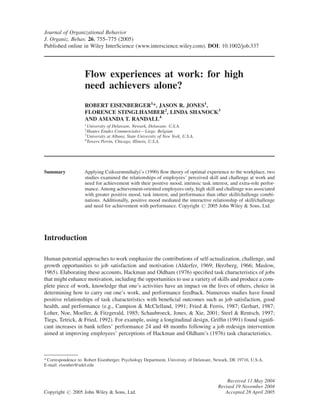
Summary             Applying Csikszentmihalyi’s (1990) flow theory of optimal experience to the workplace, two
                    studies examined the relationships of employees’ perceived skill and challenge at work and
                    need for achievement with their positive mood, intrinsic task interest, and extra-role perfor-
                    mance. Among achievement-oriented employees only, high skill and challenge was associated
                    with greater positive mood, task interest, and performance than other skill/challenge combi-
                    nations. Additionally, positive mood mediated the interactive relationship of skill/challenge
                    and need for achievement with performance. Copyright # 2005 John Wiley & Sons, Ltd.


Introduction

Human potential approaches to work emphasize the contributions of self-actualization, challenge, and
growth opportunities to job satisfaction and motivation (Alderfer, 1969; Herzberg, 1966; Maslow,
1965). Elaborating these accounts, Hackman and Oldham (1976) specified task characteristics of jobs
that might enhance motivation, including the opportunities to use a variety of skills and produce a com-
plete piece of work, knowledge that one’s activities have an impact on the lives of others, choice in
determining how to carry out one’s work, and performance feedback. Numerous studies have found
positive relationships of task characteristics with beneficial outcomes such as job satisfaction, good
health, and performance (e.g., Campion & McClelland, 1991; Fried & Ferris, 1987; Gerhart, 1987;
Loher, Noe, Moeller, & Fitzgerald, 1985; Schaubroeck, Jones, & Xie, 2001; Steel & Rentsch, 1997;
Tiegs, Tetrick, & Fried, 1992). For example, using a longitudinal design, Griffin (1991) found signifi-
cant increases in bank tellers’ performance 24 and 48 months following a job redesign intervention
aimed at improving employees’ perceptions of Hackman and Oldham’s (1976) task characteristics.


* Correspondence to: Robert Eisenberger, Psychology Department, University of Delaware, Newark, DE 19716, U.S.A.
E-mail: eisenber@udel.edu


                                                                                            Received 11 May 2004
                                                                                        Revised 19 November 2004
Copyright # 2005 John Wiley & Sons, Ltd.                                                   Accepted 28 April 2005
756    R. EISENBERGER ET AL.


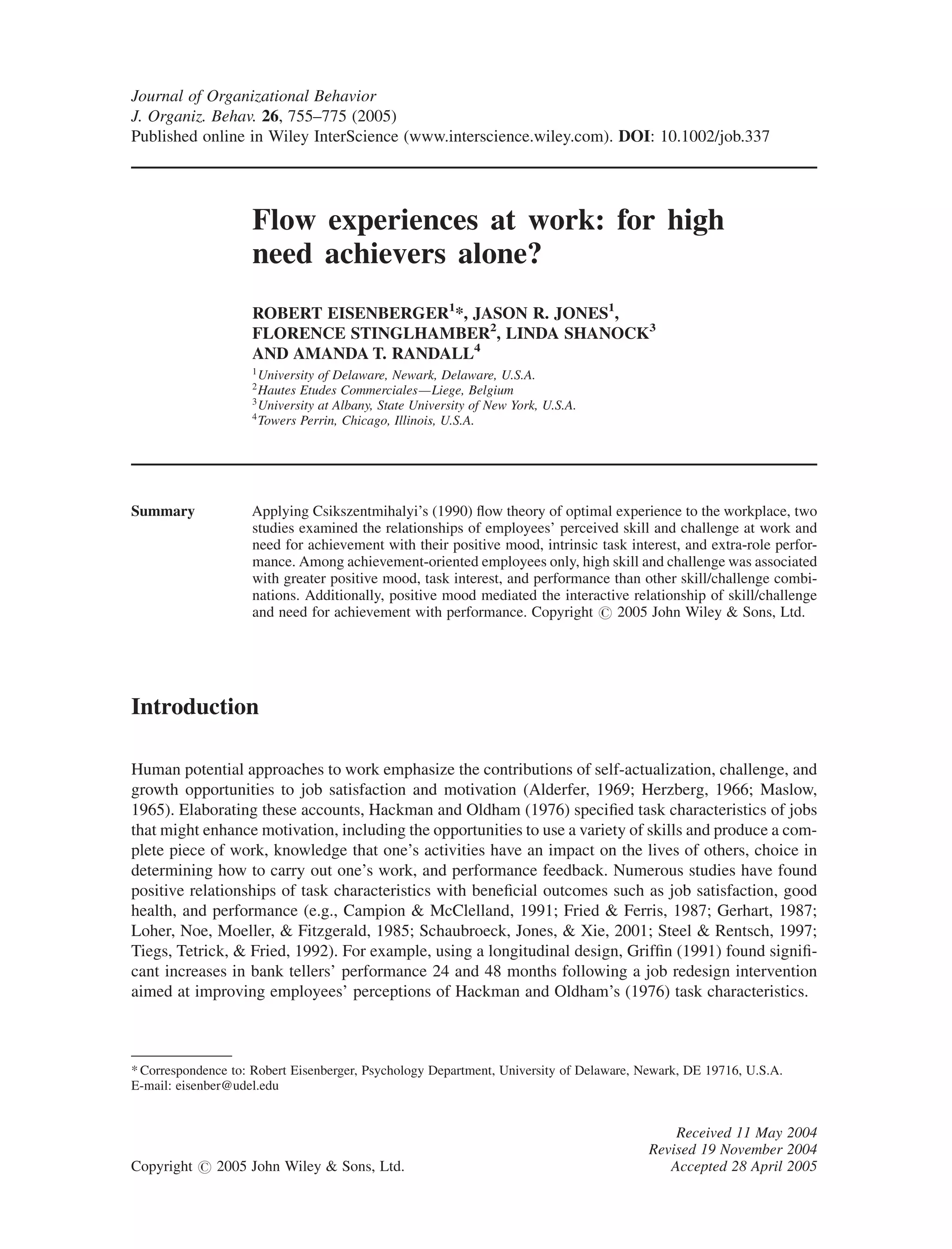
   Skill utilization, involving equivalence between the challenge of one’s work and the ability to meet
that challenge, has been suggested as an additional task characteristic that might contribute to job
satisfaction and motivation (Gavin & Axlerod, 1977; O’Brien & Dowling, 1980; O’Brien, 1983).
Accordingly, O’Brien (1983) found that skill utilization accounted for a significant portion of the var-
iance in job satisfaction beyond the job characteristics enumerated by Hackman and Oldham (1976).
Csikszentmihalyi’s flow theory of optimal experience similarly holds that an individual’s satisfaction
and motivation depend on the match between his or her skill and the challenge inherent in the task
(Csikszentmihalyi, 1975, 1990; Csikszentmihalyi & Rathunde, 1993). However, Csikszentmihalyi
emphasizes the intrinsically rewarding and satisfying subjective state, termed flow, which results from
the combination of high perceived skill and high perceived challenge.
   According to Csikszentmihalyi (1990, p. 4), the flow experience is a condition ‘‘in which people are
so involved in an activity that nothing else seems to matter at the time; the experience is so enjoyable
that people will do it even at great cost, for the sheer sake of doing it.’’ Flow experiences are suggested
to be intrinsically rewarding because they allow one to become fully involved in a task and stretch his
or her skills and abilities to the limit (Csikszentmihalyi & Rathunde, 1993). Csikszentmihalyi (1999)
assumed that in addition to increasing intrinsic task interest, the repeated experience of flow in a given
context would have a pervasive incremental effect on positive mood. Consequently, a job, hobby, or
sports activity that repeatedly provided high but manageable challenges would come to have a major
influence on positive mood.
   In contrast to the beneficial outcomes of the combination of high skill and challenge, other combina-
tions of skill and challenge are suggested by Csikszentmihalyi to produce less favorable experiences.
Activities in which the individual’s skill is perceived to be high relative to the challenge provided by
the task would lead to boredom. Low-perceived skill and high-perceived challenge would produce anxi-
ety, while low-perceived skill and low-perceived challenge would result in apathy. Typical studies based
on the flow experience assess the prediction that perceived high skill and high challenge produces a more
favorable subjective experience than other combinations of skill and challenge. Among key findings is
that high skill and challenge was associated with greater positive mood (e.g., Csikszentmihalyi &
LeFevre, 1989; Csikszentmihalyi, Rathunde, & Whalen, 1993) and task interest (e.g., Catley & Duda,
1997; Csikszentmihalyi & Larson, 1986) than other skill-challenge combinations.
   Csikszentmihalyi’s theory provides one of the most widely cited explanations for pleasurable
absorption in leisure and sports activities. The association between enjoyable subjective experience
and high skill and challenge has been found in a variety of non-employment settings, such as schooling
(Carli, Delle Fave, Massimini, & Carli, 1988; Clarke & Haworth, 1994; Moneta & Csikszentmihalyi,
1996), computing (Chen, Wigand, & Nilan, 1999; Trevino & Webster, 1992; Webster, Trevino, &
Ryan, 1993), family interaction (Rathunde, 1988), leisure (Csikszentmihalyi & LeFevre, 1989; Graef,
Csikszentmihalyi, & McManama Gianinno, 1983; Mannell, Zuzanek, & Larson, 1988), occupational
therapy (Emerson, 1998; Jacobs, 1994), and competitive and recreational sports (Catley & Duda, 1997;
Jackson, 1992; Jackson & Roberts, 1992; Kowal & Fortier, 1999; Stein, Kimiecik, Daniels, & Jackson,
1995). However, flow in work settings has received little attention.
   The opportunity to perform challenging tasks skillfully might have benefits for employees and their
organizations. Csikszentmihalyi and Rathunde (1993, p. 73) suggested that intrinsic task interest ‘‘fol-
lows from the realization that one is growing in complexity as a result of matching one’s skills to dif-
ficult challenges.’’ In other words, engagement in high skill and challenge promotes task interest
because it allows one to hone one’s skills. Employees should take an increased interest in challenging,
yet manageable activities because they provide: a sense of achievement, the opportunity to sharpen
one’s skills, and a favorable subjective experience (Csikszentmihalyi, 1990). In addition to
increasing task interest, the combination of high skill and challenge at work might promote positive
mood. George and Brief (1992, p. 320) suggested that the successful completion of work activities


Copyright # 2005 John Wiley & Sons, Ltd.                             J. Organiz. Behav. 26, 755–775 (2005)
HIGH SKILL AND CHALLENGE          757


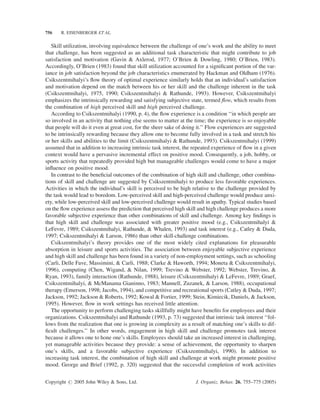
demonstrating competence, worth, or achievement, would enhance positive mood. Similarly, Isen,
Daubman, and Nowicki (1987) maintained that perceptions of competence and self-worth would
increase positive mood.
   In one of the few studies involving flow at work, Csikszentmihalyi and LeFevre (1989) reported that
the combination of high skill and challenge occurred three times more often during work than leisure
(see also Haworth & Hill, 1992), and was associated with greater positive mood than other combina-
tions of skill and challenge. Csikszentmihalyi and LeFevre’s (1989) initial findings highlight jobs as a
major source of flow for adults and raise basic issues, examined in the present studies, concerning the
affective and motivational consequences of different combinations of skill and challenge at work.


Need for Achievement and Flow

Csikszentmihalyi and LeFevre (1989) found marked individual differences among employees in the
extent to which high skill and challenge was preferred to other combinations of skill and challenge at
work. Approximately half of the employees in the sample expressed greater motivation for work in
which they had high skill and faced high challenge rather than low skill and low challenge. The other
half of the sample, in contrast, reported greater motivation under conditions of low skill and low chal-
lenge. Perhaps dispositional differences among employees account for these findings.
   Csikszentmihalyi (Csikszentmihalyi & Csikszentmihalyi, 1988; Csikszentmihalyi & Rathunde,
1993) and Adlai-Gail (1994) suggested that some individuals might have an autotelic personality,
which would lead them to be especially active in seeking out challenging tasks for which they perceive
themselves highly skillful. In addition, such individuals would work hard to create their own
challenges in mundane tasks. However, theory and research have yet to clearly identify the character-
istics of the autotelic personality or its relationship with high skill and challenge. In one such attempt,
Csikszentmihalyi et al. (1993) found that talented teenage students who scored high on a constellation
of personality characteristics involving achievement, endurance, inquisitiveness, and aestheticism
(Jackson, 1984) reported experiencing high skill and challenge a greater proportion of the time over
the course of a week than their low scoring counterparts. However, Csikszentmihalyi et al. (1993) did
not isolate the relative contributions of these personality characteristics. Nor did they consider how
personality might influence the degree to which high skill and challenge is associated with an elevated
subjective experience relative to other skill-challenge combinations.
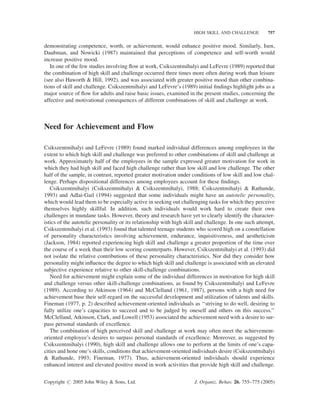
   Need for achievement might explain some of the individual differences in motivation for high skill
and challenge versus other skill-challenge combinations, as found by Csikszentmihalyi and LeFevre
(1989). According to Atkinson (1964) and McClelland (1961, 1987), persons with a high need for
achievement base their self-regard on the successful development and utilization of talents and skills.
Fineman (1977, p. 2) described achievement-oriented individuals as ‘‘striving to do well, desiring to
fully utilize one’s capacities to succeed and to be judged by oneself and others on this success.’’
McClelland, Atkinson, Clark, and Lowell (1953) associated the achievement need with a desire to sur-
pass personal standards of excellence.
   The combination of high perceived skill and challenge at work may often meet the achievement-
oriented employee’s desires to surpass personal standards of excellence. Moreover, as suggested by
Csikszentmihalyi (1990), high skill and challenge allows one to perform at the limits of one’s capa-
cities and hone one’s skills, conditions that achievement-oriented individuals desire (Csikszentmihalyi
& Rathunde, 1993; Fineman, 1977). Thus, achievement-oriented individuals should experience
enhanced interest and elevated positive mood in work activities that provide high skill and challenge.


Copyright # 2005 John Wiley & Sons, Ltd.                             J. Organiz. Behav. 26, 755–775 (2005)
758       R. EISENBERGER ET AL.


Achievement-oriented employees should find other skill-challenge combinations less inviting:
low-skill/high-challenge should produce a low probability of success (deCharms & Carpenter,
1968; Hamilton, 1974; Karabenick & Youssef, 1968; Raynor & Entin, 1982; Trope, 1975; Trope &
Brickman, 1975), and low challenge paired with low or high skill should fail to provide exacting stan-
dards of excellence.
   In contrast to achievement-oriented employees, employees having a low need for achievement
should be less interested in activities that provide high skill and challenge at work. Individuals low
in need for achievement experience greater anxiety in achievement settings and try to avoid compe-
tence assessment (Atkinson, 1974; Trope, 1975). Employees with a low achievement need may thus
find the combination of high skill and challenge less satisfying than would achievement-oriented
employees, resulting in lesser degrees of positive mood and task interest.
      Hypothesis 1: High perceived task skill and challenge will be more strongly associated with positive
      mood and task interest among employees having a high need for achievement than among employ-
      ees having a low need for achievement.


Need for Achievement, Mood, and Organizational Spontaneity

Over the last decade, organizational researchers have become increasingly interested in the influence
of employees’ positive mood on organizational outcomes. Positive mood has been found to be asso-
ciated with employees’ increased extra-role performance (Eisenberger, Armeli, Rexwinkel, Lynch, &
Rhoades, 2001; George & Brief, 1992). George and Brief suggest that positive mood primes employ-
ees to think about favorable characteristics of co-workers, leading to helping behavior. They also argue
that positive mood should promote creative thinking, leading to creative suggestions. Consistent with
these views, Eisenberger et al. (2001) found that positive mood enhanced a variety of extra-role activ-
ities, including helping co-workers and making creative suggestions.
   Extra-role behaviors that are performed voluntarily and aid the organization, termed organizational
spontaneity (George & Brief, 1992), include making constructive suggestions, enhancing one’s own
knowledge and skills in ways that will help the organization, protecting the organization from potential
problems, and helping co-workers. Employees who experience the combination of high skill and chal-
lenge at work might go beyond specified job responsibilities to contribute to organizational success as
a result of the enhanced positive mood produced by high skill and challenge on the job.
   As previously noted, the relationship of high skill and challenge with positive mood should be espe-
cially strong for employees high in need for achievement because the skillful performance of difficult
tasks allows those employees to meet and surpass personal standards of excellence. Consequently,
positive mood might mediate the interactive influence of skill/challenge and achievement orientation
on organizational spontaneity.
      Hypothesis 2: High perceived skill and challenge will be most strongly associated with organiza-
      tional spontaneity among achievement-oriented employees, as mediated by positive mood.
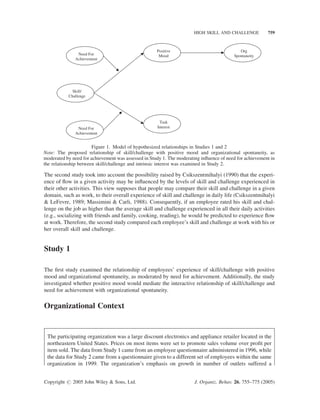
   The hypothesized relationships between all variables are summarized in Figure 1.
   Csikszentmihalyi has suggested several methods for assessing skill and challenge. To increase the
generality of our findings, we used different methods in our two studies. In the first study, we compared
each employee’s perceived skill and challenge in his or her major work activities with the median
levels of skill and challenge experienced by co-workers (cf. Csikszentmihalyi & Rathunde, 1993).


Copyright # 2005 John Wiley & Sons, Ltd.                              J. Organiz. Behav. 26, 755–775 (2005)
HIGH SKILL AND CHALLENGE           759


                                                     Positive                               Org
               Need For                               Mood                               Spontaneity
              Achievement


             Skill/
           Challenge


                                                      Task
               Need For                              Interest
              Achievement


                       Figure 1. Model of hypothesized relationships in Studies 1 and 2
Note: The proposed relationship of skill/challenge with positive mood and organizational spontaneity, as
moderated by need for achievement was assessed in Study 1. The moderating influence of need for achievement in
the relationship between skill/challenge and intrinsic interest was examined in Study 2.

The second study took into account the possibility raised by Csikszentmihalyi (1990) that the experi-
ence of flow in a given activity may be influenced by the levels of skill and challenge experienced in
their other activities. This view supposes that people may compare their skill and challenge in a given
domain, such as work, to their overall experience of skill and challenge in daily life (Csikszentmihalyi
& LeFevre, 1989; Massimini & Carli, 1988). Consequently, if an employee rated his skill and chal-
lenge on the job as higher than the average skill and challenge experienced in all their daily activities
(e.g., socializing with friends and family, cooking, reading), he would be predicted to experience flow
at work. Therefore, the second study compared each employee’s skill and challenge at work with his or
her overall skill and challenge.


Study 1

The first study examined the relationship of employees’ experience of skill/challenge with positive
mood and organizational spontaneity, as moderated by need for achievement. Additionally, the study
investigated whether positive mood would mediate the interactive relationship of skill/challenge and
need for achievement with organizational spontaneity.

Organizational Context


 The participating organization was a large discount electronics and appliance retailer located in the
 northeastern United States. Prices on most items were set to promote sales volume over profit per
 item sold. The data from Study 1 came from an employee questionnaire administered in 1996, while
 the data for Study 2 came from a questionnaire given to a different set of employees within the same
 organization in 1999. The organization’s emphasis on growth in number of outlets suffered a


Copyright # 2005 John Wiley & Sons, Ltd.                               J. Organiz. Behav. 26, 755–775 (2005)
760   R. EISENBERGER ET AL.


 setback during this interval when business declined, expansion plans were put on hold, and the num-
 ber of employees was substantially reduced. However, in the year before the second survey, busi-
 ness had begun to increase again.
    We sampled sales employees as well as sales support employees. Sales employees were paid on
 the basis of a combination of salary and commission, whereas support employees were paid entirely
 on the basis of salary. Within these two types of jobs, employees differed substantially in the tasks
 they were required to carry out. Some salespeople were assigned to more challenging areas of the
 stores containing electronics products for which technological advances were introduced frequently
 (e.g., computers and televisions). In this environment, salespeople needed to continually upgrade
 their knowledge and skills in order to effectively operate and present the favorable features to cus-
 tomers. Other salespeople were assigned to less challenging store areas containing products in
 which the required technological understanding was more easily mastered, and changes in required
 knowledge occurred slowly (e.g., refrigerators and stoves).
    Similarly, challenge levels differed considerably among sales support staff. Book keepers, for
 instance, found themselves in a challenging environment as they were required to keep track of
 a large, rapidly changing inventory, and high cash flow. As another example, in order to answer
 queries by customers, cashiers were expected to keep current with the latest layout of merchandise.
 Other sales support employees were in charge of making deliveries from the central warehouse to
 the stores along well-established routes, a less challenging endeavor. The company was often under-
 staffed, resulting in wide variation in skill levels for the jobs to which employees were assigned.
 Thus, the four possible combinations of low- or high-employee skill with low- or high-task chal-
 lenge, needed to assess flow theory, were well represented in the organization.


Method

Sample and procedure
The sample consisted of 392 employees working at eight sites. Three hundred and sixty-five employ-
ees (93%) returned completed questionnaires. The employees voluntarily completed the survey during
their regularly scheduled working hours in conference rooms at each site. To encourage candidness, we
gave employees verbal and written assurances that their individual responses would not be revealed.
Surveys were distributed and collected by the researchers in sealed envelopes. Supervisors completed
performance evaluations for each employee and were given similar assurances of confidentiality.
Evaluations were available for 335 of the 365 respondents (92%).


Measures

Tenure
We controlled for employee tenure, obtained from company records, which might be associated both
with greater perceived skills and familiarity with supervisors, leading to higher performance ratings.

Skill and challenge
Employees were asked to list the five work activities on which they spend the most time during their
average day at work. Employees then rated the degrees of skill they had in each activity and the chal-
lenge posed by the activity on nine-point Likert-type scales (1 ¼ low, 9 ¼ high). The specific items


Copyright # 2005 John Wiley & Sons, Ltd.                           J. Organiz. Behav. 26, 755–775 (2005)
HIGH SKILL AND CHALLENGE           761


used to assess skill and challenge were ‘‘What is your skill in the activity?’’ and ‘‘How challenging is
the activity?’’ respectively. The five ratings of skill and challenge were averaged for each employee in
order to create an overall job skill and challenge level for the employee. Following the between-
persons approach described in the Introduction, each employee’s overall job skill and overall job
challenge at work was compared to the median levels of skill and challenge for all employees
(Csikszentmihalyi & Rathunde, 1993). Then, the employee was placed in one of the following contexts
on the basis of Csikszentmihalyi’s (1990) theory:

1. Flow context: Employee’s skill and challenge were both above the group median skill and challenge
   levels.
2. Anxiety context: Employee’s skill was below the median group skill level; employee’s challenge
   was above the median group challenge level.
3. Boredom context: Employee’s skill was above the median group skill level; employee’s challenge
   was below the median group challenge level.
4. Apathy context: Employee’s skill and challenge were both below the group median skill and chal-
   lenge levels.


Need for achievement
Need for achievement was assessed by four of the five items from the need for achievement sub-
scale of Steers and Braunstein’s (1976) Manifest Needs Questionnaire, plus five items constructed
by the research team (see Table 1). We developed these items based upon the characteristics of
individuals high in achievement orientation as outlined by McClelland (1961, 1987), such as
working to improve one’s skills and desiring frequent feedback. We added items because although
the need for achievement sub-scale has shown acceptable internal reliabilities in some studies
(Mannheim, Baruch, & Tal, 1997; Orpen, 1985), it has fallen slightly below the 0.70 criteria
suggested by Nunnally (1967) in other studies (e.g., Schaubroeck, Ganster, & Jones, 1998; Slade
& Rush, 1991; Turban & Keon, 1993). We omitted the Steers and Braunstein (1976) item ‘‘I try to
perform better than my co-workers’’ from the measure because it appeared to apply more to a
tendency to be competitive than to the core attributes of the need for achievement. Respondents
rated their agreement with each statement using a seven-point Likert-type scale (1 ¼ strongly
disagree, 7 ¼ strongly agree).


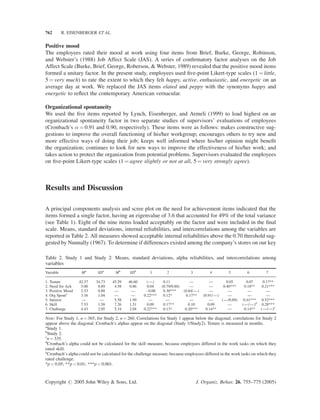
Table 1. Study 1: Factor loadings for need for achievement items
Statement                                                                                           Factor loading

1.   I am pleased when I can take on added job responsibilities.a                                         0.78
2.   I am always looking for opportunities to improve my skills on the job.                               0.77
3.   I like to set challenging goals for myself on the job.                                               0.63
4.   I enjoy situations at work where I am personally responsible for finding                              0.62
     solutions to problems.
5.   I try very hard to improve on my past performance at work.a                                          0.61
6.   I get the most satisfaction when completing job assignments that are fairly difficult.                0.42
7.   I want frequent feedback on how I am doing on the job.                                               0.40
8.   I do my best work when my job assignments are fairly difficult.a                                      0.39
9.   I believe in taking moderate risks to get ahead at work.a                                            0.34
Note: n ¼ 365.
a
 Item adapted from Steers and Braunstein’s Manifest Needs Questionnaire (1976).


Copyright # 2005 John Wiley & Sons, Ltd.                                      J. Organiz. Behav. 26, 755–775 (2005)
762        R. EISENBERGER ET AL.


Positive mood
The employees rated their mood at work using four items from Brief, Burke, George, Robinson,
and Webster’s (1988) Job Affect Scale (JAS). A series of confirmatory factor analyses on the Job
Affect Scale (Burke, Brief, George, Roberson, & Webster, 1989) revealed that the positive mood items
formed a unitary factor. In the present study, employees used five-point Likert-type scales (1 ¼ little,
5 ¼ very much) to rate the extent to which they felt happy, active, enthusiastic, and energetic on an
average day at work. We replaced the JAS items elated and peppy with the synonyms happy and
energetic to reflect the contemporary American vernacular.

Organizational spontaneity
We used the five items reported by Lynch, Eisenberger, and Armeli (1999) to load highest on an
organizational spontaneity factor in two separate studies of supervisors’ evaluations of employees
(Cronbach’s  ¼ 0.91 and 0.90, respectively). These items were as follows: makes constructive sug-
gestions to improve the overall functioning of his/her workgroup; encourages others to try new and
more effective ways of doing their job; keeps well informed where his/her opinion might benefit
the organization; continues to look for new ways to improve the effectiveness of his/her work; and
takes action to protect the organization from potential problems. Supervisors evaluated the employees
on five-point Likert-type scales (1 ¼ agree slightly or not at all, 5 ¼ very strongly agree).


Results and Discussion

A principal components analysis and scree plot on the need for achievement items indicated that the
items formed a single factor, having an eigenvalue of 3.6 that accounted for 49% of the total variance
(see Table 1). Eight of the nine items loaded acceptably on the factor and were included in the final
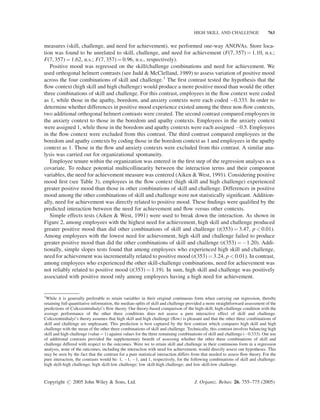
scale. Means, standard deviations, internal reliabilities, and intercorrelations among the variables are
reported in Table 2. All measures showed acceptable internal reliabilities above the 0.70 threshold sug-
gested by Nunnally (1967). To determine if differences existed among the company’s stores on our key

Table 2. Study 1 and Study 2: Means, standard deviations, alpha reliabilities, and intercorrelations among
variables
Variable            Ma      SDa       Mb      SDb        1         2             3          4        5         6         7

1. Tenure          42.37   34.73    45.29    46.60      (—)      0.11             —          —       0.05      0.07     0.17**
2. Need for Ach     5.00    0.89     4.58     0.86      0.04    (0.79/0.88)       —          —     0.40***    0.18**   0.21***
3. Positive Mood    2.53    0.88     —         —       À0.00     0.30***      (0.84/—)       —        —         —         —
4. Org Spontc       3.16    1.04     —         —      0.22***    0.12*          0.17**   (0.91/—)     —         —         —
5. Interest         —        —       5.58     1.99       —        —               —          —    (—/0.89)   0.41***   0.52***
6. Skill            7.53    1.58     7.26     1.51      0.09     0.17**          0.10       0.09      —      (—/—)d    0.28***
7. Challenge        4.43    2.05     5.34     2.04    0.22***    0.13*         0.20***    0.14**      —       0.14**   (—/—)e

Note: For Study 1, n ¼ 365; for Study 2, n ¼ 260. Correlations for Study 1 appear below the diagonal; correlations for Study 2
appear above the diagonal. Cronbach’s alphas appear on the diagonal (Study 1/Study2). Tenure is measured in months.
a
 Study 1.
b
  Study 2.
c
 n ¼ 335.
d
  Cronbach’s alpha could not be calculated for the skill measure, because employees differed in the work tasks on which they
rated skill.
e
 Cronbach’s alpha could not be calculated for the challenge measure, because employees differed in the work tasks on which they
rated challenge.
*p  0.05; **p  0.01; ***p  0.001.


Copyright # 2005 John Wiley  Sons, Ltd.                                             J. Organiz. Behav. 26, 755–775 (2005)
HIGH SKILL AND CHALLENGE                  763


measures (skill, challenge, and need for achievement), we performed one-way ANOVAs. Store loca-
tion was found to be unrelated to skill, challenge, and need for achievement (F(7, 357) ¼ 1.10, n.s.;
F(7, 357) ¼ 1.62, n.s.; F(7, 357) ¼ 0.96, n.s., respectively).
   Positive mood was regressed on the skill/challenge combinations and need for achievement. We
used orthogonal helmert contrasts (see Judd  McClelland, 1989) to assess variation of positive mood
across the four combinations of skill and challenge.1 The first contrast tested the hypothesis that the
flow context (high skill and high challenge) would produce a more positive mood than would the other
three combinations of skill and challenge. For this contrast, employees in the flow context were coded
as 1, while those in the apathy, boredom, and anxiety contexts were each coded À0.333. In order to
determine whether differences in positive mood experience existed among the three non-flow contexts,
two additional orthogonal helmert contrasts were created. The second contrast compared employees in
the anxiety context to those in the boredom and apathy contexts. Employees in the anxiety context
were assigned 1, while those in the boredom and apathy contexts were each assigned À0.5. Employees
in the flow context were excluded from this contrast. The third contrast compared employees in the
boredom and apathy contexts by coding those in the boredom context as 1 and employees in the apathy
context as 1. Those in the flow and anxiety contexts were excluded from this contrast. A similar ana-
lysis was carried out for organizational spontaneity.
   Employee tenure within the organization was entered in the first step of the regression analyses as a
covariate. To reduce potential multicollinearity between the interaction terms and their component
variables, the need for achievement measure was centered (Aiken  West, 1991). Considering positive
mood first (see Table 3), employees in the flow context (high skill and high challenge) experienced
greater positive mood than those in other combinations of skill and challenge. Differences in positive
mood among the other combinations of skill and challenge were not statistically significant. Addition-
ally, need for achievement was directly related to positive mood. These findings were qualified by the
predicted interaction between the need for achievement and flow versus other contexts.
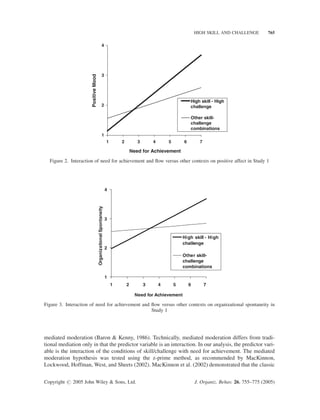
   Simple effects tests (Aiken  West, 1991) were used to break down the interaction. As shown in
Figure 2, among employees with the highest need for achievement, high skill and challenge produced
greater positive mood than did other combinations of skill and challenge (t(353) ¼ 3.47, p  0.01).
Among employees with the lowest need for achievement, high skill and challenge failed to produce
greater positive mood than did the other combinations of skill and challenge (t(353) ¼ À1.20). Addi-
tionally, simple slopes tests found that among employees who experienced high skill and challenge,
need for achievement was incrementally related to positive mood (t(353) ¼ 3.24, p  0.01). In contrast,
among employees who experienced the other skill-challenge combinations, need for achievement was
not reliably related to positive mood (t(353) ¼ 1.19). In sum, high skill and challenge was positively
associated with positive mood only among employees having a high need for achievement.


1
 While it is generally preferable to retain variables in their original continuous form when carrying out regression, thereby
retaining full quantitative information, the median-splits of skill and challenge provided a more straightforward assessment of the
predictions of Csikszentmihalyi’s flow theory. Our theory-based comparison of the high-skill, high-challenge condition with the
average performance of the other three conditions does not assess a pure interactive effect of skill and challenge.
Csikszentmihalyi’s theory assumes that high skill and high challenge (flow) is pleasant and that the other three combinations of
skill and challenge are unpleasant. This prediction is best captured by the first contrast which compares high skill and high
challenge with the mean of the other three combinations of skill and challenge. Technically, this contrast involves balancing high
skill and high challenge (value ¼ 1) against values for the three remaining combinations of skill and challenge (À0.333). Our use
of additional contrasts provided the supplementary benefit of assessing whether the other three combinations of skill and
challenge differed with respect to the outcomes. Were we to retain skill and challenge in their continuous form in a regression
analysis, none of the outcomes, including the interaction with need for achievement, would directly assess our hypotheses. This
may be seen by the fact that the contrast for a pure statistical interaction differs from that needed to assess flow theory. For the
pure interaction, the contrasts would be: 1, À1, À1, and 1, respectively, for the following combinations of skill and challenge:
high skill-high challenge; high skill-low challenge; low skill-high challenge; and low skill-low challenge.


Copyright # 2005 John Wiley  Sons, Ltd.                                            J. Organiz. Behav. 26, 755–775 (2005)
764     R. EISENBERGER ET AL.


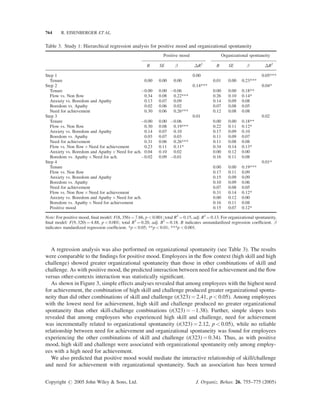
Table 3. Study 1: Hierarchical regression analysis for positive mood and organizational spontaneity
                                                                  Positive mood                      Organizational spontaneity

                                                         B      SE
ÁR2          B        SE
ÁR2

Step 1                                                                            0.00                                    0.05***
  Tenure                                         0.00          0.00     0.00                  0.01      0.00    0.23***
Step 2                                                                            0.14***                                 0.04*
  Tenure                                       À0.00           0.00 À0.06                     0.00      0.00    0.18**
  Flow vs. Non flow                               0.34          0.08  0.22***                  0.26      0.10    0.14*
  Anxiety vs. Boredom and Apathy                 0.13          0.07  0.09                     0.14      0.09    0.08
  Boredom vs. Apathy                             0.02          0.06  0.02                     0.07      0.08    0.05
  Need for achievement                           0.30          0.06  0.26***                  0.12      0.08    0.08
Step 3                                                                            0.01                                    0.02
  Tenure                                       À0.00           0.00 À0.06                     0.00      0.00    0.18**
  Flow vs. Non flow                               0.30          0.08  0.19***                  0.22      0.11    0.12*
  Anxiety vs. Boredom and Apathy                 0.14          0.07  0.10                     0.17      0.09    0.10
  Boredom vs. Apathy                             0.03          0.07  0.03                     0.11      0.09    0.07
  Need for achievement                           0.31          0.06  0.26***                  0.11      0.08    0.08
  Flow vs. Non flow  Need for achievement        0.23          0.11  0.11*                    0.34      0.14    0.13*
  Anxiety vs. Boredom and Apathy  Need for ach. 0.04          0.10  0.02                     0.00      0.12    0.00
  Boredom vs. Apathy  Need for ach.           À0.02           0.09 À0.01                     0.16      0.11    0.08
Step 4                                                                                                                    0.01*
  Tenure                                                                                      0.00      0.00    0.19***
  Flow vs. Non flow                                                                            0.17      0.11    0.09
  Anxiety vs. Boredom and Apathy                                                              0.15      0.09    0.09
  Boredom vs. Apathy                                                                          0.10      0.09    0.06
  Need for achievement                                                                        0.07      0.08    0.05
  Flow vs. Non flow  Need for achievement                                                     0.31      0.14    0.12*
  Anxiety vs. Boredom and Apathy  Need for ach.                                              0.00      0.12    0.00
  Boredom vs. Apathy  Need for achievement                                                   0.16      0.11    0.08
  Positive mood                                                                               0.15      0.07    0.12*

Note: For positive mood, final model: F(8, 356) ¼ 7.66, p  0.001; total R2 ¼ 0.15, adj. R2 ¼ 0.13. For organizational spontaneity,
final model: F(9, 320) ¼ 4.88, p  0.001; total R2 ¼ 0.20, adj. R2 ¼ 0.18. B indicates unstandardized regression coefficient.
indicates standardized regression coefficient. *p  0.05; **p  0.01; ***p  0.001.


   A regression analysis was also performed on organizational spontaneity (see Table 3). The results
were comparable to the findings for positive mood. Employees in the flow context (high skill and high
challenge) showed greater organizational spontaneity than those in other combinations of skill and
challenge. As with positive mood, the predicted interaction between need for achievement and the flow
versus other-contexts interaction was statistically significant.
   As shown in Figure 3, simple effects analyses revealed that among employees with the highest need
for achievement, the combination of high skill and challenge produced greater organizational sponta-
neity than did other combinations of skill and challenge (t(323) ¼ 2.41, p  0.05). Among employees
with the lowest need for achievement, high skill and challenge produced no greater organizational
spontaneity than other skill-challenge combinations (t(323) ¼ À1.38). Further, simple slopes tests
revealed that among employees who experienced high skill and challenge, need for achievement
was incrementally related to organizational spontaneity (t(323) ¼ 2.12, p  0.05), while no reliable
relationship between need for achievement and organizational spontaneity was found for employees
experiencing the other combinations of skill and challenge (t(323) ¼ 0.34). Thus, as with positive
mood, high skill and challenge were associated with organizational spontaneity only among employ-
ees with a high need for achievement.
   We also predicted that positive mood would mediate the interactive relationship of skill/challenge
and need for achievement with organizational spontaneity. Such an association has been termed


Copyright # 2005 John Wiley  Sons, Ltd.                                            J. Organiz. Behav. 26, 755–775 (2005)
HIGH SKILL AND CHALLENGE         765

                                                        4


                                                        3


                      Positive Mood
                                                                                                                  High skill - High
                                                        2                                                         challenge

                                                                                                                  Other skill-
                                                                                                                  challenge
                                                                                                                  combinations
                                                        1
                                                                   1       2          3       4       5       6         7

                                                                                   Need for Achievement

  Figure 2. Interaction of need for achievement and flow versus other contexts on positive affect in Study 1


                                                                   4
                                      Organizational Spontaneity


                                                                   3


                                                                                                              High skill - High
                                                                                                              challenge
                                                                   2
                                                                                                              Other skill-
                                                                                                              challenge
                                                                                                              combinations

                                                                   1
                                                                       1       2          3       4       5       6         7

                                                                                     Need for Achievement

Figure 3. Interaction of need for achievement and flow versus other contexts on organizational spontaneity in
                                                  Study 1


mediated moderation (Baron  Kenny, 1986). Technically, mediated moderation differs from tradi-
tional mediation only in that the predictor variable is an interaction. In our analysis, the predictor vari-
able is the interaction of the conditions of skill/challenge with need for achievement. The mediated
moderation hypothesis was tested using the z-prime method, as recommended by MacKinnon,
Lockwood, Hoffman, West, and Sheets (2002). MacKinnon et al. (2002) demonstrated that the classic


Copyright # 2005 John Wiley  Sons, Ltd.                                                                              J. Organiz. Behav. 26, 755–775 (2005)
766    R. EISENBERGER ET AL.


mediational method suggested by Baron and Kenny (1986) has low statistical power, and that the z-
prime method provides more power and a lesser Type 1 error rate than the Baron and Kenny approach.
   The z-prime method and Baron and Kenny’s (1986) procedure are similar, in that both calculate an
indirect (mediated) effect of the independent variable on the outcome variable through the mediator
using an identical formula. They differ in the statistical distribution used to determine whether the
indirect effect is significant. Because the estimate of the indirect effect is not normally distributed,
MacKinnon et al.’s (2002) z-prime method uses the modified critical value of 0.97 for the test of sig-
nificance, as opposed to 1.96 for the Z distribution.
   Using the z-prime method to determine the indirect effect of the skill/challenge by need for achieve-
ment interaction on organizational spontaneity through positive mood, it is necessary to calculate (a)
the effect of the exogenous variable (the skill/challenge by need for achievement interaction) on the
mediator (positive mood) and (b) the effect of the mediator (positive mood) on the outcome variable
(organizational spontaneity) controlling for the exogenous variable (the skill/challenge by need for
achievement interaction). The effect of the skill/challenge by need for achievement interaction on
positive mood was significant (B ¼ 0.23, SE ¼ 0.11, p  0.05; see Table 3). Moreover, positive mood
significantly predicted organizational spontaneity when controlling for the skill/challenge by need for
achievement interaction (B ¼ 0.15, SE ¼ 0.07, p  0.05; see Table 3). Finally, the overall test of med-
iation was statistically significant (z0 ¼ 1.51, p  0.05), thereby demonstrating that positive mood
partially mediated the interaction of skill/challenge with need for achievement on organizational
spontaneity.
   In summary, need for achievement moderated the relationship between the experience of skill and
challenge at work and employees’ positive mood and organizational spontaneity. Achievement-
oriented employees experiencing high skill and challenge showed greater positive mood and organiza-
tional spontaneity than achievement-oriented employees experiencing other combinations of skill and
challenge. Employees with a low need for achievement experiencing high skill and challenge showed
neither more positive mood nor more organizational spontaneity than did low achievement-oriented
employees experiencing other skill-challenge combinations. Moreover, positive mood partially
mediated the stronger relationship between high skill and challenge and organizational spontaneity
among achievement-oriented employees.
   These findings support Csikszentmihalyi and LeFevre’s (1989) suggestions that high skill and
challenge creates an optimal subjective experience relative to other combinations of skill and chal-
lenge and that dispositional differences influence the degree to which high skill and challenge
produces an elevated subjective experience. Specifically, need for achievement appears to have
an important influence on whether high skill and challenge influences positive mood and
organizational spontaneity at work. Positive mood appears to contribute to the association
between high skill and challenge, and organizational spontaneity for employees high in need for
achievement.


Study 2

In Study 1, we found that the positive relationship of high skill and challenge with positive mood
and organizational spontaneity depended on need for achievement. We assessed dispositional
differences in need for achievement through questionnaire items concerning employees’ desire to
develop and utilize talents and skills (Atkinson, 1964) and surpass personal standards of excellence
(McClelland, 1987; McClelland et al., 1953) in the context of work. As a general dispositional


Copyright # 2005 John Wiley  Sons, Ltd.                           J. Organiz. Behav. 26, 755–775 (2005)
HIGH SKILL AND CHALLENGE         767


orientation, need for achievement applies to non-work as well as work situations. Our conclusion that
need for achievement strongly influences employees’ positive reactions to the experience of high skill
and challenge at work would be strengthened by a more general measure of need for achievement that
included items assessing need for achievement in non-work situations. Therefore, we broadened the
questionnaire measure of need for achievement to include both work and non-work situations.
   Study 2 also extended the findings of the first study to a second important outcome of high perceived
task skill and challenge: task interest (Catley  Duda, 1997; Csikszentmihalyi  LeFevre, 1989;
Haworth  Hill, 1992). Based on the rationale that high perceived skill and challenge at work would
often meet the achievement-oriented employee’s desire to surpass personal standards of excellence, we
predicted that the relationship of high skill and challenge with task interest would be greatest among
employees with a high need for achievement.
   In Study 1, each employee’s skill and challenge was judged to be high or low based on the between-
participants approach which involved comparing each employee’s skill and challenge at work with the
median levels of skill and challenge of a reference group of employees (Csikszentmihalyi  Rathunde,
1993). To increase the generality of our finding that dispositional differences in need for achievement
influence the degree to which high skill and challenge contributes to satisfaction and enjoyment; Study
2 incorporated the within-participants methodology suggested by Csikszentmihalyi (1990; Csikszent-
mihalyi et al., 1993). Specifically, we compared each employee’s skill and challenge at work with his
or her average level of skill and challenge for a variety of daily activities.


Method
Sample and procedure
We used an independent sample of 265 employees at eight sites of the same organization examined in
Study 1. Administration procedures were the same as in the first study. Of the 265 employees given the
survey, 260 employees (98%) returned completed questionnaires. Twenty-eight percent of the partici-
pants were female.


Measures

Tenure
Employee tenure in the organization was obtained from company records.

Skill and challenge
As in Study 1, employees listed the five-job activities on which they spent the most time during an
average workday and rated their skill and challenge involved in each, using a 9-point Likert-type
scale. The specific items used to assess skill and challenge were identical to those used in Study 1.
Each employee was also administered a list of 21 activities designed by the investigators to repre-
sent a full range of typical non-work activities, such as gardening, cooking, playing competitive
sports, socializing with friends and family, surfing the internet, reading, watching television, shop-
ping, exercising, and playing games. On a nine-point Likert-type scale (1 ¼ low, 9 ¼ high), employ-
ees rated their perceived skill and challenge for each of the non-work activities in which they
participated. We averaged each participant’s skill and challenge levels across all the activities in
which he or she participated, including work, to create baseline levels of skill and challenge. Each
employee’s average skill and challenge at work was classified as high or low relative to his/her
baseline levels of skill and challenge.


Copyright # 2005 John Wiley  Sons, Ltd.                          J. Organiz. Behav. 26, 755–775 (2005)
768      R. EISENBERGER ET AL.

Table 4. Study 2: Factor loadings for need for achievement items
Statement                                                                                        Factor loading

 1.   I am pleased when I can take on added job responsibilities.                                     0.77
 2.   I like to set challenging goals for myself on the job.                                          0.73
 3.   I do my best work when my job assignments are fairly difficult.                                  0.72
 4.   I enjoy situations at work where I am personally responsible for finding                         0.70
      solutions to problems.
 5.   I enjoy difficult tasks away from work.                                                          0.66
 6.   I enjoy difficult work.                                                                          0.64
 7.   I get the most satisfaction when completing job assignments that are fairly difficult.           0.63
 8.   People should be more involved with their work.                                                 0.61
 9.   I am always looking for opportunities to improve my skills away from work.                      0.61
10.   I am always looking for opportunities to improve my skills on the job.                          0.60
11.   I try very hard to improve on my past performance at work.                                      0.56
12.   I try very hard to improve on my past performance away from work.                               0.55
13.   I often set goals away from work that are very difficult to reach.                               0.54
14.   I often set goals at work that are very difficult to reach.                                      0.54
15.   I want frequent feedback on how I am doing on the job.                                          0.43
Note: n ¼ 260.


Need for achievement
The items used are presented in Table 4. We used the 8 need for achievement items used in Study 1,
added items that explicitly asked about achievement motivation away from work (Items 5, 9, 12, and
13), and also included three additional work items (Items 6, 8, and 14) so that each item assessing need
for achievement away from work would be accompanied by a similarly worded item assessing need for
achievement at work. In this way, we could examine whether need for achievement in work settings
would form a single factor or distinct factor from need for achievement in non-work settings. Respon-
dents used the same rating scale as in the prior study.

Intrinsic task interest
Using the terms most commonly used to assess intrinsic task interest (interesting and enjoyable,
Cameron  Pierce, 1994) employees were asked to use nine-point Likert-type scales (1 ¼ not at
all, 9 ¼ very) to rate each of the 5 work activities on which they spent the most time during an average
workday. Because the two items correlated highly (0.89), we combined them to form an overall mea-
sure of intrinsic task interest.


Results and Discussion

A principal components analysis and scree plot on the need for achievement items indicated that the
items formed a single factor, with an eigenvalue of 5.8 that accounted for 39% of the total variance. As
shown in Table 4, all fifteen items had factor loadings above a value of 0.40. Since the achievement
items related to work and non-work contributed to a common factor, a single need for achievement
score was obtained by averaging each respondent’s scores on all of the items. The resultant measure
of need for achievement showed an acceptable level of internal reliability. Means, standard deviations,
and internal reliabilities for all measures are reported in Table 2.
   As with Study 1, we performed ANOVAs to determine whether differences existed between-
stores on our key measures (skill, challenge, and need for achievement). Store location was found


Copyright # 2005 John Wiley  Sons, Ltd.                                   J. Organiz. Behav. 26, 755–775 (2005)
HIGH SKILL AND CHALLENGE         769

                                      9

                                      8


                      Task Interest
                                      7

                                      6
                                                                             High skill - High
                                      5
                                                                             challenge
                                      4                                      Other skill-challenge
                                                                             combinations
                                      3
                                          1   2      3     4     5       6     7
                                                  Need for Achievement

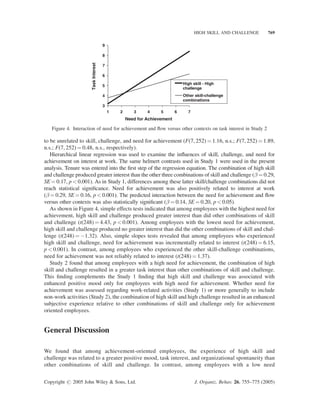
   Figure 4. Interaction of need for achievement and flow versus other contexts on task interest in Study 2

to be unrelated to skill, challenge, and need for achievement (F(7, 252) ¼ 1.16, n.s.; F(7, 252) ¼ 1.89,
n.s.; F(7, 252) ¼ 0.48, n.s., respectively).
   Hierarchical linear regression was used to examine the influences of skill, challenge, and need for
achievement on interest at work. The same helmert contrasts used in Study 1 were used in the present
analysis. Tenure was entered into the first step of the regression equation. The combination of high skill
and challenge produced greater interest than the other three combinations of skill and challenge (
¼ 0.29,
SE ¼ 0.17, p  0.001). As in Study 1, differences among these latter skill/challenge combinations did not
reach statistical significance. Need for achievement was also positively related to interest at work
(
¼ 0.29, SE ¼ 0.16, p  0.001). The predicted interaction between the need for achievement and flow
versus other contexts was also statistically significant (
¼ 0.14, SE ¼ 0.20, p  0.05).
   As shown in Figure 4, simple effects tests indicated that among employees with the highest need for
achievement, high skill and challenge produced greater interest than did other combinations of skill
and challenge (t(248) ¼ 4.43, p  0.001). Among employees with the lowest need for achievement,
high skill and challenge produced no greater interest than did the other combinations of skill and chal-
lenge (t(248) ¼ À1.32). Also, simple slopes tests revealed that among employees who experienced
high skill and challenge, need for achievement was incrementally related to interest (t(248) ¼ 6.15,
p  0.001). In contrast, among employees who experienced the other skill-challenge combinations,
need for achievement was not reliably related to interest (t(248) ¼ 1.37).
   Study 2 found that among employees with a high need for achievement, the combination of high
skill and challenge resulted in a greater task interest than other combinations of skill and challenge.
This finding complements the Study 1 finding that high skill and challenge was associated with
enhanced positive mood only for employees with high need for achievement. Whether need for
achievement was assessed regarding work-related activities (Study 1) or more generally to include
non-work activities (Study 2), the combination of high skill and high challenge resulted in an enhanced
subjective experience relative to other combinations of skill and challenge only for achievement
oriented employees.


General Discussion

We found that among achievement-oriented employees, the experience of high skill and
challenge was related to a greater positive mood, task interest, and organizational spontaneity than
other combinations of skill and challenge. In contrast, among employees with a low need


Copyright # 2005 John Wiley  Sons, Ltd.                                           J. Organiz. Behav. 26, 755–775 (2005)

Flow experiences at work: for high need achievers alone?

  • 1.
    Journal of OrganizationalBehavior J. Organiz. Behav. 26, 755–775 (2005) Published online in Wiley InterScience (www.interscience.wiley.com). DOI: 10.1002/job.337 Flow experiences at work: for high need achievers alone? ROBERT EISENBERGER1*, JASON R. JONES1, FLORENCE STINGLHAMBER2, LINDA SHANOCK3 AND AMANDA T. RANDALL4 1 University of Delaware, Newark, Delaware, U.S.A. 2 Hautes Etudes Commerciales—Liege, Belgium 3 University at Albany, State University of New York, U.S.A. 4 Towers Perrin, Chicago, Illinois, U.S.A. Summary Applying Csikszentmihalyi’s (1990) flow theory of optimal experience to the workplace, two studies examined the relationships of employees’ perceived skill and challenge at work and need for achievement with their positive mood, intrinsic task interest, and extra-role perfor- mance. Among achievement-oriented employees only, high skill and challenge was associated with greater positive mood, task interest, and performance than other skill/challenge combi- nations. Additionally, positive mood mediated the interactive relationship of skill/challenge and need for achievement with performance. Copyright # 2005 John Wiley & Sons, Ltd. Introduction Human potential approaches to work emphasize the contributions of self-actualization, challenge, and growth opportunities to job satisfaction and motivation (Alderfer, 1969; Herzberg, 1966; Maslow, 1965). Elaborating these accounts, Hackman and Oldham (1976) specified task characteristics of jobs that might enhance motivation, including the opportunities to use a variety of skills and produce a com- plete piece of work, knowledge that one’s activities have an impact on the lives of others, choice in determining how to carry out one’s work, and performance feedback. Numerous studies have found positive relationships of task characteristics with beneficial outcomes such as job satisfaction, good health, and performance (e.g., Campion & McClelland, 1991; Fried & Ferris, 1987; Gerhart, 1987; Loher, Noe, Moeller, & Fitzgerald, 1985; Schaubroeck, Jones, & Xie, 2001; Steel & Rentsch, 1997; Tiegs, Tetrick, & Fried, 1992). For example, using a longitudinal design, Griffin (1991) found signifi- cant increases in bank tellers’ performance 24 and 48 months following a job redesign intervention aimed at improving employees’ perceptions of Hackman and Oldham’s (1976) task characteristics. * Correspondence to: Robert Eisenberger, Psychology Department, University of Delaware, Newark, DE 19716, U.S.A. E-mail: eisenber@udel.edu Received 11 May 2004 Revised 19 November 2004 Copyright # 2005 John Wiley & Sons, Ltd. Accepted 28 April 2005
  • 2.
    756 R. EISENBERGER ET AL. Skill utilization, involving equivalence between the challenge of one’s work and the ability to meet that challenge, has been suggested as an additional task characteristic that might contribute to job satisfaction and motivation (Gavin & Axlerod, 1977; O’Brien & Dowling, 1980; O’Brien, 1983). Accordingly, O’Brien (1983) found that skill utilization accounted for a significant portion of the var- iance in job satisfaction beyond the job characteristics enumerated by Hackman and Oldham (1976). Csikszentmihalyi’s flow theory of optimal experience similarly holds that an individual’s satisfaction and motivation depend on the match between his or her skill and the challenge inherent in the task (Csikszentmihalyi, 1975, 1990; Csikszentmihalyi & Rathunde, 1993). However, Csikszentmihalyi emphasizes the intrinsically rewarding and satisfying subjective state, termed flow, which results from the combination of high perceived skill and high perceived challenge. According to Csikszentmihalyi (1990, p. 4), the flow experience is a condition ‘‘in which people are so involved in an activity that nothing else seems to matter at the time; the experience is so enjoyable that people will do it even at great cost, for the sheer sake of doing it.’’ Flow experiences are suggested to be intrinsically rewarding because they allow one to become fully involved in a task and stretch his or her skills and abilities to the limit (Csikszentmihalyi & Rathunde, 1993). Csikszentmihalyi (1999) assumed that in addition to increasing intrinsic task interest, the repeated experience of flow in a given context would have a pervasive incremental effect on positive mood. Consequently, a job, hobby, or sports activity that repeatedly provided high but manageable challenges would come to have a major influence on positive mood. In contrast to the beneficial outcomes of the combination of high skill and challenge, other combina- tions of skill and challenge are suggested by Csikszentmihalyi to produce less favorable experiences. Activities in which the individual’s skill is perceived to be high relative to the challenge provided by the task would lead to boredom. Low-perceived skill and high-perceived challenge would produce anxi- ety, while low-perceived skill and low-perceived challenge would result in apathy. Typical studies based on the flow experience assess the prediction that perceived high skill and high challenge produces a more favorable subjective experience than other combinations of skill and challenge. Among key findings is that high skill and challenge was associated with greater positive mood (e.g., Csikszentmihalyi & LeFevre, 1989; Csikszentmihalyi, Rathunde, & Whalen, 1993) and task interest (e.g., Catley & Duda, 1997; Csikszentmihalyi & Larson, 1986) than other skill-challenge combinations. Csikszentmihalyi’s theory provides one of the most widely cited explanations for pleasurable absorption in leisure and sports activities. The association between enjoyable subjective experience and high skill and challenge has been found in a variety of non-employment settings, such as schooling (Carli, Delle Fave, Massimini, & Carli, 1988; Clarke & Haworth, 1994; Moneta & Csikszentmihalyi, 1996), computing (Chen, Wigand, & Nilan, 1999; Trevino & Webster, 1992; Webster, Trevino, & Ryan, 1993), family interaction (Rathunde, 1988), leisure (Csikszentmihalyi & LeFevre, 1989; Graef, Csikszentmihalyi, & McManama Gianinno, 1983; Mannell, Zuzanek, & Larson, 1988), occupational therapy (Emerson, 1998; Jacobs, 1994), and competitive and recreational sports (Catley & Duda, 1997; Jackson, 1992; Jackson & Roberts, 1992; Kowal & Fortier, 1999; Stein, Kimiecik, Daniels, & Jackson, 1995). However, flow in work settings has received little attention. The opportunity to perform challenging tasks skillfully might have benefits for employees and their organizations. Csikszentmihalyi and Rathunde (1993, p. 73) suggested that intrinsic task interest ‘‘fol- lows from the realization that one is growing in complexity as a result of matching one’s skills to dif- ficult challenges.’’ In other words, engagement in high skill and challenge promotes task interest because it allows one to hone one’s skills. Employees should take an increased interest in challenging, yet manageable activities because they provide: a sense of achievement, the opportunity to sharpen one’s skills, and a favorable subjective experience (Csikszentmihalyi, 1990). In addition to increasing task interest, the combination of high skill and challenge at work might promote positive mood. George and Brief (1992, p. 320) suggested that the successful completion of work activities Copyright # 2005 John Wiley & Sons, Ltd. J. Organiz. Behav. 26, 755–775 (2005)
  • 3.
    HIGH SKILL ANDCHALLENGE 757 demonstrating competence, worth, or achievement, would enhance positive mood. Similarly, Isen, Daubman, and Nowicki (1987) maintained that perceptions of competence and self-worth would increase positive mood. In one of the few studies involving flow at work, Csikszentmihalyi and LeFevre (1989) reported that the combination of high skill and challenge occurred three times more often during work than leisure (see also Haworth & Hill, 1992), and was associated with greater positive mood than other combina- tions of skill and challenge. Csikszentmihalyi and LeFevre’s (1989) initial findings highlight jobs as a major source of flow for adults and raise basic issues, examined in the present studies, concerning the affective and motivational consequences of different combinations of skill and challenge at work. Need for Achievement and Flow Csikszentmihalyi and LeFevre (1989) found marked individual differences among employees in the extent to which high skill and challenge was preferred to other combinations of skill and challenge at work. Approximately half of the employees in the sample expressed greater motivation for work in which they had high skill and faced high challenge rather than low skill and low challenge. The other half of the sample, in contrast, reported greater motivation under conditions of low skill and low chal- lenge. Perhaps dispositional differences among employees account for these findings. Csikszentmihalyi (Csikszentmihalyi & Csikszentmihalyi, 1988; Csikszentmihalyi & Rathunde, 1993) and Adlai-Gail (1994) suggested that some individuals might have an autotelic personality, which would lead them to be especially active in seeking out challenging tasks for which they perceive themselves highly skillful. In addition, such individuals would work hard to create their own challenges in mundane tasks. However, theory and research have yet to clearly identify the character- istics of the autotelic personality or its relationship with high skill and challenge. In one such attempt, Csikszentmihalyi et al. (1993) found that talented teenage students who scored high on a constellation of personality characteristics involving achievement, endurance, inquisitiveness, and aestheticism (Jackson, 1984) reported experiencing high skill and challenge a greater proportion of the time over the course of a week than their low scoring counterparts. However, Csikszentmihalyi et al. (1993) did not isolate the relative contributions of these personality characteristics. Nor did they consider how personality might influence the degree to which high skill and challenge is associated with an elevated subjective experience relative to other skill-challenge combinations. Need for achievement might explain some of the individual differences in motivation for high skill and challenge versus other skill-challenge combinations, as found by Csikszentmihalyi and LeFevre (1989). According to Atkinson (1964) and McClelland (1961, 1987), persons with a high need for achievement base their self-regard on the successful development and utilization of talents and skills. Fineman (1977, p. 2) described achievement-oriented individuals as ‘‘striving to do well, desiring to fully utilize one’s capacities to succeed and to be judged by oneself and others on this success.’’ McClelland, Atkinson, Clark, and Lowell (1953) associated the achievement need with a desire to sur- pass personal standards of excellence. The combination of high perceived skill and challenge at work may often meet the achievement- oriented employee’s desires to surpass personal standards of excellence. Moreover, as suggested by Csikszentmihalyi (1990), high skill and challenge allows one to perform at the limits of one’s capa- cities and hone one’s skills, conditions that achievement-oriented individuals desire (Csikszentmihalyi & Rathunde, 1993; Fineman, 1977). Thus, achievement-oriented individuals should experience enhanced interest and elevated positive mood in work activities that provide high skill and challenge. Copyright # 2005 John Wiley & Sons, Ltd. J. Organiz. Behav. 26, 755–775 (2005)
  • 4.
    758 R. EISENBERGER ET AL. Achievement-oriented employees should find other skill-challenge combinations less inviting: low-skill/high-challenge should produce a low probability of success (deCharms & Carpenter, 1968; Hamilton, 1974; Karabenick & Youssef, 1968; Raynor & Entin, 1982; Trope, 1975; Trope & Brickman, 1975), and low challenge paired with low or high skill should fail to provide exacting stan- dards of excellence. In contrast to achievement-oriented employees, employees having a low need for achievement should be less interested in activities that provide high skill and challenge at work. Individuals low in need for achievement experience greater anxiety in achievement settings and try to avoid compe- tence assessment (Atkinson, 1974; Trope, 1975). Employees with a low achievement need may thus find the combination of high skill and challenge less satisfying than would achievement-oriented employees, resulting in lesser degrees of positive mood and task interest. Hypothesis 1: High perceived task skill and challenge will be more strongly associated with positive mood and task interest among employees having a high need for achievement than among employ- ees having a low need for achievement. Need for Achievement, Mood, and Organizational Spontaneity Over the last decade, organizational researchers have become increasingly interested in the influence of employees’ positive mood on organizational outcomes. Positive mood has been found to be asso- ciated with employees’ increased extra-role performance (Eisenberger, Armeli, Rexwinkel, Lynch, & Rhoades, 2001; George & Brief, 1992). George and Brief suggest that positive mood primes employ- ees to think about favorable characteristics of co-workers, leading to helping behavior. They also argue that positive mood should promote creative thinking, leading to creative suggestions. Consistent with these views, Eisenberger et al. (2001) found that positive mood enhanced a variety of extra-role activ- ities, including helping co-workers and making creative suggestions. Extra-role behaviors that are performed voluntarily and aid the organization, termed organizational spontaneity (George & Brief, 1992), include making constructive suggestions, enhancing one’s own knowledge and skills in ways that will help the organization, protecting the organization from potential problems, and helping co-workers. Employees who experience the combination of high skill and chal- lenge at work might go beyond specified job responsibilities to contribute to organizational success as a result of the enhanced positive mood produced by high skill and challenge on the job. As previously noted, the relationship of high skill and challenge with positive mood should be espe- cially strong for employees high in need for achievement because the skillful performance of difficult tasks allows those employees to meet and surpass personal standards of excellence. Consequently, positive mood might mediate the interactive influence of skill/challenge and achievement orientation on organizational spontaneity. Hypothesis 2: High perceived skill and challenge will be most strongly associated with organiza- tional spontaneity among achievement-oriented employees, as mediated by positive mood. The hypothesized relationships between all variables are summarized in Figure 1. Csikszentmihalyi has suggested several methods for assessing skill and challenge. To increase the generality of our findings, we used different methods in our two studies. In the first study, we compared each employee’s perceived skill and challenge in his or her major work activities with the median levels of skill and challenge experienced by co-workers (cf. Csikszentmihalyi & Rathunde, 1993). Copyright # 2005 John Wiley & Sons, Ltd. J. Organiz. Behav. 26, 755–775 (2005)
  • 5.
    HIGH SKILL ANDCHALLENGE 759 Positive Org Need For Mood Spontaneity Achievement Skill/ Challenge Task Need For Interest Achievement Figure 1. Model of hypothesized relationships in Studies 1 and 2 Note: The proposed relationship of skill/challenge with positive mood and organizational spontaneity, as moderated by need for achievement was assessed in Study 1. The moderating influence of need for achievement in the relationship between skill/challenge and intrinsic interest was examined in Study 2. The second study took into account the possibility raised by Csikszentmihalyi (1990) that the experi- ence of flow in a given activity may be influenced by the levels of skill and challenge experienced in their other activities. This view supposes that people may compare their skill and challenge in a given domain, such as work, to their overall experience of skill and challenge in daily life (Csikszentmihalyi & LeFevre, 1989; Massimini & Carli, 1988). Consequently, if an employee rated his skill and chal- lenge on the job as higher than the average skill and challenge experienced in all their daily activities (e.g., socializing with friends and family, cooking, reading), he would be predicted to experience flow at work. Therefore, the second study compared each employee’s skill and challenge at work with his or her overall skill and challenge. Study 1 The first study examined the relationship of employees’ experience of skill/challenge with positive mood and organizational spontaneity, as moderated by need for achievement. Additionally, the study investigated whether positive mood would mediate the interactive relationship of skill/challenge and need for achievement with organizational spontaneity. Organizational Context The participating organization was a large discount electronics and appliance retailer located in the northeastern United States. Prices on most items were set to promote sales volume over profit per item sold. The data from Study 1 came from an employee questionnaire administered in 1996, while the data for Study 2 came from a questionnaire given to a different set of employees within the same organization in 1999. The organization’s emphasis on growth in number of outlets suffered a Copyright # 2005 John Wiley & Sons, Ltd. J. Organiz. Behav. 26, 755–775 (2005)
  • 6.
    760 R. EISENBERGER ET AL. setback during this interval when business declined, expansion plans were put on hold, and the num- ber of employees was substantially reduced. However, in the year before the second survey, busi- ness had begun to increase again. We sampled sales employees as well as sales support employees. Sales employees were paid on the basis of a combination of salary and commission, whereas support employees were paid entirely on the basis of salary. Within these two types of jobs, employees differed substantially in the tasks they were required to carry out. Some salespeople were assigned to more challenging areas of the stores containing electronics products for which technological advances were introduced frequently (e.g., computers and televisions). In this environment, salespeople needed to continually upgrade their knowledge and skills in order to effectively operate and present the favorable features to cus- tomers. Other salespeople were assigned to less challenging store areas containing products in which the required technological understanding was more easily mastered, and changes in required knowledge occurred slowly (e.g., refrigerators and stoves). Similarly, challenge levels differed considerably among sales support staff. Book keepers, for instance, found themselves in a challenging environment as they were required to keep track of a large, rapidly changing inventory, and high cash flow. As another example, in order to answer queries by customers, cashiers were expected to keep current with the latest layout of merchandise. Other sales support employees were in charge of making deliveries from the central warehouse to the stores along well-established routes, a less challenging endeavor. The company was often under- staffed, resulting in wide variation in skill levels for the jobs to which employees were assigned. Thus, the four possible combinations of low- or high-employee skill with low- or high-task chal- lenge, needed to assess flow theory, were well represented in the organization. Method Sample and procedure The sample consisted of 392 employees working at eight sites. Three hundred and sixty-five employ- ees (93%) returned completed questionnaires. The employees voluntarily completed the survey during their regularly scheduled working hours in conference rooms at each site. To encourage candidness, we gave employees verbal and written assurances that their individual responses would not be revealed. Surveys were distributed and collected by the researchers in sealed envelopes. Supervisors completed performance evaluations for each employee and were given similar assurances of confidentiality. Evaluations were available for 335 of the 365 respondents (92%). Measures Tenure We controlled for employee tenure, obtained from company records, which might be associated both with greater perceived skills and familiarity with supervisors, leading to higher performance ratings. Skill and challenge Employees were asked to list the five work activities on which they spend the most time during their average day at work. Employees then rated the degrees of skill they had in each activity and the chal- lenge posed by the activity on nine-point Likert-type scales (1 ¼ low, 9 ¼ high). The specific items Copyright # 2005 John Wiley & Sons, Ltd. J. Organiz. Behav. 26, 755–775 (2005)
  • 7.
    HIGH SKILL ANDCHALLENGE 761 used to assess skill and challenge were ‘‘What is your skill in the activity?’’ and ‘‘How challenging is the activity?’’ respectively. The five ratings of skill and challenge were averaged for each employee in order to create an overall job skill and challenge level for the employee. Following the between- persons approach described in the Introduction, each employee’s overall job skill and overall job challenge at work was compared to the median levels of skill and challenge for all employees (Csikszentmihalyi & Rathunde, 1993). Then, the employee was placed in one of the following contexts on the basis of Csikszentmihalyi’s (1990) theory: 1. Flow context: Employee’s skill and challenge were both above the group median skill and challenge levels. 2. Anxiety context: Employee’s skill was below the median group skill level; employee’s challenge was above the median group challenge level. 3. Boredom context: Employee’s skill was above the median group skill level; employee’s challenge was below the median group challenge level. 4. Apathy context: Employee’s skill and challenge were both below the group median skill and chal- lenge levels. Need for achievement Need for achievement was assessed by four of the five items from the need for achievement sub- scale of Steers and Braunstein’s (1976) Manifest Needs Questionnaire, plus five items constructed by the research team (see Table 1). We developed these items based upon the characteristics of individuals high in achievement orientation as outlined by McClelland (1961, 1987), such as working to improve one’s skills and desiring frequent feedback. We added items because although the need for achievement sub-scale has shown acceptable internal reliabilities in some studies (Mannheim, Baruch, & Tal, 1997; Orpen, 1985), it has fallen slightly below the 0.70 criteria suggested by Nunnally (1967) in other studies (e.g., Schaubroeck, Ganster, & Jones, 1998; Slade & Rush, 1991; Turban & Keon, 1993). We omitted the Steers and Braunstein (1976) item ‘‘I try to perform better than my co-workers’’ from the measure because it appeared to apply more to a tendency to be competitive than to the core attributes of the need for achievement. Respondents rated their agreement with each statement using a seven-point Likert-type scale (1 ¼ strongly disagree, 7 ¼ strongly agree). Table 1. Study 1: Factor loadings for need for achievement items Statement Factor loading 1. I am pleased when I can take on added job responsibilities.a 0.78 2. I am always looking for opportunities to improve my skills on the job. 0.77 3. I like to set challenging goals for myself on the job. 0.63 4. I enjoy situations at work where I am personally responsible for finding 0.62 solutions to problems. 5. I try very hard to improve on my past performance at work.a 0.61 6. I get the most satisfaction when completing job assignments that are fairly difficult. 0.42 7. I want frequent feedback on how I am doing on the job. 0.40 8. I do my best work when my job assignments are fairly difficult.a 0.39 9. I believe in taking moderate risks to get ahead at work.a 0.34 Note: n ¼ 365. a Item adapted from Steers and Braunstein’s Manifest Needs Questionnaire (1976). Copyright # 2005 John Wiley & Sons, Ltd. J. Organiz. Behav. 26, 755–775 (2005)
  • 8.
    762 R. EISENBERGER ET AL. Positive mood The employees rated their mood at work using four items from Brief, Burke, George, Robinson, and Webster’s (1988) Job Affect Scale (JAS). A series of confirmatory factor analyses on the Job Affect Scale (Burke, Brief, George, Roberson, & Webster, 1989) revealed that the positive mood items formed a unitary factor. In the present study, employees used five-point Likert-type scales (1 ¼ little, 5 ¼ very much) to rate the extent to which they felt happy, active, enthusiastic, and energetic on an average day at work. We replaced the JAS items elated and peppy with the synonyms happy and energetic to reflect the contemporary American vernacular. Organizational spontaneity We used the five items reported by Lynch, Eisenberger, and Armeli (1999) to load highest on an organizational spontaneity factor in two separate studies of supervisors’ evaluations of employees (Cronbach’s ¼ 0.91 and 0.90, respectively). These items were as follows: makes constructive sug- gestions to improve the overall functioning of his/her workgroup; encourages others to try new and more effective ways of doing their job; keeps well informed where his/her opinion might benefit the organization; continues to look for new ways to improve the effectiveness of his/her work; and takes action to protect the organization from potential problems. Supervisors evaluated the employees on five-point Likert-type scales (1 ¼ agree slightly or not at all, 5 ¼ very strongly agree). Results and Discussion A principal components analysis and scree plot on the need for achievement items indicated that the items formed a single factor, having an eigenvalue of 3.6 that accounted for 49% of the total variance (see Table 1). Eight of the nine items loaded acceptably on the factor and were included in the final scale. Means, standard deviations, internal reliabilities, and intercorrelations among the variables are reported in Table 2. All measures showed acceptable internal reliabilities above the 0.70 threshold sug- gested by Nunnally (1967). To determine if differences existed among the company’s stores on our key Table 2. Study 1 and Study 2: Means, standard deviations, alpha reliabilities, and intercorrelations among variables Variable Ma SDa Mb SDb 1 2 3 4 5 6 7 1. Tenure 42.37 34.73 45.29 46.60 (—) 0.11 — — 0.05 0.07 0.17** 2. Need for Ach 5.00 0.89 4.58 0.86 0.04 (0.79/0.88) — — 0.40*** 0.18** 0.21*** 3. Positive Mood 2.53 0.88 — — À0.00 0.30*** (0.84/—) — — — — 4. Org Spontc 3.16 1.04 — — 0.22*** 0.12* 0.17** (0.91/—) — — — 5. Interest — — 5.58 1.99 — — — — (—/0.89) 0.41*** 0.52*** 6. Skill 7.53 1.58 7.26 1.51 0.09 0.17** 0.10 0.09 — (—/—)d 0.28*** 7. Challenge 4.43 2.05 5.34 2.04 0.22*** 0.13* 0.20*** 0.14** — 0.14** (—/—)e Note: For Study 1, n ¼ 365; for Study 2, n ¼ 260. Correlations for Study 1 appear below the diagonal; correlations for Study 2 appear above the diagonal. Cronbach’s alphas appear on the diagonal (Study 1/Study2). Tenure is measured in months. a Study 1. b Study 2. c n ¼ 335. d Cronbach’s alpha could not be calculated for the skill measure, because employees differed in the work tasks on which they rated skill. e Cronbach’s alpha could not be calculated for the challenge measure, because employees differed in the work tasks on which they rated challenge. *p 0.05; **p 0.01; ***p 0.001. Copyright # 2005 John Wiley Sons, Ltd. J. Organiz. Behav. 26, 755–775 (2005)
  • 9.
    HIGH SKILL ANDCHALLENGE 763 measures (skill, challenge, and need for achievement), we performed one-way ANOVAs. Store loca- tion was found to be unrelated to skill, challenge, and need for achievement (F(7, 357) ¼ 1.10, n.s.; F(7, 357) ¼ 1.62, n.s.; F(7, 357) ¼ 0.96, n.s., respectively). Positive mood was regressed on the skill/challenge combinations and need for achievement. We used orthogonal helmert contrasts (see Judd McClelland, 1989) to assess variation of positive mood across the four combinations of skill and challenge.1 The first contrast tested the hypothesis that the flow context (high skill and high challenge) would produce a more positive mood than would the other three combinations of skill and challenge. For this contrast, employees in the flow context were coded as 1, while those in the apathy, boredom, and anxiety contexts were each coded À0.333. In order to determine whether differences in positive mood experience existed among the three non-flow contexts, two additional orthogonal helmert contrasts were created. The second contrast compared employees in the anxiety context to those in the boredom and apathy contexts. Employees in the anxiety context were assigned 1, while those in the boredom and apathy contexts were each assigned À0.5. Employees in the flow context were excluded from this contrast. The third contrast compared employees in the boredom and apathy contexts by coding those in the boredom context as 1 and employees in the apathy context as 1. Those in the flow and anxiety contexts were excluded from this contrast. A similar ana- lysis was carried out for organizational spontaneity. Employee tenure within the organization was entered in the first step of the regression analyses as a covariate. To reduce potential multicollinearity between the interaction terms and their component variables, the need for achievement measure was centered (Aiken West, 1991). Considering positive mood first (see Table 3), employees in the flow context (high skill and high challenge) experienced greater positive mood than those in other combinations of skill and challenge. Differences in positive mood among the other combinations of skill and challenge were not statistically significant. Addition- ally, need for achievement was directly related to positive mood. These findings were qualified by the predicted interaction between the need for achievement and flow versus other contexts. Simple effects tests (Aiken West, 1991) were used to break down the interaction. As shown in Figure 2, among employees with the highest need for achievement, high skill and challenge produced greater positive mood than did other combinations of skill and challenge (t(353) ¼ 3.47, p 0.01). Among employees with the lowest need for achievement, high skill and challenge failed to produce greater positive mood than did the other combinations of skill and challenge (t(353) ¼ À1.20). Addi- tionally, simple slopes tests found that among employees who experienced high skill and challenge, need for achievement was incrementally related to positive mood (t(353) ¼ 3.24, p 0.01). In contrast, among employees who experienced the other skill-challenge combinations, need for achievement was not reliably related to positive mood (t(353) ¼ 1.19). In sum, high skill and challenge was positively associated with positive mood only among employees having a high need for achievement. 1 While it is generally preferable to retain variables in their original continuous form when carrying out regression, thereby retaining full quantitative information, the median-splits of skill and challenge provided a more straightforward assessment of the predictions of Csikszentmihalyi’s flow theory. Our theory-based comparison of the high-skill, high-challenge condition with the average performance of the other three conditions does not assess a pure interactive effect of skill and challenge. Csikszentmihalyi’s theory assumes that high skill and high challenge (flow) is pleasant and that the other three combinations of skill and challenge are unpleasant. This prediction is best captured by the first contrast which compares high skill and high challenge with the mean of the other three combinations of skill and challenge. Technically, this contrast involves balancing high skill and high challenge (value ¼ 1) against values for the three remaining combinations of skill and challenge (À0.333). Our use of additional contrasts provided the supplementary benefit of assessing whether the other three combinations of skill and challenge differed with respect to the outcomes. Were we to retain skill and challenge in their continuous form in a regression analysis, none of the outcomes, including the interaction with need for achievement, would directly assess our hypotheses. This may be seen by the fact that the contrast for a pure statistical interaction differs from that needed to assess flow theory. For the pure interaction, the contrasts would be: 1, À1, À1, and 1, respectively, for the following combinations of skill and challenge: high skill-high challenge; high skill-low challenge; low skill-high challenge; and low skill-low challenge. Copyright # 2005 John Wiley Sons, Ltd. J. Organiz. Behav. 26, 755–775 (2005)
  • 10.
    764 R. EISENBERGER ET AL. Table 3. Study 1: Hierarchical regression analysis for positive mood and organizational spontaneity Positive mood Organizational spontaneity B SE
  • 11.
    ÁR2 B SE
  • 12.
    ÁR2 Step 1 0.00 0.05*** Tenure 0.00 0.00 0.00 0.01 0.00 0.23*** Step 2 0.14*** 0.04* Tenure À0.00 0.00 À0.06 0.00 0.00 0.18** Flow vs. Non flow 0.34 0.08 0.22*** 0.26 0.10 0.14* Anxiety vs. Boredom and Apathy 0.13 0.07 0.09 0.14 0.09 0.08 Boredom vs. Apathy 0.02 0.06 0.02 0.07 0.08 0.05 Need for achievement 0.30 0.06 0.26*** 0.12 0.08 0.08 Step 3 0.01 0.02 Tenure À0.00 0.00 À0.06 0.00 0.00 0.18** Flow vs. Non flow 0.30 0.08 0.19*** 0.22 0.11 0.12* Anxiety vs. Boredom and Apathy 0.14 0.07 0.10 0.17 0.09 0.10 Boredom vs. Apathy 0.03 0.07 0.03 0.11 0.09 0.07 Need for achievement 0.31 0.06 0.26*** 0.11 0.08 0.08 Flow vs. Non flow  Need for achievement 0.23 0.11 0.11* 0.34 0.14 0.13* Anxiety vs. Boredom and Apathy  Need for ach. 0.04 0.10 0.02 0.00 0.12 0.00 Boredom vs. Apathy  Need for ach. À0.02 0.09 À0.01 0.16 0.11 0.08 Step 4 0.01* Tenure 0.00 0.00 0.19*** Flow vs. Non flow 0.17 0.11 0.09 Anxiety vs. Boredom and Apathy 0.15 0.09 0.09 Boredom vs. Apathy 0.10 0.09 0.06 Need for achievement 0.07 0.08 0.05 Flow vs. Non flow  Need for achievement 0.31 0.14 0.12* Anxiety vs. Boredom and Apathy  Need for ach. 0.00 0.12 0.00 Boredom vs. Apathy  Need for achievement 0.16 0.11 0.08 Positive mood 0.15 0.07 0.12* Note: For positive mood, final model: F(8, 356) ¼ 7.66, p 0.001; total R2 ¼ 0.15, adj. R2 ¼ 0.13. For organizational spontaneity, final model: F(9, 320) ¼ 4.88, p 0.001; total R2 ¼ 0.20, adj. R2 ¼ 0.18. B indicates unstandardized regression coefficient.
  • 13.
    indicates standardized regressioncoefficient. *p 0.05; **p 0.01; ***p 0.001. A regression analysis was also performed on organizational spontaneity (see Table 3). The results were comparable to the findings for positive mood. Employees in the flow context (high skill and high challenge) showed greater organizational spontaneity than those in other combinations of skill and challenge. As with positive mood, the predicted interaction between need for achievement and the flow versus other-contexts interaction was statistically significant. As shown in Figure 3, simple effects analyses revealed that among employees with the highest need for achievement, the combination of high skill and challenge produced greater organizational sponta- neity than did other combinations of skill and challenge (t(323) ¼ 2.41, p 0.05). Among employees with the lowest need for achievement, high skill and challenge produced no greater organizational spontaneity than other skill-challenge combinations (t(323) ¼ À1.38). Further, simple slopes tests revealed that among employees who experienced high skill and challenge, need for achievement was incrementally related to organizational spontaneity (t(323) ¼ 2.12, p 0.05), while no reliable relationship between need for achievement and organizational spontaneity was found for employees experiencing the other combinations of skill and challenge (t(323) ¼ 0.34). Thus, as with positive mood, high skill and challenge were associated with organizational spontaneity only among employ- ees with a high need for achievement. We also predicted that positive mood would mediate the interactive relationship of skill/challenge and need for achievement with organizational spontaneity. Such an association has been termed Copyright # 2005 John Wiley Sons, Ltd. J. Organiz. Behav. 26, 755–775 (2005)
  • 14.
    HIGH SKILL ANDCHALLENGE 765 4 3 Positive Mood High skill - High 2 challenge Other skill- challenge combinations 1 1 2 3 4 5 6 7 Need for Achievement Figure 2. Interaction of need for achievement and flow versus other contexts on positive affect in Study 1 4 Organizational Spontaneity 3 High skill - High challenge 2 Other skill- challenge combinations 1 1 2 3 4 5 6 7 Need for Achievement Figure 3. Interaction of need for achievement and flow versus other contexts on organizational spontaneity in Study 1 mediated moderation (Baron Kenny, 1986). Technically, mediated moderation differs from tradi- tional mediation only in that the predictor variable is an interaction. In our analysis, the predictor vari- able is the interaction of the conditions of skill/challenge with need for achievement. The mediated moderation hypothesis was tested using the z-prime method, as recommended by MacKinnon, Lockwood, Hoffman, West, and Sheets (2002). MacKinnon et al. (2002) demonstrated that the classic Copyright # 2005 John Wiley Sons, Ltd. J. Organiz. Behav. 26, 755–775 (2005)
  • 15.
    766 R. EISENBERGER ET AL. mediational method suggested by Baron and Kenny (1986) has low statistical power, and that the z- prime method provides more power and a lesser Type 1 error rate than the Baron and Kenny approach. The z-prime method and Baron and Kenny’s (1986) procedure are similar, in that both calculate an indirect (mediated) effect of the independent variable on the outcome variable through the mediator using an identical formula. They differ in the statistical distribution used to determine whether the indirect effect is significant. Because the estimate of the indirect effect is not normally distributed, MacKinnon et al.’s (2002) z-prime method uses the modified critical value of 0.97 for the test of sig- nificance, as opposed to 1.96 for the Z distribution. Using the z-prime method to determine the indirect effect of the skill/challenge by need for achieve- ment interaction on organizational spontaneity through positive mood, it is necessary to calculate (a) the effect of the exogenous variable (the skill/challenge by need for achievement interaction) on the mediator (positive mood) and (b) the effect of the mediator (positive mood) on the outcome variable (organizational spontaneity) controlling for the exogenous variable (the skill/challenge by need for achievement interaction). The effect of the skill/challenge by need for achievement interaction on positive mood was significant (B ¼ 0.23, SE ¼ 0.11, p 0.05; see Table 3). Moreover, positive mood significantly predicted organizational spontaneity when controlling for the skill/challenge by need for achievement interaction (B ¼ 0.15, SE ¼ 0.07, p 0.05; see Table 3). Finally, the overall test of med- iation was statistically significant (z0 ¼ 1.51, p 0.05), thereby demonstrating that positive mood partially mediated the interaction of skill/challenge with need for achievement on organizational spontaneity. In summary, need for achievement moderated the relationship between the experience of skill and challenge at work and employees’ positive mood and organizational spontaneity. Achievement- oriented employees experiencing high skill and challenge showed greater positive mood and organiza- tional spontaneity than achievement-oriented employees experiencing other combinations of skill and challenge. Employees with a low need for achievement experiencing high skill and challenge showed neither more positive mood nor more organizational spontaneity than did low achievement-oriented employees experiencing other skill-challenge combinations. Moreover, positive mood partially mediated the stronger relationship between high skill and challenge and organizational spontaneity among achievement-oriented employees. These findings support Csikszentmihalyi and LeFevre’s (1989) suggestions that high skill and challenge creates an optimal subjective experience relative to other combinations of skill and chal- lenge and that dispositional differences influence the degree to which high skill and challenge produces an elevated subjective experience. Specifically, need for achievement appears to have an important influence on whether high skill and challenge influences positive mood and organizational spontaneity at work. Positive mood appears to contribute to the association between high skill and challenge, and organizational spontaneity for employees high in need for achievement. Study 2 In Study 1, we found that the positive relationship of high skill and challenge with positive mood and organizational spontaneity depended on need for achievement. We assessed dispositional differences in need for achievement through questionnaire items concerning employees’ desire to develop and utilize talents and skills (Atkinson, 1964) and surpass personal standards of excellence (McClelland, 1987; McClelland et al., 1953) in the context of work. As a general dispositional Copyright # 2005 John Wiley Sons, Ltd. J. Organiz. Behav. 26, 755–775 (2005)
  • 16.
    HIGH SKILL ANDCHALLENGE 767 orientation, need for achievement applies to non-work as well as work situations. Our conclusion that need for achievement strongly influences employees’ positive reactions to the experience of high skill and challenge at work would be strengthened by a more general measure of need for achievement that included items assessing need for achievement in non-work situations. Therefore, we broadened the questionnaire measure of need for achievement to include both work and non-work situations. Study 2 also extended the findings of the first study to a second important outcome of high perceived task skill and challenge: task interest (Catley Duda, 1997; Csikszentmihalyi LeFevre, 1989; Haworth Hill, 1992). Based on the rationale that high perceived skill and challenge at work would often meet the achievement-oriented employee’s desire to surpass personal standards of excellence, we predicted that the relationship of high skill and challenge with task interest would be greatest among employees with a high need for achievement. In Study 1, each employee’s skill and challenge was judged to be high or low based on the between- participants approach which involved comparing each employee’s skill and challenge at work with the median levels of skill and challenge of a reference group of employees (Csikszentmihalyi Rathunde, 1993). To increase the generality of our finding that dispositional differences in need for achievement influence the degree to which high skill and challenge contributes to satisfaction and enjoyment; Study 2 incorporated the within-participants methodology suggested by Csikszentmihalyi (1990; Csikszent- mihalyi et al., 1993). Specifically, we compared each employee’s skill and challenge at work with his or her average level of skill and challenge for a variety of daily activities. Method Sample and procedure We used an independent sample of 265 employees at eight sites of the same organization examined in Study 1. Administration procedures were the same as in the first study. Of the 265 employees given the survey, 260 employees (98%) returned completed questionnaires. Twenty-eight percent of the partici- pants were female. Measures Tenure Employee tenure in the organization was obtained from company records. Skill and challenge As in Study 1, employees listed the five-job activities on which they spent the most time during an average workday and rated their skill and challenge involved in each, using a 9-point Likert-type scale. The specific items used to assess skill and challenge were identical to those used in Study 1. Each employee was also administered a list of 21 activities designed by the investigators to repre- sent a full range of typical non-work activities, such as gardening, cooking, playing competitive sports, socializing with friends and family, surfing the internet, reading, watching television, shop- ping, exercising, and playing games. On a nine-point Likert-type scale (1 ¼ low, 9 ¼ high), employ- ees rated their perceived skill and challenge for each of the non-work activities in which they participated. We averaged each participant’s skill and challenge levels across all the activities in which he or she participated, including work, to create baseline levels of skill and challenge. Each employee’s average skill and challenge at work was classified as high or low relative to his/her baseline levels of skill and challenge. Copyright # 2005 John Wiley Sons, Ltd. J. Organiz. Behav. 26, 755–775 (2005)
  • 17.
    768 R. EISENBERGER ET AL. Table 4. Study 2: Factor loadings for need for achievement items Statement Factor loading 1. I am pleased when I can take on added job responsibilities. 0.77 2. I like to set challenging goals for myself on the job. 0.73 3. I do my best work when my job assignments are fairly difficult. 0.72 4. I enjoy situations at work where I am personally responsible for finding 0.70 solutions to problems. 5. I enjoy difficult tasks away from work. 0.66 6. I enjoy difficult work. 0.64 7. I get the most satisfaction when completing job assignments that are fairly difficult. 0.63 8. People should be more involved with their work. 0.61 9. I am always looking for opportunities to improve my skills away from work. 0.61 10. I am always looking for opportunities to improve my skills on the job. 0.60 11. I try very hard to improve on my past performance at work. 0.56 12. I try very hard to improve on my past performance away from work. 0.55 13. I often set goals away from work that are very difficult to reach. 0.54 14. I often set goals at work that are very difficult to reach. 0.54 15. I want frequent feedback on how I am doing on the job. 0.43 Note: n ¼ 260. Need for achievement The items used are presented in Table 4. We used the 8 need for achievement items used in Study 1, added items that explicitly asked about achievement motivation away from work (Items 5, 9, 12, and 13), and also included three additional work items (Items 6, 8, and 14) so that each item assessing need for achievement away from work would be accompanied by a similarly worded item assessing need for achievement at work. In this way, we could examine whether need for achievement in work settings would form a single factor or distinct factor from need for achievement in non-work settings. Respon- dents used the same rating scale as in the prior study. Intrinsic task interest Using the terms most commonly used to assess intrinsic task interest (interesting and enjoyable, Cameron Pierce, 1994) employees were asked to use nine-point Likert-type scales (1 ¼ not at all, 9 ¼ very) to rate each of the 5 work activities on which they spent the most time during an average workday. Because the two items correlated highly (0.89), we combined them to form an overall mea- sure of intrinsic task interest. Results and Discussion A principal components analysis and scree plot on the need for achievement items indicated that the items formed a single factor, with an eigenvalue of 5.8 that accounted for 39% of the total variance. As shown in Table 4, all fifteen items had factor loadings above a value of 0.40. Since the achievement items related to work and non-work contributed to a common factor, a single need for achievement score was obtained by averaging each respondent’s scores on all of the items. The resultant measure of need for achievement showed an acceptable level of internal reliability. Means, standard deviations, and internal reliabilities for all measures are reported in Table 2. As with Study 1, we performed ANOVAs to determine whether differences existed between- stores on our key measures (skill, challenge, and need for achievement). Store location was found Copyright # 2005 John Wiley Sons, Ltd. J. Organiz. Behav. 26, 755–775 (2005)
  • 18.
    HIGH SKILL ANDCHALLENGE 769 9 8 Task Interest 7 6 High skill - High 5 challenge 4 Other skill-challenge combinations 3 1 2 3 4 5 6 7 Need for Achievement Figure 4. Interaction of need for achievement and flow versus other contexts on task interest in Study 2 to be unrelated to skill, challenge, and need for achievement (F(7, 252) ¼ 1.16, n.s.; F(7, 252) ¼ 1.89, n.s.; F(7, 252) ¼ 0.48, n.s., respectively). Hierarchical linear regression was used to examine the influences of skill, challenge, and need for achievement on interest at work. The same helmert contrasts used in Study 1 were used in the present analysis. Tenure was entered into the first step of the regression equation. The combination of high skill and challenge produced greater interest than the other three combinations of skill and challenge (
  • 19.
    ¼ 0.29, SE ¼0.17, p 0.001). As in Study 1, differences among these latter skill/challenge combinations did not reach statistical significance. Need for achievement was also positively related to interest at work (
  • 20.
    ¼ 0.29, SE¼ 0.16, p 0.001). The predicted interaction between the need for achievement and flow versus other contexts was also statistically significant (
  • 21.
    ¼ 0.14, SE¼ 0.20, p 0.05). As shown in Figure 4, simple effects tests indicated that among employees with the highest need for achievement, high skill and challenge produced greater interest than did other combinations of skill and challenge (t(248) ¼ 4.43, p 0.001). Among employees with the lowest need for achievement, high skill and challenge produced no greater interest than did the other combinations of skill and chal- lenge (t(248) ¼ À1.32). Also, simple slopes tests revealed that among employees who experienced high skill and challenge, need for achievement was incrementally related to interest (t(248) ¼ 6.15, p 0.001). In contrast, among employees who experienced the other skill-challenge combinations, need for achievement was not reliably related to interest (t(248) ¼ 1.37). Study 2 found that among employees with a high need for achievement, the combination of high skill and challenge resulted in a greater task interest than other combinations of skill and challenge. This finding complements the Study 1 finding that high skill and challenge was associated with enhanced positive mood only for employees with high need for achievement. Whether need for achievement was assessed regarding work-related activities (Study 1) or more generally to include non-work activities (Study 2), the combination of high skill and high challenge resulted in an enhanced subjective experience relative to other combinations of skill and challenge only for achievement oriented employees. General Discussion We found that among achievement-oriented employees, the experience of high skill and challenge was related to a greater positive mood, task interest, and organizational spontaneity than other combinations of skill and challenge. In contrast, among employees with a low need Copyright # 2005 John Wiley Sons, Ltd. J. Organiz. Behav. 26, 755–775 (2005)