Some Foundations of Inorganic Chemistry
Part 1
Assoc. Prof. Dr. Pham Chien Thang
Department of Inorganic Chemistry
Textbooks
2
Outline
1. Introduction to Inorganic Chemistry
2. Atomic Structures
3. Molecular Structures & Bonding
3
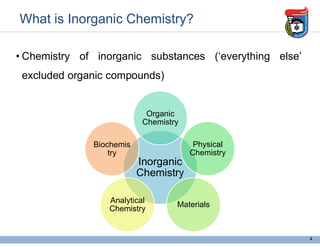
What is Inorganic Chemistry?
• Chemistry of inorganic substances (‘everything else’
excluded organic compounds)
4
Inorganic
Chemistry
Organic
Chemistry
Physical
Chemistry
Materials
Analytical
Chemistry
Biochemis
try
Outline
1. Introduction to Inorganic Chemistry
2. Atomic Structures
3. Molecular Structures & Bonding
5
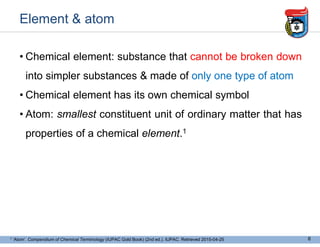
Element & atom
• Chemical element: substance that cannot be broken down
into simpler substances & made of only one type of atom
• Chemical element has its own chemical symbol
• Atom: smallest constituent unit of ordinary matter that has
properties of a chemical element.1
6
1 ‘Atom’. Compendium of Chemical Terminology (IUPAC Gold Book) (2nd ed.). IUPAC. Retrieved 2015-04-25
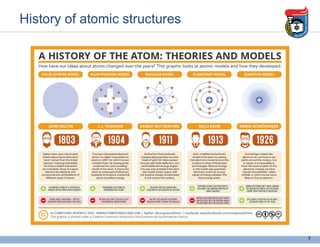
History of atomic structures
7
Atomic structure
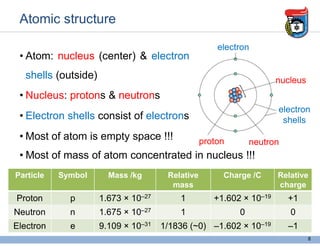
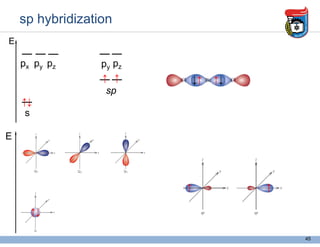
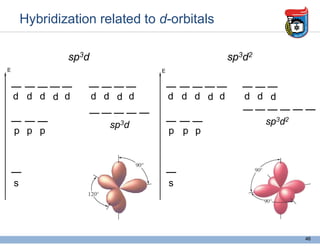
• Atom: nucleus (center) & electron
shells (outside)
• Nucleus: protons & neutrons
• Electron shells consist of electrons
• Most of atom is empty space !!!
8
nucleus
electron
shells
proton neutron
electron
Particle Symbol Mass /kg Relative
mass
Charge /C Relative
charge
Proton p 1.673 × 10⁻²⁷ 1 +1.602 × 10⁻¹⁹ +1
Neutron n 1.675 × 10⁻²⁷ 1 0 0
Electron e 9.109 × 10⁻³¹ 1/1836 (~0) –1.602 × 10⁻¹⁹ –1
• Most of mass of atom concentrated in nucleus !!!
Atomic & mass number
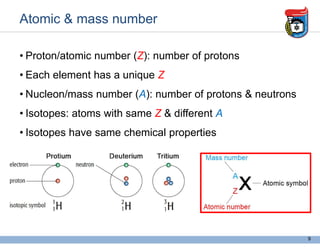
• Proton/atomic number (Z): number of protons
• Each element has a unique Z
• Nucleon/mass number (A): number of protons & neutrons
• Isotopes: atoms with same Z & different A
• Isotopes have same chemical properties
9
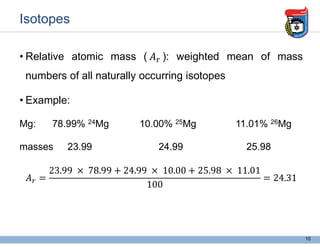
• Relative atomic mass ( ): weighted mean of mass
numbers of all naturally occurring isotopes
• Example:
Mg: 78.99% 24Mg 10.00% 25Mg 11.01% 26Mg
masses 23.99 24.99 25.98
Isotopes
10
Isotopes
11
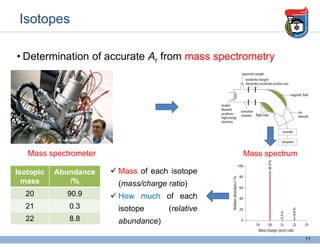
• Determination of accurate Ar from mass spectrometry
Mass spectrometer
 Mass of each isotope
(mass/charge ratio)
 How much of each
isotope (relative
abundance)
Isotopic
mass
Abundance
/%
20 90.9
21 0.3
22 8.8
Mass spectrum
Electronic structures of atoms
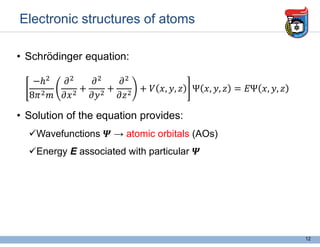
• Schrödinger equation:
• Solution of the equation provides:
Wavefunctions → atomic orbitals (AOs)
Energy E associated with particular
12
Why ?
AOs & Quantum Numbers
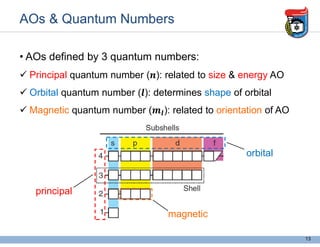
• AOs defined by 3 quantum numbers:
 Principal quantum number ( ): related to size & energy AO
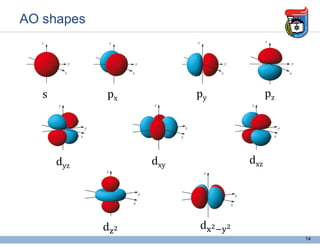
 Orbital quantum number ( ): determines shape of orbital
 Magnetic quantum number ( ): related to orientation of AO
13
principal
orbital
magnetic
AO shapes
14
Ground State Electronic Configuration
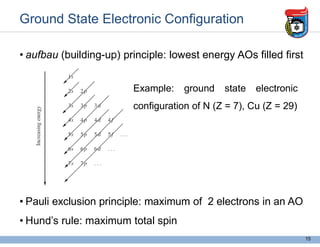
• aufbau (building-up) principle: lowest energy AOs filled first
• Pauli exclusion principle: maximum of 2 electrons in an AO
• Hund’s rule: maximum total spin
Example: ground state electronic
configuration of N (Z = 7), Cu (Z = 29)
15
Classic Periodic Table
16
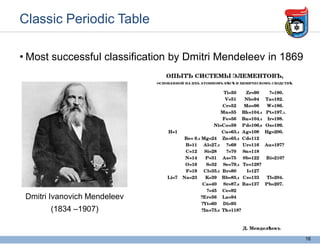
• Most successful classification by Dmitri Mendeleev in 1869
Dmitri Ivanovich Mendeleev
(1834 –1907)
Classic Periodic Table
17
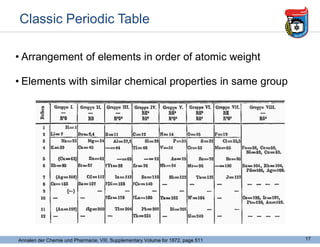
• Arrangement of elements in order of atomic weight
• Elements with similar chemical properties in same group
Annalen der Chemie und Pharmacie, VIII, Supplementary Volume for 1872, page 511
Modern Periodic Table
18
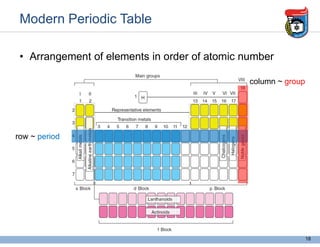
• Arrangement of elements in order of atomic number
row ~ period
column ~ group
The Periodic Table & Electronic Configuration
19
• Period: elements with same electron shells
• Period number: number of electron shells
• Group: elements with same valence electronic
configuration
• Group number: number of valence electrons with ‘1–18’ or
‘I – VIII’ numbering system
Outline
1. Introduction to Inorganic Chemistry
2. Atomic Structures
3. Molecular Structures & Bonding
20
Basic concepts
• A molecule is an electrically neutral group of two or more
atoms held together by chemical bonds.1
• Classification of chemical bonds:
Ionic bonds: electron transfer between atoms to form ions
Covalent bonds: electron sharing between atoms
Metallic bonds
21
1 ‘Molecule’. Compendium of Chemical Terminology (IUPAC Gold Book) (2nd ed.). IUPAC. Retrieved 2015-04-25
Molecular structure & Bonding
1. The Octet Rule
2. Lewis Diagram
3. Molecular Shapes & the VSEPR Model
4. Valence Bond (VB) theory
5. Molecular Orbital (MO) theory
22
The octet rule
• Atoms gain, lose or share electrons to give an outer shell
with 8 electrons (an octet)
• Elements in Period 2 strictly obey the octet rule
23
If atoms is not only 8 electron in outer
shell ?
The octet rule
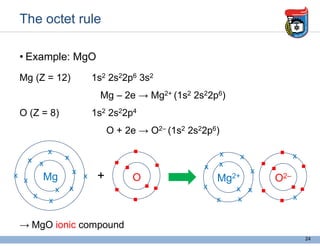
• Example: MgO
Mg (Z = 12) 1s2 2s22p6 3s2
Mg – 2e → Mg2+ (1s2 2s22p6)
O (Z = 8) 1s2 2s22p4
O + 2e → O2– (1s2 2s22p6)
→ MgO ionic compound
24
O
x
x
x
x
x
x
x Mg
x
x
x +
x
x
O2–
x
x
x
x
x
x
Mg2+
x
x
x
x
x
x
The octet rule
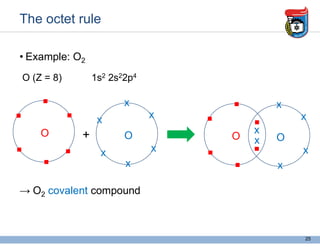
• Example: O2
O (Z = 8) 1s2 2s22p4
→ O2 covalent compound
25
O
x
x
x
x
x
x
O
+ O
x
x
x
x
x
x O
Molecular structure & Bonding
1. The Octet Rule
2. Lewis Diagram
3. Molecular Shapes & the VSEPR Model
4. Valence Bond (VB) theory
5. Molecular Orbital (MO) theory
26
Lewis Electron-dot Diagrams
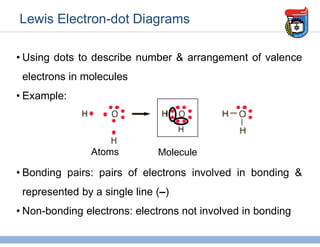
• Using dots to describe number & arrangement of valence
electrons in molecules
• Example:
• Bonding pairs: pairs of electrons involved in bonding &
represented by a single line (–)
• Non-bonding electrons: electrons not involved in bonding
Atoms Molecule
Lewis Electron-dot Diagrams
• Constructing Lewis structure:
1. Determine overal number of valence electrons
2. Write arrangement of atoms bonded together
3. Distribute electrons in pairs so that each atom has an octet
• Example: CO2, SCN–
28
Resonance structures
• More than one valid Lewis structure with a given atomic
arrangement → resonance structures
• Resonance indicated by double-headed arrow
• Actual structure ~ a resonance hybrid of all resonance
structures
• Example: CO3
2–
29
a given chemical formula
resonace structure describe the position of
elctrons in compound.
Higher electron counts
• Number of electrons around central atom over 8 →
expanded shell & hypervalent molecules
• Frequently observed for elements of 3rd & higher periods
due to the d orbitals
• Example: PCl5, SF6
30
Molecular structure & Bonding
1. The Octet Rule
2. Lewis Diagram
3. Molecular Shapes & the VSEPR Model
4. Valence Bond (VB) theory
5. Molecular Orbital (MO) theory
31
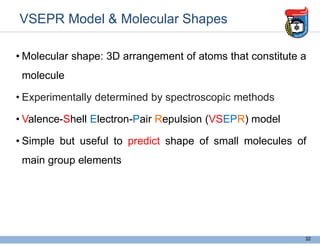
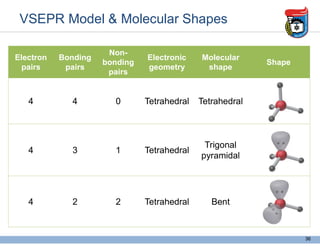
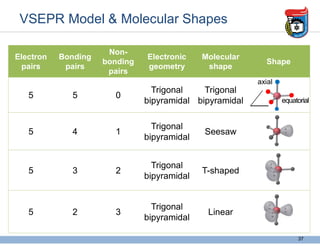
VSEPR Model & Molecular Shapes
• Molecular shape: 3D arrangement of atoms that constitute a
molecule
• Experimentally determined by spectroscopic methods
• Valence-Shell Electron-Pair Repulsion (VSEPR) model
• Simple but useful to predict shape of small molecules of
main group elements
32
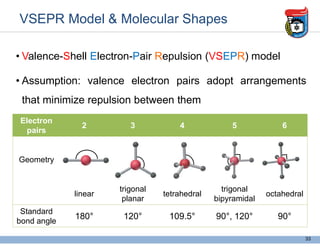
VSEPR Model & Molecular Shapes
• Valence-Shell Electron-Pair Repulsion (VSEPR) model
• Assumption: valence electron pairs adopt arrangements
that minimize repulsion between them
33
Electron
pairs
2 3 4 5 6
Geometry
linear
trigonal
planar
tetrahedral
trigonal
bipyramidal
octahedral
Standard
bond angle
180° 120° 109.5° 90°, 120° 90°
VSEPR Model & Molecular Shapes
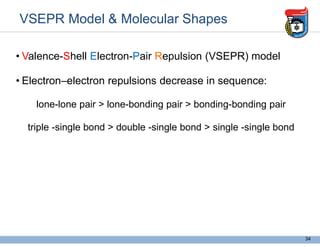
• Valence-Shell Electron-Pair Repulsion (VSEPR) model
• Electron–electron repulsions decrease in sequence:
lone-lone pair > lone-bonding pair > bonding-bonding pair
triple -single bond > double -single bond > single -single bond
34
VSEPR model describe the 3D shape in space so
of compound
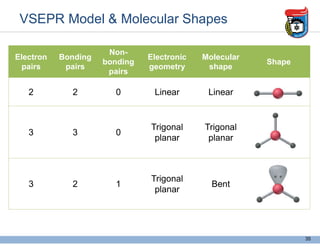
Electron
pairs
Bonding
pairs
Non-
bonding
pairs
Electronic
geometry
Molecular
shape
Shape
2 2 0 Linear Linear
3 3 0
Trigonal
planar
Trigonal
planar
3 2 1
Trigonal
planar
Bent
VSEPR Model & Molecular Shapes
35
Electron
pairs
Bonding
pairs
Non-
bonding
pairs
Electronic
geometry
Molecular
shape
Shape
4 4 0 Tetrahedral Tetrahedral
4 3 1 Tetrahedral
Trigonal
pyramidal
4 2 2 Tetrahedral Bent
VSEPR Model & Molecular Shapes
36
Electron
pairs
Bonding
pairs
Non-
bonding
pairs
Electronic
geometry
Molecular
shape
Shape
5 5 0
Trigonal
bipyramidal
Trigonal
bipyramidal
5 4 1
Trigonal
bipyramidal
Seesaw
5 3 2
Trigonal
bipyramidal
T-shaped
5 2 3
Trigonal
bipyramidal
Linear
VSEPR Model & Molecular Shapes
37
equatorial
axial
Electron
pairs
Bonding
pairs
Non-
bonding
pairs
Electronic
geometry
Molecular
shape
Shape
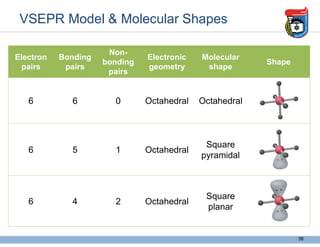
6 6 0 Octahedral Octahedral
6 5 1 Octahedral
Square
pyramidal
6 4 2 Octahedral
Square
planar
VSEPR Model & Molecular Shapes
38
Molecular structure & Bonding
1. The Octet Rule
2. Lewis Diagram
3. Molecular Shapes & the VSEPR Model
4. Valence Bond (VB) theory
5. Molecular Orbital (MO) theory
39
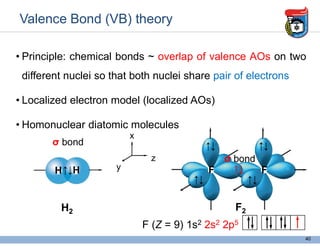
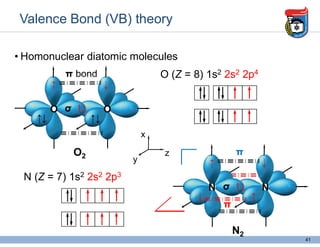
Valence Bond (VB) theory
• Principle: chemical bonds ~ overlap of valence AOs on two
different nuclei so that both nuclei share pair of electrons
• Localized electron model (localized AOs)
• Homonuclear diatomic molecules
40
x
y
z
↑↓
↑↓ ↑↓
↑↓ ↑↓
F F
σ bond
H H
↑↓
σ bond
H2 F2
F (Z = 9) 1s2 2s2 2p5
Valence Bond (VB) theory
• Homonuclear diatomic molecules
41
x
y
z
O (Z = 8) 1s2 2s2 2p4
O2
π bond
↑↓
↑↓ ↑↓
↑ ↓
O O
σ
N (Z = 7) 1s2 2s2 2p3
N2
π
↑↓
↓ ↑
↑ ↓
N N
σ
π
observe empty orbital
in atom and
VB theory & Hybridization of AOs
Polyatomic molecules – Hybridization of AOs
• Hybridization of AOs: combinations of AOs to
mathematically obtain new AOs for molecular shapes in
terms of σ-bonds
• Number of hybrid orbitals = number of AOs mixed
• Label of hybrid orbitals reflects contributing AOs
• Type of hybrid orbitals varies with types of AOs mixed
42
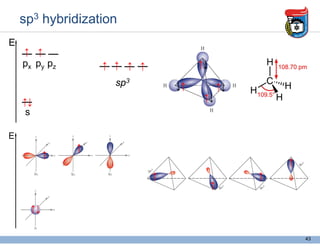
sp3 hybridization
↑↓
↑ ↑
↑ ↑ ↑ ↑
↑↓
↑
↑
↑
↑
↑
↑
↑↓
↓↑
↑↓
↑↓
s
px py pz
sp3
43
E
E
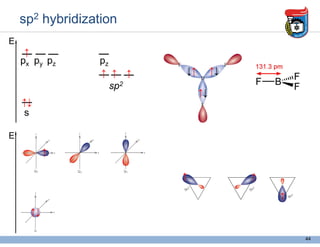
sp2 hybridization
↑↓
↑
↑ ↑ ↑
↑↓
↑
↑↓
↓↑
↑↓
↑ ↑
↑
s
px py pz
sp2
pz
44
E
E
sp hybridization
↑↓
↑ ↑
↑↓
s
px py pz
sp
pz
py
↑ ↑
↓↑ ↑↓
45
E
E
Hybridization related to d-orbitals
sp3d sp3d2
s
p p p
sp3d
d d d d
d d d d
d
s
p p p
sp3d2
d d d d
d d d d
46
E E
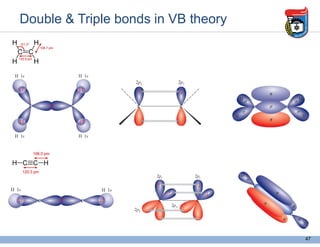
Double & Triple bonds in VB theory
C C
↓↑
↓↑
↓↑
↓↑
↓↑
↓↑ ↓↑
↓↑
↑
↑
↓
↓
↑ ↓
47
Molecular structure & Bonding
1. The Octet Rule
2. Lewis Diagram
3. Molecular Shapes & the VSEPR Model
4. Valence Bond (VB) theory
5. Molecular Orbital (MO) theory
48
Molecular Orbital (MO) theory
• Generalization AO description of atoms to MO description of
molecules
• MOs: space spread whole molecule, in which a single
electron can occupy → delocalized electron model
• Linear Combination of Atomic Orbital (LCAO) approximation
49
when 2 atom bond form bond, and valence atomic
orbital is wave function and the property of
wwave fuction is the same
when 2 atom bond form bond, and valence atomic
orbital is wave function and the property of
wwave fuction is the same
Molecular Orbital (MO) theory
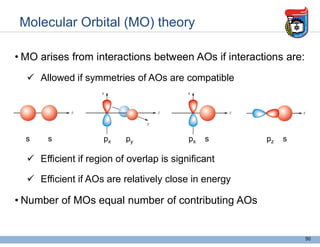
• MO arises from interactions between AOs if interactions are:
 Allowed if symmetries of AOs are compatible
 Efficient if region of overlap is significant
 Efficient if AOs are relatively close in energy
• Number of MOs equal number of contributing AOs
50
s s px py px s pz s
Molecular Orbital (MO) theory
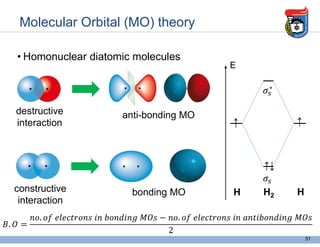
• Homonuclear diatomic molecules
destructive
interaction
↑↓
↑
H H
H2
51
E
anti-bonding MO
constructive
interaction
bonding MO
↑
Molecular Orbital (MO) theory
52
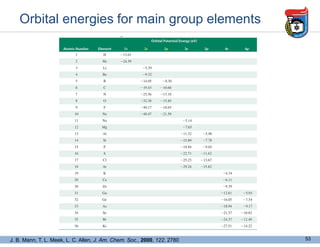
Orbital energies for main group elements
53
J. B. Mann, T. L. Meek, L. C. Allen, J. Am. Chem. Soc., 2000, 122, 2780
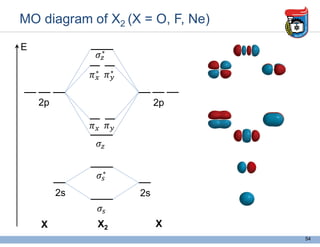
MO diagram of X2 (X = O, F, Ne)
X X
X2
2s 2s
2p 2p
54
E
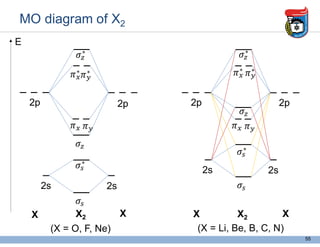
MO diagram of X2
X X
X2
2s 2s
2p 2p
2s 2s
2p 2p
X X
X2
55
E
(X = O, F, Ne) (X = Li, Be, B, C, N)
Molecular Orbital (MO) theory
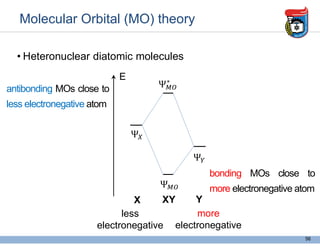
• Heteronuclear diatomic molecules
antibonding MOs close to
less electronegative atom
bonding MOs close to
more electronegative atom
56
X Y
XY
less
electronegative
more
electronegative
E
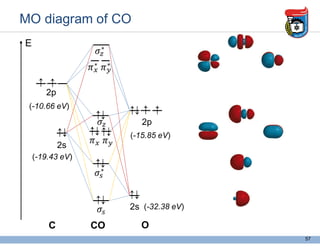
MO diagram of CO
2s
2s
2p
2p
C O
CO
(-32.38 eV)
(-15.85 eV)
(-10.66 eV)
(-19.43 eV)
↑↓
↑↓
↑↓
↑ ↑
↑ ↑
↑↓
↑↓
↑↓ ↑↓
↑↓
57
E
Molecular Orbital (MO) theory
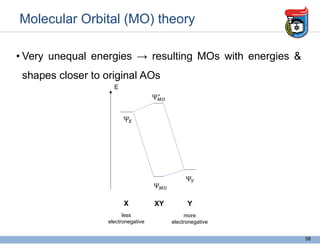
• Very unequal energies → resulting MOs with energies &
shapes closer to original AOs
58
∗
X Y
XY
E
less
electronegative
more
electronegative
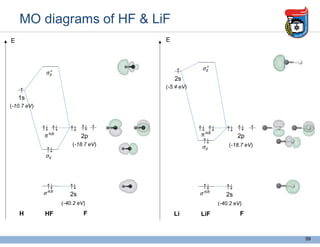
MO diagrams of HF & LiF
𝜎
𝜎
𝜎∗
𝜋
2s
1s
2p
H F
HF
(-40.2 eV)
(-18.7 eV)
(-10.7 eV)
↑↓
↑
↑↓ ↑↓ ↑
↑↓
↑↓ ↑↓
↑↓
𝜎
𝜎
𝜎∗
2s
2s
2p
Li F
LiF
(-40.2 eV)
(-18.7 eV)
(-5.4 eV)
↑↓
↑
↑↓ ↑↓ ↑
↑↓
↑↓ ↑↓
↑↓
𝜋
59
E
E

1. Atomic Structure_Chemical Bonding(1).pdf

  • 1.
    Some Foundations ofInorganic Chemistry Part 1 Assoc. Prof. Dr. Pham Chien Thang Department of Inorganic Chemistry
  • 2.
  • 3.
    Outline 1. Introduction toInorganic Chemistry 2. Atomic Structures 3. Molecular Structures & Bonding 3
  • 4.
    What is InorganicChemistry? • Chemistry of inorganic substances (‘everything else’ excluded organic compounds) 4 Inorganic Chemistry Organic Chemistry Physical Chemistry Materials Analytical Chemistry Biochemis try
  • 5.
    Outline 1. Introduction toInorganic Chemistry 2. Atomic Structures 3. Molecular Structures & Bonding 5
  • 6.
    Element & atom •Chemical element: substance that cannot be broken down into simpler substances & made of only one type of atom • Chemical element has its own chemical symbol • Atom: smallest constituent unit of ordinary matter that has properties of a chemical element.1 6 1 ‘Atom’. Compendium of Chemical Terminology (IUPAC Gold Book) (2nd ed.). IUPAC. Retrieved 2015-04-25
  • 7.
    History of atomicstructures 7
  • 8.
    Atomic structure • Atom:nucleus (center) & electron shells (outside) • Nucleus: protons & neutrons • Electron shells consist of electrons • Most of atom is empty space !!! 8 nucleus electron shells proton neutron electron Particle Symbol Mass /kg Relative mass Charge /C Relative charge Proton p 1.673 × 10⁻²⁷ 1 +1.602 × 10⁻¹⁹ +1 Neutron n 1.675 × 10⁻²⁷ 1 0 0 Electron e 9.109 × 10⁻³¹ 1/1836 (~0) –1.602 × 10⁻¹⁹ –1 • Most of mass of atom concentrated in nucleus !!!
  • 9.
    Atomic & massnumber • Proton/atomic number (Z): number of protons • Each element has a unique Z • Nucleon/mass number (A): number of protons & neutrons • Isotopes: atoms with same Z & different A • Isotopes have same chemical properties 9
  • 10.
    • Relative atomicmass ( ): weighted mean of mass numbers of all naturally occurring isotopes • Example: Mg: 78.99% 24Mg 10.00% 25Mg 11.01% 26Mg masses 23.99 24.99 25.98 Isotopes 10
  • 11.
    Isotopes 11 • Determination ofaccurate Ar from mass spectrometry Mass spectrometer  Mass of each isotope (mass/charge ratio)  How much of each isotope (relative abundance) Isotopic mass Abundance /% 20 90.9 21 0.3 22 8.8 Mass spectrum
  • 12.
    Electronic structures ofatoms • Schrödinger equation: • Solution of the equation provides: Wavefunctions → atomic orbitals (AOs) Energy E associated with particular 12 Why ?
  • 13.
    AOs & QuantumNumbers • AOs defined by 3 quantum numbers:  Principal quantum number ( ): related to size & energy AO  Orbital quantum number ( ): determines shape of orbital  Magnetic quantum number ( ): related to orientation of AO 13 principal orbital magnetic
  • 14.
  • 15.
    Ground State ElectronicConfiguration • aufbau (building-up) principle: lowest energy AOs filled first • Pauli exclusion principle: maximum of 2 electrons in an AO • Hund’s rule: maximum total spin Example: ground state electronic configuration of N (Z = 7), Cu (Z = 29) 15
  • 16.
    Classic Periodic Table 16 •Most successful classification by Dmitri Mendeleev in 1869 Dmitri Ivanovich Mendeleev (1834 –1907)
  • 17.
    Classic Periodic Table 17 •Arrangement of elements in order of atomic weight • Elements with similar chemical properties in same group Annalen der Chemie und Pharmacie, VIII, Supplementary Volume for 1872, page 511
  • 18.
    Modern Periodic Table 18 •Arrangement of elements in order of atomic number row ~ period column ~ group
  • 19.
    The Periodic Table& Electronic Configuration 19 • Period: elements with same electron shells • Period number: number of electron shells • Group: elements with same valence electronic configuration • Group number: number of valence electrons with ‘1–18’ or ‘I – VIII’ numbering system
  • 20.
    Outline 1. Introduction toInorganic Chemistry 2. Atomic Structures 3. Molecular Structures & Bonding 20
  • 21.
    Basic concepts • Amolecule is an electrically neutral group of two or more atoms held together by chemical bonds.1 • Classification of chemical bonds: Ionic bonds: electron transfer between atoms to form ions Covalent bonds: electron sharing between atoms Metallic bonds 21 1 ‘Molecule’. Compendium of Chemical Terminology (IUPAC Gold Book) (2nd ed.). IUPAC. Retrieved 2015-04-25
  • 22.
    Molecular structure &Bonding 1. The Octet Rule 2. Lewis Diagram 3. Molecular Shapes & the VSEPR Model 4. Valence Bond (VB) theory 5. Molecular Orbital (MO) theory 22
  • 23.
    The octet rule •Atoms gain, lose or share electrons to give an outer shell with 8 electrons (an octet) • Elements in Period 2 strictly obey the octet rule 23 If atoms is not only 8 electron in outer shell ?
  • 24.
    The octet rule •Example: MgO Mg (Z = 12) 1s2 2s22p6 3s2 Mg – 2e → Mg2+ (1s2 2s22p6) O (Z = 8) 1s2 2s22p4 O + 2e → O2– (1s2 2s22p6) → MgO ionic compound 24 O x x x x x x x Mg x x x + x x O2– x x x x x x Mg2+ x x x x x x
  • 25.
    The octet rule •Example: O2 O (Z = 8) 1s2 2s22p4 → O2 covalent compound 25 O x x x x x x O + O x x x x x x O
  • 26.
    Molecular structure &Bonding 1. The Octet Rule 2. Lewis Diagram 3. Molecular Shapes & the VSEPR Model 4. Valence Bond (VB) theory 5. Molecular Orbital (MO) theory 26
  • 27.
    Lewis Electron-dot Diagrams •Using dots to describe number & arrangement of valence electrons in molecules • Example: • Bonding pairs: pairs of electrons involved in bonding & represented by a single line (–) • Non-bonding electrons: electrons not involved in bonding Atoms Molecule
  • 28.
    Lewis Electron-dot Diagrams •Constructing Lewis structure: 1. Determine overal number of valence electrons 2. Write arrangement of atoms bonded together 3. Distribute electrons in pairs so that each atom has an octet • Example: CO2, SCN– 28
  • 29.
    Resonance structures • Morethan one valid Lewis structure with a given atomic arrangement → resonance structures • Resonance indicated by double-headed arrow • Actual structure ~ a resonance hybrid of all resonance structures • Example: CO3 2– 29 a given chemical formula resonace structure describe the position of elctrons in compound.
  • 30.
    Higher electron counts •Number of electrons around central atom over 8 → expanded shell & hypervalent molecules • Frequently observed for elements of 3rd & higher periods due to the d orbitals • Example: PCl5, SF6 30
  • 31.
    Molecular structure &Bonding 1. The Octet Rule 2. Lewis Diagram 3. Molecular Shapes & the VSEPR Model 4. Valence Bond (VB) theory 5. Molecular Orbital (MO) theory 31
  • 32.
    VSEPR Model &Molecular Shapes • Molecular shape: 3D arrangement of atoms that constitute a molecule • Experimentally determined by spectroscopic methods • Valence-Shell Electron-Pair Repulsion (VSEPR) model • Simple but useful to predict shape of small molecules of main group elements 32
  • 33.
    VSEPR Model &Molecular Shapes • Valence-Shell Electron-Pair Repulsion (VSEPR) model • Assumption: valence electron pairs adopt arrangements that minimize repulsion between them 33 Electron pairs 2 3 4 5 6 Geometry linear trigonal planar tetrahedral trigonal bipyramidal octahedral Standard bond angle 180° 120° 109.5° 90°, 120° 90°
  • 34.
    VSEPR Model &Molecular Shapes • Valence-Shell Electron-Pair Repulsion (VSEPR) model • Electron–electron repulsions decrease in sequence: lone-lone pair > lone-bonding pair > bonding-bonding pair triple -single bond > double -single bond > single -single bond 34 VSEPR model describe the 3D shape in space so of compound
  • 35.
    Electron pairs Bonding pairs Non- bonding pairs Electronic geometry Molecular shape Shape 2 2 0Linear Linear 3 3 0 Trigonal planar Trigonal planar 3 2 1 Trigonal planar Bent VSEPR Model & Molecular Shapes 35
  • 36.
    Electron pairs Bonding pairs Non- bonding pairs Electronic geometry Molecular shape Shape 4 4 0Tetrahedral Tetrahedral 4 3 1 Tetrahedral Trigonal pyramidal 4 2 2 Tetrahedral Bent VSEPR Model & Molecular Shapes 36
  • 37.
    Electron pairs Bonding pairs Non- bonding pairs Electronic geometry Molecular shape Shape 5 5 0 Trigonal bipyramidal Trigonal bipyramidal 54 1 Trigonal bipyramidal Seesaw 5 3 2 Trigonal bipyramidal T-shaped 5 2 3 Trigonal bipyramidal Linear VSEPR Model & Molecular Shapes 37 equatorial axial
  • 38.
    Electron pairs Bonding pairs Non- bonding pairs Electronic geometry Molecular shape Shape 6 6 0Octahedral Octahedral 6 5 1 Octahedral Square pyramidal 6 4 2 Octahedral Square planar VSEPR Model & Molecular Shapes 38
  • 39.
    Molecular structure &Bonding 1. The Octet Rule 2. Lewis Diagram 3. Molecular Shapes & the VSEPR Model 4. Valence Bond (VB) theory 5. Molecular Orbital (MO) theory 39
  • 40.
    Valence Bond (VB)theory • Principle: chemical bonds ~ overlap of valence AOs on two different nuclei so that both nuclei share pair of electrons • Localized electron model (localized AOs) • Homonuclear diatomic molecules 40 x y z ↑↓ ↑↓ ↑↓ ↑↓ ↑↓ F F σ bond H H ↑↓ σ bond H2 F2 F (Z = 9) 1s2 2s2 2p5
  • 41.
    Valence Bond (VB)theory • Homonuclear diatomic molecules 41 x y z O (Z = 8) 1s2 2s2 2p4 O2 π bond ↑↓ ↑↓ ↑↓ ↑ ↓ O O σ N (Z = 7) 1s2 2s2 2p3 N2 π ↑↓ ↓ ↑ ↑ ↓ N N σ π observe empty orbital in atom and
  • 42.
    VB theory &Hybridization of AOs Polyatomic molecules – Hybridization of AOs • Hybridization of AOs: combinations of AOs to mathematically obtain new AOs for molecular shapes in terms of σ-bonds • Number of hybrid orbitals = number of AOs mixed • Label of hybrid orbitals reflects contributing AOs • Type of hybrid orbitals varies with types of AOs mixed 42
  • 43.
    sp3 hybridization ↑↓ ↑ ↑ ↑↑ ↑ ↑ ↑↓ ↑ ↑ ↑ ↑ ↑ ↑ ↑↓ ↓↑ ↑↓ ↑↓ s px py pz sp3 43 E E
  • 44.
    sp2 hybridization ↑↓ ↑ ↑ ↑↑ ↑↓ ↑ ↑↓ ↓↑ ↑↓ ↑ ↑ ↑ s px py pz sp2 pz 44 E E
  • 45.
    sp hybridization ↑↓ ↑ ↑ ↑↓ s pxpy pz sp pz py ↑ ↑ ↓↑ ↑↓ 45 E E
  • 46.
    Hybridization related tod-orbitals sp3d sp3d2 s p p p sp3d d d d d d d d d d s p p p sp3d2 d d d d d d d d 46 E E
  • 47.
    Double & Triplebonds in VB theory C C ↓↑ ↓↑ ↓↑ ↓↑ ↓↑ ↓↑ ↓↑ ↓↑ ↑ ↑ ↓ ↓ ↑ ↓ 47
  • 48.
    Molecular structure &Bonding 1. The Octet Rule 2. Lewis Diagram 3. Molecular Shapes & the VSEPR Model 4. Valence Bond (VB) theory 5. Molecular Orbital (MO) theory 48
  • 49.
    Molecular Orbital (MO)theory • Generalization AO description of atoms to MO description of molecules • MOs: space spread whole molecule, in which a single electron can occupy → delocalized electron model • Linear Combination of Atomic Orbital (LCAO) approximation 49 when 2 atom bond form bond, and valence atomic orbital is wave function and the property of wwave fuction is the same when 2 atom bond form bond, and valence atomic orbital is wave function and the property of wwave fuction is the same
  • 50.
    Molecular Orbital (MO)theory • MO arises from interactions between AOs if interactions are:  Allowed if symmetries of AOs are compatible  Efficient if region of overlap is significant  Efficient if AOs are relatively close in energy • Number of MOs equal number of contributing AOs 50 s s px py px s pz s
  • 51.
    Molecular Orbital (MO)theory • Homonuclear diatomic molecules destructive interaction ↑↓ ↑ H H H2 51 E anti-bonding MO constructive interaction bonding MO ↑
  • 52.
  • 53.
    Orbital energies formain group elements 53 J. B. Mann, T. L. Meek, L. C. Allen, J. Am. Chem. Soc., 2000, 122, 2780
  • 54.
    MO diagram ofX2 (X = O, F, Ne) X X X2 2s 2s 2p 2p 54 E
  • 55.
    MO diagram ofX2 X X X2 2s 2s 2p 2p 2s 2s 2p 2p X X X2 55 E (X = O, F, Ne) (X = Li, Be, B, C, N)
  • 56.
    Molecular Orbital (MO)theory • Heteronuclear diatomic molecules antibonding MOs close to less electronegative atom bonding MOs close to more electronegative atom 56 X Y XY less electronegative more electronegative E
  • 57.
    MO diagram ofCO 2s 2s 2p 2p C O CO (-32.38 eV) (-15.85 eV) (-10.66 eV) (-19.43 eV) ↑↓ ↑↓ ↑↓ ↑ ↑ ↑ ↑ ↑↓ ↑↓ ↑↓ ↑↓ ↑↓ 57 E
  • 58.
    Molecular Orbital (MO)theory • Very unequal energies → resulting MOs with energies & shapes closer to original AOs 58 ∗ X Y XY E less electronegative more electronegative
  • 59.
    MO diagrams ofHF & LiF 𝜎 𝜎 𝜎∗ 𝜋 2s 1s 2p H F HF (-40.2 eV) (-18.7 eV) (-10.7 eV) ↑↓ ↑ ↑↓ ↑↓ ↑ ↑↓ ↑↓ ↑↓ ↑↓ 𝜎 𝜎 𝜎∗ 2s 2s 2p Li F LiF (-40.2 eV) (-18.7 eV) (-5.4 eV) ↑↓ ↑ ↑↓ ↑↓ ↑ ↑↓ ↑↓ ↑↓ ↑↓ 𝜋 59 E E