DATA TYPES
SANJAI D
2313212027014
Data Types in Java
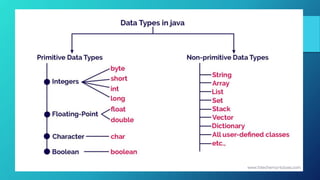
Data types specify the different sizes and values that can be stored in
the variable.
There are two types of data types in Java:
Primitive data types: The primitive data types include boolean,
char, byte, short, int, long, float and double.
Non-primitive data types: The non-primitive data types
include Classes, Interfaces, and Arrays.
Java Primitive Data Types
In Java language, primitive data
types are the building blocks of
data manipulation. These are the
most basic data types available
in java language.
There are 8 types of primitive data
types:
 boolean data type
 byte data type
 char data type
 short data type
 int data type
 long data type
 float data type
 double data type
Boolean Data Type
The Boolean data type is used to store only two possible values: true
and false. This data type is used for simple flags that track true/false
conditions.
Example:
Boolean one = false
Example - 1
public class Main
{
public static void main(String[] args)
{
int myAge = 25;
int votingAge = 18;
System.out.println(myAge >= votingAge);
// returns true (25 year olds are allowed to vote!)
}
}
Output:
true
Byte Data Type
The byte data type is an example of primitive data type. It is an 8-bit
signed two's complement integer. Its value-range lies between -128 to
127.
Its minimum value is -128 and maximum value is 127. Its default
value is 0.
Example:
byte a = 10, byte b = -20
Example - 1
public class Main
{
public static void main(String[] args)
{
byte myNum = 100;
System.out.println(myNum);
}
}
Output:
100
Short Data Type
The short data type is a 16-bit signed two's complement integer. Its
value-range lies between -32,768 to 32,767 .
Its minimum value is -32,768 and maximum value is 32,767. Its default
value is 0.
The short data type can also be used to save memory just like byte
data type. A short data type is 2 times smaller than an integer.
Example:
short s = 10000, short r = -5000
Example - 1
public class Main
{
public static void main(String[] args)
{
short myNum = 5000;
System.out.println(myNum);
}
}
Output:
5000
Int Data Type
The int data type is a 32-bit signed two's complement integer. Its
value-range lies between - 2,147,483,648 to 2,147,483,647.
Its minimum value is - 2,147,483,648 and maximum value is
2,147,483,647. Its default value is 0.
Example:
int a = 100000, int b = -200000
Example - 1
public class Main
{
public static void main(String[] args)
{
int myNum = 100000;
System.out.println(myNum);
}
}
Output:
100000
Long Data Type
The long data type is a 64-bit two's complement integer. Its value-
range lies between -9,223,372,036,854,775,808 to
9,223,372,036,854,775,807.
Its default value is 0. The long data type is used when you
need a range of values more than those provided by int.
Example:
long a = 100000L, long b = -200000L
Example - 1
public class Main
{
public static void main(String[] args)
{
long myNum = 15000000000L;
System.out.println(myNum);
}
}
Output:
15000000000
Float Data Type
The float data type is a single-precision 32-bit floating point. Its
value range is unlimited. It is recommended to use a float if you need to save
memory in large arrays of floating point numbers.
The float data type should never be used for precise values, such as
currency. Its default value is 0.0F.
Example:
float f1 = 234.5f
Example - 1
public class Main
{
public static void main(String[] args)
{
float myNum = 5.75f;
System.out.println(myNum);
}
}
Output:
5.75
Char Data Type
The char data type is a single 16-bit Unicode character. Its value-
range lies between 'u0000' (or 0) to 'uffff'.
The char data type is used to store characters.
Example:
char letterA = 'A'
Example - 1
public class Main
{
public static void main(String[] args)
{
char myGrade = 'B';
System.out.println(my Grade);
}
}
Output:
B
Double Data Type
The double data type is a double-precision 64-bit floating point. Its
value range is unlimited. The double data type is generally used for decimal
values just like float.
The double data type also should never be used for precise values,
such as currency. Its default value is 0.0d.
Example:
double d1 = 12.3
Example - 1
public class Main
{
public static void main(String[] args)
{
double myNum = 19.99d;
System.out.println(myNum);
}
}
Output:
19.99
THANK YOU

DATA TYPES in Python done by Sanajai of MCA

  • 1.
  • 2.
    Data Types inJava Data types specify the different sizes and values that can be stored in the variable. There are two types of data types in Java: Primitive data types: The primitive data types include boolean, char, byte, short, int, long, float and double. Non-primitive data types: The non-primitive data types include Classes, Interfaces, and Arrays.
  • 3.
    Java Primitive DataTypes In Java language, primitive data types are the building blocks of data manipulation. These are the most basic data types available in java language. There are 8 types of primitive data types:  boolean data type  byte data type  char data type  short data type  int data type  long data type  float data type  double data type
  • 6.
    Boolean Data Type TheBoolean data type is used to store only two possible values: true and false. This data type is used for simple flags that track true/false conditions. Example: Boolean one = false
  • 7.
    Example - 1 publicclass Main { public static void main(String[] args) { int myAge = 25; int votingAge = 18; System.out.println(myAge >= votingAge); // returns true (25 year olds are allowed to vote!) } } Output: true
  • 8.
    Byte Data Type Thebyte data type is an example of primitive data type. It is an 8-bit signed two's complement integer. Its value-range lies between -128 to 127. Its minimum value is -128 and maximum value is 127. Its default value is 0. Example: byte a = 10, byte b = -20
  • 9.
    Example - 1 publicclass Main { public static void main(String[] args) { byte myNum = 100; System.out.println(myNum); } } Output: 100
  • 10.
    Short Data Type Theshort data type is a 16-bit signed two's complement integer. Its value-range lies between -32,768 to 32,767 . Its minimum value is -32,768 and maximum value is 32,767. Its default value is 0. The short data type can also be used to save memory just like byte data type. A short data type is 2 times smaller than an integer. Example: short s = 10000, short r = -5000
  • 11.
    Example - 1 publicclass Main { public static void main(String[] args) { short myNum = 5000; System.out.println(myNum); } } Output: 5000
  • 12.
    Int Data Type Theint data type is a 32-bit signed two's complement integer. Its value-range lies between - 2,147,483,648 to 2,147,483,647. Its minimum value is - 2,147,483,648 and maximum value is 2,147,483,647. Its default value is 0. Example: int a = 100000, int b = -200000
  • 13.
    Example - 1 publicclass Main { public static void main(String[] args) { int myNum = 100000; System.out.println(myNum); } } Output: 100000
  • 14.
    Long Data Type Thelong data type is a 64-bit two's complement integer. Its value- range lies between -9,223,372,036,854,775,808 to 9,223,372,036,854,775,807. Its default value is 0. The long data type is used when you need a range of values more than those provided by int. Example: long a = 100000L, long b = -200000L
  • 15.
    Example - 1 publicclass Main { public static void main(String[] args) { long myNum = 15000000000L; System.out.println(myNum); } } Output: 15000000000
  • 16.
    Float Data Type Thefloat data type is a single-precision 32-bit floating point. Its value range is unlimited. It is recommended to use a float if you need to save memory in large arrays of floating point numbers. The float data type should never be used for precise values, such as currency. Its default value is 0.0F. Example: float f1 = 234.5f
  • 17.
    Example - 1 publicclass Main { public static void main(String[] args) { float myNum = 5.75f; System.out.println(myNum); } } Output: 5.75
  • 18.
    Char Data Type Thechar data type is a single 16-bit Unicode character. Its value- range lies between 'u0000' (or 0) to 'uffff'. The char data type is used to store characters. Example: char letterA = 'A'
  • 19.
    Example - 1 publicclass Main { public static void main(String[] args) { char myGrade = 'B'; System.out.println(my Grade); } } Output: B
  • 20.
    Double Data Type Thedouble data type is a double-precision 64-bit floating point. Its value range is unlimited. The double data type is generally used for decimal values just like float. The double data type also should never be used for precise values, such as currency. Its default value is 0.0d. Example: double d1 = 12.3
  • 21.
    Example - 1 publicclass Main { public static void main(String[] args) { double myNum = 19.99d; System.out.println(myNum); } } Output: 19.99
  • 22.