Michal Malohlava Java 7 : Quo vadis? DISTRIBUTED SYSTEMS RESEARCH GROUP http://dsrg.mff.cuni.cz/ CHARLES  UNIVERSITY IN PRAGUE Faculty of Mathematics and Physics
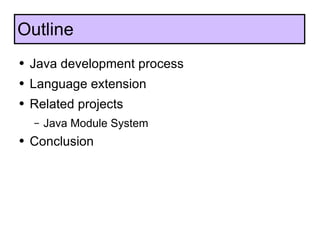
Java development process Language extension Related projects Java Module System Conclusion Outline
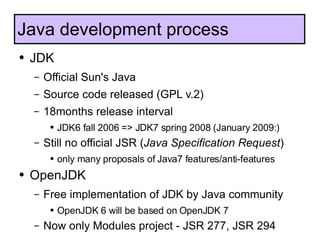
JDK  Official Sun's Java Source code released (GPL v.2) 18months release interval JDK6 fall 2006 => JDK7 spring 2008 (January 2009:) Still no official JSR ( Java Specification Request ) only many proposals of Java7 features/anti-features OpenJDK Free implementation of JDK by Java community OpenJDK 6 will be based on OpenJDK 7 Now only Modules project - JSR 277, JSR 294 Java development process
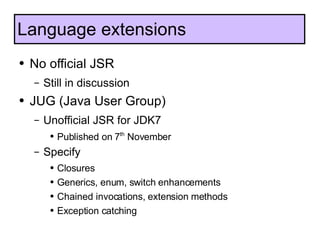
No official JSR Still in discussion JUG (Java User Group) Unofficial JSR for JDK7 Published on 7 th  November Specify Closures Generics, enum, switch enhancements Chained invocations, extension methods Exception catching Language extensions
Generics Constructors without duplicate declaration Map<String, List<String>> anagrams = new HashMap<>(); instead of Map<String, List<String>> anagrams = new HashMap<String, List<String>>();  Generics are not still covariant! List<Integer> li = new ArrayList<Integer>();  List<Number> ln = li; // illegal ln.add(new Float(3.1415)); // legal More type safe packages JDK 5: static Object newInstance(Class<?> componentType, int size) Because of backward compatibility JDK 5,7: static<T> T[] newInstance(Class<T> componentType, int size) More type-safe, can be called Array.<String>newInstance(String.class, 10) Inference of method arguments static<E> Set<E> emptySet(); void print(Set<Man> men) {...} Call: print(Collection.emptySet()) // in JDK5,6 is necessary to explicitly specify which method should be called: Collection.<Man>emptySet(); Template type information available at runtime Lang. Ext. - JUG proposal
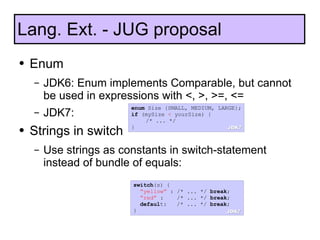
Enum JDK6: Enum  implements Comparable, but cannot be used in expressions with <, >, >=, <= JDK7:  Strings in switch Use strings as constants in switch-statement instead of bundle of equals: Lang. Ext. - JUG proposal enum  Size {SMALL, MEDIUM, LARGE}; if  (mySize  <  yourSize) {  /* ... */  } switch (s) { “ yellow”  : /* ... */  break ; “ red”  :  /* ... */  break ; defaul t:  /* ... */  break ; } JDK7 JDK7
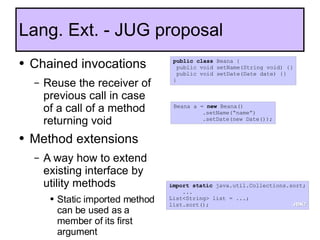
Chained invocations  Reuse the receiver of previous call in case of a call of a method returning void Method extensions A way how to extend existing interface by utility methods  Static imported method can be used as a member of its first argument  Lang. Ext. - JUG proposal public   class  Beana { public void setName(String void) {} public void setDate(Date date) {} } Beana a =  new  Beana() .setName(“name”) .setDate(new Date()); import   static  java.util.Collections.sort; ... List<String> list = ...; list.sort(); JDK7
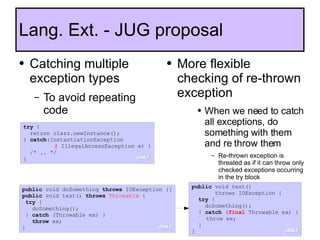
Catching multiple exception types To avoid repeating code Lang. Ext. - JUG proposal More flexible checking of re-thrown exception When we need to catch all exceptions, do something with them and re throw them Re-thrown exception is threated as if it can throw only checked exceptions occurring in the try block public  void test()  throws IOException {   try  { doSomething(); }  catch  ( final  Throwable ex) { throw ex; } } try  { return clazz.newInstance(); }  catch (InstantiationException    |  IllegalAccessException e) { /* .. */ } public  void doSomething  throws  IOException {} public  void test()  throws   Throwable  { try  { doSomething(); }  catch  (Throwable ex) } throw  ex; } JDK7 JDK7 JDK5
Creation of XML fragments XML embedded in Java code <tag> or #tag Data coders in according to XSD date/time XPath language support Lang. Ext. - XML lang. support public  void addMember(XML xml, String name,  Integer age) { xml.addChild(<member> <name> {  name  } </name> <age> {  26  } </age> </member>); } public  void makeYounger(XML fs, Integer newAge)   { List<XML> l = fs.findAll(“member[age>25]”); for (XML a : l) {   a.get(“age”).set(newAge); } } JDK7 JDK7
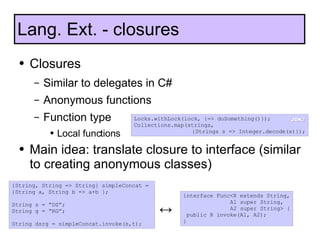
Closures Similar to delegates in C# Anonymous functions Function type Local functions Main idea: translate closure to interface (similar to creating anonymous classes) Lang. Ext. - closures {String, String => String} simpleConcat =  {String a, String b => a+b }; String s = “DS”; String g = “RG”; String dsrg = simpleConcat.invoke(s,t); interface Func<R extends String,  A1 super String,  A2 super String> { public R invoke(A1, A2); } ↔ Locks.withLock(lock, {=> doSomething()}); Collections.map(strings,  {Strings s => Integer.decode(s)}); JDK7
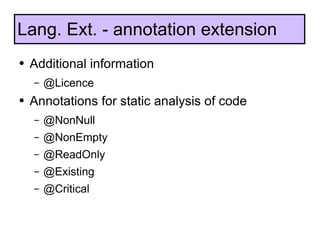
Additional information @Licence Annotations for static analysis of code @NonNull @NonEmpty @ReadOnly @Existing @Critical Lang. Ext. - annotation extension
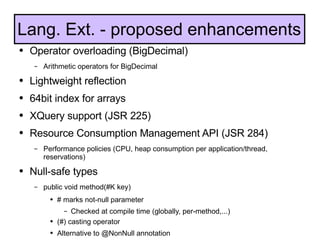
Operator overloading (BigDecimal) Arithmetic operators for BigDecimal Lightweight reflection 64bit index for arrays XQuery support (JSR 225) Resource Consumption Management API (JSR 284) Performance policies (CPU, heap consumption per application/thread, reservations) Null-safe types public void method(#K key) # marks not-null parameter Checked at compile time (globally, per-method,...) (#) casting operator Alternative to @NonNull annotation Lang. Ext. - proposed enhancements
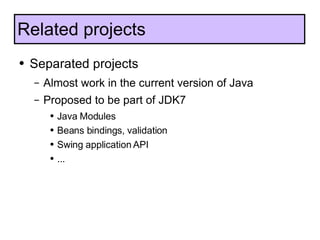
Separated projects Almost work in the current version of Java Proposed to be part of JDK7 Java Modules Beans bindings, validation Swing application API ... Related projects
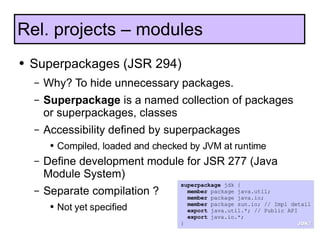
Superpackages (JSR 294) Why? To hide unnecessary packages. Superpackage  is a named collection of packages or superpackages, classes Accessibility defined by superpackages Compiled, loaded and checked by JVM at runtime Define development module for JSR 277 (Java Module System) Separate compilation ? Not yet specified Rel. projects – modules superpackage  jdk { member  package java.util; member  package java.io; member  package sun.io; // Impl detail export  java.util.*; // Public API export  java.io.*; } JDK7
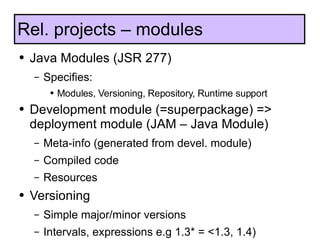
Java Modules (JSR 277) Specifies:  Modules, Versioning, Repository, Runtime support Development module (=superpackage) => deployment module (JAM – Java Module) Meta-info (generated from devel. module) Compiled code Resources Versioning Simple major/minor versions Intervals, expressions e.g 1.3* = <1.3, 1.4) Rel. projects – modules
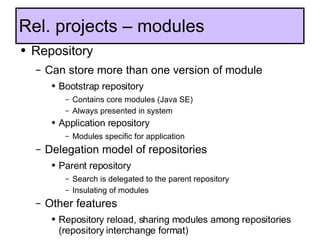
Rel. projects – modules Repository Can store more than one version of module Bootstrap repository Contains core modules (Java SE) Always presented in system Application repository Modules specific for application Delegation model of repositories Parent repository Search is delegated to the parent repository Insulating of modules Other features Repository reload, sharing modules among repositories (repository interchange format) Changed classloading
OSGi and JAM Comparison – special seminar  Rel. projects – modules and OSGi
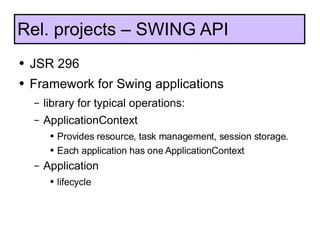
JSR 296 Framework for Swing applications library for typical operations: ApplicationContext Provides resource, task management, session storage. Each application has one ApplicationContext Application lifecycle Rel. projects – SWING API
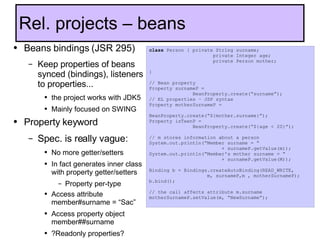
Beans bindings (JSR 295) Keep properties of beans synced (bindings), listeners to properties... the project works with JDK5 Mainly focused on SWING Property keyword  Spec. is really vague: No more getter/setters In fact generates inner class with property getter/setters Property per-type Access attribute member#surname = “Sac” Access property object member##surname  ?Readonly properties? Rel. projects – beans class  Person { private String surname;    private Integer age;   private Person mother;   } // Bean property Property surnameP =  BeanProperty.create(“surname”); // EL properties – JSP syntax Property motherSurnameP =  BeanProperty.create(“${mother.surname}”); Property isTeenP =  BeanProperty.create(“${age < 20}”); // m stores information about a person System.out.println(“Member surname = “  + surnameP.getValue(m)); System.out.println(“Member's mother surname = “  + surnameP.getValue(M)); Binding b = Bindings.createAutoBinding(READ_WRITE, m, surnameP,m , motherSurnameP); b.bind(); // the call affects attribute m.surname motherSurnameP.setValue(m, “NewSurname”);
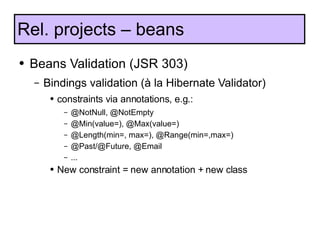
Beans Validation (JSR 303) Bindings validation ( à  la Hibernate Validator) constraints via annotations, e.g.: @NotNull, @NotEmpty @Min(value=), @Max(value=) @Length(min=, max=), @Range(min=,max=) @Past/@Future, @Email  ... New constraint = new annotation + new class Rel. projects – beans
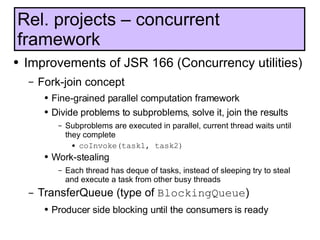
Improvements of JSR 166 (Concurrency utilities) Fork-join concept Fine-grained parallel computation framework Divide problems to subproblems, solve it, join the results Subproblems are executed in parallel, current thread waits until they complete coInvoke(task1, task2) Work-stealing Each thread has deque of tasks, instead of sleeping try to steal and execute a task from other busy threads TransferQueue (type of  BlockingQueue ) Producer side blocking until the consumers is ready Rel. projects – concurrent framework
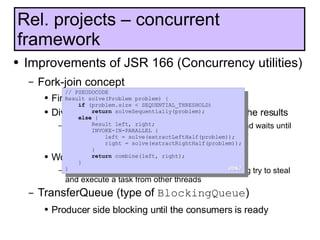
Improvements of JSR 166 (Concurrency utilities) Fork-join concept Fine-grained parallel computation framework Divide problems to subproblems, solve it, join the results Subproblems are executed in parallel, current thread waits until they complete coInvoke(task1, task2) Work-stealing Each thread has deque of tasks, instead of sleeping try to steal and execute a task from other threads TransferQueue (type of  BlockingQueue ) Producer side blocking until the consumers is ready Rel. projects – concurrent framework // PSEUDOCODE Result solve(Problem problem) {  if  (problem.size < SEQUENTIAL_THRESHOLD) return  solveSequentially(problem); else  { Result left, right; INVOKE-IN-PARALLEL {  left = solve(extractLeftHalf(problem)); right = solve(extractRightHalf(problem)); } return  combine(left, right); } } JDK7
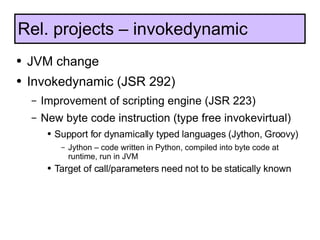
JVM change Invokedynamic (JSR 292) Improvement of scripting engine (JSR 223) New byte code instruction (type free invokevirtual) Support for dynamically typed languages (Jython, Groovy) Jython – code written in Python, compiled into byte code at runtime, run in JVM Target of call/parameters need not to be statically known Rel. projects – invokedynamic
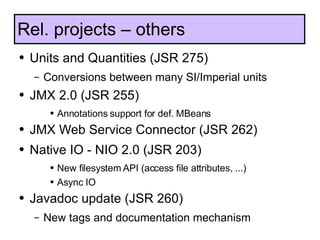
Units and Quantities (JSR 275) Conversions between many SI/Imperial units JMX 2.0 (JSR 255) Annotations support for def. MBeans JMX Web Service Connector (JSR 262) Native IO - NIO 2.0 (JSR 203) New filesystem API (access file attributes, ...) Async IO Javadoc update (JSR 260) New tags and documentation mechanism Rel. projects – others
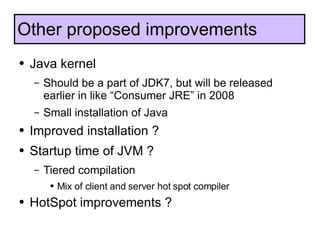
Java kernel Should be a part of JDK7, but will be released earlier in like “Consumer JRE” in 2008 Small installation of Java Improved installation ? Startup time of JVM ? Tiered compilation Mix of client and server hot spot compiler HotSpot improvements ? Other proposed improvements
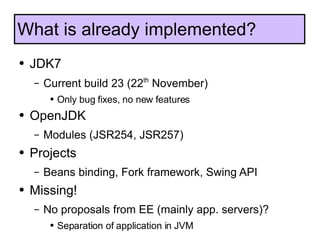
JDK7 Current build 23 (22 th  November) Only bug fixes, no new features OpenJDK Modules (JSR254, JSR257) Projects Beans binding, Fork framework, Swing API Missing! No proposals from EE (mainly app. servers)? Separation of application in JVM What is already implemented?
Java module system How will it cooperate with OSGi? Java kernel Annotations Static analysis of code How will Google's Android affect Sun's Java? Important for us
Sun JDK7 Project https://jdk7.dev.java.net/ OpenJDK http://openjdk.java.net/ Overview of Java 7 (updated) http://tech.puredanger.com/java7 Links

Java 7: Quo vadis?

  • 1.
    Michal Malohlava Java7 : Quo vadis? DISTRIBUTED SYSTEMS RESEARCH GROUP http://dsrg.mff.cuni.cz/ CHARLES UNIVERSITY IN PRAGUE Faculty of Mathematics and Physics
  • 2.
    Java development processLanguage extension Related projects Java Module System Conclusion Outline
  • 3.
    JDK OfficialSun's Java Source code released (GPL v.2) 18months release interval JDK6 fall 2006 => JDK7 spring 2008 (January 2009:) Still no official JSR ( Java Specification Request ) only many proposals of Java7 features/anti-features OpenJDK Free implementation of JDK by Java community OpenJDK 6 will be based on OpenJDK 7 Now only Modules project - JSR 277, JSR 294 Java development process
  • 4.
    No official JSRStill in discussion JUG (Java User Group) Unofficial JSR for JDK7 Published on 7 th November Specify Closures Generics, enum, switch enhancements Chained invocations, extension methods Exception catching Language extensions
  • 5.
    Generics Constructors withoutduplicate declaration Map<String, List<String>> anagrams = new HashMap<>(); instead of Map<String, List<String>> anagrams = new HashMap<String, List<String>>(); Generics are not still covariant! List<Integer> li = new ArrayList<Integer>(); List<Number> ln = li; // illegal ln.add(new Float(3.1415)); // legal More type safe packages JDK 5: static Object newInstance(Class<?> componentType, int size) Because of backward compatibility JDK 5,7: static<T> T[] newInstance(Class<T> componentType, int size) More type-safe, can be called Array.<String>newInstance(String.class, 10) Inference of method arguments static<E> Set<E> emptySet(); void print(Set<Man> men) {...} Call: print(Collection.emptySet()) // in JDK5,6 is necessary to explicitly specify which method should be called: Collection.<Man>emptySet(); Template type information available at runtime Lang. Ext. - JUG proposal
  • 6.
    Enum JDK6: Enum implements Comparable, but cannot be used in expressions with <, >, >=, <= JDK7: Strings in switch Use strings as constants in switch-statement instead of bundle of equals: Lang. Ext. - JUG proposal enum Size {SMALL, MEDIUM, LARGE}; if (mySize < yourSize) { /* ... */ } switch (s) { “ yellow” : /* ... */ break ; “ red” : /* ... */ break ; defaul t: /* ... */ break ; } JDK7 JDK7
  • 7.
    Chained invocations Reuse the receiver of previous call in case of a call of a method returning void Method extensions A way how to extend existing interface by utility methods Static imported method can be used as a member of its first argument Lang. Ext. - JUG proposal public class Beana { public void setName(String void) {} public void setDate(Date date) {} } Beana a = new Beana() .setName(“name”) .setDate(new Date()); import static java.util.Collections.sort; ... List<String> list = ...; list.sort(); JDK7
  • 8.
    Catching multiple exceptiontypes To avoid repeating code Lang. Ext. - JUG proposal More flexible checking of re-thrown exception When we need to catch all exceptions, do something with them and re throw them Re-thrown exception is threated as if it can throw only checked exceptions occurring in the try block public void test() throws IOException { try { doSomething(); } catch ( final Throwable ex) { throw ex; } } try { return clazz.newInstance(); } catch (InstantiationException | IllegalAccessException e) { /* .. */ } public void doSomething throws IOException {} public void test() throws Throwable { try { doSomething(); } catch (Throwable ex) } throw ex; } JDK7 JDK7 JDK5
  • 9.
    Creation of XMLfragments XML embedded in Java code <tag> or #tag Data coders in according to XSD date/time XPath language support Lang. Ext. - XML lang. support public void addMember(XML xml, String name, Integer age) { xml.addChild(<member> <name> { name } </name> <age> { 26 } </age> </member>); } public void makeYounger(XML fs, Integer newAge) { List<XML> l = fs.findAll(“member[age>25]”); for (XML a : l) { a.get(“age”).set(newAge); } } JDK7 JDK7
  • 10.
    Closures Similar todelegates in C# Anonymous functions Function type Local functions Main idea: translate closure to interface (similar to creating anonymous classes) Lang. Ext. - closures {String, String => String} simpleConcat = {String a, String b => a+b }; String s = “DS”; String g = “RG”; String dsrg = simpleConcat.invoke(s,t); interface Func<R extends String, A1 super String, A2 super String> { public R invoke(A1, A2); } ↔ Locks.withLock(lock, {=> doSomething()}); Collections.map(strings, {Strings s => Integer.decode(s)}); JDK7
  • 11.
    Additional information @LicenceAnnotations for static analysis of code @NonNull @NonEmpty @ReadOnly @Existing @Critical Lang. Ext. - annotation extension
  • 12.
    Operator overloading (BigDecimal)Arithmetic operators for BigDecimal Lightweight reflection 64bit index for arrays XQuery support (JSR 225) Resource Consumption Management API (JSR 284) Performance policies (CPU, heap consumption per application/thread, reservations) Null-safe types public void method(#K key) # marks not-null parameter Checked at compile time (globally, per-method,...) (#) casting operator Alternative to @NonNull annotation Lang. Ext. - proposed enhancements
  • 13.
    Separated projects Almostwork in the current version of Java Proposed to be part of JDK7 Java Modules Beans bindings, validation Swing application API ... Related projects
  • 14.
    Superpackages (JSR 294)Why? To hide unnecessary packages. Superpackage is a named collection of packages or superpackages, classes Accessibility defined by superpackages Compiled, loaded and checked by JVM at runtime Define development module for JSR 277 (Java Module System) Separate compilation ? Not yet specified Rel. projects – modules superpackage jdk { member package java.util; member package java.io; member package sun.io; // Impl detail export java.util.*; // Public API export java.io.*; } JDK7
  • 15.
    Java Modules (JSR277) Specifies: Modules, Versioning, Repository, Runtime support Development module (=superpackage) => deployment module (JAM – Java Module) Meta-info (generated from devel. module) Compiled code Resources Versioning Simple major/minor versions Intervals, expressions e.g 1.3* = <1.3, 1.4) Rel. projects – modules
  • 16.
    Rel. projects –modules Repository Can store more than one version of module Bootstrap repository Contains core modules (Java SE) Always presented in system Application repository Modules specific for application Delegation model of repositories Parent repository Search is delegated to the parent repository Insulating of modules Other features Repository reload, sharing modules among repositories (repository interchange format) Changed classloading
  • 17.
    OSGi and JAMComparison – special seminar Rel. projects – modules and OSGi
  • 18.
    JSR 296 Frameworkfor Swing applications library for typical operations: ApplicationContext Provides resource, task management, session storage. Each application has one ApplicationContext Application lifecycle Rel. projects – SWING API
  • 19.
    Beans bindings (JSR295) Keep properties of beans synced (bindings), listeners to properties... the project works with JDK5 Mainly focused on SWING Property keyword Spec. is really vague: No more getter/setters In fact generates inner class with property getter/setters Property per-type Access attribute member#surname = “Sac” Access property object member##surname ?Readonly properties? Rel. projects – beans class Person { private String surname; private Integer age; private Person mother; } // Bean property Property surnameP = BeanProperty.create(“surname”); // EL properties – JSP syntax Property motherSurnameP = BeanProperty.create(“${mother.surname}”); Property isTeenP = BeanProperty.create(“${age < 20}”); // m stores information about a person System.out.println(“Member surname = “ + surnameP.getValue(m)); System.out.println(“Member's mother surname = “ + surnameP.getValue(M)); Binding b = Bindings.createAutoBinding(READ_WRITE, m, surnameP,m , motherSurnameP); b.bind(); // the call affects attribute m.surname motherSurnameP.setValue(m, “NewSurname”);
  • 20.
    Beans Validation (JSR303) Bindings validation ( à la Hibernate Validator) constraints via annotations, e.g.: @NotNull, @NotEmpty @Min(value=), @Max(value=) @Length(min=, max=), @Range(min=,max=) @Past/@Future, @Email ... New constraint = new annotation + new class Rel. projects – beans
  • 21.
    Improvements of JSR166 (Concurrency utilities) Fork-join concept Fine-grained parallel computation framework Divide problems to subproblems, solve it, join the results Subproblems are executed in parallel, current thread waits until they complete coInvoke(task1, task2) Work-stealing Each thread has deque of tasks, instead of sleeping try to steal and execute a task from other busy threads TransferQueue (type of BlockingQueue ) Producer side blocking until the consumers is ready Rel. projects – concurrent framework
  • 22.
    Improvements of JSR166 (Concurrency utilities) Fork-join concept Fine-grained parallel computation framework Divide problems to subproblems, solve it, join the results Subproblems are executed in parallel, current thread waits until they complete coInvoke(task1, task2) Work-stealing Each thread has deque of tasks, instead of sleeping try to steal and execute a task from other threads TransferQueue (type of BlockingQueue ) Producer side blocking until the consumers is ready Rel. projects – concurrent framework // PSEUDOCODE Result solve(Problem problem) { if (problem.size < SEQUENTIAL_THRESHOLD) return solveSequentially(problem); else { Result left, right; INVOKE-IN-PARALLEL { left = solve(extractLeftHalf(problem)); right = solve(extractRightHalf(problem)); } return combine(left, right); } } JDK7
  • 23.
    JVM change Invokedynamic(JSR 292) Improvement of scripting engine (JSR 223) New byte code instruction (type free invokevirtual) Support for dynamically typed languages (Jython, Groovy) Jython – code written in Python, compiled into byte code at runtime, run in JVM Target of call/parameters need not to be statically known Rel. projects – invokedynamic
  • 24.
    Units and Quantities(JSR 275) Conversions between many SI/Imperial units JMX 2.0 (JSR 255) Annotations support for def. MBeans JMX Web Service Connector (JSR 262) Native IO - NIO 2.0 (JSR 203) New filesystem API (access file attributes, ...) Async IO Javadoc update (JSR 260) New tags and documentation mechanism Rel. projects – others
  • 25.
    Java kernel Shouldbe a part of JDK7, but will be released earlier in like “Consumer JRE” in 2008 Small installation of Java Improved installation ? Startup time of JVM ? Tiered compilation Mix of client and server hot spot compiler HotSpot improvements ? Other proposed improvements
  • 26.
    JDK7 Current build23 (22 th November) Only bug fixes, no new features OpenJDK Modules (JSR254, JSR257) Projects Beans binding, Fork framework, Swing API Missing! No proposals from EE (mainly app. servers)? Separation of application in JVM What is already implemented?
  • 27.
    Java module systemHow will it cooperate with OSGi? Java kernel Annotations Static analysis of code How will Google's Android affect Sun's Java? Important for us
  • 28.
    Sun JDK7 Projecthttps://jdk7.dev.java.net/ OpenJDK http://openjdk.java.net/ Overview of Java 7 (updated) http://tech.puredanger.com/java7 Links