



What‟s New()
                  What‟s Next()

©Copyright 2011
Now()

 11:11
11/11/11
Disclaimer
I am just an ordinary developer
I don‟t work for Oracle
Mattias Karlsson

              Avega Group


Twitter: @matkar
www.Linkedin/in/mattiask
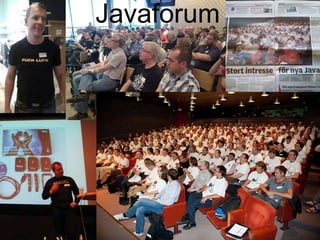
Javaforum
Javaforum


 www.jforum.se
Biggest news?
Java 7 is GA
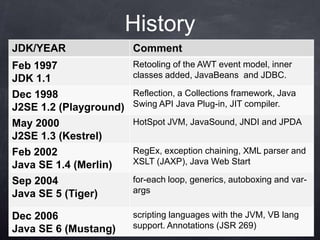
History
JDK/YEAR                Comment
Feb 1997                Retooling of the AWT event model, inner
JDK 1.1                 classes added, JavaBeans and JDBC.

Dec 1998                Reflection, a Collections framework, Java
J2SE 1.2 (Playground)   Swing API Java Plug-in, JIT compiler.

May 2000                HotSpot JVM, JavaSound, JNDI and JPDA
J2SE 1.3 (Kestrel)
Feb 2002                RegEx, exception chaining, XML parser and
Java SE 1.4 (Merlin)    XSLT (JAXP), Java Web Start

Sep 2004                for-each loop, generics, autoboxing and var-
Java SE 5 (Tiger)       args

Dec 2006                scripting languages with the JVM, VB lang
Java SE 6 (Mustang)     support. Annotations (JSR 269)
Java SE 7


Started in Aug 2006
Why was 7 delayed
•   Open Sourcing JDK
•   Conflicts Blocking JCP
•   Sun Finance
•   JavaFX
•   Oracle Deal
Trouble in paradise
•   James Gosling leaving Oracle
•   Oracle vs Google
•   Apache leaving JCP
•   Doug Lea, Bob Lee leaving JCP
Java 7
                        Plan A,
           JDK 7
                        Late 2012


”It„s been clear for some time that the
most recent JDK 7 development
schedule is, to put it mildly, Unrealistic”

(Mark Reinhold, 8 Sep 2010)
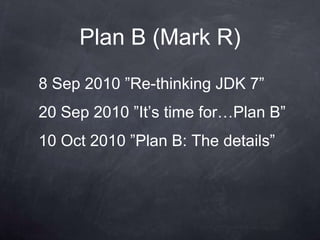
Plan B (Mark R)
8 Sep 2010 ”Re-thinking JDK 7”
20 Sep 2010 ”It‟s time for…Plan B”
10 Oct 2010 ”Plan B: The details”
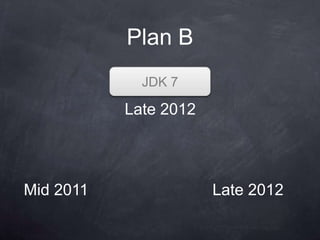
Plan B
             JDK 8
                 7

           Late 2012


Mid 2011               Late 2012
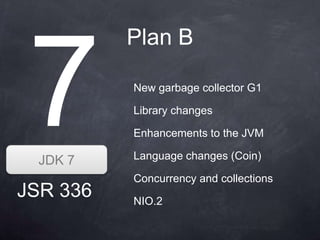
Plan B

          New garbage collector G1

          Library changes

          Enhancements to the JVM

  JDK 7   Language changes (Coin)

          Concurrency and collections
JSR 336   NIO.2
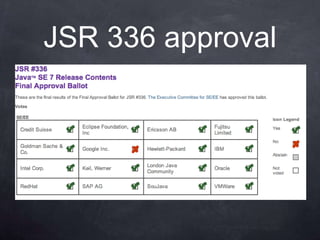
JSR 336 approval
Performance
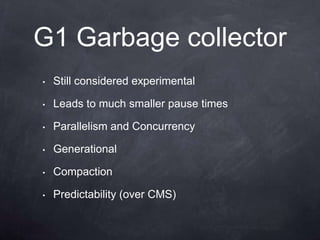
G1 Garbage collector
•   Still considered experimental

•   Leads to much smaller pause times

•   Parallelism and Concurrency

•   Generational

•   Compaction

•   Predictability (over CMS)
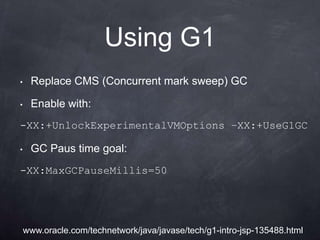
Using G1
•    Replace CMS (Concurrent mark sweep) GC

•    Enable with:
-XX:+UnlockExperimentalVMOptions –XX:+UseG1GC

•    GC Paus time goal:
-XX:MaxGCPauseMillis=50


    www.oracle.com/technetwork/java/javase/tech/g1-intro-jsp-135488.html
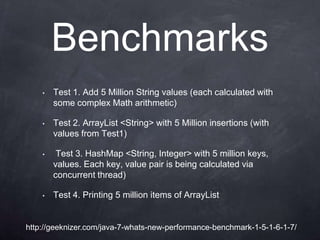
Benchmarks
    •   Test 1. Add 5 Million String values (each calculated with
        some complex Math arithmetic)

    •   Test 2. ArrayList <String> with 5 Million insertions (with
        values from Test1)

    •    Test 3. HashMap <String, Integer> with 5 million keys,
        values. Each key, value pair is being calculated via
        concurrent thread)

    •   Test 4. Printing 5 million items of ArrayList


http://geeknizer.com/java-7-whats-new-performance-benchmark-1-5-1-6-1-7/
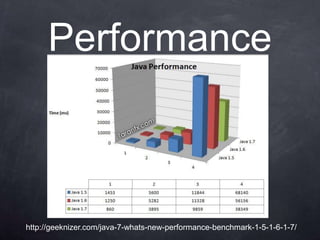
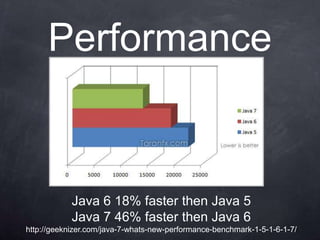
Performance


http://geeknizer.com/java-7-whats-new-performance-benchmark-1-5-1-6-1-7/
Performance


            Java 6 18% faster then Java 5
            Java 7 46% faster then Java 6
http://geeknizer.com/java-7-whats-new-performance-benchmark-1-5-1-6-1-7/
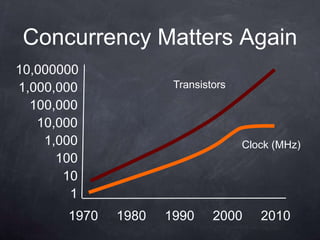
Concurrency Matters Again
10,000000
1,000,000             Transistors

  100,000
   10,000
    1,000                           Clock (MHz)
      100
       10
        1
       1970   1980   1990     2000     2010
Fork/Join
 Java 7 concurrency
     JSR 166y
JSR 166y Fork/Join
•   similar to MapReduce
•   useful for a certain class of problems
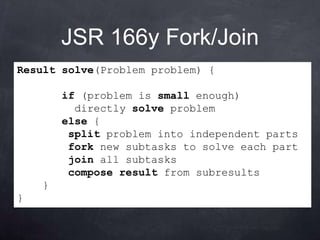
JSR 166y Fork/Join
Result solve(Problem problem) {

        if (problem is small enough)
          directly solve problem
        else {
         split problem into independent parts
         fork new subtasks to solve each part
         join all subtasks
         compose result from subresults
    }
}
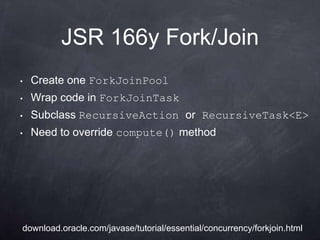
JSR 166y Fork/Join
•   Create one ForkJoinPool
•   Wrap code in ForkJoinTask
•   Subclass RecursiveAction or RecursiveTask<E>
•   Need to override compute() method


download.oracle.com/javase/tutorial/essential/concurrency/forkjoin.html
class Sum extends RecursiveTask<Long> {
    static final int SEQUENTIAL_THRESHOLD = 1000;
    Sum(int[] arr, int lo, int hi) {
        array = arr; low = lo; high = hi;
    }
    protected Long compute() {
        if(high - low <= SEQUENTIAL_THRESHOLD) {
            long sum = 0;
            for(int i=low; i < high; ++i)
                  sum += array[i];
            return sum;
         } else {
            int mid = low + (high - low) / 2;
            Sum left = new Sum(array, low, mid);
            Sum right = new Sum(array, mid, high);
            invokeAll(left, right);
            return right.join() + left.join();
         }
     }
}
DEMO
Fork/Join Java 7
   JSR 166y
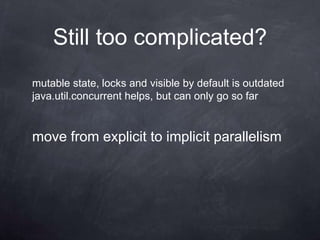
Still too complicated?
mutable state, locks and visible by default is outdated
java.util.concurrent helps, but can only go so far


move from explicit to implicit parallelism
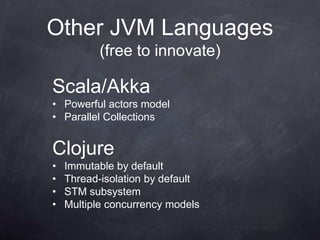
Other JVM Languages
           (free to innovate)

Scala/Akka
• Powerful actors model
• Parallel Collections


Clojure
•   Immutable by default
•   Thread-isolation by default
•   STM subsystem
•   Multiple concurrency models
Coin
JSR 334
Project Coin
A set of small language changes
   should be added to JDK 7
           (OpenJDK)
Strings in switch

Add the ability to switch on string values
analogous to the existing ability to switch
on values of the primitive types.
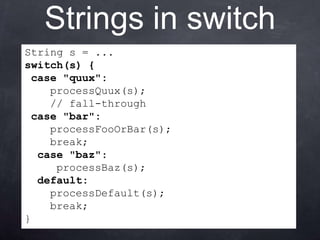
Strings in switch
String s = ...
switch(s) {
 case "quux":
    processQuux(s);
    // fall-through
 case "bar":
    processFooOrBar(s);
    break;
  case "baz":
     processBaz(s);
  default:
    processDefault(s);
    break;
}
Improved Exception
              Handling

•   Catching multiple exception types
    •   A single catch clause can now catch
        more than one exception types
•   Improved checking for re-thrown
    exceptions
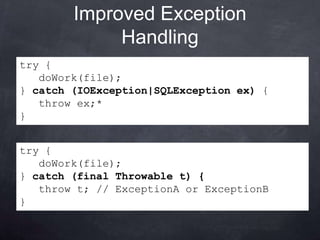
Improved Exception
             Handling
try {
   doWork(file);
} catch (IOException|SQLException ex) {
   throw ex;*
}


try {
   doWork(file);
} catch (final Throwable t) {
   throw t; // ExceptionA or ExceptionB
}
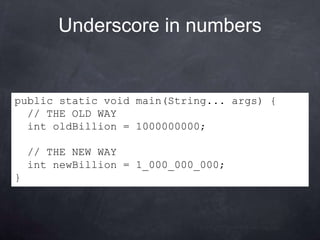
Underscore in numbers


public static void main(String... args) {
  // THE OLD WAY
  int oldBillion = 1000000000;

    // THE NEW WAY
    int newBillion = 1_000_000_000;
}
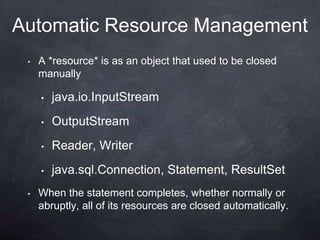
Automatic Resource Management
 •   A *resource* is as an object that used to be closed
     manually

     •   java.io.InputStream
     •   OutputStream
     •   Reader, Writer
     •   java.sql.Connection, Statement, ResultSet
 •   When the statement completes, whether normally or
     abruptly, all of its resources are closed automatically.
Pre Java 7
public void copy(String src, String dest) throws IOEx{
   InputStream in = new FileInputStream(src);
   OutputStream out = new FileOutputStream(dest);
    try {
      byte[] buf = new byte[8 * 1024];
      int n;
      while ((n = in.read(buf)) >= 0)
        out.write(buf, 0, n);
   } finally {
      in.close();
      out.close();
   }
}
Pre Java 7
public void copy(String src, String dest) throws IOEx{
   InputStream in = new FileInputStream(src);
   try {
      OutputStream out = new FileOutputStream(dest);
      try {
         byte[] buf = new byte[8 * 1024];
         int n;
         while ((n = in.read(buf)) >= 0)
            out.write(buf, 0, n);
      } finally {
         out.close();
      }
   } finally {
      in.close();
   }
}
Automatic Resource Management
public void copy(String src, String dest) throws IOEx{
    try ( InputStream in = new FileInputStream(src);
        OutputStream out = new FileOutputStream(dest)){
       byte[] buf = new byte[8 * 1024];
       int n;
       while ((n = in.read(buf)) >= 0)
          out.write(buf, 0, n);
    }
      //in and out closes automagically
}
Improved Type Inference for
     Generic Instance
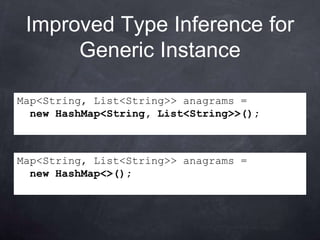
Improved Type Inference for
      Generic Instance

Map<String, List<String>> anagrams =
  new HashMap<String, List<String>>();


Map<String, List<String>> anagrams =
  new HashMap<>();
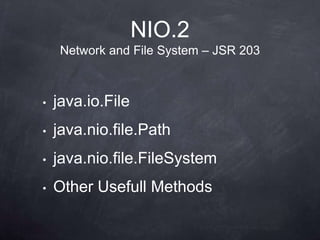
NIO.2
Network and File System
       JSR 203
NIO.2
     Network and File System – JSR 203


•   java.io.File
•   java.nio.file.Path
•   java.nio.file.FileSystem
•   Other Usefull Methods
Pre Java 7
URL url = new URL("http://www.blog.se/?page_id=1");
try (
  FileOutputStream fos =
    new FileOutputStream(new File("output.txt"));
  InputStream is = url.openStream() ){
  byte[] buf = new byte[4096];
  int len;
  while ((len = is.read(buf)) > 0){
    fos.write(buf, 0, len);
  }
} catch (IOException e){
  e.printStackTrace();
}
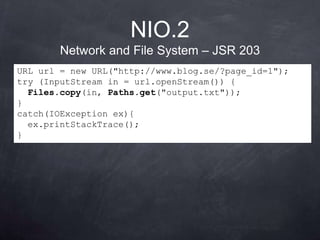
NIO.2
        Network and File System – JSR 203
URL url = new URL("http://www.blog.se/?page_id=1");
try (InputStream in = url.openStream()) {
  Files.copy(in, Paths.get("output.txt"));
}
catch(IOException ex){
  ex.printStackTrace();
}
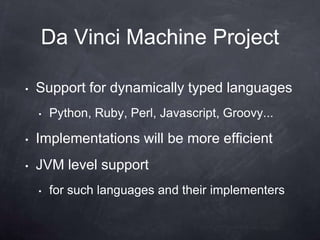
Da Vinci Machine Project

•   Support for dynamically typed languages
    •   Python, Ruby, Perl, Javascript, Groovy...

•   Implementations will be more efficient
•   JVM level support
    •   for such languages and their implementers
Charles Nutter
  co-leads Jruby project
  Engine Yard
JSR-292

invokedynamic
Method Handles
WTF?
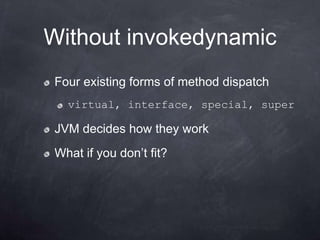
Without invokedynamic
Four existing forms of method dispatch
  virtual, interface, special, super

JVM decides how they work
What if you don‟t fit?
invokedynamic
User-defined dispatch
Name, signature as usual
Additional bootstrap method handle
Bootstrap called first time to wire it up
JVM then optimizes like “real Java”
Method Handles
Super-awesome function pointers
  Faster than reflection
  Curry-able
  Still talking directly to JVM
Used by invokedynamic bootstrapping
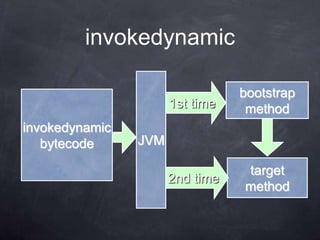
invokedynamic

                                 bootstrap
                      1st time    method
invokedynamic
   bytecode     JVM

                                 target
                      2nd time
                                 method
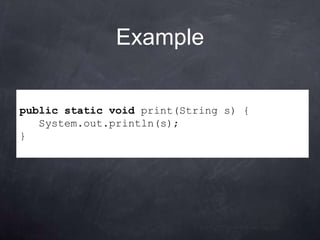
Example


public static void print(String s) {
   System.out.println(s);
}
Example

public static void main(java.lang.String[]);
  Code:
    0: ldc           #9     // String Hello, invokedynamic!
    2: invokedynamic #18, 0 // InvokeDynamic #0:print:(Ljava/lang/String;)V
    7: return


    invokedynamic               bootstrap                    name and
       bytecode                  handle                      signature
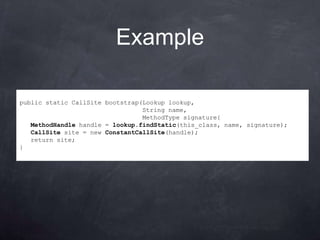
Example

public static CallSite bootstrap(Lookup lookup,
                                 String name,
                                 MethodType signature{
   MethodHandle handle = lookup.findStatic(this_class, name, signature);
   CallSite site = new ConstantCallSite(handle);
   return site;
}
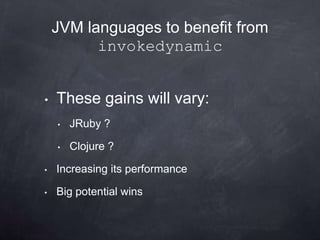
JVM languages to benefit from
          invokedynamic


•   These gains will vary:
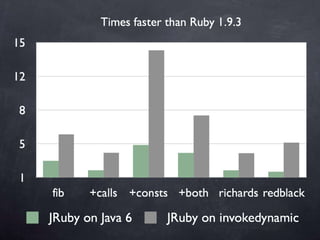
    •   JRuby ?

    •   Clojure ?

•   Increasing its performance

•   Big potential wins
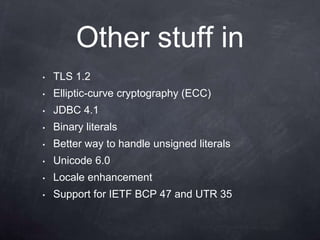
Other stuff in
•   TLS 1.2
•   Elliptic-curve cryptography (ECC)
•   JDBC 4.1
•   Binary literals
•   Better way to handle unsigned literals
•   Unicode 6.0
•   Locale enhancement
•   Support for IETF BCP 47 and UTR 35
Other stuff in

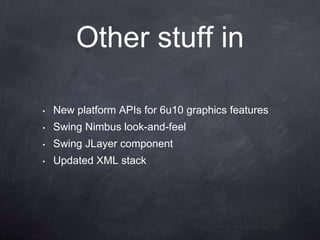
•   New platform APIs for 6u10 graphics features
•   Swing Nimbus look-and-feel
•   Swing JLayer component
•   Updated XML stack
Runtimes
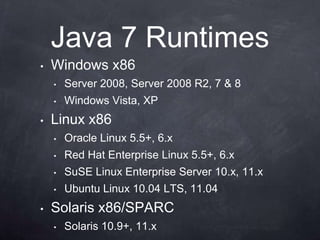
Java 7 Runtimes
•   Windows x86
    •   Server 2008, Server 2008 R2, 7 & 8
    •   Windows Vista, XP
•   Linux x86
    •   Oracle Linux 5.5+, 6.x
    •   Red Hat Enterprise Linux 5.5+, 6.x
    •   SuSE Linux Enterprise Server 10.x, 11.x
    •   Ubuntu Linux 10.04 LTS, 11.04
•   Solaris x86/SPARC
    •   Solaris 10.9+, 11.x
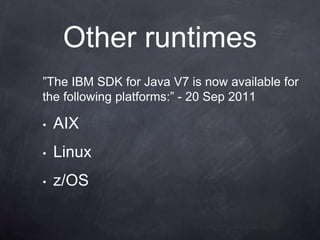
Other runtimes
”The IBM SDK for Java V7 is now available for
the following platforms:” - 20 Sep 2011

•   AIX
•   Linux
•   z/OS
http://openjdk.java.net/projects/macosx-port/
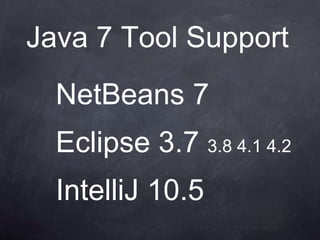
Java 7 Tool Support
  NetBeans 7
  Eclipse 3.7 3.8 4.1 4.2
  IntelliJ 10.5
Whats.Next()
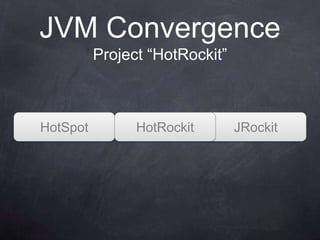
JVM Convergence
          Project “HotRockit”


HotSpot         HotRockit       JRockit
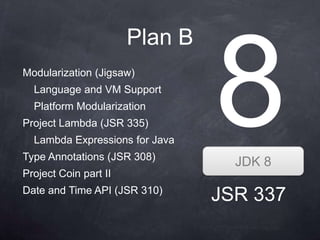
Plan B
Modularization (Jigsaw)
  Language and VM Support
  Platform Modularization
Project Lambda (JSR 335)
  Lambda Expressions for Java
Type Annotations (JSR 308)
                                  JDK 8
Project Coin part II
Date and Time API (JSR 310)
                                JSR 337
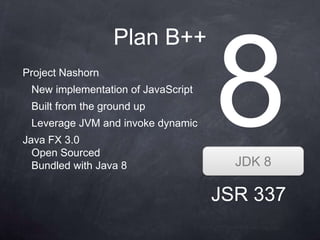
Plan B++
Project Nashorn
 New implementation of JavaScript
 Built from the ground up
 Leverage JVM and invoke dynamic
Java FX 3.0
  Open Sourced
  Bundled with Java 8                 JDK 8

                                    JSR 337
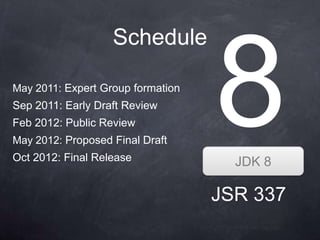
Schedule

May 2011: Expert Group formation
Sep 2011: Early Draft Review
Feb 2012: Public Review
May 2012: Proposed Final Draft
Oct 2012: Final Release              JDK 8

                                   JSR 337
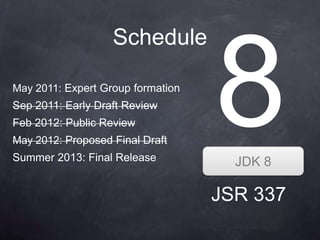
Schedule

May 2011: Expert Group formation
Sep 2011: Early Draft Review
Feb 2012: Public Review
May 2012: Proposed Final Draft
Summer 2013: Final Release           JDK 8

                                   JSR 337
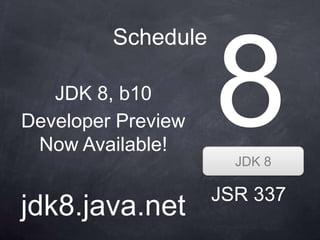
Schedule

   JDK 8, b10
Developer Preview
 Now Available!
                      JDK 8

                    JSR 337
jdk8.java.net
JCP.next
•   Using the process to improve the process
•   JSR 348
    •   Transparency
    •   Participation
    •   Agility
    •   Governance
•   A second JSR will be filed soon
    •   JavaSE and JavaME EC - merged
JCP, new
 members
  Twitter
Azul System
We‟re moving again
•   The JCP Dead Lock Needed to be Broken
•   OpenJDK is liberated (GPL)
•   JUG attendances are growing
•   Oracle marketing estimates 9-10 million devs
•   Dozens of new JVM languages
•   A Vibrant Java Ecosystem
Community
Summary
•   Java 7 is GA
•   Java 8 is on its way
•   The JVM Rocks
•   JCP.next
•   The community is very much alive!
Mattias Karlsson
                                            www.linkedin.com/in/mattiask
                                            twitter: @matkar
                                            mattias.karlsson@avegagroup.s
                                            e


                  Oracle and Java are registered trademarks of Oracle and/or its affiliates. Other names
                  appearing on the slides may be trademarks of their respective owners.

                  The development, release, and timing of any features or functionality described for Oracle„s
                  products remains at the sole discretion of Oracle and JCP

©Copyright 2011

Java 7 Whats New(), Whats Next() from Oredev

  • 1.
    What‟s New() What‟s Next() ©Copyright 2011
  • 2.
  • 3.
    Disclaimer I am justan ordinary developer I don‟t work for Oracle
  • 4.
    Mattias Karlsson Avega Group Twitter: @matkar www.Linkedin/in/mattiask
  • 5.
  • 8.
  • 9.
  • 10.
    History JDK/YEAR Comment Feb 1997 Retooling of the AWT event model, inner JDK 1.1 classes added, JavaBeans and JDBC. Dec 1998 Reflection, a Collections framework, Java J2SE 1.2 (Playground) Swing API Java Plug-in, JIT compiler. May 2000 HotSpot JVM, JavaSound, JNDI and JPDA J2SE 1.3 (Kestrel) Feb 2002 RegEx, exception chaining, XML parser and Java SE 1.4 (Merlin) XSLT (JAXP), Java Web Start Sep 2004 for-each loop, generics, autoboxing and var- Java SE 5 (Tiger) args Dec 2006 scripting languages with the JVM, VB lang Java SE 6 (Mustang) support. Annotations (JSR 269)
  • 11.
    Java SE 7 Startedin Aug 2006
  • 12.
    Why was 7delayed • Open Sourcing JDK • Conflicts Blocking JCP • Sun Finance • JavaFX • Oracle Deal
  • 13.
    Trouble in paradise • James Gosling leaving Oracle • Oracle vs Google • Apache leaving JCP • Doug Lea, Bob Lee leaving JCP
  • 15.
    Java 7 Plan A, JDK 7 Late 2012 ”It„s been clear for some time that the most recent JDK 7 development schedule is, to put it mildly, Unrealistic” (Mark Reinhold, 8 Sep 2010)
  • 16.
    Plan B (MarkR) 8 Sep 2010 ”Re-thinking JDK 7” 20 Sep 2010 ”It‟s time for…Plan B” 10 Oct 2010 ”Plan B: The details”
  • 17.
    Plan B JDK 8 7 Late 2012 Mid 2011 Late 2012
  • 18.
    Plan B New garbage collector G1 Library changes Enhancements to the JVM JDK 7 Language changes (Coin) Concurrency and collections JSR 336 NIO.2
  • 19.
  • 20.
  • 21.
    G1 Garbage collector • Still considered experimental • Leads to much smaller pause times • Parallelism and Concurrency • Generational • Compaction • Predictability (over CMS)
  • 22.
    Using G1 • Replace CMS (Concurrent mark sweep) GC • Enable with: -XX:+UnlockExperimentalVMOptions –XX:+UseG1GC • GC Paus time goal: -XX:MaxGCPauseMillis=50 www.oracle.com/technetwork/java/javase/tech/g1-intro-jsp-135488.html
  • 23.
    Benchmarks • Test 1. Add 5 Million String values (each calculated with some complex Math arithmetic) • Test 2. ArrayList <String> with 5 Million insertions (with values from Test1) • Test 3. HashMap <String, Integer> with 5 million keys, values. Each key, value pair is being calculated via concurrent thread) • Test 4. Printing 5 million items of ArrayList http://geeknizer.com/java-7-whats-new-performance-benchmark-1-5-1-6-1-7/
  • 24.
  • 25.
    Performance Java 6 18% faster then Java 5 Java 7 46% faster then Java 6 http://geeknizer.com/java-7-whats-new-performance-benchmark-1-5-1-6-1-7/
  • 26.
    Concurrency Matters Again 10,000000 1,000,000 Transistors 100,000 10,000 1,000 Clock (MHz) 100 10 1 1970 1980 1990 2000 2010
  • 27.
    Fork/Join Java 7concurrency JSR 166y
  • 28.
    JSR 166y Fork/Join • similar to MapReduce • useful for a certain class of problems
  • 29.
    JSR 166y Fork/Join Resultsolve(Problem problem) { if (problem is small enough) directly solve problem else { split problem into independent parts fork new subtasks to solve each part join all subtasks compose result from subresults } }
  • 30.
    JSR 166y Fork/Join • Create one ForkJoinPool • Wrap code in ForkJoinTask • Subclass RecursiveAction or RecursiveTask<E> • Need to override compute() method download.oracle.com/javase/tutorial/essential/concurrency/forkjoin.html
  • 31.
    class Sum extendsRecursiveTask<Long> { static final int SEQUENTIAL_THRESHOLD = 1000; Sum(int[] arr, int lo, int hi) { array = arr; low = lo; high = hi; } protected Long compute() { if(high - low <= SEQUENTIAL_THRESHOLD) { long sum = 0; for(int i=low; i < high; ++i) sum += array[i]; return sum; } else { int mid = low + (high - low) / 2; Sum left = new Sum(array, low, mid); Sum right = new Sum(array, mid, high); invokeAll(left, right); return right.join() + left.join(); } } }
  • 32.
  • 33.
    Still too complicated? mutablestate, locks and visible by default is outdated java.util.concurrent helps, but can only go so far move from explicit to implicit parallelism
  • 34.
    Other JVM Languages (free to innovate) Scala/Akka • Powerful actors model • Parallel Collections Clojure • Immutable by default • Thread-isolation by default • STM subsystem • Multiple concurrency models
  • 35.
  • 36.
    Project Coin A setof small language changes should be added to JDK 7 (OpenJDK)
  • 37.
    Strings in switch Addthe ability to switch on string values analogous to the existing ability to switch on values of the primitive types.
  • 38.
    Strings in switch Strings = ... switch(s) { case "quux": processQuux(s); // fall-through case "bar": processFooOrBar(s); break; case "baz": processBaz(s); default: processDefault(s); break; }
  • 39.
    Improved Exception Handling • Catching multiple exception types • A single catch clause can now catch more than one exception types • Improved checking for re-thrown exceptions
  • 40.
    Improved Exception Handling try { doWork(file); } catch (IOException|SQLException ex) { throw ex;* } try { doWork(file); } catch (final Throwable t) { throw t; // ExceptionA or ExceptionB }
  • 41.
    Underscore in numbers publicstatic void main(String... args) { // THE OLD WAY int oldBillion = 1000000000; // THE NEW WAY int newBillion = 1_000_000_000; }
  • 42.
    Automatic Resource Management • A *resource* is as an object that used to be closed manually • java.io.InputStream • OutputStream • Reader, Writer • java.sql.Connection, Statement, ResultSet • When the statement completes, whether normally or abruptly, all of its resources are closed automatically.
  • 43.
    Pre Java 7 publicvoid copy(String src, String dest) throws IOEx{ InputStream in = new FileInputStream(src); OutputStream out = new FileOutputStream(dest); try { byte[] buf = new byte[8 * 1024]; int n; while ((n = in.read(buf)) >= 0) out.write(buf, 0, n); } finally { in.close(); out.close(); } }
  • 44.
    Pre Java 7 publicvoid copy(String src, String dest) throws IOEx{ InputStream in = new FileInputStream(src); try { OutputStream out = new FileOutputStream(dest); try { byte[] buf = new byte[8 * 1024]; int n; while ((n = in.read(buf)) >= 0) out.write(buf, 0, n); } finally { out.close(); } } finally { in.close(); } }
  • 45.
    Automatic Resource Management publicvoid copy(String src, String dest) throws IOEx{ try ( InputStream in = new FileInputStream(src); OutputStream out = new FileOutputStream(dest)){ byte[] buf = new byte[8 * 1024]; int n; while ((n = in.read(buf)) >= 0) out.write(buf, 0, n); } //in and out closes automagically }
  • 46.
    Improved Type Inferencefor Generic Instance
  • 47.
    Improved Type Inferencefor Generic Instance Map<String, List<String>> anagrams = new HashMap<String, List<String>>(); Map<String, List<String>> anagrams = new HashMap<>();
  • 48.
    NIO.2 Network and FileSystem JSR 203
  • 49.
    NIO.2 Network and File System – JSR 203 • java.io.File • java.nio.file.Path • java.nio.file.FileSystem • Other Usefull Methods
  • 50.
    Pre Java 7 URLurl = new URL("http://www.blog.se/?page_id=1"); try ( FileOutputStream fos = new FileOutputStream(new File("output.txt")); InputStream is = url.openStream() ){ byte[] buf = new byte[4096]; int len; while ((len = is.read(buf)) > 0){ fos.write(buf, 0, len); } } catch (IOException e){ e.printStackTrace(); }
  • 51.
    NIO.2 Network and File System – JSR 203 URL url = new URL("http://www.blog.se/?page_id=1"); try (InputStream in = url.openStream()) { Files.copy(in, Paths.get("output.txt")); } catch(IOException ex){ ex.printStackTrace(); }
  • 52.
  • 53.
    Da Vinci MachineProject • Support for dynamically typed languages • Python, Ruby, Perl, Javascript, Groovy... • Implementations will be more efficient • JVM level support • for such languages and their implementers
  • 54.
    Charles Nutter co-leads Jruby project Engine Yard
  • 55.
  • 56.
    Without invokedynamic Four existingforms of method dispatch virtual, interface, special, super JVM decides how they work What if you don‟t fit?
  • 57.
    invokedynamic User-defined dispatch Name, signatureas usual Additional bootstrap method handle Bootstrap called first time to wire it up JVM then optimizes like “real Java”
  • 58.
    Method Handles Super-awesome functionpointers Faster than reflection Curry-able Still talking directly to JVM Used by invokedynamic bootstrapping
  • 59.
    invokedynamic bootstrap 1st time method invokedynamic bytecode JVM target 2nd time method
  • 60.
    Example public static voidprint(String s) { System.out.println(s); }
  • 61.
    Example public static voidmain(java.lang.String[]); Code: 0: ldc #9 // String Hello, invokedynamic! 2: invokedynamic #18, 0 // InvokeDynamic #0:print:(Ljava/lang/String;)V 7: return invokedynamic bootstrap name and bytecode handle signature
  • 62.
    Example public static CallSitebootstrap(Lookup lookup, String name, MethodType signature{ MethodHandle handle = lookup.findStatic(this_class, name, signature); CallSite site = new ConstantCallSite(handle); return site; }
  • 64.
    JVM languages tobenefit from invokedynamic • These gains will vary: • JRuby ? • Clojure ? • Increasing its performance • Big potential wins
  • 65.
    Other stuff in • TLS 1.2 • Elliptic-curve cryptography (ECC) • JDBC 4.1 • Binary literals • Better way to handle unsigned literals • Unicode 6.0 • Locale enhancement • Support for IETF BCP 47 and UTR 35
  • 66.
    Other stuff in • New platform APIs for 6u10 graphics features • Swing Nimbus look-and-feel • Swing JLayer component • Updated XML stack
  • 67.
  • 68.
    Java 7 Runtimes • Windows x86 • Server 2008, Server 2008 R2, 7 & 8 • Windows Vista, XP • Linux x86 • Oracle Linux 5.5+, 6.x • Red Hat Enterprise Linux 5.5+, 6.x • SuSE Linux Enterprise Server 10.x, 11.x • Ubuntu Linux 10.04 LTS, 11.04 • Solaris x86/SPARC • Solaris 10.9+, 11.x
  • 69.
    Other runtimes ”The IBMSDK for Java V7 is now available for the following platforms:” - 20 Sep 2011 • AIX • Linux • z/OS
  • 70.
  • 71.
    Java 7 ToolSupport NetBeans 7 Eclipse 3.7 3.8 4.1 4.2 IntelliJ 10.5
  • 72.
  • 73.
    JVM Convergence Project “HotRockit” HotSpot HotRockit JRockit
  • 74.
    Plan B Modularization (Jigsaw) Language and VM Support Platform Modularization Project Lambda (JSR 335) Lambda Expressions for Java Type Annotations (JSR 308) JDK 8 Project Coin part II Date and Time API (JSR 310) JSR 337
  • 75.
    Plan B++ Project Nashorn New implementation of JavaScript Built from the ground up Leverage JVM and invoke dynamic Java FX 3.0 Open Sourced Bundled with Java 8 JDK 8 JSR 337
  • 76.
    Schedule May 2011: ExpertGroup formation Sep 2011: Early Draft Review Feb 2012: Public Review May 2012: Proposed Final Draft Oct 2012: Final Release JDK 8 JSR 337
  • 77.
    Schedule May 2011: ExpertGroup formation Sep 2011: Early Draft Review Feb 2012: Public Review May 2012: Proposed Final Draft Summer 2013: Final Release JDK 8 JSR 337
  • 78.
    Schedule JDK 8, b10 Developer Preview Now Available! JDK 8 JSR 337 jdk8.java.net
  • 79.
    JCP.next • Using the process to improve the process • JSR 348 • Transparency • Participation • Agility • Governance • A second JSR will be filed soon • JavaSE and JavaME EC - merged
  • 80.
    JCP, new members Twitter Azul System
  • 81.
    We‟re moving again • The JCP Dead Lock Needed to be Broken • OpenJDK is liberated (GPL) • JUG attendances are growing • Oracle marketing estimates 9-10 million devs • Dozens of new JVM languages • A Vibrant Java Ecosystem
  • 82.
  • 83.
    Summary • Java 7 is GA • Java 8 is on its way • The JVM Rocks • JCP.next • The community is very much alive!
  • 84.
    Mattias Karlsson www.linkedin.com/in/mattiask twitter: @matkar mattias.karlsson@avegagroup.s e Oracle and Java are registered trademarks of Oracle and/or its affiliates. Other names appearing on the slides may be trademarks of their respective owners. The development, release, and timing of any features or functionality described for Oracle„s products remains at the sole discretion of Oracle and JCP ©Copyright 2011