Jason Huggins
Presented By: Waqas Latif
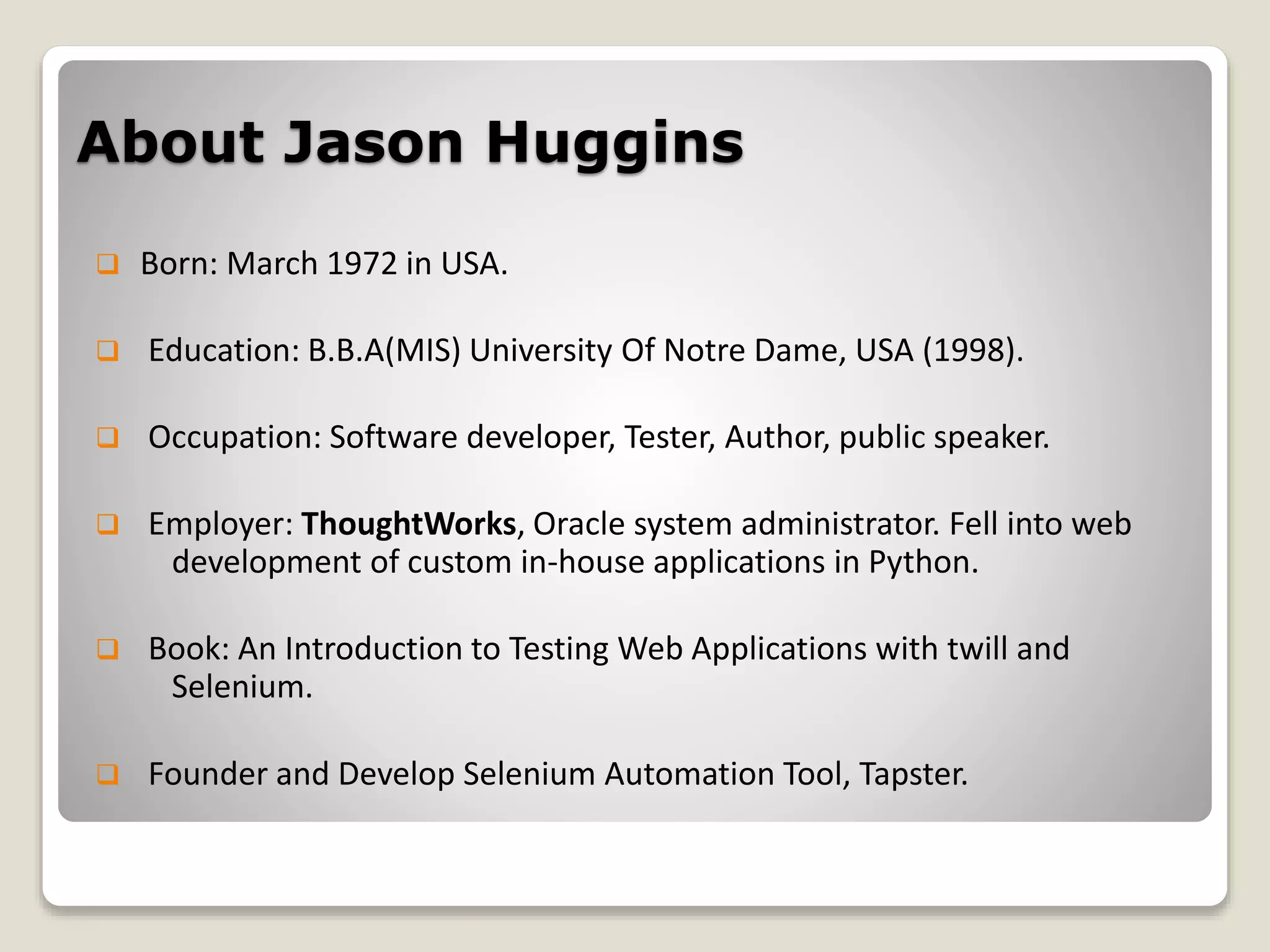
About Jason Huggins
 Born: March 1972 in USA.
 Education: B.B.A(MIS) University Of Notre Dame, USA (1998).
 Occupation: Software developer, Tester, Author, public speaker.
 Employer: ThoughtWorks, Oracle system administrator. Fell into web
development of custom in-house applications in Python.
 Book: An Introduction to Testing Web Applications with twill and
Selenium.
 Founder and Develop Selenium Automation Tool, Tapster.
Huggins & Tool History
Selenium, It was Invented by Jason Huggins and later has help from
Paul Gross and Jie Tina. While testing an internal application Time
and Expenses (T&E) system at ThoughtWorks. In order to avoid the
frequent manual testing on different browsers.
Selenium project started back in 2004 at ThoughtWorks, in Chicago
under the name of JavaScriptTestRunner.
At first, Selenium was originally developed by Jason Huggins and
joined by other programmers and testers at ThoughtWorks.
Huggins & Tool History
The name Selenium comes from a joke made by Jason
Huggins(Inventor of Selenium) in an email, mocking a competitor
named Mercury(UFT now), saying that you can cure mercury
poisoning by taking selenium supplements
He created a Javascript library. This library originally called
"Selenium" but later referred to as "Selenium Core" which underlies
all the functionality of Selenium(RC) and Selenium IDE.
Jason started demoing the test tool to various colleagues. Many were
excited about its immediate and intuitive visual feedback.
Huggins & Tool History
As well as selenium is potential to grow as a reusable testing
framework for other web applications.
Soon after in 2004 fellow his colleague, Paul Hammant saw the demo,
and started discussions about the open sourcing of Selenium. As well
as defining a 'driven' mode of Selenium where you'd get to use
Selenium over the wire from a language of your choice.
In 2005 Dan Fabulich and Nelson Sproul decided to improve Selenium
and bundle the browser driver code into a standalone server,
‘Selenium Remote Control’. Pat Lightbody, worked with Dan and
Nelson to improve and stabilize it.
Huggins & Tool History
Jason Huggins left Thoughtworks in 2007 and joined the (then secret)
Selenium support team inside Google.
Jason Huggins at Google and with other Googlers like Jennifer
Bevan worked on a selenium capability where he ran a computer
farm that used Selenium to test new features of Google’s public
applications (Gmail & Google Maps).
Google presented their use of selenium at the 2nd Google Test
Automation Conference (GTAC) and Jennifer was invited to join the
Selenium team.
Huggins & Tool History
The same year, Haw-bin Chai in Chicago developed the “UI Element”
extension, which he was invited to merge into Selenium IDE by
joining the team.
In 2008, Philippe Hanrigou (then at ThoughtWorks) made "Selenium
Grid", which provides a hub allowing the running of multiple
Selenium tests concurrently on any number of local or remote
systems, thus minimizing test execution time.
Then in 2008, Huggins met his co-founders for what would be Sauce
Labs.
Huggins & Tool History
Huggins, then chief technology officer at Sauce Labs, a software-
testing company he had co-founded in 2008 with John Dunham,
Steven Hazel, Al Sargent, a startup that basically took what Selenium
was doing for Google but made it available for other startups looking
for software testing. SauceLabs would be headquartered in San
Francisco, but Huggins made it clear he would be working out of
Chicago.
"I told (my co-founders), 'We can start this. I can totally be your
implementer of these thing. But I’m moving back to Chicago.‘ So for
two years Huggins worked as Sauce Labs' CTO from Chicago.
Huggins & Tool History
The next thing for Huggins was actually fixing President Obama's
Healthcare.gov. In the Fall of 2013, after being called to the White
House to address the President's most pressing issue, he took a leave
of absence from Sauce Labs.
He eventually left his role as CTO, and after the Obama care website
was fixed he shifted his focus to Tapster, a robot for automating
applications on a smartphone.
His bit of performance art has become his second startup company.
Tapster Robotics opened in Oak Park last year. Huggins, and his two
employees make and sell robots.
Huggins & Tool History
Huggins continues his work with Tapster, which helps software
developers test iPhone and Android apps with a robotic finger that
operate smartphone screen, saving programmers from having to
manually test their applications.
Customers, which he declines to identify, include automakers,
phone manufacturers, software producers and government agencies.
He projects 2016 revenue of $250,000 and says Tapster should be
profitable after losing $50,000 last year.
Jason Huggins always said:
"My one strength is that I know my weaknesses. My one big
weakness is that I love to create the first version of something, but
once I’ve created it, I do kind of get bored easily.“
THANK YOU

Jason huggins

  • 1.
  • 2.
    About Jason Huggins Born: March 1972 in USA.  Education: B.B.A(MIS) University Of Notre Dame, USA (1998).  Occupation: Software developer, Tester, Author, public speaker.  Employer: ThoughtWorks, Oracle system administrator. Fell into web development of custom in-house applications in Python.  Book: An Introduction to Testing Web Applications with twill and Selenium.  Founder and Develop Selenium Automation Tool, Tapster.
  • 3.
    Huggins & ToolHistory Selenium, It was Invented by Jason Huggins and later has help from Paul Gross and Jie Tina. While testing an internal application Time and Expenses (T&E) system at ThoughtWorks. In order to avoid the frequent manual testing on different browsers. Selenium project started back in 2004 at ThoughtWorks, in Chicago under the name of JavaScriptTestRunner. At first, Selenium was originally developed by Jason Huggins and joined by other programmers and testers at ThoughtWorks.
  • 4.
    Huggins & ToolHistory The name Selenium comes from a joke made by Jason Huggins(Inventor of Selenium) in an email, mocking a competitor named Mercury(UFT now), saying that you can cure mercury poisoning by taking selenium supplements He created a Javascript library. This library originally called "Selenium" but later referred to as "Selenium Core" which underlies all the functionality of Selenium(RC) and Selenium IDE. Jason started demoing the test tool to various colleagues. Many were excited about its immediate and intuitive visual feedback.
  • 5.
    Huggins & ToolHistory As well as selenium is potential to grow as a reusable testing framework for other web applications. Soon after in 2004 fellow his colleague, Paul Hammant saw the demo, and started discussions about the open sourcing of Selenium. As well as defining a 'driven' mode of Selenium where you'd get to use Selenium over the wire from a language of your choice. In 2005 Dan Fabulich and Nelson Sproul decided to improve Selenium and bundle the browser driver code into a standalone server, ‘Selenium Remote Control’. Pat Lightbody, worked with Dan and Nelson to improve and stabilize it.
  • 6.
    Huggins & ToolHistory Jason Huggins left Thoughtworks in 2007 and joined the (then secret) Selenium support team inside Google. Jason Huggins at Google and with other Googlers like Jennifer Bevan worked on a selenium capability where he ran a computer farm that used Selenium to test new features of Google’s public applications (Gmail & Google Maps). Google presented their use of selenium at the 2nd Google Test Automation Conference (GTAC) and Jennifer was invited to join the Selenium team.
  • 7.
    Huggins & ToolHistory The same year, Haw-bin Chai in Chicago developed the “UI Element” extension, which he was invited to merge into Selenium IDE by joining the team. In 2008, Philippe Hanrigou (then at ThoughtWorks) made "Selenium Grid", which provides a hub allowing the running of multiple Selenium tests concurrently on any number of local or remote systems, thus minimizing test execution time. Then in 2008, Huggins met his co-founders for what would be Sauce Labs.
  • 8.
    Huggins & ToolHistory Huggins, then chief technology officer at Sauce Labs, a software- testing company he had co-founded in 2008 with John Dunham, Steven Hazel, Al Sargent, a startup that basically took what Selenium was doing for Google but made it available for other startups looking for software testing. SauceLabs would be headquartered in San Francisco, but Huggins made it clear he would be working out of Chicago. "I told (my co-founders), 'We can start this. I can totally be your implementer of these thing. But I’m moving back to Chicago.‘ So for two years Huggins worked as Sauce Labs' CTO from Chicago.
  • 9.
    Huggins & ToolHistory The next thing for Huggins was actually fixing President Obama's Healthcare.gov. In the Fall of 2013, after being called to the White House to address the President's most pressing issue, he took a leave of absence from Sauce Labs. He eventually left his role as CTO, and after the Obama care website was fixed he shifted his focus to Tapster, a robot for automating applications on a smartphone. His bit of performance art has become his second startup company. Tapster Robotics opened in Oak Park last year. Huggins, and his two employees make and sell robots.
  • 10.
    Huggins & ToolHistory Huggins continues his work with Tapster, which helps software developers test iPhone and Android apps with a robotic finger that operate smartphone screen, saving programmers from having to manually test their applications. Customers, which he declines to identify, include automakers, phone manufacturers, software producers and government agencies. He projects 2016 revenue of $250,000 and says Tapster should be profitable after losing $50,000 last year. Jason Huggins always said: "My one strength is that I know my weaknesses. My one big weakness is that I love to create the first version of something, but once I’ve created it, I do kind of get bored easily.“
  • 11.