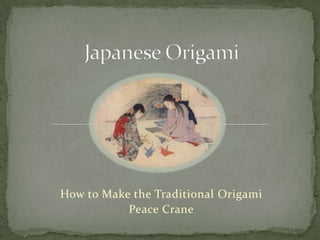
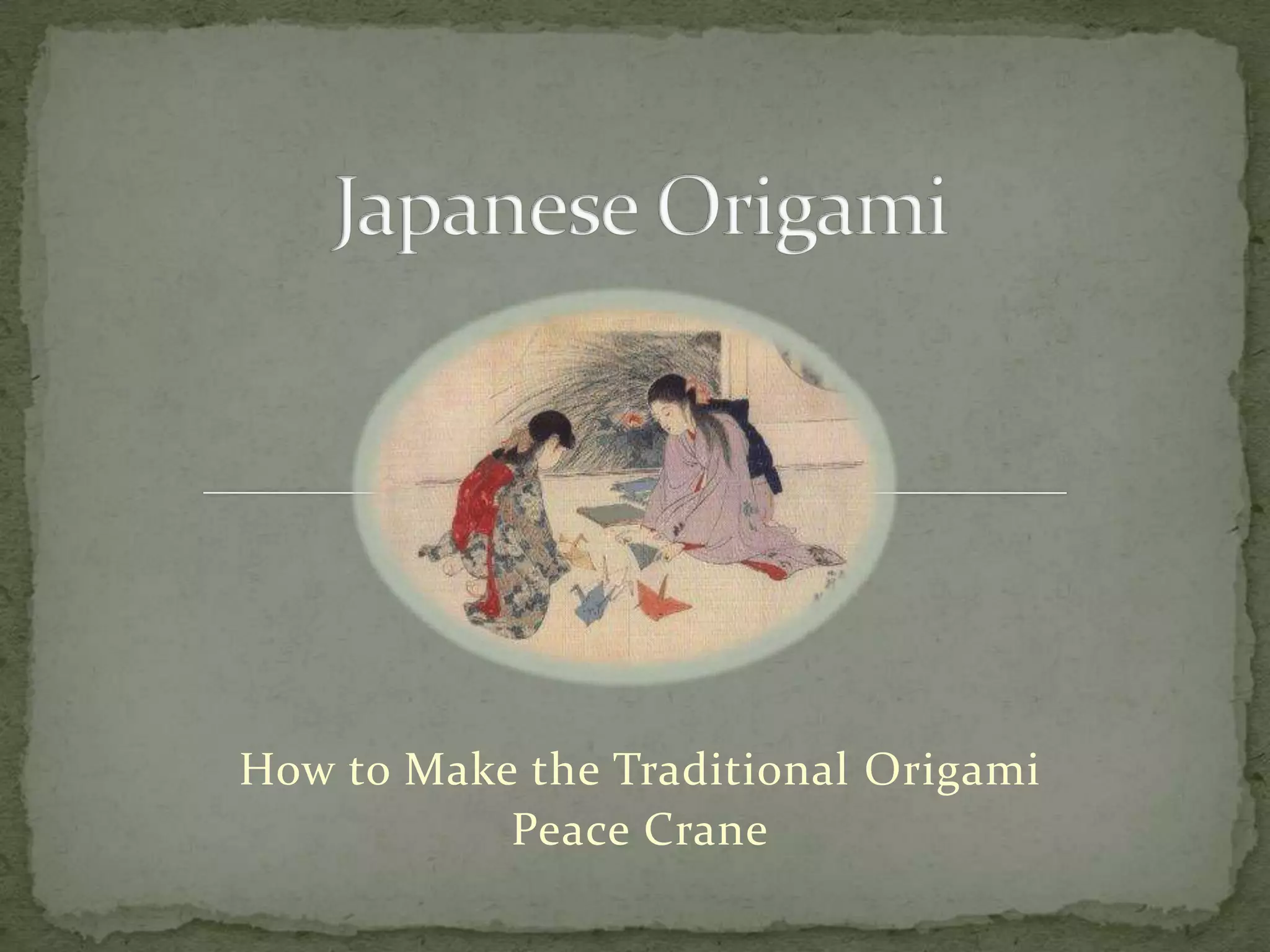
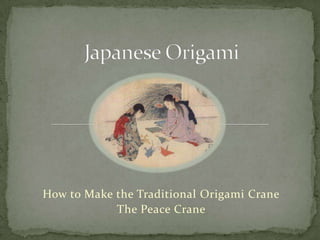
Japanese OrigamiHow to Make the Traditional OrigamiPeace Crane
History:  Mostly speculation; little historical evidenceChina credited with paper origin ca. 1st century ADActually silk writing paper-no folding evidentJapanese word for paper is kamiLikely made of birch tree or bambooEarliest use for writingCan mean god or paper causing historical inaccuracies Meiji restoration (1868-1912)Brought European and Asian traditions togetherDeveloped into modern origami of Japan“oru” to fold + “kami” means paper thus “to fold paper”Hand made “washi” paper as preferred medium05/10/20092Sarah WeigertSome Origami History
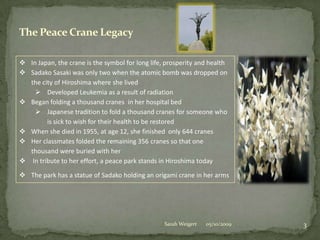
The Peace Crane Legacy05/10/20093Sarah WeigertIn Japan, the crane is the symbol for long life, prosperity and health
Sadako Sasaki was only two when the atomic bomb was dropped on the city of Hiroshima where she lived 
Developed Leukemia as a result of radiation 
Began folding a thousand cranes  in her hospital bed
Japanese tradition to fold a thousand cranes for someone who is sick to wish for their health to be restored
When she died in 1955, at age 12, she finished  only 644 cranes

Example Original PowerPoint Presentation

  • 1.
    Japanese OrigamiHow toMake the Traditional OrigamiPeace Crane
  • 2.
    History: Mostlyspeculation; little historical evidenceChina credited with paper origin ca. 1st century ADActually silk writing paper-no folding evidentJapanese word for paper is kamiLikely made of birch tree or bambooEarliest use for writingCan mean god or paper causing historical inaccuracies Meiji restoration (1868-1912)Brought European and Asian traditions togetherDeveloped into modern origami of Japan“oru” to fold + “kami” means paper thus “to fold paper”Hand made “washi” paper as preferred medium05/10/20092Sarah WeigertSome Origami History
  • 3.
    The Peace CraneLegacy05/10/20093Sarah WeigertIn Japan, the crane is the symbol for long life, prosperity and health
  • 4.
    Sadako Sasaki wasonly two when the atomic bomb was dropped on the city of Hiroshima where she lived 
  • 5.
    Developed Leukemia asa result of radiation 
  • 6.
    Began folding athousand cranes  in her hospital bed
  • 7.
    Japanese tradition tofold a thousand cranes for someone who is sick to wish for their health to be restored
  • 8.
    When she diedin 1955, at age 12, she finished only 644 cranes

Editor's Notes

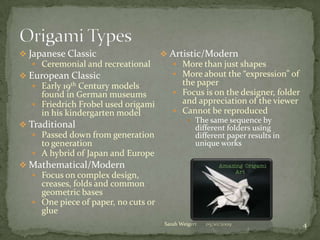
  • #3 There is little historical information on the origins of origami. It is mostly speculation, tradition or folk-lore. The Japanese are clear origami is not “Japanese Art”. This is a very small sample of the tons of information out there on the internet, in books and the many group or clubs dedicated to this traditional modeling form.Washi, also known as wagami, is traditionally a handmade Japanese paper based on three chief components: kozo or mulberry bark, gampi, and misumata. Each of the three has unique properties and is used alone or in combination in multiple types of washi. Used for more complex forms that if western papers were used, it would tear.
  • #4 Hiroshima Peace Memorial Day is 8/6.There are today many organizations and children’s peace projects carrying on this tradition around the world. In 2007 Sadako’s uncle presented the WTC with 1000 Cranes; a wish for Peace from Japan to the US. Ironic, isn’t it? There were over 700M Google hits for “Peace Crane”, but I recommend www.origami.org.uk/peace.html; it has spectacular animation.
  • #5 Friedrich Froebel’s (freed-rick froibel’s) kindergarten model was imported into Japan during the Meiji Restoration, which introduced the European Classic style to Japan, and imported much of their education models. Japanese school children used it to learn math, specifically geometry. Modern Artistic Origami can use paper, usually washi, that has been manipulated by the artist such as wet-folding by dampening the paper and hand dyeing. There is more flexibility than in Modern Mathematical Origami allowing for more creative expression and unique outcome.Modern Origami in general has one common rule: use a single sized sheet of paper, perfectly square, without cutting or gluing. Multiple sheet designs are intrinsically beautiful and impressive, but must follow the same uniformity rule.
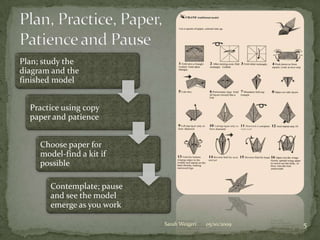
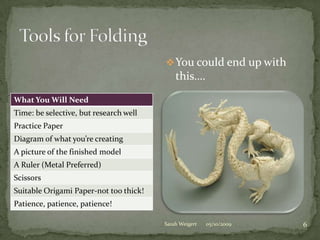
  • #6 I suggest practicing with copy paper that easily cuts to a perfect square by folding (demonstrate). Show kit.
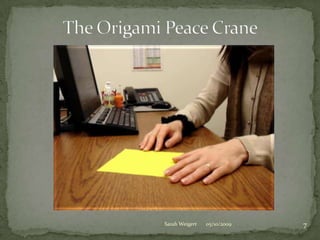
  • #8 Acknowledge and thank you to Aiko Shaw, a co-worker, who agreed to let me film her making the Crane.Notice her hands and how she handles the paper.
  • #9 Hand out rabbit heads and diagram for Peace Crane.