LEARNING
ABOUT
ORIGAMI
Hello friends
BY GROUP NO.---1
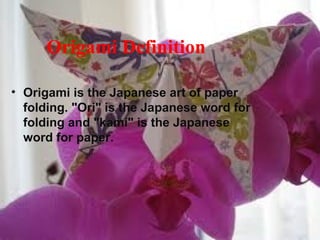
• Origami is the Japanese art of paper
folding. "Ori" is the Japanese word for
folding and "kami" is the Japanese
word for paper.
Origami Definition
Types of Origami
• Origami has expanded and evolved beyond birds and boats. There
are now many types of origami. In a recent, informal survey,
origami enthusiasts have come up with over "80" different types
of origami. You can see the list here. In the future, we hope to
organize the list so that we can have a better understanding of
how the art form is evolving.
• There are different ways to categorize paper folding. John
Smith's sorts origami chronologically: Classical, Neo Classical,
Modern, and Hyper-Modern. David Mitchell's site shows a family
• tree of origami design styles.
• Below is a list of origami types featured in this web site. Each style
of origami will produce a different genre of origami models. Click
on to a branch of origami to learn more.
The History of Origami
• In ancient times, Origami could only be used for
special occasions because the paper was scarce. The
figures made from origami were shaped like animals,
costumed people, and ceremonial designs that had
special meanings to them. The constructions were
done using a single sheet of colored paper that was
often, though not always, square.
• There were no directions back then. None of the
folding instructions were ever written down for the
models. They were passed down by generation
through learning and practicing.
• The art of paper folding was not called Origami until
the end of the nineteenth century. By the 1950’s
origami gained popularity from world famous origami
artist Akira Yoshizawa (1911-2005).
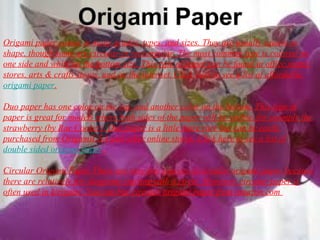
Origami paper comes in many grades, types, and sizes. They are usually square in
shape, though some are circular or rectangular. The most common type is colored on
one side and white on the bottom size. This type of paper can be found in office supply
stores, arts & crafts stores, and on the internet. Click here to see a list of affordable
origami paper.
Duo paper has one color on the top, and another color on the bottom. This type of
paper is great for models where both sides of the paper will be visible, for example the
strawberry (by Rae Cooker). Duo paper is a little more rare but can be easily
purchased from OrigamiUSA and other online stores. Click here to see a list of
double sided origami paper.
Circular Origami Paper There are very few sources of circular origami paper because
there are relatively few diagrams starting with a circle. However, circular paper is
often used in kirigami. You can buy circular origami paper from amazon.com
Origami In Maths
• The connection with geometry is clear and yet
multifaceted; a folded model is both a piece of art
and a geometric figure. Just unfold it and take a
look! You will see a complex geometric pattern,
even if the model you folded was a simple one. A
beginning geometry student might want to figure
out the types of triangles on the paper. What
angles can be seen? What shapes? How did those
angles and shapes get there? Did you know that
you were folding those angles or shapes during the
folding itself?
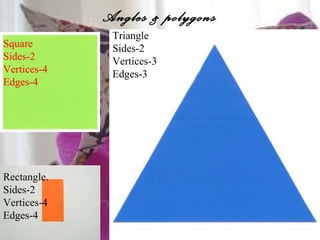
Square
Sides-2
Vertices-4
Edges-4
Rectangle.
Sides-2
Vertices-4
Edges-4
Triangle
Sides-2
Vertices-3
Edges-3
Angles & polygons
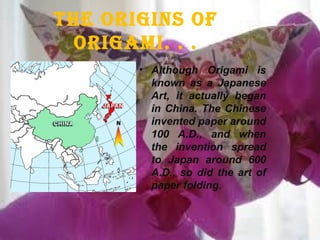
• Although Origami is
known as a Japanese
Art, it actually began
in China. The Chinese
invented paper around
100 A.D., and when
the invention spread
to Japan around 600
A.D., so did the art of
paper folding.
The Origins Of
Origami. . .
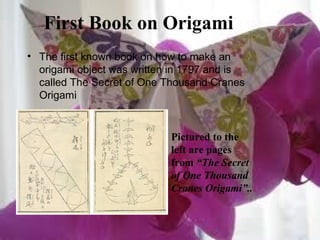
First Book on Origami
• The first known book on how to make an
origami object was written in 1797 and is
called The Secret of One Thousand Cranes
Origami
Pictured to the
left are pages
from “The Secret
of One Thousand
Cranes Origami”..
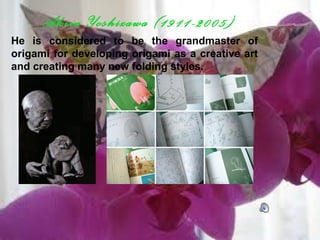
He is considered to be the grandmaster of
origami for developing origami as a creative art
and creating many new folding styles.
Akira Yoshizawa (1911-2005)
Examples of Origami Folds
• http://www.oriland.com/oriversity/symbols/a_sym
bols.asp
• http://www.tammyyee.com/origamishirt.html
Origamiproject

Origamiproject

  • 1.
  • 2.
    • Origami isthe Japanese art of paper folding. "Ori" is the Japanese word for folding and "kami" is the Japanese word for paper. Origami Definition
  • 3.
    Types of Origami •Origami has expanded and evolved beyond birds and boats. There are now many types of origami. In a recent, informal survey, origami enthusiasts have come up with over "80" different types of origami. You can see the list here. In the future, we hope to organize the list so that we can have a better understanding of how the art form is evolving. • There are different ways to categorize paper folding. John Smith's sorts origami chronologically: Classical, Neo Classical, Modern, and Hyper-Modern. David Mitchell's site shows a family • tree of origami design styles. • Below is a list of origami types featured in this web site. Each style of origami will produce a different genre of origami models. Click on to a branch of origami to learn more.
  • 4.
    The History ofOrigami • In ancient times, Origami could only be used for special occasions because the paper was scarce. The figures made from origami were shaped like animals, costumed people, and ceremonial designs that had special meanings to them. The constructions were done using a single sheet of colored paper that was often, though not always, square. • There were no directions back then. None of the folding instructions were ever written down for the models. They were passed down by generation through learning and practicing. • The art of paper folding was not called Origami until the end of the nineteenth century. By the 1950’s origami gained popularity from world famous origami artist Akira Yoshizawa (1911-2005).
  • 5.
    Origami paper comesin many grades, types, and sizes. They are usually square in shape, though some are circular or rectangular. The most common type is colored on one side and white on the bottom size. This type of paper can be found in office supply stores, arts & crafts stores, and on the internet. Click here to see a list of affordable origami paper. Duo paper has one color on the top, and another color on the bottom. This type of paper is great for models where both sides of the paper will be visible, for example the strawberry (by Rae Cooker). Duo paper is a little more rare but can be easily purchased from OrigamiUSA and other online stores. Click here to see a list of double sided origami paper. Circular Origami Paper There are very few sources of circular origami paper because there are relatively few diagrams starting with a circle. However, circular paper is often used in kirigami. You can buy circular origami paper from amazon.com
  • 6.
    Origami In Maths •The connection with geometry is clear and yet multifaceted; a folded model is both a piece of art and a geometric figure. Just unfold it and take a look! You will see a complex geometric pattern, even if the model you folded was a simple one. A beginning geometry student might want to figure out the types of triangles on the paper. What angles can be seen? What shapes? How did those angles and shapes get there? Did you know that you were folding those angles or shapes during the folding itself?
  • 7.
  • 8.
    • Although Origamiis known as a Japanese Art, it actually began in China. The Chinese invented paper around 100 A.D., and when the invention spread to Japan around 600 A.D., so did the art of paper folding. The Origins Of Origami. . .
  • 9.
    First Book onOrigami • The first known book on how to make an origami object was written in 1797 and is called The Secret of One Thousand Cranes Origami Pictured to the left are pages from “The Secret of One Thousand Cranes Origami”..
  • 10.
    He is consideredto be the grandmaster of origami for developing origami as a creative art and creating many new folding styles. Akira Yoshizawa (1911-2005)
  • 11.
    Examples of OrigamiFolds • http://www.oriland.com/oriversity/symbols/a_sym bols.asp • http://www.tammyyee.com/origamishirt.html