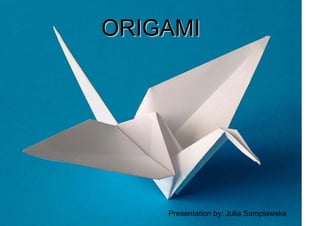
ORIGAMIORIGAMI
Presentation by: Julia Samplawska
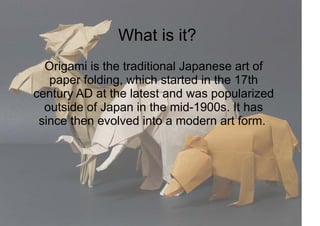
Origami is the traditional Japanese art of
paper folding, which started in the 17th
century AD at the latest and was popularized
outside of Japan in the mid-1900s. It has
since then evolved into a modern art form.
What is it?
Misterious history
There is much speculation about the origin
of Origami. While Japan seems to have had
the most extensive tradition, there is
evidence of an independent tradition of
paperfolding in China, Germany, Italy and
Spain.
However, because of the problems
associated with preserving origami, there
are little evidence of its age or origins.
Tools
It is common to fold using a flat surface, but
some folders like doing it in the air with no
tools, especially when displaying the folding.
Many folders believe that no tool should be
used when folding. However a couple of tools
can help especially with the more complex
models.
For instance a
bone folder allows
sharp creases to
be made in the
paper easily, paper
clips can act as
extra pairs of
fingers, and
tweezers can be
used to make small
folds
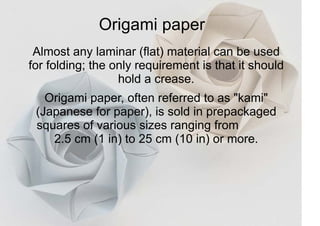
Origami paper
Almost any laminar (flat) material can be used
for folding; the only requirement is that it should
hold a crease.
Origami paper, often referred to as "kami"
(Japanese for paper), is sold in prepackaged
squares of various sizes ranging from
2.5 cm (1 in) to 25 cm (10 in) or more.
Action origami
Origami not only covers still-life, there are also
moving objects; Origami can move in clever
ways. Action origami includes origami that flies,
or, when complete, uses the kinetic energy of a
person's hands, applied at a certain region on
the model, to move another flap or limb.
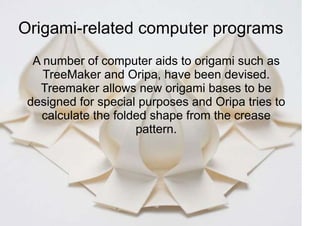
Origami-related computer programs
A number of computer aids to origami such as
TreeMaker and Oripa, have been devised.
Treemaker allows new origami bases to be
designed for special purposes and Oripa tries to
calculate the folded shape from the crease
pattern.

Origami

  • 1.
  • 2.
    Origami is thetraditional Japanese art of paper folding, which started in the 17th century AD at the latest and was popularized outside of Japan in the mid-1900s. It has since then evolved into a modern art form. What is it?
  • 3.
    Misterious history There ismuch speculation about the origin of Origami. While Japan seems to have had the most extensive tradition, there is evidence of an independent tradition of paperfolding in China, Germany, Italy and Spain. However, because of the problems associated with preserving origami, there are little evidence of its age or origins.
  • 4.
    Tools It is commonto fold using a flat surface, but some folders like doing it in the air with no tools, especially when displaying the folding. Many folders believe that no tool should be used when folding. However a couple of tools can help especially with the more complex models.
  • 5.
    For instance a bonefolder allows sharp creases to be made in the paper easily, paper clips can act as extra pairs of fingers, and tweezers can be used to make small folds
  • 6.
    Origami paper Almost anylaminar (flat) material can be used for folding; the only requirement is that it should hold a crease. Origami paper, often referred to as "kami" (Japanese for paper), is sold in prepackaged squares of various sizes ranging from 2.5 cm (1 in) to 25 cm (10 in) or more.
  • 7.
    Action origami Origami notonly covers still-life, there are also moving objects; Origami can move in clever ways. Action origami includes origami that flies, or, when complete, uses the kinetic energy of a person's hands, applied at a certain region on the model, to move another flap or limb.
  • 8.
    Origami-related computer programs Anumber of computer aids to origami such as TreeMaker and Oripa, have been devised. Treemaker allows new origami bases to be designed for special purposes and Oripa tries to calculate the folded shape from the crease pattern.