ORIGAMI
Japanese art of paper-folding
To create a unit origami model, we
build 2 or more units that are
identical and put them together
without using glue.
Materials Needed for each learner
 8 squares of origami paper- 4 each
of 2 different colours or 2 each of 4
different colours.
 Origami journal
Activity : In pairs or individually
FOLDING INSTRUCTIONS AND
QUESTIONS
 1. Fold the paper in half and unfold
 2. Rotate the paper 900
. Fold in half
and unfold.
 3. Fold the top 2 corners down.
 How does the area of the pentagon
compare to the area of the original
square?
 4. Fold the green sides together on
the diagonals indicated on the
diagram. Crease only to the middle
the square
 5. Rotate the piece 900
and fold in
half.
 6. Push the fold to the inside so that
a parallelogram is formed. You have
completed one of the units for the
octagon star. Now make 7 more
identical
units
 7 What are the measures of each
angle of the parallelogram? Explain
how you know.
ASSEMBLY INSTRUCTIONS
 1. Pick up 2 different coloured
units. Insert the short side of one
unit between the long folded edges
of the other unit.
 2. Hook the parallelograms
together by tucking in the tails.
 3. Connecting the parallelograms
together until you have formed and
octagon
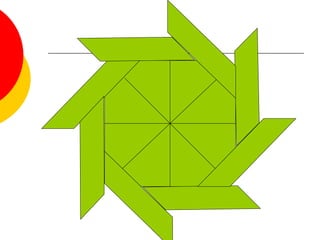
 4. Slide the pieces of the octagon
together until an 8-pointed star is
formed. If your units do not slide
easily, then check to see that when
you tucked in the last two tails,
both were not locked over the
centre piece but folded over the
edges.
EXPLORING YOUR MODEL
 1. Without measuring , determine the measure
of each angle in the pentagon of your octagon
ring.
 2. Determine the measure of each of the angles
of the quadrilaterals in the inside octagon. What
kind of quad. do you see?
 3. Describe the rotational and reflective
symmetries of the octagon ring and the octagon
star. Are they the same or different?
 Describe the relationship between the parm. in
the completed octagon star and the star-building
unit.

Origami

  • 1.
    ORIGAMI Japanese art ofpaper-folding To create a unit origami model, we build 2 or more units that are identical and put them together without using glue.
  • 2.
    Materials Needed foreach learner  8 squares of origami paper- 4 each of 2 different colours or 2 each of 4 different colours.  Origami journal Activity : In pairs or individually
  • 3.
    FOLDING INSTRUCTIONS AND QUESTIONS 1. Fold the paper in half and unfold
  • 4.
     2. Rotatethe paper 900 . Fold in half and unfold.
  • 5.
     3. Foldthe top 2 corners down.  How does the area of the pentagon compare to the area of the original square?
  • 6.
     4. Foldthe green sides together on the diagonals indicated on the diagram. Crease only to the middle the square
  • 7.
     5. Rotatethe piece 900 and fold in half.
  • 8.
     6. Pushthe fold to the inside so that a parallelogram is formed. You have completed one of the units for the octagon star. Now make 7 more identical units
  • 9.
     7 Whatare the measures of each angle of the parallelogram? Explain how you know.
  • 10.
    ASSEMBLY INSTRUCTIONS  1.Pick up 2 different coloured units. Insert the short side of one unit between the long folded edges of the other unit.  2. Hook the parallelograms together by tucking in the tails.  3. Connecting the parallelograms together until you have formed and octagon
  • 12.
     4. Slidethe pieces of the octagon together until an 8-pointed star is formed. If your units do not slide easily, then check to see that when you tucked in the last two tails, both were not locked over the centre piece but folded over the edges.
  • 14.
    EXPLORING YOUR MODEL 1. Without measuring , determine the measure of each angle in the pentagon of your octagon ring.  2. Determine the measure of each of the angles of the quadrilaterals in the inside octagon. What kind of quad. do you see?  3. Describe the rotational and reflective symmetries of the octagon ring and the octagon star. Are they the same or different?  Describe the relationship between the parm. in the completed octagon star and the star-building unit.