JAPAN
Japan 
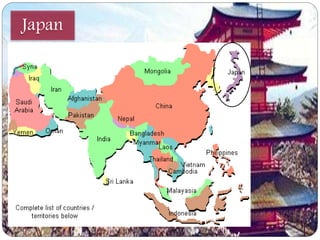
 is an island nation in East Asia. 
 The characters that make up Japan’s 
name mean "sun-origin", which is 
why Japan is often referred to as the 
Land of the Rising Sun. 
 Japan has a total of 6,852 islands . 
The four largest islands are Honshu, 
Hokkaido, Kyushu, and Shikoku.
Traditional Japanese 
Clothing 
Kimono 
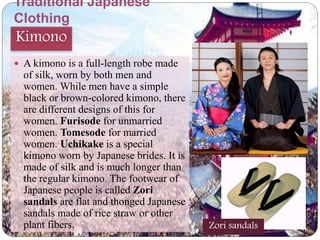
 A kimono is a full-length robe made 
of silk, worn by both men and 
women. While men have a simple 
black or brown-colored kimono, there 
are different designs of this for 
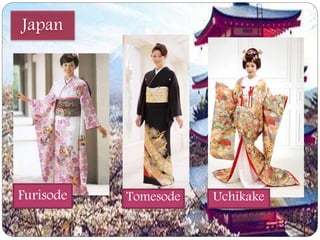
women. Furisode for unmarried 
women. Tomesode for married 
women. Uchikake is a special 
kimono worn by Japanese brides. It is 
made of silk and is much longer than 
the regular kimono. The footwear of 
Japanese people is called Zori 
sandals are flat and thonged Japanese 
sandals made of rice straw or other 
plant fibers. Zori sandals
Japan 
Furisode Tomesode Uchikake
Japan 
 Apart from these specific kimonos, it is interesting to 
note that the patterns of kimonos vary based on the 
prevalent season. Those in fall are less brighter than 
those of spring, while those of winter are made in 
heavier fabrics. A popular type of kimono worn in 
summer is known as yukata, made of cotton.
More about Japanese Crafts 
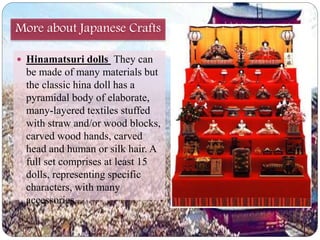
 Hinamatsuri dolls They can 
be made of many materials but 
the classic hina doll has a 
pyramidal body of elaborate, 
many-layered textiles stuffed 
with straw and/or wood blocks, 
carved wood hands, carved 
head and human or silk hair. A 
full set comprises at least 15 
dolls, representing specific 
characters, with many 
accessories.
More about Japanese Crafts 
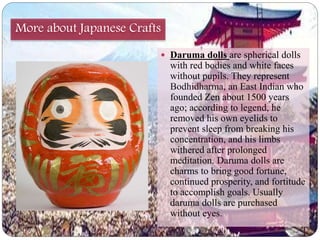
 Daruma dolls are spherical dolls 
with red bodies and white faces 
without pupils. They represent 
Bodhidharma, an East Indian who 
founded Zen about 1500 years 
ago; according to legend, he 
removed his own eyelids to 
prevent sleep from breaking his 
concentration, and his limbs 
withered after prolonged 
meditation. Daruma dolls are 
charms to bring good fortune, 
continued prosperity, and fortitude 
to accomplish goals. Usually 
daruma dolls are purchased 
without eyes.
More about Japanese Crafts 
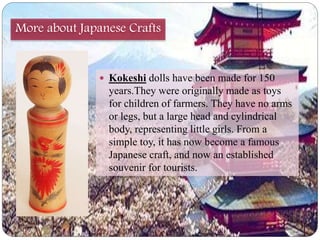
 Kokeshi dolls have been made for 150 
years.They were originally made as toys 
for children of farmers. They have no arms 
or legs, but a large head and cylindrical 
body, representing little girls. From a 
simple toy, it has now become a famous 
Japanese craft, and now an established 
souvenir for tourists.
More about Japanese Crafts 
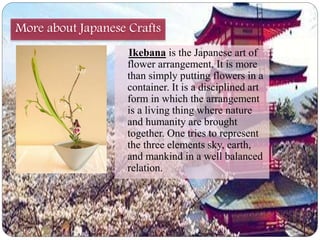
Ikebana is the Japanese art of 
flower arrangement. It is more 
than simply putting flowers in a 
container. It is a disciplined art 
form in which the arrangement 
is a living thing where nature 
and humanity are brought 
together. One tries to represent 
the three elements sky, earth, 
and mankind in a well balanced 
relation.
More about Japanese Crafts 
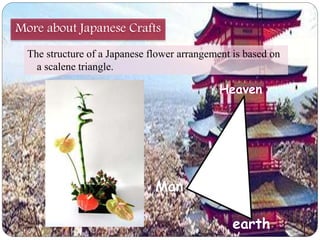
The structure of a Japanese flower arrangement is based on 
a scalene triangle. 
Heaven 
Man 
earth
More about Japanese Crafts 
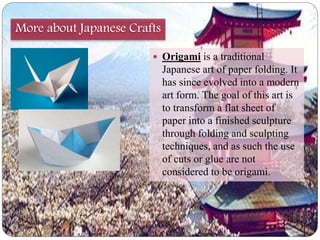
 Origami is a traditional 
Japanese art of paper folding. It 
has since evolved into a modern 
art form. The goal of this art is 
to transform a flat sheet of 
paper into a finished sculpture 
through folding and sculpting 
techniques, and as such the use 
of cuts or glue are not 
considered to be origami.

Japan - Arts and culture

  • 1.
  • 2.
    Japan  isan island nation in East Asia.  The characters that make up Japan’s name mean "sun-origin", which is why Japan is often referred to as the Land of the Rising Sun.  Japan has a total of 6,852 islands . The four largest islands are Honshu, Hokkaido, Kyushu, and Shikoku.
  • 3.
    Traditional Japanese Clothing Kimono  A kimono is a full-length robe made of silk, worn by both men and women. While men have a simple black or brown-colored kimono, there are different designs of this for women. Furisode for unmarried women. Tomesode for married women. Uchikake is a special kimono worn by Japanese brides. It is made of silk and is much longer than the regular kimono. The footwear of Japanese people is called Zori sandals are flat and thonged Japanese sandals made of rice straw or other plant fibers. Zori sandals
  • 4.
  • 5.
    Japan  Apartfrom these specific kimonos, it is interesting to note that the patterns of kimonos vary based on the prevalent season. Those in fall are less brighter than those of spring, while those of winter are made in heavier fabrics. A popular type of kimono worn in summer is known as yukata, made of cotton.
  • 6.
    More about JapaneseCrafts  Hinamatsuri dolls They can be made of many materials but the classic hina doll has a pyramidal body of elaborate, many-layered textiles stuffed with straw and/or wood blocks, carved wood hands, carved head and human or silk hair. A full set comprises at least 15 dolls, representing specific characters, with many accessories.
  • 7.
    More about JapaneseCrafts  Daruma dolls are spherical dolls with red bodies and white faces without pupils. They represent Bodhidharma, an East Indian who founded Zen about 1500 years ago; according to legend, he removed his own eyelids to prevent sleep from breaking his concentration, and his limbs withered after prolonged meditation. Daruma dolls are charms to bring good fortune, continued prosperity, and fortitude to accomplish goals. Usually daruma dolls are purchased without eyes.
  • 8.
    More about JapaneseCrafts  Kokeshi dolls have been made for 150 years.They were originally made as toys for children of farmers. They have no arms or legs, but a large head and cylindrical body, representing little girls. From a simple toy, it has now become a famous Japanese craft, and now an established souvenir for tourists.
  • 9.
    More about JapaneseCrafts Ikebana is the Japanese art of flower arrangement. It is more than simply putting flowers in a container. It is a disciplined art form in which the arrangement is a living thing where nature and humanity are brought together. One tries to represent the three elements sky, earth, and mankind in a well balanced relation.
  • 10.
    More about JapaneseCrafts The structure of a Japanese flower arrangement is based on a scalene triangle. Heaven Man earth
  • 11.
    More about JapaneseCrafts  Origami is a traditional Japanese art of paper folding. It has since evolved into a modern art form. The goal of this art is to transform a flat sheet of paper into a finished sculpture through folding and sculpting techniques, and as such the use of cuts or glue are not considered to be origami.