





















ACKnowledge


            Science Publishing:

       The Different Interests of
Record Keeping and Knowledge Transfer

       Jan Velterop – “Open Access-Open Data” – Köln – December 2010
Publ!hing   =
knowled" transfer
Publ!hing   ≠
knowled" transfer
Why $! chan" ?
A new article in PubMed
   every 36 seconds


        ACKnowledge
Molecular Biology Laboratory in Heidelberg, Germany,
and won Elsevier’s Grand Challenge 2009 competition
for new tools that improve the communication and use
of scientific information.
Reflect automatically recognizes and highlights the
names of genes, proteins and small molecules in the Cell
articles. Users clicking on a highlighted term will see a pop-
up box containing information related to that term, such as
      A new article in PubMed
sequence data and molecular structures, along with links to
the sources of the data. Reflect obtains this information from
         every 36 seconds
its dictionary of millions of proteins and small molecules.
Such ‘entity recognition’ can be done fairly accurately
by many mining tools today. But other tools take on the
tougher challenge of recognizing relationships between the
entities. Researchers from Leiden University and Erasmus
University in Rotterdam, both in the Netherlands, have
developed software called Peregrine, and used it to pre-
dict an undocumented interaction between two proteins:


                          ACKnowledge
ACKnowledge
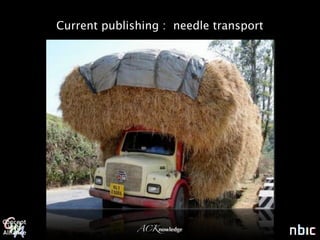
Current publishing : needle transport


              ACKnowledge
What does it all

mean for publ!hing ?
Why do scient!ts

    publ!h ?
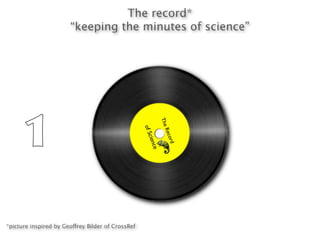
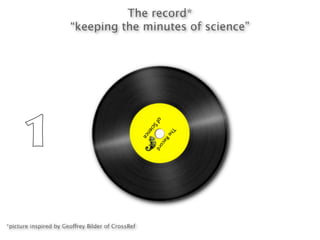
The record*
                       “keeping the minutes of science”


      1                                            of S
                                                       c
                                                     ienc
                                                            The
                                                             Rec
                                                                 o
                                                               rd
                                                      e


*picture inspired by Geoffrey Bilder of CrossRef
The record*
                       “keeping the minutes of science”


      1                                            i
                                                       o fS
                                                           c


                                                                 Th
                                                     en


                                                            e
                                                   e    c


                                                              Re
                                                         c or
                                                             d


*picture inspired by Geoffrey Bilder of CrossRef
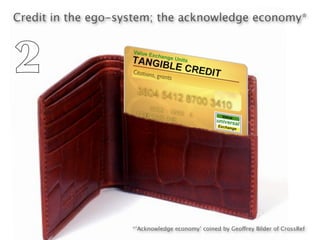
Credit in the ego-system; the acknowledge economy*


2


                    *‘Acknowledge economy’ coined by Geoffrey Bilder of CrossRef
Credit in the ego-system; the acknowledge economy*


2


                    *‘Acknowledge economy’ coined by Geoffrey Bilder of CrossRef
1+2=
the interface with
   officialdom
Transfer of
    information and knowledge


3
3=
the interface with science
Are ' requirements

for all $ree $e same?
Are ' requirements

for all $ree $e same?
What we have may

be good for ' record

  and for cre(t...
What we have may

be good for ' record

  and for cre(t...
...but ! it sat!factory

  for ' transfer of

     knowled" ?

                   ?
)ere ! ju* too

 much to read
Information consumes

$e a+ention of its

recipients...
...hence a weal$ of

     information creates a

     pove,y of a+ention

Herbert Simon
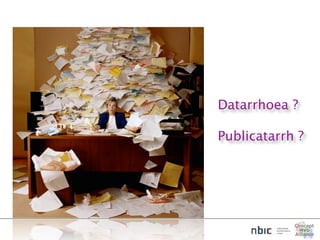
Datarrhoea ?

Publicatarrh ?
Sh-ld we have to

 make choices ?
Can we, truly ?
How w-ld we

choose anyway?
How w-ld we

choose anyway?
Sh-ldn’t we take in

ALL ' knowled"

    in -r area?
As well as sat!fy

$e academic desire to

   avoid rea(ng ?
Create an overview

  fir*, perhaps?
ACKnowledge
And $en home in on

     detail?
ACKnowledge
What does it all

mean for publ!hing ?
In the interface with publishers
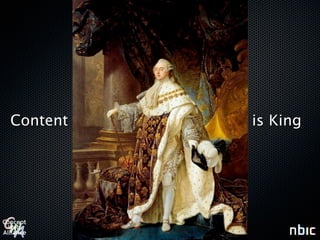
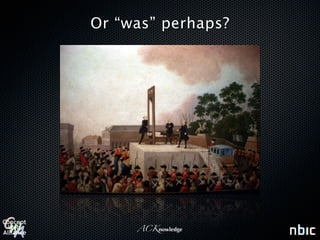
Content In the interface with publishers is King
Or “was” perhaps?


     ACKnowledge
Well, it’s *ill

content $at c-nts
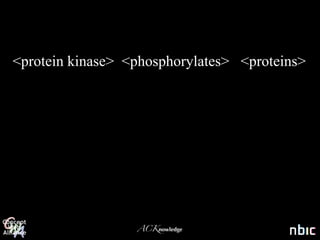
<protein kinase> <phosphorylates> <proteins>


                  ACKnowledge
<protein kinase> <phosphorylates> <proteins>

      <subject>    <predicate>    <object>


                  ACKnowledge
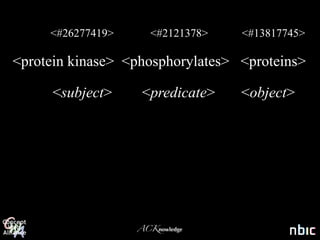
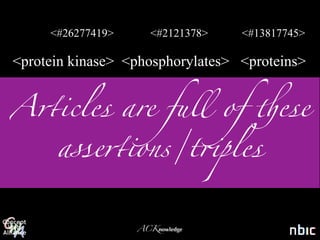
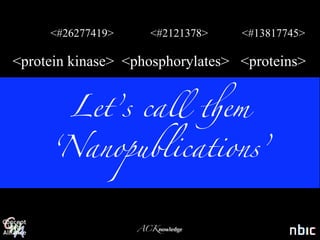
<#26277419>      <#2121378>   <#13817745>

<protein kinase> <phosphorylates> <proteins>

      <subject>     <predicate>    <object>


                   ACKnowledge
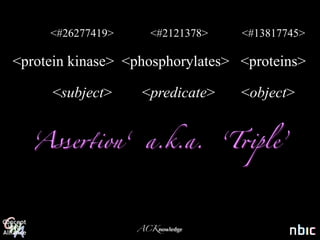
<#26277419>      <#2121378>     <#13817745>

<protein kinase> <phosphorylates> <proteins>

      <subject>     <predicate>      <object>


  ‘Asse,ion‘        a.k.a.         ‘T/ple’


                   ACKnowledge
<#26277419>      <#2121378>     <#13817745>

<protein kinase> <phosphorylates> <proteins>


A,icles are full of $ese
      <subject>     <predicate>      <object>


  ‘
      asse,ions/t/ples
   Asse,ion‘        a.k.a.         ‘T/ple’


                   ACKnowledge
<#26277419>      <#2121378>     <#13817745>

<protein kinase> <phosphorylates> <proteins>


A,icles are full of $ese
   Let’s call $em
      <subject>     <predicate>      <object>


  ‘
      asse,ions/t/ples
     ‘Nanopublications’
   Asse,ion‘        a.k.a.         ‘T/ple’


                   ACKnowledge
Nanopublications: Assertions with Attitudes


                 ACKnowledge
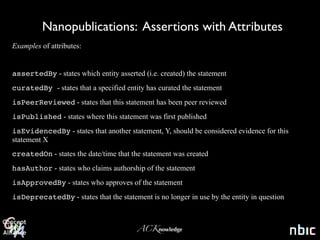
Nanopublications: Assertions with Attributes


                 ACKnowledge
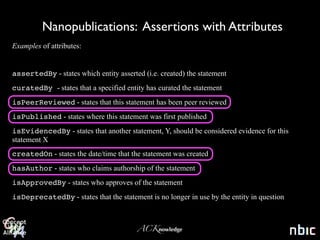
Nanopublications: Assertions with Attributes
Examples of attributes:


assertedBy - states which entity asserted (i.e. created) the statement
curatedBy - states that a specified entity has curated the statement
isPeerReviewed - states that this statement has been peer reviewed
isPublished - states where this statement was first published
isEvidencedBy - states that another statement, Y, should be considered evidence for this
statement X
createdOn - states the date/time that the statement was created
hasAuthor - states who claims authorship of the statement
isApprovedBy - states who approves of the statement
isDeprecatedBy - states that the statement is no longer in use by the entity in question


                                        ACKnowledge
Nanopublications

 are asse,ions
Nanopublications

    are also

   references
Nanopublications: Assertions with Attributes
Examples of attributes:


assertedBy - states which entity asserted (i.e. created) the statement
curatedBy - states that a specified entity has curated the statement
isPeerReviewed - states that this statement has been peer reviewed
isPublished - states where this statement was first published
isEvidencedBy - states that another statement, Y, should be considered evidence for this
statement X
createdOn - states the date/time that the statement was created
hasAuthor - states who claims authorship of the statement
isApprovedBy - states who approves of the statement
isDeprecatedBy - states that the statement is no longer in use by the entity in question


                                        ACKnowledge
i.0

 $ey can be cited:

  good for impact

&acknowled"ment
And...aren’t

references open and

      free ?
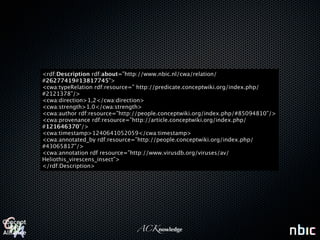
<rdf:Description rdf:about=”http://www.nbic.nl/cwa/relation/
#26277419#13817745">
<cwa:typeRelation rdf:resource=” http://predicate.conceptwiki.org/index.php/
#2121378”/>
<cwa:direction>1,2</cwa:direction>
<cwa:strength>1.0</cwa:strength>
<cwa:author rdf:resource=”http://people.conceptwiki.org/index.php/#85094810”/>
<cwa:provenance rdf:resource=”http://article.conceptwiki.org/index.php/
#121646370”/>
<cwa:timestamp>1240641052059</cwa:timestamp>
<cwa:annotated_by rdf:resource=”http://people.conceptwiki.org/index.php/
#43065817”/>
<cwa:annotation rdf resource=”http://www.virusdb.org/viruses/av/
Heliothis_virescens_insect”>
</rdf:Description>


                               ACKnowledge
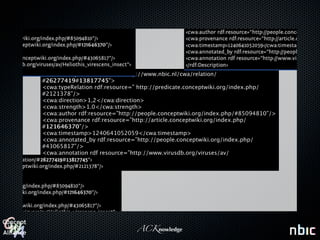
<rdf:Description rdf:about=”http://www.nbic.nl/cwa/relation/
#26277419#13817745">
<cwa:typeRelation rdf:resource=” http://predicate.conceptwiki.org/index.php/
#2121378”/>
<cwa:direction>1,2</cwa:direction>
<cwa:strength>1.0</cwa:strength>
<cwa:author rdf:resource=”http://people.conceptwiki.org/index.php/#85094810”/>
<cwa:provenance rdf:resource=”http://article.conceptwiki.org/index.php/
#121646370”/>
<cwa:timestamp>1240641052059</cwa:timestamp>
<cwa:annotated_by rdf:resource=”http://people.conceptwiki.org/index.php/
#43065817”/>
<cwa:annotation rdf resource=”http://www.virusdb.org/viruses/av/
Heliothis_virescens_insect”>
</rdf:Description>


                               ACKnowledge
ACKnowledge
ACKnowledge
The whole picture
Even if you don’t have all the
            detail
detail


ACKnowledge
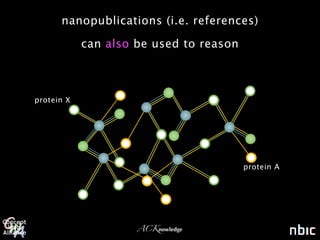
nanopublications (i.e. references)

   can also be used to reason


             ACKnowledge
nanopublications (i.e. references)

       can also be used to reason


‘Publications’ yield ‘data’


                 ACKnowledge
nanopublications (i.e. references)

   can also be used to reason


             ACKnowledge
nanopublications (i.e. references)

            can also be used to reason


protein X


                                         protein A


                     ACKnowledge
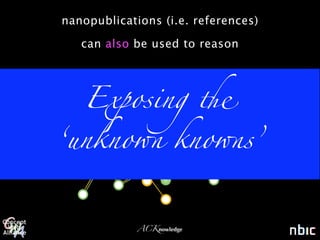
nanopublications (i.e. references)

            can also be used to reason


protein X
            Exposing '

     ‘unkno1 kno1s’
                                         protein A


                     ACKnowledge
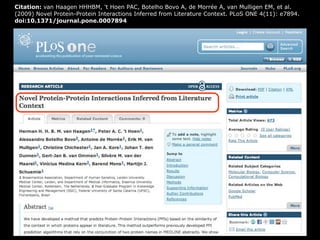
Citation: van Haagen HHHBM, 't Hoen PAC, Botelho Bovo A, de Morrée A, van Mulligen EM, et al.
(2009) Novel Protein-Protein Interactions Inferred from Literature Context. PLoS ONE 4(11): e7894.
doi:10.1371/journal.pone.0007894
velterop@conceptweballiance
jan.velterop@acknowledgeconnect.com


             ACKnowledge

Jan Velterop: Science publishing: the different interests of record keeping and knowledge transfer

  • 1.
    ACKnowledge Science Publishing: The Different Interests of Record Keeping and Knowledge Transfer Jan Velterop – “Open Access-Open Data” – Köln – December 2010
  • 2.
    Publ!hing = knowled" transfer
  • 3.
    Publ!hing ≠ knowled" transfer
  • 4.
  • 5.
    A new articlein PubMed every 36 seconds ACKnowledge
  • 6.
    Molecular Biology Laboratoryin Heidelberg, Germany, and won Elsevier’s Grand Challenge 2009 competition for new tools that improve the communication and use of scientific information. Reflect automatically recognizes and highlights the names of genes, proteins and small molecules in the Cell articles. Users clicking on a highlighted term will see a pop- up box containing information related to that term, such as A new article in PubMed sequence data and molecular structures, along with links to the sources of the data. Reflect obtains this information from every 36 seconds its dictionary of millions of proteins and small molecules. Such ‘entity recognition’ can be done fairly accurately by many mining tools today. But other tools take on the tougher challenge of recognizing relationships between the entities. Researchers from Leiden University and Erasmus University in Rotterdam, both in the Netherlands, have developed software called Peregrine, and used it to pre- dict an undocumented interaction between two proteins: ACKnowledge
  • 7.
  • 8.
    Current publishing :needle transport ACKnowledge
  • 9.
    What does itall mean for publ!hing ?
  • 10.
  • 11.
    The record* “keeping the minutes of science” 1 of S c ienc The Rec o rd e *picture inspired by Geoffrey Bilder of CrossRef
  • 12.
    The record* “keeping the minutes of science” 1 i o fS c Th en e e c Re c or d *picture inspired by Geoffrey Bilder of CrossRef
  • 13.
    Credit in theego-system; the acknowledge economy* 2 *‘Acknowledge economy’ coined by Geoffrey Bilder of CrossRef
  • 14.
    Credit in theego-system; the acknowledge economy* 2 *‘Acknowledge economy’ coined by Geoffrey Bilder of CrossRef
  • 15.
  • 16.
    Transfer of information and knowledge 3
  • 17.
  • 18.
    Are ' requirements forall $ree $e same?
  • 19.
    Are ' requirements forall $ree $e same?
  • 20.
    What we havemay be good for ' record and for cre(t...
  • 21.
    What we havemay be good for ' record and for cre(t...
  • 22.
    ...but ! itsat!factory for ' transfer of knowled" ? ?
  • 23.
    )ere ! ju*too much to read
  • 24.
  • 25.
    ...hence a weal$of information creates a pove,y of a+ention Herbert Simon
  • 26.
  • 27.
    Sh-ld we haveto make choices ?
  • 28.
  • 29.
  • 30.
  • 31.
    Sh-ldn’t we takein ALL ' knowled" in -r area?
  • 32.
    As well assat!fy $e academic desire to avoid rea(ng ?
  • 33.
    Create an overview fir*, perhaps?
  • 34.
  • 35.
    And $en homein on detail?
  • 36.
  • 37.
    What does itall mean for publ!hing ?
  • 38.
    In the interfacewith publishers
  • 39.
    Content In theinterface with publishers is King
  • 40.
  • 41.
  • 42.
    <protein kinase> <phosphorylates><proteins> ACKnowledge
  • 43.
    <protein kinase> <phosphorylates><proteins> <subject> <predicate> <object> ACKnowledge
  • 44.
    <#26277419> <#2121378> <#13817745> <protein kinase> <phosphorylates> <proteins> <subject> <predicate> <object> ACKnowledge
  • 45.
    <#26277419> <#2121378> <#13817745> <protein kinase> <phosphorylates> <proteins> <subject> <predicate> <object> ‘Asse,ion‘ a.k.a. ‘T/ple’ ACKnowledge
  • 46.
    <#26277419> <#2121378> <#13817745> <protein kinase> <phosphorylates> <proteins> A,icles are full of $ese <subject> <predicate> <object> ‘ asse,ions/t/ples Asse,ion‘ a.k.a. ‘T/ple’ ACKnowledge
  • 47.
    <#26277419> <#2121378> <#13817745> <protein kinase> <phosphorylates> <proteins> A,icles are full of $ese Let’s call $em <subject> <predicate> <object> ‘ asse,ions/t/ples ‘Nanopublications’ Asse,ion‘ a.k.a. ‘T/ple’ ACKnowledge
  • 48.
    Nanopublications: Assertions withAttitudes ACKnowledge
  • 49.
    Nanopublications: Assertions withAttributes ACKnowledge
  • 50.
    Nanopublications: Assertions withAttributes Examples of attributes: assertedBy - states which entity asserted (i.e. created) the statement curatedBy - states that a specified entity has curated the statement isPeerReviewed - states that this statement has been peer reviewed isPublished - states where this statement was first published isEvidencedBy - states that another statement, Y, should be considered evidence for this statement X createdOn - states the date/time that the statement was created hasAuthor - states who claims authorship of the statement isApprovedBy - states who approves of the statement isDeprecatedBy - states that the statement is no longer in use by the entity in question ACKnowledge
  • 51.
  • 52.
    Nanopublications are also references
  • 53.
    Nanopublications: Assertions withAttributes Examples of attributes: assertedBy - states which entity asserted (i.e. created) the statement curatedBy - states that a specified entity has curated the statement isPeerReviewed - states that this statement has been peer reviewed isPublished - states where this statement was first published isEvidencedBy - states that another statement, Y, should be considered evidence for this statement X createdOn - states the date/time that the statement was created hasAuthor - states who claims authorship of the statement isApprovedBy - states who approves of the statement isDeprecatedBy - states that the statement is no longer in use by the entity in question ACKnowledge
  • 54.
    i.0 $ey canbe cited: good for impact &acknowled"ment
  • 55.
  • 56.
    <rdf:Description rdf:about=”http://www.nbic.nl/cwa/relation/ #26277419#13817745"> <cwa:typeRelation rdf:resource=”http://predicate.conceptwiki.org/index.php/ #2121378”/> <cwa:direction>1,2</cwa:direction> <cwa:strength>1.0</cwa:strength> <cwa:author rdf:resource=”http://people.conceptwiki.org/index.php/#85094810”/> <cwa:provenance rdf:resource=”http://article.conceptwiki.org/index.php/ #121646370”/> <cwa:timestamp>1240641052059</cwa:timestamp> <cwa:annotated_by rdf:resource=”http://people.conceptwiki.org/index.php/ #43065817”/> <cwa:annotation rdf resource=”http://www.virusdb.org/viruses/av/ Heliothis_virescens_insect”> </rdf:Description> ACKnowledge
  • 57.
    <rdf:Description rdf:about=”http://www.nbic.nl/cwa/relation/ #26277419#13817745"> <cwa:typeRelation rdf:resource=”http://predicate.conceptwiki.org/index.php/ #2121378”/> <cwa:direction>1,2</cwa:direction> <cwa:strength>1.0</cwa:strength> <cwa:author rdf:resource=”http://people.conceptwiki.org/index.php/#85094810”/> <cwa:provenance rdf:resource=”http://article.conceptwiki.org/index.php/ #121646370”/> <cwa:timestamp>1240641052059</cwa:timestamp> <cwa:annotated_by rdf:resource=”http://people.conceptwiki.org/index.php/ #43065817”/> <cwa:annotation rdf resource=”http://www.virusdb.org/viruses/av/ Heliothis_virescens_insect”> </rdf:Description> ACKnowledge
  • 58.
  • 59.
  • 61.
  • 63.
    Even if youdon’t have all the detail
  • 67.
  • 68.
    nanopublications (i.e. references) can also be used to reason ACKnowledge
  • 69.
    nanopublications (i.e. references) can also be used to reason ‘Publications’ yield ‘data’ ACKnowledge
  • 70.
    nanopublications (i.e. references) can also be used to reason ACKnowledge
  • 71.
    nanopublications (i.e. references) can also be used to reason protein X protein A ACKnowledge
  • 72.
    nanopublications (i.e. references) can also be used to reason protein X Exposing ' ‘unkno1 kno1s’ protein A ACKnowledge
  • 73.
    Citation: van HaagenHHHBM, 't Hoen PAC, Botelho Bovo A, de Morrée A, van Mulligen EM, et al. (2009) Novel Protein-Protein Interactions Inferred from Literature Context. PLoS ONE 4(11): e7894. doi:10.1371/journal.pone.0007894
  • 74.