Drivers for Open Access and Data
                                                - A Funder’s Perspective
                                                       Dr Malcolm Read, JISC


Joint Information Systems Committee
Open Access is one part of Open Knowledge

Open knowledge is any kind of information
– sonnets to statistics, genes to geodata –
that can be freely used, reused, and
redistributed.
(Open Knowledge Foundation)

     Open data (e.g. human genome)
     Open Science
     Open Innovation
                                                           http://thand.wordpress.com/
     Open educational resources
     (e.g. OpenLearn at OU)

JISC Strategy recognises ‘open’ as a
   key generic theme
Joint Information Systems Committee
Open Access: UK progress

   Policies
     – All seven Research Councils mandate OA, as does Wellcome Trust
     – As do several UK Government departments (e.g., Health)
     – A small but growing number of UK universities mandate OA (6)
     – UK Open Access Implementation Group


Joint Information Systems Committee
Repositories
     – JISC investment since 2002, direct support since 2006 for ~100 repositories
     – UK has 169 repositories; 121 of which are ‘institutional’
     – Funder repositories (UK PubMedCentral, several Research Councils)
     – JISC Repositories Support Project, UK Council of Research Repositories
     – Increasingly seen as core research information management tools (REF, etc)
   OA Journals
     – Seed funding for several OA journals
     – Investigating the role for JISC Collections in managing payments
   Open Access Implementation Group
     – Chair Professor Martin Hall, VC University of Salford


Joint Information Systems Committee
Open Data

    “Open and accessible data up and down the information chain”
    (Open Data Foundation)

    Short-term archival (“I can get her thesis data”),
    Re-use (“I can mash his data with mine”)
    Exposure (“they cited my paper because the robot found my data”)
    Communities (“I found these other people in this field”)
    Semantics (“I never thought of looking at the data in that way).
    Human value (“we can tackle this global problem with this data”)
    (Peter Murray-Rust)


Joint Information Systems Committee
UK data infrastructure

   Some subject-based data repositories collating data
   for reuse
     – Social sciences, natural and environmental sciences,
       some biosciences
   Few institutional repositories accepting data yet,
   though emerging as an issue
   Data innovation programme
   Digital Curation Centre
     – International centre of expertise
     – Advice and guidance to UK sector
   UK Research Data Service


Joint Information Systems Committee
Relevant university drivers


   Legal compliance


   Funder policies


   Visibility and impact


   Research-led teaching


Joint Information Systems Committee
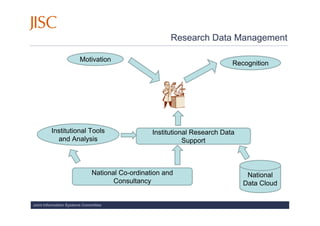
Research Data Management

                       Motivation
                                                                           Recognition


         Institutional Tools                     Institutional Research Data
           and Analysis                                     Support


                              National Co-ordination and                        National
                                     Consultancy                               Data Cloud


Joint Information Systems Committee
Benefits of open data
   2008 JISC study* outlined the following potentially measurable benefits of
      more open data:
          – Cross sector collaboration
          – Data-led education
          – Data re-use, avoiding costs of duplication, avoiding survey fatigue, data
            mining
          – Fuller record of science, better detection of fraud and plagiarism
          – Better alignment of research evaluation with actual research practice and
            outputs
          – Improved visibility of researchers, funders and research institutions
          – Underpinning new industries, eg in geo-spatial
          – Emergence of new opportunities for service companies, adding value for
            data storage and access
   * Fry, J and Lockyer, S and Oppenheim, C and Houghton, J and Rasmussen, B (2009) Identifying benefits
        arising for the curation and open sharing of research date produced by UK Higher Education and
        research institutes http://ie-repository.jisc.ac.uk/279/

Joint Information Systems Committee
Researchers: motivations and constraints (1)

JISC-RIN study* with the National Environment Research Council in the UK
Motivations:
    - altruism,
    - encouragement from peers
    - hope of opening up opportunities for collaboration
But major disincentive:
    - lack of explicit career rewards, and in particular the perceived failure of
    research evaluation and funding regimes explicitly to recognise and
    reward the creating and sharing of datasets


* Swan, A and Brown, S (2008) To share or not to share: Publication and Quality Assurance of Research Data
    Outputs http://eprints.ecs.soton.ac.uk/16742/


 Joint Information Systems Committee
Researchers: motivations and constraints (2)

Many researchers wish to retain exclusive use of the data they have
created until they have extracted all the publication value they can


Also:


     Lack of time and resources
     Lack of experience
     Legal and ethical constraints
     Lack of an appropriate archive service
     Fear of exploitation or inappropriate use of the data


Joint Information Systems Committee
Open data (1)

Further work


   Clear guidance on what data should be curated, and which data should
   be open


   Integration of discipline and institutional repositories


   Improved links to OA resources and other “finding” tools


Joint Information Systems Committee
Open data (2)

Further work


   Promote strategic debate among funders, researchers and institutional
   management with aim to:
     – Determine appropriate policies
     – Provide infrastructure
     – Manage resources and identify sustainability


   Significant potential for FP8 initiatives and joint projects with N America
   (eg NSF), SE Asia, Australia etc


Joint Information Systems Committee

Malcolm Read: Drivers for Open Access and Data - a funder's perspective

  • 1.
    Drivers for OpenAccess and Data - A Funder’s Perspective Dr Malcolm Read, JISC Joint Information Systems Committee
  • 2.
    Open Access isone part of Open Knowledge Open knowledge is any kind of information – sonnets to statistics, genes to geodata – that can be freely used, reused, and redistributed. (Open Knowledge Foundation) Open data (e.g. human genome) Open Science Open Innovation http://thand.wordpress.com/ Open educational resources (e.g. OpenLearn at OU) JISC Strategy recognises ‘open’ as a key generic theme Joint Information Systems Committee
  • 3.
    Open Access: UKprogress Policies – All seven Research Councils mandate OA, as does Wellcome Trust – As do several UK Government departments (e.g., Health) – A small but growing number of UK universities mandate OA (6) – UK Open Access Implementation Group Joint Information Systems Committee
  • 4.
    Repositories – JISC investment since 2002, direct support since 2006 for ~100 repositories – UK has 169 repositories; 121 of which are ‘institutional’ – Funder repositories (UK PubMedCentral, several Research Councils) – JISC Repositories Support Project, UK Council of Research Repositories – Increasingly seen as core research information management tools (REF, etc) OA Journals – Seed funding for several OA journals – Investigating the role for JISC Collections in managing payments Open Access Implementation Group – Chair Professor Martin Hall, VC University of Salford Joint Information Systems Committee
  • 5.
    Open Data “Open and accessible data up and down the information chain” (Open Data Foundation) Short-term archival (“I can get her thesis data”), Re-use (“I can mash his data with mine”) Exposure (“they cited my paper because the robot found my data”) Communities (“I found these other people in this field”) Semantics (“I never thought of looking at the data in that way). Human value (“we can tackle this global problem with this data”) (Peter Murray-Rust) Joint Information Systems Committee
  • 6.
    UK data infrastructure Some subject-based data repositories collating data for reuse – Social sciences, natural and environmental sciences, some biosciences Few institutional repositories accepting data yet, though emerging as an issue Data innovation programme Digital Curation Centre – International centre of expertise – Advice and guidance to UK sector UK Research Data Service Joint Information Systems Committee
  • 7.
    Relevant university drivers Legal compliance Funder policies Visibility and impact Research-led teaching Joint Information Systems Committee
  • 8.
    Research Data Management Motivation Recognition Institutional Tools Institutional Research Data and Analysis Support National Co-ordination and National Consultancy Data Cloud Joint Information Systems Committee
  • 9.
    Benefits of opendata 2008 JISC study* outlined the following potentially measurable benefits of more open data: – Cross sector collaboration – Data-led education – Data re-use, avoiding costs of duplication, avoiding survey fatigue, data mining – Fuller record of science, better detection of fraud and plagiarism – Better alignment of research evaluation with actual research practice and outputs – Improved visibility of researchers, funders and research institutions – Underpinning new industries, eg in geo-spatial – Emergence of new opportunities for service companies, adding value for data storage and access * Fry, J and Lockyer, S and Oppenheim, C and Houghton, J and Rasmussen, B (2009) Identifying benefits arising for the curation and open sharing of research date produced by UK Higher Education and research institutes http://ie-repository.jisc.ac.uk/279/ Joint Information Systems Committee
  • 10.
    Researchers: motivations andconstraints (1) JISC-RIN study* with the National Environment Research Council in the UK Motivations: - altruism, - encouragement from peers - hope of opening up opportunities for collaboration But major disincentive: - lack of explicit career rewards, and in particular the perceived failure of research evaluation and funding regimes explicitly to recognise and reward the creating and sharing of datasets * Swan, A and Brown, S (2008) To share or not to share: Publication and Quality Assurance of Research Data Outputs http://eprints.ecs.soton.ac.uk/16742/ Joint Information Systems Committee
  • 11.
    Researchers: motivations andconstraints (2) Many researchers wish to retain exclusive use of the data they have created until they have extracted all the publication value they can Also: Lack of time and resources Lack of experience Legal and ethical constraints Lack of an appropriate archive service Fear of exploitation or inappropriate use of the data Joint Information Systems Committee
  • 12.
    Open data (1) Furtherwork Clear guidance on what data should be curated, and which data should be open Integration of discipline and institutional repositories Improved links to OA resources and other “finding” tools Joint Information Systems Committee
  • 13.
    Open data (2) Furtherwork Promote strategic debate among funders, researchers and institutional management with aim to: – Determine appropriate policies – Provide infrastructure – Manage resources and identify sustainability Significant potential for FP8 initiatives and joint projects with N America (eg NSF), SE Asia, Australia etc Joint Information Systems Committee