A commons-based foundation of
                     open access and other open
                              models

                     Rainer Kuhlen
     Department of Computer and Information Science
            University of Konstanz, Germany


                                                                                                 CC
A commons-based foundation of open access and other open models – Open Data Cologne 14.12.2010
A commons-based foundation
                        of open access

                                           or
                         knowledge is the water
                              of the mind


                                                                                                 CC
A commons-based foundation of open access and other open models – Open Data Cologne 14.12.2010
Content - Topics

   ➢         Open Access part of a new value system in electronic
             environments

   ➢         Open Access – part of knowledge ecology

   ➢         Towards an understanding of knowledge as a commons

   ➢         Models for the institutionalization of knowledge

   ➢         What needs to be done? Transformation processes

   ➢         Conclusion


A commons-based foundation of open access and other open models – Open Data Cologne 14.12.2010   3
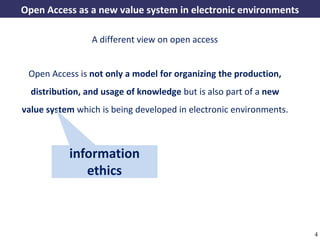
Open Access as a new value system in electronic environments

                          A different view on open access


              Open Access is not only a model for organizing the
    production, distribution, and usage of knowledge but is also part
       of a new value system which is being developed in electronic
                                      environments.

                   information
                      ethics


A commons-based foundation of open access and other open models – Open Data Cologne 14.12.2010   4
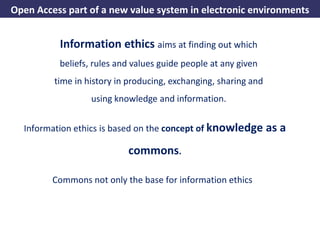
Open Access part of a new value system in electronic environments


                Information ethics aims at finding out which
                beliefs, rules and values guide people at any given
              time in history in producing, exchanging, sharing and
                          using knowledge and information.


    Information ethics is based on the concept of knowledge as a

                                      commons.

             Commons not only the base for information ethics


A commons-based foundation of open access and other open models – Open Data Cologne 14.12.2010
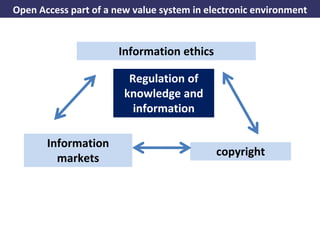
Open Access part of a new value system in electronic environment


                                   Information ethics

                                      Regulation of
                                     knowledge and
                                       information

            Information
                                                                   copyright
              markets


A commons-based foundation of open access and other open models – Open Data Cologne 14.12.2010
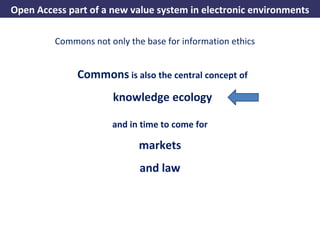
Open Access part of a new value system in electronic environments

              Commons not only the base for information ethics


                      Commons is also the central concept of
                                 knowledge ecology

                                 and in time to come for

                                          markets
                                          and law


A commons-based foundation of open access and other open models – Open Data Cologne 14.12.2010
Open Access – part of knowledge ecology

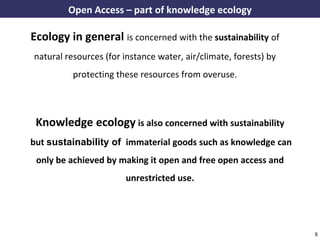
      Ecology in general is concerned with the sustainability of
       natural resources (for instance water, air/climate, forests) by
                    protecting these resources from overuse.


        Knowledge ecology is also concerned with sustainability
      but sustainability of immaterial goods such as knowledge can
        only be achieved by making it open and free open access and
                                      unrestricted use.


A commons-based foundation of open access and other open models – Open Data Cologne 14.12.2010   8
Open Access – part of knowledge ecology


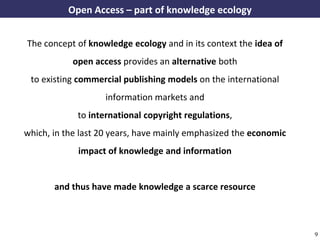
     The concept of knowledge ecology and in its context the idea of
                    open access provides an alternative both
      to existing commercial publishing models on the international
                               information markets and
                      to international copyright regulations,
    which, in the last 20 years, have mainly emphasized the economic
                      impact of knowledge and information


              and thus have made knowledge a scarce resource


A commons-based foundation of open access and other open models – Open Data Cologne 14.12.2010   9
Open Access – part of knowledge ecology


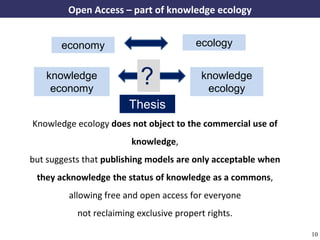
                economy                                      ecology


           knowledge
            economy
                                          ?                   knowledge
                                                               ecology
                                       Thesis
       Knowledge ecology does not object to the commercial use of
                                       knowledge,
      but suggests that publishing models are only acceptable when
        they acknowledge the status of knowledge as a commons,
                   allowing free and open access for everyone
                      not reclaiming exclusive propert rights.

A commons-based foundation of open access and other open models – Open Data Cologne 14.12.2010   10
Towards an under-
                        standing of knowledge
                                   as a commons


A commons-based foundation of open access and other open models – Open Data Cologne 14.12.2010   11
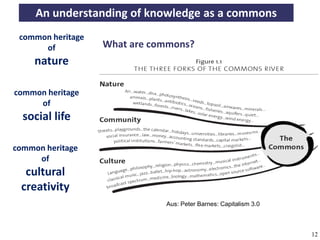
An understanding of knowledge as a commons
   common heritage
        of                    What are commons?
        nature

 common heritage
      of
    social life

common heritage
     of
    cultural
   creativity
                                                   Aus: Peter Barnes: Capitalism 3.0


A commons-based foundation of open access and other open models – Open Data Cologne 14.12.2010   12
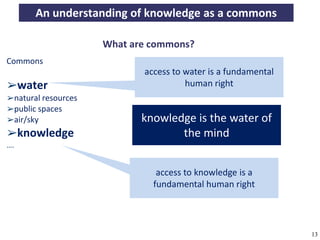
An understanding of knowledge as a commons

                              What are commons?
Commons
                                            access to water is a fundamental
➢water                                                human right
➢natural resources
➢public spaces
➢air/sky                                   knowledge is the water of
➢knowledge                                        the mind
….


                                                access to knowledge is a
                                               fundamental human right


A commons-based foundation of open access and other open models – Open Data Cologne 14.12.2010   13
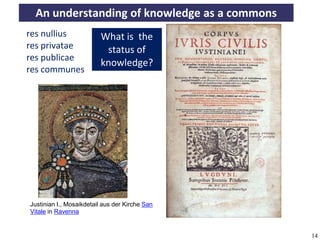
An understanding of knowledge as a commons
     res nullius               What is the
     res privatae               status of
     res publicae
                               knowledge?
     res communes


      Justinian I., Mosaikdetail aus der Kirche San
      Vitale in Ravenna


A commons-based foundation of open access and other open models – Open Data Cologne 14.12.2010   14
An understanding of knowledge as a commons
                               Who owns knowledge?

                                      producers/authors?

                      exploiters/content providers/publishers?


                       users/those who need it for their work?

                  knowledge is part of the commons – of the res
                                   communes
             nobody should own knowledge exclusively


A commons-based foundation of open access and other open models – Open Data Cologne 14.12.2010   15
An understanding of knowledge as a commons
                               Who owns knowledge?

                                    is it the right question?

                 knowledge itself, ideas, facts, theories, …data(??)
                            is not protected by copyright laws


A commons-based foundation of open access and other open models – Open Data Cologne 14.12.2010   16
An understanding of knowledge as a commons


                            knowledge is a commons
                         but only usable when accessible


                          Who has access to knowledge?
                       Who controls the access to knowledge?

        The question is not one of knowledge but that of information

        Who has access to information – who controls
                       information?


A commons-based foundation of open access and other open models – Open Data Cologne 14.12.2010   17
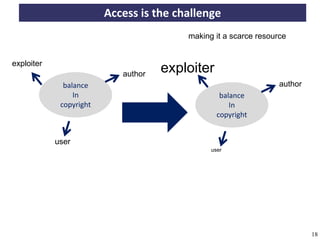
Access is the challenge
                                                          making it a scarce resource


exploiter
                                     author
                                                 exploiter
                 balance                                                                author
                    In                                               balance
                copyright                                               In
                                                                    copyright


              user
                                                                  user


A commons-based foundation of open access and other open models – Open Data Cologne 14.12.2010   18
Access is the challenge


                            knowledge is a commons
                         but only usable when accessible


             knowledge needs to be institutionalized appropriately
                   In order to become a common property


         Open access is a form of institutionalization of
                  knowledge as a commons


A commons-based foundation of open access and other open models – Open Data Cologne 14.12.2010   19
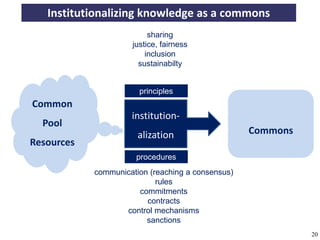
Institutionalizing knowledge as a commons
                                             sharing
                                        justice, fairness
                                            inclusion
                                          sustainabilty


                                          principles
       Common
                                        institution-
          Pool
                                         alization                            Commons
      Resources
                                         procedures
                           communication (reaching a consensus)
                                           rules
                                      commitments
                                        contracts
                                  control mechanisms
                                        sanctions
A commons-based foundation of open access and other open models – Open Data Cologne 14.12.2010   20
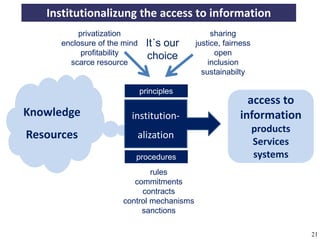
Institutionalizung the access to information
                     privatization                               sharing
                enclosure of the mind       It´s our        justice, fairness
                      profitability         choice                open
                  scarce resource                               inclusion
                                                              sustainabilty

                                          principles
                                                                             access to
    Knowledge                           institution-                       information
                                                                                products
     Resources                           alization
                                                                                Services
                                         procedures                             systems
                                             rules
                                        commitments
                                          contracts
                                     control mechanisms
                                          sanctions

A commons-based foundation of open access and other open models – Open Data Cologne 14.12.2010   21
Models for the
                     institutionalization of
                           knowledge


A commons-based foundation of open access and other open models – Open Data Cologne 14.12.2010   22
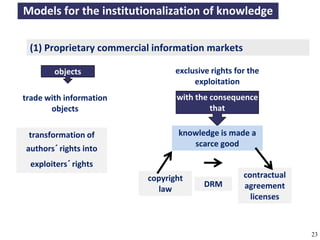
Models for the institutionalization of knowledge

      (1) Proprietary commercial information markets

              objects                                 exclusive rights for the
                                                           exploitation
    trade with information                            with the consequence
           objects                                             that


      transformation of                                knowledge is made a
                                                          scarce good
     authors´ rights into
      exploiters´ rights
                                             copyright                      contractual
                                                               DRM          agreement
                                               law
                                                                              licenses


A commons-based foundation of open access and other open models – Open Data Cologne 14.12.2010   23
Models for the institutionalization of knowledge
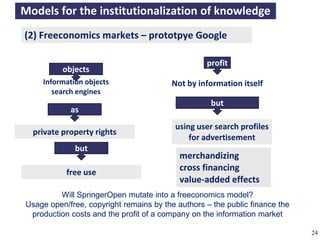
    (2) Freeconomics markets – prototpye Google

                                                                profit
                 objects
          Information objects                        Not by information itself
             search engines
                                                                  but
                   as
                                                      using user search profiles
       private property rights
                                                          for advertisement
                     but
                                                       merchandizing
                  free use
                                                       cross financing
                                                       value-added effects
              Will SpringerOpen mutate into a freeconomics model?
     Usage open/free, copyright remains by the authors – the public finance the
      production costs and the profit of a company on the information market

A commons-based foundation of open access and other open models – Open Data Cologne 14.12.2010   24
Models for the institutionalization of knowledge


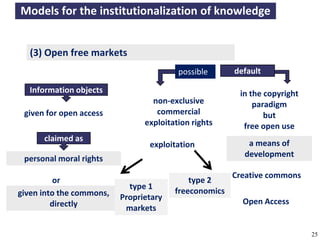
      (3) Open free markets
                                                       possible          default

      Information objects                                                  in the copyright
                                              non-exclusive                    paradigm
    given for open access                      commercial                         but
                                            exploitation rights                   as
                                                                            free open use
           claimed as
                                             exploitation                     a means of
                                                                             development
    personal moral rights
                                                                         Creative commons
            or                                            type 2
                                      type 1
        given into the                                freeconomics
                                    Proprietary                             Open Access
      commons, directly              markets

A commons-based foundation of open access and other open models – Open Data Cologne 14.12.2010   25
Models for the institutionalization of knowledge

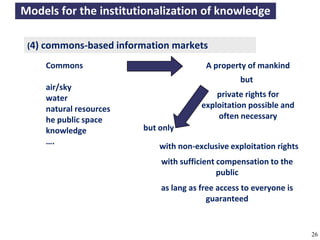
     (4) commons-based information markets

           Commons                                              A property of mankind
                                                                           but
           air/sky
           water                                                  private rights for
           natural resources                                  exploitation possible and
           he public space                                        often necessary
           knowledge                       but only
           ….
                                                 with non-exclusive exploitation rights
                                                 with sufficient compensation to the
                                                                 public
                                                 as lang as free access to everyone is
                                                              guaranteed


A commons-based foundation of open access and other open models – Open Data Cologne 14.12.2010   26
What needs to be done?
                  Transformation processes


A commons-based foundation of open access and other open models – Open Data Cologne 14.12.2010
What needs to be done? Transformation processes

       (1) transforming the understanding of intellectual
           property

         knowledge as a commons is not to be considered a res
          nullius which can be used ad libitum by everyone for
                                 whatever purpose


                 developing a concept of common property rights
                 without denying private individual property rights


A commons-based foundation of open access and other open models – Open Data Cologne 14.12.2010   28
What needs to be done? Transformation processes

       (1) transforming the understanding of intellectual
           property

          knowledge as a commons is not to be considered an
           exclusive private producers´ individual right nor a
                          commercial exploiters´ right


A commons-based foundation of open access and other open models – Open Data Cologne 14.12.2010   29
What needs to be done? Transformation processes

       (1) transforming the understanding of intellectual
           property

         What was feasible with respect to patent right – no longer a

              professor´s/inventor´s right but now a right of their

                                        institutions

                   should be possible with respect to copyright
              That means: overcoming the objections against an
                                 institutional mandate


A commons-based foundation of open access and other open models – Open Data Cologne 14.12.2010   30
What needs to be done? Transformation processes

      (2) developing a new understanding and practice of
                           copyright
            Overcoming the systems of exceptions/limitations in
                                copyright

          for science and education a generic clause is needed
                      rather then a set of exceptions

        right to use published information for any ethically and
          justifiably purpose in science and education without
                            asking permission
                   (but with reasonable remuneration)


A commons-based foundation of open access and other open models – Open Data Cologne 14.12.2010   31
What needs to be done? Transformation processes

   Art. 5.2– Uses for the purpose of freedom of
     expression and information
   (2) The following uses for the purpose of freedom
      of expression and information are permitted
      without authorisation, but only against
      payment of remuneration and to the extent
      justified by the purpose of the use:
             (a) use of single articles for purposes of
             internal reporting within an organisation;
             (b) use for purposes of scientific research.


A commons-based foundation of open access and other open models – Open Data Cologne 14.12.2010
What needs to be done? Transformation processes


                    A generic clause for
                  science and education
                      A proposal by the Coalition for
                                  Action
                      "Copyright for Education and
                               Research”
                                   2010
   Similar:
    The Alliance of German Science Organisations
     (AvH, DAAD, DFG, FhG, HGF, HRK, MPG, WGL, WR)
    Standing Conference of the Ministers of Education and Cultural Affairs of the
     Länder in the Federal Republic of Germany

A commons-based foundation of open access and other open models – Open Data Cologne 14.12.2010   33
What needs to be done? Transformation processes

       § 45b Education and Science
       (1) Copying, distributing and making published works available to the
       public is permitted for personal use in science and for educational
       purposes in schools, institutions of higher education (such as
       universities), and other non-commercial institutions dedicated to
       education, continuing and professional training.


     provided that the source from which the                      not restricted to publicly
     reproduction is made is not an obviously                         financed science
                   infringing copy
        from a legitimately acquired copy
     only, e.g. from a library or bought from a
                commercial provider


A commons-based foundation of open access and other open models – Open Data Cologne 14.12.2010   34
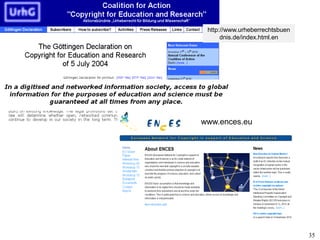
http://www.urheberrechtsbuen
                                                                     dnis.de/index.html.en


                                                              www.ences.eu


A commons-based foundation of open access and other open models – Open Data Cologne 14.12.2010   35
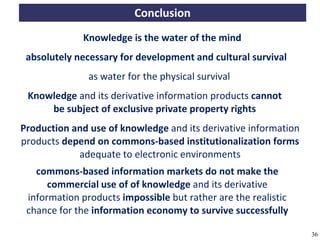
Conclusion
                        Knowledge is the water of the mind
     absolutely necessary for development and cultural survival
                         as water for the physical survival
     Knowledge and its derivative information products cannot
         be subject of exclusive private property rights
   Production and use of knowledge and its derivative information
   products depend on commons-based institutionalization forms
               adequate to electronic environments
       commons-based information markets do not make the
          commercial use of of knowledge and its derivative
     information products impossible but rather are the realistic
     chance for the information economy to survive successfully

A commons-based foundation of open access and other open models – Open Data Cologne 14.12.2010   36
Thank you for your
                               attention
              Slides under a CC-Licence from www.kuhlen.name


          Towards a commons-based copyright– IFLA 08/2010
A commons-based foundation of open access and other open models – Open Data Cologne 14.12.2010   37
Towards a commons-based copyright– IFLA 08/2010
A commons-based foundation of open access and other open models – Open Data Cologne 14.12.2010   38
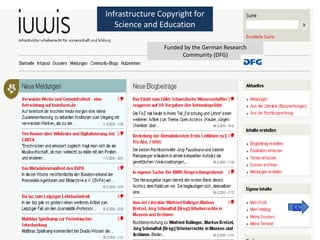
Infrastructure Copyright for
                                  Science and Education

                                                  Funded by the German Research
                                                        Community (DFG)


                                                                                            CC

                                                                                                 39
A commons-based foundation of open access and other open models – Open Data Cologne 14.12.2010

Rainer Kuhlen: A commons-based foundation of open access and other open models

  • 1.
    A commons-based foundationof open access and other open models Rainer Kuhlen Department of Computer and Information Science University of Konstanz, Germany CC A commons-based foundation of open access and other open models – Open Data Cologne 14.12.2010
  • 2.
    A commons-based foundation of open access or knowledge is the water of the mind CC A commons-based foundation of open access and other open models – Open Data Cologne 14.12.2010
  • 3.
    Content - Topics ➢ Open Access part of a new value system in electronic environments ➢ Open Access – part of knowledge ecology ➢ Towards an understanding of knowledge as a commons ➢ Models for the institutionalization of knowledge ➢ What needs to be done? Transformation processes ➢ Conclusion A commons-based foundation of open access and other open models – Open Data Cologne 14.12.2010 3
  • 4.
    Open Access asa new value system in electronic environments A different view on open access Open Access is not only a model for organizing the production, distribution, and usage of knowledge but is also part of a new value system which is being developed in electronic environments. information ethics A commons-based foundation of open access and other open models – Open Data Cologne 14.12.2010 4
  • 5.
    Open Access partof a new value system in electronic environments Information ethics aims at finding out which beliefs, rules and values guide people at any given time in history in producing, exchanging, sharing and using knowledge and information. Information ethics is based on the concept of knowledge as a commons. Commons not only the base for information ethics A commons-based foundation of open access and other open models – Open Data Cologne 14.12.2010
  • 6.
    Open Access partof a new value system in electronic environment Information ethics Regulation of knowledge and information Information copyright markets A commons-based foundation of open access and other open models – Open Data Cologne 14.12.2010
  • 7.
    Open Access partof a new value system in electronic environments Commons not only the base for information ethics Commons is also the central concept of knowledge ecology and in time to come for markets and law A commons-based foundation of open access and other open models – Open Data Cologne 14.12.2010
  • 8.
    Open Access –part of knowledge ecology Ecology in general is concerned with the sustainability of natural resources (for instance water, air/climate, forests) by protecting these resources from overuse. Knowledge ecology is also concerned with sustainability but sustainability of immaterial goods such as knowledge can only be achieved by making it open and free open access and unrestricted use. A commons-based foundation of open access and other open models – Open Data Cologne 14.12.2010 8
  • 9.
    Open Access –part of knowledge ecology The concept of knowledge ecology and in its context the idea of open access provides an alternative both to existing commercial publishing models on the international information markets and to international copyright regulations, which, in the last 20 years, have mainly emphasized the economic impact of knowledge and information and thus have made knowledge a scarce resource A commons-based foundation of open access and other open models – Open Data Cologne 14.12.2010 9
  • 10.
    Open Access –part of knowledge ecology economy ecology knowledge economy ? knowledge ecology Thesis Knowledge ecology does not object to the commercial use of knowledge, but suggests that publishing models are only acceptable when they acknowledge the status of knowledge as a commons, allowing free and open access for everyone not reclaiming exclusive propert rights. A commons-based foundation of open access and other open models – Open Data Cologne 14.12.2010 10
  • 11.
    Towards an under- standing of knowledge as a commons A commons-based foundation of open access and other open models – Open Data Cologne 14.12.2010 11
  • 12.
    An understanding ofknowledge as a commons common heritage of What are commons? nature common heritage of social life common heritage of cultural creativity Aus: Peter Barnes: Capitalism 3.0 A commons-based foundation of open access and other open models – Open Data Cologne 14.12.2010 12
  • 13.
    An understanding ofknowledge as a commons What are commons? Commons access to water is a fundamental ➢water human right ➢natural resources ➢public spaces ➢air/sky knowledge is the water of ➢knowledge the mind …. access to knowledge is a fundamental human right A commons-based foundation of open access and other open models – Open Data Cologne 14.12.2010 13
  • 14.
    An understanding ofknowledge as a commons res nullius What is the res privatae status of res publicae knowledge? res communes Justinian I., Mosaikdetail aus der Kirche San Vitale in Ravenna A commons-based foundation of open access and other open models – Open Data Cologne 14.12.2010 14
  • 15.
    An understanding ofknowledge as a commons Who owns knowledge? producers/authors? exploiters/content providers/publishers? users/those who need it for their work? knowledge is part of the commons – of the res communes nobody should own knowledge exclusively A commons-based foundation of open access and other open models – Open Data Cologne 14.12.2010 15
  • 16.
    An understanding ofknowledge as a commons Who owns knowledge? is it the right question? knowledge itself, ideas, facts, theories, …data(??) is not protected by copyright laws A commons-based foundation of open access and other open models – Open Data Cologne 14.12.2010 16
  • 17.
    An understanding ofknowledge as a commons knowledge is a commons but only usable when accessible Who has access to knowledge? Who controls the access to knowledge? The question is not one of knowledge but that of information Who has access to information – who controls information? A commons-based foundation of open access and other open models – Open Data Cologne 14.12.2010 17
  • 18.
    Access is thechallenge making it a scarce resource exploiter author exploiter balance author In balance copyright In copyright user user A commons-based foundation of open access and other open models – Open Data Cologne 14.12.2010 18
  • 19.
    Access is thechallenge knowledge is a commons but only usable when accessible knowledge needs to be institutionalized appropriately In order to become a common property Open access is a form of institutionalization of knowledge as a commons A commons-based foundation of open access and other open models – Open Data Cologne 14.12.2010 19
  • 20.
    Institutionalizing knowledge asa commons sharing justice, fairness inclusion sustainabilty principles Common institution- Pool alization Commons Resources procedures communication (reaching a consensus) rules commitments contracts control mechanisms sanctions A commons-based foundation of open access and other open models – Open Data Cologne 14.12.2010 20
  • 21.
    Institutionalizung the accessto information privatization sharing enclosure of the mind It´s our justice, fairness profitability choice open scarce resource inclusion sustainabilty principles access to Knowledge institution- information products Resources alization Services procedures systems rules commitments contracts control mechanisms sanctions A commons-based foundation of open access and other open models – Open Data Cologne 14.12.2010 21
  • 22.
    Models for the institutionalization of knowledge A commons-based foundation of open access and other open models – Open Data Cologne 14.12.2010 22
  • 23.
    Models for theinstitutionalization of knowledge (1) Proprietary commercial information markets objects exclusive rights for the exploitation trade with information with the consequence objects that transformation of knowledge is made a scarce good authors´ rights into exploiters´ rights copyright contractual DRM agreement law licenses A commons-based foundation of open access and other open models – Open Data Cologne 14.12.2010 23
  • 24.
    Models for theinstitutionalization of knowledge (2) Freeconomics markets – prototpye Google profit objects Information objects Not by information itself search engines but as using user search profiles private property rights for advertisement but merchandizing free use cross financing value-added effects Will SpringerOpen mutate into a freeconomics model? Usage open/free, copyright remains by the authors – the public finance the production costs and the profit of a company on the information market A commons-based foundation of open access and other open models – Open Data Cologne 14.12.2010 24
  • 25.
    Models for theinstitutionalization of knowledge (3) Open free markets possible default Information objects in the copyright non-exclusive paradigm given for open access commercial but exploitation rights as free open use claimed as exploitation a means of development personal moral rights Creative commons or type 2 type 1 given into the freeconomics Proprietary Open Access commons, directly markets A commons-based foundation of open access and other open models – Open Data Cologne 14.12.2010 25
  • 26.
    Models for theinstitutionalization of knowledge (4) commons-based information markets Commons A property of mankind but air/sky water private rights for natural resources exploitation possible and he public space often necessary knowledge but only …. with non-exclusive exploitation rights with sufficient compensation to the public as lang as free access to everyone is guaranteed A commons-based foundation of open access and other open models – Open Data Cologne 14.12.2010 26
  • 27.
    What needs tobe done? Transformation processes A commons-based foundation of open access and other open models – Open Data Cologne 14.12.2010
  • 28.
    What needs tobe done? Transformation processes (1) transforming the understanding of intellectual property knowledge as a commons is not to be considered a res nullius which can be used ad libitum by everyone for whatever purpose developing a concept of common property rights without denying private individual property rights A commons-based foundation of open access and other open models – Open Data Cologne 14.12.2010 28
  • 29.
    What needs tobe done? Transformation processes (1) transforming the understanding of intellectual property knowledge as a commons is not to be considered an exclusive private producers´ individual right nor a commercial exploiters´ right A commons-based foundation of open access and other open models – Open Data Cologne 14.12.2010 29
  • 30.
    What needs tobe done? Transformation processes (1) transforming the understanding of intellectual property What was feasible with respect to patent right – no longer a professor´s/inventor´s right but now a right of their institutions should be possible with respect to copyright That means: overcoming the objections against an institutional mandate A commons-based foundation of open access and other open models – Open Data Cologne 14.12.2010 30
  • 31.
    What needs tobe done? Transformation processes (2) developing a new understanding and practice of copyright Overcoming the systems of exceptions/limitations in copyright for science and education a generic clause is needed rather then a set of exceptions right to use published information for any ethically and justifiably purpose in science and education without asking permission (but with reasonable remuneration) A commons-based foundation of open access and other open models – Open Data Cologne 14.12.2010 31
  • 32.
    What needs tobe done? Transformation processes Art. 5.2– Uses for the purpose of freedom of expression and information (2) The following uses for the purpose of freedom of expression and information are permitted without authorisation, but only against payment of remuneration and to the extent justified by the purpose of the use: (a) use of single articles for purposes of internal reporting within an organisation; (b) use for purposes of scientific research. A commons-based foundation of open access and other open models – Open Data Cologne 14.12.2010
  • 33.
    What needs tobe done? Transformation processes A generic clause for science and education A proposal by the Coalition for Action "Copyright for Education and Research” 2010 Similar:  The Alliance of German Science Organisations (AvH, DAAD, DFG, FhG, HGF, HRK, MPG, WGL, WR)  Standing Conference of the Ministers of Education and Cultural Affairs of the Länder in the Federal Republic of Germany A commons-based foundation of open access and other open models – Open Data Cologne 14.12.2010 33
  • 34.
    What needs tobe done? Transformation processes § 45b Education and Science (1) Copying, distributing and making published works available to the public is permitted for personal use in science and for educational purposes in schools, institutions of higher education (such as universities), and other non-commercial institutions dedicated to education, continuing and professional training. provided that the source from which the not restricted to publicly reproduction is made is not an obviously financed science infringing copy from a legitimately acquired copy only, e.g. from a library or bought from a commercial provider A commons-based foundation of open access and other open models – Open Data Cologne 14.12.2010 34
  • 35.
    http://www.urheberrechtsbuen dnis.de/index.html.en www.ences.eu A commons-based foundation of open access and other open models – Open Data Cologne 14.12.2010 35
  • 36.
    Conclusion Knowledge is the water of the mind absolutely necessary for development and cultural survival as water for the physical survival Knowledge and its derivative information products cannot be subject of exclusive private property rights Production and use of knowledge and its derivative information products depend on commons-based institutionalization forms adequate to electronic environments commons-based information markets do not make the commercial use of of knowledge and its derivative information products impossible but rather are the realistic chance for the information economy to survive successfully A commons-based foundation of open access and other open models – Open Data Cologne 14.12.2010 36
  • 37.
    Thank you foryour attention Slides under a CC-Licence from www.kuhlen.name Towards a commons-based copyright– IFLA 08/2010 A commons-based foundation of open access and other open models – Open Data Cologne 14.12.2010 37
  • 38.
    Towards a commons-basedcopyright– IFLA 08/2010 A commons-based foundation of open access and other open models – Open Data Cologne 14.12.2010 38
  • 39.
    Infrastructure Copyright for Science and Education Funded by the German Research Community (DFG) CC 39 A commons-based foundation of open access and other open models – Open Data Cologne 14.12.2010