JAIPUR
A HISTORIC PINK CITY OF INDIA
A PRESENTATION BY :--
SURESH KUMAR SHARMA
INTRODUCTION
 Jaipur is the capital and largest city of indian state of Rajasthan in
Northern India. It was founded on 18 November 1727 by Maharja
Sawai Jai Singh II ,the ruler of Amber, after whom the city is
named . The City today has a population of 3.1 million.
 Jaipur is a popular tourist destination of india and forms a part of
the west Golden Tringle tourist circuit of india with Delhi and Agra
(240 km ,149mi).
 UNESCO World Heritage Committee inscribed Jaipur the “Pink
City of India” among it’s World Heritage Sites.
Lat: 26.689301 Long: 75.70265
ARCHITECTURE
 The City was planed according to the indian Vastu Shastra by Vidyadhar Bhattarcharya in 1727.
There are three gates facing east,west,and north.
 The eastern gate is called Surajpol(Sun gate), the western gate is called Chand Pol (Moon gate)
and the northan gate faces the ancestral capital of Amer
Suraj Pol Gate Chand Pol Gate
Historic Place of Jaipur
1. Hawa Mahal
2. City Palace
3. Jantar Mantar
4. Jal mahal
5. Amber Fort
 With the old city surrounded by walls and gates decorated with drawings on the backdrop of a
beautiful pink hue, Jaipur, the pink city successfully manages to retain its old-world charm. Home to
a few UNESCO World Heritage sites including Amer Fort and Jantar Mantar, Jaipur holds many
magnificent forts, palaces, temples and museums and brims with bustling local bazaars where you
can shop to your heart's content. Popular bazaars in the city include Bapu Bazaar, Tripolia Bazaar
and Johri Bazaar.
 Following 5 are most popular historic places of Jaipur :----
HAWAMAHAL
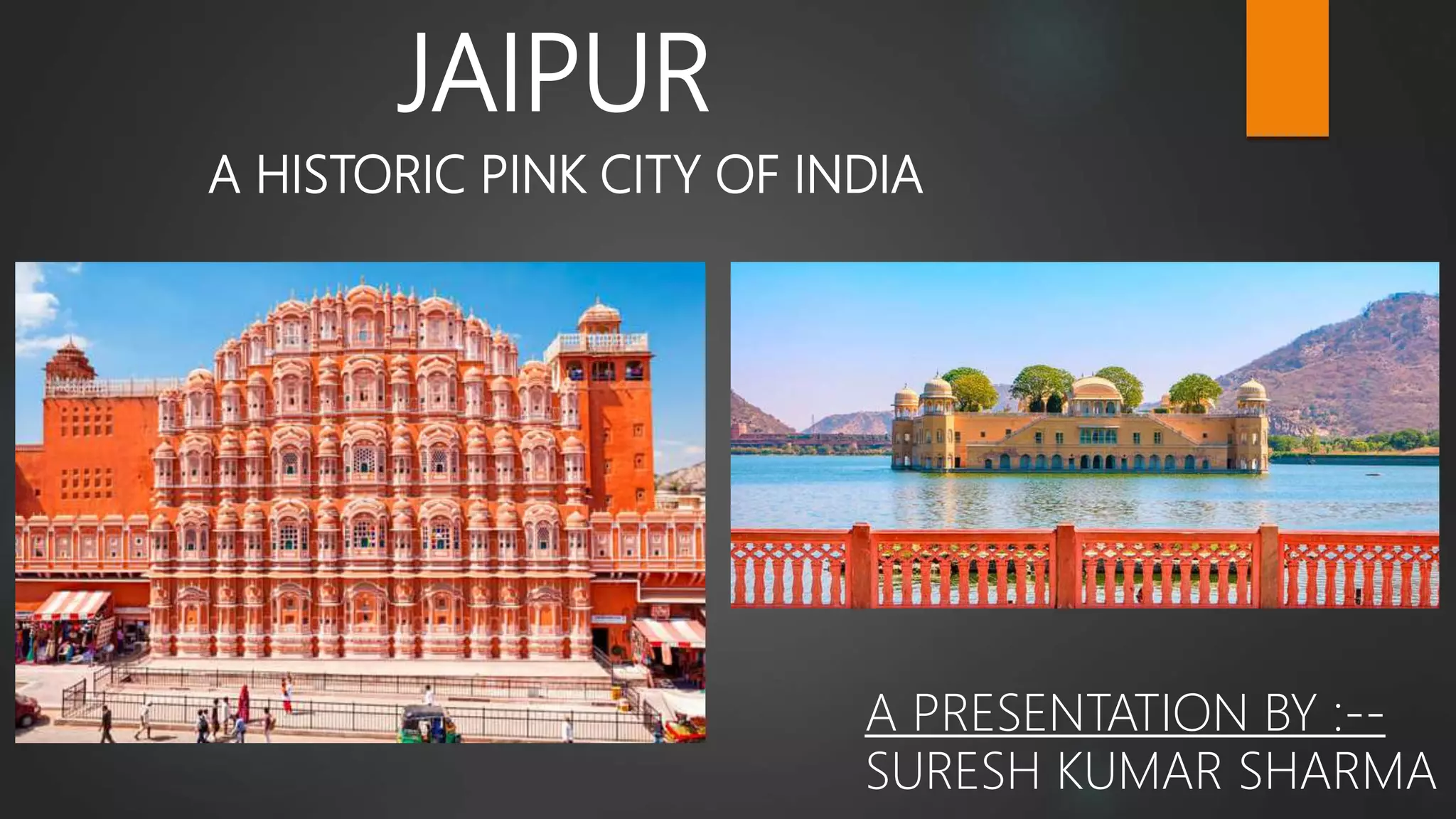
 The Hawa Mahal stands at the intersection of the main road in Jaipur, Badi Chaupad. It is regarded
as the signature building of Jaipur and was built by Maharaja Sawai Pratap Singh. It is an iconic
historical place of Jaipur. Hawa Mahal derives its name from its unique structure, which is a mesh of
small windows that allowed cool wind to enter the palace and hence kept the palace comfortable
during the hot summer months.
CITY PALACE
 The magnificent City Palace in Jaipur is one of the most famous tourist attractions located in the old
part of the city. Built by Maharaja Sawai Jai Singh during the years 1729 to 1732, the vast complex of
the palace occupied one-seventh of the walled city. In fact, it was once the seat of the Maharaja of
Jaipur. The palace is divided into a series of courtyards, buildings and gardens including the Chandra
Mahal and the Mubarak Mahal. The museum showcases various unique handcrafted products and
other things that belong to the royal heritage of the City Palace.
JANTAR MANTAR
 Jantar Mantar is the largest stone astronomical observatory in the world. Owing to its rich
cultural, heritage and scientific value, Jantar Mantar in Jaipur has also been featured on
UNESCO's list of World Heritage Sites. The main objective of building this vast observatory was
to study and gather information about space and time. The instruments here pertain to Egyptian
study of Ptolemaic astronomy and follows three classical celestial coordinates to track the
positions of heavenly bodies- namely horizon-zenith local system, the equatorial system and the
ecliptic system.
JAL MAHAL
 Sitting prettily right in the centre of the Man Sagar Lake on the outskirts of Jaipur, lies the splendid
and tranquil Jal Mahal. A masterful creation, it is bordered by the Nahargarh Hills. This low rise
symmetrical Palace was once a shooting lodge for the Maharajas and now fascinates many visitors
from all over the world. Jal Mahal was constructed in the 1750s and was commissioned by Maharaja
Madho Singh.
AMER FORT
 In the Pink City of Jaipur, cradled on the top of the Aravali Hill lies the Amer Fort, one of the most
magnificent palaces in India. Also commonly known as the Amber Fort, this majestic building with its
maze-like passages and serpentine staircases is an architectural masterpiece and with significant
importance in Indian history. Only 11 kilometres away from the capital city of Jaipur, Amer Fort is clad
in pink and yellow sandstone and is a part of an extensive complex. Built by one of the most trusted
generals of Akbar, Maharaja Man Singh I in the year 1592, Amer Fort served as the main residence
of the Rajput Rulers.
THANK YOU

Jaipur city a historic pink city

  • 1.
    JAIPUR A HISTORIC PINKCITY OF INDIA A PRESENTATION BY :-- SURESH KUMAR SHARMA
  • 2.
    INTRODUCTION  Jaipur isthe capital and largest city of indian state of Rajasthan in Northern India. It was founded on 18 November 1727 by Maharja Sawai Jai Singh II ,the ruler of Amber, after whom the city is named . The City today has a population of 3.1 million.  Jaipur is a popular tourist destination of india and forms a part of the west Golden Tringle tourist circuit of india with Delhi and Agra (240 km ,149mi).  UNESCO World Heritage Committee inscribed Jaipur the “Pink City of India” among it’s World Heritage Sites. Lat: 26.689301 Long: 75.70265
  • 3.
    ARCHITECTURE  The Citywas planed according to the indian Vastu Shastra by Vidyadhar Bhattarcharya in 1727. There are three gates facing east,west,and north.  The eastern gate is called Surajpol(Sun gate), the western gate is called Chand Pol (Moon gate) and the northan gate faces the ancestral capital of Amer Suraj Pol Gate Chand Pol Gate
  • 4.
    Historic Place ofJaipur 1. Hawa Mahal 2. City Palace 3. Jantar Mantar 4. Jal mahal 5. Amber Fort  With the old city surrounded by walls and gates decorated with drawings on the backdrop of a beautiful pink hue, Jaipur, the pink city successfully manages to retain its old-world charm. Home to a few UNESCO World Heritage sites including Amer Fort and Jantar Mantar, Jaipur holds many magnificent forts, palaces, temples and museums and brims with bustling local bazaars where you can shop to your heart's content. Popular bazaars in the city include Bapu Bazaar, Tripolia Bazaar and Johri Bazaar.  Following 5 are most popular historic places of Jaipur :----
  • 5.
    HAWAMAHAL  The HawaMahal stands at the intersection of the main road in Jaipur, Badi Chaupad. It is regarded as the signature building of Jaipur and was built by Maharaja Sawai Pratap Singh. It is an iconic historical place of Jaipur. Hawa Mahal derives its name from its unique structure, which is a mesh of small windows that allowed cool wind to enter the palace and hence kept the palace comfortable during the hot summer months.
  • 6.
    CITY PALACE  Themagnificent City Palace in Jaipur is one of the most famous tourist attractions located in the old part of the city. Built by Maharaja Sawai Jai Singh during the years 1729 to 1732, the vast complex of the palace occupied one-seventh of the walled city. In fact, it was once the seat of the Maharaja of Jaipur. The palace is divided into a series of courtyards, buildings and gardens including the Chandra Mahal and the Mubarak Mahal. The museum showcases various unique handcrafted products and other things that belong to the royal heritage of the City Palace.
  • 7.
    JANTAR MANTAR  JantarMantar is the largest stone astronomical observatory in the world. Owing to its rich cultural, heritage and scientific value, Jantar Mantar in Jaipur has also been featured on UNESCO's list of World Heritage Sites. The main objective of building this vast observatory was to study and gather information about space and time. The instruments here pertain to Egyptian study of Ptolemaic astronomy and follows three classical celestial coordinates to track the positions of heavenly bodies- namely horizon-zenith local system, the equatorial system and the ecliptic system.
  • 8.
    JAL MAHAL  Sittingprettily right in the centre of the Man Sagar Lake on the outskirts of Jaipur, lies the splendid and tranquil Jal Mahal. A masterful creation, it is bordered by the Nahargarh Hills. This low rise symmetrical Palace was once a shooting lodge for the Maharajas and now fascinates many visitors from all over the world. Jal Mahal was constructed in the 1750s and was commissioned by Maharaja Madho Singh.
  • 9.
    AMER FORT  Inthe Pink City of Jaipur, cradled on the top of the Aravali Hill lies the Amer Fort, one of the most magnificent palaces in India. Also commonly known as the Amber Fort, this majestic building with its maze-like passages and serpentine staircases is an architectural masterpiece and with significant importance in Indian history. Only 11 kilometres away from the capital city of Jaipur, Amer Fort is clad in pink and yellow sandstone and is a part of an extensive complex. Built by one of the most trusted generals of Akbar, Maharaja Man Singh I in the year 1592, Amer Fort served as the main residence of the Rajput Rulers.
  • 10.