PRESENTATION MATLAB
Sajjad Ahmad
2015-CH-241
Contents:
• Introduction of Jacobi Method
• Algorithm
• Example related algorithm
• Code for Jacobi Method
• Example with code
• Applications in Engineering
• Advantages and Disadvantages
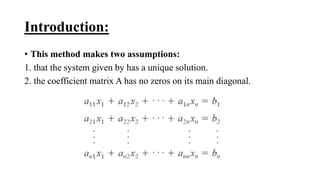
Introduction:
• This method makes two assumptions:
1. that the system given by has a unique solution.
2. the coefficient matrix A has no zeros on its main diagonal.
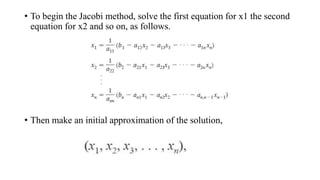
• To begin the Jacobi method, solve the first equation for x1 the second
equation for x2 and so on, as follows.
• Then make an initial approximation of the solution,
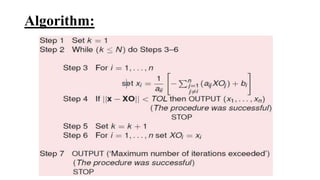
Algorithm:
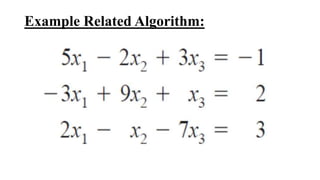
Example Related Algorithm:
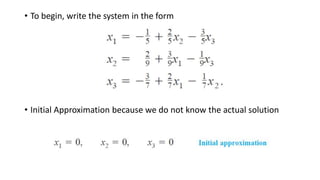
• To begin, write the system in the form
• Initial Approximation because we do not know the actual solution
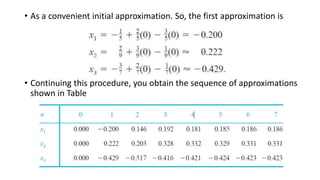
• As a convenient initial approximation. So, the first approximation is
• Continuing this procedure, you obtain the sequence of approximations
shown in Table
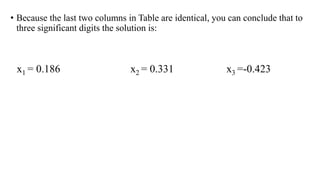
• Because the last two columns in Table are identical, you can conclude that to
three significant digits the solution is:
x1 = 0.186 x2 = 0.331 x3 =-0.423
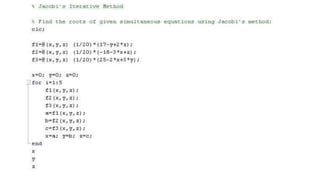
Matlab Implementation for jacobi method:
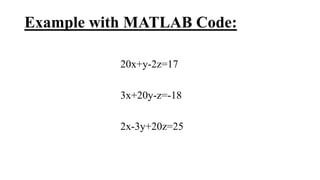
Example with MATLAB Code:
20x+y-2z=17
3x+20y-z=-18
2x-3y+20z=25
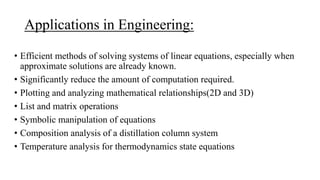
Applications in Engineering:
• Efficient methods of solving systems of linear equations, especially when
approximate solutions are already known.
• Significantly reduce the amount of computation required.
• Plotting and analyzing mathematical relationships(2D and 3D)
• List and matrix operations
• Symbolic manipulation of equations
• Composition analysis of a distillation column system
• Temperature analysis for thermodynamics state equations
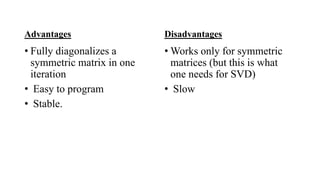
Advantages
• Fully diagonalizes a
symmetric matrix in one
iteration
• Easy to program
• Stable.
Disadvantages
• Works only for symmetric
matrices (but this is what
one needs for SVD)
• Slow
Little Thing is Big Thing

jacobi method

  • 1.
  • 2.
    Contents: • Introduction ofJacobi Method • Algorithm • Example related algorithm • Code for Jacobi Method • Example with code • Applications in Engineering • Advantages and Disadvantages
  • 3.
    Introduction: • This methodmakes two assumptions: 1. that the system given by has a unique solution. 2. the coefficient matrix A has no zeros on its main diagonal.
  • 4.
    • To beginthe Jacobi method, solve the first equation for x1 the second equation for x2 and so on, as follows. • Then make an initial approximation of the solution,
  • 5.
  • 6.
  • 7.
    • To begin,write the system in the form • Initial Approximation because we do not know the actual solution
  • 8.
    • As aconvenient initial approximation. So, the first approximation is • Continuing this procedure, you obtain the sequence of approximations shown in Table
  • 9.
    • Because thelast two columns in Table are identical, you can conclude that to three significant digits the solution is: x1 = 0.186 x2 = 0.331 x3 =-0.423
  • 10.
  • 11.
    Example with MATLABCode: 20x+y-2z=17 3x+20y-z=-18 2x-3y+20z=25
  • 13.
    Applications in Engineering: •Efficient methods of solving systems of linear equations, especially when approximate solutions are already known. • Significantly reduce the amount of computation required. • Plotting and analyzing mathematical relationships(2D and 3D) • List and matrix operations • Symbolic manipulation of equations • Composition analysis of a distillation column system • Temperature analysis for thermodynamics state equations
  • 14.
    Advantages • Fully diagonalizesa symmetric matrix in one iteration • Easy to program • Stable. Disadvantages • Works only for symmetric matrices (but this is what one needs for SVD) • Slow
  • 15.
    Little Thing isBig Thing