Editor’snote:In 1960, Jack Welch began his career at General Electric (GE) at age 24. He
would eventually become chairman and CEO and lead an epic two-decade upsurge. As
head of the company, he used his hands-on, unrestrained management approach to
evolve GE into a $400 billion business.
In 2009, he and his wife, Suzy, former editor in chief of the Harvard Business Review,
launched the Jack Welch Management Institute at Strayer University. The program is
an online MBA and certificate curriculum. Most recently, they released The Real-Life
MBA: Your No-BS Guide to Winning the Game, Building a Team, and Growing Your Career.
APICS magazine Managing Editor Elizabeth Rennie recently spoke with Welch.
Jack Welch
Shares His Candid
People Strategies
40 July/August 2015
The legendary business leader discusses managing employees,
giving feedback, and fostering thriving careers
apics.org/magazine 41
Rennie: Before I ask my prepared inter-
view questions, there was some big news
today: GE just announced that it will cut
its financial businesses by selling almost all
of its GE Capital assets. The press release
stated that GE and its board “determined
that market conditions are favorable to
pursue disposition of most GE Capital
assets over the next 24 months except the
financing verticals that relate to GE’s indus-
trial businesses.” What do you think about
this? Is it something you would have done
if you were still leading the company?
Welch: The world has changed since 2008.
Financial services had been a great business
for us for 35 years or so. We had a wonder-
ful run in the 20 years I was CEO, and we
had a good run for the first seven years that
[current chairman and CEO] Jeff Immelt ran
it. And then the world changed in 2008. Since
the financial crisis, with all the regulations
and government involvement, it’s a much
tougher business. GE is having a lot of trouble
being a systematically important financial
institution … It’s tough to make the cost of
capital back, so [Immelt] has decided to sell
these assets. He’ll get very good prices for
these and be able to buy back stock. It looks to
me like a very smart move—well done.
Rennie: Immelt has been at the helm since
2001, but before that—for 20 years—you
were the person responsible for turning GE
into what has been called “the world’s most
valuable corporation.” When you look back on
that time, what are the key actions you took or
choices you made that led to that success?
Welch: We worked hard to become leaders
in every business we were in, and we got
rid of those businesses where we could not
become a leader by either selling them or
closing them. Those were actions to clean
up the portfolio. The rest of the time I spent
almost exclusively on building great teams.
The team with the best players wins—I
believe that to my toes. That’s something
that is extremely important to me and a
major part of the time I spent in business.
Rennie: Tell me about making those
difficult decisions you mentioned. Do you
ever think that you’ve identified a division,
team, or employee as a problem, but you’re
surprised to discover that it’s not exactly
what you thought? Or can you tell right
away what you’re dealing with?
Welch: You can’t tell right away about any-
thing. You have to take the time to measure
people on two things: their financial perfor-
mance and their values. Each one is equally
important. You can give speeches all day
about values, but every promotion you make
is worth 1,000 speeches in terms of convincing
the organization of what’s important to you.
For example, if you’ve got a series of behaviors
that you want—sharing ideas, giving promo-
tions for people, generosity of spirit—but you
promote someone who’s mean-spirited and
steals ideas, but gets good results, then your
whole culture breaks down. You have to make
the culture and the numbers both work.
Rennie: You are known for giving no-
nonsense advice. Within the realm of the
business world, what is the most common
type of guidance people ask you for?
Welch: They vary from personal questions
to complex business questions. I’ve spoken
to more than one million people in the last
decade at conferences and other events, so I
honestly couldn’t pinpoint just one. But I can
tell you the questions that I ask most often
to people in the audience: I ask, “How many
of you know exactly where you stand in your
company? Are you well thought of? Are you
aware of your career path? Do you know what
you do well? Is somebody telling you what
you need to do to improve?” And I don’t get
15 percent of the crowd knowing where they
stand. It’s a violation of Management 101.
Rennie: Is that an issue of that person not
taking initiative, the management style, or
a combination of the two?
Welch:No, it’s the manager. The manager is
not spending the time to do the development
face-to-face, candidly, transparently with
people. And this has been going on for years.
Rennie: So how can that person approach
his or her manager and try to fix that?
Welch: You tell your manager that you
don’t know where you stand and that you’d
like some feedback on what they like about
what you’re doing and what you can do
better. You clearly ask for it.
Rennie: You have often said that formality
slows a company, and you’re well known
for being a fan of candor and breaking down
bureaucracy in the workplace. I know a while
back, many managers would tell their subor-
dinates, “Put your head down, keep quiet,
Jack Welch
Shares His Candid
People Strategies
42 July/August 2015
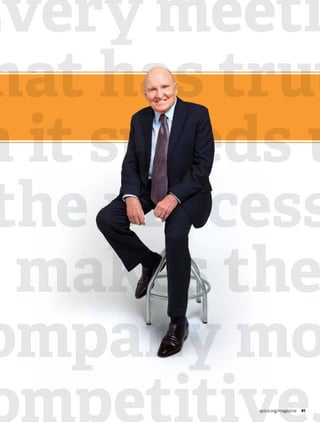
“Every meeting that has truth in it speeds up the
process, makes the company more competitive,
and makes it ready to act.”
and you’ll do fine.” But it seems to me that I
hear more and more today about employee
empowerment, companies encouraging
workers to speak up, and employees being
rewarded for being outspoken about prob-
lems and inefficiencies.
Welch: I’ve been doing that for 35 years,
but every company today should be fighting
desperately to get the best intellectual con-
tent out of every person in the room. You
want every brain in the game. That concept
to me is everything. You want truth and you
want trust. You get truth when you build
trust. Every meeting must strive for the right
answers through truth and have everybody
speaking their mind. Every meeting that has
truth in it speeds up the process, makes the
company more competitive, and makes it
ready to act. It doesn’t happen overnight, but
it’s a critical part of today’s management.
Rennie: Your first book, Straight from the Gut,
was about you and your career; your second,
Winning, was about the management philoso-
phies that helped define your career. Tell me
about The Real-Life MBA. And how does a
“real-life” MBA differ from a traditional one?
Welch: By the nature of the words, it will
be much more practical, much less theo-
retical, and 100 percent online. [The Jack
Welch Management Institute at Strayer
University] is growing 40 percent a year.
We’re at 900 students now, and we’re fully
accredited. We teach the basics of work: how
to hire, fire, motivate, allocate resources,
differentiate, communicate better—all the
things you do in the real world.
Rennie: You and your wife, Suzy, have said
that The Real-Life MBA can help today’s
worker escape “career purgatory.” What do
you mean by that, and how does the book
offer guidance and strategies to help people
get out of limbo?
Welch: One of the things that exists in
companies, particularly since 2008, is that
there’s not enough growth. You see that
everywhere. So people are stuck. But are
you stuck because your performance isn’t
very good? Are you stuck because you’re in a
“velvet coffin” where you’re too comfortable
in your job? Are you stuck because your boss
is going nowhere? There are tips in the book
for how to deal with all of that. We talk about
over-delivering versus just doing the assign-
ment. We talk about insatiable curiosity to
get involved with everything. We talk about
taking the tough assignments to show the
company your stuff. We talk about how you
win the game ... We talk about building a
team—whether it’s a “wow team,” how that
feels, and why it’s different. We talk about
how to make work fun and about growing
your own personal career trajectory.
Rennie: Thetopicsinthebookseemtobe
appropriateforpeopleatalllevelsoftheircareer.
Welch: All levels—definitely. Senior pro-
fessionals to college graduates just starting
out. It’s a book that gives you the tools,
the lingo, the language to be able to work
comfortably in any environment.
Rennie: APICS members also represent
all levels of supply chain and operations
management. What do our APICS 2015
attendees have to look forward to from
your session later this year in Las Vegas?
Welch: They’ll get straight answers about any
subject on their minds. The session will be
determined by the quality of the questions
from the audience.
Rennie: It sounds like APICS 2015 attendees
should come armed with questions to ask you.
Welch: Yes, we encourage questions from
the audience. I’m not there to give a speech.
I’ve spoken thousands of times, and I have
no interest in giving another speech. People
should come with questions—questions
about their lives, their careers, their com-
panies, their strategies, their frustrations,
whatever. No holds barred.
Elizabeth Rennie is managing editor for
APICS magazine. She may be contacted at
editorial@apics.org.
To comment on this article, send a message to
feedback@apics.org.
Attend Jack and Suzy Welch’s general
session at APICS 2015, October 5–7 in
Las Vegas. This is designed to be a highly
interactive,question-and-answersession.
You and more than 2,000 of your supply
chain and operations management peers
from around the world will experience
the industry’s premier educational and
networkingevent.Visitapicsconference.org
for more information and to register.
apics.org/magazine 43
Photo:©MikeCoppola/Staff/Getty

JackWelchInterview

  • 1.
    Editor’snote:In 1960, JackWelch began his career at General Electric (GE) at age 24. He would eventually become chairman and CEO and lead an epic two-decade upsurge. As head of the company, he used his hands-on, unrestrained management approach to evolve GE into a $400 billion business. In 2009, he and his wife, Suzy, former editor in chief of the Harvard Business Review, launched the Jack Welch Management Institute at Strayer University. The program is an online MBA and certificate curriculum. Most recently, they released The Real-Life MBA: Your No-BS Guide to Winning the Game, Building a Team, and Growing Your Career. APICS magazine Managing Editor Elizabeth Rennie recently spoke with Welch. Jack Welch Shares His Candid People Strategies 40 July/August 2015 The legendary business leader discusses managing employees, giving feedback, and fostering thriving careers
  • 2.
  • 3.
    Rennie: Before Iask my prepared inter- view questions, there was some big news today: GE just announced that it will cut its financial businesses by selling almost all of its GE Capital assets. The press release stated that GE and its board “determined that market conditions are favorable to pursue disposition of most GE Capital assets over the next 24 months except the financing verticals that relate to GE’s indus- trial businesses.” What do you think about this? Is it something you would have done if you were still leading the company? Welch: The world has changed since 2008. Financial services had been a great business for us for 35 years or so. We had a wonder- ful run in the 20 years I was CEO, and we had a good run for the first seven years that [current chairman and CEO] Jeff Immelt ran it. And then the world changed in 2008. Since the financial crisis, with all the regulations and government involvement, it’s a much tougher business. GE is having a lot of trouble being a systematically important financial institution … It’s tough to make the cost of capital back, so [Immelt] has decided to sell these assets. He’ll get very good prices for these and be able to buy back stock. It looks to me like a very smart move—well done. Rennie: Immelt has been at the helm since 2001, but before that—for 20 years—you were the person responsible for turning GE into what has been called “the world’s most valuable corporation.” When you look back on that time, what are the key actions you took or choices you made that led to that success? Welch: We worked hard to become leaders in every business we were in, and we got rid of those businesses where we could not become a leader by either selling them or closing them. Those were actions to clean up the portfolio. The rest of the time I spent almost exclusively on building great teams. The team with the best players wins—I believe that to my toes. That’s something that is extremely important to me and a major part of the time I spent in business. Rennie: Tell me about making those difficult decisions you mentioned. Do you ever think that you’ve identified a division, team, or employee as a problem, but you’re surprised to discover that it’s not exactly what you thought? Or can you tell right away what you’re dealing with? Welch: You can’t tell right away about any- thing. You have to take the time to measure people on two things: their financial perfor- mance and their values. Each one is equally important. You can give speeches all day about values, but every promotion you make is worth 1,000 speeches in terms of convincing the organization of what’s important to you. For example, if you’ve got a series of behaviors that you want—sharing ideas, giving promo- tions for people, generosity of spirit—but you promote someone who’s mean-spirited and steals ideas, but gets good results, then your whole culture breaks down. You have to make the culture and the numbers both work. Rennie: You are known for giving no- nonsense advice. Within the realm of the business world, what is the most common type of guidance people ask you for? Welch: They vary from personal questions to complex business questions. I’ve spoken to more than one million people in the last decade at conferences and other events, so I honestly couldn’t pinpoint just one. But I can tell you the questions that I ask most often to people in the audience: I ask, “How many of you know exactly where you stand in your company? Are you well thought of? Are you aware of your career path? Do you know what you do well? Is somebody telling you what you need to do to improve?” And I don’t get 15 percent of the crowd knowing where they stand. It’s a violation of Management 101. Rennie: Is that an issue of that person not taking initiative, the management style, or a combination of the two? Welch:No, it’s the manager. The manager is not spending the time to do the development face-to-face, candidly, transparently with people. And this has been going on for years. Rennie: So how can that person approach his or her manager and try to fix that? Welch: You tell your manager that you don’t know where you stand and that you’d like some feedback on what they like about what you’re doing and what you can do better. You clearly ask for it. Rennie: You have often said that formality slows a company, and you’re well known for being a fan of candor and breaking down bureaucracy in the workplace. I know a while back, many managers would tell their subor- dinates, “Put your head down, keep quiet, Jack Welch Shares His Candid People Strategies 42 July/August 2015 “Every meeting that has truth in it speeds up the process, makes the company more competitive, and makes it ready to act.”
  • 4.
    and you’ll dofine.” But it seems to me that I hear more and more today about employee empowerment, companies encouraging workers to speak up, and employees being rewarded for being outspoken about prob- lems and inefficiencies. Welch: I’ve been doing that for 35 years, but every company today should be fighting desperately to get the best intellectual con- tent out of every person in the room. You want every brain in the game. That concept to me is everything. You want truth and you want trust. You get truth when you build trust. Every meeting must strive for the right answers through truth and have everybody speaking their mind. Every meeting that has truth in it speeds up the process, makes the company more competitive, and makes it ready to act. It doesn’t happen overnight, but it’s a critical part of today’s management. Rennie: Your first book, Straight from the Gut, was about you and your career; your second, Winning, was about the management philoso- phies that helped define your career. Tell me about The Real-Life MBA. And how does a “real-life” MBA differ from a traditional one? Welch: By the nature of the words, it will be much more practical, much less theo- retical, and 100 percent online. [The Jack Welch Management Institute at Strayer University] is growing 40 percent a year. We’re at 900 students now, and we’re fully accredited. We teach the basics of work: how to hire, fire, motivate, allocate resources, differentiate, communicate better—all the things you do in the real world. Rennie: You and your wife, Suzy, have said that The Real-Life MBA can help today’s worker escape “career purgatory.” What do you mean by that, and how does the book offer guidance and strategies to help people get out of limbo? Welch: One of the things that exists in companies, particularly since 2008, is that there’s not enough growth. You see that everywhere. So people are stuck. But are you stuck because your performance isn’t very good? Are you stuck because you’re in a “velvet coffin” where you’re too comfortable in your job? Are you stuck because your boss is going nowhere? There are tips in the book for how to deal with all of that. We talk about over-delivering versus just doing the assign- ment. We talk about insatiable curiosity to get involved with everything. We talk about taking the tough assignments to show the company your stuff. We talk about how you win the game ... We talk about building a team—whether it’s a “wow team,” how that feels, and why it’s different. We talk about how to make work fun and about growing your own personal career trajectory. Rennie: Thetopicsinthebookseemtobe appropriateforpeopleatalllevelsoftheircareer. Welch: All levels—definitely. Senior pro- fessionals to college graduates just starting out. It’s a book that gives you the tools, the lingo, the language to be able to work comfortably in any environment. Rennie: APICS members also represent all levels of supply chain and operations management. What do our APICS 2015 attendees have to look forward to from your session later this year in Las Vegas? Welch: They’ll get straight answers about any subject on their minds. The session will be determined by the quality of the questions from the audience. Rennie: It sounds like APICS 2015 attendees should come armed with questions to ask you. Welch: Yes, we encourage questions from the audience. I’m not there to give a speech. I’ve spoken thousands of times, and I have no interest in giving another speech. People should come with questions—questions about their lives, their careers, their com- panies, their strategies, their frustrations, whatever. No holds barred. Elizabeth Rennie is managing editor for APICS magazine. She may be contacted at editorial@apics.org. To comment on this article, send a message to feedback@apics.org. Attend Jack and Suzy Welch’s general session at APICS 2015, October 5–7 in Las Vegas. This is designed to be a highly interactive,question-and-answersession. You and more than 2,000 of your supply chain and operations management peers from around the world will experience the industry’s premier educational and networkingevent.Visitapicsconference.org for more information and to register. apics.org/magazine 43 Photo:©MikeCoppola/Staff/Getty