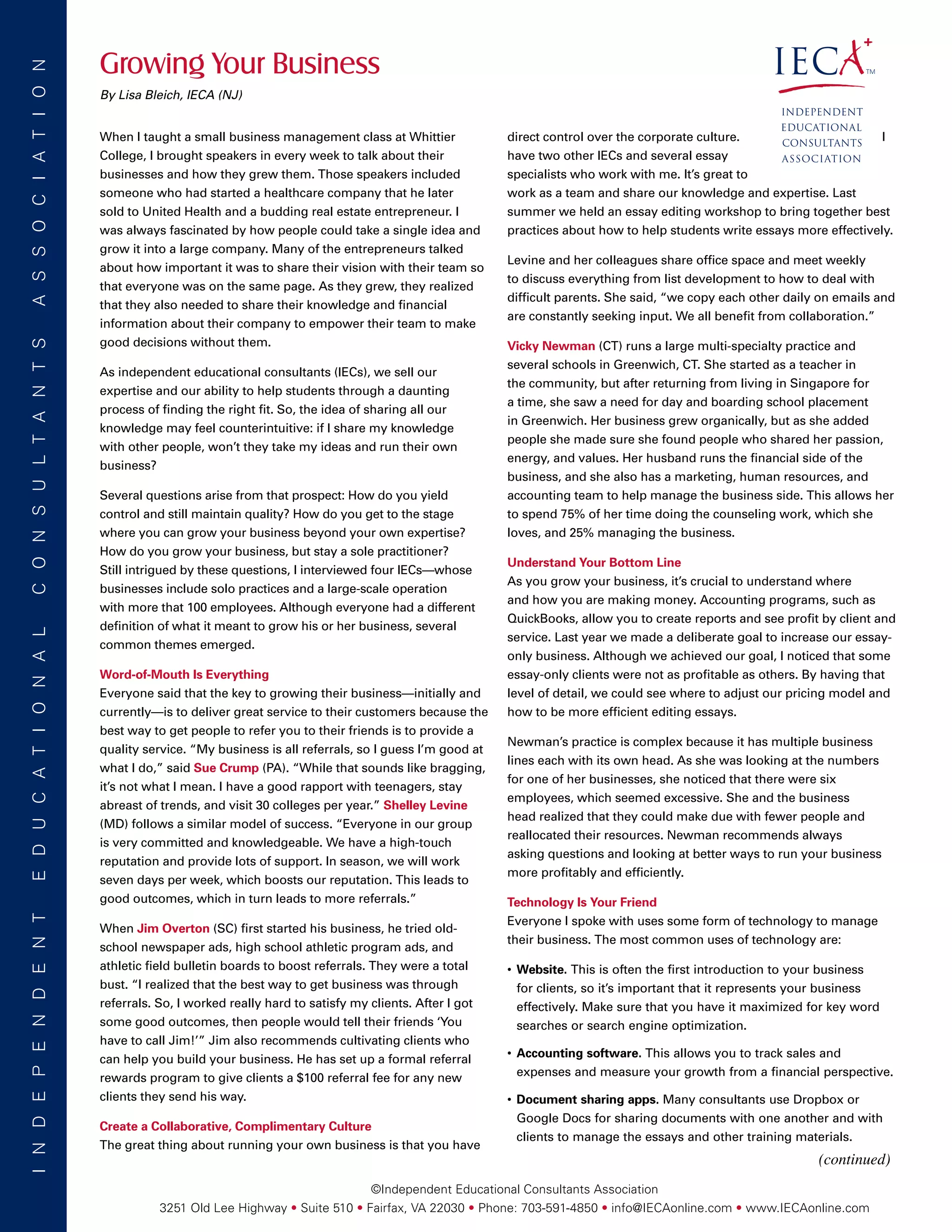
When I taught a small business management class at Whittier
College, I brought speakers in every week to talk about their
businesses and how they grew them. Those speakers included
someone who had started a healthcare company that he later
sold to United Health and a budding real estate entrepreneur. I
was always fascinated by how people could take a single idea and
grow it into a large company. Many of the entrepreneurs talked
about how important it was to share their vision with their team so
that everyone was on the same page. As they grew, they realized
that they also needed to share their knowledge and financial
information about their company to empower their team to make
good decisions without them.
As independent educational consultants (IECs), we sell our
expertise and our ability to help students through a daunting
process of finding the right fit. So, the idea of sharing all our
knowledge may feel counterintuitive: if I share my knowledge
with other people, won’t they take my ideas and run their own
business?
Several questions arise from that prospect: How do you yield
control and still maintain quality? How do you get to the stage
where you can grow your business beyond your own expertise?
How do you grow your business, but stay a sole practitioner?
Still intrigued by these questions, I interviewed four IECs—whose
businesses include solo practices and a large-scale operation
with more that 100 employees. Although everyone had a different
definition of what it meant to grow his or her business, several
common themes emerged.
Word-of-Mouth Is Everything
Everyone said that the key to growing their business—initially and
currently—is to deliver great service to their customers because the
best way to get people to refer you to their friends is to provide a
quality service. “My business is all referrals, so I guess I’m good at
what I do,” said Sue Crump (PA). “While that sounds like bragging,
it’s not what I mean. I have a good rapport with teenagers, stay
abreast of trends, and visit 30 colleges per year.” Shelley Levine
(MD) follows a similar model of success. “Everyone in our group
is very committed and knowledgeable. We have a high-touch
reputation and provide lots of support. In season, we will work
seven days per week, which boosts our reputation. This leads to
good outcomes, which in turn leads to more referrals.”
When Jim Overton (SC) first started his business, he tried old-
school newspaper ads, high school athletic program ads, and
athletic field bulletin boards to boost referrals. They were a total
bust. “I realized that the best way to get business was through
referrals. So, I worked really hard to satisfy my clients. After I got
some good outcomes, then people would tell their friends ‘You
have to call Jim!’” Jim also recommends cultivating clients who
can help you build your business. He has set up a formal referral
rewards program to give clients a $100 referral fee for any new
clients they send his way.
Create a Collaborative, Complimentary Culture
The great thing about running your own business is that you have
direct control over the corporate culture. I
have two other IECs and several essay
specialists who work with me. It’s great to
work as a team and share our knowledge and expertise. Last
summer we held an essay editing workshop to bring together best
practices about how to help students write essays more effectively.
Levine and her colleagues share office space and meet weekly
to discuss everything from list development to how to deal with
difficult parents. She said, “we copy each other daily on emails and
are constantly seeking input. We all benefit from collaboration.”
Vicky Newman (CT) runs a large multi-specialty practice and
several schools in Greenwich, CT. She started as a teacher in
the community, but after returning from living in Singapore for
a time, she saw a need for day and boarding school placement
in Greenwich. Her business grew organically, but as she added
people she made sure she found people who shared her passion,
energy, and values. Her husband runs the financial side of the
business, and she also has a marketing, human resources, and
accounting team to help manage the business side. This allows her
to spend 75% of her time doing the counseling work, which she
loves, and 25% managing the business.
Understand Your Bottom Line
As you grow your business, it’s crucial to understand where
and how you are making money. Accounting programs, such as
QuickBooks, allow you to create reports and see profit by client and
service. Last year we made a deliberate goal to increase our essay-
only business. Although we achieved our goal, I noticed that some
essay-only clients were not as profitable as others. By having that
level of detail, we could see where to adjust our pricing model and
how to be more efficient editing essays.
Newman’s practice is complex because it has multiple business
lines each with its own head. As she was looking at the numbers
for one of her businesses, she noticed that there were six
employees, which seemed excessive. She and the business
head realized that they could make due with fewer people and
reallocated their resources. Newman recommends always
asking questions and looking at better ways to run your business
more profitably and efficiently.
Technology Is Your Friend
Everyone I spoke with uses some form of technology to manage
their business. The most common uses of technology are:
•	Website. This is often the first introduction to your business
for clients, so it’s important that it represents your business
effectively. Make sure that you have it maximized for key word
searches or search engine optimization.
•	Accounting software. This allows you to track sales and
expenses and measure your growth from a financial perspective.
•	Document sharing apps. Many consultants use Dropbox or
Google Docs for sharing documents with one another and with
clients to manage the essays and other training materials.
Growing Your Business
By Lisa Bleich, IECA (NJ)
TM
INDEPENDENTEDUCATIONALCONSULTANTSASSOCIATION
©Independent Educational Consultants Association
3251 Old Lee Highway • Suite 510 • Fairfax, VA 22030 • Phone: 703-591-4850 • info@IECAonline.com • www.IECAonline.com
(continued)
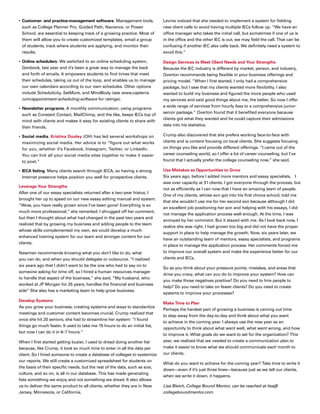
•	Customer- and practice-management software. Management tools,
such as College Planner Pro, Guided Path, Naviance, or Power
School, are essential to keeping track of a growing practice. Most of
them will allow you to create customized templates, email a group
of students, track where students are applying, and monitor their
results.
•	Online schedulers. We switched to an online scheduling system,
Genbook, last year and it’s been a great way to manage the back
and forth of emails. It empowers students to find times that meet
their schedules, taking us out of the loop, and enables us to manage
our own calendars according to our own schedules. Other options
include Schedulicity, SetMore, and MindBody (see www.capterra.
com/appointment-scheduling-software for ratings).
•	Newsletter programs. A monthly communication, using programs
such as Constant Contact, MailChimp, and the like, keeps IECs top of
mind with clients and makes it easy for existing clients to share with
their friends.
•	Social media. Kristina Dooley (OH) has led several workshops on
maximizing social media. Her advice is to “figure out what works
for you, whether it’s Facebook, Instagram, Twitter, or LinkedIn.
You can link all your social media sites together to make it easier
to post.”
•	IECA listing. Many clients search through IECA, so having a strong
Internet presence helps position you well for prospective clients.
Leverage Your Strengths
After one of our essay specialists returned after a two-year hiatus, I
brought her up to speed on our new essay editing manual and system.
“Wow, you have really grown since I’ve been gone! Everything is so
much more professional,” she remarked. I shrugged off her comment,
but then I thought about what had changed in the past two years and
realized that by growing my business and adding people to the team
whose skills complemented my own, we could develop a much-
enhanced training system for our team and stronger content for our
clients.
Newman recommends knowing what you don’t like to do, what
you can do, and when you should delegate or outsource. “I realized
six years ago that I didn’t want to be the one who had to say no to
someone asking for time off, so I hired a human resources manager
to handle that aspect of the business,” she said. “My husband, who
worked at JP Morgan for 25 years, handles the financial and business
side” She also has a marketing team to help grow business.
Develop Systems
As you grow your business, creating systems and ways to standardize
meetings and customer content becomes crucial. Crump realized that
once she hit 20 seniors, she had to streamline her system: “I found
things go much faster. It used to take me 15 hours to do an initial list,
but now I can do it in 6–7 hours.”
When I first started getting busier, I used to dread doing another list
because, like Crump, it took so much time to enter in all the data per
client. So I hired someone to create a database of colleges to systemize
our reports. We still create a customized spreadsheet for students on
the basis of their specific needs, but the rest of the data, such as size,
culture, and so on, is all in our database. This has made generating
lists something we enjoy and not something we dread. It also allows
us to deliver the same product to all clients, whether they are in New
Jersey, Minnesota, or California.
Levine noticed that she needed to implement a system for fielding
new client calls to avoid having multiple IECs follow up. “We have an
office manager who takes the initial call, but sometimes if one of us is
in the office and the other IEC is out, we may field the call. That can be
confusing if another IEC also calls back. We definitely need a system to
avoid this.”
Design Services to Meet Client Needs and Your Strengths
Because the IEC industry is different by market, person, and industry,
Overton recommends being flexible in your business offerings and
pricing model. “When I first started, I only had a comprehensive
package, but I saw that my clients wanted more flexibility. I also
wanted to build my business and figured the more people who used
my services and said good things about me, the better. So now I offer
a wide range of services from hourly fees to a comprehensive junior-
senior package.” Overton found that it benefited everyone because
clients got what they wanted and he could capture their admissions
data into his statistics.
Crump also discovered that she prefers working face-to-face with
clients and is content focusing on local clients. She suggests focusing
on things you like and provide different offerings. “I came out of the
career counseling world, so I offer a lot of career counseling, but I’ve
found that I actually prefer the college counseling now,” she said.
Use Mistakes as Opportunities to Grow
Six years ago, before I added more mentors and essay specialists, 	 I
was over capacity at 31 clients. I got everyone through the process, but
not as efficiently as I can now that I have an amazing team of people.
One of my clients, whose son got into his first choice school, told me
that she wouldn’t use me for her second son because although I did
an excellent job positioning her son and helping with his essays, I did
not manage the application process well enough. At the time, I was
annoyed by her comment. But it stayed with me. As I look back now, I
realize she was right. I had grown too big and did not have the proper
support in place to help manage the growth. Now, six years later, we
have an outstanding team of mentors, essay specialists, and programs
in place to manage the application process. Her comments forced me
to improve our overall system and make the experience better for our
clients and IECs.
So as you think about your pressure points, mistakes, and areas that
drive you crazy, what can you do to improve your system? How can
you make those negatives positive? Do you need to hire people to
help? Do you need to take on fewer clients? Do you need to create
systems to improve your processes?
Make Time to Plan
Perhaps the hardest part of growing a business is carving out time
to step away from the day-to-day and think about what you want
to achieve in the coming year. I always use the new year as an
opportunity to think about what went well, what went wrong, and how
to improve it. What goals do we want to set for the organization? This
year, we realized that we needed to create a communication plan to
make it easier to know what we should communicate each month to
our clients.
What do you want to achieve for the coming year? Take time to write it
down—even if it’s just three lines—because just as we tell our clients,
when we write it down, it happens.
Lisa Bleich, College Bound Mentor, can be reached at lisa@
collegeboundmentor.com

Growing Your Service Based Business

  • 1.
    When I taughta small business management class at Whittier College, I brought speakers in every week to talk about their businesses and how they grew them. Those speakers included someone who had started a healthcare company that he later sold to United Health and a budding real estate entrepreneur. I was always fascinated by how people could take a single idea and grow it into a large company. Many of the entrepreneurs talked about how important it was to share their vision with their team so that everyone was on the same page. As they grew, they realized that they also needed to share their knowledge and financial information about their company to empower their team to make good decisions without them. As independent educational consultants (IECs), we sell our expertise and our ability to help students through a daunting process of finding the right fit. So, the idea of sharing all our knowledge may feel counterintuitive: if I share my knowledge with other people, won’t they take my ideas and run their own business? Several questions arise from that prospect: How do you yield control and still maintain quality? How do you get to the stage where you can grow your business beyond your own expertise? How do you grow your business, but stay a sole practitioner? Still intrigued by these questions, I interviewed four IECs—whose businesses include solo practices and a large-scale operation with more that 100 employees. Although everyone had a different definition of what it meant to grow his or her business, several common themes emerged. Word-of-Mouth Is Everything Everyone said that the key to growing their business—initially and currently—is to deliver great service to their customers because the best way to get people to refer you to their friends is to provide a quality service. “My business is all referrals, so I guess I’m good at what I do,” said Sue Crump (PA). “While that sounds like bragging, it’s not what I mean. I have a good rapport with teenagers, stay abreast of trends, and visit 30 colleges per year.” Shelley Levine (MD) follows a similar model of success. “Everyone in our group is very committed and knowledgeable. We have a high-touch reputation and provide lots of support. In season, we will work seven days per week, which boosts our reputation. This leads to good outcomes, which in turn leads to more referrals.” When Jim Overton (SC) first started his business, he tried old- school newspaper ads, high school athletic program ads, and athletic field bulletin boards to boost referrals. They were a total bust. “I realized that the best way to get business was through referrals. So, I worked really hard to satisfy my clients. After I got some good outcomes, then people would tell their friends ‘You have to call Jim!’” Jim also recommends cultivating clients who can help you build your business. He has set up a formal referral rewards program to give clients a $100 referral fee for any new clients they send his way. Create a Collaborative, Complimentary Culture The great thing about running your own business is that you have direct control over the corporate culture. I have two other IECs and several essay specialists who work with me. It’s great to work as a team and share our knowledge and expertise. Last summer we held an essay editing workshop to bring together best practices about how to help students write essays more effectively. Levine and her colleagues share office space and meet weekly to discuss everything from list development to how to deal with difficult parents. She said, “we copy each other daily on emails and are constantly seeking input. We all benefit from collaboration.” Vicky Newman (CT) runs a large multi-specialty practice and several schools in Greenwich, CT. She started as a teacher in the community, but after returning from living in Singapore for a time, she saw a need for day and boarding school placement in Greenwich. Her business grew organically, but as she added people she made sure she found people who shared her passion, energy, and values. Her husband runs the financial side of the business, and she also has a marketing, human resources, and accounting team to help manage the business side. This allows her to spend 75% of her time doing the counseling work, which she loves, and 25% managing the business. Understand Your Bottom Line As you grow your business, it’s crucial to understand where and how you are making money. Accounting programs, such as QuickBooks, allow you to create reports and see profit by client and service. Last year we made a deliberate goal to increase our essay- only business. Although we achieved our goal, I noticed that some essay-only clients were not as profitable as others. By having that level of detail, we could see where to adjust our pricing model and how to be more efficient editing essays. Newman’s practice is complex because it has multiple business lines each with its own head. As she was looking at the numbers for one of her businesses, she noticed that there were six employees, which seemed excessive. She and the business head realized that they could make due with fewer people and reallocated their resources. Newman recommends always asking questions and looking at better ways to run your business more profitably and efficiently. Technology Is Your Friend Everyone I spoke with uses some form of technology to manage their business. The most common uses of technology are: • Website. This is often the first introduction to your business for clients, so it’s important that it represents your business effectively. Make sure that you have it maximized for key word searches or search engine optimization. • Accounting software. This allows you to track sales and expenses and measure your growth from a financial perspective. • Document sharing apps. Many consultants use Dropbox or Google Docs for sharing documents with one another and with clients to manage the essays and other training materials. Growing Your Business By Lisa Bleich, IECA (NJ) TM INDEPENDENTEDUCATIONALCONSULTANTSASSOCIATION ©Independent Educational Consultants Association 3251 Old Lee Highway • Suite 510 • Fairfax, VA 22030 • Phone: 703-591-4850 • info@IECAonline.com • www.IECAonline.com (continued)
  • 2.
    • Customer- and practice-managementsoftware. Management tools, such as College Planner Pro, Guided Path, Naviance, or Power School, are essential to keeping track of a growing practice. Most of them will allow you to create customized templates, email a group of students, track where students are applying, and monitor their results. • Online schedulers. We switched to an online scheduling system, Genbook, last year and it’s been a great way to manage the back and forth of emails. It empowers students to find times that meet their schedules, taking us out of the loop, and enables us to manage our own calendars according to our own schedules. Other options include Schedulicity, SetMore, and MindBody (see www.capterra. com/appointment-scheduling-software for ratings). • Newsletter programs. A monthly communication, using programs such as Constant Contact, MailChimp, and the like, keeps IECs top of mind with clients and makes it easy for existing clients to share with their friends. • Social media. Kristina Dooley (OH) has led several workshops on maximizing social media. Her advice is to “figure out what works for you, whether it’s Facebook, Instagram, Twitter, or LinkedIn. You can link all your social media sites together to make it easier to post.” • IECA listing. Many clients search through IECA, so having a strong Internet presence helps position you well for prospective clients. Leverage Your Strengths After one of our essay specialists returned after a two-year hiatus, I brought her up to speed on our new essay editing manual and system. “Wow, you have really grown since I’ve been gone! Everything is so much more professional,” she remarked. I shrugged off her comment, but then I thought about what had changed in the past two years and realized that by growing my business and adding people to the team whose skills complemented my own, we could develop a much- enhanced training system for our team and stronger content for our clients. Newman recommends knowing what you don’t like to do, what you can do, and when you should delegate or outsource. “I realized six years ago that I didn’t want to be the one who had to say no to someone asking for time off, so I hired a human resources manager to handle that aspect of the business,” she said. “My husband, who worked at JP Morgan for 25 years, handles the financial and business side” She also has a marketing team to help grow business. Develop Systems As you grow your business, creating systems and ways to standardize meetings and customer content becomes crucial. Crump realized that once she hit 20 seniors, she had to streamline her system: “I found things go much faster. It used to take me 15 hours to do an initial list, but now I can do it in 6–7 hours.” When I first started getting busier, I used to dread doing another list because, like Crump, it took so much time to enter in all the data per client. So I hired someone to create a database of colleges to systemize our reports. We still create a customized spreadsheet for students on the basis of their specific needs, but the rest of the data, such as size, culture, and so on, is all in our database. This has made generating lists something we enjoy and not something we dread. It also allows us to deliver the same product to all clients, whether they are in New Jersey, Minnesota, or California. Levine noticed that she needed to implement a system for fielding new client calls to avoid having multiple IECs follow up. “We have an office manager who takes the initial call, but sometimes if one of us is in the office and the other IEC is out, we may field the call. That can be confusing if another IEC also calls back. We definitely need a system to avoid this.” Design Services to Meet Client Needs and Your Strengths Because the IEC industry is different by market, person, and industry, Overton recommends being flexible in your business offerings and pricing model. “When I first started, I only had a comprehensive package, but I saw that my clients wanted more flexibility. I also wanted to build my business and figured the more people who used my services and said good things about me, the better. So now I offer a wide range of services from hourly fees to a comprehensive junior- senior package.” Overton found that it benefited everyone because clients got what they wanted and he could capture their admissions data into his statistics. Crump also discovered that she prefers working face-to-face with clients and is content focusing on local clients. She suggests focusing on things you like and provide different offerings. “I came out of the career counseling world, so I offer a lot of career counseling, but I’ve found that I actually prefer the college counseling now,” she said. Use Mistakes as Opportunities to Grow Six years ago, before I added more mentors and essay specialists, I was over capacity at 31 clients. I got everyone through the process, but not as efficiently as I can now that I have an amazing team of people. One of my clients, whose son got into his first choice school, told me that she wouldn’t use me for her second son because although I did an excellent job positioning her son and helping with his essays, I did not manage the application process well enough. At the time, I was annoyed by her comment. But it stayed with me. As I look back now, I realize she was right. I had grown too big and did not have the proper support in place to help manage the growth. Now, six years later, we have an outstanding team of mentors, essay specialists, and programs in place to manage the application process. Her comments forced me to improve our overall system and make the experience better for our clients and IECs. So as you think about your pressure points, mistakes, and areas that drive you crazy, what can you do to improve your system? How can you make those negatives positive? Do you need to hire people to help? Do you need to take on fewer clients? Do you need to create systems to improve your processes? Make Time to Plan Perhaps the hardest part of growing a business is carving out time to step away from the day-to-day and think about what you want to achieve in the coming year. I always use the new year as an opportunity to think about what went well, what went wrong, and how to improve it. What goals do we want to set for the organization? This year, we realized that we needed to create a communication plan to make it easier to know what we should communicate each month to our clients. What do you want to achieve for the coming year? Take time to write it down—even if it’s just three lines—because just as we tell our clients, when we write it down, it happens. Lisa Bleich, College Bound Mentor, can be reached at lisa@ collegeboundmentor.com