Writing Helpful 
Recommendations 
Jan Richards
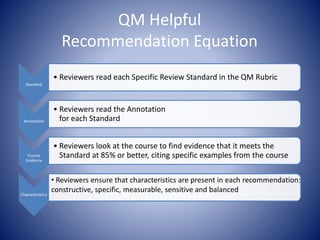
QM Helpful 
Recommendation Equation 
Standard 
• Reviewers read each Specific Review Standard in the QM Rubric 
Annotation 
• Reviewers read the Annotation 
for each Standard 
Course 
Evidence 
• Reviewers look at the course to find evidence that it meets the 
Standard at 85% or better, citing specific examples from the course 
Characteristics 
• Reviewers ensure that characteristics are present in each recommendation: 
constructive, specific, measurable, sensitive and balanced
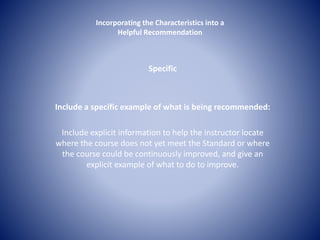
Incorporating the Characteristics into a 
Helpful Recommendation 
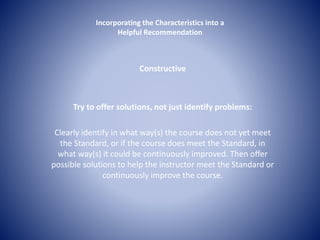
Constructive 
Try to offer solutions, not just identify problems: 
Clearly identify in what way(s) the course does not yet meet 
the Standard, or if the course does meet the Standard, in 
what way(s) it could be continuously improved. Then offer 
possible solutions to help the instructor meet the Standard or 
continuously improve the course.
Incorporating the Characteristics into a 
Helpful Recommendation 
Specific 
Include a specific example of what is being recommended: 
Include explicit information to help the instructor locate 
where the course does not yet meet the Standard or where 
the course could be continuously improved, and give an 
explicit example of what to do to improve.
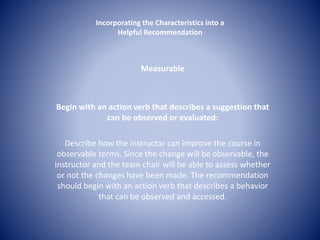
Incorporating the Characteristics into a 
Helpful Recommendation 
Measurable 
Begin with an action verb that describes a suggestion that 
can be observed or evaluated: 
Describe how the instructor can improve the course in 
observable terms. Since the change will be observable, the 
instructor and the team chair will be able to assess whether 
or not the changes have been made. The recommendation 
should begin with an action verb that describes a behavior 
that can be observed and accessed.
Incorporating the Characteristics into a 
Helpful Recommendation 
Constructive 
Try to offer solutions, not just identify problems: 
Clearly identify in what way(s) the course does not yet meet 
the Standard, or if the course does meet the Standard, in 
what way(s) it could be continuously improved. Then offer 
possible solutions to help the instructor meet the Standard or 
continuously improve the course.
Example: The Start Here button on the course homepage was a great 
idea for "linking students to start-up information" as specified in the 
Annotation for Standard 1.1, "Instructions make clear how to get started 
and where to find various course components." 
When I read the information it contained, I still couldn't tell exactly how 
to begin the course. It might be very helpful to [include a prominent link 
and directions at the end of the Start Here section about what students 
should do next to actually begin the first lesson of the course]. Having a 
"clear statement about how to get started in the course" would meet this 
Standard and ensure that students know what to do next after reading 
Start Here in order to begin the course itself.

J richards writing helpful recommendations

  • 1.
  • 2.
    QM Helpful RecommendationEquation Standard • Reviewers read each Specific Review Standard in the QM Rubric Annotation • Reviewers read the Annotation for each Standard Course Evidence • Reviewers look at the course to find evidence that it meets the Standard at 85% or better, citing specific examples from the course Characteristics • Reviewers ensure that characteristics are present in each recommendation: constructive, specific, measurable, sensitive and balanced
  • 3.
    Incorporating the Characteristicsinto a Helpful Recommendation Constructive Try to offer solutions, not just identify problems: Clearly identify in what way(s) the course does not yet meet the Standard, or if the course does meet the Standard, in what way(s) it could be continuously improved. Then offer possible solutions to help the instructor meet the Standard or continuously improve the course.
  • 4.
    Incorporating the Characteristicsinto a Helpful Recommendation Specific Include a specific example of what is being recommended: Include explicit information to help the instructor locate where the course does not yet meet the Standard or where the course could be continuously improved, and give an explicit example of what to do to improve.
  • 5.
    Incorporating the Characteristicsinto a Helpful Recommendation Measurable Begin with an action verb that describes a suggestion that can be observed or evaluated: Describe how the instructor can improve the course in observable terms. Since the change will be observable, the instructor and the team chair will be able to assess whether or not the changes have been made. The recommendation should begin with an action verb that describes a behavior that can be observed and accessed.
  • 6.
    Incorporating the Characteristicsinto a Helpful Recommendation Constructive Try to offer solutions, not just identify problems: Clearly identify in what way(s) the course does not yet meet the Standard, or if the course does meet the Standard, in what way(s) it could be continuously improved. Then offer possible solutions to help the instructor meet the Standard or continuously improve the course.
  • 7.
    Example: The StartHere button on the course homepage was a great idea for "linking students to start-up information" as specified in the Annotation for Standard 1.1, "Instructions make clear how to get started and where to find various course components." When I read the information it contained, I still couldn't tell exactly how to begin the course. It might be very helpful to [include a prominent link and directions at the end of the Start Here section about what students should do next to actually begin the first lesson of the course]. Having a "clear statement about how to get started in the course" would meet this Standard and ensure that students know what to do next after reading Start Here in order to begin the course itself.