Studocu is not sponsored or endorsed by any college or university
Iwrbs Module 8 Hinduism
Human Relations 1 (Araullo University)
Studocu is not sponsored or endorsed by any college or university
Iwrbs Module 8 Hinduism
Human Relations 1 (Araullo University)
Downloaded by JB Pafin (jb_pafin@yahoo.com)
lOMoARcPSD|17019769
Introduction to
World Religions
and Belief
Systems
Quarter 2 – Module 8:
Hinduism
Downloaded by JB Pafin (jb_pafin@yahoo.com)
lOMoARcPSD|17019769
Introduction to World Religions and Belief Systems – Grade 11
Alternative Delivery Mode
Quarter 2 – Module 8: Hinduism
First Edition, 2020
Republic Act 8293, section 176 states that: No copyright shall subsist in any
work of the Government of the Philippines. However, prior approval of the government
agency or office wherein the work is created shall be necessary for exploitation of such
work for profit. Such agency or office may, among other things, impose as a condition
the payment of royalties.
Borrowed materials (i.e., songs, stories, poems, pictures, photos, brand names,
trademarks, etc.) included in this module are owned by their respective copyright
holders. Every effort has been exerted to locate and seek permission to use these
materials from their respective copyright owners. The publisher and authors do not
represent nor claim ownership over them.
Published by the Department of Education
Division of Science City of Muñoz
Printed in the Philippines by Department of Education – Region III –
Division of Science City of Muñoz
Office Address: Brgy. Rizal, Science City of Muñoz, Nueva Ecija
Telephone Number: (044) 806 2192
E-mail Address: muñozsciencecity@deped.gov.ph
Development Team of the Module
Writer: Elena C. Lanuza
Language Editor: Honey Rocehl V. Sapitan
Reviewer: Nelie D. Sacman, PhD
Layout Artist: Christine Ann C. Buenaventura
Management Team: Dante G. Parungao, CESO VI
Zurex T. Bacay, PhD
Larry B. Espiritu, PhD
Rodolfo A. Dizon, PhD
Nelie D. Sacman, PhD
Joven P. La Rosa, EdD
Downloaded by JB Pafin (jb_pafin@yahoo.com)
lOMoARcPSD|17019769
Introduction to
World Religions
and Belief
Systems
Quarter 2 – Module 8:
Hinduism
Downloaded by JB Pafin (jb_pafin@yahoo.com)
lOMoARcPSD|17019769
1
Introductory Message
For the facilitator:
Welcome to the Introduction to World Religions and Belief Systems for Grade 11
Alternative Delivery Mode (ADM) Module on Hinduism.
This module was collaboratively designed, developed and reviewed by educators both
from public and private institutions to assist you, the teacher or facilitator in helping
the learners meet the standards set by the K to 12 Curriculum while overcoming
their personal, social, and economic constraints in schooling.
This learning resource hopes to engage the learners into guided and independent
learning activities at their own pace and time. Furthermore, this also aims to help
learners acquire the needed 21st century skills while taking into consideration their
needs and circumstances.
For the learners:
Welcome to the Introduction to World Religions and Belief Systems for Grade 11
Alternative Delivery Mode (ADM) Module on Hinduism.
This module will let you know about the brief history, core teachings, fundamental
beliefs, practices, and related issues of Hinduism. And it is designed to provide you
fun and meaningful opportunities for guided and independent learning at your own
pace and time. You will be enabled to process the contents of the learning resource
while being an active learner. Your academic success lies in your own hands!
In addition to the material in the main text, you will also see this box in the body of
the module:
As a facilitator you are expected to orient the learners on how to use this module.
You also need to keep track of the learners' progress while allowing them to manage
their own learning. Furthermore, you are expected to encourage and assist the
learners as they do the tasks included in the module.
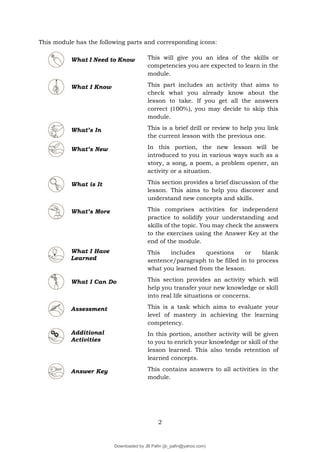
Notes to the Teacher
This contains helpful tips or strategies that
will help you in guiding the learners.
Downloaded by JB Pafin (jb_pafin@yahoo.com)
lOMoARcPSD|17019769
2
This module has the following parts and corresponding icons:
What I Need to Know This will give you an idea of the skills or
competencies you are expected to learn in the
module.
What I Know This part includes an activity that aims to
check what you already know about the
lesson to take. If you get all the answers
correct (100%), you may decide to skip this
module.
What’s In This is a brief drill or review to help you link
the current lesson with the previous one.
What’s New In this portion, the new lesson will be
introduced to you in various ways such as a
story, a song, a poem, a problem opener, an
activity or a situation.
What is It This section provides a brief discussion of the
lesson. This aims to help you discover and
understand new concepts and skills.
What’s More This comprises activities for independent
practice to solidify your understanding and
skills of the topic. You may check the answers
to the exercises using the Answer Key at the
end of the module.
What I Have
Learned
This includes questions or blank
sentence/paragraph to be filled in to process
what you learned from the lesson.
What I Can Do This section provides an activity which will
help you transfer your new knowledge or skill
into real life situations or concerns.
Assessment This is a task which aims to evaluate your
level of mastery in achieving the learning
competency.
Additional
Activities
In this portion, another activity will be given
to you to enrich your knowledge or skill of the
lesson learned. This also tends retention of
learned concepts.
Answer Key This contains answers to all activities in the
module.
Downloaded by JB Pafin (jb_pafin@yahoo.com)
lOMoARcPSD|17019769
3
At the end of this module you will also find:
The following are some reminders in using this module:
1. Use the module with care. Do not put unnecessary mark/s on any part of the
module. Use a separate sheet of paper in answering the exercises.
2. Don’t forget to answer What I Know before moving on to the other activities
included in the module.
3. Read the instruction carefully before doing each task.
4. Observe honesty and integrity in doing the tasks and checking your answers.
5. Finish the task at hand before proceeding to the next.
6. Return this module to your teacher/facilitator once you are through with it.
If you encounter any difficulty in answering the tasks in this module, do not hesitate
to consult your teacher or facilitator. Always bear in mind that you are not alone.
We hope that through this material, you will experience meaningful learning and
gain deep understanding of the relevant competencies. You can do it!
References
This is a list of all the sources used in
developing this module.
Downloaded by JB Pafin (jb_pafin@yahoo.com)
lOMoARcPSD|17019769
4
What I Need to Know
This module was designed and written with you in mind. It is here to help you
know the brief history, core teachings, fundamental beliefs, practices, and related
issues of Hinduism. The scope of this module permits it to be used in many different
learning situations. The language used recognizes the diverse vocabulary level of
students. The lessons are arranged to follow the standard sequence of the course.
But the order in which you read them can be changed to correspond with the
textbook you are now using.
This module is about the Hinduism.
After going through this module, you are expected to:
1. identify the sacred scriptures of Hinduism;
2. explain the worship and observances of Hinduism;
3. discuss the beliefs and doctrines of Hinduism;
4. determine the different subdivisions of Hinduism
Directions: Read and analyze each statement below and carefully choose the letter
that best describe the statement. Write the letter of the correct answer on a separate
sheet of paper or notebook.
1. “Sanatana Dharma” the formal name of Hinduism, means _____________.
a. Divine Light
b. Eternal Religion
c. Way of Truth
d. Holy Religion
2. Belief in the incarnations of a deity in different manifestations and personalities
is called ___________.
a. Bhakti
b. Yogi
c. Avatara
d. Reincarnation
What I Know
Downloaded by JB Pafin (jb_pafin@yahoo.com)
lOMoARcPSD|17019769
5
3. The ____________ scripture is “that which is heard.”
a. Darshan
b. Smriti
c. Shruti
d. Yoga
4. The highest god in the Hindu pantheon and one of the Trimurthi is ______.
a. Brahma
b. Lakshmi
c. Siva
d. Brahman
5. The Shudras caste was renamed ___________ by Mahatma Gandhi in protest of
the injustice of the caste system.
a. Prasad
b. Harijans
c. Puja
d. Jati
6. “Bhagavad Gita” means ______________.
a. Song of the enlightened one
b. Song of joy
c. Song of thanksgiving
d. Song of the lord
7. The three most powerful gods in Hinduism is called the ____________.
a. Vedas
b. Moksha
c. Kali
d. Trimurthi
8. A type of yoga that encourages a worshiper to offer love and devotion to a
god/goddess is _____________.
a. Atharva Yoga
b. Bhakti Yoga
c. Karma Yoga
d. Jnana Yoga
9. The highest and purest of all castes is the _____________ caste.
a. Shudra
b. Kshatriya
c. Brahmin
d. Vaishya
10.The Hindu Festival of Light is called ________________.
a. Holi
b. Lohari
c. Kumbha Mela
d. Divali
Downloaded by JB Pafin (jb_pafin@yahoo.com)
lOMoARcPSD|17019769
6
11.The incarnation Kurma is in the form of ______________.
a. Boar
b. Dwarf
c. Fish
d. Turtle
12.The incarnation of Matay is in the form of _____________.
a. Boar
b. Dwarf
c. Fish
d. Turtle
13.Horse is the incarnation of what avatar?
a. Buddha
b. Kalki
c. Khrisna
d. Narasimha
14.The attribute of this incarnation is to helped create the world by supporting it
on his back.
a. Kurma
b. Narasimha
c. Rama
d. Varaha
15.The enlightened man in the 10 avatars of Vishnu is ____________.
a. Buddha
b. Kalki
c. Khrisna
d. Narasimha
Downloaded by JB Pafin (jb_pafin@yahoo.com)
lOMoARcPSD|17019769
7
Lesson
8
Hinduism
What’s In
Before we proceed to the new lesson, let us go back to the previous lesson by
answering the following questions below.
Fill in the blanks. What have you learned from the previous lesson? Fill in the
blanks with the correct words to complete the paragraph. Use separate answer sheet
or notebook in answering.
The three Abrahamic religions (1) __________________, (2) __________________,
and (3) ____________________ all originated from a region we now call Southwest Asia.
They are also called (4) ____________________ since they came from an area where
people speak or express the Semitic languages, particularly (5) ______________
Aramaic and Arabic.
Judaism originated from a land called (6) __________________; Christianity
began in (7) ____________________ while Islam developed in (8) _____________________.
Looking back at the history of the three religions, we can see that they share
commonalities in certain beliefs such as belief in the same Patriarch and other
prophets; angels as (9) ___________________ of God; heaven and hell; and (10)
___________________ day, among others.
Notes to the Teacher
This Alternative Delivery Mode contains helpful tips or
strategies that will help you in guiding the learners in
learning the Hinduism.
Downloaded by JB Pafin (jb_pafin@yahoo.com)
lOMoARcPSD|17019769
8
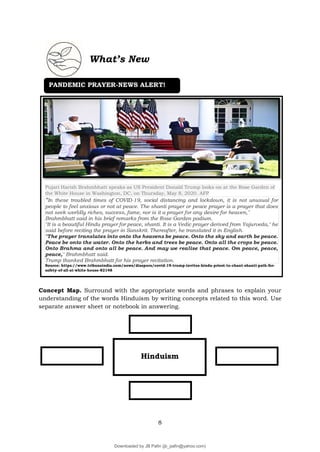
Concept Map. Surround with the appropriate words and phrases to explain your
understanding of the words Hinduism by writing concepts related to this word. Use
separate answer sheet or notebook in answering.
What’s New
Hinduism
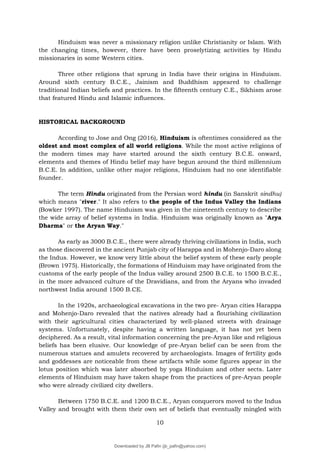
Pujari Harish Brahmbhatt speaks as US President Donald Trump looks on at the Rose Garden of
the White House in Washington, DC, on Thursday, May 8, 2020. AFP
“In these troubled times of COVID-19, social distancing and lockdown, it is not unusual for
people to feel anxious or not at peace. The shanti prayer or peace prayer is a prayer that does
not seek worldly riches, success, fame, nor is it a prayer for any desire for heaven,"
Brahmbhatt said in his brief remarks from the Rose Garden podium.
"It is a beautiful Hindu prayer for peace, shanti. It is a Vedic prayer derived from Yajurveda," he
said before reciting the prayer in Sanskrit. Thereafter, he translated it in English.
"The prayer translates into onto the heavens be peace. Onto the sky and earth be peace.
Peace be onto the water. Onto the herbs and trees be peace. Onto all the crops be peace.
Onto Brahma and onto all be peace. And may we realise that peace. Om peace, peace,
peace," Brahmbhatt said.
Trump thanked Brahmbhatt for his prayer recitation.
Source: https://www.tribuneindia.com/news/diaspora/covid-19-trump-invites-hindu-priest-to-chant-shanti-path-for-
safety-of-all-at-white-house-82148
PANDEMIC PRAYER-NEWS ALERT!
Downloaded by JB Pafin (jb_pafin@yahoo.com)
lOMoARcPSD|17019769
9
In 1-2 sentences, explain each word you have written to understand Hinduism.
(1) _____________________________________________________________________
_____________________________________________________________.
(2) _____________________________________________________________________
_____________________________________________________________.
(3) _____________________________________________________________________
_____________________________________________________________.
(4) ____________________________________________________________________
_____________________________________________________________.
Hinduism
Concept map
This lesson is divided into four groups:
Hinduism
Hinduism is the world's third largest
religion with around 15% of the entire population
practicing the Hindu faith. Hindu followers in India
comprise the major bulk with almost 80% of the
country's population adhering to the religion. Other
Asian countries with considerable Hindu faithful
include Nepal (23 million), Bangladesh (15 million),
and Indonesia (3.9 million in Bali). There are also
substantial number of Hindus in Mauritius,
Guyana, Fiji, Bhutan, Trinidad and Tobago,
Suriname, and Sri Lanka (Jose and Ong, 2016).
What is It
https://en.wikipedia.org/wiki/Hinduism#/media/File:1_Om.svg
Hinduism
1
Sacred
Scriptures
2
Worship and
Observances
3
Beliefs and
Doctrines
4
Subdivision
Downloaded by JB Pafin (jb_pafin@yahoo.com)
lOMoARcPSD|17019769
10
Hinduism was never a missionary religion unlike Christianity or Islam. With
the changing times, however, there have been proselytizing activities by Hindu
missionaries in some Western cities.
Three other religions that sprung in India have their origins in Hinduism.
Around sixth century B.C.E., Jainism and Buddhism appeared to challenge
traditional Indian beliefs and practices. In the fifteenth century C.E., Sikhism arose
that featured Hindu and Islamic influences.
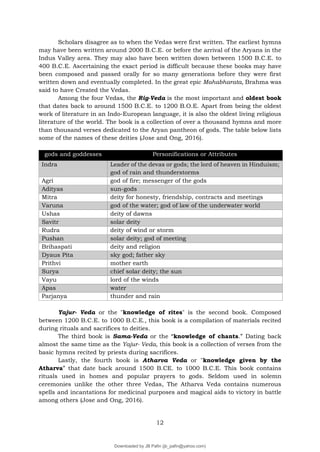
HISTORICAL BACKGROUND
According to Jose and Ong (2016), Hinduism is oftentimes considered as the
oldest and most complex of all world religions. While the most active religions of
the modern times may have started around the sixth century B.C.E. onward,
elements and themes of Hindu belief may have begun around the third millennium
B.C.E. In addition, unlike other major religions, Hinduism had no one identifiable
founder.
The term Hindu originated from the Persian word hindu (in Sanskrit sindhu)
which means "river." It also refers to the people of the Indus Valley the Indians
(Bowker 1997). The name Hinduism was given in the nineteenth century to describe
the wide array of belief systems in India. Hinduism was originally known as "Arya
Dharma" or the Aryan Way."
As early as 3000 B.C.E., there were already thriving civilizations in India, such
as those discovered in the ancient Punjab city of Harappa and in Mohenjo-Daro along
the Indus. However, we know very little about the belief system of these early people
(Brown 1975). Historically, the formations of Hinduism may have originated from the
customs of the early people of the Indus valley around 2500 B.C.E. to 1500 B.C.E.,
in the more advanced culture of the Dravidians, and from the Aryans who invaded
northwest India around 1500 B.CE.
In the 1920s, archaeological excavations in the two pre- Aryan cities Harappa
and Mohenjo-Daro revealed that the natives already had a flourishing civilization
with their agricultural cities characterized by well-planed streets with drainage
systems. Unfortunately, despite having a written language, it has not yet been
deciphered. As a result, vital information concerning the pre-Aryan like and religious
beliefs has been elusive. Our knowledge of pre-Aryan belief can be seen from the
numerous statues and amulets recovered by archaeologists. Images of fertility gods
and goddesses are noticeable from these artifacts while some figures appear in the
lotus position which was later absorbed by yoga Hinduism and other sects. Later
elements of Hinduism may have taken shape from the practices of pre-Aryan people
who were already civilized city dwellers.
Between 1750 B.C.E. and 1200 B.C.E., Aryan conquerors moved to the Indus
Valley and brought with them their own set of beliefs that eventually mingled with
Downloaded by JB Pafin (jb_pafin@yahoo.com)
lOMoARcPSD|17019769
11
the religion of the natives. Classical Hinduism resulted in the consolidation of their
faiths. Around sixth century B.C.B., they began to settle into cities while local leaders
started organizing small kingdoms for themselves.
Aryans brought with them their set of beliefs based on oral texts known as
Vedas. This Vedic literature, however, was chiefly composed at the time the Aryans
had already settled in India and blended with the natives. Admittedly, there is much
difficulty in identifying elements in the Vedas that are genuinely pre-Aryan or Aryan
influenced. However, certain fundamental assumptions about the Aryan religion can
be stated here. Firstly, the Aryans brought with them a polytheistic religion like that
of other Indo-European people.
The sun, the moon and storms, are personified in reference to the pantheon
of gods and goddesses worshipped by the Aryans. Secondly, sacrifice was the
principal form of worship to the Aryan gods. Offerings to gods include animals and
dairy products performed on altars in open spaces. Since Aryans later were nomadic,
they had no temples In general, Hinduism has pre-Aryan and Aryan elements that
date back to ancient times. (Jose and Ong, 2016).
1. SACRED SCRIPTURES OF HINDUISM
As stated by Jose and Ong (2016), the sacred texts of Hinduism have been
principally passed down throughout generations by way of music, recitation, dance,
and drama. Sanskrit has been the language of the earliest writings.
The sacred writings of the Hindus are categorized into two classes, the Shruti
and Smriti.
a. SHRUTI
Shruti literally, means "that which is heard." They are regarded as eternal
truths that were passed orally until the beginning of the present age wherein there
came the need to write them down (Bowker 1997).
The four collections of texts of the Vedas form the shruti and are considered
primary sources and the most authoritative texts of the Hindu faith. Other writings
that form part of shruti include the Samhitas, Brahmanas, Upanishads, and a few
Sutras.
Vedas
The four basic Vedic books, which are sacrificial hymns compiled from an
earlier oral tradition, are composed of Rig-veda, Sama-veda, Yajur-veda, and
Atharva-veda. The word Veda means "knowledge" or "'sacred lore."
The Vedas are the earliest known Sanskrit literature from the Brahmanic
period and oldest scriptures of Hinduism.
Downloaded by JB Pafin (jb_pafin@yahoo.com)
lOMoARcPSD|17019769
12
Scholars disagree as to when the Vedas were first written. The earliest hymns
may have been written around 2000 B.C.E. or before the arrival of the Aryans in the
Indus Valley area. They may also have been written down between 1500 B.C.E. to
400 B.C.E. Ascertaining the exact period is difficult because these books may have
been composed and passed orally for so many generations before they were first
written down and eventually completed. In the great epic Mahabharata, Brahma was
said to have Created the Vedas.
Among the four Vedas, the Rig-Veda is the most important and oldest book
that dates back to around 1500 B.C.E. to 1200 B.O.E. Apart from being the oldest
work of literature in an Indo-European language, it is also the oldest living religious
literature of the world. The book is a collection of over a thousand hymns and more
than thousand verses dedicated to the Aryan pantheon of gods. The table below lists
some of the names of these deities (Jose and Ong, 2016).
gods and goddesses Personifications or Attributes
Indra Leader of the devas or gods; the lord of heaven in Hinduism;
god of rain and thunderstorms
Agri god of fire; messenger of the gods
Adityas sun-gods
Mitra deity for honesty, friendship, contracts and meetings
Varuna god of the water; god of law of the underwater world
Ushas deity of dawns
Savitr solar deity
Rudra deity of wind or storm
Pushan solar deity; god of meeting
Brihaspati deity and religion
Dyaus Pita sky god; father sky
Prithvi mother earth
Surya chief solar deity; the sun
Vayu lord of the winds
Apas water
Parjanya thunder and rain
Yajur- Veda or the "knowledge of rites" is the second book. Composed
between 1200 B.C.E. to 1000 B.C.E., this book is a compilation of materials recited
during rituals and sacrifices to deities.
The third book is Sama-Veda or the “knowledge of chants.” Dating back
almost the same time as the Yajur- Veda, this book is a collection of verses from the
basic hymns recited by priests during sacrifices.
Lastly, the fourth book is Atharva Veda or "knowledge given by the
Atharva” that date back around 1500 B.CE. to 1000 B.C.E. This book contains
rituals used in homes and popular prayers to gods. Seldom used in solemn
ceremonies unlike the other three Vedas, The Atharva Veda contains numerous
spells and incantations for medicinal purposes and magical aids to victory in battle
among others (Jose and Ong, 2016).
Downloaded by JB Pafin (jb_pafin@yahoo.com)
lOMoARcPSD|17019769
13
Each Vedas consists of four main parts the Mantras, Brahmanas, Aranyakas,
and Upanishads.
1.Mantras are hymns and chants for praising god.
2.Brahmanas are explanations of the Mantras with detailed descriptions of
the sacrificial ceremonies related to them.
3. Aranyakas are meditations that explicate their meaning.
4. Upanishads or secret teachings transcend rituals to elucidate the nature
of the universe and human’s connectedness to it. The many teachings
embedded in the Upanishads are called Vedanta, and these are teeming with
spiritual truths.
Upanishads
Forming the fourth part of the Vedas, the term Upanishad literally translates
as “sitting down near” or “sitting close to” as it implies listening intently to the
mystic teachings of a spiritual teacher who has fully understood the universal truths.
It could also mean “brahma-knowledge" whereby ignorance is totally eliminated.
Within these amazing collections of writings that were transmitted orally
through generations, one can find early philosophical statements that form the basis
for all 1ater Hindu philosophy.
The great Indian nationalist and philosopher Sri Aurobindo described the
Upanishads as the “supreme work of the Indian mind.” Varying in length from one
page to over fifty pages, all fundamental teachings and concepts about Hinduism are
found in these profound dissertations such as:
1. karma (action)
2. samsara (reincarnation)
3. moksha (nirvana)
4. atman (soul); and
5. brahman (Absolute Almighty)
Of the two hundred Upanishads, fourteen of these are considered principal
writings. The earliest of the Upanishads may have originated in the ninth century
B.C.E. while the most recent around the sixth century B.C.E
b. SHMRITI
Smriti literally means “that which has been remembered.” These writings
serve to reinforce shruti and are interpreted by sages and scholars alike. Most of
these texts are sectarian in nature and considered of lesser importance compared to
shruti, such as stories and legends, codes of conduct for the society, and guidebooks
for worship.
The great epics Ramayana and Mahabharata, which contains the
philosophical poem Bhagavad Gita, are part of Shrmriti. These are national epics of
India and considered to be the sacred texts of the masses where they draw their
values and ideals (Jose and Ong, 2016).
Downloaded by JB Pafin (jb_pafin@yahoo.com)
lOMoARcPSD|17019769
14
Ramayana
The Ramayana, translated as the “Story of Rama’s Journey,” is a Sanskrit
epic poem written by the poet Valmiki consisting of 24,000 verses in seven books
and 500 cantos. This great epic was written between 200 BCE and 200 CE. Central
to the story is Rama, a prince and later portrayed as avatar or incarnation of the
Hindu god Vishnu, who was born in Ayodhya. Rama was exiled by his father on the
eve of his coronation.
Presently, this story is danced out and acted in Southeast Asia where Hindu
influence is observable. Most characters are popular in Indonesia, Thailand, and
Cambodia.
Mahabharata
From the book of Jose and Ong (2016), another major Sanskrit literature of
old India is Mahabharata which is composed of around one hundred thousand
verses making it the world’s longest poem. Written around 500 B.C.E., this
magnificent work is attributed to the author Vyasa who is also considered to be the
scribe of the Vedas.
The Mahabharata tells of a great struggle among the descendants of a king
called Bharata, a name used by many Indians to mean "India" (Jose and Ong, 2016).
Two families are at war, the Pandavas who represent good and the Kauravas who
embody evil (Brown 1975). The hundred Raurava brothers try to cheat their five
cousins, the Pandavas, out of their share of the kingdom.
As intense battle ensued, every kingdom had to take sides. With the help of
Krishna, another incarnation of Vishnu, the Pandavas emerged triumphant but lost
all their sons and closest kin in battle (Coogan 2000).
With about 100,000 couplets and 1.8 million words in total, this poem is about
four times longer than the Ramayana, eight times longer than the Iliad and the
Odyssey put together, and fifteen times longer than the Bible. Along with the Bible
and the Quran, the Mahabharata ranks in importance among the sacred writings of
various world religions. It is an epic vision of the human condition, such as intrigue,
romance, duplicity, moral collapse, dishonour, and lamentations.
Bhagavad Gita
A celebrated episode within the Mahabharata is the Bhagavad Gita (or simply
Gita) which is translated as “the Lord's Song." It is believed to have been written
between the second century B.C.E. and third century C.E.
Considered as one of the holiest books by the Hindus, the Gita is a 700-
verse narrative of a dialogue between the Pandava prince Arjuna and his guide-
cousin Krishna. Just as the war is about to commence at Kurukshetra, plates his
fate and struggles set before him.
The Gita instructs any person that one may reach god through devotion,
knowledge, or selfless action. Humans must do their duty or dharma whatever it may
be and whatever results it could produce.
Downloaded by JB Pafin (jb_pafin@yahoo.com)
lOMoARcPSD|17019769
15
The Gita is considered the layman’s Upanishads because the difficult
teachings of the Upanishads are presented here in a manner that commoners can
understand (Jose and Ong, 2016).
2. BELIEFS AND DOCTRINES OF HINDUISM
As stated by Cornelio et al. (2016), the Hindu faith offers its followers many
paths to salvation. They may find liberation from the cycle of life through devotion to
one or more gods. Their gods and goddesses can be worshipped at their temples. In
temples, devotees can pray and offer sacrifices so that they can gain favor from deities
and assist them in their struggle for salvation.
Bhakti stands for the soul’s longing for and clinging to god.
Devotion to the Trimurti
Central to Hinduism is the Brahman who is the ultimate reality, one and
undivided. The Brahman is often seen in three forms or functions. Called the
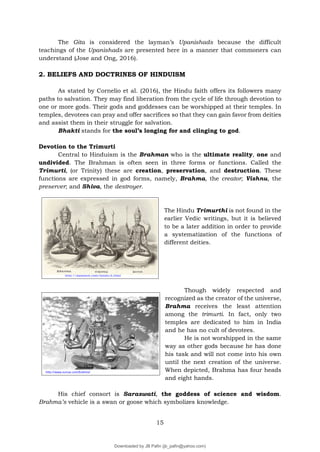
Trimurti, (or Trinity) these are creation, preservation, and destruction. These
functions are expressed in god forms, namely, Brahma, the creator; Vishnu, the
preserver; and Shiva, the destroyer.
The Hindu Trimurthi is not found in the
earlier Vedic writings, but it is believed
to be a later addition in order to provide
a systematization of the functions of
different deities.
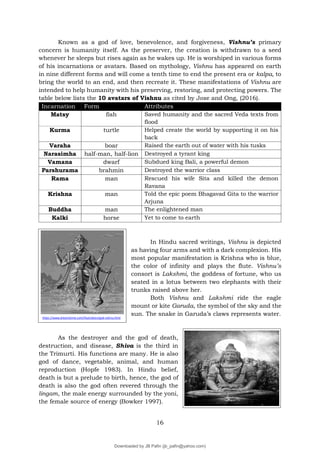
Though widely respected and
recognized as the creator of the universe,
Brahma receives the least attention
among the trimurti. In fact, only two
temples are dedicated to him in India
and he has no cult of devotees.
He is not worshipped in the same
way as other gods because he has done
his task and will not come into his own
until the next creation of the universe.
When depicted, Brahma has four heads
and eight hands.
His chief consort is Saraswati, the goddess of science and wisdom.
Brahma’s vehicle is a swan or goose which symbolizes knowledge.
http://www.zunray.com/brahma/
http://mesosyn.com/hindu-6.html
Downloaded by JB Pafin (jb_pafin@yahoo.com)
lOMoARcPSD|17019769
16
Known as a god of love, benevolence, and forgiveness, Vishnu’s primary
concern is humanity itself. As the preserver, the creation is withdrawn to a seed
whenever he sleeps but rises again as he wakes up. He is worshiped in various forms
of his incarnations or avatars. Based on mythology, Vishnu has appeared on earth
in nine different forms and will come a tenth time to end the present era or kalpa, to
bring the world to an end, and then recreate it. These manifestations of Vishnu are
intended to help humanity with his preserving, restoring, and protecting powers. The
table below lists the 10 avatars of Vishnu as cited by Jose and Ong, (2016).
Incarnation Form Attributes
Matsy fish Saved humanity and the sacred Veda texts from
flood
Kurma turtle Helped create the world by supporting it on his
back
Varaha boar Raised the earth out of water with his tusks
Narasimha half-man, half-lion Destroyed a tyrant king
Vamana dwarf Subdued king Bali, a powerful demon
Parshurama brahmin Destroyed the warrior class
Rama man Rescued his wife Sita and killed the demon
Ravana
Krishna man Told the epic poem Bhagavad Gita to the warrior
Arjuna
Buddha man The enlightened man
Kalki horse Yet to come to earth
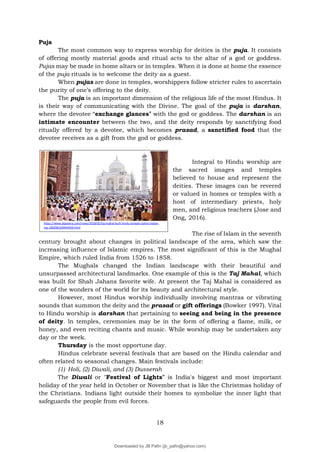
In Hindu sacred writings, Vishnu is depicted
as having four arms and with a dark complexion. His
most popular manifestation is Krishna who is blue,
the color of infinity and plays the flute. Vishnu’s
consort is Lakshmi, the goddess of fortune, who us
seated in a lotus between two elephants with their
trunks raised above her.
Both Vishnu and Lakshmi ride the eagle
mount or kite Garuda, the symbol of the sky and the
sun. The snake in Garuda’s claws represents water.
As the destroyer and the god of death,
destruction, and disease, Shiva is the third in
the Trimurti. His functions are many. He is also
god of dance, vegetable, animal, and human
reproduction (Hopfe 1983). In Hindu belief,
death is but a prelude to birth, hence, the god of
death is also the god often revered through the
lingam, the male energy surrounded by the yoni,
the female source of energy (Bowker 1997).
https://www.dreamstime.com/illustration/god-vishnu.html
Downloaded by JB Pafin (jb_pafin@yahoo.com)
lOMoARcPSD|17019769
17
Routes to Moksha
From the Upanishads, one may find the three principal and inter-related
doctrines within the Indian religion. These are the following:
1. Every soul dies and is reborn anew in new form (this cycle is called samsara).
2. One's deeds have an effect in this or a future life.
3. One may escape the weary round of death and birth.
Within every human is an eternal soul or atman that is being reborn many
times and in various forms in accordance to the moral law or karma (Bowker 1997).
A soul may escape the cycle of rebirth and attain moksha. This liberation can be
achieved through the four yogas that involve a system of practices aimed at
producing spiritual enlightenment.
The word yoga is derived from the root word yuj which translates as “to yoke”
or "to join."
The philosophy of yoga was developed by the sage Patanjali who lived in the
second century B.C.E. He is considered as the “father of modern yoga" as he
codified the teachings of yoga in his Yoga Sutra (Hopfe 1983).
Table below lists down the four yogas with their corresponding practices.
The Four Yogas Practices
Jnana Yoga
(the way of
knowledge)
The path of knowledge, wisdom, introspection, and
contemplation.
Bhakti Yoga
(the way of love)
The path of devotion, emotion, love, compassion, and service
to God and others.
Karma Yoga
(the way of work)
The path of action, service to others, mindfulness, and
remembering the levels of our being while fulfilling our
actions or karma in the world.
Raja Yoga
(the way of
meditation)
The path of meditation that directly deals with the
encountering and transcending thoughts of the mind.
For all Hindus, there are four desirable goals or areas of life or purushartha.
These are:
1. dharma (appropriate behavior)
2. artha (the pursuit of legitimate worldly success)
3. kama (the pursuit of legitimate pleasure); and
4. moksha (release from rebirth).
The terminal stage involves the liberation from the bonds of flesh and the
limitations of death-bound life.
3. WORSHIP AND OBSERVANCES OF HINDUISM
Hindu scriptures state that there are 330 million gods or devas (Kolanad
1994). These include manifestations of natural phenomena, evil forces, and even
illnesses. Others are venerated humans or town deities. Hindu worship or puja
involves images (murtis), prayers (mantras), and diagrams of the universe (yantras)
(Bowker 1997).
Downloaded by JB Pafin (jb_pafin@yahoo.com)
lOMoARcPSD|17019769
18
Puja
The most common way to express worship for deities is the puja. It consists
of offering mostly material goods and ritual acts to the altar of a god or goddess.
Pujas may be made in home altars or in temples. When it is done at home the essence
of the puja rituals is to welcome the deity as a guest.
When pujas are done in temples, worshippers follow stricter rules to ascertain
the purity of one’s offering to the deity.
The puja is an important dimension of the religious life of the most Hindus. It
is their way of communicating with the Divine. The goal of the puja is darshan,
where the devotee “exchange glances” with the god or goddess. The darshan is an
intimate encounter between the two, and the deity responds by sanctifying food
ritually offered by a devotee, which becomes prasad, a sanctified food that the
devotee receives as a gift from the god or goddess.
Integral to Hindu worship are
the sacred images and temples
believed to house and represent the
deities. These images can be revered
or valued in homes or temples with a
host of intermediary priests, holy
men, and religious teachers (Jose and
Ong, 2016).
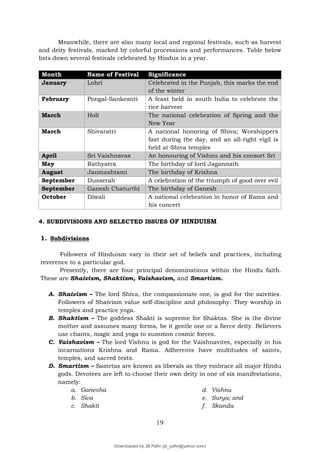
The rise of Islam in the seventh
century brought about changes in political landscape of the area, which saw the
increasing influence of Islamic empires. The most significant of this is the Mughal
Empire, which ruled India from 1526 to 1858.
The Mughals changed the Indian landscape with their beautiful and
unsurpassed architectural landmarks. One example of this is the Taj Mahal, which
was built for Shah Jahans favorite wife. At present the Taj Mahal is considered as
one of the wonders of the world for its beauty and architectural style.
However, most Hindus worship individually involving mantras or vibrating
sounds that summon the deity and the prasad or gift offerings (Bowker 1997). Vital
to Hindu worship is darshan that pertaining to seeing and being in the presence
of deity. ln temples, ceremonies may be in the form of offering a flame, milk, or
honey, and even reciting chants and music. While worship may be undertaken any
day or the week.
Thursday is the most opportune day.
Hindus celebrate several festivals that are based on the Hindu calendar and
often related to seasonal changes. Main festivals include:
(1) Holi, (2) Diwali, and (3) Dusserah
The Diwali or "Festival of Lights” is India's biggest and most important
holiday of the year held in October or November that is like the Christmas holiday of
the Christians. Indians light outside their homes to symbolize the inner light that
safeguards the people from evil forces.
https://www.aljazeera.com/news/2018/02/taj-mahal-built-hindu-temple-claims-indian-
mp-180206104944929.html
Downloaded by JB Pafin (jb_pafin@yahoo.com)
lOMoARcPSD|17019769
19
Meanwhile, there are also many local and regional festivals, such as harvest
and deity festivals, marked by colorful processions and performances. Table below
lists down several festivals celebrated by Hindus in a year.
4. SUBDIVISIONS AND SELECTED ISSUES OF HINDUISM
1. Subdivisions
Followers of Hinduism vary in their set of beliefs and practices, including
reverence to a particular god.
Presently, there are four principal denominations within the Hindu faith.
These are Shaivism, Shaktism, Vaishavism, and Smartism.
A. Shaivism – The lord Shiva, the compassionate one, is god for the saivities.
Followers of Shaivism value self-discipline and philosophy. They worship in
temples and practice yoga.
B. Shaktism – The goddess Shakti is supreme for Shaktas. She is the divine
mother and assumes many forms, be it gentle one or a fierce deity. Believers
use chants, magic and yoga to summon cosmic forces.
C. Vaishavism – The lord Vishnu is god for the Vaishnavites, especially in his
incarnations Krishna and Rama. Adherents have multitudes of saints,
temples, and sacred texts.
D. Smartism – Samrtas are known as liberals as they embrace all major Hindu
gods. Devotees are left to choose their own deity in one of six manifestations,
namely:
a. Ganesha
b. Siva
c. Shakti
d. Vishnu
e. Surya; and
f. Skanda
Month Name of Festival Significance
January Lohri Celebrated in the Punjab, this marks the end
of the winter
February Pongal-Sankranti A feast held in south India to celebrate the
rice harvest
March Holi The national celebration of Spring and the
New Year
March Shivaratri A national honoring of Shiva; Worshippers
fast during the day, and an all-right vigil is
held at Shiva temples
April Sri Vaishnavas An honouring of Vishnu and his consort Sri
May Rathyatra The birthday of lord Jagannath
August Janmashtami The birthday of Krishna
September Dusserah A celebration of the triumph of good over evil
September Ganesh Chaturthi The birthday of Ganesh
October Diwali A national celebration in honor of Rama and
his concert
Downloaded by JB Pafin (jb_pafin@yahoo.com)
lOMoARcPSD|17019769
20
2. Selected Issues
Hinduism continues to be the religion of almost 80% of the Indian people.
While mostly comprised of Hindu followers, India is a secular state that remains
neutral in issues involving religious convictions and practices of its citizenry. All
Indians can follow and propagate their own set of beliefs.
Being a country with the largest adherents of Hinduism, India is presently
facing numerous challenges that are religious in character, some of which are below.
A. HINDUISM AND WOMEN
Even though the Manusmriti or the “Laws of Manu” states that women should
be honored in Hindu society, women have always been considered inferior to mean
in almost all aspects of life. A woman’s life revolves around the men in her life, to be
taken care of by her father in childhood, by her husband in married life, and by her
sons upon old age.
In traditional society, women are expected to perform sati or suttee wherein
widowed women are expected to jump on the funeral pyre of their husbands to prove
their loyalty and help save the soul of their husbands in afterlife. Although sati was
already demolished by the British in India, there are still cases of sati being reported
in modern times.
B. CASTE SYSTEM
As stated by Cornelio et al. (2016), the case system is one of the major
distinguishing features of Indian culture that still affects modern-day society. A case
system of social class composed of the Brahmins, Kshatriyas, Vaishyas, and
Shudras, opportunities are based upon family origin. One person belongs to a caste
by being born to parents of that caste.
The Brahmins are the highest in the hierarchy and are perceived to be the
purest among all castes.
This has been an issue of distinctive concern for the reformers of the caste
system. While full-blown divisions are relatively a modern development, the caste
system began to divide into thousands of castes that are sometimes based on
occupations.
A person’s diet, vocation and residence are dictated by the caste where he or
she belongs. There can be more than 3,000 separate castes in India.
The teachings of Hinduism may have justified the status of the outcastes.
Their present condition may have been caused by their accumulated karma from the
past. By fulfilling their duties and accepting their dharma, they may be born to a
better caste in their next lives.
Despite the negative backlash on the caste system, India has been receptive
in enacting legislation aimed at eradicating inherent social evils. For example,
untouchability has been banned and the caste system is no longer rigid.
The Indian constitution has provided that it is unlawful to discriminate
against lower castes. Lower caste members are now being elected to key government
Downloaded by JB Pafin (jb_pafin@yahoo.com)
lOMoARcPSD|17019769
21
positions, including Kocherii R. Narayanan, a dalit who became the tenth president
of India from 1997 to 2002.
As stated by Cornelio et al.
(2016), the caste system had its vocal
critics who claim that it is unjust and
tramples a person’s human rights.
One of its most severe critics is
Mohandas Karamchand Gandhi, more
well known as Mahatma Gandhi, a
social activist and critic who
attacked the caste system and called
the Shudras, who were the least
among the castes, as harijans, or
“children of god.”
In 1948, the newly enacted Indian Constitution legally abolished the caste
system. Its influence, however, is still pervasive and it is still used to determine social
rank and prestige up to the present day.
https://medium.com/@vermapratik52/mahatma-gandhi-a-true-peacemaker-
28243dd36645
Downloaded by JB Pafin (jb_pafin@yahoo.com)
lOMoARcPSD|17019769
22
What’s More
Independent Activity 1
MODIFIED TRUE OR FALSE. Read the following statements. Write TRUE if the
statement is correct and change the underlined word or phrase if the statement is
incorrect. Use the separate answer sheet in answering.
______________1. Shaivism faith value self-discipline and philosophy, devotees’
worship in temples and practice yoga.
______________2. Smartism believers use chants, magic, and yoga to summon cosmic
forces.
______________3. The Vaishnavism devotees have multitudes of saints, temples and
sacred texts.
______________4. Shaktism devotees are left to choose their own deity, they embrace
all major Hindu gods.
______________5. Ganesha is one of the six manifestations of Smartism.
Independent Assessment 1
FILL IN THE BLANKS. Fill in the blanks with the correct word to complete the
sentence. Use the separate answer sheet in answering.
The Upanishads include fundamental teachings in Hinduism such as karma
(action), (1) _____________ (reincarnation), moksha (nirvana), atman (soul) and
Brahman (2) (________________).
Hinduism is the (3) _______________ largest religion in the whole world, and
around (4) _______________ % of the entire population practicing the Hindu
faith.
(5) _________________, a social activist and critic who attacked the caste system
and called the (6) _______________, who were the least among the castes, as (7)
__________________, or “children of God.”
The goal of the puja is (8) __________________, where the devotee “exchange
glances” with the god or goddess. (9) _______________, is a sanctified food that
the devotee receives as a (10) ___________________ from the god or goddess.
Downloaded by JB Pafin (jb_pafin@yahoo.com)
lOMoARcPSD|17019769
23
L M I N R A M A M W U E
O A M J L K S F J F A R
C T S T E J S B V Z E I
P S X D K A L K I D H E
A Y I S H N U F R N T K
R U J O U L Q E K A U U
S T K H Y D G I G R A R
H N T B E L I E F A G M
U V A R A H A B D S G A
R S M T R X F U E I B U
A D P H E C B T L M U A
M F K R I S H N A H D K
A G E L Q I A N E A D E
X J H B C M H I D D H S
C H M O P O M P S A A G
E N L V A M A N A Y Z A
A E L A H A X R Q E Z K
Independent Activity 2
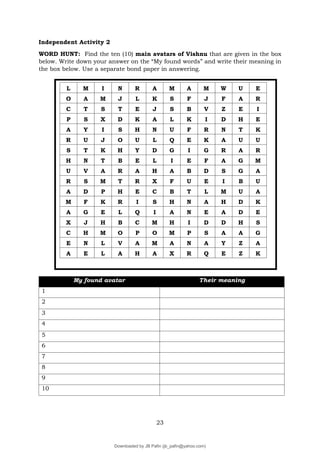
WORD HUNT: Find the ten (10) main avatars of Vishnu that are given in the box
below. Write down your answer on the “My found words” and write their meaning in
the box below. Use a separate bond paper in answering.
My found avatar Their meaning
1
2
3
4
5
6
7
8
9
10
Downloaded by JB Pafin (jb_pafin@yahoo.com)
lOMoARcPSD|17019769
24
Independent Assessment 2
IDENTIFICATION: Choose from the box the appropriate word for the following
statements. Write the answer on the space provided.
Trimurti Puja Brahmanas Taj-mahal Upanishads
Caste Aranyakas Thursday Diwali Mantras
___________________ 1. These are hymns and chants for praising god.
___________________ 2. These are explanations of the Mantras with detailed
descriptions of the sacrificial ceremonies related to them.
___________________ 3. These are meditations that explicate their meaning.
___________________ 4. These are secret teachings transcend rituals to elucidate the
nature of the universe and human’s connectedness to it.
___________________ 5. The most common way to express worship for deities.
___________________ 6. It is the most opportune day.
___________________ 7. It is the India's biggest and most important holiday of the
year held in October or November that is like the Christmas holiday of the Christians.
___________________ 8. This system is one of the major distinguishing features of
Indian culture that still affects modern-day society.
___________________ 9. It is considered as one of the wonders of the world for its
beauty and architectural style.
___________________ 10. These are creation, preservation and destruction.
Independent Activity 3
FACT OR BLUFF. Write FACT if the statement is correct otherwise, write BLUFF.
Use separate answer sheet in answering.
___________1. Taj Mahal was built for Shah Johan’s favorite wife.
___________2. There are also many local and regional festivals, such as harvest and
deity festivals, marked by colorful processions and performances.
___________3. Followers of Hinduism vary in their set of beliefs and practices,
including reverence to a particular god.
___________4. Hinduism continues to be the religion of almost 50% of the Indian
people.
___________5. The “Laws of Manu” states that women should be honored in Hindu
society and women have always been considered superior to men in
almost all aspects of life
Downloaded by JB Pafin (jb_pafin@yahoo.com)
lOMoARcPSD|17019769
25
Independent Assessment 3
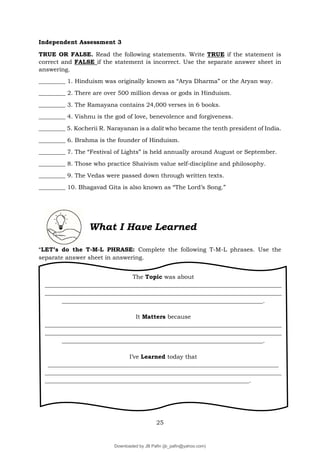
TRUE OR FALSE. Read the following statements. Write TRUE if the statement is
correct and FALSE if the statement is incorrect. Use the separate answer sheet in
answering.
_________ 1. Hinduism was originally known as “Arya Dharma” or the Aryan way.
_________ 2. There are over 500 million devas or gods in Hinduism.
_________ 3. The Ramayana contains 24,000 verses in 6 books.
_________ 4. Vishnu is the god of love, benevolence and forgiveness.
_________ 5. Kocherii R. Narayanan is a dalit who became the tenth president of India.
_________ 6. Brahma is the founder of Hinduism.
_________ 7. The “Festival of Lights” is held annually around August or September.
_________ 8. Those who practice Shaivism value self-discipline and philosophy.
_________ 9. The Vedas were passed down through written texts.
_________ 10. Bhagavad Gita is also known as “The Lord’s Song.”
What I Have Learned
“LET’s do the T-M-L PHRASE: Complete the following T-M-L phrases. Use the
separate answer sheet in answering.
The Topic was about
________________________________________________________________________________
________________________________________________________________________________
____________________________________________________________________.
It Matters because
________________________________________________________________________________
________________________________________________________________________________
____________________________________________________________________.
I’ve Learned today that
______________________________________________________________________________
________________________________________________________________________________
_____________________________________________________________________.
Downloaded by JB Pafin (jb_pafin@yahoo.com)
lOMoARcPSD|17019769
26
Your output will be assessed using the following rubrics:
What I Can Do
INFOGRAPHIC. Based on what you have learned in this module, create an
infographic design that will inform people about the Hinduism religion. Below is the
sample template, use the separate answer sheet in answering.
Your infographic will be evaluated using the rubrics below:
Content - 20 points
Clarity - 20 points
Design - 10 points
Total - 50 points
Content
(5 points)
Organization
(5 points)
Conventions
(5 points)
The presence of ideas
developed through facts,
examples, details,
opinions, reasons, and/or
explanations.
The order developed and
sustained within and across
paragraph using transitional
devices and including
introduction and conclusion.
Grammar, mechanics,
spelling, usage and
sentence formation.
HINDUISM
beliefs
gods/goddesses
Downloaded by JB Pafin (jb_pafin@yahoo.com)
lOMoARcPSD|17019769
27
Assessment
MULTIPLE CHOICES: Read each statement carefully. Choose the letter of the correct
answer. Use separate sheet in answering.
1. The Hindu word for “Laws of Manu” is ________________.
a. Brahmans
b. Kshatriyas
c. Manusmriti
d. Vaishyas
2. The Hindu word for “children of god” is ______________.
a. Brahmans
b. Kshatriyas
c. Harijans
d. Manusmriti
3. "River" means ___________.
a. Hinda
b. Hindi
c. Hindo
d. Hindu
4. The Hindu word for “that which is heard” is ____________.
a. Sanskrit
b. Smriti
c. Shruti
d. Vedas
5. The meaning of the word Veda is _____________.
a. Favors
b. Knowledge
c. Love
d. Wisdom
6. Which among the four Vedas is the most important and oldest book?
a. Rig-veda
b. Sama-veda
c. Yajur-veda
d. Atharva-veda
7. Atharva Veda means ____________.
a. Knowledge of rites
b. Knowledge of chants
c. Knowledge given by Atharva
d. Knowledge given by Yajur
Downloaded by JB Pafin (jb_pafin@yahoo.com)
lOMoARcPSD|17019769
28
8. The part of Vedas that consists of hymns and chants for praising god is
_________.
a. Aranyakas
b. Brahmanas
c. Mantras
d. Upanishads
9. The Hindu word for action is ____________
a. Atman
b. Brahman
c. Karma
d. mosksha
10. The Hindu word for “that which has been remembered” is ____________.
a. Sanskrit
b. Smriti
c. Shruti
d. Vedas
11.It is considered as the world’s longest poem.
a. Bhagavad Gita
b. Mahabharata
c. Ramayana
d. Smriti
12. This book means “the lord’s song”
a. Bhagavad Gita
b. Mahabharata
c. Ramayana
d. Smriti
13.The Hindu god for creation is ____________.
a. Bhakti
b. Brahma
c. Shiva
d. Vishnu
14. The Hindu god for preservation is ____________.
a. Bhakti
b. Brahma
c. Shiva
d. Vishnu
15. The Hindu god for destruction is ____________.
a. Bhakti
b. Brahma
c. Shiva
d. Vishnu
Downloaded by JB Pafin (jb_pafin@yahoo.com)
lOMoARcPSD|17019769
29
ESSAY. In 3-5 sentences explain the following situation. Use separate answer sheet
in answering.
12.What makes Hinduism’s beliefs, particularly its polytheistic nature, complex
for other people?
Your essay will be checked using the following rubrics:
Additional Activities
Content
10 points
Organization
10 points
Conventions
5 points
The presence of ideas
developed through facts,
examples, details,
opinions, reasons,
and/or explanations.
The order developed and
sustained within and across
paragraph using transitional
devices and including
introduction and conclusion.
Grammar, mechanics,
spelling, usage and
sentence formation.
My answer
Downloaded by JB Pafin (jb_pafin@yahoo.com)
lOMoARcPSD|17019769
30
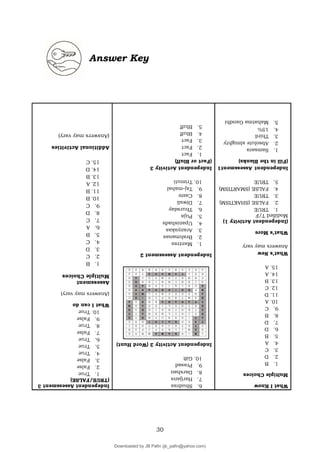
Answer Key
What
I
Know
Multiple
Choices
1.
B
2.
D
3.
C
4.
A
5.
B
6.
D
7.
D
8.
B
9.
C
10.
A
11.
D
12.
C
13.
B
14.
A
15.
A
What’s
New
Answers
may
vary
What’s
More
(Independent
Activity
1)
Modified
T/F
1.
TRUE
2.
FALSE
(SHAKTISM)
3.
TRUE
4.
FALSE
(SMARTISM)
5.
TRUE
Independent
Assessment1
(Fill
in
the
Blanks)
1.
Samsara
2.
Absolute
almighty
3.
Third
4.
15%
5.
Mahatma
Gandhi
6.
Shudras
7.
Harijans
8.
Darshan
9.
Prasad
10.
Gift
Independent
Activity
2
(Word
Hunt)
Independent
Assessment
2
1.
Mantras
2.
Brahmanas
3.
Aranyakas
4.
Upanishads
5.
Puja
6.
Thursday
7.
Diwali
8.
Caste
9.
Taj-mahal
10.
Trimuti
Independent
Activity
3
(Fact
or
Bluff)
1.
Fact
2.
Fact
3.
Fact
4.
Bluff
5.
Bluff
Independent
Assessment
3
(TRUE/FALSE)
1.
True
2.
False
3.
False
4.
True
5.
True
6.
True
7.
False
8.
True
9.
False
10.
True
What
I
can
do
(Answers
may
vary)
Assessment
Multiple
Choices
1.
B
2.
C
3.
D
4.
C
5.
B
6.
A
7.
C
8.
D
9.
C
10.
B
11.
B
12.
A
13.
B
14.
D
15.
C
Additional
Activities
(Answers
may
vary)
Downloaded by JB Pafin (jb_pafin@yahoo.com)
lOMoARcPSD|17019769
31
References
Cornelio, J. S. PhD., et. al., Introduction to World Religions and Belief Systems, for
Senior High School, Rex Bookstore. 2016
https://www.tribuneindia.com/news/diaspora/covid-19-trump-invites-hindu
priest-to-chant-shanti-path-for-safety-of-all-at-white-house-82148
https://medium.com/@vermapratik52/mahatma-gandhi-a-true-peacemaker-
28243dd36645
http://mesosyn.com/hindu-6.html
http://www.zunray.com/brahma/
https://www.dreamstime.com/illustration/god-vishnu.html
https://www.aljazeera.com/news/2018/02/taj-mahal-built-hindu-temple-claims-
indian-mp-180206104944929.html
Ong, J.A., DL Jose, M.J. Introduction to World Religions and Belief Systems, for Senior
High School, Vibal Group, Inc. 2016
Downloaded by JB Pafin (jb_pafin@yahoo.com)
lOMoARcPSD|17019769
32
For inquiries or feedback, please write or call:
Department of Education – Division of Science City of Muñoz,
Nueva Ecija
Office Address: Brgy. Rizal, Science City of Muñoz, Nueva Ecija
Telephone Number: (044) 806 2192
Email address: muñozsciencecity@deped.gov.ph
Downloaded by JB Pafin (jb_pafin@yahoo.com)
lOMoARcPSD|17019769

iwrbs-module-8-hinduism (1).pdf

  • 1.
    Studocu is notsponsored or endorsed by any college or university Iwrbs Module 8 Hinduism Human Relations 1 (Araullo University) Studocu is not sponsored or endorsed by any college or university Iwrbs Module 8 Hinduism Human Relations 1 (Araullo University) Downloaded by JB Pafin (jb_pafin@yahoo.com) lOMoARcPSD|17019769
  • 2.
    Introduction to World Religions andBelief Systems Quarter 2 – Module 8: Hinduism Downloaded by JB Pafin (jb_pafin@yahoo.com) lOMoARcPSD|17019769
  • 3.
    Introduction to WorldReligions and Belief Systems – Grade 11 Alternative Delivery Mode Quarter 2 – Module 8: Hinduism First Edition, 2020 Republic Act 8293, section 176 states that: No copyright shall subsist in any work of the Government of the Philippines. However, prior approval of the government agency or office wherein the work is created shall be necessary for exploitation of such work for profit. Such agency or office may, among other things, impose as a condition the payment of royalties. Borrowed materials (i.e., songs, stories, poems, pictures, photos, brand names, trademarks, etc.) included in this module are owned by their respective copyright holders. Every effort has been exerted to locate and seek permission to use these materials from their respective copyright owners. The publisher and authors do not represent nor claim ownership over them. Published by the Department of Education Division of Science City of Muñoz Printed in the Philippines by Department of Education – Region III – Division of Science City of Muñoz Office Address: Brgy. Rizal, Science City of Muñoz, Nueva Ecija Telephone Number: (044) 806 2192 E-mail Address: muñozsciencecity@deped.gov.ph Development Team of the Module Writer: Elena C. Lanuza Language Editor: Honey Rocehl V. Sapitan Reviewer: Nelie D. Sacman, PhD Layout Artist: Christine Ann C. Buenaventura Management Team: Dante G. Parungao, CESO VI Zurex T. Bacay, PhD Larry B. Espiritu, PhD Rodolfo A. Dizon, PhD Nelie D. Sacman, PhD Joven P. La Rosa, EdD Downloaded by JB Pafin (jb_pafin@yahoo.com) lOMoARcPSD|17019769
  • 4.
    Introduction to World Religions andBelief Systems Quarter 2 – Module 8: Hinduism Downloaded by JB Pafin (jb_pafin@yahoo.com) lOMoARcPSD|17019769
  • 5.
    1 Introductory Message For thefacilitator: Welcome to the Introduction to World Religions and Belief Systems for Grade 11 Alternative Delivery Mode (ADM) Module on Hinduism. This module was collaboratively designed, developed and reviewed by educators both from public and private institutions to assist you, the teacher or facilitator in helping the learners meet the standards set by the K to 12 Curriculum while overcoming their personal, social, and economic constraints in schooling. This learning resource hopes to engage the learners into guided and independent learning activities at their own pace and time. Furthermore, this also aims to help learners acquire the needed 21st century skills while taking into consideration their needs and circumstances. For the learners: Welcome to the Introduction to World Religions and Belief Systems for Grade 11 Alternative Delivery Mode (ADM) Module on Hinduism. This module will let you know about the brief history, core teachings, fundamental beliefs, practices, and related issues of Hinduism. And it is designed to provide you fun and meaningful opportunities for guided and independent learning at your own pace and time. You will be enabled to process the contents of the learning resource while being an active learner. Your academic success lies in your own hands! In addition to the material in the main text, you will also see this box in the body of the module: As a facilitator you are expected to orient the learners on how to use this module. You also need to keep track of the learners' progress while allowing them to manage their own learning. Furthermore, you are expected to encourage and assist the learners as they do the tasks included in the module. Notes to the Teacher This contains helpful tips or strategies that will help you in guiding the learners. Downloaded by JB Pafin (jb_pafin@yahoo.com) lOMoARcPSD|17019769
  • 6.
    2 This module hasthe following parts and corresponding icons: What I Need to Know This will give you an idea of the skills or competencies you are expected to learn in the module. What I Know This part includes an activity that aims to check what you already know about the lesson to take. If you get all the answers correct (100%), you may decide to skip this module. What’s In This is a brief drill or review to help you link the current lesson with the previous one. What’s New In this portion, the new lesson will be introduced to you in various ways such as a story, a song, a poem, a problem opener, an activity or a situation. What is It This section provides a brief discussion of the lesson. This aims to help you discover and understand new concepts and skills. What’s More This comprises activities for independent practice to solidify your understanding and skills of the topic. You may check the answers to the exercises using the Answer Key at the end of the module. What I Have Learned This includes questions or blank sentence/paragraph to be filled in to process what you learned from the lesson. What I Can Do This section provides an activity which will help you transfer your new knowledge or skill into real life situations or concerns. Assessment This is a task which aims to evaluate your level of mastery in achieving the learning competency. Additional Activities In this portion, another activity will be given to you to enrich your knowledge or skill of the lesson learned. This also tends retention of learned concepts. Answer Key This contains answers to all activities in the module. Downloaded by JB Pafin (jb_pafin@yahoo.com) lOMoARcPSD|17019769
  • 7.
    3 At the endof this module you will also find: The following are some reminders in using this module: 1. Use the module with care. Do not put unnecessary mark/s on any part of the module. Use a separate sheet of paper in answering the exercises. 2. Don’t forget to answer What I Know before moving on to the other activities included in the module. 3. Read the instruction carefully before doing each task. 4. Observe honesty and integrity in doing the tasks and checking your answers. 5. Finish the task at hand before proceeding to the next. 6. Return this module to your teacher/facilitator once you are through with it. If you encounter any difficulty in answering the tasks in this module, do not hesitate to consult your teacher or facilitator. Always bear in mind that you are not alone. We hope that through this material, you will experience meaningful learning and gain deep understanding of the relevant competencies. You can do it! References This is a list of all the sources used in developing this module. Downloaded by JB Pafin (jb_pafin@yahoo.com) lOMoARcPSD|17019769
  • 8.
    4 What I Needto Know This module was designed and written with you in mind. It is here to help you know the brief history, core teachings, fundamental beliefs, practices, and related issues of Hinduism. The scope of this module permits it to be used in many different learning situations. The language used recognizes the diverse vocabulary level of students. The lessons are arranged to follow the standard sequence of the course. But the order in which you read them can be changed to correspond with the textbook you are now using. This module is about the Hinduism. After going through this module, you are expected to: 1. identify the sacred scriptures of Hinduism; 2. explain the worship and observances of Hinduism; 3. discuss the beliefs and doctrines of Hinduism; 4. determine the different subdivisions of Hinduism Directions: Read and analyze each statement below and carefully choose the letter that best describe the statement. Write the letter of the correct answer on a separate sheet of paper or notebook. 1. “Sanatana Dharma” the formal name of Hinduism, means _____________. a. Divine Light b. Eternal Religion c. Way of Truth d. Holy Religion 2. Belief in the incarnations of a deity in different manifestations and personalities is called ___________. a. Bhakti b. Yogi c. Avatara d. Reincarnation What I Know Downloaded by JB Pafin (jb_pafin@yahoo.com) lOMoARcPSD|17019769
  • 9.
    5 3. The ____________scripture is “that which is heard.” a. Darshan b. Smriti c. Shruti d. Yoga 4. The highest god in the Hindu pantheon and one of the Trimurthi is ______. a. Brahma b. Lakshmi c. Siva d. Brahman 5. The Shudras caste was renamed ___________ by Mahatma Gandhi in protest of the injustice of the caste system. a. Prasad b. Harijans c. Puja d. Jati 6. “Bhagavad Gita” means ______________. a. Song of the enlightened one b. Song of joy c. Song of thanksgiving d. Song of the lord 7. The three most powerful gods in Hinduism is called the ____________. a. Vedas b. Moksha c. Kali d. Trimurthi 8. A type of yoga that encourages a worshiper to offer love and devotion to a god/goddess is _____________. a. Atharva Yoga b. Bhakti Yoga c. Karma Yoga d. Jnana Yoga 9. The highest and purest of all castes is the _____________ caste. a. Shudra b. Kshatriya c. Brahmin d. Vaishya 10.The Hindu Festival of Light is called ________________. a. Holi b. Lohari c. Kumbha Mela d. Divali Downloaded by JB Pafin (jb_pafin@yahoo.com) lOMoARcPSD|17019769
  • 10.
    6 11.The incarnation Kurmais in the form of ______________. a. Boar b. Dwarf c. Fish d. Turtle 12.The incarnation of Matay is in the form of _____________. a. Boar b. Dwarf c. Fish d. Turtle 13.Horse is the incarnation of what avatar? a. Buddha b. Kalki c. Khrisna d. Narasimha 14.The attribute of this incarnation is to helped create the world by supporting it on his back. a. Kurma b. Narasimha c. Rama d. Varaha 15.The enlightened man in the 10 avatars of Vishnu is ____________. a. Buddha b. Kalki c. Khrisna d. Narasimha Downloaded by JB Pafin (jb_pafin@yahoo.com) lOMoARcPSD|17019769
  • 11.
    7 Lesson 8 Hinduism What’s In Before weproceed to the new lesson, let us go back to the previous lesson by answering the following questions below. Fill in the blanks. What have you learned from the previous lesson? Fill in the blanks with the correct words to complete the paragraph. Use separate answer sheet or notebook in answering. The three Abrahamic religions (1) __________________, (2) __________________, and (3) ____________________ all originated from a region we now call Southwest Asia. They are also called (4) ____________________ since they came from an area where people speak or express the Semitic languages, particularly (5) ______________ Aramaic and Arabic. Judaism originated from a land called (6) __________________; Christianity began in (7) ____________________ while Islam developed in (8) _____________________. Looking back at the history of the three religions, we can see that they share commonalities in certain beliefs such as belief in the same Patriarch and other prophets; angels as (9) ___________________ of God; heaven and hell; and (10) ___________________ day, among others. Notes to the Teacher This Alternative Delivery Mode contains helpful tips or strategies that will help you in guiding the learners in learning the Hinduism. Downloaded by JB Pafin (jb_pafin@yahoo.com) lOMoARcPSD|17019769
  • 12.
    8 Concept Map. Surroundwith the appropriate words and phrases to explain your understanding of the words Hinduism by writing concepts related to this word. Use separate answer sheet or notebook in answering. What’s New Hinduism Pujari Harish Brahmbhatt speaks as US President Donald Trump looks on at the Rose Garden of the White House in Washington, DC, on Thursday, May 8, 2020. AFP “In these troubled times of COVID-19, social distancing and lockdown, it is not unusual for people to feel anxious or not at peace. The shanti prayer or peace prayer is a prayer that does not seek worldly riches, success, fame, nor is it a prayer for any desire for heaven," Brahmbhatt said in his brief remarks from the Rose Garden podium. "It is a beautiful Hindu prayer for peace, shanti. It is a Vedic prayer derived from Yajurveda," he said before reciting the prayer in Sanskrit. Thereafter, he translated it in English. "The prayer translates into onto the heavens be peace. Onto the sky and earth be peace. Peace be onto the water. Onto the herbs and trees be peace. Onto all the crops be peace. Onto Brahma and onto all be peace. And may we realise that peace. Om peace, peace, peace," Brahmbhatt said. Trump thanked Brahmbhatt for his prayer recitation. Source: https://www.tribuneindia.com/news/diaspora/covid-19-trump-invites-hindu-priest-to-chant-shanti-path-for- safety-of-all-at-white-house-82148 PANDEMIC PRAYER-NEWS ALERT! Downloaded by JB Pafin (jb_pafin@yahoo.com) lOMoARcPSD|17019769
  • 13.
    9 In 1-2 sentences,explain each word you have written to understand Hinduism. (1) _____________________________________________________________________ _____________________________________________________________. (2) _____________________________________________________________________ _____________________________________________________________. (3) _____________________________________________________________________ _____________________________________________________________. (4) ____________________________________________________________________ _____________________________________________________________. Hinduism Concept map This lesson is divided into four groups: Hinduism Hinduism is the world's third largest religion with around 15% of the entire population practicing the Hindu faith. Hindu followers in India comprise the major bulk with almost 80% of the country's population adhering to the religion. Other Asian countries with considerable Hindu faithful include Nepal (23 million), Bangladesh (15 million), and Indonesia (3.9 million in Bali). There are also substantial number of Hindus in Mauritius, Guyana, Fiji, Bhutan, Trinidad and Tobago, Suriname, and Sri Lanka (Jose and Ong, 2016). What is It https://en.wikipedia.org/wiki/Hinduism#/media/File:1_Om.svg Hinduism 1 Sacred Scriptures 2 Worship and Observances 3 Beliefs and Doctrines 4 Subdivision Downloaded by JB Pafin (jb_pafin@yahoo.com) lOMoARcPSD|17019769
  • 14.
    10 Hinduism was nevera missionary religion unlike Christianity or Islam. With the changing times, however, there have been proselytizing activities by Hindu missionaries in some Western cities. Three other religions that sprung in India have their origins in Hinduism. Around sixth century B.C.E., Jainism and Buddhism appeared to challenge traditional Indian beliefs and practices. In the fifteenth century C.E., Sikhism arose that featured Hindu and Islamic influences. HISTORICAL BACKGROUND According to Jose and Ong (2016), Hinduism is oftentimes considered as the oldest and most complex of all world religions. While the most active religions of the modern times may have started around the sixth century B.C.E. onward, elements and themes of Hindu belief may have begun around the third millennium B.C.E. In addition, unlike other major religions, Hinduism had no one identifiable founder. The term Hindu originated from the Persian word hindu (in Sanskrit sindhu) which means "river." It also refers to the people of the Indus Valley the Indians (Bowker 1997). The name Hinduism was given in the nineteenth century to describe the wide array of belief systems in India. Hinduism was originally known as "Arya Dharma" or the Aryan Way." As early as 3000 B.C.E., there were already thriving civilizations in India, such as those discovered in the ancient Punjab city of Harappa and in Mohenjo-Daro along the Indus. However, we know very little about the belief system of these early people (Brown 1975). Historically, the formations of Hinduism may have originated from the customs of the early people of the Indus valley around 2500 B.C.E. to 1500 B.C.E., in the more advanced culture of the Dravidians, and from the Aryans who invaded northwest India around 1500 B.CE. In the 1920s, archaeological excavations in the two pre- Aryan cities Harappa and Mohenjo-Daro revealed that the natives already had a flourishing civilization with their agricultural cities characterized by well-planed streets with drainage systems. Unfortunately, despite having a written language, it has not yet been deciphered. As a result, vital information concerning the pre-Aryan like and religious beliefs has been elusive. Our knowledge of pre-Aryan belief can be seen from the numerous statues and amulets recovered by archaeologists. Images of fertility gods and goddesses are noticeable from these artifacts while some figures appear in the lotus position which was later absorbed by yoga Hinduism and other sects. Later elements of Hinduism may have taken shape from the practices of pre-Aryan people who were already civilized city dwellers. Between 1750 B.C.E. and 1200 B.C.E., Aryan conquerors moved to the Indus Valley and brought with them their own set of beliefs that eventually mingled with Downloaded by JB Pafin (jb_pafin@yahoo.com) lOMoARcPSD|17019769
  • 15.
    11 the religion ofthe natives. Classical Hinduism resulted in the consolidation of their faiths. Around sixth century B.C.B., they began to settle into cities while local leaders started organizing small kingdoms for themselves. Aryans brought with them their set of beliefs based on oral texts known as Vedas. This Vedic literature, however, was chiefly composed at the time the Aryans had already settled in India and blended with the natives. Admittedly, there is much difficulty in identifying elements in the Vedas that are genuinely pre-Aryan or Aryan influenced. However, certain fundamental assumptions about the Aryan religion can be stated here. Firstly, the Aryans brought with them a polytheistic religion like that of other Indo-European people. The sun, the moon and storms, are personified in reference to the pantheon of gods and goddesses worshipped by the Aryans. Secondly, sacrifice was the principal form of worship to the Aryan gods. Offerings to gods include animals and dairy products performed on altars in open spaces. Since Aryans later were nomadic, they had no temples In general, Hinduism has pre-Aryan and Aryan elements that date back to ancient times. (Jose and Ong, 2016). 1. SACRED SCRIPTURES OF HINDUISM As stated by Jose and Ong (2016), the sacred texts of Hinduism have been principally passed down throughout generations by way of music, recitation, dance, and drama. Sanskrit has been the language of the earliest writings. The sacred writings of the Hindus are categorized into two classes, the Shruti and Smriti. a. SHRUTI Shruti literally, means "that which is heard." They are regarded as eternal truths that were passed orally until the beginning of the present age wherein there came the need to write them down (Bowker 1997). The four collections of texts of the Vedas form the shruti and are considered primary sources and the most authoritative texts of the Hindu faith. Other writings that form part of shruti include the Samhitas, Brahmanas, Upanishads, and a few Sutras. Vedas The four basic Vedic books, which are sacrificial hymns compiled from an earlier oral tradition, are composed of Rig-veda, Sama-veda, Yajur-veda, and Atharva-veda. The word Veda means "knowledge" or "'sacred lore." The Vedas are the earliest known Sanskrit literature from the Brahmanic period and oldest scriptures of Hinduism. Downloaded by JB Pafin (jb_pafin@yahoo.com) lOMoARcPSD|17019769
  • 16.
    12 Scholars disagree asto when the Vedas were first written. The earliest hymns may have been written around 2000 B.C.E. or before the arrival of the Aryans in the Indus Valley area. They may also have been written down between 1500 B.C.E. to 400 B.C.E. Ascertaining the exact period is difficult because these books may have been composed and passed orally for so many generations before they were first written down and eventually completed. In the great epic Mahabharata, Brahma was said to have Created the Vedas. Among the four Vedas, the Rig-Veda is the most important and oldest book that dates back to around 1500 B.C.E. to 1200 B.O.E. Apart from being the oldest work of literature in an Indo-European language, it is also the oldest living religious literature of the world. The book is a collection of over a thousand hymns and more than thousand verses dedicated to the Aryan pantheon of gods. The table below lists some of the names of these deities (Jose and Ong, 2016). gods and goddesses Personifications or Attributes Indra Leader of the devas or gods; the lord of heaven in Hinduism; god of rain and thunderstorms Agri god of fire; messenger of the gods Adityas sun-gods Mitra deity for honesty, friendship, contracts and meetings Varuna god of the water; god of law of the underwater world Ushas deity of dawns Savitr solar deity Rudra deity of wind or storm Pushan solar deity; god of meeting Brihaspati deity and religion Dyaus Pita sky god; father sky Prithvi mother earth Surya chief solar deity; the sun Vayu lord of the winds Apas water Parjanya thunder and rain Yajur- Veda or the "knowledge of rites" is the second book. Composed between 1200 B.C.E. to 1000 B.C.E., this book is a compilation of materials recited during rituals and sacrifices to deities. The third book is Sama-Veda or the “knowledge of chants.” Dating back almost the same time as the Yajur- Veda, this book is a collection of verses from the basic hymns recited by priests during sacrifices. Lastly, the fourth book is Atharva Veda or "knowledge given by the Atharva” that date back around 1500 B.CE. to 1000 B.C.E. This book contains rituals used in homes and popular prayers to gods. Seldom used in solemn ceremonies unlike the other three Vedas, The Atharva Veda contains numerous spells and incantations for medicinal purposes and magical aids to victory in battle among others (Jose and Ong, 2016). Downloaded by JB Pafin (jb_pafin@yahoo.com) lOMoARcPSD|17019769
  • 17.
    13 Each Vedas consistsof four main parts the Mantras, Brahmanas, Aranyakas, and Upanishads. 1.Mantras are hymns and chants for praising god. 2.Brahmanas are explanations of the Mantras with detailed descriptions of the sacrificial ceremonies related to them. 3. Aranyakas are meditations that explicate their meaning. 4. Upanishads or secret teachings transcend rituals to elucidate the nature of the universe and human’s connectedness to it. The many teachings embedded in the Upanishads are called Vedanta, and these are teeming with spiritual truths. Upanishads Forming the fourth part of the Vedas, the term Upanishad literally translates as “sitting down near” or “sitting close to” as it implies listening intently to the mystic teachings of a spiritual teacher who has fully understood the universal truths. It could also mean “brahma-knowledge" whereby ignorance is totally eliminated. Within these amazing collections of writings that were transmitted orally through generations, one can find early philosophical statements that form the basis for all 1ater Hindu philosophy. The great Indian nationalist and philosopher Sri Aurobindo described the Upanishads as the “supreme work of the Indian mind.” Varying in length from one page to over fifty pages, all fundamental teachings and concepts about Hinduism are found in these profound dissertations such as: 1. karma (action) 2. samsara (reincarnation) 3. moksha (nirvana) 4. atman (soul); and 5. brahman (Absolute Almighty) Of the two hundred Upanishads, fourteen of these are considered principal writings. The earliest of the Upanishads may have originated in the ninth century B.C.E. while the most recent around the sixth century B.C.E b. SHMRITI Smriti literally means “that which has been remembered.” These writings serve to reinforce shruti and are interpreted by sages and scholars alike. Most of these texts are sectarian in nature and considered of lesser importance compared to shruti, such as stories and legends, codes of conduct for the society, and guidebooks for worship. The great epics Ramayana and Mahabharata, which contains the philosophical poem Bhagavad Gita, are part of Shrmriti. These are national epics of India and considered to be the sacred texts of the masses where they draw their values and ideals (Jose and Ong, 2016). Downloaded by JB Pafin (jb_pafin@yahoo.com) lOMoARcPSD|17019769
  • 18.
    14 Ramayana The Ramayana, translatedas the “Story of Rama’s Journey,” is a Sanskrit epic poem written by the poet Valmiki consisting of 24,000 verses in seven books and 500 cantos. This great epic was written between 200 BCE and 200 CE. Central to the story is Rama, a prince and later portrayed as avatar or incarnation of the Hindu god Vishnu, who was born in Ayodhya. Rama was exiled by his father on the eve of his coronation. Presently, this story is danced out and acted in Southeast Asia where Hindu influence is observable. Most characters are popular in Indonesia, Thailand, and Cambodia. Mahabharata From the book of Jose and Ong (2016), another major Sanskrit literature of old India is Mahabharata which is composed of around one hundred thousand verses making it the world’s longest poem. Written around 500 B.C.E., this magnificent work is attributed to the author Vyasa who is also considered to be the scribe of the Vedas. The Mahabharata tells of a great struggle among the descendants of a king called Bharata, a name used by many Indians to mean "India" (Jose and Ong, 2016). Two families are at war, the Pandavas who represent good and the Kauravas who embody evil (Brown 1975). The hundred Raurava brothers try to cheat their five cousins, the Pandavas, out of their share of the kingdom. As intense battle ensued, every kingdom had to take sides. With the help of Krishna, another incarnation of Vishnu, the Pandavas emerged triumphant but lost all their sons and closest kin in battle (Coogan 2000). With about 100,000 couplets and 1.8 million words in total, this poem is about four times longer than the Ramayana, eight times longer than the Iliad and the Odyssey put together, and fifteen times longer than the Bible. Along with the Bible and the Quran, the Mahabharata ranks in importance among the sacred writings of various world religions. It is an epic vision of the human condition, such as intrigue, romance, duplicity, moral collapse, dishonour, and lamentations. Bhagavad Gita A celebrated episode within the Mahabharata is the Bhagavad Gita (or simply Gita) which is translated as “the Lord's Song." It is believed to have been written between the second century B.C.E. and third century C.E. Considered as one of the holiest books by the Hindus, the Gita is a 700- verse narrative of a dialogue between the Pandava prince Arjuna and his guide- cousin Krishna. Just as the war is about to commence at Kurukshetra, plates his fate and struggles set before him. The Gita instructs any person that one may reach god through devotion, knowledge, or selfless action. Humans must do their duty or dharma whatever it may be and whatever results it could produce. Downloaded by JB Pafin (jb_pafin@yahoo.com) lOMoARcPSD|17019769
  • 19.
    15 The Gita isconsidered the layman’s Upanishads because the difficult teachings of the Upanishads are presented here in a manner that commoners can understand (Jose and Ong, 2016). 2. BELIEFS AND DOCTRINES OF HINDUISM As stated by Cornelio et al. (2016), the Hindu faith offers its followers many paths to salvation. They may find liberation from the cycle of life through devotion to one or more gods. Their gods and goddesses can be worshipped at their temples. In temples, devotees can pray and offer sacrifices so that they can gain favor from deities and assist them in their struggle for salvation. Bhakti stands for the soul’s longing for and clinging to god. Devotion to the Trimurti Central to Hinduism is the Brahman who is the ultimate reality, one and undivided. The Brahman is often seen in three forms or functions. Called the Trimurti, (or Trinity) these are creation, preservation, and destruction. These functions are expressed in god forms, namely, Brahma, the creator; Vishnu, the preserver; and Shiva, the destroyer. The Hindu Trimurthi is not found in the earlier Vedic writings, but it is believed to be a later addition in order to provide a systematization of the functions of different deities. Though widely respected and recognized as the creator of the universe, Brahma receives the least attention among the trimurti. In fact, only two temples are dedicated to him in India and he has no cult of devotees. He is not worshipped in the same way as other gods because he has done his task and will not come into his own until the next creation of the universe. When depicted, Brahma has four heads and eight hands. His chief consort is Saraswati, the goddess of science and wisdom. Brahma’s vehicle is a swan or goose which symbolizes knowledge. http://www.zunray.com/brahma/ http://mesosyn.com/hindu-6.html Downloaded by JB Pafin (jb_pafin@yahoo.com) lOMoARcPSD|17019769
  • 20.
    16 Known as agod of love, benevolence, and forgiveness, Vishnu’s primary concern is humanity itself. As the preserver, the creation is withdrawn to a seed whenever he sleeps but rises again as he wakes up. He is worshiped in various forms of his incarnations or avatars. Based on mythology, Vishnu has appeared on earth in nine different forms and will come a tenth time to end the present era or kalpa, to bring the world to an end, and then recreate it. These manifestations of Vishnu are intended to help humanity with his preserving, restoring, and protecting powers. The table below lists the 10 avatars of Vishnu as cited by Jose and Ong, (2016). Incarnation Form Attributes Matsy fish Saved humanity and the sacred Veda texts from flood Kurma turtle Helped create the world by supporting it on his back Varaha boar Raised the earth out of water with his tusks Narasimha half-man, half-lion Destroyed a tyrant king Vamana dwarf Subdued king Bali, a powerful demon Parshurama brahmin Destroyed the warrior class Rama man Rescued his wife Sita and killed the demon Ravana Krishna man Told the epic poem Bhagavad Gita to the warrior Arjuna Buddha man The enlightened man Kalki horse Yet to come to earth In Hindu sacred writings, Vishnu is depicted as having four arms and with a dark complexion. His most popular manifestation is Krishna who is blue, the color of infinity and plays the flute. Vishnu’s consort is Lakshmi, the goddess of fortune, who us seated in a lotus between two elephants with their trunks raised above her. Both Vishnu and Lakshmi ride the eagle mount or kite Garuda, the symbol of the sky and the sun. The snake in Garuda’s claws represents water. As the destroyer and the god of death, destruction, and disease, Shiva is the third in the Trimurti. His functions are many. He is also god of dance, vegetable, animal, and human reproduction (Hopfe 1983). In Hindu belief, death is but a prelude to birth, hence, the god of death is also the god often revered through the lingam, the male energy surrounded by the yoni, the female source of energy (Bowker 1997). https://www.dreamstime.com/illustration/god-vishnu.html Downloaded by JB Pafin (jb_pafin@yahoo.com) lOMoARcPSD|17019769
  • 21.
    17 Routes to Moksha Fromthe Upanishads, one may find the three principal and inter-related doctrines within the Indian religion. These are the following: 1. Every soul dies and is reborn anew in new form (this cycle is called samsara). 2. One's deeds have an effect in this or a future life. 3. One may escape the weary round of death and birth. Within every human is an eternal soul or atman that is being reborn many times and in various forms in accordance to the moral law or karma (Bowker 1997). A soul may escape the cycle of rebirth and attain moksha. This liberation can be achieved through the four yogas that involve a system of practices aimed at producing spiritual enlightenment. The word yoga is derived from the root word yuj which translates as “to yoke” or "to join." The philosophy of yoga was developed by the sage Patanjali who lived in the second century B.C.E. He is considered as the “father of modern yoga" as he codified the teachings of yoga in his Yoga Sutra (Hopfe 1983). Table below lists down the four yogas with their corresponding practices. The Four Yogas Practices Jnana Yoga (the way of knowledge) The path of knowledge, wisdom, introspection, and contemplation. Bhakti Yoga (the way of love) The path of devotion, emotion, love, compassion, and service to God and others. Karma Yoga (the way of work) The path of action, service to others, mindfulness, and remembering the levels of our being while fulfilling our actions or karma in the world. Raja Yoga (the way of meditation) The path of meditation that directly deals with the encountering and transcending thoughts of the mind. For all Hindus, there are four desirable goals or areas of life or purushartha. These are: 1. dharma (appropriate behavior) 2. artha (the pursuit of legitimate worldly success) 3. kama (the pursuit of legitimate pleasure); and 4. moksha (release from rebirth). The terminal stage involves the liberation from the bonds of flesh and the limitations of death-bound life. 3. WORSHIP AND OBSERVANCES OF HINDUISM Hindu scriptures state that there are 330 million gods or devas (Kolanad 1994). These include manifestations of natural phenomena, evil forces, and even illnesses. Others are venerated humans or town deities. Hindu worship or puja involves images (murtis), prayers (mantras), and diagrams of the universe (yantras) (Bowker 1997). Downloaded by JB Pafin (jb_pafin@yahoo.com) lOMoARcPSD|17019769
  • 22.
    18 Puja The most commonway to express worship for deities is the puja. It consists of offering mostly material goods and ritual acts to the altar of a god or goddess. Pujas may be made in home altars or in temples. When it is done at home the essence of the puja rituals is to welcome the deity as a guest. When pujas are done in temples, worshippers follow stricter rules to ascertain the purity of one’s offering to the deity. The puja is an important dimension of the religious life of the most Hindus. It is their way of communicating with the Divine. The goal of the puja is darshan, where the devotee “exchange glances” with the god or goddess. The darshan is an intimate encounter between the two, and the deity responds by sanctifying food ritually offered by a devotee, which becomes prasad, a sanctified food that the devotee receives as a gift from the god or goddess. Integral to Hindu worship are the sacred images and temples believed to house and represent the deities. These images can be revered or valued in homes or temples with a host of intermediary priests, holy men, and religious teachers (Jose and Ong, 2016). The rise of Islam in the seventh century brought about changes in political landscape of the area, which saw the increasing influence of Islamic empires. The most significant of this is the Mughal Empire, which ruled India from 1526 to 1858. The Mughals changed the Indian landscape with their beautiful and unsurpassed architectural landmarks. One example of this is the Taj Mahal, which was built for Shah Jahans favorite wife. At present the Taj Mahal is considered as one of the wonders of the world for its beauty and architectural style. However, most Hindus worship individually involving mantras or vibrating sounds that summon the deity and the prasad or gift offerings (Bowker 1997). Vital to Hindu worship is darshan that pertaining to seeing and being in the presence of deity. ln temples, ceremonies may be in the form of offering a flame, milk, or honey, and even reciting chants and music. While worship may be undertaken any day or the week. Thursday is the most opportune day. Hindus celebrate several festivals that are based on the Hindu calendar and often related to seasonal changes. Main festivals include: (1) Holi, (2) Diwali, and (3) Dusserah The Diwali or "Festival of Lights” is India's biggest and most important holiday of the year held in October or November that is like the Christmas holiday of the Christians. Indians light outside their homes to symbolize the inner light that safeguards the people from evil forces. https://www.aljazeera.com/news/2018/02/taj-mahal-built-hindu-temple-claims-indian- mp-180206104944929.html Downloaded by JB Pafin (jb_pafin@yahoo.com) lOMoARcPSD|17019769
  • 23.
    19 Meanwhile, there arealso many local and regional festivals, such as harvest and deity festivals, marked by colorful processions and performances. Table below lists down several festivals celebrated by Hindus in a year. 4. SUBDIVISIONS AND SELECTED ISSUES OF HINDUISM 1. Subdivisions Followers of Hinduism vary in their set of beliefs and practices, including reverence to a particular god. Presently, there are four principal denominations within the Hindu faith. These are Shaivism, Shaktism, Vaishavism, and Smartism. A. Shaivism – The lord Shiva, the compassionate one, is god for the saivities. Followers of Shaivism value self-discipline and philosophy. They worship in temples and practice yoga. B. Shaktism – The goddess Shakti is supreme for Shaktas. She is the divine mother and assumes many forms, be it gentle one or a fierce deity. Believers use chants, magic and yoga to summon cosmic forces. C. Vaishavism – The lord Vishnu is god for the Vaishnavites, especially in his incarnations Krishna and Rama. Adherents have multitudes of saints, temples, and sacred texts. D. Smartism – Samrtas are known as liberals as they embrace all major Hindu gods. Devotees are left to choose their own deity in one of six manifestations, namely: a. Ganesha b. Siva c. Shakti d. Vishnu e. Surya; and f. Skanda Month Name of Festival Significance January Lohri Celebrated in the Punjab, this marks the end of the winter February Pongal-Sankranti A feast held in south India to celebrate the rice harvest March Holi The national celebration of Spring and the New Year March Shivaratri A national honoring of Shiva; Worshippers fast during the day, and an all-right vigil is held at Shiva temples April Sri Vaishnavas An honouring of Vishnu and his consort Sri May Rathyatra The birthday of lord Jagannath August Janmashtami The birthday of Krishna September Dusserah A celebration of the triumph of good over evil September Ganesh Chaturthi The birthday of Ganesh October Diwali A national celebration in honor of Rama and his concert Downloaded by JB Pafin (jb_pafin@yahoo.com) lOMoARcPSD|17019769
  • 24.
    20 2. Selected Issues Hinduismcontinues to be the religion of almost 80% of the Indian people. While mostly comprised of Hindu followers, India is a secular state that remains neutral in issues involving religious convictions and practices of its citizenry. All Indians can follow and propagate their own set of beliefs. Being a country with the largest adherents of Hinduism, India is presently facing numerous challenges that are religious in character, some of which are below. A. HINDUISM AND WOMEN Even though the Manusmriti or the “Laws of Manu” states that women should be honored in Hindu society, women have always been considered inferior to mean in almost all aspects of life. A woman’s life revolves around the men in her life, to be taken care of by her father in childhood, by her husband in married life, and by her sons upon old age. In traditional society, women are expected to perform sati or suttee wherein widowed women are expected to jump on the funeral pyre of their husbands to prove their loyalty and help save the soul of their husbands in afterlife. Although sati was already demolished by the British in India, there are still cases of sati being reported in modern times. B. CASTE SYSTEM As stated by Cornelio et al. (2016), the case system is one of the major distinguishing features of Indian culture that still affects modern-day society. A case system of social class composed of the Brahmins, Kshatriyas, Vaishyas, and Shudras, opportunities are based upon family origin. One person belongs to a caste by being born to parents of that caste. The Brahmins are the highest in the hierarchy and are perceived to be the purest among all castes. This has been an issue of distinctive concern for the reformers of the caste system. While full-blown divisions are relatively a modern development, the caste system began to divide into thousands of castes that are sometimes based on occupations. A person’s diet, vocation and residence are dictated by the caste where he or she belongs. There can be more than 3,000 separate castes in India. The teachings of Hinduism may have justified the status of the outcastes. Their present condition may have been caused by their accumulated karma from the past. By fulfilling their duties and accepting their dharma, they may be born to a better caste in their next lives. Despite the negative backlash on the caste system, India has been receptive in enacting legislation aimed at eradicating inherent social evils. For example, untouchability has been banned and the caste system is no longer rigid. The Indian constitution has provided that it is unlawful to discriminate against lower castes. Lower caste members are now being elected to key government Downloaded by JB Pafin (jb_pafin@yahoo.com) lOMoARcPSD|17019769
  • 25.
    21 positions, including KocheriiR. Narayanan, a dalit who became the tenth president of India from 1997 to 2002. As stated by Cornelio et al. (2016), the caste system had its vocal critics who claim that it is unjust and tramples a person’s human rights. One of its most severe critics is Mohandas Karamchand Gandhi, more well known as Mahatma Gandhi, a social activist and critic who attacked the caste system and called the Shudras, who were the least among the castes, as harijans, or “children of god.” In 1948, the newly enacted Indian Constitution legally abolished the caste system. Its influence, however, is still pervasive and it is still used to determine social rank and prestige up to the present day. https://medium.com/@vermapratik52/mahatma-gandhi-a-true-peacemaker- 28243dd36645 Downloaded by JB Pafin (jb_pafin@yahoo.com) lOMoARcPSD|17019769
  • 26.
    22 What’s More Independent Activity1 MODIFIED TRUE OR FALSE. Read the following statements. Write TRUE if the statement is correct and change the underlined word or phrase if the statement is incorrect. Use the separate answer sheet in answering. ______________1. Shaivism faith value self-discipline and philosophy, devotees’ worship in temples and practice yoga. ______________2. Smartism believers use chants, magic, and yoga to summon cosmic forces. ______________3. The Vaishnavism devotees have multitudes of saints, temples and sacred texts. ______________4. Shaktism devotees are left to choose their own deity, they embrace all major Hindu gods. ______________5. Ganesha is one of the six manifestations of Smartism. Independent Assessment 1 FILL IN THE BLANKS. Fill in the blanks with the correct word to complete the sentence. Use the separate answer sheet in answering. The Upanishads include fundamental teachings in Hinduism such as karma (action), (1) _____________ (reincarnation), moksha (nirvana), atman (soul) and Brahman (2) (________________). Hinduism is the (3) _______________ largest religion in the whole world, and around (4) _______________ % of the entire population practicing the Hindu faith. (5) _________________, a social activist and critic who attacked the caste system and called the (6) _______________, who were the least among the castes, as (7) __________________, or “children of God.” The goal of the puja is (8) __________________, where the devotee “exchange glances” with the god or goddess. (9) _______________, is a sanctified food that the devotee receives as a (10) ___________________ from the god or goddess. Downloaded by JB Pafin (jb_pafin@yahoo.com) lOMoARcPSD|17019769
  • 27.
    23 L M IN R A M A M W U E O A M J L K S F J F A R C T S T E J S B V Z E I P S X D K A L K I D H E A Y I S H N U F R N T K R U J O U L Q E K A U U S T K H Y D G I G R A R H N T B E L I E F A G M U V A R A H A B D S G A R S M T R X F U E I B U A D P H E C B T L M U A M F K R I S H N A H D K A G E L Q I A N E A D E X J H B C M H I D D H S C H M O P O M P S A A G E N L V A M A N A Y Z A A E L A H A X R Q E Z K Independent Activity 2 WORD HUNT: Find the ten (10) main avatars of Vishnu that are given in the box below. Write down your answer on the “My found words” and write their meaning in the box below. Use a separate bond paper in answering. My found avatar Their meaning 1 2 3 4 5 6 7 8 9 10 Downloaded by JB Pafin (jb_pafin@yahoo.com) lOMoARcPSD|17019769
  • 28.
    24 Independent Assessment 2 IDENTIFICATION:Choose from the box the appropriate word for the following statements. Write the answer on the space provided. Trimurti Puja Brahmanas Taj-mahal Upanishads Caste Aranyakas Thursday Diwali Mantras ___________________ 1. These are hymns and chants for praising god. ___________________ 2. These are explanations of the Mantras with detailed descriptions of the sacrificial ceremonies related to them. ___________________ 3. These are meditations that explicate their meaning. ___________________ 4. These are secret teachings transcend rituals to elucidate the nature of the universe and human’s connectedness to it. ___________________ 5. The most common way to express worship for deities. ___________________ 6. It is the most opportune day. ___________________ 7. It is the India's biggest and most important holiday of the year held in October or November that is like the Christmas holiday of the Christians. ___________________ 8. This system is one of the major distinguishing features of Indian culture that still affects modern-day society. ___________________ 9. It is considered as one of the wonders of the world for its beauty and architectural style. ___________________ 10. These are creation, preservation and destruction. Independent Activity 3 FACT OR BLUFF. Write FACT if the statement is correct otherwise, write BLUFF. Use separate answer sheet in answering. ___________1. Taj Mahal was built for Shah Johan’s favorite wife. ___________2. There are also many local and regional festivals, such as harvest and deity festivals, marked by colorful processions and performances. ___________3. Followers of Hinduism vary in their set of beliefs and practices, including reverence to a particular god. ___________4. Hinduism continues to be the religion of almost 50% of the Indian people. ___________5. The “Laws of Manu” states that women should be honored in Hindu society and women have always been considered superior to men in almost all aspects of life Downloaded by JB Pafin (jb_pafin@yahoo.com) lOMoARcPSD|17019769
  • 29.
    25 Independent Assessment 3 TRUEOR FALSE. Read the following statements. Write TRUE if the statement is correct and FALSE if the statement is incorrect. Use the separate answer sheet in answering. _________ 1. Hinduism was originally known as “Arya Dharma” or the Aryan way. _________ 2. There are over 500 million devas or gods in Hinduism. _________ 3. The Ramayana contains 24,000 verses in 6 books. _________ 4. Vishnu is the god of love, benevolence and forgiveness. _________ 5. Kocherii R. Narayanan is a dalit who became the tenth president of India. _________ 6. Brahma is the founder of Hinduism. _________ 7. The “Festival of Lights” is held annually around August or September. _________ 8. Those who practice Shaivism value self-discipline and philosophy. _________ 9. The Vedas were passed down through written texts. _________ 10. Bhagavad Gita is also known as “The Lord’s Song.” What I Have Learned “LET’s do the T-M-L PHRASE: Complete the following T-M-L phrases. Use the separate answer sheet in answering. The Topic was about ________________________________________________________________________________ ________________________________________________________________________________ ____________________________________________________________________. It Matters because ________________________________________________________________________________ ________________________________________________________________________________ ____________________________________________________________________. I’ve Learned today that ______________________________________________________________________________ ________________________________________________________________________________ _____________________________________________________________________. Downloaded by JB Pafin (jb_pafin@yahoo.com) lOMoARcPSD|17019769
  • 30.
    26 Your output willbe assessed using the following rubrics: What I Can Do INFOGRAPHIC. Based on what you have learned in this module, create an infographic design that will inform people about the Hinduism religion. Below is the sample template, use the separate answer sheet in answering. Your infographic will be evaluated using the rubrics below: Content - 20 points Clarity - 20 points Design - 10 points Total - 50 points Content (5 points) Organization (5 points) Conventions (5 points) The presence of ideas developed through facts, examples, details, opinions, reasons, and/or explanations. The order developed and sustained within and across paragraph using transitional devices and including introduction and conclusion. Grammar, mechanics, spelling, usage and sentence formation. HINDUISM beliefs gods/goddesses Downloaded by JB Pafin (jb_pafin@yahoo.com) lOMoARcPSD|17019769
  • 31.
    27 Assessment MULTIPLE CHOICES: Readeach statement carefully. Choose the letter of the correct answer. Use separate sheet in answering. 1. The Hindu word for “Laws of Manu” is ________________. a. Brahmans b. Kshatriyas c. Manusmriti d. Vaishyas 2. The Hindu word for “children of god” is ______________. a. Brahmans b. Kshatriyas c. Harijans d. Manusmriti 3. "River" means ___________. a. Hinda b. Hindi c. Hindo d. Hindu 4. The Hindu word for “that which is heard” is ____________. a. Sanskrit b. Smriti c. Shruti d. Vedas 5. The meaning of the word Veda is _____________. a. Favors b. Knowledge c. Love d. Wisdom 6. Which among the four Vedas is the most important and oldest book? a. Rig-veda b. Sama-veda c. Yajur-veda d. Atharva-veda 7. Atharva Veda means ____________. a. Knowledge of rites b. Knowledge of chants c. Knowledge given by Atharva d. Knowledge given by Yajur Downloaded by JB Pafin (jb_pafin@yahoo.com) lOMoARcPSD|17019769
  • 32.
    28 8. The partof Vedas that consists of hymns and chants for praising god is _________. a. Aranyakas b. Brahmanas c. Mantras d. Upanishads 9. The Hindu word for action is ____________ a. Atman b. Brahman c. Karma d. mosksha 10. The Hindu word for “that which has been remembered” is ____________. a. Sanskrit b. Smriti c. Shruti d. Vedas 11.It is considered as the world’s longest poem. a. Bhagavad Gita b. Mahabharata c. Ramayana d. Smriti 12. This book means “the lord’s song” a. Bhagavad Gita b. Mahabharata c. Ramayana d. Smriti 13.The Hindu god for creation is ____________. a. Bhakti b. Brahma c. Shiva d. Vishnu 14. The Hindu god for preservation is ____________. a. Bhakti b. Brahma c. Shiva d. Vishnu 15. The Hindu god for destruction is ____________. a. Bhakti b. Brahma c. Shiva d. Vishnu Downloaded by JB Pafin (jb_pafin@yahoo.com) lOMoARcPSD|17019769
  • 33.
    29 ESSAY. In 3-5sentences explain the following situation. Use separate answer sheet in answering. 12.What makes Hinduism’s beliefs, particularly its polytheistic nature, complex for other people? Your essay will be checked using the following rubrics: Additional Activities Content 10 points Organization 10 points Conventions 5 points The presence of ideas developed through facts, examples, details, opinions, reasons, and/or explanations. The order developed and sustained within and across paragraph using transitional devices and including introduction and conclusion. Grammar, mechanics, spelling, usage and sentence formation. My answer Downloaded by JB Pafin (jb_pafin@yahoo.com) lOMoARcPSD|17019769
  • 34.
    30 Answer Key What I Know Multiple Choices 1. B 2. D 3. C 4. A 5. B 6. D 7. D 8. B 9. C 10. A 11. D 12. C 13. B 14. A 15. A What’s New Answers may vary What’s More (Independent Activity 1) Modified T/F 1. TRUE 2. FALSE (SHAKTISM) 3. TRUE 4. FALSE (SMARTISM) 5. TRUE Independent Assessment1 (Fill in the Blanks) 1. Samsara 2. Absolute almighty 3. Third 4. 15% 5. Mahatma Gandhi 6. Shudras 7. Harijans 8. Darshan 9. Prasad 10. Gift Independent Activity 2 (Word Hunt) Independent Assessment 2 1. Mantras 2. Brahmanas 3. Aranyakas 4. Upanishads 5. Puja 6. Thursday 7. Diwali 8. Caste 9. Taj-mahal 10. Trimuti Independent Activity 3 (Fact or Bluff) 1. Fact 2. Fact 3. Fact 4. Bluff 5. Bluff Independent Assessment 3 (TRUE/FALSE) 1. True 2. False 3. False 4. True 5. True 6. True 7. False 8. True 9. False 10. True What I can do (Answers may vary) Assessment Multiple Choices 1. B 2. C 3. D 4. C 5. B 6. A 7. C 8. D 9. C 10. B 11. B 12. A 13. B 14. D 15. C Additional Activities (Answers may vary) Downloaded byJB Pafin (jb_pafin@yahoo.com) lOMoARcPSD|17019769
  • 35.
    31 References Cornelio, J. S.PhD., et. al., Introduction to World Religions and Belief Systems, for Senior High School, Rex Bookstore. 2016 https://www.tribuneindia.com/news/diaspora/covid-19-trump-invites-hindu priest-to-chant-shanti-path-for-safety-of-all-at-white-house-82148 https://medium.com/@vermapratik52/mahatma-gandhi-a-true-peacemaker- 28243dd36645 http://mesosyn.com/hindu-6.html http://www.zunray.com/brahma/ https://www.dreamstime.com/illustration/god-vishnu.html https://www.aljazeera.com/news/2018/02/taj-mahal-built-hindu-temple-claims- indian-mp-180206104944929.html Ong, J.A., DL Jose, M.J. Introduction to World Religions and Belief Systems, for Senior High School, Vibal Group, Inc. 2016 Downloaded by JB Pafin (jb_pafin@yahoo.com) lOMoARcPSD|17019769
  • 36.
    32 For inquiries orfeedback, please write or call: Department of Education – Division of Science City of Muñoz, Nueva Ecija Office Address: Brgy. Rizal, Science City of Muñoz, Nueva Ecija Telephone Number: (044) 806 2192 Email address: muñozsciencecity@deped.gov.ph Downloaded by JB Pafin (jb_pafin@yahoo.com) lOMoARcPSD|17019769