GEF International Waters
Learning Exchange and
Resource Network
Mish Hamid
Kingtston, Jamaica
23 April 2014
IW:LEARN4 Activities
2
Introduction
IW:LEARN4
GEF International Waters:Learning Exchange And Resources Network
(IW:LEARN)
Project Objective: To strengthen knowledge management capacity and promote
scaled-up learning of disseminated experiences, tools and methodologies for
transboundary waters management—across and beyond the GEF IW portfolio,
together with a global network of partners—in order to improve the effectiveness
of GEF IW and partner projects to deliver tangible results and scaled-up
investments.
2014-2018, $4.9M
3
• Conservation International
• Global Water Partnership
• Int. Commission for the Protection of the Danube River
• International River Foundation
• International Union for the Conservation of Nature
• The Nature Conservancy
• UN Economic Commission for Europe
• UNESCO-International Hydrological Program
• UN Industrial Development Organization
• UN University – Institute for Water, Environment & Health
• World Wildlife Fund
Scaled-up Partnerships
4
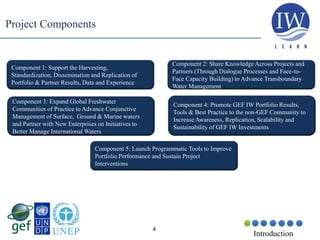
Component 1: Support the Harvesting,
Standardization, Dissemination and Replication of
Portfolio & Partner Results, Data and Experience
Project Components
Component 2: Share Knowledge Across Projects and
Partners (Through Dialogue Processes and Face-to-
Face Capacity Building) to Advance Transboundary
Water Management
Component 3: Expand Global Freshwater
Communities of Practice to Advance Conjunctive
Management of Surface, Ground & Marine waters
and Partner with New Enterprises on Initiatives to
Better Manage International Waters
Component 4: Promote GEF IW Portfolio Results,
Tools & Best Practice to the non-GEF Community to
Increase Awareness, Replication, Scalability and
Sustainability of GEF IW Investments
Introduction
Component 5: Launch Programmatic Tools to Improve
Portfolio Performance and Sustain Project
Interventions
5
Outcome 1
Component 1: Support the Harvesting, Standardization, Dissemination and
Replication of Portfolio & Partner Results, Data and Experience
Description: a spatially-based reporting system—to be based on instantaneous direct project
inputs along the indicators of the GEF IW tracking tool as well as metric-based performance
assessment tools pioneered by the GEF Transboundary Waters Assessment Programme to
measure the state of international waters as well as project progress and basin scorecards
Upgraded portfolio visualization tool
6
Outcome 1
Description: dynamic and topical/thematic navigation system (among other improvements).
expanding the IW:LEARN website through linkage with partners’ online knowledge platforms
and serving as an information exchange for beneficiaries to access services from the global
learning partnership.
Improved IW:LEARN.net Website
Component 1: Support the Harvesting, Standardization, Dissemination and
Replication of Portfolio & Partner Results, Data and Experience
9
Outcome 1
Description: ICT trainings on applying cost-effective & state-of-the-art technologies to
improve the management of information by GEF projects
Information & Communication Training (ICT)
Component 1: Support the Harvesting, Standardization, Dissemination and
Replication of Portfolio & Partner Results, Data and Experience
10
Outcome 2
Component 2 Share Knowledge Across Projects and Partners (Through Dialogue
Processes and Face-to-Face Capacity Building) to Advance Transboundary Water
Management
Project-Project Twinning Exchanges
Description: twinning between projects on a more programmatic and long-term basis
11
Outcome 2
GEF International Waters Conference
Description: 8th and 9th GEF Biennial International Waters Conferences as key vehicle to
promote face-to-face portfolio learning
Component 2 Share Knowledge Across Projects and Partners (Through Dialogue
Processes and Face-to-Face Capacity Building) to Advance Transboundary Water
Management
12
Outcome 2
Regional/Global Targeted Training
Description: regional and global training, through workshops, on specific topics such as, inter alia,
groundwater modeling, legal frameworks for transboundary cooperation, gender mainstreaming, economic
valuation (with Component 5) and mainstreaming climatic variability & change. Workshops will be
undertaken in collaboration with the LME governance project, with the support of partners in the Global
Network.
Component 2 Share Knowledge Across Projects and Partners (Through Dialogue
Processes and Face-to-Face Capacity Building) to Advance Transboundary Water
Management
13
Outcome 3
Regional dialogue processes
Description: facilitate the replication of the trust- and consensus-building regional dialogue
model, known as the Athens-Petersberg Process, to promote transboundary cooperation in
various regions. The tested approach includes trust and confidence building measures, deployed
as such through policy roundtables, capacity-building workshops and written assessments.
Component 2 Share Knowledge Across Projects and Partners (Through Dialogue
Processes and Face-to-Face Capacity Building) to Advance Transboundary Water
Management
14
Global Freshwater Communities of Practice
Description: facilitated face-to-face exchanges among particular subsets of projects, especially
ecosystem sub-sets, with a particular focus on integrating freshwater projects to advance
conjunctive management, particularly with groundwater resources.
Activities may include things like integration dialogues, webinars, video lectures, specific
technical support to projects, training material (in conjunction with Components 2 and 5), peer-
to-peer assistance (in conjunction with Component 2 project twinning), ecosystem-specific
programmatic support though guidance materials and face-to-face exchanges.
Component 3 Expand Global Freshwater Communities of Practice to Advance
Conjunctive Management of Surface, Ground & Marine waters and Partner with
New Enterprises on Initiatives to Better Manage International Waters
15
Outcome 3
Private sector engagement
Description: Activities in this area will include trainings on water stewardship and risk tools,
dialogues on business participation in water resource management and multi-stakeholder basin
funds. Activities will be designed to engage local and national officials, as well as the private
sector. Such activities mean this component is specifically targeted at reaching beyond the
GEF IW portfolio, to build partnerships with other actors in the water sector, as well as
specifically with joint management bodies like transboundary commissions, with an aim to
support global scale-up of GEF IW investments through various knowledge management
approaches.
Component 3 Expand Global Freshwater Communities of Practice to Advance
Conjunctive Management of Surface, Ground & Marine waters and Partner with
New Enterprises on Initiatives to Better Manage International Waters
16
Outcome 3
Support for Participation in key global events
Description: supporting participation in key global dialogue processes as an organizing partner,
mostly of side events—and in supporting GEF IW project participation—at large international
IW events to promote the IW portfolio and obtain tools and ideas to enhance its knowledge
management activities.
Description: act as a co-organizer of large international events centered on water management
(both fresh and marine), as well as relevant private sector events in the water sector, some
events might include Stockholm Water Week or International Marine Conservation Congress
(IMCC)
Component 4 Promote GEF IW Portfolio Results, Tools & Best Practice to the non-
GEF Community to Increase Awareness, Replication, Scalability and Sustainability
of GEF IW Investments
17
Outcome 1
Description: GEF IW Box (akin to the Danube Box), aimed at wider communities,
containing pertinent information and guidance on the portfolio, its results, its processes
International Waters Awareness Raising Kit
Component 4 Promote GEF IW Portfolio Results, Tools & Best Practice to the non-
GEF Community to Increase Awareness, Replication, Scalability and Sustainability
of GEF IW Investments
19 Outcome 4
Economic Valuation
Description: Integrate economic valuation of natural resources into the TDA-SAP guidance and
other processes to enhance advocacy for proposed SAP reforms to senior government decision-
makers as well as the private sector.
Component 5 Launch Programmatic Tools to Improve Portfolio Performance and
Sustain Project Interventions
20 Outcome 4
Community-level SAP Engagement
Description: guidance on the translation of SAPs into local actions as well as how to link
community-level actions with regional governance processes and facilitate the scale-up of
identified community-based management models to support the coming generation of SAP
implementation-phase projects.
Component 5 Launch Programmatic Tools to Improve Portfolio Performance and
Sustain Project Interventions
21
Support to SAP Implementation
Description: how well the governance measures in these SAPs have worked, good SAP
practices need to be shared and SAP use scaled up for greater governance impact in the IW
portfolio. This activity aims to improve the quality of SAPs by ensuring they are focused on
actions that can be realistically implemented thru new guidance. The activity will also improve
the existing methodology in terms of uptaking results from the Transboundary Waters
Assessment Program recommendations, specific guidance on ecosystem-specific
considerations in the process as well as improvements in the area of gender mainstreaming.
Component 5 Launch Programmatic Tools to Improve Portfolio Performance and
Sustain Project Interventions
22 Outcome 4
Online thematic training course
Description: This activity may include the creation of short , interactive training courses on
topics like economic valuation/payment for ecosystem services, stakeholder engagement,
mainstreaming climatic change and variability, governance, communications and outreach, and
data and information management as possible topics.
Component 5 Launch Programmatic Tools to Improve Portfolio Performance and
Sustain Project Interventions

IWLEARN4 Activities

  • 1.
    GEF International Waters LearningExchange and Resource Network Mish Hamid Kingtston, Jamaica 23 April 2014 IW:LEARN4 Activities
  • 2.
    2 Introduction IW:LEARN4 GEF International Waters:LearningExchange And Resources Network (IW:LEARN) Project Objective: To strengthen knowledge management capacity and promote scaled-up learning of disseminated experiences, tools and methodologies for transboundary waters management—across and beyond the GEF IW portfolio, together with a global network of partners—in order to improve the effectiveness of GEF IW and partner projects to deliver tangible results and scaled-up investments. 2014-2018, $4.9M
  • 3.
    3 • Conservation International •Global Water Partnership • Int. Commission for the Protection of the Danube River • International River Foundation • International Union for the Conservation of Nature • The Nature Conservancy • UN Economic Commission for Europe • UNESCO-International Hydrological Program • UN Industrial Development Organization • UN University – Institute for Water, Environment & Health • World Wildlife Fund Scaled-up Partnerships
  • 4.
    4 Component 1: Supportthe Harvesting, Standardization, Dissemination and Replication of Portfolio & Partner Results, Data and Experience Project Components Component 2: Share Knowledge Across Projects and Partners (Through Dialogue Processes and Face-to- Face Capacity Building) to Advance Transboundary Water Management Component 3: Expand Global Freshwater Communities of Practice to Advance Conjunctive Management of Surface, Ground & Marine waters and Partner with New Enterprises on Initiatives to Better Manage International Waters Component 4: Promote GEF IW Portfolio Results, Tools & Best Practice to the non-GEF Community to Increase Awareness, Replication, Scalability and Sustainability of GEF IW Investments Introduction Component 5: Launch Programmatic Tools to Improve Portfolio Performance and Sustain Project Interventions
  • 5.
    5 Outcome 1 Component 1:Support the Harvesting, Standardization, Dissemination and Replication of Portfolio & Partner Results, Data and Experience Description: a spatially-based reporting system—to be based on instantaneous direct project inputs along the indicators of the GEF IW tracking tool as well as metric-based performance assessment tools pioneered by the GEF Transboundary Waters Assessment Programme to measure the state of international waters as well as project progress and basin scorecards Upgraded portfolio visualization tool
  • 6.
    6 Outcome 1 Description: dynamicand topical/thematic navigation system (among other improvements). expanding the IW:LEARN website through linkage with partners’ online knowledge platforms and serving as an information exchange for beneficiaries to access services from the global learning partnership. Improved IW:LEARN.net Website Component 1: Support the Harvesting, Standardization, Dissemination and Replication of Portfolio & Partner Results, Data and Experience
  • 7.
    9 Outcome 1 Description: ICTtrainings on applying cost-effective & state-of-the-art technologies to improve the management of information by GEF projects Information & Communication Training (ICT) Component 1: Support the Harvesting, Standardization, Dissemination and Replication of Portfolio & Partner Results, Data and Experience
  • 8.
    10 Outcome 2 Component 2Share Knowledge Across Projects and Partners (Through Dialogue Processes and Face-to-Face Capacity Building) to Advance Transboundary Water Management Project-Project Twinning Exchanges Description: twinning between projects on a more programmatic and long-term basis
  • 9.
    11 Outcome 2 GEF InternationalWaters Conference Description: 8th and 9th GEF Biennial International Waters Conferences as key vehicle to promote face-to-face portfolio learning Component 2 Share Knowledge Across Projects and Partners (Through Dialogue Processes and Face-to-Face Capacity Building) to Advance Transboundary Water Management
  • 10.
    12 Outcome 2 Regional/Global TargetedTraining Description: regional and global training, through workshops, on specific topics such as, inter alia, groundwater modeling, legal frameworks for transboundary cooperation, gender mainstreaming, economic valuation (with Component 5) and mainstreaming climatic variability & change. Workshops will be undertaken in collaboration with the LME governance project, with the support of partners in the Global Network. Component 2 Share Knowledge Across Projects and Partners (Through Dialogue Processes and Face-to-Face Capacity Building) to Advance Transboundary Water Management
  • 11.
    13 Outcome 3 Regional dialogueprocesses Description: facilitate the replication of the trust- and consensus-building regional dialogue model, known as the Athens-Petersberg Process, to promote transboundary cooperation in various regions. The tested approach includes trust and confidence building measures, deployed as such through policy roundtables, capacity-building workshops and written assessments. Component 2 Share Knowledge Across Projects and Partners (Through Dialogue Processes and Face-to-Face Capacity Building) to Advance Transboundary Water Management
  • 12.
    14 Global Freshwater Communitiesof Practice Description: facilitated face-to-face exchanges among particular subsets of projects, especially ecosystem sub-sets, with a particular focus on integrating freshwater projects to advance conjunctive management, particularly with groundwater resources. Activities may include things like integration dialogues, webinars, video lectures, specific technical support to projects, training material (in conjunction with Components 2 and 5), peer- to-peer assistance (in conjunction with Component 2 project twinning), ecosystem-specific programmatic support though guidance materials and face-to-face exchanges. Component 3 Expand Global Freshwater Communities of Practice to Advance Conjunctive Management of Surface, Ground & Marine waters and Partner with New Enterprises on Initiatives to Better Manage International Waters
  • 13.
    15 Outcome 3 Private sectorengagement Description: Activities in this area will include trainings on water stewardship and risk tools, dialogues on business participation in water resource management and multi-stakeholder basin funds. Activities will be designed to engage local and national officials, as well as the private sector. Such activities mean this component is specifically targeted at reaching beyond the GEF IW portfolio, to build partnerships with other actors in the water sector, as well as specifically with joint management bodies like transboundary commissions, with an aim to support global scale-up of GEF IW investments through various knowledge management approaches. Component 3 Expand Global Freshwater Communities of Practice to Advance Conjunctive Management of Surface, Ground & Marine waters and Partner with New Enterprises on Initiatives to Better Manage International Waters
  • 14.
    16 Outcome 3 Support forParticipation in key global events Description: supporting participation in key global dialogue processes as an organizing partner, mostly of side events—and in supporting GEF IW project participation—at large international IW events to promote the IW portfolio and obtain tools and ideas to enhance its knowledge management activities. Description: act as a co-organizer of large international events centered on water management (both fresh and marine), as well as relevant private sector events in the water sector, some events might include Stockholm Water Week or International Marine Conservation Congress (IMCC) Component 4 Promote GEF IW Portfolio Results, Tools & Best Practice to the non- GEF Community to Increase Awareness, Replication, Scalability and Sustainability of GEF IW Investments
  • 15.
    17 Outcome 1 Description: GEFIW Box (akin to the Danube Box), aimed at wider communities, containing pertinent information and guidance on the portfolio, its results, its processes International Waters Awareness Raising Kit Component 4 Promote GEF IW Portfolio Results, Tools & Best Practice to the non- GEF Community to Increase Awareness, Replication, Scalability and Sustainability of GEF IW Investments
  • 16.
    19 Outcome 4 EconomicValuation Description: Integrate economic valuation of natural resources into the TDA-SAP guidance and other processes to enhance advocacy for proposed SAP reforms to senior government decision- makers as well as the private sector. Component 5 Launch Programmatic Tools to Improve Portfolio Performance and Sustain Project Interventions
  • 17.
    20 Outcome 4 Community-levelSAP Engagement Description: guidance on the translation of SAPs into local actions as well as how to link community-level actions with regional governance processes and facilitate the scale-up of identified community-based management models to support the coming generation of SAP implementation-phase projects. Component 5 Launch Programmatic Tools to Improve Portfolio Performance and Sustain Project Interventions
  • 18.
    21 Support to SAPImplementation Description: how well the governance measures in these SAPs have worked, good SAP practices need to be shared and SAP use scaled up for greater governance impact in the IW portfolio. This activity aims to improve the quality of SAPs by ensuring they are focused on actions that can be realistically implemented thru new guidance. The activity will also improve the existing methodology in terms of uptaking results from the Transboundary Waters Assessment Program recommendations, specific guidance on ecosystem-specific considerations in the process as well as improvements in the area of gender mainstreaming. Component 5 Launch Programmatic Tools to Improve Portfolio Performance and Sustain Project Interventions
  • 19.
    22 Outcome 4 Onlinethematic training course Description: This activity may include the creation of short , interactive training courses on topics like economic valuation/payment for ecosystem services, stakeholder engagement, mainstreaming climatic change and variability, governance, communications and outreach, and data and information management as possible topics. Component 5 Launch Programmatic Tools to Improve Portfolio Performance and Sustain Project Interventions