SJRA’s GRP Program -
Implementing Conjunctive
Use in Montgomery County
June, 2016
Jace A. Houston, General Manager
San Jacinto River Authority
• Created in 1937; seven member board
appointed by the Governor
• Primary purpose – Long-term, regional
water resource planning and
development
• Secondary benefit – Partnering with
local entities on water-related projects
or services (such as regional water and
wastewater systems, dam and
drainage system maintenance, and
development of new drinking water
supplies)
Groundwater Reduction Plan
Why the GRP program?
• Montgomery County has a water supply problem.
• Regulations were adopted to force utilities to find a solution.
• SJRA offered a “regional” solution that proposed conjunctive use
of surface water from Lake Conroe.
• SJRA’s proposal was made available to all regulated utilities in the
county on a cost-equal basis regardless of their location.
• 85 entities chose to join representing 80% of county demand.
2015 204520352025 20602055
Regulated
Groundwater
Available
City of
Conroe
The
Woodlands
Lake
Conroe
Montgomery
County
GRP
Participants
City of
Willis
City of
Magnolia
City of Oak
Ridge North
Harris
County
58.3
127.5
37.5
57.9
34.3
53.5
27.8
33.0
43.6
37.5
0.00
20.00
40.00
60.00
80.00
100.00
120.00
140.00
2015
2020
2025
2030
2035
2040
2045
TotalGRPWaterDemand(mgd)
Surface Water Delivered (mgd) Estimated Groundwater Pumpage (mgd)
Total GRP Participant Demand 70% of TQD: 37.5 mgd
GRP Participants Projected Water Demand
GRP Phase 1 Program
• 30 mgd Surface Water Treatment Plant
• 52-mile water transmission system
• Modifications to customer facilities to deliver treated
surface water to six participants at 17 receiving
facilities for blending in existing ground storage tanks
• Total cost = $490,000,000
• Largest civil works project in Montgomery County ever
• Highly visible project to public and elected officials
• Nearly invisible problem being solved by the project
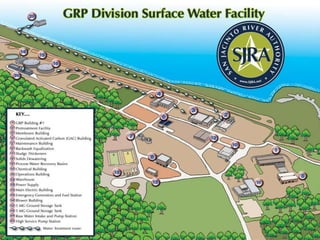
Raw Water Intake and Pump Station
Facility # 20
Pretreatment Facility
Facility #2
Membrane Building
Facility #3
Granulated Activated Carbon Building
Facility #4
High Service Pump Station
Facility #30
Transmission Pipeline System
• 277,000 linear feet of pipe
• 60” – 12” diameter
• 163 shutoff valves
• 115 flushing valves
• 459 access manholes
• 1 standpipe
• 17 water receiving facilities
STRATEGIES AND LESSONS LEARNED
Construction Communications Plan
• Know your goals
• Know your key message points
• Know your audiences
• Have communications strategies for each
audience
• Start well in advance
Customer Review Committee
• Six members representing various customer
groups
• Meet monthly to review . . . everything!
• Appointed by customers:
– Woodlands JPA
– City of Conroe
– Cities other than Conroe
– MUDs west of I-45
– MUDs east of I-45
– Lone Star Groundwater Conservation District
Reporting for Transparency
Staffing PlanResources
Pre-Program
Time
PostProgram
SJRA Staff
Consultants
and
Contractors
Vendor Selection / Project Delivery
• Changed from low bid to competitive sealed
proposals
• Used Construction-Manager-At-Risk for plant
• Conducted outreach to engage local vendors
and contractors
• Educated ourselves!
• Educated our Board!
THANK YOU!

Houston, SJRA's GRP Program

Editor's Notes

  • #5 The goal of the SJRA’s proposed GRP is to create a countywide solution that is available for ALL LVGUs in the county. In other words, a plan that allows us ALL to achieve compliance with the LSGCD’s rules. The Lone Star’s rules specifically allow LVGUs to join together to form a regional solution. Any LVGU that chooses to join the SJRA’s plan would be considered in compliance with the LSGCD’s groundwater reduction requirements. This group approach to compliance is the key to creating the LOWEST POSSIBLE COST for all water users in the county.
  • #7 This chart illustrates our strategy for meeting the regulatory requirements by expanding surface water capacity and reducing groundwater use at ten year intervals. New growth will be allowed to use groundwater as long as the average over the milestone years is <37.5 mgd. Future expansions will be built to supply more surface water as the water demand grows.
  • #8 The goal of the SJRA’s proposed GRP is to create a countywide solution that is available for ALL LVGUs in the county. In other words, a plan that allows us ALL to achieve compliance with the LSGCD’s rules. The Lone Star’s rules specifically allow LVGUs to join together to form a regional solution. Any LVGU that chooses to join the SJRA’s plan would be considered in compliance with the LSGCD’s groundwater reduction requirements. This group approach to compliance is the key to creating the LOWEST POSSIBLE COST for all water users in the county.
  • #18 The LVGUs have a panel of representatives that watch over the SJRA’s implementation and management of the GRP. This group is called the GRP Review Committee. There is a representative appointed by the City of Conroe, The Woodlands Joint Powers Agency, and one appointed by the LSGCD to represent investor owned utilities. In addition, there are three members elected by the LVGUs to represent other cities, MUDs east of I-45 and MUDs west of I-45. The Review Committee meets monthly and votes to recommend approval of budgets, contracts, rates, policies and the admission of new members to the GRP. Mike Mooney – JPA representing The Woodlands Joint Powers Agency Scott Taylor – Conroe representing the City of Conroe Joe Sherwin – City of Oak Ridge North representing small cities Kerry Masson – Southern Montgomery County MUD representing MUDs east of I45 Jackie Chance – WCID -1 representing MUDs west of I45 Richard Wagner – Appointed by LSGCD representing investor owned utilities