NISO Thought Leaders on
eLearning and Course
Management Systems
October Ivins, MLS
october.ivins@mindspring.com
January 25, 2009
Overview
 Goals
 Participants
 Process
 Topics
 Recommendations
 Next steps
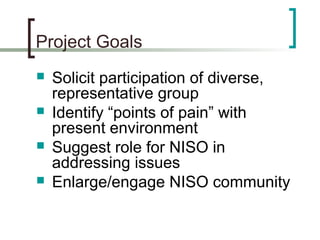
Project Goals
 Solicit participation of diverse,
representative group
 Identify “points of pain” with
present environment
 Suggest role for NISO in
addressing issues
 Enlarge/engage NISO community
Participants 1
 Rob Abel IMS Global Learning
Consortium
 Bryan Alexander NITLE
 Tracey Armstrong CCC
 Roddy Austin NYU Libraries
 John Harwood Penn State
 John L. King University of Michigan
and SAKAI
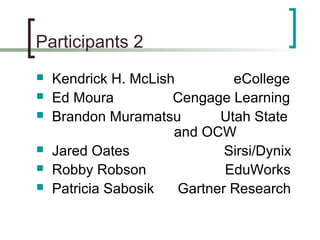
Participants 2
 Kendrick H. McLish eCollege
 Ed Moura Cengage Learning
 Brandon Muramatsu Utah State
and OCW
 Jared Oates Sirsi/Dynix
 Robby Robson EduWorks
 Patricia Sabosik Gartner Research
Participants 3
 Joel Thierstein Connexions and
Rice University
 Beth Forrest Warner University of
Kansas
by email
 Mark E. Belles Blackboard, Inc.
 Julian Clayton John Wiley and Sons
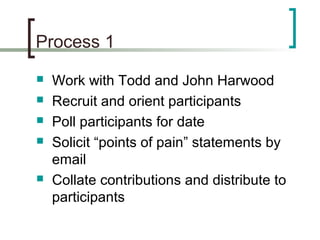
Process 1
 Work with Todd and John Harwood
 Recruit and orient participants
 Poll participants for date
 Solicit “points of pain” statements by
email
 Collate contributions and distribute to
participants
Process 2
 Start with orientation/social dinner
 All day meeting
 Morning- full group discussion
 Afternoon- divide into two groups
 Last hour- report out
 Analyse results
 Prepare report
Topics- Points of Pain
 Interoperability
 Authentication and Privacy
 Usage
 Assessment
Recommendations-
Technical Interoperability
1. Do not approach technical and content
interoperability by developing
standardization. Instead, develop
lightweight gateways that provide a
standard framework to bring together
multiple strands of metadata and content,
and software supporting different functions.
The best models to follow are OpenURL;
Google Scholar search results display.
Recommendations-
Technical Interoperability
2. Recognize that standards alone will
not be sufficient; they must be
supported with social conventions
of production or best practices.
3. Encourage solutions that move
away from unsustainable locally
developed solutions.
Recommendations –
Content interoperability
4. Users want the ability to reuse, share
and chunk information. While it is
beyond NISO’s scope to attempt to
revise or impact copyright law, NISO
could develop best practices for how
content is used within the context of
elearning systems, such as linking
rather than copying content into the
CMS.
Recommendations –
Content interoperability
5. Address concerns about trust (distrust
of the available technology,
agreements, exposure, public
relations, privacy, etc.—see page 3 of
discussion summary) by creating a
very transparent process; recruit early
adopters to text and encourage them
to share their outcomes and
experiences.
Recommendations –
Content interoperability
6. An alternative way to address trust
concerns is to explore these issues
and identify solutions in a white
paper.
7. Develop standards for content
integration from publisher/content
provider to systems vendors that
would improve access and reduce
costs.
Recommendations –
Content interoperability
8. Develop standards for the rights expression
language/semantics and its transmission.
Expand from journal/book content to
additional formats and sources of content,
including learner and instructor generated.
9. Participate in the development of
bibliographic metadata standards
(including monitoring FRBR) to support the
ready sharing of data and information.
Recommendations-
Learner/Faculty Information
10. Explore standardizing additional
types of user data: user profiles (what
they know and don’t know), length of
time connected, performance.
Recommendations-
Learner/Faculty Information
11. Prepare white paper on intra-campus
collaboration, need coordination
between faculty, library and IT as
described in University of Kansas
Environmental Model.
12. Prepare white paper on inter-campus
coordination for research, sharing of
course materials and syllabi.
Recommendations
-Authentication and Privacy
13. Create best practice guidelines for
learner, faculty privacy.
14. Explore credentialing function- will
Shibboleth support the authentication
and credentialing required for
elearning and course management
systems? If not, what else is needed
and can NISO provide it?
Recommendations-
Authentication and Privacy
15. Develop standards for user
authentication at the publisher site
rather than in the Course
Management System to eliminate the
“double charging issue” for content
providers which result in increased
costs for users and institutions.
Recommendations-
Authentication and Privacy
16. Determine the desired impact of a digital
identity—what impact it will have. This
needs to be answered before other
questions can be addressed. Work with
the PESC: Postsecondary Electronic
Standards Council (www.pesc.org).
Contact Charles Leonhardt, Principal
Technologist, Georgetown, chair of the
Inter-Organizational Task Force to
Advance Electronic Authentication and
Authorization for Higher Education.
Recommendations-
Usage and Assessment
17. Investigate the feasibility of a COUNTER
type system for elearning. What
management issues need to be
addressed? What metrics are valuable?
Would standardization among different
platform providers be useful? Would
system outputs be compared in the way
cross-publisher data is compared? Is any
cross-institutional bench-marking done?
Prepare white paper about data needs and
analysis expectations.
Recommendations-
Usage and Assessment
18. Develop a use case for a “learning
dashboard” that accommodates FERPA
restrictions. (NISO can also encourage its
members to lobby for changes to FERPA.)
19. Lead a data collection study to determine
what regional college/unit accreditation
agencies require and collect, with the goal
of making data collection easier and more
standardized.
Next Steps
 Todd Carpenter will discuss following
all three presentations
Thank you
October Ivins, MLS
october.ivins@mindspring.com

Ivins, "E-Learning Systems and Content"

  • 1.
    NISO Thought Leaderson eLearning and Course Management Systems October Ivins, MLS october.ivins@mindspring.com January 25, 2009
  • 2.
    Overview  Goals  Participants Process  Topics  Recommendations  Next steps
  • 3.
    Project Goals  Solicitparticipation of diverse, representative group  Identify “points of pain” with present environment  Suggest role for NISO in addressing issues  Enlarge/engage NISO community
  • 4.
    Participants 1  RobAbel IMS Global Learning Consortium  Bryan Alexander NITLE  Tracey Armstrong CCC  Roddy Austin NYU Libraries  John Harwood Penn State  John L. King University of Michigan and SAKAI
  • 5.
    Participants 2  KendrickH. McLish eCollege  Ed Moura Cengage Learning  Brandon Muramatsu Utah State and OCW  Jared Oates Sirsi/Dynix  Robby Robson EduWorks  Patricia Sabosik Gartner Research
  • 6.
    Participants 3  JoelThierstein Connexions and Rice University  Beth Forrest Warner University of Kansas by email  Mark E. Belles Blackboard, Inc.  Julian Clayton John Wiley and Sons
  • 7.
    Process 1  Workwith Todd and John Harwood  Recruit and orient participants  Poll participants for date  Solicit “points of pain” statements by email  Collate contributions and distribute to participants
  • 8.
    Process 2  Startwith orientation/social dinner  All day meeting  Morning- full group discussion  Afternoon- divide into two groups  Last hour- report out  Analyse results  Prepare report
  • 9.
    Topics- Points ofPain  Interoperability  Authentication and Privacy  Usage  Assessment
  • 10.
    Recommendations- Technical Interoperability 1. Donot approach technical and content interoperability by developing standardization. Instead, develop lightweight gateways that provide a standard framework to bring together multiple strands of metadata and content, and software supporting different functions. The best models to follow are OpenURL; Google Scholar search results display.
  • 11.
    Recommendations- Technical Interoperability 2. Recognizethat standards alone will not be sufficient; they must be supported with social conventions of production or best practices. 3. Encourage solutions that move away from unsustainable locally developed solutions.
  • 12.
    Recommendations – Content interoperability 4.Users want the ability to reuse, share and chunk information. While it is beyond NISO’s scope to attempt to revise or impact copyright law, NISO could develop best practices for how content is used within the context of elearning systems, such as linking rather than copying content into the CMS.
  • 13.
    Recommendations – Content interoperability 5.Address concerns about trust (distrust of the available technology, agreements, exposure, public relations, privacy, etc.—see page 3 of discussion summary) by creating a very transparent process; recruit early adopters to text and encourage them to share their outcomes and experiences.
  • 14.
    Recommendations – Content interoperability 6.An alternative way to address trust concerns is to explore these issues and identify solutions in a white paper. 7. Develop standards for content integration from publisher/content provider to systems vendors that would improve access and reduce costs.
  • 15.
    Recommendations – Content interoperability 8.Develop standards for the rights expression language/semantics and its transmission. Expand from journal/book content to additional formats and sources of content, including learner and instructor generated. 9. Participate in the development of bibliographic metadata standards (including monitoring FRBR) to support the ready sharing of data and information.
  • 16.
    Recommendations- Learner/Faculty Information 10. Explorestandardizing additional types of user data: user profiles (what they know and don’t know), length of time connected, performance.
  • 17.
    Recommendations- Learner/Faculty Information 11. Preparewhite paper on intra-campus collaboration, need coordination between faculty, library and IT as described in University of Kansas Environmental Model. 12. Prepare white paper on inter-campus coordination for research, sharing of course materials and syllabi.
  • 18.
    Recommendations -Authentication and Privacy 13.Create best practice guidelines for learner, faculty privacy. 14. Explore credentialing function- will Shibboleth support the authentication and credentialing required for elearning and course management systems? If not, what else is needed and can NISO provide it?
  • 19.
    Recommendations- Authentication and Privacy 15.Develop standards for user authentication at the publisher site rather than in the Course Management System to eliminate the “double charging issue” for content providers which result in increased costs for users and institutions.
  • 20.
    Recommendations- Authentication and Privacy 16.Determine the desired impact of a digital identity—what impact it will have. This needs to be answered before other questions can be addressed. Work with the PESC: Postsecondary Electronic Standards Council (www.pesc.org). Contact Charles Leonhardt, Principal Technologist, Georgetown, chair of the Inter-Organizational Task Force to Advance Electronic Authentication and Authorization for Higher Education.
  • 21.
    Recommendations- Usage and Assessment 17.Investigate the feasibility of a COUNTER type system for elearning. What management issues need to be addressed? What metrics are valuable? Would standardization among different platform providers be useful? Would system outputs be compared in the way cross-publisher data is compared? Is any cross-institutional bench-marking done? Prepare white paper about data needs and analysis expectations.
  • 22.
    Recommendations- Usage and Assessment 18.Develop a use case for a “learning dashboard” that accommodates FERPA restrictions. (NISO can also encourage its members to lobby for changes to FERPA.) 19. Lead a data collection study to determine what regional college/unit accreditation agencies require and collect, with the goal of making data collection easier and more standardized.
  • 23.
    Next Steps  ToddCarpenter will discuss following all three presentations
  • 24.
    Thank you October Ivins,MLS october.ivins@mindspring.com